
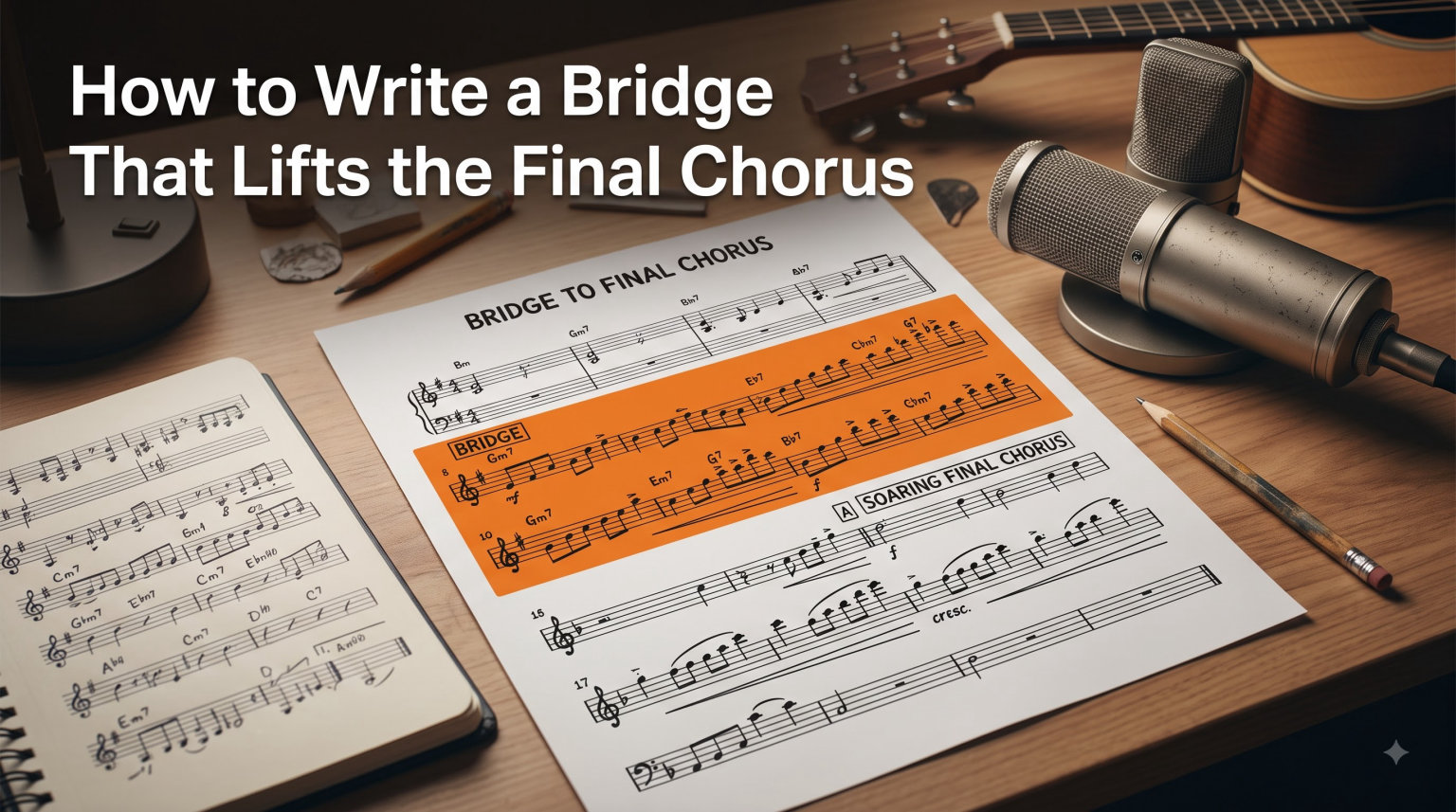
If you have ever finished a verse and a chorus and then felt completely stuck, you are not alone. I have sat at my guitar for hours trying to figure out how to write a bridge that lifts the final chorus instead of just filling space. The bridge is the most underestimated section in modern songwriting, and learning to write one well changes everything about how your songs feel.
Most songwriters can build a solid verse and a sticky chorus. The bridge is where songs win or lose their emotional ending. In this guide I will walk you through what a bridge actually is, where it sits, the contrast techniques that make it work, and the specific moves that turn a flat ending into a final chorus that hits the listener right in the chest.
Table of Contents
What Is a Bridge in a Song, and Why Does It Matter
A bridge is a contrasting section in a song that appears after a chorus, usually the second one, and leads back into a final chorus. The bridge exists to create change, add narrative depth, and most importantly to set up a payoff. The English term is bridge, but in British songwriting circles the same section is often called the middle 8 because it is typically 8 bars long and sits in the middle of the arrangement.
The bridge is not the same as a pre-chorus, post-chorus, or hook. A pre-chorus builds anticipation right before the chorus. A post-chorus is a melodic or rhythmic tag that follows the chorus. The bridge is a full section with its own lyrics, chords, and melody, and its job is to take the listener somewhere new before pulling them home.
When the bridge is written well, the final chorus feels inevitable and electric. When it is written poorly, the song limps to the end. That is why bridge writing is worth the effort, even though it is the part songwriters say they get stuck on the most.
Where the Bridge Sits in Song Structure
The bridge lives between the second chorus and the final chorus in a standard pop, rock, or country arrangement. A typical song map looks like this: intro, verse 1, pre-chorus, chorus, verse 2, pre-chorus, chorus, bridge, final chorus, outro. Some songs repeat the final chorus twice or add a tag, but the bridge itself almost always lives in that single slot.
Eight bars is the most common bridge length, which is why you hear it called a middle 8. Four bars can work in fast-tempo songs. Twelve bars give you room for a bigger emotional arc. The point is to keep it short. A bridge that overstays its welcome burns through the energy you are trying to save for the final chorus.
Not every song needs a bridge. Ballads under two minutes, three-minute punk songs, and high-energy dance tracks often skip the bridge and just hit the final chorus directly. If your chorus is already so strong that nothing improves it, leave the bridge out. Forcing one in can dilute a great arrangement.
Musical Contrast Techniques That Make the Bridge Pop
Contrast is the single most important concept in bridge writing. The bridge has to feel different enough that the listener notices they have arrived somewhere new, but related enough that the final chorus still makes sense. There are four main ways to create that contrast: chords, melody, rhythm, and texture.
Chord Progressions and Borrowed Chords
Most verses and choruses share the same diatonic chords, the seven chords that fit inside the song’s key. A great bridge breaks that pattern by borrowing chords from outside the key, modulating to a relative minor, or holding a single chord longer than expected. In the key of C major, you might shift to A minor for the bridge to pull the listener away from the home key.
A simple and reliable move is to end the bridge on the V chord, the dominant. Ending on the V creates tension that the final chorus resolves the moment it lands on the I chord. This is the harmonic engine that makes the final chorus feel lifted. The bridge withholds resolution, and the chorus pays it back.
Melody Range and Contour Changes
If your chorus melody sits high, drop the bridge melody into a lower register. If the chorus climbs, let the bridge descend. The change in contour makes the final chorus feel like a release when the melody climbs back up. Adele’s “Someone Like You” uses exactly this trick. The bridge stays in a lower, conversational range, and the final chorus opens up.
You can also reverse the melodic shape. Take the climax of your chorus, the highest note or the most important phrase, and place it at the start of the bridge instead. The listener expects a peak and gets an opening, which subtly resets their ear before the chorus returns.
Rhythmic and Tempo Shifts
Changing the rhythmic feel is one of the fastest ways to create contrast. If your verses and choruses sit on a steady quarter-note pulse, try a syncopated bridge. If everything is straight eighth notes, switch to triplet patterns. A half-time groove in the bridge, where the band plays half as fast over the same tempo, is a classic lift-builder for the final chorus.
You can also briefly drop the drums out, leave only bass and vocal, then bring the full kit back in on the final chorus. That single moment of space and re-entry is one of the most powerful tools in modern production.
Texture and Instrumentation Drops
Texture is what your ear notices before melody or harmony. A bridge that strips the arrangement down to a piano and vocal creates a quiet palette cleanser before the full band returns. Conversely, a bridge that adds a string section, layered pads, or a counter-melody makes the contrast additive rather than subtractive.
Pick the move that fits the emotion. Introspective songs usually want subtraction. Anthemic songs usually want addition. Either way, the goal is to make the final chorus sound like something the listener has not heard yet, even though it uses the same chords and melody as the earlier choruses.
Lyrical Contrast: Shifting the Story or Perspective
The bridge is your chance to say something the verses and choruses could not. In the verse you set up the story, and in the chorus you state the emotional headline. The bridge delivers the twist, the new information, or the question the rest of the song is circling around. Without that shift, the final chorus just repeats what the listener already knows.
Three reliable lyrical moves work in almost any genre. First, shift the perspective. If verses are first person and choruses are direct address, the bridge can be a memory, a letter, or a second-person confession. Second, introduce a new piece of information. The bridge is where the narrator finally admits the thing they have been avoiding. Third, ask a question the chorus answers.
Olivia Rodrigo’s “drivers license” uses the bridge to admit the unsaid thing: the narrator still loves the person, even though she tried to convince herself otherwise. That single bridge line reframes every chorus the listener has already heard. That is the lift.
How to Set Up the Final Chorus Lift
The lift is what the bridge is actually for. Everything in the bridge should be in service of making the final chorus land harder than the first two. There are five specific techniques that almost every hit song uses to create that lift, and you can combine them in any order.
- End the bridge on the V chord. The V chord is the dominant. Holding it for one extra beat or a full bar creates the strongest possible pull back to the I chord when the final chorus begins.
- Cut the instrumentation right before the chorus. Stop the band, leave a vocal or a sustained note, and let the silence do the work. The return of the full band on beat one of the final chorus is the moment listeners physically react.
- Add a vocal run or harmony on the downbeat. Singers can hit a higher note, add an octave jump, or layer a harmony on the first word of the final chorus. Anything that makes the entry feel bigger helps.
- Modulate up a half step or whole step. Moving the entire song up a step for the final chorus is one of the oldest tricks in pop. Use it sparingly, but when the emotion of the bridge calls for it, this move is undeniable.
- Slow the rhythmic feel into the chorus, then push forward. A half-time bridge that snaps back to double-time on the first beat of the final chorus creates a rush of momentum the listener feels in their body.
The lift is not about volume. It is about contrast and release. Quiet can lift just as hard as loud if the song is structured to make that quiet feel earned. The bridge earns the final chorus by changing the game right before the chorus takes it back.
Step-by-Step Process for Writing a Bridge
Here is the workflow I use when I coach songwriters through a bridge. These steps come from years of sitting in rooms with writers who were stuck, and they line up with the techniques that working pros reach for first.
- Listen to the final chorus before writing the bridge. Hum or play the final chorus. The bridge has to lead into that exact moment, so build backward from the destination.
- Decide the emotional turn. Pick one feeling, one question, or one new piece of information the bridge delivers. Write that down in a single sentence. The sentence becomes your north star.
- Choose your contrast weapon. Pick one main technique. Usually it is a chord change, a register shift, or a texture drop. Do not try to use all four at once.
- Sketch chords that end on the V. Hum the lyric line over a chord progression. Make sure the last chord of the bridge is the V chord of the home key, so the final chorus lands with resolution.
- Write 4 to 8 lines of lyric. Aim for half the line count of your chorus. Brevity keeps the bridge tight and reserves energy for the chorus that follows.
- Sing the bridge and walk into the chorus. Play the last chord of the bridge, then immediately start the first chord of the final chorus. The transition should feel inevitable. If it feels forced, adjust the bridge’s last note or chord.
- Re-record the demo and listen back. Bridges that feel perfect in the room often feel long on playback. Cut any line that does not earn its place.
- Test the lift. Play the song for one person and watch their body when the final chorus hits. If they physically react, the bridge worked. If they nod along, the bridge needs more contrast.
Common Bridge Mistakes to Avoid
After working with hundreds of songwriters, I see the same bridge problems come up again and again. Knowing them ahead of time saves you hours of frustration.
Writing the bridge as verse 2.5. The most common mistake is making the bridge sound like another verse. The same chords, the same melody range, the same rhythmic feel. The bridge has to feel like a departure. If a listener cannot tell when the bridge has started, the contrast is missing.
Letting the bridge overstay its welcome. A 16-bar bridge in a 3-minute pop song drains the energy you are trying to save. Stick to 4, 8, or 12 bars. If you have more material than that, save it for the final chorus extension or the outro.
Writing a bridge that does not connect to the chorus. The bridge has to set up the final chorus, not exist next to it. If the chord or note you end on does not pull naturally into the chorus, the lift will not work. Always test the transition before you commit.
Adding new musical ideas that have no payoff. A key change in the bridge that the chorus does not answer is just showing off. Every contrast move in the bridge should pay off in the final chorus. If you shift to a new key, the chorus should resolve it. If you drop to a single instrument, the chorus should bring everything back.
Forcing a bridge when the song does not need one. Some songs are stronger without a bridge. A tight two-minute pop track with a killer chorus often does more work without an extra section. Trust the song. If the bridge feels like filler, cut it.
Frequently Asked Questions About Song Bridges
What is a bridge in a song?
A bridge is a contrasting section, usually 8 bars long, that appears after the second chorus and leads into the final chorus. Its job is to create change in lyrics, chords, melody, or texture so the final chorus hits harder.
How do you write a catchy bridge?
Start with one strong emotional turn in the lyric. Change at least one musical element, such as chords, melody range, rhythm, or texture. End the bridge on the V chord so the final chorus has a strong harmonic pull back home.
What do you call a bridge at the end of a song?
A bridge at the end of a song is still called a bridge, often called the middle 8 because of its typical 8-bar length. The section that follows the bridge is the final chorus, sometimes followed by a tag or outro.
How long should a bridge be?
Most bridges are 8 bars, which is why the section is sometimes called a middle 8. Four bars works in fast songs, and 12 bars works for slower ballads. Anything beyond 16 bars usually drains energy from the final chorus.
What is the final bridge of a song?
The final bridge is the bridge that appears immediately before the final chorus. It is the only bridge in most pop, rock, and country songs, and its job is to create contrast and lift the final chorus into the song’s emotional peak.
Does every song need a bridge?
No. Not every song needs a bridge. Short, high-energy songs often skip the bridge and go straight into the final chorus. If your chorus is already at its peak, a bridge can weaken the arrangement instead of strengthening it.
Final Thoughts on Writing a Bridge That Lifts the Final Chorus
The bridge is not an extra section. It is the hinge that determines how your song ends. Every decision in the bridge, from the chords to the lyric to the silence before the chorus, exists to make the final chorus the emotional peak of the song. Once you understand that the bridge is a setup, not a filler, the writing gets easier.
Pick one technique from this guide, write a bridge into your next song, and test the lift on a friend. If their body reacts, you have it. If they nod politely, change one contrast element and try again. That feedback loop is the fastest way to learn how to write a bridge that lifts the final chorus, and it is the same loop every working songwriter uses.