

Most game rooms are finished in one afternoon and then argued about for years. The dartboard is the piece nobody notices until it is wrong: hung too high, drilled into drywall with no stud behind it, or bought as a bargain sisal panel that dulls every throw. Choosing among the best dart boards for home game rooms comes down to four things — who is throwing, steel tip or soft tip, what the wall looks like, and whether the wall stays visible when you play.
Our answer up front: for most homes the right board is a regulation self-healing sisal board in the 17.75 to 18 inch class, mounted at the official measurements, inside a cabinet or surround so the drywall stops collecting holes. That is the configuration regular players recognise, and it is the one that still looks right five years later.
We spent six weeks with 12 boards: bare steel-tip sisal panels, two full cabinet sets, one ultra-thin hideaway cabinet, and four electronic soft-tip models ranging from a battery-powered 15 inch starter unit to an app-connected board with online play. Each section below covers what the box contains, who it suits, and who should keep scrolling.
One note on the room itself. A dartboard is a sound source as much as a game, and the throw line eats floor space whether or not you notice. If you are also planning audio for the same space, our guide to the best home jukeboxes for game rooms covers the sizing questions that come up alongside board placement.
Table of Contents
Top 3 Dartboard Picks for a Home Game Room in October
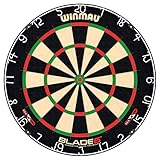
Winmau Blade 6 Bristle Board
- Tournament-spec sisal
- Ultra-thin wiring
- Staple-free bullseye
- Rota-Lock bracket


Viper Shot King Sisal Board
- 17.75 inch sisal face
- Rotating number ring
- Darts and hardware in box
The Blade 6 is the one we would build a room around. It carries the highest rating in this group alongside the Diamond Plus, and it has the review volume to match, with more than ten thousand ratings averaging 4.8.
The Diamond Plus is the same idea taken further on wire geometry, which is why it appeals to players who already know how they like a board to sound and settle.
The Viper Shot King is the starter package: regulation sisal face, staple-free bullseye and a rotating number ring, with darts, throw line, tape and hardware in the same carton.
Best Dart Boards for Home Game Rooms in 2026
| Product | Specs | Action |
|---|---|---|
| Winmau Blade 6 Bristle Dartboard |
|
Check Latest Price |
| Winmau Diamond Plus Dartboard |
|
Check Latest Price |
| Viper Shot King Sisal Dartboard |
|
Check Latest Price |
 EastPoint Belmont Cabinet Set EastPoint Belmont Cabinet Set |
|
Check Latest Price |
 Viper League Pro Sisal Set Viper League Pro Sisal Set |
|
Check Latest Price |
 Winmau Pro SFB Bristle Dartboard Winmau Pro SFB Bristle Dartboard |
|
Check Latest Price |
 Viper Hideaway Cabinet Set Viper Hideaway Cabinet Set |
|
Check Latest Price |
 Franklin Sports Electronic Board Franklin Sports Electronic Board |
|
Check Latest Price |
 Fat Cat Mercury Electronic Board Fat Cat Mercury Electronic Board |
|
Check Latest Price |
 Arachnid CricketMaxx 1.0 Arachnid CricketMaxx 1.0 |
|
Check Latest Price |
 Arachnid Cricket Pro 450 Arachnid Cricket Pro 450 |
|
Check Latest Price |
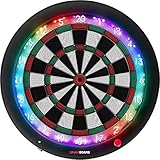 GranBoard 3s Bluetooth Board GranBoard 3s Bluetooth Board |
|
Check Latest Price |
Read the table as a map rather than a ranking. Five of the twelve are bare steel-tip sisal boards, two are steel-tip cabinet sets, and five are electronic soft-tip systems. The first group is for players who want the real thing, the second is for rooms where the wall matters, and the third is for households where a plastic tip hitting a wall is the responsible choice.
Which Type of Dartboard Does Your Game Room Actually Need?
Four board types cover almost every home, and picking the wrong one is the expensive mistake. A bristle board is built from compressed self-healing sisal fibers: the fibers part when a dart enters and close when it pulls out, so the scoring surface stays flat over years. Steel-tip boards use this design because it is the standard in leagues and pubs.
An electronic board swaps the sisal for a molded plastic segment matrix with sensors behind each segment. Soft plastic-tipped darts land in holes, the board reads the hit, and it scores for you. No chalk, no counting, and no bounce-outs, at the cost of some of the feel and sound that regular players care about.
A cabinet set is not a separate type of board so much as a packaging decision. You still get a sisal board, but it arrives inside a wooden surround that protects the wall, hides wiring and gives you somewhere to keep darts and a scoring surface on the doors.
The fourth type — magnetic and paper boards — is the kids’ and novelty category. It is worth buying for a playroom or a first birthday, not for a game room where adults intend to play every week. Pick bristle for steel-tip, pick electronic for soft-tip and mixed ages, and pick a cabinet when the wall behind the board is finished and visible.
1. Winmau Blade 6 Bristle Dartboard — The Board We Would Build a Room Around
WINMAU Blade 6 Single Core Dartboard – Tournament Specification Board
Self-healing sisal board
Ultra-thin wiring
Staple-free bullseye
Rota-Lock bracket
Pros
- Tournament-specification build
- Very low bounce-outs
- Laser-cut number ring spreads wear
- Rota-Lock leveling system
Cons
- Board only
- darts sold separately
- Heavier board needs solid anchoring
- Higher tier than entry boards
The Winmau Blade 6 is the best dartboard for a home game room because it is the board most players will recognise as correct. It is built to professional tournament specifications, and the difference shows up in the places that decide how a game feels: the wire is thin, the bullseye is staple-free, and the sisal is dense enough to close up behind itself.
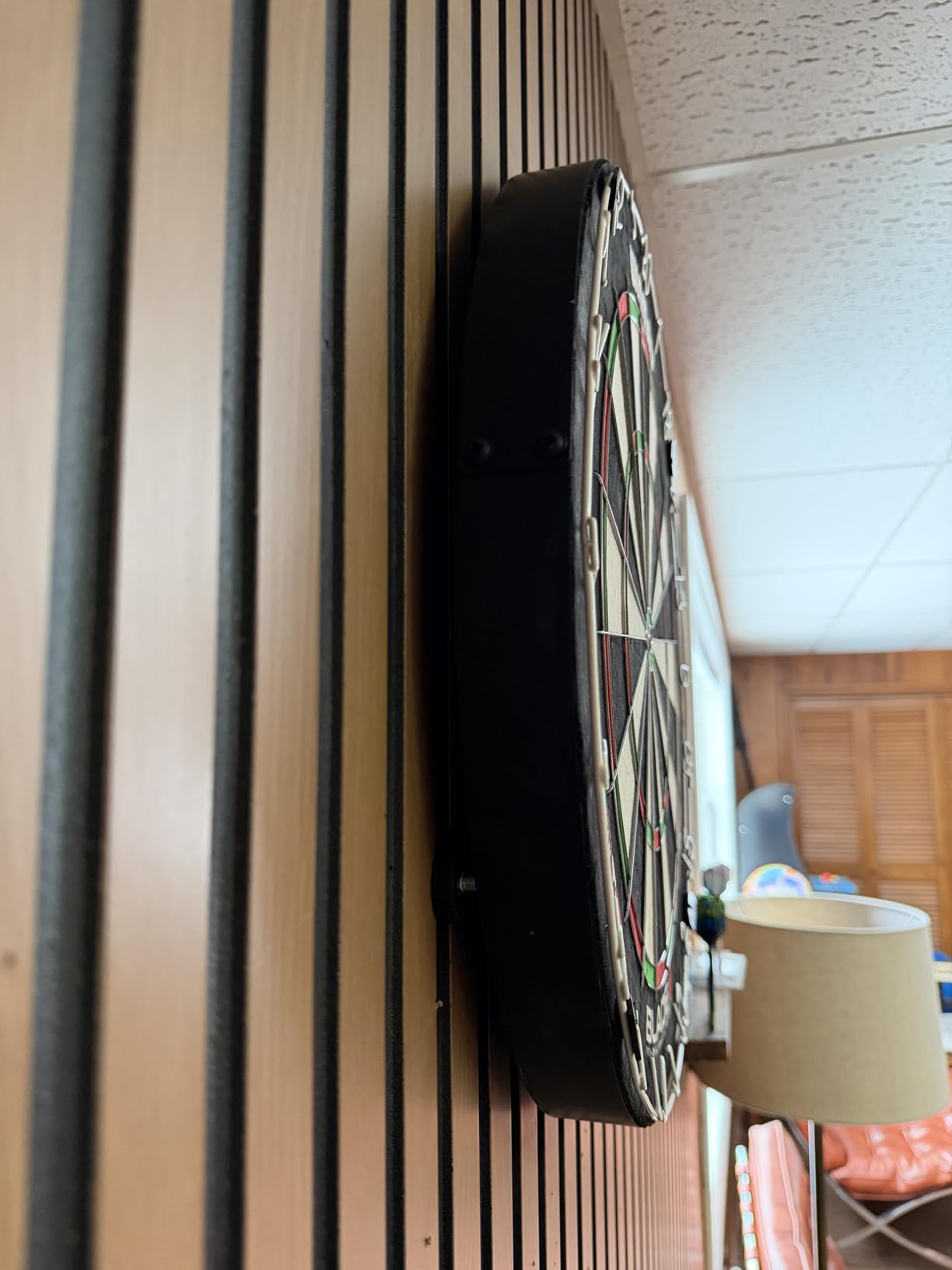
What is in the box is a board, and only a board. At 19 inches wide with a 2 inch depth and a listed weight of 5 kg, this is a substantial object to hang, and it wants a bracket fixed into something solid. The Rota-Lock leveling system and the supplied Spirit Master level are the reason it ends up square instead of the usual slightly-off mount that wrecks a night’s grouping.
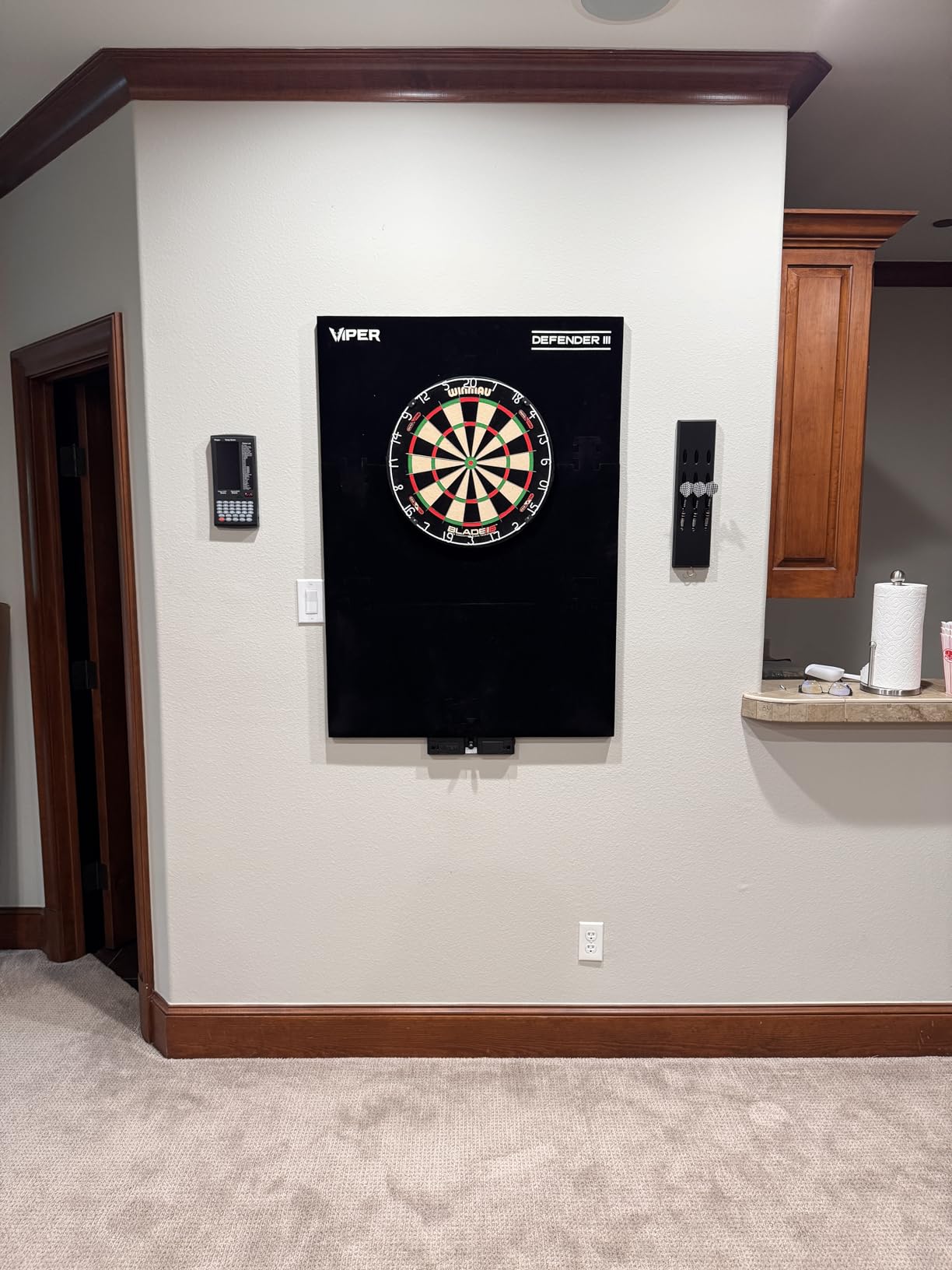
The laser-cut number ring is a small detail that matters more than it sounds. You can reposition it as the face wears, so the heavily used sections get a break and the board keeps an even feel around the spider. Boards without that option develop a soft patch where everybody throws, and eventually the whole surface feels tired.
Ultra-thin wiring is the feature regulars mention most. Darts arrive in the scoring area instead of skating off the wire, which cuts both bounce-outs and the awkward deflections that turn a double attempt into a re-throw. Across the six weeks we spent comparing this board with the others, that was the difference we noticed first from the throw line.
Reviewers raise one practical point that is worth planning around: the package is bare. You will add darts, a bracket and, in most game rooms, a cabinet or surround. Budget for that as a second step rather than assuming the box is complete.
Who the Blade 6 suits
This is the board for a room where adults play regularly, there is a wall to fix into, and somebody will notice the difference between a tight group and a loose one. r/Darts regulars name the Blade 6 family as the default recommendation more often than any other model, and that consensus matches what we saw on the wall.
It also handles a beginner well, because a board that gives clean scoring feedback teaches good habits. New players get a readable score area and a satisfying landing sound, and the self-healing surface means the board still looks right after months of learning.
Where the Blade 6 falls short
It is a board-only purchase, and buyers regularly note the second-order costs: darts, a bracket, and wall protection are all separate. It is also one of the heavier boards in this roundup, so drywall with no stud behind it is not an option.
On price tier it sits above the entry group, which is difficult to justify for a room where a soft-tip board would do the job. If children will be throwing unsupervised, this is the wrong class of board regardless of how good the surface is.
2. Winmau Diamond Plus — Super-Dense Sisal for Heavier Use
WINMAU Diamond Plus Dartboard – Tournament Specification Board
Super-dense sisal
Triangular wire guides
CNC staple-free bullseye
BDO specification board
Pros
- Very consistent scoring
- Dense sisal resists wear
- Triangular wiring reduces deflections
- Long BDO tournament pedigree
Cons
- Board only
- no darts or cabinet
- Needs a proper bracket and wall backing
- Dart holes stay visible
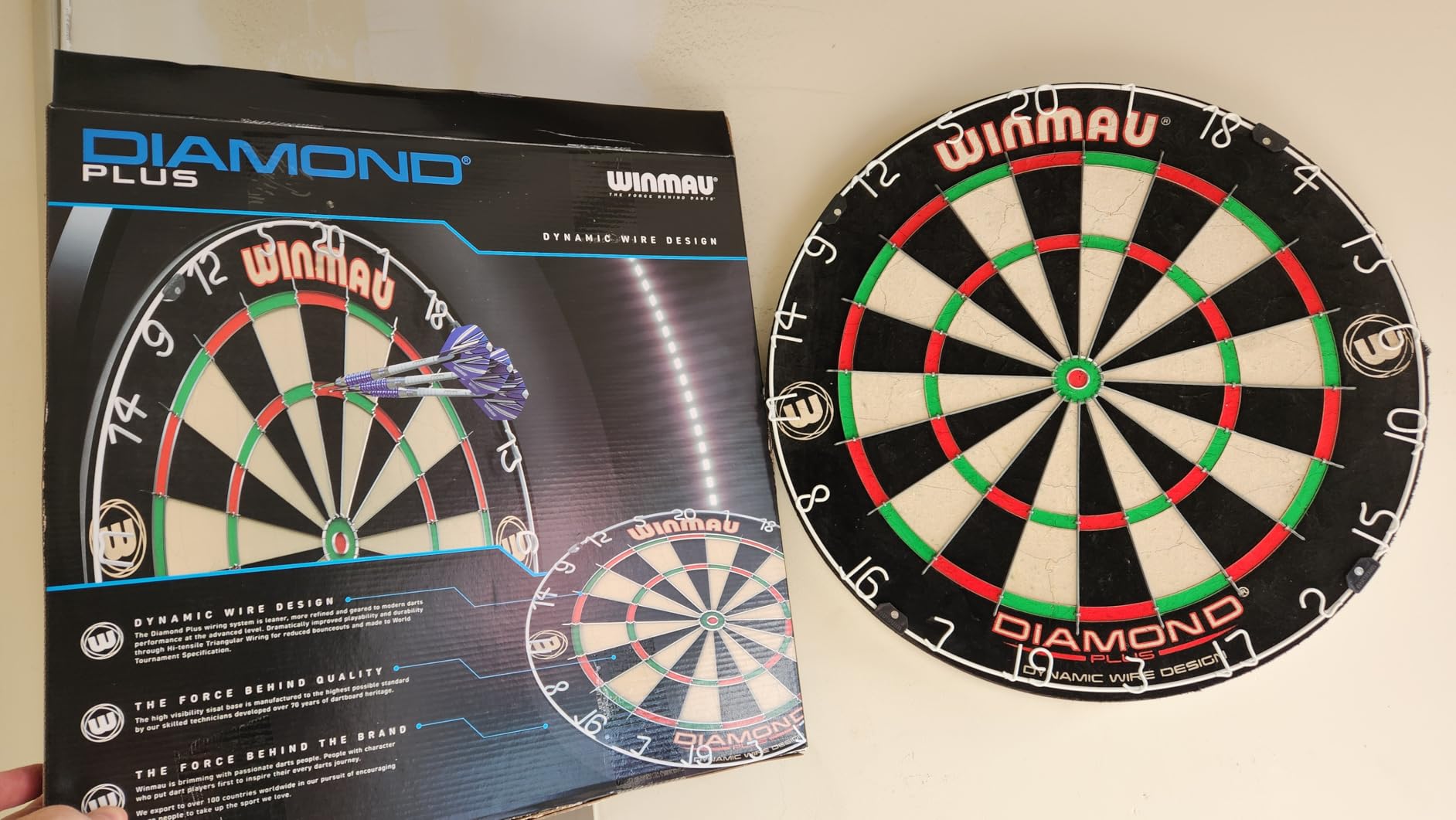
The Winmau Diamond Plus is the board for a game room that gets used every week rather than most Fridays. It shares the 4.8 rating at the top of this roundup and has one of the largest review counts on the market, and the reason owners keep it for years is the density of the sisal rather than any headline feature.
Super-dense fibers recover after each throw and resist the compression that makes a cheaper board feel spongy in the outer double and treble rings. If your game room doubles as a league room or hosts eight-player house tournaments, this is the surface that holds its shape under that volume of play.
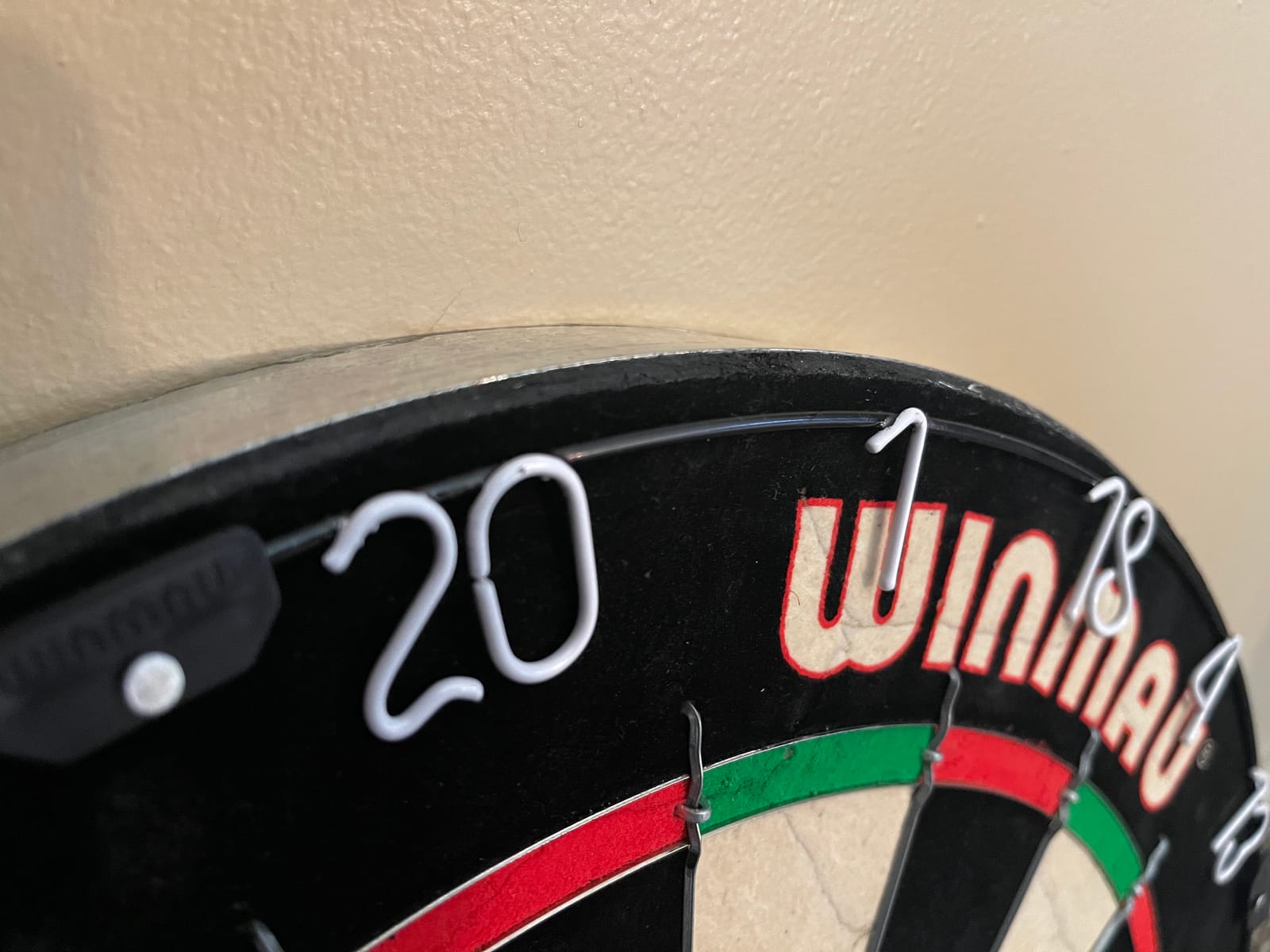
Two details do the quiet work. The triangular wiring is designed to guide a dart into the scoring area instead of letting it glance sideways, and the CNC-engineered staple-free bullseye removes the metal obstruction that sits in the middle of the board on stapled models. That bullseye is where most bounce-outs begin.
At 10.5 pounds with a 1.5 inch playing thickness, the board has the deep, solid landing sound that regular players describe as the difference between a game room and a spare room. The listed dimensions make it a full-size board, so it wants a proper bracket and backing rather than a single drywall anchor.
Reviewers are consistent on one cosmetic point: dart holes remain visible in the sisal even with a self-healing surface. That is normal for bristle boards and gets less noticeable as the face darkens with use, but buyers expecting a permanently pristine board should know it in advance.
Who the Diamond Plus suits
It fits a household with several regular players, a league night that happens at home, or a game room where the board is a focal point rather than a novelty. Reviewers describe it as a board they stopped thinking about because it never gave them a reason to replace it.
The BDO tournament pedigree also makes it the safe pick for anyone who plays in a league and does not want to explain to teammates why their home board feels different from the club board.
Where the Diamond Plus falls short
Like the Blade 6, it ships as a bare board. There are no darts, no cabinet and no bracket in the box, so the total cost of a finished setup is higher than the listing suggests.
It is also strictly a steel-tip board. A household with children running around the room should look at an electronic soft-tip option instead, because a dense sisal face still accepts a steel point without any argument.
3. Viper Shot King — The Complete Regulation Starter Package
Viper by GLD Products Shot King Sisal Dartboard Set for Adults, 6 Darts
17.75 inch sisal face
Staple-free bullseye
Circular spider wire
Darts and hardware included
Pros
- Regulation playing surface out of the box
- Rotating number ring evens wear
- Everything needed to play in one carton
- Low bounce-outs
Cons
- Bundled darts are entry level
- Wall buffers awkward without a center punch
- Superficial surface cracking over time
The Viper Shot King is the pick when you want a real regulation board without a second shopping trip. It carries more ratings than anything else in this roundup — over fourteen thousand at 4.6 — and the reason is simple: it arrives with everything a first room needs.
Inside the box you get a 17.75 inch compressed sisal board with a staple-free bullseye and a galvanized steel circular spider, plus two sets of steel-tip darts, a throw line, a measuring tape and mounting hardware. That is the entire beginner kit, and it is why this board keeps showing up in starter recommendations.
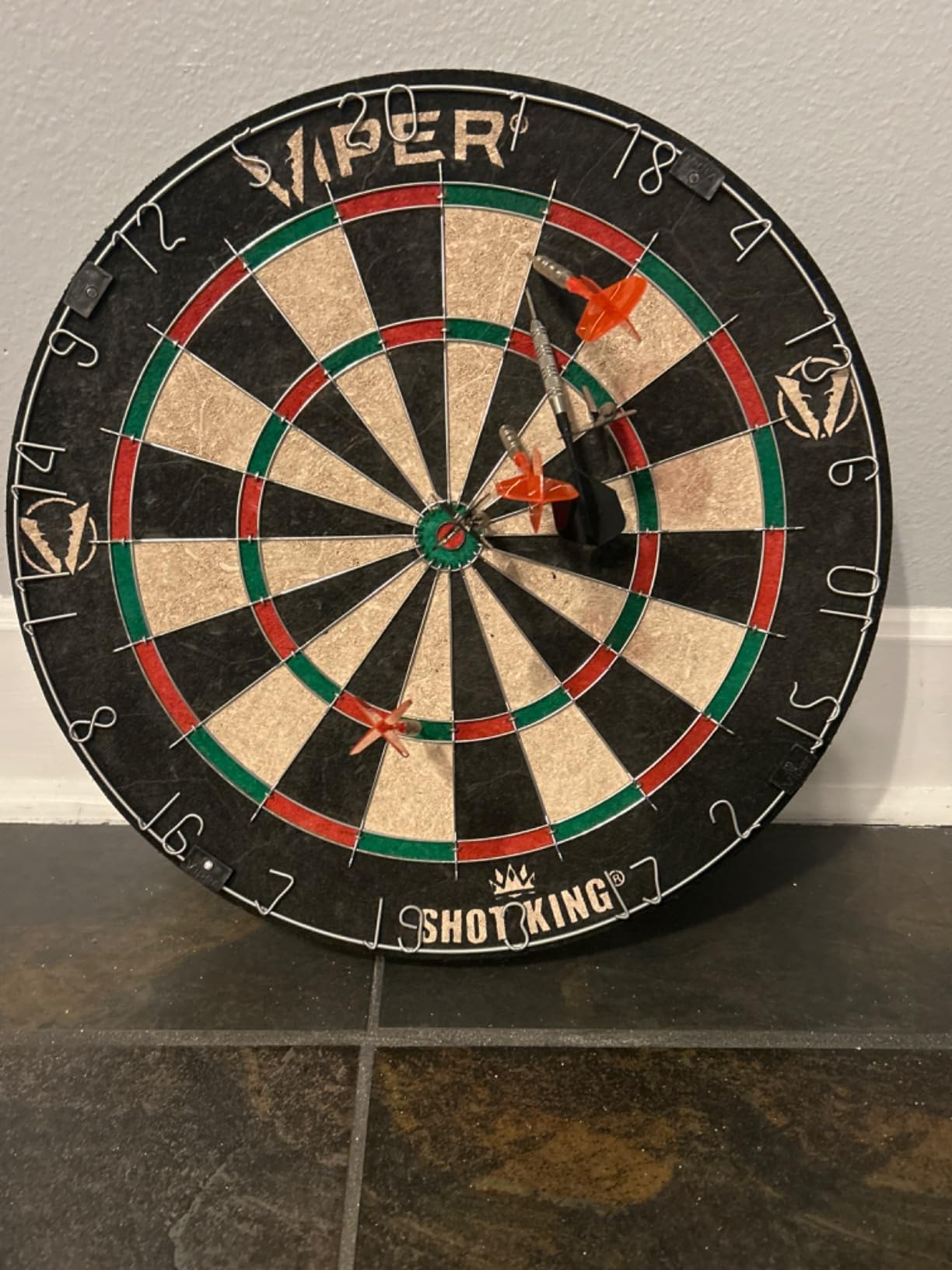
The circular spider wire is the detail we would point out to anyone comparing it with a cheaper board. Round wire gives cleaner segment definition than the flat stock used on budget panels, and combined with the staple-free bullseye it keeps darts in the scoring area rather than spitting them back out.
The detachable number ring rotates, so a face that is wearing in the 20 and the 3 can be re-indexed to spread the work. On a board that will be thrown at several times a week, that rotation is the difference between a surface that stays lively and one that goes dead in the high-traffic zones.
Two criticisms come up repeatedly and neither is about play. The board face can show cosmetic cracking in the sisal as darts penetrate it over time, and the included wall buffers can be difficult to seat unless you have a center punch. Both are installation and appearance issues rather than accuracy problems.

Who the Shot King suits
It suits a first game room, a garage, or a man cave where you want playing within a day of delivery and you do not want to research brackets. The regulation 17.75 inch surface means nobody has to adjust their throw when they move to a league board.
It also works well as a second board in a house where one room hosts the real play and another hosts the casual crowd. The number ring and the self-healing sisal handle irregular use without the board going soft.
Where the Shot King falls short
The bundled darts are entry level rather than competition grade, so most owners replace them within the first few months. Budget for a proper set of 22 to 24 gram tungsten darts rather than planning to keep these.
It is a bare board, so the wall behind it is still your problem. If the room is finished and you care about the paint, pair it with a surround or mount it over a section of wall you are willing to patch later.
4. EastPoint Belmont Cabinet Set — The All-in-One Game Room Wall Unit
EastPoint Derbyshire Official Size Dart Board Cabinet, 6 Steel Tip Darts
18 inch sisal board
Wood cabinet with doors
Two chalk scoreboards
Six steel darts included
Pros
- Cabinet board and darts in one package
- 18 inch board built for regular use
- Rotating steel ring and steel spider
- Built-in dart holders
Cons
- Bulky at nearly 40 inches wide
- Manual chalk scoring
- Board must be swapped to close doors
The EastPoint Belmont is the one to buy when the wall is finished, visible and already has things hanging on it. It is a cabinet with a professional-grade 18 inch bristle board already fitted, six steel-tip darts, dart holders and two chalk scoreboards, and it ranks at the top of the dartboard cabinets category.
The board itself is the strong part. An 18 inch high-density self-healing sisal surface with a rotating steel number ring and a heavy-duty steel spider frame is a durable build, and the steel frame is the piece that stops a cabinet board from sagging over years of use.
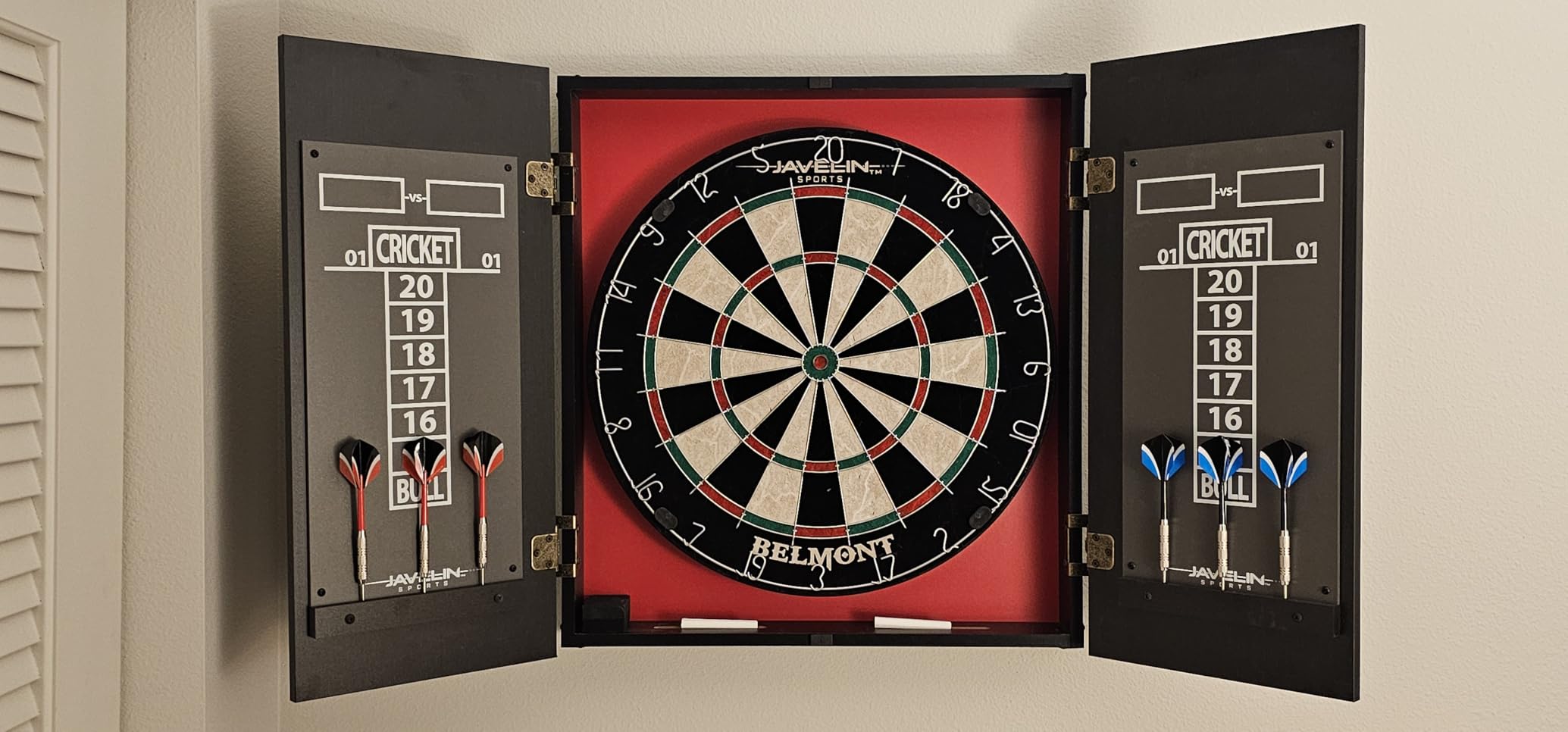
Where cabinets usually fall down is the woodwork, and this one is specified at 39.75 inches wide by 23.3 inches high with a 1.5 inch depth and a listed weight of 24.3 pounds. That is a real piece of furniture. Measure the wall, find a stud, and check the swing of the doors before you buy.
The two chalk scoreboards on the doors are a genuine period detail rather than a gimmick, and for 01 and Cricket play with steel-tip darts they are faster than a phone. If your group would rather not handle chalk, the manual counting is the part of this set most likely to annoy you.
Reviewers note one design consequence: the board has to be swapped out before the doors can close. That is a deliberate feature, since a closed cabinet protects the surface and the wall, but it means the doors are a storage state rather than a playing state.
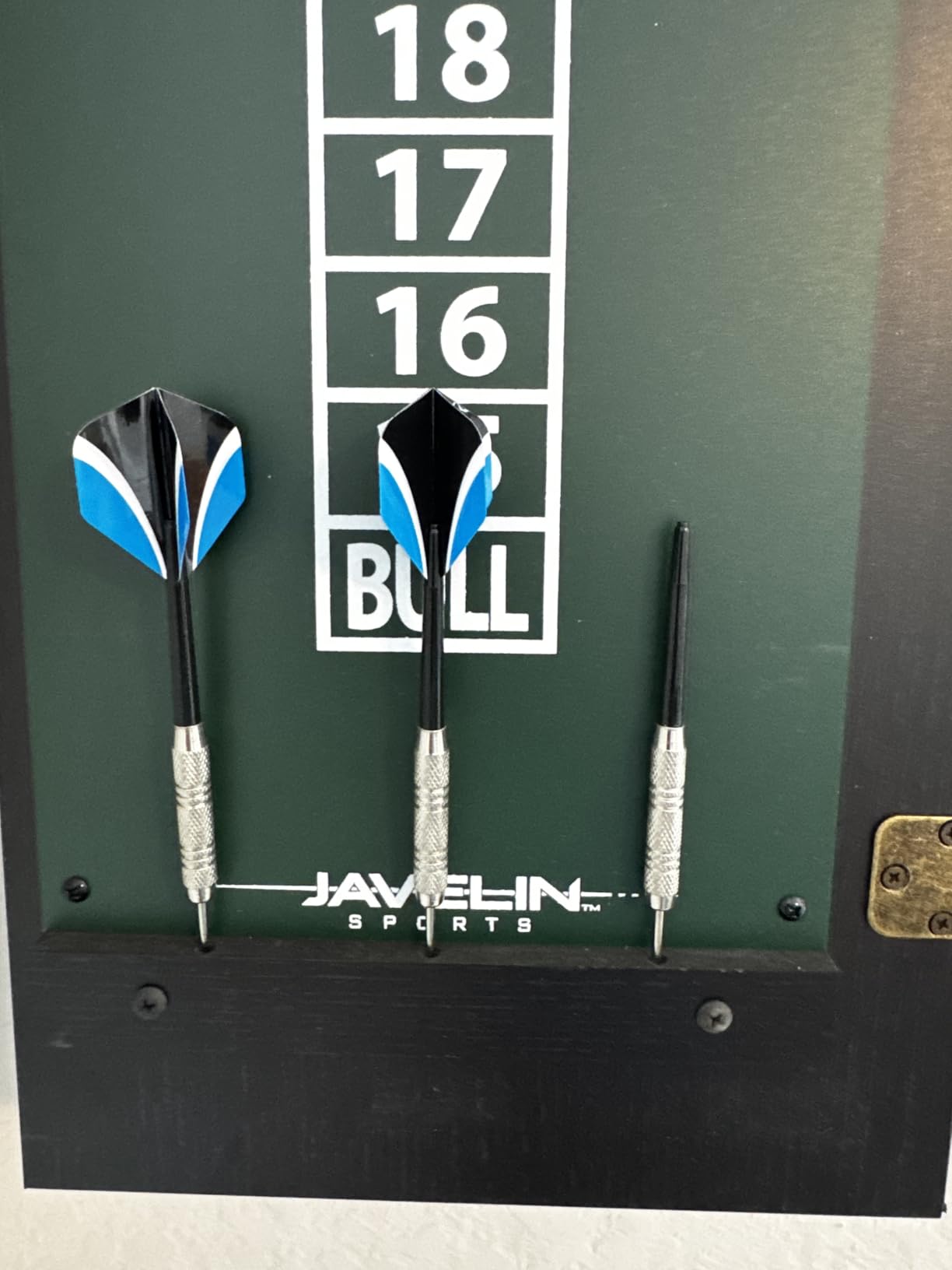
Who the Belmont suits
It suits a finished game room with a feature wall, a finished basement, or a man cave where the dart zone should look deliberate from across the room. It is also a strong first cabinet because you are not assembling a board, a bracket and a surround from three separate listings.
For a house that hosts four to eight players regularly, the built-in dart holders and the twin scoreboards make resets between games fast, and the 18 inch board has the full scoring area that smaller targets lack.
Where the Belmont falls short
Size is the honest limitation. At nearly 40 inches across it swallows wall space, and in a small room it can dominate the layout. If your available wall is under three feet of clear width, this is the wrong cabinet.
It is also a steel-tip set. In a house where children run through the room, the manual scoreboards and the exposed steel points are two separate arguments for an electronic board instead.
5. Viper League Pro Regulation Set — Best Budget Route Into Real Sisal
Viper by GLD Products League Pro Regulation Sisal Dartboard Set, 3 Darts
17.75 inch sisal board
Staple-free bullseye
Chalk cricket scoreboard
Three steel darts included
Pros
- Everything needed in one box
- Regulation sisal surface
- Rotating white number ring is easy to read
- Low deflections
Cons
- Bundled darts bend or break at the shaft
- Buffers fiddly without a center punch
- Cosmetic cracking of the face
The Viper League Pro is the cheapest route in this roundup to a regulation sisal board with a staple-free bullseye, and at 4.7 across nearly 4,800 ratings it out-rates most of the boards above it. It is the pick when the budget is real but you refuse to give up on bristle.
The package is generous for the tier: a 17.75 inch compressed sisal board, three ViperStrike steel-tip darts, an MDF cricket scoreboard with chalk and eraser, a throw line, a measuring tape and the mounting hardware. Owners repeatedly mention how quickly they were playing after delivery.
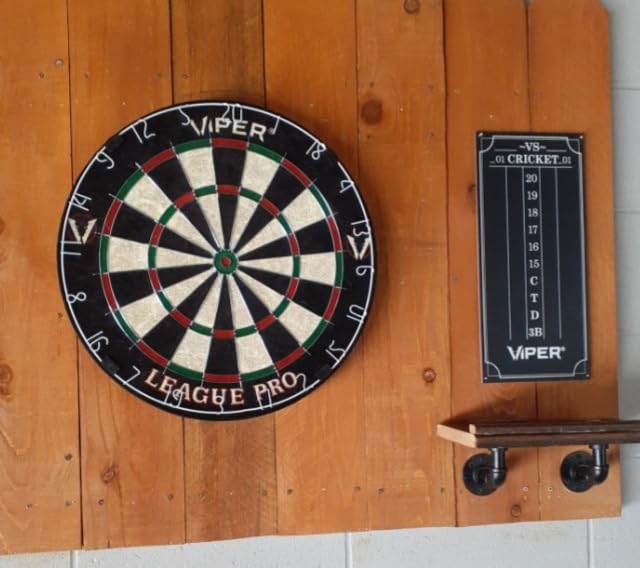
The white number ring is worth mentioning because it is a legibility decision rather than a spec. A bright white detachable ring that rotates is easier to read from the throw line than a printed ring, and rotating it is how you keep the wear even across a board that sees a lot of play.
Galvanized steel circular spider wire plus a staple-free bullseye is the correct hardware at this level, and it is the reason bounce-outs stay infrequent despite the lower price. The sisal does not fully close after repeated play, but it stays flat enough to score consistently.
The weak link is the darts. Reviewers report the bundled shafts bending or breaking, which is the single most common replacement in the first six months. Everything else in the box tends to survive; the darts usually do not.
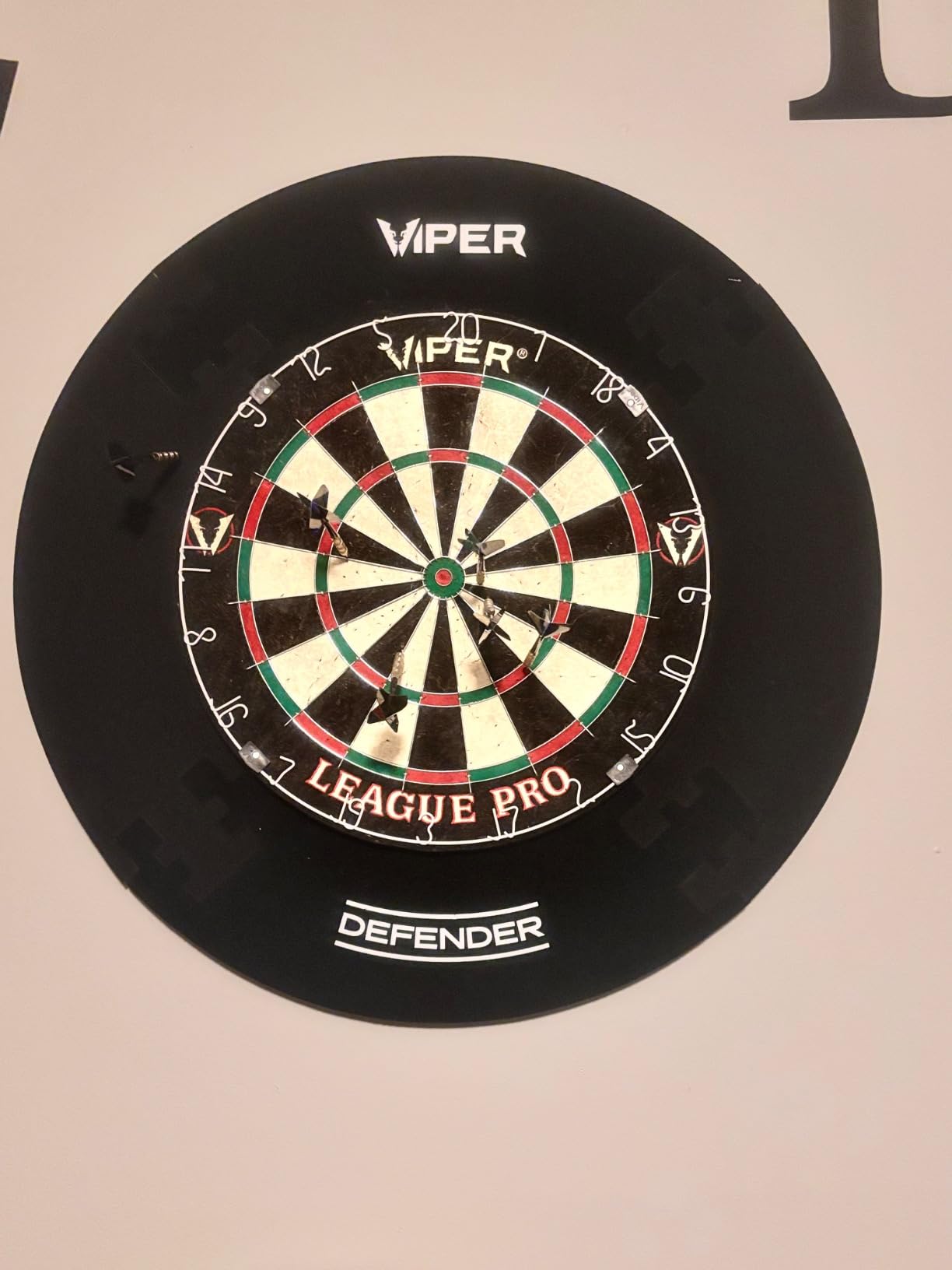
Who the League Pro suits
It suits a first purchase, a student room, or a rental where you want a real sisal surface without committing to a premium bracket. The included cricket scoreboard makes it a complete 01 and Cricket setup on arrival, which is more than most boards in this tier offer.
It is also a sensible second board for a game room, since a spare sisal board keeps a league group playing while a second set of numbers is being marked, and it is light enough to move between rooms.
Where the League Pro falls short
Plan to replace the darts early, and expect cosmetic surface cracking over time. Both are normal for a board at this level and neither affects scoring, but they do affect how finished the wall looks after a year of play.
It is still a bare board with no cabinet, so wall protection is still on you. If the wall is finished, the money saved on the board is better spent on a surround than on a premium panel.
6. Winmau Pro SFB — Thick, Heavy and Built to Tournament Dimensions
WINMAU Pro SFB Bristle Dartboard – Staple-Free Bullseye Dart Board – Self-Healing Sisal, Cliple II Wiring – Reduced Bounce-Outs – Official Size for Home, Club & Practice
450 mm sisal face
38 mm board thickness
Cliple II wiring
Staple-free bullseye
Pros
- Official tournament dimensions
- Thick board with a solid landing sound
- Self-healing sisal resists deformation
- High-tensile round wire
Cons
- Tricky to hang without wobbling
- No darts cabinet or bracket included
- Bracket mounting needs care to stay level
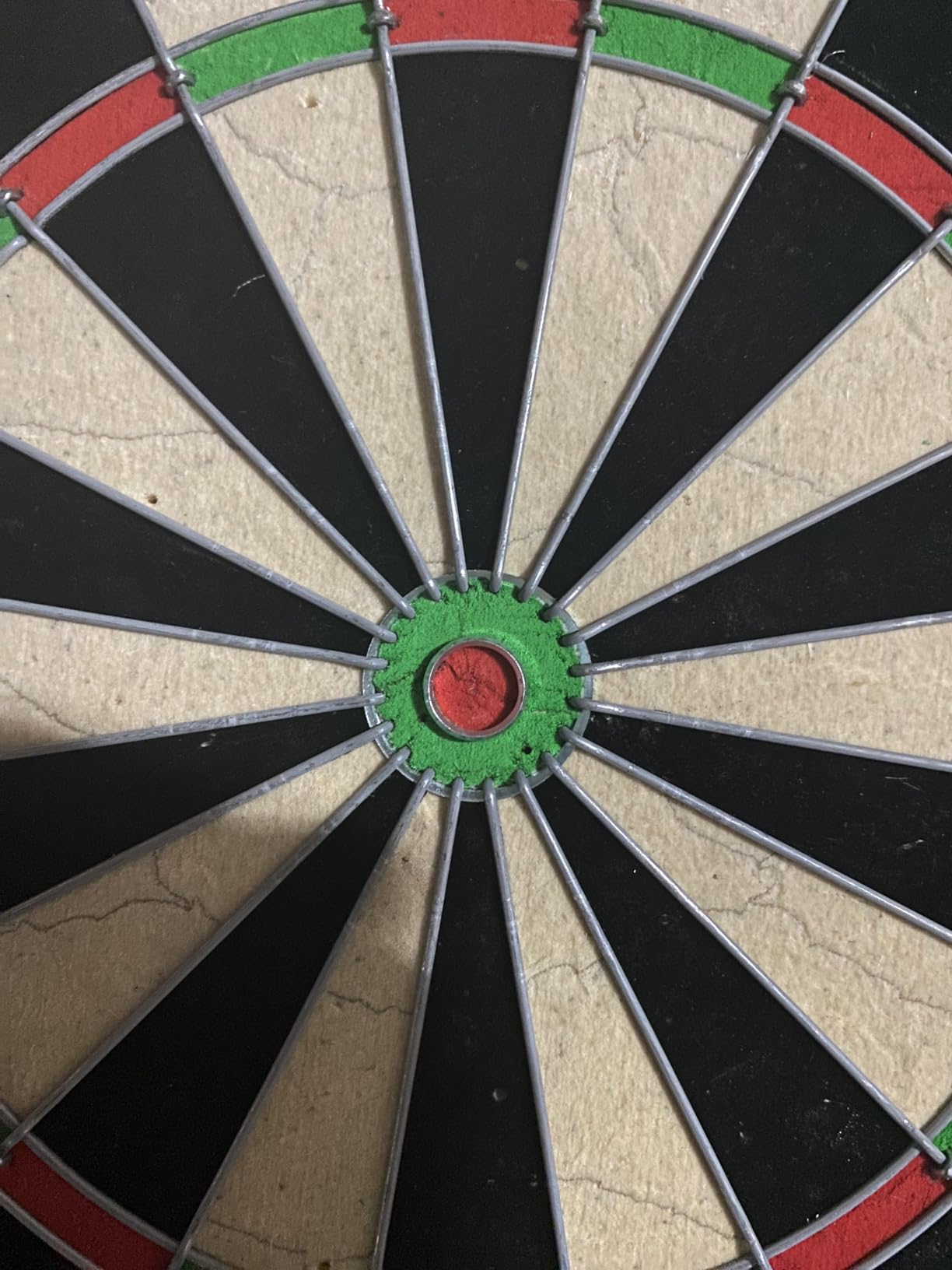
The Winmau Pro SFB is the board that teaches a new player a proper feel. At 450 millimeters in diameter and 38 millimeters thick, it is a properly substantial object, and the depth of the board is what produces the solid landing sound that makes people want to throw again.
Cliple II wiring and a staple-free bullseye do the accuracy work. The high-tensile round wire gives clear segment definition and tight grouping, which is exactly what a beginner needs — a player learning to aim benefits from a board that rewards a good throw instead of hiding the error in a defection.
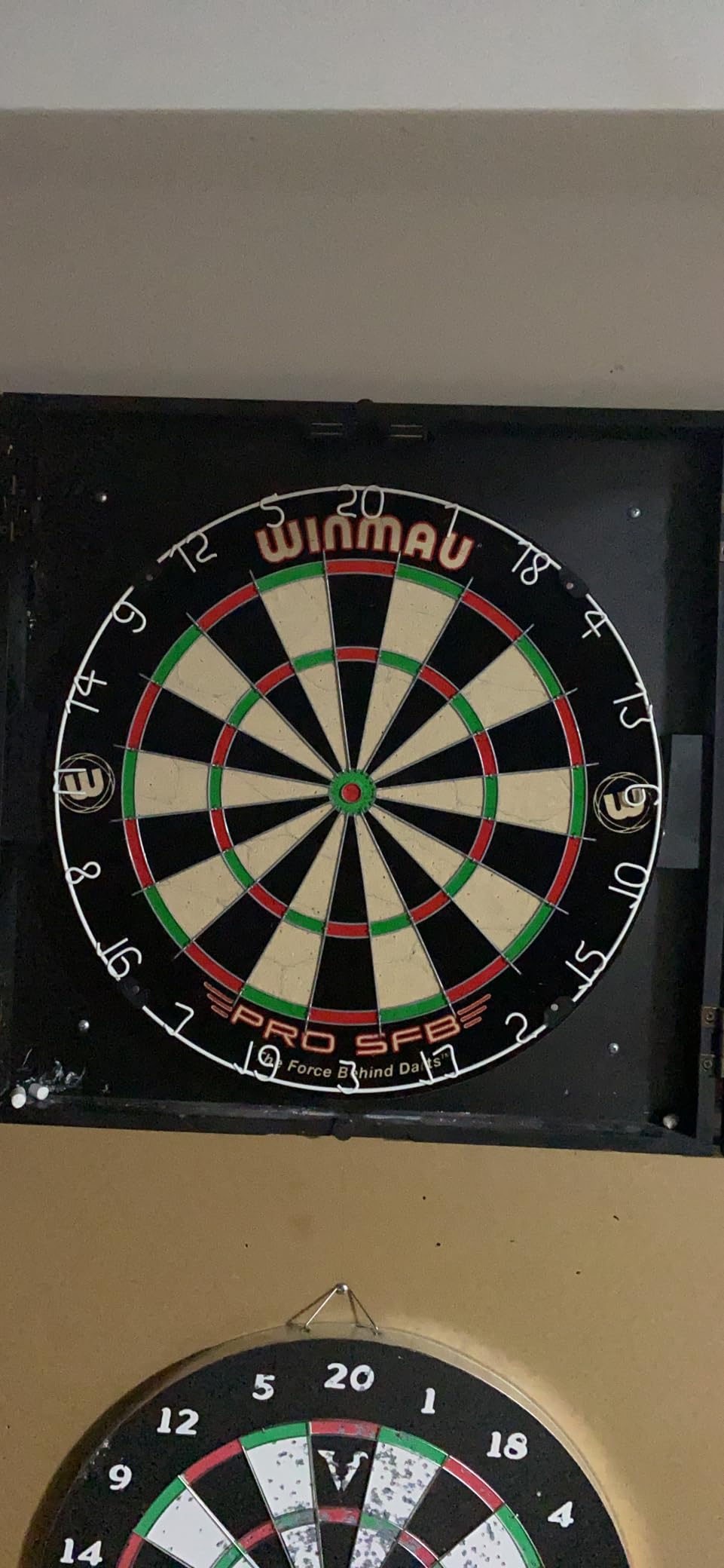
Reviewers from across several regions describe the same experience: the sisal holds its shape, the board does not deform, and the sound is the part they remember. That is a durable combination in a room where the board is thrown at every gathering.
Installation is where the reviews get cautionary. The board is bracket-mounted, and several owners note that it can wobble or feel tricky to hang unless the bracket is carefully levelled, sometimes with extra foam behind it. Some buyers wish for a top hanger point to make the job simpler.
The box contains a fixing kit and the board. There are no darts, no cabinet and no bracket, so this is one of the picks that needs the most planning before it reaches the wall.
Who the Pro SFB suits
It suits a beginner who wants to develop a consistent throw on a surface that matches league dimensions, and a household that plays often enough to care about how the board settles and sounds over time.
The listed international review base also makes it a confident pick for anyone who may move rooms or host visitors from other countries, since the dimensions are the official tournament specification rather than a regional variant.
Where the Pro SFB falls short
Mounting is the practical trap. Without a stud or solid blocking, a board this thick will feel wrong on the wall and can damage drywall, so check what is behind the plasterboard before the purchase rather than after.
It is a bare board with a self-healing but visibly punctured sisal face and no dart storage. In a finished game room, plan on a surround and a bracket as separate items.
7. Viper Hideaway Cabinet — Slim Wall Protection With a Swappable Board
Viper Hideaway Dartboard Cabinet with Reversible Steel Tip Dart Board for Adults, Traditional and Baseball Dartboard Cabinet Set with Matte Black Finish
Reversible 2-in-1 board
Slim matte black cabinet
Magnetic door latch
Prints scoreboards on doors
Pros
- Extra-thin profile suits tight walls
- Reversible face adds a baseball option
- Sturdy hinges and reliable magnetic latch
- Boards swap in seconds
Cons
- Bundled board is stapled not staple-free
- Plastic shafts on included darts
- Chipping paint on the supplied board
The Viper Hideaway is the cabinet for a room where wall space is the constraint. At 21 inches wide by 21.5 inches high it is a fraction of the footprint of a full cabinet, and the extra-thin matte black profile sits flat against the wall rather than projecting into the room.
Doors close over the board to protect the wall and the surface, and they carry printed scoreboards with a chalk storage slot, so the scoring surface travels with the cabinet. It holds six darts upright, which is the detail that stops flights from being crushed in a drawer.
The reversible board is the unusual feature. One face is 01 and Cricket, the other is a baseball game, and owners report swapping boards in seconds. The cabinet itself gets the praise: accurate mounting template, solid antique brass hinges, a magnetic latch that keeps working, and 95 percent MDF construction that does not flex.
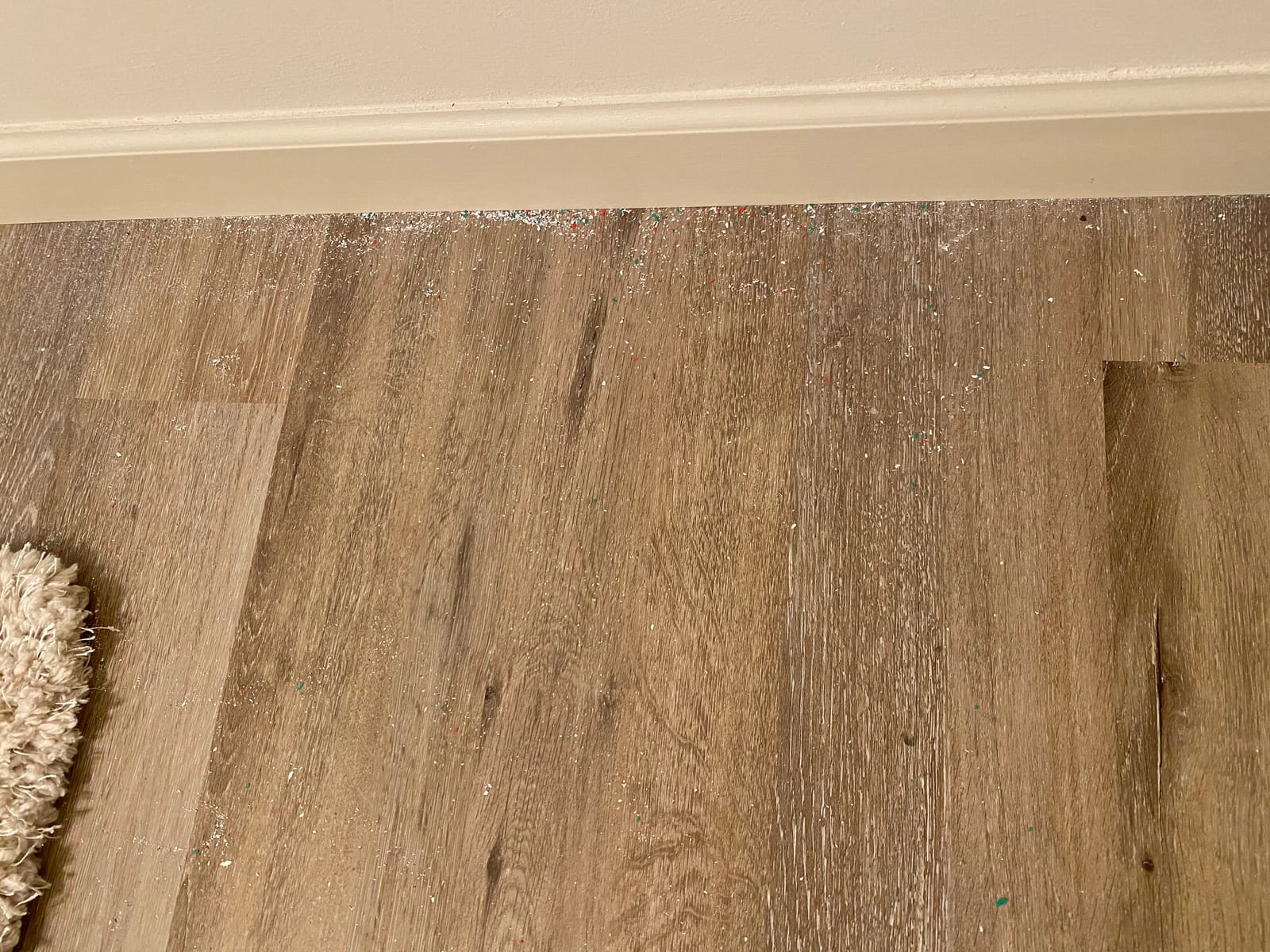
Here is the honest split in the reviews. The cabinet is well made; the board supplied with it is not competition grade. It is stapled rather than staple-free, so darts do not sit as cleanly, and the paint can chip within weeks of regular use. A good number of owners keep the cabinet and fit a better board to it.
Plan for that if you buy it. The mounting template tells you exactly where the board sits, which makes fitting a different board straightforward, and the cabinet is the part that is hard to replace later.
Who the Hideaway suits
It suits a small game room, a basement, or a wall where a 40 inch cabinet would feel like furniture you had to live around. It also suits anyone who wants the board to disappear when the room is not in use, which matters in a multi-purpose space.
For a family that plays a lot of cricket and 01, the printed door scoreboards remove the need for a separate scoring accessory, and the slim silhouette keeps the setup visually quiet.
Where the Hideaway falls short
The supplied darts use plastic shafts and wobble or bend, so they are a short-term accessory. The stapled board is the bigger caveat, and buyers who only read the headline will be disappointed by the playing surface.
It also does not fix the drywall problem for you. A slim cabinet still needs a sound fixing point, and the wiring you are trying to hide needs a chase or a surface conduit.
8. Franklin Sports Electronic Board — The Soft-Tip Answer for Mixed-Age Homes
Franklin Sports FS1500 Electronic Dartboard
15 inch electronic target
Digital scoreboard with voice
6 soft tip darts and spare tips
Runs on 3 AAA batteries
Pros
- Kid-safe soft tips
- Automatic scoring
- Large game library for varied players
- Portable and simple to mount
Cons
- Light plastic construction
- Soft tips break and miss some hits
- Quiet speaker and some bounce misreads
The Franklin Sports electronic set is the board for a house with children in it. Six soft-tip darts and a set of spare tips come in the box, and a soft dart that bounces off a plastic matrix is the difference between a game room everyone uses and one the kids are told to stay out of.
Scoring is automatic on a built-in digital display with voice and sound effects, and the game library is listed at 65 programmed variations. For a household cycling through guests of different ages, that range matters more than it does for a fixed group of four regular players.
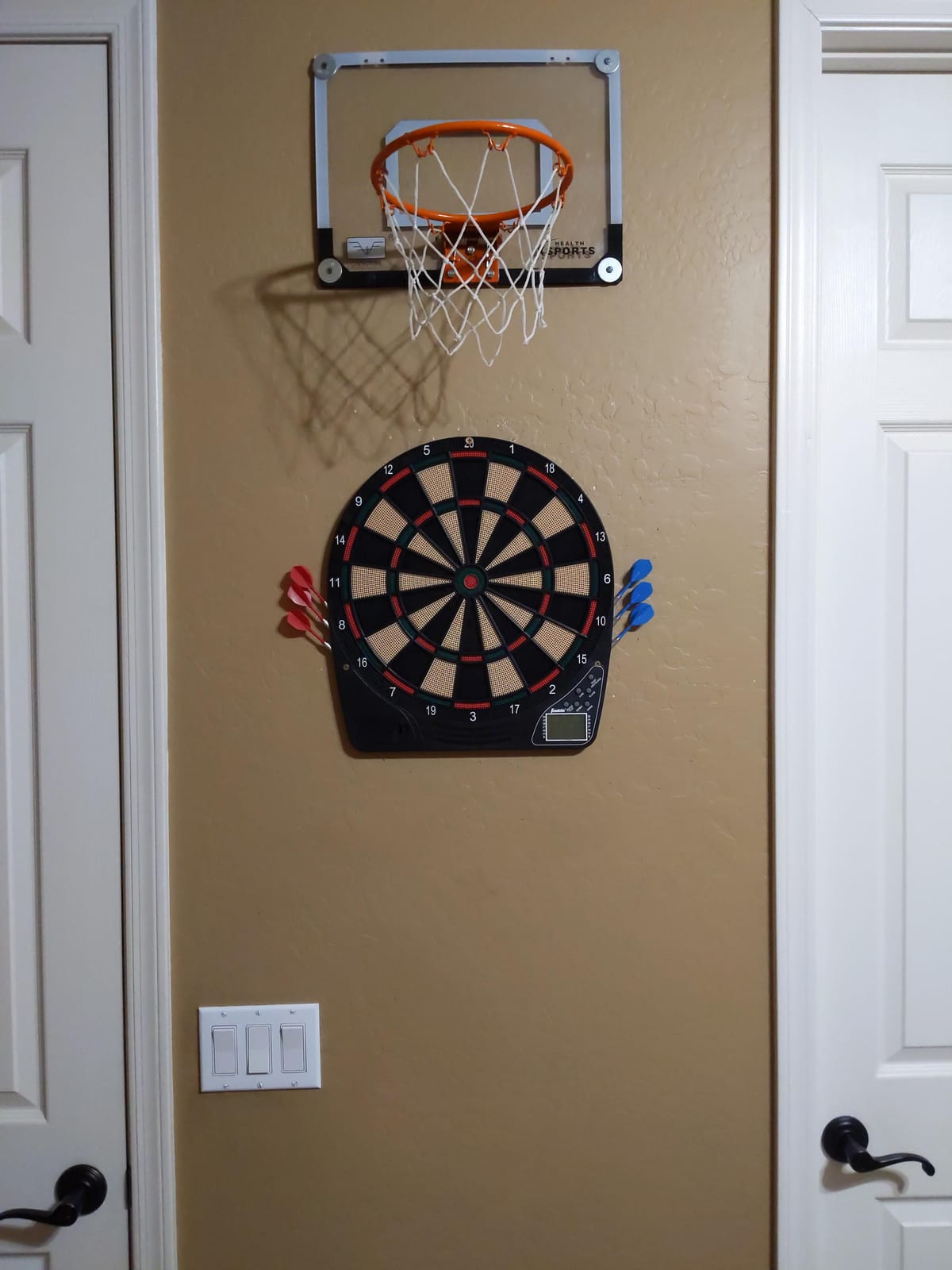
Operationally it is simple: three AAA batteries, the mounting hardware, and a side dart storage rail. Owners report months or years of use between battery changes, which is a good sign in a room where the board is switched on for an evening and forgotten.
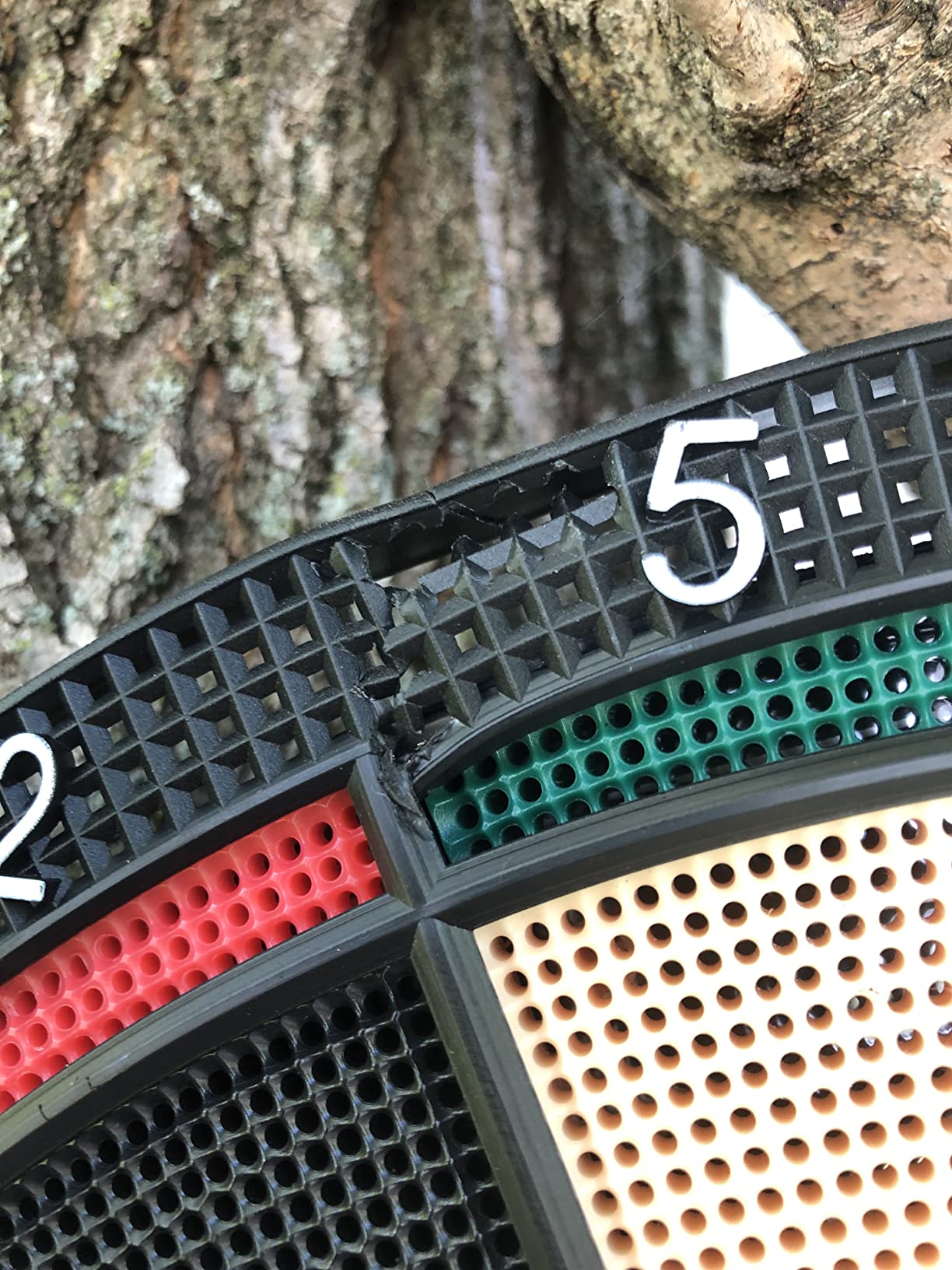
The limitations are honest ones. The plastic construction is light, which reads as inexpensive in the hand, and the supplied soft tips do not always stick or stay straight. Some hits register on a bounce, and the speaker is quiet enough that a group of six talking will not hear it.
Switching between game types is also described as fiddly, and the bullseye occasionally fails to register on a genuinely stuck dart. None of that ruins a family evening; it does mean this is a leisure board rather than a practice surface.
Who the Franklin set suits
It suits families, playrooms, and any room where the throw line is a shared space with children, grandparents or guests who are not going to practise their throw. The safe tips and the automatic scoring remove two whole categories of household friction.
It is also a sensible first board for someone who is not sure whether darts will stick in the house. At 15 inches and under three pounds it is portable, so it can live in a garage or spare room and come out for game nights.
Where the Franklin set falls short
Feel and sound. A plastic segment board does not have the feedback of sisal, and players used to a bristle surface often describe the transition as feeling imprecise. If everyone who plays already throws steel-tip, this is a downgrade in playability even though it is a safer choice.
It also does nothing for the wall. A soft-tip board still needs a surround or a cabinet behind it, because the darts will mark a finished wall just as permanently as steel.
9. Fat Cat Mercury — Compact Electronic Board With Doors and Storage
Fat Cat Mercury Electronic Dart Board, 13.5 Inch Soft Tip with Cabinet
13.5 inch electronic target
Cabinet doors storing 12 darts
28 games and 150 options
AC adapter powered
Pros
- Compact cabinet footprint for small rooms
- Ultra-thin spider and catch ring cut bounce-outs
- Backlit display shows points per dart
- Handicap setting for mixed skill levels
Cons
- Small target is less forgiving
- Electronic feel does not match sisal
- Tighter scoring area than a full-size board
The Fat Cat Mercury is the pick when the wall is small but you still want doors, storage and a backlit display. At 13.5 inches the target is a compact electronic board, and the whole unit is 18 by 24 inches, so it fits a basement wall or a narrow section beside a pool table.
The cabinet doors close over the board and store up to 12 soft-tip darts upright, which keeps the room tidy between games. An AC adapter powers it, so there are no batteries to replace in a room that gets played weekly.
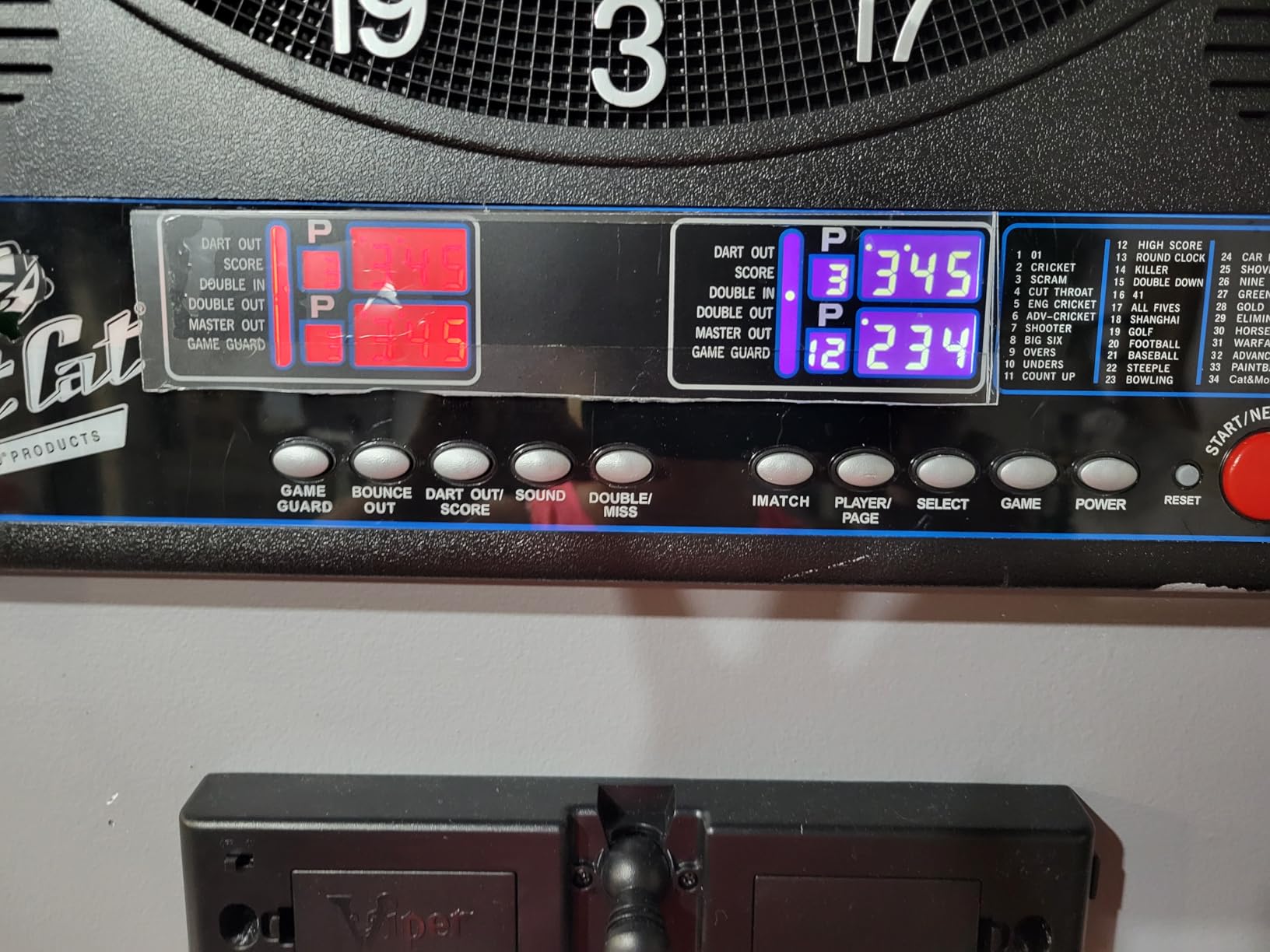
Where it beats cheaper electronics is the hardware detail. The ultra-thin spider and extended catch ring are aimed at bounce-outs, and the precision concave holes help a soft dart settle rather than skate. The backlit display reporting points per dart and marks per round is unusually informative for a home board.
The handicap setting is the feature we would highlight for a mixed group. It lets a beginner play an experienced thrower without the score becoming the reason people stop playing, and the game library covers 28 games with more than 150 scoring options for up to eight players.
The trade-off is the 13.5 inch face. A smaller target concentrates play into a tighter area, which makes the game faster and the room more forgiving, but it is less satisfying for anyone who plays on a full-size board regularly.
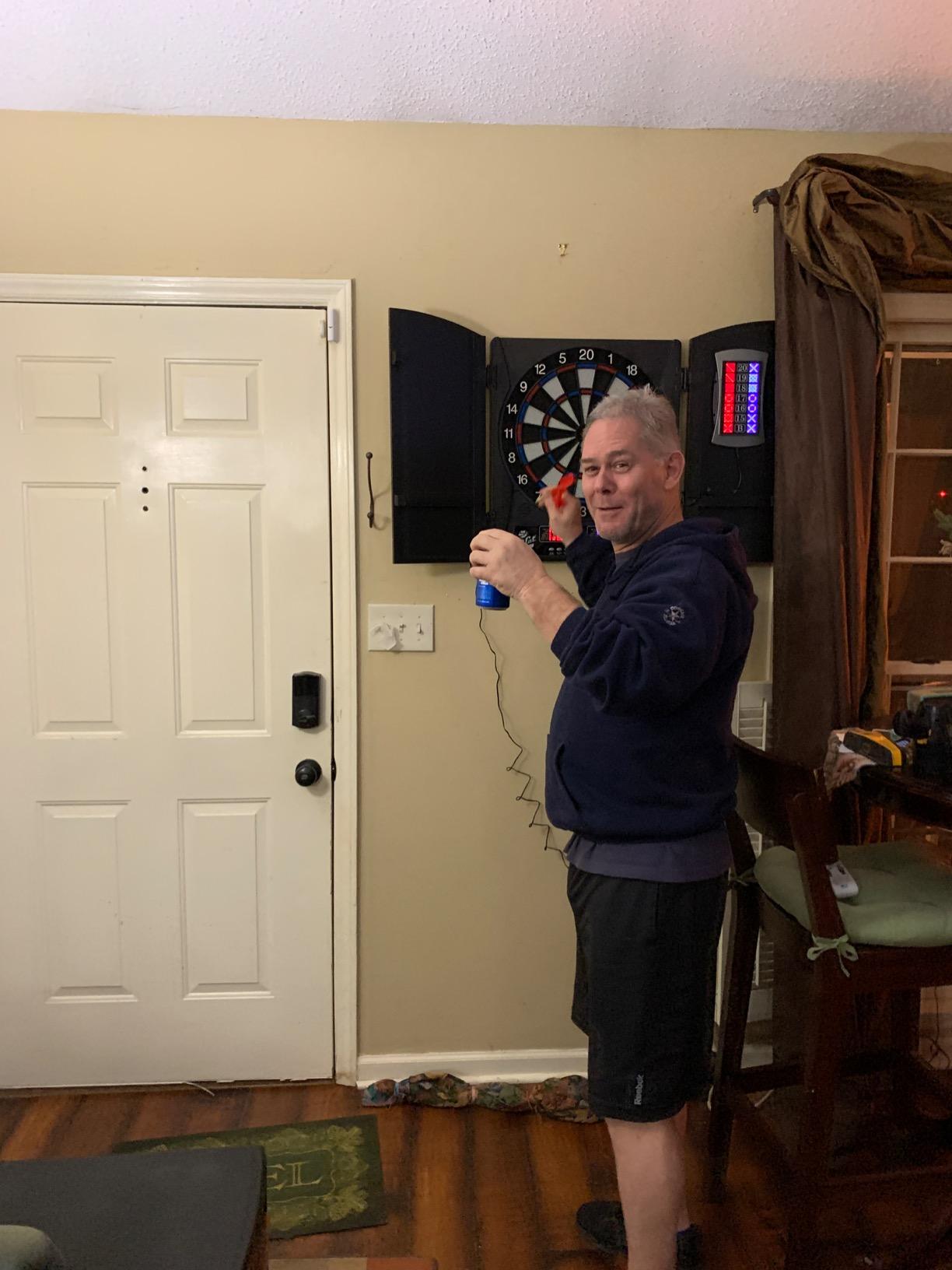
Who the Mercury suits
It suits small game rooms, basements and apartments where a full-size cabinet would eat the wall, and households that want soft-tip safety with a furniture-grade look rather than a bare board on a bracket.
For a group of mixed ability it is unusually well suited, because the handicap system and the depth of the statistics display both reward repeat play. The quiet start and tidy storage also make it a good fit for a room that doubles as a study or a lounge.
Where the Mercury falls short
The 13.5 inch face is the whole compromise. Casual throwers and beginners do fine, but the review consensus is clear that it is less forgiving and less satisfying than a full-size bristle board for anyone taking the game seriously.
It is also an electronic surface, so the feel and the sound are plastic. If your group already throws steel-tip and simply wants a smaller cabinet, a slim steel-tip cabinet is the better route.
10. Arachnid CricketMaxx 1.0 — The Party Board for Eight Players
Arachnid CricketMaxx 1.0: 13.5” recreation size with wood cabinet. Features 34 games, 183 variations, 8-player LED X/O scoring, and Heckler mode. Integrated storage for darts and accessories
13.5 inch electronic target
34 games and 183 variations
8 player LED scoring
Wood cabinet storage for 12 darts
Pros
- Eight-player LED display with four panels
- Large game and variation library
- Wood cabinet keeps setup organized
- Solo computer play in five levels
Cons
- Recreation size is smaller than regulation
- Weighs 14 pounds so it stays put
- Some bounce-outs reported
- Uses more wall space than board-only
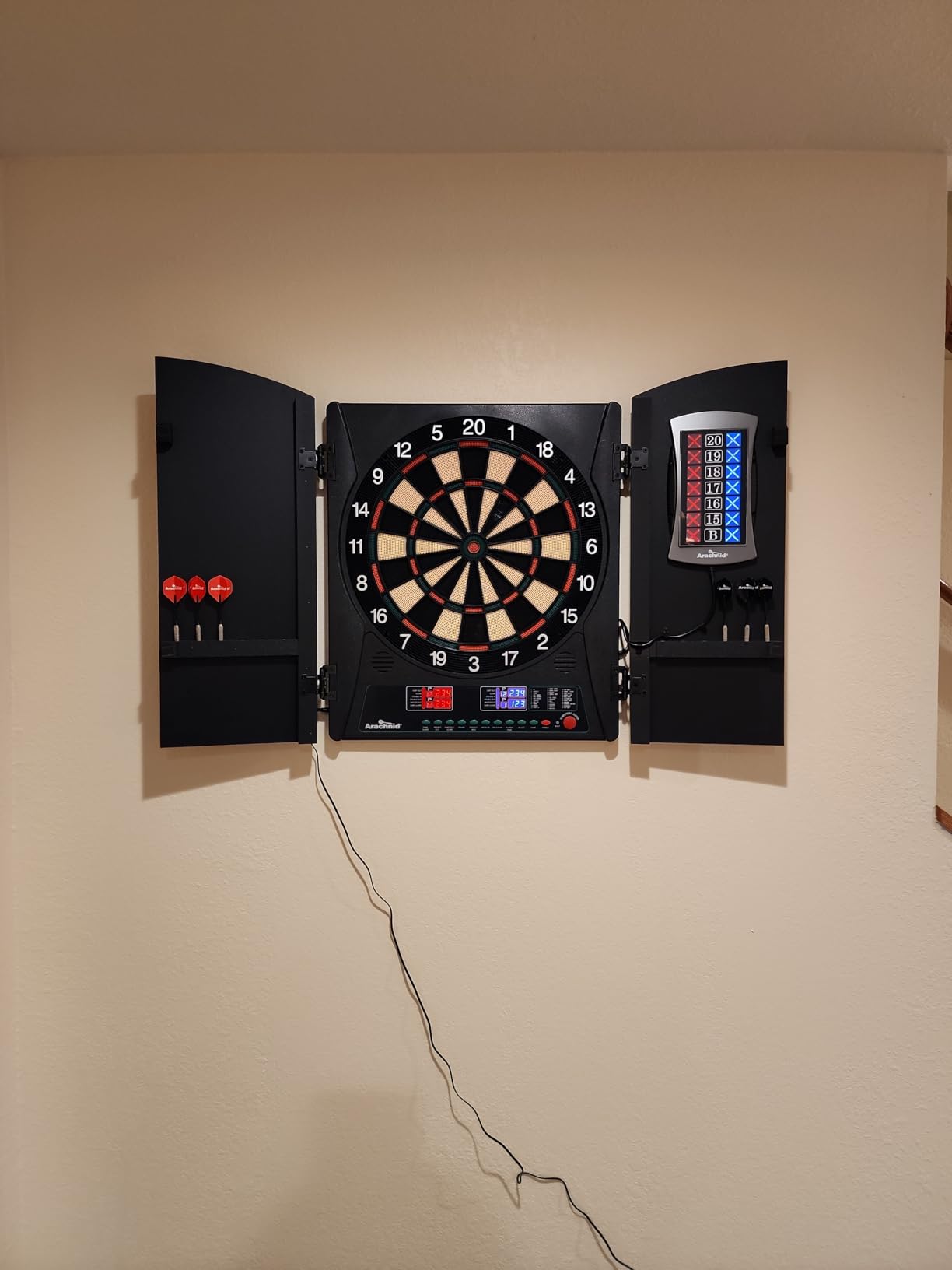
The Arachnid CricketMaxx 1.0 is built for a specific scenario: eight people in a room and nobody willing to keep score by hand. Four dedicated display panels and 8-player LED scoring mean the match runs itself, which is the entire point of an electronic board in a party setting.
The library is the other headline. Thirty-four built-in games with 183 variations keep a group from exhausting the options, and the CricketMaxx X/O display uses the classic pub-style marks, so players who grew up with a chalk scoreboard recognise it immediately.
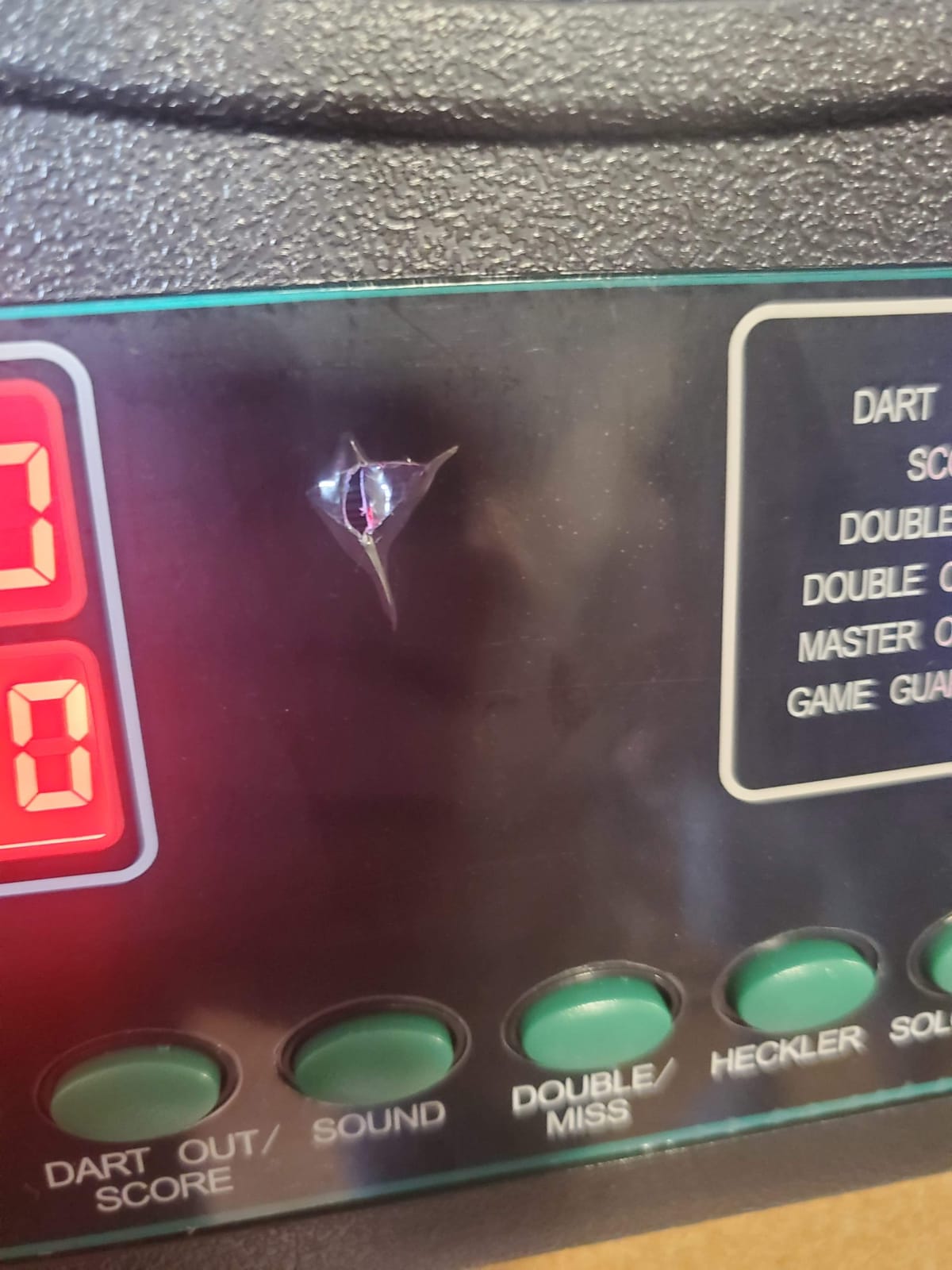
Two features exist purely for fun and both work. Heckler mode delivers voice-activated taunts when a score drops, and five levels of solo computer play fill the gap when nobody else is home and you still want to throw.
The integrated wood cabinet with storage for up to 12 darts is what makes it a game room piece rather than a wall gadget. The wood finish also solves the coordination problem — a walnut-toned cabinet sits more comfortably beside a pool table than a bare electronic board ever would.
Against that, the 13.5 inch recreation size is smaller than the regulation dimension, and at a listed 14 pounds the unit is not something you move between rooms casually. Reviewers also report the occasional bounce-out, which is normal when soft tips land on a hard matrix.
Who the CricketMaxx suits
It suits a house that regularly fills up with guests, a man cave that runs seasonal tournaments, and anyone who wants the pub experience without chalk. Eight players is a genuine ceiling here, which is rare among electronic boards at this size.
It also suits a gift buyer. The cabinet, the storage, the display and the voice features make it look like a finished product the moment it is mounted, with no extra accessories needed to make it look the part.
Where the CricketMaxx falls short
The recreation-size target means serious players will find it tight, and the smaller scoring area changes how games feel compared with a 15.5 inch regulation electronic or a full sisal board.
At 20.4 by 23.9 inches with a 5.5 inch depth, it needs more wall than a bare board. In a tight room, the Fat Cat Mercury is the smaller-footprint alternative with comparable storage.
11. Arachnid Cricket Pro 450 — Regulation Electronic Play Without a Cabinet
Arachnid CricketPro 450 Electronic Dartboard, 15.5″ Regulation
15.5 inch regulation target
31 games and 178 variations
Automatic scoring with checkout assist
Two player LED display
Pros
- Regulation-size target
- Checkout assist for 01 games
- Auto-corrects bounce-outs
- Simpler and lighter than cabinet models
Cons
- Two player display only
- No cabinet or dart storage
- Plastic build
- Does not cover a large group
The Cricket Pro 450 is the electronic board for someone who wants the scoring benefits and the regulation scoring area without paying for a cabinet. The 15.5 inch target is the regulation electronic dimension, and at a listed 6 pounds it is the lightest serious board in this roundup.
Automatic score tracking with checkout assist is the feature that changes how a game runs. The board tracks the route to a finish for 01 games, which speeds up play and stops the arguing about what the last dart should have left.
It also handles the most common electronic complaint. The system auto-calculates scores and amends for bounce-outs, so a dart that skips out of a treble is not a disputed turn. Reviewers who moved from manual scoring tend to stay for that reason alone.
The library runs 31 games with 178 variations, with single and double in and out options, arcade sound effects, solo computer play and the Heckler mode that has become a signature of this brand’s boards.
The limit is the display: two-player multi-colour LED scoring across five backlit screens. That is fine for a couple or a pair of rotating opponents and a squeeze for an eight-player house tournament, where a cabinet model with dedicated panels is the better tool.

Who the Cricket Pro 450 suits
It suits a couple’s game room, a den, or a two-player home setup where automatic scoring removes the tedium. It is also the pick for someone who already owns a cabinet and wants a second playing surface on a different wall.
Players who want to practise checkout routines get real value from the checkout assist, and the regulation-size target means the muscle memory transfers to a league or club board.
Where the Cricket Pro 450 falls short
There is no integrated cabinet and no dart storage, so you need a separate surround for the wall and a place to keep the darts. It also does not scale beyond two players on the display.
The plastic build is lighter in the hand than a wood-cabinet model. If aesthetics in a finished room matter to you, the visual gap between this and a cabinet is obvious.
12. GranBoard 3s Bluetooth — Online Play and Solo Practice on a Board
GRANBOARD3s Bluetooth Electronic Dartboard – Green
Bluetooth 5.0 app connection
Worldwide online multiplayer
LED lighting effects
Nine computer difficulty levels
Pros
- Play against opponents worldwide
- Quiet acoustic segments
- Portable on USB or AA batteries
- Automatic scoring and stat tracking
Cons
- Cricket capped at four players
- Needs a phone or tablet for the full feature set
- Included darts are basic
- Premium tier
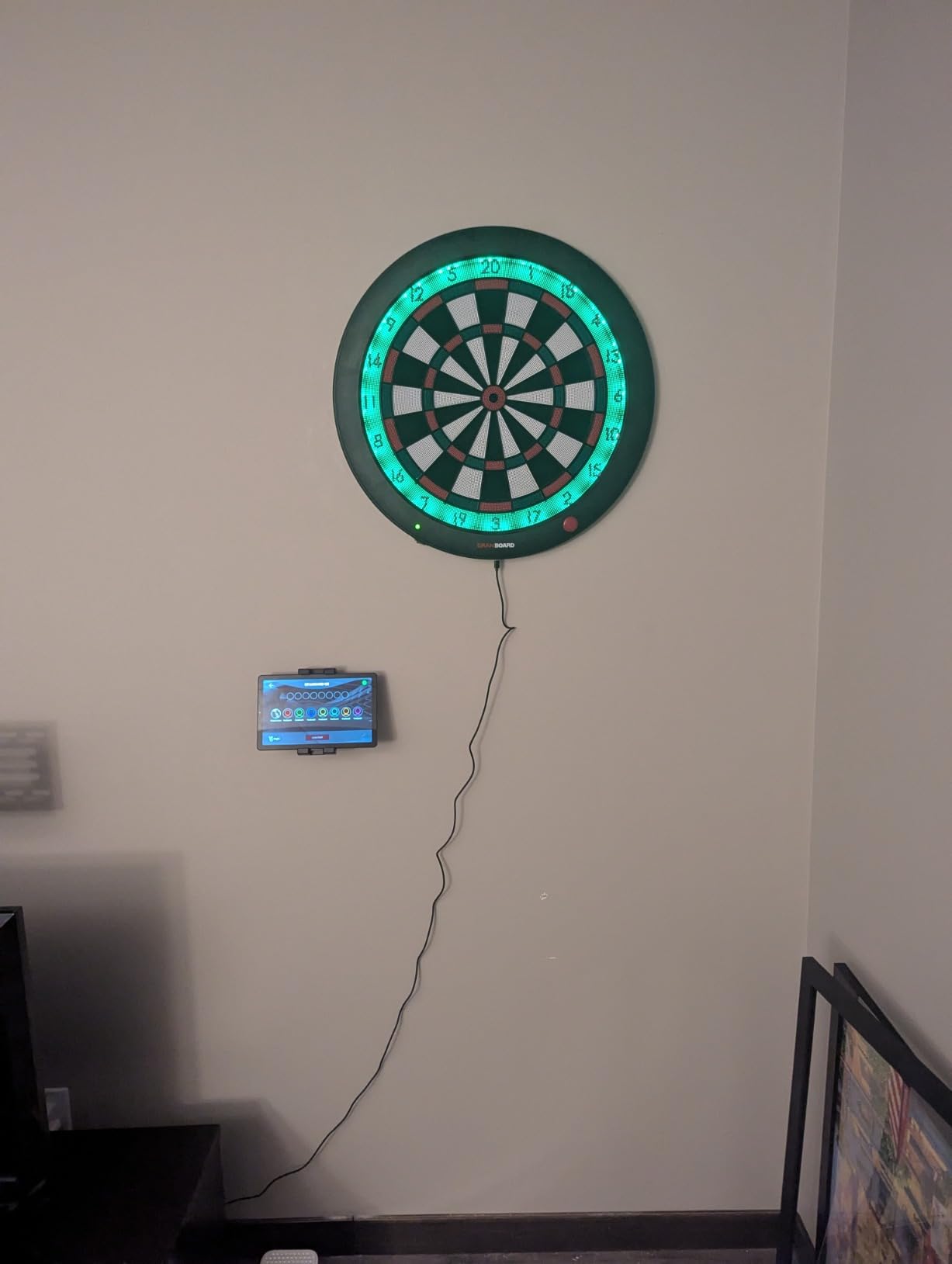
The GranBoard 3s is the pick when your real opponent is not in the room. Bluetooth 5.0 connects to a phone, tablet or smart TV, and the free app turns the board into an online multiplayer system with opponents worldwide plus a global player rating.
That solves the problem every home board has: nobody to play against on a Tuesday. Nine computer difficulty levels cover solo practice from beginner to advanced, and the app handles automatic scoring and stat tracking without a chalk board or a scorebook.
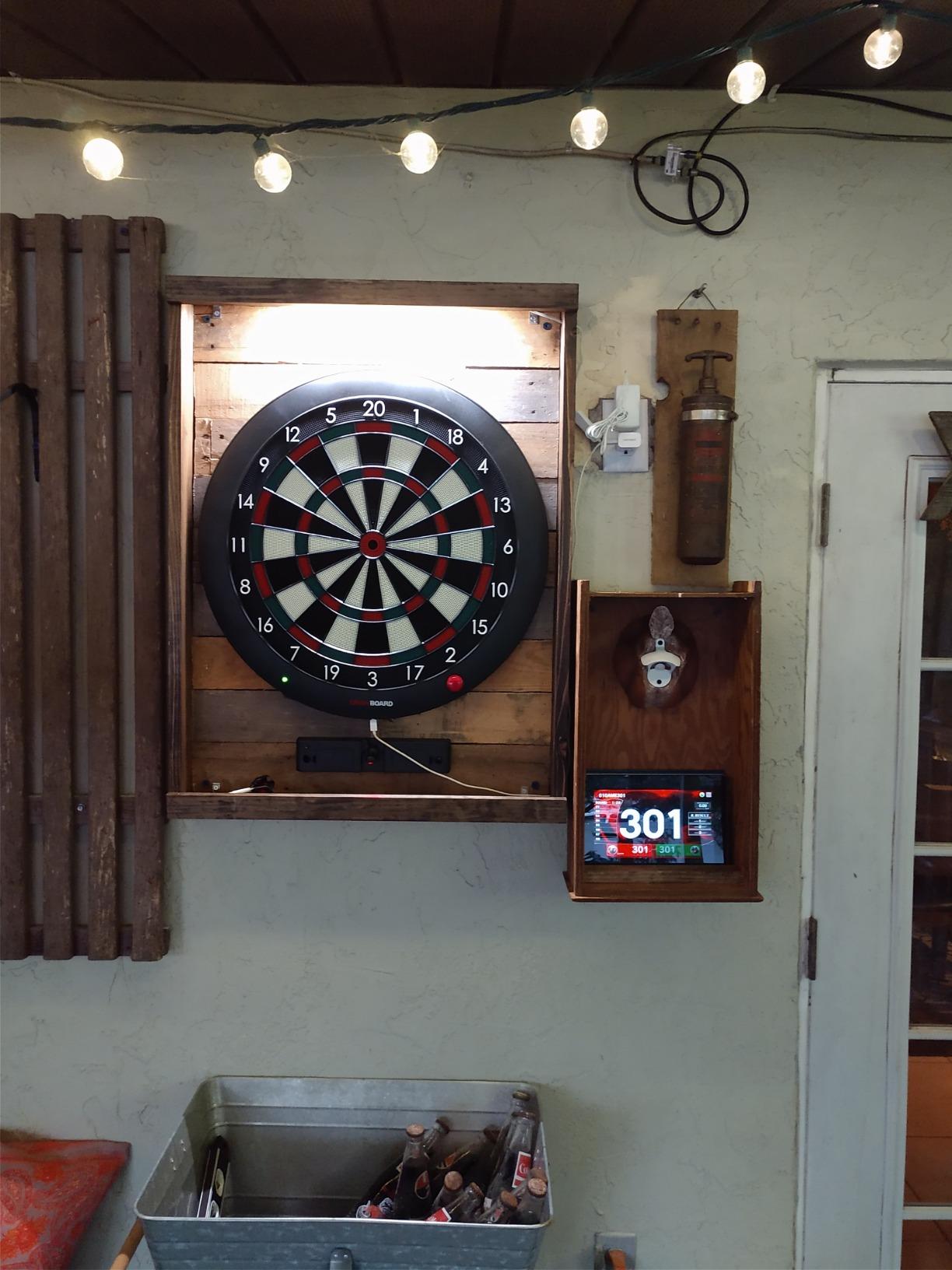
The acoustic absorbent segments are the quiet-play feature, and in a basement or a room shared with a neighbour that matters more than the LED lighting. The lighting with customizable effects adds an arcade look that suits a man cave, and the board runs on USB power or AA batteries, so it travels between rooms.
Two constraints to plan for. Cricket mode is limited to four players by the software, which rules it out for a full eight-player house tournament, and the LED lighting needs a power cord while the AA batteries only power the Bluetooth function.
The included darts are basic, so a hardware upgrade for the tips is worth budgeting. Reviewers also note that the app experience depends entirely on having a phone or tablet alongside the board.
Who the GranBoard 3s suits
It suits players who live alone, travel frequently, or want to keep playing during a season when their regular group is away. r/Darts users who value the online community, events and leagues recommend this board for reasons that have as much to do with the app as the hardware.
The acoustic segments also make it a good fit for a shared-wall building where a board that thumps on every hit would be a problem. Practice against the computer levels means skill work does not need a partner.
Where the GranBoard 3s falls short
It sits in a premium tier, and the value case depends on whether you will actually use online play. A group of four playing together every week will get more from a cabinet set at a lower tier.
The 22.5 inch footprint and the app dependency also make it a less tidy choice for a finished game room. Anyone who wants a board to hang and forget will find the setup more involved than a plain sisal panel.
How to Choose and Install a Dartboard in a Home Game Room
Bristle, electronic or cabinet: what you are really choosing
Start with who throws. If the players are adults or older teens who already throw steel-tip, a bristle board is the only answer that will not feel like a toy. If children share the room, an electronic soft-tip board is the responsible choice, because a plastic tip that fails to stick simply drops to the floor.
Then decide what happens to the wall. A cabinet protects drywall, hides conduit and gives you dart storage and a scoring surface. A foam or plastic surround is cheaper and does the job of catching holes. A bare board on a bracket is fine in an unfinished room and a mistake in a finished one.
Steel tip versus soft tip in a shared house
The rule that has never failed us: a room with unsupervised children gets soft tips, full stop. Steel-tip darts are dense metal points on a shaft, and the board is a hard target at child height. Players who will only throw steel-tip can still use an electronic board well, they simply need to adjust to the feel.
Reverse the situation with care. Soft tips on a sisal board bend and deform, so a plastic-tipped dart hitting a bristle face is a poor pairing that wrecks the tips. Match the dart to the board, not the other way around.
Measurements that decide whether the room works
A regulation board has an 18 inch scoring face. Mount the bullseye center at 5 feet 8 inches from the floor, and chalk the oche — the throw line — at 7 feet 9.25 inches for steel-tip, or 8 feet for soft-tip. Clear a lane at least 5 feet wide and 11 feet long from the board to the back wall.
Those numbers are the reason a 10 by 10 room may not work. Measure before you buy, mark the bullseye height with tape, and stand at the oche position. If the walkway or the door is inside the lane, the room will feel cramped no matter which board you hang.
What to check before you drill
Find a stud with a detector or by knocking, because a board plus a cabinet is heavy and drywall anchors will not hold it. Check for wiring and conduit before you drill, since the back of a cabinet is exactly where you do not want to find a live cable.
Concealing wiring is the question that gets asked most in forums and answered least. The practical options are a surface-mounted conduit run painted to match the wall, a shallow chase cut into the plasterboard behind the cabinet, or accepting the visible cable and routing it down behind the skirting.
Quality tells when you compare boards
Look for a staple-free bullseye, a thin radial or circular wire spider, stated board diameter and thickness, and a number ring that can be moved. Those four details separate a board that stays flat from one that develops a dead zone, and every regularly maintained board in this roundup has at least three of them.
Weight is a decent proxy too. Heavier boards tend to be thicker and land with a deeper sound, and a board that feels substantial on the wall also stays stable, which matters more for scoring than any feature on the box.
Lighting, noise and the rest of the room
Light the board from above and to the side with shaded fixtures, or the players will throw into their own shadow and blame the board. A single bare bulb in the ceiling creates exactly the shadow across the upper scoring area that makes a good board feel unfair.
Sound travels further than people expect. Steel-tip on sisal is loud, and an electronic board adds a speaker on top of that. If the room is above a neighbour or shares a wall, an acoustic-segment board or a softer surround will save the arrangement. For the rest of the room’s equipment, our picks for the best speakers for small rooms cover the sizing side of that equation.
Frequently Asked Questions
What is the best dart board for playing at home?
For most homes, a regulation self-healing sisal board of about 18 inches, hung with the bullseye at 5 feet 8 inches and the throw line at 7 feet 9.25 inches, is the best dart board for home use. Add a cabinet or surround so the wall behind it stays finished, and choose steel-tip only if every regular player is comfortable with sharp points.
What is the best dartboard for a beginner?
Beginners do best on a board that rewards a straight dart rather than hiding errors. A staple-free bullseye and a thin wire spider give cleaner feedback, and a thicker sisal face produces a sound that makes practice enjoyable. The Winmau Pro SFB and the Winmau Blade 6 both suit a learner who will progress to league play.
Is Unicorn or Winmau better?
Both compete in the premium bristle tier, and the choice usually comes down to wire style and finish rather than quality. In this roundup, Winmau placed three boards in the top tier, with the Blade 6 and Diamond Plus both rated 4.8 across more than nine thousand reviews each. Judge any board in that tier on its bullseye, spider and bracket.
What is the best dartboard with cabinet?
The EastPoint Belmont is the strongest all-in-one cabinet set here, with an 18 inch self-healing sisal board, a steel spider, a rotating number ring, six steel darts and two chalk scoreboards in one unit. For a narrow wall, the Viper Hideaway has a far smaller footprint, though its supplied board is stapled and worth replacing.
How far up a wall should a dart board be?
Mount the bullseye centre at 5 feet 8 inches from the finished floor. From there, chalk the oche at 7 feet 9.25 inches for steel-tip play and 8 feet for soft-tip play, and keep a clear lane about 5 feet wide and 11 feet long between the board and the back wall.
Do expensive darts make a difference?
Not much to the score, and regular players say so directly. Weight and grip shape matter for comfort and consistency, and most beginners are well served by 22 to 24 gram tungsten. The darts bundled with budget boards, however, tend to bend or break quickly, so replacing them is a cheap upgrade worth making.
Are soft-tip dartboards better for home?
They are better for safety, not for feel. Soft tips make an electronic board the right choice in a house with children, since a dart that fails to stick simply drops. Players used to sisal often find the plastic surface imprecise, and soft tips should never be thrown at a bristle board because they bend and deform.
What is the best interactive dart board for home use?
The Arachnid Cricket Pro 450 offers a regulation 15.5 inch target, 31 games with 178 variations, automatic scoring and checkout assist, plus bounce-out correction. For a group of up to eight, the Arachnid CricketMaxx adds dedicated LED panels, and the GranBoard 3s adds online play against opponents worldwide.
The Verdict for a Home Game Room in 2026
Measure the wall before you choose anything. The bullseye goes at 5 feet 8 inches, the oche at 7 feet 9.25 inches for steel-tip, and you need a clear 5 by 11 foot lane behind it. Boards that fit that lane in 2026 are a different shortlist from boards that do not.
For a typical home game room we would start with the Winmau Blade 6 on a proper bracket inside a cabinet, and add the Viper Shot King or Viper League Pro as the second board if a second wall exists. Households with children should skip straight to an electronic soft-tip option instead, and small rooms should look at the Fat Cat Mercury or the Viper Hideaway before anything else.
Whatever you pick, the finishing touches decide whether the room looks deliberate: shaded lighting from above and to the side, darts stored upright, a scoring surface that lives with the board, and cables that do not run visibly down the wall.
Our guides to the best stereo cabinets for living rooms and best speakers for large rooms cover the rest of a finished game room once the throwing lane is set.