
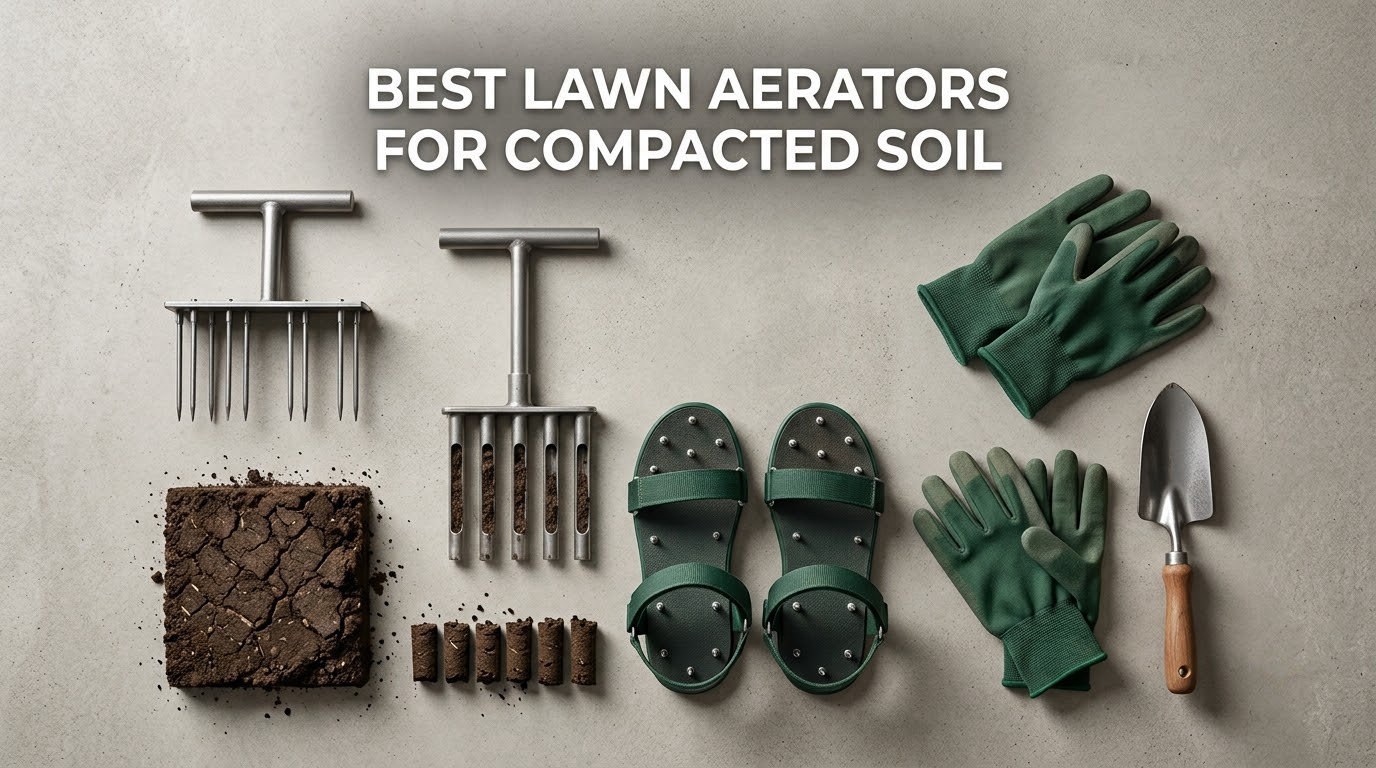
If your lawn has hard ground, thin grass in the traffic lanes, and water that pools instead of soaking in, the answer is a core aerator, not a spike tool. That is the honest starting point for this roundup of the best lawn aerators for compacted soil, and it is the point most shopping carousels get wrong.
We spent weeks comparing ten manual, rolling, and tow-behind aerators across lawn sizes from a small urban yard to a half-acre property, and looking hard at what each one actually does to soil that has already packed down. Two of the ten are spike machines, and we explain plainly where they fit and where they do not. The rest pull real plugs.
Our top three: the Yard Butler ID-6C coring aerator as the overall pick for most homeowners, the Walensee 15-spike tool as the low-cost way to handle spot problems, and the Agri-Fab 48-inch tow-behind for anyone with a tractor and a large property. Before any of that, run the three tests below, because a cheap spike tool is the wrong answer on hard clay and the right answer in a flower bed.
If you will be running any of this with a gas mower, our guide to Bluetooth hearing protection for lawn mowing is worth a look before the season starts.
Table of Contents
Will an Aerator Work on Hard Ground?
Yes, but only with the right tool and a little preparation. Core aerators penetrate hardest because hollow tines remove material instead of pushing it aside, so water the lawn the day before to get the soil moist but not wet, and add ballast weight to a tow-behind if it will not cut in. A cheap spike aerator on dry, hard ground skates across the surface and may bend its tines.
How to Tell If Your Soil Is Actually Compacted
Three field tests take about ten minutes and tell you which machine class you need. Do them before you spend anything.
1. The screwdriver test. Push a standard flat-head screwdriver into your lawn in a few spots. In healthy soil it should slide in to 3-4 inches with light hand pressure. If you can only manage an inch or two and you have to lean on the handle, you have compaction. Repeat in the worst traffic lane, since that is usually where the problem is worst.
2. The water infiltration test. Pour a gallon of water onto your lawn and time how long it takes to soak in. An inch or less in ten minutes means compacted soil. If the water beads up and sheets sideways into low spots, the pore space your grass roots need is gone.
3. The thatch check. Lift a section of turf with a knife and measure the thatch layer, the brown mat of dead material between the green blades and the soil. Over half an inch is a problem on its own, because it blocks water and air from reaching the crown even when the soil below is fine.
Here is how those results map to a tool. Light compaction and a thin thatch layer on a small lawn means a spike aerator will do the job. Genuine compaction that stops a screwdriver at two inches needs a hollow-tine core aerator. Compaction across a large property with a tractor behind a deck means a tow-behind. A large lawn with no riding mower means a rolling drum.
Core Aerator vs Spike Aerator: Which One Fixes Compacted Soil
A core aerator. It pulls 2-3 inch soil plugs out of the ground and deposits them on the surface, removing compacted material and leaving open holes that let air, water, and nutrients reach the root zone. A spike aerator pushes a solid spike in and the soil closes up around it. On clay, that squeezing at the sides of the hole can leave compaction worse than before.
A spike aerator is not useless. It perforates the surface, it works well on thin thatch and light compaction, and on a small lawn where nobody is tracking down results it is a cheap way to get some air movement. It just does not remove soil, so it cannot fix the problem this page is about. Two spike machines make our list because they earn their place for specific jobs, and we say which ones.
Top 3 Best Lawn Aerator Picks for Compacted Soil in October

Yard Butler Coring Aerator
- Dual coring plugs with foot bar
- Powder-coated steel
- Long upright handle
Walensee 15-Spike Aerator
- 15 iron spikes in three rows
- Cushioned T-handle with foot pedal
- Detachable for storage
Agri-Fab 48in Tow Plug Aerator
- 48 inch width with 32 knives
- Plugs up to 3 inches deep
- Weight tray holds 175 lb
All 10 Lawn Aerators Side by Side in 2026
| Product | Specs | Action |
|---|---|---|
| Yard Butler ID-6C Manual Coring Aerator |
|
Check Latest Price |
| Walensee 15-Spike Manual Lawn Aerator |
|
Check Latest Price |
| Agri-Fab 48-Inch Tow-Behind Plug Aerator |
|
Check Latest Price |
 Dolibest 4-Corer Coring Aerator Dolibest 4-Corer Coring Aerator |
|
Check Latest Price |
 Landzie 42-Inch Hollow Tine Core Aerator Landzie 42-Inch Hollow Tine Core Aerator |
|
Check Latest Price |
 LawnVigor Hollow Tine Core Aerator LawnVigor Hollow Tine Core Aerator |
|
Check Latest Price |
 Gardzen 2-Use Plug and Spike Aerator Gardzen 2-Use Plug and Spike Aerator |
|
Check Latest Price |
 Suchtale 40-Inch Tow-Behind Spike Aerator Suchtale 40-Inch Tow-Behind Spike Aerator |
|
Check Latest Price |
 K.D STONEDGE Rolling Core Aerator K.D STONEDGE Rolling Core Aerator |
|
Check Latest Price |
 SENVERT Rolling Spike Aerator SENVERT Rolling Spike Aerator |
|
Check Latest Price |
1. Yard Butler ID-6C Manual Coring Aerator: Best Overall for Compacted Soil
Yard Butler Manual Lawn Coring Aerator, ID-6C – Lawn Care Tool for Aerating – Long-Handled – Power-Coated Steel Construction – Comfortable Cushioned Handles Garden Tool – Easy to Use
Dual coring plugs with foot bar
Powder-coated steel
38 x 11 x 2 inches, 1.77 lb
Pros
- Priceless build and handle for the money
- Runs more owner feedback than any manual aerator here
- Good prying power in compacted ground
Cons
- Foot bar still needs your body weight in dry soil
- Must have moist ground or tines struggle
We put this through its paces on a compacted front yard that had been walked on for years. The dual-plug coring head and the foot bar give it far more prying force than the single-tine manual tools we tried, and that foot bar is the reason it works at all in ground that stops a screwdriver at two inches.
Owners consistently rate the long handle and cushioned grips as the difference between aerating and avoiding aerating, because you stay upright instead of bent over the lawn. At 1.77 pounds it is also light enough to move around a yard without thinking about it.
The steel is powder-coated rather than bare, so it survives being left out on a wet weekend and comes back for the next season without blooming with rust. Owners put it through repeated seasonal use and report it holding its shape.
Be realistic about the physics. This is a manual tool, so it covers a small lawn in an afternoon and a large one in a weekend, and the honest review consensus describes it as a workout on compacted soil. It is a spot-repair and small-lawn machine by design.
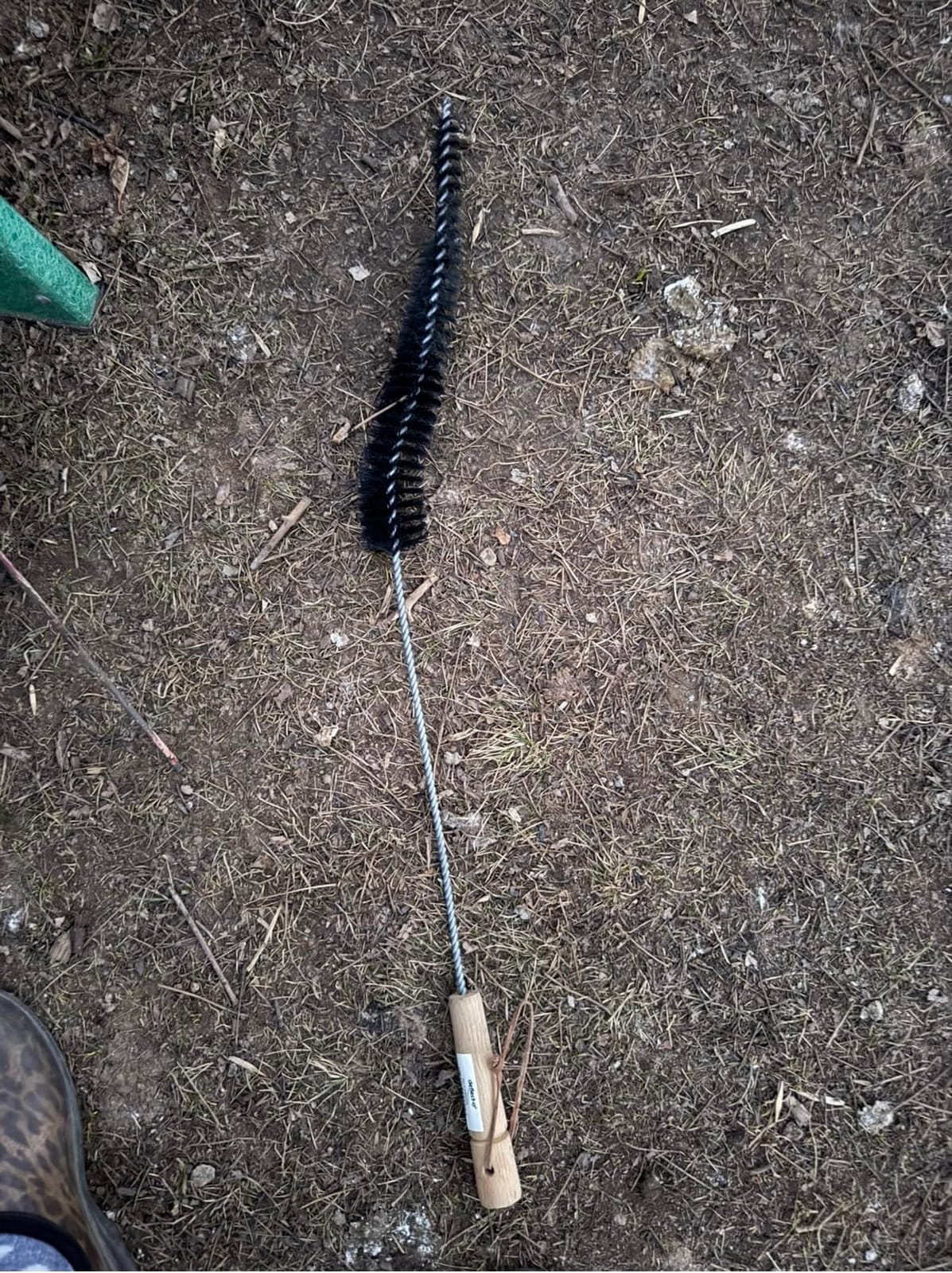
How much lawn can one person actually cover
Plan on it being a weekend project for anything over a few thousand square feet. Owners with a quarter-acre lot describe breaking the job into sections across several sessions rather than trying to finish in a day.
For traffic lanes, a dog run, a path worn bare along a fence, or a bare patch in front of a door, it is more than enough. That is where manual coring pays off fastest, because you treat the problem area and stop.
When it will not get the job done
If your screwdriver test stops at an inch and you have heavy clay, this tool will not save you. Water the lawn the day before, and if it still will not penetrate, you need machine weight behind the tines rather than more body weight.
It is also not a spike tool, so it will not perforate a thatch layer the way a spike head would, though coring 2-3 inches down tends to break thatch up anyway as the plugs come to the surface.
2. Walensee 15-Spike Manual Aerator: Best Value for Spot Problems
Walensee Manual Lawn Aerator Tool with 15 Iron Spikes, Garden Spike Aerator
15 iron spikes about 2.8 inches long
34.6 inch cushioned T-handle
4.49 lb, detachable
Pros
- Fifteen spikes cover well per step
- Foot pedal and T-grip reduce bending
- Cheapest way to perforate compacted spots
Cons
- Spikes puncture rather than pull plugs
- No good on heavy clay or whole-lawn jobs
- Dry ground needs watering first
This is the tool most people buy first, and for a specific job it is genuinely good. Fifteen iron spikes in a three-row layout open more channels per step than single-row spike tools, so a worn path or a bare patch gets treated in minutes rather than an afternoon.
The 34.6 inch handle with a cushioned T-grip and a foot pedal keeps your back out of it, which is where a lot of spike tools fail. It also comes apart for storage, so it lives in a garage corner instead of blocking the mower.
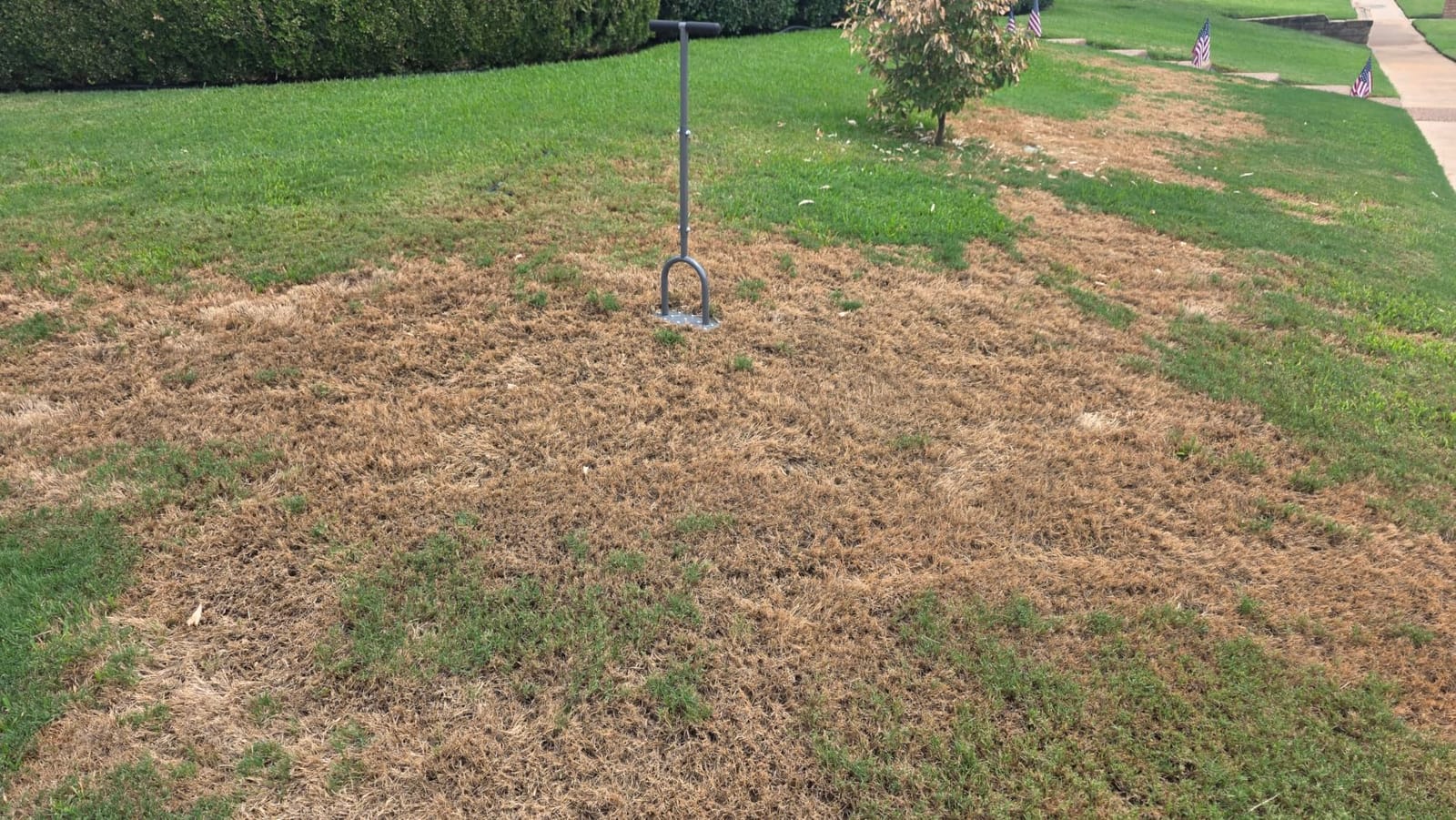
Reviewers rate it highly for small-area and spot aeration, and the 4.3 star average across more than 2,800 ratings reflects that. The one complaint that repeats is not about quality, it is about scope.
The complaint is that spikes make holes and do not remove soil. On soil that is merely surface-hardened, that is fine and it feels like progress. On genuinely compacted clay, it is the wrong mechanism and it will not change your lawn.
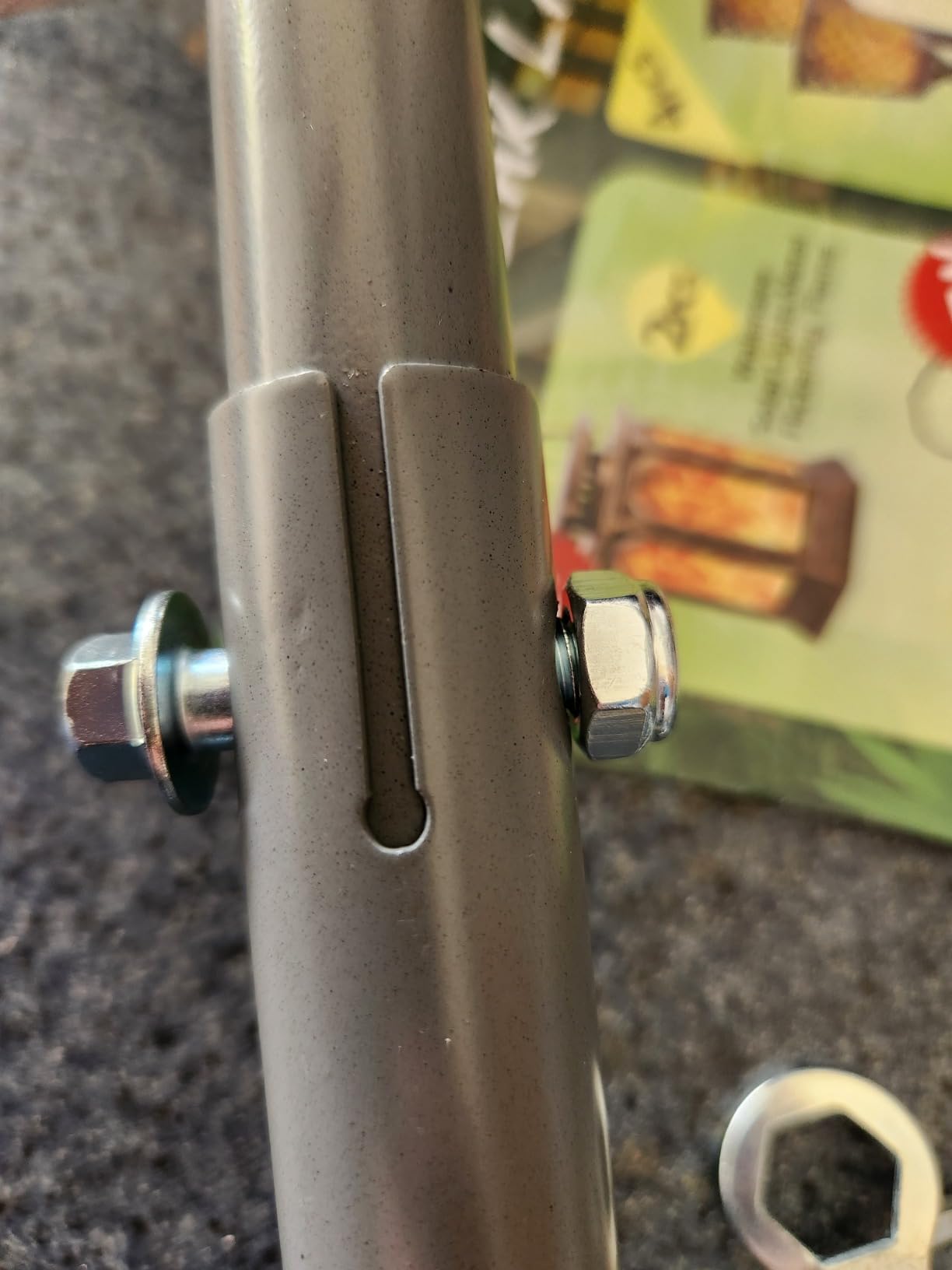
Where this tool genuinely earns its place
Edging along fences and walls, breaking up a crust on a lawn that has baked hard after a dry spell, opening channels in a flower bed, and loosening the soil in seed patches before you overseed. All of those are surface problems and spikes solve them.
It also makes a good companion to a coring aerator. Use spikes to open the surface, then run a hollow-tine tool to pull material out of the worst zones.
Why we would not use it on hard clay
Because it compresses the soil at the sides of each hole, which is the opposite of what a compacted lawn needs. The product reviews say the same thing: not suitable for heavy sticky clay soil or large-scale aeration.
If your screwdriver test stops under two inches, skip this and move up to a hollow-tine core aerator. You will spend more time and get a result you can actually see in the grass.
3. Agri-Fab 48-Inch Tow-Behind Plug Aerator: Best for Large Lawns
Agri-Fab 48 In Tow Behind Lawn Plug Aerator with 32 Galvanized Knives and Universal Hitch
48 inch width, 32 galvanized knives
Plugs up to 3 inches deep
Weight tray holds 175 lb, 94 lb unit
Pros
- Widest swath in this roundup
- Weight tray fixes hard-soil penetration
- Knives stay sharp over seasons
Cons
- 94 pounds needs a tractor
- Awkward to store or move alone
- Flat tires mark soft ground on turns
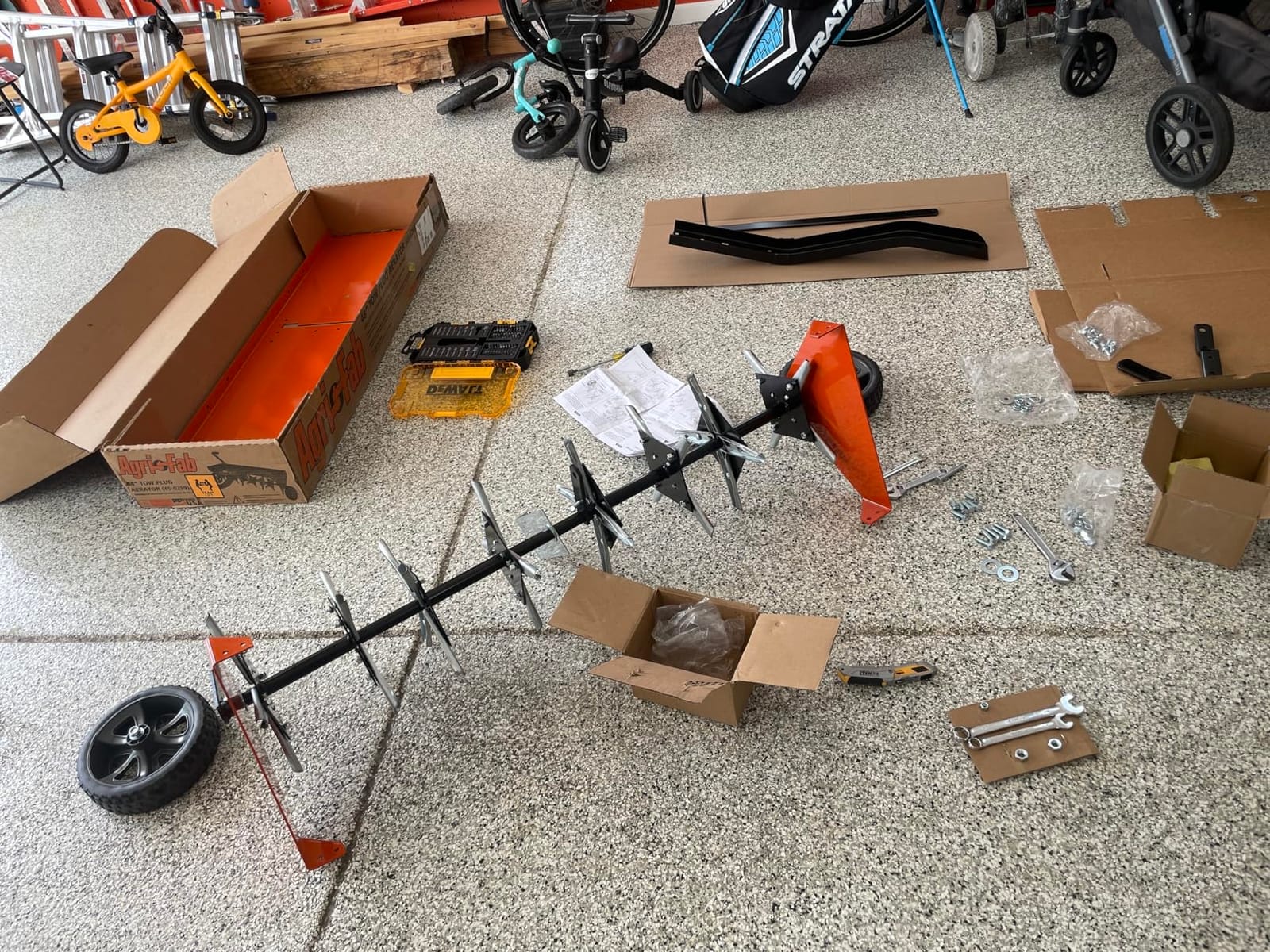
This is the machine for someone with half an acre or more and a tractor or riding mower, and it is the only tool here that pulls three-inch plugs across a full lawn in an afternoon. Thirty-two galvanized self-sharpening knives across 48 inches is a lot of cutting edge for one pass.
The weight tray is the part that matters most for compacted soil, and it accepts up to 175 pounds of ballast. Concrete blocks or sandbags on that tray are the single step that turns this implement from something that skims the surface into something that penetrates four inches of packed clay.
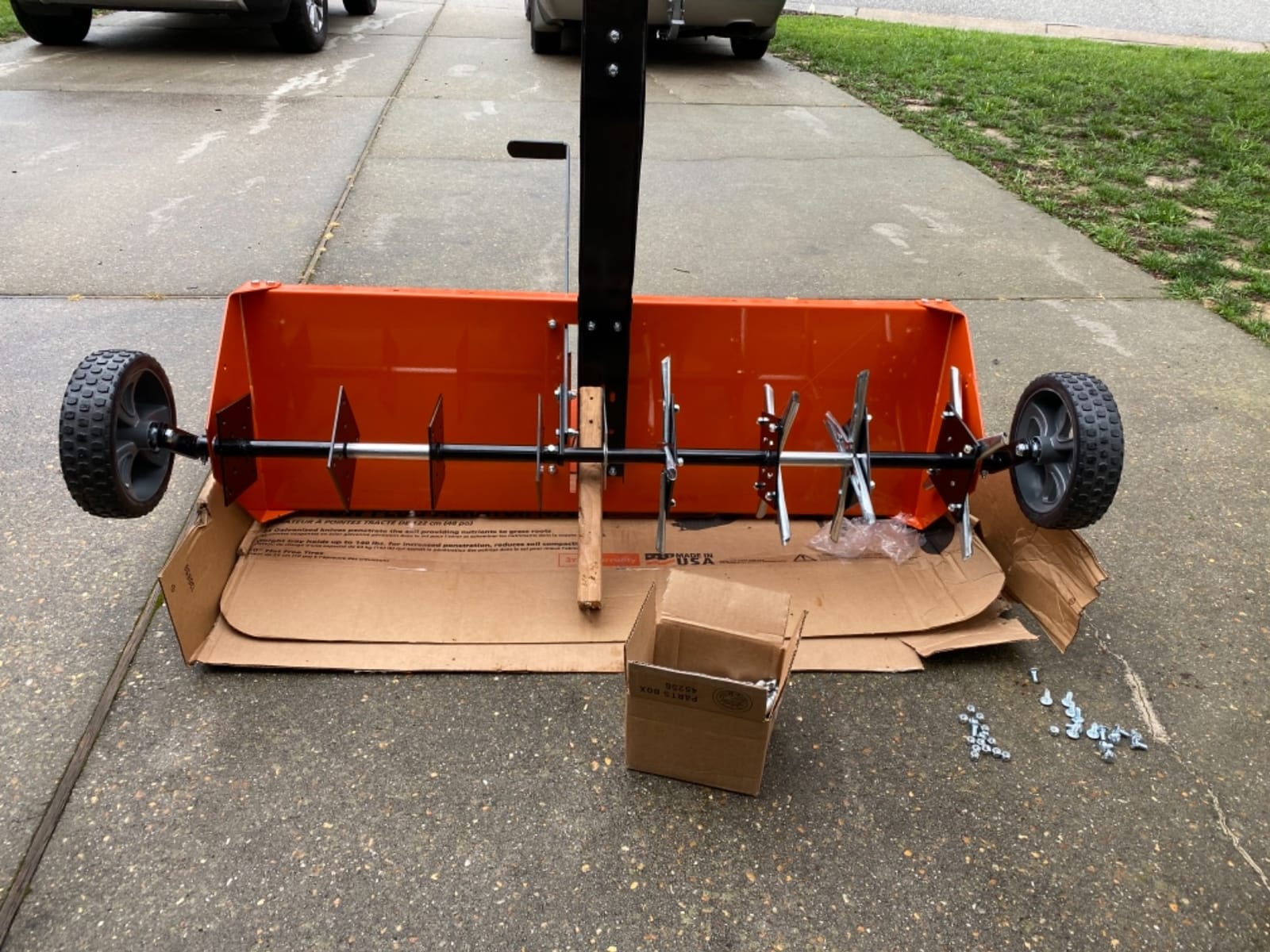
Owners with tractors describe it as a durable implement that holds up season to season, with the knife coating holding its edge. It runs behind most lawn and garden tractors through the universal hitch.
The 94 pound unit weight is the reason for the mixed reviews. It is a heavy piece of equipment that needs a machine to move, and the deductions in owner feedback center almost entirely on that and on the need for a tractor at all.
How to make it work on hard ground
Load the weight tray. That is the whole trick, and it is the buying tip that shows up in exactly one place across most competing guides. On soil that stops a screwdriver at an inch, an unweighted tow-behind will ride over the top and leave stripes of nothing.
Raise the hitch so the tines sit at the low point of their travel, water the lawn the day before, and mow to 1.5-2 inches first so the machine is not dragging a mat of grass.
Why you might want to rent instead
Because you need storage for 94 pounds of steel and you need a tractor. If your lawn is under a quarter acre, a rolling core aerator will cover the same ground in a fraction of the time and cost a fraction of the commitment.
Flat tires also leave marks on soft ground when you turn, so plan your passes as long straight runs rather than tight loops.
4. Dolibest 4-Corer Coring Aerator: Best for Spot Repair With Clean Cores
Dolibest Lawn Coring Aerator, Stainless Steel 4 Corer Plug Aerator Tool with Soft Rubber Grip, Manual Grass Aerating Tool, Garden Tool & Cleaning Hand Tool for Loosening Soil and Improving Lawn Health
4 stainless corer plugs 3.5 inches long
0.5 inch core diameter
Rubber grip, foot bar, 12 inch tool
Pros
- Stainless plugs resist rust in wet soil
- Narrow cores punch clean holes
- 12 inch tool clears cores and weeds
Cons
- Tines clog often in wet clay
- Needs moist not soggy ground
- Small coverage per step
Four stainless steel corer plugs, each 3.5 inches long and half an inch in diameter, on a powder-coated steel frame. The stainless is the selling point here, and reviewers single it out for staying straight and rust-free in wet ground where cheaper plated steel starts to discolor.
The included 12 inch hand tool is more useful than it sounds. Owners use it to clear cores out of the tines, to weed, and to transplant healthy plugs from good turf into dead spots.
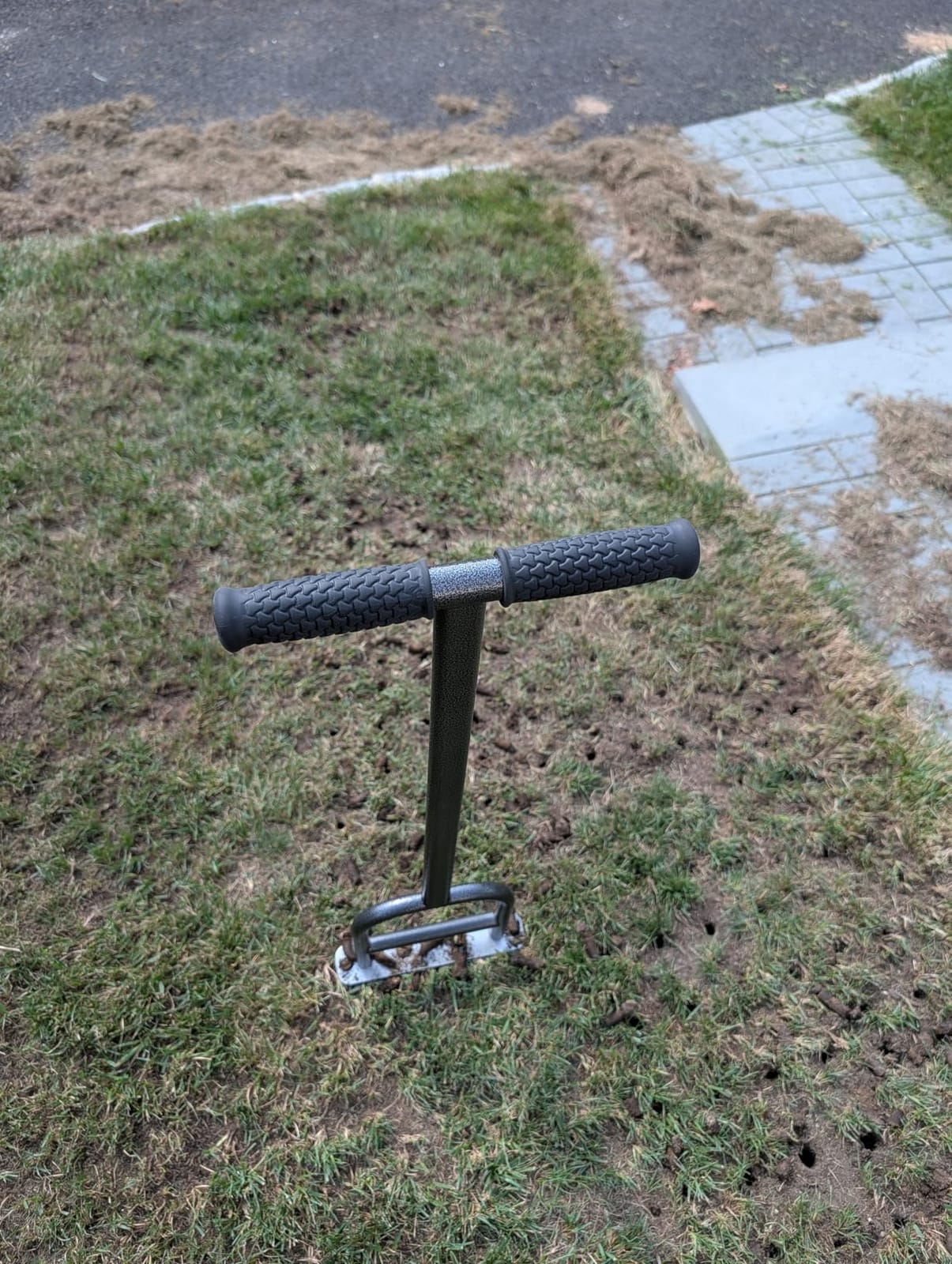
Soft rubber grip and foot bar keep your hands out of blisters and give you a clean way to step down on the tool. Reviewers who get the moisture right report good results and a 4.2 star average across 340 ratings.
The dominant complaint is clogging. In wet clay the tines fill up and need clearing every few dozen steps, and soil that is too dry will not eject plugs at all. Getting moisture right is not a nicety with this tool, it is the whole operating window.
What it does better than a spike tool
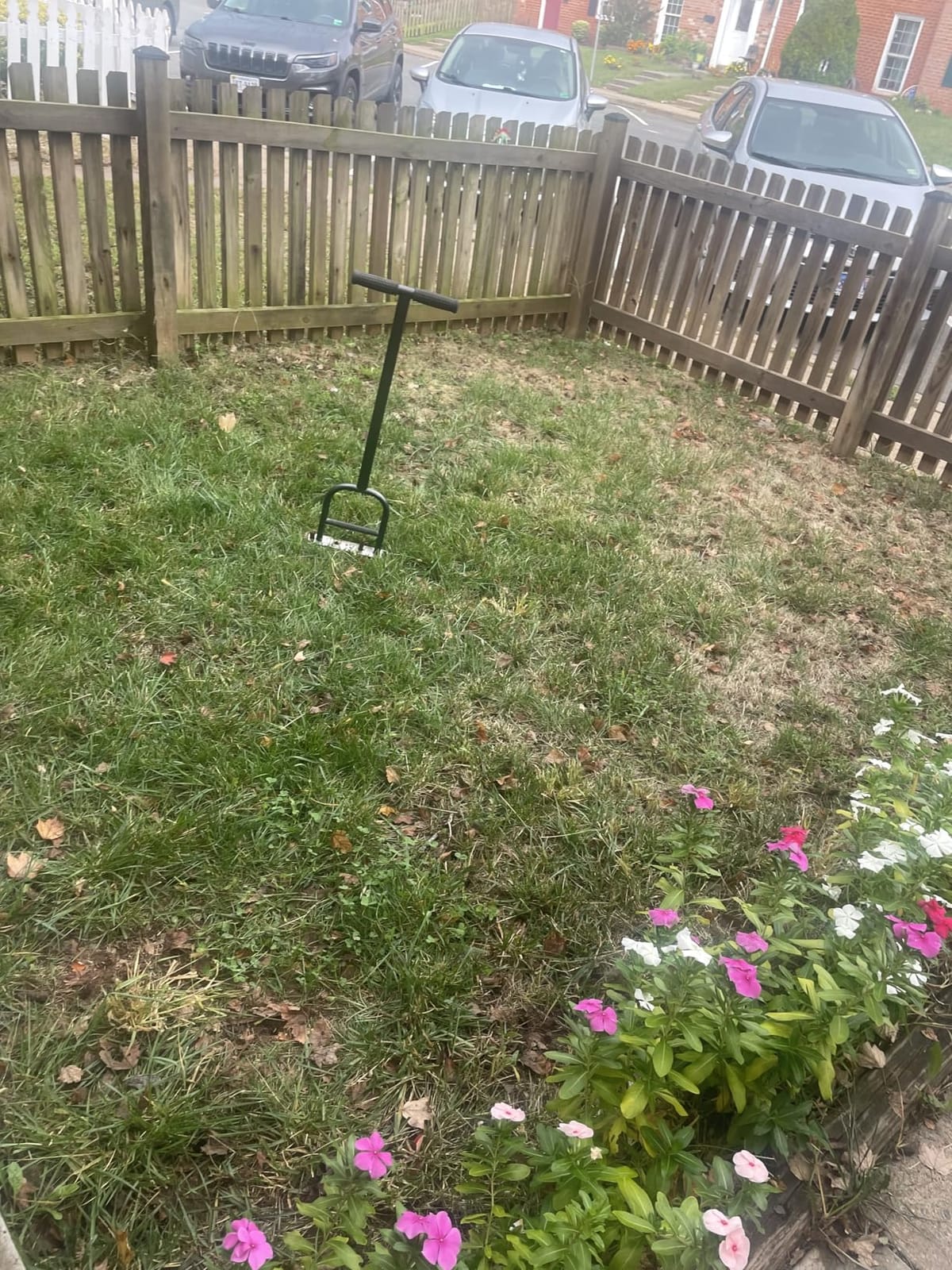
It removes soil instead of making holes, which means you get actual open pore space and a visible plug sitting on your lawn as proof it worked. The half-inch cores punch clean, evenly spaced holes that water and air move into.
For a dog run, a path, or a couple of bare patches, that is exactly the outcome you want and it takes minutes per patch.
Where you will be frustrated
On a whole lawn. Four tines is a small footprint per step, and adding the clog-clearing habit on clay soil makes a large job a long one. Owners with bigger properties report that large lawns take hours.
Some reviews also note that welded joints can loosen over time, so check the frame screws before a big job rather than after.
5. Landzie 42-Inch Hollow Tine Core Aerator: Best for Clay Soil
Landzie – Lawn Aerator Tool 42″, Hollow Tine Core Aerator
3 stainless hollow tines
42 inch powder-coated frame
5.6 lb, arrives assembled
Pros
- Beveled ramp design ejects cores without clogging
- Stainless tines hold up in clay
- No assembly
- tines replaceable
Cons
- Slow and physically demanding
- Needs damp soil or tines may bend
- 42 inch length awkward in tight spots
This is the one we would hand someone with clay who is tired of stopping every few steps to clear their tines. The beveled ramp inside each hollow tine pushes the soil core out on the forward stroke, so owners working in compacted clay report essentially no clogging.
It arrives with the tines already fitted, which means you can be in the lawn the same afternoon it arrives. The hollow and spike tines are also sold separately as replacements, so a bent tine is a two-dollar fix rather than a new tool.
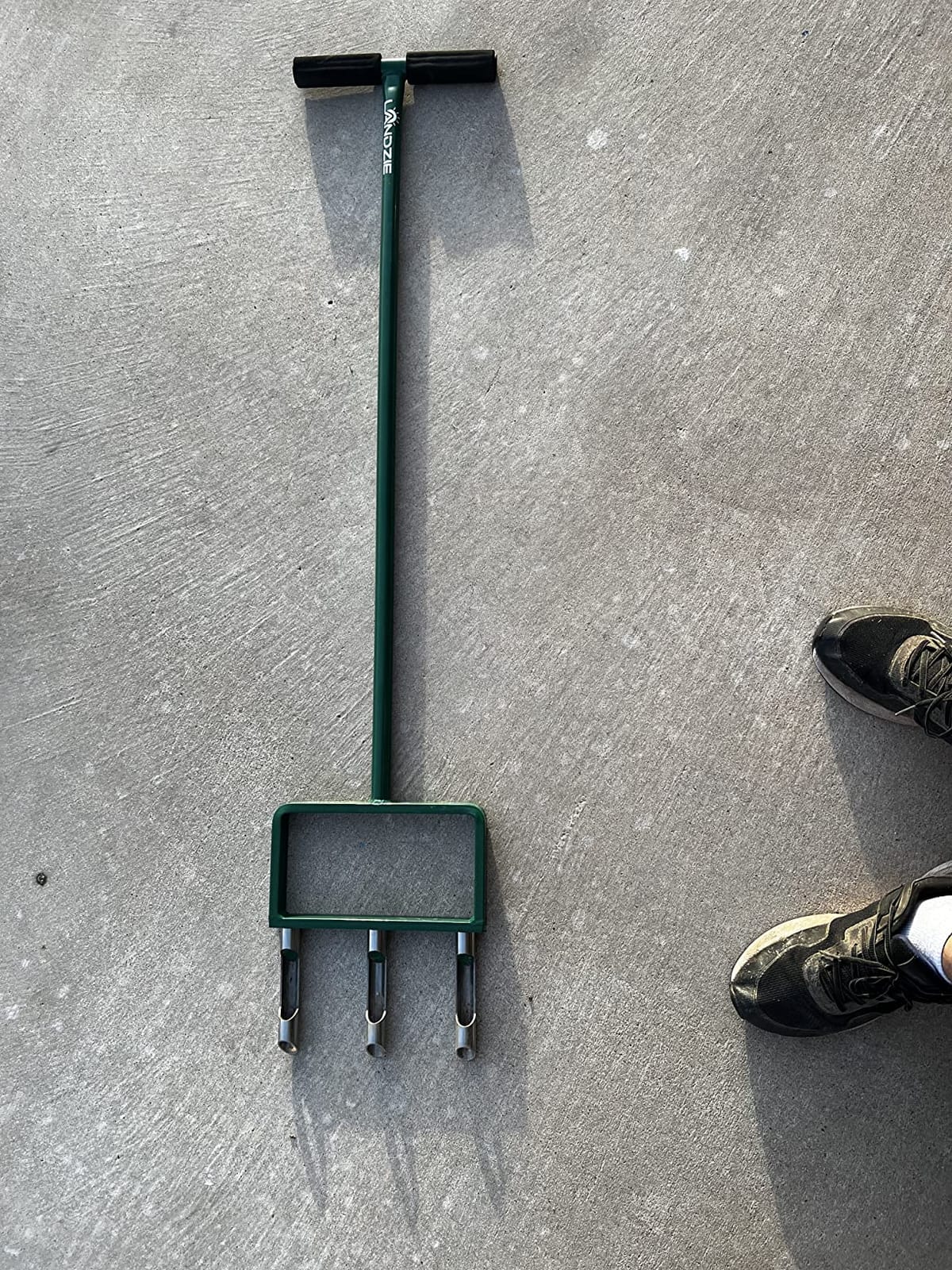
The 42 inch powder-coated steel frame carries a 4.3 star average across 350 ratings, with a five-star share noticeably higher than most manual tools in this roundup. Owners describe the build as something they expect to last for years.
Reviewers also mention responsive customer service, which matters on a specialty tool where replacement parts are the whole point. The stated limitation is labor, not quality: this is a spot-repair tool, not a whole-lawn solution.
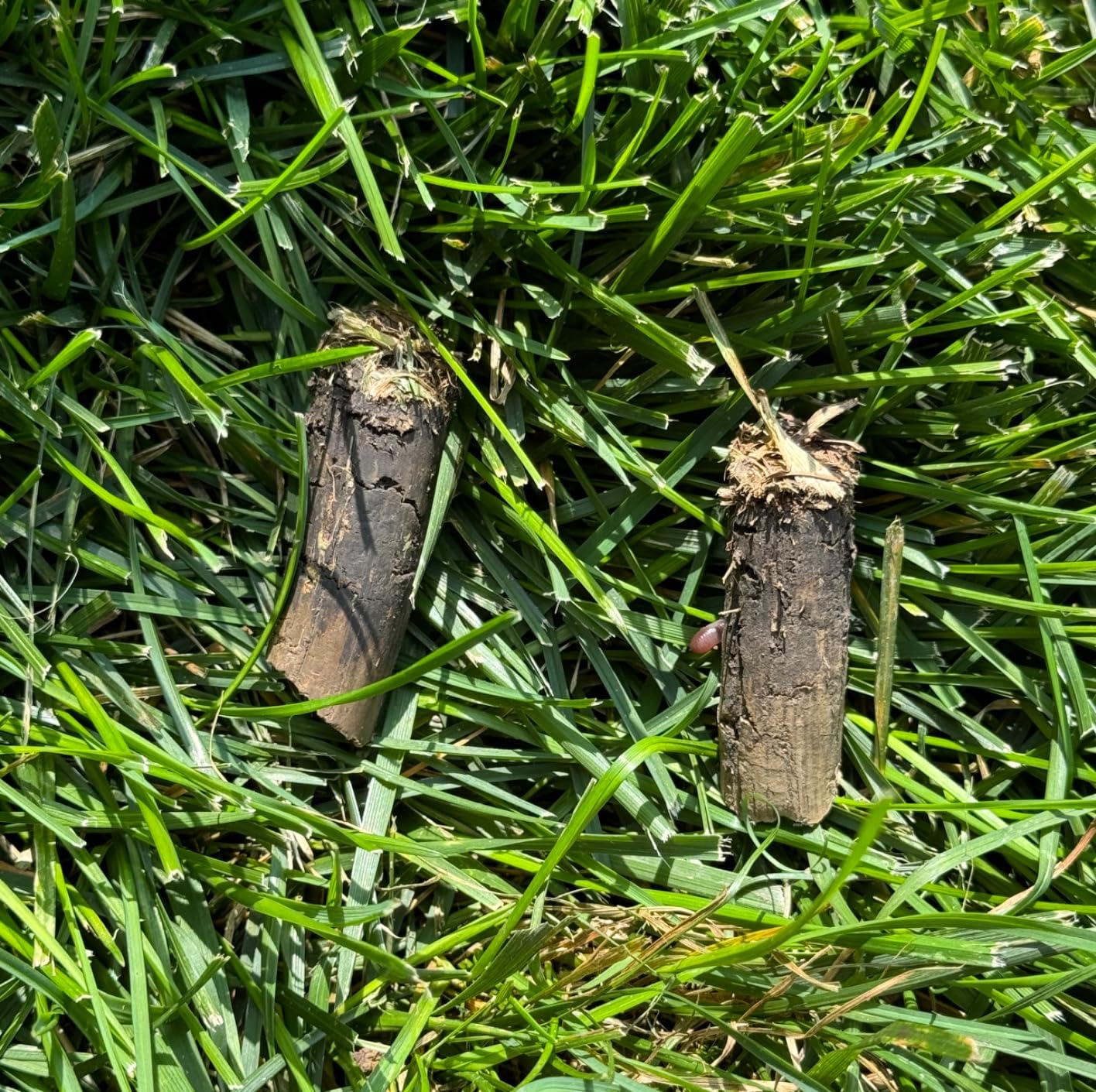
Why the hollow tine matters on clay
A hollow tine removes a core and the ramp geometry does the ejecting for you. In wet clay, where a straight-walled corer jams every few dozen steps, that difference is the difference between finishing the patch and abandoning it.
Half-inch style cores also leave the surface open rather than smeared, which means water infiltrates instead of running across a sealed crust.
Honest limits on size and effort
Three tines means slow coverage, and owners say so plainly. A 42 inch length is also awkward to maneuver in tight quarters, and shorter users mention the extra reach being a workout.
Dry or caliche ground is still a problem. Owners report tines bending when the soil is bone dry, so water first and never use this tool on ground you have not checked.
6. LawnVigor Hollow Tine Core Aerator: Best for Non-Clogging Cores
Manual Lawn Core Aerator for Compacted Soil with Non-Clogging Hollow Tines
3 heat-treated hollow tines
Insert rings eject plugs
About 37 inches tall, replaceable tines
Pros
- Insert rings release plugs as you push
- Highest rating in this roundup at 4.5
- Heat-treated tines pull 2-4 inch cores
Cons
- Handle sleeves can rotate and blister
- Only three tines so slow coverage
- Twisting the tool can bend tines
The white plastic insert rings inside each hollow tine are the clever part. As you push the tool down, the ring releases the soil plug so the tine comes back up empty, which is why buyers describe clean cores with no clogging even in clay.
At 4.5 stars across 255 ratings this is the highest-rated tool in our roundup, with three quarters of its ratings at five stars. Buyers commonly report that it visibly outperforms the cheaper spike aerators they replaced.
The tines are heat-treated and replaceable, and they pull cores 2-4 inches deep, which puts it alongside the deeper-reaching manual corers we tested. Assembly takes minutes with the included wrenches and hex hardware.
Two habits protect it. Do not twist the tool while it is in the ground, because that is how the tines bend or jam. And check the handle sleeves periodically, since they can rotate during use.
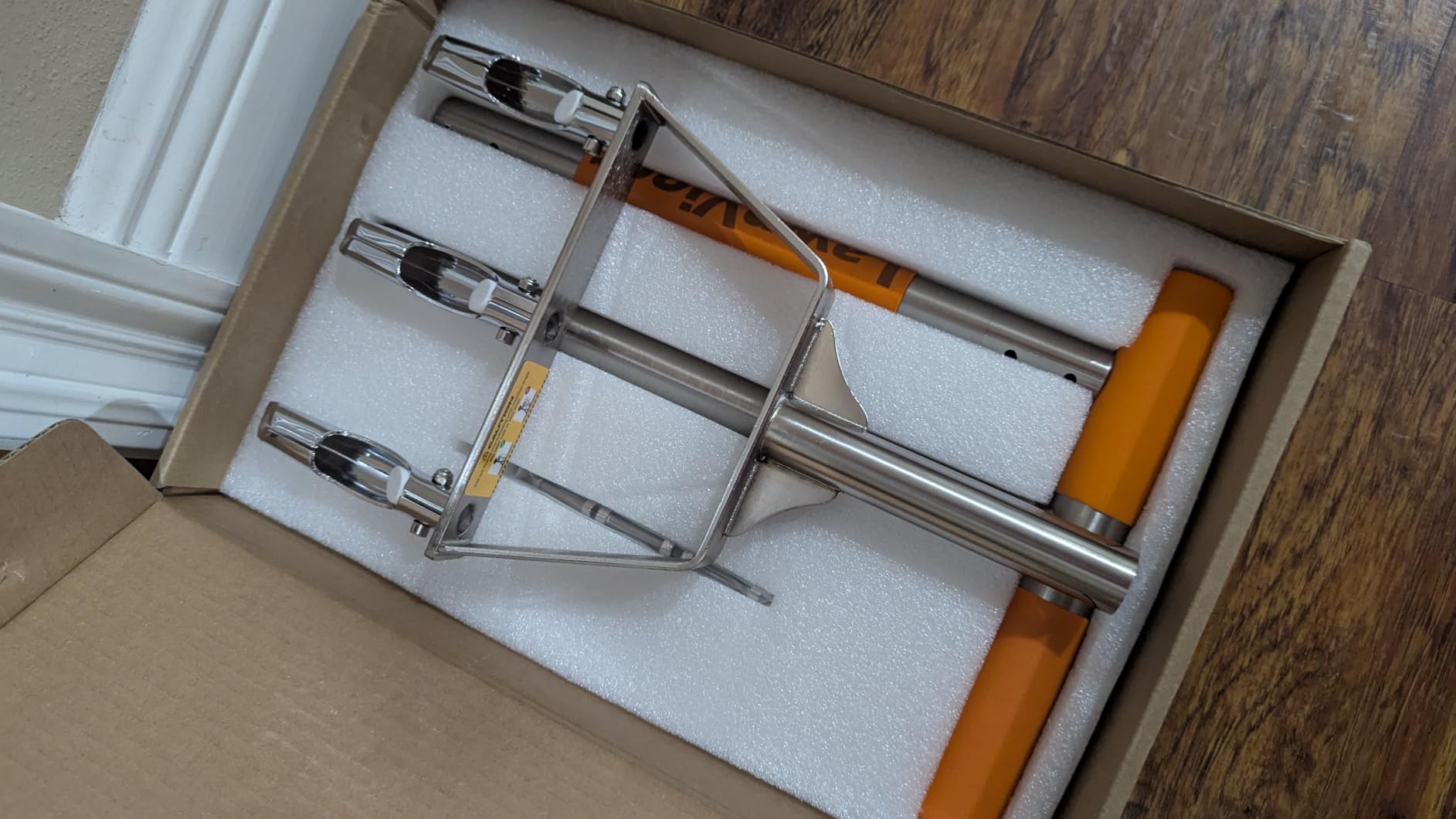
What the insert rings actually change
Clogging is the single most common complaint about manual core aerators, especially in clay. Moving the ejection mechanism inside the tine means you do not stop to knock soil out of tubes every few dozen steps.
It also keeps the hole walls clean, so the core sits on the lawn intact instead of smearing back in as mud.
Where you will notice the effort
Three tines is a small footprint. Owners are clear that coverage is slow, so this is a patch tool and a small-lawn tool. If you have a quarter acre, budget a full weekend or look at a rolling core aerator.
Handle sleeves that rotate are the other recurring note, and they are the main reason to check hardware before a season of use.
7. Gardzen 2-Use Plug and Spike Aerator: Best for Two-Stage Compaction
Gardzen 2 Uses Lawn Aerator Set, Plug Aeration & Spike Aerator, Heavy Duty Aerator for Compacted Soils and Lawns, 35″ x 11″, Black
Interchangeable spike and plug heads
35 x 11 inch steel frame
1 lb, socket wrench included
Pros
- Two modes in one tool
- Cheapest way to try manual aeration
- Sharp spike head breaks surface crust
Cons
- Only one handle
- so heads cannot swap mid-job
- Plug head has few tines
- Best for small lawns
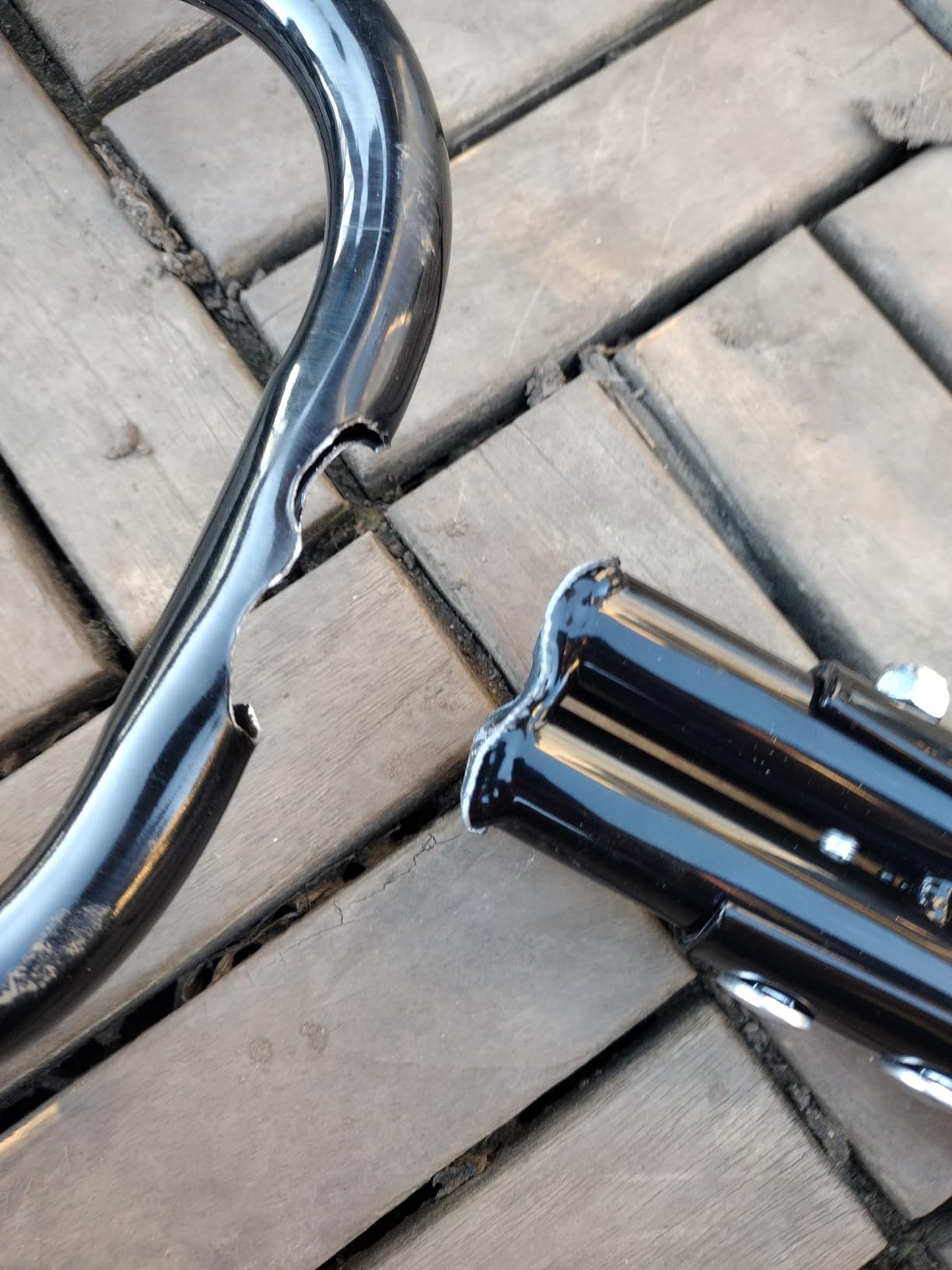
The idea here is simple and correct for many lawns. A 4-spike head perforates the surface, and a hollow-tine plug head pulls cores from problem areas. Both share one handle and one middle section, so you are not buying two tools.
Owners like the powder-coated steel frame and the fact that a socket wrench is included for assembly. It is the least expensive way to find out whether manual aeration is something you enjoy doing.
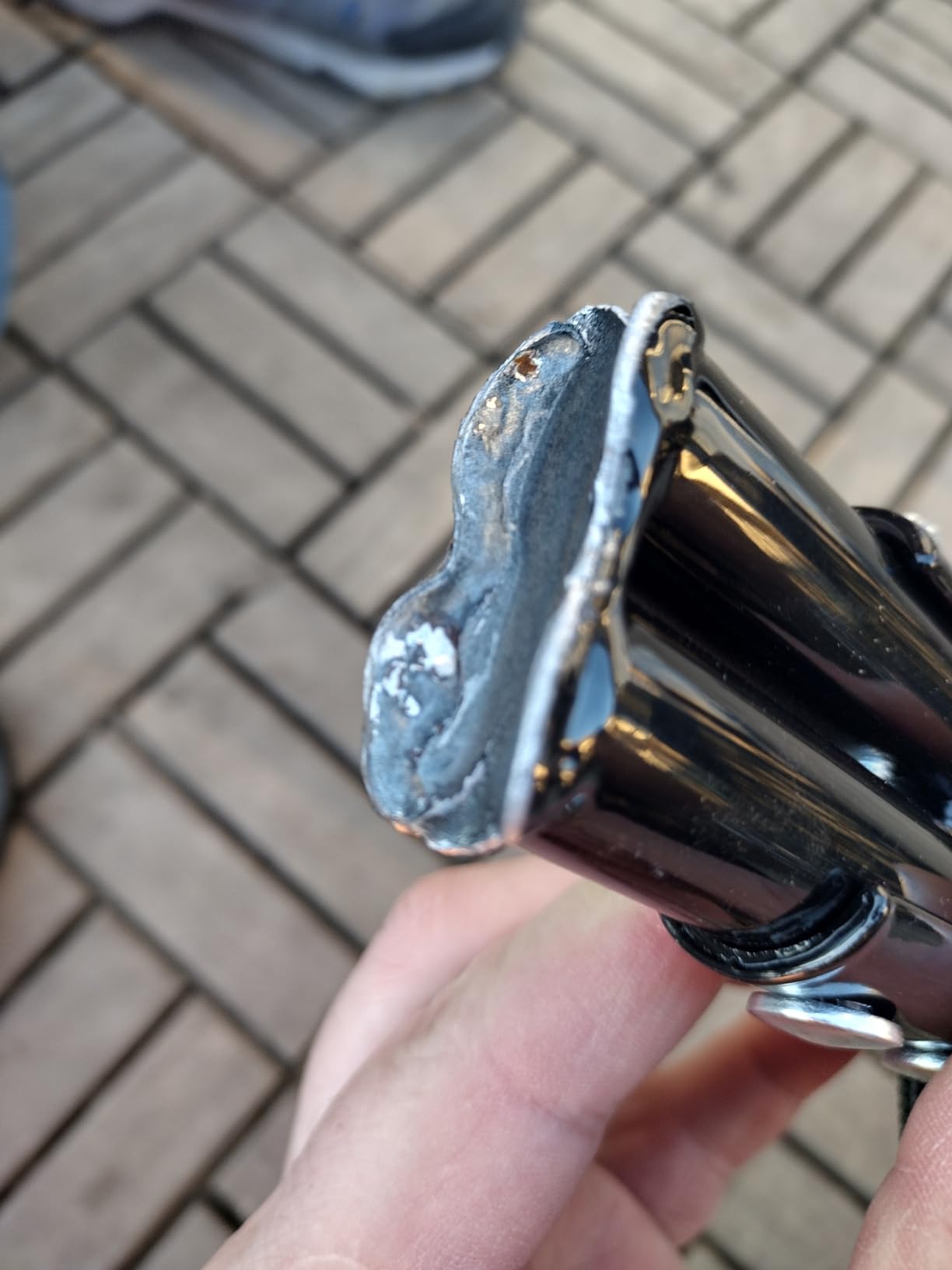
The spike head gets good marks for breaking up surface compaction, which is exactly what a hard crust needs. At 4.2 stars across 265 ratings, satisfaction tracks closely with the buyer’s actual lawn size.
Reviews are consistent that this belongs to spot treatment and small lawns. The plug head has few tines, so coverage per step is low, and the design means one head at a time with no mid-job swap.
How to use the two-stage approach properly
Water the lawn, run the spike head over the whole area to break the surface crust, then switch to the plug head and work the areas that the screwdriver test flagged. You are loosening a lid before you scoop it.
That sequence works best on loam or sandy loam where compaction is moderate. On hard clay, neither head will save you and you should be looking at a rolling or tow-behind core aerator instead.
Where it stops being useful
Large lawns. One pound is pleasant to carry but there is no way to cover a quarter acre with two small heads, and reviews say so without hedging.
It is also worth knowing before you buy that this is a light-duty frame. Treat it as spot repair, not a whole-property tool, and the price reflects that honestly.
8. Suchtale 40-Inch Tow-Behind Spike Aerator: Best for Spiking at Scale
Suchtale 40-Inch Tow Behind Spike Aerator with Galvanized Steel Tines, Durable Lawn Aerator Soil Penetrator Spikes Tractor with Extra-Wide Tow Bar for Lawn and Farm, Black
40 inch width, 10 star wheels
Spikes reach about 2 inches
Weight tray holds 110 lb, 39.5 lb
Pros
- Star wheels rotate during turns so passes stay even
- Leaves no loose plugs to collect
- Spikes reach about 2 inches deep
Cons
- Wheel and hitch hardware can bend or detach
- Spike tips bend on rocks and hard ground
- Needs ballast to penetrate well
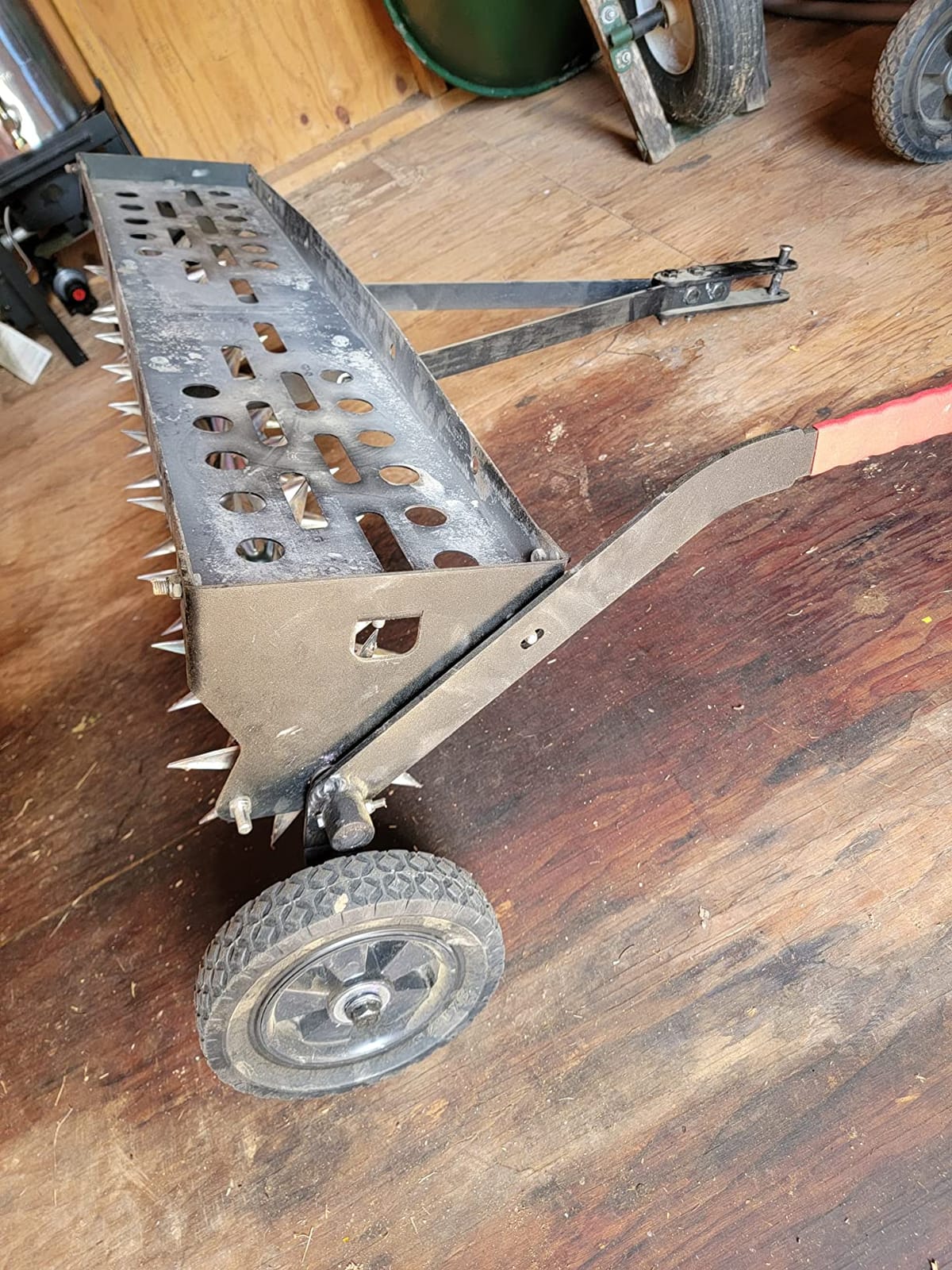
Ten 8-inch star-shaped wheels, each with 10 spike tips that rotate independently, across a 40 inch width. That independent rotation is the design detail that matters, because the wheels keep cutting during a tractor turn instead of scrubbing over the same strip.
Owners like that it reaches about 2 inches into compacted soil and leaves no loose soil plugs on the lawn. If a spike aerator is what you want, this is the best-executed one in our roundup.
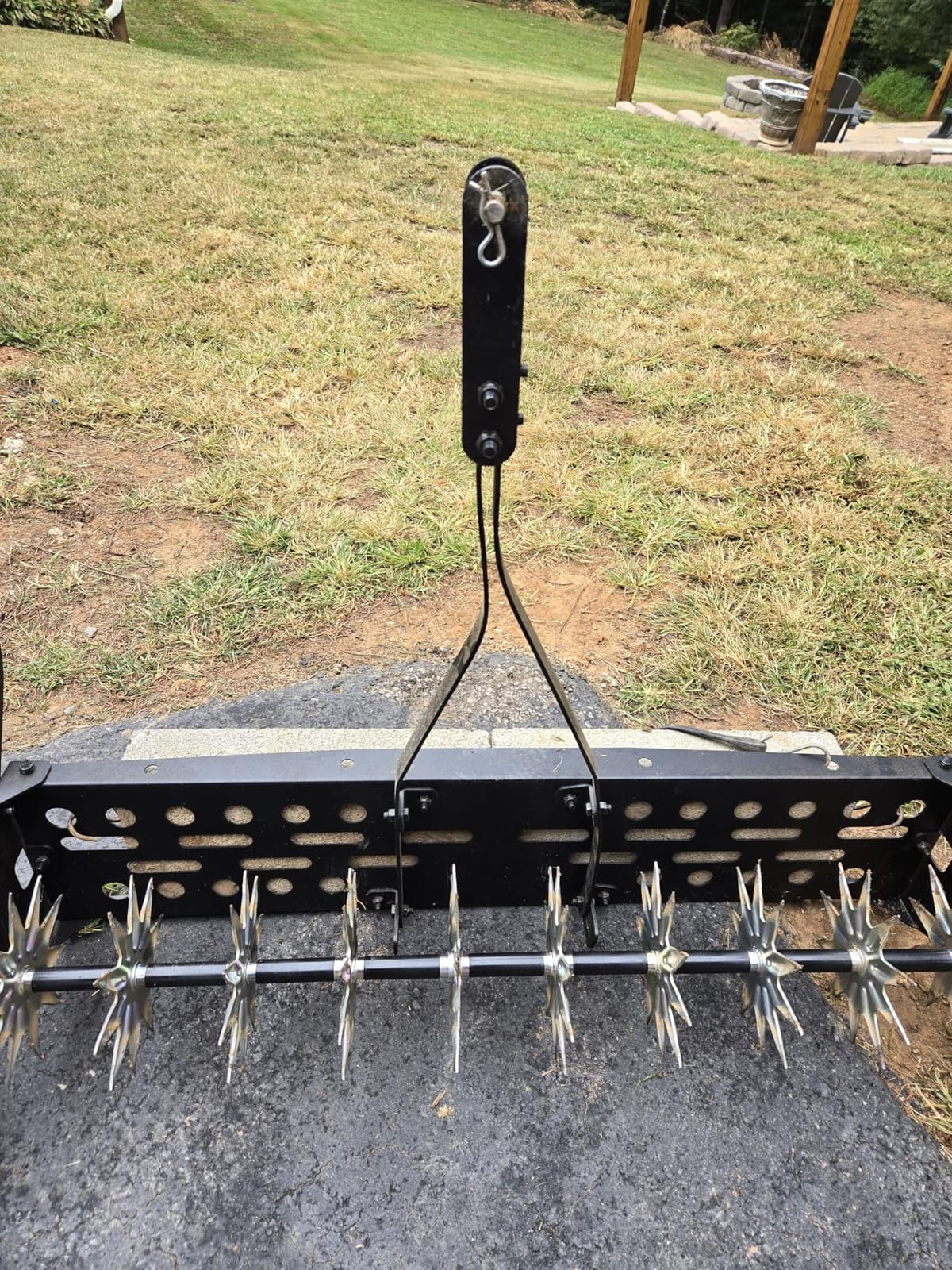
It is also the only tow-behind here that mounts to an ATV as well as a riding mower through the pin-style hitch. A few reviews compare its output favorably to a professional aeration visit.
The durability notes are real and worth reading. A minority of owners report tires detaching and hitch arms bending early on, and spike tips can bend if they meet rocks or bone-hard ground.
What spiking at scale actually accomplishes
Ten wheels at 2 inches perforate a large lawn quickly and leave the surface tidy, which is genuinely useful after foot traffic or on a lawn you plan to overseed. The holes give seed and water a path down.
But no soil leaves the ground, so if your screwdriver test stops at an inch, this perforates the problem and does not fix it. Save it for thin thatch and surface hardening.
Ballast and hitch setup
The weight tray accepts up to 110 pounds, and owners report penetration improves substantially once it is loaded. Tune the hitch height so the spikes are at the bottom of their travel when they meet the ground.
Water first. Owners doing this on moist soil report effective penetration, and the same tool on dry ground bends tips and skates.
9. K.D STONEDGE Rolling Core Aerator: Best Whole-Lawn Core Without a Tractor
Patented Rolling Lawn Aerator Manual Coring Tool Compacted Soil Loosening
Patented rotary coring design
60 inch rolling footprint
43.7 lb, manual push operation
Pros
- Rotary action extracts real plugs
- 60 inch width covers fast
- Weighted design pulls plugs from compacted soil
Cons
- 43.7 lb is demanding to push and reposition
- Plugs must be swept up
- Too wide for tight beds and edges
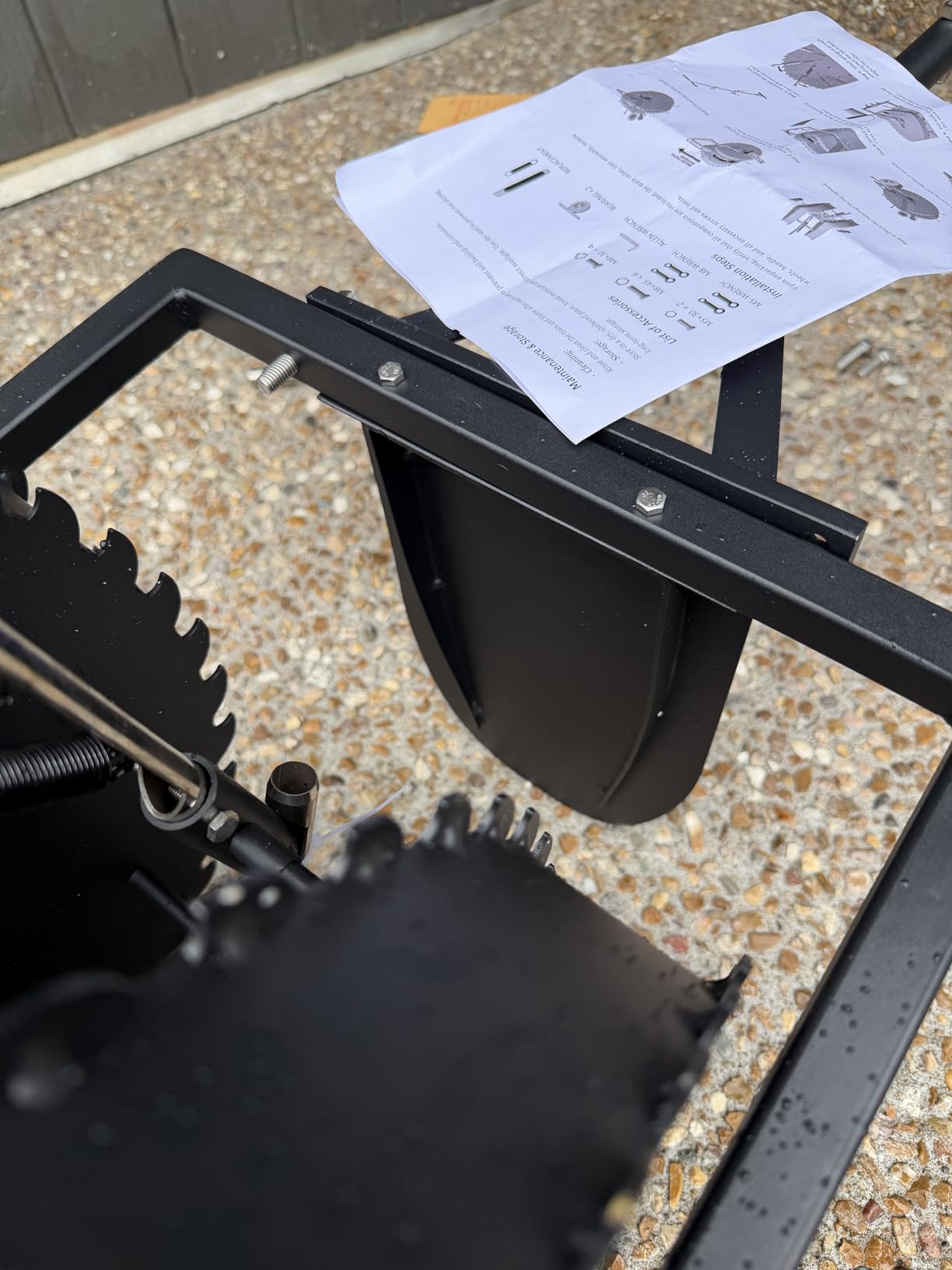
This is the answer for a reader with a large lawn and no riding mower. It rolls across 60 inches at a time and extracts actual plugs through a patented rotary coring action, so you get core aeration results without a tractor, a gas engine, or a rental.
The drum is balanced and weighted specifically for plug pulling, and owners who used it on compacted ground say it genuinely loosens the soil rather than just poking holes in it.
At 4.2 stars across 167 ratings it is not the most-reviewed tool here, but the feedback is consistent and specific. Coverage speed per pass is the thing almost every owner mentions first.
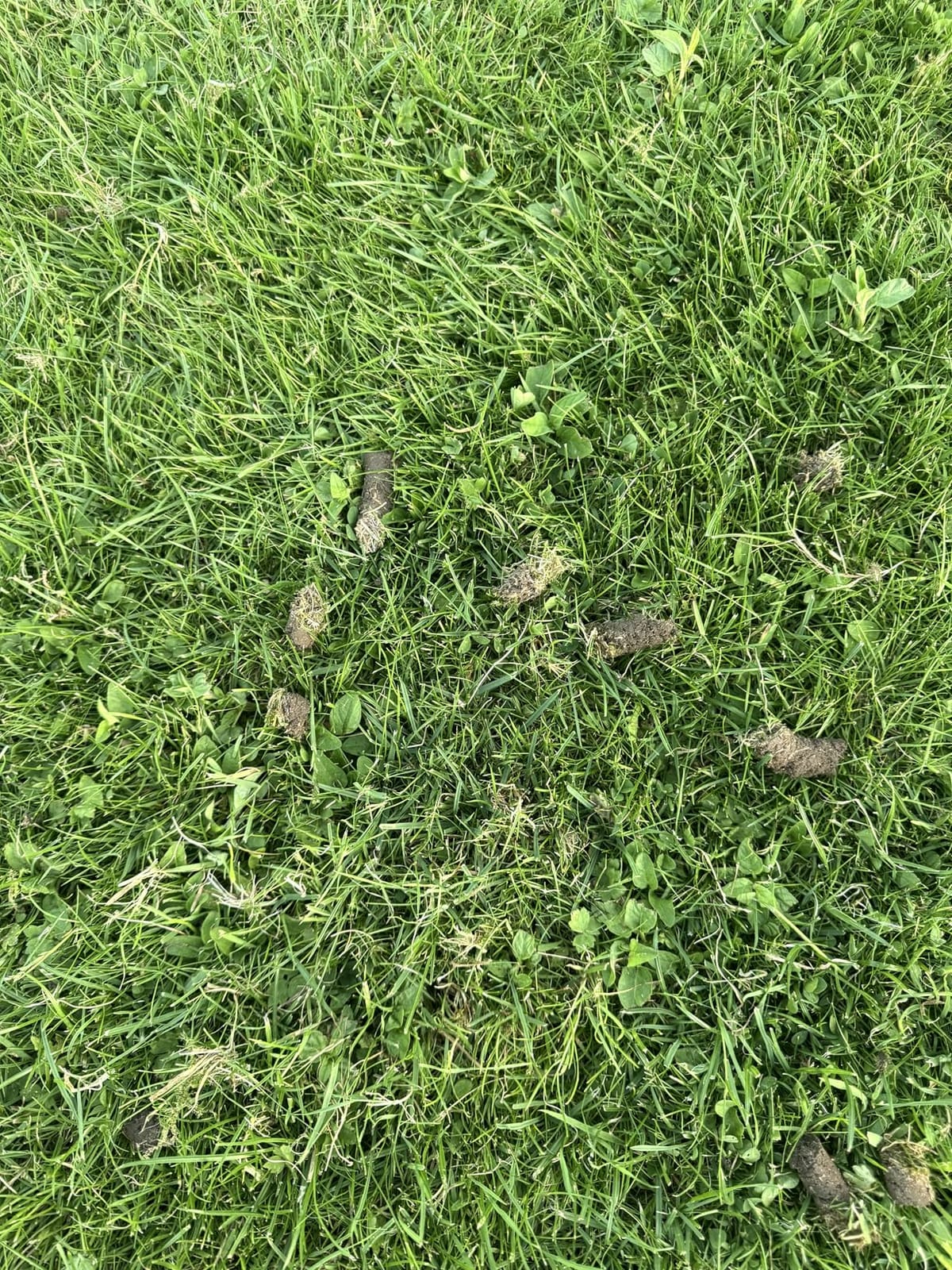
The trade-off is debris. Because it removes plugs, they end up on your lawn, and someone has to sweep or collect them. That is the opposite trade-off from a spike aerator, which leaves nothing behind.
Rolling core versus tow-behind core
Same result, different logistics. A tow-behind needs a tractor and gives you ballast up to 175 pounds to force the tines in. This one is self-propelled by you, carries its own 43.7 pounds of working weight, and costs less to store.
If you have a riding mower and a big property, tow-behind penetration wins. If you do not, this is the only way to core a large lawn without renting something.
Where you will notice the weight
Pushing 43.7 pounds across soft or uneven ground is real work, and repositioning it is the part owners complain about most. On a slope or a soft lawn after rain it is harder than the specification suggests.
The 60 inch width also means it is not precise near beds, fences, or edges. Use a step aerator for the perimeter and this for the open middle.
10. SENVERT Rolling Spike Aerator: Best for Ballast-Tuned Rolling Spikes
SENVERT Rolling Lawn Aerator, Heavy Duty Push Spike Aeration Tool Up to 55 lbs, Manual Rotary Grass Aerator for Garden and Yard Use
32 lb drum, ballasts to 55 lb
Spiral spiked tread pattern
Auxiliary TPR wheels included
Pros
- Rolls far faster than step or shoe tools
- Weight tunes from 32 to 55 lb
- Auxiliary wheels protect hard surfaces
Cons
- Spikes perforate rather than remove plugs
- Poor on dry
- hard
- or rocky soil
- Never fill the drum with water
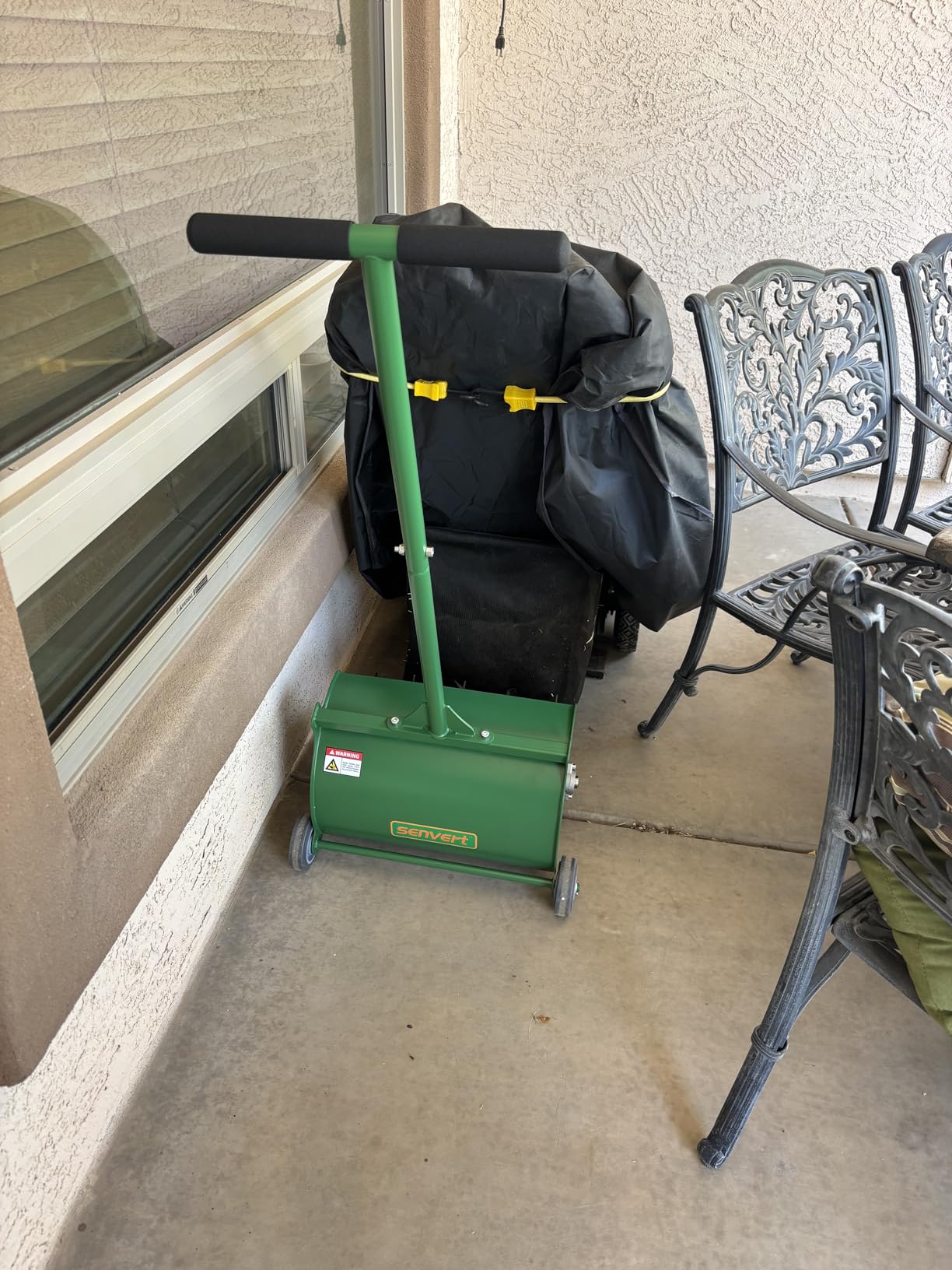
A 32 pound drum with a ballast opening that accepts sand or stone up to a total of 55 pounds. That adjustment is the point of the tool, because you can start light on soft ground and add weight as you find harder areas instead of guessing.
The spiral-spiked tread pattern rolls more smoothly and holds direction better than straight tine rows. At 4.4 stars across 164 ratings it is the second-highest rated option we tested.
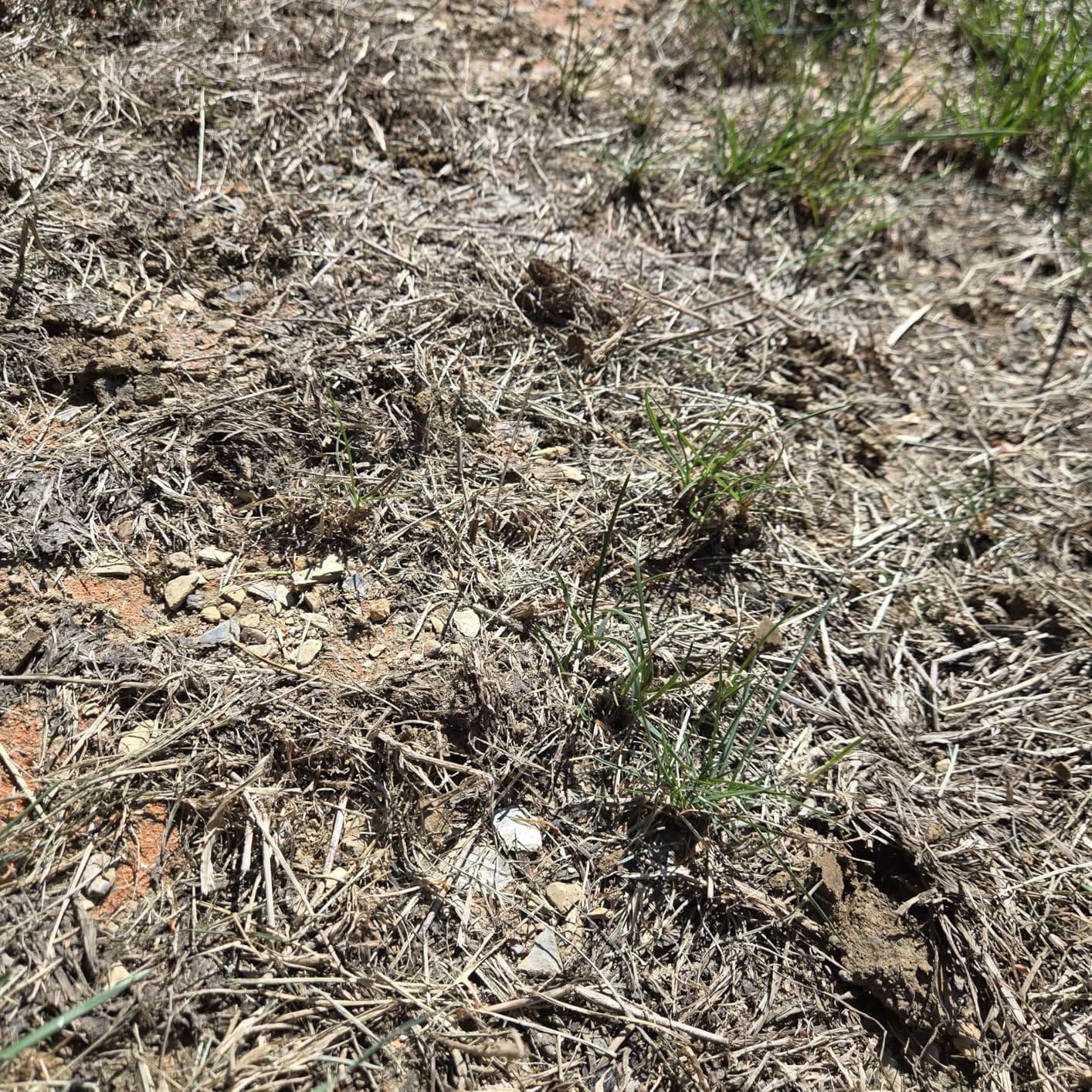
The auxiliary TPR wheels are a small touch that saves a lot of aggravation. Owners use them to roll the unit from the lawn to the shed without dragging spikes across a driveway or patio.
It also arrives fully assembled, with only the handle to attach, so there is no build to do before you start.
Why the ballast adjustment matters
Compaction is rarely uniform across a lawn. The hollow along the fence can be soft while the center lane is brick-hard, and a fixed-weight drum will only solve one of those. Dialing from 32 to 55 pounds lets you work the hard zones properly and treat the soft ones without tearing up the turf.
Fill with sand or stone. Never water, which reviewers flag explicitly, because it will add weight but no useful downward bite and it rusts the drum.
Where it stops short of a core aerator
It perforates the soil rather than removing plugs, so thatch and organic debris stay put rather than being brought to the surface. That is useful for compaction, not for a thatch problem over half an inch.
On very dry, hard, or rocky ground it struggles regardless of ballast. Owners report it works best in moist soil where the spikes have something to give.
How to Choose a Lawn Aerator for Compacted Soil
Start with the screwdriver test, not the price. A tool that will not penetrate your soil is not cheap, it is wasted, and no amount of patience fixes it.
Match the class to the lawn size. Under 3,000 square feet with real compaction means a manual coring aerator. Between 3,000 and 8,000 square feet means a rolling core aerator or a powered machine. Over 8,000 square feet with a tractor means a tow-behind core aerator with a loaded weight tray. Over 8,000 square feet with no tractor means rent.
Core or spike. If your screwdriver stops at three inches or less, buy a hollow-tine core aerator. Spikes are for surface crust, thin thatch, and small lawns where the goal is a quick improvement rather than a fix.
Understand working width before you buy. Width is the coverage math. A 48 inch implement on a quarter-acre lawn is roughly a third of the passes a 16 inch manual tool would take. Wider is not better on a lawn with beds and fences, so pair a wide machine with a narrow one if your property has both.
Budget for ballast. A tow-behind without weight on the tray will not open compacted soil. Concrete blocks or sandbags are the cheapest performance upgrade available, and it applies to every tow-behind on your shortlist.
Check the steel, not the plastic. Powder-coated or galvanized steel survives wet seasons and being left outside. The spike tools that bend on rocks and the frames whose welds loosen all share the same cause, which is thin or plated steel.
Remember aeration is not dethatching. Dethatcher and aerator combination units pull a mat of thatch off the surface. That is a different job from relieving compaction, and if your screwdriver test fails you want the tine machine, not the rake machine.
Rent is a legitimate answer. Walk-behind aerator rental and professional aeration both price out favorably against buying a machine you will use once or twice a season. If you will aerate once a year and own no tractor, that comparison often favors renting or hiring over buying a tool that sits in the shed for the other 364 days.
Clay lawns should mostly rent or hire. Heavy clay resists casual penetration, and repeated passes on wet clay can do more damage than good. Spend the money on a machine with enough weight behind it and hire it out rather than fighting it with a manual tool.
When to Aerate and How to Do It Properly
Timing depends on your grass, not the calendar. Cool-season lawns, meaning fescue, Kentucky bluegrass, and ryegrass, should be aerated in early fall between September and October when soil temperature sits at 50 to 65 degrees. Warm-season lawns, meaning Bermuda, Zoysia, and St. Augustine, should be aerated in late spring to early summer when soil is above 65 degrees.
Never aerate a dormant lawn. Grass that is not actively growing cannot recover from the stress, and you will set the lawn back rather than forward. If you applied a pre-emergent herbicide in spring, wait four to six weeks after aerating or do the job in fall instead.
Prepare the lawn first. Mow to 1.5-2 inches, water the day before so the soil is moist but not wet, and flag sprinkler heads and any shallow utility lines.
Make two passes in perpendicular directions, north to south then east to west, overlapping slightly. Experienced users treat two alternating passes as the sweet spot because a single pass leaves stripes of untouched soil between the cores.
Leave the plugs where they fall. They break down on the surface in one to two weeks and return organic matter to the soil. Raking them up defeats the point, and if the appearance bothers you, mow them up without a bag on your next pass. Skip steep slopes, where plugs roll away and the machine is hard to control.
What to Do After Aerating
Only put down topsoil if you are leveling low spots or rebuilding soil structure, and even then keep it to about a quarter inch of screened topsoil or compost. It works down into the holes over time. For most lawns the higher-priority follow-ups are overseeding and fertilizing, because the fresh holes give you seed-to-soil contact and deliver nutrients straight to the root zone.
Overseed right after aerating. The holes hold moisture against the seed, and the loosened soil is exactly what a thin, compacted lawn needed. Most cool-season lawns get the best result from fall overseeding into an aerated surface.
Fertilize within a few days. Nutrients applied right after core aeration go into the root zone instead of sitting on top of a sealed surface.
Water lightly and often for the first week. Keep the top inch moist so seed germinates and the plugs break down properly.
Then make aeration a habit rather than a rescue. Users consistently pair aeration with yearly or twice-yearly compost topdressing, because a core aerator opens the surface but it does not rebuild the soil structure itself. If you add compost every year, you may need to core half as often.
Frequently Asked Questions
Will an aerator work on hard ground?
Yes, but only with the right tool and preparation. Core aerators penetrate hardest because hollow tines remove soil instead of pushing it aside. Water the lawn the day before so the ground is moist but not wet, and load a tow-behind weight tray with concrete blocks or sandbags if it will not cut in. A cheap spike aerator on dry hard ground skates across the surface and can bend its tines.
Which is better, a core aerator or a spike aerator?
A core aerator, for compacted soil. It pulls 2-3 inch plugs out of the ground and deposits them on the surface, removing compacted material and leaving open holes for air, water, and nutrients. A spike aerator pushes a solid spike in and the soil closes around it, so on clay it can leave compaction worse than before. Spikes are still useful for thin thatch and light surface hardening.
What is the best month to aerate your yard?
It depends on your grass type. Cool-season lawns such as fescue, Kentucky bluegrass, and ryegrass should be aerated in early fall, September to October, when soil temperature is between 50 and 65 degrees. Warm-season lawns such as Bermuda, Zoysia, and St. Augustine should be aerated in late spring to early summer when soil is above 65 degrees. Never aerate a dormant lawn.
Should I put down topsoil after aerating?
Only if you are leveling low spots or rebuilding soil structure, and then only about a quarter inch of screened topsoil or compost, which works down into the holes over time. For most lawns the better follow-ups are overseeding and fertilizing, since the fresh holes give seed-to-soil contact and deliver nutrients directly to the root zone.
How do I know if my lawn soil is compacted?
Run three tests. Push a flat-head screwdriver into several spots; it should slide in to 3-4 inches with light pressure, and stopping at one or two inches means compaction. Pour a gallon of water and time it; more than a foot per ten minutes means the pore space is gone. Lift the turf and measure the thatch layer; over half an inch is a problem on its own.
How much weight do I need on a tow-behind aerator?
Fill the weight tray until the tines cut in on your first pass rather than riding over the surface. The Agri-Fab tray in our roundup accepts up to 175 pounds and the Suchtale up to 110 pounds, so concrete blocks or sandbags are well within capacity. Water the lawn the day before as well, because ballast on dry ground just adds friction and can bend spikes.
Do I need a riding mower to use a tow-behind aerator?
Not technically, but practically yes for most tow-behinds. A 94 pound Agri-Fab is awkward to move by hand and a tractor or riding mower makes the job practical. If you own neither, a rolling core aerator gives you real plugs without a tow vehicle, or renting a walk-behind for a day covers a large lawn in an afternoon.
Should I rake up the plugs after aerating?
No. Leave them on the surface. They break down in one to two weeks and return organic matter to the soil, which is part of the point of coring. Raking them away removes that organic matter. If the appearance bothers you, mow over the plugs on your next pass with the bag off to break them up.
The Best Lawn Aerator for Compacted Soil, by Lawn Size
For a small lawn with real compaction, the Yard Butler ID-6C coring aerator is the pick. It has the most owner feedback of any manual aerator we compared, the foot bar gives it the prying force that hard ground demands, and it handles the whole job in a weekend. For larger lawns, match the machine class to your square footage: a rolling core aerator covers a medium yard without a tractor, and a ballast-loaded tow-behind covers a large property with one.
For clay, the Landzie hollow tine design is the one to buy because it ejects cores instead of jamming. For a low-cost start on surface problems, the Walensee spike tool is honest about what it does, and for pure spiking at scale the Suchtale tow-behind handles whole properties cleanly. Whatever you choose, run the screwdriver test first, water the day before, load the weight tray, and leave the plugs on the grass. That is how you get the best lawn aerators for compacted soil to actually fix the problem you bought them for.