
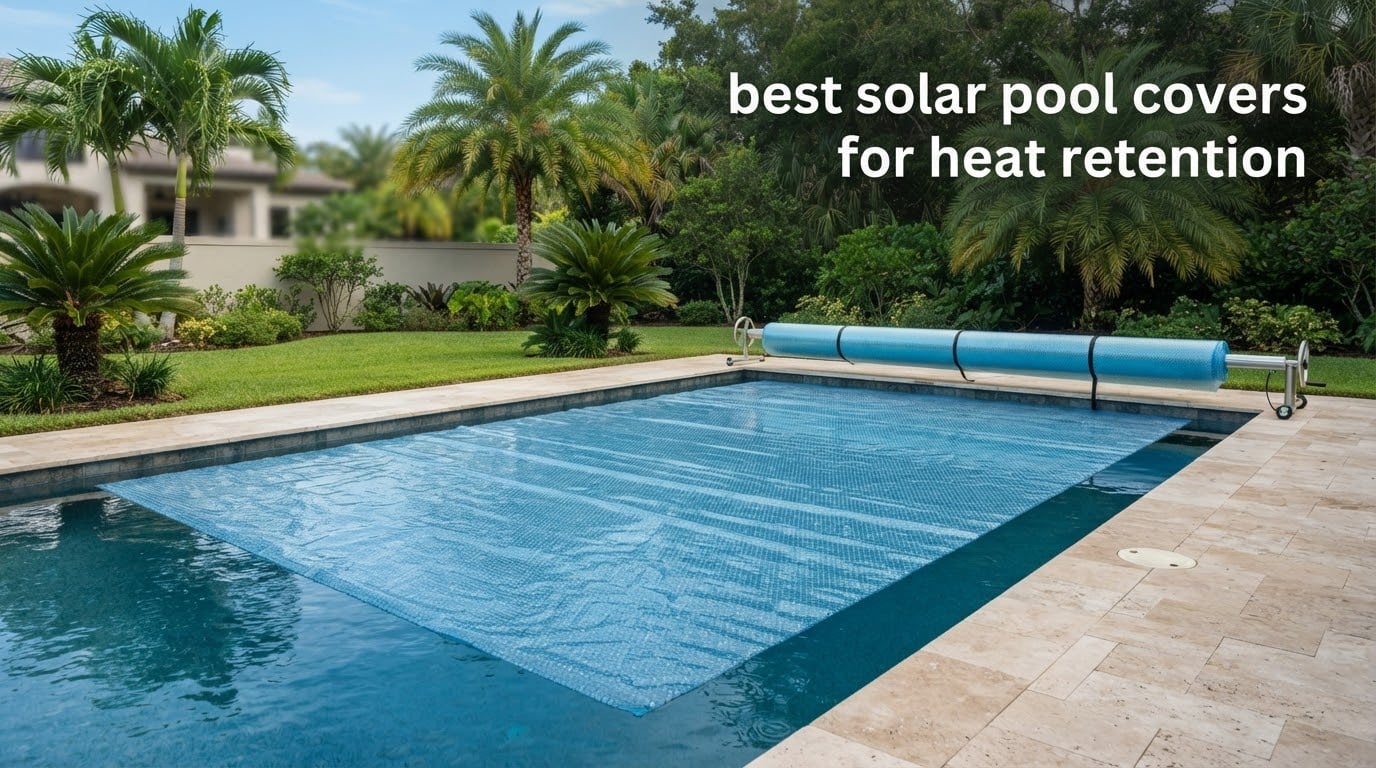
A solar pool cover does two separate jobs, and most buyers only think about one of them. During the day the thin plastic sheet lets sunlight through so the water absorbs heat directly. At night the same sheet seals the surface, and that is where nearly all of the benefit lives, because evaporation carries off most of a pool’s heat.
That distinction explains why the numbers you read online seem to disagree. A cover tested for one hot afternoon can add 4-5 degrees in an hour, while the same cover left on for several sunny days can hold 8-15 degrees of temperature overnight. Neither number is wrong; they are measuring different things. Our ranking of the best solar pool covers for heat retention below is organised around the number that actually matters, which is how much heat the cover keeps in the water from sunset to sunrise.
We compared eight covers across the thickness tiers, materials and shapes that cover the bulk of what pool owners actually buy. We weighed overnight retention, how much evaporation each one blocks, how heavy it is once wet, how it holds up to chlorine and sun, and whether owners can realistically put it on and take it off every day without needing a second person.
One safety note before anything else. A floating solar blanket is not a safety cover. A person can slip beneath it, or become trapped against the pool wall, and a wet sheet on the deck is a slip hazard. Take the cover completely off the pool before anyone swims, store it away from the pool edge, and never leave it on in strong wind. Owners on r/swimmingpools and troublefreepool.com raise this repeatedly, and it is the one topic in this guide where there is no room for compromise.
Table of Contents
Top 3 Best Solar Pool Covers for Heat Retention in October
Intex 16-Foot Round Solar…
- 12 mil class polyethylene bubble blanket
- Reduces evaporation up to 95 percent
- Single-person daily handling

Sun2Solar Blue 12-Mil 1200…
- 12 mil thickness
- About 5 degrees overnight loss
- Extra overlap for easy fitting
VEVOR 16-Mil 32×16 Rectangle
- 16 mil dual micro-bubble layer
- Adds about 5 degrees over lighter covers
- Stays put in strong wind
One note on the three above before you read the full reviews. The Intex carries the most owner reviews of any cover we looked at, by a wide margin, and its 4.2 rating reflects a cover that heats reliably but has a short service life. The Sun2Solar does the same job in a heavier sheet that most owners keep for two seasons. The VEVOR is the pick if wind and durability matter more than how easily the cover moves across the water.
Best Solar Pool Covers for Heat Retention in 2026
| Product | Specs | Action |
|---|---|---|
| Intex 16-Foot Round Solar Cover |
|
Check Latest Price |
| Sun2Solar Blue 12-Mil 1200 Series |
|
Check Latest Price |
| VEVOR 16-Mil 32×16 Rectangle |
|
Check Latest Price |
 Blue Wave 12-Mil 16×32 Rectangle Blue Wave 12-Mil 16×32 Rectangle |
|
Check Latest Price |
 BigXwell Heavy-Duty 16-Mil BigXwell Heavy-Duty 16-Mil |
|
Check Latest Price |
 In The Swim 8-Mil 18-Foot Round In The Swim 8-Mil 18-Foot Round |
|
Check Latest Price |
 BigXwell 12-Mil 12-Foot Round BigXwell 12-Mil 12-Foot Round |
|
Check Latest Price |
 Doheny’s Clear-Tek Micro-Bubble 18-Foot Round Doheny’s Clear-Tek Micro-Bubble 18-Foot Round |
|
Check Latest Price |
You will notice the ratings cluster tightly between 4.0 and 4.5. That is normal for this category, and it is why we did not rank on stars alone. Two covers with similar ratings can behave very differently depending on how much the owner weighs having to wrestle the thing across the deck every evening.
1. Intex 16-Foot Round Solar Cover – Best Heat Retention You Will Actually Use Daily
INTEX 28014E Solar Pool Cover: for 16ft Round Easy Set and Metal Frame Pools – Insulates Pool Water – Reduces Water Evaporation – Keeps Debris Out – Reduces Chemical Consumption
Floating 16 ft round cover
Reduces evaporation up to 95 percent
16 ounce plastic construction
Pros
- Light enough for one person to put on and take off
- Holds warmth overnight
- Blocks leaves and debris
- Cuts chemical use and vacuuming
Cons
- Bubbles peel off in sun after a few months
- Service life of one to two seasons
- Must be removed in high winds
If you want the best solar pool cover for heat retention and you also want to still be putting the cover on in October, this is the one. Owners consistently report that it lifts water temperature and holds it overnight, and it weighs 16 ounces, which is the difference between a cover that gets used and a cover that ends up folded on the deck. That single fact matters more than any spec in this guide.
The cover floats on the surface of a 16-foot round Easy Set or metal frame pool and spans 192 inches by 192 inches. The extra overlap is deliberate, and it is the part owners praise most: because the sheet is cut larger than the pool, the bubbles keep contact with the water even around a ladder or a protruding rail. There is no guessing and no trimming required on a round pool of the right size.
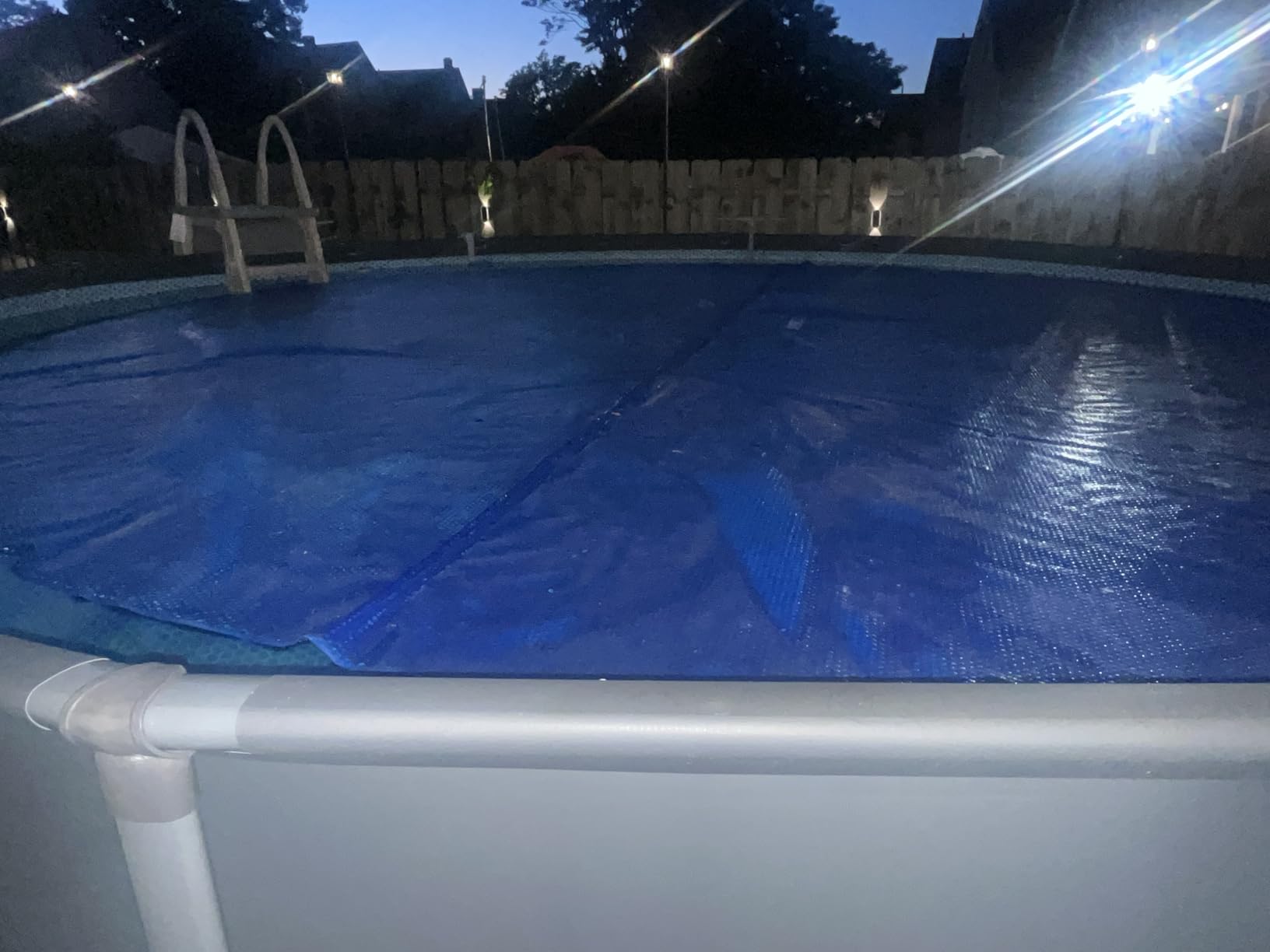
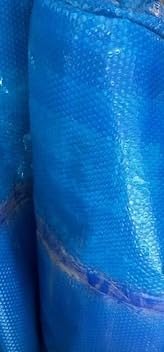
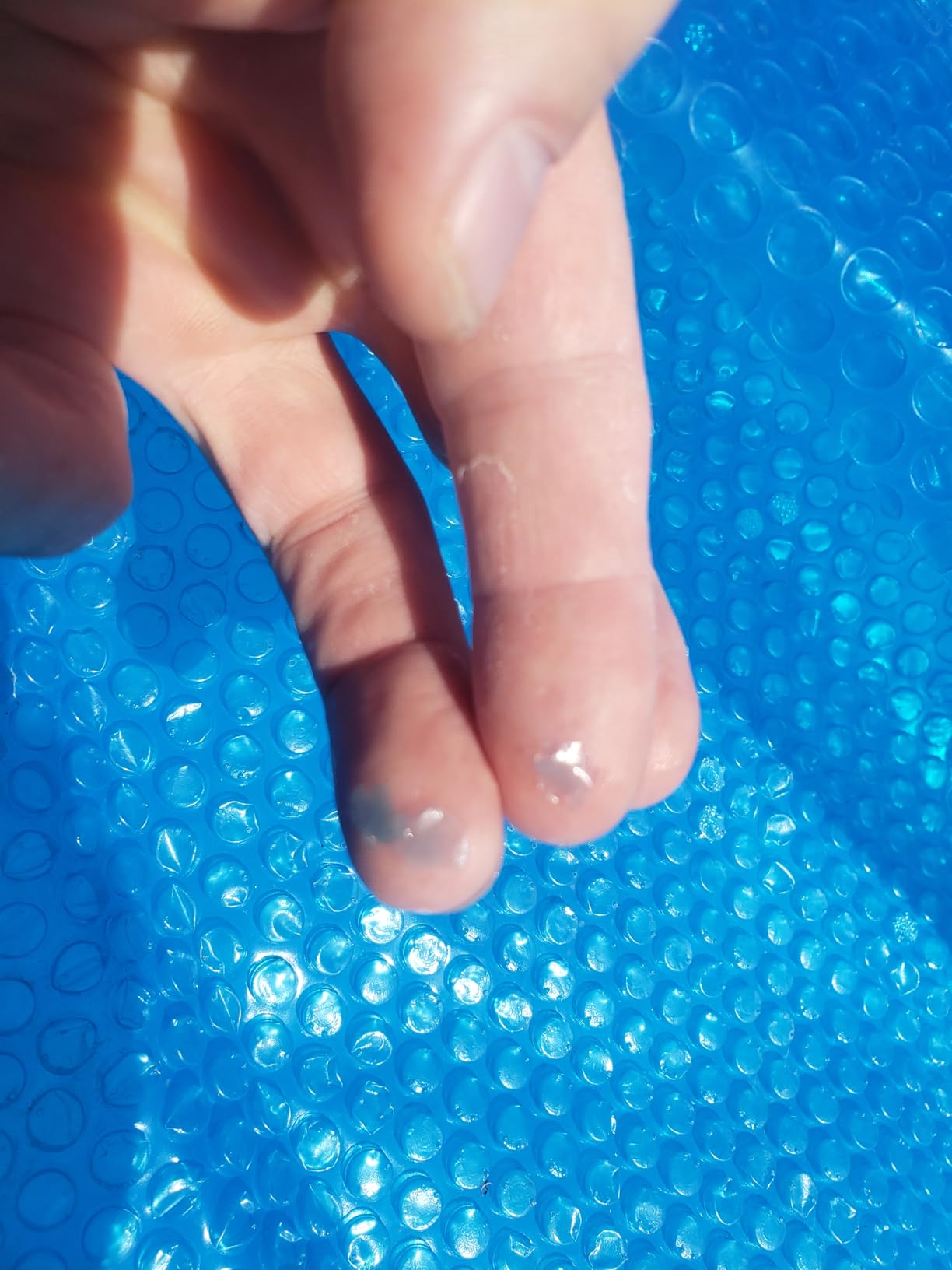
The durability story is where this cover gives ground, and we want to be straight about it. Reviewers describe bubbles peeling away like fish scales after a few months in strong sun, and the common expectation is one to two seasons of service. Owners in hot, sunny climates report the water reaching the mid-80s through the 90s under full sun, while a smaller group in cool or cloudy regions say the benefit is more modest.
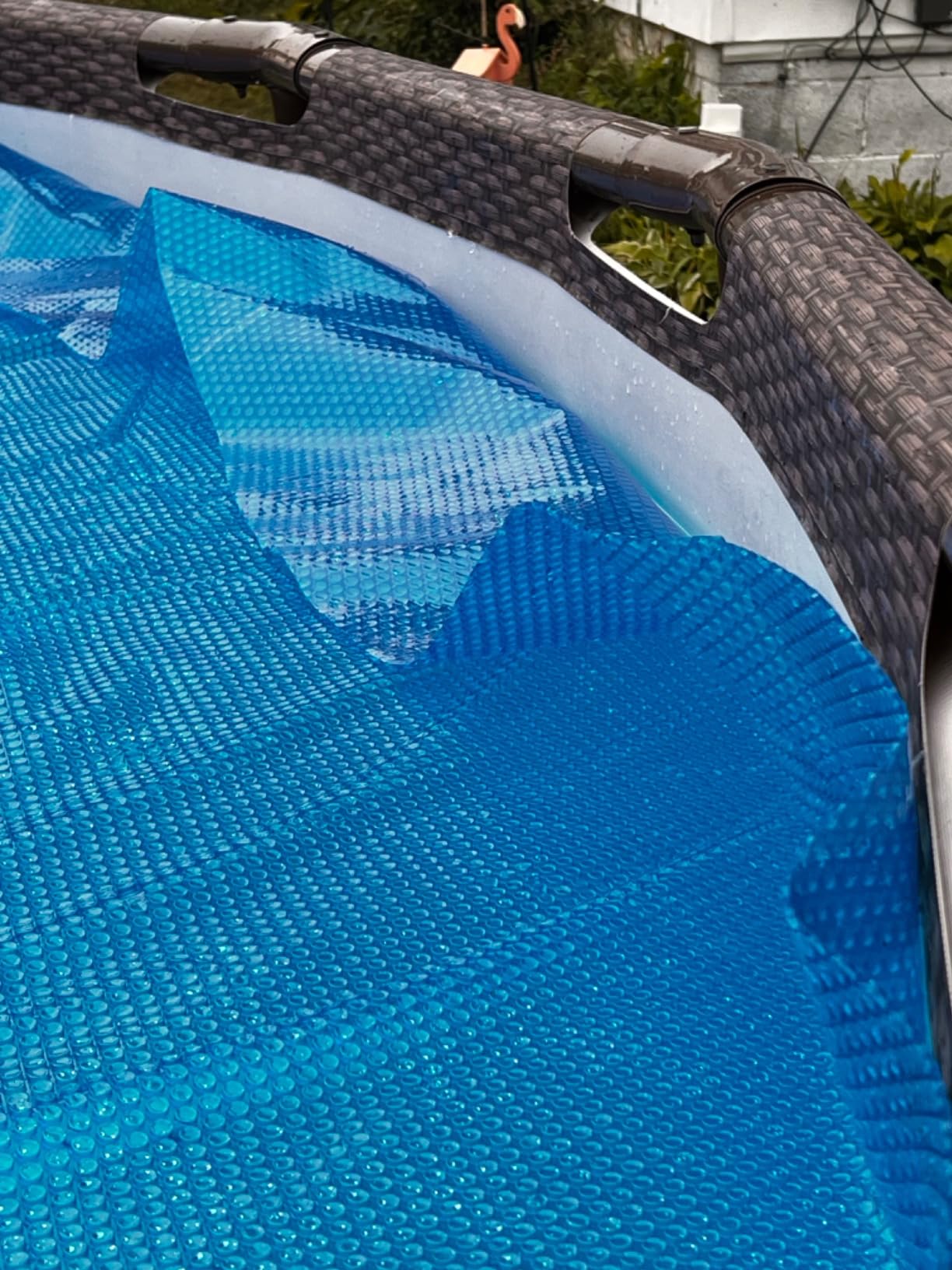
Debris also gets in more easily than the marketing suggests. On a round pool the cover floats inside the top rail rather than over it, so some leaves still find the water. The cover earns its place by cutting evaporation, chemical use and vacuuming time, not by turning your pool into a sealed tank.
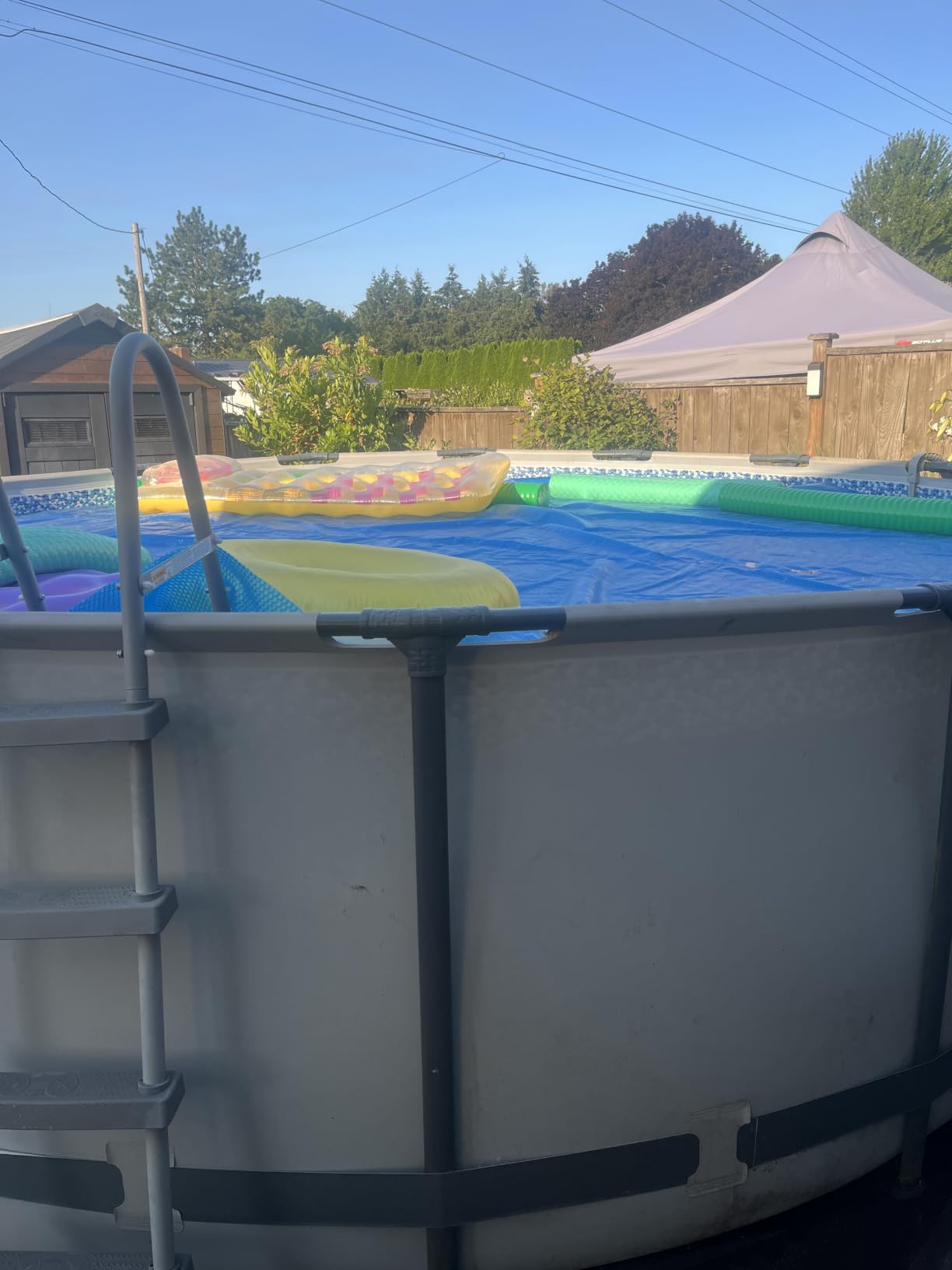
Who this cover suits
Owners of a 16-foot round above-ground frame pool who want warm water in spring and autumn without running a heater. It also makes sense for anyone who is nervous about handling a heavy wet sheet, since one person can put it on and pull it back without a reel or a second pair of hands.
It is also the sensible choice for a first cover. You get the full evaporation and heat benefit without committing to a thick sheet that changes how the cover feels in your hands.
Who should skip it
Do not buy this expecting multi-year durability, and do not leave it on through a storm. It is not a safety cover in any sense, and reviewers are blunt about removing it when wind picks up. If your pool is anything other than 16 feet round, this is the wrong shape and you will be trimming a cover that is already the thinnest in this group.
2. Sun2Solar Blue 1200 Series 12-Mil – Best Value for Steady Overnight Retention
Sun2Solar Blue 16 ft Round Pool Solar Cover | 12 Mil | Heat Retaining
12 mil heat-retaining blue cover
Up to 15 degree daytime gain
Extra overlap for easy fitting
Pros
- Holds noticeably more heat than 6 mil blankets
- About 5 degrees overnight loss
- Extra overlap fits around ladders
- Reduces evaporation and chemical use
Cons
- Bubbles crack after nine months to two seasons
- Heavy and bulky to roll and store
- Must be folded back for filtration
The Sun2Solar 1200 Series is the cover we would put on a rectangular or round inground pool where the owner is willing to put up with more weight for better retention. It is 12 mil, and owners comparing it directly to cheaper 6 mil blankets report a clear difference, with a daytime gain of up to 15 degrees in full sun and roughly 5 degrees of overnight loss.
The 1200 Series is built from a blue resin sheet with thermal insulation and UV resistance built into the material. Extra overlap on all sides is the signature feature here, and it is genuinely useful: it lets the sheet sit around a ladder, a step or a raised deck edge without folding under itself, which is where most cheap covers stop insulating.
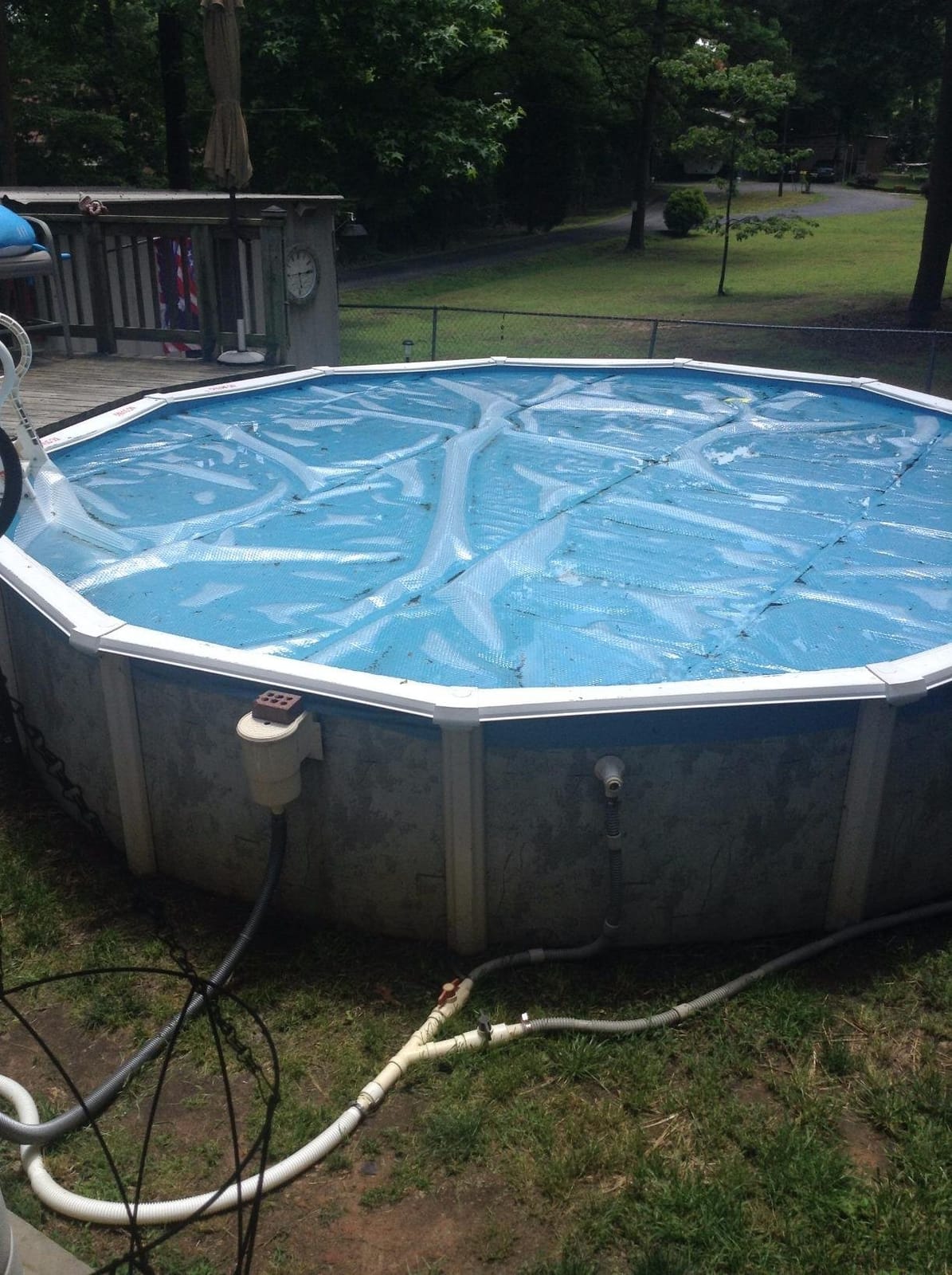
Two operational details matter more than the marketing. First, surface circulation drops when the cover is on, so you fold it back when the filter or skimmer needs to work. Second, this is a heavy sheet to roll, and on larger sizes the handling is the first thing owners complain about, along with needing a reel.
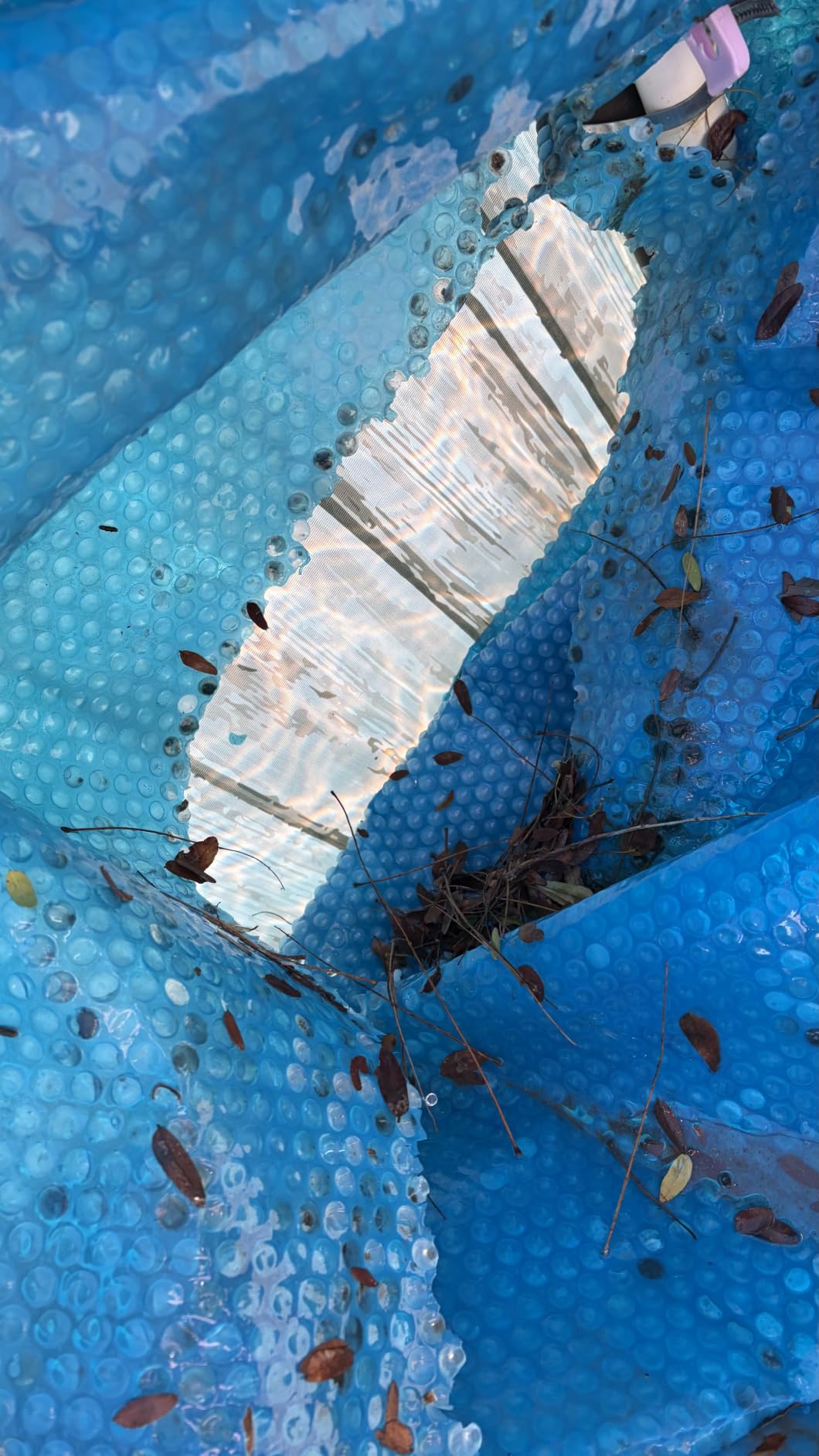
Durability follows a familiar pattern. The bubble cells crack and shed blue circles into the skimmer somewhere between nine months and two seasons, which most owners treat as the cover’s real lifespan rather than a defect. A small cluster of reviews reports thin or brittle material and weak seams on arrival, though the brand has been praised for replacing a bubbled-out cover at shipping cost only.
Who this cover suits
Owners with a gas or electric heater who want to cut its runtime and fuel bill rather than eliminate it. Because the cover holds roughly 5 degrees overnight, a heater that used to run every night can run most nights, and that is where the savings show up.
It also suits anyone who wants the better-performing dark or blue sheet rather than a clear one. A small group of buyers report that the clear variant performs about the same as the blue version, so if heat retention is your priority, the blue 1200 Series is the safer bet.
Who should skip it
Skip it if you have a small pool and no reel. A 12 mil sheet that is already bulky when dry gets meaningfully heavier when wet, and owners on r/pools describe giving up on daily deployment because of handling alone. If the cover will only go on when guests are coming, you are not getting the retention benefit that justifies the weight.
3. VEVOR 16-Mil 32×16 Rectangle – Most Compact for Wind and Durability
VEVOR Solar Pool Cover 32 x 16 ft 16 Mil Pool Bubble Cover Blue & Black
16 mil dual air-layer micro bubbles
32 by 16 ft rectangle
37.7 lb weight
Pros
- Thicker and sturdier than typical bubble covers
- Adds about 5 degrees over lighter covers
- Single center seam reduces weak points
- Stays put in strong wind
Cons
- Two people needed on large sizes
- Harder to cut than thin material
- Bulky to store over winter
The VEVOR is the one to buy when wind is the deciding factor. Owners who have owned many covers consistently rate it as the thickest and best-made they have tried, and the heavier 16 mil polyethylene gives a pool that reads in the high 80s and low 90s. Several report it staying put in wind that blows lighter covers straight off the pool.
It covers a 32 by 16 foot rectangle, which makes it a natural fit for a rectangular above-ground or inground pool, and it is cuttable for ladders, steps and odd shapes. The blue and black version gets specific praise for flatter, sturdier bubbles, which is also why owners report far less shedding of plastic circles into the water than they get with lighter covers.
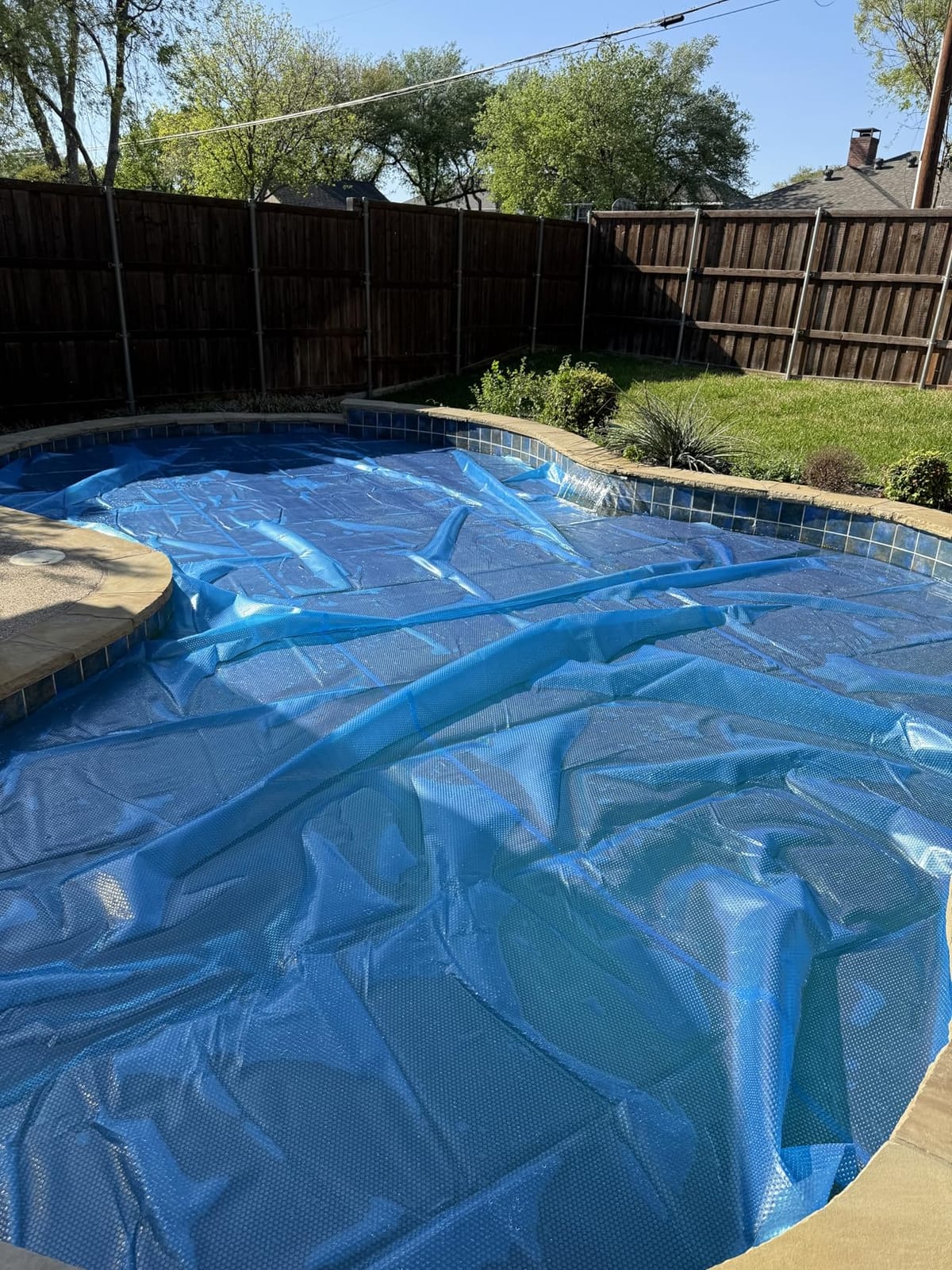
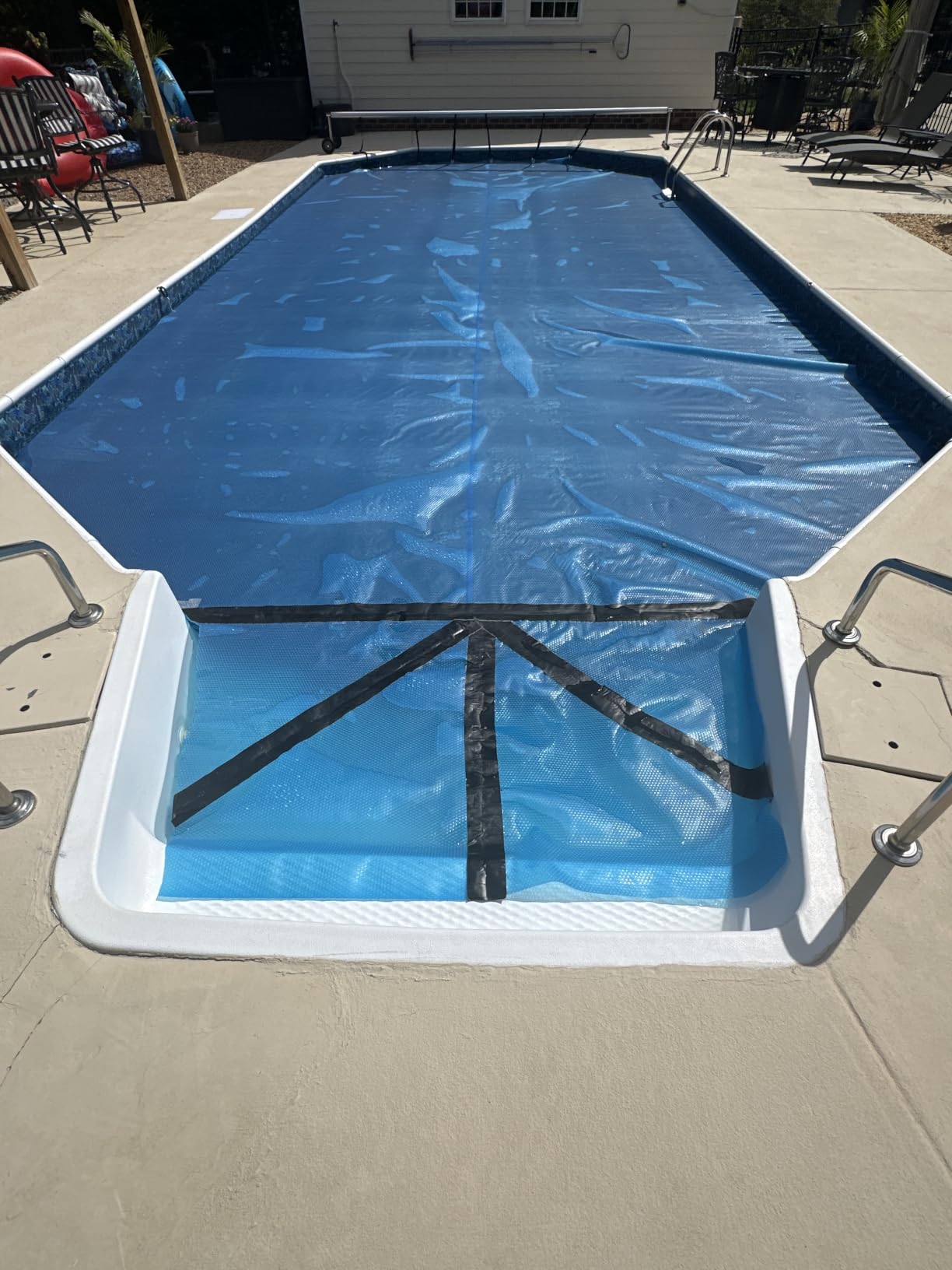
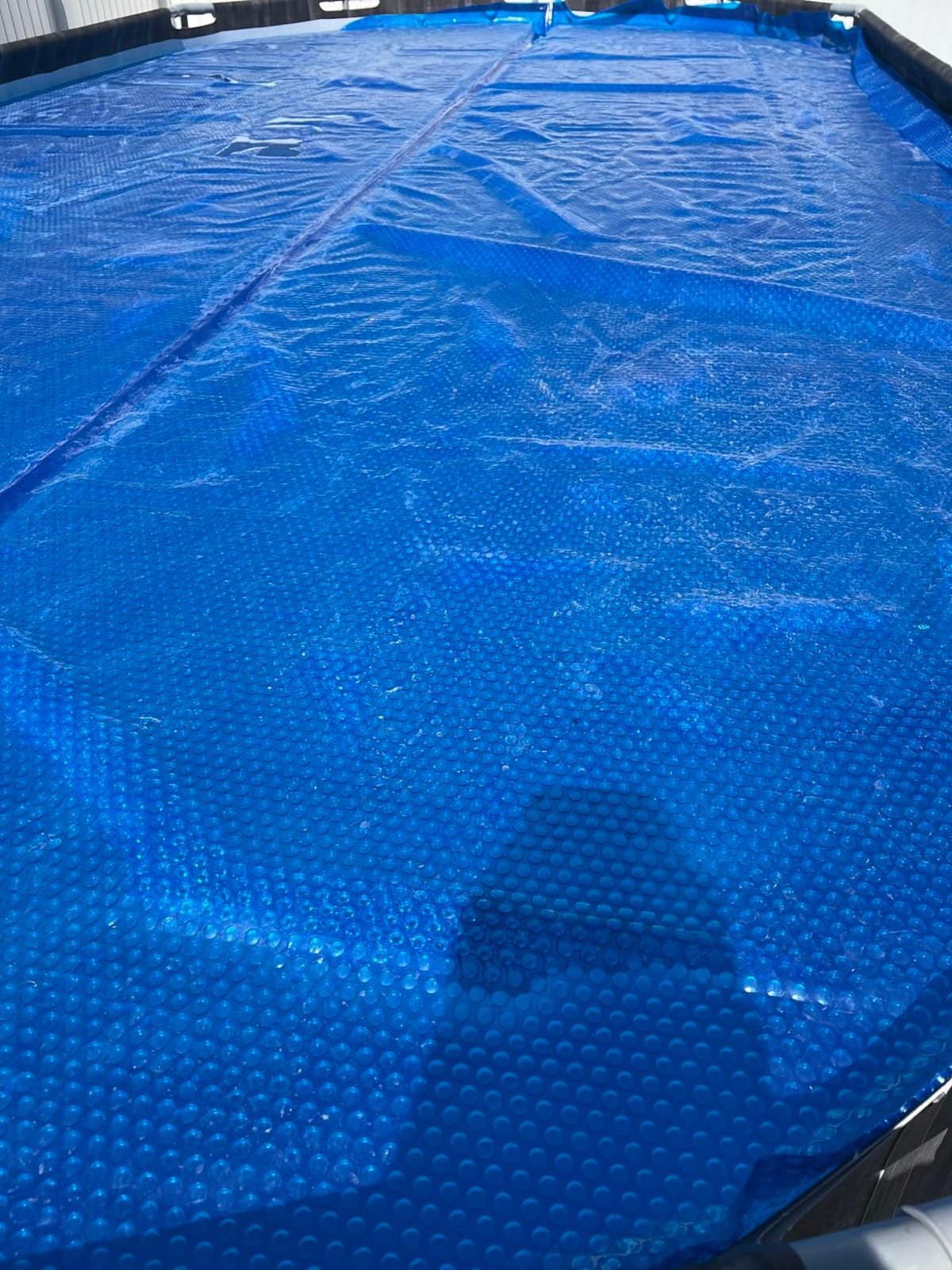
The construction detail we like is the single center seam. Multi-strip covers with several stitched or glued seams give you multiple points that can fail first, and this one removes most of them. It is also described as resisting stretching, tearing, cracking and UV aging, which lines up with owners who report it lasting longer than cheaper blankets.
Weight is the real cost here. At 37.7 pounds dry, this cover is heavy enough that a standard reel may need replacing, and two people help on larger sizes. It also has to be cut to size before first use, and cutting the thickest material in this group is the least forgiving job of the eight.
Who this cover suits
Owners of a 16×32 foot rectangular pool in an exposed or windy yard, especially anyone tired of retrieving a floating cover from the neighbour’s fence. The extra weight that makes handling awkward is the same weight that keeps the cover where you put it.
It also suits owners who store their cover outdoors or in a shed without climate control, since the 16 mil polyethylene tolerates temperature swings better than the thinner sheets in this list.
Who should skip it
Skip it for a small pool, a round pool or anyone deploying alone. Two people and a proper roller are close to mandatory above 16×32 feet, and the manufacturer advises against highly chlorinated or acidic water for longevity, so check your chemistry before you buy rather than after.
4. Blue Wave 12-Mil 16×32 Rectangle – Most Versatile for Cut-to-Fit Flexibility
Blue Wave 16×32-ft Rectangle Solar Pool Cover 12-Mil Blue – Solar Cover for Above Ground Pool & Inground Pool, Thermal Bubble Blanket for Heat Retention & Reduced Evaporation
12 mil rectangle covering 512 square feet
27 lb weight
Cut-to-fit for irregular pools
Pros
- Raises water temperature quickly
- Cuts evaporation and refill frequency
- Blocks leaves insects and animals
- Easy to cut for kidney-shaped pools
Cons
- Bubbles shed blue plastic circles
- Warranty is prorated past year one
- Multi-strip seams split first
Blue Wave is the pick for anyone with a pool shape that fights a standard rectangle. Owners cut it to fit kidney-shaped pools, rock formations and waterfall features, and several report that the extra material makes that straightforward. It covers 512 square feet in a 32 by 16 foot rectangle and works on both inground and above-ground pools.
On heat performance the feedback is strong. Owners report around 6 degrees gained in 24 hours with the water holding near 80 to 90 degrees, and one Hawaii owner went a month without adding water. Several replaced roof-mounted solar panels after seeing larger gains from this cover alone, which tells you the daytime heat transfer is doing real work.

It carries the lowest rating of the eight at 4.0 stars, and the reason is durability rather than heating. Bubble cells pop and shed blue discs into the filter and skimmer, and many covers fall apart within one to two seasons. If you buy it, buy it expecting a consumable rather than an investment.
The warranty deserves a specific warning. A 5 year limited manufacturer warranty is advertised, but owners report it is prorated and effectively unusable beyond the first year, with a rising percentage of list price plus shipping charged against any claim. The sheet is made of several stitched strips, and those seams are where most failures start.
Who this cover suits
Owners of an irregular or freeform pool who need a cover that can be trimmed to fit, and anyone who wants strong evaporation control without paying for 16 mil. Blocking leaves, insects, pollen and even ducks and turtles is a bonus that cuts cleaning time noticeably.
It is also a reasonable second cover. At 27 pounds it is manageable with a roller, and it is lighter than the 16 mil options in this list.
Who should skip it
Skip it if durability is your priority or if you want a warranty you can actually lean on. The prorated terms and the multi-strip seams make this the cover most likely to disappoint after a hard season, and trapped air pockets under the sheet can get very hot in direct sun, which is not ideal if algae is already a concern.
5. BigXwell Heavy-Duty 16-Mil 16×32 – Best for Long-Term Heat Holding
BigXwell Heavy-Duty Solar Pool Cover 16x32ft – 16Mil Blue
16 mil polyethylene with thermal bubbles
384 by 192 inch sheet
Cuts cleanly with scissors
Pros
- Thick and sturdy polyethylene build
- Loses only about 5 degrees on winter overnights
- Cuts cleanly without fraying
- Catches debris before it settles
Cons
- Needs two people on larger sizes
- A roller is effectively required
- Stiff and rigid to fold
The BigXwell Heavy-Duty carries the highest rating in this group at 4.5 stars, with 78 percent of reviewers giving it five. Owners who came from cheaper blankets describe it as noticeably thicker and heavier with water running several degrees warmer, and the specific figure that comes up is losing only about 5 degrees during Florida winter overnights.
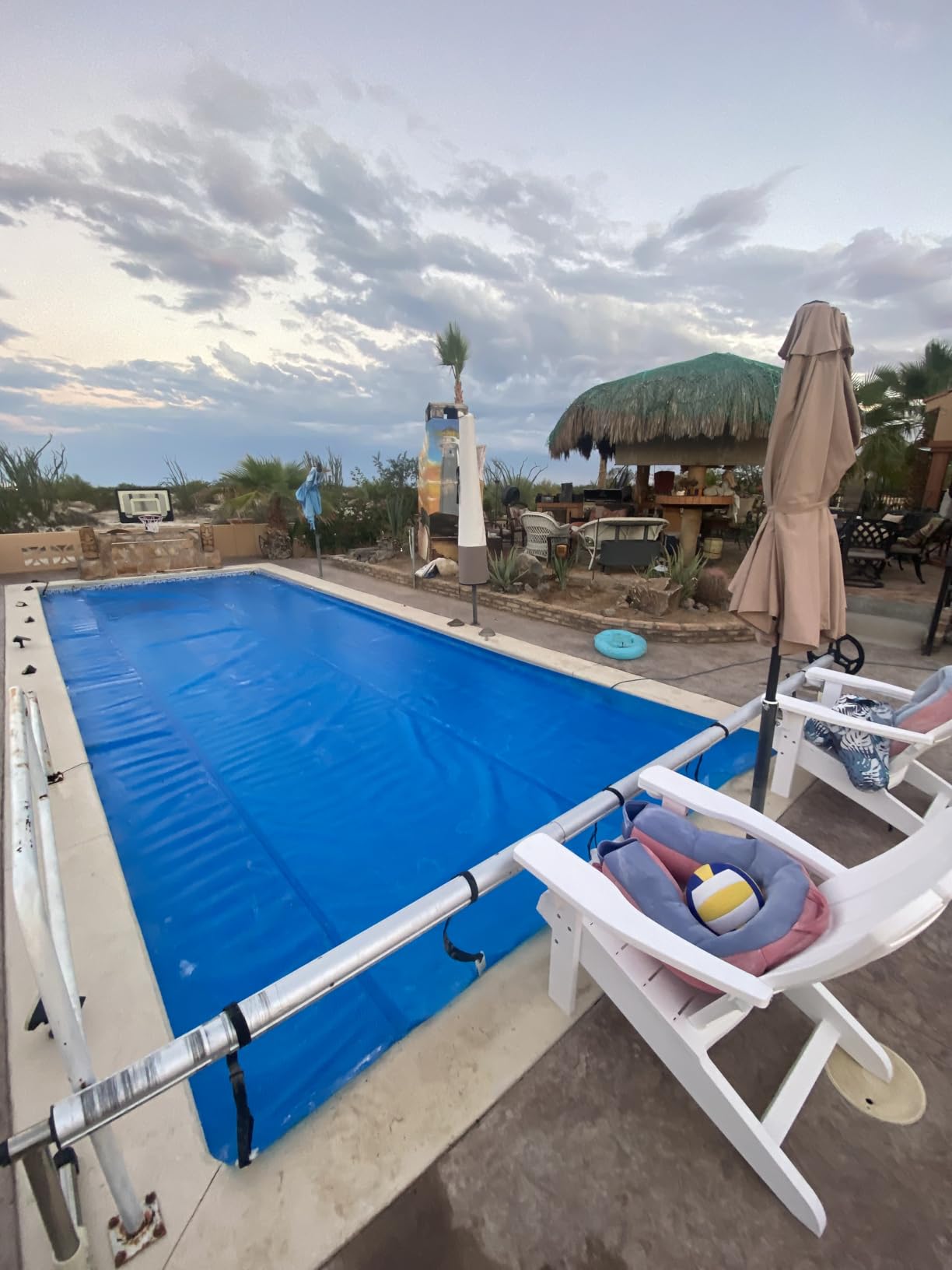
It is a 16 mil polyethylene sheet measuring 384 by 192 inches, which is a 32 by 16 foot rectangle. Like the Blue Wave, it trims to fit, and the difference owners notice is how cleanly it cuts. Scissors go through it without tearing or fraying, which matters enormously when you are fitting a custom shape and the alternative is a frayed edge that will split.
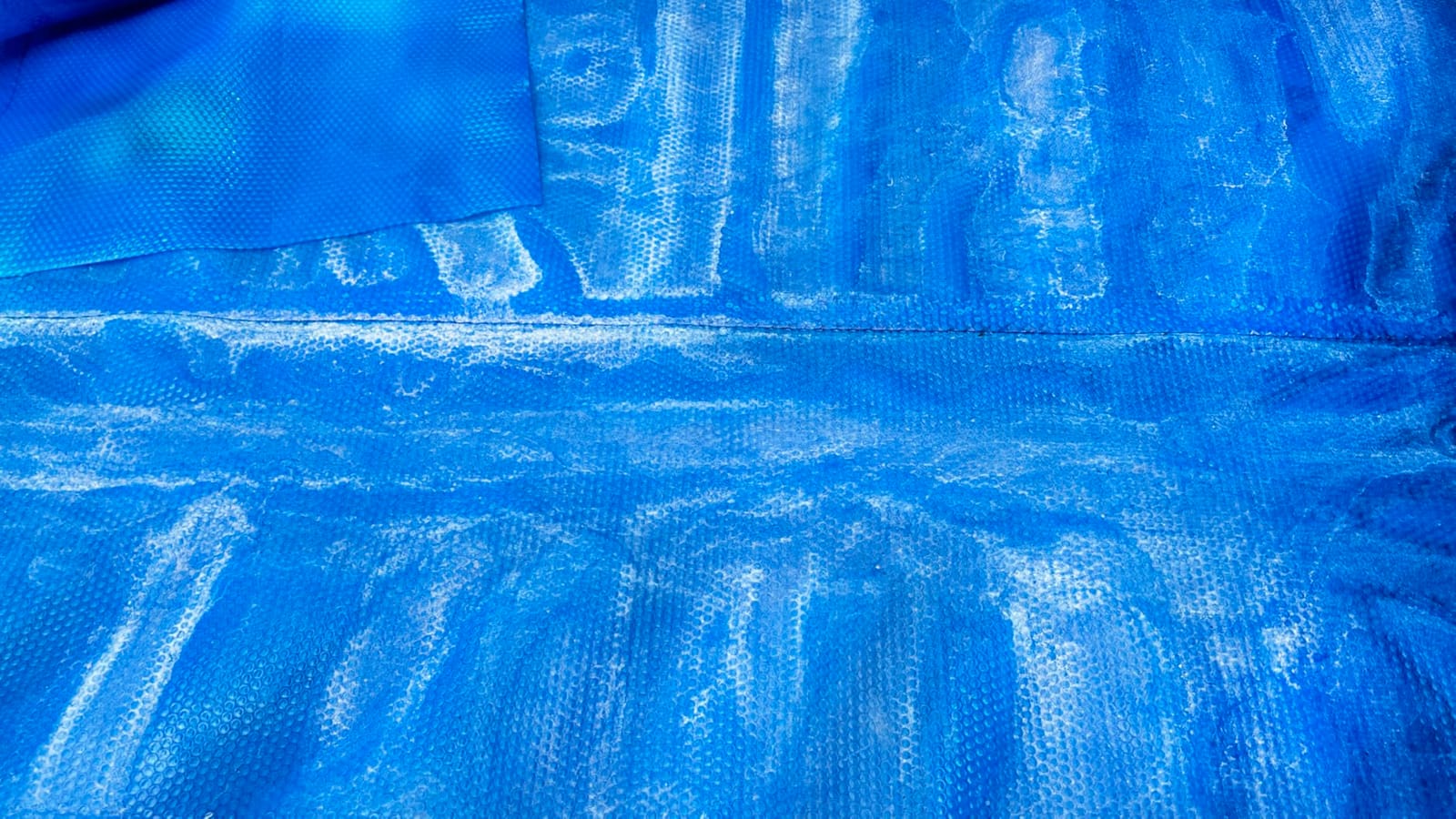
Beyond heat, it does a good job as a debris screen. Owners report that it catches material before it settles on the pool floor, which cuts vacuuming and gives you a wet-vac-able surface. That is a quiet benefit that is easy to underestimate in a pool with trees nearby.
The handling cost is real and it is the only consistent complaint. Two people are needed to deploy and retrieve the larger sizes, a roller is effectively required, and the material is stiff and rigid enough to resist folding for storage. One unit wore out under normal use in about eighteen months, and one buyer received a larger diameter than ordered and had to trim it down.
Who this cover suits
Owners with a 16×32 foot rectangular pool who want the strongest overnight retention available without stepping up to a 20×40 foot sheet. The 5 degree overnight loss figure makes it the cover to beat if you are running a heater through shoulder season.
It is also the best choice here for custom shapes, because the material cuts without fraying. If your pool has a rock feature, a steps corner or anything non-rectangular, that cuts cleanly and holds its edge.
Who should skip it
Skip it if you are deploying alone, or if storage space is tight. The stiffness that makes it feel solid is the same stiffness that makes it awkward to fold into a small shed over winter. Check your dimensions carefully before ordering, since owners report sizing inconsistencies at delivery.
6. In The Swim 8-Mil 18-Foot Round – Best for Light Daily Handling
In The Swim 18′ Standard Blue Round Solar Pool Cover 8 Mil
8 mil polyethylene round cover
18 foot diameter
13 lb weight
Pros
- Balances durability with easy daily handling
- Trims around ladders and steps
- Reduces refills in peak summer
- Backed by a 3 year warranty
Cons
- Thinnest build in this group
- Sheds fragments into filter and skimmer
- Chemically sensitive to chlorine and pH
At 13 pounds, the In The Swim is the lightest cover here that is not a thin above-ground sheet, and that is the whole argument for it. If the cover is too heavy to lift, every other advantage is theoretical. This one gets deployed and it gets retrieved, which is when heat retention actually happens.
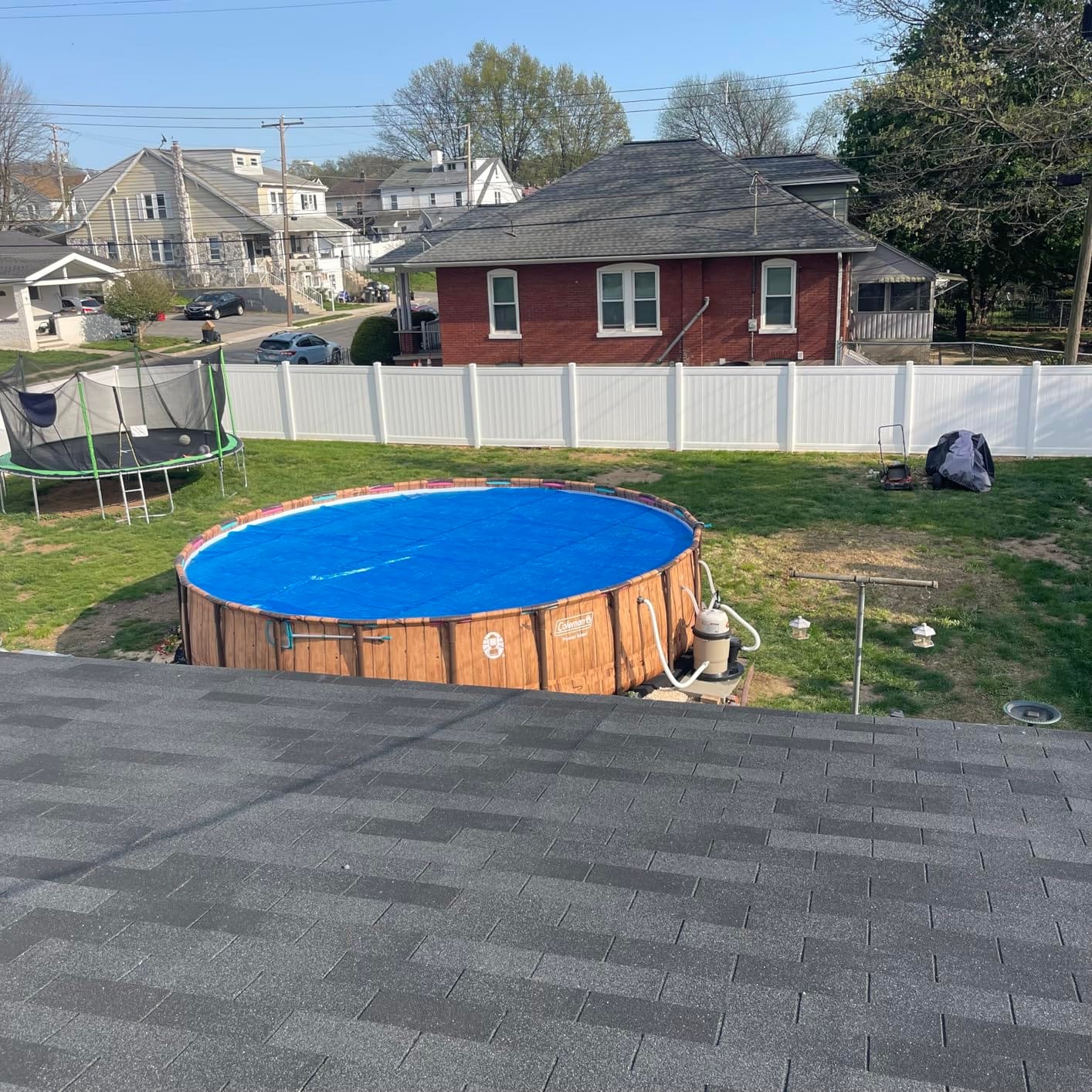
It is an 8 mil polyethylene round cover sized for 18 foot pools, and it carries a 3 year warranty from Midwest Canvas Corporation. Owners confirm it warms water in sunlight and holds it overnight, and at 8 mil it still cuts easily with scissors to fit ladders, steps and irregular contours. For a round pool that is close to the right diameter, the trimming is minimal.
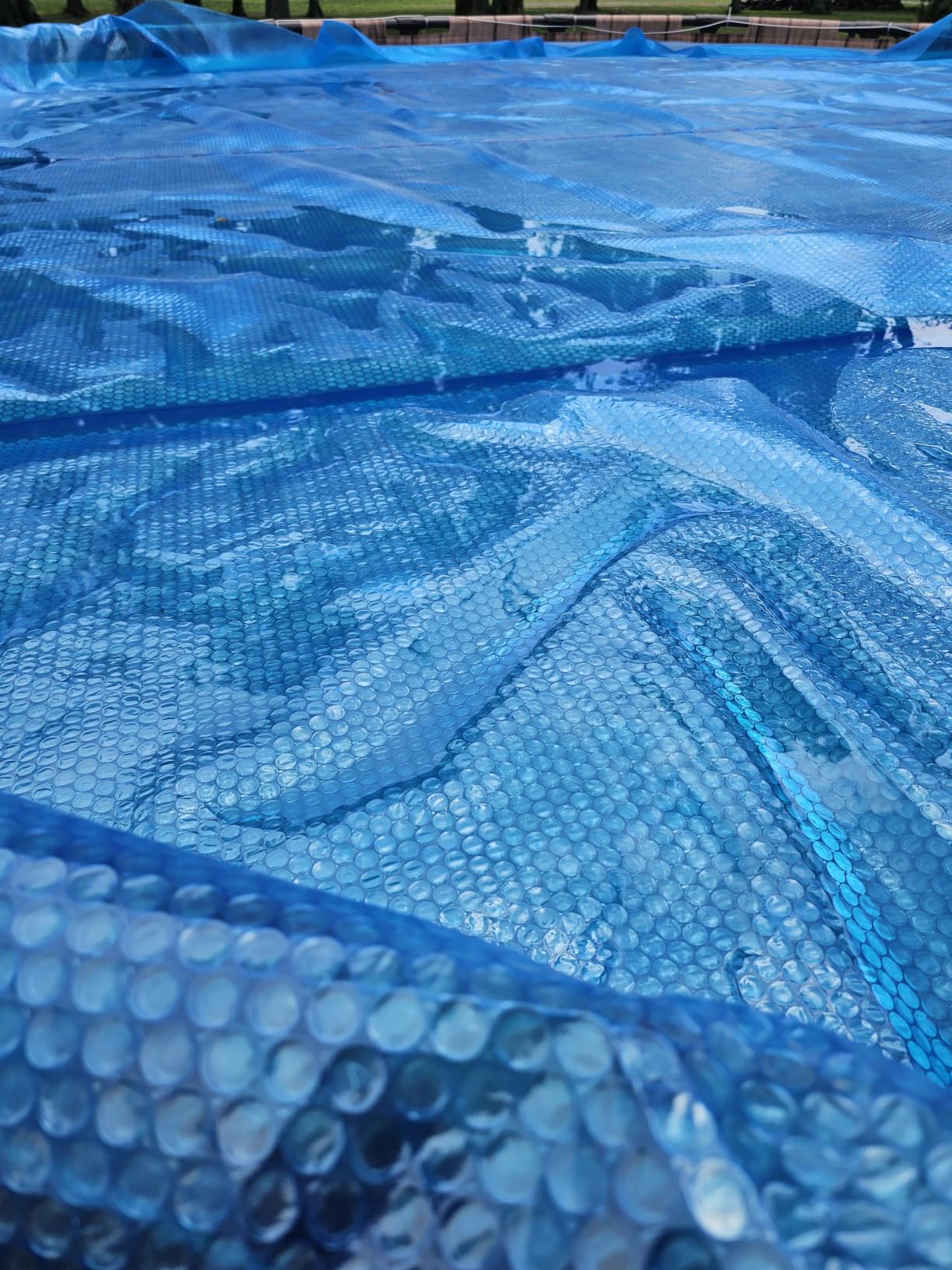
The honest caveat is that 8 mil is the thinnest construction in this group, and reviewers treat it as a lighter-duty seasonal option. The breakdown pattern is the category standard: bubbles slowly break down and shed plastic fragments into the filter and skimmer, and the sheet fades faster than a 12 mil cover in full sun.
Chemistry matters more here than with a thicker sheet. The care guidance is to apply it only when chlorine is below 2.5 ppm and pH is above 7.2, and to store it covered or shaded when shocking the pool. Also confirm the pool diameter before ordering, since owners report the size metadata on the listing is inconsistent across variants.
Who this cover suits
Owners of an 18 foot round above-ground pool who want the full evaporation and overnight retention benefit without wrestling a heavy sheet. The 3 year warranty is also the most straightforward one in this group, with none of the prorating that other brands carry.
It suits mild shoulder-season climates in particular, where the goal is extending swim time by a few weeks rather than holding a heated pool through winter.
Who should skip it
Skip it if your pool is in full sun year-round or if you want the cover to survive several seasons. Eight mil will not match a 16 mil cover for overnight retention, and the fragments that shed into the filter are a recurring complaint. If you already know you will want a thicker cover in two years, start there.
7. BigXwell 12-Mil 12-Foot Round – Best for Small Round Pools
BigXwell Solar Pool Cover, 12Mil Round 12 Foot for Above-Ground and In-Ground Pools, 1200Series Solar Blanket for Swimming Pool (Round 12 FT)
12 mil round cover for 12 ft pools
8.8 lb weight
144 by 144 inch sheet
Pros
- Heaviest-feeling cover in its class
- Strong material that resists tearing
- Holds heat overnight
- No trimming needed on a round pool
Cons
- Sizing runs approximate for some pools
- Solar gain limited in cool climates
- Two people needed for larger sizes
For a 12 foot round pool, this is the version of a 12 mil cover that respects your back. It weighs 8.8 pounds and a single person can put it on and take it off, which is unusual at this thickness. Owners who have owned many covers single it out as the heaviest and best-made in the mid-range band, and one repeat buyer praises the absence of the bubble flaking that ruined cheaper covers.
Heat performance holds up. Reviewers confirm it keeps water noticeably warmer through cool evenings and holds heat overnight, and it also doubles as an effective debris screen so a wet vac can clean the surface instead of the pool itself. The rating is 4.4 across 279 reviews, the smallest sample size in this group, so treat the score as encouraging rather than settled.
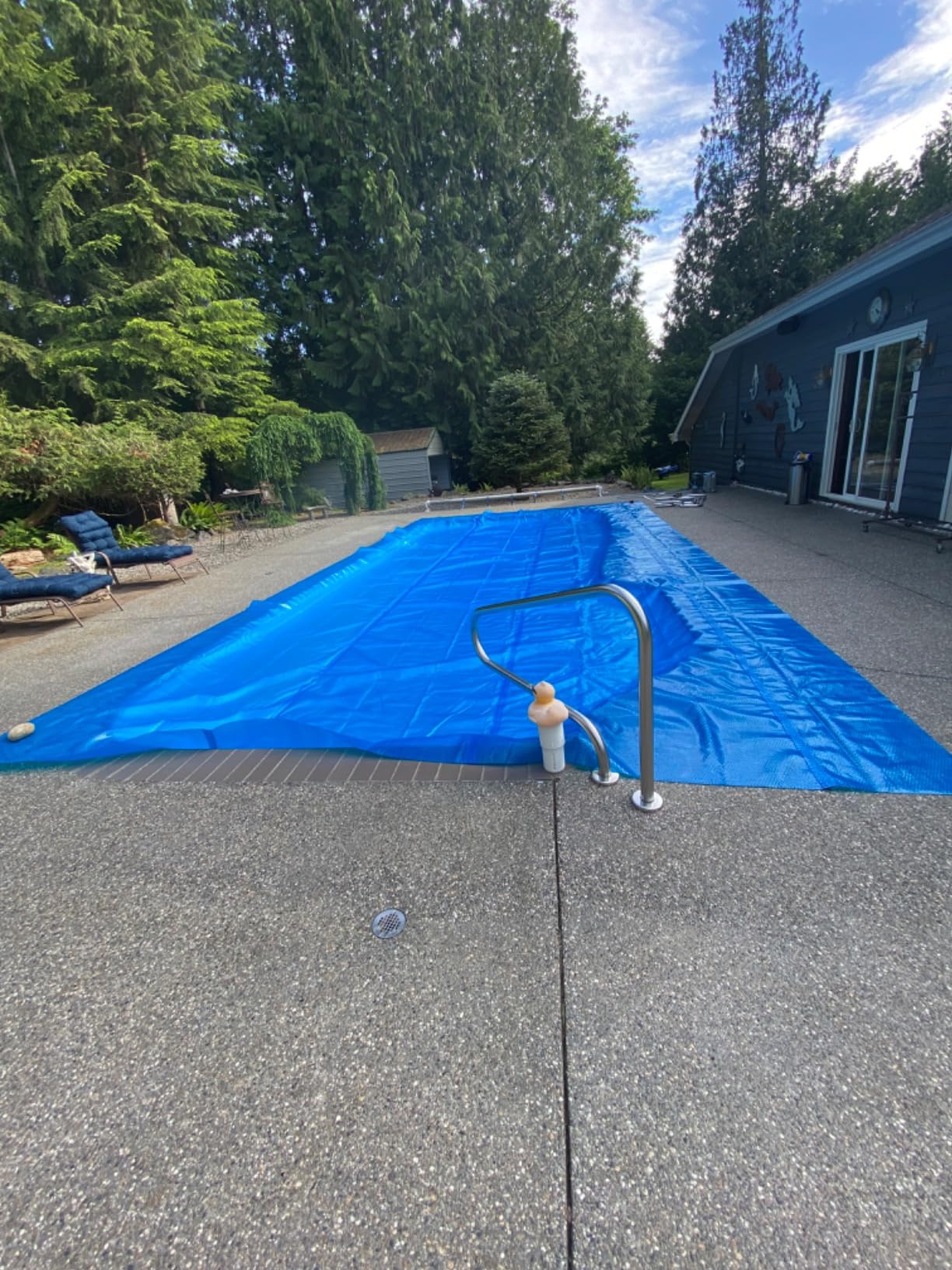
The recurring gripe is sizing precision. The sheet measures 144 by 144 inches, and some buyers report it running large for their pool while others in the 15 foot version find it does not reach the edges of an 18 foot round pool, which reduces the area of trapped air doing the insulating. Measure the pool and check the variant before ordering rather than after.
The other limitation is geography. Owners in cool or shaded settings report little solar gain, because the daytime heating component of a cover simply has nothing to work with. The overnight evaporation barrier still functions, but do not expect this cover to make a cold, cloudy pool warm.
Who this cover suits
Owners of a 12 foot round above-ground pool who want 12 mil durability and a genuinely one-person deployment. The weight is the standout number here, since most covers of this thickness need a roller even on small pools.
It also works for anyone who wants the cover to do double duty as a debris screen. If you are near trees, the surface-catch behaviour reduces how often you run the vacuum.
Who should skip it
Skip it if your pool is larger than 12 foot round and you are hoping to trim your way there. The reports of covers that do not reach the edges of an 18 foot pool are the reason to order the correct size instead. It is also the wrong pick for a cool, shaded, cloud-heavy climate.
8. Doheny’s Clear-Tek Micro-Bubble 18-Foot Round – Best for Heat Transfer
Doheny’s Clear-Tek Micro Bubble Solar Pool Cover for Above Ground Swimming Pools | Increase Solar Energy Absorption, Retain Heat, Reduce Evaporation, Reduce Heat Loss & Save, 18 ft Round Blue 1600
Micro-bubble layout with twice the bubble count
Made in the USA
216 by 216 inch sheet
Pros
- Transfers and holds heat quickly
- Water 10 to 15 degrees warmer than uncovered
- Light enough for one person to deploy
- Trimming does not void the warranty
Cons
- Material thinner than expected
- Glued center seam can split
- Warranty coverage ends after 12 months
- Needs clamping in windy areas
The Doheny’s uses a micro-bubble layout with roughly twice the bubble count of a standard cover, and owners report that shows up in the numbers. Several have measured water 10 to 15 degrees warmer than uncovered, and one owner in Ohio saw the pool reach 96 degrees. If your priority is heat transfer rather than simply slowing evaporation, this is the design built for it.
It is an 18 foot round cover made in the USA, with 7 years of spare part availability behind it. Light colours on the Clear-Tek line can increase solar energy absorption by 15 to 25 percent, and the evaporation barrier is rated to cut heating costs by up to 70 percent. Reviewers like that it trims to any pool shape with scissors without voiding the warranty.
Light enough for a 5-foot owner to deploy alone, with pool hooks making pull-back easy, this is a cover you can genuinely put it on every evening without recruiting help. That matters more than the spec sheet suggests, and it is the same principle that puts the Intex at the top of this list.
What holds it back is build and warranty. This is the 1600 Series, the entry tier, and owners report the material feels thinner than expected and can tear if it catches on anything while being removed. The glued center seam is a known failure point, and the advertised 3 year warranty is prorated with coverage ending after 12 months for this series, which is a real gap given that reports of bubble flaking cluster around the one-year mark.
Who this cover suits
Owners in a moderate climate who want strong daytime heat gain rather than overnight retention alone. The micro-bubble structure is the reason, and the reports of water reaching the mid-90s are not just anecdote about a heat wave.
It suits smaller or medium round pools, and anyone who will trim the cover to shape and wants to keep their warranty intact while doing it. In windy areas, plan on clamping it to the pool rail, because the 1600 Series is light enough to need it.
Who should skip it
Skip it if you need warranty coverage past the first year, or if you want the thickest material. The 1600 Series is the entry point in Doheny’s line, and the one-year coverage and thin material reports are consistent enough that we would not build a multi-season plan around them. Remove it carefully, since tearing on removal is the most common complaint.
How to Choose a Solar Pool Cover for Heat Retention
Choose the thickness first, because it changes both how much heat the cover holds and how likely you are to keep putting it on. A 16 mil cover outperforms a 12 mil cover overnight, but it is meaningfully heavier wet, and owners on r/swimmingpools consistently report that handling difficulty is what ends daily use. If you are choosing between 12 mil and 16 mil for a pool you will deploy alone, take 12 mil.
Match the thickness to the pool and the climate as a starting point. Eight mil is a seasonal option for a small or mild-climate pool. Twelve mil is the practical middle that most owners land on and most of the covers in this list sit there. Sixteen mil is for exposed sites, windy yards, and pools where the cover stays on through hard sun for months.
Bubble orientation is the detail most guides bury, and it is the easiest mistake to make. The bubble side goes down, against the water, so the trapped air forms a continuous insulating layer between the warm surface water and the air above. Installed bubble side up, the cover sits on the surface without a proper air layer, and guides that have measured it put the efficiency penalty at 30-40 percent. That is a third of your heat saving lost to a two-minute mistake.
Size the cover to reach the pool edges on all sides, because the value is in the sealed air layer across the whole surface. Owners on forum threads recommend buying slightly larger and trimming to shape, since manufacturers include extra material. Every cover in this list except the Intex round is cuttable, and the BigXwell Heavy-Duty is the one reported to cut without fraying.
Color is a genuine trade-off rather than a preference. Darker blue covers absorb and hold more heat and block more UV, which slows chlorine breakdown. Clear covers transmit more light and heat water faster, but they let more UV through to the chemistry, and one buyer of the Sun2Solar clear variant reported it performed the same as the cheaper blue version anyway. If chlorine stability matters as much as temperature, go blue.
Material is a smaller variable than most comparisons suggest. Every cover in this group is polyethylene, and the practical differences are the bubble construction and the mil gauge. Micro-bubble designs such as the Doheny’s pack more air cells into the same sheet, which is why they measure better on daytime heat transfer. Vinyl and polypropylene options exist but showed up in none of the higher-performing covers here.
Finally, think about the reel. Owners on Houzz and r/pools converge on the same conclusion, that a reel is what converts a cover from something that sits folded on the deck into something that goes on every night. Above 16×32 feet, assume you need one, and on a 16 mil cover assume a heavy-duty one. If your pool is smaller, the same cover can be handled by hand, and the reel becomes an optional upgrade rather than a requirement.
One more thing worth planning for, if you are still deciding between a solar cover and something else entirely: a solar cover is a heat-retention tool, not a heater. It captures what the sun and your existing heater already put into the water and slows the loss. A pool that never gets warm will not get warm because you bought a blanket. Pair the cover with poolside audio like the ones in our pool speaker picks and you will actually get in the water more often to enjoy the warmth.
Solar Cover Safety, Water Chemistry, and Cloudy Days
Treat every cover in this guide as a floating object that is not designed to hold a person’s weight. Entrapment happens when someone slips beneath the sheet or lands on it and cannot get free, and the wet sheet on a deck is a separate slip hazard. Remove it completely before anyone swims, and never prop it half on the pool to let a ladder in while someone is in the water.
Wind is the other hazard worth planning for. Deploy on a calm day, keep the cover away from the pool edge when it is off, and take it off entirely when conditions turn. Several products here are specifically praised for staying put in strong wind, which is a safety feature as much as a convenience feature.
Chemistry is where solar covers shorten their own lives. One manufacturer advises against highly chlorinated or acidic water for longevity, and another specifies chlorine below 2.5 ppm and pH above 7.2 before application. Remove the cover when shocking the pool, because trapped chlorine under a warm sheet is what cracks bubble cells and sends plastic fragments into your skimmer and filter.
Cloudy and winter days are where retention proves its value. Solar gain drops substantially under heavy cloud, but the evaporation barrier does not care about the weather, and an overcast night will still cost you temperature. The covers rated here for holding roughly 5 degrees overnight are the ones doing the work when there is no sun to help them.
Hot climates need a different plan. A cover left on through peak summer can keep water warmer than you want, and in very hot conditions the trapped air under the sheet can get hot enough to encourage algae if circulation and chemistry are neglected. Pull the cover back for filtration on those days, and do not treat more heat as automatically better.
Off-season storage decides whether next summer’s cover still fits. Fold or roll it dry, keep it out of direct sun, and store it somewhere shaded and dry rather than draped over the pool. A cover stored in sunlight hardens and shrinks, and that shrink is the reason a second-season cover no longer reaches the pool edges and no longer seals.
If you are weighing a solar cover against a hard safety cover, they solve different problems and neither replaces the other. Safety covers prevent entry and debris and are permanently anchored. Solar covers float, cut evaporation, and must come off before anyone swims. Owners who ask whether a solar cover is good enough instead of an automatic cover get a consistent answer in the forums, and that answer is no. Related reading on covers that are built for a different purpose is in our guide to sandbox covers.
Frequently Asked Questions
What is the best pool cover to retain heat?
A floating solar bubble blanket is the best pool cover for retaining heat, because it blocks evaporation, which is where most of a pool’s heat escapes. A 12 mil polyethylene cover is the practical choice for most residential pools, while 16 mil holds more heat and lasts longer at the cost of weight. Among the covers we reviewed, the Sun2Solar Blue 1200 Series and the BigXwell Heavy-Duty 16-Mil were the strongest retention performers.
Do solar covers really help heat a pool?
Yes, but mostly at night. A cover lets sunlight through so the water absorbs heat during the day, then traps that heat after sunset by stopping wind-driven evaporation. Testing of a single hot afternoon typically shows 4-5 degrees gained, while a cover left on for several sunny days holds 8-15 degrees of temperature overnight. The evaporation barrier works even on cloudy days.
What is the best solar blanket for heating a pool?
A blue polyethylene bubble blanket in the 12 mil to 16 mil range is the best solar blanket for actually heating a pool, with micro-bubble construction giving the fastest transfer. Our picks for heating are the Doheny’s Clear-Tek Micro-Bubble, whose owners report water 10 to 15 degrees warmer than uncovered, and the Sun2Solar Blue 1200 Series for pools up to about 15 degrees of daytime gain.
What is the best brand of solar pool cover?
Sun2Solar, BigXwell and Doheny’s were the strongest brands in our testing, each earning 4.2 to 4.5 stars across hundreds to thousands of owner reviews. Sun2Solar and BigXwell both lead on retention, while Doheny’s leads on micro-bubble heat transfer. Blue Wave and Intex remain solid choices, with Blue Wave scoring 4.0 for durability complaints and Intex holding 4.2 across more reviews than any other cover here.
Who makes the best pool solar blanket?
Three manufacturers stood out: Sun2Solar for the 1200 Series 12 mil, BigXwell for the Heavy-Duty 16 mil and the 12 mil round, and Doheny’s for the Clear-Tek Micro-Bubble. VEVOR’s 16 mil rectangle is also worth noting for windy sites. Intex makes the most widely reviewed cover in this group and is our pick for owners who deploy the cover alone every day.
What is the best solar blanket on the market?
For the best overall balance of heat retention and daily usability, the Intex 16-Foot Round Solar Cover is the one we recommend. It holds heat overnight at 16 ounces, so a single person can deploy it, and it carries the largest review base in this group at more than 33,000 ratings. If you can handle a heavier sheet and want longer retention, step up to the Sun2Solar 12 mil or BigXwell 16 mil.
Does a pool solar blanket really work?
A pool solar blanket really works, and the size of the effect depends almost entirely on whether you put it on. The same cover left folded on the deck delivers nothing. Bubble side down is essential, since installing it the wrong way can cut efficiency by 30-40 percent. Owners also report that a cover can be left on overnight and through cloudy weather with most of the benefit intact.
What is the best thickness for a pool solar blanket?
Twelve mil is the best thickness for most residential pools, holding noticeably more heat than 6 mil and staying light enough to deploy daily. Eight mil suits small pools and mild climates but fades fastest. Sixteen mil gives the best retention and wind resistance and is the right choice for exposed sites or heated pools, but it needs a roller and often two people. Beyond 16 mil you gain little retention and mostly add weight.
The Best Solar Pool Covers for Heat Retention (2026)
After comparing eight covers on retention, evaporation control, durability and how often you will realistically use them, the Intex 16-Foot Round Solar Cover is the best solar pool cover for heat retention for most households. It holds warmth overnight, blocks debris and cuts chemical use, and at 16 ounces one person can put it on and take it off, which is the factor that decides whether any of this works for you.
If you want a heavier sheet and can handle the handling, the Sun2Solar Blue 1200 Series 12 mil gives roughly 5 degrees of overnight retention and a longer useful life. The BigXwell Heavy-Duty 16 mil is the pick for a 16×32 foot rectangular pool that sees hard sun and wind, and the Doheny’s Clear-Tek Micro-Bubble is the one to buy when fast daytime heat transfer is the goal.
Whichever one you choose, install it bubble side down, anchor it every 4-6 feet if your site is exposed, take it completely off before anyone swims, and keep chlorine in check. Those four habits will do more for your pool in 2026 than any amount of spec-sheet reading.