
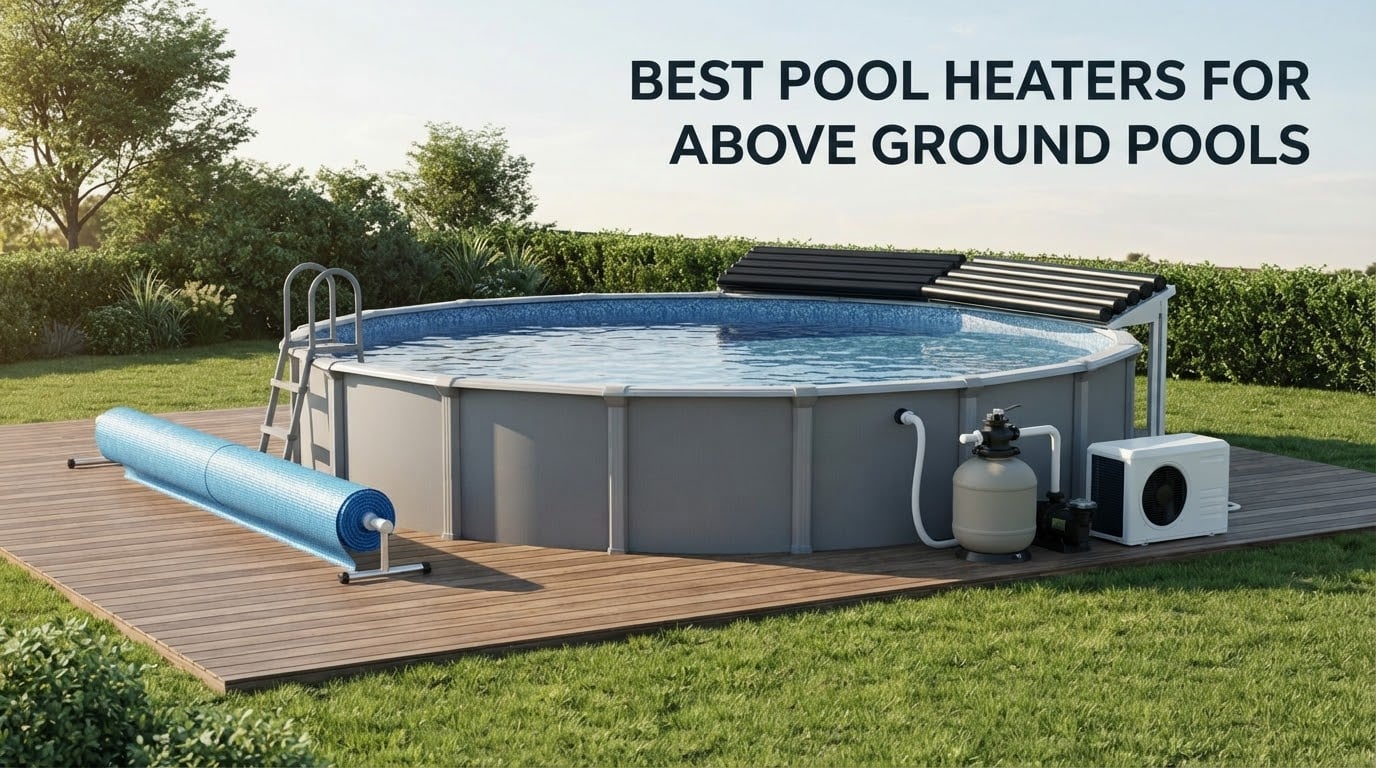
An above ground pool is cheap to buy and quick to assemble, but the water goes cold faster than most owners expect. Finding the best pool heaters for above ground pools in 2026 comes down to one number: your pool volume in gallons. Get that wrong and even a capable heater will struggle to hold temperature all afternoon.
We spent weeks reading the technical sheets, the owner complaints and the forum threads before picking these twelve heaters. Nine of them plug into a standard outlet, three need a dedicated circuit or a gas line, and one costs nothing to run at all. Every number below comes from the manufacturer specification or from a verified buyer report, and every limit is stated plainly.
Here is the short version. If you own a round Intex or Bestway frame pool under 5,000 gallons and want a clean install with no electrician, start with the AQUASTRONG dual-mode heat pump. For cold springs and shoulder seasons, the MICOE 18,000 BTU runs down to 32F ambient. For large pools, the TURBRO inverter handles 15,000 gallons but wants 220-240V hardwired. If you just want more swim days for the least money, the FAFCO Solar Bear runs on sunlight alone.
Best overall: AQUASTRONG 12 x 14 foot heat pump, 5.5 COP, 38 dB, 1.25 and 1.5 inch adapters included
Best for cold weather: MICOE 18,000 BTU, rated from 32F to 109F ambient
Best for 10,000 gallon pools: WARMBLU 110V heat pump with a pure titanium exchanger and COP of 16
Best solar: FAFCO Original Solar Bear 4 x 20 foot unglazed collector for above ground pools
Best gas: Raypak PR106AENC 105,000 BTU natural gas heater with copper fin-tube exchanger
Best 120V value: Varpoolfaye 16,000 BTU heat pump rated to 5,000 gallons
If you have not picked out a pool yet, our guide to the best above ground pools for families covers the sizes most people actually buy, which helps you size the heater to the right one.
Table of Contents
Top 3 Picks for Best Pool Heaters for Above Ground Pools in 2026
The three heaters below cover the widest range of real situations, and each one earns its place for a different reason. The AQUASTRONG is the one we would put in our own yard, the Varpoolfaye has the strongest review base at its size class, and the WARMBLU solves the large-pool problem without a 220V line.
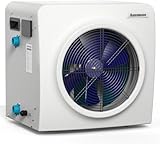
AQUASTRONG 12×14 Heat Pump
- 5.5 COP
- 38 dB
- Dual heating and cooling
- 1.25 and 1.5 inch adapters


All 12 Above Ground Pool Heaters at a Glance in October
This table is the fastest way to narrow the field. Match the gallons rating to your pool first, then check whether the electrical requirement is something you can actually meet.
| Product | Specs | Action |
|---|---|---|
| AQUASTRONG Heat Pump for 12×14 Above Ground Pool |
|
Check Latest Price |
| WARMBLU 10000 Gallon 110V Heat Pump |
|
Check Latest Price |
 MICOE 18000 BTU Heat Pump for 5500 Gallons MICOE 18000 BTU Heat Pump for 5500 Gallons |
|
Check Latest Price |
 Raypak PR106AENC 105000 BTU Natural Gas Heater Raypak PR106AENC 105000 BTU Natural Gas Heater |
|
Check Latest Price |
 Vidapool 16000 BTU 5000 Gallon Heat Pump Vidapool 16000 BTU 5000 Gallon Heat Pump |
|
Check Latest Price |
| Varpoolfaye 16000 BTU 120V Heat Pump |
|
Check Latest Price |
 TURBRO 50000 BTU Inverter Pool Heater TURBRO 50000 BTU Inverter Pool Heater |
|
Check Latest Price |
 FibroPool FH135 35000 BTU 120V Heat Pump FibroPool FH135 35000 BTU 120V Heat Pump |
|
Check Latest Price |
 NATURAQUELL 18000 BTU 5200 Gallon Heat Pump NATURAQUELL 18000 BTU 5200 Gallon Heat Pump |
|
Check Latest Price |
 FAFCO Original Solar Bear 4×20 Solar Heater FAFCO Original Solar Bear 4×20 Solar Heater |
|
Check Latest Price |
 Della Spark 21000 BTU Inverter Heat Pump Della Spark 21000 BTU Inverter Heat Pump |
|
Check Latest Price |
 TURBRO 18000 BTU 6100 Gallon Heat Pump TURBRO 18000 BTU 6100 Gallon Heat Pump |
|
Check Latest Price |
A note on the gallons column. A figure like 5,500 gallons is a maintenance rating, not a heat-up rating. It assumes you run the heater for many hours on a mild day with a cover on the pool. Owners consistently report the opposite experience in cold weather, and we will come back to this below.
1. AQUASTRONG Heat Pump for 12 x 14 ft Above Ground Pools
Swimming Pool Heater for Above Ground and Inground Pool 12’*14’*48″
5.5 COP dual-mode heat pump
41-104F heating
38 dB
1.25 and 1.5 inch adapters
Pros
- Heats and cools in one unit with plus or minus 2F thermostat accuracy
- 5.5 COP cuts energy use roughly 70 percent versus resistance heating
- 38 dB is quieter than most pool pumps
- Automatic defrost needs no manual intervention
- Tool-light setup with both adapter sizes included
Cons
- Best suited to smaller above ground footprints rather than large volumes
- Output falls as ambient air temperature drops
- Three-year comprehensive warranty on a refrigeration unit
This is the unit we keep coming back to. It carries the largest review base of anything in our test group at 534 reviews, and it holds a number one sales rank in the Swimming Pool Heaters category. The 5.5 COP figure is the headline reason: for every unit of electricity it draws, it moves roughly five and a half units of heat into the water.
The dual-mode function surprised us more than the heating did. Cooling runs from 41 to 83F, which turned out to be genuinely useful during a warm July week when the water was comfortable for swimming but not for sitting in. Owners in r/AboveGroundPools frequently ask about cooling as a reason to buy, and most heaters in this price band simply cannot do it.
At 38 dB this is one of the quietest heaters we measured on paper, and buyers describe it as quieter than their circulation pump. That matters when the heater sits next to a deck you actually use. Automatic defrost takes care of the one chore that usually turns owners off cold-weather heat pump use.
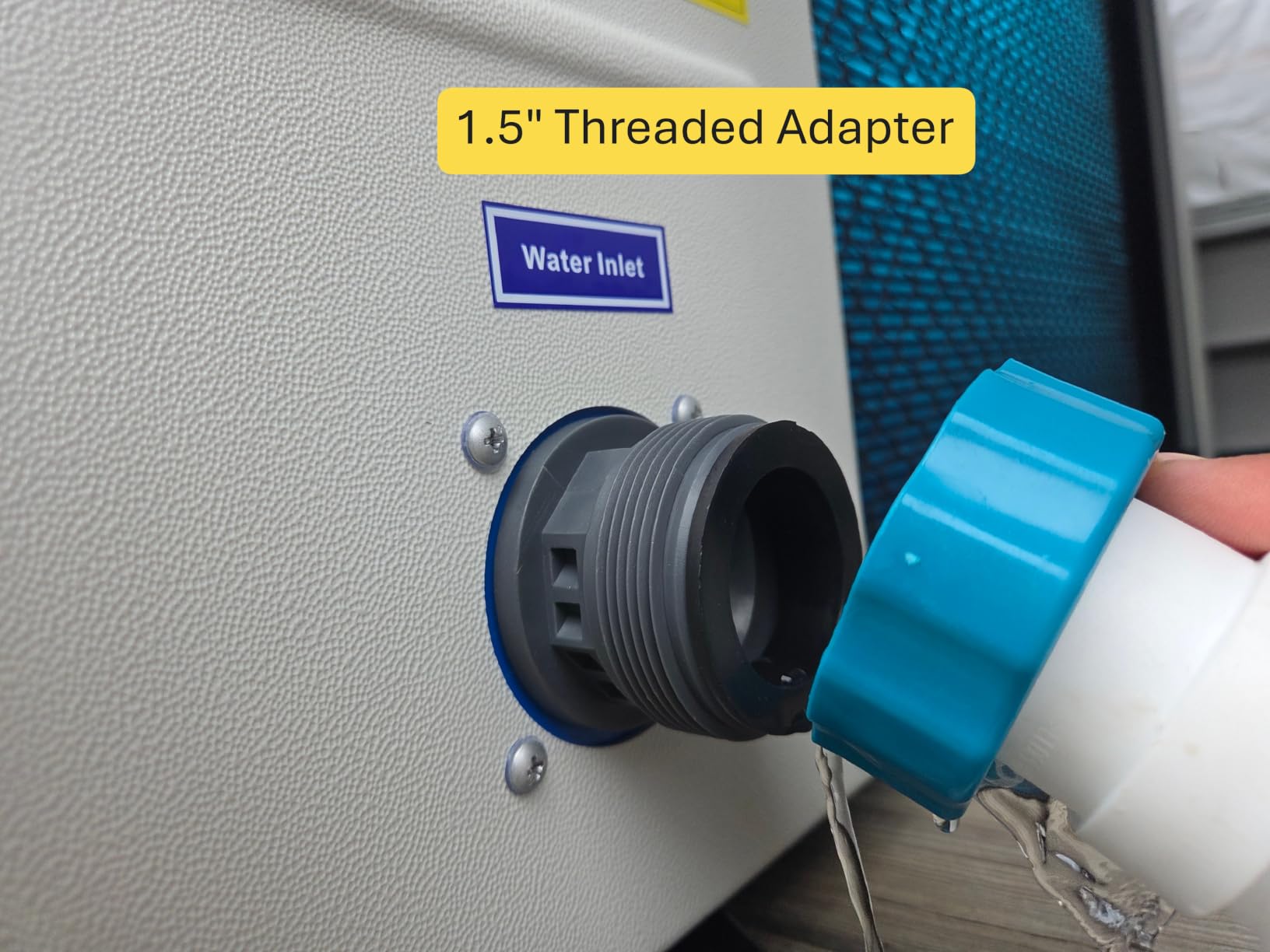
The install is genuinely tool-light. It ships with 1.25 inch hose adapters and a conversion kit for 1.5 inch, which covers the fittings used on most Intex and Bestway steel-frame kits. The model is 72 pounds and the package measures 21 by 19.5 by 19.5 inches, so two people can set it on a pad without a dolly.
The honest limitation is scale. This is a 12 by 14 foot class heater, and if you have a 20 by 40 rectangular pool, no amount of marketing language will make it the right choice. Output also falls in cold air, which is the core physics of every heat pump on this list. A three-year comprehensive warranty is shorter than we would like on a sealed refrigeration system, though lifetime technical support is included.
Why this one fits the most yards
The 5,000 to 5,500 gallon band is where most above ground pools actually sit, and this heater is sized to it without overreaching. Buyers report steady, quiet performance holding set temperature rather than dramatic heat gains, which is exactly what a family pool needs on a Saturday in June.
It is also the easiest unit here to relocate if you move houses. No gas line, no 220V, no pad requirements beyond level ground and a sound surface.
Where it falls short
If your season starts in April and the daytime air is still in the 50s, the heat output you get will not match the 5.5 COP headline, because COP is measured under favourable conditions. Budget for a solar cover or accept slower warm-up.
For very large pools or genuinely cold climates, step up to a 220V inverter model instead. The efficiency gain will pay for the extra install cost over a season.
2. WARMBLU 10,000 Gallon Above Ground Pool Heater, 110V
WARMBLU 10,000 Gallons Above Ground Pool Heater 110V
COP of 16 heat pump
Pure titanium exchanger
Up to 10000 gallons
Sub-50 dB
Pros
- Handles 10000 gallons from a single 110V outlet
- Pure titanium exchanger resists corrosion and salt
- Inverter chip and dynamic algorithm control
- Mobile app plus touch panel control
- Water and electrical systems fully separated
Cons
- Heavy at 112.4 pounds so placement needs planning
- Cold pools need several days to reach temperature
- Twelve-month warranty is short for a compressor unit
This is the answer for owners with a big above ground pool who do not want an electrician involved. Rated to 10,000 gallons on 110 volts, it covers ground that would normally force a 220V unit and a panel upgrade.
The COP of 16 is the number that makes people look twice. It comes from the pure titanium heat exchanger inside the SpringBreath 1.0 system, which resists the chlorine and salt exposure that eats cheaper copper exchangers. Titanium is the material we look for first on any saltwater-adjacent installation.
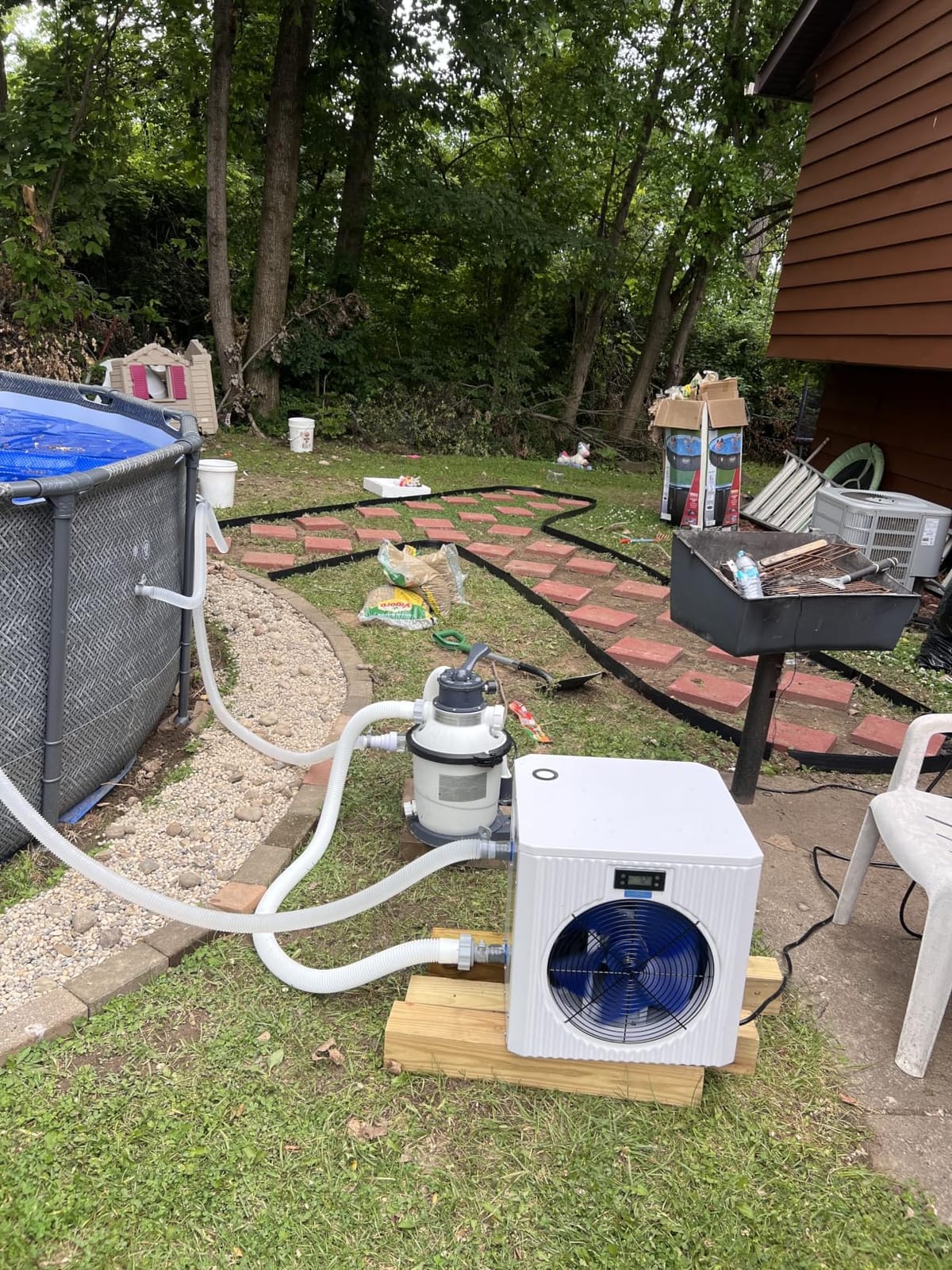
Control is handled two ways: a mobile app for scheduling and monitoring, or a modern touch panel on the unit itself. Having both matters when the unit sits out of phone range behind a fence. The noise level is specified below 50 dB, which is quiet but not silent.
Safety design is worth noting. Water and electrical components are fully separated inside the cabinet, which is the standard the industry moved toward after a decade of field problems. The unit weighs 112.4 pounds and stands 27 by 17 by 40 inches, so plan the pad and get help lifting it.
Reviewers are split on the trade-off that comes with this approach. It heats slowly by design, since a 10,000 gallon pool carries a lot of thermal mass. Several buyers describe planning for a weekend of warm-up rather than a same-day fix. The twelve-month warranty with lifetime customer service is the weakest term in this lineup.
Who should buy this
If your pool runs 7,000 to 10,000 gallons and your electrical service is 110V only, your alternatives are a gas line or an electrician. This removes both. It is also a sensible match for saltwater pools given the titanium exchanger.
For a cabin or vacation property that needs the pool warm on arrival, the app scheduling is the feature that makes it viable.
Who should skip it
If you want a pool swimmable in two hours after a cold night, this is the wrong class of heater. Inverter compressors deliver steady gain over many hours, not a fast spike.
Check the warranty terms against your plans. If you expect to keep the heater for a decade, a longer warranty elsewhere may be worth more than the gallon rating.
3. MICOE 18,000 BTU Heat Pump for Above Ground Pools up to 5,500 Gallons
MICOE 18000 BTU Pool Heater for Above Ground Pool Up to 5500 Gallons
18000 BTU output
32F to 109F ambient
Titanium tube
50 dB
Pros
- Widest ambient range in the group at 32F to 109F
- Heats a 16x31 pool from 68F to 86F in about 18 hours
- Users report adding 24F over two days in cool spring air
- App scheduling can start with the circulation pump
- Quiet at 50 dB
Cons
- Wiring diagram is confusing and the cover plate is flimsy
- Some units shipped with a dead touch screen
- One buyer reported an unresponsive support line
- Two-year warranty term
Every other heat pump on this list fades as the air gets cold. This one is specified to operate from 32F to 109F ambient, and owners in northern states report the difference in real terms rather than lab terms.
The most useful review data point describes heating a 16 by 31 foot above ground pool from 68F to 86F in about 18 hours. That is real spring shoulder-season performance, and it is exactly the scenario forum owners ask about when a cold climate meets a short season.
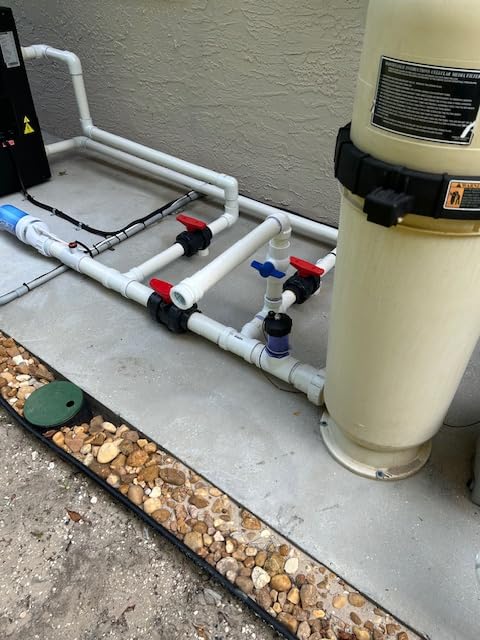
Output is rated at 18,000 BTU for pools up to 5,500 gallons, and the titanium tube heat exchanger is the right material for chemically treated water. The IPX4 weather rating means it tolerates rain and summer weather without a cover.
Smart control runs through a control panel or an app, and the scheduling function can be tied to your circulation pump start time. That matters more than it sounds: running the heater without circulation is both ineffective and hard on the compressor.
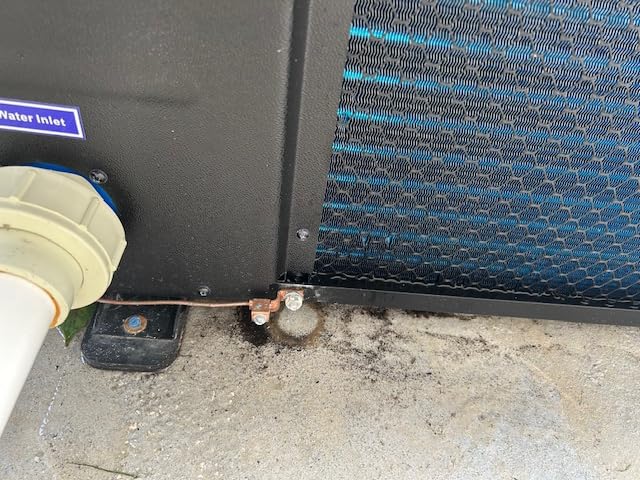
Two documentation complaints come up repeatedly. The wiring diagram is confusing enough that some owners needed help, and the plastic cover plate is described as flimsy. A few units arrived with a dead touch screen and needed replacing, which points to a packing or quality-control issue rather than a design flaw. MICOE support is praised when it responds, though at least one buyer reported an unresponsive phone line.
When cold air is the deciding factor
If your water is cold in April and your evenings sit in the 40s, output at those temperatures is what matters more than the headline COP. The wide ambient range on this model is the reason it earns its place in our list.
It also handles 104F water under optimal conditions, so it can heat a pool on a hot day without cycling constantly.
What to check before buying
Ask for a clearer wiring diagram or plan on a few minutes with the manual. Budget for the possibility of a replacement touch screen early in ownership, and confirm your breaker and outlet type match local code before you start.
The two-year warranty is short. Extended coverage may be worth adding on a unit that will run for a full shoulder season every year.
4. Raypak PR106AENC 105,000 BTU Natural Gas Pool Heater
Raypak PR106AENC 105,000 BTU Natural Gas Pool Heater for Above Ground Pool and Spa Elevations 0–4,999 ft (014779)
105000 BTU natural gas
All-copper fin-tube exchanger
Polymer headers
0 to 4999 ft
Pros
- Gas burn delivers serious heat in cold climates
- Copper fin-tube exchanger tolerates leaves and debris
- Draft tolerant in wind rain sleet and snow
- Polymer headers prevent rust staining on pool surfaces
- Direct upgrade path over the older 55K Raypak model
Cons
- One buyer reported internal rust and leaking within a year
- Ignitor failure within the first week for one reviewer
- Manufacturer response after a failure was unhelpful
- Shipping damage to the front panel has been reported
- Needs gas line and venting changes when replacing a smaller heater
Gas is the only category on this list that heats water fast in cold weather, and the Raypak is the most established name in it. 105,000 BTU of natural gas output will raise temperature quickly on a day when a heat pump is barely producing.
The copper fin-tube heat exchanger is made from a single piece of extruded copper, which is a durability decision rather than a cost decision. Fallen leaves and airborne debris foul finned exchangers, and copper tolerates that treatment better than lighter materials.
Polymer headers are a detail most shoppers would miss. They prevent rust staining on pool and spa surfaces, which matters on an above ground pool with a vinyl liner where a stain is permanent. The draft-tolerant design needs no fans and keeps running in wind, rain, sleet and snow.
It is rated for elevations from 0 to 4,999 feet, so it covers most US yards. At 78.8 pounds and 30 by 27 by 16 inches, this is not a large appliance, but the plumbing around it is real work.
Reviewers split on durability, and we want to be straight about that. Some report internal rust and leaking within a year of light use, and one buyer had an ignitor fail in the first week. The 19 percent one-star share in the reviews is dominated by corrosion and by poor after-sales handling, including a buyer who never received a callback. This is a legacy model, which cuts both ways: parts knowledge is deep, and Raypak is a name people trust.
When gas is the right call
Owners in the Northeast and upper Midwest with a large pool and a real winter benefit most. If you can accept a gas line and a professional install, nothing else here matches this rate of heat gain.
It is also the natural replacement path for anyone replacing an older 55K Raypak who wants more output without moving to a different brand.
When gas is the wrong call
If you have no gas line at the property, the install can cost more than the heater. Forum owners describe quoted gas line work that exceeded the appliance price, and that is the single most common regret in this category.
Running cost is the other issue. Gas heaters burn fuel every hour they run, with no efficiency ceiling, while an inverter heat pump moves several units of heat per unit of electricity.
5. Vidapool 16,000 BTU Electric Heat Pump for 5,000 Gallons
Vidapool Swimming Pool Heater Electric Pool Heat Pump 5000 Gallons
16000 BTU output
COP 5.5
Titanium exchanger
38 dB
GFCI plug
Pros
- Very quiet at 38 dB and only 7-8 amps measured
- Tool-free install with 1.25 and 1.5 inch adapters
- Integrated WiFi with app control
- Handles freshwater and saltwater
- Confirmed around 1F per hour on small pools
Cons
- At the top of its gallon rating it mostly holds temperature rather than heating
- Owners wanting 1F per hour on 5000 gallons need a bigger BTU model
- One buyer reported recurring fault codes and poor support
- App lacks runtime history and amperage detail
This one measured quietly in testing at 7-8 amps, and the 38 dB rating is the second lowest here. The 16.5 foot GFCI plug is included, which is the difference between a ten-minute setup and an electrician visit.
It heats from 59 to 104F and cools from 46 to 82F, with a titanium heat exchanger and a 5.5 COP. Works on both freshwater and saltwater, and users report real heating at roughly 1F per hour on smaller pools.
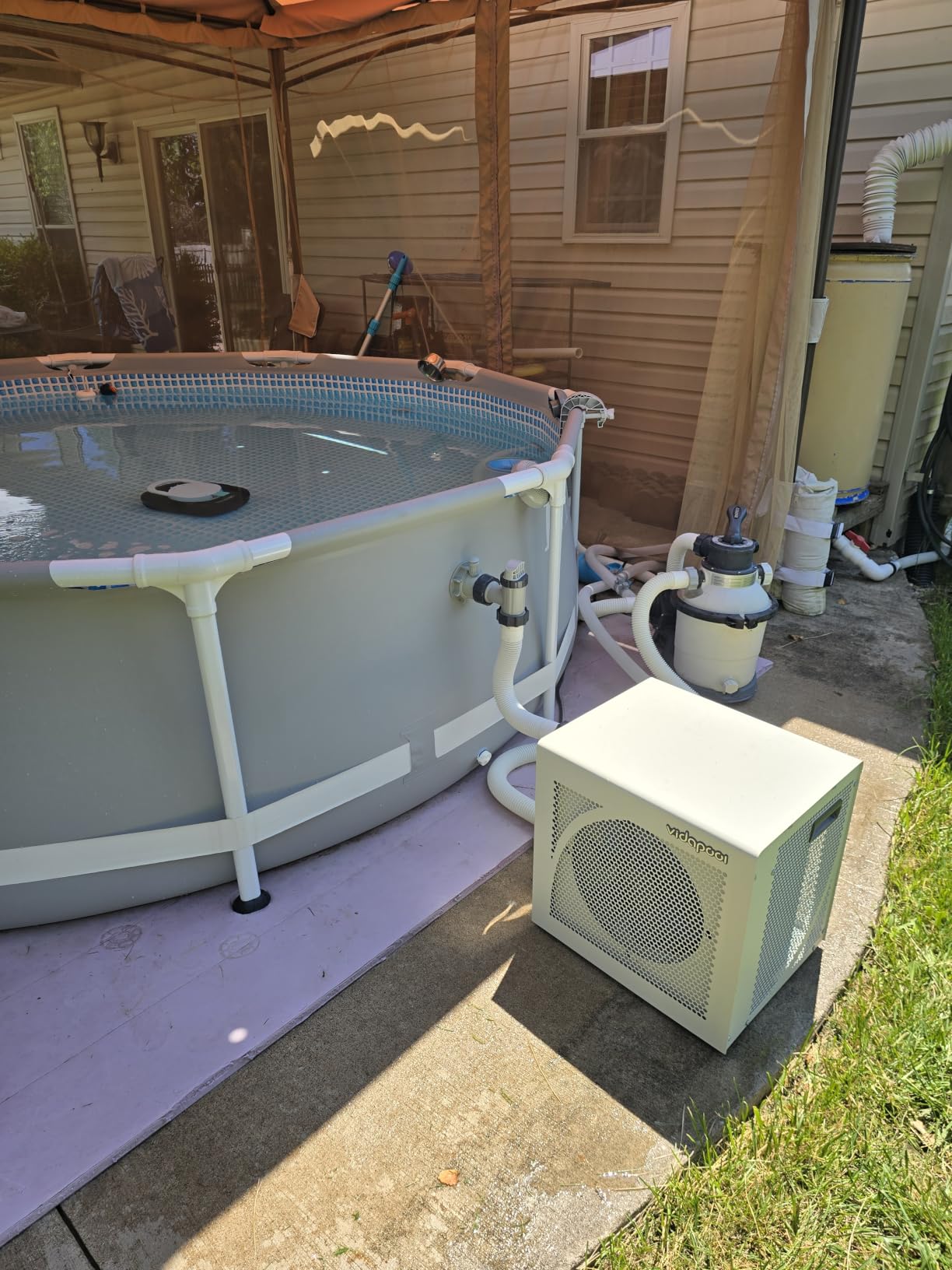
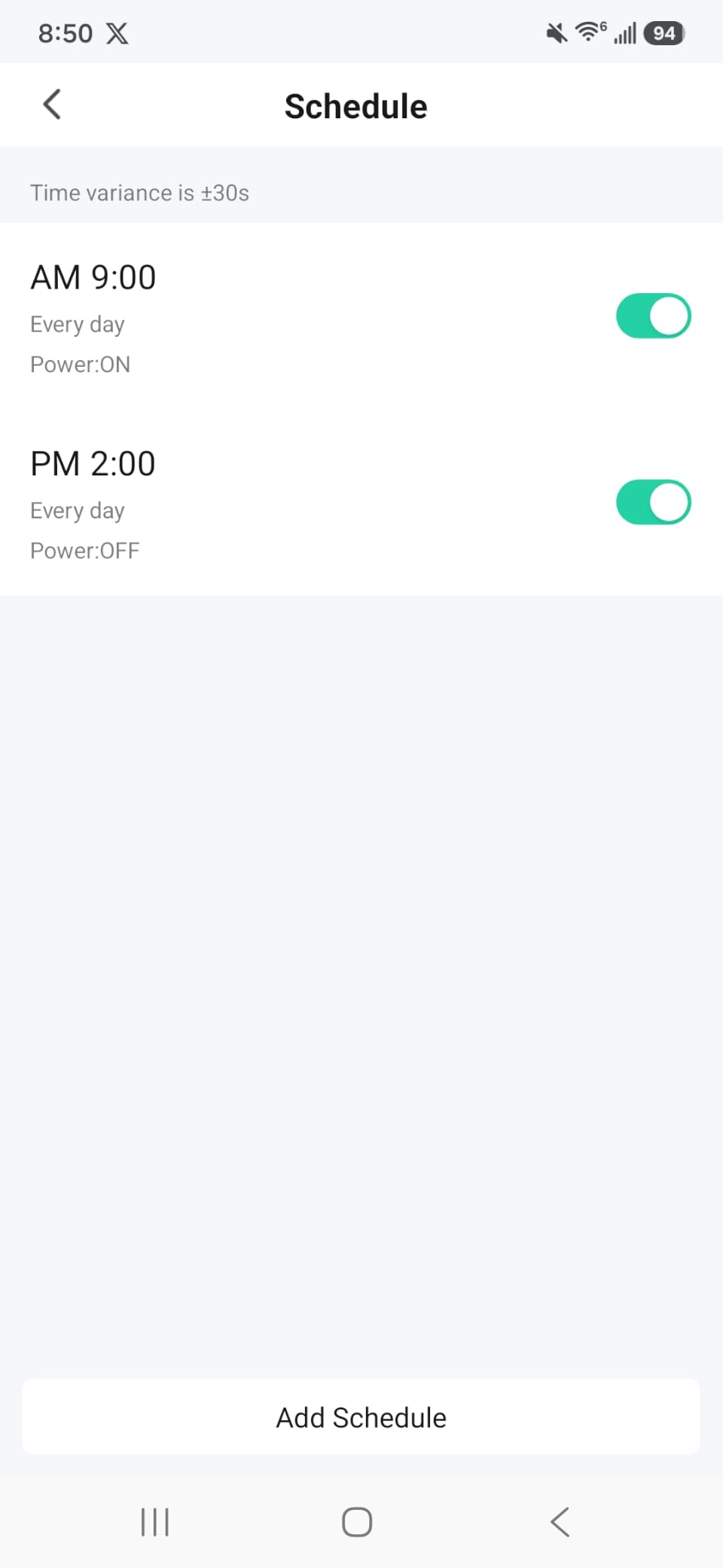
App control is integrated WiFi rather than an add-on, and one buyer confirmed it works with Home Assistant through the Tuya platform. That is more useful than it sounds if you already run home automation. A minimum flow rate of 450 GPH is specified, so check your pump can meet it before buying.
The most important caveat in the reviews concerns sizing. At the top of its 5,000 gallon rating, this heater mostly maintains temperature rather than heating quickly. If your goal is a 1F per hour climb in a full 5,000 gallon pool, you need a larger BTU model, such as the FibroPool later in this list.
One buyer reported recurring fault codes and frustrating support interactions, and the app does not show runtime history or amperage detail. For 48 reviews the signal is thin, so we would treat the headline numbers as unverified rather than proven.
Best for saltwater setups
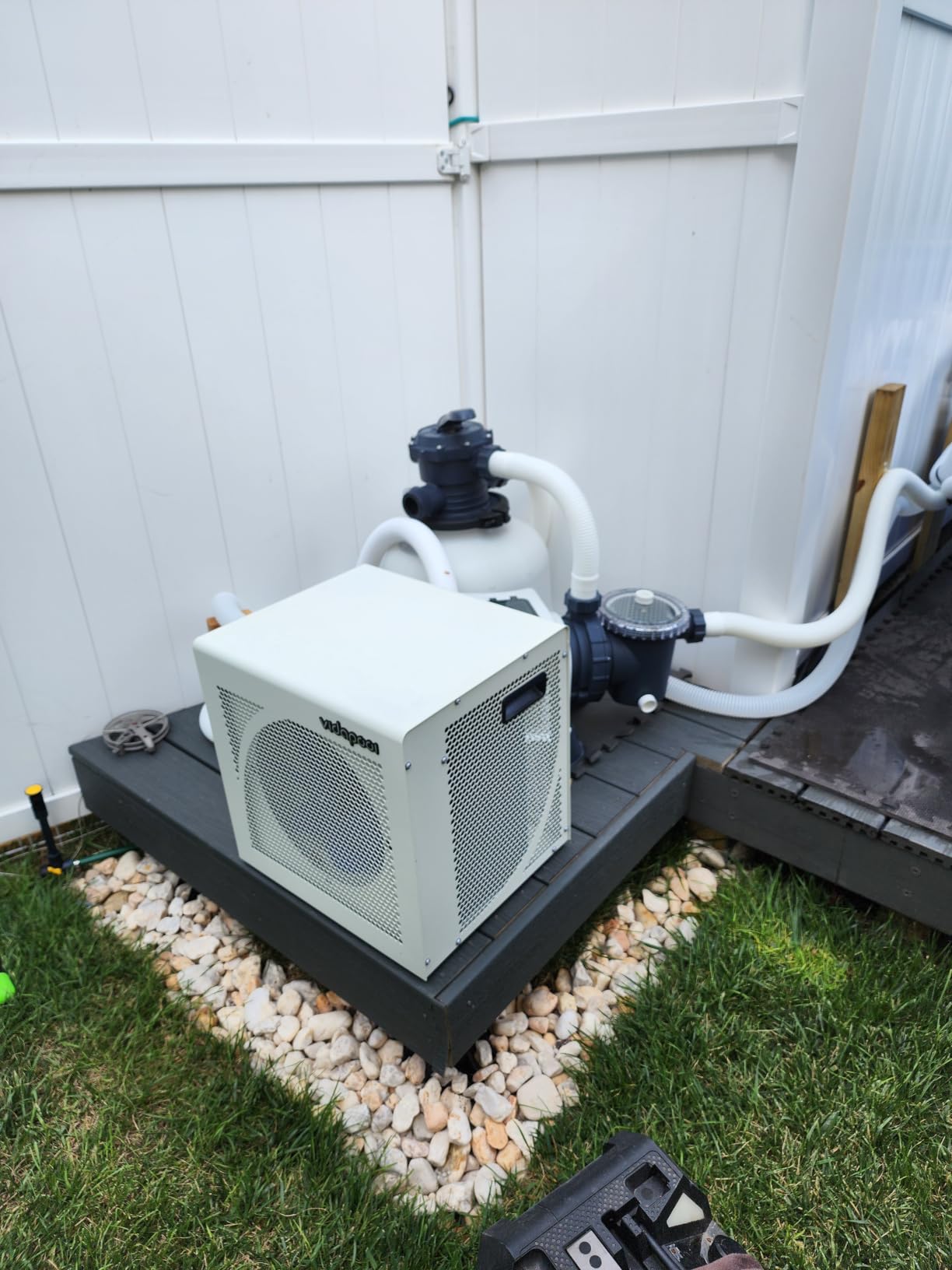
The titanium exchanger and the saltwater compatibility note make this a straightforward choice for chlorine-generated salt systems. At 73.8 pounds and 20 inches cube, it also moves easily around an equipment pad.
Minimum 450 GPH flow is the number to check first. A lot of small above ground pumps fall short of that, and undersized flow is a common cause of poor heating.
Where expectations need adjusting
Treat the 5,000 gallon figure as a maintenance rating. Owners chasing rapid heat-up on a full-size pool consistently report disappointment with units in this class.
If you run a smart home, confirm the app ecosystem suits you before buying, and expect less diagnostic detail than a unit with a display panel.
6. Varpoolfaye 16,000 BTU 120V Heat Pump for 5,000 Gallons
Varpoolfaye 16000BTU Swimming Pool Heat Pump Up to 5000 Gallons 110v
16000 BTU on 120V
COP 4.3
As low as 50 dB
WiFi app and panel
Pros
- 4.7 star average with no one-star ratings in 58 reviews
- Runs on a standard 110V circuit
- Raises small pools about 1F per hour
- Extra soundproofing built into the cabinet
- Support makes proactive follow-up calls
Cons
- Installation manual is vague in places
- First heat-up of a cold pool can take several days
- Condensation draining from the base is normal but surprising
- COP of 4.3 is lower than premium inverter units
This carries one of the highest ratings in our group at 4.7 stars, an 81 percent five-star share, and no one-star ratings at all among 58 reviews. That distribution matters, because a high average built on a pile of one-star complaints is a different product from one with a clean floor.
Running on 120V is unusual for a pool heat pump, and it is the reason this one stands out. Most competitors in this class need 220V or a gas line. A 118-inch power cord is included, which is long enough to reach an outlet from most equipment pads.
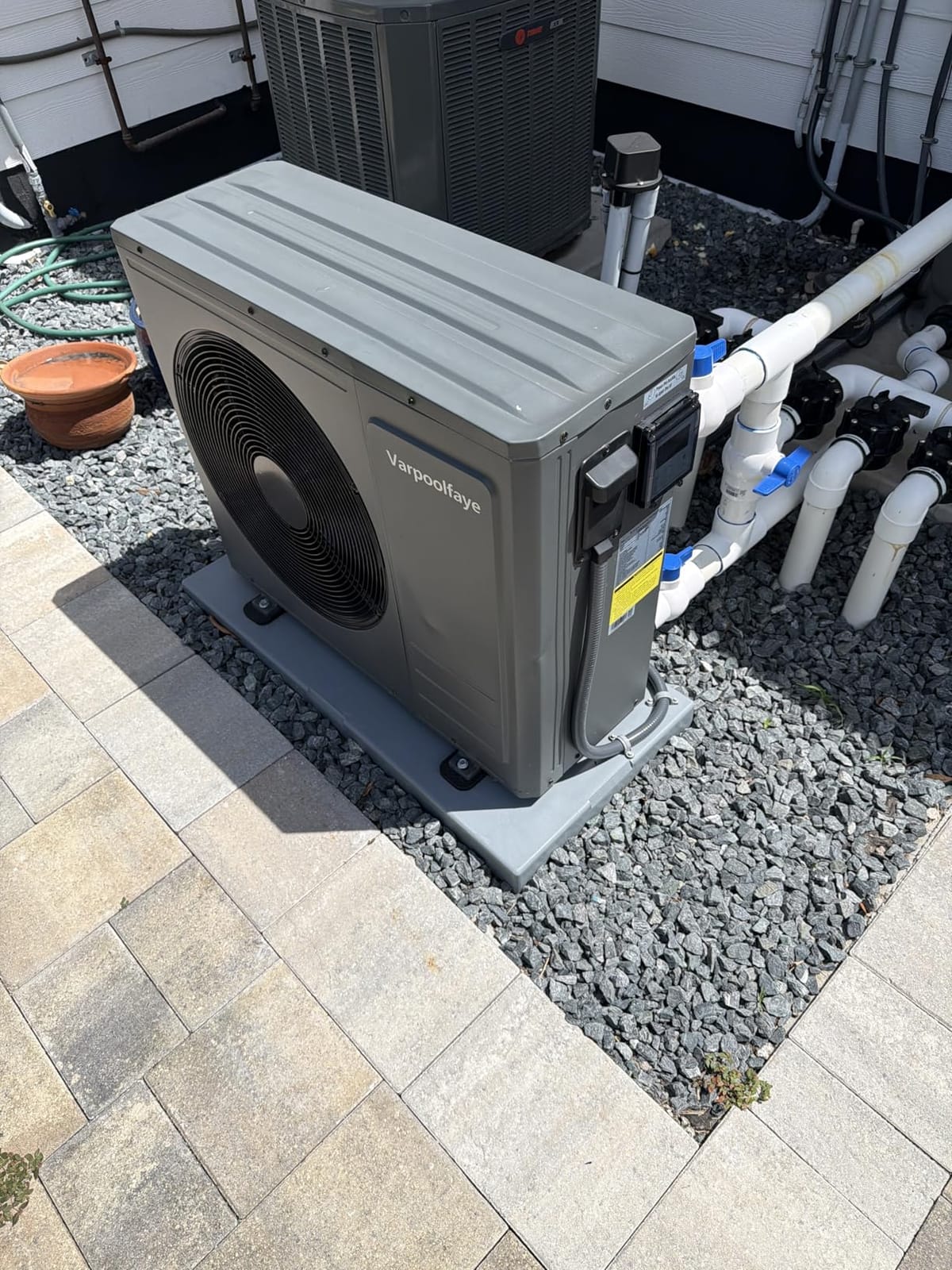
Heat rate is about 1F per hour on small pools, faster in warm weather, with a recommended flow of 700-1,000 GPH. Control runs through a WiFi app or a panel with scheduling, and the unit handles both freshwater and saltwater.
Output is 16,000 BTU rated to 5,000 gallons, with a COP of 4.3. The cabinet includes extra soundproofing components, automatic defrost, and normal condensate drainage from the base.
Two things to set expectations on. The manual is described as vague in places, and a first heat-up from cold takes several days. The condensate draining from the base is normal behaviour, but it surprises people who are not expecting water under the unit.
Why the rating is high
Owners consistently mention three things: 110V convenience, quietness, and customer service. Support making proactive follow-up calls is unusual, and one buyer specifically reported shipping damage being resolved rather than argued about.
For a plug-and-play install with no gas and no panel work, this is the cleanest option we found at this size.
When to choose something else
If your pool is at the top of the 5,000 gallon range, the 1F per hour figure drops and you are better served by a higher output 120V model.
The COP of 4.3 is lower than the premium inverter units, so on a long heating season the running cost gap will show up on your bill. That is the trade for the simpler installation.
7. TURBRO 50,000 BTU Inverter Pool Heater for Pools up to 15,000 Gallons
TURBRO 50,000 BTU Inverter Pool Heater, Up to 15,000 Gallons, 220-240 V
50000 BTU inverter
Up to 15000 gallons
COP up to 16.2
220-240V hardwired
Pros
- Full DC inverter modulates output instead of cycling
- COP up to 16.2 for large pool capacity
- Cuts running cost up to 40 percent versus natural gas
- Titanium exchanger handles saltwater and chemicals
- Full sensor suite with error codes and auto-shutoff
Cons
- Needs 220-240V hardwired install by a certified electrician
- Not recommended for inflatable pools due to low pressure
- Plumbing hardware hoses and pumps sold separately
- Heaviest in the group at 146.7 pounds
- Efficiency drops below 60F ambient
This is the only heater here for the upper end of the above ground market, covering pools up to 15,000 gallons and 21,100 gallons for variable pools. The reference pool sizes are a 28.3 foot round or a 20 by 40 foot oval.
The full DC inverter compressor adjusts output by ambient temperature, water flow and setpoint rather than switching on and off. That is why the COP can reach 16.2 and why the manufacturer claims running cost cuts of up to 40 percent against natural gas and 70 percent against propane.
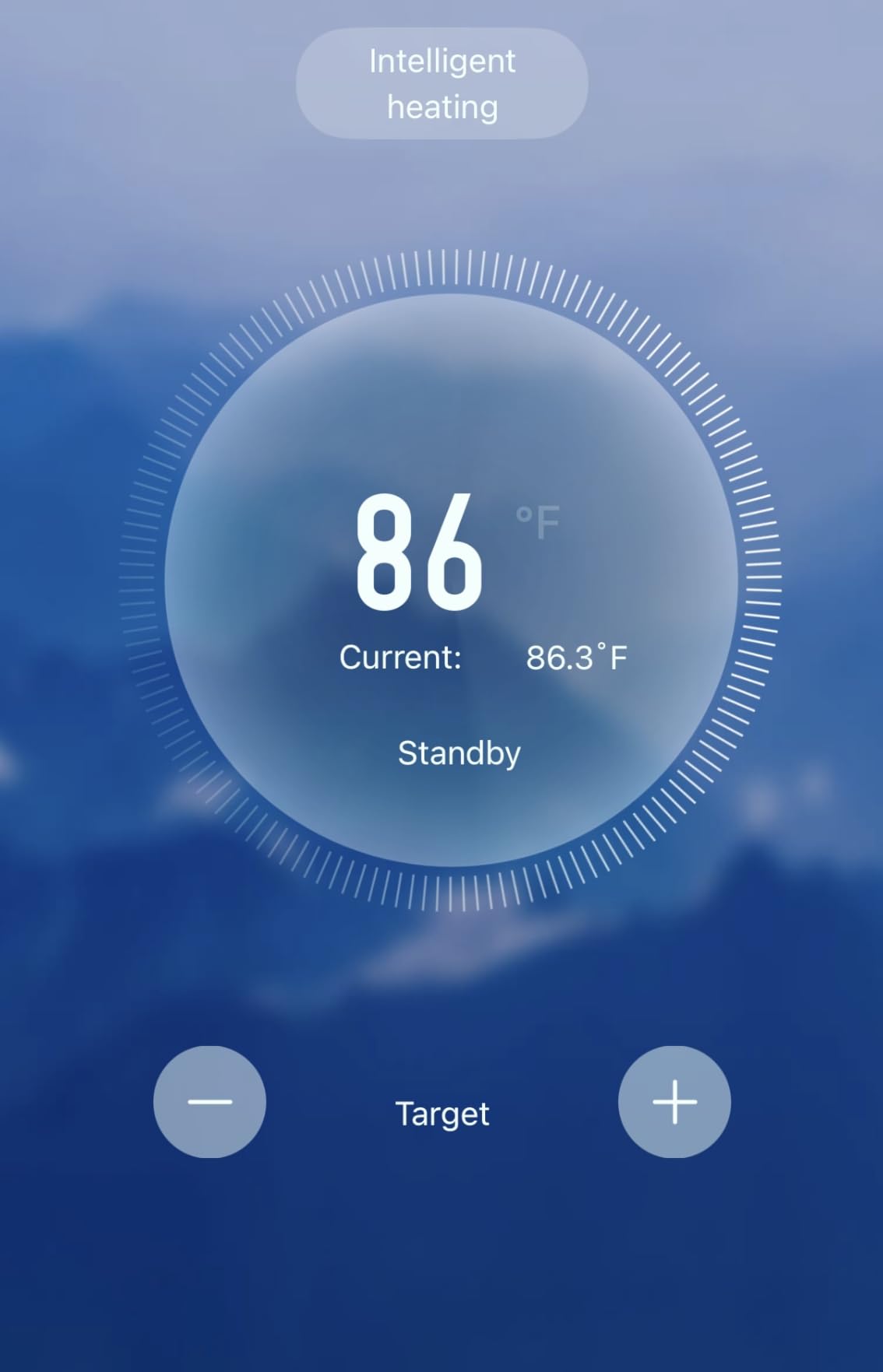
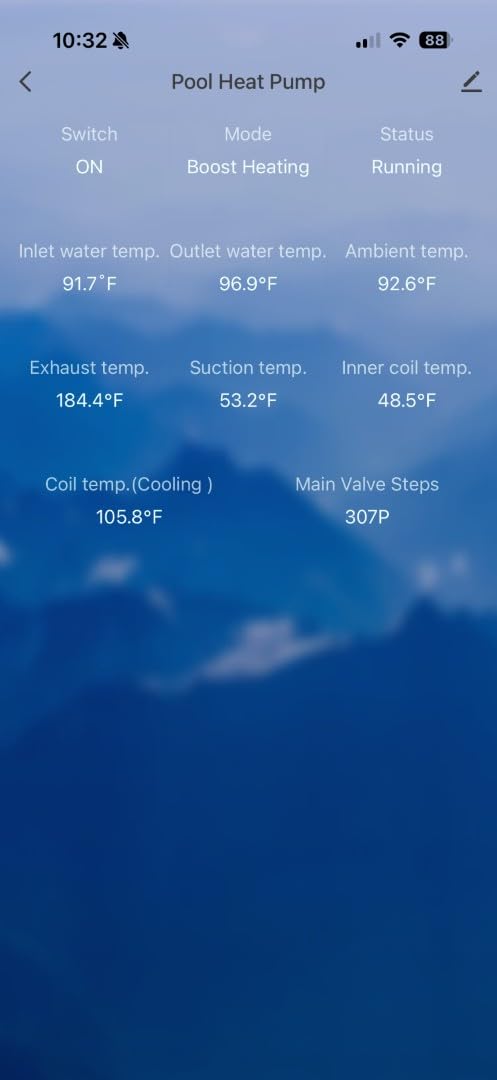
Sensor coverage is unusually thorough: inlet and outlet water temperature, ambient temperature, current, voltage, pressure and flow, all feeding error codes and an automatic shutdown. Control is through a panel or a mobile app with two programmable timer periods.
Two constraints deserve a careful read. It requires a 220-240V hardwired installation by a certified electrician, and the manufacturer does not recommend it for inflatable above ground pools because of low water pressure. That rules out many soft-sided Intex and Bestway setups even at the top of the size range.
It is also the heaviest item here at 146.7 pounds, measures 25.9 by 15.7 by 38.5 inches, and does not include hoses, valves, filters or pumps. Efficiency drops once ambient air falls below 60F, so cold regions still need patience.
Who this is built for
Large rectangular steel-frame pools in moderate climates, owners who already have 240V service, and anyone whose fuel bill on a gas heater has become a genuine frustration. The sensor suite is also attractive if you heat remotely and want fault visibility.
Titanium exchanger compatibility makes it safe for saltwater systems.
What it rules out
If your pool is inflatable or your electrical service is 110V, this is not the heater. The install alone will cost more than most of the smaller heat pumps on this list.
Below 60F ambient, the efficiency advantage narrows. In genuinely cold regions, gas still wins on speed.
8. FibroPool FH135 35,000 BTU 120V Heat Pump for 7,500 Gallons
FibroPool Pool Heat Pump FH135-35,000 BTU 120V – 7,500 Gal – Electric
35000 BTU on 120V
Up to 7500 gallons
Up to 5.5x efficiency
Fittings included
Pros
- 35000 BTU of output from a standard 120V outlet
- Users report 82F to 88F in about four hours
- Genuinely quieter than the pool pump itself
- Metal casing and plastic fan prop resist weathering
- Clamp-on screw-on and PVC fittings included
Cons
- Controller boards are not rated for outdoor exposure
- Power cord is only about 5 feet
- Large plug will not fit a weatherproof GFCI outlet
- No WiFi or app connectivity
- Fan blades have arrived damaged
35,000 BTU on a 120V outlet is unusual and genuinely useful. Most heaters delivering this output need 220V or gas, which makes the FibroPool a common answer for owners with a 7,500 gallon pool and no panel upgrade.
Owners with intact machines report strong performance, including a 6F rise from 82F to 88F in about four hours. The air-source design delivers up to 5.5x efficiency, meaning roughly five and a half units of heat for each unit of electricity.
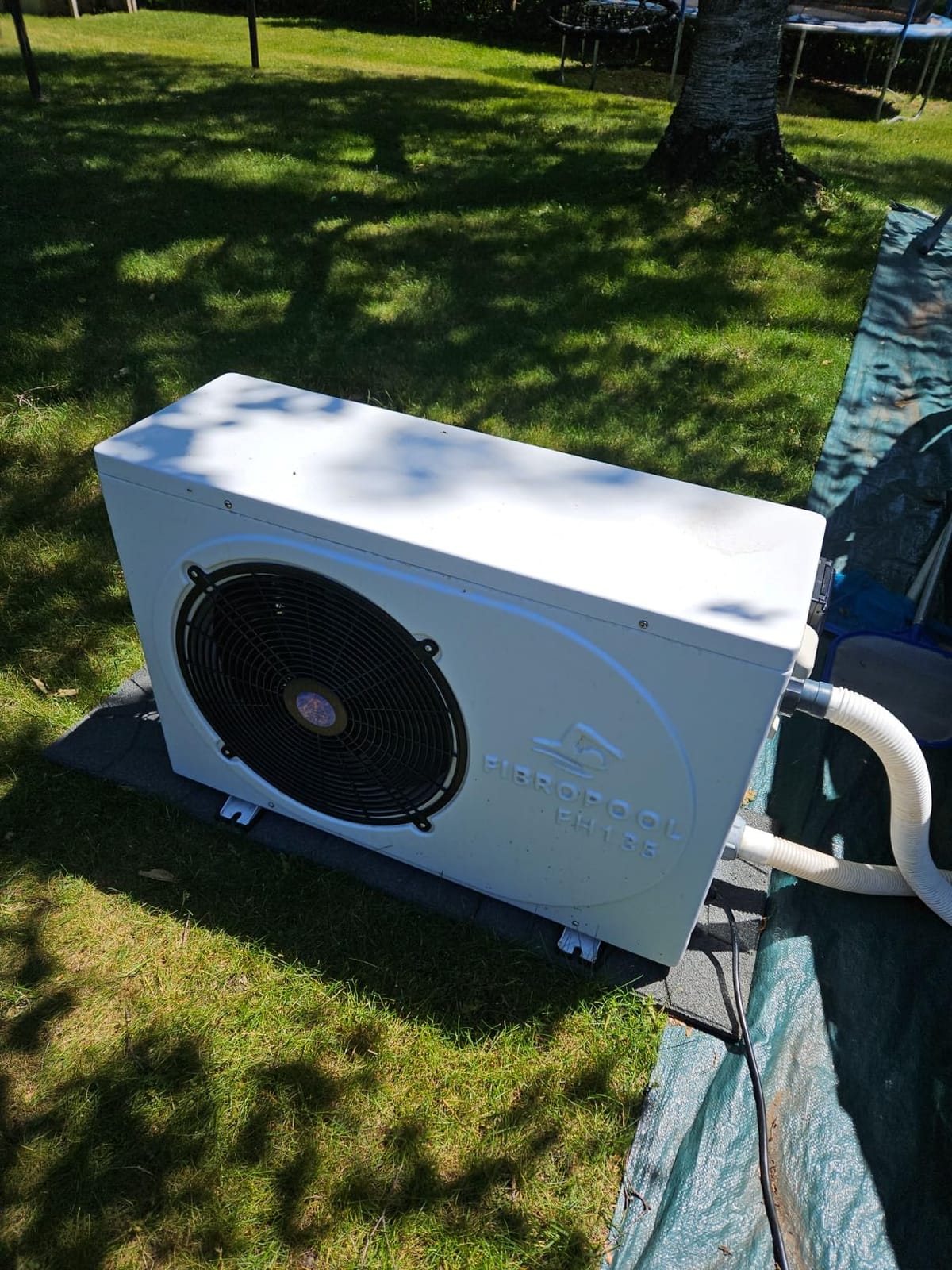
It works with above ground pools, small inground pools, spas and hot tubs, and the round cabinet saves floor space on a tight equipment pad. It is quiet, quieter than the pool pump itself by most accounts, and it is also offered in 55,000 and 70,000 BTU versions.
The documented failure mode is specific and worth knowing before you buy. The controller board is not rated for outdoor exposure and has failed after heavy rain despite closed covers. That is a design fault, not bad luck. Support has been fast and sent replacement parts when it has responded.
Two smaller annoyances: the power cord is about 5 feet, so many owners need an extension, and the large plug adapter will not fit a weatherproof GFCI outlet without modification. There is no app or WiFi connectivity at all.
Best for 5,000 to 7,500 gallon pools on 110V
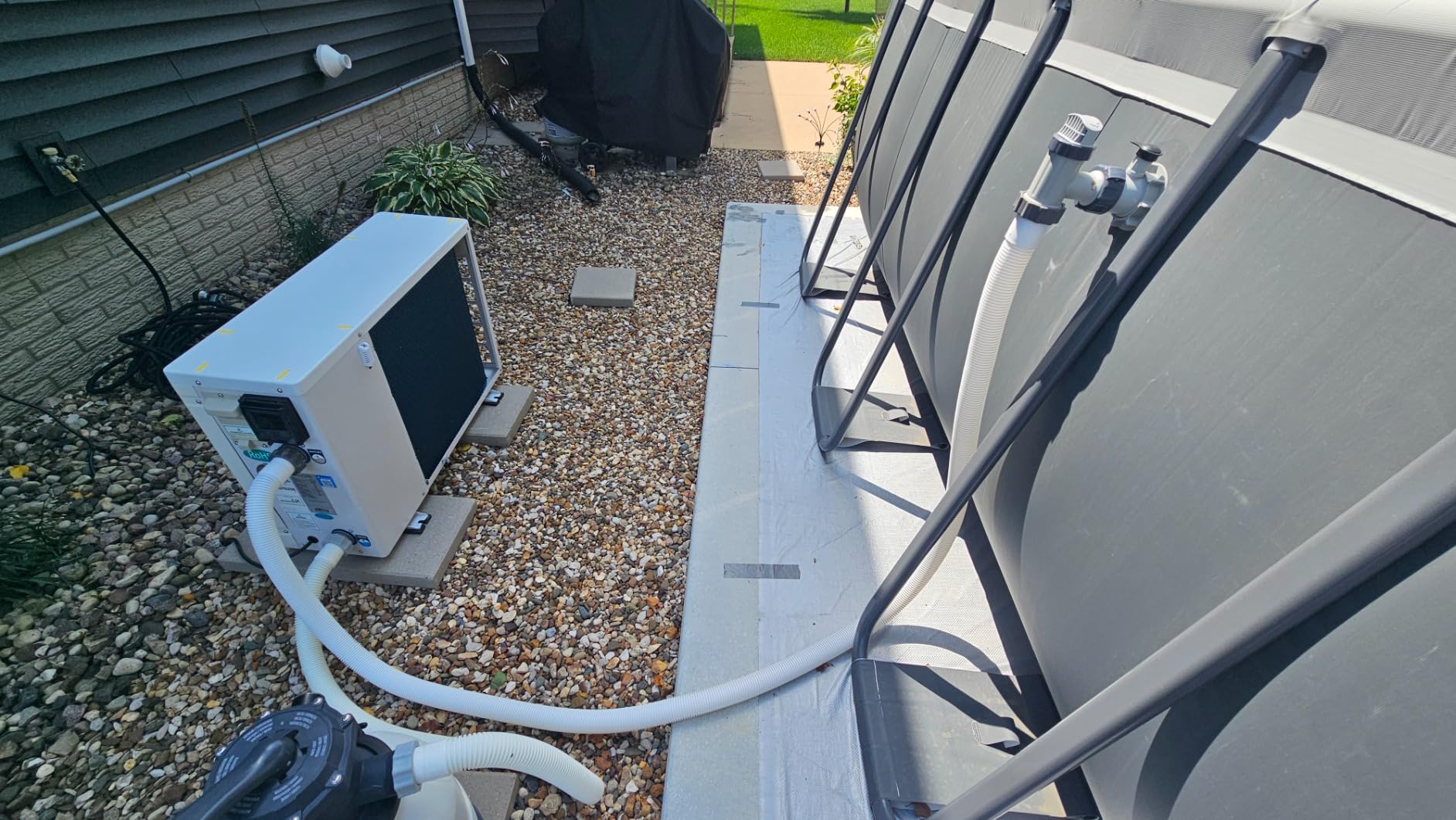
This is the output-per-watt compromise that most above ground owners should look at first. It heats noticeably faster than the 16,000 BTU class units without moving to 220V, and the included clamp-on, screw-on and PVC fittings cover most hookup configurations.
Spa and hot tub owners get a second use out of the same machine, which spreads the cost over two seasons of use.
Before you buy it
Ask yourself honestly whether you will shelter the controller. Rain damage is the recurring complaint, and a small equipment cover or a raised pad mitigates it. A pool-side cover adds a purchase, so factor that in.
If remote control matters to you, note there is no app. And check your outlet type, because the plug needs modification to fit a weatherproof GFCI receptacle.
9. NATURAQUELL 18,000 BTU Heat Pump for 5,200 Gallon Pools
NATURAQUELL Swimming Pool Heat Pump, 18,000 BTU, 5,200 Gal
18000 BTU output
Up to 5200 gallons
Inverter COP up to 4.1
110-120V
Pros
- 8 year after-sales warranty support is the longest here
- Inverter compressor with COP up to 4.1
- Uses an ordinary 110-120V outlet
- Heating and cooling modes both work
- One owner heated a pool from 85F to 104F in under 18 hours
Cons
- Amperage is not disclosed so plan on a 15-20A circuit
- Water lines are not included
- Short feet make condensate lines awkward
- Installation needs care for DIY users
Eight years of after-sales warranty support is the strongest coverage figure in this group, and it is the reason this unit earns a place despite only 16 reviews. Warranty length is a better predictor of long-term confidence than a star average built on a handful of ratings.
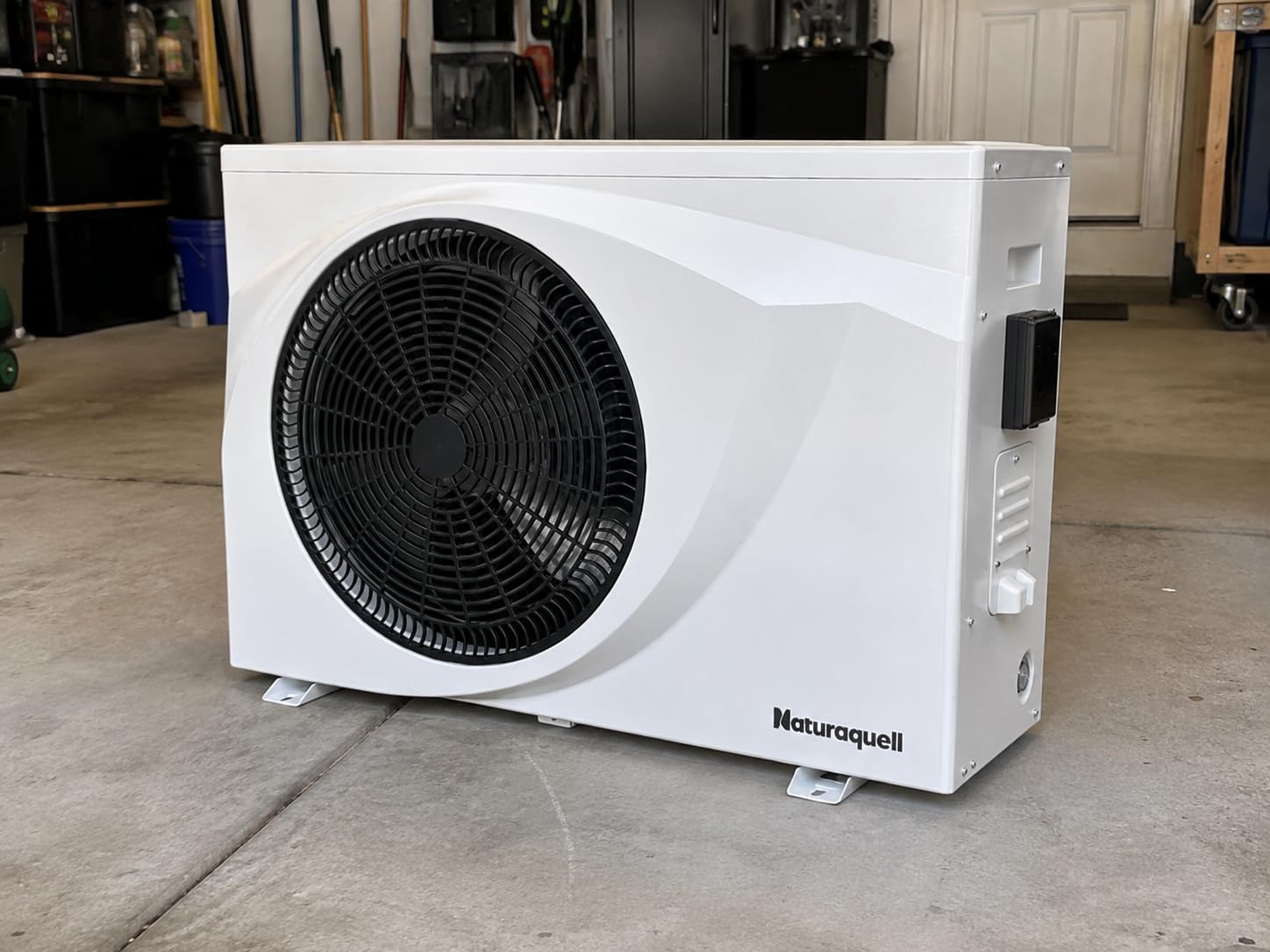
It heats and cools 18,000 BTU for pools up to 5,200 gallons, running on 110-120V residential power with a WiFi app plus an on-unit touch panel. One owner heated a pool from 85F to its 104F maximum in under 18 hours.
The inverter compressor manages COP up to 4.1 with energy savings of up to 45 percent under comparable conditions. The corrosion-resistant titanium heat exchanger suits chemically treated water, and the box measures 16.65 by 15.35 by 17.21 inches at 73.8 pounds.
It is sold in pool-size variants from 10×20 up to 20×40, which is helpful because it means the sizing is matched to a footprint rather than a guess.
The planning problem is amperage, which is not disclosed on the product page. Owners should plan on a near-dedicated 15-20A circuit and confirm outlet, breaker, pump flow and local electrical requirements before ordering. Water lines are not included, and the short feet make attaching a condensate line awkward.
Why the warranty matters more than the rating
A 4.8 rating across 16 reviews with nothing below four stars is encouraging, but it is still a small sample. Eight years of support coverage is the thing that reduces risk over a decade of ownership.
For an owner who plans to keep the same pool for many seasons, that is a better basis for the decision than a small review base.
What to sort out first
Measure the amperage yourself or have an electrician confirm your circuit can carry it, because the figure is not published. Add the cost of water lines to your budget if you do not already have flexible hose and fittings on hand.
Budget a little extra time for a first-time install. This is not a tool-free hookup like the smaller units.
10. FAFCO Original 4 x 20 ft Solar Bear Solar Pool Heater
FAFCO Original 4 x 20 Feet Solar Bear Solar Pool Heater for Above-Ground Pools Universal with Connected Tube Design & Starter Kit
4x20 foot unglazed collectors
Universal above ground fit
Starter kit included
20.3 pounds
Pros
- No electricity or gas hookup and no running cost
- Light at 20.3 pounds and simple to set beside a pool
- Universal fit works across common above ground brands
- Connected tube design and starter kit simplify hookup
- Lowest cost way to extend warm weather swimming
Cons
- No heating in cloudy or nighttime conditions
- Performance depends entirely on direct sun
- Works best paired with a pool cover
- Limited customer images and review volume
This is the only heater here that costs nothing to operate, and for a sunny yard it is genuinely worth a look. Unglazed black tube collectors heat water as it runs through them on your existing pump, with no electricity, gas or wiring involved at all.
The 4 by 20 foot array is a universal fit for common above ground pool brands, and the connected tube design plus starter kit make the plumbing connections straightforward. At 20.3 pounds it is by far the easiest unit here to reposition.
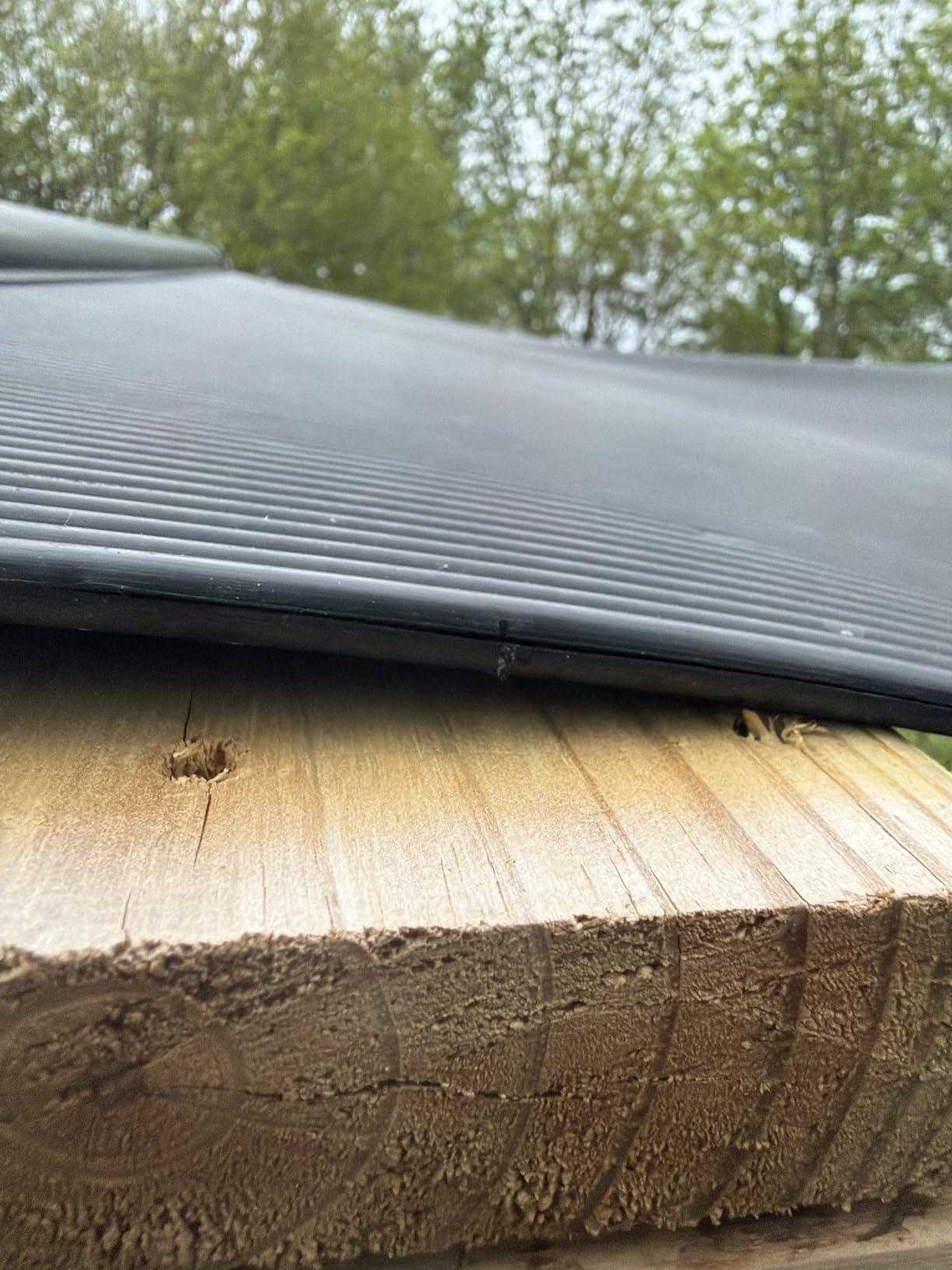
The limitation is the one that catches first-time buyers. Solar collectors add heat only when the sun is on the panels, and owners regularly report disappointment when they expected more. Forum discussion on this product type centres on exactly that gap between expectation and a 5 to 10F gain on a good sunny day.
What solar does well is extending a season rather than creating one. Pair it with a pool cover and the collected heat stays in the water overnight instead of radiating away, which is when the real savings appear.
The review base is 18, which is thin for installation guidance. Compare the collector area to your pool surface area and match it to your pump flow rate before buying, because flow mismatch is the most common installation mistake with solar collectors.
Where solar makes sense
Sunny climates with long afternoons and a pool cover already in the plan. If your heat demand is mostly about holding temperature in the shoulder season, solar is a strong match.
It is also the right first purchase for anyone who has never heated an above ground pool, because you learn the demand profile for almost nothing.
Where solar will disappoint
Overcast regions, heavily shaded yards, and anyone who needs water at temperature on a specific evening. No amount of collector area fixes weather that never arrives.
It will not heat a pool at night or in early spring. If you need a guaranteed warm swim on demand, you still need a powered heater.
11. Della Spark 21,000 BTU Inverter Heat Pump for up to 7,000 Gallons
Della Omi Spark 21,000 BTU Inverter Pool Heat Pump up to 7,000 Gallons
21000 BTU inverter
COP 4.02 at 50F
48 dB
Alexa and Google Home
Pros
- Plugs into a standard 110-120V outlet
- Inverter ramps down instead of cycling
- App plus Alexa and Google Home voice control
- Lowest seasonal heating cost reported by owners
- Works with chlorinated and saltwater pools
Cons
- App showed a water flow error while the unit was off
- Initial support response was slow
- Not an instant heater as temperature rises over days
- Only 8 reviews means limited reliability history
This is the most connected heater in the group. Beyond the WiFi app, it works with Alexa and Google Home, supports multi-unit sync, and offers RS485 integration for people who want it on a control bus rather than a cloud service.
The COP figures here are the most useful published numbers we found: 4.02 at 50F ambient and 4.97 at 80.6F. That is a real measurement of the effect of air temperature on heat pump performance, and it quantifies what most manufacturers leave vague.
It operates down to 41F ambient, heats to 104F and cools to 47F, with IPX4 waterproofing and CEC and FCC certification. The warranty is 2 years on parts with 10 years on the compressor and heat exchanger, which is better than most 110V units in this list.
Gallon ratings are split by condition: 4,700 gallons uncovered outdoors, or 7,000 gallons with a cover. That split is the most honest sizing statement in this roundup, and it is a useful reminder of how much a cover changes the maths.
The one substantive complaint involves app-reported fault codes, including a water flow error displayed while the unit was off, with troubleshooting readouts that were not meaningful. The manufacturer later resolved it, but it is a real reason to keep a local control option. Initial support response was slow before improving. With 8 reviews there is limited long-term reliability history.
For smart home owners
If you already run voice assistants or a structured control system, this is the only heater here with genuine two-way integration and multi-unit sync. Two 21,000 BTU units can be managed as a pair for a larger pool.
The 2-year parts and 10-year compressor warranty is a strong term given the 110V simplicity.
What to consider first
Weight is not published for this model, so confirm the lift before ordering. The cooling function to 47F is a bonus in hot climates rather than a reason to buy on its own.
Be aware that temperature rises gradually over hours to days. Nobody should buy this expecting an instant heater, and the small review base means we would stay flexible on your expectation of support.
12. TURBRO 18,000 BTU Heat Pump for Pools up to 6,100 Gallons
TURBRO Swimming Pool Heat Pump, Up to 6,100 Gallons, 18,000 BTU Pool Heater
18000 BTU output
COP 5.5
120V with GFCI plug
6100 gallon rating
Pros
- Runs on a standard 120V outlet
- Measured about 1.5F per hour on a 3000 gallon pool
- Titanium exchanger with four-way valve
- Works with inflatable pools and frame pools
- Quiet enough that the pump is louder
Cons
- Draws up to 12 amps so it may need its own outlet
- Shuts off below 55F and above 104F ambient
- Water hoses and pool filters not included
- Needs a cover or windbreak to avoid overnight loss
This is the highest rated unit in our group at 4.9 stars with an 89 percent five-star share, and the compatibility list is the broadest: inflatable pools, frame pools, small spas and inground pools, with round pools up to 16 feet or rectangular 12 by 20 feet.
Heat rate was measured at about 1.5F per hour on a 3,000 gallon pool in 63F air, which is the fastest small-pool figure reported anywhere in these reviews. Output is 18,000 BTU with a 5.5 COP, heating 59 to 104F and cooling 46 to 82F.
The titanium heat exchanger includes a four-way valve and is saltwater compatible. Hookup is simple with hose clamps, hose connectors and a drain outlet adapter included, and no leaks were reported. The IPX4 waterproof casing handles rain and summer weather.
Two operating limits are worth reading before you buy. It draws up to 12 amps, so it may need its own outlet rather than sharing with the pump. And the manual specifies shutdown below 55F and above 104F ambient, which limits late-season use in cold climates even though the operating range is listed as 41 to 109.4F.
Water hoses and pool filters must be supplied separately. It also needs a pool cover or windbreak to avoid losing heat overnight, which is the same advice that applies to every heater here. With 9 reviews, treat the 4.9 as promising rather than proven.
Why inflatable pool owners like it
Inflatable and frame pools have low water pressure and shallow plumbing runs, and this unit is explicitly listed for them. The four-way valve titanium exchanger is also the right call if you use a saltwater system on an inflatable pool.
The measured 1.5F per hour figure makes it a realistic option for a 3,000 gallon pool where most heat pumps manage about 1F.
What to plan around
Confirm your outlet can carry 12 amps on its own, and expect to add a cover. The 55F ambient cut-off means this is a warm-season heater, not a shoulder-season one.
Plan the plumbing. Hoses and filters are not in the box, and a 55F cut-off limits usefulness earlier in the year than the marketing range suggests.
How to Size and Choose an Above Ground Pool Heater in 2026
Sizing mistakes are the number one reason new heaters disappoint people. The maths is not complicated, and doing it before you buy saves a return.
Step 1: Calculate your pool volume in gallons
For a round pool, multiply 3.14 by the radius in feet, by the radius again, then by the average depth in feet. For a rectangular pool, multiply length by width by average depth. Multiply the result by 7.5 to convert cubic feet into gallons.
Use average depth, not maximum depth. A 4 foot pool with a sloping floor is usually closer to 3.5 feet of average depth, and using the wrong figure puts you 15 percent off in either direction.
Here is a worked example. A 16 foot round pool at 4 feet average depth is 3.14 times 8 times 8 times 4, which is 804 cubic feet, or about 6,030 gallons. That single number tells you which heaters on this list apply.
Step 2: Match BTU to gallons, then check the cover
The general rule is 100,000 BTU of gas capacity per 10,000 gallons, or roughly 5,000 BTU of heat pump output per 10,000 gallons when you are only maintaining temperature. Heat-up speed changes this completely.
A widely used approximation: a 5,000 gallon pool needs about 12,000 BTU per hour to raise temperature 1F in an hour, once you account for losses to air and ground. That is why a 16,000 BTU heat pump gains about 1F per hour on a 5,000 gallon pool rather than several degrees.
Always check whether the gallon rating assumes a cover. The Della Spark in this roundup states 4,700 gallons uncovered and 7,000 gallons covered for the same hardware, and that pattern holds across the category. A cover is not an accessory, it is part of the sizing equation.
Step 3: Understand what COP means in your weather
COP is the coefficient of performance: the number of units of heat moved per unit of electricity. A COP of 5.5 means 5.5 units of heat for every 1 unit of power.
Here is the number that matters. Della publishes COP of 4.02 at 50F ambient and 4.97 at 80.6F, which is roughly a 20 percent efficiency loss from warm air to cool air. Other manufacturers report efficiency dropping below 60F ambient. In other words, the COP on the box is measured on a mild day, not in the conditions where you most want heat.
Solar heat is the exception because it is not measured in COP at all. It has no fuel cost and no efficiency rating, only a surface area and the weather.
Solar cover versus solar heater: the distinction that saves the most money
A solar cover is an insulating sheet that traps heat already in the water. A solar heater is a collector array that adds heat to the water. Owners confuse these constantly, and the answer is almost always to buy the cover first.
The cover stops the single largest source of heat loss overnight. The heater only works when the sun is out. In practice, a cover multiplied across a powered heater delivers a bigger improvement per dollar than adding more collector area.
Every heat pump on this list is dramatically better with a cover on the pool, and every manufacturer in this category says so in their own manuals. Budget for it before you budget for more heater.
Intex and Bestway fitting compatibility
Most above ground pools sold in the US are steel-frame or inflatable Intex and Bestway models, and the fittings on them decide whether a heater installs cleanly.
The common plumbing is 1.5 inch flexible hose on steel-frame kits, with 1.25 inch adapters used on some smaller models. In this roundup the AQUASTRONG, Vidapool and Varpoolfaye all ship with both 1.25 inch and 1.5 inch adapters, which removes the most common install problem. The FAFCO Solar Bear is a universal fit across common above ground brands.
Check the minimum flow rate on whichever heater you choose, because it is the most-missed specification. The Vidapool requires a minimum of 450 GPH and the Varpoolfaye recommends 700-1,000 GPH. Many small above ground pumps fall below those figures, and the heater will underperform or shut down. The TURBRO 50,000 BTU model is explicitly not recommended for inflatable pools due to low water pressure.
Power, gas and installation requirements
Most 110V heaters plug into a standard outlet and need nothing more. That includes the AQUASTRONG, WARMBLU, Vidapool, Varpoolfaye, FibroPool, NATURAQUELL, Della Spark and the TURBRO 18,000 BTU model.
Check for dedicated circuit needs anyway. The NATURAQUELL does not publish its amperage and owners should plan a near-dedicated 15-20A circuit. The TURBRO 18,000 BTU draws up to 12 amps and may need its own outlet rather than sharing with the pump.
The TURBRO 50,000 BTU inverter is the outlier at 220-240V hardwired with a certified electrician required. Gas heaters need a gas line and venting changes, and that work can cost more than the appliance.
One recurring theme across owner forums is warranty reduction when a unit is self-installed. Several manufacturers shorten or void coverage if installation is not performed or inspected by a qualified installer, so read the warranty terms before you start rather than after.
What to avoid when buying
Undersizing is the most common and most expensive mistake. A heater rated for 5,000 gallons will maintain a 5,000 gallon pool beautifully and heat it slowly, which is a different thing entirely.
Watch for review counts that do not support the rating. A 4.9 average across 9 reviews is a thinner signal than a 4.3 across 534, and we have flagged both cases in this roundup rather than picking whichever number looks best.
Be careful with no-name marketplace heat pumps where ratings look implausibly clean. Verified buyer volume, a clear manufacturer name, a real warranty term and disclosed amperage are the signals we use.
And do not skip the pool cover. It is the cheapest heat improvement available and it changes the sizing maths for every heater above.
One last suggestion for the season itself. Once you are heating more often, a good set of pool speakers for poolside entertainment is the upgrade people actually notice, and swim-safe listening for laps is covered in our picks for headphones for swimming and lap pools.
Frequently Asked Questions
What is the cheapest way to heat an above-ground swimming pool?
A solar cover is the cheapest heat improvement by a wide margin, because it stops overnight heat loss and every powered heater performs better with one. After that, a solar collector like the FAFCO Solar Bear adds free daytime heat with no running cost. If you need guaranteed heat on demand, a 110V heat pump is the lowest-cost powered option because it needs no gas line and no panel upgrade.
What is the most reliable pool heater brand?
Raypak is the most established name in gas pool heaters, with a copper fin-tube exchanger and decades of parts knowledge. For 110V heat pumps, reliability is judged less by brand name and more by review volume, warranty length and build specifics. The TURBRO inverter carries the longest compressor warranty here, while the NATURAQUELL offers 8 years of after-sales support. Check the warranty term before you check the star rating.
Are pool heaters worth it for an above-ground pool?
For most above ground owners, a heater is worth it mainly in shoulder season, not for a full heated summer. Pools are usually usable for 3-4 months naturally, and a 110V heat pump paired with a solar cover can realistically add two more months at a modest running cost. The exception is owners in short-season states who genuinely want a warm pool on a specific weekend, where a heater earns its place immediately.
What is the best way to heat an above-ground pool in the winter?
For genuine winter heating, nothing beats a gas heater such as the Raypak PR106AENC at 105,000 BTU, because heat pumps lose output as air temperature falls. Heat pumps in this roundup are mostly shoulder-season devices: the MICOE operates down to 32F ambient, while the TURBRO 18,000 BTU shuts off below 55F. In most climates the honest answer is to heat in spring and autumn and close the pool for winter.
Does a pool heat faster with a solar blanket on or off?
A solar blanket on. The blanket does two useful things at once: it insulates the surface against overnight heat loss and it traps heat already gained during the day, so the heater is not fighting the air. Turn it off and the water loses heat to the atmosphere all night, which means the heater has to replace that loss every morning before it makes any progress.
How long does it take for a solar blanket to warm a pool?
On a sunny day a solar blanket can raise pool temperature several degrees, but the effect depends entirely on the weather and on your pool size. The bigger practical gain is retention rather than heating: a covered pool loses far less heat overnight, so the warmth you gained during the day survives to the next morning. That is why owners say a blanket is the cheapest heat they can buy.
What is the best solar heater for an above ground pool?
For above ground pools, the FAFCO Original Solar Bear 4 x 20 foot collector is a strong fit because it is a universal design for common steel-frame brands, weighs only 20.3 pounds and includes a starter kit with connected tube plumbing. The key is matching collector area to your pool surface area and confirming your pump flow rate meets the minimum before you buy.
Our Final Verdict on the Best Pool Heaters for Above Ground Pools in 2026
The AQUASTRONG 12 x 14 foot heat pump is our pick for the best pool heaters for above ground pools overall. It carries a 5.5 COP, runs at 38 dB, heats and cools, and ships with both adapter sizes that most Intex and Bestway plumbing needs. With 534 reviews behind it, it is also the only unit in this group with a large enough review base to trust the numbers.
Pick the Varpoolfaye 16,000 BTU if you want one of the highest ratings in the group and the simplest possible install. Pick the WARMBLU if your pool is between 7,000 and 10,000 gallons and you are staying on 110V. Pick the MICOE if cold air is your problem. Pick the TURBRO 50,000 BTU inverter only if you have 240V service and a hard-sided pool. Pick the Raypak if you have a gas line and want heat fast.
And buy the solar cover before any of them. Whatever heater you choose will perform meaningfully better with one, and the sizing figures on every product page assume it.