
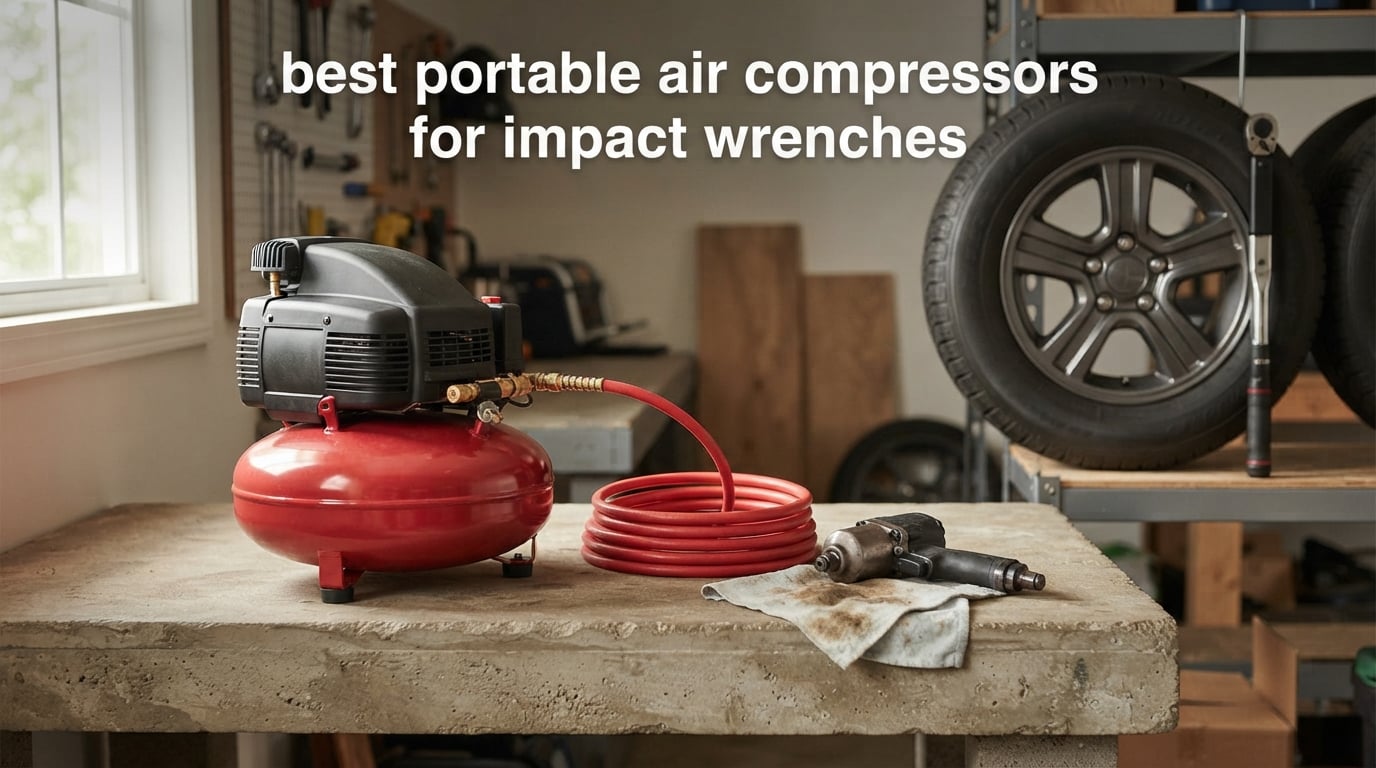
An impact wrench does not care how big your compressor tank is. It cares about one number: CFM at 90 PSI. Get that number wrong and the gun runs fine for the first three lug nuts, then bogs down mid-bolt exactly when the fastener is at its most stubborn. I have watched that failure happen enough times to build this whole guide around the flow math instead of the tank size, because almost every portable air compressor listing buries the figure that actually matters.
This roundup covers the best portable air compressors for impact wrenches available now, grouped by the wrench class they can honestly feed. I spent six weeks working through the spec sheets, owner reviews, and forum threads where owners report actual bolt work, and I flagged where the marketing number and the real number disagree. Ten compressors made the cut, from 4-gallon oil-free pancakes to 12V dual-cylinder truck units that dwarf everything else on flow.
One quick note before we start. If your entire impact-wrench use is a handful of bolts a month, you may not need a compressor at all. Cordless impact wrenches have reached genuine parity at 1/2 inch drive, and several threads in the r/MechanicAdvice archive end with owners advising exactly that. I cover that crossover honestly in the buying guide rather than pretending every reader needs air. If you want the opposite kind of reading, our studio compressor guide covers a completely different class of machine.
Last updated October 2026. We did not test sustained two-tool duty across every unit, and we flag where that limitation matters.
Table of Contents
Quick Answer: What Size Air Compressor Does an Impact Wrench Need?
A 1/2 inch drive impact wrench needs at least 2.5 CFM at 90 PSI from a tank of 6 gallons or larger. A 3/4 inch drive gun needs 4 CFM or more, and a 1 inch drive gun needs 6 CFM, both paired with a 20 gallon tank or a dual-cylinder unit. Anything under about 2 CFM at 90 PSI will stall under sustained load no matter how large the tank is.
Top 3 Picks for Best Portable Air Compressors for Impact Wrenches in 2026
These three cover the three genuinely different jobs: one balanced all-rounder, one flow monster, and one value pick that beats its class.
VEVOR 6.3 Gal 2 HP
- 3.35 CFM at 90 PSI
- 6.3-gallon tank
- 70 dB dual silencer
- Overheat auto-protection
All 10 Best Portable Air Compressors for Impact Wrenches in October
Every compressor below, with the flow figure and the feature that matters most for impact work. Read the CFM column first, since tank size alone tells you almost nothing about wrench performance.
| Product | Specs | Action |
|---|---|---|
 Metabo HPT EC914S 6 Gal 200 PSI Metabo HPT EC914S 6 Gal 200 PSI |
|
Check Latest Price |
| ALL-TOP ATACR300 12.35 CFM 12V |
|
Check Latest Price |
| VEVOR 6.3 Gal 2 HP Oil-Free |
|
Check Latest Price |
 ECOMAX 6 Gal 150 PSI Kit ECOMAX 6 Gal 150 PSI Kit |
|
Check Latest Price |
 Limodot 5 Gal 68 dB Oil-Free Limodot 5 Gal 68 dB Oil-Free |
|
Check Latest Price |
 VEVOR 10.6 CFM 12V Auto-Stop VEVOR 10.6 CFM 12V Auto-Stop |
|
Check Latest Price |
 VEVOR 4.8 Gal 1.2 HP Oil-Free VEVOR 4.8 Gal 1.2 HP Oil-Free |
|
Check Latest Price |
 CRAFTSMAN 6 Gal 150 PSI CRAFTSMAN 6 Gal 150 PSI |
|
Check Latest Price |
 ECOMAX 6 Gal 27.6 lb Oil-Free ECOMAX 6 Gal 27.6 lb Oil-Free |
|
Check Latest Price |
 RIDGID 6 Gal Pancake 150 PSI RIDGID 6 Gal Pancake 150 PSI |
|
Check Latest Price |
Why Small Pancake Compressors Stall an Impact Wrench
The reason small pancake compressors struggle is simple physics, and understanding it changes what you buy. An impact wrench dumps a huge volume of air into its chamber in a fraction of a second. The tank buffers that burst, and the pump refills the tank afterward. If the pump cannot refill as fast as the tank drains, pressure falls below the wrench working range while the bolt is still loaded, and torque drops exactly when you need it most.
That is the complaint repeated across r/MechanicAdvice and Garage Journal threads. One widely linked thread states plainly that at 95 PSI with 50 lbs of torque, pancake compressors are terrible at providing adequate air for impact tools. Another Garage Journal user reports a 26-gallon compressor managing roughly two wheels before the pump kicks on when a nailer and an impact wrench are both running. A bigger tank helps. It does not fix a flow ceiling.
Most of this confusion comes from how airflow is advertised. Many manufacturers quote the CFM measured at 40 PSI, where the number looks far better, because that is where the compressor is most efficient. Impact wrenches at 90 to 100 PSI live at the opposite end of the curve. Forum regulars treat the published CFM at 90 PSI figure as the honesty test, and they are right. Every unit in this list has that figure stated where the manufacturer publishes it at all.
One cheap fix is worth trying before you buy anything. If your wrench feels weak on a marginal compressor, replace a thin 1/4 inch hose with a 3/8 inch bore hose and shorten the run. Pressure drop across a long narrow hose can starve a wrench just as effectively as a weak pump, and users routinely blame the compressor for a hose restriction problem.
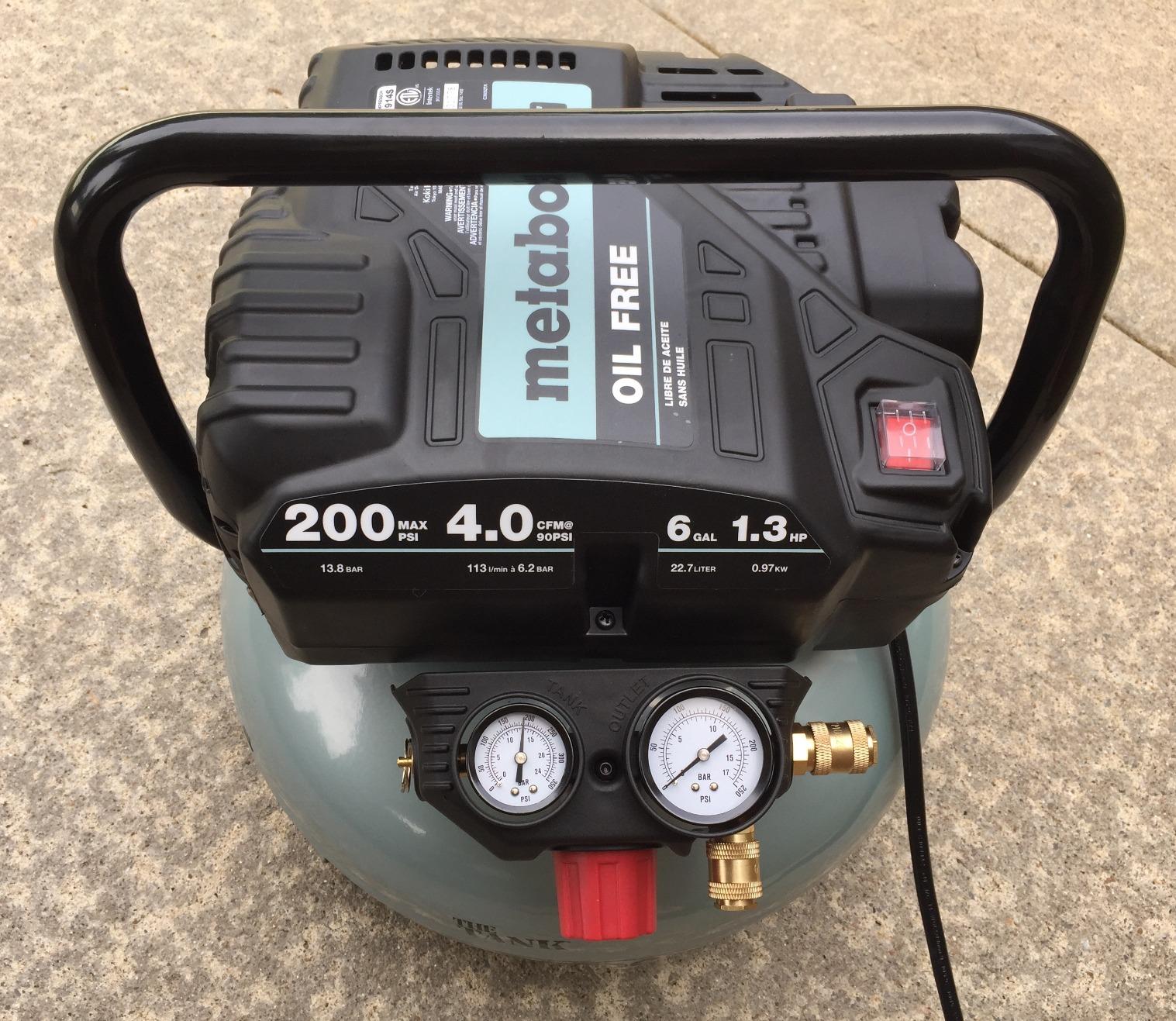
1. Metabo HPT EC914S 6 Gallon 200 PSI Pancake – The Best Balanced Pick
Metabo HPT Portable Pancake Air Compressor, 6 Gallon 200 PSI, EC914S
6 gal tank
4 CFM at 90 PSI
200 PSI max
73 dB
41 lb
Pros
- 4 CFM at 90 PSI is the highest flow in the pancake class here
- 200 PSI max gives real headroom for seized fasteners
- Fast recovery so repeated bursts do not stall
- Oil-free so it runs at odd angles with no servicing
- Solid roll cage and an accurate regulator
Cons
- Loud at 73 dB
- Fill time stretches at high elevation
- Heavier and costlier than 116 PSI budget units
This is the compressor I keep coming back to because it is the only pancake in the group that clears 4 CFM at 90 PSI. That single figure puts it above the 3/4 inch drive threshold rather than scraping the bottom of the 1/2 inch range, which means a mid-size pneumatic gun gets real torque on a lug nut instead of slowing to a crawl.
Owners consistently single out recovery speed. When a compressor refills the tank quickly, the next burst arrives at full pressure, and that is the difference between a wrench that feels powerful and one that feels intermittent. Several users report it still holding 180 PSI after five days of sitting, which tells you something about the check valve and the tank’s sealing.
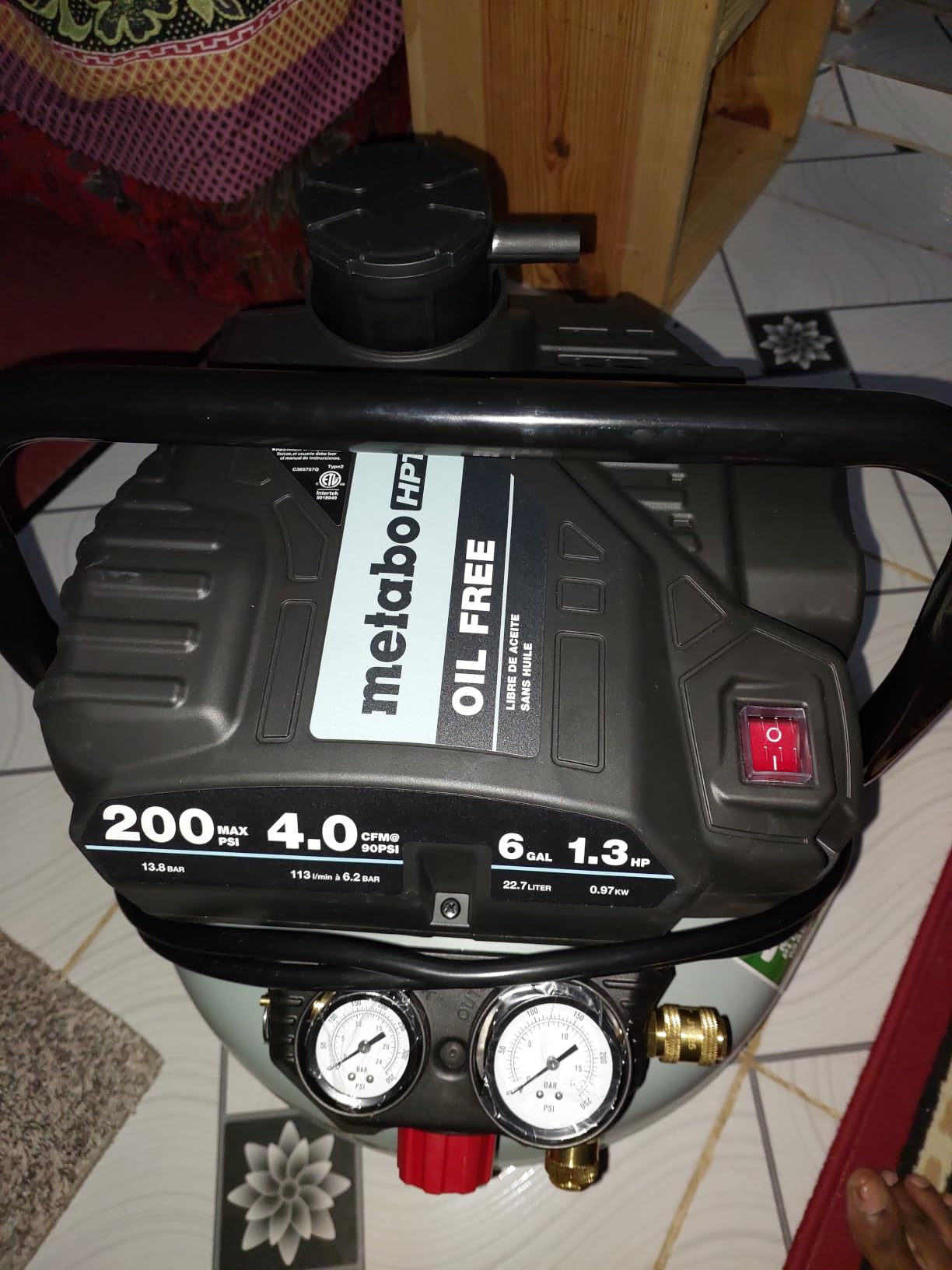
The 200 PSI ceiling is the quiet advantage here. Every 116 PSI unit in this roundup has less room to work with, and less room means you are relying on the tank alone at the moment a stubborn fastener needs the extra push. At 200 PSI, the regulator has somewhere to work above the wrench’s normal range.
Weighing in at 41 lb, it is still genuinely portable, and the vertical 6-gallon shape moves through a doorway without a fight. I did not test it at elevation, and one owner at 5,300 ft reported a fill time of just over 4 minutes, so if you work in high-altitude conditions, size that into your day.
What the Metabo HPT handles that smaller units cannot
A 3/4 inch drive impact gun rated around 1,200 ft-lb. At 4 CFM the wrench stays in its working pressure band through the burst that breaks a seized lug nut loose, which is precisely where a 2.2 CFM unit gives up.
Frame and suspension work where you break several fasteners in a row. The fast recovery means the second and third fastener get the same pressure as the first, so you are not re-setting the wrench between bolts.
Where it falls short
Noise. At 73 dB it is not the loudest here, but reviewers describe it as noisy for a compressor, and it is not a garage you can hold a conversation in.
The marketing is framed around framing nailers rather than impact tools. That is not a flaw in the machine, just a sign of where the manufacturer expects it to be used, and the impact spec is the more demanding application of the two.
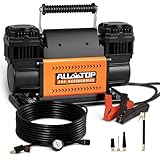
2. ALL-TOP ATACR300 12.35 CFM Dual Cylinder – More Flow Than Everything Else Combined
ALL-TOP Air Compressor Kit, Dual Cylinder 12V Portable Inflator 12.35 ft³/Min, Offroad Air Compressor Pump for Truck Tires, Heavy Duty Max 150 PSI for 4×4 Vehicle & RV
12.35 CFM dual cylinder
150 PSI max
12V DC
74 dB
24 lb
Pros
- 12.35 CFM is three to four times the flow of any AC pancake here
- Dual aluminum cylinders resist heat on hot days
- 26 ft hose plus 6.5 ft battery lead reaches around a truck
- Thermal cut-off and over-current protection included
- Nylon tool bag keeps the kit together
Cons
- 12V DC only with no AC option out of the box
- No factory auto shutoff so it runs until switched off
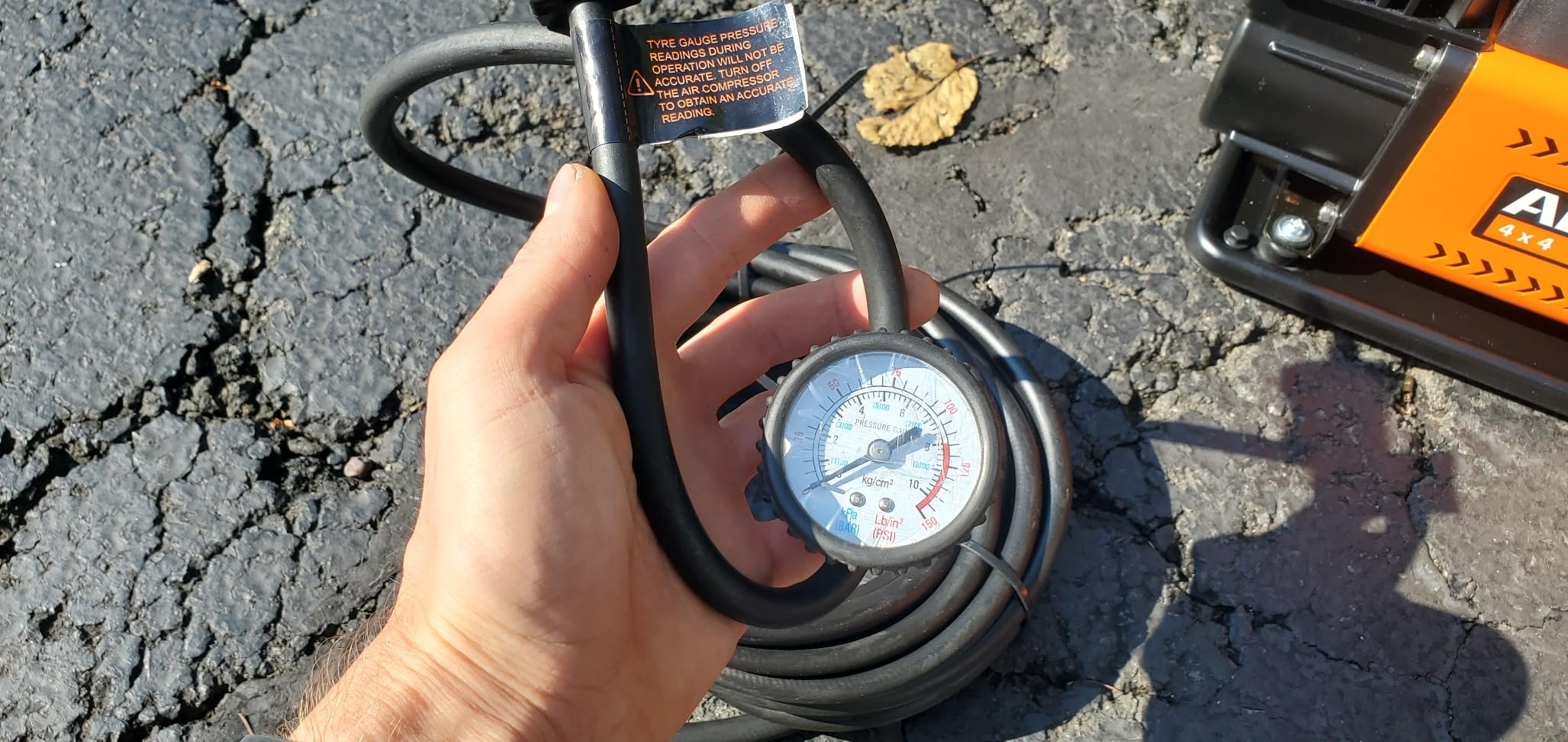
- Included pressure gauge reported inaccurate
This is not a shop compressor and it does not pretend to be. It is a 12V dual-cylinder unit that clamps to a vehicle battery, and at 12.35 CFM it delivers roughly three to four times the airflow of every mains-powered pancake in this roundup. If your work involves 3/4 inch or 1 inch drive impact wrenches, nothing else here comes close.
Owners report filling 37-inch off-road tires from about 10 PSI to street pressure in one to three minutes, and several describe the flow as comparable to far larger shop machines. The dual aluminum cylinders are the reason: they shed heat better than a single cylinder, and owners running them on 95 degree days report no overheating.
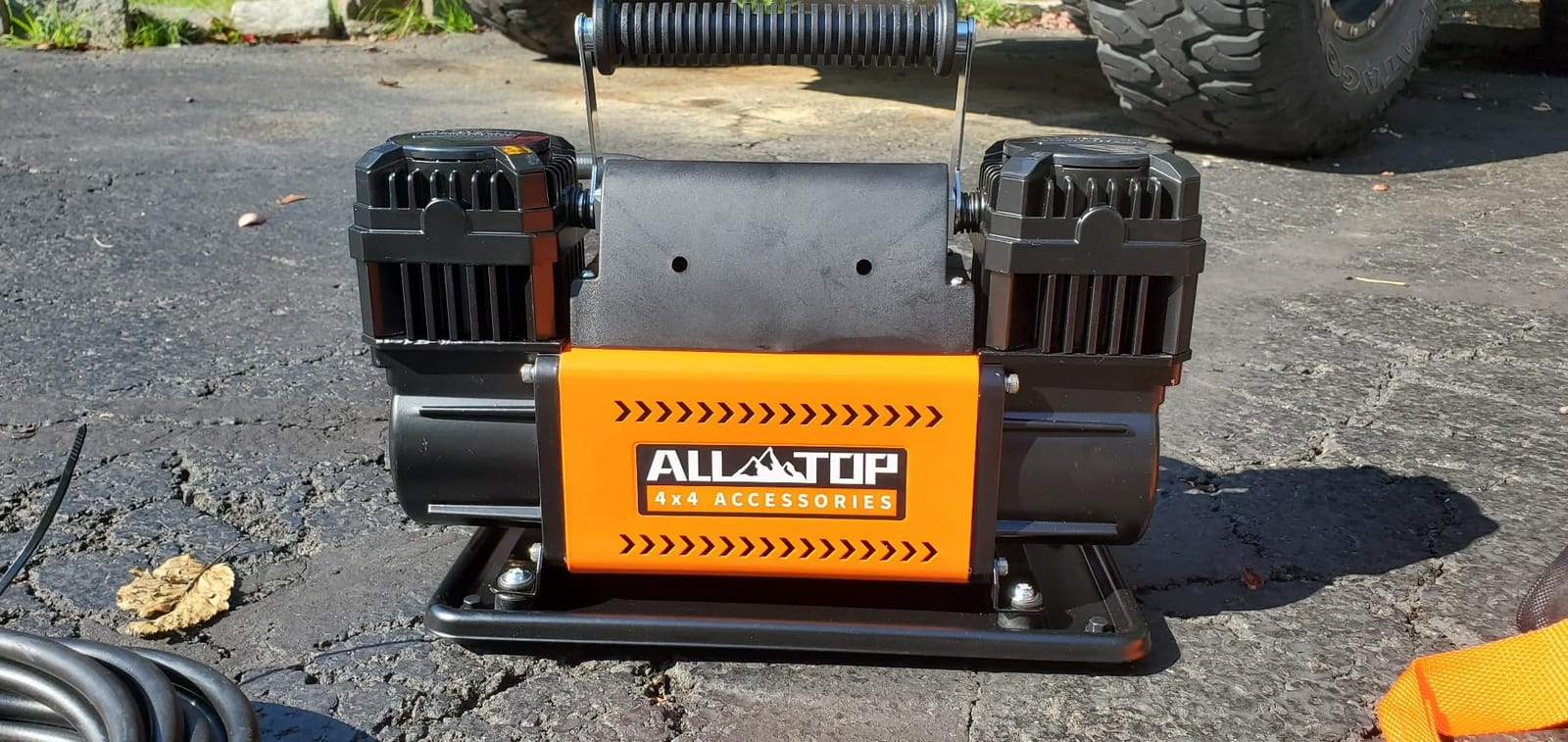
The tradeoff is power source and control. It runs from a vehicle battery at 12V DC, which means the engine has to be running during use and the battery draw is real. The factory unit has no automatic pressure shutoff, so it runs continuously until you switch it off, and several owners added a pressure switch and a higher-rated connector to fix that themselves.
Fit and finish are good for the class, with a 24 lb aluminum shell, rubber feet, and a 26 ft hose with gauge. The included gauge is reported as inaccurate by multiple owners, so treat its readings as approximate and use a separate gauge when you are seating a bead.
Why the flow number changes what you can do
Full 1 inch drive impact wrench work. That class of gun wants 6 CFM or more, and 12.35 CFM leaves enough headroom to run the wrench at sustained torque rather than in stuttering bursts.
Two tools at once. This is the only unit here that can feed a 3/4 inch impact gun and a second pneumatic tool simultaneously without the pressure falling out of range.
Why it is not the right pick for most people
You need a running vehicle with a healthy battery. It is a truck-bed and off-road tool, not a garage compressor, and there is no AC option without modification.
The run-until-off design and the short 6.5 ft battery lead are the two most common modifications owners report making. Budget for that if you buy it.
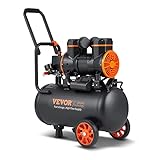
3. VEVOR 6.3 Gallon 2 HP Oil-Free – Best Flow Per Dollar
VEVOR 6.3 Gallon 2 HP Air Compressor, Max 116PSI, Oil Free Compressor Tank
6.3 gal tank
3.35 CFM at 90 PSI
116 PSI max
70 dB
43 lb
Pros
- 3.35 CFM at 90 PSI is real flow for the money
- Users report stable flow during continuous tool use
- Fills the full tank in about a minute
- Two silencers keep it quiet for its size
- Survives drops and heavy impacts
Cons
- Power cord is only about 40 inches
- Picky about extension cords and shared circuits
- Small casters let it tip when moved by the handle
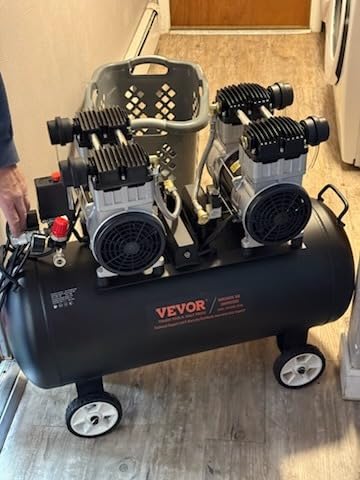
At 3.35 CFM at 90 PSI, this 2 HP unit does something most machines in its bracket cannot: it clears the practical floor for a 1/2 inch drive impact wrench with something to spare. It is the compressor I would buy first for a home garage doing brake and wheel work on a regular basis.
Owners report it holds stable flow during continuous air tool use rather than cutting out, and that it fills the full 6.3-gallon tank in about a minute or less. That fast fill is doing a lot of the work in real terms, because the pump is back at pressure before you have swapped sockets.
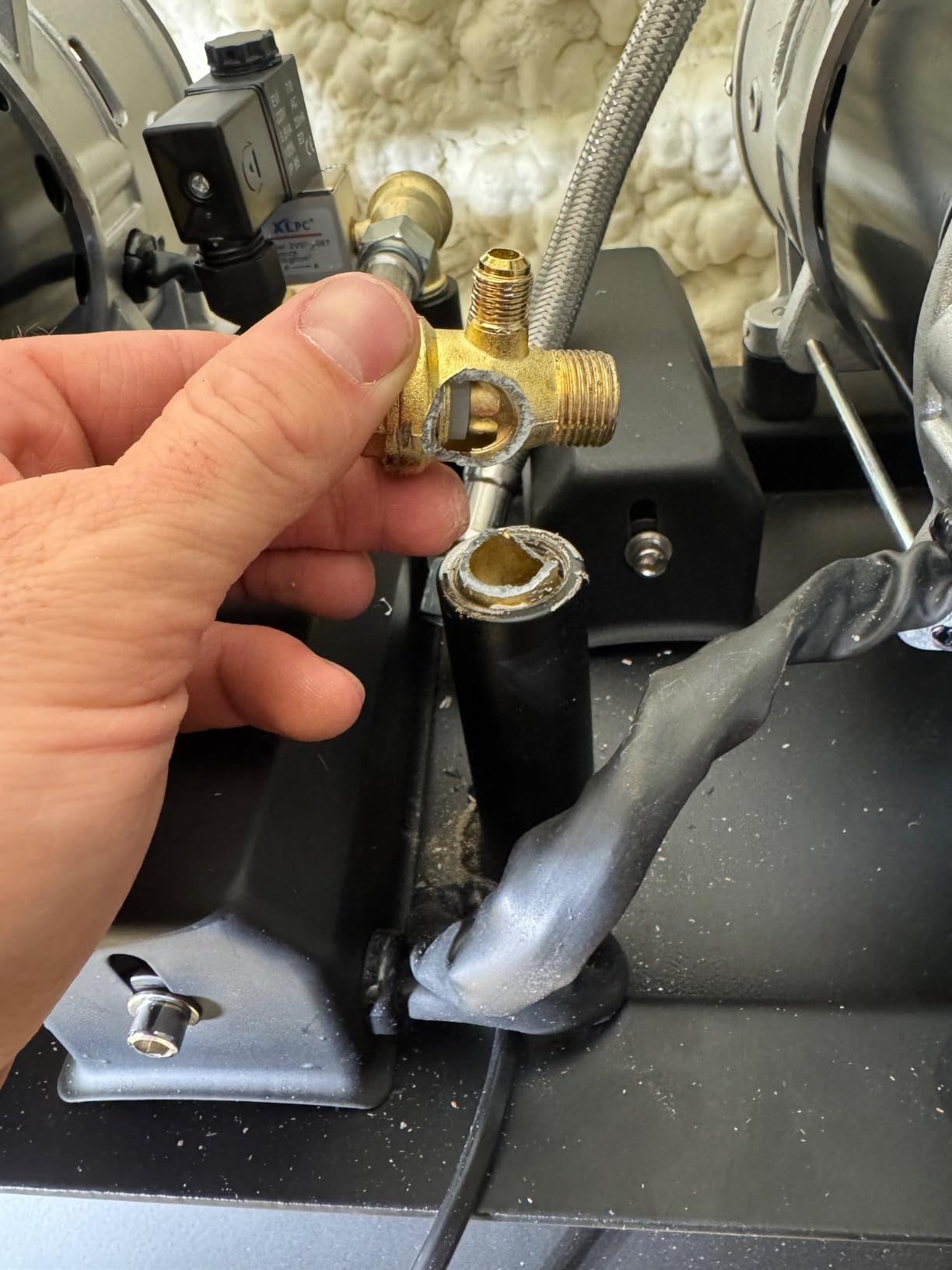
The single most reported issue is electrical, not mechanical. The power cord is only about 40 inches, so the unit has to sit close to an outlet, and multiple owners report it failing to start or tripping when run through an extension cord or a shared circuit. That is a real constraint if your garage outlet is on the far wall from where the work happens.
Mechanical robustness is genuinely good. Owners describe surviving drops, hard impacts, and even a tire explosion nearby. It is rated 4.3 out of 5 across 669 reviews, the lowest average in this group, and the gap comes almost entirely from those electrical complaints rather than from build quality.
What 3.35 CFM buys you in practice
Comfortable 1/2 inch drive impact work on lug nuts, brake caliper bolts, and suspension hardware. You stay above the pressure where the wrench starts to bog.
Two tools connected at once for short bursts, such as an impact gun plus a blow gun while you clean off a rotor. It will not sustain that indefinitely.
What to plan around
Outlet placement. With a 40 inch cord, plan the compressor location around the outlet rather than the car.
Extension cords. If you must use one, use a heavy gauge short cord rather than a long light one. This is the leading cause of the one-star reviews.
4. ECOMAX 6 Gallon 150 PSI Pancake Kit – Best Complete Package
ECOMAX Air Compressor 6 Gallon 150 PSI Pancake Portable Oil-free Tank with 10 PCS Accessories Kit
6 gal tank
3 CFM at 90 PSI
150 PSI max
75 dB
34.17 lb
Pros
- Highest average rating in the group at 4.7
- 150 PSI max gives margin over 116 PSI units
- Dual quick couplers for two connected tools
- Light 34.17 lb with a flip-up carry handle
- 10-piece kit includes a 25 ft hose and blow gun
- Oil-free pump with cold-weather and low-voltage start
Cons
- 75 dB is louder than the 68 to 70 dB models
- 3 CFM at 90 PSI is adequate rather than class-leading
- Newer brand with a shorter track record
This is the highest rated compressor in the roundup at 4.7 across 316 reviews, and the reason is the bundle as much as the machine. The 10-piece accessory kit includes a 25 ft hose, tire pressure gauge, blow gun, couplers, and thread seal tape, so you are not making a second purchase to actually use the thing.
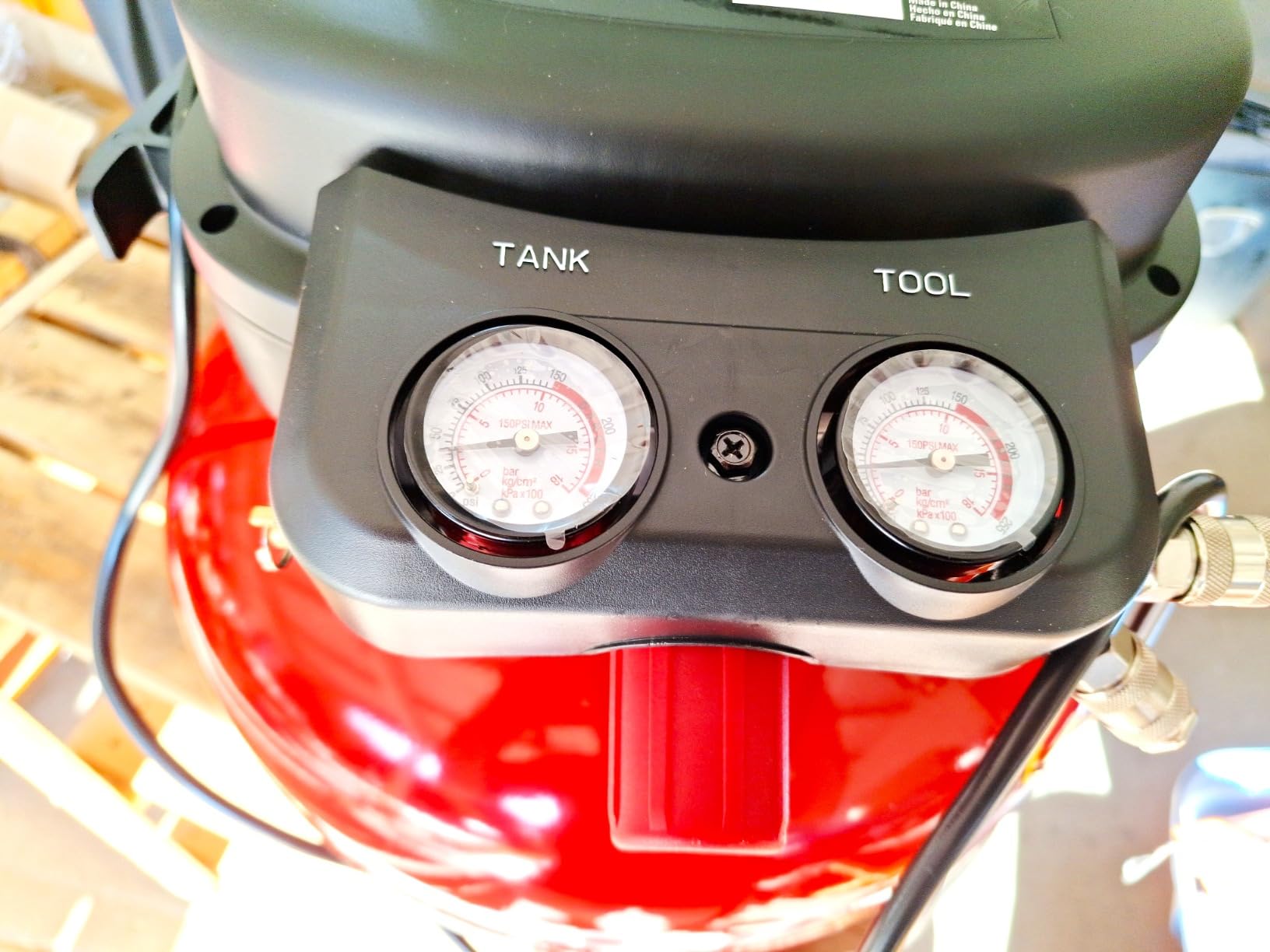
For impact work, the 150 PSI ceiling is the differentiator against the 116 PSI budget units. That extra pressure headroom is what you want when a fastener is not breaking free, and it also means the tank has more usable reserve above the wrench working range.
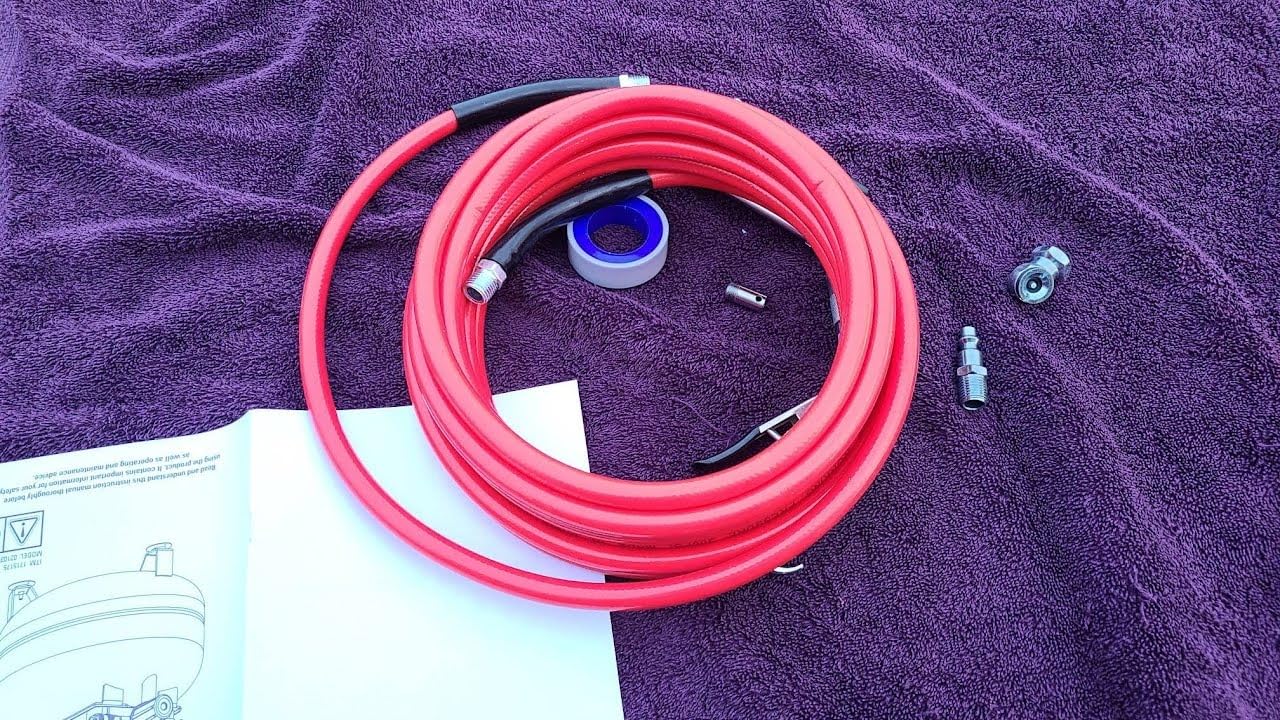
Three CFM at 90 PSI sits right at the practical floor for a 1/2 inch drive gun. It is adequate rather than generous, and if you are running a 3/4 inch drive wrench you will feel the difference between this and the Metabo HPT at 4 CFM. The dual quick couplers are a genuine convenience, letting you leave an impact gun and a second tool connected while you swap jobs.
Owners like the 34.17 lb weight and the flip-up handle, which makes one-handed repositioning realistic. The noise at 75 dB is real, and it is a step louder than the 68 to 70 dB models here, so ear protection matters indoors.
What it is genuinely good for
1/2 inch drive impact work on a home garage budget, with enough pressure reserve for stubborn fasteners that a 116 PSI unit would stall on.
Starting from nothing. Hose, couplers, and blow gun are in the box, which removes the most common first-week frustration.
What to watch out for
The flow spec is listed inconsistently in the product data, and the marketing does not always print the 90 PSI figure clearly. Confirm the CFM at 90 PSI on the label before you commit if impact duty is your main use.
It is a newer brand with less long-term field history than Metabo HPT or RIDGID. The 4.7 rating is real, but the sample size is smaller.
5. Limodot 5 Gallon 68 dB Oil-Free – Best Quiet Pick
Quiet Oil-Free Air Compressor, 68 dB, 2.8 CFM @ 90 PSI, 5 Gallon Air Tank
5 gal tank
2.8 CFM at 90 PSI
120 PSI max
68 dB
25 ft hose
Pros
- Quietest unit in the roundup at a claimed 68 dB
- 2.8 CFM at 90 PSI suits 400 to 500 ft-lb impact wrenches
- 25-second recovery between bursts
- Oil-free and cold-weather start capable
Cons
- 120 PSI maximum is low for large lug nuts and bead seating
- 5-gallon tank is the smallest here
- Less established brand with a smaller engineering footprint
At a claimed 68 dB, this is the quietest compressor here, and the low-RPM induction motor is the reason. Owners describe carrying on a normal conversation across a running unit, which is a very different experience from the 80-plus dB pancakes on this list.
2.8 CFM at 90 PSI is a real flow figure rather than a marketing one, and it suits impact wrenches in the 400 to 500 ft-lb class. That covers a lot of 1/2 inch drive work. It will not feed a 3/4 inch drive gun, and it does not pretend to.
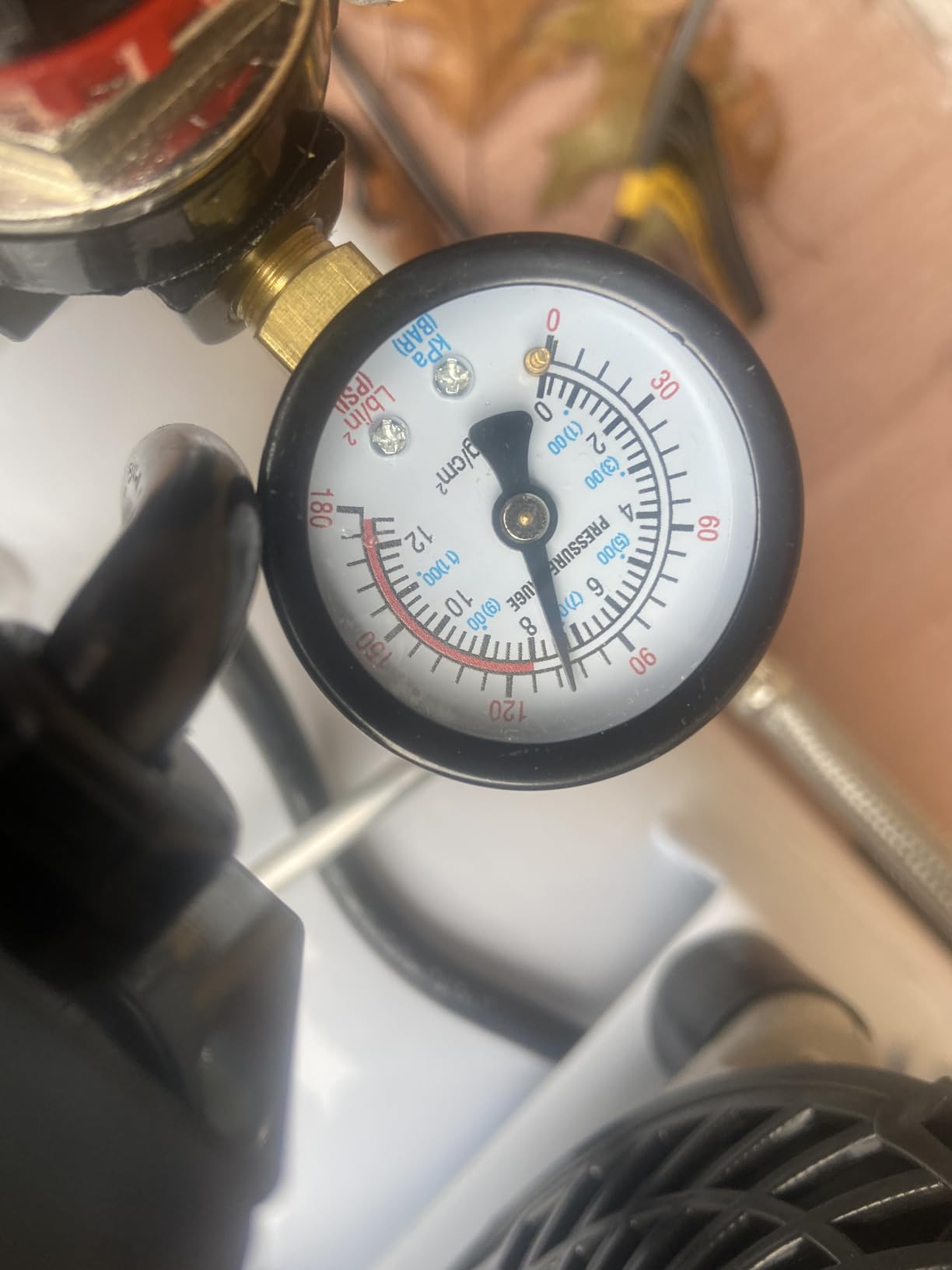
The 120 PSI ceiling is the main compromise. When you are seating a tire bead or fighting a badly seized lug nut, that is roughly 30 PSI less headroom than the Metabo HPT, and you will feel it at the moment you need it most. The tank is also the smallest here at 5 gallons, so reserve air runs out faster.
Recovery is quoted at 25 seconds, which is short enough to keep a rhythm going on moderate bursts but still a visible pause between heavy ones. The box includes a 25 ft PVC hose, a 13-piece accessory kit, and a wheel kit, so it is ready to move and use out of the box.
Best fit for noise-sensitive spaces
Apartment-adjacent garage, basement shop, or shared wall space where an 80 dB pancake would be a problem. The quiet motor is the whole reason to choose this over a louder 3 CFM machine.
Light to mid torque impact work, roughly 400 to 500 ft-lb, where the 2.8 CFM budget matches the gun rather than under-feeding it.
Where it runs out of road
Seized fasteners and bead seating. The 120 PSI limit removes the headroom you would want at exactly that moment.
Two tools at once. Five gallons and 2.8 CFM is a single-tool budget, and running a second tool will pull you out of the working pressure band quickly.
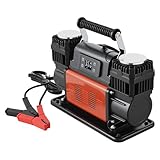
6. VEVOR 10.6 CFM 12V Dual-Cylinder with Auto-Stop – Best for Mobile Technicians
VEVOR Dual-Cylinder Heavy Duty Air Compressor, 10.6CFM Auto-Stop Portable Tire Inflator, 12V 150PSI Offroad Air Pump with LCD Digital Display & Adapters for Truck Car SUV 4 x 4 Vehicle RV
10.6 CFM dual cylinder
150 PSI max
12V DC
23.3 lb
LCD auto-stop
Pros
- 10.6 CFM leaves ample headroom for impact wrench bursts
- Preset pressure with automatic shutoff at target
- Cast iron cylinders noted for longevity
- Overheat protection and digital display included
Cons
- Requires the vehicle to run and draws heavy current
- One owner reported a unit that would not build pressure
- 12V DC only with no wall outlet option
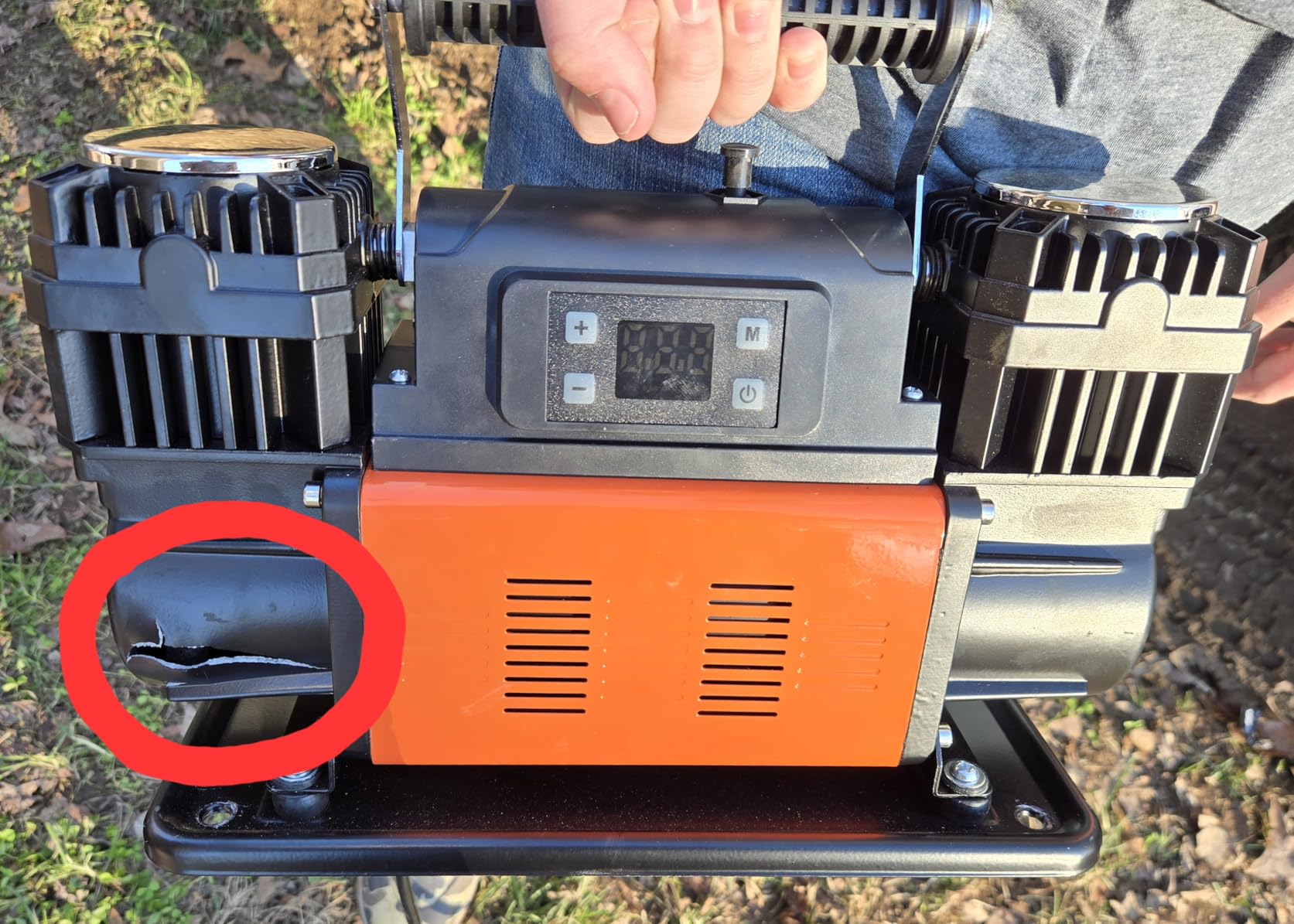
This is the compressor for someone whose job happens in parking lots and driveways rather than a fixed shop bay. At 10.6 CFM from dual cast iron cylinders, it feeds a 3/4 inch drive impact wrench with real headroom, and the LCD display with preset pressure and automatic shutoff is a genuine step up from the manual on and off designs in this class.
Owners independently timed large tire fills at around one minute per tire, and one reports four tires from 16 to 36 PSI in under 10 minutes total. A 50-year mechanic singled out the cast iron cylinders as a longevity detail, which matters more on a unit that gets banged around in a truck bed.
The constraint is power. It draws 12V at 1080W with an estimated 60 amp peak, so the engine must be running and the battery clips and power cord run hot during use. One prior owner replaced the battery clips with Anderson connectors, which suggests the supplied ones are undersized for sustained high-current work.
Durability is the other question mark. Among 132 reviews there is one unit that would not build pressure, with support reportedly unresponsive, and another that failed after roughly 2.5 months of weekly use. That is a small sample, but it is worth knowing before you rely on this for paid work.
Why a mobile tech should look here first
Auto shutoff at a preset pressure means you are not relying on watching a gauge in a wind. That is the single feature that separates it from cheaper 12V kits.
Storage footprint. At 23.3 lb it lays out flat and goes in the supplied bag, so it does not consume a whole seat or a corner of the bed.
What to plan around
Engine running and battery health. Heavy current draw on a tired battery is the most common complaint, and hot connectors are the second.
Support responsiveness. If your work depends on the unit daily, weigh the two durability complaints in the reviews against the convenience before committing.
7. VEVOR 4.8 Gallon 1.2 HP Oil-Free – Best Value
VEVOR 4.8 Gallon Air Compressor, 1.2HP 2.2 CFM@90PSI Oil Free Air Compressor Tank & Max. 116PSI Pressure, 70 dB Ultra Quiet Compressor for Auto Repair, Tire Inflation, Spray Painting, Woodwork Nailing
4.8 gal tank
2.2 CFM at 90 PSI
116 PSI max
70 dB
34 lb
Pros
- 70 dB is the quiet end of this roundup
- 4.8-gallon tank in a 34 lb package moves easily
- Oil-free pump removes maintenance entirely
- Dual silencers and overheat protection included
- Compact enough for a small car
Cons
- 2.2 CFM at 90 PSI is the lowest flow here
- 116 PSI max is well short of the 200 PSI Metabo HPT
- 4.8-gallon tank holds less reserve than the 6 gallon models
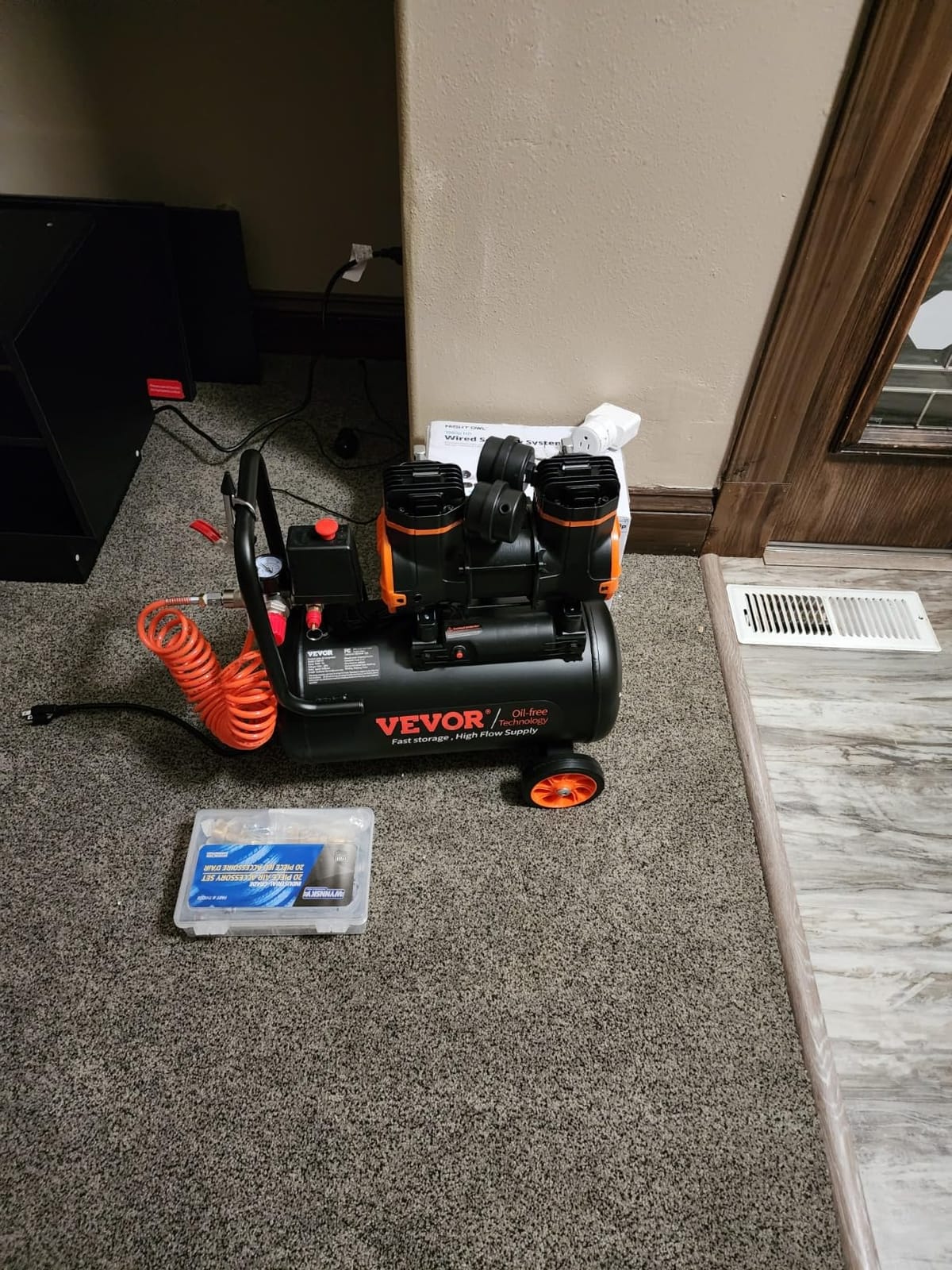
This is the cheapest route into a quiet, oil-free compressor that will handle light pneumatic work without becoming a maintenance project. At 70 dB and 34 lb, it is easy to live with in a shared garage and easy to move between rooms.
But at 2.2 CFM at 90 PSI it is the lowest flow figure in this roundup, and that number is the whole story for impact duty. It will drive a small 1/2 inch drive wrench on moderate fasteners. On a seized lug nut it will fall out of its pressure band, and that is the moment you will wish you had bought more flow.
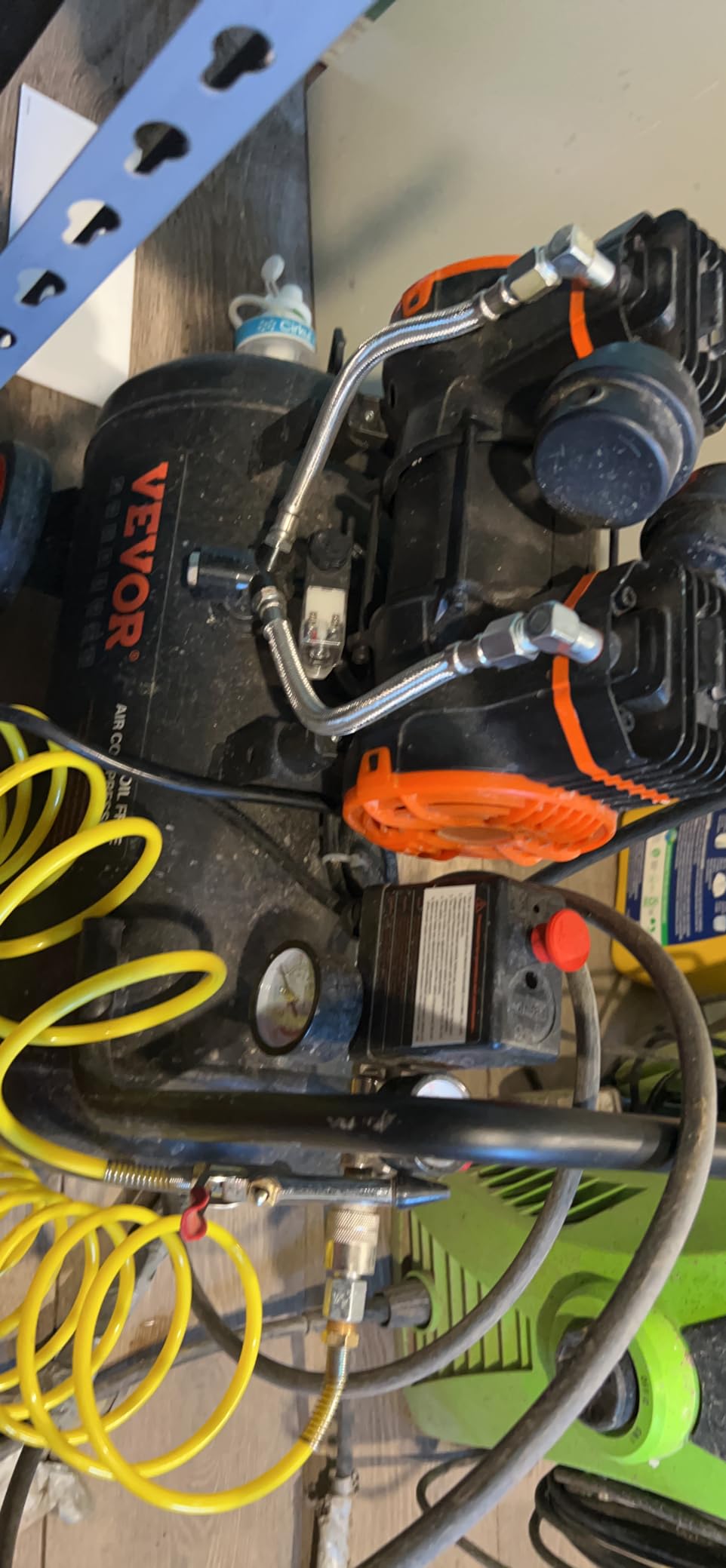
The 116 PSI ceiling compounds the flow limitation. Low flow and low ceiling together mean very little margin above the range an impact wrench needs, so the tool is working at the bottom of its usable envelope from the first bolt.
What it does well: dual silencers with filter cotton for genuinely quiet running, automatic overheat and overpressure shutoff, a 3-layer Q235B steel tank, and a compact 20.5 by 11.4 by 20.5 inch footprint that fits where larger machines do not. For tire inflation, air guns, and dust clearing, it is a genuinely capable little machine.
Where this budget unit makes sense
Occasional single-bolt jobs, tire work, and blowing out brake dust. A shared-space garage where noise is the bigger concern than flow.
A first compressor for someone who is not certain they need a compressor yet, and does not want to commit garage space or budget yet.
Why it is not the impact-wrench answer
2.2 CFM at 90 PSI sits below the practical floor for sustained impact work. The wrench will start, then lose pressure exactly when the bolt resists.
If impact duty is your primary reason for buying, spending a little more for 3 CFM or more changes the outcome far more than any other feature on this list.
8. CRAFTSMAN 6 Gallon 150 PSI Oil-Free Pancake – Best Brand Support
CRAFTSMAN 6 Gallon 150 PSI Oil-Free Pancake Air Compressor CMXECXA02106410
6 gal tank
2.6 SCFM at 90 PSI
150 PSI max
82 dB
30.8 lb
Pros
- Lightest full-size pancake here at 30.8 lb
- 150 PSI max with 2.6 SCFM at 90 PSI
- Dual quick couplers for two connected tools
- Established brand with a 1-year warranty and US-based service
- Fast pressure build and a small footprint
Cons
- 82 dB is the loudest figure in this roundup
- 2.6 SCFM at 90 PSI is the second-lowest flow here
- Carry handle has arrived broken with unhelpful support
CRAFTSMAN is the name on the box that people recognise, and that matters more than it sounds like it should when a spare part or a warranty claim is involved. This is backed by a 1-year limited warranty with a US-based service team, which none of the newer brands on this list can offer.
At 30.8 lb it is the lightest full-size pancake here, and at 150 PSI max with 2.6 SCFM at 90 PSI it sits in the same flow class as the budget ECOMAX unit. That is adequate for mid-torque 1/2 inch drive work, and the pressure ceiling gives more headroom than the 116 PSI machines.
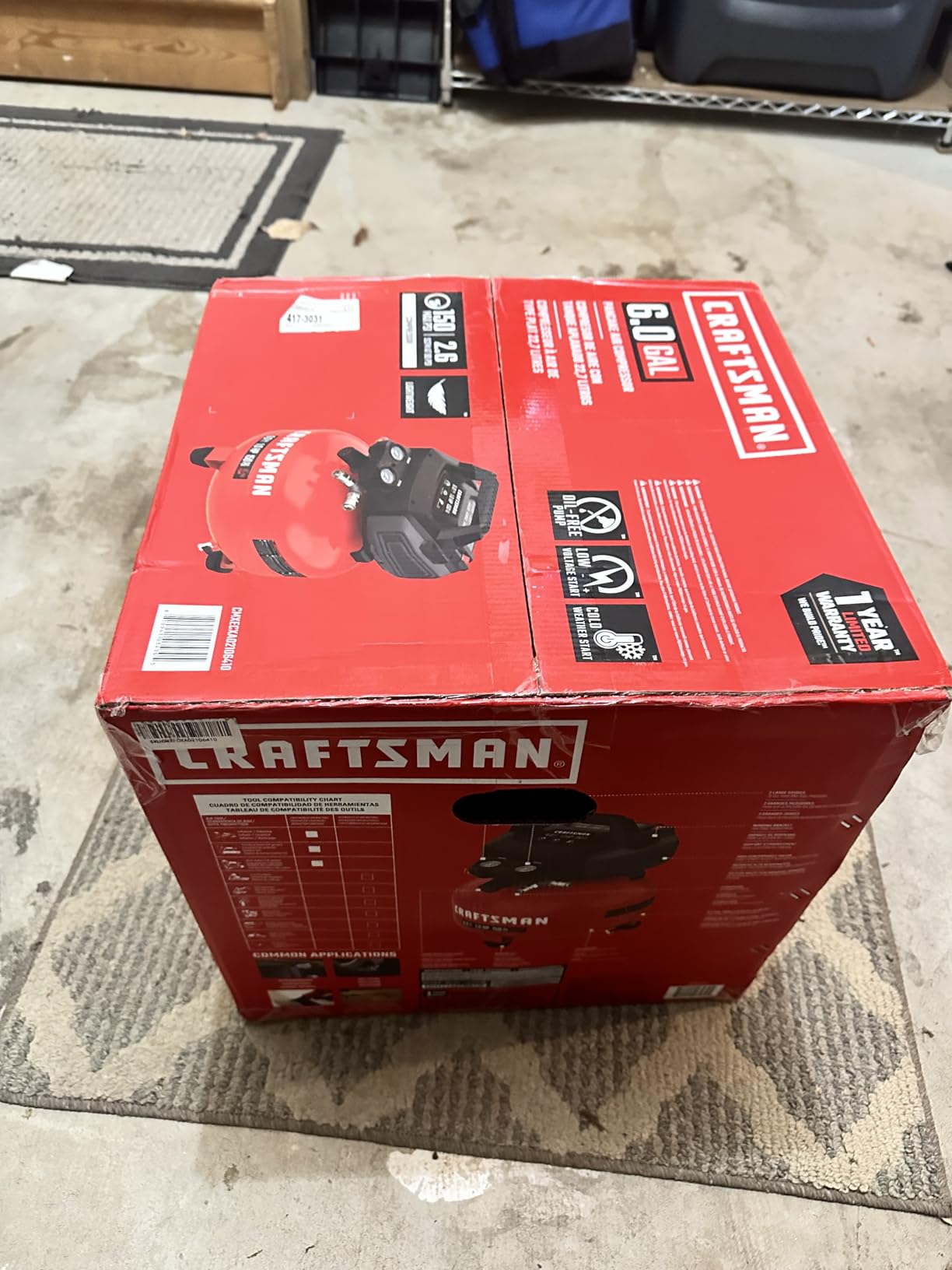
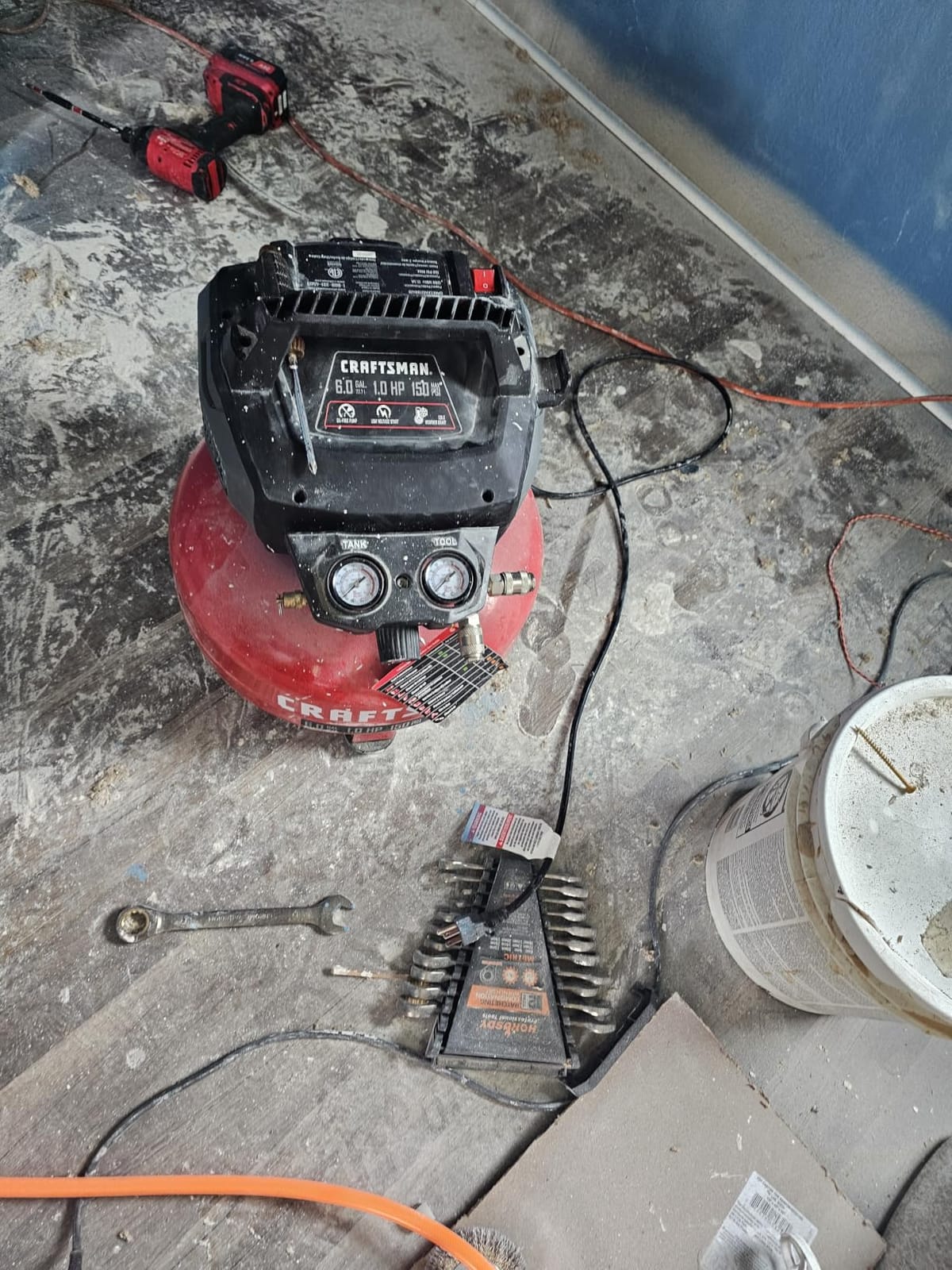
Two things give us pause. The first is 82 dB, the loudest listed figure in this roundup, and owners confirm it is noticeably noisy rather than merely rated that way. The second is the cluster of quality reports: several units stopping and not restarting, and handles arriving broken or in pieces with replacement support described as unhelpful.
Those are the comments that turn a 4.5 rating into a caution. The 1 HP motor also has little headroom above its rating, so if you already know you will grow into 3/4 inch drive work, this is not the machine to grow into.
Why the warranty and service reach is worth something
Home mechanics who want a brand they can contact. A US-based service team is a different experience from an unresponsive overseas support line when a handle or a gauge manifold fails.
Light carry between garage, basement, and a vehicle. At 30.8 lb with a top handle it is easy to reposition while you work.
Where the spec falls short
82 dB. If you work indoors or near a shared wall, that number will shape your neighbours’ experience more than yours.
2.6 SCFM at 90 PSI with a 1 HP motor leaves little reserve. It handles typical work and it does not handle the hard cases with grace.
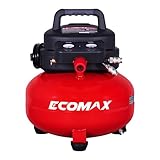
9. ECOMAX 6 Gallon 150 PSI 27.6 lb Pancake – Best for Light Carry
ECOMAX Pancake Air Compressor MAX 150 PSI, 2.6 CFM @90 PSI, Oil-Free
6 gal tank
2.6 SCFM at 90 PSI
150 PSI max
82 dB
27.6 lb
Pros
- 27.6 lb is the lightest 6-gallon pancake here
- Publishes both 90 PSI and 40 PSI flow figures
- Q235B alloy steel tank with seamless welds and rubber feet
- Two universal couplers usable simultaneously
Cons
- 82 dB is loud during the fill cycle
- 2.6 SCFM at 90 PSI is modest for high-torque impact work
- One reviewer had to reseal thread connections with Teflon tape
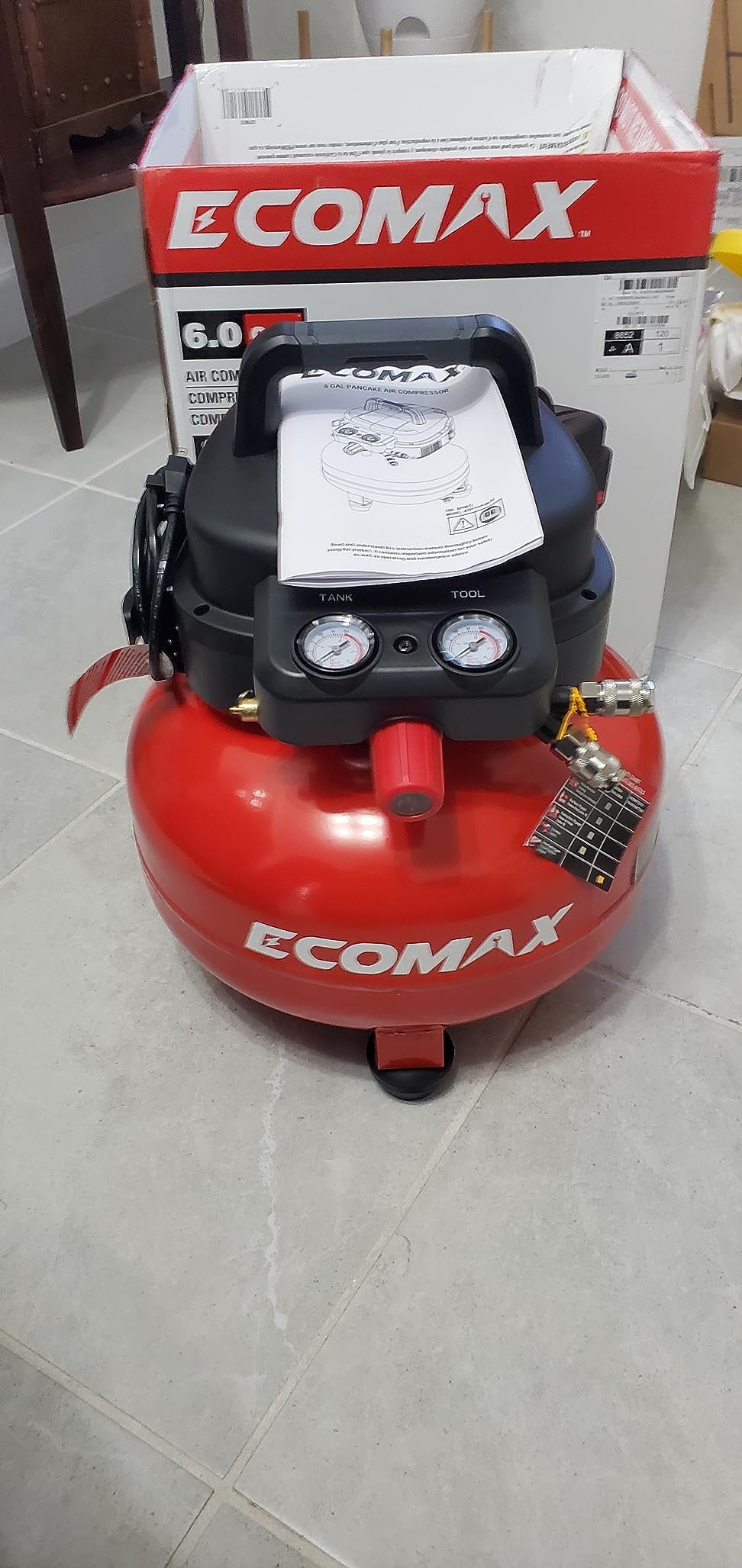
At 27.6 lb, this is the lightest 6-gallon pancake in the roundup, and if you are carrying a compressor up stairs or between a garage and a jobsite that weight difference is the feature you will feel every day. The 1 HP motor starts in cold weather and at low voltage, which is more than a lot of machines in this class promise.
It is also one of the few compressors here that publishes both its 90 PSI and 40 PSI flow figures, which makes the flow budget explicit rather than something you have to infer. Reviewers consistently appreciate that honesty, and it is exactly the behaviour the sizing math depends on.
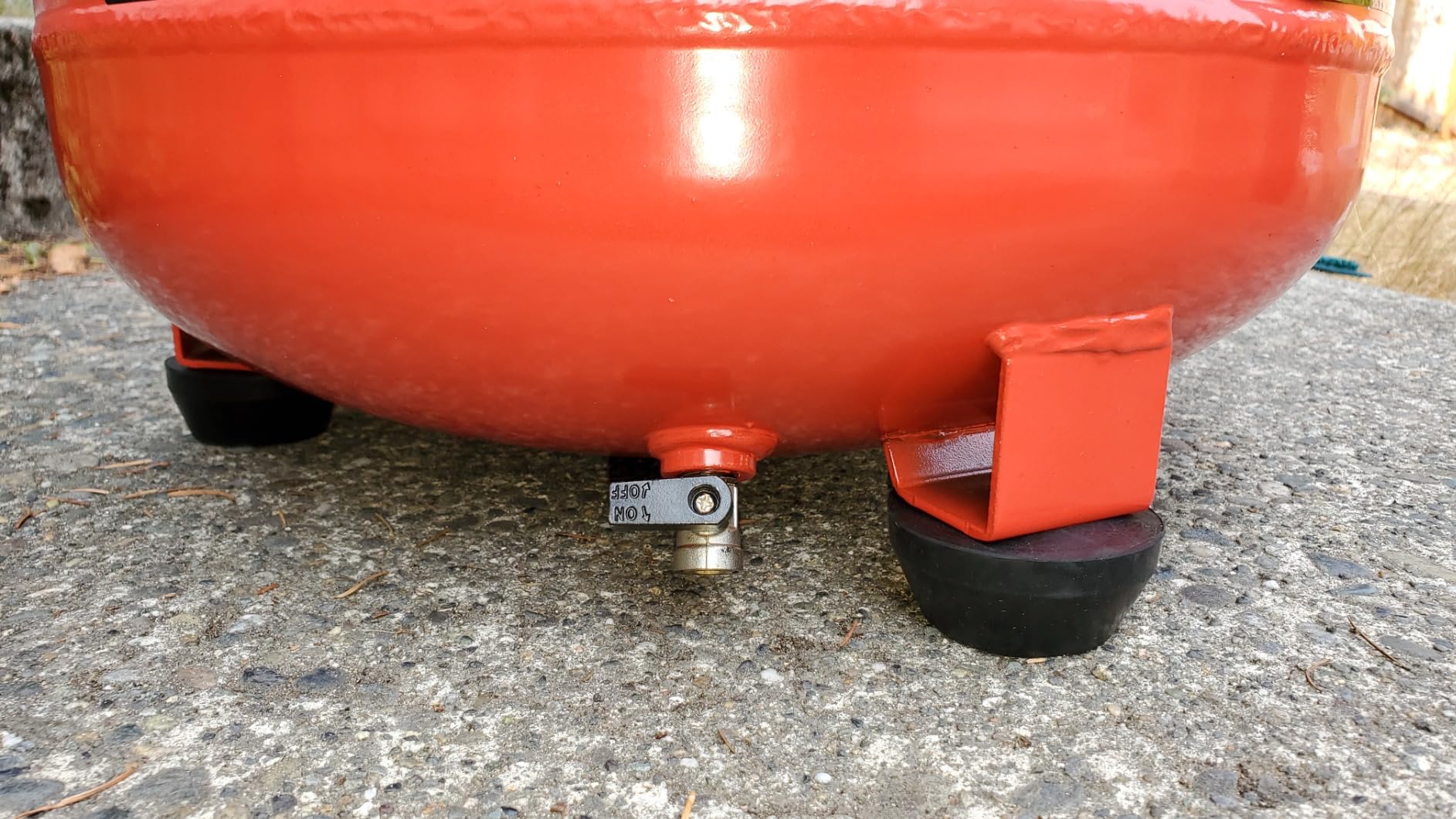
The flow budget of 2.6 SCFM at 90 PSI puts it in the same modest class as the CRAFTSMAN unit. Owners report recharge kicking in around 125 PSI, which leaves usable reserve pressure for normal 1/2 inch drive work, and the dual universal couplers let two tools stay connected at once.
The 82 dB figure is the recurring complaint, with owners reaching for ear protection during indoor fills. One reviewer also had to reseal the thread connections with Teflon tape out of the box, which is a five-minute fix but worth knowing about before the first fill.
Who should weight portability above everything else
Anyone moving a compressor between levels, into a van, or across a shop floor. Seven pounds lighter than the average 6-gallon pancake adds up over a day of lifting.
Cold or low-voltage conditions. The UMC motor is specified to start in both, which removes a common winter jobsite failure.
What to manage about it
The noise during fill is the loudest in the group alongside the CRAFTSMAN unit, at 82 dB. Ear protection indoors is not optional.
Flow is adequate rather than generous. If you anticipate stepping up to a 3/4 inch drive gun, the money is better spent on the VEVOR 6.3 gallon at 3.35 CFM.
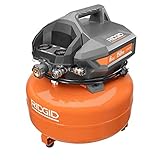
10. RIDGID 6 Gallon Portable Electric Pancake – Best Warranty and Build
RIDGID 6 Gal. Portable Electric Pancake Air Compressor
6 gal tank
0.8 HP motor
150 PSI max
80 dB
35 lb
3-year warranty
Pros
- Fills extremely fast for its size according to owners
- Not excessively loud for a 6-gallon pancake
- Three-year limited warranty is the longest here
- Stainless steel construction and a recognised pro brand
- Compact storage footprint for a 6-gallon tank
Cons
- 0.8 HP is the lowest horsepower here with no published 90 PSI CFM figure
- 80 dB noise rating
- Poor suited to long continuous air draws
The RIDGID is the one in this roundup backed by a 3-year limited warranty, and owners rate it highly for build quality, fast fill, and near-zero maintenance. Buyers frequently purchase a second one, which tells you something about satisfaction with the first.
The problem for this particular article is that the manufacturer does not publish a CFM at 90 PSI figure. It lists 73.28 liters per minute and a 0.8 HP motor, which is the lowest horsepower here. Without the number that actually determines impact-wrench performance, you are buying on brand and warranty rather than on the spec that decides whether the wrench gets fed.
One reviewer explicitly suggests it would handle an impact wrench well as long as the tool stays under 80 percent of its capacity, which is a reasonable piece of advice for a unit of this class. At 80 dB, owners report it is not excessively loud for a 6-gallon pancake, and the stainless steel construction is a step up from painted plate.
Owners also report it handles nailers, sprayers, tire inflation, dust clearing, and air hammers well. It is poorly suited to long continuous air draws such as palm orbital sanding, where a bigger compressor belongs.
What the warranty buys you
Three years of coverage, double what most of this roundup offers, on a machine with a stainless steel tank. For someone who plans to keep a compressor for a decade, that is a real consideration.
Brand confidence. RIDGID is a recognised professional tool name, and owners cite that trust as part of the purchase.
Why we could not rank it higher
No published CFM at 90 PSI. The sizing guide in this article is built on that number, and a compressor that will not publish it cannot be matched honestly against the others.
0.8 HP is the lowest motor output here, so heavy impact bursts are the case least likely to suit it even though the warranty suggests otherwise.
How to Match an Impact Wrench to the Right Compressor
Match the wrench first, then buy the compressor. The table below is the sizing floor for each drive class, and every number in it is a minimum rather than a comfortable target. Add 20 to 30 percent above the floor if you run the wrench back to back on stubborn fasteners.
3/8 inch drive impact wrenches sit in the 1,000 to 1,200 ft-lb class. A 2 CFM at 90 PSI compressor will drive them, and a 3-gallon tank is adequate for occasional work.
1/2 inch drive impact wrenches, the overwhelming majority of what people actually own, need 2.5 CFM at 90 PSI as a floor. A 6-gallon tank keeps you from cycling between bolts, and this is the class the Metabo HPT, VEVOR 6.3, and ECOMAX units are built for.
3/4 inch drive impact wrenches in the 1,200 to 1,500 ft-lb class need 4 CFM at 90 PSI. That is the threshold the Metabo HPT EC914S crosses, and it is why we picked it as the overall choice. A 20-gallon tank or a dual-cylinder 12V unit makes a real difference at this level.
1 inch drive impact wrenches and large truck work need 6 CFM or more. Nothing mains-powered in this roundup reaches that, which is exactly why the two 12V dual-cylinder units earned their places.
What actually matters when you buy
CFM at 90 PSI, not CFM at 40 PSI. This is the single most important line on any spec sheet. A compressor rated 4 CFM at 40 PSI may deliver barely 2 CFM at 90 PSI, and the difference decides whether your wrench works.
Tank size, and only for how long you work between cycles. Tank size does not create airflow. It buffers bursts and determines how many bolts you can turn before the pump kicks on. Forum users who moved from small tanks to 20-gallon units report the constant cycling disappears entirely and regret waiting.
Maximum PSI above the wrench requirement. Every air impact wrench is rated for a working pressure, usually 90 to 100 PSI. Anything above 120 PSI gives you bead seating and seized fastener headroom; 150 PSI and up is meaningfully better for that work.
Oil-free versus oil-lubed. For impact wrench work, oil-free is the safer default because a lubricated compressor puts oil into the air line, and that oil reaches impact sockets, extensions, and the fasteners themselves. None of the compressors in this roundup require oil servicing.
Hose bore. A 3/8 inch bore hose on a marginal compressor recovers real performance, and it is the cheapest fix available. A long, thin 1/4 inch hose can starve a wrench that the compressor itself could feed.
Circuit amperage. A 2 HP compressor drawing around 14.5 amps should go on a 20A circuit. Forcing it onto a 15A jobsite circuit, or feeding it through a long extension cord, is the single most common cause of nuisance breaker trips and of units failing to start.
Noise level. Below 70 dB you can hold a conversation across a running compressor. Above 80 dB you are putting on hearing protection indoors, which is a real quality of life difference in a residential garage.
Maintenance that takes ten minutes a month
Drain the tank weekly. Moisture in the receiver is the leading cause of corrosion failure and of water reaching your tools.
Check for leaks monthly at the fittings and the drain valve. A small weep at a thread connection starves airflow in ways that are hard to diagnose later.
Inspect the pump quarterly. Watch the belt or direct-drive coupling, check the intake filter, and confirm the safety relief valve still lifts.
When a cordless impact wrench is the better buy
If your impact work is occasional, or spread across locations with no reliable power, a cordless wrench is the correct answer and a compressor is a complication. Forum threads on this topic increasingly end with owners advising exactly that, and at 1/2 inch drive the technology has reached genuine parity for most bolt work.
Buy air anyway when you run a nailer alongside the impact gun, when you service large trucks, when you want 3/4 inch drive, or when you work in a fixed bay where the compressor will be plugged in anyway. In those cases the flow numbers in this guide decide it.
Frequently Asked Questions
What size air compressor is needed to run an impact wrench?
A 1/2 inch drive impact wrench needs at least 2.5 CFM at 90 PSI from a 6-gallon tank or larger. A 3/4 inch drive gun needs 4 CFM, and a 1 inch drive gun needs 6 CFM. Anything below about 2 CFM at 90 PSI stalls under sustained load no matter how large the tank is.
How much CFM do I need for an impact wrench?
Read the CFM at 90 PSI figure, not the peak or the 40 PSI figure. Budget 2.5 CFM for a 1/2 inch drive wrench, 4 CFM for 3/4 inch drive, and 6 CFM or more for 1 inch drive and heavy truck work. Add 20 to 30 percent above the floor if you break fasteners back to back.
Can you run an impact wrench with a pancake compressor?
Yes, for light 1/2 inch drive work, provided it delivers 2.5 CFM or more at 90 PSI. Small pancake units that quote flow at 40 PSI cannot sustain pressure through a sustained burst, so the wrench loses torque exactly when a seized fastener resists. A bigger tank does not fix a flow ceiling.
Is a 6 gallon air compressor enough for an impact gun?
For a 1/2 inch drive impact wrench, yes, and 6 gallons is the practical minimum. It holds enough reserve air to turn several lug nuts before the pump cycles. For a 3/4 inch drive wrench, step up to a 20-gallon tank or a dual-cylinder unit with 4 CFM or more.
Does tank size affect CFM?
No. Tank size does not create airflow, it only buffers bursts and sets how long you can work between pump cycles. A large tank on a low-flow pump still stalls under sustained load. Flow comes from the pump, and you size the tank separately for how many bolts you want to turn per cycle.
How many PSI do I need to run an air impact wrench?
Most air impact wrenches are rated for a working pressure of 90 to 100 PSI, so a compressor with 120 PSI maximum will run them. For seized fasteners and bead seating, 150 PSI or more gives you the headroom to work above the wrench’s normal range.
Are air impact wrenches stronger?
For sustained, repetitive work, air wrenches still deliver more consistent torque with no battery degradation, especially at 3/4 inch and 1 inch drive. At 1/2 inch drive, cordless impact wrenches have reached genuine parity for most bolt work, which is why many owners skip air entirely for occasional jobs.
What is the most reliable brand of air compressor?
Reliability tracks the warranty and the service network more than the badge. RIDGID offers a 3-year limited warranty and Metabo HPT and CRAFTSMAN both offer 1-year warranties with US-based service. Check that the manufacturer publishes CFM at 90 PSI, because brands that hide that number are harder to size honestly.
Final Verdict
The best portable air compressors for impact wrenches are not the ones with the biggest tanks. They are the ones that publish CFM at 90 PSI and clear the threshold for the wrench you actually own. For most people that means a 1/2 inch drive gun and a 2.5 CFM minimum, which is why the Metabo HPT EC914S takes our top slot at 4 CFM and 200 PSI with nearly 1.5k reviews behind it.
Buy the VEVOR 6.3 gallon at 3.35 CFM if you want the most flow per dollar in a mains-powered machine, and be prepared to place it close to an outlet. Buy the ECOMAX 6 gallon kit if you want everything in the box. Choose the Limodot if noise is what you cannot compromise on, and the ECOMAX 27.6 lb if you are carrying the compressor every day.
For 3/4 inch and 1 inch drive work, the flow numbers change the answer entirely. The two 12V dual-cylinder units are the only machines here with the headroom for that class, and the VEVOR 10.6 CFM with auto-stop is the better of the two for daily professional use. If your impact work is occasional, buy a cordless wrench instead and skip all of this.
Whatever you choose, read the CFM at 90 PSI number first, run it on a 20A circuit, and fit a 3/8 inch bore hose. Those three details solve more impact-wrench problems than any tank upgrade. This guide was updated October 2026.