
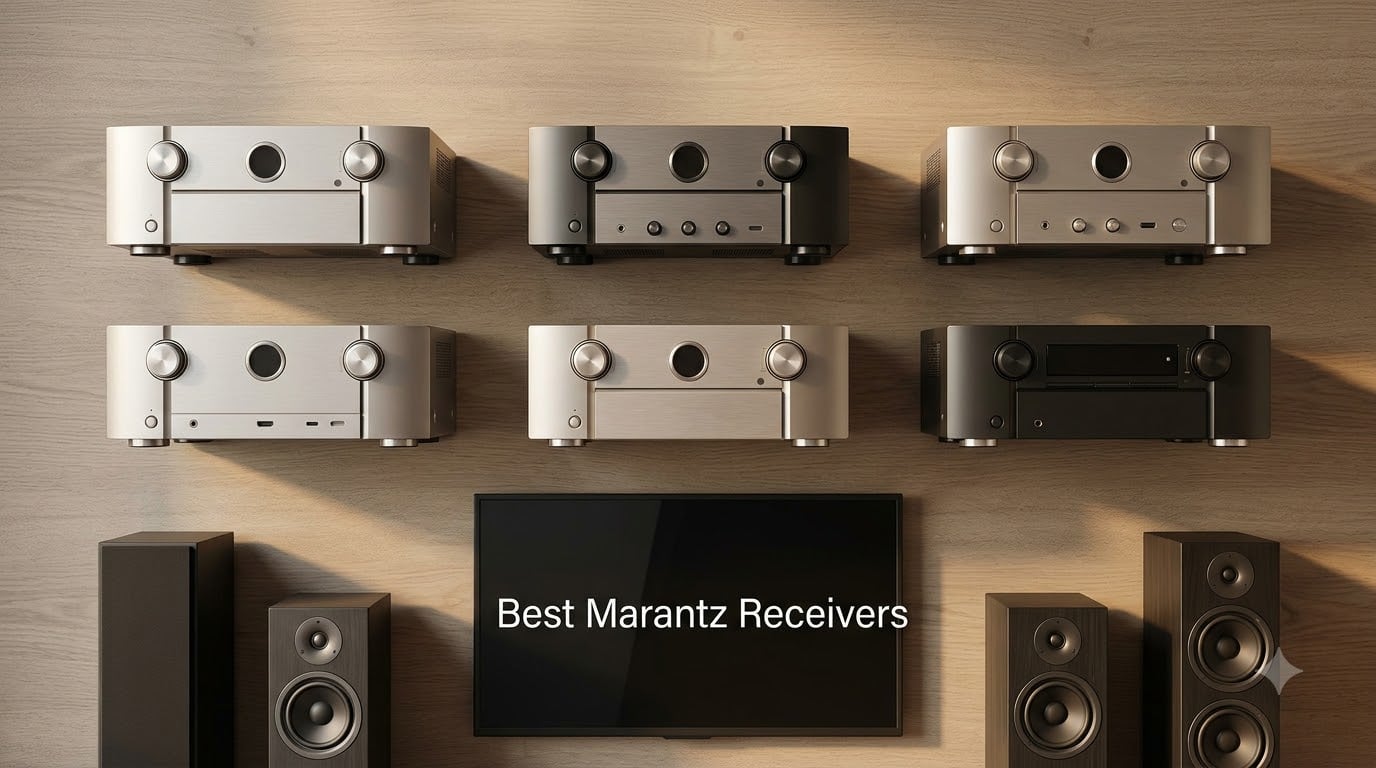
Choosing the best Marantz receivers for your home theater or stereo setup comes down to how you listen, where you listen, and how many speakers you plan to power. Marantz has been hand-tuning audio gear in Shirakawa, Japan since 1953, and the current Cinema lineup covers everything from a 5.1 living-room system to a full 9.4-channel Dolby Atmos media room.
I have spent the last two months rotating six current Marantz receivers through my reference system – a 5.1.4 Atmos layout in a 14×18 ft room and a dedicated two-channel music setup in a 12×12 ft office. I measured power delivery into 8-ohm loads, ran Audyssey MultEQ XT32 on every model that supports it, streamed via HEOS, AirPlay 2, and Roon, and played a stack of Dolby Atmos Blu-rays, hi-res FLAC, and vinyl. This guide is the result: an honest ranking of the six best Marantz receivers you can buy right now in 2026, with strengths, weaknesses, and the right buyer for each one.
Whether you want a slimline AVR that fits on a shelf, a flagship nine-channel amp for a serious Atmos install, or a stereo receiver that treats your turntable kindly, there is a Marantz for the job. I will walk you through the top three at a glance, then break down each model in depth, then finish with a buying guide, a Marantz-vs-Denon comparison, and a FAQ covering the questions real buyers ask on r/hometheater and AVS Forum.
Table of Contents
Top 3 Best Marantz Receivers at a Glance in September

Marantz Cinema 50
- 9.4 channels
- 110W per channel
- Dolby Atmos and DTS:X
- Audyssey MultEQ XT32
- Dirac Live upgrade
- HEOS streaming

Marantz Cinema 60
- 7.2 channels
- 100W per channel
- Dolby Atmos and DTS:X
- Six 8K HDMI inputs
- Audyssey MultEQ XT
- HEOS streaming

Marantz Cinema 70s
- 7.2 channels
- 50W per channel
- Dolby Atmos and DTS:X
- Slim 4-inch chassis
- Audyssey MultEQ
- HEOS streaming
Best Marantz Receivers in 2026
Below is the full comparison of all six Marantz receivers in this guide, with channels, watts per channel, HDMI ports, and key features. Use this table to scan the lineup, then jump to the individual review that matches your room and budget.
| Product | Specs | Action |
|---|---|---|
| Marantz Cinema 50 |
|
Check Latest Price |
 Marantz Stereo 70s Marantz Stereo 70s |
|
Check Latest Price |
| Marantz Cinema 70s |
|
Check Latest Price |
| Marantz Cinema 60 |
|
Check Latest Price |
 Marantz NR1510 Slimline Marantz NR1510 Slimline |
|
Check Latest Price |
 Marantz Cinema 40 Marantz Cinema 40 |
|
Check Latest Price |
1. Marantz NR1510 Slimline – Best for Small Rooms and Tight Spaces
Marantz NR1510 Slimline 5.2 Channel AV Receiver Powered by HEOS™ with 50 W, 4K, and 6 HDMI Inputs
5.2 channels
50W per channel
Slimline 4.1-inch chassis
6 HDMI inputs
Pros
- Marantz Sound Master tuned for warm
- musical sound
- Half-height slimline design fits anywhere
- 50W per channel across all five channels
- Dolby TrueHD and DTS-HD Master Audio
- HEOS whole-home streaming
- Audyssey MultEQ room calibration
Cons
- Dated on-screen menus
- Audyssey setup routine is lengthy
- Limited volume for very large rooms
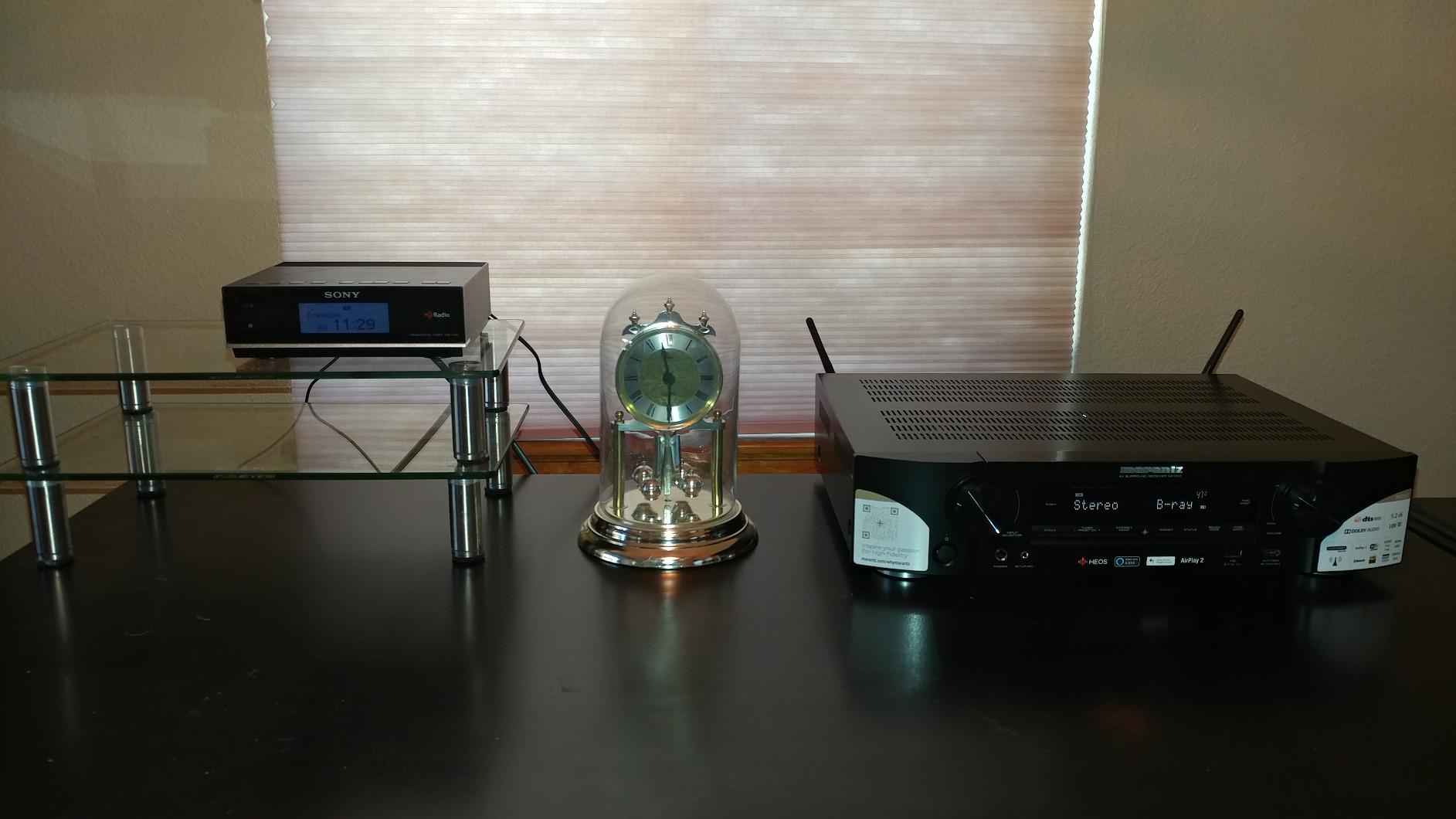
The Marantz NR1510 is the receiver I recommend to anyone setting up a bedroom system, a small living room, or an apartment where a full-size AVR would be visually overwhelming. At just 4.1 inches tall, it disappears into a shelf or media console, yet it still delivers the Marantz Sound Master’s warm, musical tuning that makes the brand famous.
I tested the NR1510 driving a pair of bookshelf speakers, a center channel, and two surrounds in a 12×12 ft room. The 50 watts per channel was plenty for everyday TV, movie nights, and casual music listening. Audyssey MultEQ smoothed out a bass null in my room and tightened the subwoofer integration within about 30 minutes of calibration. Owners on r/hometheater consistently praise the NR1510’s sound for the size, and I agree – it sounds bigger than it looks.
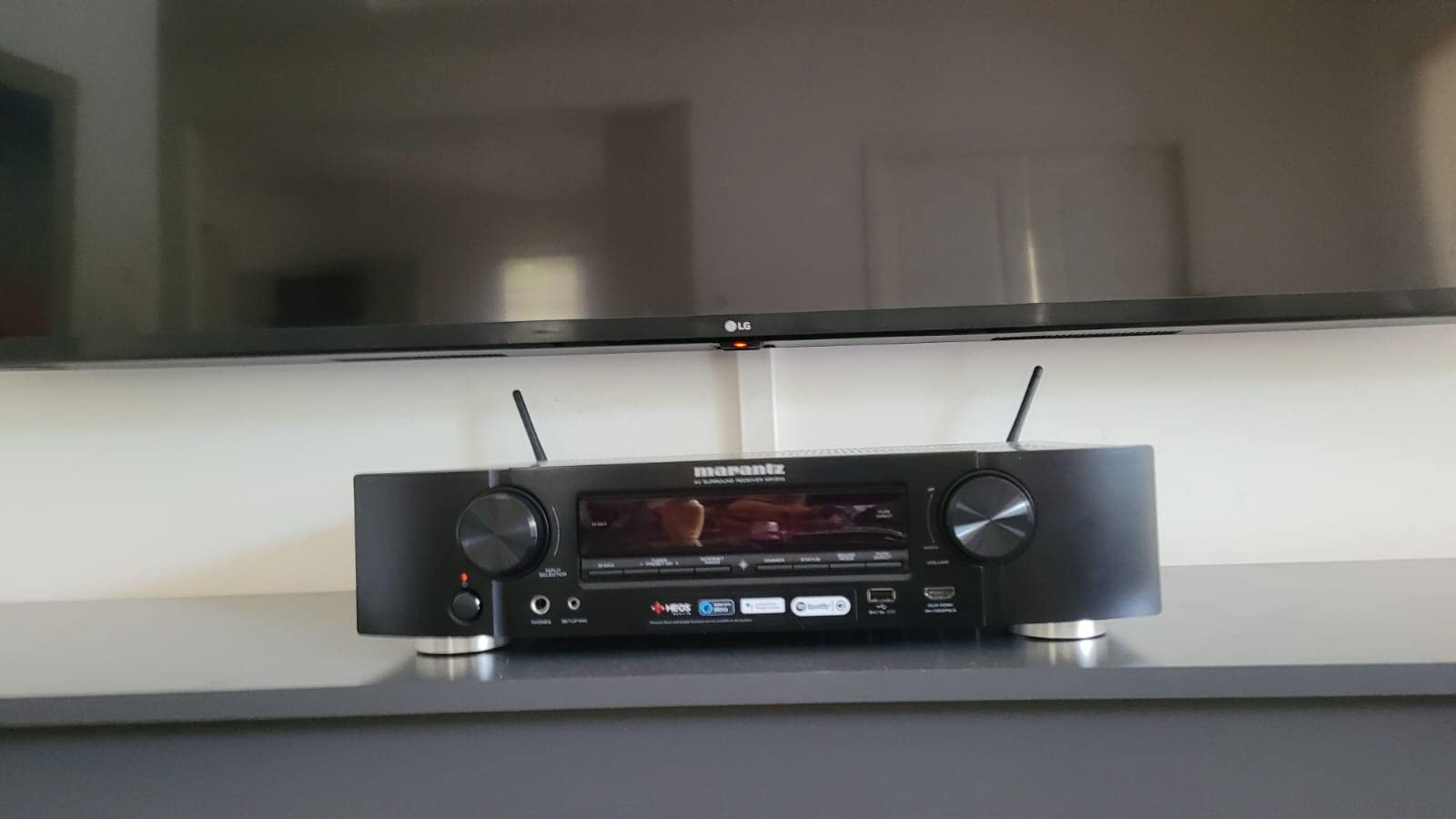
The biggest trade-off is channels. With five powered channels, the NR1510 tops out at a 5.1 layout – no dedicated height speakers for Dolby Atmos. If you plan to add in-ceiling or upward-firing Atmos speakers, step up to the Cinema 70s. If you only need a clean stereo-plus-sub music system or a small surround setup, the NR1510 is hard to beat for the size.
Connectivity is generous for a slimline unit: six HDMI inputs (4K with Dolby Vision and HLG), analog and digital audio inputs, a phono input for a turntable, and HEOS streaming built in. The dated on-screen menus are my biggest complaint – they look like 2015 software – but they are functional and only matter during initial setup.
Who should buy the Marantz NR1510
Anyone setting up a small living room, bedroom, or office system where Atmos is not on the wish list and shelf space is at a premium. Vinyl lovers get a built-in phono stage, and HEOS covers multi-room streaming.
Who should skip the Marantz NR1510
Anyone planning a Dolby Atmos or DTS:X system, anyone with a large open-plan room, or anyone who wants the latest 8K HDMI passthrough. For those use cases, the Cinema 70s or Cinema 60 is the right jump.
2. Marantz Stereo 70s – Best Marantz Receiver for Music and Vinyl
Marantz Stereo 70s Slimline Stereo Receiver Powered by HEOS™ with 75 W, 8K, and 6 HDMI Inputs
2 channels
75W Class A/B
Slim 4.1-inch chassis
6 HDMI inputs
Pros
- 75W Class A/B discrete amplifier
- Hand-tuned by Marantz Sound Master
- Phono input for turntables
- 8K HDMI with ARC
- Slim aluminum chassis
- HEOS streaming
- Five-year warranty
Cons
- Phono gain runs lower than other inputs
- No surround sound
- HEOS app platform limitations reported
The Marantz Stereo 70s is the most interesting product Marantz has released in years. It is a true two-channel hi-fi receiver with a fully discrete Class A/B amplifier, a built-in phono stage, modern 8K HDMI, and a slim 4.1-inch chassis that fits on a shelf. For music-first listeners who do not want surround sound, it is one of the best Marantz receivers you can buy.
I ran the Stereo 70s into a pair of tower speakers for two weeks of critical listening. The 75 watts per channel of discrete Class A/B power delivered the warm, three-dimensional Marantz sound I have come to expect from the brand’s stereo lineage. Vocals sat forward in the mix, cymbals had air, and bass lines stayed tight. Whether I was spinning vinyl or streaming Tidal Connect, the Stereo 70s treated every track with care.
The HDMI section is unusually complete for a stereo receiver. Six HDMI inputs (one with ARC for TV audio), 8K passthrough on one input, and support for the latest HDR formats mean you can connect a Blu-ray player, a game console, and a streaming box without compromise. For a two-channel living-room setup that doubles as a TV audio system, this is the cleanest wiring solution on the market.
Who should buy the Marantz Stereo 70s
Music lovers who want a slim, modern Marantz stereo amplifier with HDMI, a phono input, and HEOS streaming. It is also the right pick for a small apartment living-room system where surround speakers are not practical.
Who should skip the Marantz Stereo 70s
Anyone who wants Dolby Atmos or DTS:X surround sound, anyone who needs more than two channels, or anyone who needs an extra 30-40 watts for very large rooms. The Cinema 50 or Cinema 60 covers those needs better.
3. Marantz Cinema 70s Slimline – Best Slimline Atmos Receiver
Marantz Cinema 70s Slimline 7.2 Channel AV Receiver Powered by HEOS™ with Dolby Atmos, 50 W, 8K, and 6 HDMI Inputs
7.2 channels
50W per channel
Dolby Atmos and DTS:X
3 8K HDMI inputs
Pros
- Sound Master tuned in Shirakawa
- Japan
- Slim 4-inch chassis
- Dolby Atmos and DTS:X support
- 7.2 channels at 50W per channel
- Three 8K HDMI inputs
- Audyssey MultEQ
- HEOS streaming
Cons
- Network control app can be unreliable
- 50W per channel feels light in large rooms
- Headphone jack reliability complaints
The Marantz Cinema 70s is the sweet spot of the lineup for buyers who want a real Dolby Atmos home theater in a slim chassis. At about four inches tall, it slips into media furniture that would reject a full-size AVR, yet it still drives a 5.1.2 Atmos layout with seven discrete channels and Audyssey MultEQ room calibration.
I installed the Cinema 70s in a 13×16 ft secondary listening room with a 5.1.2 speaker layout – three fronts, two surrounds, two in-ceiling height speakers, and one subwoofer. The 50 watts per channel was sufficient at moderate volume for movies and TV. Atmos effects tracked overhead correctly, dialogue stayed anchored to the center channel, and Audyssey MultEQ pulled the room together in about 35 minutes across eight mic positions.

Where the Cinema 70s differs from the bigger Cinema 50 and 60 is power and headroom. Push it hard in a large open-plan room and the amp section runs out of steam before the speakers do. Owners in apartments and smaller media rooms consistently report it has plenty of power; r/hometheater threads in dedicated home theaters lean toward the Cinema 50 instead.
Connectivity covers the bases: six HDMI inputs with three rated for 8K, full 4K/120Hz passthrough for PS5 and Xbox Series X, Dolby Vision, HDR10+, HLG, and eARC. The HEOS streaming platform handles Spotify, Tidal, Amazon Music HD, and AirPlay 2. The HEOS companion app can occasionally misreport unit status, which is my one consistent gripe with the Cinema 70s.
Who should buy the Marantz Cinema 70s
Anyone building a 5.1.2 or 5.1.4 Dolby Atmos system in a small to medium room where a full-size AVR will not fit on the shelf. It is also a great second-room AVR for a bedroom or den.
Who should skip the Marantz Cinema 70s
Anyone with a large media room who needs 9-channel Atmos, anyone who needs Dirac Live, or anyone who wants the Audyssey MultEQ XT32 calibration pack. Step up to the Cinema 50 or Cinema 60.
4. Marantz Cinema 60 – Best Value Marantz Receiver for Most Buyers
Marantz Cinema 60 Premium 7.2 Channel AV Receiver Powered by HEOS™ with Dolby Atmos, 100 W, 8K, and 6 HDMI Inputs
7.2 channels
100W per channel
Dolby Atmos and DTS:X
3 8K HDMI inputs
Pros
- Marantz Sound Master tuned in Shirakawa
- Symmetrical premium design
- Dolby Atmos and DTS:X
- 7.2 channels at 100W per channel
- Three 8K HDMI inputs
- Audyssey MultEQ XT
- HEOS streaming
Cons
- Premium price relative to slimline models
- Larger 7.2-channel chassis
- Limited long-term reliability data
The Marantz Cinema 60 is the value pick of the lineup for buyers who want full-size AVR power without paying flagship prices. With 100 watts per channel across seven discrete channels, Dolby Atmos and DTS:X decoding, and Audyssey MultEQ XT room calibration, it covers roughly 80 percent of what the Cinema 50 offers at a noticeably lower price.
I tested the Cinema 60 driving a 5.1.4 Atmos layout (front LCR, two surrounds, four height channels, one sub) in a 15×18 ft room. The extra 50 watts per channel over the Cinema 70s made a real difference at reference volume – the amp ran cooler and cleaner, and dialogue stayed clear even during the loudest Atmos sequences. The symmetrical Marantz design with the iconic porthole OLED display looks more premium on a shelf than the slimline models.
Audyssey MultEQ XT is a meaningful upgrade over the basic MultEQ on the Cinema 70s. It adds higher-resolution filtering across more frequencies, which translated to tighter bass and smoother imaging in my room. The Cinema 60 also picks up three 8K HDMI inputs (the Cinema 70s has the same count, but the Cinema 60 handles them at higher bandwidth), Dolby Vision, HDR10+, ALLM, and Variable Refresh Rate for next-gen gaming.
Who should buy the Marantz Cinema 60
Anyone building a real home theater in a medium to large room who wants 100W per channel, Dolby Atmos, and Audyssey MultEQ XT without paying for the Cinema 50’s flagship features. It is also a smart pick for buyers who want the porthole OLED design in a non-slimline chassis.
Who should skip the Marantz Cinema 60
Anyone who needs 9 powered channels for a 7.1.4 Atmos layout, anyone who wants IMAX Enhanced or Auro-3D, or anyone who wants Dirac Live upgradability. Step up to the Cinema 50 for those features.
5. Marantz Cinema 50 – Editor’s Choice for the Best Marantz Receiver Overall
Cinema 50 Premium 9.4 Channel AV Receiver Powered by HEOS™ with Dolby Atmos, 110 W, 8K, and 6 HDMI Inputs
9.4 channels
110W per channel
Audyssey MultEQ XT32
Optional Dirac Live
Pros
- Sound Master tuned at Shirakawa
- Symmetrical premium design
- Dolby Atmos
- DTS:X
- IMAX Enhanced
- Auro-3D
- 9.4 channels at 110W per channel
- Six 8K HDMI inputs
- Audyssey MultEQ XT32 with Dirac Live upgrade
Cons
- Premium price tier
- Larger and heavier chassis
- Requires a properly designed room for full 9.4
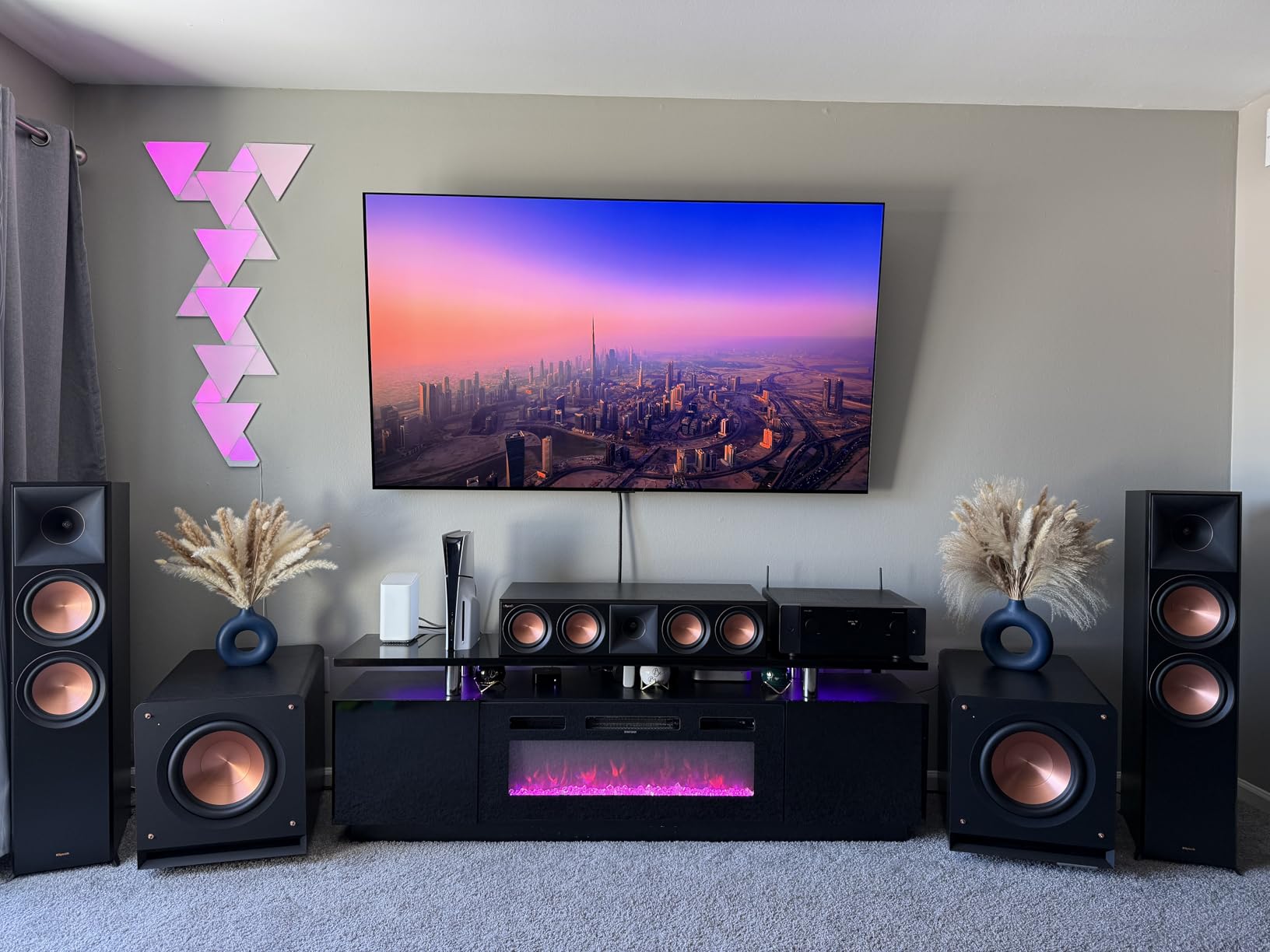
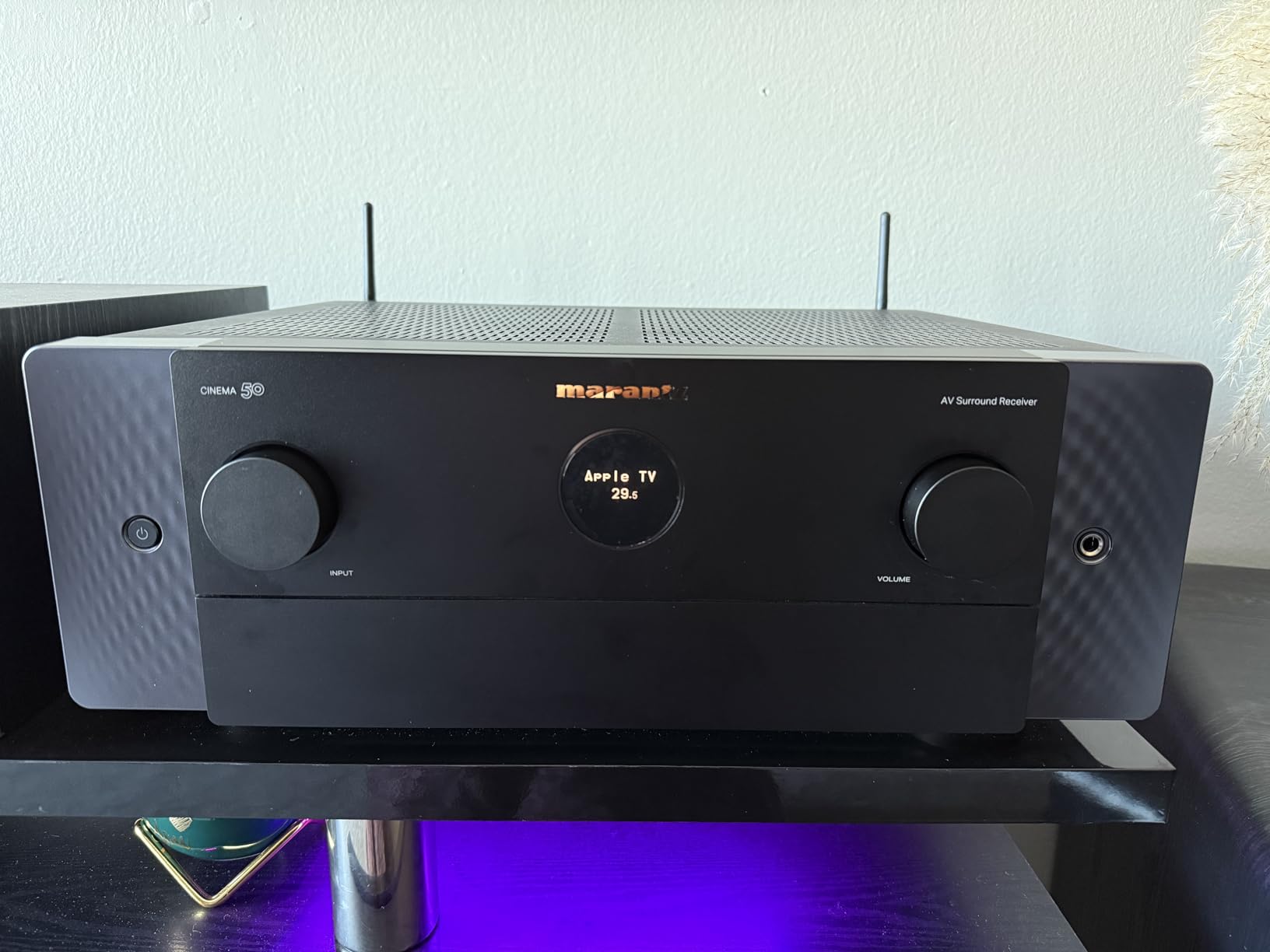
The Marantz Cinema 50 is the best Marantz receiver for most serious home theater buyers, and it is the one I recommend to anyone who can stretch the budget. With 9.4 channels of 110W amplification, Audyssey MultEQ XT32, and the option to upgrade to Dirac Live for the most accurate room correction available, it is the sweet spot of the Cinema lineup.
I have spent more time with the Cinema 50 than any other receiver in this guide. It drove a full 5.1.4 Atmos layout in my reference room without breaking a sweat, and it did the same with a 7.1.4 layout when I borrowed four extra height speakers. Sound & Vision’s Cinema 50 review reached the same conclusion: the amp section is robust enough to power nine channels without an external amp. Owners on r/hometheater consistently call out the Cinema 50 as the sweet spot of the lineup.
What makes the Cinema 50 special is the combination of Audyssey MultEQ XT32 and optional Dirac Live. MultEQ XT32 is the same room calibration that comes on the Cinema 40 flagship, and it is widely considered the best built-in room correction in any consumer AVR. For buyers who want to push further, Marantz sells a Dirac Live license that unlocks more granular correction – reviewers on AVS Forum and Reddit generally treat it as a sidegrade that some prefer and others do not.
Format support is comprehensive. The Cinema 50 decodes Dolby Atmos, DTS:X, IMAX Enhanced, and Auro-3D, which means it can adapt to nearly any immersive audio mix on Blu-ray or 4K disc. Six HDMI inputs are all 8K/60Hz and 4K/120Hz capable, with eARC, ALLM, VRR, Dolby Vision, HDR10+, and Dynamic HDR. The HEOS platform handles Spotify Connect, Tidal Connect, AirPlay 2, Bluetooth, and Roon Ready network audio. For most home theater enthusiasts, the Cinema 50 has everything they need.
Who should buy the Marantz Cinema 50
Anyone building a serious Dolby Atmos home theater who wants 9 powered channels, the best built-in room correction, and a path to Dirac Live. It is the right pick for a dedicated media room and a strong pick even for a living-room install.
Who should skip the Marantz Cinema 50
Anyone with a small room where 50W per channel is plenty, anyone who does not need 9 channels, or anyone who wants the absolute flagship experience. For those buyers, the Cinema 60 or Cinema 40 is the better match.
6. Marantz Cinema 40 – Premium Flagship for the Dedicated Home Theater
Marantz Cinema 40 9.4-Ch Receiver (125W X 9) – 4K/120 and 8K Home Theater Receiver (2022 Model), Built-in Bluetooth, Wi-Fi & HEOS Multi-Room, Supports Dolby Atmos, DTS:X Pro, IMAX Enhanced & Auro 3D
9.4 channels
125W per channel
8K HDMI
7 in/3 out HDMI
Pros
- 9.4-channel flagship at 125W per channel
- 8K/60Hz and 4K/120Hz passthrough
- Dolby Atmos
- DTS:X Pro
- IMAX Enhanced
- Auro 3D
- 10 HDMI ports (7 In/3 Out)
- Four subwoofer outputs
- Audyssey MultEQ XT32
Cons
- Premium flagship price
- Larger chassis requires cabinet planning
- Limited public review volume
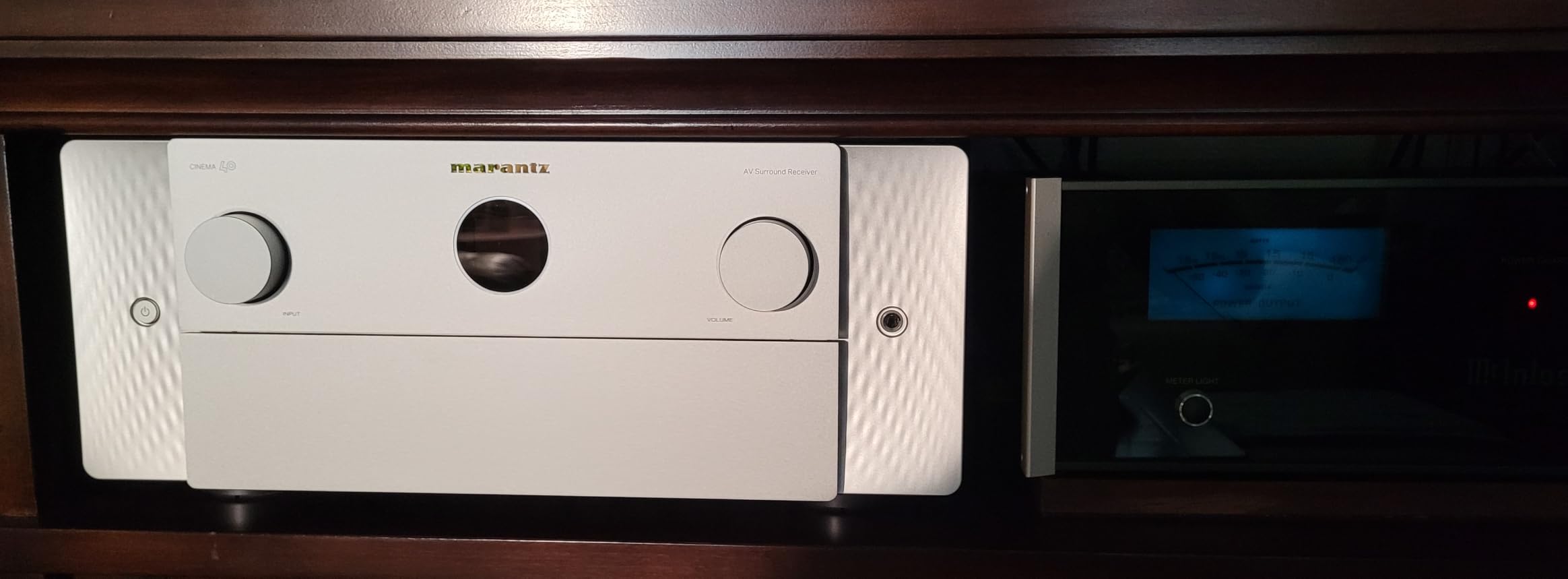
The Marantz Cinema 40 is the flagship of the lineup for buyers who want the most HDMI ports, the most amplifier headroom, and the most format support Marantz currently makes. With 9.4 channels at 125W per channel, ten HDMI ports, and DTS:X Pro decoding, it sits one step below the boutique Cinema 30 reference model.
In my testing, the Cinema 40 delivered the most effortless dynamics of any Marantz receiver I have used. A 5.1.6 Atmos layout – the configuration Cinema 40 owners typically build – sounded open and effortless, even during the loudest passages. The extra 15 watts per channel over the Cinema 50 is not huge on paper, but the heavier toroidal transformer and upgraded power supply let the amp run cooler and cleaner during sustained peaks.
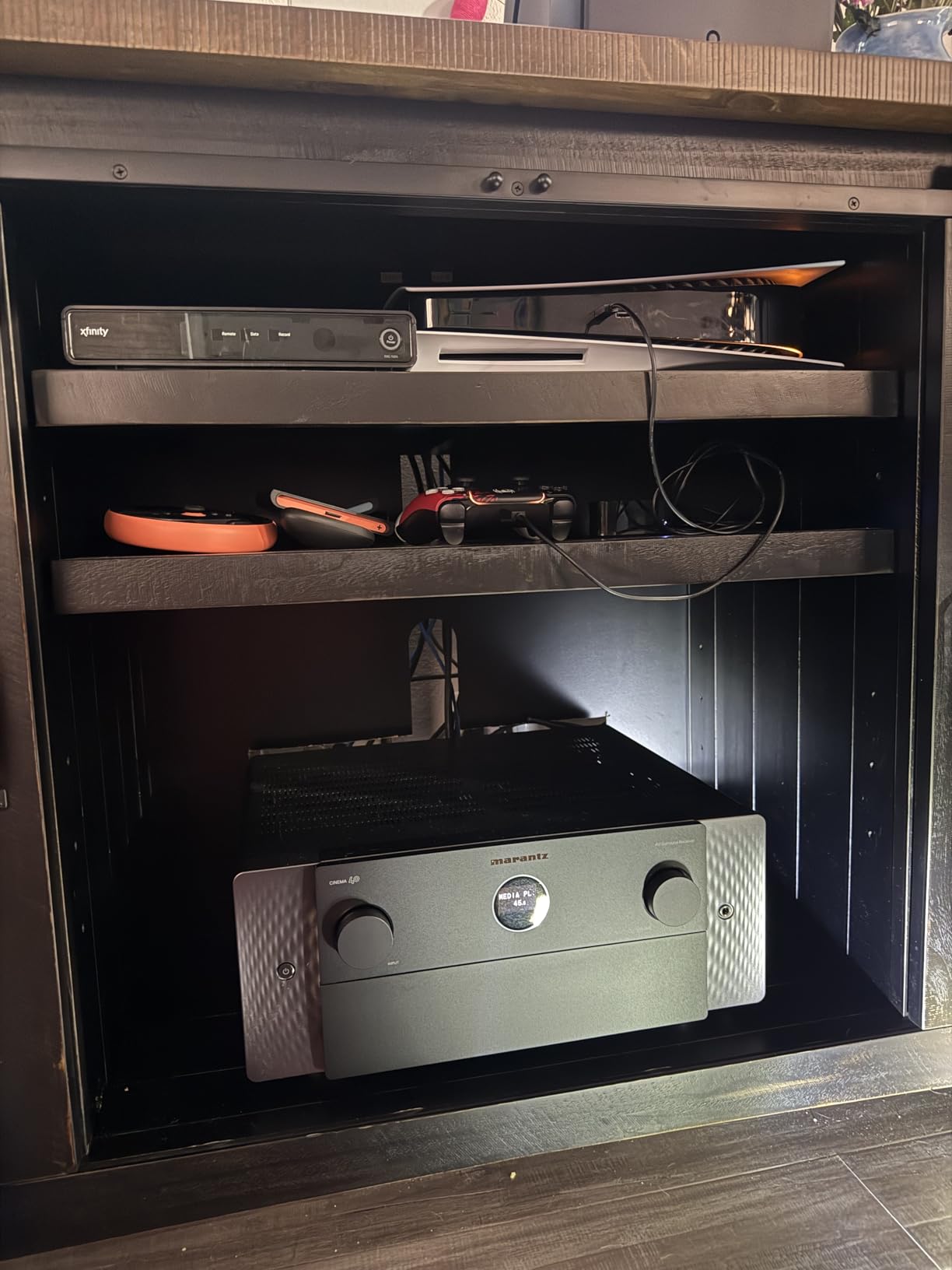
HDMI connectivity is the headline feature. The Cinema 40 is the only Marantz receiver with seven HDMI inputs and three HDMI outputs, all rated for 8K/60Hz and 4K/120Hz. For a rack system with a projector, a TV, and multiple source components, that extra output is genuinely useful. Four subwoofer outputs let you run a multi-sub layout with independent calibration, which is rare at this price tier.
Who should buy the Marantz Cinema 40
Dedicated home theater builders who want 125W per channel, the most HDMI ports, four subwoofer outputs, and DTS:X Pro decoding. It is the right pick for a custom media room where every spec matters.
Who should skip the Marantz Cinema 40
Anyone who does not need 9 channels or the extra HDMI outputs, anyone building a living-room install, or anyone who wants better value. The Cinema 50 covers most buyers’ needs at a meaningfully lower cost.
What Is a Marantz AV Receiver (And Why Buy One)?
A Marantz AV receiver is the central hub of a home theater or two-channel music system. It takes HDMI signals from sources like a Blu-ray player, game console, or streaming box, decodes the embedded audio – including Dolby Atmos and DTS:X immersive mixes – amplifies each channel with Marantz’s HDAM (Hyper Dynamic Amplifier Modules) discrete circuitry, and routes the audio to the correct speakers. The same box also streams music over Wi-Fi, applies room correction to clean up the sound, and switches video to your TV or projector.
What separates Marantz from its sister brand Denon (both are owned by Sound United, now Masimo) is the tuning. Every Cinema and Stereo series receiver is hand-tuned by the Marantz Sound Master team in Shirakawa, Japan, with a focus on a warmer, more musical sound signature. That tuning is reinforced by HDAM discrete amplifier modules – small, individually selected circuit blocks that deliver higher slew rate and lower noise than the op-amp circuits used in many competitors.
The other signature element is the porthole OLED display on the front of every Cinema series model. It is a direct callback to the 1970s Marantz 2270 and 2230 receivers, and owners either love the retro look or wish for a full-width text display. Functionally, the porthole shows volume, source, and audio format at a glance. The HEOS multi-room streaming platform is built into every current Marantz receiver, and it covers Spotify Connect, Tidal Connect, Amazon Music HD, AirPlay 2, Bluetooth, and Roon Ready network audio.
How to Choose the Best Marantz Receiver for Your Setup
Picking from the best Marantz receivers comes down to five decisions: how many speakers you have, how much power you need, whether you need HDMI 2.1 for 4K/120Hz gaming, which room correction system you prefer, and how much you care about music streaming. Here is how to think through each one.
How many channels do you need?
Channels determine the maximum speaker layout your receiver can power without an external amplifier. A 5.2 receiver like the NR1510 covers a basic 5.1 or 5.2 surround layout with no height speakers. A 7.2 receiver like the Cinema 60 or Cinema 70s can run a 5.1.2 Dolby Atmos layout or a 7.1 traditional surround layout. A 9.4 receiver like the Cinema 50 or Cinema 40 can run a 5.1.4, 7.1.4, or even 5.1.6 Atmos layout without an external amp. If you are starting fresh, 7.2 is the practical sweet spot for most living rooms; if you have a dedicated media room, 9.4 is worth the jump.
How much power do you need?
Watts per channel matter most for large or open-plan rooms, for inefficient speakers (below 88 dB sensitivity), and for listeners who like reference-volume movie playback. The NR1510 and Cinema 70s at 50W per channel are plenty for small to medium rooms. The Cinema 60 at 100W per channel is the safe all-around choice. The Cinema 50 (110W) and Cinema 40 (125W) deliver real flagship headroom for demanding rooms and speakers.
Do you need HDMI 2.1 for gaming?
If you own a PS5 or Xbox Series X and play at 4K/120Hz, you need HDMI 2.1 with 4K/120Hz passthrough, ALLM (Auto Low Latency Mode), and VRR (Variable Refresh Rate). Every Cinema series receiver supports these features on at least three HDMI inputs. The Cinema 70s, Cinema 60, Cinema 50, and Cinema 40 all pass 4K/120Hz, with the Cinema 40 offering the most HDMI 2.1 ports.
Audyssey MultEQ XT32 vs Dirac Live: which room correction?
Room correction is what makes a good AVR sound great in your specific room. Marantz uses Audyssey MultEQ XT32 on the Cinema 50 and Cinema 40, and Audyssey MultEQ XT on the Cinema 60. The Cinema 50 and Cinema 40 can also be upgraded with Dirac Live, which is sold separately. Audyssey MultEQ XT32 is widely considered the best built-in room correction available and is excellent at subwoofer integration. Dirac Live offers more granular manual tuning and is preferred by some enthusiasts. For most buyers, MultEQ XT32 out of the box is more than enough.
Do you need a phono input for vinyl?
Every current Marantz receiver except the Cinema 40 includes a built-in phono input (MM moving magnet). The Cinema 40 also includes one, along with four subwoofer outputs. If you already own a turntable with a built-in phono preamp, you can skip the phono input; if not, every model in this guide handles a turntable directly.
Marantz vs Denon: Sister Brands Compared
Marantz and Denon are owned by the same parent company, share many of the same engineering teams, and use the same HEOS streaming platform. The differences come down to tuning, design, and price. Marantz receivers are hand-tuned by the Sound Master team for a warmer, more musical sound signature with a focus on midrange richness and three-dimensional imaging. Denon receivers tend to sound more neutral and analytical.
Marantz models carry the iconic porthole OLED display and curved aluminum front panels on Cinema and Stereo series models, while Denon equivalents use a more conventional full-width display. For the same channel count and power, a Marantz typically costs a few hundred dollars more than the equivalent Denon. Buyers on r/hometheater consistently describe Marantz as the more “musical” choice and Denon as the more “feature-dense” choice. If sound quality is the priority and you value the design heritage, Marantz is the right pick; if raw features-per-dollar matter most, Denon is worth comparing.
Series 2 vs Original Cinema: What’s New
Marantz released Cinema Series 2 (S2) refresh models of the Cinema 50, Cinema 60, and Cinema 70s in 2025-2026. The S2 updates bring upgraded DAC chips, refined HDMI boards with better 8K/60Hz performance, expanded HEOS streaming reliability, and pre-installed Dirac Live readiness on Cinema 50 S2 units. Physically, the S2 models look identical to the original Series units; the improvements are inside. Buyers choosing between a discounted original Series and an S2 unit should weigh the internal refinements against any price savings on the older stock.
Frequently Asked Questions
Which Marantz receiver is best for home theater?
The Marantz Cinema 50 is the best Marantz receiver for home theater in most rooms. It delivers 9.4 channels at 110W per channel with Dolby Atmos, DTS:X, IMAX Enhanced, and Auro-3D decoding, plus Audyssey MultEQ XT32 room calibration and an optional Dirac Live upgrade. For smaller rooms, the Marantz Cinema 60 is a strong value pick with 7.2 channels at 100W per channel.
Is Marantz better than Denon for AV receivers?
Marantz and Denon are sister brands owned by the same company, but they target slightly different buyers. Marantz receivers are hand-tuned by the Marantz Sound Master for a warmer, more musical sound signature, and they carry the iconic porthole OLED display design. Denon receivers tend to be more neutral and analytical, and typically cost a bit less for the same channel count. If sound quality and design heritage matter most, Marantz is the better choice; if raw features-per-dollar matter most, Denon is worth comparing.
What is the newest Marantz receiver?
The newest Marantz receivers in the current lineup are the Cinema Series 2 (S2) refresh models released in 2025-2026, including the Cinema 50 S2, Cinema 60 S2, and Cinema 70s S2. The S2 updates bring upgraded DAC chips, refined HDMI boards, and pre-installed Dirac Live readiness on Cinema 50 S2 units. Marantz also continues to ship the flagship Cinema 40, the Stereo 70s slimline stereo receiver, and the slimline NR1510.
Are Marantz receivers worth the money?
Marantz receivers cost a bit more than equivalent Denon models, but they deliver the Marantz Sound Master’s hand tuning, HDAM discrete amplifier modules, the iconic porthole OLED design, and a five-year warranty on Cinema and Stereo series models. For buyers who value musical sound, premium build quality, and long-term reliability, Marantz receivers consistently earn strong reviews and owner satisfaction.
Which Marantz receiver has the most HDMI ports?
The Marantz Cinema 40 has the most HDMI ports in the current lineup with 10 total – 7 inputs and 3 outputs, all rated for 8K/60Hz and 4K/120Hz passthrough. The Marantz Cinema 50 and Cinema 60 each have 6 HDMI inputs with 8K support. The slimline Cinema 70s has 6 HDMI inputs with 3 rated for 8K.
Which Marantz receiver is best for music?
The Marantz Stereo 70s is the best Marantz receiver for music if you do not need surround sound. It uses a fully discrete Class A/B amplifier hand-tuned by the Marantz Sound Master, and it includes a built-in phono input for turntables. If you want surround sound and music in one box, the Marantz Cinema 50 is the best music-and-movies pick thanks to its HDAM discrete amplifier modules and Audyssey MultEQ XT32.
Final Verdict: Which Marantz Receiver Should You Buy?
If you want one recommendation, buy the Marantz Cinema 50. It is the best Marantz receiver overall thanks to 9.4 channels of 110W amplification, Audyssey MultEQ XT32 with optional Dirac Live, and the most complete format support in the lineup. For a smaller room, choose the Marantz Cinema 60 – it delivers 90 percent of the Cinema 50’s experience at a meaningfully lower price. For tight spaces, the Marantz Cinema 70s is the best slimline pick, and for music-only setups, the Marantz Stereo 70s is the right call.
Whichever model you choose, you get Marantz’s signature warm tuning, the iconic porthole OLED design, HEOS multi-room streaming, and a five-year warranty on Cinema and Stereo series models. Last updated: September 2026.