
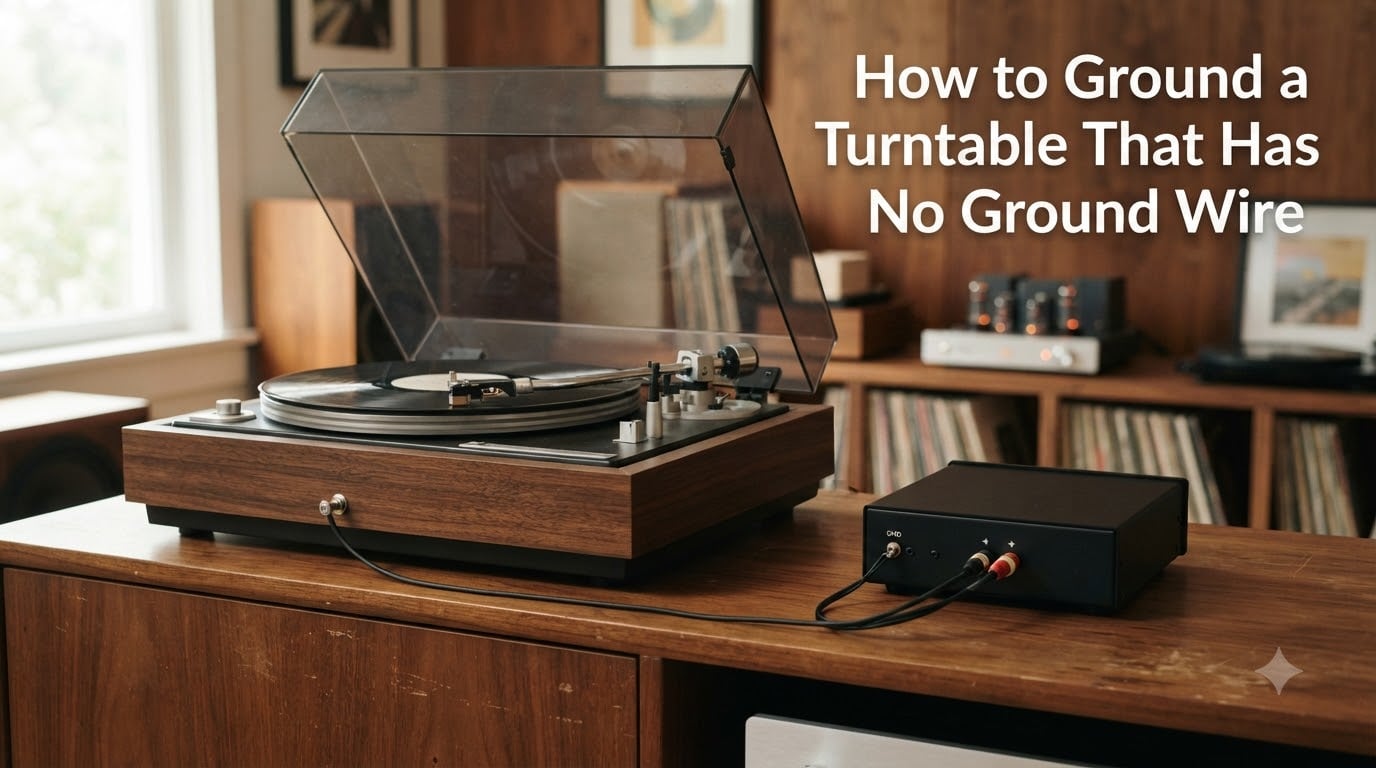
If your turntable has no ground wire and your speakers are humming, you are in the right place. Learning how to ground a turntable that has no ground wire is one of the most common fixes new vinyl owners face. The good news is that even if your turntable lacks a dedicated ground post, you can almost always solve the hum with a few dollars of wire and a screwdriver.
Many older record players and budget models skip the ground terminal entirely. Some modern turntables have built-in grounding through the RCA cables, while others genuinely need a separate ground path to your amplifier or phono preamp. This guide walks through every option, from the chassis screw method to DIY ground wires and ground loop isolators.
I have set up a lot of turntables over the years, including several that had no obvious ground connection. The methods below come from vinyl forums, community-verified fixes, and direct experience with turntables that hum when they should not.
Table of Contents
What Is Turntable Grounding and Why Does It Matter
Turntable grounding is the connection between your turntable’s metal chassis and your amplifier’s ground reference. It gives stray electrical current a safe path away from the delicate phono signal path. Without it, that current leaks into the audio signal and shows up as a constant low hum or buzz.
The phono cartridge produces a signal that is much weaker than a line-level signal. Even tiny amounts of electrical interference become audible when amplified. That is why grounding matters more for turntables than for CD players, streamers, or any other source in your system.
If you hear a steady 60 Hz hum (50 Hz in regions with that mains frequency) that gets louder when you turn up the volume, you almost certainly have a grounding problem. A proper ground connection removes the hum at the source rather than masking it.
Understanding Ground Loops in Turntable Setups
A ground loop happens when two or more devices in your audio chain connect to ground through more than one path. The slight difference in electrical potential between those paths causes a small current to flow along the shield of your audio cables. That current becomes the hum you hear.
Turntables are especially prone to ground loops because the tonearm, motor, and chassis can all sit at slightly different ground potentials. When the turntable, phono preamp, and amplifier each have their own ground reference, current can loop through the RCA cable shields instead of flowing cleanly to ground.
This is also why adding a ground wire sometimes makes hum worse before it gets better. If you create a second ground path without removing the first, you extend the loop rather than breaking it. The fix is a single clean ground path from turntable to amplifier.
How to Ground a Turntable That Has No Ground Wire: Step-by-Step
This is the core question, so here is the direct answer. To ground a turntable that has no ground wire, find a metal screw on the chassis that touches bare metal, attach a length of insulated wire to it, and run the other end to the ground terminal on your amplifier or phono preamp. If your amplifier has no ground terminal either, you can connect to any grounded metal point on the amp chassis.
Follow these steps in order. The whole process takes about 15 minutes once you have the wire ready.
Step 1: Power everything off. Unplug your turntable, amplifier, and any other gear in the chain. You will be working near metal parts, so this is non-negotiable for safety.
Step 2: Find a chassis ground point on the turntable. Look for any screw that threads directly into metal rather than plastic. The screw holding the tonearm base, the motor mounting screw, or a transformer cover screw all work well. The key is that the screw makes electrical contact with the metal chassis beneath it.
Step 3: Loosen the screw slightly. You do not need to remove it entirely. Just loosen it enough to slip a spade connector or bare wire underneath.
Step 4: Attach your DIY ground wire. Slide the bare end of a length of insulated wire (around 5 feet is usually enough) under the screw head, or crimp a spade connector onto the wire and place it under the screw. Tighten the screw firmly so the wire stays put.
Step 5: Run the other end to your amplifier. Route the wire to the ground terminal on your phono preamp or amplifier. If it has a GND terminal with a thumb nut, loosen the nut, slip the bare wire under it, and tighten.
Step 6: If your amp has no ground terminal, find any metal screw on the amp chassis that contacts bare metal. Use the same spade connector method there. Do not connect to a speaker terminal, RCA shell, or anything labeled as signal ground.
Step 7: Power on and listen. Turn everything back on and play a record. The hum should be gone or dramatically reduced. If it is not, move to the troubleshooting section below.
Tip: Forum users on VinylEngine and AudioKarma confirm that any screw known to make good contact with a metal chassis works as a ground point. The motor mounting screw is a favorite because it is almost always in solid contact with the chassis.
DIY Grounding Solutions You Can Build Today
You do not need to buy a pre-made ground cable. A DIY ground wire for a turntable without a terminal works just as well and costs almost nothing if you have basic supplies on hand.
The simplest option is a single length of insulated stranded wire with spade connectors crimped on both ends. Stranded wire is more flexible than solid core and holds up better to the slight movement any turntable gets.
If your turntable has no obvious chassis screw exposed, you can remove the bottom plate to access an internal motor or transformer screw. Just remember that opening the case may void a warranty on newer tables, so check first if yours is still covered.
For setups where a wire run is impractical, a ground loop isolator is a useful backup. These are small inline transformers that break the ground loop through the RCA cables instead of through a dedicated ground wire. They are not a perfect substitute for proper grounding, but they solve stubborn hum when nothing else works.
Tools and Materials You Will Need
The list is short. You probably already have most of this in a basic tool kit.
5 feet of insulated stranded wire (18 to 22 AWG works fine)
Two spade connectors sized to fit your screws
A crimping tool or pair of pliers
A small flathead or Phillips screwdriver
A wire stripper (or careful use of scissors)
Optional: a multimeter for continuity testing
Spade connectors are not strictly required, but they make a much more reliable connection than a bare wire jammed under a screw. They also keep the wire from fraying over time.
Troubleshooting Common Grounding Problems
If you attached a ground wire and the hum is still there, do not give up. Most grounding issues have a fix that takes another 10 minutes.
Hum persists after grounding. Check that your ground wire is actually making metal-to-metal contact. Paint and anodized coating on the chassis act as insulators. Scrape a small patch of paint away under the screw if needed.
Hum gets louder when you connect the ground wire. You probably have a ground loop. Try disconnecting any other ground path, such as a cable TV line or a second device grounded through the same outlet.
No ground terminal on your amplifier. Use any chassis screw on the amp. Many vintage amps have a screw on the back panel that works. Avoid using the RCA outer ring as a ground because it is part of the signal path.
Hum changes when you move cables. Your RCA cables may be picking up interference from nearby power cables. Separate the audio cables from any power cords running parallel to them. A few inches of separation is usually enough.
Hum only appears when the turntable motor runs. This points to motor-induced interference rather than a grounding fault. Try relocating the turntable away from the amplifier’s power transformer, since magnetic fields from transformers can leak into the cartridge.
How to Test if Your Grounding Worked
The simplest test is the unplug test, which vinyl forum users recommend constantly. With music playing at a normal level, briefly disconnect the ground wire. If the hum gets louder, your ground was doing its job. If the hum gets quieter, you have a ground loop and need to remove the extra ground path.
For a more precise check, use a multimeter set to continuity (the beep mode). Place one probe on the turntable chassis where you attached the ground wire and the other probe on the amplifier chassis. A continuous beep means your ground path is solid.
You can also test the wire itself. Disconnect both ends and measure continuity from one end to the other. If there is no beep, the wire is broken internally and needs to be replaced.
When You Might Not Need a Ground Wire at All
Not every turntable needs a separate ground wire. Some modern turntables handle grounding internally, which is why yours may have arrived without one.
Turntables with a built-in phono preamp usually ground through the RCA cable shields. The internal preamp is wired to the chassis, and the ground path runs through the audio cable to your amplifier. If your turntable has a switch labeled PHONO/LINE, you likely fall into this category.
USB turntables and portable record players almost never need external grounding because their entire signal path is self-contained. The same applies to turntables that connect to powered Bluetooth speakers.
If your system is silent with no ground wire attached, leave it alone. Adding an unnecessary ground wire can introduce a ground loop where none existed.
FAQs
How to ground if there is no ground wire?
Find a metal screw on the turntable chassis that contacts bare metal, attach an insulated wire to it, and run the other end to the ground terminal on your amplifier or phono preamp. If your amp has no ground terminal, use any chassis screw on the amp that touches bare metal.
What can I use to ground my turntable?
You can use any insulated stranded wire (18 to 22 AWG) with spade connectors on both ends. The wire connects a bare-metal chassis screw on the turntable to the ground terminal or chassis of your amplifier. A ground loop isolator is an alternative if a wire run is not practical.
Does a turntable have to be grounded?
Not always. Turntables with a built-in phono preamp, USB turntables, and portable record players typically ground through the RCA cable shields and do not need a separate ground wire. Turntables feeding an external phono preamp or amplifier usually do need grounding to avoid hum.
Can I ground my turntable to anything metal?
Only ground to metal parts that are electrically bonded to the chassis and to your amplifier’s ground reference. The motor mounting screw, tonearm base screw, and chassis screws on the amplifier all work. Never ground to a speaker terminal, RCA signal pin, or any painted surface.
Why is my turntable still humming after grounding?
The most common cause is poor metal-to-metal contact under the ground screw. Paint and anodized coatings insulate. Other causes include ground loops from a second ground path, RCA cables running too close to power cords, or motor interference from a nearby amplifier transformer.
Conclusion
Figuring out how to ground a turntable that has no ground wire is easier than it looks. The chassis screw method, validated across vinyl forums and confirmed in practice, works on almost any turntable with a metal frame. A few feet of wire and a pair of spade connectors are usually all you need.
Test your work with the unplug test, keep your audio cables away from power cords, and remember that some modern turntables simply do not need a separate ground at all. If the hum persists after trying these steps, a ground loop isolator is a reliable fallback before you consider replacing any gear.