
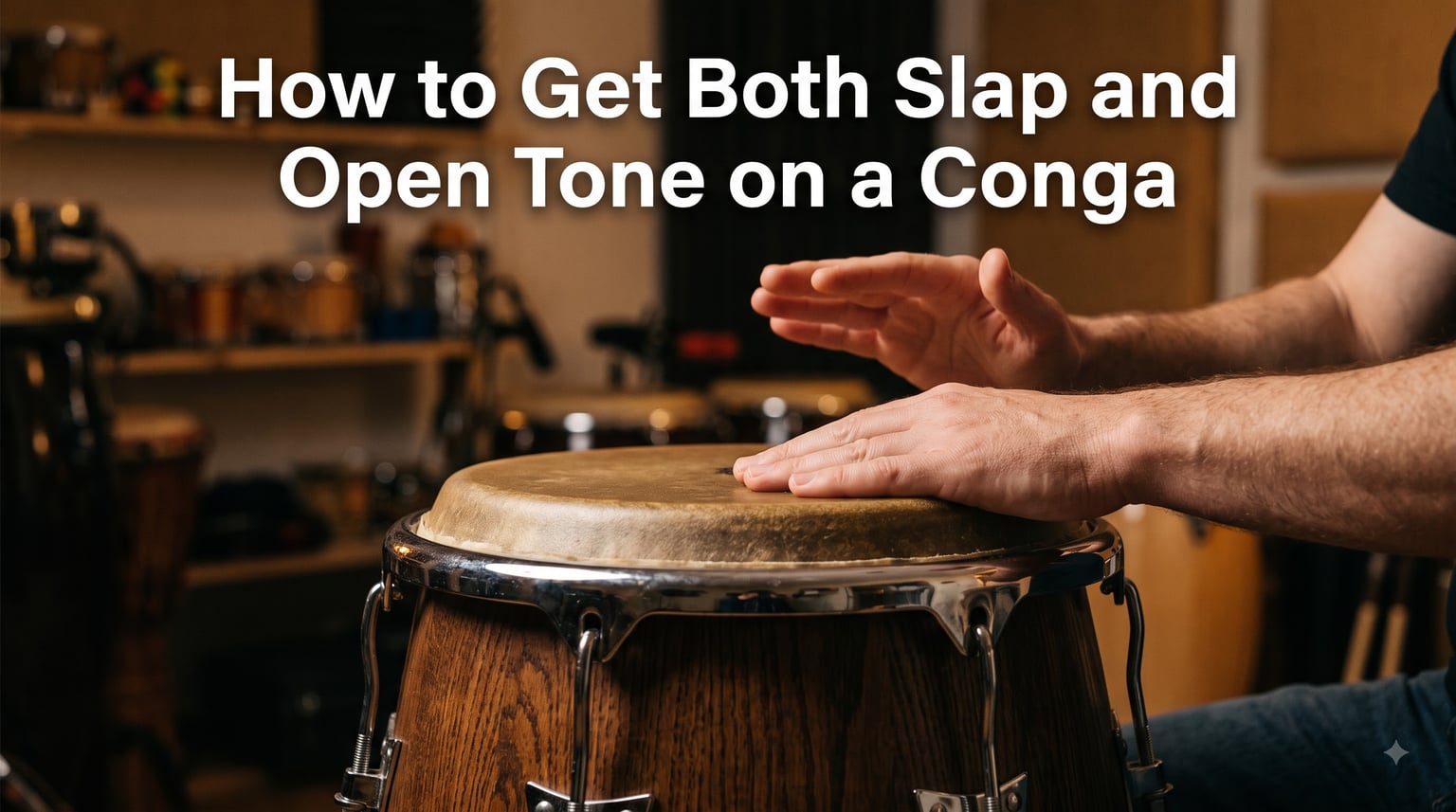
If you have ever tried to play a conga line and felt that your playing only had one sound, you are not alone. Mastering both slap and open tone on a conga is the single biggest leap most beginners make on the instrument. I have spent years teaching workshops and recording with percussionists, and I keep seeing the same pattern: students either get a clean open tone or a sharp slap, but rarely both in the same session. This guide fixes that gap.
In the next ten minutes I will walk you through hand positioning, the wrist mechanics behind each stroke, and a progressive practice routine that builds both sounds together. By the end, you will know exactly where to strike, how to shape your fingers, and how to alternate cleanly between the two tones without your hand tensing up.
Table of Contents
Hand Positioning Fundamentals for Conga Drumming
Every clean stroke starts before your hand ever touches the drumhead. Before you think about slap or open tone, sit or stand with your elbow about hip height, forearm relaxed, and your wrist neutral rather than bent up or down.
Your hand shape should feel loose, like you are holding a small ball. Keep your fingers slightly curved, never locked straight. The palm is the source of your open tone, while the fingertips are the source of your slap. Both need to be ready at the same time, which is why relaxed fingers are non-negotiable.
Sit close enough to the drum that your upper arm can hang at your side. If you reach forward, you will tense your shoulder, and that tension travels straight into your wrist. Tension is the enemy of both slap and open tone on a conga, because it makes your strokes louder but less musical.
What Is an Open Tone on a Conga
An open tone is the warm, ringing, full sound that people picture when they think of a conga. It is what you hear when a tumbao pattern rolls under salsa music. It is produced by striking the drumhead near the edge with the fleshy part of your hand where the palm meets the base of the fingers.
To play a clean open tone, keep your fingers straight and stiff, like a small paddle. Your wrist snaps from a relaxed position, and your hand lands flat on the drumhead. The fingers must stay together and the contact area must be the palm edge, not the fingertips.
Here is the rule our team repeats in every workshop: if your fingers flop forward, you will get a slap instead of an open tone. Keep them firm and you will get that round, woody ring. Where you strike matters too. Aim about two to three inches in from the rim for the warmest tone. Closer to the center and the sound goes dead, closer to the rim and it becomes thin.
What Is a Conga Slap
A conga slap is the bright, sharp, percussive crack that sits on top of an open tone in almost every Afro-Cuban pattern. Beginners chase this sound because it is dramatic, but it is also the easiest stroke to get wrong.
The slap uses a whip-like motion. Your fingers stay relaxed, your wrist snaps, and your fingertips come down onto the drumhead. The contact point is the tips of the fingers, not the palm. The palm edge may touch the drum just a fraction of a second before the fingertips, which is what creates the percussive attack.
There are two flavors of slap. An open slap leaves the fingers spread slightly after contact, giving a slightly fuller crack. A closed slap keeps the fingers together and lands more like a single pad. Both are valid, and you will use both in traditional patterns like guaguanco and rumba. Start with the open slap because it is more forgiving, then tighten the fingers as your control improves.
Slap and Open Tone Side by Side
Understanding the difference between slap and open tone on a conga becomes much easier when you see the mechanics next to each other. Here is the comparison I wish I had when I started.
- Contact point: Open tone uses the palm edge near the knuckles, slap uses the fingertips.
- Finger shape: Open tone needs stiff, straight fingers held together, slap needs relaxed, slightly curved fingers.
- Wrist motion: Open tone is a clean downward snap, slap is a whip-like flick that lets the fingers land last.
- Strike location: Open tone lives two to three inches from the rim, slap works best a little further in, around the middle third of the head.
- Sound character: Open tone is round and ringing, slap is bright, short, and percussive.
The biggest mental shift is realizing that the same hand produces both. You are not switching grips, you are switching tension levels. The slap asks your fingers to relax, the open tone asks them to firm up. Train that switch and your playing immediately sounds more musical.
Step by Step Practice Routine to Master Both Strokes
I run this routine with my own students every week, and the metronome tempos are what most forums never tell you. Slow practice is the only path to clean slap and open tone on a conga.
Step 1: Isolate the open tone. Set a metronome to 60 BPM. Play one open tone per beat, alternating hands, for two minutes. Focus only on tone quality. If the sound rings clearly, you are doing it right.
Step 2: Isolate the slap. Stay at 60 BPM. Now play one slap per beat, alternating hands, for two minutes. Aim for a clean crack with no buzz. If you hear a metallic ring, your fingers are too stiff or your contact point is wrong.
Step 3: Alternate slowly. At 60 BPM, play open tone, slap, open tone, slap, alternating hands. Repeat for three minutes. Listen to the difference in pitch and length.
Step 4: Add the bass. Introduce a heel stroke on beat one and three, with an open tone on two and a slap on four. This is the basic tumbao skeleton. Stay at 60 BPM for one full minute.
Step 5: Raise the tempo. Move to 80 BPM and play the same pattern. When you can do it cleanly, jump to 100, then 120. Most beginners hit a wall around 90 BPM because their fingers tighten. If you feel tension, drop back down.
Step 6: Play along with music. Put on a salsa track at a comfortable tempo and play the tumbao you just built. Real music forces you to keep both strokes consistent across longer phrases.
Common Mistakes and How to Fix Them
Every player I coach runs into the same handful of problems. Here is what they are and how to fix them without getting discouraged.
Metallic slap sound. This is the number one complaint on percussion forums. The fix is almost always that you are hitting with the fingernails or the flat of the fingertips. Rotate your hand so the pads of the fingers land first, not the nails. Also relax your wrist. A locked wrist produces metal, a loose wrist produces wood.
Sore hands after practice. If your hands hurt, you are doing something wrong. You are playing too hard, too long, or both. Cut your volume, not your practice time. A clean slap at low volume is harder to produce than a sloppy slap at full power.
Muffled open tone. Usually caused by striking too close to the center of the drum or by cupping your hand. Keep the hand flat and aim closer to the rim. Your palm edge should be the only part touching the head on the first impact.
Inconsistent volume between hands. Most players have a dominant hand that hits harder. Practice single-hand open tone and slap drills for five minutes each side. Slow, even, alternating practice resets the imbalance faster than full patterns do.
Frequently Asked Questions
How do I get a clean conga slap?
Relax your fingers, strike with the pads of your fingertips (not the nails), and use a whip-like wrist motion. Start at 60 BPM and alternate hands. A clean slap sounds round and woody, not metallic.
Where should I strike the conga for the best open tone?
Aim two to three inches in from the rim of the drumhead. Use the fleshy part of your palm where it meets the base of your fingers, with your fingers held straight and stiff. Hitting the center mutes the tone.
Why does my conga slap sound metallic?
A metallic slap usually means you are hitting with the fingernails, your wrist is locked, or your fingers are too stiff. Relax the fingers, rotate so the pads land first, and let the wrist whip instead of forcing the strike.
What is the difference between an open slap and a closed slap?
An open slap uses slightly spread fingers for a fuller crack. A closed slap keeps the fingers together for a tighter, more focused attack. Both are used in Afro-Cuban patterns like guaguanco and rumba.
Why do my hands hurt when I practice conga slap?
Hand pain means you are playing too hard or with too much tension. Lower your volume, slow your tempo to 60 BPM, and focus on relaxation. If pain continues, take a day off and let your hands recover.
How long does it take to get both slap and open tone on a conga?
With daily 20-minute practice sessions using a metronome, most beginners get a usable open tone within two weeks and a clean slap within four to six weeks. Consistency matters more than total hours.
Final Thoughts
Getting both slap and open tone on a conga is not about talent or special hands. It is about building two distinct muscle memories: one for stiff fingers and palm contact, one for relaxed fingers and fingertip contact. Once your body knows the difference, switching between them becomes as natural as changing gears. It is the same kind of control that separates a beginner from a working drummer.
Keep your practice slow, your metronome honest, and your hands relaxed. Spend two focused weeks on the open tone before you chase the slap. Then add the slap in alternation. Within a month, you will hear the difference in every pattern you play, and your tumbao will finally sound like the records you have been listening to.