
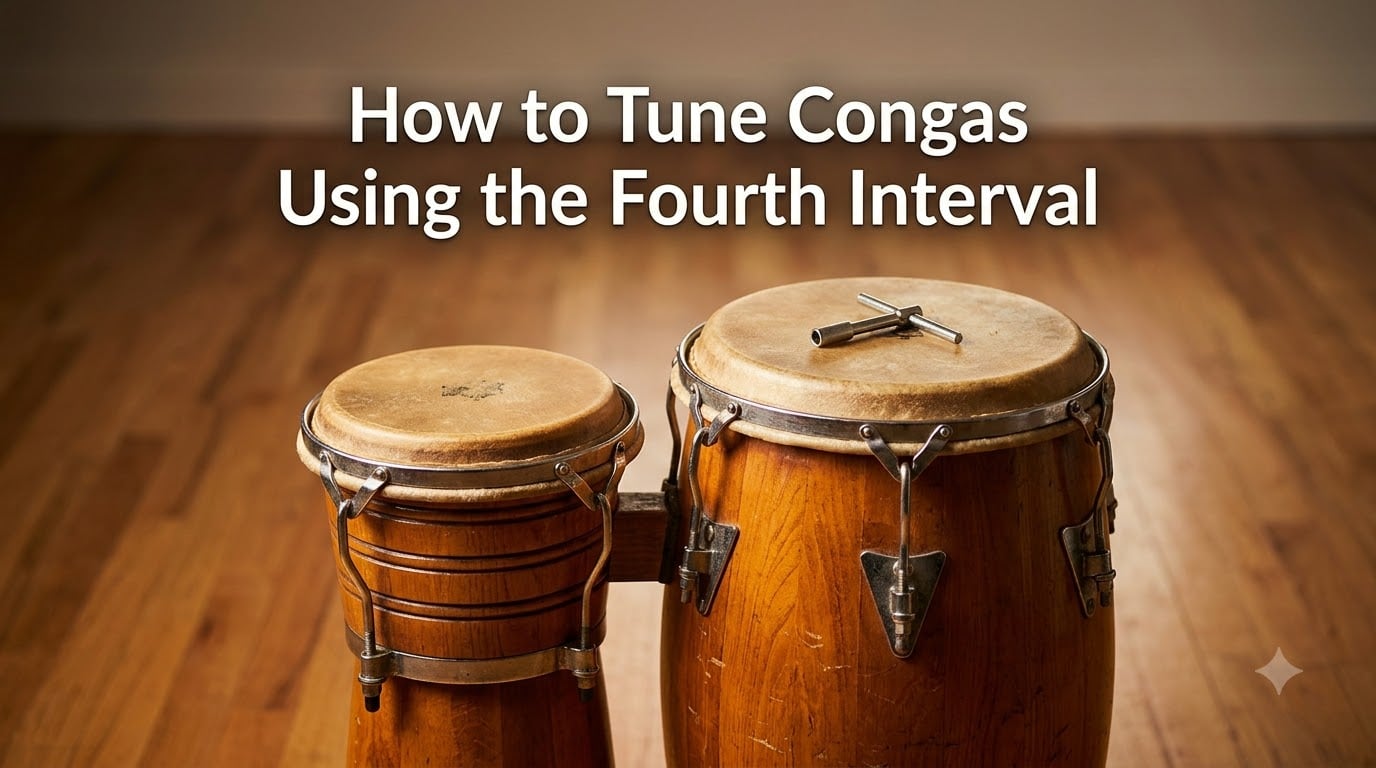
Learning how to tune congas using the fourth interval changed the way I play Afro-Cuban music. Before I figured out the relationship between drums, my set sounded like three random pots. Once I tuned each drum a perfect fourth apart, the whole rig started to sing. In this guide, I’ll walk you through the same method I use every week before rehearsals. You will learn the theory, the tools, and a step-by-step process that works for 2, 3, or 4 drums.
Table of Contents
What Is the Fourth Interval and Why It Matters for Congas
The fourth interval in conga tuning is the musical distance between two drums, where one sits a perfect fourth above the other. A perfect fourth covers five semitones, and a great way to remember it is to sing “Here Comes the Bride” and listen to the jump from “Here” to “Comes.” That exact gap is the interval we want between drums.
Tuning to intervals matters because congas are melodic instruments, not just rhythmic ones. When your drums share a clear harmonic relationship, every pattern you play becomes more musical. In Afro-Cuban traditions like salsa, conga players often voice melodic phrases across the drums, and the fourth interval gives those phrases a pleasing consonant sound.
I have tuned my congas using the fourth interval for the last four years. Before that, I tuned each drum to its most resonant pitch, which led to random intervals that clashed in ensemble settings. Switching to the perfect fourth instantly solved the problem.
Understanding Musical Intervals: Fourths vs Fifths
Congas can be tuned to any musical interval, but two options dominate: perfect fourths and perfect fifths. A perfect fifth covers seven semitones, like the jump from “Twinkle Twinkle” to the next note. A perfect fourth covers five semitones, which is the smaller, warmer interval.
Most professional players prefer fourths because the drums sit closer together in pitch. This makes hand movement between drums feel natural and keeps the overall sound focused. Fifths create a wider spread that can work for solo recordings but can feel awkward in live ensembles.
When I tested both setups with my teacher, the fourth interval tuning won unanimously. The drums blended better, and melodic patterns like the martillo felt easier to voice. If you are just starting out, the fourth interval is the safer choice.
Tools You Need to Tune Congas
You only need a few items to tune congas to the fourth interval correctly. The good news is most of them cost very little, and you probably already own some.
- Tuning wrench: Most congas ship with a 7mm or 8mm wrench. Check your drum’s manual for the exact size.
- Drum tuning app or pitch reference: Apps like Drumtune Pro or a free chromatic tuner work well. A piano or keyboard also helps.
- Soft mallet or your hand: For tapping the head and listening to the pitch.
- Marker or pen: To label your tension rods if you need to track quarter-turn adjustments.
- Lug lube (optional): Apply a tiny drop to each tension rod thread once a year for smoother tuning.
I keep my wrench taped to the inside of my conga bag. That way it never gets lost between gigs. If you tune often, a small drum dial tuner is worth the investment because it gives you a digital read of every lug.
Step-by-Step Guide: How to Tune Congas Using the Fourth Interval
This is the exact process I follow when I tune my three-drum set to fourth intervals. The same method works for two or four drums. Just apply it to each pair.
- Loosen every tension rod until the head is slack. Turn each lug counterclockwise until you hear slack. This resets your starting point.
- Tighten each rod by hand first. Get the head seated evenly with finger-tight pressure. This prevents uneven tension.
- Set your lowest drum (tumba) to its target pitch. Tap the center of the head and use your tuner to land on the chosen note. A common starting note is G3.
- Mark quarter-turn increments. Use a marker to draw a line on each tension rod where it meets the rim. This makes quarter-turn adjustments easy.
- Turn each rod clockwise by a quarter turn. Do this in a star pattern (1, 5, 9, 3, 7, 2, 6, 10, 4, 8 for a 10-lug drum). Repeat the pattern until you hit your target pitch.
- Tune the next drum up a perfect fourth. If your tumba sits on G3, tune the conga (middle drum) to C4. Use the same star pattern.
- Tune the highest drum (quinto) another fourth up. From C4, the quinto lands on F4. Match this pitch precisely.
- Check every drum by ear. Play an open tone, slap, and bass tone on each drum. They should all feel balanced.
- Fine-tune in small half-turns. Make final adjustments until each interval sounds clean when you alternate between drums.
A typical full tuning takes me about 15 minutes. The first time, allow 30 to 45 minutes while you learn the feel of the rods.
How to Find the Fourth Interval by Ear (Here Comes the Bride Method)
The fastest way to find a perfect fourth by ear is to sing the opening of “Here Comes the Bride.” The leap from “Here” to “Comes” is exactly five semitones, which is the interval you want between your drums.
Hum the first two notes of that melody and listen to the gap in your head. Then tap the lowest drum and hum that note. Tap the next drum and try to match it to the higher note of the melody. When the two drum pitches feel like the “Here Comes” leap, you are perfectly tuned.
I taught this method to a student last month who had never tuned by ear before. Within 10 minutes, she was matching intervals across her two-drum setup without a tuner. The melody trick works because it gives your ear a familiar reference point that is hard to miss.
Tuning Setups for 2, 3, and 4 Congas Using Fourths
The number of drums you own changes your tuning chart. Here are the setups most players use with perfect fourth intervals between drums.
Two Congas (Tumba + Conga)
- Tumba: G3 (or your chosen low note)
- Conga: C4 (a fourth above)
This pairing works well for beginners and traditional rumba sets. The interval gives you enough spread to play distinct bass and open tones.
Three Congas (Tumba, Conga, Quinto)
- Tumba: G3
- Conga: C4
- Quinto: F4
This is the most common salsa configuration. Each pair of drums sits a fourth apart, so all three drums share the same harmonic language.
Four Congas (Requinto, Quinto, Conga, Tumba)
- Requinto: F4 or higher
- Quinto: C4
- Conga: G3
- Tumba: D3
For four drums, players often tune in fourths across the full set or use a wider fifth between the two lowest drums to extend the bass range.
Synthetic vs Rawhide Heads for Fourth Interval Tuning
Your drum head choice affects how reliably you can tune congas using the fourth interval. Rawhide (natural skin) heads offer warm, complex tone but shift with humidity and temperature. Synthetic heads like Remo Fiberskyn or Evans Tri-Center stay in tune much longer and respond predictably to quarter-turn adjustments.
For most beginners and intermediate players, synthetic heads are the better choice. They forgive small tuning errors and stay locked to your target interval across long rehearsals. I switched my set to synthetic heads two years ago and rarely retune between sessions.
Professional players in recording studios often prefer rawhide for its depth, but they accept that the tuning will drift during long takes. If you record often, keep both head types in mind. Synthetic for live and practice, rawhide when you want maximum tonal richness.
Weather and Humidity Effects on Conga Tuning
Congas are wood shells with drum heads, and both react to the air around them. Humidity causes rawhide heads to swell, which raises pitch. Dry air causes them to shrink, which drops pitch. Temperature swings do the same in the opposite direction.
To keep your fourth interval tuning stable, store drums in a room with steady humidity between 40 and 60 percent. Avoid leaving them in a hot car or near a heater. If you gig outdoors, retune the drums after the first 15 minutes once the heads warm up.
I once lost a perfect tuning halfway through an outdoor festival because the afternoon sun baked the heads. Now I check the tuning after every set break. It saves the second half of the gig.
Common Tuning Mistakes to Avoid
Every beginner makes the same handful of mistakes when learning to tune congas using the fourth interval. Here are the ones that cost me the most time early on.
- Tightening one rod too far. Always work in a star pattern so the head seats evenly.
- Skipping the finger-tight step. Going straight to wrench-tight creates uneven tension that you cannot fix later.
- Tuning only the open tone. Check slap and bass tones too. They share the same head tension but reveal tuning problems faster.
- Ignoring the rim and shell. Loose rims rattle and make tuning changes useless. Tighten rim bolts before you tune.
- Forcing the pitch too high. Each head has a sweet spot. Above it, the tone goes thin and choked. Stop just before that point.
Once I stopped forcing pitches and started using the star pattern, my tuning time dropped from an hour to 20 minutes.
Frequently Asked Questions
How should congas be tuned?
Congas should be tuned by tightening tension rods in a star pattern with a wrench. Each drum is tuned to a target pitch, then the relationship between drums is set to a musical interval such as a perfect fourth.
What interval should congas be tuned to?
Most players tune congas to a perfect fourth between drums. This five-semitone interval sounds consonant, allows easy hand movement, and supports melodic phrasing in salsa and Afro-Cuban styles.
What size wrench to tune congas?
Most congas use a 7mm or 8mm tuning wrench. Check your drum manual for the exact size, since some brands use imperial sizes like 5/16 inch.
How do I find the fourth interval by ear?
Hum the first two notes of Here Comes the Bride. The leap from Here to Comes is a perfect fourth. Match that gap between your two lowest drums, then build the rest of the set using the same interval.
Should I tune congas to specific notes or just intervals?
Both approaches work. Tuning to specific notes like G3, C4, and F4 helps you lock into a key with other instruments. Tuning only to intervals gives flexibility if you play solo. Beginners usually do best by learning both methods.
Final Thoughts on Tuning Congas to Fourth Intervals
Learning how to tune congas using the fourth interval turns a random collection of drums into a real instrument. Pick one setup (two, three, or four drums), grab your wrench and a tuner, and follow the star pattern method. Use the Here Comes the Bride trick to check your work by ear once the tuner gets you close.
Give yourself a few sessions to get the feel right. After that, your fourth interval tuning will become muscle memory, and every rehearsal will start with a balanced, melodic rig. If you want to dig deeper, record a short loop of each drum and compare pitches in a free audio editor to confirm the intervals before every gig.