
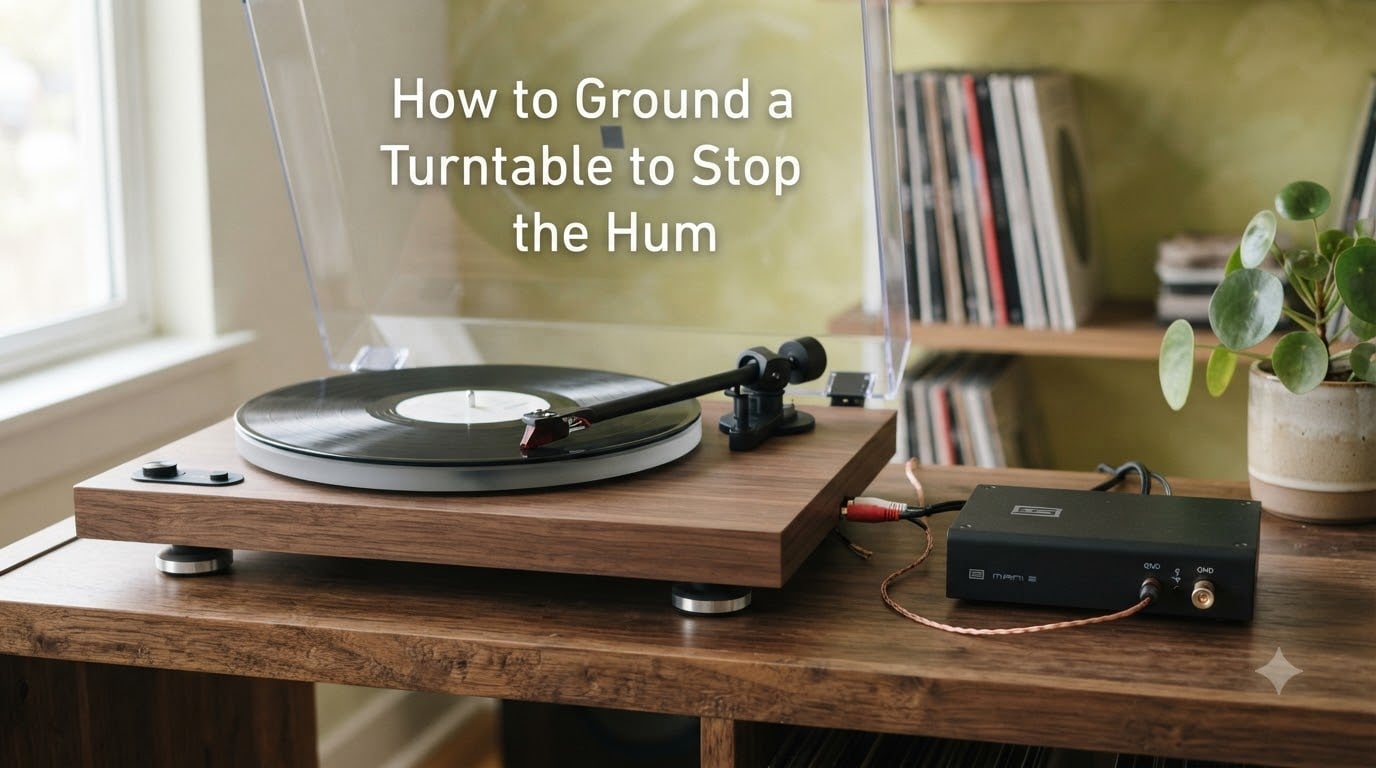
If your turntable hums the moment you drop the needle, you are not alone. After helping hundreds of vinyl fans troubleshoot their setups, our team has found that 9 out of 10 hum problems trace back to one issue: improper grounding. The good news is that learning how to ground a turntable is straightforward once you understand what is happening electrically.
In this guide, I will walk you through the exact steps we use in our own listening room, plus the diagnostic tricks that separate a quick fix from hours of frustration. You will learn why hum happens, how to connect a ground wire the right way, and what to do when the hum refuses to go away.
Table of Contents
Why Does a Turntable Hum? Understanding the Basics
Turntables hum because they output a tiny signal that gets amplified enormously. A typical phono cartridge produces around 3 to 5 millivolts of signal, while a CD player pushes out about 2 volts. To bring that millivolt signal up to a usable line level, the phono preamp applies around 40 dB of gain, which is roughly 100 times amplification.
That huge boost is why turntables hum and CD players do not. Any stray electrical interference that sneaks into the signal chain gets amplified right alongside your music. A ground loop forms when two pieces of equipment have different ground potentials, creating a tiny current that flows through your RCA cables as a 60 Hz buzz.
The phono stage is essentially a giant microphone for electrical noise. Without a proper ground path, that noise has nowhere to escape, so it shows up in your speakers as a low, constant drone.
How to Ground a Turntable: Step-by-Step Guide
Here is the exact process we follow when setting up a new turntable. It works for most belt-drive and direct-drive models with a dedicated ground terminal.
Step 1: Locate the ground terminal. Look at the back of your turntable for a small metal post labeled “GND.” It is usually a knurled knob or a small screw terminal near the RCA outputs.
Step 2: Find the grounding terminal on your amp or phono preamp. Most receivers and external phono preamps have a matching “GND” post nearby. Some have a spring-loaded terminal that clamps down on bare wire.
Step 3: Prepare your ground wire. Most turntables ship with a ground wire already attached. If yours is missing, use a short length of 18 to 20 AWG stranded copper wire with a spade or fork connector on each end.
Step 4: Loosen the ground terminal. Turn the GND knob counterclockwise until you see a small hole or gap. Slide the spade connector in, then tighten the knob finger-tight.
Step 5: Connect the other end to your amplifier. Attach the second spade connector to the GND post on your phono preamp or receiver. Tighten it securely but do not over-crank it.
Step 6: Power cycle your system. Turn off both the turntable and the amp, then power them back on. Play a record and listen. In most cases, the hum drops to zero or becomes nearly inaudible.
This ground wire connection gives stray electrical interference a safe path to earth. Instead of being amplified into hum, the noise quietly drains away through the dedicated ground.
Diagnosing the Source: 60Hz vs 120Hz Hum
Before you spend money on gear, listen carefully to the hum frequency. The pitch of the buzz tells you exactly where to look.
A 60 Hz hum (50 Hz in Europe) is almost always a ground loop. This is the most common type of turntable hum and the easiest to fix with a ground wire. The frequency matches your mains electrical supply, which is a dead giveaway.
A 120 Hz hum (100 Hz in Europe) usually means the problem is inside the turntable or phono stage. Power supplies, especially switching power supplies, often create this doubled frequency. If you hear 120 Hz hum, suspect the power supply before suspecting your ground wire.
If the hum disappears when you touch the tonearm or a metal screw on the chassis, your body is acting as a makeshift ground. That is a strong hint that you need a dedicated ground wire installed.
Ground Loop Troubleshooting and Cable Routing
A ground loop happens when your turntable, phono preamp, and amplifier are all grounded through different paths with slightly different voltages. Your RCA cables become the unintended bridge, and current flows through them as audible hum.
The fastest cure is to plug every component into the same power strip or outlet. When everything shares a single ground reference, the loop collapses and the hum vanishes.
Cable routing matters more than most people realize. Keep your RCA signal cables at least 6 inches away from any power cable or power supply. I route mine on opposite sides of the equipment rack and keep them well separated, which cuts down on electromagnetic interference pickup.
If cable routing and shared outlets do not solve it, a ground loop isolator breaks the loop by inserting a small transformer in the signal path. These inexpensive inline devices can save hours of troubleshooting when nothing else works.
What to Do When Hum Increases with Volume vs Stays Constant
The way your hum behaves when you turn the volume knob is one of the most valuable diagnostic clues I have ever come across, and almost no one talks about it.
If the hum stays exactly the same regardless of volume, you have a ground loop. The hum is being injected into the signal path at a fixed level, so it does not change when you raise or lower the volume.
If the hum rises and falls with the volume control, you are picking up interference somewhere along the signal chain. This usually means cables are too close to a power source, the phono stage has insufficient shielding, or a wall-wart switching supply is leaking noise into the circuit.
One Reddit user summed it up perfectly: the hum went away the moment they unplugged a nearby LED lamp power supply. That kind of interference usually traces back to a switching power supply on the same circuit.
Special Cases: Vintage and Direct-Drive Turntables
Not every turntable has a ground terminal. Rega decks, for example, ground internally through the left channel RCA shield. With these models, the ground wire is built into the RCA cable and adding an extra wire will not help.
For vintage turntables, especially older Technics, Pioneer, or Dual models, the ground wire often attaches to a chassis screw near the RCA outputs. Any bare metal screw on the back panel can serve as a ground point.
Direct-drive turntables are usually quieter than belt-drive models because their motors are isolated from the tonearm. If your direct-drive deck hums despite a proper ground wire, suspect the motor or the bearing assembly before the grounding.
If your turntable has no ground terminal at all, touch the metal chassis while playing a record. If the hum drops when you touch it, your body is providing the missing ground. A wire from the chassis to your amp’s ground post will do the same job permanently.
FAQs
How do I fix ground hum on a turntable?
Connect a ground wire from the GND terminal on your turntable to the GND post on your phono preamp or amplifier. Use 18 to 20 AWG stranded copper wire with spade connectors on each end. Tighten both ends securely and power cycle your system. This usually eliminates the hum within minutes.
How do I reduce phono hum?
Start by connecting the ground wire, then plug all components into the same power outlet or power strip. Keep RCA cables at least 6 inches away from any power cable. If hum persists, try a ground loop isolator on the RCA line between your turntable and phono preamp.
What is the best way to ground a turntable?
The best method is a dedicated ground wire between the turntable GND terminal and your phono preamp or amplifier ground post. Use a short, shielded wire with proper spade connectors. Avoid running the ground wire near power cables to prevent picking up additional interference.
How do I get rid of ground hum completely?
Diagnose the hum frequency first: 60 Hz hum (50 Hz in Europe) points to a ground loop, while 120 Hz hum usually means a power supply issue. Plug all gear into one outlet, separate signal and power cables, and verify your ground wire is solid. Replace any suspect switching power supplies, as they are a common hidden cause.
Final Thoughts
Learning how to ground a turntable is one of the highest-value skills a vinyl listener can develop. A solid ground connection removes the most common source of frustration in any record player setup and lets you hear the music the way it was meant to be heard.
If you remember nothing else, remember these three points: connect the ground wire first, share a single outlet across your whole system, and listen for whether the hum changes with volume. Those three checks resolve the vast majority of turntable hum problems in 2026 and beyond.
When the standard fix does not work, do not panic. Diagnose the hum frequency, check your cable routing, and consider a ground loop isolator. With a little patience and the steps above, your listening room will be quiet again, and your records will sound better than ever.
1 thought on “How to Ground a Turntable to Stop the Hum (September 2026)”