
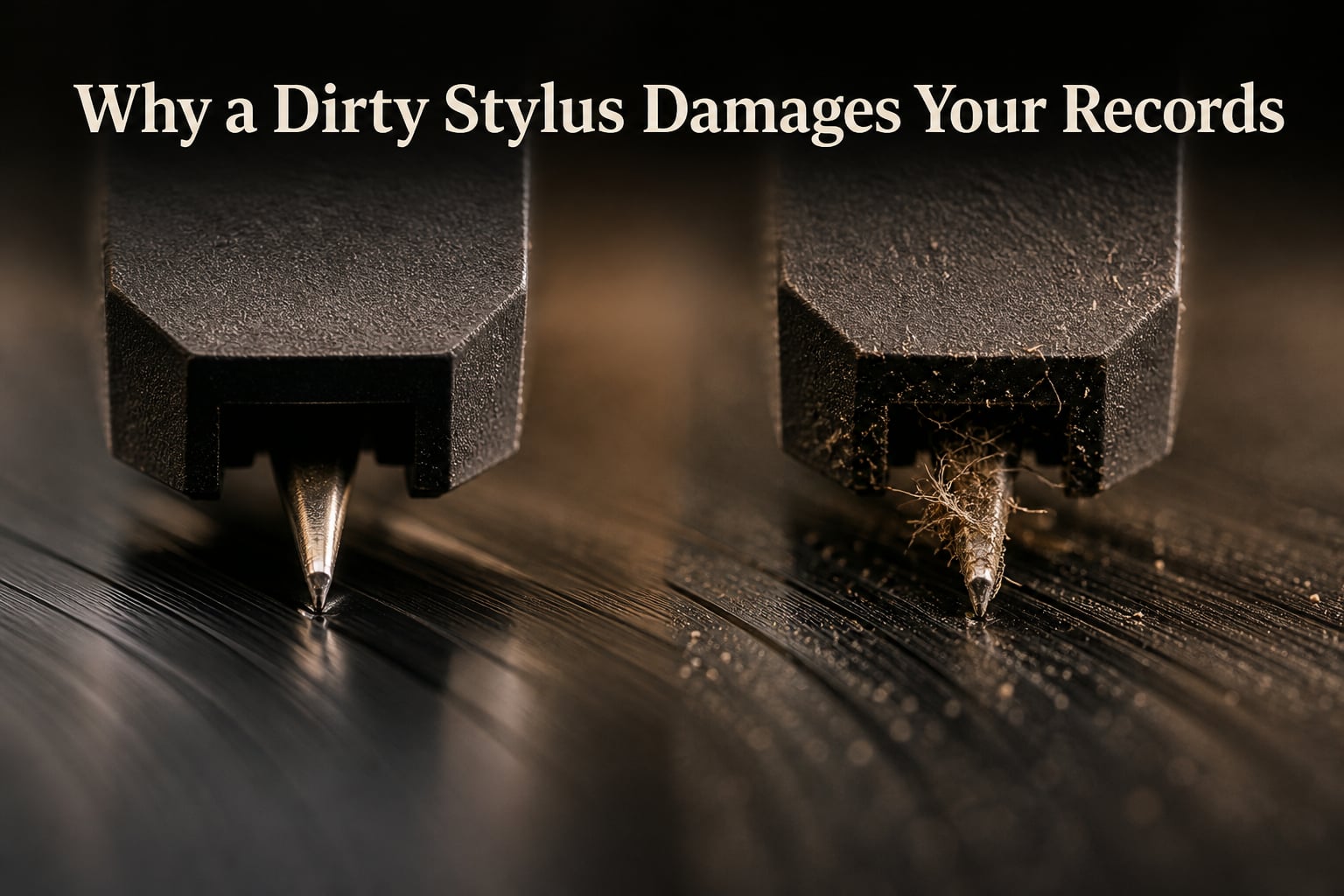
I learned this the hard way with my dad’s 1980s record collection. After a few months of playing without cleaning my stylus, I started hearing pops, crackles, and distortion that weren’t on the original recordings. Worse, I noticed my favorite records looked visibly dusty in the grooves. That’s when I dug into the science of why a dirty stylus damages your records and how fast it can happen.
Your turntable’s stylus is the only part of your entire system that physically touches your vinyl. The diamond tip rides inside the groove walls, vibrating at microscopic scales to recreate sound. When that tip carries dust, lint, or grime, it stops being a precision instrument and starts acting like sandpaper.
In this guide, I’ll walk you through the exact mechanism of damage, the warning signs I noticed in my own setup, how to clean your stylus safely, and how often you should be doing it. By the end, you’ll know how to break the feedback loop that wears down both your records and your stylus faster than necessary.
Table of Contents
How a Dirty Stylus Damages Your Records: The Mechanism Explained
Dust and debris act as abrasives when caught between the stylus and the record groove. Every time you play a record, you wear it down a little, and a dirty stylus can accelerate this process dramatically.
The mechanism is straightforward once you see it. A clean diamond tip has a precisely shaped contact point that rides smoothly along the groove walls. When even a tiny speck of dust sits on that tip, it drags along the soft PVC of the groove wall like a miniature grinding wheel.
Vinyl is softer than you might think. Groove walls are measured in micrometers, and the contact pressure at the stylus tip is high enough that any embedded particle will scratch, gouge, or shave material off the groove. Over dozens of plays, this adds up to permanent groove damage that no amount of cleaning can undo.
Here’s what actually settles on your stylus during normal use:
- Household dust settling from the air while the record spins
- Static-attracted lint pulled from record sleeves and inner sleeves
- Vinyl shavings from previous plays on worn or dusty records
- Wax and mold-release residue from the record manufacturing process
- Skin oils and fingerprints if you’ve ever touched the stylus accidentally
The thing that shocked me is how small the particles can be. We’re not talking visible chunks of dust. A particle the size of a human hair is already huge compared to the groove geometry, and it only takes one of those to start wearing down your records.
The Feedback Loop: Why the Problem Gets Worse Over Time
What nobody told me when I started collecting is that a dirty stylus creates a feedback loop of damage. It’s not a one-time problem, it gets worse the longer you ignore it.
The cycle works like this. A dirty stylus scratches grooves and shaves off tiny bits of vinyl. Those shavings mix with existing dust on the record and get redeposited in the grooves. On the next play, your stylus picks up that fresh debris, becomes even dirtier, and damages the grooves even more aggressively.
Dirty records make a dirty stylus, and a dirty stylus makes damaged records. Within a few weeks of neglect, you’re not just playing music, you’re grinding down your collection.
This is the same feedback loop vinyl enthusiasts on Reddit’s r/vinyl and r/turntables have been warning about for years. The posts asking “can a dirty stylus damage records” usually get the same answer: yes, and it gets worse the longer you wait.
Warning Signs Your Stylus Is Dirty or Damaged
Your ears will tell you most of what you need to know. Here are the symptoms I started noticing in my own setup, in roughly the order they appeared.
- New pops and crackles that weren’t on the original recording, especially in quiet passages
- Surface noise getting louder between tracks where there used to be silence
- Distortion on loud passages, particularly cymbals and vocals (sibilance on “s” sounds)
- Mistracking, where the stylus jumps or skips rather than tracking smoothly
- Loss of high-frequency detail, with recordings sounding muffled or dull compared to before
- Visible debris on the stylus tip when you inspect it under magnification or strong light
Some of these signs overlap with other problems. A bad phono cartridge alignment can cause similar distortion. Dirty records will also pop and crack. But if you’ve ruled those out and the symptoms persist after cleaning both the record and the stylus, your stylus itself is likely worn or damaged.
Distortion, fuzziness, and a lack of clarity are key clues when it comes to what a damaged stylus sounds like. The detail goes first because the highest frequencies live in the smallest, most delicate parts of the groove.
How to Clean Your Stylus Properly (Without Causing More Damage)
The goal is to remove debris without bending the cantilever or scratching the diamond tip. I’ve tried a few methods, and these are the ones that consistently work without risk.
The Stylus Brush Method (Safest for Regular Use)
A dedicated stylus brush with soft, anti-static bristles is the standard tool. Use it from back to front, in one direction only. Never scrub back and forth, because you can catch the cantilever and bend it.
- Lower the tonearm onto a clean section of record or a cleaning disc.
- Hold the brush steady on the record surface.
- Move the stylus onto the brush from the rear.
- Lift the stylus straight up.
- Repeat two or three times per cleaning session.
The Gel-Pad Method (Great for Stubborn Debris)
A cleaning gel pad picks up debris through adhesion rather than brushing. Lower the stylus onto the gel pad just as you would a record. The dust sticks to the gel as the stylus settles into it. Lift, and you’re done. This works well for gummy buildup that brushes won’t shift.
What to Avoid
I want to flag a few popular methods that can cause more damage than they prevent. Wet cleaning with isopropyl alcohol can leave residue or seep into the cartridge if you’re not careful. Magic Eraser is too abrasive for the cantilever mount and risks damaging the suspension. And never use your fingers to wipe a stylus. The oils and pressure are a bad combination.
How Often Should You Clean Your Stylus?
Most sources give vague advice like “clean it regularly.” That’s not helpful, so here’s what I actually do in 2026.
Clean your stylus before every record if you’re playing a lot, and at minimum after every record side you play. Dust accumulates fast, and even one play on a slightly dusty record is enough to load up the tip.
If you only spin a record once a week, a quick brush before each session is plenty. If you’re a daily listener like I am, build the habit of brushing between every side. It takes about 20 seconds and saves you hours of restoration work later.
The vinyl community’s general rule is that if you can see anything on the tip under direct light, it’s been too long. A clean stylus under a flashlight or magnifier looks like a clean diamond. Anything fuzzy or matte is debris that needs to come off.
When to Replace Your Stylus Instead of Cleaning It
Cleaning handles debris. It doesn’t fix a worn diamond. Stylus tips wear down over time even with perfect care, and there’s a typical lifespan you should know about.
Most manufacturers rate a stylus for around 1,000 hours of play. High-end elliptical and line-contact tips can reach 2,000 to 3,000 hours, while budget conical styli may wear out closer to 500 to 800 hours. These numbers assume proper tracking force and clean records. Heavy tracking force, dirty records, and mistracking all cut that lifespan significantly.
Signs it’s time to replace rather than clean:
- Visible flat spots or jagged edges on the tip under magnification
- Sound quality issues persist after a thorough cleaning
- Mistracking at normal tracking force on clean, undamaged records
- You’ve exceeded the rated hours for your cartridge
The biggest culprit that damages a stylus is long-term exposure to dirt and grime. Even the most well-cared-for stylus, used to exclusively play pristine records, has a shelf life. Plan on replacing the stylus periodically rather than waiting for catastrophic failure.
Prevention Tips to Keep Your Stylus and Records Clean
Cleaning is reactive. Prevention is where you save the most records and extend stylus life the longest. Here are the habits that have made the biggest difference in my setup.
- Always use inner sleeves. Paper sleeves scratch the record surface and shed fibers that end up in the grooves. Anti-static inner sleeves cost a few dollars and prevent a lot of damage.
- Store records vertically. Stacking or leaning records warps them over time and increases dust contact.
- Use the cueing lever. Dropping the tonearm by hand scratches the record surface and jolts the stylus. The cueing lever lowers it gently every time.
- Clean your records before each play. A carbon-fiber record brush takes 10 seconds and removes most surface dust before it reaches your stylus.
- Keep your turntable covered. Dust settles on a stationary stylus and is harder to remove than fresh dust.
Forum users on Vinyl Engine and Audiogon tend to agree on one piece of advice: it’s the dirt, not the scratches, that ruins your stylus first. Even old records can play safely if they’re clean. Focus your energy on cleaning and the rest of the system stays healthier longer.
Frequently Asked Questions
Can a dirty stylus damage records?
Yes. Dust and debris act as abrasives between the stylus tip and the vinyl groove, wearing down the soft groove walls with every play. Once a groove is damaged, the change is permanent and cannot be reversed.
How long does a stylus last on a record player?
Most styli are rated for around 1,000 hours of play. Line-contact and high-end elliptical tips can reach 2,000 to 3,000 hours, while budget conical tips may wear out closer to 500 to 800 hours. Dirty records and improper tracking force shorten that lifespan significantly.
How do I clean a dirty record stylus?
Use a dedicated stylus brush from back to front in a single direction, or a gel cleaning pad that lifts debris through adhesion. Avoid wet cleaning, household cleaners, and your fingers, all of which can damage the cantilever or leave residue.
What destroys vinyl records the most?
The biggest destroyers of vinyl records are abrasive dirt on the stylus, dirty playback conditions, repeated play with a worn stylus, and improper storage that warps or scratches the disc. A clean stylus on a clean record will preserve vinyl far longer than a perfect stylus on a dirty one.
How do I know when my stylus is worn out?
Inspect the diamond tip under magnification. A worn stylus shows flat spots, jagged edges, or an asymmetrical shape. Sound-wise, you’ll notice persistent distortion, sibilance, loss of high-frequency detail, and mistracking even on clean, undamaged records.
Final Thoughts
A dirty stylus damages records because it turns your precision playback tool into an abrasive. Every play with a contaminated tip grinds the groove walls a little more, and the resulting debris feeds back into the system to cause even more damage.
The fix isn’t complicated. Brush the stylus before every play, clean your records before they hit the platter, store everything properly with anti-static inner sleeves, and replace the stylus when it reaches the end of its rated life. These four habits will dramatically extend the life of both your records and your cartridge.
Whether you’re spinning a 40-year-old record from your father’s collection or a fresh pressing, the same rule applies: clean stylus, clean record, careful handling. Your vinyl will reward you with decades of listening, and your stylus will last far closer to its rated lifespan than it would otherwise.