
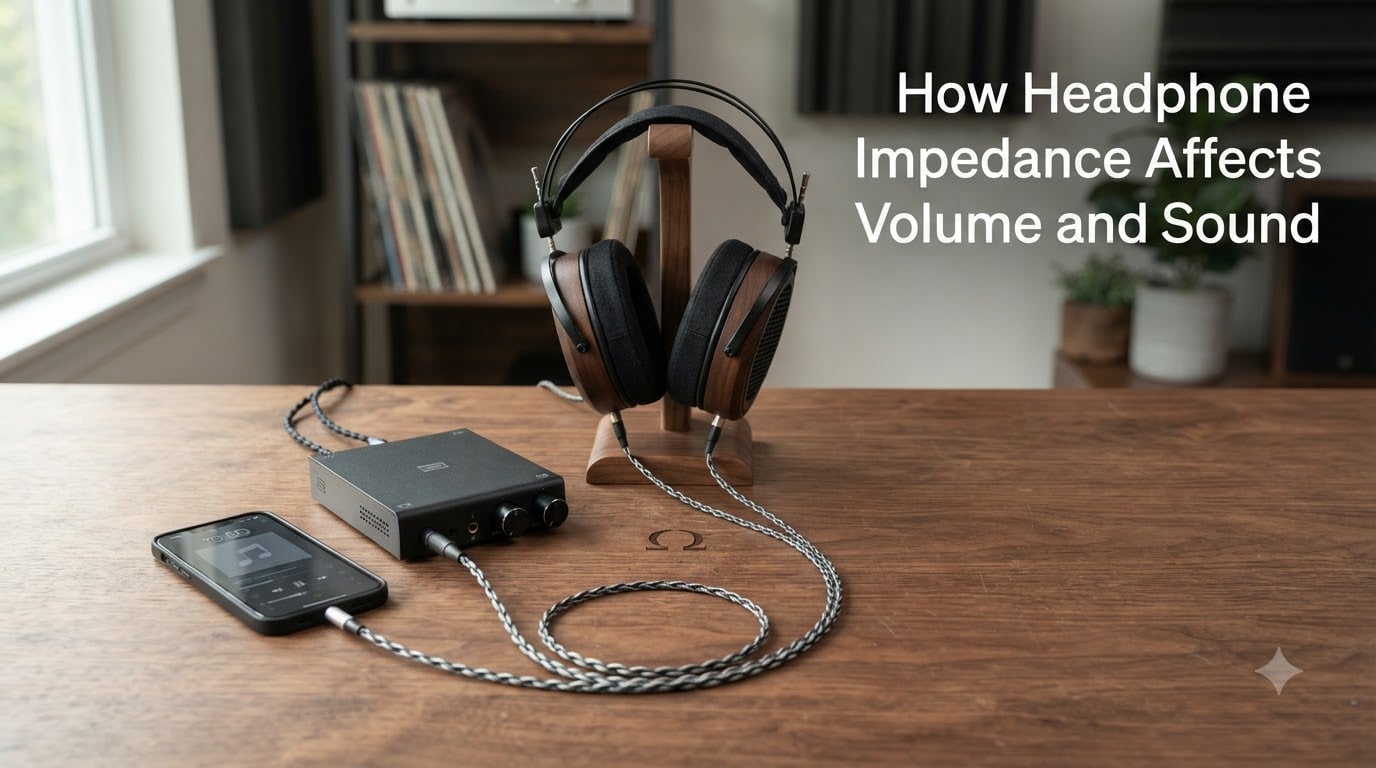
Have you ever plugged a pair of headphones into your phone and wondered why the volume barely reaches a comfortable level? Or maybe you bought premium headphones only to find they sound thin and quiet from your laptop. The culprit is almost always headphone impedance, and it is one of the most misunderstood specs in all of audio.
Headphone impedance determines how much electrical resistance your headphones put up against the signal coming from your device. That resistance directly controls how loud your headphones get, how much power they need, and which devices can actually drive them properly. Get the match wrong and you are stuck with quiet, lifeless sound. Get it right and everything opens up.
In this guide, I will break down exactly how headphone impedance affects volume and sound, what the ohm ratings actually mean, and which impedance range works best with the gear you already own. No electrical engineering degree required.
Table of Contents
What Is Headphone Impedance?
Headphone impedance is the electrical resistance your headphones present to whatever device is powering them, measured in ohms. Think of it as a gate that controls how easily electrical current flows from your phone, laptop, or amplifier into the headphone drivers. The higher the impedance, the harder the source has to work to push current through.
Every headphone has a voice coil inside its driver, and that coil is made of thin wire wrapped around a magnet. The thickness of that wire, the number of turns, and the magnetic design all determine the impedance value. A 32-ohm headphone uses a different coil design than a 250-ohm headphone, even if the drivers look identical from the outside.
The number you see on a spec sheet is called nominal impedance, which is a representative average. Real impedance actually fluctuates across the frequency range. A headphone rated at 80 ohms might dip to 50 ohms at certain bass frequencies and rise to 120 ohms in the treble. This variation matters more than most people realize, and I will explain why when we cover output impedance later.
For practical purposes, you can think of impedance in three broad categories. Low impedance runs from 16 to about 32 ohms and is designed for portable devices. Medium impedance sits in the 32 to 80 ohm range and works with some portable gear but benefits from better sources. High impedance starts at around 100 ohms and extends up to 600 ohms or more, requiring dedicated amplification.
How Headphone Impedance Affects Volume
Here is the core relationship: higher headphone impedance means your device needs to deliver more voltage to reach the same volume. A phone jack simply cannot generate enough voltage to push high-impedance headphones to satisfying listening levels. That is why 250-ohm Beyerdynamic DT 990s sound barely audible when you plug them straight into an iPhone.
It comes down to basic electrical physics. Volume is determined by power, and power equals voltage multiplied by current. A smartphone headphone jack outputs maybe 1 volt at best. Into a 16-ohm headphone, that produces plenty of power and a loud signal. Into a 250-ohm headphone, the same voltage produces a fraction of the power, and you get quiet, underwhelming sound.
This is the single most common frustration I see in audio forums. Someone buys a pair of 250-ohm headphones, plugs them into their PC or laptop, and immediately assumes the headphones are defective. They are not. The source simply cannot supply the voltage those headphones need. Add a headphone amplifier into the chain and the same pair suddenly comes alive with volume and dynamics.
The reverse problem exists too. Very low-impedance headphones (below 16 ohms) can demand too much current from weak sources, causing distortion, hiss, or even damaging the output stage of some equipment. This is less common but worth knowing if you are pairing sensitive in-ear monitors with a powerful desktop amplifier.
There is one more wrinkle: impedance alone does not predict volume. Two headphones with the exact same impedance rating can produce very different loudness levels because of sensitivity, which measures how efficiently a headphone converts electrical power into sound. I will cover that distinction in detail shortly.
Low vs High Impedance Headphones: The Key Differences
The difference between low and high impedance headphones goes well beyond volume. It affects sound character, build quality, amplifier pairing, and even the overall listening experience in ways most guides skip entirely.
Low-impedance headphones (16 to 32 ohms) are built for portability and convenience. They are designed to reach high volume levels from the weak outputs of smartphones, tablets, and laptops. The trade-off is that they are more sensitive to the quality of the source. A noisy phone jack or a poorly shielded laptop will introduce hiss and background noise that you can actually hear through sensitive, low-impedance drivers.
High-impedance headphones (100 ohms and above) take the opposite approach. They require more voltage to reach a given volume, but that higher impedance acts as a natural filter. They are far less susceptible to noise from cheap source equipment, and they tend to reproduce bass with better control and texture because the voice coil design allows for lighter, more precisely wound wire. Many audiophiles and studio professionals prefer high-impedance headphones specifically for this tighter, more refined bass response.
Here is something almost no competitor article mentions: impedance can influence sound signature. High-impedance headphones often have a different frequency response character compared to their low-impedance siblings. The Beyerdynamic DT 880, for example, comes in both 32-ohm and 250-ohm versions, and they do not sound identical. The 250-ohm version typically has smoother treble and more controlled bass. The voice coil design that creates higher impedance also changes how the driver moves, which subtly shifts the tonal balance.
The practical takeaway: if you own a good amplifier, high-impedance headphones often reward you with a cleaner, more composed sound. If you are listening from a phone, low-impedance headphones are not a compromise. They are the correct choice.
Impedance Ranges Explained: What the Numbers Mean
Let me break down exactly what each impedance range means for real-world use, so you can look at a spec sheet and immediately know whether a pair of headphones will work with your setup.
16 to 32 ohms (low impedance): This is the sweet spot for smartphones, tablets, laptops, and gaming controllers. Most consumer headphones, earbuds, and gaming headsets live in this range. You will get plenty of volume from any portable device without needing an amplifier. Apple EarPods, most Sony consumer models, and the vast majority of Bluetooth headphone drivers sit around 16 to 32 ohms.
32 to 80 ohms (medium impedance): These headphones straddle the line. A phone can drive them to reasonable volume, but they will sound noticeably better with a stronger source like a USB DAC, a gaming PC with a decent sound card, or a portable amplifier. Many Audio-Technica models, including popular studio options, fall in this range.
80 to 250 ohms (high impedance): This is where you start needing dedicated amplification. A laptop or phone will struggle to reach comfortable volumes, and even if it does, the sound will lack dynamics and bass impact. Desktop headphone amplifiers, audio interfaces with strong headphone outputs, or dedicated DAC-amp combos are essential here.
300 ohms and above (very high impedance): The Sennheiser HD 600 and HD 650, both legendary audiophile headphones, sit at 300 ohms. These demand serious amplification. A budget portable amp will not cut it. You need a quality desktop amplifier to hear what these headphones can actually do.
So is 32 ohm impedance good for headphones? Yes, for the vast majority of listeners. It is the ideal impedance for portable use and works with virtually any consumer device. Is 40 ohms good? Absolutely. A 40-ohm headphone behaves very similarly to a 32-ohm model, and you will not notice any practical difference plugging it into a phone or laptop.
Device Compatibility: Matching Headphone Impedance to Your Gear
This is where theory meets reality. Let me walk through the most common devices and which impedance ranges work best with each one.
Smartphones and tablets: Most modern phones output between 0.5 and 1 volt from their headphone jacks, and many flagship phones no longer have a jack at all. If you are using a dongle DAC, it likely outputs around 1 to 2 volts. For these sources, stick with headphones in the 16 to 32 ohm range. Anything above 50 ohms will likely sound quiet unless your dongle DAC is particularly powerful.
Laptops and desktop PCs: Built-in computer audio outputs vary wildly in quality and power. A budget laptop might output less than 1 volt with a noisy signal, while a decent motherboard audio chip might handle headphones up to 50 or 60 ohms without trouble. If your headphones are 80 ohms or higher, you will almost certainly benefit from a USB DAC or amplifier.
Gaming controllers (PS5, Xbox, Switch): Controller headphone outputs are weak and designed for low-impedance gaming headsets, which are almost universally rated at 16 to 32 ohms. Plugging 80 or 250 ohm headphones into a controller will give you very quiet, thin audio. Forum users consistently report that low-impedance headphones resolve this immediately.
Audio interfaces and studio gear: Interfaces like the Focusrite Scarlett, Motu M2, or Universal Audio Volt have dedicated headphone amplifiers designed to handle higher impedance loads. Most can comfortably drive headphones up to 250 ohms. This is why studio professionals often use Beyerdynamic DT 770 Pro or DT 990 Pro headphones at 80 or 250 ohms with their interfaces.
Dedicated headphone amplifiers: A proper amp can drive anything from 16 ohms to 600 ohms with ease. This is where high-impedance headphones shine. If you own or plan to buy an amplifier, do not be afraid of 250 or 300 ohm headphones. They are designed for exactly this kind of source.
The most common PAA question is whether to get 80 or 250 ohm headphones. Here is my answer: if you have an audio interface, a headphone amplifier, or a strong desktop DAC, 250 ohms often gives you better bass control and a slightly more refined sound. If you are plugging into a laptop, phone, or controller without any external amplification, 80 ohms is the safer choice. It is easier to drive and far more versatile across different sources.
Output Impedance and the 1/8 Rule
There is a second impedance number that almost nobody talks about: output impedance. This is the impedance of the source device itself, the headphone jack, amplifier, or interface you are plugging into. And it matters just as much as your headphone impedance.
Every audio output has some internal resistance. A cheap laptop jack might have an output impedance of 10 or even 50 ohms. A good headphone amplifier might have an output impedance below 1 ohm. The problem arises when output impedance interacts with your headphone impedance.
Because headphone impedance fluctuates across the frequency range, a high output impedance creates a voltage divider that changes with frequency. The result is an uneven frequency response. Bass might get bloated, treble might become harsh, and the carefully tuned sound signature of your headphones gets distorted. You are no longer hearing what the manufacturer designed.
The audio engineering community has a simple guideline called the 1/8 rule. Your source’s output impedance should be no more than one-eighth of your headphone’s impedance. So for 32-ohm headphones, your output impedance should be 4 ohms or less. For 250-ohm headphones, an output impedance up to about 31 ohms is acceptable. This is why high-impedance headphones are more forgiving of source quality. Their high impedance ratio naturally satisfies the 1/8 rule with most equipment.
If you have ever noticed that your headphones sound different plugged into your phone versus your amplifier, output impedance is likely the reason. It is one of the most overlooked factors in audio quality.
Impedance vs Sensitivity: The Spec Most People Ignore
If impedance determines how much voltage your headphones need, sensitivity determines how efficiently they use that voltage. Sensitivity is measured in decibels per milliwatt (dB/mW), and it tells you how loud a headphone will get from a given amount of power.
This is why two headphones with the same impedance can have very different volume levels. A 32-ohm headphone with a sensitivity of 110 dB/mW will get extremely loud from a phone. A 32-ohm headphone with a sensitivity of 95 dB/mW might sound relatively quiet from the same phone, even though the impedance is identical.
Forum users constantly confuse these two specs. They buy a low-impedance headphone expecting loud volume, then find it quiet because the sensitivity is low. Or they avoid a high-impedance headphone, not realizing its high sensitivity means it is actually quite easy to drive. The Sennheiser HD 598 is 50 ohms with a sensitivity of 112 dB, which means it is actually easier to drive than many 32-ohm models with lower sensitivity.
When you are evaluating whether a headphone will work with your device, look at both numbers together. High impedance plus high sensitivity is manageable. Low impedance plus low sensitivity can still be demanding. And high impedance plus low sensitivity means you absolutely need a dedicated amplifier.
Common Headphone Impedance Mistakes to Avoid
After years of reading audio forums and helping people troubleshoot their setups, the same mistakes come up over and over. Here are the ones I see most frequently.
Mistake 1: Buying high-impedance headphones without an amplifier. This is the number one mistake. Someone reads that 250-ohm headphones sound better, buys them, and plugs them into a phone. The result is disappointment. If you are buying headphones above 80 ohms, budget for an amplifier too. Otherwise, stick with lower impedance options.
Mistake 2: Assuming high impedance automatically means better sound quality. This is a persistent myth. Impedance is a design choice, not a quality indicator. Some of the best-sounding headphones ever made are low impedance. Some mediocre ones are high impedance. Sound quality comes from driver design, materials, tuning, and build quality, not from the ohm rating alone.
Mistake 3: Ignoring output impedance entirely. Even experienced audio enthusiasts overlook this. You can have the best headphones in the world, but if your source has a high output impedance, you are not hearing them accurately. Check your source specifications and apply the 1/8 rule.
Mistake 4: Confusing sensitivity with impedance. As I explained above, these are separate specs that work together. A headphone that is easy to drive is one with low impedance and high sensitivity. Knowing the difference saves you from buying something that will not work with your gear.
Mistake 5: Buying based on ohms alone without considering your use case. Your ideal impedance depends entirely on what you are plugging into. There is no universally best impedance. Match the headphone to your source, not to a number you saw on a forum.
FAQs
Should I get 80 or 250 ohm headphones?
Choose 80 ohm headphones if you want versatility and plan to use them with laptops, phones, or controllers without a dedicated amplifier. Choose 250 ohm headphones if you already own an audio interface, headphone amplifier, or quality desktop DAC, as they often deliver tighter bass and a slightly more refined sound signature with proper amplification.
How does impedance affect volume?
Higher impedance headphones require more voltage from your audio source to reach the same volume as lower impedance models. A smartphone outputting about 1 volt can easily drive 16 to 32 ohm headphones to loud levels, but the same voltage into 250 ohm headphones produces far less power and therefore much quieter sound. This is why high-impedance headphones sound quiet when plugged directly into phones and laptops.
Is 32 ohm impedance good for headphones?
Yes, 32 ohms is one of the best impedance ratings for general use. It works perfectly with smartphones, tablets, laptops, and gaming controllers without requiring any external amplification. The vast majority of consumer headphones and gaming headsets are designed around 16 to 32 ohms specifically because this range is easy to drive from portable devices.
Is 40 ohms good for headphones?
Yes, 40 ohms is perfectly fine for headphones. It behaves almost identically to 32 ohm models in practice, and you will not notice any meaningful difference when plugging into a phone, laptop, or controller. Anything in the 16 to 50 ohm range works well with standard consumer audio devices.
Do high-impedance headphones sound better?
Not necessarily. High impedance is a design choice, not a guarantee of quality. Sound quality depends on driver design, materials, and tuning, not the ohm rating alone. High-impedance headphones can offer better bass control and less susceptibility to source noise, but many excellent low-impedance headphones deliver outstanding sound. Match the impedance to your source rather than chasing a higher number.
Conclusion
Understanding how headphone impedance affects volume and sound comes down to one principle: match your headphones to your source. Low-impedance headphones (16 to 32 ohms) are designed for phones, tablets, laptops, and gaming controllers. High-impedance headphones (100 ohms and above) are built for dedicated amplifiers, audio interfaces, and serious audio gear.
If you take away one thing from this guide, let it be this: impedance alone does not determine sound quality, but the wrong impedance match will absolutely ruin your listening experience. A 250-ohm headphone on a phone is not a quality problem. It is a compatibility problem. Fix the pairing, and the sound transforms.
Before you buy your next pair of headphones, check the impedance rating, check the sensitivity, and compare them against what you actually plug into every day. That 30 seconds of research will save you from the most common mistake in audio. Your ears will thank you for it.