
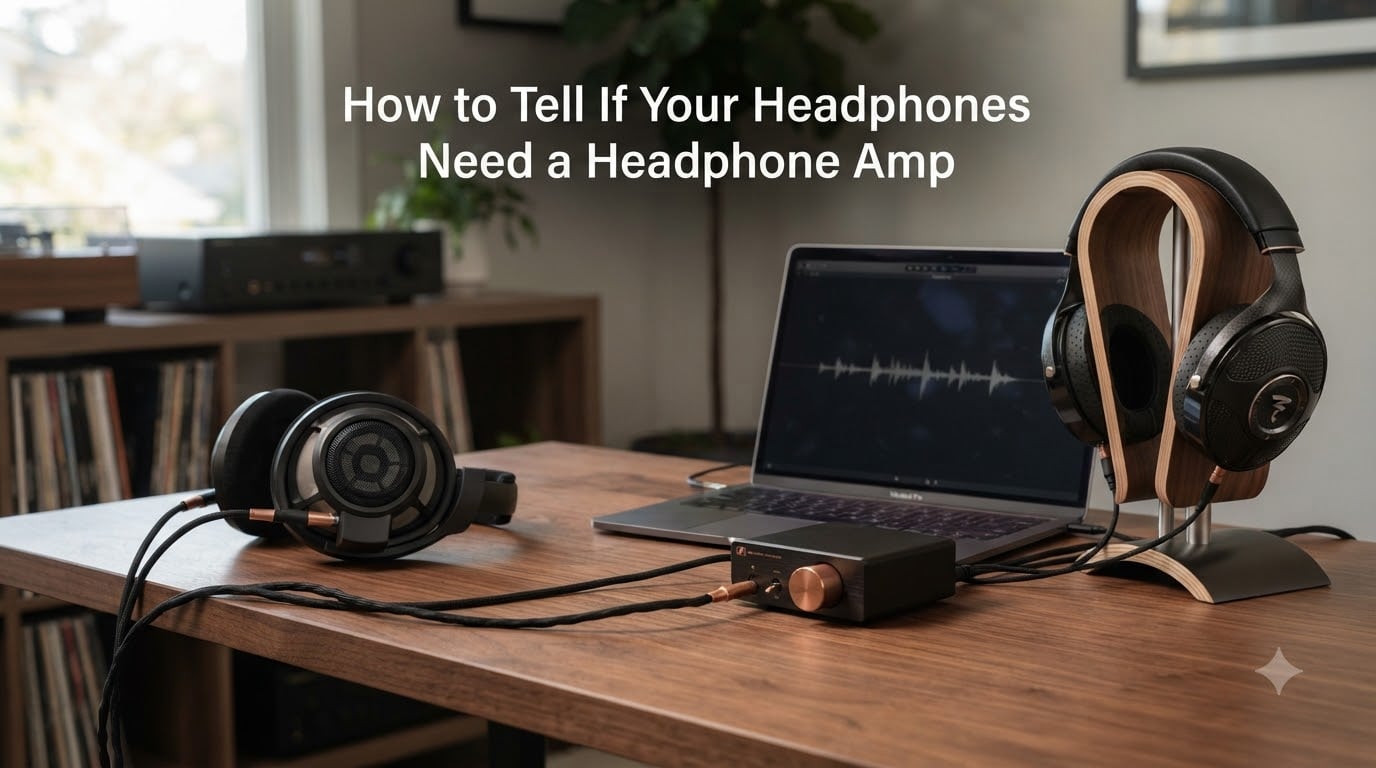
Your headphones likely need a headphone amp if they sound quiet at max volume, lose bass control, or have an impedance rating above 80 ohms. For most listeners using smartphones or laptops with easy-to-drive earbuds, an amp is optional. For audiophile headphones, planar magnetic models, or any pair rated above 250 ohms, an amp is practically mandatory.
I have spent years testing headphones across every source imaginable, from phones to studio interfaces. In this guide, I will walk you through the exact signals I look for, the numbers that matter, and the simple test you can run in under a minute at home. No jargon dumps, just clear answers.
Table of Contents
What Is a Headphone Amp and What Does It Do
A headphone amp is a small dedicated amplifier that boosts the voltage and current sent to your headphones. Your phone, laptop, and most audio gear already contain a built-in headphone amp, but those tiny internal circuits are designed for easy-to-drive earbuds, not power-hungry audiophile headphones.
When a headphone amp steps in, it does three things. It raises the voltage swing so your headphones reach louder peaks. It delivers more current so bass drivers stay controlled instead of flabby. It also improves the damping factor, which is the amplifier’s ability to stop the headphone driver from moving once the music signal stops. Better damping means tighter, more accurate bass response.
Think of it like this. Your source device is a garden hose, and your headphones are a fire hose. A headphone amp widens the pipe so the right amount of water pressure actually reaches the nozzle. Without it, you get a trickle when you wanted a stream.
Understanding Headphone Impedance and Sensitivity
Before you can decide whether you need an amp, you need to understand two numbers printed on every headphone spec sheet. The first is impedance, measured in ohms. The second is sensitivity, measured in decibels per milliwatt (dB/mW).
Impedance is the electrical resistance your headphones present to the amplifier. Low-impedance headphones (16 to 32 ohms) are easy to drive and work fine with phones. High-impedance headphones (80 ohms and above) demand more voltage to reach the same volume. Planar magnetic headphones often sit in the 30 to 100 ohm range but draw lots of current, which is why they are still considered power-hungry.
Sensitivity tells you how loud your headphones get for a given amount of power. A sensitivity of 100 dB/mW is louder than 90 dB/mW at the same input. Lower-sensitivity headphones, even with low impedance, often benefit from extra amplification.
Quick Impedance Reference Chart
Here is the simple chart I use when friends ask me this question. Bookmark this for your next headphone purchase.
16 to 32 ohms: Easy to drive. Phones, laptops, and most portable DACs handle these with no problem. An amp is optional.
32 to 80 ohms: Moderate. Most laptops work, but phones may struggle at higher volumes. A portable amp helps.
80 to 250 ohms: Difficult to drive. Studio and broadcast headphones live here. A dedicated amp is recommended.
250 ohms and above: Very difficult to drive. Beyerdynamic DT 880 Pro, Sennheiser HD 600, and similar models need a real amp to shine.
Planar magnetic (any impedance): Often power-hungry. Models like the Audeze LCD series and HiFiMan Sundara want current, not just voltage.
5 Clear Signs Your Headphones Need an Amp
If you recognize yourself in any of these five situations, it is time to consider an amp. I have hit every one of these personally while testing gear.
1. You max out the volume and still want more. If your source is at 100 percent and the sound is only comfortable, not loud, your headphones are underpowered. This is the single most common sign.
2. Bass sounds loose or sloppy. Without proper current, the driver overextends and bass loses definition. Drums sound mushy, and basslines blur together.
3. The sound gets harsh or distorted at higher volumes. The internal amp in your phone is clipping. Distortion at the top of the volume range means the source is out of clean power.
4. Your headphones are rated above 80 ohms. Manufacturers publish impedance and sensitivity for a reason. If your pair is in the upper range, plan on pairing it with an amp.
5. You hear channel imbalance at low volumes. The volume pot on your source lacks the fine control needed for sensitive headphones. An external amp with a high-quality volume control smooths this out.
How to Test If Your Headphones Need More Power
You do not need expensive gear to run this test. Grab your phone, your laptop, and your headphones, and try this 60-second check I have used on dozens of reviews.
Play a bass-heavy track with strong transients, like a song with kick drums and stand-up bass. Set your source to 75 percent volume. Listen for three things. Is the bass tight, or does it smear? Can you hear the texture of the bass strings, or just a muffled thump? Does the volume feel comfortable, or are you reaching for more?
Now switch to a quiet acoustic track with soft vocals. Can you hear the room ambiance, the breath of the singer, the subtle reverb tails? If those details vanish and you only get the main melody, your source is missing the nuance an amp recovers.
Finally, try the loudest setting you would ever actually use. If you hear any grit, harshness, or that edge-of-clipping buzz, the internal amp is out of gas. That is the clearest signal.
When NOT to Use a Headphone Amp
Adding an amp is not always an upgrade. Here is when you should skip it.
If you use Bluetooth headphones, stop here. Wireless headphones already contain their own amplifier and DAC inside the ear cup. Plugging them into an external amp before the Bluetooth radio does nothing useful. The amp lives downstream of the wireless conversion.
If your headphones are rated 16 to 32 ohms with high sensitivity (above 100 dB/mW), an external amp adds cost without audible benefit. Many popular earbuds fall in this category. Your phone is already driving them perfectly.
If you already find the volume too loud at 40 percent, your headphones are too sensitive for your source. Adding an amp just makes the problem worse. You want a high-impedance pair or a source with better volume control, not more power.
If you hear a hiss or buzz when no music is playing, your amp may be the wrong match for your headphones. A high-gain amp paired with sensitive IEMs produces noise no EQ can fix.
Portable vs Desktop Amps: Which Do You Need
The choice between portable and desktop amps comes down to where you listen and how much power you need.
Portable amps like the Qudelix 5K or iFi Go Blu run on battery and pair well with phones. They deliver clean power for most headphones up to around 300 ohms. If your plan is commuting, traveling, or driving moderate-impedance headphones, portable is the answer.
Desktop amps plug into the wall and offer more power, more inputs, and often balanced outputs. They make sense for home studios, critical listening, and high-impedance audiophile headphones. They also tend to be quieter, with better signal-to-noise ratios.
My rule for our team members. If your headphones are below 80 ohms and you listen mostly on the go, go portable. If you sit at a desk and own anything above 80 ohms, go desktop.
Common Myths About Headphone Amps
A few myths keep showing up in forums, and they are worth clearing up.
The first myth is that an amp changes the sound signature. A neutral amp does not add warmth or bass. It only delivers more clean power. If you hear a difference, you were probably underpowered before.
The second myth is that expensive amps always sound better. Past a certain price point, you are paying for build quality and features, not for sound. A 100 dollar amp that delivers clean power will drive your headphones the same way as a 1000 dollar amp that delivers clean power.
The third myth is that you need a DAC and an amp together. A DAC converts digital to analog, and an amp boosts the signal. If your source sounds clean, you may only need the amp. If your source sounds noisy or you play lossless files, a DAC helps first.
The fourth myth is that amps need burn-in. Headphones sometimes loosen up with use, but amps measure the same on day one and day 1000. Skip the superstition.
Frequently Asked Questions
Is it worth getting a headphone amp?
A headphone amp is worth it if your headphones need more power than your source can deliver. If you notice quiet volume, loose bass, or distortion at high levels, an amp will restore clarity and headroom. If your headphones are easy to drive and sound good at 50 percent volume, the upgrade is not worth the money.
Do Bluetooth headphones need an amp?
No. Bluetooth headphones have a built-in DAC and amplifier inside the ear cup. Adding an external amp upstream of the Bluetooth signal does nothing because the wireless conversion happens after the amp stage. Focus on Bluetooth codecs and battery life instead.
Can I use 250 ohm headphones without an amp?
You can plug 250 ohm headphones into a phone or laptop, but they will sound quiet and lack bass control. Most smartphones cannot deliver enough voltage to drive them properly. A dedicated amp is strongly recommended for any headphone rated 250 ohms or above.
Do 32 ohm headphones need an amp?
Most 32 ohm headphones do not need an amp. Phones, laptops, and basic audio interfaces drive them to comfortable levels easily. The exception is low-sensitivity 32 ohm planar magnetic headphones, which often benefit from extra current that a portable amp provides.
Final Verdict
Now you know how to tell if your headphones need a headphone amp in 2026. Check the impedance first, then run the bass and volume test I outlined. If your pair falls above 80 ohms or shows any of the five signs, an amp is the missing piece. If your earbuds are easy to drive and the sound is clean, save your money and enjoy the music.
3 thoughts on “How to Tell If Your Headphones Need a Headphone Amp (September 2026)”