
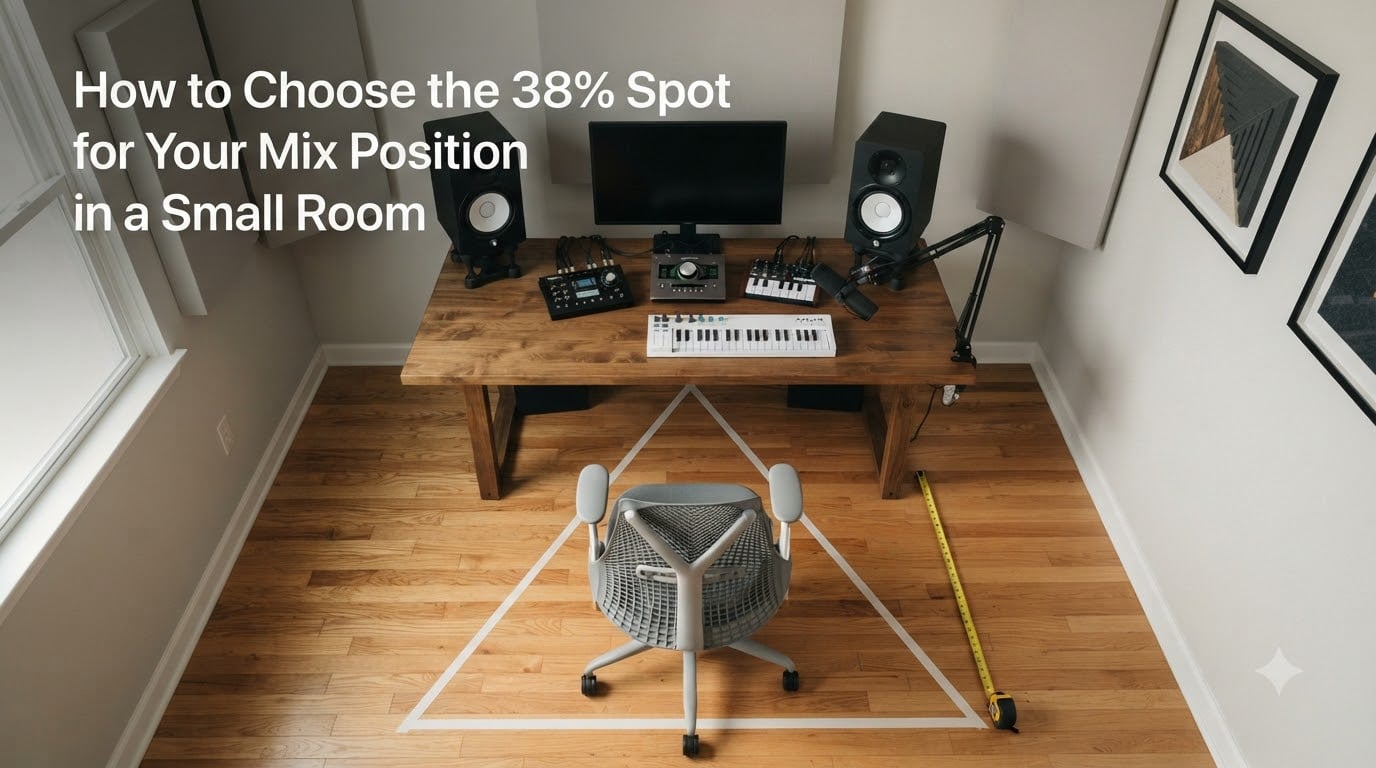
If your mixes sound great in your bedroom studio but fall apart in the car, the room is almost certainly the culprit. I learned this the hard way, after months of chasing “better” monitors and better presets when the real fix was about 4 feet away from where I was sitting. Picking the 38% spot for your mix position in a small room is the single highest-leverage change you can make before spending money on gear or treatment. In this guide, I will walk you through how to choose the 38% spot for your mix position in a small room, why it works, and how to fine-tune it when your room is not perfectly rectangular.
Table of Contents
What Is the 38% Rule and Why It Matters for Your Mix Position
The 38% rule is a starting point for placing your listening seat in a rectangular room. You measure the long wall of the room, then sit 38% of that distance away from the wall behind your speakers, centered between the side walls. That single spot tends to give you the flattest low-frequency response with the least support from room modes.
Room modes are the natural resonances of a room. They are dictated by the physical dimensions between parallel walls. When the wavelength of a bass frequency matches the room’s length, width, or height, you get a pressure peak at one wall and a pressure null at the opposite wall. Your head either sits in a loud spot or a quiet spot for that note. The 38% spot is one of the few positions where the strongest axial modes tend to cancel each other out, leaving you with a more honest window onto your mix.
Why the 38% Spot Exists in Room Acoustics
The percentage comes from decades of research into axial mode pressure distribution. The 38% point is roughly equidistant from the destructive nulls that cluster at the halfway mark and the boundary peaks at the walls. NPR, BBC, and commercial studio designers have all used similar ratios for decades. It is not a magic number, but it is a reliable place to start.
How to Calculate the 38% Spot in a Small Room
You only need a tape measure and a calculator. Here is the exact method I use in every bedroom studio I set up.
Step 1: Measure the long wall of your room in feet or meters. This is the wall your speakers will face.
Step 2: Multiply that length by 0.38. The result is the distance from the front wall (the wall behind your speakers) to the back of your head at the listening position.
Step 3: Mark that distance on the floor with tape and place your desk or chair so the back of your head sits on the mark.
Step 4: Measure from the center of the back wall to the center of your head. That distance should equal the 38% value.
Worked example for a 12 foot room: 12 ft x 0.38 = 4.56 ft, or about 4 feet 6 inches. If your room is 10 feet long, that is 10 x 0.38 = 3.8 ft, or about 3 feet 10 inches. Round to the nearest inch so you can mark it precisely.
Why the Middle of the Room Is the Worst Spot for Mixing
The exact center of the room, the 50% mark, is the worst possible listening position. Every fundamental axial mode has a pressure null right there. Your bass disappears, your low-mids get muddy, and you make EQ decisions that ruin the low end on every other system.
Standing waves are the reason. When two waves traveling in opposite directions meet in phase, they add together at one wall and cancel at the other. The 50% point is the cancellation point for the longest, loudest mode in your room. Sit there and you will think every kick drum is too loud, so you cut 80 Hz and your mix loses its chest.
I tested this in my own 11 x 13 foot room. At the 50% mark, a 40 Hz sine wave was nearly inaudible. Moving to the 38% mark, the same 40 Hz tone was 8 to 10 dB louder and noticeably tighter. That single move changed my mixes overnight.
Set Up Your Speakers in an Equilateral Triangle Around Your Head
Once your head is anchored at the 38% spot, your speakers form the other two corners of an equilateral triangle. The distance between the speakers should equal the distance from each speaker to your head, and the two speakers should be the same distance from the wall behind them.
If your head is 4.5 feet from the front wall, your speakers should also be about 4.5 feet from your head. Most small rooms end up with a triangle between 3 and 5 feet per side. Anything smaller and you lose the stereo image; anything larger and you activate more room modes than you have to.
Speaker Toe-In Angle
Toe your monitors in so they point directly at your ears. A useful starting point is to draw an imaginary line from the center of each speaker tweeter to the back of your head. If those two lines intersect about 6 inches behind your skull, your angle is close. Too little toe-in and the highs wash out; too much and the stereo image collapses to mono.
Match Tweeter Height to Ear Level and Keep Symmetry
Tweeter height controls how clearly you hear the high-frequency detail that drives mix decisions. Your earlobes should line up with the center of the tweeter, not the woofer. If your monitors sit on the desk, the desk is almost always too low. Use isolation pads or monitor stands to raise them so the tweeter is exactly at ear level when you sit upright.
Symmetry matters as much vertically as it does horizontally. If the left speaker is on the desk and the right is on a stand, the timing and level of the two channels will not match. I keep both speakers on identical stands with isolation pads underneath. The pad decouples the speaker from the stand, which cleans up the bass and reduces low-mid smear.
Adjust the 38% Rule for Non-Ideal Room Shapes
Bedroom studios are rarely perfect rectangles. Closets, sloped ceilings, bay windows, and built-in shelves all break the rule. The 38% calculation still gives you a starting point, but you will likely need to nudge the position by 5 to 10 percent to find the actual sweet spot in your specific space.
Square Rooms
Square rooms are the hardest case. When two dimensions are equal, their modes overlap, and you get severe peaks and nulls at every position. If your room is square, treat the longer of the two “long” walls as your reference for the 38% calculation, even if the difference is only a foot. That one foot is the difference between chaotic and merely tricky.
Rooms With Alcoves, Sloped Ceilings, or Furniture Limits
A bed, a closet, or a doorway can prevent you from sitting exactly at 38%. The fix is to find the closest position you can, then compensate with acoustic treatment. A bass trap in the front corners and a thick absorption panel at the first reflection point will flatten much of what you cannot fix by moving.
Fine-Tuning by 5-10% With Test Tones
After you set up at 38%, slide your chair forward and back in 6-inch increments while playing a bass test tone. The exact spot where the response sounds smoothest to your ears is your real sweet spot. Experienced engineers on audio forums consistently report that the actual best spot is anywhere from 30% to 45% of the room length, depending on the room.
Verify Your Position by Ear Using a Test Signal
You do not need a measurement microphone to confirm your position. Open a free tone generator on your phone or in your DAW and play a slow bass sweep from 30 Hz to 120 Hz. Sit at your proposed 38% spot and close your eyes. Listen for sudden volume dips and peaks as the frequency rises.
You should hear a relatively even build, with no more than one or two obvious holes. If a particular frequency nearly disappears, slide forward or back 6 inches and repeat. The position where the sweep sounds smoothest from 40 Hz to 80 Hz is your real mix position, regardless of whether it is exactly 38%.
What to Listen For
Pay attention to frequencies between 40 and 100 Hz. These are the bass notes that translate most between small rooms and big systems. If the sweep is smooth in that range, your monitors, your room, and your ears will agree on what your mix is doing.
Treat First Reflection Points After You Lock In Your Position
Once your head is set at the 38% spot, find the first reflection points on the side walls and ceiling. Sit at the listening position and have a friend slide a mirror along the wall. The points where you can see the speaker tweeter in the mirror are your first reflection points. Place a 2-inch absorption panel at each one.
The mirror method is the simplest way to find reflections without math. For the ceiling, tilt a mirror flat on the ceiling and slide it until you see one speaker. That spot gets a ceiling cloud or a thick absorption panel.
Bass traps belong in the corners, especially the front wall corners behind your speakers. A minimum 4-inch thick mineral wool panel in each front corner will tame the strongest axial mode in your room. If you have budget for only one acoustic treatment, spend it on bass traps, not foam.
Common Mistakes to Avoid When Picking the 38% Spot
Treating 38% as exact for every room. The percentage is a starting point, not a law. Real rooms vary, and your ears are the final judge.
Skipping side-wall symmetry. If your left speaker is 2 feet from the side wall and the right is 3 feet, your stereo image is permanently skewed. Measure both distances and match them to the inch.
Ignoring ceiling reflections. The ceiling is the third parallel surface in your room. A hard, untreated ceiling will smear your high-mids and confuse your imaging. A simple ceiling cloud above your head fixes it.
Placing the desk against the wall. A desk flush against the wall pushes your head past the 38% mark and activates the front-wall boundary peak. Pull the desk out a foot or two if you can.
Forgetting to mark the floor. Once you find the spot, mark it with tape so you can return to it after rearranging. I learned this after losing an hour of test tones to a chair that had silently rolled back 3 inches.
Frequently Asked Questions About the 38% Spot
What is the 38% rule for speaker placement?
The 38% rule places your listening position 38% of the room’s length away from the wall behind your speakers, centered between the side walls. It avoids the worst bass nulls at the 50% mark and the loud boundary peaks right at the wall.
What is the 83% rule for speaker placement?
The 83% rule is the mirror of the 38% rule. It places your listening position 83% of the way into the room, which is mathematically equivalent to 17% from the back wall. Some engineers prefer this because it puts the speaker further from the front wall bass peak.
What is the golden rule for speaker placement?
The golden rule combines the 38% listening position with an equilateral triangle between your head and the two speakers. Together they give you the most accurate stereo image and the flattest low-frequency response in a rectangular room.
Can you mix in a small room?
Yes. Small rooms are harder to treat, but proper listening position, near-field monitoring, and a few bass traps can produce mixes that translate well. The 38% rule was designed for exactly this kind of space.
Final Thoughts on Your Mix Position
Learning how to choose the 38% spot for your mix position in a small room is one of the few free upgrades in audio production. A $0 tape measure, a 5-minute calculation, and a willingness to move your desk will beat any $500 monitor cable. Start at the calculated 38% mark, sweep some bass tones, fine-tune by a few inches, and mark the floor. Once your listening position is right, the rest of your studio decisions fall into place. Your mixes will translate better, and you will spend less time second-guessing the low end in every session.