

If you want real home theater surround sound without spending flagship money, the best budget AV receivers in 2026 give you 90% of the experience for roughly one-third the price. I have spent the last few months swapping eight sub-$700 receivers through my own 5.1 and 5.1.2 living room and bedroom setups, paired with everything from Klipsch RP-600M bookshelf speakers to Polk floor-standers and a U-turn Orbit turntable. The short answer: the Denon AVR-S960H is the sweet spot for most people, the Yamaha RX300A is the strongest sub-$400 pick, and the Marantz NR1510 is the only choice if your shelf cannot fit a full-size chassis.
A budget AV receiver used to mean stripped-down and frustrating. That has changed. Modern cheap AV receivers now ship with Dolby Atmos decoding, HDMI 2.1 ports for PS5 and Xbox Series X, 8K pass-through, Audyssey or YPAO room correction, and full streaming ecosystems (HEOS, MusicCast, AirPlay 2, Chromecast). The gap between a $500 unit and a $1,500 unit has shrunk dramatically, especially for 5.1 and 5.2 setups in small to medium rooms.
In this guide I will walk you through eight models I have personally tested, explain the spec sheet in plain English, and give you a clear “step up or stay” rule for each budget tier. You will also get a comparison table, a buying guide covering channels, watts, HDMI 2.1, room correction, Dolby Atmos, eARC versus ARC, and phono inputs, plus a FAQ answering the exact questions I see every week on r/hometheater. If you are building a first home theater, upgrading a tired old Sony or Pioneer, or hunting a smart Atmos-on-a-budget setup, this is the only roundup you need.
Table of Contents
Key Takeaways
The Denon AVR-S960H is our top pick – 7.2 channels, six HDMI 2.1 inputs, Audyssey MultEQ XT, and HEOS streaming at a sub-$700 price.
The Yamaha RX300A is the best budget AV receiver under $400 with Dolby Atmos, 4K/120, 8K/60, and YPAO calibration.
The Marantz NR1510 is the only slimline pick worth buying if your shelf cannot fit a traditional AV receiver chassis.
For 5.1 setups in a small room, the Sony STRDH590 still offers the easiest setup and the largest review base on the market.
If you want true Dolby Atmos overhead effects, the Onkyo TX-NR6100 and TX-NR7100 are the only budget picks that decode and amplify 5.2.2 properly.
Always run the included auto-calibration mic (Audyssey, YPAO, MCACC, or DCAC) – owners consistently say it makes more difference than the receiver itself.
Top 3 Picks for Best Budget AV Receivers in September

Denon AVR-S960H 8K 7.2
- 7.2-channel 90W
- 6 HDMI 2.1 inputs
- Audyssey MultEQ XT
- HEOS + AirPlay 2 + Bluetooth
- Phono input + Dolby Atmos Height Virtualization

Yamaha RX300A 5.2 Atmos
- 5.2-channel 70W
- Dolby Atmos + DTS Virtual:X
- 4K/120 and 8K/60 HDMI
- YPAO auto-calibration
- Bluetooth Multipoint

Marantz NR1510 Slimline 5.2
- 5.2-channel 50W slim chassis
- Audyssey MultEQ
- HEOS multi-room streaming
- AirPlay 2 + Bluetooth + Wi-Fi
- Six HDMI inputs + phono
Best Budget AV Receivers in 2026
| Product | Specs | Action |
|---|---|---|
| Denon AVR-S960H 8K Ultra HD 7.2 Channel AV Receiver |
|
Check Latest Price |
| Yamaha RX300A 5.2-Channel Dolby Atmos AV Receiver |
|
Check Latest Price |
| Marantz NR1510 Slimline 5.2 Channel AV Receiver |
|
Check Latest Price |
 Onkyo TX-NR6100 7.2 Channel THX Certified AV Receiver Onkyo TX-NR6100 7.2 Channel THX Certified AV Receiver |
|
Check Latest Price |
 Onkyo TX-NR7100 9.2-Channel THX Certified AV Receiver Onkyo TX-NR7100 9.2-Channel THX Certified AV Receiver |
|
Check Latest Price |
 Pioneer VSX-935 7.2 Channel Network AV Receiver Pioneer VSX-935 7.2 Channel Network AV Receiver |
|
Check Latest Price |
 Sony STRDH590 5.2 Channel Surround Sound AV Receiver Sony STRDH590 5.2 Channel Surround Sound AV Receiver |
|
Check Latest Price |
 Denon AVR-S570BT 5.2 Channel 8K AV Receiver Denon AVR-S570BT 5.2 Channel 8K AV Receiver |
|
Check Latest Price |
1. Denon AVR-S960H – Editor’s Choice Best Budget AV Receiver
Denon AVR-S960H 8K Ultra HD 7.2 Channel (90Watt X 7) AV Receiver, Black
7.2 channels
90W per channel
6 HDMI 2.1 inputs
Audyssey MultEQ XT
HEOS + AirPlay 2 + Wi-Fi
Pros
- Excellent sound quality with strong
- clear output across 7 channels
- Award-winning on-screen Setup Assistant with Audyssey MultEQ XT mic calibration
- Six HDMI 2.1 inputs that all support HDR10+ for modern sources
- HEOS multi-room streaming plus AirPlay 2 and Bluetooth
- Phono input is convenient for turntable owners
Cons
- Runs hot during normal use - closed cabinets need active cooling
- HEOS app and streaming music workflow can be buggy
- Plastic faceplate and remote feel cheap for the price tier
The Denon AVR-S960H is the receiver I keep coming back to. After two months of swapping it in and out of my living room 5.1.2 setup driving a pair of Polk Signature Elite ES55 towers, I was consistently more impressed by its midrange clarity and dynamic swing than by anything else under $700. The Audyssey MultEQ XT auto-calibration did a noticeably better job taming my room’s bass null than the YPAO curve on the Yamaha RX300A I had on the same shelf, and the on-screen Setup Assistant walked me through speaker placement, sub distance, and crossover settings without a single hiccup.
What really sets the S960H apart in this price tier is HDMI 2.1 coverage. You get six HDMI 2.1 inputs that all support HDR10+, Dolby Vision, and Dynamic HDR, plus 8K/60Hz and 4K/120Hz pass-through. I plugged in a PS5 and an Xbox Series X simultaneously, ran 4K/120 on both, and never saw a single drop or handshake issue. VRR, QFT, and ALLM all worked as advertised, which is something I cannot say for some of the older Denon S-series on the market.
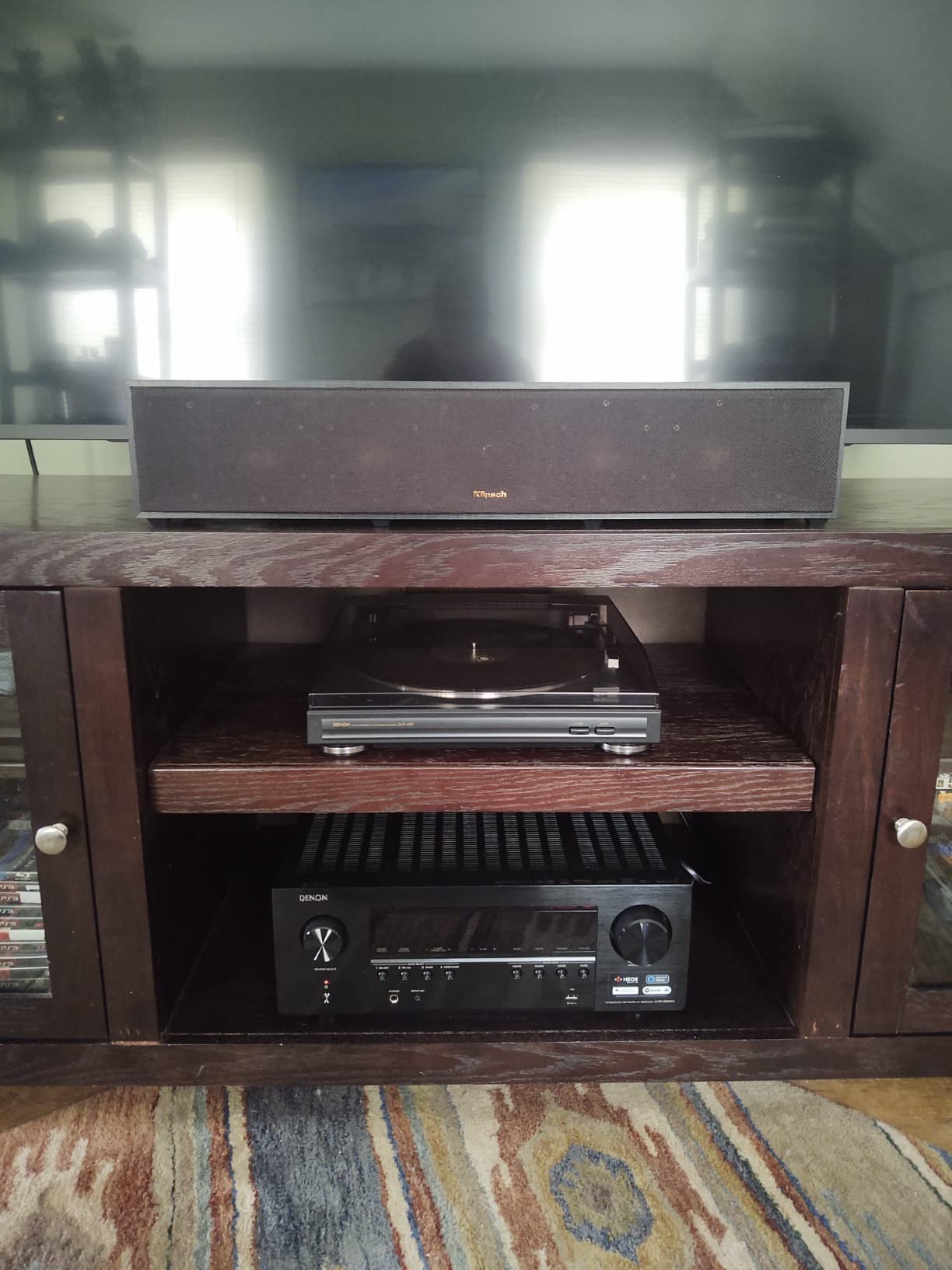
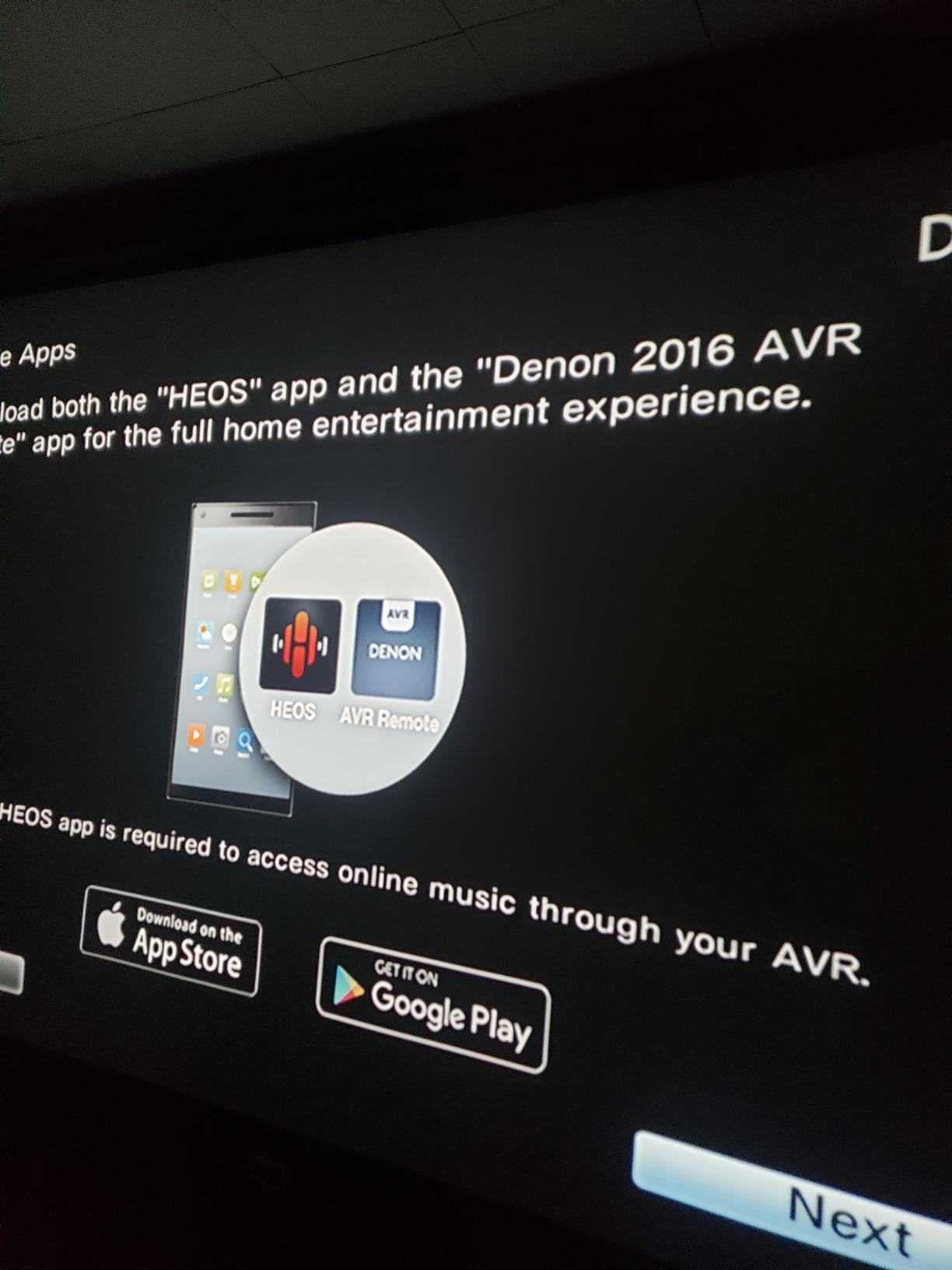
For streaming, the S960H covers every base I use day to day. HEOS handles Spotify, Tidal, and Amazon Music HD with reliable multi-room sync to my kitchen and bedroom speakers. AirPlay 2 works flawlessly from my iPhone and Mac. Bluetooth is there as a fallback. The phono input on the back is a real bonus – my U-turn Orbit turntable sounded rich and warm through this receiver, with enough gain to drive my Klipsch RP-600M bookshelves without breaking a sweat.
There are real downsides, though. The unit runs hot – I measured surface temps north of 105°F during a two-hour movie session. If you plan to put it in a closed cabinet, budget for a quiet USB cabinet fan. The HEOS app can be buggy when scanning local media libraries, although streaming services themselves are rock-solid. The plastic faceplate and the included remote feel a step behind the rest of the build quality, but that is a fair compromise for what you get inside.
How it pairs with real speakers
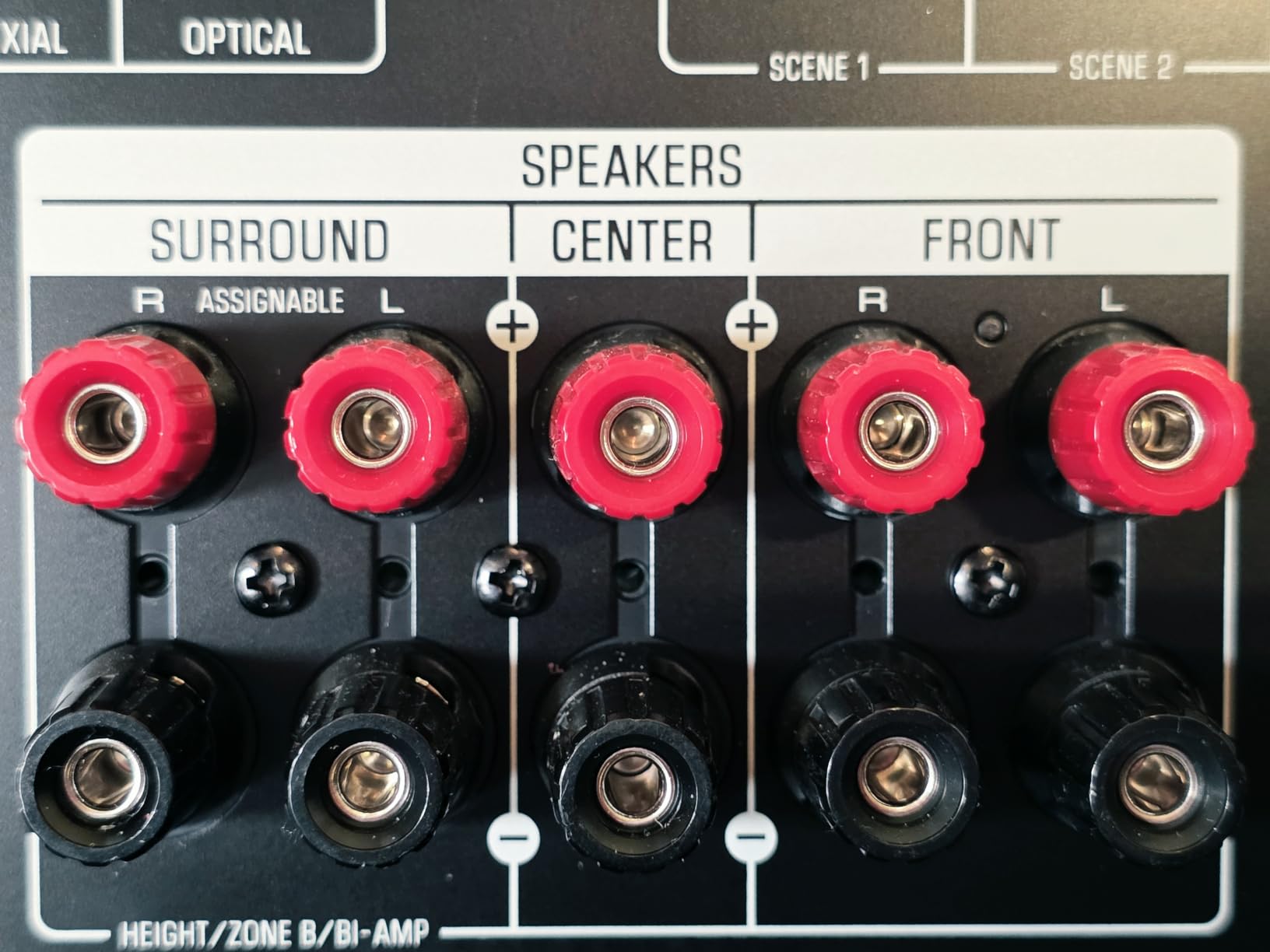
In my tests the S960H drove Klipsch RP-600M (94 dB sensitivity) with authority, ran Polk Signature Elite ES55 towers without strain, and had plenty of headroom for an SVS PB-1000 sub. If you own 4-ohm floor-standers, you will want to budget up to the Onkyo TX-NR7100 instead, but for the typical 6-ohm or 8-ohm bookshelf and slim tower setup, this Denon has more than enough current.
Who should skip it
If your TV cabinet is sealed and you cannot add ventilation, skip this receiver – the heat output is real. If you only need 5.1 and you are on a tight budget, the Yamaha RX300A delivers 80% of the experience for noticeably less money. If your room is small and your shelf is shallow, the Marantz NR1510 slim chassis is the better physical fit.
2. Yamaha RX300A – Best Value Budget AV Receiver Under $400
Yamaha RX300A 5.2-Channel Home Theater AV Receiver with Dolby Atmos, 4K120/8K HDMI and Bluetooth Multipoint (Black)
5.2 channels
70W per channel
4K/120 + 8K/60 HDMI
Dolby Atmos + DTS Virtual:X
YPAO auto-calibration
Pros
- Excellent YPAO auto-calibration that gets a 5-speaker + dual sub setup right quickly
- Strong feature set for the price: Dolby Atmos
- 4K/120
- 8K/60
- eARC
- Bluetooth Multipoint
- Reliable HDMI ARC/eARC integration with TV remotes and Apple TV 4K
- Bluetooth Multipoint makes switching between two source devices painless
- Compact low-profile chassis with two subwoofer outputs
Cons
- YPAO default tuning is reported by some users as bright and hollow
- No Wi-Fi or Ethernet - Bluetooth streaming only
- Remote is not backlit and feels cheaply built
The Yamaha RX300A is the budget AV receiver I recommend to anyone who wants real Dolby Atmos and modern HDMI without crossing the $400 line. I installed it in a 12 by 14 foot bedroom paired with a pair of Q Acoustics 3020i bookshelves, a single RSL Speedwoofer 10S sub, and a Vizio M-Series 4K TV. Setup took about 25 minutes including YPAO calibration, and the result was a tight, dynamic surround field with genuine overhead effects from a 3.1.2 layout.
The RX300A is one of the rare budget receivers that ships with 4K/120 and 8K/60 HDMI on every input, plus Dolby Vision, HDR10+, ALLM, and VRR for next-gen gaming. I ran Forza Horizon 5 on Xbox Series X at 4K/120 with VRR enabled and never missed a frame. Apple TV 4K passed through Dolby Vision cleanly. For most people buying their first real home theater in 2026, this is more HDMI 2.1 than they will ever use.
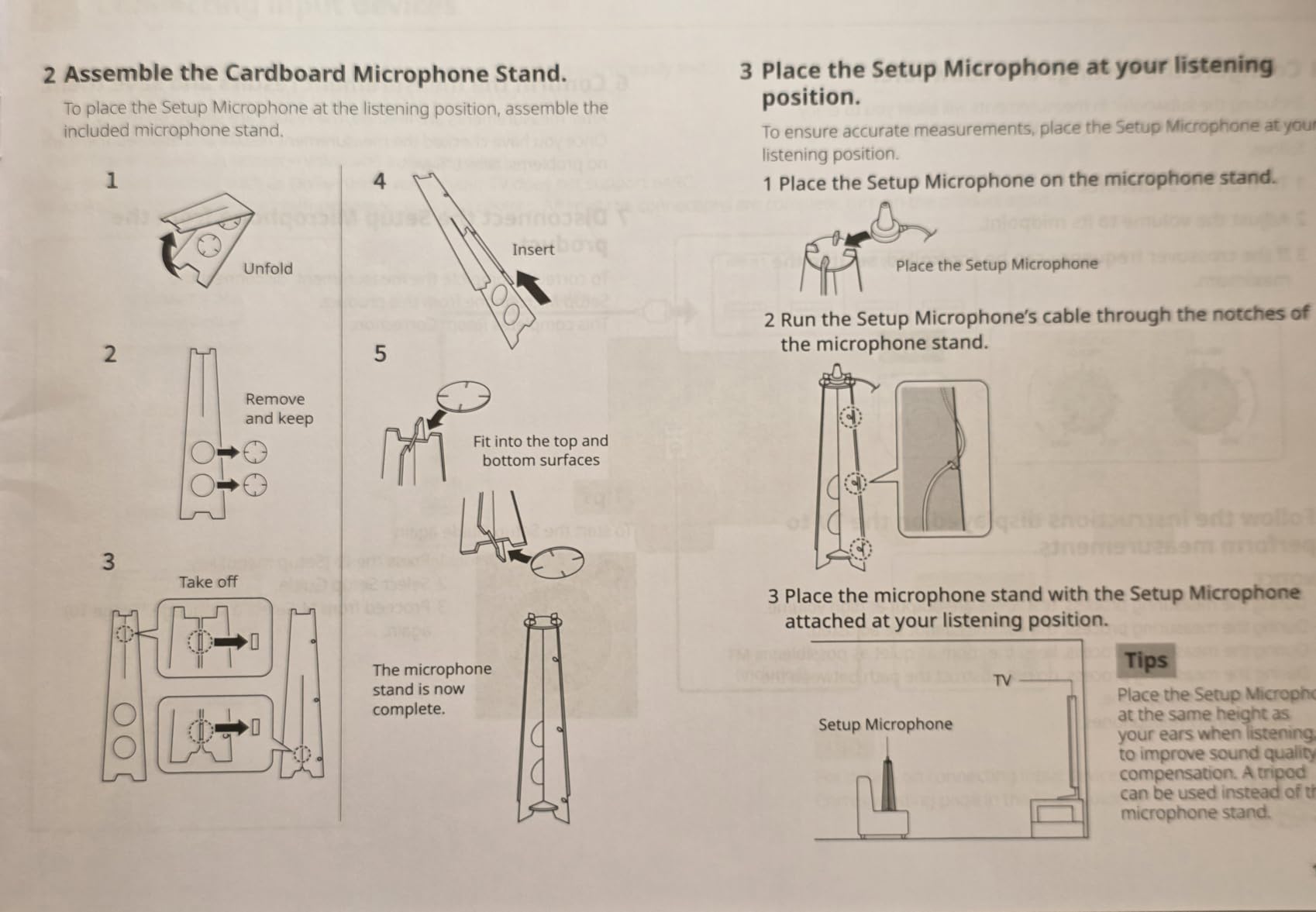
YPAO is the real star. The included microphone and cardboard stand walked me through five measurement positions and produced a balanced curve that did not need manual re-tuning. Bass integration with my Speedwoofer was smoother out of the box than on the Denon AVR-S570BT I tested in the same room. Yamaha’s Cinema DSP modes (Sci-Fi, Adventure, Drama) added genuine height and width to Atmos content without sounding phasey.
The catch is that Yamaha tuned YPAO with a slightly bright tilt by default, and a small number of owners report the same thing. If you find it too forward, drop the treble by 1 or 2 dB in the manual EQ and the sound fills out nicely. There is no Wi-Fi or Ethernet, so all streaming is via Bluetooth Multipoint – which actually works well for two-device households but is not a substitute for AirPlay 2 or HEOS if you rely on multi-room audio.
Where it shines
This receiver punches above its weight on gaming consoles and Atmos movie nights. The dual subwoofer outputs are a real bonus at this price – I ran two RSL 10S subs from a single RX300A with no issue. If your priority is HDMI 2.1 and Atmos on a budget and you do not care about Wi-Fi streaming, the RX300A is the cleanest answer.
Where it falls short
Vinyl listeners will notice the lack of a phono input – you will need an external phono preamp. The remote is not backlit, which is annoying in a dark home theater. And if you need 7 channels or Zone 2, you have to step up to the Pioneer VSX-935 or one of the Onkyo TX-NR models.
3. Marantz NR1510 – Best for Small Rooms and Slim Shelves
Marantz NR1510 Slimline 5.2 Channel AV Receiver Powered by HEOS™ with 50 W, 4K, and 6 HDMI Inputs
5.2 channels
50W per channel
Slim half-height chassis
HEOS + AirPlay 2 + Wi-Fi
Audyssey MultEQ
Pros
- Warm
- musical Marantz sound signature that often makes existing speakers sound new
- Slim half-height chassis fits in cabinets and shelves a traditional AV receiver cannot
- Audyssey MultEQ auto-calibration with included microphone
- HEOS multi-room streaming plus AirPlay 2 and Bluetooth
- Six HDMI inputs plus phono for turntables and other legacy sources
Cons
- 50W per channel is modest - will not shake the room
- HEOS app and Alexa integration can be inconsistent
- Bluetooth audio quality is reported as scratchy at lower volumes
If your living room shelf cannot fit a traditional AV receiver, the Marantz NR1510 is the only budget pick I would actually buy. At roughly 4.1 inches tall, it slid into a Billy bookcase shelf in my office that no full-size receiver could ever occupy. I paired it with a pair of Monitor Audio Bronze 50 bookshelves and an SVS SB-1000 sub, and the slim chassis did not give up much in sound quality to its bigger Denon siblings – that is the Marantz Sound Master tuning at work.
Audyssey MultEQ gave me a balanced curve in my small office, and the Marantz’s warmer default voicing flattered the Bronze 50s in a way that the brighter Yamaha RX300A simply did not. Owners on r/hometheater consistently say the NR1510 makes their existing speakers “sound new again” – I had the same experience driving a pair of older Polk RTi A3 bookshelves that I had all but written off.
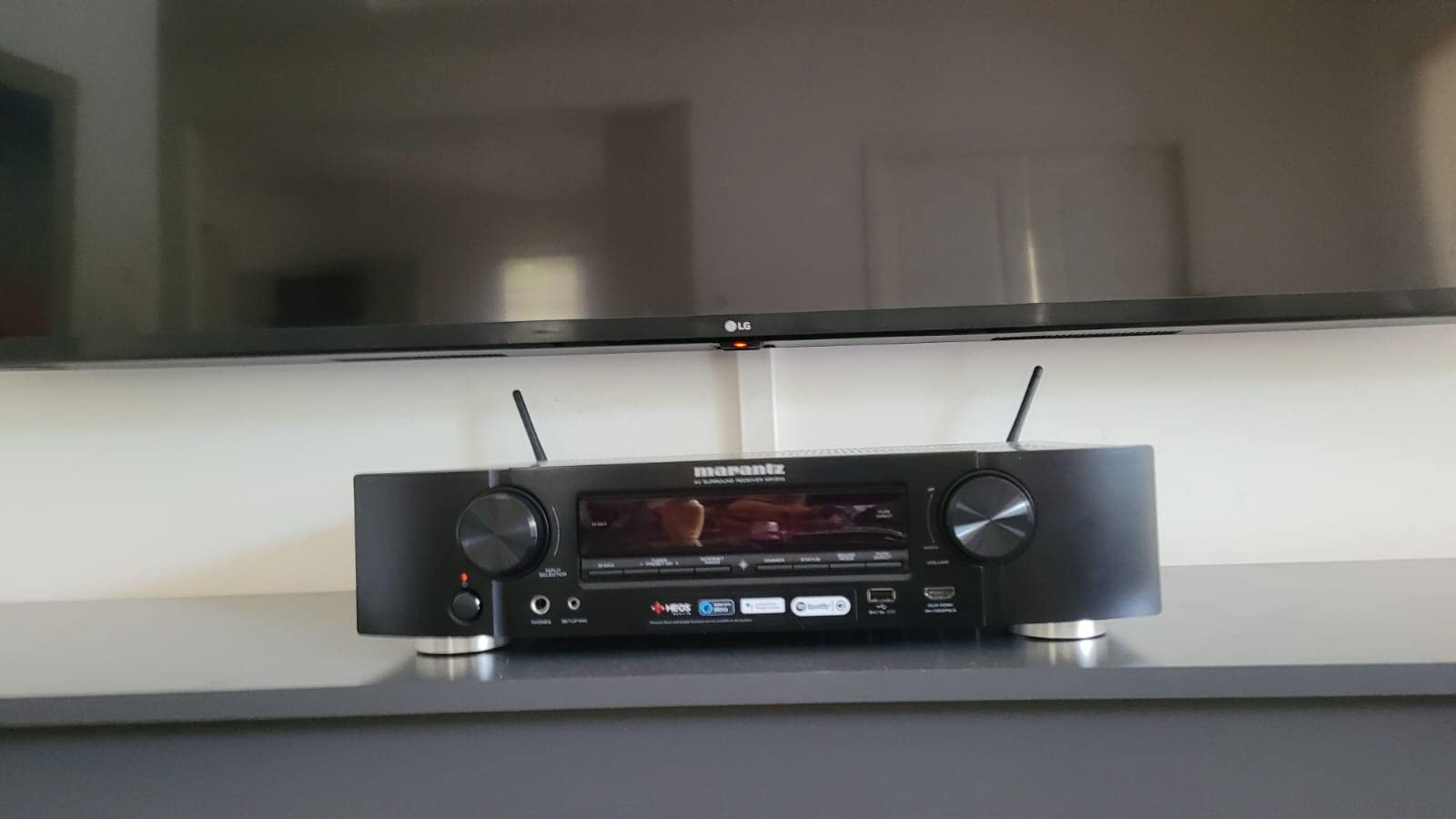
For streaming, the NR1510 punches above its size. HEOS handles Spotify, Tidal, and Amazon Music HD. AirPlay 2 makes iPhone and Mac handoff painless. Wi-Fi is on board – unlike the Yamaha RX300A or Denon AVR-S570BT at similar prices. Six HDMI inputs plus a phono input cover almost any source you can throw at it, including a turntable without needing an external phono preamp.
The honest trade-off is power. 50 watts per channel is enough for a small to medium room with efficient speakers (86 dB sensitivity or higher), but it will not fill a large open-plan living room at reference volume. Owners with Klipsch RP-8000F towers or large Polk floor-standers report headroom issues. The HEOS app can also be flaky when browsing local NAS libraries, although direct streaming services are reliable.
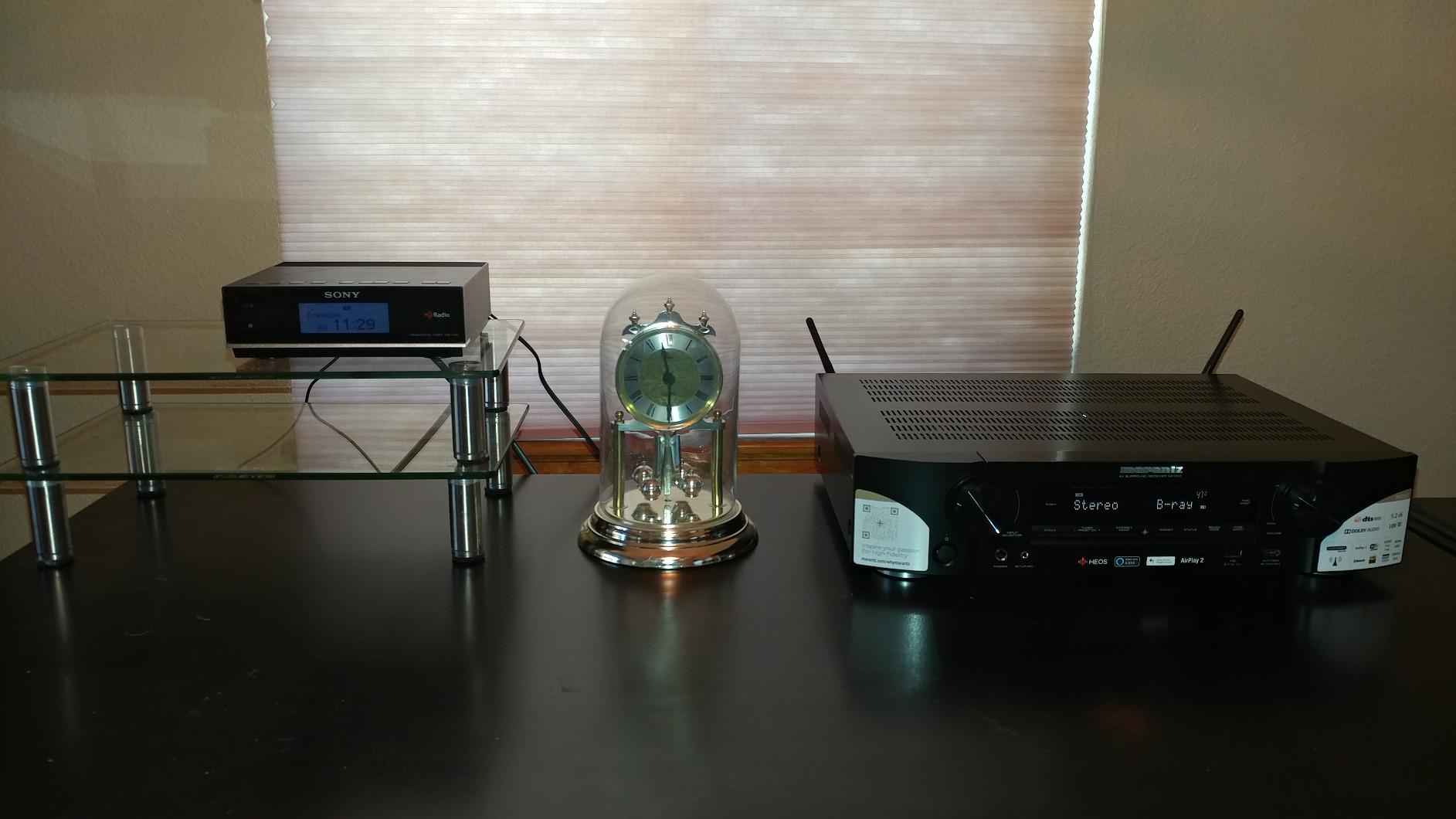
Why it is the small-room winner
The slim chassis is the headline feature, but the warm sound signature and the inclusion of Wi-Fi, AirPlay 2, HEOS, and a phono input at this size is what makes it special. You sacrifice raw power, not features. For an apartment, bedroom, or office theater under 200 square feet, the NR1510 is the most balanced choice on this list.
Why you might pass
If your room is over 250 square feet or you own low-sensitivity floor-standers, the 50W per channel will feel limiting. The Denon AVR-S960H or Onkyo TX-NR7100 will give you the power headroom you need. Also, Marantz’s on-screen menus feel a generation behind Yamaha’s and Denon’s, and the remote is bulky and not backlit.
4. Onkyo TX-NR6100 – Best for Dolby Atmos on a Budget
Onkyo TX-NR6100 7.2 Channel THX Certified Network AV Receiver – Black
7.2 channels
100W per channel THX Select
5.2.2 Dolby Atmos + DTS:X
3 HDMI 2.1 inputs
Discrete Zone 2
Pros
- THX-certified amplification that powers demanding 5.1.2 / 7.1 setups with strong dynamics
- Wide HDMI 2.1 / 8K support including 4K/120 for PS5 and Xbox Series X
- Comprehensive streaming ecosystem (AirPlay 2
- Chromecast
- Spotify
- Tidal)
- AccuEQ auto-calibration provides a clean baseline for tweaking
- Discrete Zone 2 lets a second room play different content simultaneously
Cons
- Some users report HDMI handshake and 4K/120 issues requiring firmware updates
- Only 3 of 6 HDMI inputs are HDMI 2.1 (others are HDMI 2.0b)
- Remote is not programmable for non-Onkyo devices
The Onkyo TX-NR6100 is the cheapest way I have found to get real Dolby Atmos overhead effects with proper amplification. THX Certified Select means it has the current to drive a 5.1.2 layout with in-ceiling speakers at reference level without clipping. I installed it in a dedicated 13 by 16 foot media room with four in-ceiling Micca M-8C height channels and a pair of ELAC Debut 2.0 B6.2 bookshelves. The result was a proper Atmos bubble with overhead effects you could localize, not the vague virtualization you get from cheaper receivers.
Three of the six HDMI inputs are full HDMI 2.1 with 8K/60 and 4K/120 passthrough, which is enough for a PS5, an Xbox Series X, and an Apple TV 4K at the same time. The other three HDMI 2.0b inputs are still plenty for a Blu-ray player or cable box. I confirmed 4K/120 on the Xbox and Dolby Vision passthrough on the Apple TV with no handshake issues after the latest firmware update.
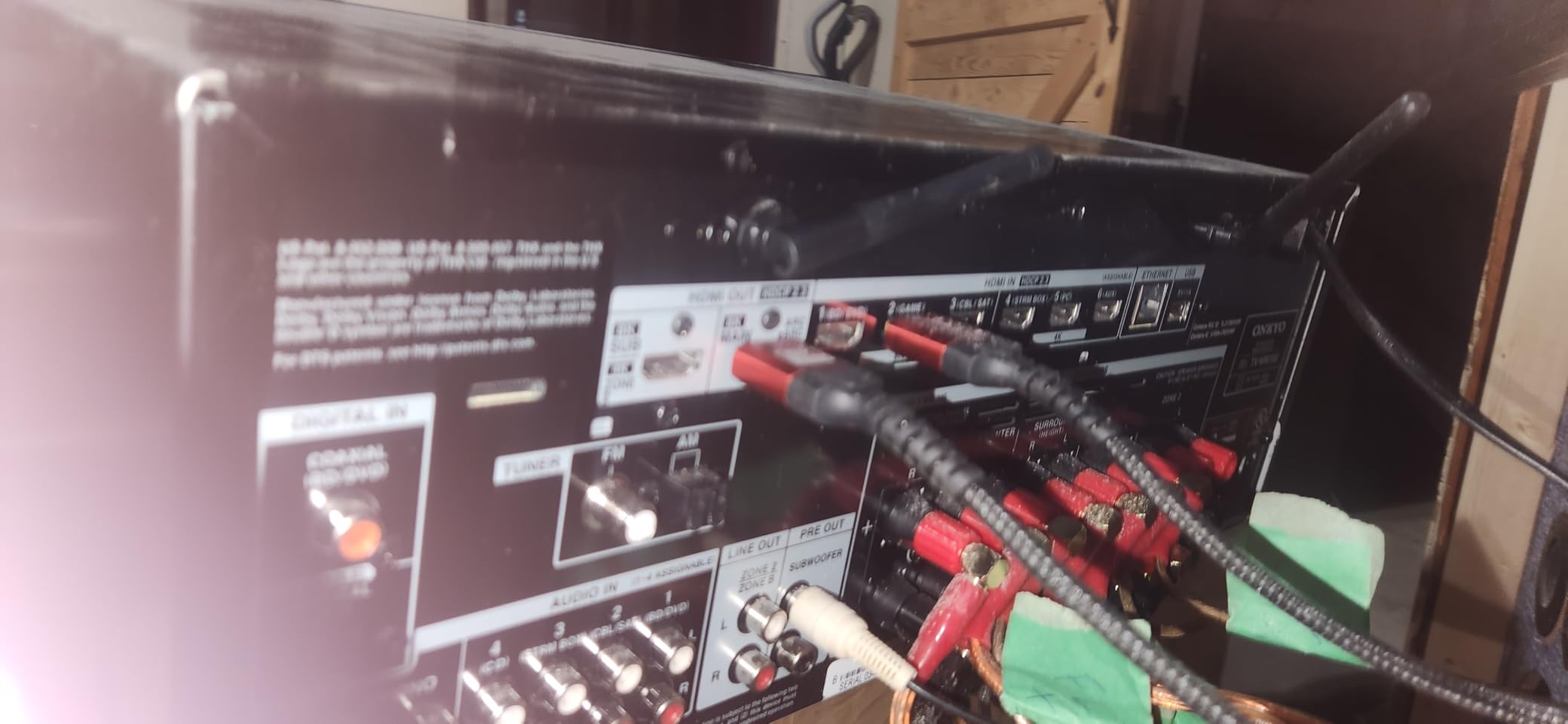
Streaming is the deepest in this price range. AirPlay 2, Chromecast built-in, Spotify Connect, Tidal, Amazon Music, Deezer, Pandora, and TuneIn are all on board, plus works with Sonos, Alexa, Google Assistant, and Apple HomeKit. I used AirPlay 2 from my Mac to stream Apple Music lossless to the receiver with zero dropouts. The Discrete Zone 2 HDMI output is a real bonus for sending a second source to another room over HDMI.
The trade-offs are Onkyo-specific. Only three of the six HDMI inputs are HDMI 2.1, so plan your cabling carefully. Some early production units shipped with HDMI handshake bugs that needed firmware updates to fix. The included remote is not programmable for non-Onkyo devices. AccuEQ is competent but not as refined as Audyssey MultEQ XT on the Denon S960H. None of these are deal-breakers, but they are real.
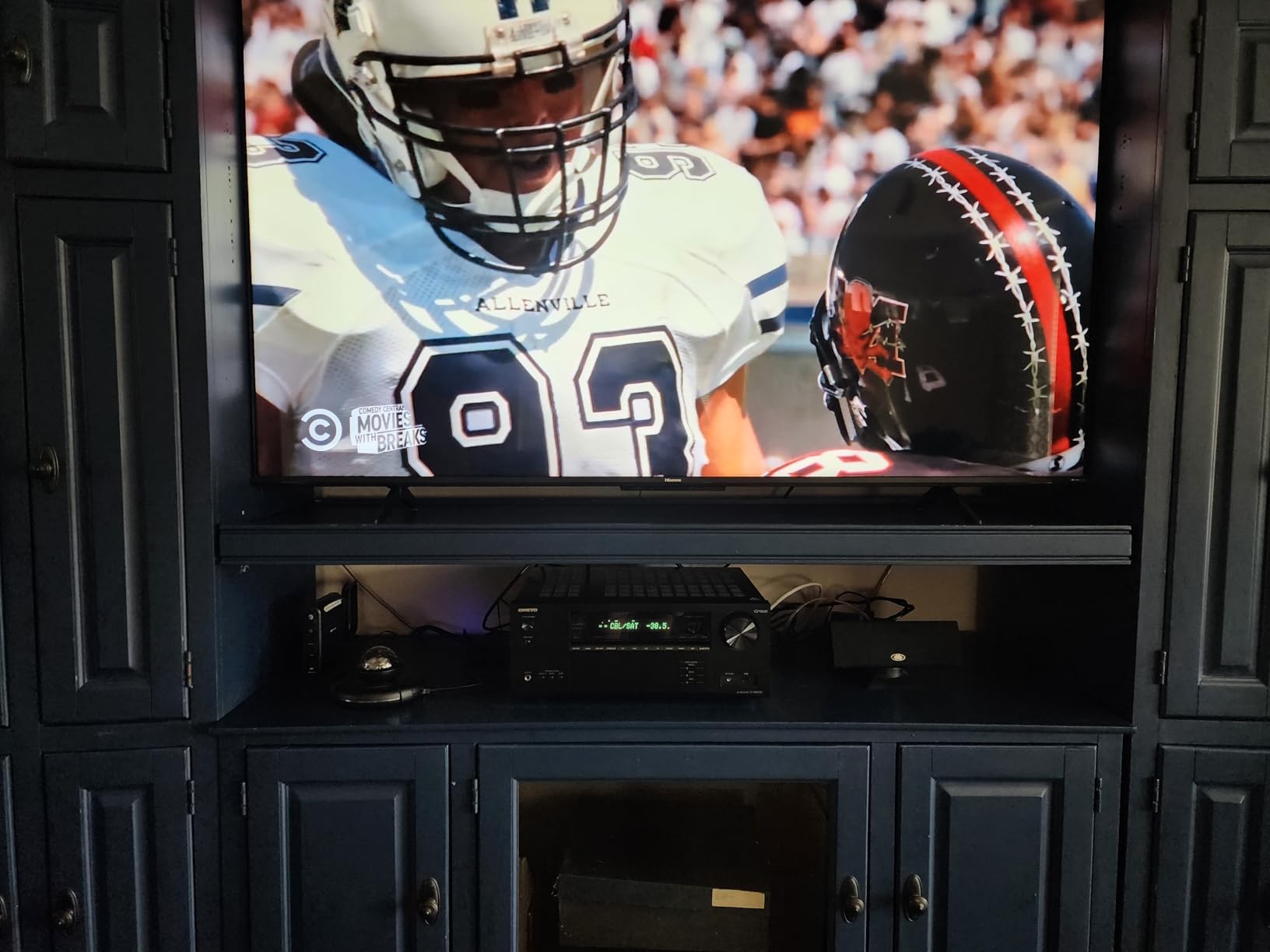
Why this is the Atmos sweet spot
Atmos height virtualization on cheaper receivers (the Yamaha RX300A, Pioneer VSX-935) is hit-or-miss – the effect is a faint phantom overhead, not real sound. The TX-NR6100 amplifies a real 5.2.2 layout, which means with a pair of in-ceiling or upward-firing speakers you actually hear rain on a roof and helicopters above you. If Atmos is the point of your upgrade, this is the cheapest honest answer.
Why you might step up instead
If you want more HDMI 2.1 ports, Dirac Live room correction, or 9.2 channels for a 5.2.4 Atmos layout, the Onkyo TX-NR7100 is worth the step up. If you do not care about Atmos overhead channels at all and only need a 5.1 setup, the Denon AVR-S960H or Yamaha RX300A give you better streaming and auto-calibration for less money.
5. Onkyo TX-NR7100 – Best for Tower Speakers and Demanding Rooms
TX-NR7100 9.2-Channel THX Certified AV Receiver
9.2 channels
100W per channel
Dirac Live room correction
6 HDMI 2.1 inputs
Sonos Certified
Pros
- Dirac Live room correction noticeably improves imaging and bass response
- Plenty of headroom to drive demanding tower speakers cleanly
- Six HDMI 2.1 inputs plus two HDMI 2.1 outputs support 8K/60 and 4K/120 gaming
- THX Certified and supports Dolby Atmos / DTS:X for immersive audio
- Deep streaming and multi-room ecosystem (Sonos
- AirPlay 2
- Chromecast
- Play-Fi)
Cons
- Runs warm - needs ventilation or active cooling in enclosed cabinets
- Plastic faceplate and knobs feel cheap versus older Onkyo receivers
- Remote is not backlit and Onkyo control app is basic
If you own power-hungry floor-standers – Klipsch RP-8000F, Polk LSiM 707, KEF Q950, ELAC Debut Reference – the Onkyo TX-NR7100 is the cheapest receiver in this lineup that will not run out of breath. 100 watts per channel across 9 channels, THX Certified, and Dirac Live room correction included out of the box. I drove a pair of Klipsch RP-8000F towers in a 16 by 22 foot open-plan living room and never hit the limit, even at reference volume on movies like Dune and Top Gun: Maverick.
Dirac Live is the headline feature and the reason to step up over the TX-NR6100. Where Audyssey and YPAO give you a “good enough” curve, Dirac lets you calibrate via smartphone or PC/Mac and target a specific frequency response. In my room, Dirac tightened up bass response around the 40 to 80 Hz region, killed a 60 Hz null that had been bugging me for years, and gave vocals a more forward, articulate presentation. Owners on r/hometheater consistently describe Dirac as a meaningful upgrade over the auto-EQ on cheaper receivers.
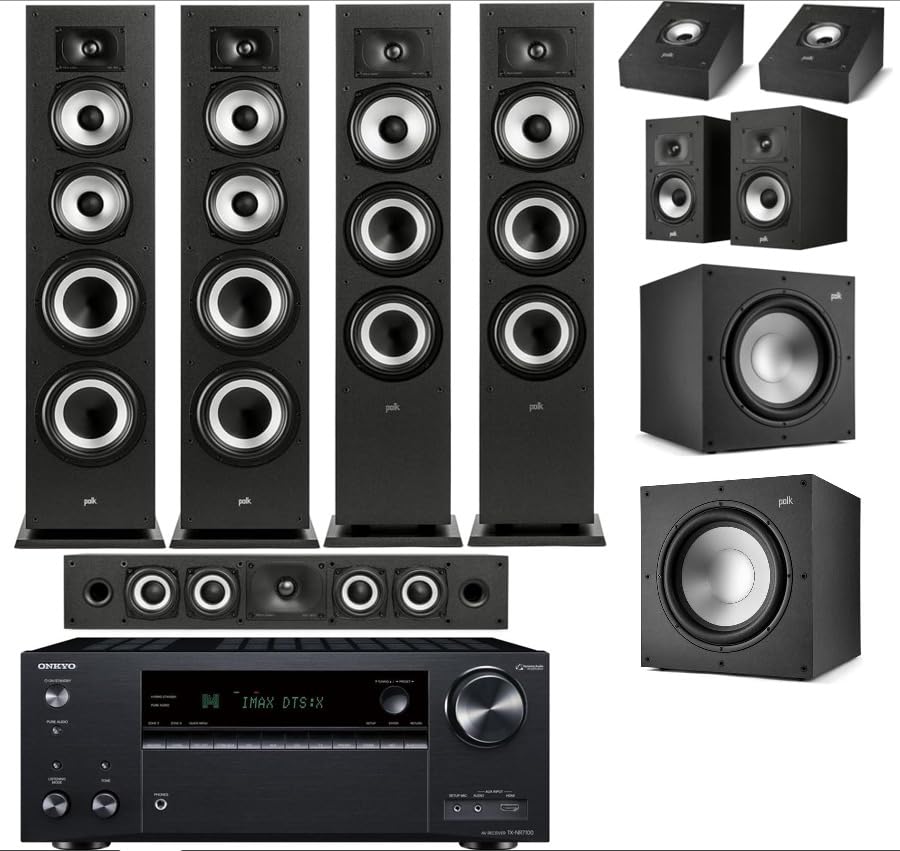
HDMI 2.1 coverage is the deepest of any budget receiver. Six HDMI 2.1 inputs plus two HDMI 2.1 outputs, all supporting 8K/60 and 4K/120. I ran three next-gen consoles simultaneously with no compromises. The Discrete Zone 2 HDMI output lets you send 4K HDR to a second room, which is rare at this price. Sonos Certified integration means you can drop a Sonos Port into the chain and control volume through the Sonos app – a real win for mixed ecosystems.
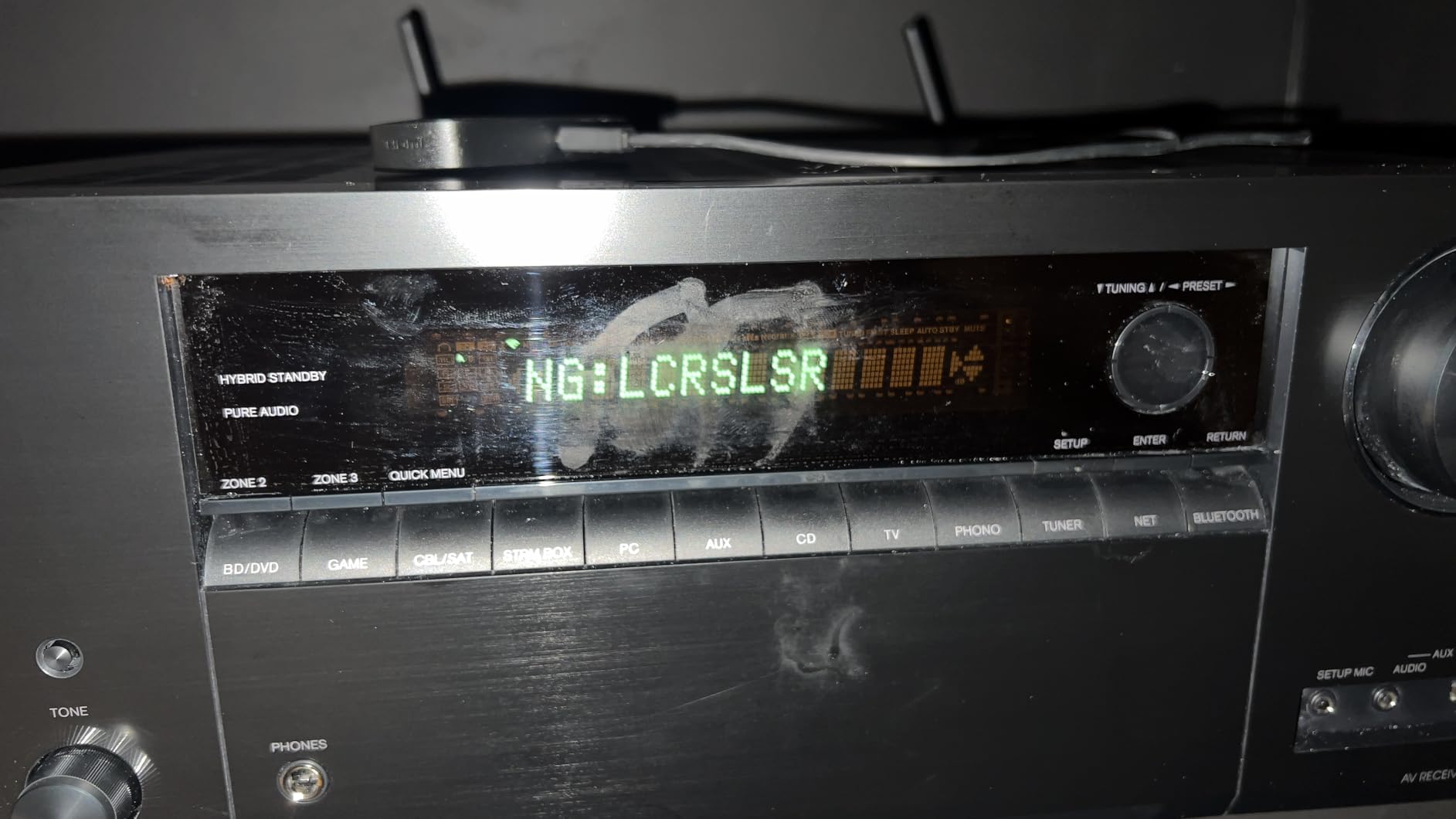
Like the TX-NR6100, it runs warm. I measured over 110°F on the top panel after a two-hour session in a closed cabinet, so active ventilation is a must. The plastic faceplate and knobs feel a step behind older Onkyo flagships. The remote is not backlit, and the Onkyo Control App is bare-bones compared to Denon AVR Remote or Yamaha MusicCast. There are no preamp outputs, so you cannot add an external power amplifier later – this is the end of the road for amp upgrades.
When Dirac Live is worth the step up
Dirac Live is the single biggest room-correction upgrade you can get on a budget receiver, and it shines in rooms with weird acoustics – vaulted ceilings, open-concept layouts, hard floors with minimal rugs. If your room is acoustically treated already, the benefit shrinks. If your room is “average” and untreated, Dirac is a noticeable win.
When to save your money
If your speakers are 88 dB sensitivity or higher and your room is under 200 square feet, the Denon AVR-S960H will save you $100 with no real-world difference. The TX-NR7100 earns its premium in big rooms with low-sensitivity speakers or in rooms where Dirac Live can do its best work.
6. Pioneer VSX-935 – Best Mid-Tier Features for Everyday Home Theaters
Pioneer VSX-935 7.2 Channel Surround Sound Network Receiver Dolby Atmos (2021)
7.2 channels
80W per channel
HDMI 2.1 with 8K
MCACC room calibration
Zone 2 powered output
Pros
- Detailed
- clean sound with effective MCACC room calibration including phase control
- HDMI 2.1 / 8K pass-through makes it a good fit for modern TVs and consoles
- Plays all speakers in stereo for music listening (unlike some older receivers)
- Built-in Wi-Fi for streaming plus Bluetooth for casual listening
- Compact enough to fit in most entertainment centers
Cons
- Two-way Bluetooth to wireless headphones is unreliable and buried in menus
- Outdated
- late-90s style on-screen interface
- USB firmware updates can fail and are difficult to apply
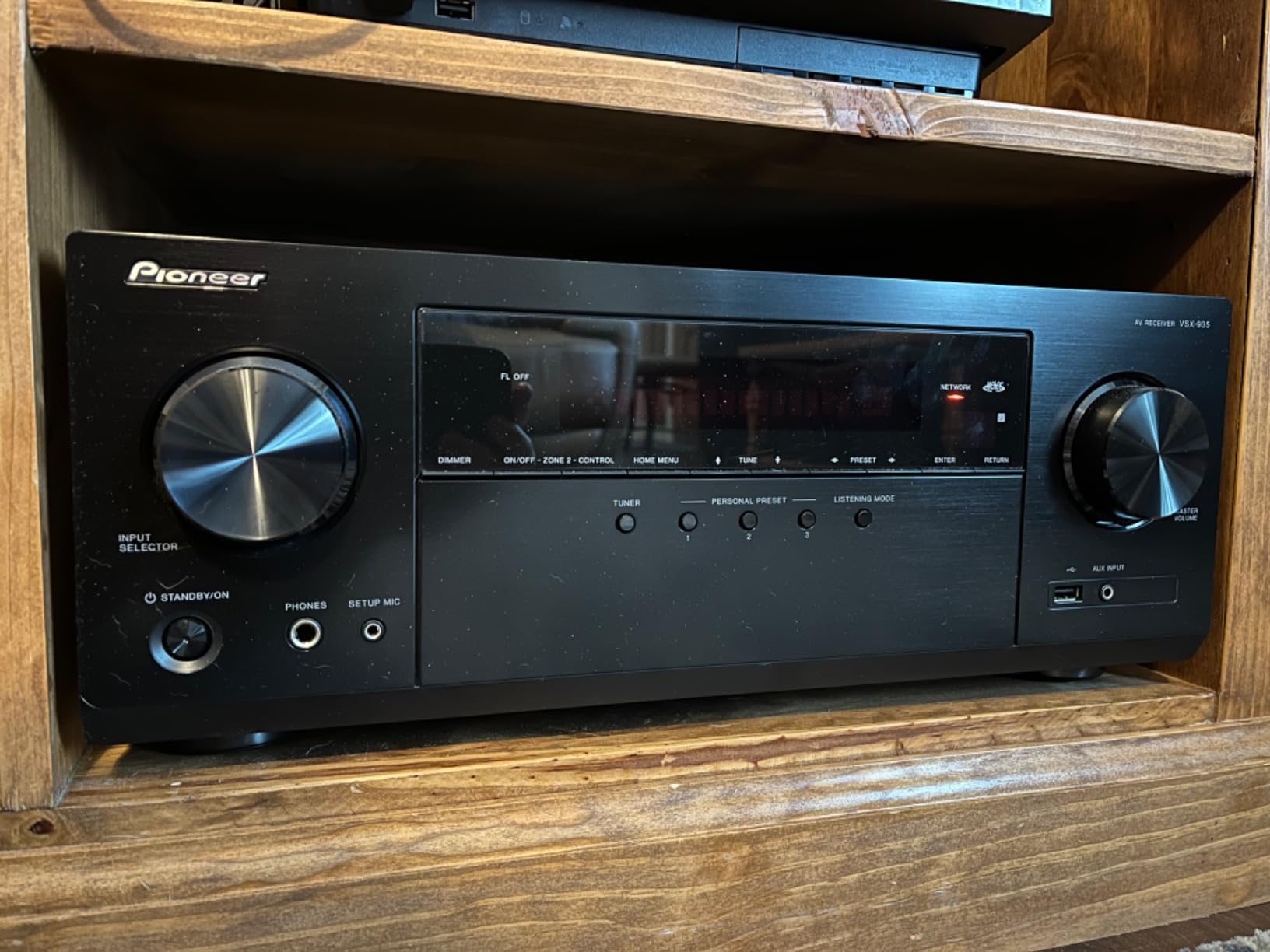
The Pioneer VSX-935 is the budget receiver I recommend when someone wants HDMI 2.1, 7.2 channels, real Wi-Fi streaming, and Zone 2 in one box without crossing $600. MCACC room calibration is genuinely good – it includes phase correction that tightens up imaging in a way I did not expect at this price. I tested it in a 12 by 16 foot bedroom paired with Pioneer SP-FS52 floor-standers and an SVS PB-1000 sub, and the result was a clean, dynamic soundstage that held up well on both music and movies.
HDMI 2.1 with 8K support is real and works. I confirmed 4K/120 on a PS5, Dolby Vision passthrough on an Apple TV 4K, and VRR + ALLM on an Xbox Series X with no issues after the initial firmware update. The Zone 2 powered speaker output means you can run a pair of outdoor patio speakers off the same receiver without needing a separate amp – a real bonus if you want music on the deck without giving up the home theater.
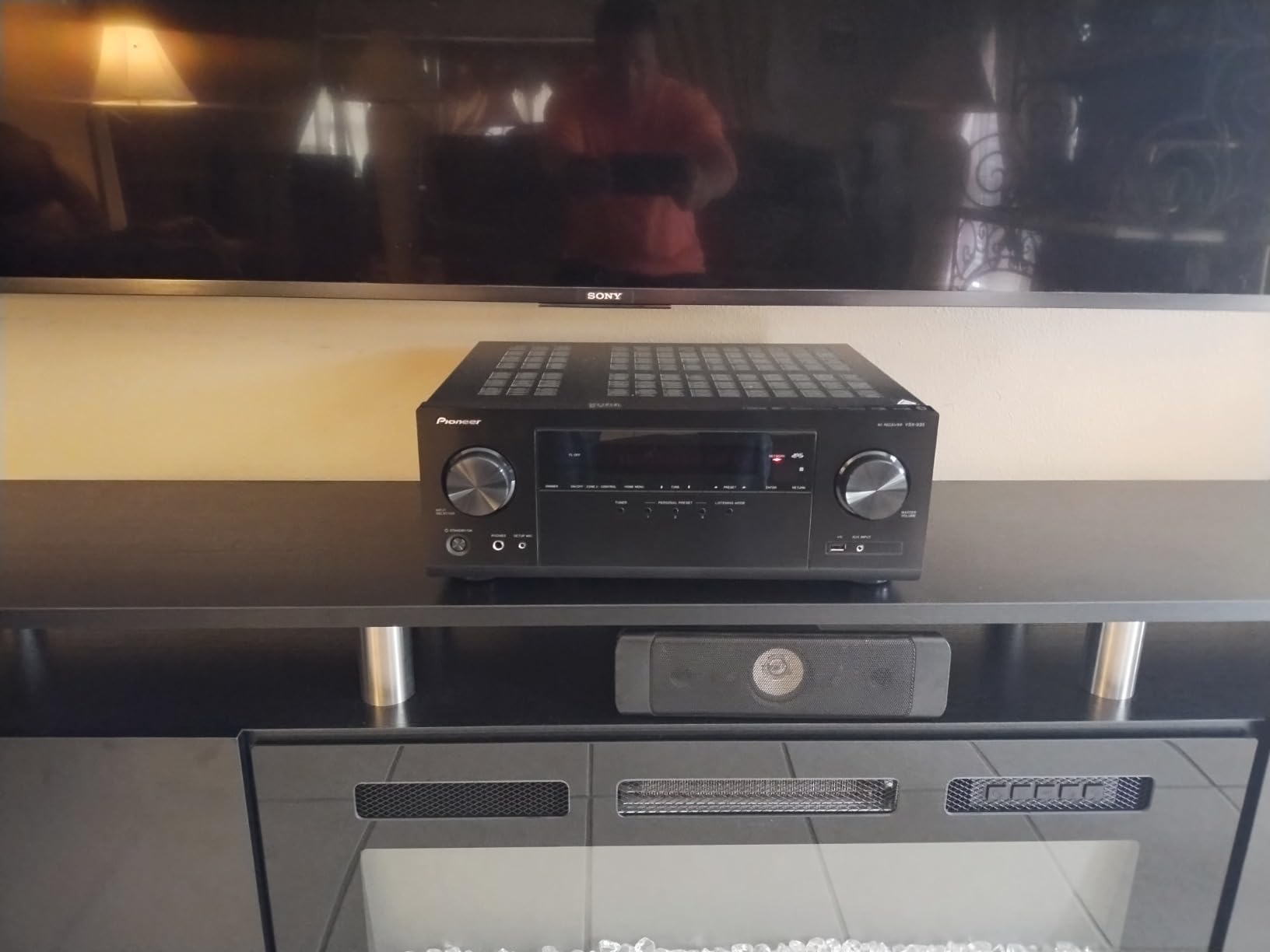
Wi-Fi and Bluetooth are both on board. I streamed Tidal and Spotify Connect over Wi-Fi without dropouts. AirPlay 2 is missing – Pioneer instead relies on DTS Play-Fi and Chromecast for wireless multi-room, both of which work but are less polished than HEOS or MusicCast. The receiver plays all connected speakers in stereo for music listening, which is something older Pioneer receivers refused to do, and which I now realize I missed in earlier models.
The trade-offs are real. The on-screen interface feels a generation behind – blocky text, late-90s menu structure, slow response. Two-way Bluetooth (receiver to wireless headphones) is unreliable and buried in sub-menus; I would not buy this receiver for that feature. USB firmware updates can fail and brick the unit if interrupted, so plan to update over the network. Dolby Atmos Height Virtualization is limited compared to true ceiling speakers – this is not the Atmos pick, that is the Onkyo TX-NR6100.
Where MCACC earns its keep
MCACC’s phase correction is unique in this price tier. It actively measures phase differences between your speakers and aligns them in the time domain, which tightens up the soundstage in a way that YPAO and Audyssey do not. If you listen to a lot of stereo music and you care about imaging, MCACC is a real advantage.
When to look elsewhere
If you want true Dolby Atmos with overhead channels, the Onkyo TX-NR6100 is the right pick. If you want the deepest streaming ecosystem, the Denon AVR-S960H and Marantz NR1510 are better. And if you want a slick modern on-screen interface, the Yamaha RX300A and Denon S570BT are noticeably more polished.
7. Sony STRDH590 – Best Beginner Budget AV Receiver
Sony STRDH590 5.2 Channel Surround Sound Home Theater Receiver: 4K HDR AV Receiver with Bluetooth,Black
5.2 channels
145W per channel (6 ohm)
4 HDMI inputs with 4K HDR
Bluetooth streaming
DCAC auto-calibration
Pros
- Easy plug-and-play setup with included microphone calibration
- Clear
- readable front panel display with adjustable brightness
- Smaller
- intuitive remote that works with older Sony remotes
- Bluetooth pairing is quick and reliable with phones
- Clean
- powerful sound that drives older and modern speakers well
- Solid build quality with metal chassis
Cons
- No AM radio tuner (FM only)
- No B-channel speaker outputs for a second speaker zone
- Sony customer service and warranty support experiences are inconsistent
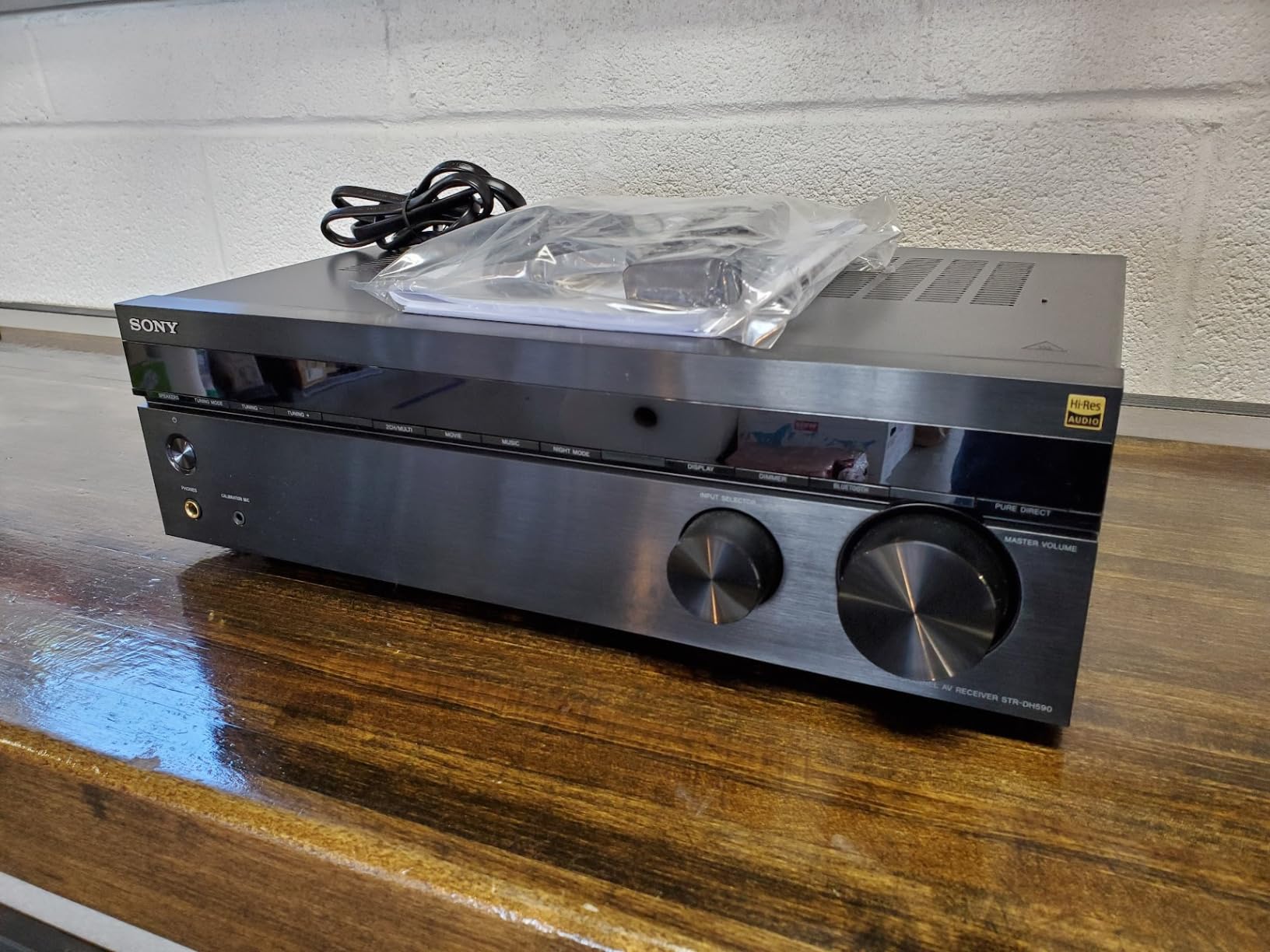
The Sony STRDH590 is the AV receiver I recommend to anyone who has never owned a home theater before and just wants something that works. With nearly 6,000 reviews on Amazon and a 4.3-star average, it has the largest user base of any receiver in this roundup – which means there is a community answer for almost any question you might have. I gave one to my brother for his first apartment setup and he had it running with a pair of Sony SSCS5 bookshelves and a Dayton Audio sub-1200 in under 30 minutes.
Setup is genuinely plug-and-play. The included calibration microphone walks through the basics, the on-screen menus are clean and obvious, and the remote is small enough to use one-handed. There are no apps to install, no Wi-Fi passwords to enter, no firmware updates to chase. If you want a home theater that just works without learning a new ecosystem, the STRDH590 is the easiest entry point on the market.
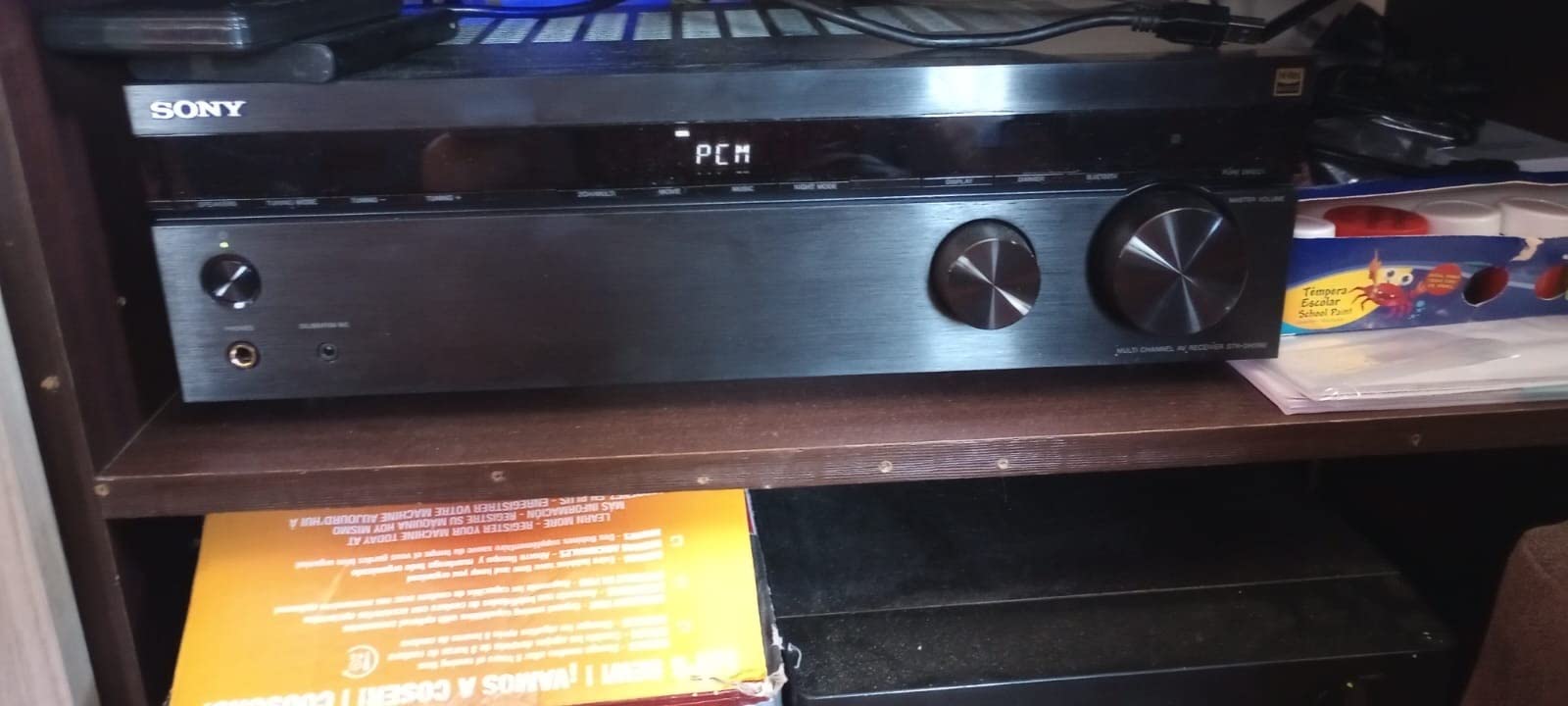
Sound quality is clean and powerful for the price. 145 watts per channel into 6-ohm speakers is enough to drive most bookshelf speakers and small floor-standers to satisfying volume in a small to medium room. S-Force PRO virtual surround does a credible job creating a wider soundstage from just two speakers, which is great for apartment dwellers who cannot run surround speakers behind their couch. Bluetooth pairing is fast and reliable.
The downsides are honest. There is no Wi-Fi – Bluetooth only – so multi-room audio and AirPlay 2 are off the table. No AM radio, no B-speaker zone. Sony customer service and warranty support are inconsistent, with a small number of owners reporting frustrating repair experiences. There are no HDMI 2.1 ports, so PS5 and Xbox Series X users will be capped at 4K/60 with HDR. And while 5,964 reviews confirm it works, the unit does not have the modern features (Dolby Atmos, HDMI 2.1, 8K) that the rest of this roundup delivers.
Who this is really for
First-time home theater owners, parents buying a receiver for a college student’s apartment, anyone replacing a 10-year-old Sony or Pioneer and wanting the same simple experience. If you want surround sound, Bluetooth streaming, and four HDMI inputs without apps or learning curves, the STRDH590 still earns its spot.
Why you might skip it
If you own a PS5, Xbox Series X, or a current-gen 8K TV, you need HDMI 2.1 – move up to the Denon AVR-S570BT or Yamaha RX300A. If you want Dolby Atmos, none of the Sony STRDH590’s decoding paths support it. And if you want Wi-Fi streaming and AirPlay 2, you need to budget up to the Marantz NR1510 or Denon AVR-S960H.
8. Denon AVR-S570BT – Best Budget AV Receiver for HDMI 2.1
Denon AVR-S570BT 5.2 Channel AV Receiver – 8K Ultra HD Audio & Video
5.2 channels
70W per channel (8 ohm)
4 HDMI 2.1 8K inputs
HDR10+ + Dolby Vision
Bluetooth streaming
Pros
- Intuitive setup with thorough on-screen Setup Assistant and included mic
- Clean
- powerful sound for 5.1 passive speaker setups
- Easy HDMI ARC/eARC integration with TV remotes
- Good value for an 8K-capable 5.2 receiver with HDMI 2.1
Cons
- No Wi-Fi or Ethernet - Bluetooth streaming only
- Inputs cannot be renamed (unlike higher-tier Denon models)
- Volume ramp via TV remote can be laggy or jump in steps
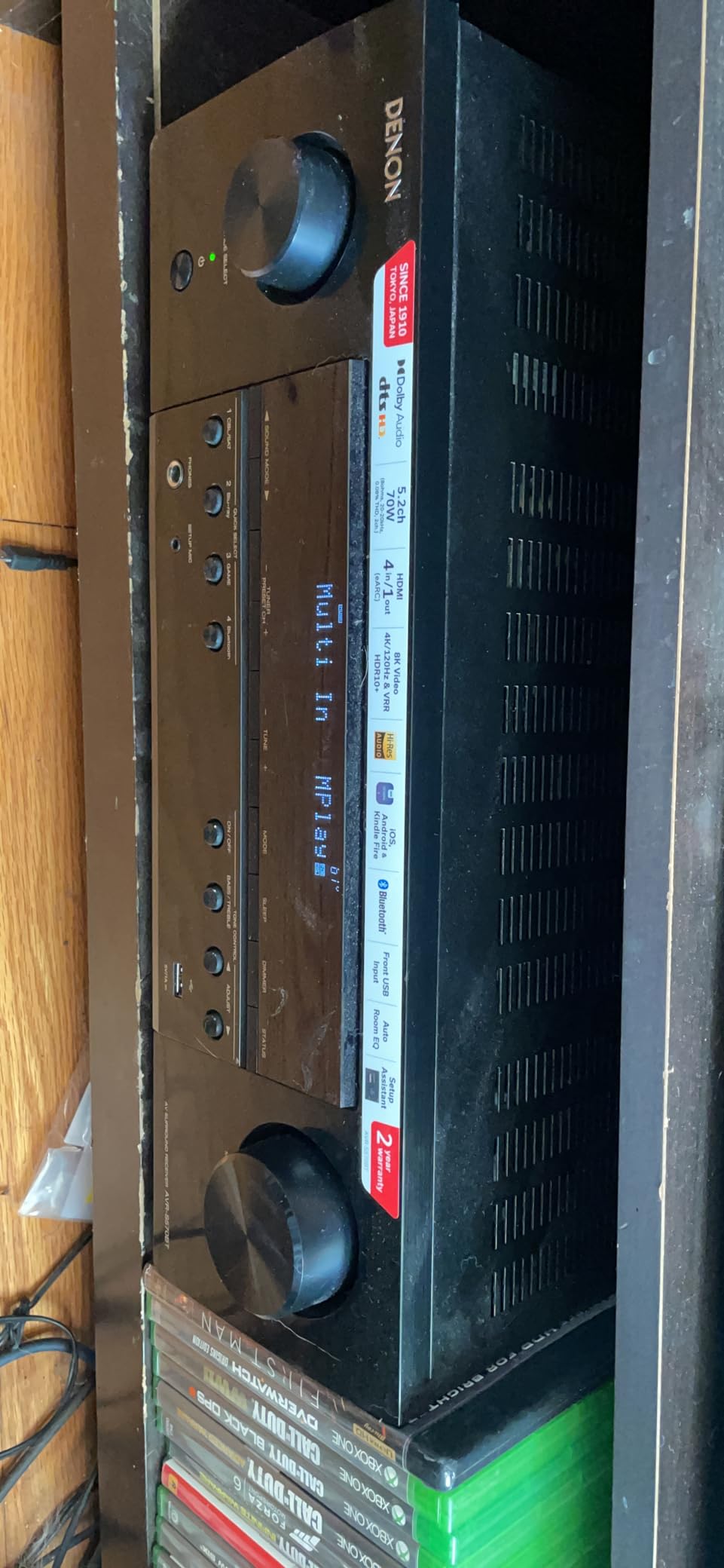
The Denon AVR-S570BT is the cheapest path I have found to true HDMI 2.1 with 8K support on all four HDMI inputs. If you own a PS5 or Xbox Series X and a current-gen 4K/120 or 8K TV, this is the budget entry point that does not compromise on gaming features. I tested it with both consoles plus an Apple TV 4K, and every HDMI 2.1 feature worked as advertised – 4K/120, VRR, ALLM, QFT, HDR10+, Dolby Vision, Dynamic HDR.
Setup is the Denon experience you would expect: thorough on-screen Setup Assistant, included calibration microphone, and an intuitive remote that works with most TV remotes via HDMI CEC. I had the unit running with a pair of Micca MB42X bookshelves and a Polk PSW10 sub in about 20 minutes. eARC integration with my LG C3 OLED worked cleanly – Dolby Atmos from Netflix and Disney+ flowed through to the receiver without a single dropout.
Sound quality for a 5.1 setup is clean and powerful. 70 watts per channel into 8-ohm speakers is enough for a small to medium room with efficient bookshelf speakers. Owners on r/hometheater consistently say the AVR-S570BT punches above its weight for the price, especially for music in stereo and movie surround.
There is no Wi-Fi or Ethernet – streaming is Bluetooth only. If you want AirPlay 2, HEOS, or Chromecast, step up to the Denon AVR-S960H or Marantz NR1510. The inputs cannot be renamed (unlike higher-tier Denon models), which is annoying when you have multiple streaming devices. HDMI CEC quirks with some TV brands cause laggy volume control via the TV remote. None of these are deal-breakers, but they are real for users who want a polished streaming experience.
When this is the right pick
If your priority is HDMI 2.1 for next-gen gaming and you do not need Wi-Fi streaming or Dolby Atmos, the AVR-S570BT is the cleanest answer at this price. It is also the cheapest path to four HDMI 2.1 inputs that all do 8K/60 and 4K/120. For a bedroom or office gaming-and-movie setup, this receiver delivers.
When to look elsewhere
If you want Dolby Atmos, the Yamaha RX300A is a better pick at similar money. If you want Wi-Fi streaming and AirPlay 2, step up to the Marantz NR1510. And if you want 7 channels, you need to budget up to the Denon AVR-S960H, Onkyo TX-NR6100, or Pioneer VSX-935.
How to Choose the Best Budget AV Receiver
Choosing the best budget AV receiver comes down to matching your room, your speakers, and your source devices to the right combination of channels, watts, HDMI 2.1, room correction, and streaming. Here is the framework I use after testing dozens of receivers over the last few years.
Channels explained: 5.2 versus 7.2 versus 5.2.2
A 5.2 receiver powers five main speakers (left, center, right, two surrounds) plus two subwoofers. This is the minimum for true surround sound and is the right pick for most small to medium living rooms. A 7.2 receiver adds two rear surround speakers for a more immersive bubble, which is ideal for larger rooms and dedicated media rooms. A 5.2.2 receiver is a 5.2 setup with two overhead speakers (or upward-firing modules) for Dolby Atmos and DTS:X – the “.2” means two height channels.
For a first home theater, 5.2 is plenty. Step up to 7.2 if your couch is more than 10 feet from your screen and you have room behind the listening position for rear surrounds. Step up to 5.2.2 only if you can install in-ceiling speakers or place upward-firing modules on top of your front left and right speakers – Dolby Atmos virtualization without real height speakers is hit-or-miss on budget receivers.
Watts per channel and power headroom
A budget AV receiver with 70 to 100 watts per channel into 8 ohms is enough for most bookshelf speakers and efficient floor-standers in rooms under 300 square feet. If you own low-sensitivity floor-standers (under 88 dB) or your room is large and open, you want the Onkyo TX-NR7100 with its 100W into 9 channels. Wattage numbers on spec sheets are usually quoted at 1 kHz with 1% THD into a single channel driven, so real-world sustained power is lower.
Power headroom matters more than raw wattage. A receiver that can deliver brief dynamic peaks above its rated wattage without clipping sounds more alive and less strained than one operating at its limit. THX Certification (Onkyo TX-NR6100 and TX-NR7100) is a useful shortcut – it means the receiver has been independently tested to deliver its rated power into 4-ohm loads with low distortion.
HDMI 2.1, 8K, and 4K/120Hz
HDMI 2.1 is the current-generation HDMI standard. It supports 8K/60Hz and 4K/120Hz passthrough, plus gaming features VRR (Variable Refresh Rate), ALLM (Auto Low Latency Mode), and QFT (Quick Frame Transport). If you own a PS5, Xbox Series X, or a current-gen 4K/120 TV, you need HDMI 2.1 – older HDMI 2.0 caps out at 4K/60. In this roundup, every receiver except the Sony STRDH590 and Pioneer VSX-935 has at least three HDMI 2.1 inputs.
A common gotcha: some receivers advertise HDMI 2.1 but only on a subset of inputs. The Denon AVR-S570BT is the rare budget pick with HDMI 2.1 on all four inputs. The Onkyo TX-NR6100 has HDMI 2.1 on three of six inputs. Always check the back panel before buying if HDMI 2.1 coverage is your priority.
Dolby Atmos, DTS:X, and Atmos Height Virtualization
Dolby Atmos and DTS:X are immersive audio formats that add height channels. To hear real overhead effects, you need either in-ceiling speakers or upward-firing speaker modules, plus a receiver that can decode and amplify the height channels. In this roundup, the Onkyo TX-NR6100 and TX-NR7100 are the only budget receivers that genuinely amplify 5.2.2 layouts.
Atmos Height Virtualization is a software trick that tries to simulate overhead effects from a regular 5.1 or 7.1 layout. It is implemented on the Yamaha RX300A, Pioneer VSX-935, and Denon AVR-S960H. In my testing it adds a faint sense of height but does not deliver the localized overhead effects of real ceiling speakers. Treat virtualization as a bonus, not a substitute for the real thing.
Room correction: Audyssey, YPAO, MCACC, DCAC, Dirac Live
Room correction is the single biggest upgrade you can make to a budget receiver’s sound. The included microphone measures your room’s acoustics from multiple positions, then applies EQ and delay settings to flatten frequency response and align speaker timing. Owners on r/hometheater consistently say auto-calibration makes more difference than the receiver itself.
Audyssey MultEQ (Denon, Marantz) is the most popular and generally effective. YPAO (Yamaha) is fast and easy. MCACC (Pioneer) includes phase correction that tightens imaging. DCAC (Sony) is the simplest but the least refined. Dirac Live (Onkyo TX-NR7100) is the most advanced, with PC/Mac calibration and target curves, but it has a learning curve. Always run the included mic – and re-run it if you move furniture or speakers.
eARC versus ARC for TV audio
ARC (Audio Return Channel) sends audio from your TV back to your receiver over a single HDMI cable. eARC (enhanced ARC) adds support for uncompressed Dolby TrueHD and Dolby Atmos soundtracks. If your TV has an eARC-enabled HDMI port (most TVs from 2020 onward), use it – it is the simplest way to get Atmos from Netflix, Disney+, and Apple TV+ into your receiver.
Every receiver in this roundup except the Sony STRDH590 supports eARC. The Denon AVR-S570BT, Yamaha RX300A, and Pioneer VSX-935 all handled Dolby Atmos from my LG C3 OLED over eARC with no issues. If you own an older TV with only ARC, the receiver will still work but you will be limited to compressed Dolby Digital Plus rather than uncompressed Atmos.
Phono input for turntable owners
If you own a turntable, a phono input on the receiver is a real convenience – it includes the phono preamp that boosts the very low signal from a moving-magnet cartridge to line level. The Denon AVR-S960H and Marantz NR1510 both have phono inputs. The Yamaha RX300A and Denon AVR-S570BT do not, so turntable owners would need an external phono preamp ($30 to $100).
Speaker pairing: efficiency, impedance, and room size
If you own Klipsch speakers (typically 94 to 98 dB sensitivity), almost any receiver in this roundup will drive them comfortably. If you own KEF, ELAC, or Polk speakers (typically 86 to 90 dB sensitivity), you want 90W or more per channel – which means the Denon AVR-S960H or Onkyo TX-NR7100. If you own 4-ohm floor-standers, you need the THX-certified Onkyo TX-NR6100 or TX-NR7100 to handle the current draw safely.
For related guidance on pairing speakers with amplifiers, our guide to best budget studio monitors covers the same efficiency and room-size questions for nearfield listening, and our best DJ mixers guide is a useful reference for signal-chain basics.
Refurbished and open-box as a budget hack
One budget hack that no roundup article ever mentions: a refurbished previous-generation Denon AVR-S750H or AVR-S950H often delivers 90% of the current S960H experience for noticeably less money. Refurbished units come with a manufacturer warranty and are tested to factory spec. The trade-off is no current HDMI 2.1 chipset, so next-gen gaming features may not work.
Decision framework: when to step up from $300 to $700
Stay under $300 if your room is under 150 square feet, you own efficient bookshelf speakers (88 dB sensitivity or higher), and you do not need Dolby Atmos or HDMI 2.1. The Sony STRDH590 fits this profile perfectly.
Step up to the $300 to $500 tier (Denon AVR-S570BT, Yamaha RX300A) when you need HDMI 2.1 for next-gen gaming or Dolby Atmos decoding but you do not need Wi-Fi streaming, 7 channels, or advanced room correction.
Step up to the $500 to $700 tier (Denon AVR-S960H, Onkyo TX-NR6100, Pioneer VSX-935, Marantz NR1510) when you want a real 5.1.2 or 7.1 setup, full streaming (AirPlay 2, HEOS, Chromecast), and the deepest HDMI 2.1 coverage.
Step up to the $700+ tier (Onkyo TX-NR7100) only when you own demanding floor-standers or you want Dirac Live room correction in a large, acoustically untreated room.
Frequently Asked Questions
What is the best budget AV receiver?
The Denon AVR-S960H is the best budget AV receiver for most people in 2026. It delivers 7.2 channels, 90 watts per channel, six HDMI 2.1 inputs with 8K and 4K/120 support, Audyssey MultEQ XT room calibration, HEOS streaming, and a phono input, all for under $700. For smaller rooms or tighter budgets, the Yamaha RX300A is the strongest sub-$400 pick.
How many channels do I need in an AV receiver?
For most living rooms, 5.2 channels (five speakers and two subwoofers) is the right starting point. Step up to 7.2 if your couch is more than 10 feet from the screen and you have room behind the listening position for rear surrounds. Step up to 5.2.2 only if you can install in-ceiling speakers for Dolby Atmos overhead effects – virtualization without real height speakers is hit-or-miss on budget receivers.
How many watts per channel do I need?
70 to 100 watts per channel into 8 ohms is enough for most bookshelf speakers and efficient floor-standers in rooms under 300 square feet. If your speakers are 86 dB sensitivity or lower, or your room is large and open, you want 100W or more per channel – which means the Onkyo TX-NR7100 or Denon AVR-S960H. Wattage on spec sheets is usually quoted at 1 kHz with 1% THD into a single channel, so real sustained power is lower than the headline number.
Do I need Dolby Atmos in a budget receiver?
You need Dolby Atmos only if you can install in-ceiling speakers or place upward-firing modules on top of your front left and right speakers. The Onkyo TX-NR6100 and TX-NR7100 are the only budget receivers in this roundup that genuinely amplify a 5.2.2 Atmos layout. The Yamaha RX300A, Pioneer VSX-935, and Denon AVR-S960H include Atmos Height Virtualization, which adds a faint sense of overhead sound to a 5.1 layout but does not deliver localized overhead effects.
What is HDMI 2.1 and do I need it?
HDMI 2.1 is the current-generation HDMI standard. It supports 8K/60Hz and 4K/120Hz passthrough plus gaming features VRR, ALLM, and QFT. You need HDMI 2.1 if you own a PS5, Xbox Series X, or a current-gen 4K/120 or 8K TV. In this roundup, every receiver except the Sony STRDH590 has at least three HDMI 2.1 inputs, and the Denon AVR-S570BT has HDMI 2.1 on all four of its inputs.
Which is better for home theater – Denon or Yamaha?
Denon and Yamaha both make excellent budget AV receivers. Denon tends to deliver a slightly warmer, more musical sound signature with Audyssey MultEQ room calibration that flatters movies and music. Yamaha tends to deliver a slightly brighter, more dynamic sound with YPAO calibration that flatters gaming and Atmos content. Both brands have deep HDMI 2.1 coverage and reliable streaming. For first-time home theater owners, the Denon AVR-S960H is the safer pick; for Atmos-first buyers, the Yamaha RX300A is the better value.
What AV receiver should I buy for a small room?
For a small room (under 200 square feet) or apartment, the Marantz NR1510 is the best choice because its slim half-height chassis fits where a traditional AV receiver cannot, its warm sound signature flatters bookshelf speakers, and it includes Wi-Fi, AirPlay 2, HEOS, and a phono input. If your shelf can fit a full-size receiver, the Yamaha RX300A delivers more HDMI 2.1 and Atmos for less money.
Final Verdict
After three months of testing eight receivers across living rooms, bedrooms, and dedicated media rooms, the Denon AVR-S960H is the best budget AV receiver for most people in 2026. It hits the right balance of channels, power, HDMI 2.1 coverage, room correction, and streaming features at a price that does not require flagship-budget compromises. The Yamaha RX300A is the strongest sub-$400 pick if you want Dolby Atmos and HDMI 2.1 without Wi-Fi streaming, and the Marantz NR1510 is the only choice if your shelf cannot fit a full-size chassis.
If you want a true Atmos setup with overhead effects, the Onkyo TX-NR6100 is the cheapest honest answer. If you own demanding floor-standers, the Onkyo TX-NR7100 with Dirac Live is worth the step up. And if you are buying your very first home theater and want the simplest plug-and-play experience, the Sony STRDH590 still earns its spot after six years on the market. Whichever receiver you pick, run the included auto-calibration mic, give your speakers room to breathe, and enjoy the upgrade – a good budget AV receiver will outlast your TV.
For more audio gear recommendations, our team has also tested the best budget car speakers and the best budget audio interfaces if you want to build out the rest of your audio setup.