
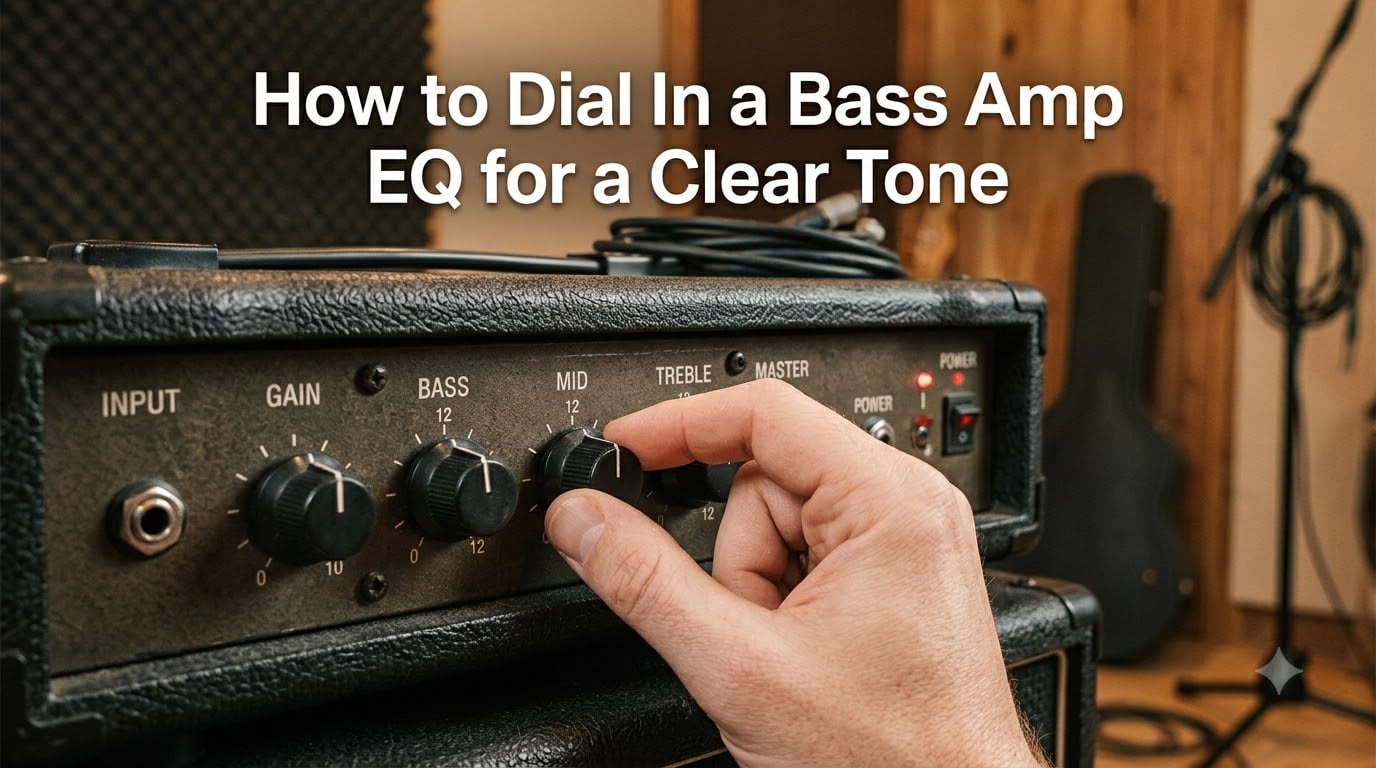
If your bass sounds boomy, muddy, or just disappears in the band mix, the fix is almost always in your EQ. I have spent years teaching bass players how to dial in a bass amp EQ for a clear tone, and the same few mistakes show up every time.
The good news is that getting clarity does not require fancy gear or a sound engineering degree. You only need to understand what each knob does, start from a clean baseline, and make small adjustments while listening critically. In this guide I will walk you through the exact process I use in my own playing and teaching, plus a frequency cheat sheet, room-specific tweaks, and answers to the questions bass players ask me most.
By the end, you will know how to cut mud, boost definition, and shape a tone that sits perfectly in any mix.
Table of Contents
Understanding Bass Amp EQ: What Each Knob Actually Does
Before you turn anything, you need to know what you are adjusting. Most bass amps give you between three and five bands of EQ. Here is what each one really controls.
The bass knob shapes frequencies below about 250 Hz. This is the body and weight of your sound, the rumble that you feel in your chest. Pushing it up makes your tone thicker. Pulling it back thins things out.
The low-mid knob (sometimes labeled 250 Hz or 500 Hz) controls the region where mud lives. This is the area that gets boomy in small rooms or when you stand too close to a wall.
The high-mid knob covers roughly 800 Hz to 2 kHz. This is the most important band for clarity. It contains the harmonics that let other musicians hear your note choice clearly.
The treble knob shapes everything above 3 kHz. This adds string noise, finger attack, and pick definition. Too much treble gets harsh fast, especially with roundwound strings.
Some amps also include a presence control, a bright switch, or a contour button. These add a fixed EQ curve on top of your manual settings. Always turn them off when you start dialing in. They are useful once you have a baseline, but they mask what your main knobs are doing.
Bass EQ Frequency Cheat Sheet (40 Hz to 6 kHz)
Most competitors skip this and it is one of the most useful tools for beginners. Here is what each frequency range actually sounds like on a bass.
| Frequency Range | What It Sounds Like | What to Do With It |
|---|---|---|
| 40 Hz to 80 Hz | Sub-bass rumble, felt more than heard | Cut in small rooms, gentle boost outdoors |
| 80 Hz to 250 Hz | Body, warmth, fundamental weight | Core of your tone. Leave near flat unless the room is boomy |
| 250 Hz to 500 Hz | Mud zone, where boom lives | Cut slightly to clean up a muddy tone |
| 500 Hz to 1 kHz | Note definition, “punch” | Boost for cut in a band mix |
| 1 kHz to 3 kHz | Snarl, growl, finger attack | Adjust for style. Slap and rock need more here |
| 3 kHz to 6 kHz | String noise, brightness, pick click | Use sparingly. Too much gets fizzy |
Save this table on your phone. The next time something sounds off, you will know which knob to reach for.
Step 1: Set a Flat EQ Starting Point (All Knobs at Noon)
Every pro I know starts here. Flat EQ means every knob sits at 12 o’clock, the middle position. This gives you a neutral reference so you can actually hear what each adjustment does.
Before you do anything, turn off every shape switch on your amp. That includes bright, contour, vintage, deep, and any other tone-shaping button. These add hidden EQ curves that confuse your starting point.
Now set your bass, low-mid, high-mid, and treble knobs to exactly noon. On a passive bass, set your tone knob to about 75 percent up. On an active bass with a three-band preamp, set the bass and treble flat and the mid flat or slightly scooped, depending on the brand.
Set your amp volume low for now. You will raise it in a moment. The goal at this stage is to get a clean signal path before you start shaping tone.
Step-by-Step: How to Dial In a Bass Amp EQ for a Clear Tone
Now that everything is flat, you can actually hear your adjustments. Follow these steps in order.
Step 2: Raise the volume slowly. Bring your amp volume up to a comfortable practice level. If you are in a band, raise it to roughly gig volume. EQ sounds completely different at low volume than at performance volume.
Step 3: Cut before you boost. Boosting everything creates a thick, fizzy mess. Cutting the frequencies you do not want gives you more headroom and clarity. Start by reducing any band that sounds boomy or harsh.
Step 4: Boost the mids for definition. The single most important adjustment for bass tone clarity is a small boost in the high-mid range, somewhere between 500 Hz and 1 kHz. Try pushing your high-mid knob up about 2 dB and listen. That is where your note definition lives.
Step 5: Test with a reference track. Pull up a song with bass you admire and play along. Listen for which frequencies stand out. Compare your tone to the recording and adjust by ear.
Step 6: Solo, then full band. Always re-check your EQ in the full band mix. A tone that sounds amazing alone often disappears when a guitarist and drummer join in.
Step 7: Save your settings. If your amp has presets, save this as your baseline. Now you have a clean starting point you can tweak for every gig.
Smiley vs Frown EQ: Two Ways to Shape Your Tone
This is one of my favorite concepts to teach because it gives you a mental picture of what your EQ is doing. Draw an imaginary line across your EQ knobs and you will see one of two shapes.
A smiley EQ has your bass and treble knobs turned up with the mids scooped down. It looks like a smile. This shape sounds huge, modern, and scooped. It works great for slap, funk, and aggressive rock. The downside is that you lose definition and you can sound lost in a busy mix.
A frown EQ has the mids pushed up while bass and treble sit lower. It looks like a frown. This shape emphasizes the note definition and cuts through a mix beautifully. It is the classic rock and Motown bass sound.
Most beginners default to a smiley curve because it sounds huge in the bedroom. In a band mix, frown EQ almost always wins. Try both shapes for yourself and notice how each one changes your role in the music.
Why Mids Are the Secret to Note Definition and Cut
If you remember nothing else from this guide, remember this. Mids are what let the drummer hear your kick, the guitarist hear your root notes, and the singer hear your harmony. Without mids, you become a wall of low rumble.
The exact sweet spot is between 500 Hz and 1 kHz for note definition, and 1.5 kHz to 3 kHz for picking attack and growl. A small boost of 2 to 4 dB in this range usually makes a bass tone come alive.
If your amp only has a single mid knob, sweep it slowly while playing a sustained note. You will hear a point where your tone suddenly pops out of the speaker. That is your mid sweet spot.
Forum regulars on TalkBass and the bass subreddit agree. The most common answer to “why does my bass sound muddy” is almost always “boost your mids.”
Active vs Passive Bass: How Your Pickups Change Your EQ
This is one area that almost no beginner guide covers, and it matters more than most players realize.
A passive bass has no onboard preamp. The signal goes straight from the pickups to your amp. Your amp’s EQ is doing all the work. Flat EQ on your amp sounds neutral.
An active bass has a built-in preamp powered by a 9V battery. The preamp already shapes your tone before it ever reaches your amp. This means your amp’s EQ is now working on an already-shaped signal.
If you play active, your amp’s bass knob often needs to come down a little, and your treble can come down too. The preamp is already adding those. If you crank every knob on the amp with an active bass, you will get a honky, scooped tone.
Quick test. Plug in your active bass, set everything flat, and listen. Then plug in a passive bass with the same settings. The difference tells you how much your bass’s preamp is doing.
Adjusting EQ for Your Room (Small Room, Large Venue, Corner Placements)
Your EQ settings change based on where you play. A living room and a stadium are not the same acoustic environment.
Small rooms and bedrooms: Walls reflect low frequencies back at you. Cut your bass knob by 1 to 2 dB to avoid boom. If you sit in a corner, the problem gets worse. Move away from the wall first if you can.
Mid-size venues and rehearsal spaces: Start with flat EQ and adjust by ear. These rooms usually reward a slight mid boost for cut.
Large venues and outdoor gigs: Bass frequencies get absorbed by air over distance. Boost your bass slightly and consider adding a touch more treble so your tone carries to the back of the room.
Corner placement: Bass frequencies build up in corners. If your amp sits in a corner, your low end is being doubled by the room. Cut bass and low-mid aggressively or move the amp.
Common Bass EQ Mistakes (and How to Avoid Them)
After teaching bass for years, I see the same five mistakes over and over. Here is how to avoid them.
Mistake 1: Boosting everything. If every knob is at 3 o’clock, you have more EQ than your amp can deliver cleanly. Pull back and start from noon.
Mistake 2: Skipping the flat start. Without a reference, you are guessing. Always set flat first.
Mistake 3: Ignoring mids. Mids are your best friend. Most beginners cut them when they should be boosting them.
Mistake 4: Never checking the band mix. A great solo tone can vanish in a band. Always test in context.
Mistake 5: Cranking treble for definition. Treble gives you string noise, not clarity. For real definition, boost mids instead.
Genre-Specific EQ Starting Points
Use these as starting points, then adjust by ear. Every room and every bass is different.
Rock and pop: Flat bass, slight mid boost around 800 Hz, treble at noon or slightly up.
Jazz and Motown: Boost mids, keep bass present but not boomy, gentle treble. The classic frown curve.
Metal and punk: Boost treble and presence for pick attack, slight mid scoop, controlled bass.
Slap and funk: Heavy smiley curve. Boost bass and treble, scoop the mids for that 80s slap sound.
Recording vs live: Recording allows more low end since you are not competing with stage volume. Live needs more mids to cut through.
Quick EQ Reference Checklist
Save this checklist for your next practice session.
Turn off all shape switches (bright, contour, vintage)
Set every EQ knob to 12 o’clock
Set bass tone knob to 75 percent
Raise amp volume to gig level
Boost high-mid 2 dB for definition
Cut low-mid if the room sounds boomy
Test with a reference track
Re-check in the full band mix
Save the settings as your baseline
FAQs
How to EQ bass for clarity?
Start with all EQ knobs at the 12 o’clock position and turn off any bright or contour switches. Then boost the high-mid knob by 2 to 4 dB in the 500 Hz to 1 kHz range. This is where note definition lives and where your tone will cut through a band mix.
How to get a clear bass tone?
A clear bass tone starts with a flat EQ reference and small, focused adjustments. Boost mids for definition, cut low-mids if the room sounds boomy, and keep treble moderate to avoid harsh string noise. Always test your tone in a full band mix, not just solo.
What Hz gives bass clarity?
Clarity lives in the high-mid range between 500 Hz and 1 kHz. Boosting this region gives you note definition and helps your bass cut through a mix. The 1 kHz to 3 kHz range adds growl and pick attack for styles like rock and slap.
Should I boost or cut bass frequencies?
Cut before you boost. Lowering unwanted frequencies gives you more headroom and a cleaner signal. Most beginners boost too much, which creates a muddy and harsh tone. Make small cuts and even smaller boosts.
Why does my bass sound muddy?
Muddy bass usually comes from too much energy in the 200 Hz to 500 Hz range. Cut your low-mid knob slightly, reduce the bass knob if you are in a small room, and add a small mid boost to restore definition. Room acoustics also play a big role in muddiness.
What is flat EQ on a bass amp?
Flat EQ means every EQ knob is set to the 12 o’clock or middle position, with no boost or cut on any band. Shape switches like bright and contour should also be turned off. Flat EQ gives you a neutral reference point for dialing in your tone.
Final Thoughts on Dialing In a Bass Amp EQ for a Clear Tone
Learning how to dial in a bass amp EQ for a clear tone is really about building a repeatable process. Start flat, listen, cut the bad, boost the good, and always test in a band mix.
Your perfect EQ will change from gig to gig and room to room. That is normal. What matters is that you have a system you trust. Save your baseline, write down what you tweak, and over time you will build a library of settings for every situation.
Pick up your bass, set everything to noon, and start with one small adjustment. That is the whole secret.