
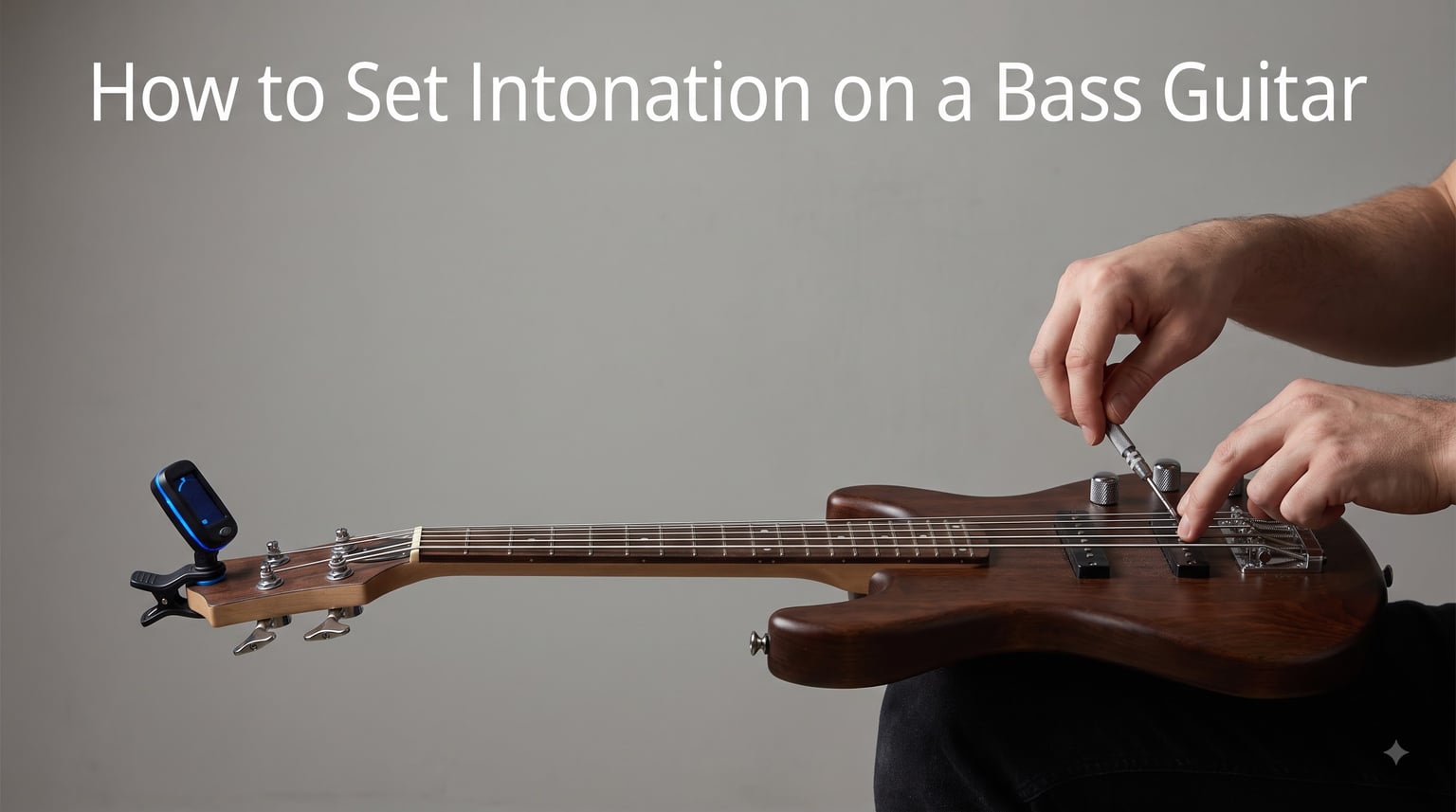
Learning how to set intonation on a bass guitar is one of those skills that separates a good-sounding instrument from a frustrating one. You tune your open strings perfectly, but the moment you play a note higher up the neck, something sounds off. That is an intonation problem, and it affects almost every bassist at some point.
I have set up dozens of basses over the years, from entry-level imports to custom shop instruments. The process is the same regardless of what you play, and with the right approach, you can nail it in about 30 minutes per bass. No luthier degree required.
In this guide, I will walk you through the entire process step by step. You will learn what intonation actually is, how to tell when it is off, the exact tools you need, and the precise if-then rules for adjusting each string. I will also cover the specific issues that come up with 5-string basses and the common mistakes that trip people up.
Table of Contents
What Is Bass Intonation?
Intonation is how accurately your bass plays in tune across the entire fretboard. When intonation is correct, every fretted note matches its correct pitch relative to the open string. When it is wrong, your bass will sound out of tune even though your open strings are perfectly tuned to E, A, D, and G.
Here is what happens physically. Each string on your bass has a set scale length, which is the distance from the nut to the bridge saddle. When you press a string down at any fret, you are effectively shortening that string. If the saddle is positioned so the string length matches the scale length precisely, the fretted notes land at the correct pitch. If the saddle is too far forward or too far back, every fretted note will be slightly sharp or flat.
The bridge saddle is the adjustable piece on your bridge that each string passes over. Moving it forward shortens the string, and moving it backward lengthens the string. That adjustment is what sets your intonation.
One thing most guides skip: perfect intonation is physically impossible on a fretted instrument. Basses use equal temperament tuning, which means the frets are positioned as a compromise so that you can play in any key. Some notes will always be slightly off. The goal is not perfection. The goal is to get the 12th fret as close as possible so that the errors are small enough that no one notices them in real-world playing.
Signs Your Bass Intonation Is Off
Before you start adjusting anything, you need to confirm that intonation is actually the problem. Here are the telltale signs:
Your open strings are perfectly tuned, but chords and fretted notes sound sour.
The 12th fret harmonic and the fretted 12th fret note do not match on your tuner.
Notes higher up the neck (past the 7th fret) sound progressively more out of tune.
You find yourself constantly retuning mid-song even though the open strings are fine.
The quickest diagnostic test is the 12th fret check. Play the 12th fret harmonic on any string and watch your tuner. Then press down and play the actual 12th fret note on that same string. If both register as perfectly in tune, your intonation on that string is correct. If the fretted note reads sharp or flat compared to the harmonic, you need to adjust.
Prerequisites: What to Do Before Setting Intonation
This is where a lot of bassists go wrong. They jump straight to the bridge saddles without doing the prep work first. Intonation is the last step in a proper bass setup, and if you skip the earlier steps, your adjustments will not hold.
1. Put on fresh strings. Old, dead strings do not intonate accurately. The wear and accumulated grime change how the string vibrates, and no amount of saddle adjustment will fix that. Put on a new set before you touch anything else. I cannot stress this enough based on how many times I have seen players chase intonation problems that disappeared with a string change.
2. Set your neck relief. The truss rod controls the forward bow of your neck, and that bow affects string tension and pitch at every fret. If your neck has too much or too little relief, your intonation readings will be thrown off. Adjust the truss rod first so you have a slight, even curve in the neck.
3. Set your action (string height). String height directly affects intonation because pressing a string down stretches it slightly. Higher action means more stretch, which means sharper fretted notes. Set your action to your preferred playing height before you intonate, because if you change the action later, the intonation will shift.
4. Check your nut slots. If the nut slots are too high, the strings pull sharp when you fret notes in the first few positions. This is a separate problem from bridge intonation, but it will make you think your intonation is off when the bridge is actually fine. Nut slots should be just deep enough that a string barely clears the first fret.
The order matters: strings, then relief, then action, then nut, then intonation. Do it in that sequence every time.
Tools You Need to Set Intonation
The good news is you only need a few basic tools:
A quality chromatic tuner — This is the most important tool. A clip-on tuner, pedal tuner, or phone app will work, but accuracy matters. Pedal tuners like the Boss TU-3 tend to be the most reliable. Phone apps are acceptable in a pinch but can be less stable on low frequencies.
A small screwdriver or Allen wrench — Most bass bridges use either a Phillips head screw or an Allen wrench to adjust the intonation screws. Check your bridge hardware before starting.
Fresh strings — Already covered above, but listing it here as a required tool because it is that critical.
A quiet space — Background noise can interfere with tuner readings, especially on low notes like the E and B strings.
That is it. No specialty luthier tools, no expensive equipment. A good tuner and the right screwdriver are all you need.
How to Set Intonation on a Bass Guitar: Step by Step
Now for the main event. Here is the exact process I use on every bass I set up. Work on one string at a time, starting with the lowest string (E or B) and moving to the highest (G).
Step 1: Tune the open string to perfect pitch. Use your tuner and get the open string locked in. Tune up to the note rather than down to it, meaning if the string is sharp, detune below the target pitch and then tune back up. This removes slack from the tuning peg and gives you a more stable starting point.
Step 2: Play the 12th fret harmonic. Lightly touch the string directly over the 12th fret and pluck it. Do not press down. This produces a pure harmonic that should read as perfectly in tune on your tuner since it is exactly one octave above the open string.
Step 3: Play the fretted 12th fret note. Now press down normally at the 12th fret and play the note. Use your normal fretting pressure, not extra hard and not feather-light. The goal is to match your real playing technique.
Step 4: Compare the two readings. Look at your tuner for both notes. If the harmonic is in tune but the fretted note is sharp, the string is too short. If the fretted note is flat, the string is too long.
Step 5: Adjust the bridge saddle. This is where the if-then rules come in, and getting this right is the key to the entire process:
If the fretted note is sharp, the string is too short. Loosen the intonation screw and move the saddle backward (away from the neck) to lengthen the string.
If the fretted note is flat, the string is too long. Loosen the intonation screw and move the saddle forward (toward the neck) to shorten the string.
Step 6: Retune and recheck. Every time you move a saddle, the string tension changes, which throws the open string out of tune. Retune the open string to perfect pitch, then check the 12th fret harmonic and fretted note again. You will likely need to repeat steps 5 and 6 two or three times before the fretted note matches the harmonic.
Step 7: Repeat for each string. Move to the next string and run through the same process. Each string is independent, so getting one right does not affect the others.
A quick tip: make small adjustments. A quarter turn of the intonation screw can move the tuner needle significantly. Small tweaks, retune, recheck. Patience here pays off.
Also, check your intonation in playing position, not just sitting down with the bass flat on your lap. The angle of the bass affects how strings vibrate and can shift the readings slightly. I learned this from a luthier who insisted on having the player hold the bass the way they actually perform before finalizing any setup.
Sharp vs Flat: Quick Reference Rules
Because the sharp and flat adjustment rules come up so often, here is a clean reference you can bookmark. These rules apply to every string on every type of bass.
If the fretted 12th fret note is sharp:
The vibrating string length is too short.
Move the bridge saddle backward, away from the fingerboard.
This lengthens the string and flattens the fretted note.
Retune the open string, then recheck the 12th fret.
If the fretted 12th fret note is flat:
The vibrating string length is too long.
Move the bridge saddle forward, toward the fingerboard.
This shortens the string and sharpens the fretted note.
Retune the open string, then recheck the 12th fret.
An easy memory trick: sharp means the saddle goes back (both start with letters in the back half of the alphabet). Flat means the saddle goes forward. If that does not stick, just think about it logically. A string that reads sharp at the 12th fret is effectively too short for the fret positions, so you need to give it more length by moving the saddle back.
5-String Bass Intonation Considerations
If you play a 5-string bass, the low B string introduces some unique challenges that 4-string players never deal with. The fundamental frequency of a low B is around 31 Hz, and many tuners struggle to read that low accurately.
If your tuner will not lock onto the B string, try playing the 12th fret harmonic instead of the open string for your baseline. The harmonic sits at a higher, more readable frequency. You can also try a pedal tuner designed for bass, as these are built to track low notes better than clip-on tuners or phone apps.
The B string also has a lot of mass and tension, which means small saddle movements produce bigger pitch changes than on the thinner strings. Make even smaller adjustments than you would on the E string, and be extra patient with the retune-and-recheck cycle.
Some 5-string players find that the B string intonation is a compromise no matter what they do. The physics of a thick, low-tension string over a fixed scale length means the B will never be as perfectly intonated as the G. Get it as close as you can, and accept that it may read slightly off at certain frets. That is normal and not a sign that your bass is defective.
Common Intonation Problems and Troubleshooting
Even when you follow the process correctly, some stubborn problems can arise. Here are the issues I see most often and how to handle them.
The G string will not intonate properly. This is the most common complaint on bass forums, and for good reason. The G string is the thinnest and has the least tension, which makes it the most sensitive to setup variables. If your G string refuses to intonate, check three things: string age, nut slot height, and saddle condition. A worn saddle groove can cause the string to sit inconsistently, throwing off readings. If the saddle looks worn or notched too deeply, it may need to be replaced or re-filed by a professional.
Intonation is correct at the 12th fret but off at other frets. This is where equal temperament and fret wear come into play. If your frets are worn unevenly, notes fretted on worn spots will read differently than notes on clean frets. The 12th fret method gets you close, but it cannot compensate for individual fret wear. If your bass has significant fret wear, a fret level and dress job will do more for your intonation than any saddle adjustment.
Notes past the 15th fret are consistently sharp. This usually points to action that is too high. When you press a string down hard against high frets, the extra stretch sharpens the pitch. Lower your action slightly and recheck. If the problem persists, your neck may have too much relief in the upper register.
Intonation keeps drifting after adjustment. If you set the intonation and it shifts within a few days, something is mechanically wrong. Check that the intonation screws are not stripped and that the saddles are not sliding under string tension. On older bridges, the screw threads can wear out and lose their grip. A bridge upgrade may be the only lasting fix.
Your bridge does not have adjustable saddles. Some vintage-style and budget bridges have fixed saddles that cannot be moved forward or backward individually. On these bridges, you cannot adjust intonation per string. Your options are to replace the bridge with an adjustable unit or accept the factory intonation. Most modern basses under reasonable price points now come with individually adjustable saddles, so this is increasingly rare.
When to take it to a professional. If you have fresh strings, correct relief, proper action, and good nut slots, but your bass still will not intonate, the problem is likely deeper than the bridge. A luthier can diagnose issues like a misplaced bridge, warped neck, or severe fret wear that no amount of DIY adjustment will fix. Spending on a pro setup is cheaper than replacing parts in frustration.
FAQs
What is the 3 fret rule on bass?
The 3 fret rule is a quick intonation check. Play a note open, then play the same note fretted at the 3rd fret (or 5th or 7th). If the open string is in tune but the fretted note reads sharp or flat on your tuner, your intonation is off. The most reliable version uses the 12th fret: compare the 12th fret harmonic to the fretted 12th fret note. If they match, intonation is correct for that string.
How to correctly set intonation?
To set intonation correctly, first put on fresh strings and set your neck relief and action. Tune the open string to perfect pitch. Play the 12th fret harmonic and note the reading. Then play the fretted 12th fret note. If it reads sharp, move the bridge saddle backward to lengthen the string. If it reads flat, move the saddle forward to shorten it. Retune the open string after each adjustment and recheck until the fretted note matches the harmonic.
How do you tell if your intonation is off?
The easiest way to check is the 12th fret test. Play the 12th fret harmonic on a string and check it on a tuner. Then press and play the actual 12th fret note. If the harmonic is in tune but the fretted note reads sharp or flat, your intonation needs adjustment. Other signs include chords sounding sour despite tuned open strings and notes getting progressively more out of tune as you move up the neck.
How to intonate a bass bridge?
To intonate a bass bridge, use the intonation screws at the back of each bridge saddle. For each string, tune the open string, then compare the 12th fret harmonic to the fretted 12th fret note. Turn the intonation screw to move the saddle backward if the fretted note is sharp, or forward if it is flat. Retune the string after each adjustment and repeat until the fretted note matches the harmonic.
How often should I check my bass intonation?
Check your intonation every time you change strings, which for most players is every 1 to 3 months. You should also check it after any setup change, such as adjusting action or truss rod relief, since those changes can shift your intonation. If you play regularly and notice your bass sounding out of tune despite perfect open-string tuning, it is time to recheck.
Conclusion
Knowing how to set intonation on a bass guitar gives you control over how your instrument actually sounds in the real world. The process comes down to a few fundamentals: fresh strings, correct setup order, a quality tuner, and the simple rule that sharp means move the saddle back and flat means move it forward. Take your time, make small adjustments, and always retune between changes. Your ears, your bandmates, and anyone listening will hear the difference.
1 thought on “How to Set Intonation on a Bass Guitar (September 2026)”