

Most home-shop compressors ship with three things bolted to the tank: a plastic bowl that weeps, a fixed regulator you cannot adjust, and a petcock valve tucked underneath where you cannot see it. The best air compressor tank accessories replace those three weak points and add a few things the factory never bothered with, such as a real moisture filter, more than one outlet, and a drain you can reach without crawling under the machine.
We spent several weeks in a two-car garage going through tank-side hardware of every kind: drain assemblies, filter-regulators, manifolds, pressure switches, replacement gauges and a certified reserve tank. The difference between a well-equipped shop and a stripped one is rarely the compressor itself. It is what sits on top of it.
This guide covers the tank side specifically, not hose and gun kits. If you want the broader picture, our beginner kit roundup format is a useful model for how we test parts at home, and the sizing logic here is the same kind of checklist we use when laying out a starter equipment bundle for a new space.
Table of Contents
What Are the Best Air Compressor Tank Accessories?
Here is the short answer, one line per accessory. Every item below mounts to, threads into, or serves the tank and its outlet.
Adjustable filter-regulator — controls outlet pressure and strips water and oil in a single body.
Ball-type tank drain valve — a quarter-turn brass drain that empties the tank in seconds instead of a slow screw petcock.
Extended tank drain assembly — moves the drain valve out from under the tank on a braided steel hose so you can actually reach it.
Air manifold with quick-connect couplers — splits one line into several outlets so two tools can run at once.
Tank pressure gauge — a readable dial so you know what the tank is doing without walking over to the machine.
Liquid-filled pressure gauge — a glycerin or liquid damped dial that holds a steady needle on a vibrating tank.
Replacement pressure switch — restores automatic cut-out when the original switch contacts weld shut.
OEM regulator replacement — a direct-fit unit for common house-brand compressors with a weeping regulator.
Safety relief valve and bypass assembly — the part that protects the tank, and the part most people never inspect.
Check valve or anti-surge valve — stops tank pressure bleeding back toward the pump when the compressor stops.
ASME-certified reserve tank — adds stored air so a small compressor stops running nonstop on air-hungry tools.
Thread seal tape and threadlocker — the two sealing consumables that decide whether a fitting leaks from day one.
Top 3 Picks for Best Air Compressor Tank Accessories in October
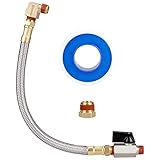
Hromee Extended Tank Drain Kit
- 1/4 inch NPT at both ends
- 175 PSI working pressure
- 10 inch braided steel hose
- Chrome-plated brass ball valve

Hromee Air Tank Repair Kit
- Brass manifold and safety valve
- 0-200 PSI dual scale gauge
- 4 foot hose at 300 PSI
- Rescues a worn tank assembly
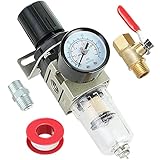
Hromee Filter Regulator Combo
- Brass filter element
- Adjustable outlet pressure
- 150 PSI maximum
- Transparent filter cup
All 12 Air Compressor Tank Accessories at a Glance in 2026
| Product | Specs | Action |
|---|---|---|
| Hromee Extended Tank Drain Assembly Kit |
|
Check Latest Price |
| Hromee Air Tank Repair Kit |
|
Check Latest Price |
 Milosline 3-Way Air Manifold Splitter Milosline 3-Way Air Manifold Splitter |
|
Check Latest Price |
 Performance Tool 0-200 PSI Air Gauge Performance Tool 0-200 PSI Air Gauge |
|
Check Latest Price |
 senctrl Liquid Filled 0-200 PSI Gauge senctrl Liquid Filled 0-200 PSI Gauge |
|
Check Latest Price |
| Hromee Filter Regulator Combo AW2000-02 |
|
Check Latest Price |
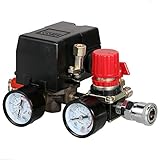 Secbolt Pressure Switch Regulator Gauges Secbolt Pressure Switch Regulator Gauges |
|
Check Latest Price |
 JahyShow Pressure Switch 90-125 PSI JahyShow Pressure Switch 90-125 PSI |
|
Check Latest Price |
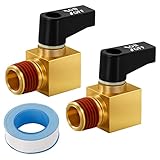 SUNROAD Brass Ball Drain Valve 2 Pack SUNROAD Brass Ball Drain Valve 2 Pack |
|
Check Latest Price |
 Metabo HPT 10 Gallon ASME Tank Metabo HPT 10 Gallon ASME Tank |
|
Check Latest Price |
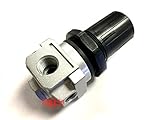 D27253 Regulator Replacement D27253 Regulator Replacement |
|
Check Latest Price |
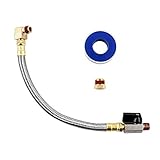 QWORK Extended Tank Drain Valve Kit QWORK Extended Tank Drain Valve Kit |
|
Check Latest Price |
1. Hromee Extended Tank Drain Assembly Kit – the drain you will actually use
Hromee Extended Tank Drain Assembly Kit with 10 Inch Braided Steel Hose 1/4 Inch Drain Valve and Elbow Fitting for Air Compressor
1/4 inch NPT both ends
175 PSI working pressure
10 inch braided steel hose
Pros
- Chrome-plated brass valve resists corrosion
- Braided steel hose resists kinking and breaking
- Everything needed for installation is included
- Makes draining far easier than reaching under the tank
Cons
- 10 inch length can be too long on some tanks
- No clip included to hold the valve end in place
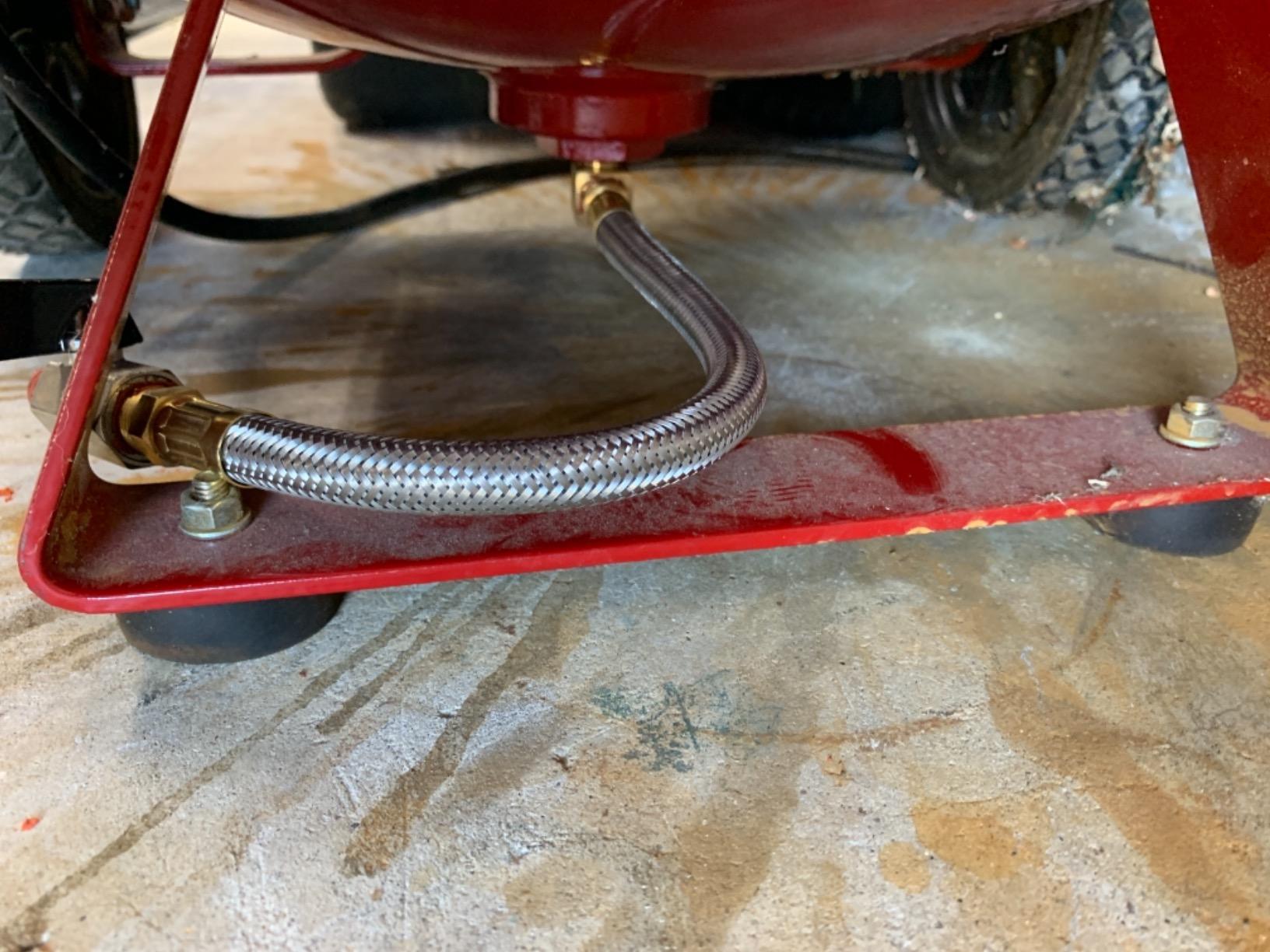
The single most common complaint we heard about factory compressors is that nobody drains the tank, and the reason nobody drains the tank is that the valve is underneath the machine. This kit moves that valve out on a 10 inch braided steel hose with a quarter-turn brass ball valve on the end, so draining takes one hand and no crawling.
Construction is the story here. The hose is braided steel rather than plastic, the valve body is chrome-plated brass, and both ends are 1/4 inch NPT male, which is the size almost every home compressor drain uses. The kit also throws in a 1/4 inch elbow with pre-applied thread sealant, a roll of seal tape, and a 3/8 inch male by 1/4 inch female brass bushing for tanks that use the larger drain.
Rated to 175 PSI working pressure with a 475 PSI blasting pressure and a 200 degree F maximum temperature, it has more headroom than the tank it usually ends up on. Owners consistently describe it as a factory replacement rather than an add-on, which tells you how closely the fit mirrors the original hardware.
When this is the right pick
If you drain by feel and never actually open the valve, this is the accessory that fixes the habit. Rust and water inside a tank are the two things that end compressor life quietly, and moving the drain into view is the cheapest way to stop both. It is also the right call on vertical tanks where the drain sits behind a frame member.
It suits brands where the 1/4 inch NPT male drain is standard, and it works well next to a filter-regulator because the added hose length means the condensate drains downward away from the bowl.
Where it falls short
Length is the recurring caveat. Several buyers note that the 10 inch hose is longer than the distance from the tank drain to the frame on compact machines, so it hangs in the way. There is also no clip or bracket to hold the valve end in a fixed position, which means you route it yourself with a clamp or cable tie.
If your compressor uses a 3/8 inch drain rather than 1/4 inch, the included bushing handles it, but check before you order.
2. Hromee Air Tank Repair Kit – manifold, gauge and hose in one box
Hromee Air Tank Repair Kit w/Safety Valve, Pressure Gauge and 4 Feet Air Tank Hose Assembly kit for Portable Carry Tank
Brass manifold and safety valve
0-200 PSI dual scale gauge
4 foot hose at 300 PSI
Pros
- Complete kit with manifold gauge and hose
- Brass holds pressure better than zinc or aluminum
- Rescues a serviceable tank instead of replacing it
- Simple assembly on worn tank fittings
Cons
- Gauge accuracy is approximate
- Long hose fitting can stop the valve fully closing
- Built for portable carry tanks
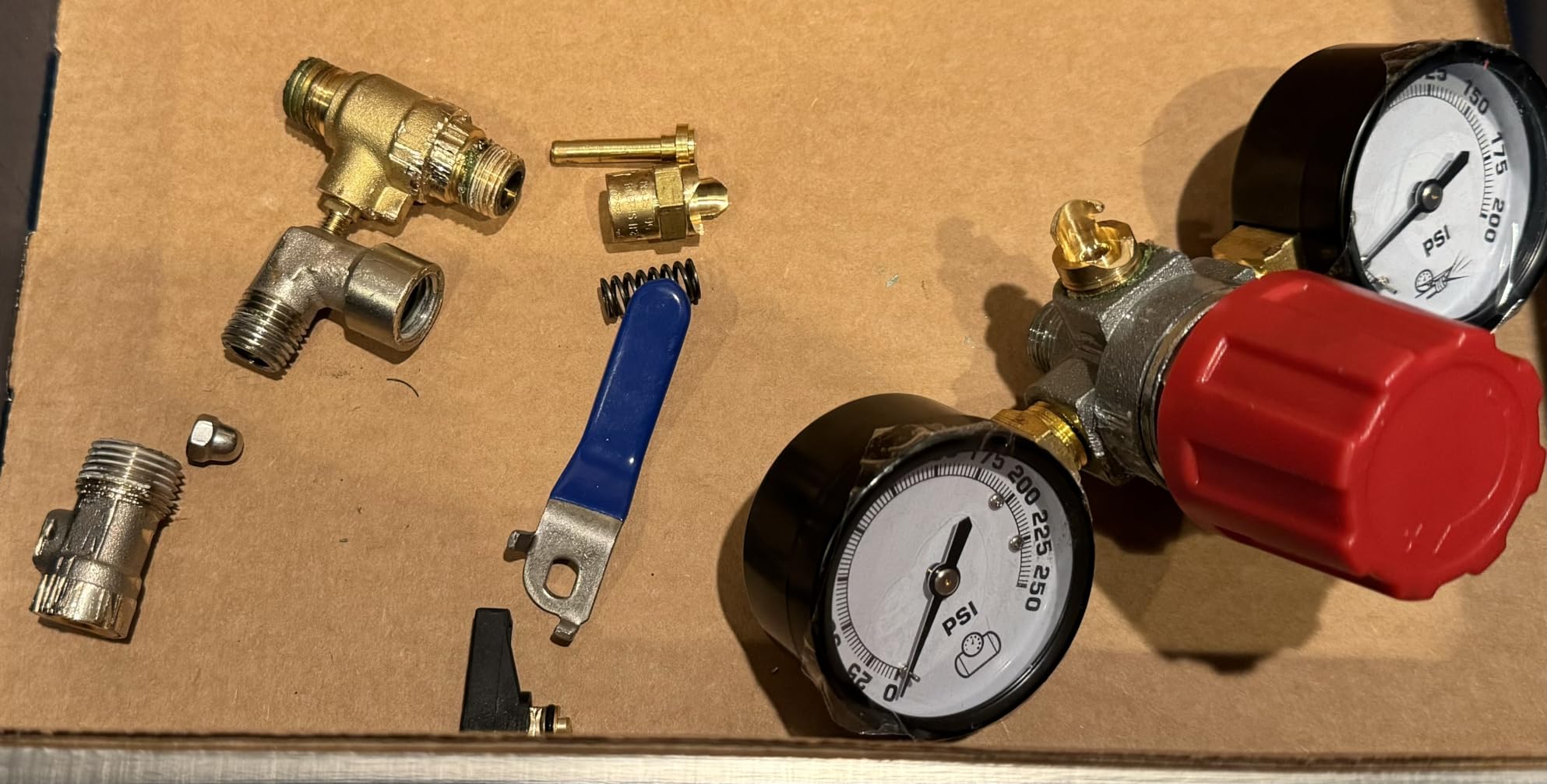
This is the kit for anyone staring at a tank whose outlet assembly has gone: weeping manifold, fogged gauge, perished hose. It bundles a brass manifold, a brass safety bypass valve with a manual override, a 0-200 PSI dual-unit gauge, and four feet of hose with a tire chuck, so you replace the whole assembly in one session instead of hunting part numbers.
The thread layout is the useful detail. The tank end is 1/2 inch MNPT male, the gauge port is 1/8 inch FNPT, and the hose port is 1/4 inch FNPT female. That mix covers most portable carry tank fittings and a lot of older small compressors. A one year manufacturer warranty comes with it.
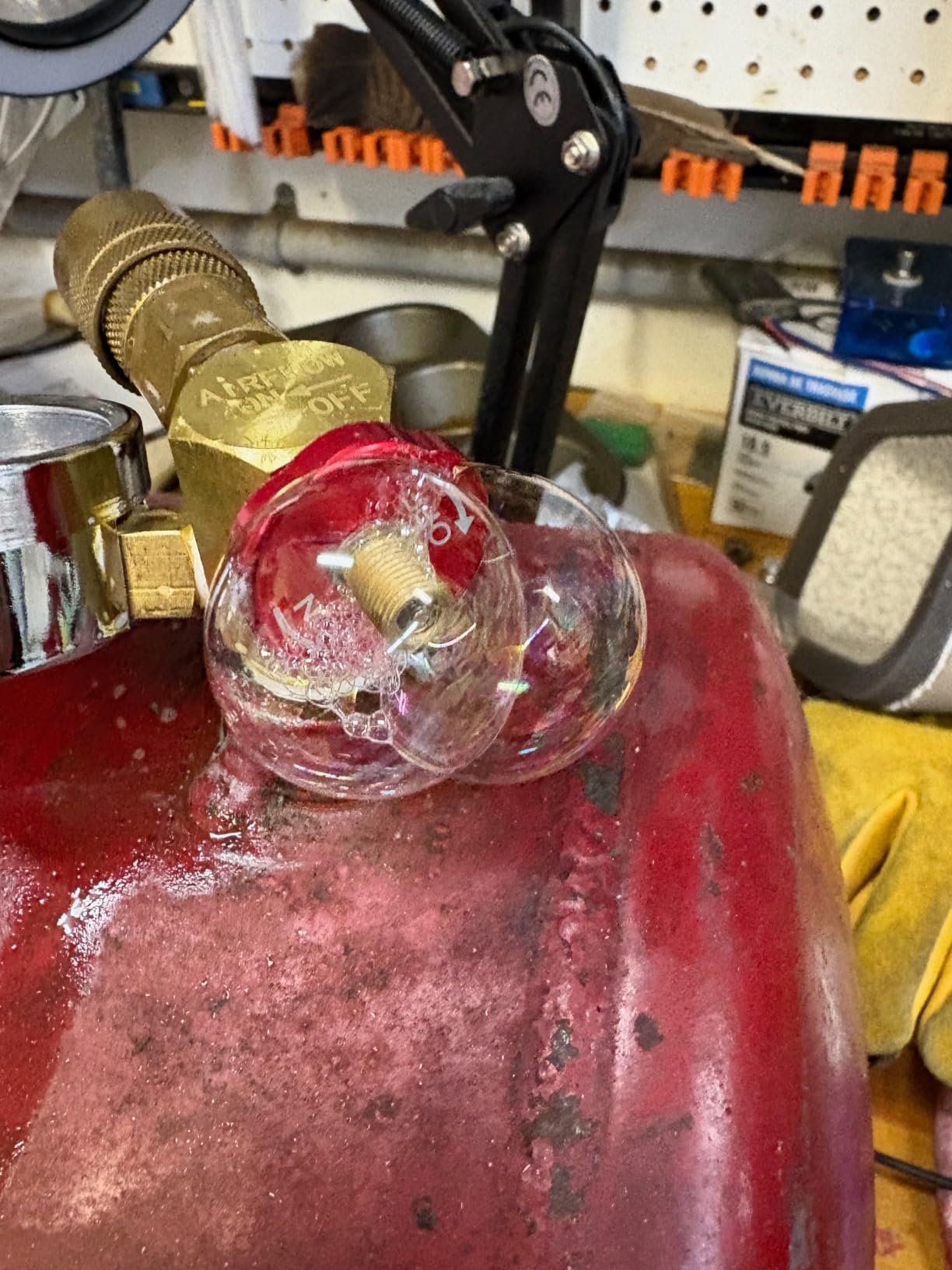
Buyers report that these kits hold air over time where previous repair attempts did not, and that the brass pieces are the reason. Brass threads seal better and resist corrosion compared with the thin zinc fittings that come on budget tanks, and the bypass valve gives you a manual shut-off you can reach from outside the machine.
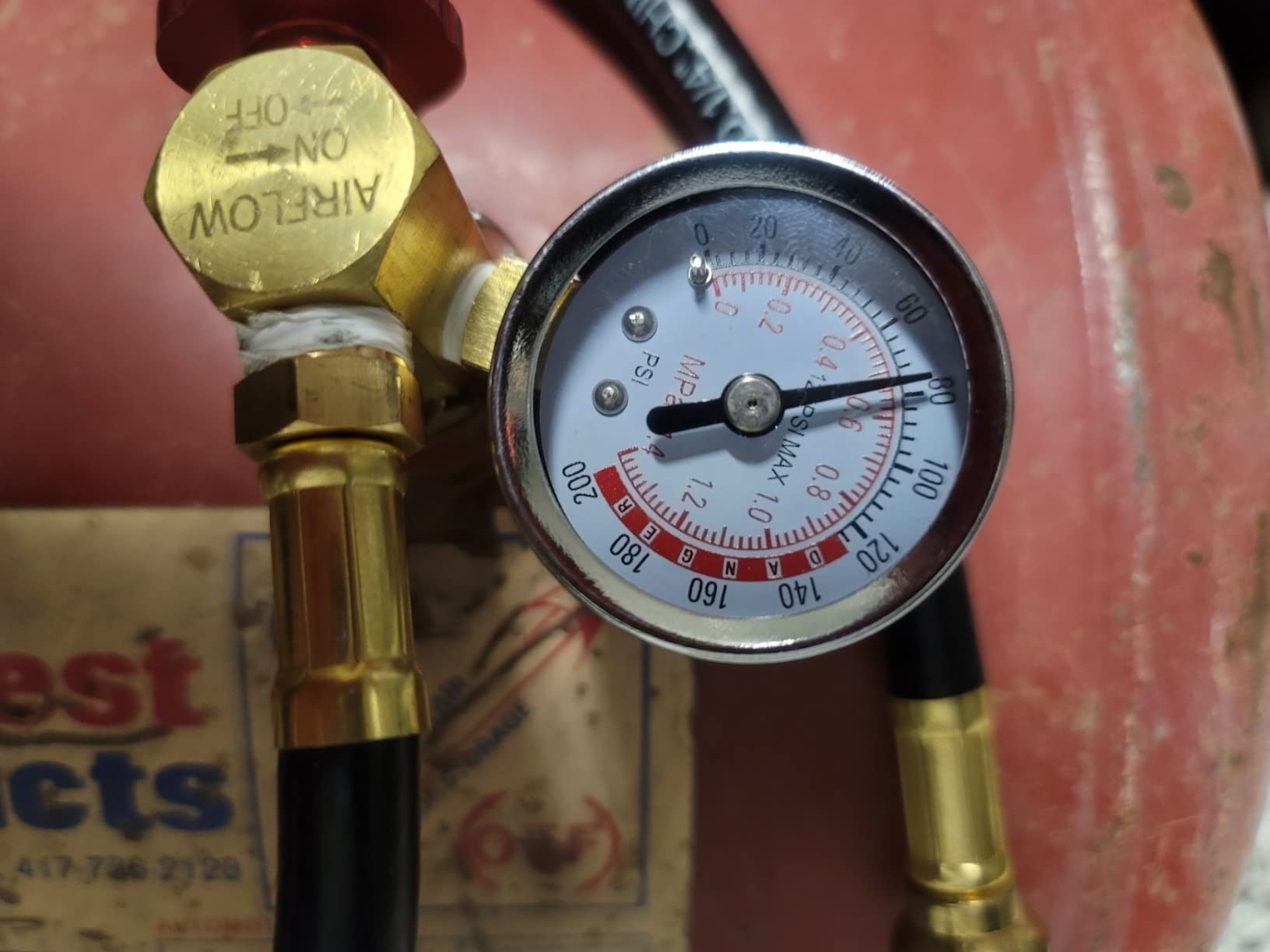
When this is the right pick
It earns its place on portable carry tanks and small shop compressors that have passed the point where a single fitting swap makes sense. If your gauge is fogged, your hose is stiff, and your manifold is weeping, replacing all three at once is less work than three separate trips to the hardware store.
It is also useful as a donor assembly. Several owners use the manifold, valve and gauge as spares for a machine whose tank itself is still perfectly sound.
Where it falls short
The gauge is described as approximate rather than precise, so do not trust it for calibration work. On some units the hose fitting runs long enough that tightening it fully stops the valve from closing completely. It is designed around portable carry tanks, and on some powered compressors you will need adapters you already own.
A small number of buyers report a safety valve that does not fully shut off, which is worth checking with soapy water after fitting.
3. Milosline 3-Way Air Manifold – three outlets from one line
Milosline Connect Fittings Air Splitter, 1/4 Inch NPT 3-Way Air Manifold With 3 Pieces Industrial Quick 1/4NPT Couplers And Plug, Hex Style Air Compressor Hose Accessories Quick Connect Fittings
One 1/4 inch FNPT inlet
Three 1/4 inch FNPT outlets
300 PSI rated
Pros
- Splits one air line into three tool outlets
- Quick couplers switch tools without disconnecting
- Interchangeable with M D and I/M plug types
- Compact hex aluminum body saves space
Cons
- Only one inlet so everything hangs on one hose
- No regulator so outlet pressure follows the tank
- Aluminum body dents more easily than brass
A compressor with one outlet forces a choice: unplug the nailer to plug in the impact wrench. This manifold removes that choice. One 1/4 inch FNPT inlet feeds three 1/4 inch FNPT outlets, each with a four-ball quick coupler, and a matching plug is included in the box.
The couplers are nickel-plated steel with an aluminium sleeve and a blue coating, and they accept M, D and I/M style plugs, which covers virtually every hose and coupler already in a home shop. Rated to 300 PSI working pressure, the couplers are also noticeably lighter than standard steel fittings, which matters when you are moving a line around a bench.
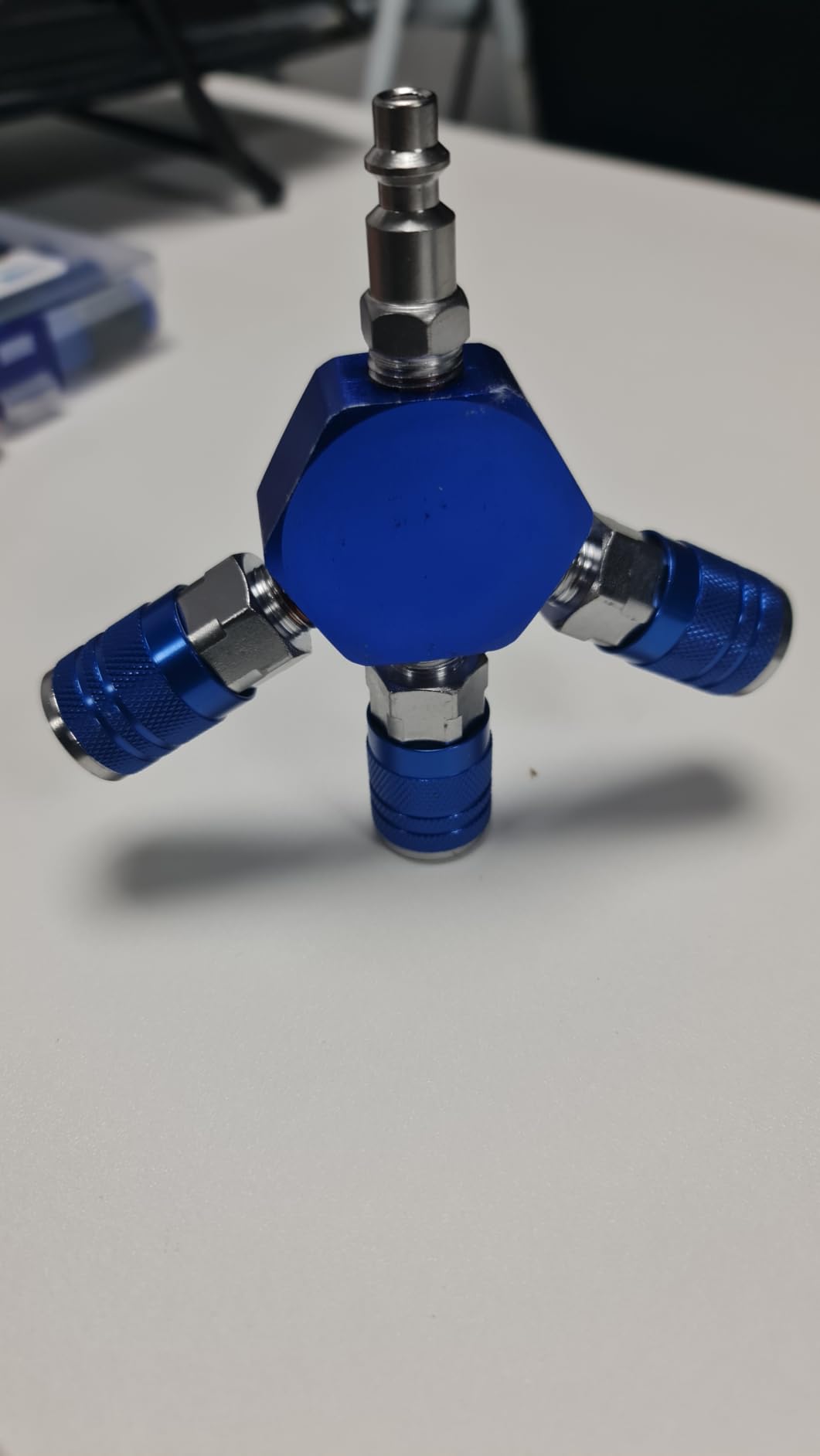
The flat hex aluminium body is the shape choice that earns its keep. It is thin enough to mount on a wall bracket or a bench riser without a deep pocket of clearance, and it keeps the outlets visually organized so you can tell at a glance which hose feeds which tool.
When this is the right pick
It suits a shop where two people work at once, or where you routinely run a finish gun and a dust blower in the same session. It is also the fix for a compressor that shipped with a single hardwired outlet and no room for a second one.
Because the coupler type is standard, you can mix it with hoses from different brands without adapters. That interchangeability is the whole point.
Where it falls short
Everything downstream of one inlet still depends on a single hose, so this is not a capacity upgrade. There is no regulation in the body, meaning outlet pressure simply mirrors tank pressure unless you place a regulator upstream of the manifold. The aluminium body will dent if you drop it or clip it with a hose.
If you plan to run two air-hungry tools continuously at once, a reserve tank addresses that more effectively than more outlets.
4. Performance Tool 0-200 PSI Gauge – the cheap gauge fix
Performance Tool W10055 0-200 PSI Air Gauge for Air Tank Accessory
0 to 200 PSI range
Two color easy-read dial
NPT threaded port
Alloy steel body
Pros
- Inexpensive direct swap for a failed tank gauge
- Two color dial reads at a glance
- Compact body fits standard gauge ports
Cons
- No liquid fill so the needle bounces under load
- Small dial is hard to read across the shop
- Readout only with no regulator function
Tank gauges die in two ways: the face fogs permanently from moisture, or the needle stops moving. Both end the same way, with you guessing at tank pressure. This is the direct replacement for that moment, and at 2,400 reviews it is the most proven part in this whole list.
The dial runs 0 to 200 PSI, which covers every tank in a home shop without going into four-digit territory. The two color face is the feature reviewers mention most, since it lets you read the needle at a glance rather than squinting. The NPT threaded connection and compact alloy steel body fit standard tank gauge ports without fuss.
When this is the right pick
It is the correct part for a compressor where the gauge is the only failed component and the rest of the assembly still holds pressure. It also works well as a second readout: many shops mount one on the tank and one near the bench so you can check pressure without walking across the garage.
Buying a spare keeps you covered. This is the kind of part that sits on a shelf until the day you need it.
Where it falls short
There is no liquid fill, so the needle bounces noticeably whenever the pump is cycling. That makes it a poor choice as the primary readout on a loud tank-mounted setup. The dial is also small, which limits how far away you can read it.
It is a gauge, not a regulator. If the original failure was caused by a regulator that would not hold pressure, replacing the gauge will not help.
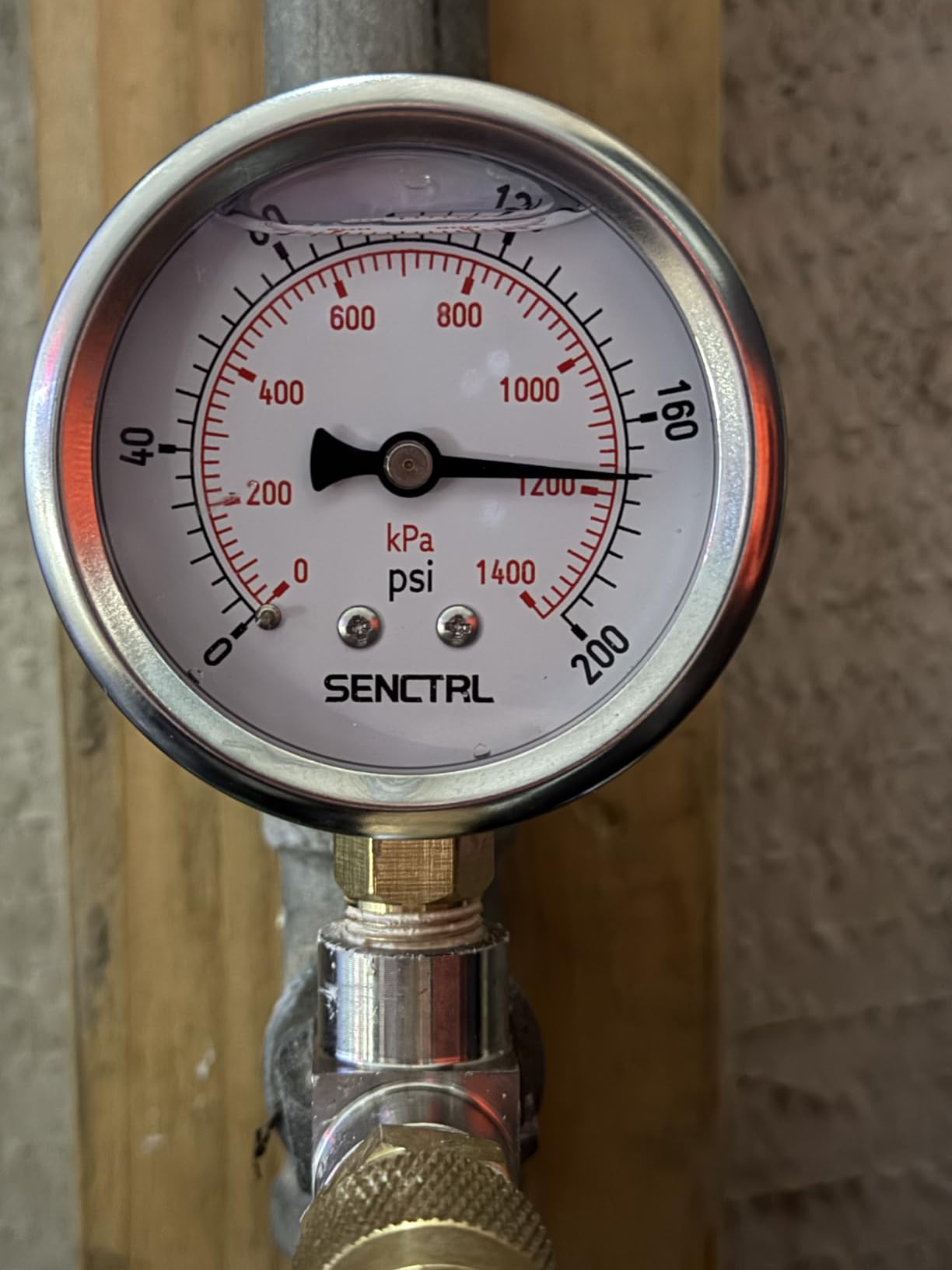
5. senctrl Liquid Filled Gauge – a steady needle on a rattling tank
SENCTRL 0-200 Psi Liquid Filled Pressure Gauge, 1/4″ NPT Lower Mount
2.5 inch glycerin filled dial
0-200 PSI dual scale
1.5 percent accuracy
1/4 inch NPT male
Pros
- Glycerin fill steadies the needle under vibration
- 304 stainless case and brass wetted parts resist corrosion
- IP67 sealing stops internal fogging
- Dual psi and kPa scale
- Also suits water oil and pump lines
Cons
- 2.5 inch dial needs clearance on a small manifold
- Lower mount orientation only
- Readout only with no regulator function
The difference between this gauge and a cheap one shows up the moment the compressor kicks on. A glycerin or liquid fill damps the movement, so the needle holds a readable value instead of bouncing every time the pump cycles. If you have ever tried to set a nailer depth by watching a jumping needle, this is the part that fixes it.
Accuracy is stated at plus or minus 1.5 percent across the full 0-200 PSI range, with a dual scale in psi and kPa on a 2.5 inch dial. The case is 304 stainless steel with brass and stainless wetted parts, and IP67 sealing keeps condensation from fogging the window, which is the failure mode that kills most tank gauges.
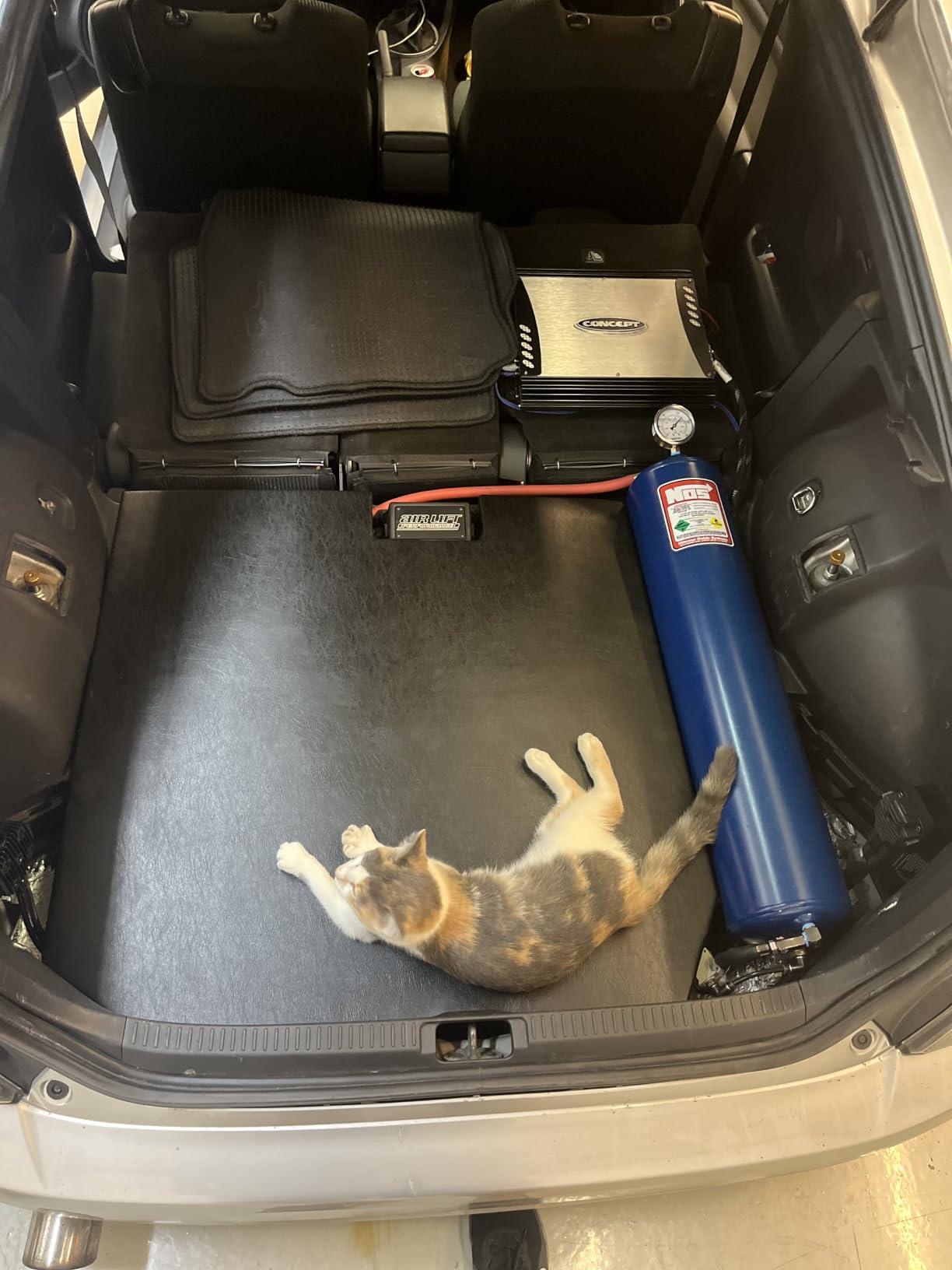
Connection is a 1/4 inch NPT male lower mount. The glycerin fill also protects the internal movement from vibration and pulsation, which is exactly the environment a tank-mounted gauge lives in.
When this is the right pick
It suits a tank near a workbench where you read pressure often, or any setup where the pump is close enough that vibration is constant. It is also a good bench gauge for checking line pressure at a tool rather than tank pressure.
Because it is rated for water, oil, pumps and pipe testing too, it doubles as a shop instrument for non-air work if you ever need it.
Where it falls short
The 2.5 inch dial is larger than a stock tank gauge, so check clearance on a tight manifold or inside a roll cage. It is a lower mount part only, so an upper mount port will not accept it. As with any gauge, it reports but does not regulate.
Glycerin fill does slow response slightly, which matters less on a tank than on a live line.
6. Hromee Filter Regulator Combo – moisture control and pressure in one
Hromee 1/4 Inch Air Compressor Filter Regulator Combo, Water Oil Separator with Pressure Gauge, Manual Drain, Ball Valve and Bracket AW2000-02
Brass filter element
Adjustable outlet pressure knob
150 PSI maximum
Transparent filter cup
Pros
- Strips water and oil before it reaches tools
- Adjustable knob holds steady outlet pressure
- Transparent cup shows what needs draining
- Bracket and fittings included in the box
Cons
- Gauge needle bounces while the pump runs
- Some copies arrive with a bent drain stem
- A few filter bowls report a stubborn air leak
If you only add one thing from this list, this is usually it. A filter-regulator does two jobs in one body: it steps tank pressure down to a safe working level for your tools, and it strips the water and oil that come with it. Most people buy one to replace a leaking factory plastic bowl and end up with far more air quality than they started with.
The filter element is brass rather than a sintered plastic frit, and the cup is transparent so you can see how much is collecting without guessing. The top knob adjusts outlet pressure, and the included gauge carries dual psi and kPa scales to a 150 PSI maximum, which is comfortably above any tank pressure a home compressor delivers.
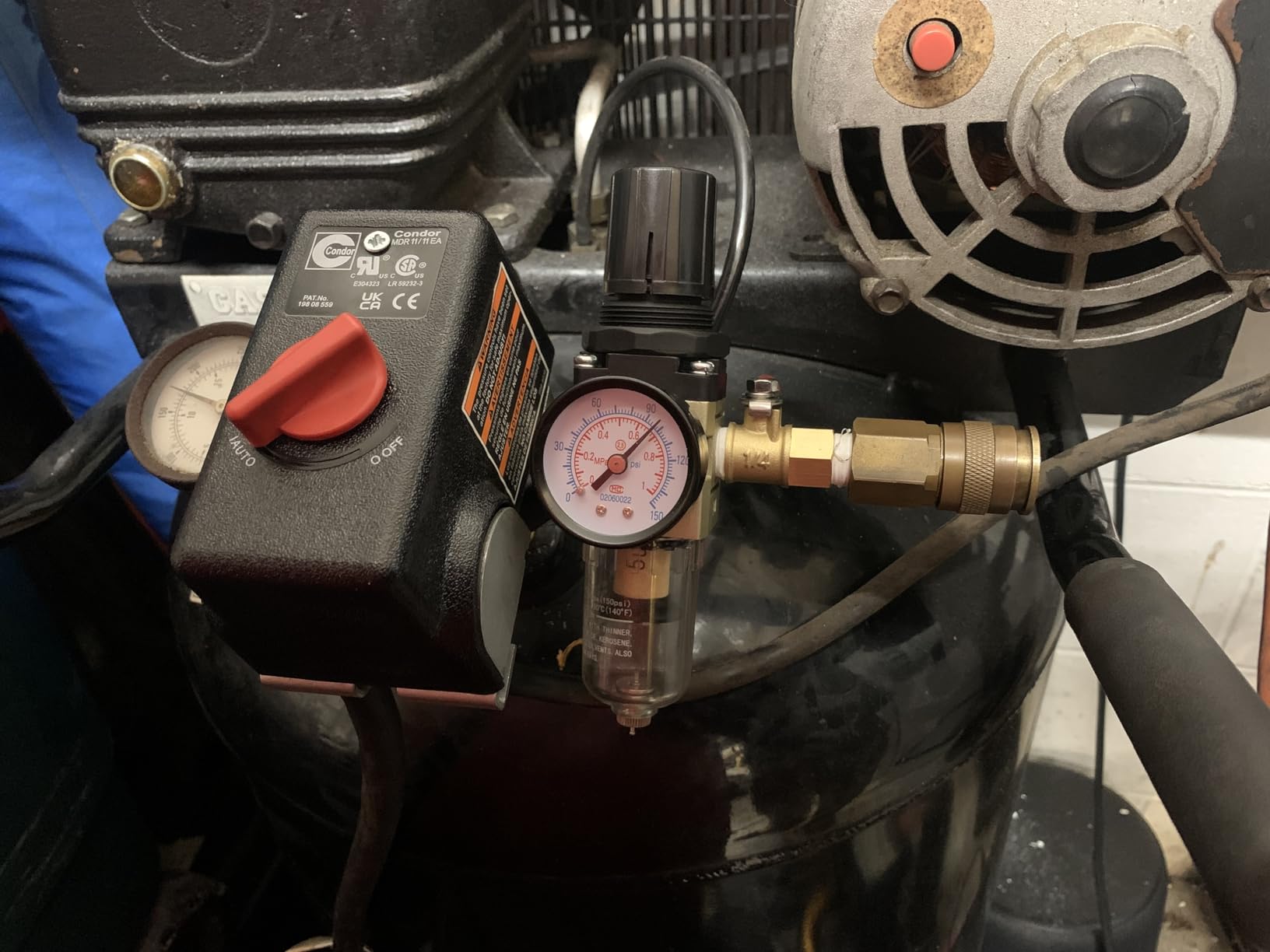
A forged brass ball valve with a plastic-covered lever handles the downstream shut-off, and the compact piggyback layout keeps the footprint small. A mounting bracket, a double MNPT fitting and thread seal tape are all in the box, so installation is one fitting and a bracket.
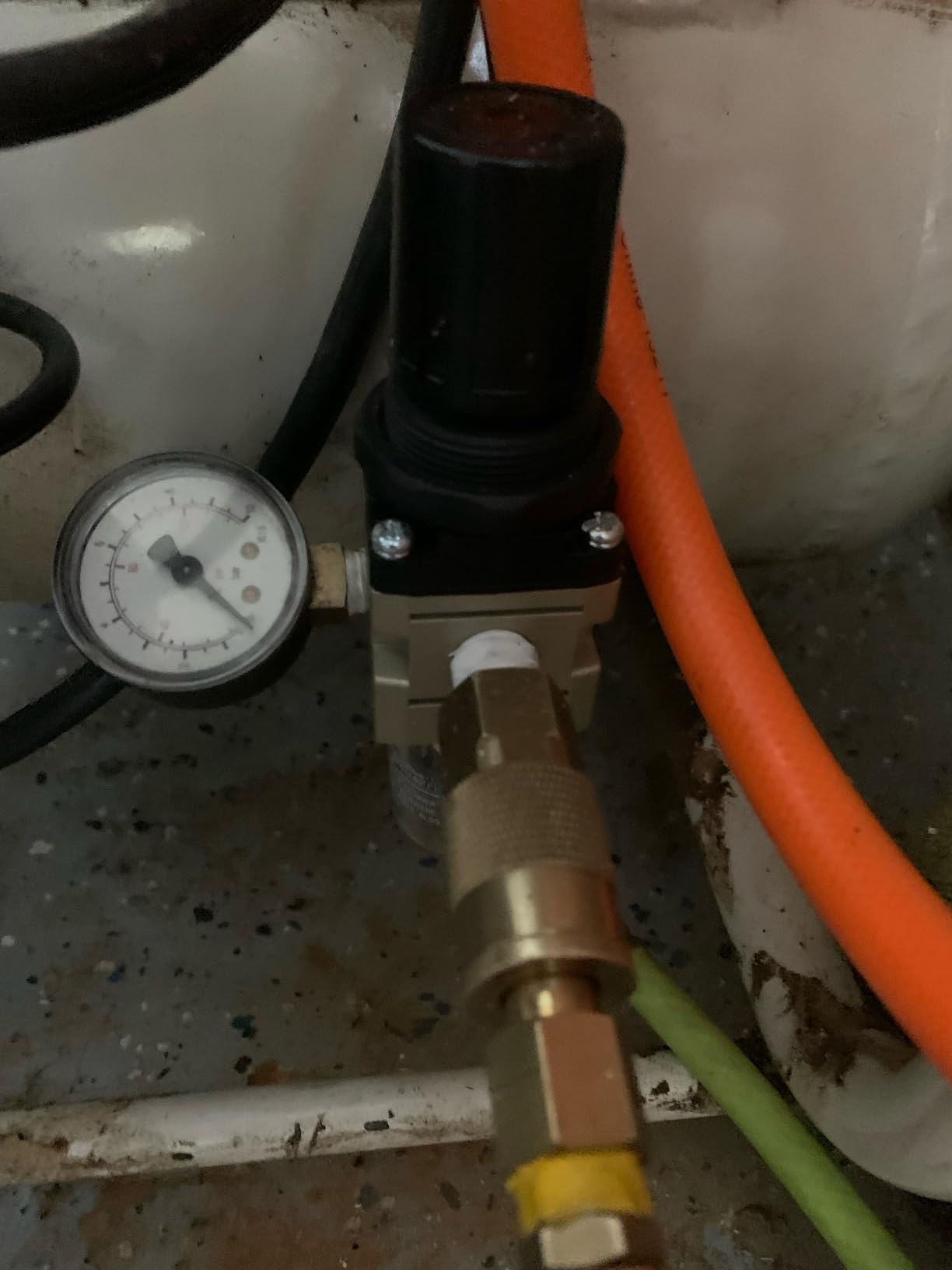
Owners consistently report a measurable reduction in moisture reaching downstream tools, which is the difference between a spray gun that fans out properly and one that spits water. Installation is described as straightforward and typically leak-free.
When this is the right pick
It suits anyone doing finish work, spraying, or running a pneumatic tool where water in the line causes a problem. It also makes an excellent first upgrade on a compressor that came with a cheap plastic bowl regulator, which is nearly all of them.
Place it downstream of the tank outlet and upstream of your manifold, and every tool you plug in benefits. One unit serves the whole shop when mounted centrally.
Where it falls short
The gauge needle bounces noticeably while the compressor is running, since nothing damps the movement. Some buyers received units with the water trap drain stem bent, which points to a packaging problem rather than a design flaw. A small number report a filter bowl that will not seal and passes air.
Check the drain cup during the first week of use. If it is filling faster than you expect, the separator may be mounted too close to the tank.
7. Secbolt Pressure Switch Regulator Gauges – the full switch retrofit
Secbolt Air Compressor Pressure Switch Regulator Gauges (American Pattern)
Cut out at 120 PSI
Turn on at 90 PSI
1/4 inch NPT with four female ports
Threadlocker included
Pros
- Turns a compressor that never shuts off into a cycling unit
- All in one box with switch manifold gauges and couplers
- Supplied threadlocker seals fittings reliably
- Direct replacement for worn switches
Cons
- Thin manifold metal with a port reported split
- Relief valve threads undersized so it does not fully seal
- Instructions leave the assembly order unclear
A compressor whose switch contacts have welded shut runs continuously. That is noisy, it wastes electricity, and it wears the motor out. This kit replaces the whole control assembly: pressure switch, manifold, two gauges, two brass couplers, a safety valve and a tube of threadlocker, with automatic cut-out at 120 PSI and turn-on at 90 PSI.
The switch port is 1/4 inch NPT with four female ports, and one coupler gives adjustable air output. The kit supports up to 16 A and 3840 W, and the dimensions are 3.8 by 3 by 3.7 inches, small enough to sit on a pancake tank without a rebuild.
One instruction matters more than any other here: use the supplied threadlocker and do not use PTFE tape, because tape can crack the female manifold fittings once it cures. That single note prevents most of the leak complaints attached to this category.
When this is the right pick
It suits an older compressor that never shuts down, or one whose regulator and switch have both been repaired enough times that replacing the assembly is simpler than chasing parts. Two gauges give you tank and outlet readings side by side, which is useful when tuning a setup.
It is the most polarised item in our set, with the widest spread between delight and frustration of anything we tested, so it suits a confident DIYer more than a first-time installer.
Where it falls short
The manifold metal is thin, and one port is reported to have split after the threadlocker cured. The relief valve threads are undersized so it does not fully seat, leaving a small permanent leak. The included O-ring coupler and vent assembly is described by several buyers as unnecessary and a possible failure point.
Some units suffer a kick-on failure where the pin platform is too small for the spring, and a few buyers needed extra fittings such as a 90 degree adapter or a reducer to interface with their compressor.
8. JahyShow Pressure Switch 90-125 PSI – the single port swap
JahyShow Air Compressor Pressure Switch 90-125 PSI, 26A Heavy Duty 1/4″ NPT Single Port, Universal Replacement Part with Unloader Valve & Leak-Proof Design for Air Tank
90 PSI kick-in and 125 PSI cut-out
26 A silver contacts
1/4 inch NPT female port
IP54 rated
Pros
- Restores proper cut-out on welded contact switches
- Often a close match to the original part
- Quick install on most compressors
- Silver contacts resist overheating and arcing
- Manual ON/OFF lever adds convenience
Cons
- Port direction differs from some original switches
- Terminal style may need eyelet lug changes
- Some copies report a diaphragm that fails early
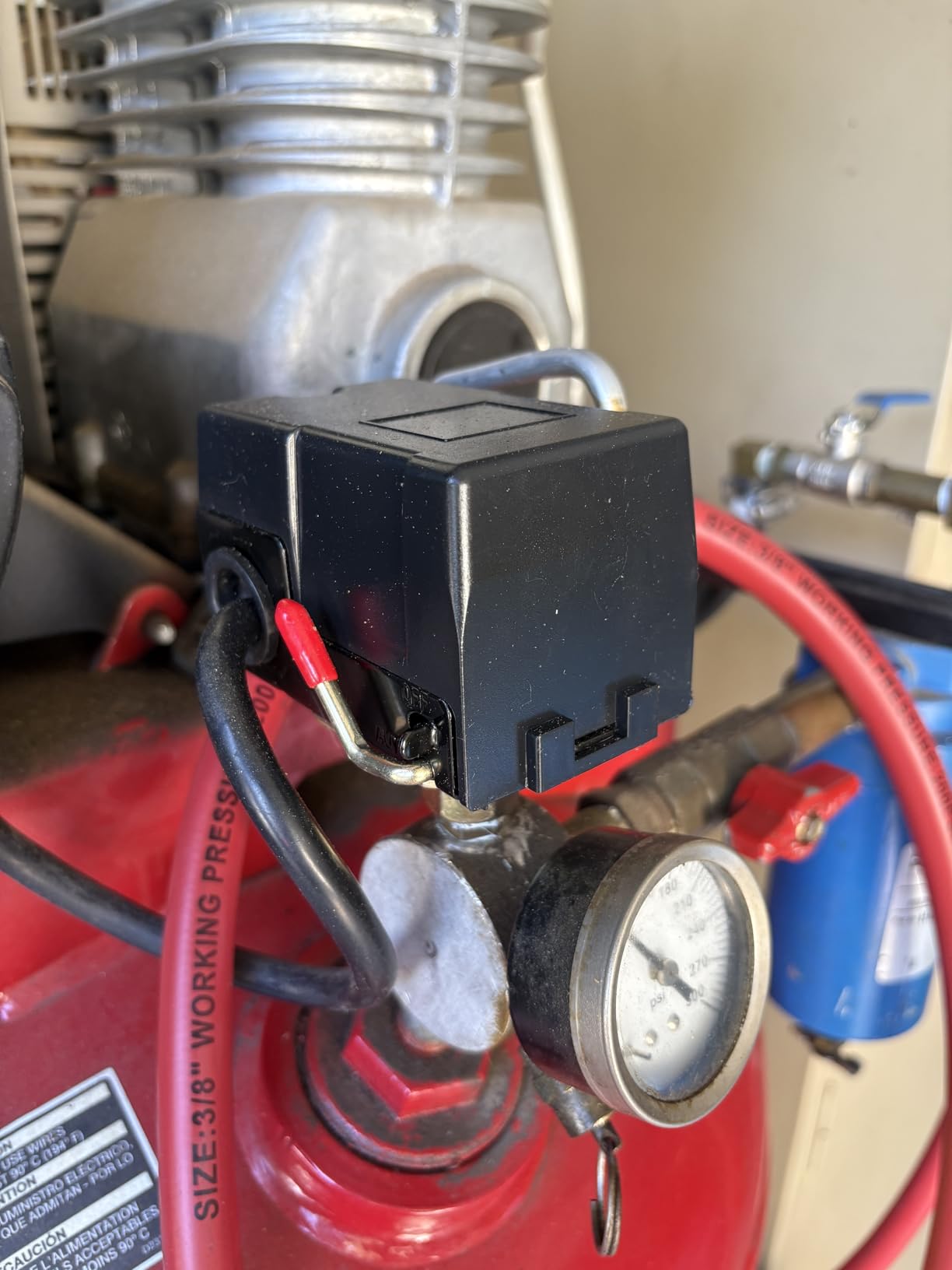
Where the Secbolt kit rebuilds the whole assembly, this is the focused version. It is a single 1/4 inch NPT female port switch with a factory preset of 90 PSI kick-in and 125 PSI cut-out, silver contacts rated 26 A at 120 V AC and 12 A at 240 V AC, and a manual ON and OFF lever on the body.
That 90 to 125 PSI band is slightly wider than many factory switches, which gives you headroom to choose your own tank cut-in and cut-out points. The contacts are silver rather than cheap alloy, and a reinforced diaphragm with pre-tightened screws is used to resist leaking at the case seam.
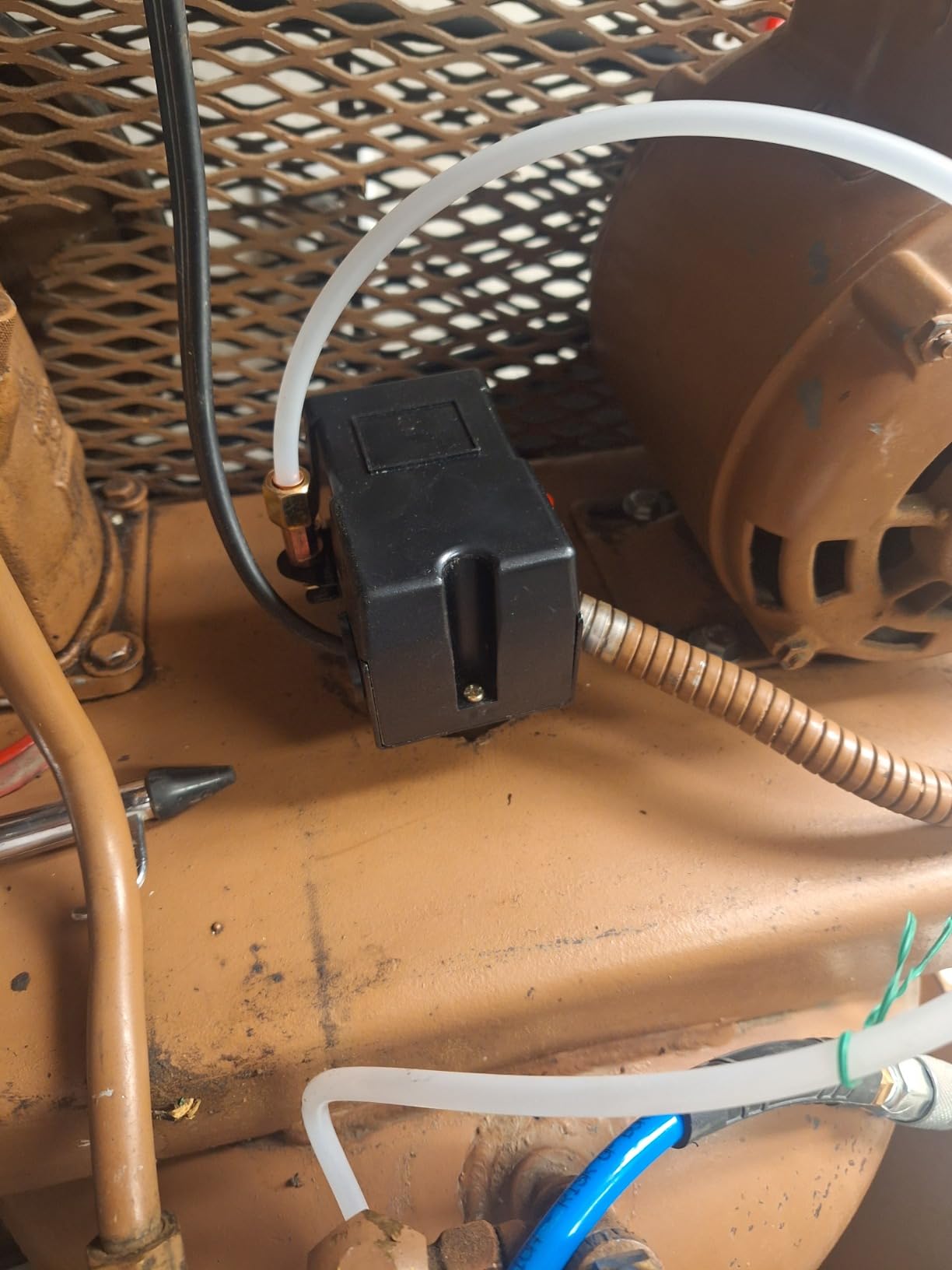
IP54 protection and a 32 to 140 degree F operating range cover a normal garage or unheated storage space. A plunger actuator with a one-way circuit handles the switching, and buyers report that it restores correct cycling on machines whose contacts have welded shut.
When this is the right pick
It suits a compressor that is otherwise healthy but will not shut off, and where you would rather swap one component than rebuild the assembly. It is often a direct duplicate of the original part, which is the best-case scenario for fitting time.
Look for a listed part number match on the failed switch before ordering, and check the port direction against your existing plumbing.
Where it falls short
Port orientation varies between models, so on some compressors you need a fabricated pressure tube to reach the tank. Terminal style also varies, meaning you may need to change blade spade lugs to eyelet rings on the wiring. A small group reports a diaphragm that fails after only a few cycles or leaks out of the box.
The unloader and bleed port layout may not match the original plumbing either, which matters on a compressor that relies on an unloader to unload the pump at cut-out.
9. SUNROAD Brass Ball Drain Valve – the fastest tank drain
SUNROAD Air Compressor Valve Brass Drain Cock Ball Valve 1/4″ NPT Male Thread Air Compressor Accessories 2pcs with Thread Seal Tape with Plastic Case
1/4 inch NPT male
150 PSI working pressure
Quarter-turn handle
Two pack
Pros
- Quarter turn beats a slow screw petcock
- Solid brass resists corrosion and rust
- Large bore outlet dumps condensate fast
- Two valves plus seal tape in one package
- Seals well with little or no tape
Cons
- One reviewer doubts long term body durability
- Needs careful hand tightening to avoid snapped threads
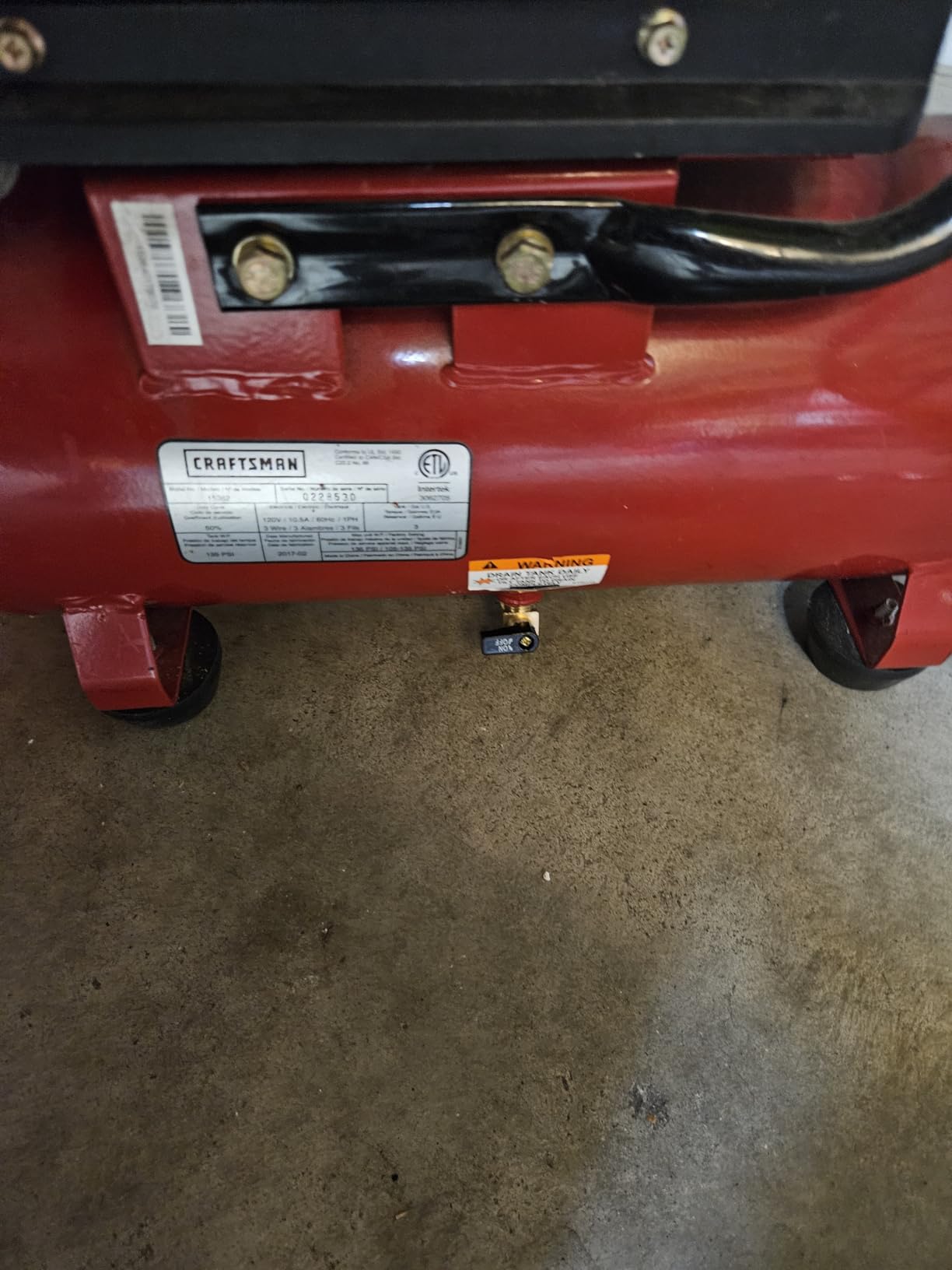
This is the highest-rated part in our set, and the reason is a feature most people underestimate: a quarter-turn ball valve. Screw-style petcocks take many rotations and usually weep at the stem. This one opens fully with a flick of the aluminium handle and dumps the tank in a fraction of the time.
Construction is a solid brass ball valve on a 1/4 inch NPT male thread, rated to 150 PSI working pressure across a temperature range of minus 65 to 250 degrees F. The design is O-ring-free, which removes the single most common failure point in this category, and the outlet is an unthreaded large bore that clears air, water and oil fast.
You get two valves plus roughly 400 inches of thread seal tape, so you can replace a drain now and keep a spare for the second tank or the next unit.
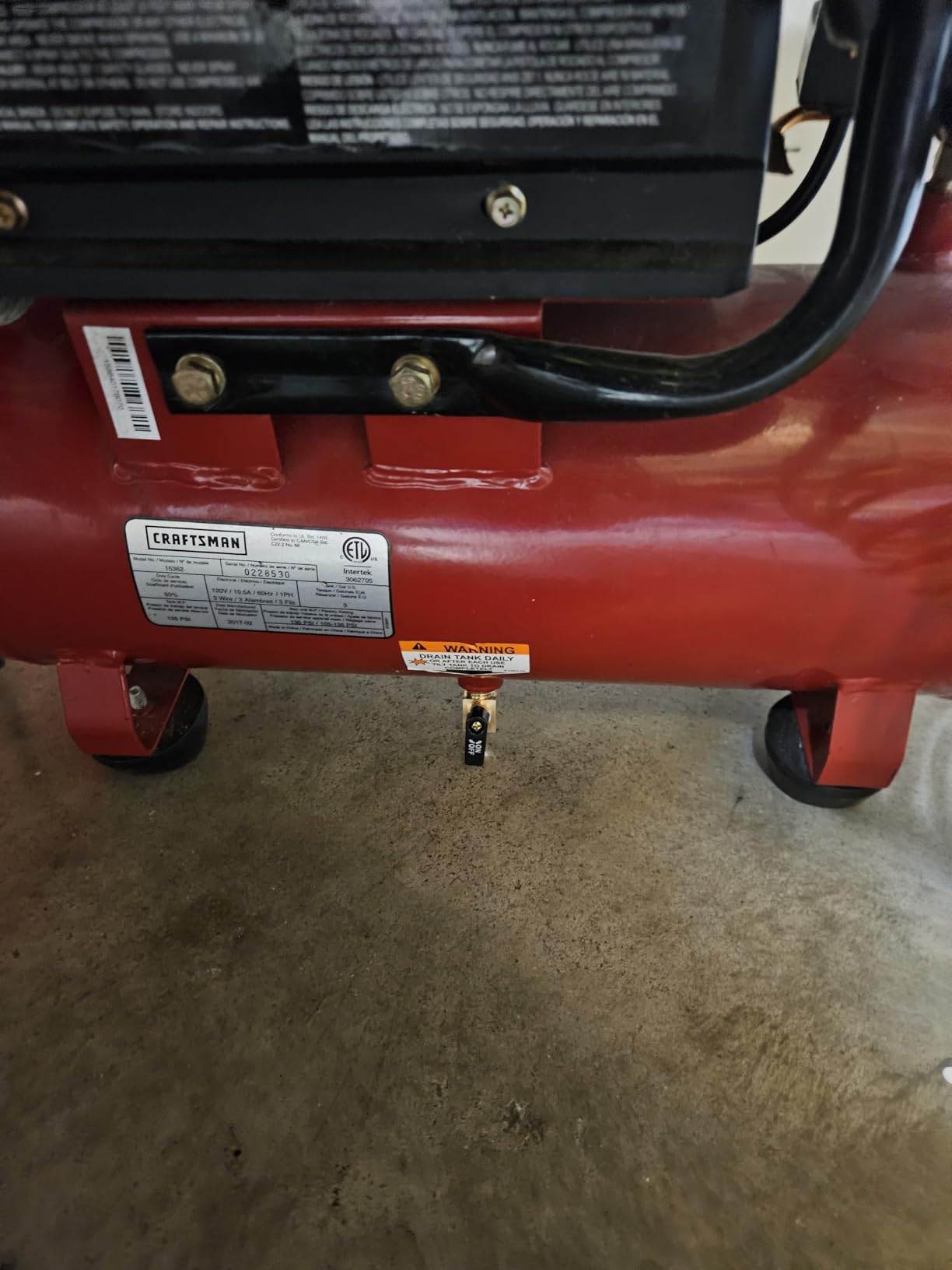
Owners report installing it in minutes on compressors of many ages and brands, with leak-free results and very little tape needed. The most common tip in the reviews is to snug the fitting by hand rather than over-torquing it, since overtightening can snap the threads.
When this is the right pick
It suits anyone who wants the tank empty without wrestling a stiff valve, and it is the fastest upgrade you can make to a compressor whose existing petcock never fully opens. Pair it with an extended drain assembly if reach is the problem, because the two solve different parts of the same job.
It also suits a second tank or a portable carry tank where the drain sits in an awkward spot, because the quarter-turn action is easy to operate one-handed.
Where it falls short
One reviewer expressed doubt about the durability of the valve body for heavy-duty long-term service, which is worth weighing if your tank runs hot or you drain daily. Tightening matters here: overtightening can break the 1/4 inch male thread, and that is an annoying repair on a thin tank boss.
It is a manual drain. It does nothing about water already in the air line downstream.
10. Metabo HPT 10 Gallon ASME Tank – reserve capacity for small compressors
Metabo HPT 10 Gallon Air Tank, High Capacity ASME Certified, UA3810AB
10 gallon ASME certified
175 PSI stamped rating
Five quick connect couplers
Input shut-off valve
Pros
- Adds reserve capacity so small compressors run less
- All five fittings arrive pre-wrapped with Teflon
- Regulated coupler plus dual industrial gauges
- Input ball valve allows filling without draining
- Rated for five or more nailers at 200 feet
Cons
- Relief valve pops at 150 PSI so set the regulator near 145
- Uneven leg lengths leave it wobbling on flat ground
- At 39.6 pounds it is heavy to move
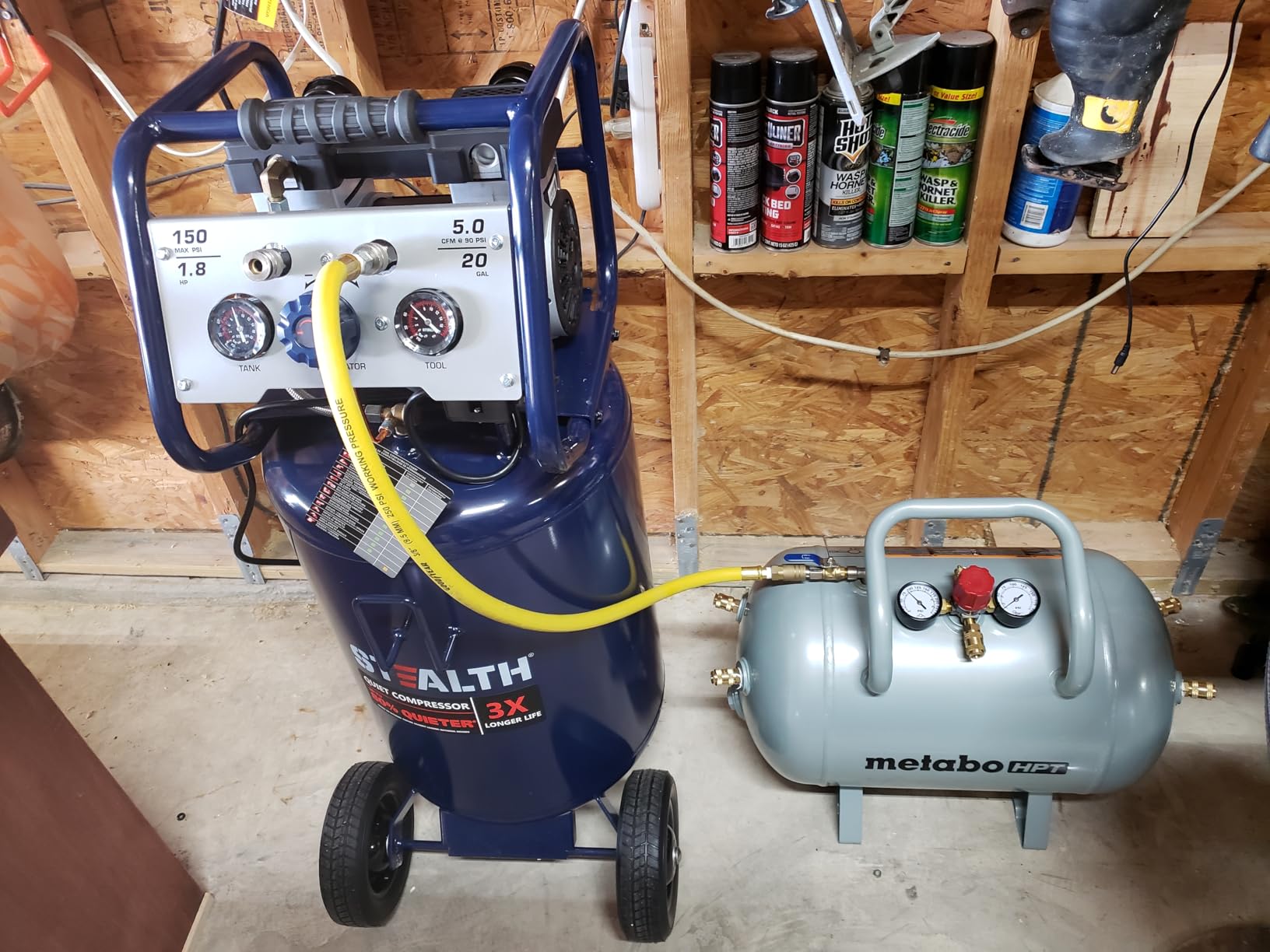
Small compressors do not have a pump problem so much as a buffer problem. They cannot make air fast enough to feed an air-hungry tool, so the tank empties and the machine runs flat out. An auxiliary receiver fixes that by adding stored air rather than more pump, and this 10 gallon ASME-certified vertical tank is the cleanest version of that idea.
It comes with five quick connect couplers, four unregulated and one regulated, plus two steel-cased industrial pressure gauges, an industrial ball shut-off valve on the input, a safety relief valve and a pre-installed industrial plug. The input shut-off is the detail that makes it practical: you fill the tank, close the valve, and disconnect from the compressor without draining it.
It is rated to supply five or more nailers simultaneously at distances up to 200 feet, with angled steel legs and a roll cage design to protect the regulator and gauges. All five 1/4 inch fittings arrive pre-wrapped with Teflon for fast hookup, and a one year manufacturer warranty is included.
When this is the right pick
It suits a garage with a 6 gallon pancake or a small vertical unit that works fine on an impact wrench and bogs down on framing nails. The reserve air means your tools finish their stroke at full pressure instead of slowing at the end.
It is also a genuine safety upgrade path. ASME certification means the vessel is rated, stamped and code-compliant, and the roll cage and steel legs survive being dragged around a garage floor.
Where it falls short
Watch the pressure numbers. The tank is stamped for 175 PSI but the safety relief valve pops at 150 PSI, so set the compressor regulator to around 145 PSI to stay clear of nuisance trips. Some legs are not the same length, which leaves the tank wobbling on flat ground until you shim or level it. The plastic reservoir evacuator underneath is widely viewed as a weak point.
At 39.6 pounds it is heavy, so many owners replace the supplied fittings with lighter ones.
11. D27253 Regulator Replacement – an exact fit for common house compressors
D27253 Air Compressor Regulator 4 Port Devilbiss Porter Cable Craftsman
Direct D27253 fit
1/4 inch NPT female port
1/8 inch NPT gauge ports
In-line or modular mounting
Pros
- Exact fit on common Craftsman and Porter Cable units
- Stops air leaking at the regulator
- Installs quickly
- Full flow gauge ports
- Works in in-line or modular layouts
Cons
- Airflow direction must match the arrow on the body or it will not regulate correctly
- Regulator pressure only so a tank/regulator gauge needs a separate part
- One buyer reported it did not resolve their compressor issue
House-brand compressors from the 2000s and 2010s are notorious for regulators that weep at the diaphragm. Air escapes from the outlet area, the pump runs longer, and the machine gets hot. This replacement is for part number D27253, which fits many DeWalt, Black and Decker, Craftsman and Porter Cable units, and it is the part number to match before you order anything.
Port layout is 1/4 inch NPT female with 1/8 inch NPT female gauge ports, and the body supports either in-line or modular installation, so it works whether your gauges sit on the tank or on the regulator itself. Buyers commonly report that it stops an air leak at the regulator outright.
When this is the right pick
It suits a compressor that still makes good pressure at the gauge but leaks audibly from the outlet block, and where the part number matches. An exact-fit replacement takes minutes and costs a fraction of buying a whole regulator assembly by a name brand.
It is also the sensible fix before buying a filter-regulator. If the regulator is weeping, putting a premium filter on the outlet just moves the leak downstream.
Where it falls short
Airflow direction must follow the arrow on the body, or it will not regulate correctly. This is a regulator-pressure unit only, not a combined tank and regulator gauge, so if your original had both you need a separate part. One buyer reported that replacing it did not resolve their particular compressor fault.
Check the part number carefully; similar-looking regulators are not interchangeable.
12. QWORK Extended Tank Drain Kit – reach with a 3/8 inch adapter
QWORK Extended Tank Drain Valve Assembly Kit for Air Compressor, Including 10 Inches Air Compressor Tank Drain Hose 1/4 inch NPT, 1/4″ to 3/8″ Brass Adapter and Thread Seal Tape
10 inch braided steel drain hose
175 PSI working pressure
1/4 to 3/8 inch brass adapter
Pros
- Puts the drain where you can reach it
- Braided steel and brass resist rust and corrosion
- Shifts heavy water buildup effectively
- Pre-applied sealant plus a roll of seal tape
- Stays leak-free over months of use
Cons
- Usable length is under 10 inches once the fittings are fitted
- Thread size must be confirmed before purchase
This is the closest sibling to our top pick, and the difference is the adapter. Where most extended drain kits give you a 3/8 inch male by 1/4 inch female bushing, this one ships a 1/4 inch to 3/8 inch brass adapter so it reaches both drain sizes without a separate purchase. If your tank drains through 3/8 inch pipe, this is the one that fits out of the box.
The hose is 10 inches of braided steel with a brass head, rated to 175 PSI working pressure with a 475 PSI blasting pressure and a 200 degree F maximum temperature. Fittings arrive with pre-applied thread sealant, and a separate roll of thread seal tape is included for the joints you do not.
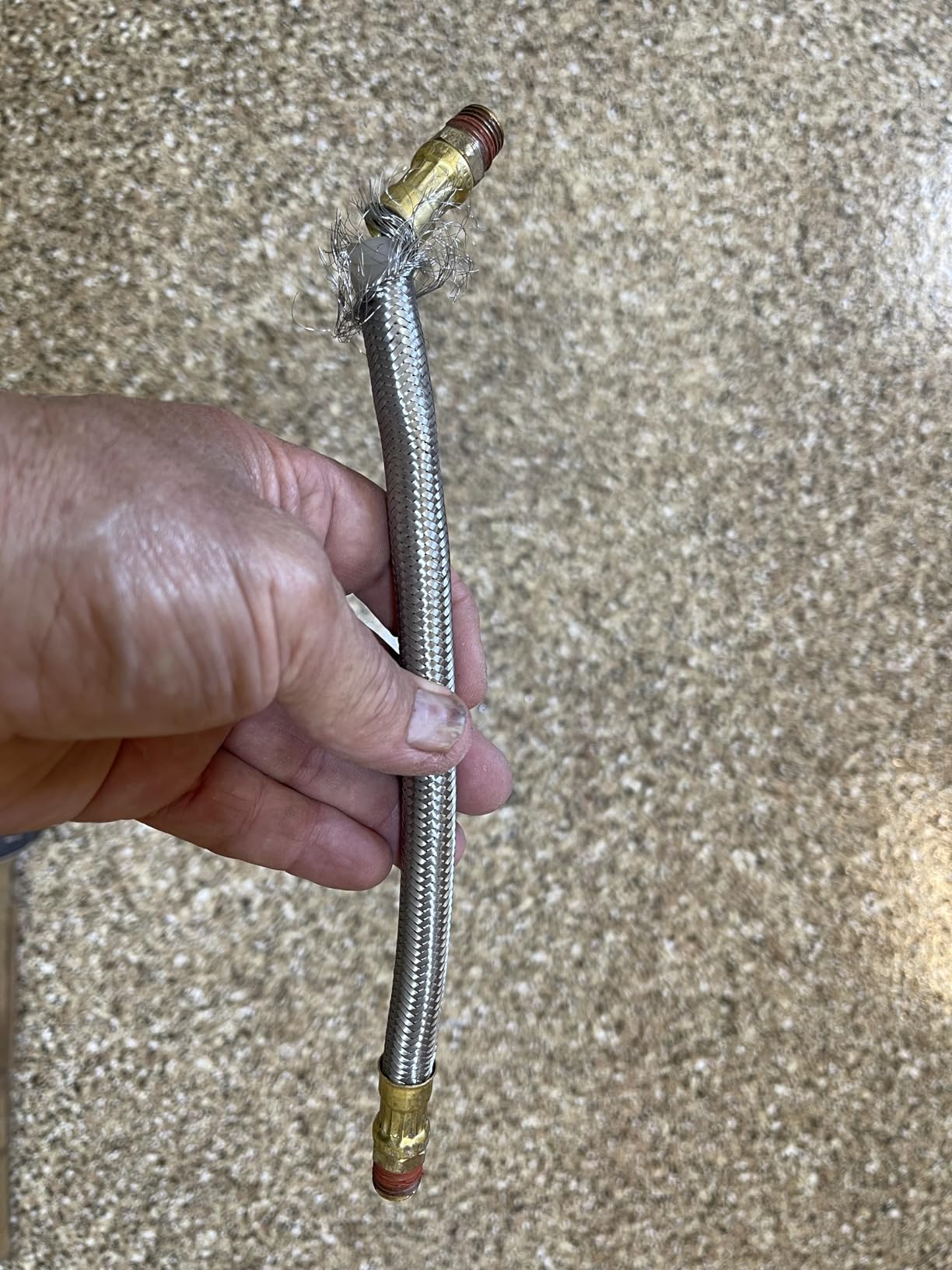
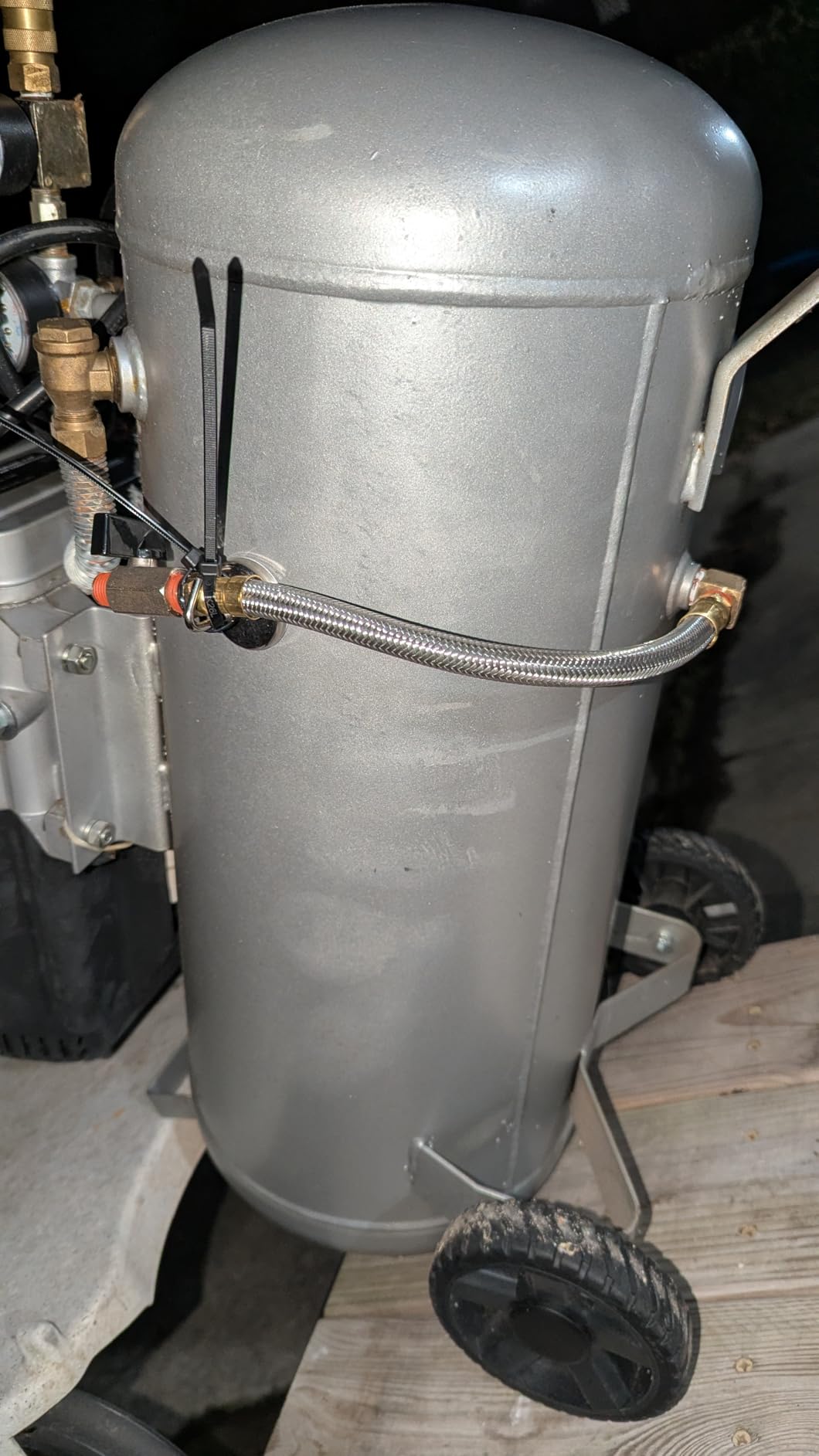
Owners consistently report that it puts the drain where it can be reached without crawling under or tipping the compressor, and that the braided steel and brass construction has stayed leak-free over months. It is also available in single and two piece configurations if you have more than one tank.
When this is the right pick
It suits a tank where the drain is behind a frame member or a wheel, which is common on vertical and horizontal shop compressors. It drains heavy water build-up effectively, so it pairs well with a machine that gets used for finish work and accumulates condensate quickly.
Choose it over the similar kit when your drain line is 3/8 inch rather than 1/4 inch, or when you want one purchase that covers both sizes.
Where it falls short
The most repeated caveat is length. Once both fittings are accounted for, the usable reach is less than the stated 10 inches, so on a compact tank it can still hang in the way. Thread size must be confirmed before ordering, because the included adapter covers 1/4 and 3/8 inch but nothing larger.
Like the rest of this category, it is a manual drain and does nothing about moisture already in the downstream air line.
How to Match Tank Accessories to Your Compressor
Start with what you actually run. A pancake compressor between 2 and 6 gallons suits finish work, tire inflation, inflating sports balls, and light brad nailers. Its needs are modest: a working drain, a readable gauge, and a filter-regulator if you spray anything. A vertical 20 to 30 gallon tank is the general-purpose home shop unit, and here a manifold starts to earn its place. A horizontal tank of 80 gallons or more is already doing most of what an auxiliary receiver would do, so spend on regulation and moisture control instead.
CFM matters more than tank size when you are judging whether a machine can keep up. A rule of thumb used in shop sizing is three to five gallons of tank per CFM of output, so a small compressor feeding air-hungry tools will run constantly no matter how large the tank is. That is the moment an auxiliary tank helps, because it stores air instead of trying to make more. For context, 4 SCFM at 90 PSI is adequate for an air ratchet, an impact wrench on small fasteners and inflating tires, and inadequate for continuous framing nailer work.
Is 4 SCFM at 90 PSI good? For a garage with an air ratchet, a small impact wrench and tire inflation, yes. It is fine for a single nailer used intermittently. It falls short the moment you run two air-hungry tools at once or hold a spray gun for a full coat, which is exactly the situation a reserve tank and a manifold are built to address.
How to Size NPT Threads and Seal Them Properly
NPT stands for National Pipe Thread Tapered, and it is the reason accessories from different manufacturers work together. Nearly all tank-side hardware is 1/4 inch NPT female, which is the port size on the outlet, the regulator inlet and the manifold inlet. The 1/4 inch port is the default, and the right accessory is almost always the one that matches it without an adapter.
Three sizes cover a home shop. 1/4 inch NPT carries up to about 30 CFM and handles single-tool lines. 3/8 inch NPT handles roughly 50 CFM and appears on drain lines and on some manifold inlets. 1/2 inch NPT carries about 60 CFM or more and shows up on tank outlets and pressure switch ports. Move up a size when your line runs long, when you use two tools simultaneously, or when your pressure drop is unacceptable at the tool end.
A common misconception is that thread seal tape covers the gap in a tapered thread to stop a leak. It does not. The taper seals metal on metal under torque, and tape is there to lubricate the threads and fill microscopic imperfections. Apply two or three wraps of PTFE thread seal tape in the direction of the thread, which is clockwise for male threads, keep it off the first thread, and snug the fitting firmly by hand. Overtorquing strips threads and cracks brass, and the seal happens without tape at all on a good flare or on NPT with the right tension.
One exception matters. On some pressure switch and manifold assemblies, tape is the wrong sealer entirely. Secbolt kits, for example, supply threadlocker and specify that PTFE tape can crack the female manifold fittings as it cures. Where a manufacturer supplies a threadlocker, follow that instruction rather than reaching for tape.
Tank Accessories You Do Not Need
We would rather earn your trust than your click, so here is what we would skip. The first is a filler-heavy accessory kit bought as a shortcut. Buyers on home improvement forums repeatedly describe buying one oversized kit, using three pieces from it, and resenting the rest for years. The second is a premium inline separator mounted right at the tank outlet. Forum consensus is consistent on this point: a moisture filter works better the further it sits from the tank, so mounting a good one in the wrong spot wastes the money. In many climates, draining the tank after each use is simply sufficient, and no separator is needed at all.
The third is a second gauge before the first is working. A dead gauge is worth replacing, but two healthy gauges on one tank rarely tell you anything the first one did not. The fourth is any tank-side accessory fitted to a compressor that is still under warranty or still covered by a service agreement, because opening the assembly can complicate a claim. The fifth is a bigger auxiliary tank on a machine that is undersized at the pump. More stored air on a compressor that cannot deliver air just means it cycles more often and wears the motor faster.
One more worth naming: a blow gun used as a shop vacuum substitute. Owners caution against blowing wood dust into the air because it circulates fine particulate straight back into the room and onto your finish work. A blower is for clearing chips off a part; it is not a dust collector.
Frequently Asked Questions
What are the best air compressor accessories?
The best air compressor tank accessories are an adjustable filter-regulator, a quarter-turn ball drain valve, an extended drain assembly that brings that valve within reach, and a manifold with quick-connect couplers if you run more than one tool. A readable tank gauge and a working pressure switch round out the tank side. For most home shops, a filter-regulator and a reachable drain deliver more improvement per purchase than anything else, because together they fix water in the line and rust inside the tank.
Do I need a water separator for my air compressor?
In many climates, no. Draining the tank after each use removes most of the water, and forum users consistently note that a basic inline filter is only worth buying when you spray finish or run tools where moisture causes a visible problem. If you do add one, mount it as far from the tank outlet as your layout allows, because the air cools and releases more moisture the further it travels.
Why should you drain water from a compressor air tank?
Water that collects inside a tank is the start of internal corrosion. It sits against the steel wall, and combined with the oil and rust already in the air stream it produces a slurry that pits the tank from the inside where you cannot see it. A tank is rated for pressure cycling, not for standing liquid. Draining takes seconds and slows the corrosion that ends tank life.
Should the air compressor drain valve be open?
No. A tank drain valve should be closed while the compressor is in use, because an open drain vents air and prevents the pump from building pressure. Open it only after shutting the compressor down and bleeding the tank, then close it again before you start the next session. The single exception is an automatic or zero-loss drain valve, which is designed to discharge condensate while the tank is still pressurized.
Which brand of compressor regulator is considered the best?
Forum users name California Air Tools, Ingersoll Rand, BendPak, DeWalt, Milwaukee and Harbor Freight as the brands they actually trust, more than any particular model. What matters more than the badge is construction: a brass body resists corrosion and seals threads better than thin zinc or plastic, and an adjustable knob lets you set outlet pressure for finish work instead of running tools at full tank pressure. A combo filter-regulator in brass is the upgrade most home shops need.
Is 4 SCFM at 90 PSI good?
It is good for a garage running an air ratchet, a small impact wrench, inflating tires and occasional light nailer use. It is not good for continuous framing nailer work, for running two air-hungry tools at once, or for holding a spray gun through a full coat. In those cases the fix is more stored air rather than a faster pump, which is what an auxiliary ASME-certified reserve tank provides.
Conclusion
If you take one thing from this guide, take the drain. The Hromee extended tank drain assembly is our Editor’s Choice because it fixes the habit that does the most damage over time: a tank that is never emptied, rusting quietly from the inside. It is simple, it fits the 1/4 inch NPT port almost every home compressor has, and once the valve is somewhere you can see, you will actually use it.
Add a brass filter-regulator next, and the air reaching your tools changes more than any hose or gun ever will. From there, the parts worth adding depend on your machine: a manifold if you run two tools at once, a replacement pressure switch if the compressor never shuts off, a liquid-filled gauge if the needle is unreadable while the pump cycles, and an ASME-certified reserve tank if a small compressor cannot keep up.
That is the working set behind the best air compressor tank accessories for home shops in 2026, and the order we would buy them in. Check the thread size before anything else, since a 1/4 inch versus 3/8 inch mismatch is the only mistake that turns a good accessory into an expensive adapter.