
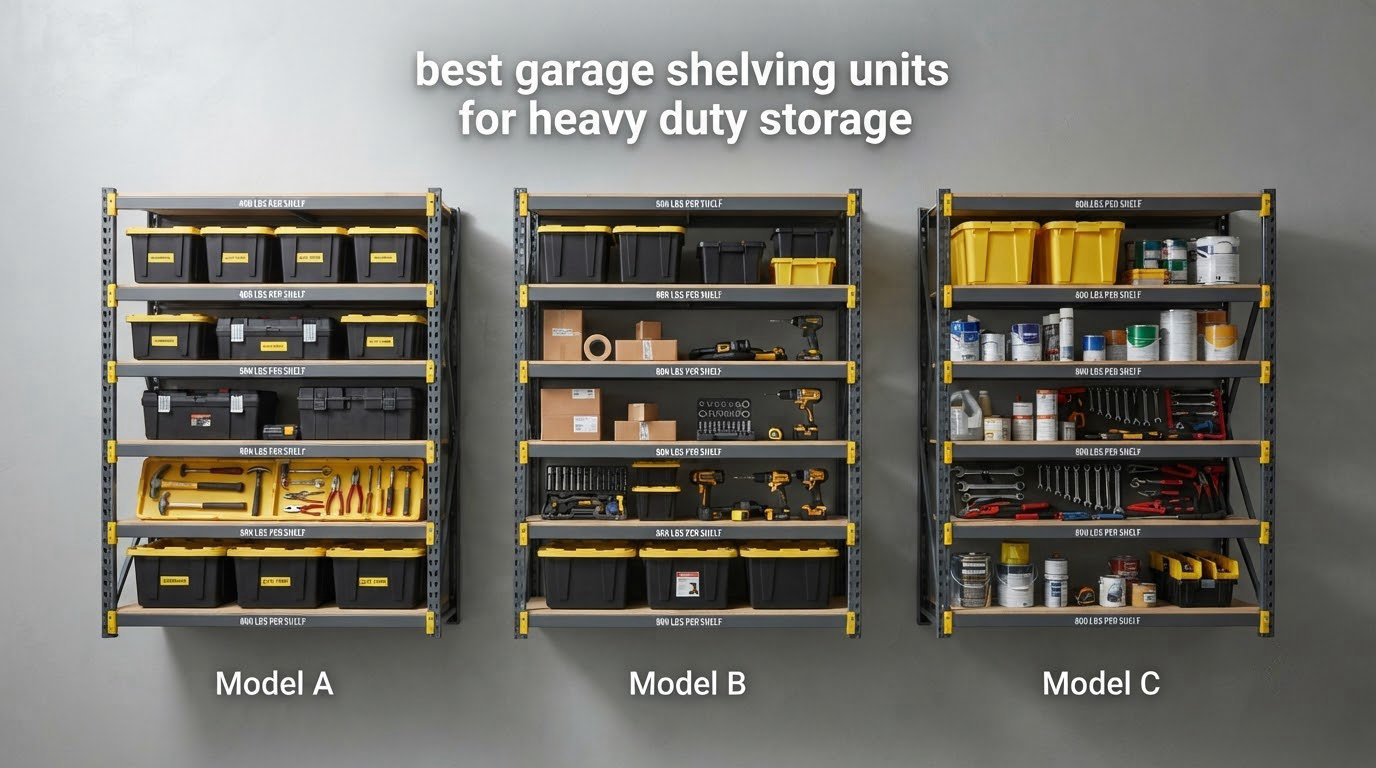
Heavy duty garage shelving earns the label when a single shelf carries several hundred pounds without the deck flexing, bowing, or pushing the unit across the floor. Three variables decide which rack belongs in your garage: what you plan to store, how much floor or wall space you can give up, and whether you want a freestanding rack or a wall-mounted system. We compared ten of the highest-rated racks sold for garage and workshop duty, focusing on the numbers that actually predict performance.
Every load figure in this roundup is the manufacturer’s stated rating, not a figure we verified on a load cell. Listings in this category advertise anything from 1000 to 5000 lbs, so treat those numbers as the manufacturer says, then read the per-shelf figure rather than the headline total. A 2000 lb total across five shelves works out to 400 lbs per shelf, and that is the number that governs what you can put on one level.
One more note before the picks. Steel rack frames look alike from across the garage, but the form factor matters: a storage rack for tools and totes is a different product from an equipment rack built for sensitive gear. Our studio rack roundup covers that second category, while every unit below is built for tools, totes, paint, and shop inventory.
Table of Contents
Top 3 Best Heavy Duty Garage Shelving Units in October

Amazon Basics 5-Shelf Wire…
- 350 lbs per shelf
- 1750 lbs total
- 1-inch height adjustment
- No-tool assembly

HOMEDANT 47.7 Inch 5-Tier
- 47.7 inch width
- 24.1 inch depth
- Boltless snap-together
- 5 repositionable tiers

VEVOR 5-Tier 2000 lbs Rack
- 400 lbs per shelf
- 2000 lbs total
- Press-to-assemble design
- Splits into two racks
Heavy Duty Garage Shelving Units Compared in 2026
All ten racks below are listed with their manufacturer-stated per-shelf and total load figures, footprint, deck type, and assembly method. Read the depth column first, because a 14 inch rack and a 24 inch rack hold very different bins.
| Product | Specs | Action |
|---|---|---|
| Amazon Basics 5-Shelf Wire Rack |
|
Check Latest Price |
 Sakugi 5-Tier 0.9 Inch Tube Sakugi 5-Tier 0.9 Inch Tube |
|
Check Latest Price |
| HOMEDANT 47.7 Inch 5-Tier |
|
Check Latest Price |
| VEVOR 5-Tier 2000 lbs |
|
Check Latest Price |
 REIBII 55.5 Inch Wire 3200 lbs REIBII 55.5 Inch Wire 3200 lbs |
|
Check Latest Price |
 SISESOL 71 Inch 4-Tier 5000 lbs SISESOL 71 Inch 4-Tier 5000 lbs |
|
Check Latest Price |
 REIBII 2-Pack 5-Tier Racks REIBII 2-Pack 5-Tier Racks |
|
Check Latest Price |
 Letaya 71 Inch 4-Tier 5000 lbs Letaya 71 Inch 4-Tier 5000 lbs |
|
Check Latest Price |
 RAVIGIN 71 Inch 4-Tier 5000 lbs RAVIGIN 71 Inch 4-Tier 5000 lbs |
|
Check Latest Price |
 VEVOR 5-Tier 3000 lbs VEVOR 5-Tier 3000 lbs |
|
Check Latest Price |
What Counts As Heavy Duty Garage Shelving?
Heavy duty garage shelving is a steel rack with a per-shelf load rating in the hundreds of pounds, built so the deck stays flat and the frame stays square when loaded. The detail most listings bury is that load ratings come in two forms: a per-shelf rating and a total rating across all tiers. A five-tier rack advertised at 2000 lbs total is carrying about 400 lbs per shelf, and if the shelf is thin MDF with no center support, the deck will bow long before the frame is anywhere near its limit.
Load travels from the deck into the horizontal beams, down the corner posts, and out through the feet onto the floor. That means the weakest link sets the real capacity, and in practice that link is almost always the shelf panel rather than the steel. Posts, beams, and bracing are cheap to overbuild; a thin flat panel deflects the moment weight concentrates in its center.
None of the ten racks in this roundup is a wall-mounted system. Wall-mounted shelving is a different product class with different hardware, and we cover how to choose between the two in the buying guide below.
1. Amazon Basics 5-Shelf Adjustable Steel Wire Rack – Best Overall Heavy Duty Pick
Amazon Basics 5-Shelf Adjustable Heavy Duty Steel Wire Storage Shelves for Garage, Kitchen, Easy Assembly, 36″ x 14″ x 72″, Black
Alloy steel wire
5 shelves
350 lbs per shelf, 1750 lbs total
36W x 14D x 72H
27.3 lb
Pros
- Tool-free assembly most buyers finish quickly
- 350 lbs per shelf and 1750 lbs total
- Shelf height adjusts in 1-inch increments
- Four leveling feet steady the frame on uneven floors
- Over 263k ratings averaging 4.6 stars
Cons
- Wire gaps swallow small loose parts
- 14 inch depth limits bulky bins
- Two people recommended for the 72 inch frame
This is the unit we kept coming back to while comparing these ten, and the reason is the sheer volume of real-world feedback behind it. More than 263k ratings at an average of 4.6 stars is a much longer durability record than anything else on this list, and that record matters in a category where the difference between a rack that lasts a decade and one that sags in two years is often just the steel gauge.
At 350 lbs per shelf and 1750 lbs total, it is not the highest number here, but the rating is backed by an alloy steel frame with four leveling feet and 1-inch height increments, so you can reconfigure it as your storage changes. Assembly is genuinely tool-free, which is unusual in a rack this tall.
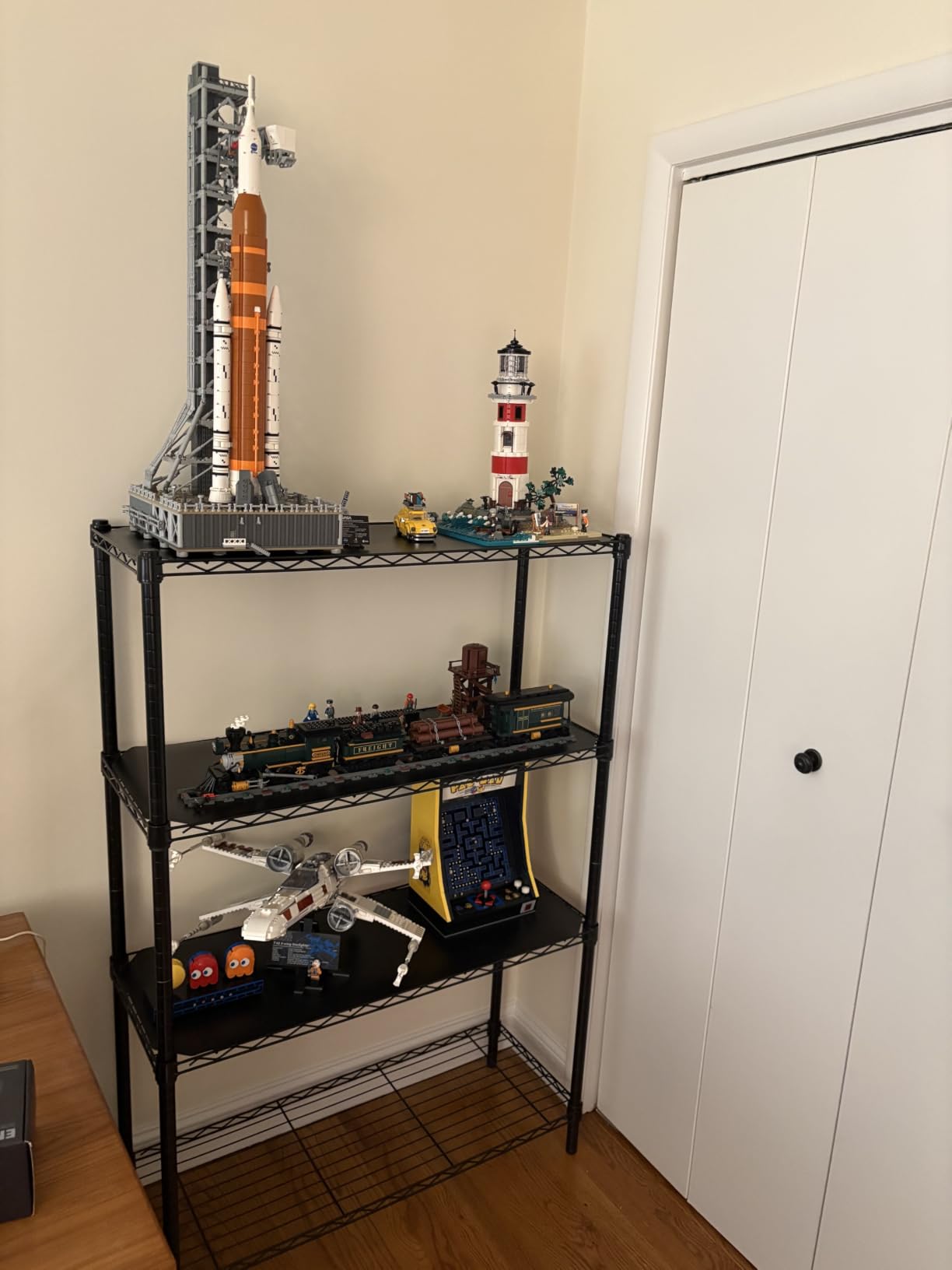
The tradeoff is geometry. At 36 inches wide by 14 inches deep, this is a narrow unit, and the 14 inch depth is the single biggest limitation. Standard storage totes will not sit flat on it, so you are working with shallow bins, paint trays, and long-handled tools rather than bulk storage.
Reviewers also point out that the wire deck drops small items. Screws, hardware, and loose fittings fall through unless you line each tier with a mat or a bin liner. Plan to buy liners before the first heavy load goes on.

What You Get With the Narrowest Footprint
This is the rack to buy if your storage is organized around long, shallow things: lumber offcuts, trim, extension cords, paint rollers, and boxed accessories. The 1-inch shelf adjustment also lets you drop a tier to create a wide open bay for oversized items like a compressor or a folded ladder.
Owners who load it heavily report the frame stays square and the leveling feet do their job on sloped garage floors. That combination is why it earns the top spot for most people: the rating is real, the build is unexciting in the best way, and assembly takes one session.
When This Rack Is the Wrong Choice
If you plan to store full-size totes or anything deeper than roughly a foot, move on. The 14 inch depth means most of the plastic bins sold for garage shelving simply overhang, which adds tip risk and wastes the space above.
It is also a floor unit whose listed components are casters and leveling feet with no anti-tip kit, so a loaded 72 inch frame still needs to be anchored to a stud if children or vehicles are in the same space.
2. Sakugi 5-Tier Metal Shelves – Best for Tight Corners and Utility Spaces
Sakugi Storage Shelves – 5 Tier Shelf Organizer, Heavy Duty Garage Shelving Unit with Leveling Feet, Stable Metal Shelves Organizer for Pantry, Kitchen and Closet, 33.0″ W x 12.6″ D x 72.0″ H, Black
Alloy steel
0.9 inch tubing
1000 lbs total
33W x 12.6D x 72H
8 kg
Pros
- Thick 0.9 inch steel tubing resists bending
- 1000 lb total capacity for boxes and equipment
- Waterproof rustproof finish wipes clean with a damp cloth
- Four non-slip leveling feet plus a wall fixing kit
- 4.5 stars from over 4400 ratings
Cons
- Shallow 12.6 inch depth is narrow for bins
- Assembly takes patience even with the included instructions
- Best suited to light to medium loads
The Sakugi is the simplest unit in this roundup and one of the few that comes with a wall fixing kit in the box. That combination of leveling feet and anti-tip hardware answers the most common concern in garage forums, where tall racks stand level but still lean when the floor is crowned.
Build quality is the story here. The 0.9 inch diameter tubing is visibly heavier than the standard tubing used on budget racks, and reviewers consistently single it out as the reason the frame does not feel flimsy when loaded. The total rating of 1000 lbs works out to roughly 200 lbs per tier.

What the Sakugi is not is a machine-storage rack. Owners place it in pantries, closets, and utility rooms more often than garages, and at 12.6 inches deep it will not take a standard tote. Its real value is vertical storage in a spot where wall width is the constraint.
Assembly is the part that takes longest. No specialized tools are needed, but the instructions ask for patience, and building the frame upright rather than flat saves a lot of confusion.
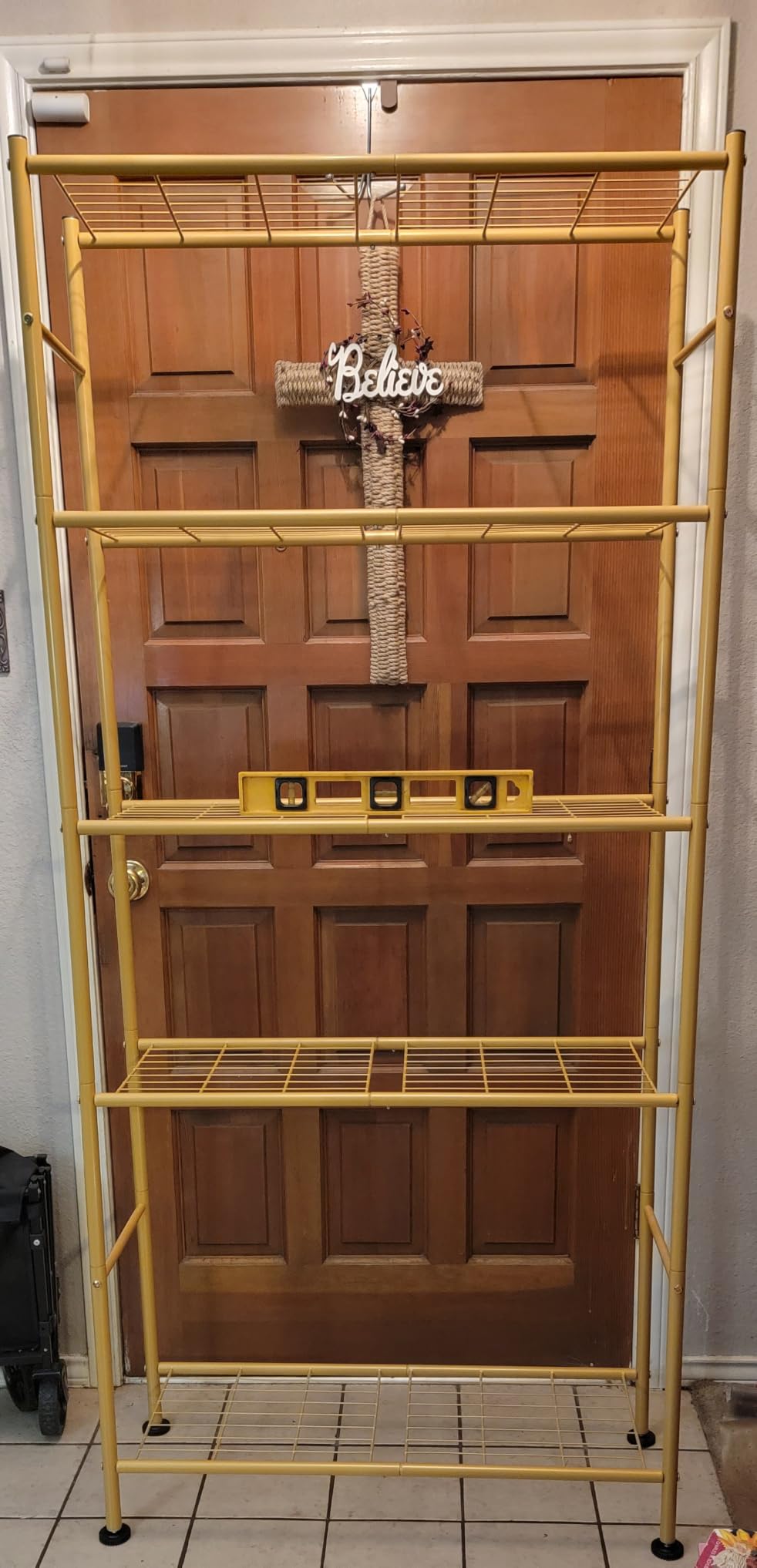
Where This Unit Earns Its Space
Put this rack in a laundry room, pantry, or the corner of a garage where you need vertical storage for lighter goods. The finish wipes clean with a damp cloth, which matters in a space that collects dust from drywall sanding or paint overspray.
Because the wall fixing kit is included, this is also one of the easiest units here to secure properly. If you are buying your first rack and want anchoring handled from day one, that is a genuine advantage over racks that ship with feet and nothing else.
When to Look Elsewhere
Skip it if you are storing engine parts, paint in quantity, or any load where the deck itself is the limiting factor. The 1000 lb total is honest but modest, and the 12.6 inch depth rules out most garage bins.
The 4.5 star average across more than 4400 ratings is solid, though the review profile describes owners as using it for light to medium duty. Buyers who needed real weight capacity moved up to a wider, heavier unit.
3. HOMEDANT 47.7 Inch Deep 5-Tier Shelving – Best Value for Wide Storage
HOMEDANT Black 47.7″ Deep 5 Tier Storage Shelves Garage Shelving Unit Metal
Alloy steel and engineered wood
5 adjustable tiers
257-771 lbs stated
47.7W x 24.1D x 71.3H
40.8 lb
Pros
- Boltless snap-together assembly
- 47.7 inch width and 24 inch depth fit totes and appliances
- All five tiers reposition
- Clean powder-coated finish
- Made in Korea
Cons
- Modest total load for heavy machinery
- 47.7 inch footprint needs a roomy wall
- 40.8 lb frame is awkward to move alone
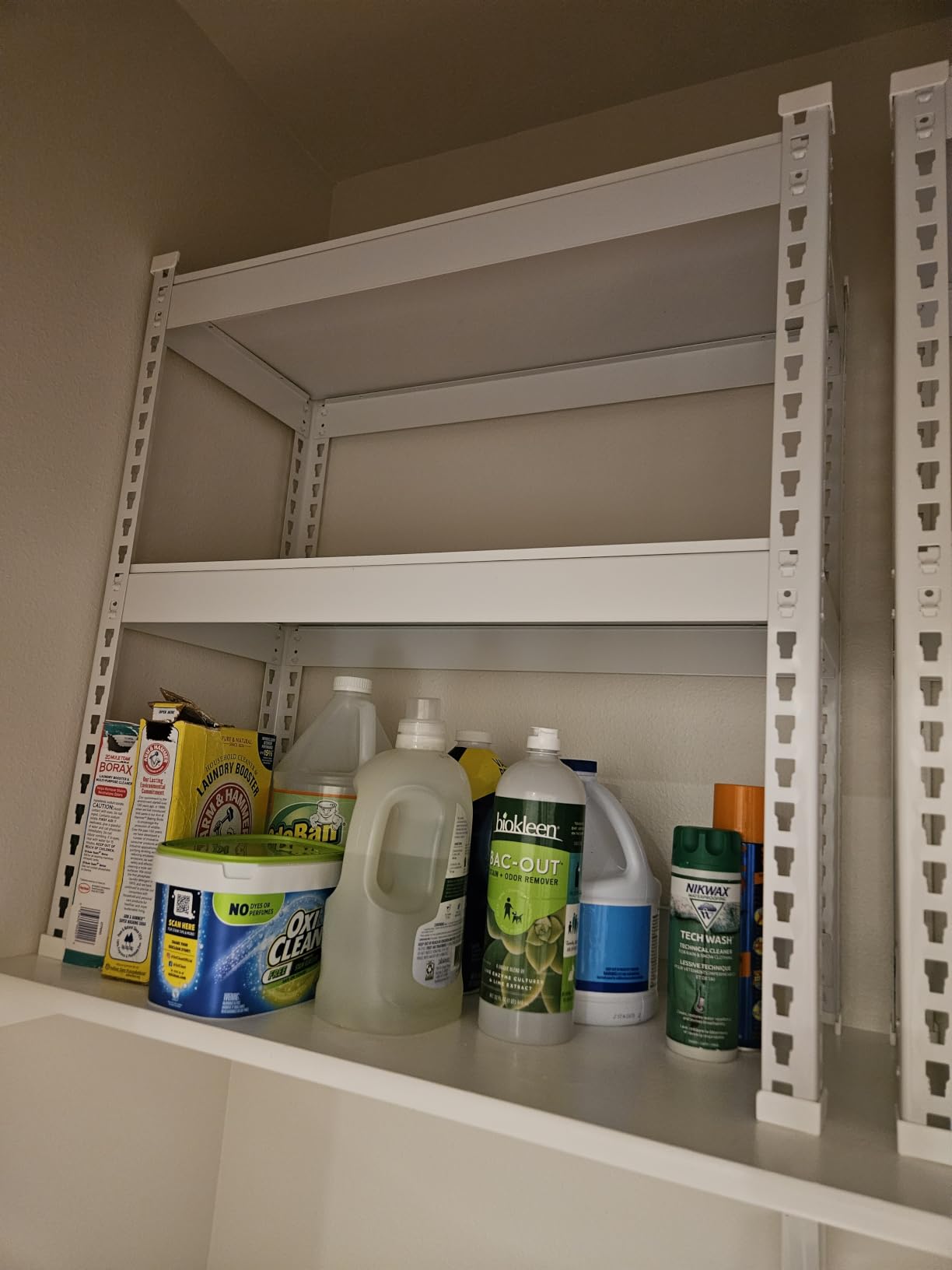
The HOMEDANT solves the depth problem better than anything else in this group. At 47.7 inches wide and 24.1 inches deep, it is one of only a few racks here that accepts full-size storage totes and small appliances without overhang, which changes what the whole garage can be organized around.
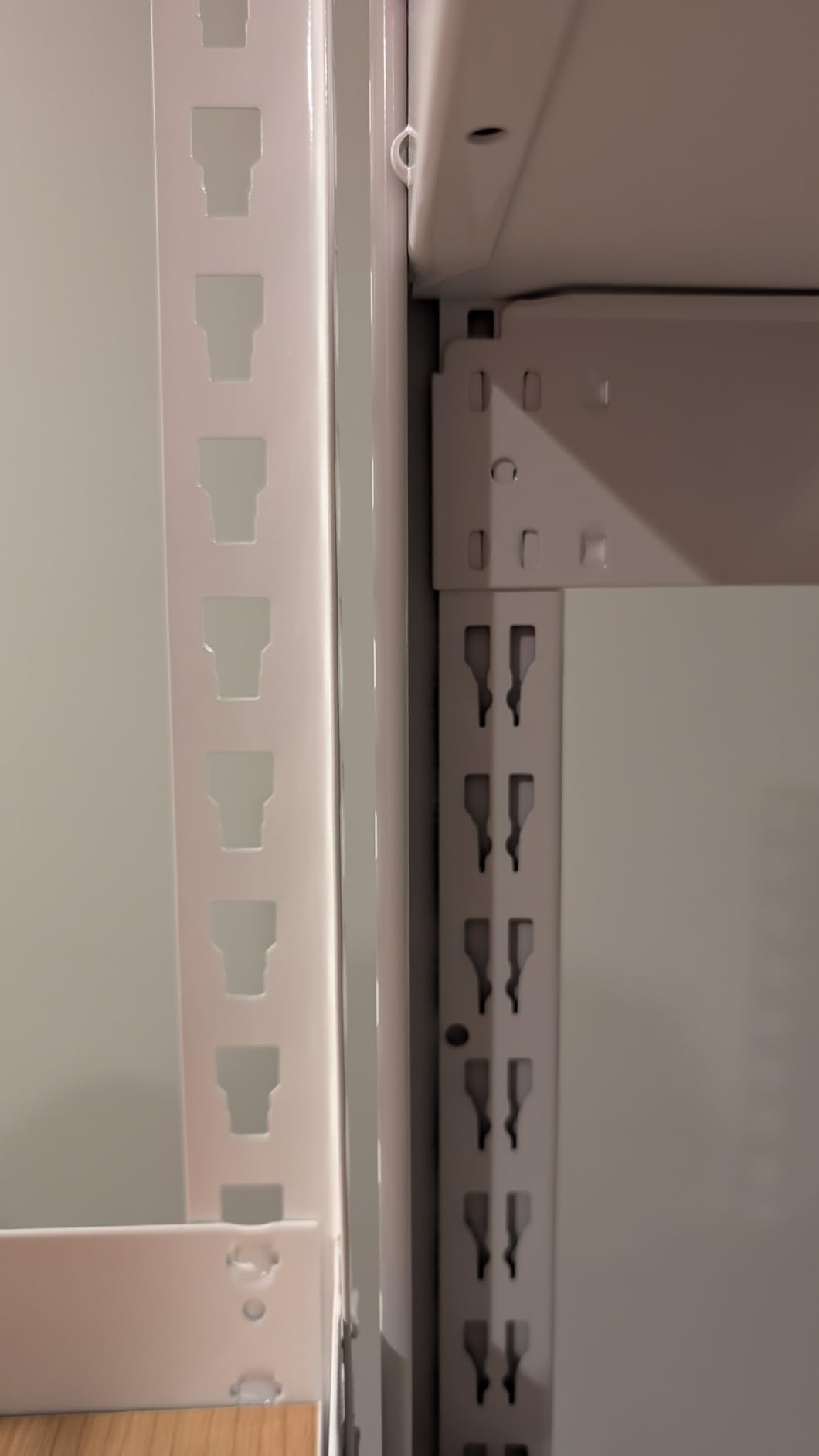
Assembly is the most praised feature across its review history: a boltless snap-together design that needs no drill and no hardware, finished in minutes by buyers who expected a longer job. All five tiers reposition, so the same frame serves a pantry in the morning and a parts rack later.
The honest limitation is the load rating, which is listed in a range of 257 to 771 lbs depending on the configuration. That is fine for boxes, bins, and household overflow, and it is not enough for engine blocks, jack stands stacked high, or full loads of paint.
The 47.7 inch width also has to fit somewhere. Against a single-car garage wall, it claims nearly four feet of the run, so measure your wall first and treat that as a planning constraint rather than a detail.
Why This Is the Best Value Pick
You are paying for footprint and assembly speed rather than headline capacity. For most households rearranging a garage, that is the correct trade, because a 24 inch deep rack that goes up in one session gets loaded far sooner than a heavier frame that sits in parts for a weekend.
Reviewers also like the finish. The powder coating is clean enough for a laundry room or a home office, so the unit does not look like industrial equipment parked in a living space.
When the Rating Is the Problem
If your heaviest item is over 150 lbs, look at the four-tier 5000 lb units further down instead. The HOMEDANT’s frame is rigid and its assembly is easy, but the rating range simply does not cover concentrated shop loads.
Buyers who load it with totes of seasonal gear report no flex at all. It is a storage organizer first and a load-bearing rack second, and knowing which one you need is the whole decision.
4. VEVOR 5-Tier 2000 lbs Adjustable Shelving – Best Budget Heavy Duty Start
VEVOR Storage Shelves 5-Tier Adjustable 2000 lbs 48″x24″x72″ Shelving Unit
SPCC carbon steel with MDF decks
400 lbs per shelf, 2000 lbs total
48W x 24D x 72H
64.8 lb
Pros
- Frame and braces feel sturdier than the price suggests
- 24 inch depth and 72 inch height fit large totes
- Press-to-assemble with mallet and gloves included
- Splits into two separate racks
- 16 rubber foot pads protect the floor
Cons
- Thin MDF decks bow in the center
- 24 inch depth needs real floor space
- Included rubber mallet is small
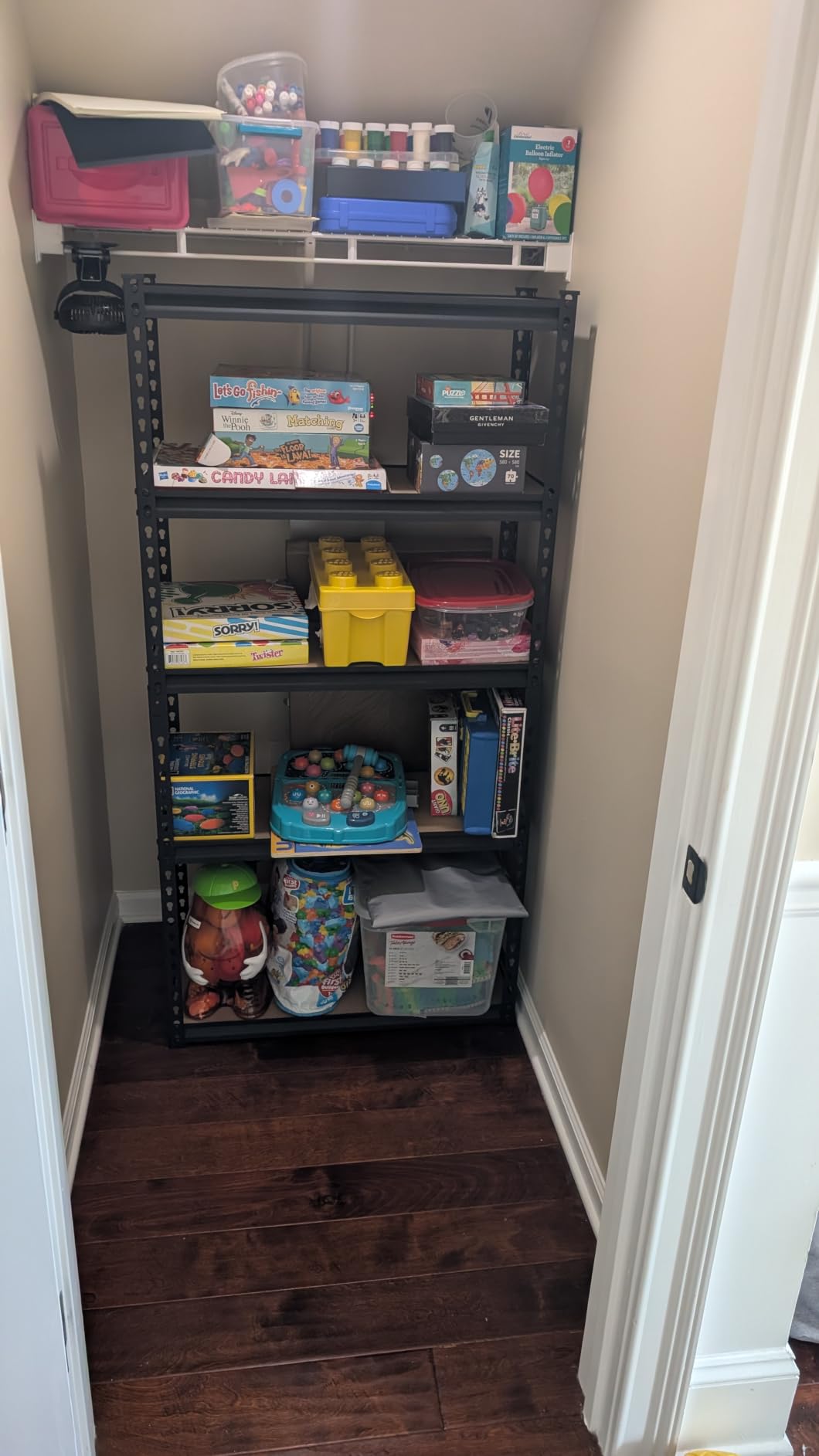
VEVOR’s 2000 lb unit is the entry point where the steel frame stops being an afterthought. The SPCC carbon steel posts, braces, and powder coating hold up to contact in a way that budget racks with painted steel usually do not, and at 64.8 pounds the frame itself has real mass.
The press-to-assemble design needs no tools, and the box includes a rubber mallet, gloves, and 16 foot pads that keep the frame from scratching a sealed garage floor. You can also split the unit into two shorter racks, which is genuinely useful if your wall run is not 48 inches straight.
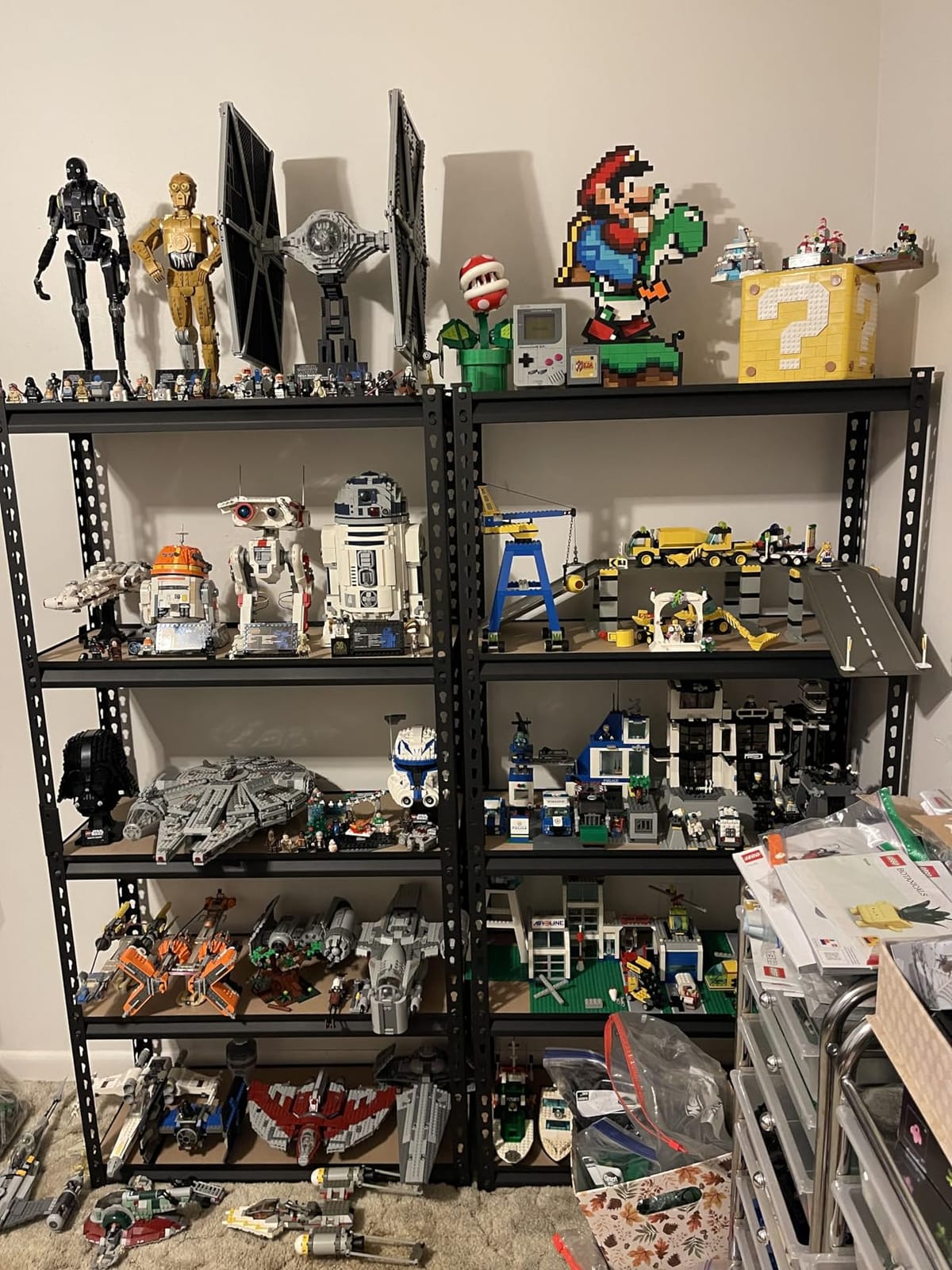
Here is the number to read carefully: 400 lbs per shelf is a frame claim, not a deck claim. The shelves are MDF, and multiple reviewers report the boards bowing in the center under concentrated weight well before that figure is reached. There is no center support under a long span.
That does not make the unit bad. It makes it a spread-the-load rack. Distributing weight across the full width of each tier, with the heaviest items centered on the beams, gets you close to the advertised figure in normal use.
Best Fit for a First Heavy Duty Purchase
This is the rack to buy when you want a real steel frame, a 24 inch depth, and five tiers without moving up to a four-tier 5000 lb industrial frame. Owners who bought it for garage storage and workshop parts report the frame staying rigid through repeated loading and unloading.
Splitting the unit into two shorter sections also solves a real space problem. A single 48 inch run is harder to place in a garage with an awkward wall or an existing workbench than two 24 inch sections are.
Where the Deck Will Disappoint
If you plan to park a single heavy object at the center of a tier, the MDF board will tell you about it before the frame does. Watch for a visible dip across the middle of the shelf after a few weeks of heavy loading.
Also plan for the floor space. A 48 by 24 inch footprint is the second largest in this group, and the 64.8 pound frame is not something you want to shuffle across a finished garage floor repeatedly. Choose the wall before you unbox it.
5. REIBII 55.5 Inch Wire Shelving 3200 lbs – Top Wire Deck Capacity
REIBII 3200LBS Storage Shelves 55.5″ W Garage Shelving Heavy Duty 5 Tier Adjustable Wire Shelving Unit Metal Shelving for Garage Pantry Commercial Basement,55.5″ W X 18”D X 71″ H
Alloy steel wire
640 lbs per tier, 3200 lbs total
5 tiers
55.5W x 18D x 71H
25.2 mm wire
Pros
- 4.8 stars with 87 percent five-star ratings
- V-shaped reinforced braces and 25 mm wire
- 55.5 inch width holds bulky items
- Advanced powder coating resists rust and oxidation
- Anti-tip hardware and leveling feet included
Cons
- Wire surface is not flat so small items need liners
- 18 inch depth is shallower than deep-storage racks
- 830 ratings gives the shortest review history
This unit has the highest rating profile in the roundup at 4.8 stars, with 87 percent of ratings at five stars and only 2 percent at one star. More importantly, the rating is backed by hardware that matches the claim: 25 mm wire rods, V-shaped reinforced braces on the frame, and a 640 lb per-tier figure rather than a headline-only claim.
At 55.5 inches wide it is the second-widest rack here, which means a single unit can hold bulky items without forcing you to buy a second bay. Shelves adjust vertically, and the frame can be split into two sections or configured as a workbench-style surface.
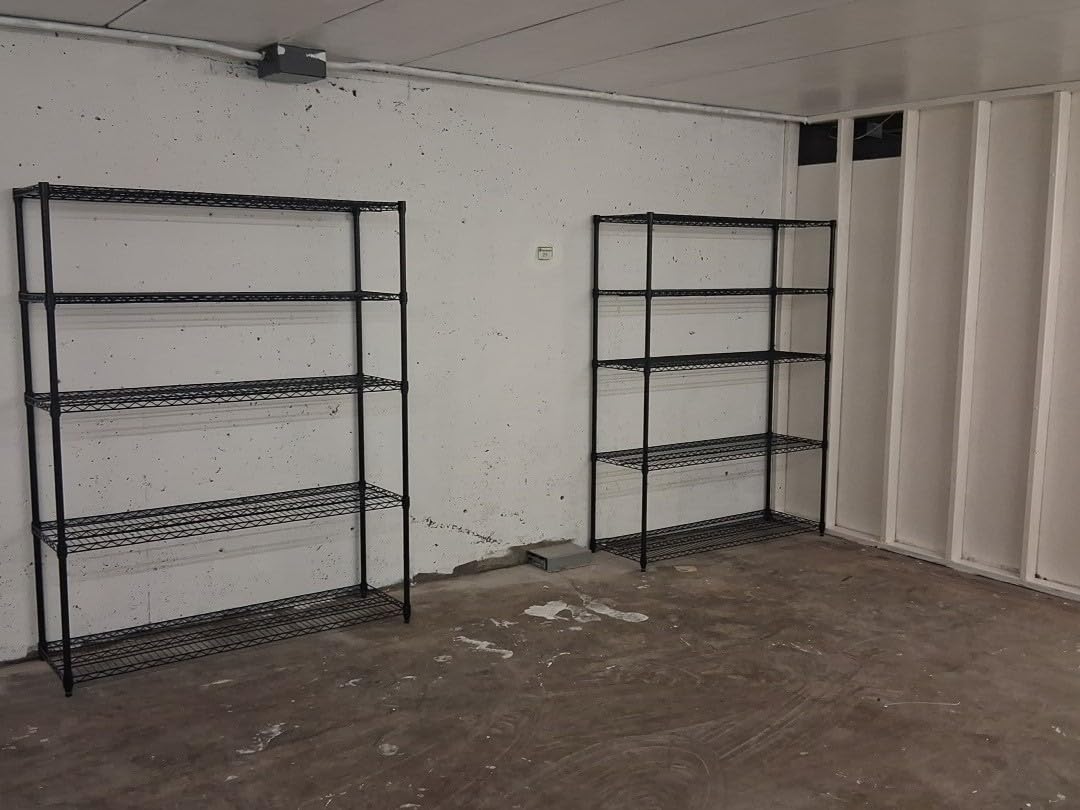
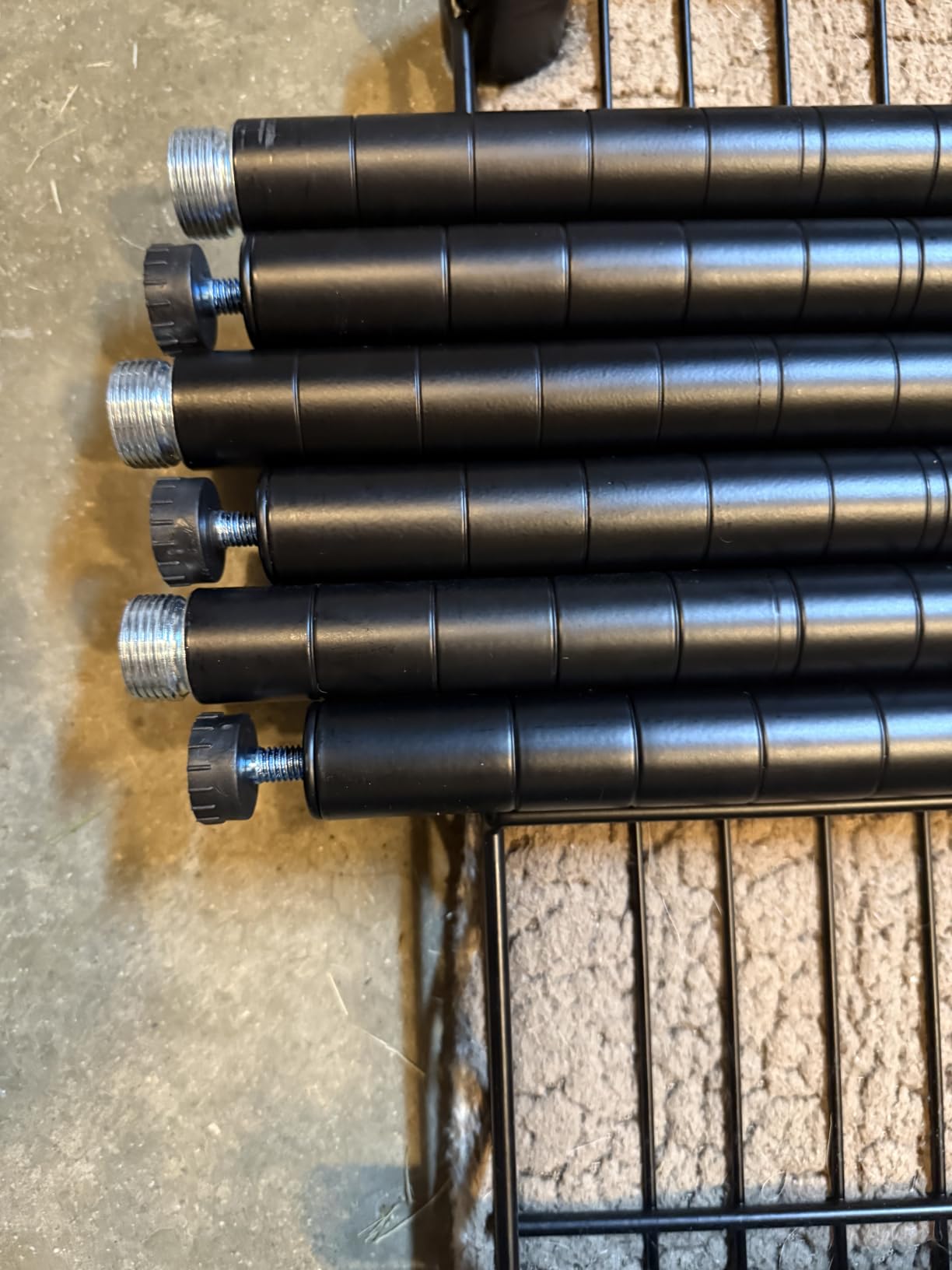
Two details make this the best-anchored wire unit in the group. Anti-tip hardware and leveling feet are both included in the box, and the bolt-free assembly takes about ten minutes, which is fast for a 3200 lb-rated frame.
The powder coating is described as advanced rust and oxidation resistance, and owners in humid basements report clean frames after extended use. That matters more in this category than most listings suggest, because coastal and unheated garages eat bare or thinly coated steel quickly.
Where Wire Deck Wins
Wire decking drains water, does not trap dust in corners, and lets you see what is on the shelf without pulling bins forward. For a garage, a damp basement, or a covered outdoor bay, that is a real practical advantage over a flat panel that holds condensation against the steel.
If you are organizing by bins rather than by individual items, the 55.5 inch span means fewer frames to anchor and fewer gaps to clean around. That reduces both floor coverage and the number of tip hazards in the room.
When Wire Is the Wrong Choice
Do not buy a wire deck if you store loose hardware, fasteners, or small electrical parts. They fall through, and owners consistently recommend liners or small bins as a mandatory accessory. The 18 inch depth is also shallower than the deep-storage units, so full-size totes will overhang.
Be aware of the shorter history. At 830 ratings it is the smallest review base among the ten units here, so you have less long-term data behind it than the racks with hundreds of thousands of ratings. The engineering claims are specific, but they are still manufacturer claims.
6. SISESOL 71 Inch 4-Tier Heavy Duty Rack – Best for Linked Runs
71.3″ Wide Heavy Duty Garage Shelving Units,5000LBS Deep Storage Shelves,Black Metal Garage Shelves,Steel Shelf,Large Storage Rack,Industrial Shelving for Shop,Warehouse,Basement,71.3″W x 24″D x 70″H
One-piece uprights
5000 lbs total
4 tiers
71.3W x 23.6D x 69.7H
80 lb
Pros
- One-piece uprights resist twisting and buckling
- 8 reinforced lateral stabilizer bars reduce sway
- Units can be linked into a continuous run
- 23.6 inch steel shelves suit bulky items
- Locking shelf pins
- Foot mats and rubber mallet included
Cons
- Shelf panels flex under concentrated loads
- Assembly takes a couple of hours
- Occasional reports of broken arms or missing parts
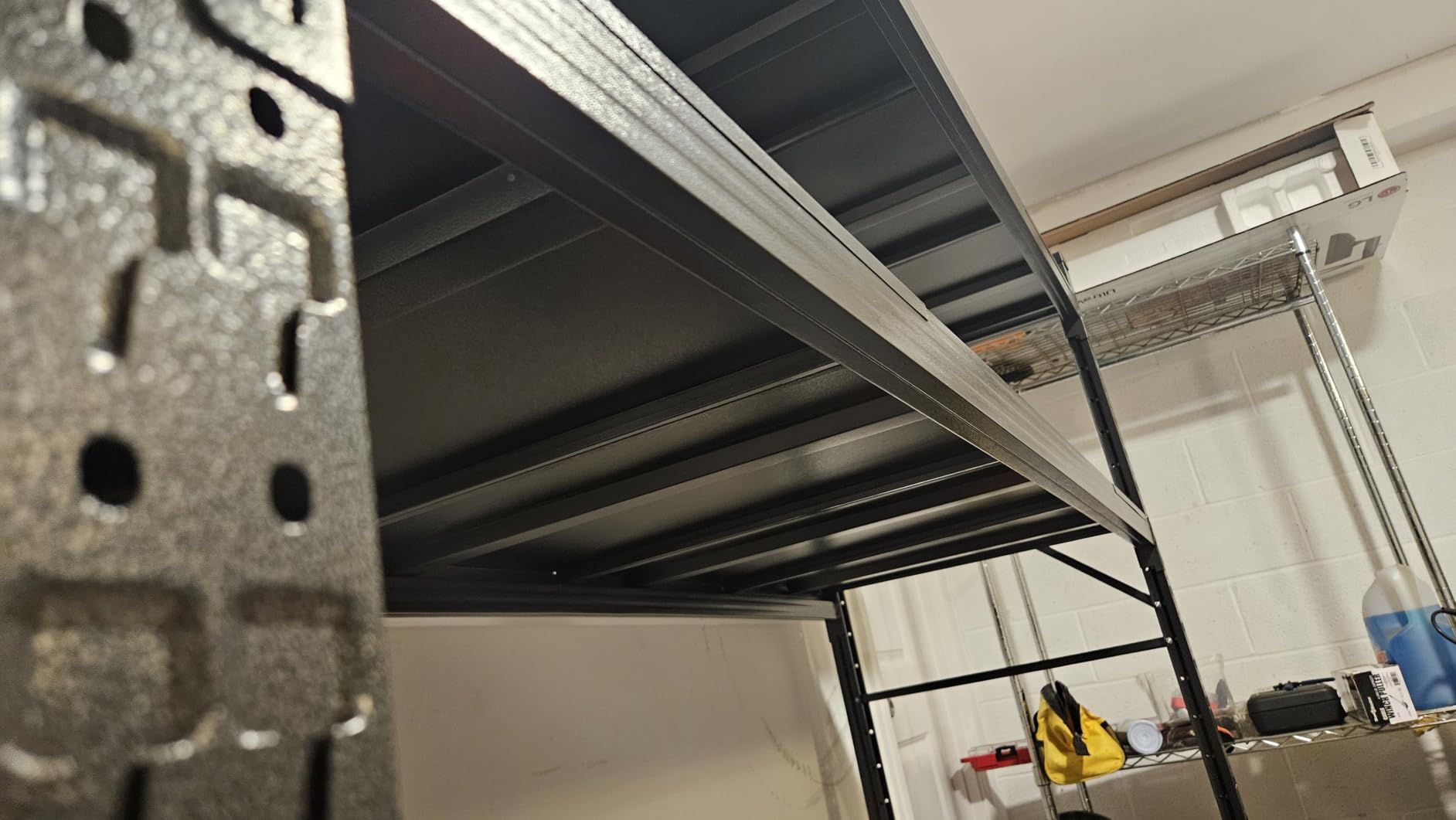
The structural story on this rack is the one-piece uprights. Rather than bolting two shorter posts together, the columns are a single formed piece, which removes the joint that is usually the first thing to work loose on a heavily loaded industrial frame. Eight reinforced lateral stabilizer bars add further resistance to sway and twisting.
At 5000 lbs stated total across 4 tiers, this is a genuine shop-class frame. The 23.6 inch depth handles bulky items and totes well, and the powder coating is reported to hold up in dirty barns and damp basements, which is the environment most garages actually have.
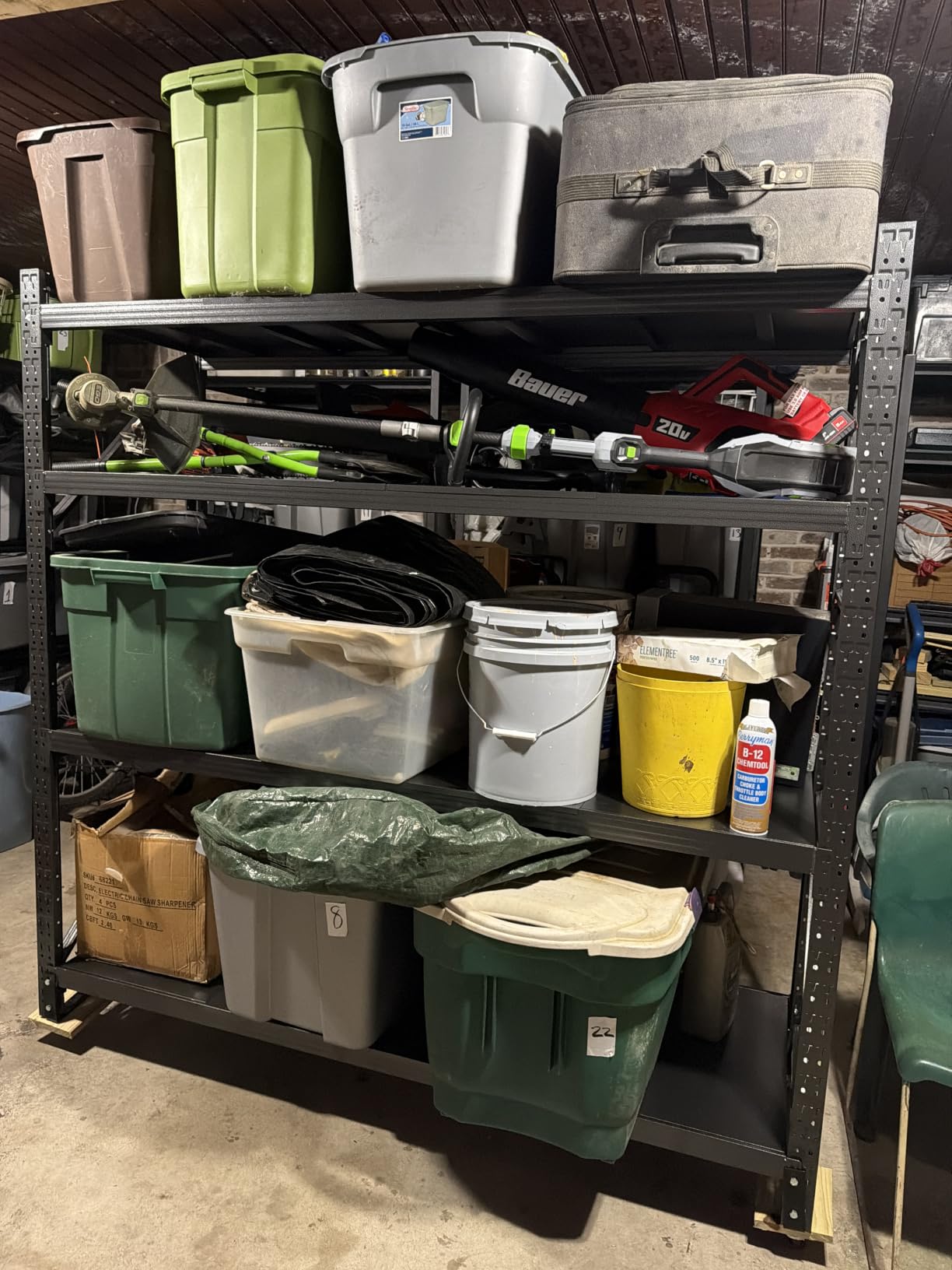
Two features make it the pick for a wall-length run. Units can be interconnected side by side into a continuous shelving line, and locking shelf pins stop adjustable shelves from shifting once the rack is loaded. For a workshop, that combination is worth more than an extra tier.
Expect the assembly to take a couple of hours, and read the instructions properly rather than sorting hardware by eye. It is an 80 pound unit, so moving it into position after building is a two-person job.
When a Wide Industrial Frame Pays Off
Buy this if you are building out a workshop wall, a small shop, or a basement run where you want a long continuous bank of shelving instead of a row of separate racks. The interlocking design removes the light gap and the shared wobble between bays.
It also suits mixed loads. Reviewers report holding heavy items on the lower tiers and lighter stock above without the frame complaining, and the 23.6 inch depth gives you room for awkward shapes like wheelbarrows or shop vacs.
Before You Order a 5000 lb Claim
Reviewers report visible shelf panel flex under heavy concentrated loads even though the frame itself holds. The panels are the limiting factor on any rack in this class, so load the center of a tier with something narrow, or add a plywood deck of your own over a steel frame.
A smaller share of buyers also report broken support arms or pieces arriving missing, and the seller has replaced parts when contacted. Its 4.2 average carries an 11 percent one-star share that points to parts and instruction issues rather than frame failure.
7. REIBII 2-Pack 5-Tier Racks, 2400 lbs Each – Best for Two Bays
REIBII 2 Pack Garage Shelving, 2400LBS Each,Heavy Duty Storage Shelves
Carbon steel frame with MDF decks
480 lbs per tier, 2400 lbs per unit
2 racks of 5 tiers
36W x 16D x 72H each
44 lb
Pros
- Two complete 5-tier racks in one purchase
- Support rod under each MDF board spreads weight
- 1.4mm rolled-edge posts resist flexing
- MDF surface keeps small items in place
- Bolt-free build in about 10 minutes
Cons
- Narrow 16 inch depth limits bulky bins
- MDF boards fall short of the 480 lb tier claim
- A second person helps with assembly
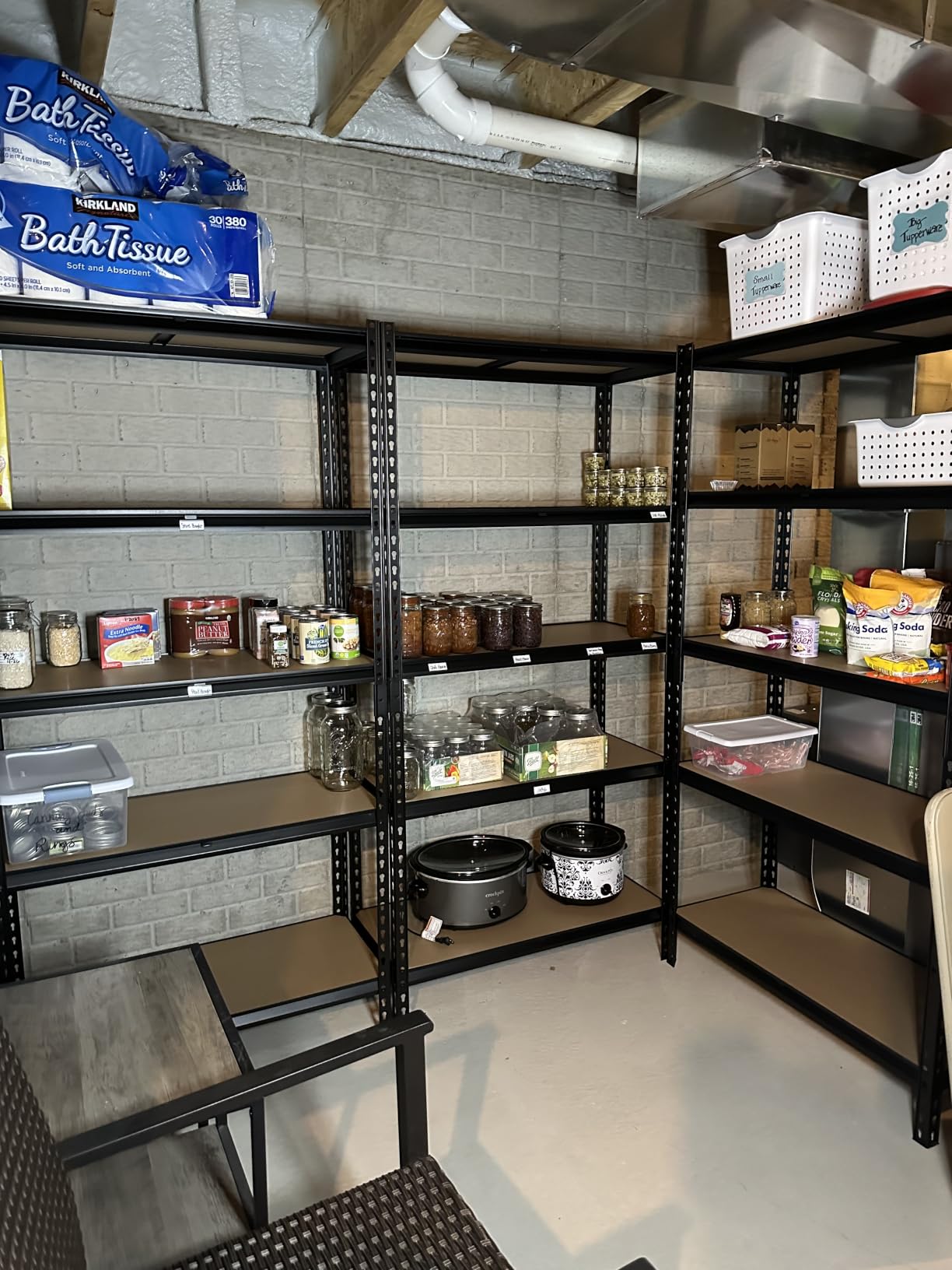
This is the packaging play of the group: two complete five-tier racks in a single purchase, which works out to ten storage tiers. If you are organizing a garage with two usable walls or a workshop that needs matching bays, buying the pair is simpler than sourcing two units separately and it gives you identical frames to anchor.
The frame engineering is better than most at this level. Posts are 1.4 mm rolled-edge steel, and a support rod runs beneath each MDF shelf board to spread the load into the frame rather than letting the panel carry it alone. That rod is the difference between a deck that bows and one that stays flat.

Owners also like the 5 mm MDF surface for a practical reason: it keeps small items from slipping through the way a wire deck does. If you are storing hand tools, fasteners, and parts rather than bulky goods, a flat surface is easier to organize.
Each unit can be split into two shorter sections if a 72 inch height is more than you have room for, which is a useful option under low garage ceilings.
Best Value When You Need Two Separate Bays
The two-pack is the right call when your storage plan calls for a rack against the back wall and another against the side wall. Identical frames mean one set of anchoring hardware, one set of instructions, and a uniform look across the garage.
Buyers report a bolt-free build in roughly ten minutes using the included hammer and gloves, and wall fasteners are in the box. The 4.3 star average across more than 3600 ratings reflects a value product that does what the listing says, with the MDF as the soft spot.
Know the MDF Limit Before Loading
Reviewers consistently advise keeping the heaviest items on the lower tiers because the 5 mm MDF boards, not the steel, are what limits this rack. The stated 480 lbs per tier is a frame figure, and a point load in the middle of a 36 inch span will show deflection well before that.
The 16 inch depth is the other constraint. It fits paint cans, small totes, and boxed goods, but it is not a bulk-storage footprint. Buyers needing full-size bins should look at the HOMEDANT or one of the 24 inch deep units instead.
8. Letaya 71 Inch 4-Tier Heavy Duty Rack – Best for Shops and Basements
Letaya 71.3″ W Metal Storage Shelves,5000LBS Heavy Duty Garage Shelving Units, 4 Tier Adjustable Utility Rack Shelf,Large Industrial Shelves,for Shop,Warehouse,Black (71.3″ W x 24″ D x 70″ H)
Cold-rolled steel
5000 lbs total
4 tiers
71.3W x 23.6D x 69.9H
79 lb
Pros
- Seamless one-piece columns remove joint weak points
- Multi-fold bent uprights with reinforced diagonal braces
- 4 structural ribs per shelf
- Anti-corrosion powder coating for humid spaces
- Locking pins and soft floor pads included
Cons
- Only 385 ratings so durability data is thin
- Four tiers across a very wide span
- 79 lb unit needs two people to move
The Letaya takes the same wide industrial format as the SISESOL and pushes the panel construction further. Each shelf has four structural ribs, which is the direct answer to the panel-flex complaint that shows up on every wide rack in this category. Combined with a seamless one-piece column and multi-fold bent uprights, it is a genuinely stiff frame.
Anti-corrosion powder coating over cold-rolled steel is specified for humid basements and covered outdoor use, which matches how these racks get used in a real garage more than the usual indoor-only claim.
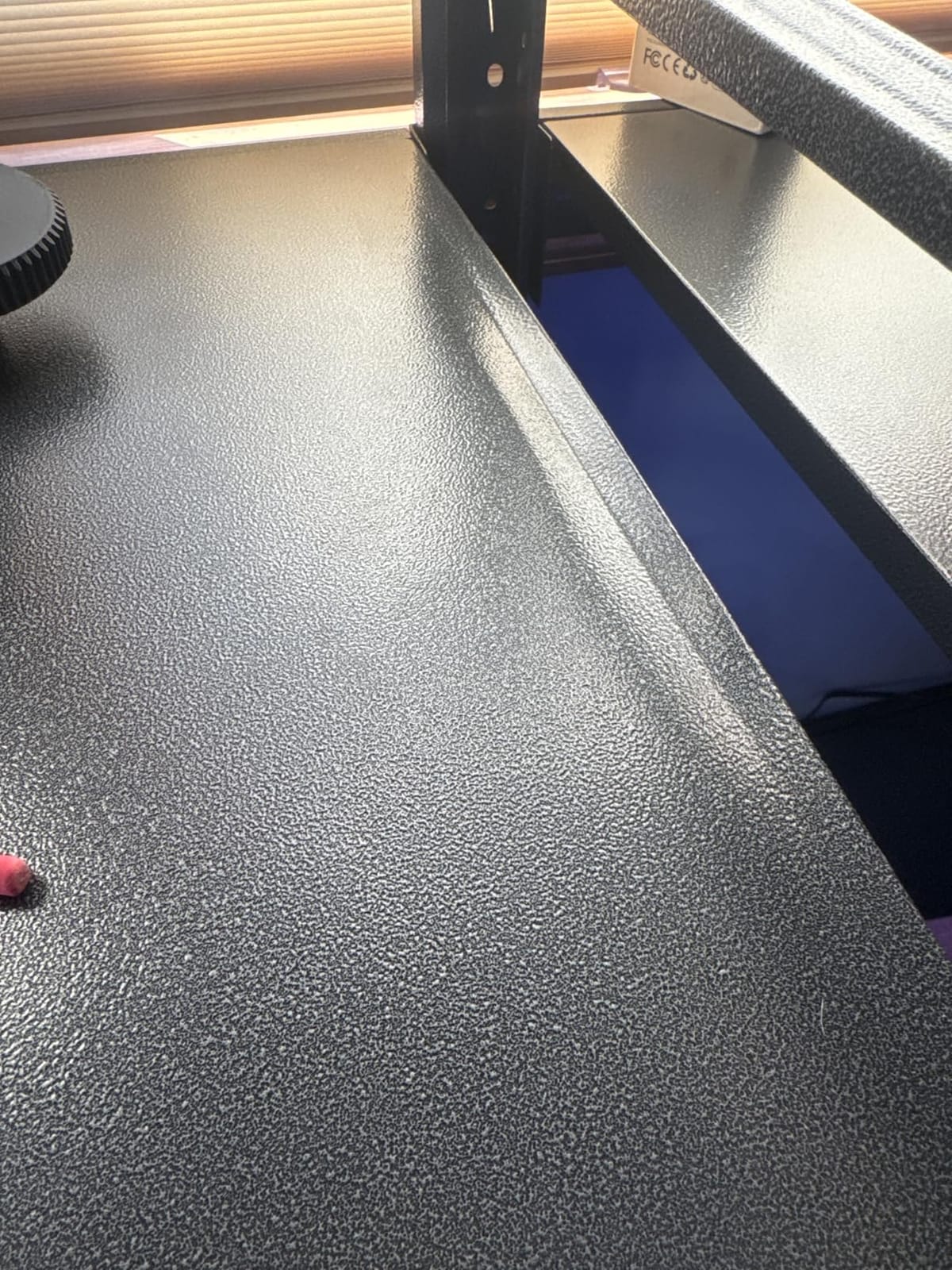
Locking pins keep adjustable shelves from slipping or shaking, and soft floor pads protect a sealed floor. The instructions are clear and all hardware is included, so the assembly experience is smoother than the rating spread might suggest.
At 79 pounds the unit is heavy enough that moving it is a two-person task. Position it before you build it, not after.
Where Four Ribbed Shelves Matter
Ribs are the detail that separates a shelf that stays flat from one that dishes in the middle. If you are storing long lengths of material, sheet goods, or evenly distributed bins across a 71 inch span, a four-rib panel behaves far better than a flat pressed panel of the same size.
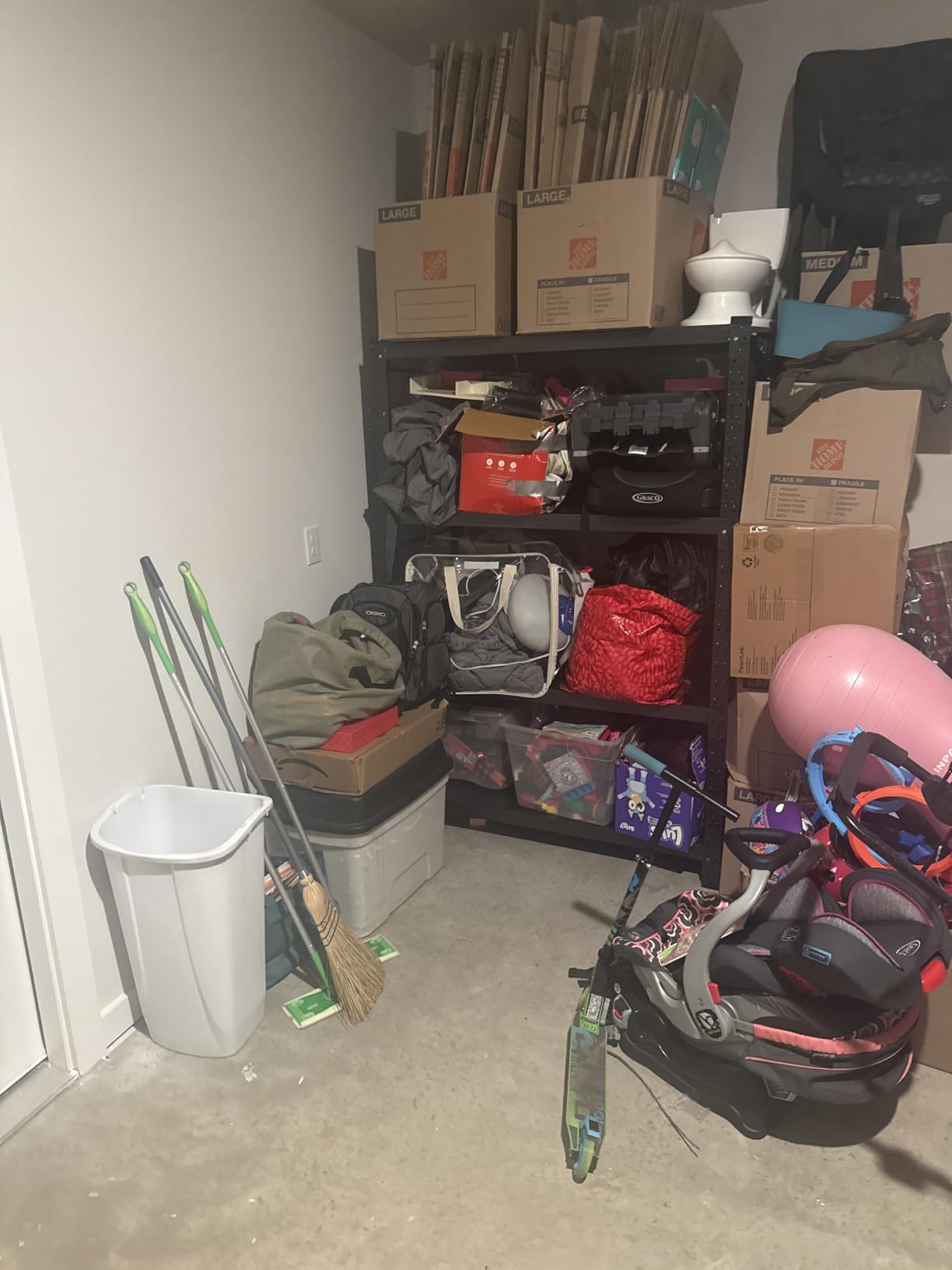
For a shop, warehouse-adjacent storage, or a basement, this is the shape you want: wide, deep, and stiff, with hardware that resists the rust cycle. Buyers report the frame feeling solid once loaded with no wobble.
Buying With a Thin Rating History
At 385 ratings, this is the newest listing in the roundup, and its 4.2 average carries an 11 percent one-star share that mostly reflects assembly friction rather than frame failure. You have less long-term data here than with any established brand on this list.
Only four tiers across a 71.3 inch span is also a real trade. You get a very large, very stiff deck area, but you give up the vertical flexibility that a five-tier rack would offer. Decide which matters more for your inventory before you order.
9. RAVIGIN 71 Inch 4-Tier Heavy Duty Rack – Wide Bay on a Lighter Frame
RAVIGIN 5000LBS Storage Shelves,71″ W Garage Shelving Heavy Duty Metal Adjustable Garage Shelves, Shelving Units Industrial Shelving for Warehouse,71″ W x 24″ D x 70″ H,Black
Powder-coated metal
up to 5000 lbs
4 tiers
71W x 24D x 70H
60 lb
Pros
- 71 inch width holds four totes per tier
- Diagonal cross braces resist leaning over time
- Stays solid with no wobble once loaded
- Two-person build with clear instructions and spare screws
Cons
- Buyers dispute the listed shelf material
- J-pin locking hardware is fiddly
- Instructions are vague and support can be slow
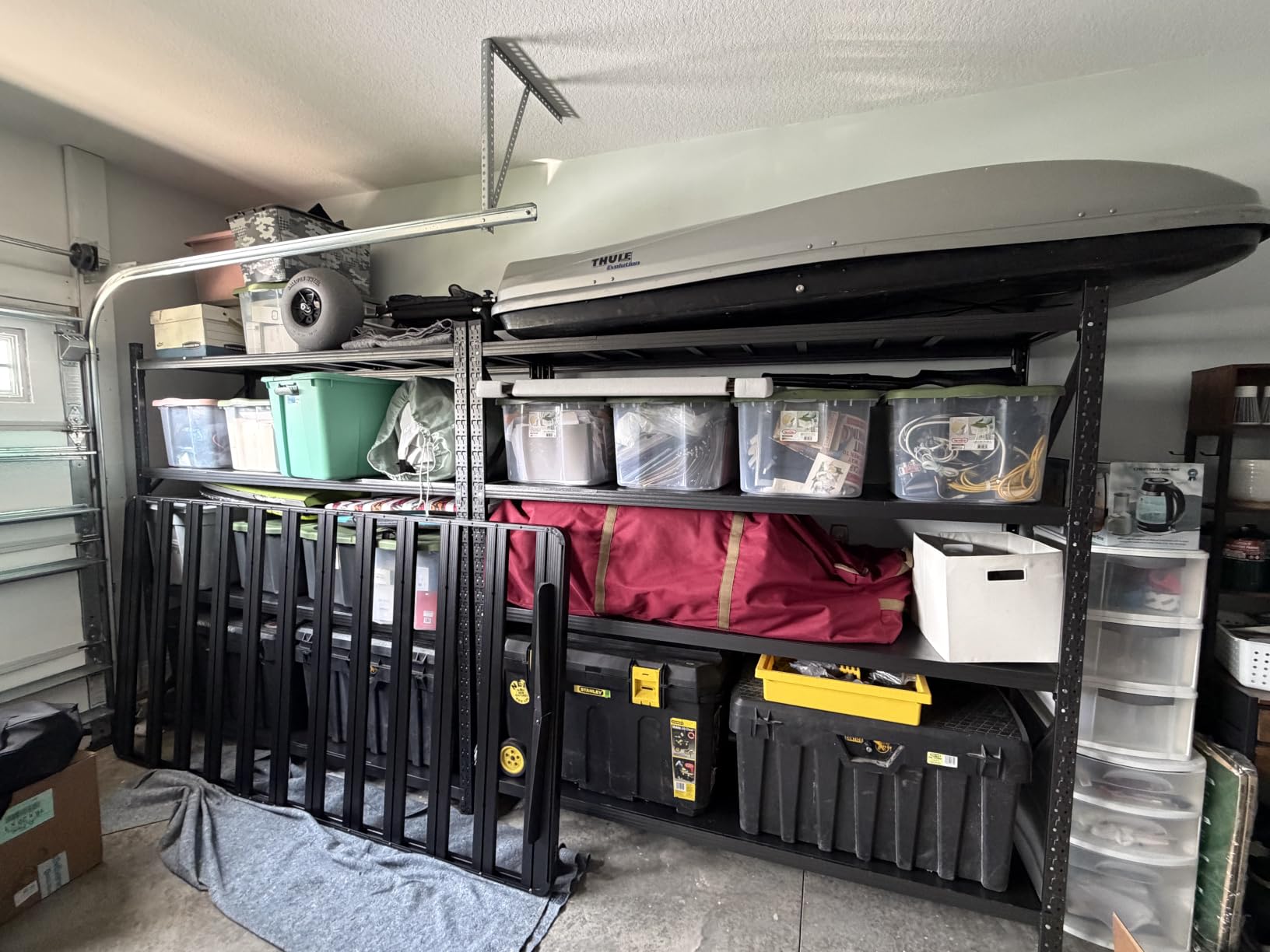
The RAVIGIN gets the geometry right. At 71 inches wide by 24 inches deep, buyers report fitting four standard totes on a single tier, which is the most storage-dense arrangement of the ten racks here. The frame sits at 60 pounds, lighter than the other 5000 lb frames, which makes it easier to reposition during a garage reorg.
Diagonal cross braces are the structural feature owners credit for a frame that does not lean or develop a list over years of use. Once loaded, buyers report no wobble at all, which is the practical test that matters.
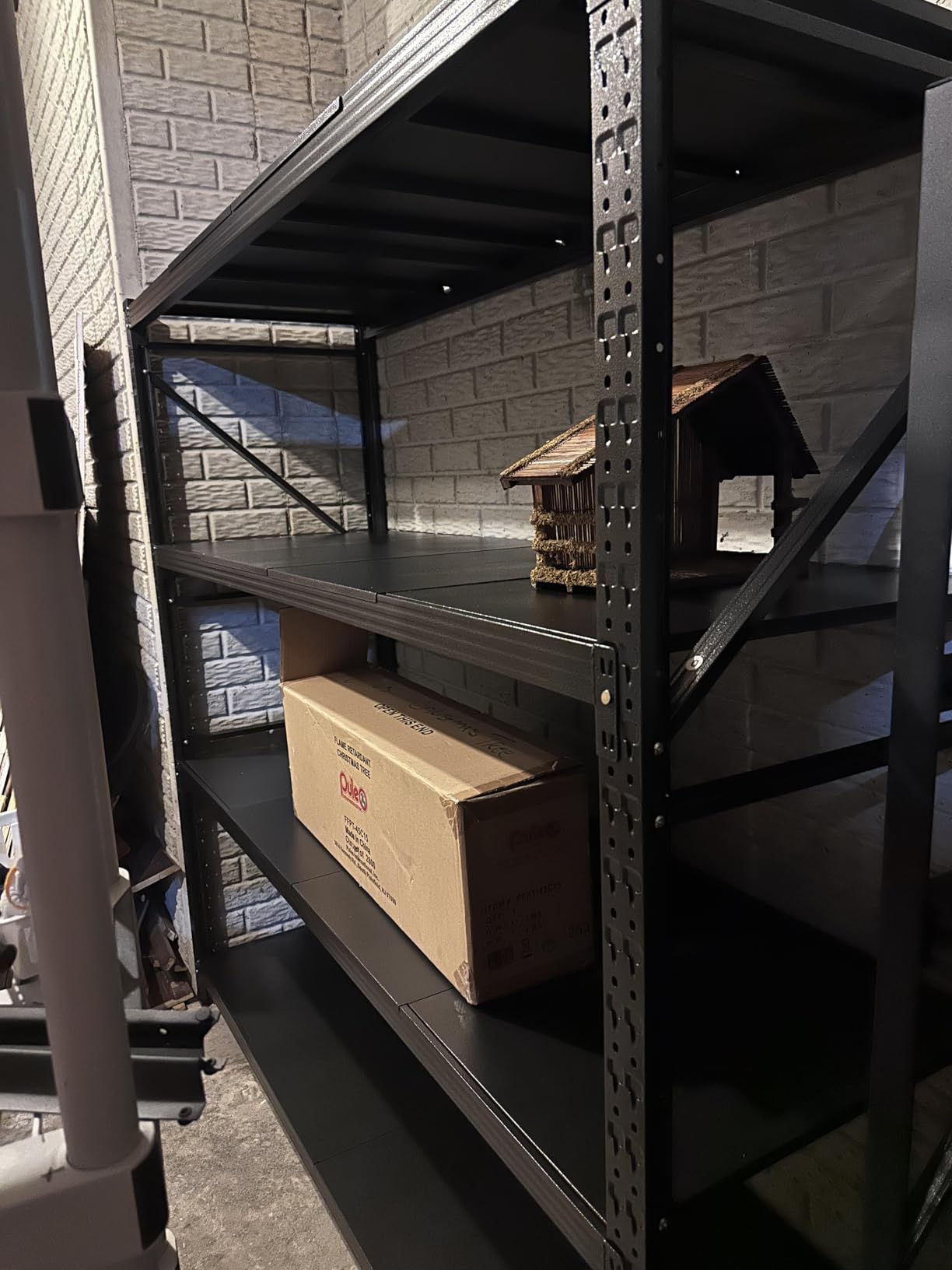
This is also the unit where the load claim deserves the most scrutiny. A notable share of buyers dispute the stated material, reporting panels that feel lighter than a steel description implies, with some describing aluminum construction. Treat the 5000 lb figure as a frame rating from the seller, not a verified steel specification.
The J-pin locking hardware is the second complaint. Owners report the pins being fiddly to seat in the beam slots and not staying put as described, so check every pin by hand once the rack is loaded.
When the 71 Inch Footprint Earns Its Place
Buy this to maximize storage on a single wall run. Four totes per tier across four tiers is a large amount of organized storage without a second frame, and the locking shelf pins allow the shelf height to change as the storage mix changes.
Buyers who put it together with a second person rate the experience well, thanks to clear instructions and extra screws shipped in the box, which is a better parts story than most racks in this class offer.
Where This Falls Short of the Class
This is the lowest-rated unit here at 4.1 stars, with a 13 percent one-star share. Material disputes, fiddly J-pins, vague instructions, slow customer support, and occasional missing shelf pieces account for most of it. The frame itself draws good marks; the hardware and the paperwork do not.
If the seller cannot confirm whether the shelf panels are steel, put your money elsewhere. A 24 inch deep unit with a documented material and ribbed construction, like the Letaya or the SISESOL, is a safer bet when the load claim is this large.
10. VEVOR 5-Tier 3000 lbs Adjustable Rack – Stiffest MDF Deck in the Roundup
VEVOR Storage Shelves, 5-Tier Adjustable, 3000 lbs Capacity, Heavy Duty Garage Storage Shelving Unit, Metal Utility Rack Shelf, for Garage Workshop Warehouse Basement, 48.43″ W x 24.53″ D x 71.38″ H
SPCC carbon steel with 7mm MDF
600 lbs per shelf, 3000 lbs total
48.4W x 24.5D x 71.4H
Pros
- Thicker metal and round dowel keyways feel rigid
- 7mm MDF decks stiffer than 5mm budget boards
- Splits into two units or a work surface
- Snap-on assembly one person can manage
- Gloves and rubber mallet included
Cons
- MDF tops warp under load
- No center support on each shelf
- Instructions not always clear unaided
This is the VEVOR to choose over the 2000 lb version. The frame uses a rib-reinforced SPCC carbon steel with round dowel keyways instead of the tabbed connections used on budget units, and that difference in joinery is why owners describe it as rigid rather than merely serviceable.
The deck boards are 7 mm MDF, roughly 40 percent thicker than the 5 mm boards common on budget competitors, and that stiffer panel is why this unit carries a 600 lbs per shelf claim with more credibility than most flat-panel racks. Five tiers at 3000 lbs total give you both width of shelf and vertical count.
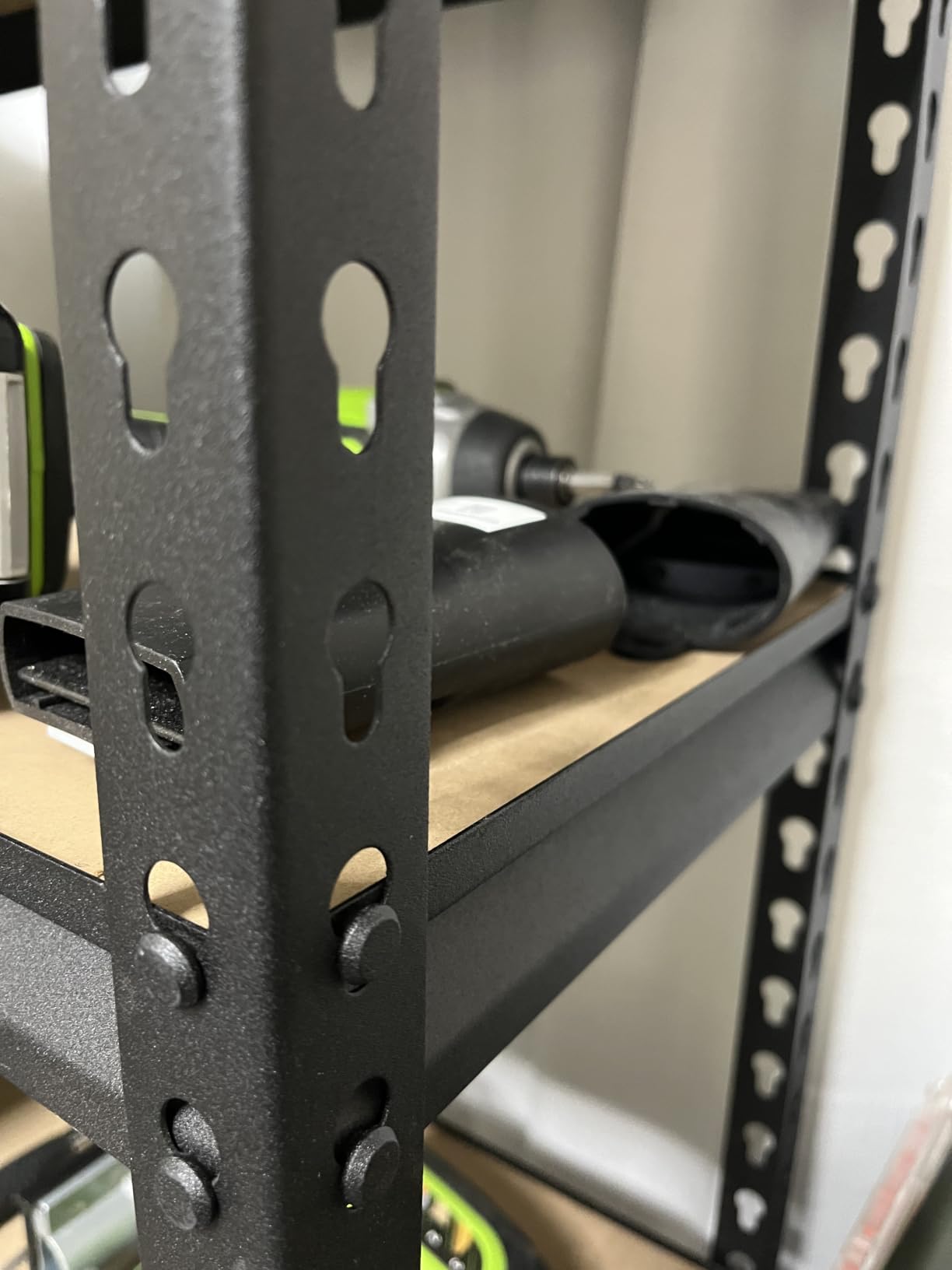
Assembly is snap-on with no screws or nuts, and one person can complete it. The box includes a rubber mallet, gloves, and wall fasteners. You can also split the five tiers into two independent short units, or run two sections side by side as a continuous work surface.
Gourd-shaped shelf slots allow flexible vertical positioning, so the same frame can hold tall bottles low and shallow trays up high without buying a second rack.
Best Balance of Deck Strength and Tier Count
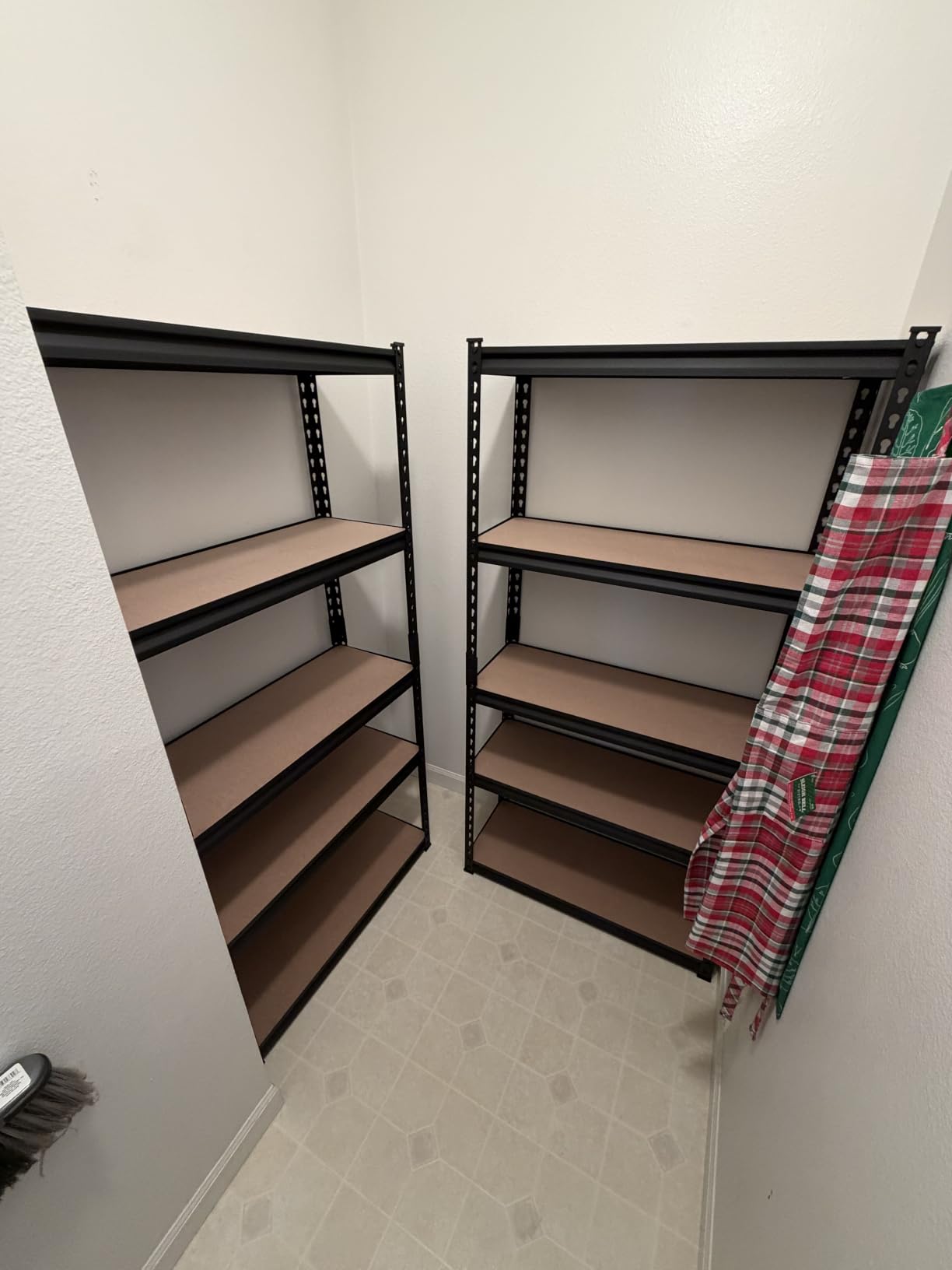
Choose this if your storage is a mix of bulky totes and smaller parts, because 24.5 inches of depth handles the bulky items and a flat MDF top handles the small ones. A wire deck would fail the second job, and a four-tier 5000 lb frame gives up depth.
Reviewers rate the metal gauge and the dowel-based assembly above bargain shelving units, and the 4.4 star average across more than 1800 ratings reflects a consistent experience rather than a mixed one.
When the MDF Top Still Limits You
Even at 7 mm, the MDF tops warp under sustained load and there is no center support on each shelf, so long spans need a wall behind them. Place this unit against a wall rather than free-standing in the middle of a garage if you plan to load the tiers fully.
Instructions are not always clear enough to follow unaided, so budget extra time for the first build. If you need flat shelves that never bow, skip to the all-steel wire and ribbed-panel units, or plan to lay your own plywood deck over this frame.
How To Choose Heavy Duty Garage Shelving
Start with the three questions that matter most here, and they are the same ones search engines ask: what are you storing, how much space do you have, and do you want floor or wall mounting. Everything else in the buying process follows from those three answers.
Freestanding Racks vs Wall-Mounted Shelving
Freestanding racks give you adjustable shelf height and the freedom to move the unit, at the cost of floor space and a tip-over risk. Wall-mounted systems, sold as rack-and-shelf, track-rail, or slat-wall systems, trade both of those away: they put storage above the floor and keep it there permanently, and they hold far more per foot of wall than a deep rack.
Choose wall-mounted when floor space is the binding constraint, which is the situation in most single-car garages and in any garage with a vehicle, a workbench, and a shelving rack competing for the same slab. Choose freestanding when you want to reorganize as your storage changes, or when your wall does not have studs in a usable position. None of the ten racks in this roundup is wall-mounted; if that is what you need, look for a rail-based system rather than adapting a floor rack.
Cabinets are a third category entirely. A garage storage cabinet is a different product class from a shelving rack, with doors, lockable contents, and a much lower per-shelf load figure. Cabinets protect tools and chemicals from dust and access; racks move bulk volume. Most organized garages end up using both.
Wire Deck vs Resin and Wood Decks
Wire decking is the strongest and most durable option. Rods and welded wire do not bow, do not absorb moisture, and drain water, which makes wire the right deck for a damp basement, an unheated garage, or covered outdoor storage. Its weakness is function: small items fall through, and the surface is not flat for tools or parts.
Resin and plastic decks are flat and water-resistant but flex far more than wire under the same load, and they soften in heat. A car in the sun can lift a garage to temperatures that deform a resin shelf you thought was solid.
Flat panel decks, whether MDF, particle board, or plywood, are the most convenient for tools and small parts but the least forgiving of moisture. They also deflect in the center unless a support rod or center beam runs beneath them, and that is the single most common cause of a rack that looks overloaded when the frame is nowhere near its rating.
MDF vs Plywood vs Particle Board for Garage Shelves
Plywood is the best shelf core for a garage, and 3/4 inch full-depth plywood is the thickness most builders settle on. It is dimensionally stable in humidity, holds screws well, and will not crumble at the edges the way particle board does. Buy exterior or treated plywood if the shelves will see any moisture at all.
MDF is smooth and flat, which is nice for parts, but its fibers absorb moisture and swell, and it loses strength once wet. It is the wrong choice in an unheated or humid garage unless you seal every edge.
Particle board and chipboard are the weakest of the three. They swell, delaminate, and crumble at drilled and fastened edges, and none of them should be used as a structural shelf in a garage. If a listing advertises heavy duty shelving built on particle board, treat the load rating as a marketing number.
Sizing a Unit for Your Garage
Measure the wall before the unit, and measure it at the height you plan to load. A 71 inch wide rack needs 71 inches of clear run plus a few inches of clearance at each end so you can build and anchor it. Depth is the second constraint: 12 to 18 inch racks take cans, trays, and shallow bins, while 24 inch racks take standard totes and small appliances.
Height matters in a low-ceiling garage. Most of these units are around 70 to 72 inches tall, which fits under an 8 foot ceiling with room to spare, but check that you still have headroom to lift a bin onto the top tier without scraping the door track. A rack you cannot load from the top is a rack that stays half empty.
Anchoring, Load Distribution, and Common Mistakes
An unanchored tall rack holding hundreds of pounds per shelf is a genuine tip-over hazard, and anchoring takes minutes. Attach the unit to wall studs with the included anti-tip hardware, not to drywall anchors alone. If you cannot find a stud, use a toggle or molly bolt rated well above the shelf load, and fix the hardware into the top of the unit where leverage is lowest.
Load distribution is the second rule. Put the heaviest items on the lowest tier, center weight over the support beams rather than the middle of an unsupported span, and avoid stacking one heavy object in the center of a flat panel. Do not use a loaded rack as a step ladder; a bottom shelf that takes body weight in an unexpected direction is a failure waiting to happen.
Other recurring mistakes: leaving the wall fasteners in the box, mixing deck types so the front of the rack is stronger than the back, storing fluids and solvents on the top tier where leaks land on everything below, and ignoring floor levelness. Run a level along the base before you tighten anything, because a frame built out of square will not get in square later.
Boltless vs Screw-Together Assembly
Boltless racks use pressed pins, dowels, or snap-fit connections. They build fast, usually in one sitting with the included mallet, but the joints are the first place a frame can develop play after years of loading. Screw-together racks take longer and need tools, and the fasteners add stiffness that boltless frames do not have.
Neither is automatically better. What matters is the joint geometry and the steel gauge behind it, which is why the round dowel keyways on the 3000 lb VEVOR and the one-piece columns on the wide 5000 lb racks read as stiffer than generic tab-and-pin frames at similar headline ratings. Plan on a second person for any unit over 60 pounds, and read the instructions before sorting hardware.
Frequently Asked Questions
What are some good heavy-duty wall shelves for a garage?
The best heavy-duty garage wall shelves use a steel rail or track system with brackets and adjustable shelves rather than a free-standing frame. They hold more per foot of wall and clear the floor entirely, which matters in single-car garages. None of the racks in this roundup are wall-mounted, so look for a rail-based system with brackets rated above your heaviest planned load, and fasten into studs.
What is the strongest shelving material?
Steel is the strongest shelving material for a garage, and it comes down to the panel, not the frame. Solid steel shelf panels and heavy wire decking hold their shape under load and do not absorb moisture. Flat MDF, particle board, or resin decks are lighter and easier to organize, but they bow in the center and degrade in a damp or unheated garage.
What is the best thickness of plywood for garage shelves?
Three-quarter inch full-depth plywood is the standard choice for garage shelf decks. It is stiff enough to stay flat across a typical 18 to 24 inch span, holds screws without stripping, and tolerates humidity far better than MDF or particle board. Use exterior or treated plywood if the shelves will see any moisture, and support the panel at both ends plus a center beam for wider spans.
Which is better for garage shelves, mdf or chipboard?
Plywood is better than either for garage shelves. MDF is smooth and flat but its fibers absorb moisture and swell, which permanently weakens it in an unheated or humid space. Chipboard and particle board are weaker still, crumbling at drilled edges and delaminating when damp. If you want MDF for a smooth work surface, seal every edge and keep the shelf indoors.
What are common garage shelving mistakes?
The most common mistakes are skipping wall anchoring, ignoring the per-shelf rating in favor of the total, overloading a single tier with a concentrated point load, leaving the frame out of level during assembly, and using a loaded rack as a step ladder. Heavy items also belong on the lowest tier, and fluids and solvents should never sit where a leak can run onto items stored below.
Our Final Pick for Heavy Duty Garage Storage in 2026
For most garages in 2026, the Amazon Basics 5-shelf wire rack is the right call: a real steel frame, a 350 lbs per shelf rating backed by the longest review history in the category, tool-free assembly, and a footprint that fits a modest wall. Anchor it to studs and line the wire tiers if you plan to store small hardware.
Buy the HOMEDANT if depth matters more than capacity, since its 24 inch shelves accept full-size totes. Buy the REIBII 3200 if you want wire decking without giving up width, and step up to a 71 inch four-tier unit only when you genuinely need a 5000 lb frame. In every case, anchor to studs, keep the heaviest items low, and read the per-shelf rating rather than the headline total.