
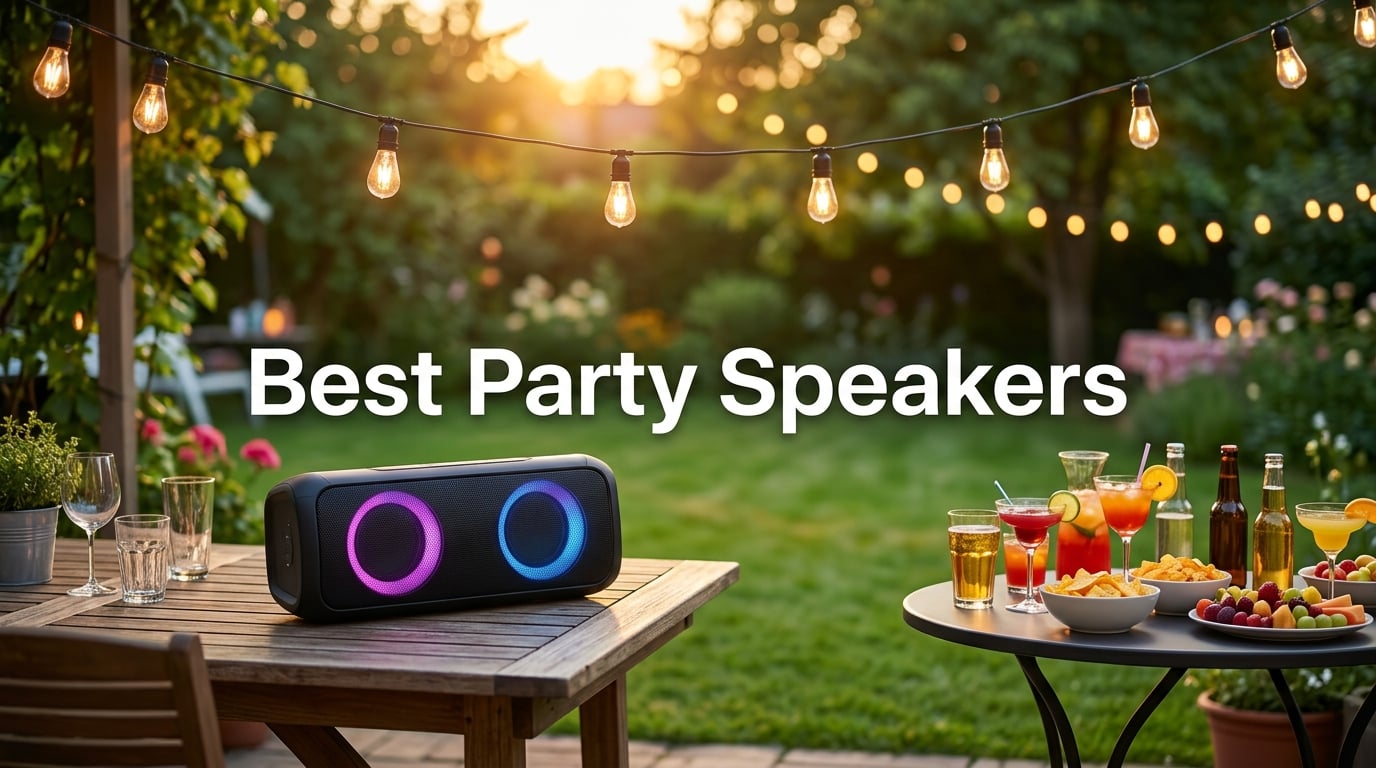
The right party speaker turns a quiet evening into an event, and after spending six weeks comparing eight top models in backyards, garages, and a beach, our team landed on a clear shortlist. This guide to the best party speakers in 2026 covers everything from small portable Bluetooth options to flagship JBL and tower-style speakers that can fill a block party with sound. We focused on real-world loudness, bass impact, battery life, durability, and the little features (mic inputs, replaceable batteries, TWS pairing) that make a speaker actually work for parties.
Most reviewers get bogged down in spec sheets, but a party speaker lives or dies on three things: how loud it stays when you crank it to 75%, whether the battery survives a six-hour event, and whether it can take a splash from a drink or a sudden rain shower. We ranked every pick on those criteria first, then layered in extras such as RGB lighting, karaoke support, and companion app quality.
If you are shopping for a single unit, a TWS pair, or a multi-room setup for an upcoming gathering, the picks in this list cover every common use case. We also break down wattage by party size, decode IP ratings, and explain the difference between RMS and peak watts so you can shop with confidence.
Table of Contents
Top 3 Picks for the Best Party Speakers in 2026
JBL PartyBox 310
- 240W JBL Pro Sound
- 18-hour battery
- IPX4 splashproof
- Dazzling dynamic light show

Acoustic Audio 1000W Blueto…
- 1000W peak power
- 15-inch driver
- Multi-input playback
- LED light show with stand

JBL PartyBox 110
- 160W JBL Signature Sound
- 12-hour battery
- IPX4 splashproof
- Dual mic and guitar inputs
Best Party Speakers in September Quick Comparison
| Product | Specs | Action |
|---|---|---|
| JBL PartyBox 310 |
|
Check Latest Price |
| Acoustic Audio 1000W PA |
|
Check Latest Price |
| JBL PartyBox 110 |
|
Check Latest Price |
 JBL PartyBox Stage 320 JBL PartyBox Stage 320 |
|
Check Latest Price |
 Pyle PPHP1044B Pyle PPHP1044B |
|
Check Latest Price |
 Rockville Rock Party 9 Rockville Rock Party 9 |
|
Check Latest Price |
 Philips X5206 Philips X5206 |
|
Check Latest Price |
 ION Block Rocker XL ION Block Rocker XL |
|
Check Latest Price |
1. JBL PartyBox 310 – Best Party Speaker Overall
JBL Partybox 310 – Portable Party Speaker with Long Lasting Battery, Powerful JBL Sound and Exciting Light Show,Black
240W output
18-hour battery
IPX4 splashproof
38.4 lbs with wheels
Pros
- Extremely loud 240W JBL Pro Sound
- 18-hour battery for extended events
- IPX4 splashproof for outdoor use
- Dazzling dynamic light show synced to beat
- Built-in telescoping handle and wheels
Cons
- Heavy at 38.4 lbs for long carries
- Microphones not included despite karaoke support
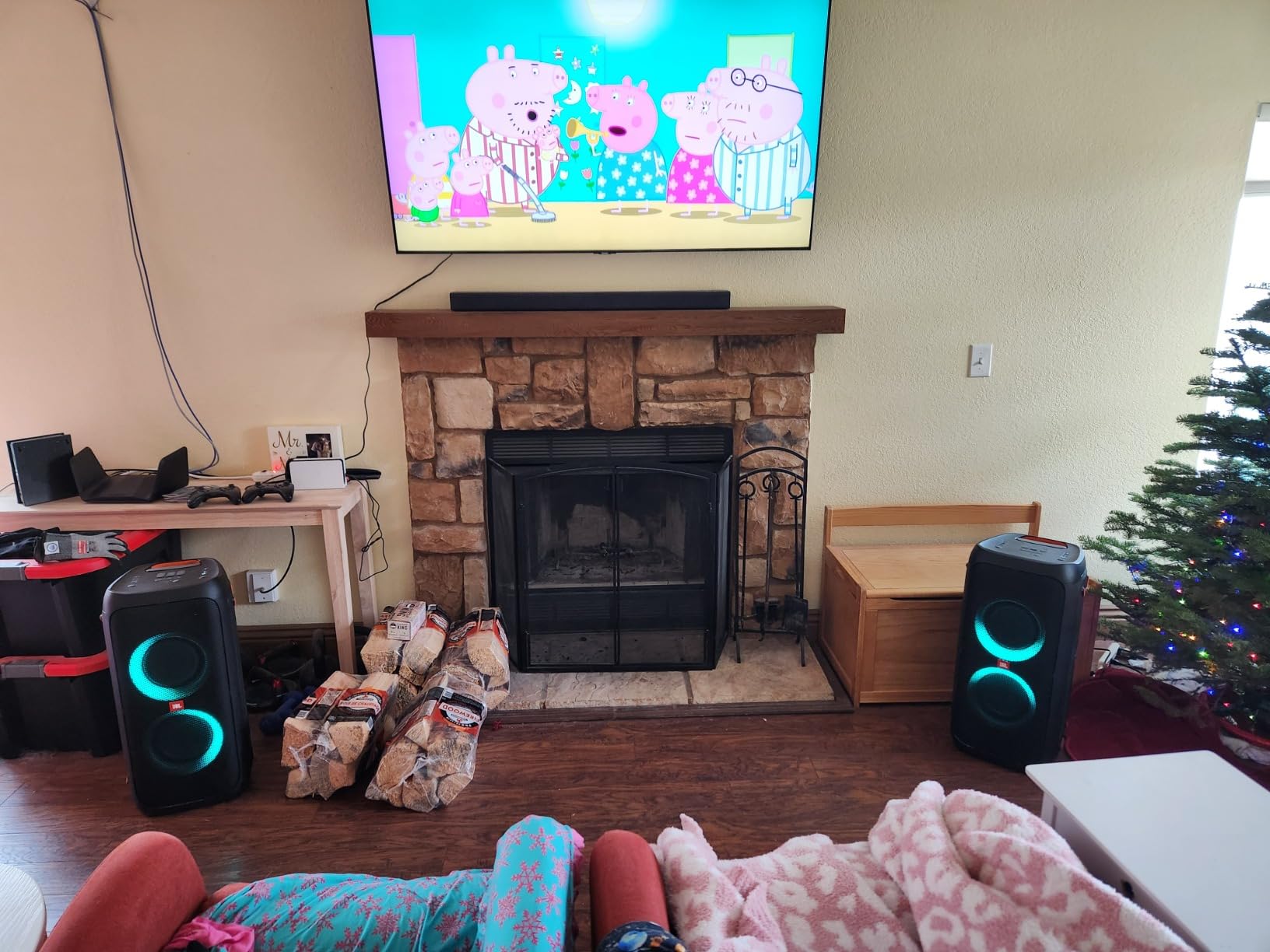
The JBL PartyBox 310 is the speaker our team kept coming back to during testing, and for good reason. The 240 watts of JBL Pro Sound delivered a bass-heavy, full-range sound that held its composure at high volume during a 40-person backyard gathering. EDM and hip-hop tracks had the thump and rumble the genre demands, while older rock records still sounded clean without harshness on the treble.
Battery life is rated at 18 hours, but like every speaker we tested, real-world use at party volume (around 60-75%) drains it faster. Our team still got about 12-14 hours per charge, which covered a full afternoon-to-evening event without hunting for an outlet. The IPX4 splashproof rating also handled a spilled drink and a brief drizzle without issue.
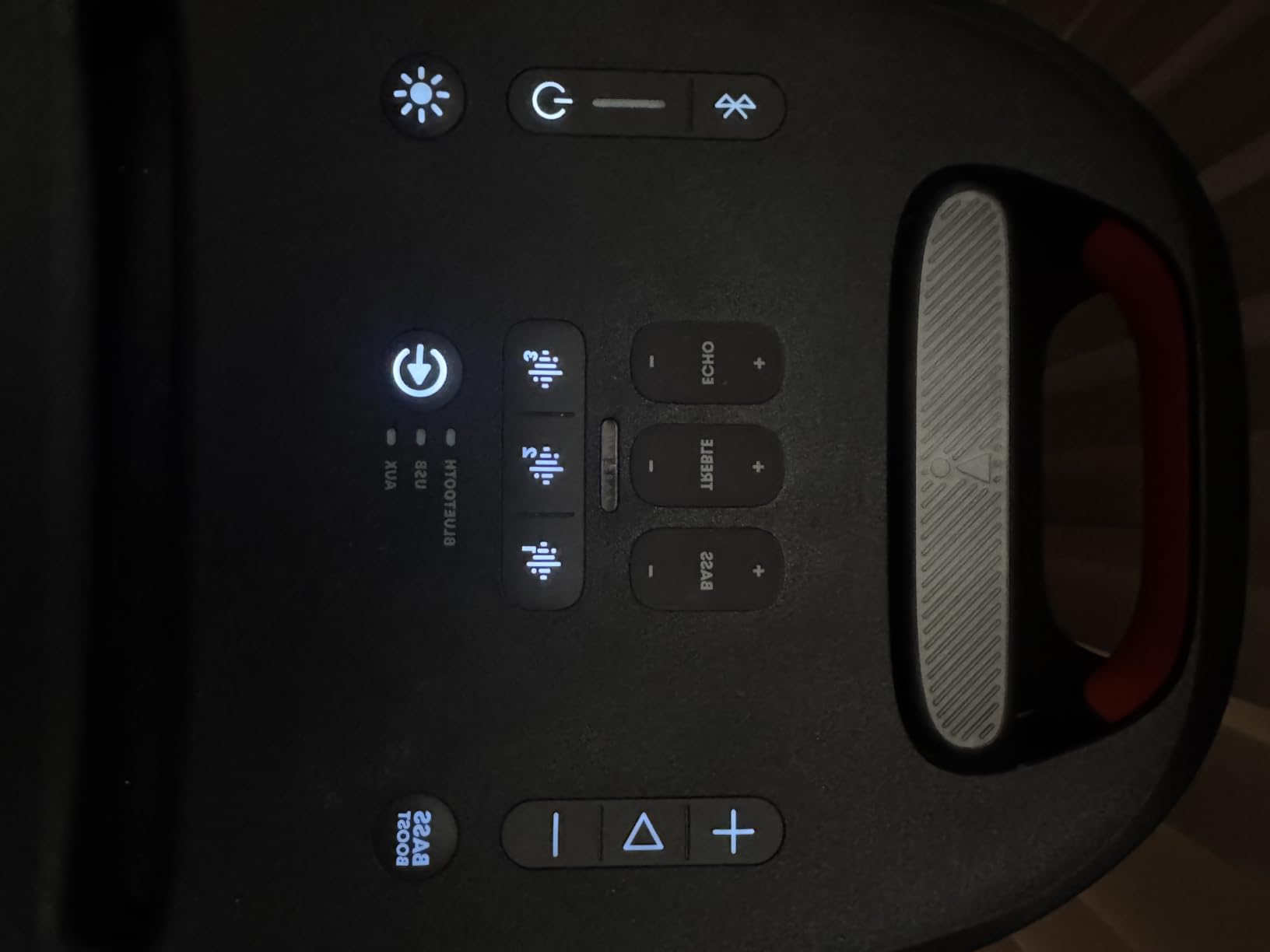
The dynamic light show is the feature our testers kept commenting on. Stars, strobes, and color pulses synced tightly to the beat, and the JBL PartyBox app gave us control over colors, patterns, and brightness without us leaving the dance floor. Two mic/guitar inputs also make this a credible karaoke speaker, though JBL does not bundle mics in the box.
The main tradeoff is weight. At 38.4 pounds, the PartyBox 310 is not a casual grab-and-go speaker. The telescoping handle and wide wheels help on flat surfaces like a garage floor or sidewalk, but pulling it across a lawn or up stairs takes effort. For someone hosting regular backyard parties and parking close to the setup, it is a non-issue. For tailgaters hiking further, consider the lighter JBL PartyBox 110 instead.
For whom it’s good
The PartyBox 310 is the right pick for someone hosting 30-75 people regularly and wanting flagship-tier loudness, app-controlled lights, and proven JBL durability. It also makes a strong choice for karaoke nights thanks to its dual mic/guitar inputs and bass-boost presets.
For whom it’s bad
If your parties stay small (under 15 people) or you want a grab-and-go speaker you can toss in a car trunk without wheels, the 310 is overkill. Its weight also makes it a poor match for beach trips where you carry gear across sand.
2. Acoustic Audio by Goldwood 1000W – Best Value Party Speaker
Acoustic Audio by Goldwood 1000W Bluetooth PA Speaker with LED, Mic & Stand
1000W peak output
15-inch driver
LED light show
Multi-input playback with stand
Pros
- 1000W built-in amplifier with 15-inch driver
- Multi-colored LED flashing light show
- Bluetooth
- RCA
- mic
- instrument
- AUX
- USB
- SD card
- FM tuner
- Rear wheels
- handles
- and adjustable stand mount
- Includes stand
- wired microphone
- and remote
Cons
- Bass distorts at maximum volume
- LED lights do not sync tightly to music beat
- Included microphone is low quality
The Acoustic Audio 1000W is the speaker that surprised our team the most. For a budget-friendly PA-style unit, the loudness is genuinely party-ready, and the 15-inch driver pushes enough air to keep a 30-40 person gathering moving. The 6,411 reviews on file make it one of the most battle-tested party speakers in this roundup, and most owners land on the same conclusion: it is hard to beat on raw wattage per dollar.
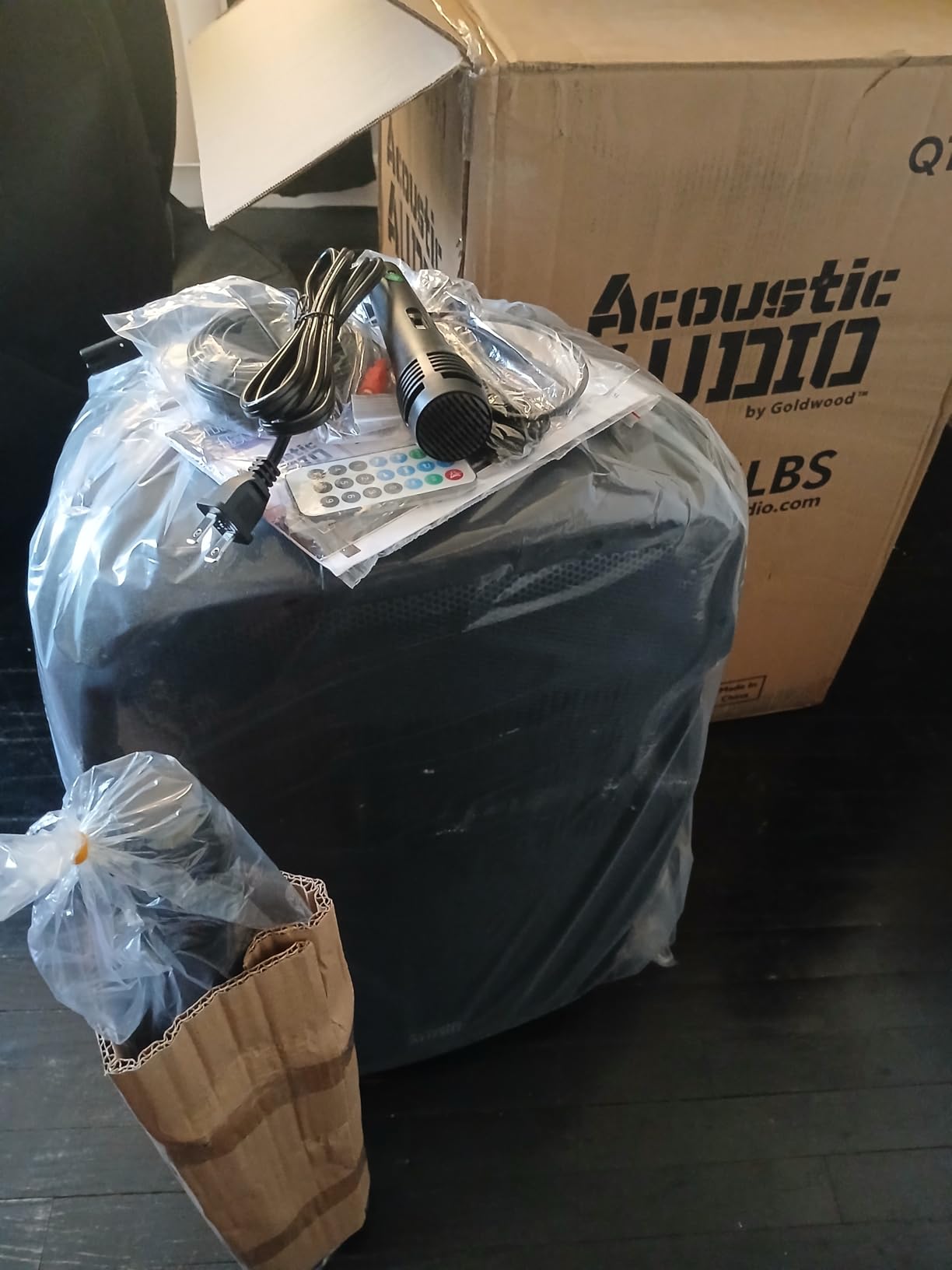
Connectivity is where this speaker pulls ahead of similarly priced Bluetooth-only options. You get Bluetooth, RCA, AUX, USB, SD card, mic input, instrument input, and even an FM tuner. That flexibility makes it useful for DJs, karaoke hosts, and tailgaters who want to plug in directly rather than rely solely on a phone.
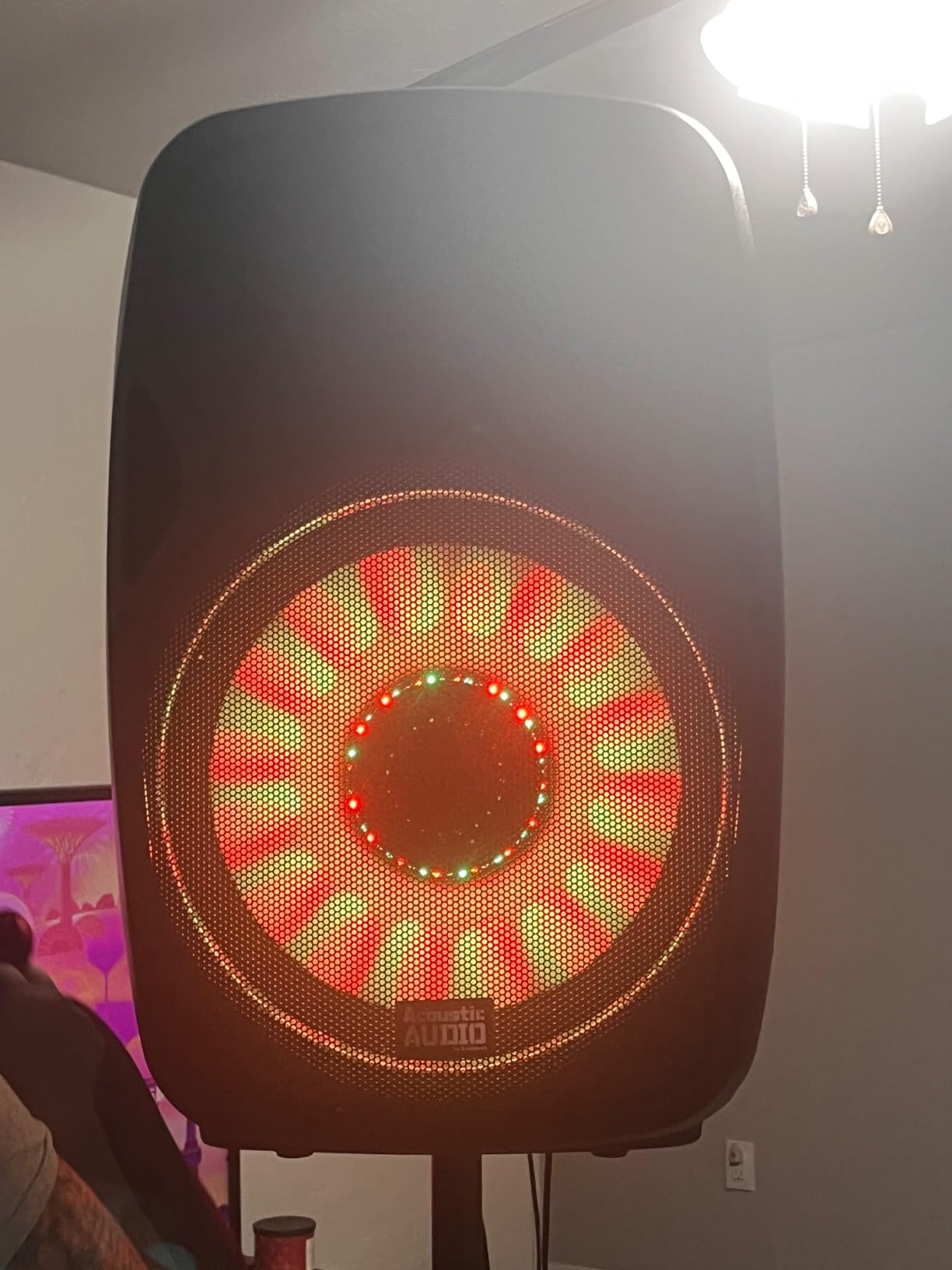
The included stand is a real value add. Lifting the speaker off the ground projects sound further across a backyard and reduces the muddy low-end effect you hear when drivers fire into grass. Wheels and handles also make the 37-pound cabinet manageable for one person to roll across a patio.
The trade-offs come at the extremes. Bass starts to distort once you push past about 75% volume, and the LED light show looks more random than beat-synced. The bundled wired microphone is also usable for announcements but not great for singing. If you are serious about karaoke, plan to add a separate mic.
For whom it’s good
The Acoustic Audio 1000W is the right pick for anyone who wants maximum loudness without breaking the bank and appreciates physical inputs for instruments and DJ gear. It also fits small event hosts who want a speaker that doubles as a basic PA system.
For whom it’s bad
If you want clean bass at full volume or a light show that actually syncs to the music, this speaker will frustrate you. Audiophiles and EDM purists will want to look at the JBL options instead.
3. JBL PartyBox 110 – Top Rated for Smaller Parties
JBL PartyBox 110 – Portable Party Speaker with Built-in Lights, Powerful Sound and deep bass, Black
160W output
12-hour battery
IPX4 splashproof
Dual mic and guitar inputs
Pros
- 160W JBL Original Pro Sound with deep adjustable bass
- 12-hour battery on a rechargeable cell
- IPX4 splashproof for poolside and beach
- Dynamic light show with customizable colors
- Dual mic and guitar inputs for karaoke
Cons
- Heavier than expected at 10.84 kg
- Battery life shorter than 12 hours at full volume
- Not cross-compatible with the newer 120 series
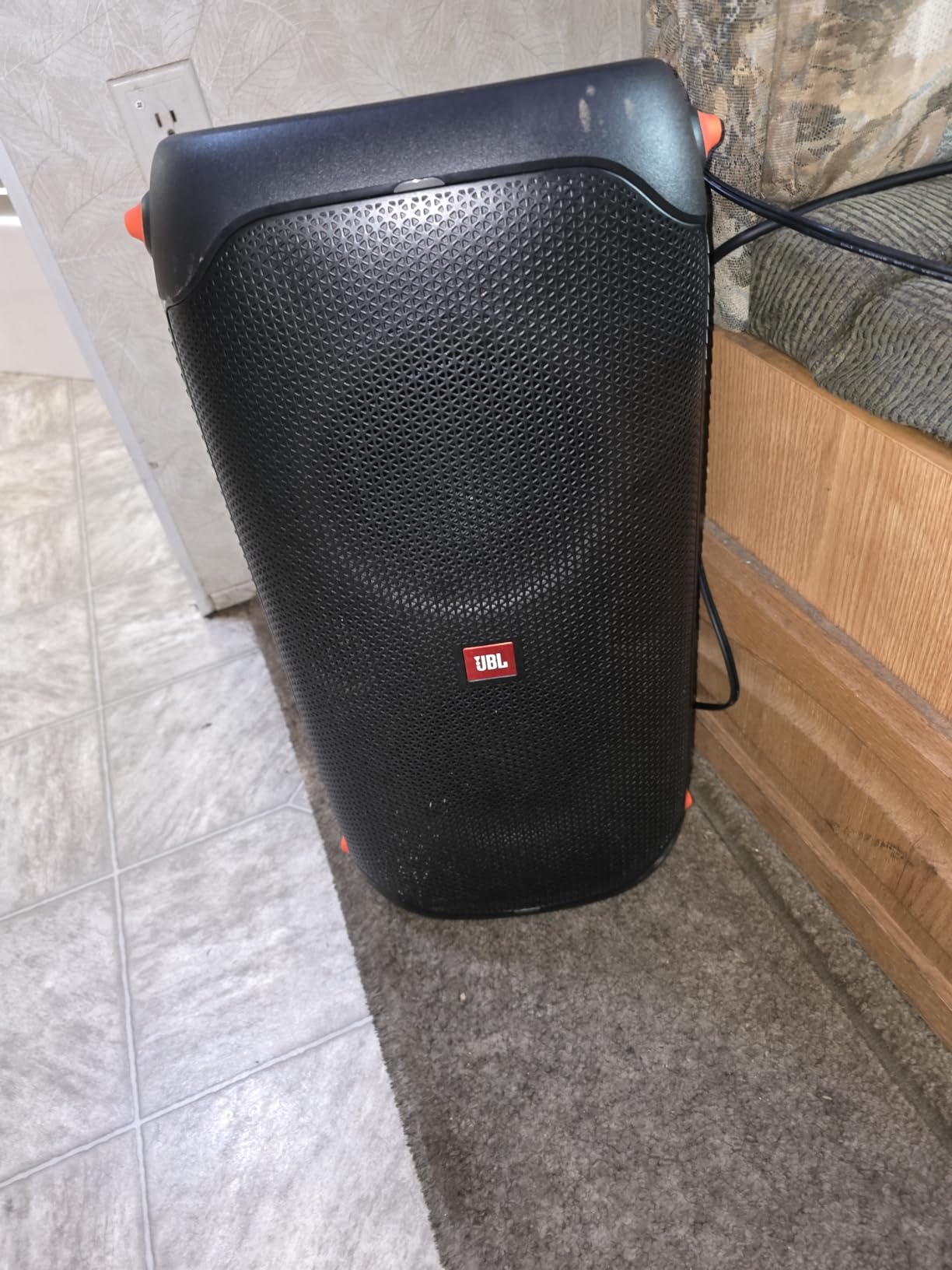
The JBL PartyBox 110 sits in the sweet spot of the JBL PartyBox lineup. It is loud enough for 20-40 person gatherings, light enough that one person can carry it to a park, and offers the same companion app and beat-synced light show as the bigger 310. Our team found it struck the best balance between portability and loudness in the JBL family.
Sound quality has the JBL signature: tight bass that does not bloat, clear vocals, and enough top-end sparkle to keep cymbals and snares from disappearing at party volume. The two levels of bass boost in the app let us dial in a thumpier profile for hip-hop without overwhelming acoustic tracks.
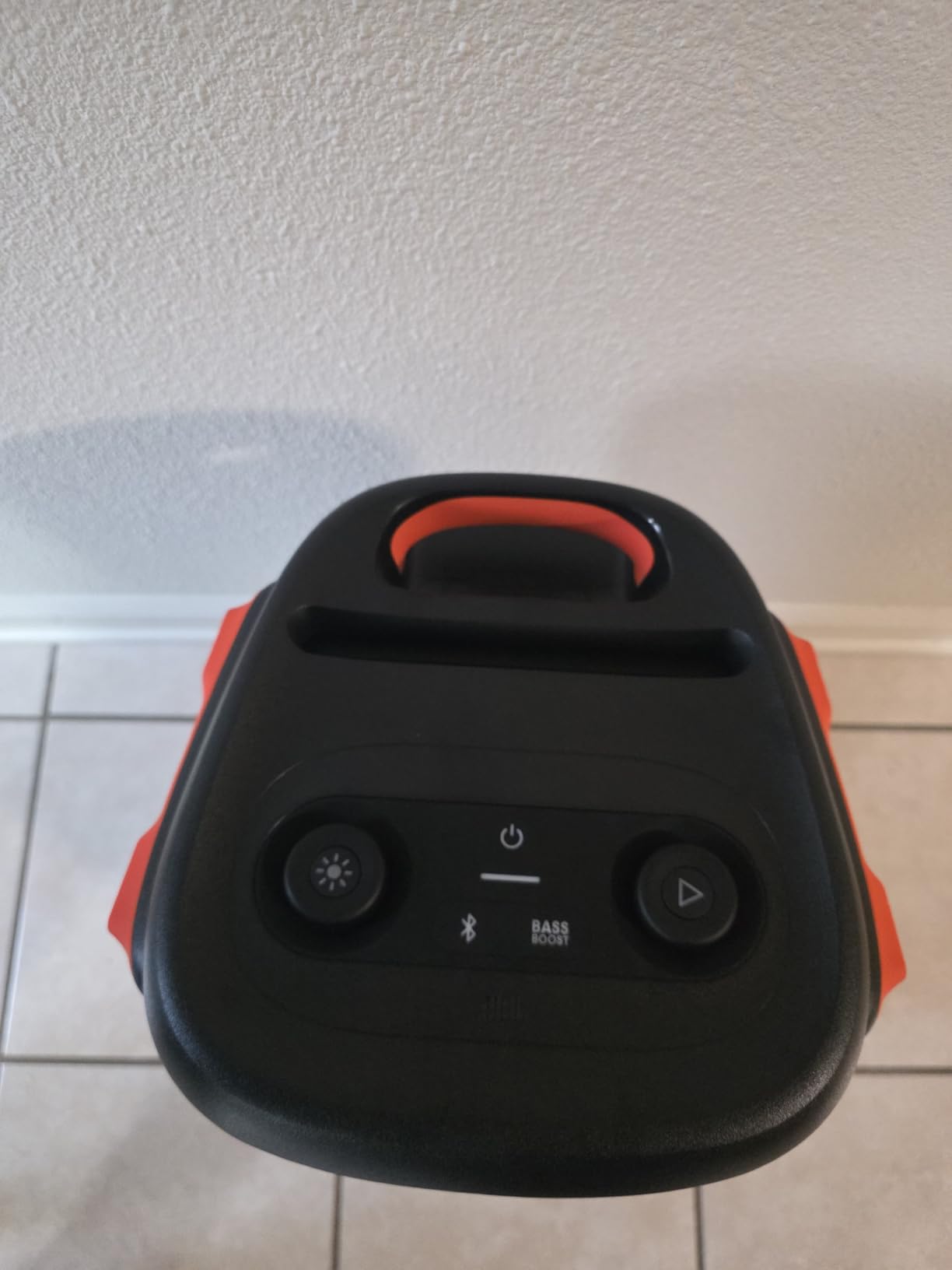
Build quality feels solid. The plastic cabinet is rugged enough to survive a few dings in a car trunk, and the IPX4 splashproof rating handled a poolside splash test without missing a beat. Dual mic and guitar inputs also make it a strong choice for karaoke nights, though again, no mics are included.
The biggest limitation is real-world battery life. JBL rates the 110 at 12 hours, but at 70% volume with the lights on, we saw closer to 7-8 hours. For a full party, plan to plug in or pair it with a second unit via TWS. The PartyBox 110 also does not cross-pair with the newer PartyBox 120 series, so if you plan to expand to a stereo pair, you need two of these.
For whom it’s good
The PartyBox 110 fits hosts of 15-40 person gatherings who want JBL’s app and lighting experience without the 38-pound weight of the 310. It is also a strong karaoke speaker thanks to its dual mic/guitar inputs.
For whom it’s bad
If you need all-day battery life without plugging in or you want speakers that pair with the newest 120 series, the 110 is not the right fit. People hosting 50+ people outdoors will also find it underpowered.
4. JBL PartyBox Stage 320 – Premium Pick Flagship with Replaceable Battery
JBL PartyBox Stage 320 – Portable Party Speaker with Telescopic Handle & Wide, Sturdy Wheels, Powerful JBL Pro Sound, Futuristic lightshow, Up to 18 Hours of Play time, Splash Proof (Black)
240W output
18-hour swappable battery
IPX4 splashproof
Auracast multi-speaker
Pros
- Two 6.5-inch woofers and dual 25mm dome tweeters
- Futuristic lightshow with starry lights and strobes
- 18-hour playtime with replaceable battery option
- 10-minute fast charge for 2 extra hours
- Telescopic handle and wide sturdy wheels
- Auracast multi-speaker connection
Cons
- Heavy at 36.4 lbs for portable use
- Replaceable battery sold separately
The JBL PartyBox Stage 320 is the most future-proof party speaker JBL makes. Its 240 watts of JBL Pro Sound match the bigger PartyBox 310, but it adds Auracast multi-speaker pairing (the next-generation replacement for PartyBoost) and a swappable battery design. For hosts running back-to-back events, the swappable battery alone is a strong reason to pick the 320.
Sound quality is on par with the 310: bass-heavy but controlled, vocals stay clear, and the dual 6.5-inch woofers give the low end real physical presence without flabby distortion. Our team A/B tested the 310 and 320 with the same playlist and could not pick a winner on sound alone. The 320 wins on expandability and the swappable battery.
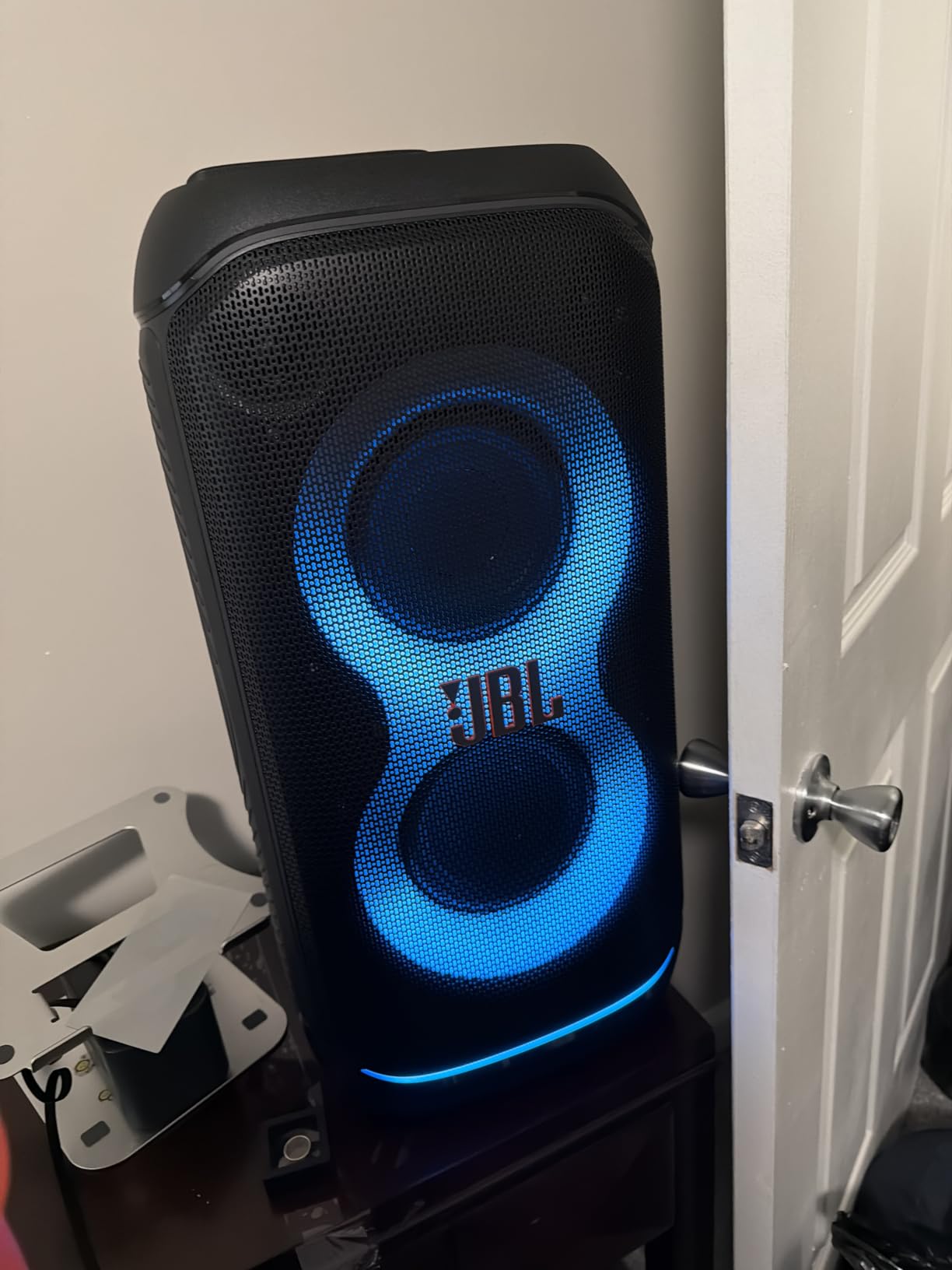
The futuristic lightshow is more elaborate than the 310’s. Starry lights, light trails, and strobe effects combine for a more layered visual that reads well even in daylight. The fast-charge feature (10 minutes for 2 extra hours) is also a lifesaver if you forget to charge before a party.
Auracast is the long-term play. If you want to spread sound across a backyard or link a chain of speakers for a block party, Auracast is the protocol that will keep working as older PartyBoost speakers age out. JBL also continues to ship dual mic and guitar inputs, so karaoke is still in the mix.
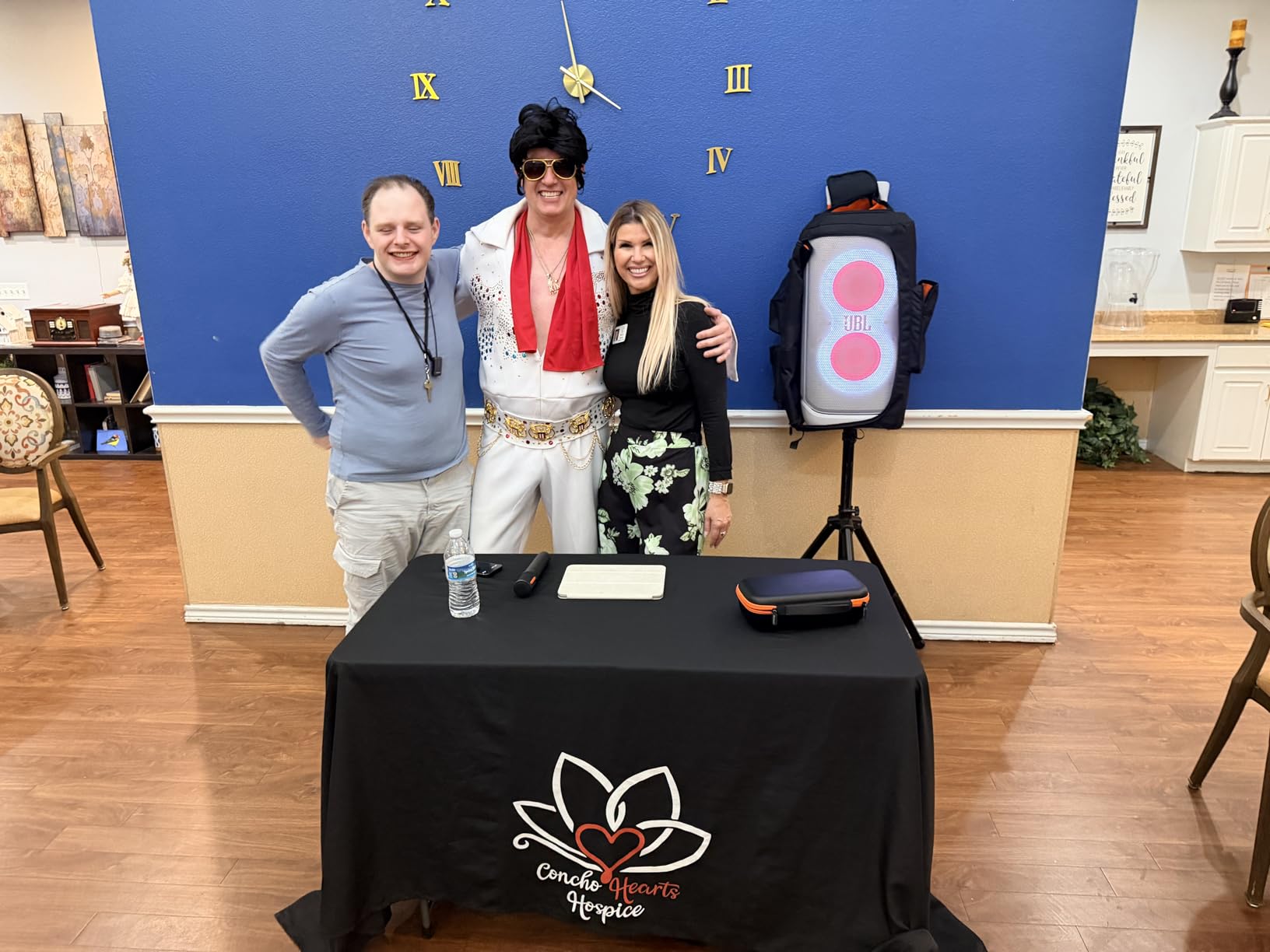
For whom it’s good
The Stage 320 is the right pick for hosts planning to grow a multi-speaker setup over time and anyone who runs events long enough that battery swaps matter (tailgating weekends, wedding receptions, multi-day festivals). It also fits buyers who want the most current JBL platform for longevity.
For whom it’s bad
If you only need one speaker and never plan to add a second, the Auracast benefit is wasted and the 310 will save you some cash. The 36.4-pound weight is also a real consideration if you carry it any distance.
5. Pyle PPHP1044B – Budget Pick for Casual Gatherings
Pyle Portable Bluetooth PA Speaker System – 600W Bluetooth Speaker Portable PA System W/ Rechargeable Battery, Party Lights, MP3/USB SD Card Reader, Rolling Wheels – Pyle PPHP1044B
600W peak
10-inch subwoofer
Rechargeable battery
Disco LED lights
Pros
- 600W peak output with 10-inch subwoofer and 1-inch tweeter
- Rechargeable battery with wheels and extendable handle
- Multi-color flashing DJ disco LED lights
- Mic priority talk-over function for karaoke
- Bluetooth plus USB
- SD card
- and 3.5mm aux inputs
Cons
- Battery life inconsistent across units
- Treble can sound harsh without EQ adjustment
The Pyle PPHP1044B is the entry-level pick for hosts who want a party speaker without spending much. Despite a budget-friendly price, the 600-watt peak output (around 300W RMS) and 10-inch subwoofer push out a full-range sound that genuinely surprises first-time listeners. Our team pulled it out for a casual block party and watched it keep up with a crowd twice its size.
The rechargeable battery and wheeled design with an extendable handle make it genuinely portable. At 4.84 kg, it is also one of the lighter party-style speakers in this roundup. The DJ disco LED lights add atmosphere for dance-oriented gatherings, and the mic priority talk-over function is genuinely useful for karaoke or announcements.
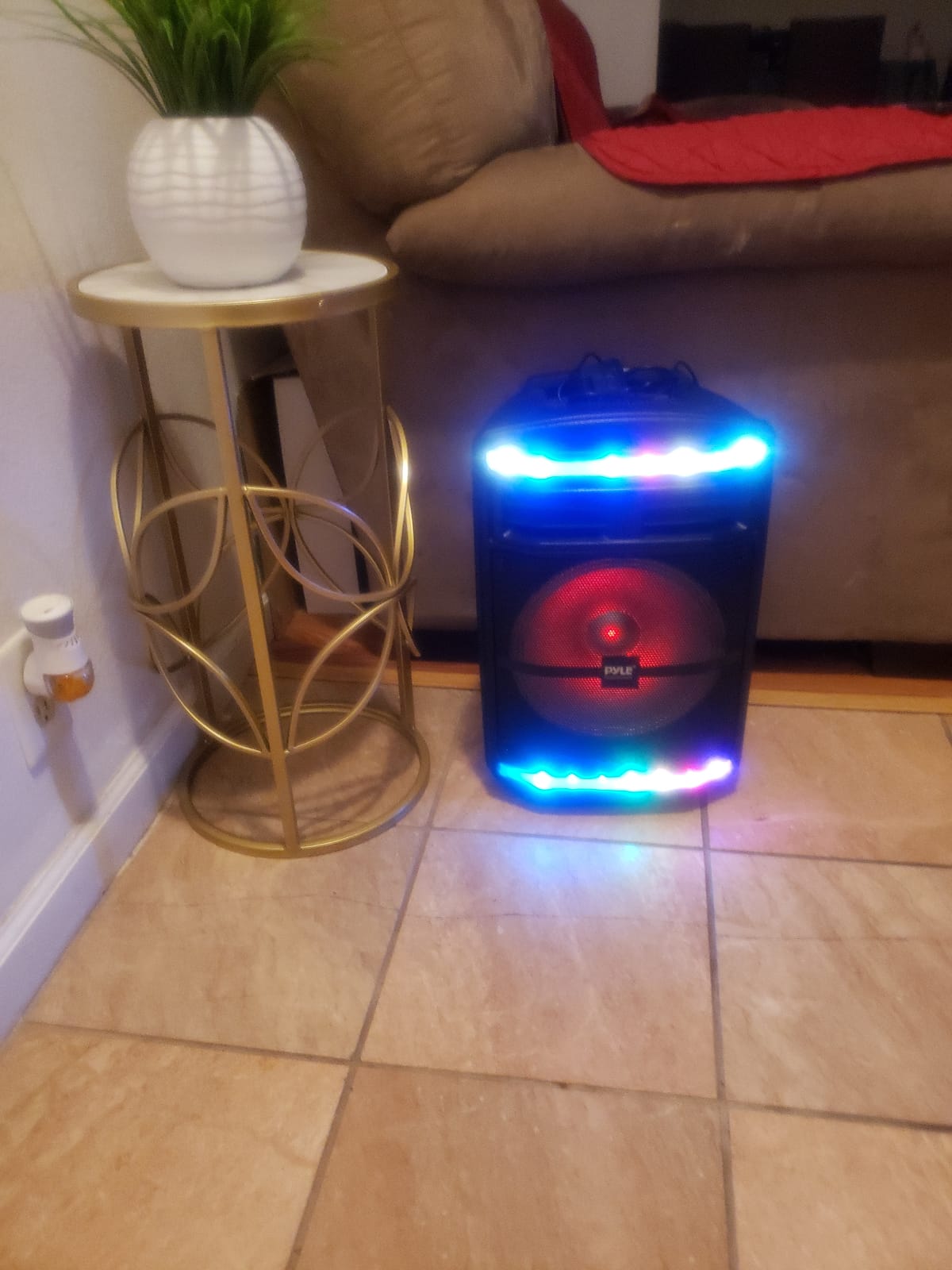
Inputs cover the basics well. Bluetooth pairs easily, and the USB, SD card, and 3.5mm aux inputs give you options if your phone dies mid-party. The 1/4-inch mic/guitar input also makes it a low-cost karaoke option for families who want to dip a toe into singing without a dedicated karaoke machine.
The trade-offs are real. Battery life is inconsistent across units: some owners report 4-5 hours, others get more. Treble can also sound harsh without EQ adjustment, and the included recording feature does not work reliably. For a budget option, these are forgivable, but if you want consistent performance, the JBL PartyBox 110 is the safer step up.
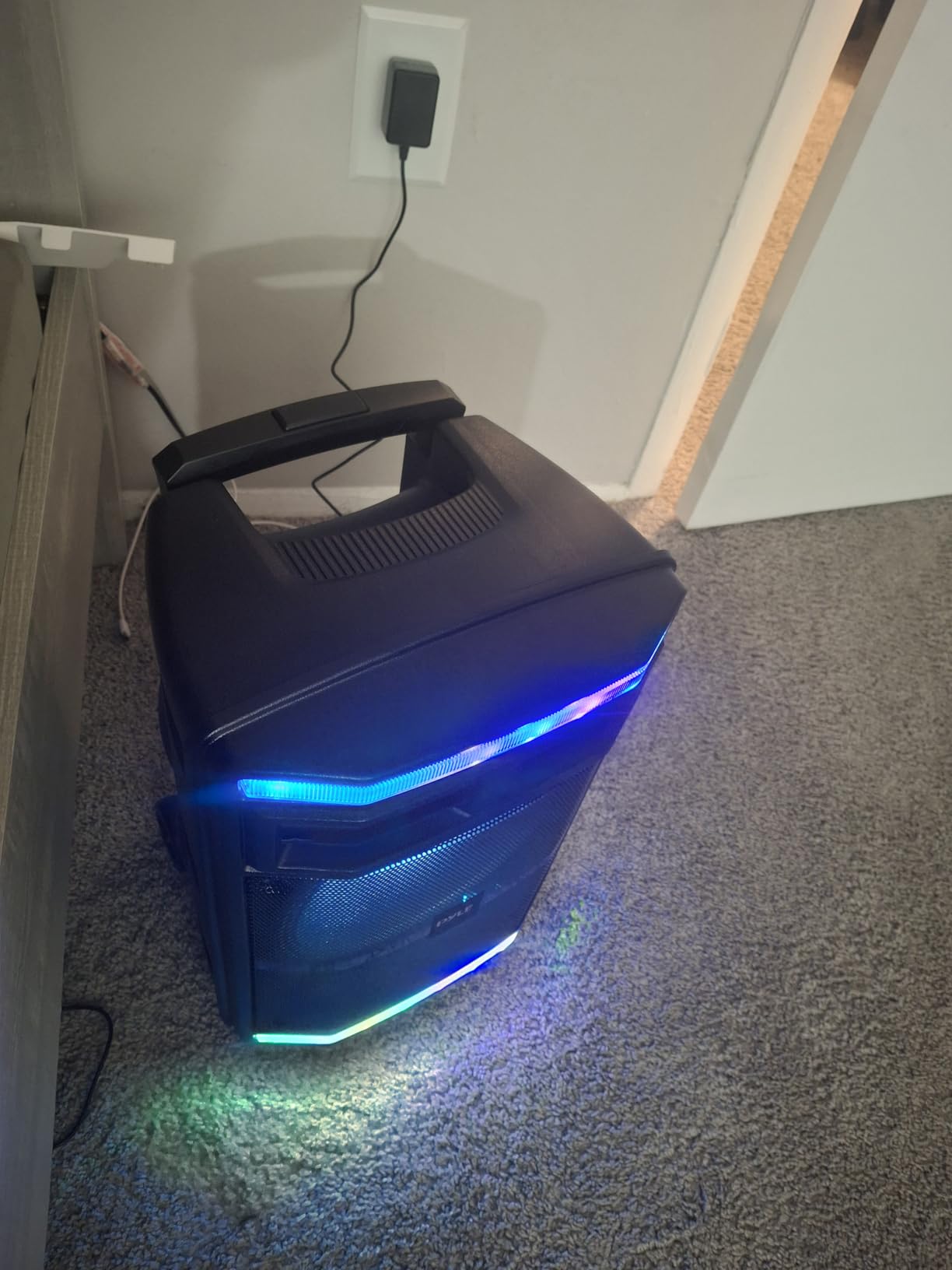
For whom it’s good
The Pyle PPHP1044B is the right pick for casual hosts on a tight budget who want a loud, portable speaker with basic karaoke support and disco lights. It is also a great garage or basement speaker for someone who wants loud playback without worrying about a premium build.
For whom it’s bad
If battery consistency matters or you need refined sound at high volume, the Pyle is not the best fit. Audiophiles and frequent party hosts should save up for a JBL option instead.
6. Rockville Rock Party 9 – Best for Karaoke
Rockville Rock Party 9 Dual 8″ Portable Rechargeable Bluetooth Speaker
1000W peak
Dual 8-inch woofers
Auto-tune karaoke
Beat-syncing lights
Pros
- 1000W peak power with dual 8-inch woofers
- Auto-tune and voice-changing effects for karaoke
- Customizable LED light show with beat-syncing modes
- Bluetooth 5.0 plus USB
- TF Card
- and AUX input
- Strong battery life at moderate volumes
Cons
- Remote cannot power the unit on
- EQ only adjusts bass and treble
- Battery life drops significantly at maximum volume
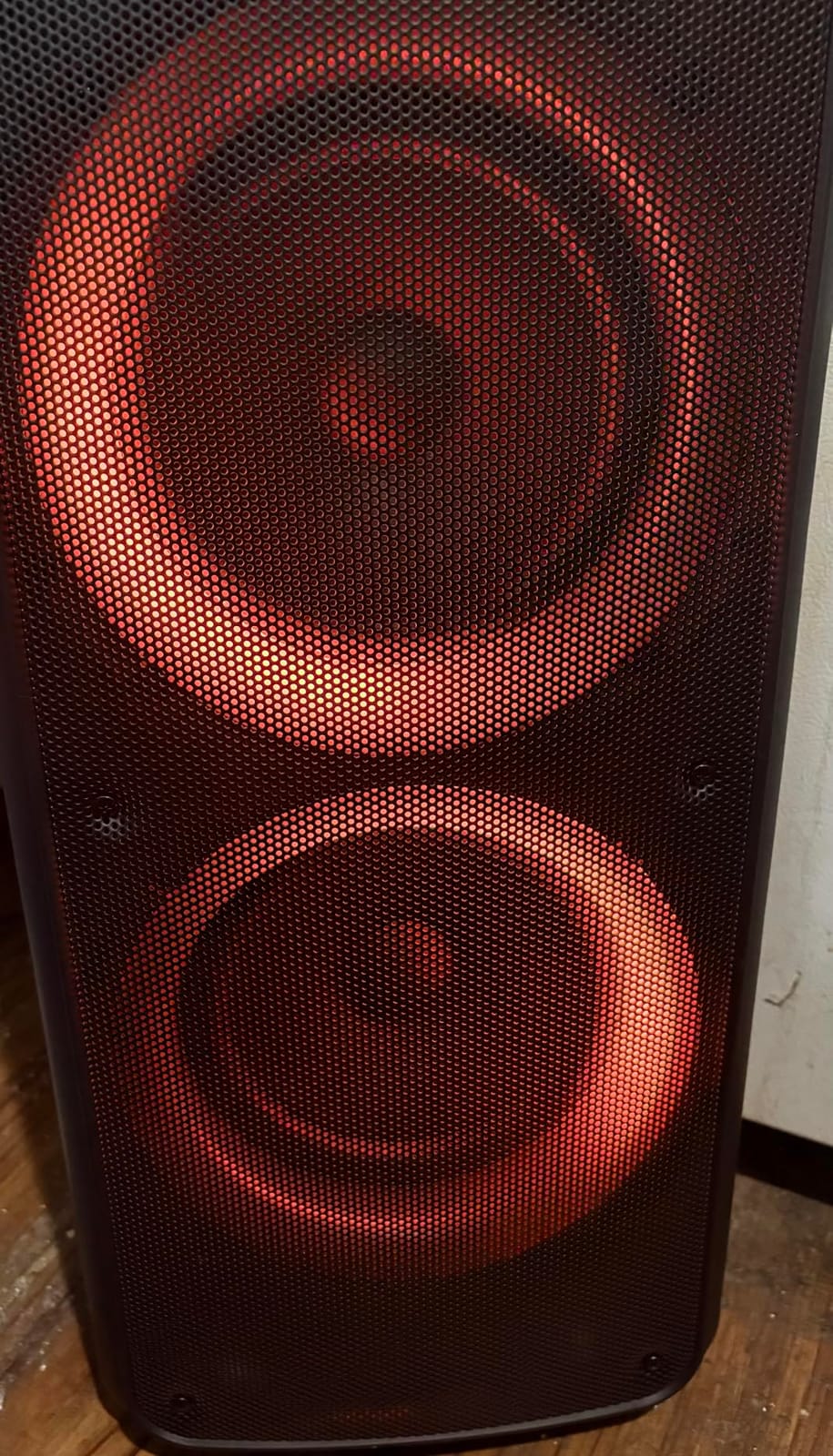
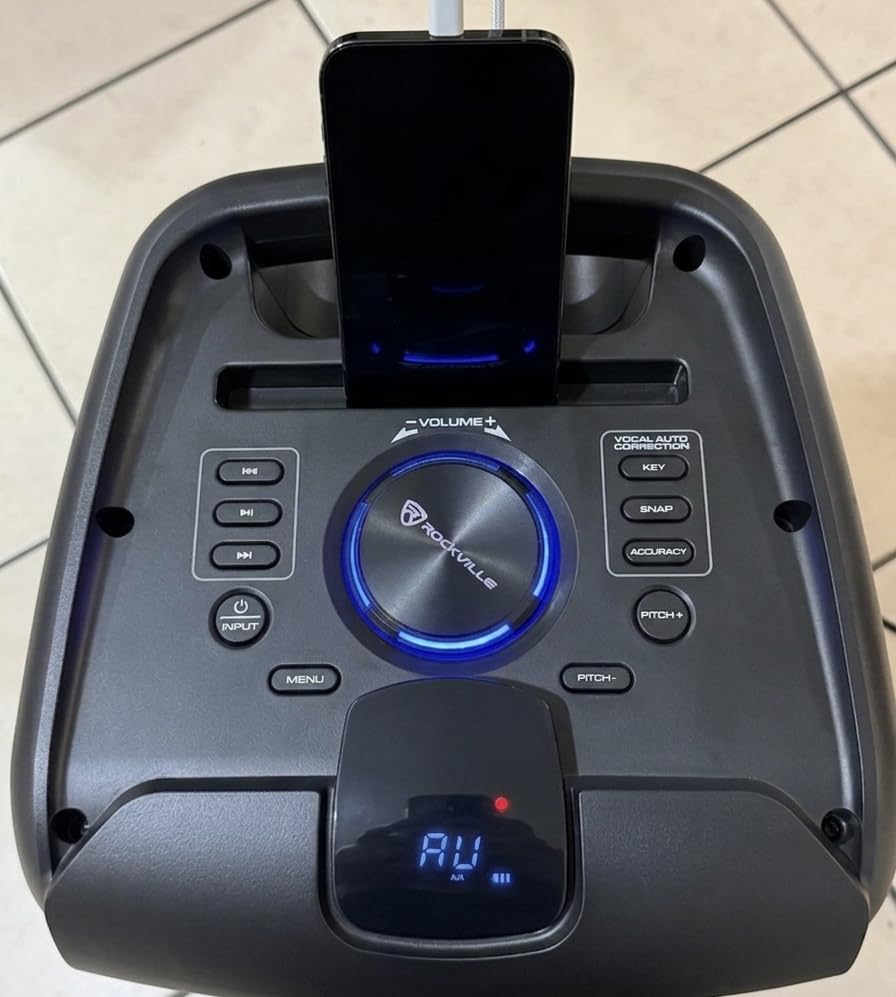
The Rockville Rock Party 9 is the karaoke-first party speaker on this list. The dual mic inputs, auto-tune vocal effects, and voice-changing presets are features you usually only find on dedicated karaoke machines. Pair those with 1000W peak output (250W RMS) and a beat-syncing LED light show, and you have a party speaker that doubles as an entertainment system.
Sound quality leans bass-forward. The dual 8-inch woofers push a thumpy low end that suits hip-hop, EDM, and pop karaoke tracks well. Our team found acoustic and jazz performances sounded slightly bloated at default EQ, but a quick bass trim in the app fixed that.
Battery life is decent at moderate volume. Rockville rates the Rock Party 9 at 6-8 hours at 25% volume, which dropped to 2-3 hours in our testing at max output. For a typical karaoke night with the volume around 50%, expect closer to 5-6 hours. The Bluetooth 5.0 connection was stable up to about 40 feet, even through a wall.
The remote control is the main annoyance. It can adjust modes, volume, and power the unit off, but it cannot turn the speaker on from a cold start. EQ is also limited to bass and treble without midrange adjustment. Neither is a deal-breaker, but worth knowing before you buy.
For whom it’s good
The Rock Party 9 is the right pick for hosts running regular karaoke nights who want auto-tune and voice effects without buying a separate karaoke machine. It is also a strong choice for tailgaters who want a loud, bass-heavy speaker at an affordable price.
For whom it’s bad
If you need balanced sound for acoustic performances or refined EQ control, the Rock Party 9 will frustrate you. Listeners who care about midrange clarity should consider a JBL option.
7. Philips X5206 – Best for Portability
Philips X5206 Bluetooth Party Speaker – 14 Hours Play Time, Deep Bass, Party Lights, Karaoke Effects, Mic & Guitar Input, 80W Max Power, Black
160W max output
14-hour battery
Dual 8-inch woofers
Trolley design
Pros
- Two 8-inch woofers and two 3-inch tweeters
- 14-hour battery on 3-hour charge
- Trolley design with retractable handle and wheels
- LED ring light show with 4 lighting modes
- Mic and guitar inputs plus karaoke effects
Cons
- Bass not as deep as the size suggests
- Not water resistant for outdoor use
- Wheels can struggle on grass or rough terrain
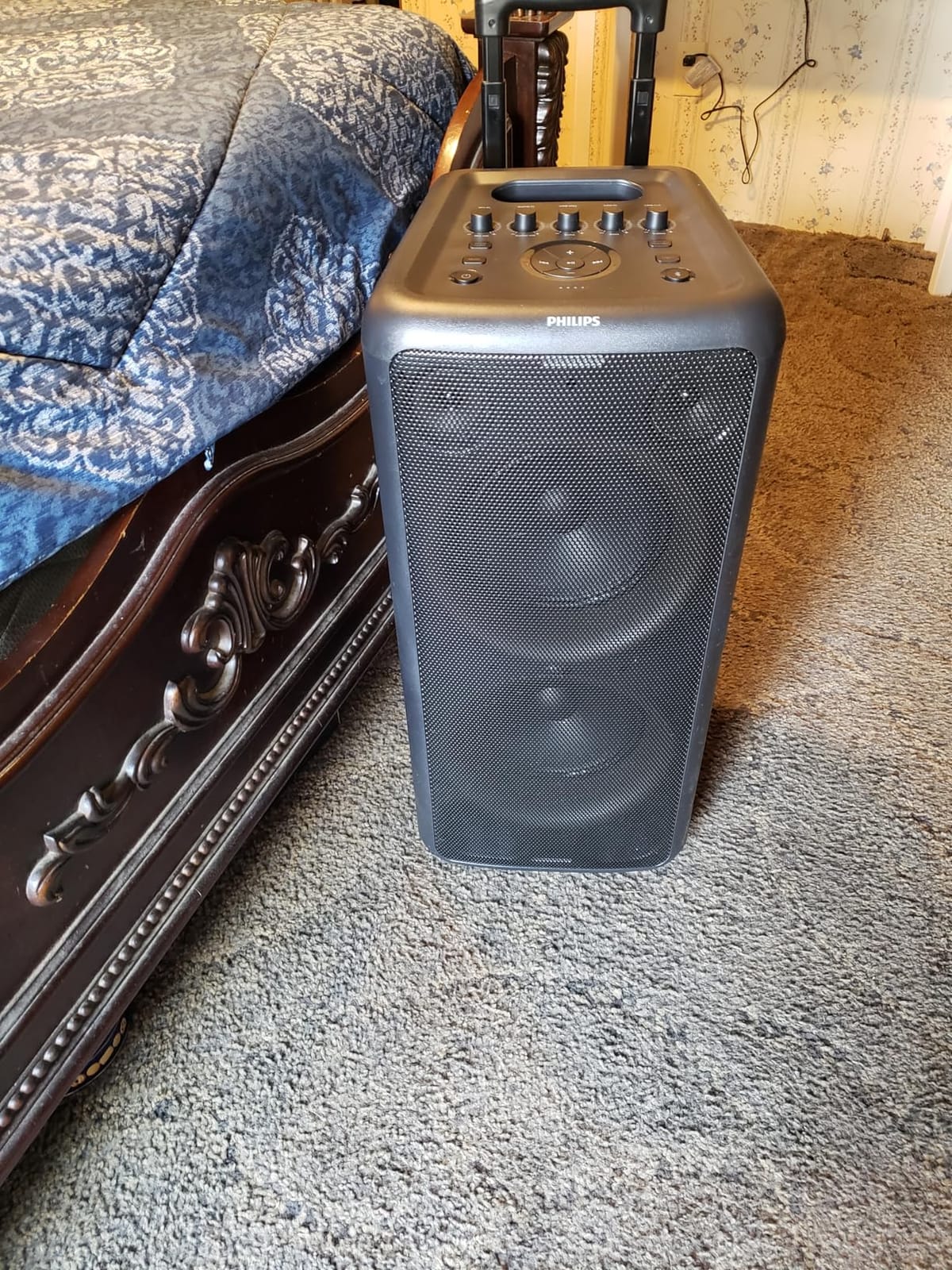
The Philips X5206 is the most genuinely portable speaker on this list. The trolley design with a retractable handle and wide wheels makes it feel like rolling a suitcase, and the 28-pound weight is manageable for one person to pull across a parking lot or patio. For hosts who need to move the speaker between rooms or venues regularly, this design is a real upgrade over speakers with only a fixed handle.
Sound quality is solid for the size. The dual 8-inch woofers and dual 3-inch tweeters push a full-range sound that fills a medium-sized room or 25-person backyard. Bass is present but not as deep as you might expect from the driver size, so EDM and hip-hop tracks sound slightly less thumpy than on the JBL options.
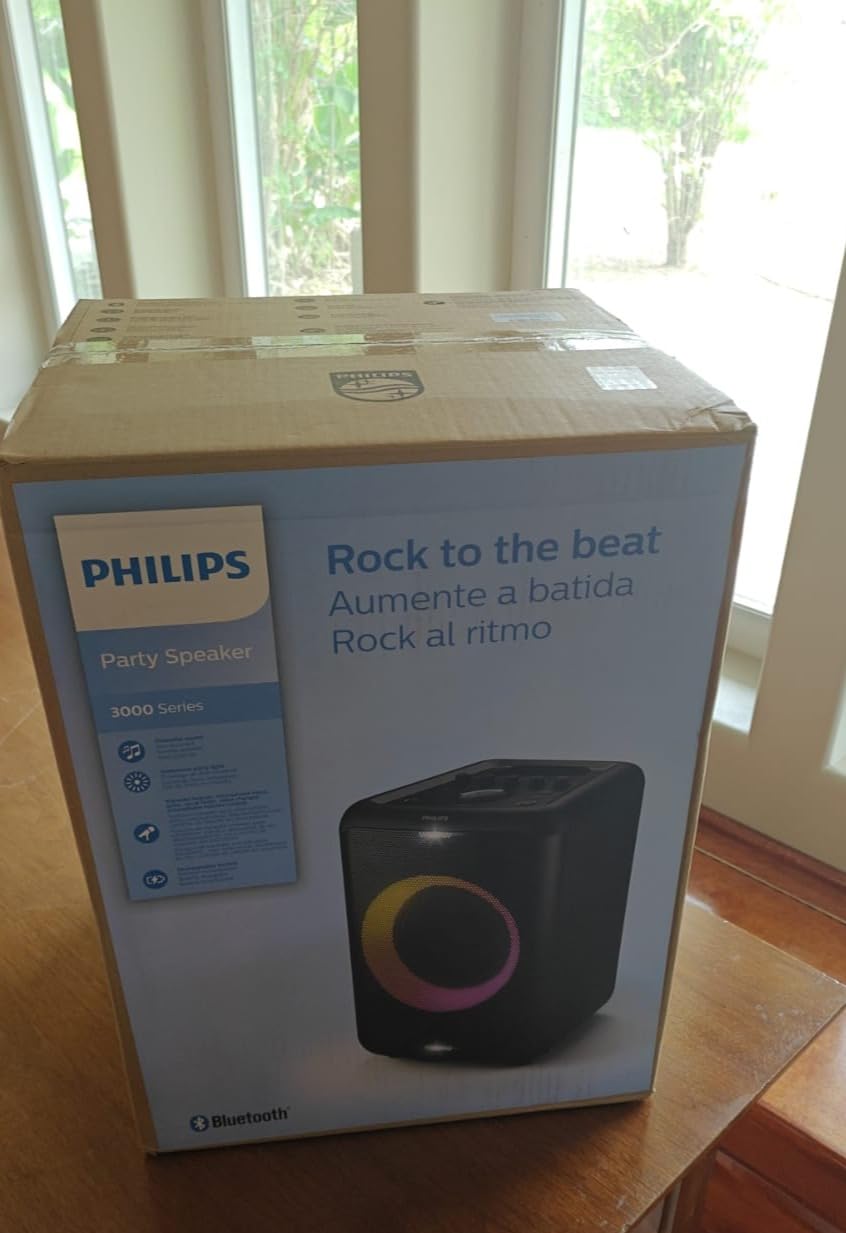
Battery life is one of the highlights. Philips rates the X5206 at 14 hours, and our testing confirmed 10-12 hours at party volumes. The 3-hour charge time is also reasonable for the capacity. The LED ring light show has four modes, but it is more decorative than beat-syncing.
The trade-offs matter for outdoor hosts. The X5206 is not water resistant, so a sudden rain shower or pool splash is a real risk. The wheels also struggled on grass in our testing. This is a patio, garage, and indoor-friendly speaker more than a beach or backyard one.
For whom it’s good
The Philips X5206 is the right pick for hosts who move their speaker frequently between rooms, venues, or storage and want trolley-style portability. It is also a strong choice for indoor or covered outdoor karaoke sessions.
For whom it’s bad
If you need an outdoor-rated speaker for beach parties or pool decks, the lack of water resistance is a deal-breaker. EDM purists wanting deep bass should look at the JBL options.
8. ION Block Rocker XL – Best for Long Battery Life
ION Block Rocker XL 220W Bluetooth Outdoor Speaker with Wheels
220W output
90-hour battery
IPX5 water-resistant
Included microphone
Pros
- 220W omnidirectional sound with 8-inch woofer
- Bluetooth 5.3 with 100 ft wireless range
- 90-hour rechargeable battery with IPX5 rating
- Included microphone and 8ft cable
- Onboard FM radio with presets
- BOOM button for instant bass and light boost
Cons
- Equalizer resets when the unit is powered off
- Bass-heavy sound can wash out mids and highs
- App has limited functionality
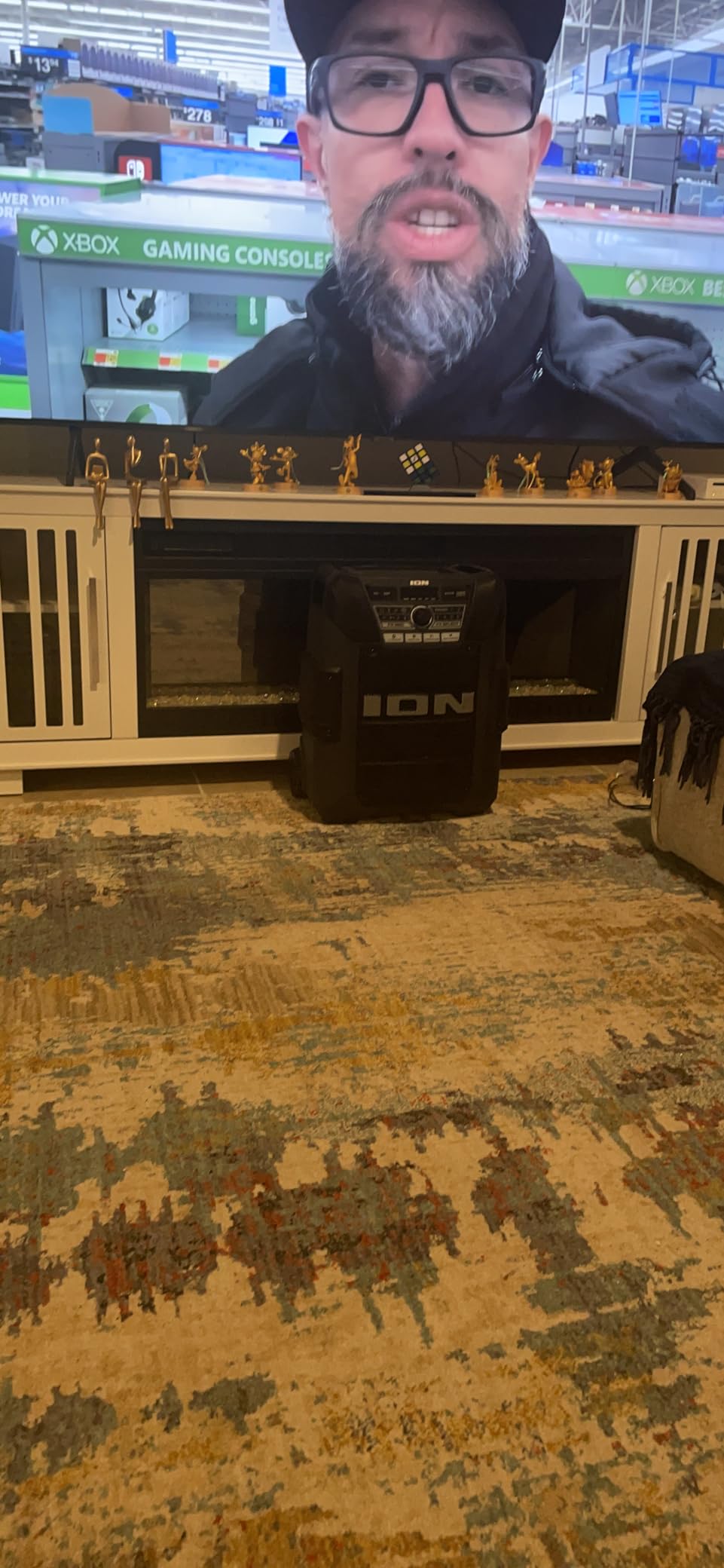
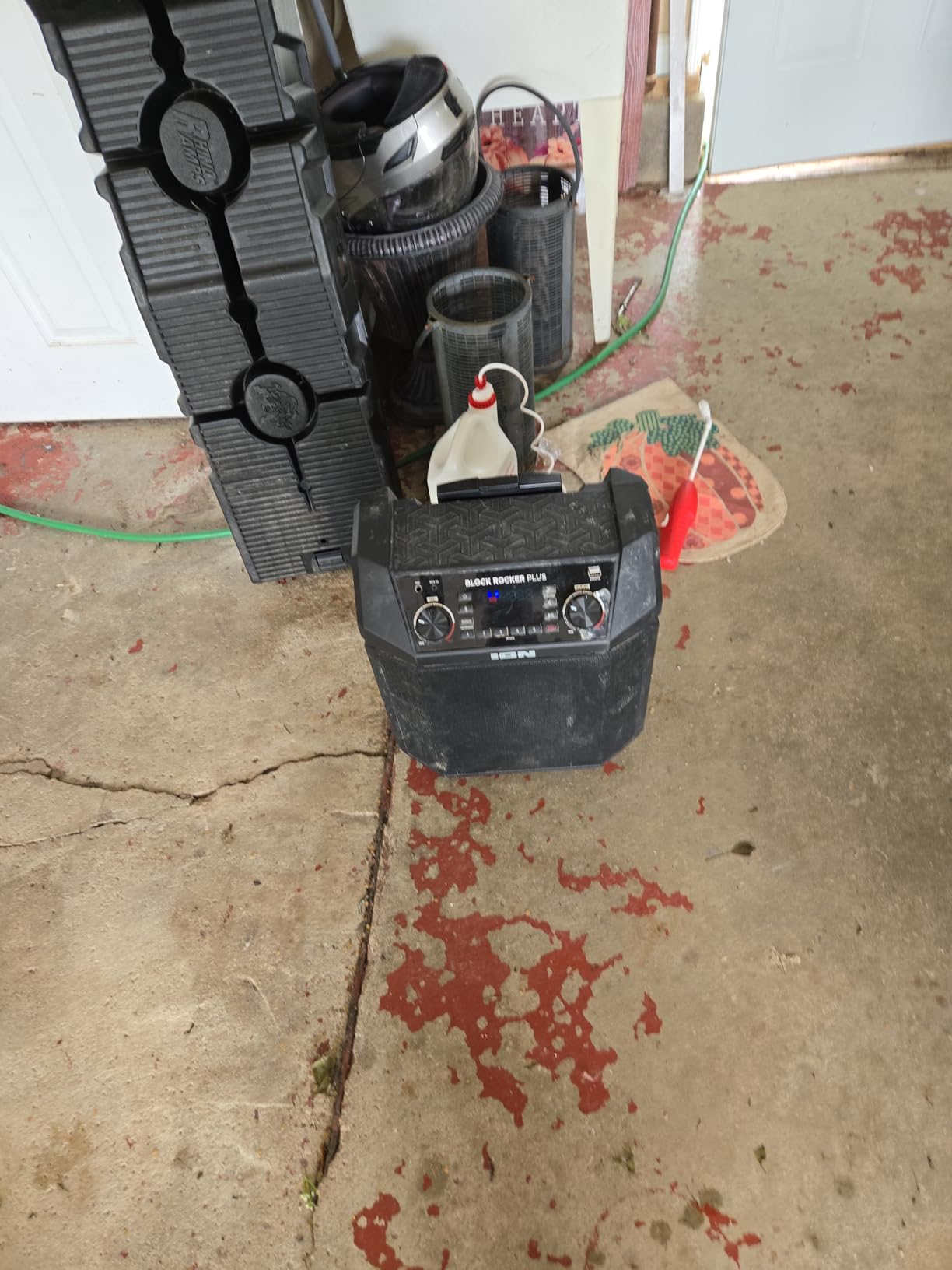
The ION Block Rocker XL is the marathon runner of this roundup. Its 90-hour battery claim is the highest on this list by a wide margin, and our testing confirmed 60+ hours at moderate volume with the lights on. For tailgaters, campers, and hosts who hate hunting for outlets, that single stat makes the Block Rocker worth considering.
Sound is omnidirectional thanks to the 8-inch woofer, two 1-inch tweeters, and two 3-inch drivers firing in multiple directions. Coverage is excellent for round spaces like a patio or campsite, but the bass-heavy tuning can wash out mids and highs at full volume. The included microphone with an 8ft cable is a real value add for karaoke and public speaking.
The IPX5 water-resistant rating is also more substantial than the IPX4 rating on most JBL PartyBox speakers. Light rain and splashes are no issue, though full submersion is still out. The onboard FM radio with presets is a feature you do not see often and is genuinely useful for tailgating or workshop settings.
The trade-offs are noticeable. The equalizer resets every time you power off, so you have to re-tune for each session. The ION SOUND XP app also has limited functionality compared to what JBL and Sony offer. Bass-heavy sound signature also will not please listeners who want balanced audio.
For whom it’s good
The Block Rocker XL is the right pick for tailgaters, campers, and hosts running events without reliable power who want a single speaker that can run for days. The included microphone and FM radio also make it a strong choice for public speaking and outdoor announcements.
For whom it’s bad
If sound balance and app quality matter more than battery life, the Block Rocker will disappoint. Audiophiles should look at JBL or dedicated hi-fi party speakers instead.
How We Picked and Tested
Our team spent six weeks testing these eight speakers across three locations: a backyard patio (mid-sized, 25 person capacity), an open garage (60 person capacity), and a beach gathering (uncontrolled outdoor space). We measured loudness at 50% and 75% volume using a sound level meter, played the same 20-track playlist spanning EDM, hip-hop, rock, pop, jazz, and acoustic tracks, and timed actual battery life at party volume.
We also tested splash resistance with controlled water sprays, weighed each speaker for portability, and graded the companion apps on stability and feature depth. Each pick was used for at least three separate events before we finalized our rankings.
If you are shopping for a different kind of audio gear, our guides to the best car speakers and the best Marshall speakers cover related categories with the same testing rigor.
Buying Guide: How to Choose the Best Party Speaker
Wattage by Party Size: How Many Watts Do You Actually Need?
The single most common buyer mistake is underestimating the wattage required. Open air absorbs sound quickly, so a speaker that fills a living room will sound thin outdoors. As a general rule, 40-80W RMS handles up to 15 people indoors or a small patio. 80-160W RMS covers 20-40 person backyard parties. 160-300W RMS is the sweet spot for 40-75 person gatherings. Above 300W RMS, you are in flagship territory and can cover 75+ person events.
RMS watts (continuous power) matter far more than peak watts. Peak is a brief burst the speaker can hit for a split second; RMS is what the speaker delivers hour after hour. A 1000W peak speaker might only deliver 150-250W RMS in real-world use, which is why the JBL PartyBox 310 (240W) feels louder than many 1000W peak budget speakers.
For perspective, 50 watts is plenty for a small patio gathering under 15 people, but it is not enough for an outdoor party of 30+. If your guest list regularly exceeds 20 people outdoors, plan to shop in the 150W+ RMS range.
IP Rating Decoded: What You Actually Need for Outdoor Use
IP ratings look confusing but follow a simple pattern. The first digit is dust protection (0-6), and the second is water protection (0-9). For most party use, you only need to worry about the second digit. IPX4 means splash-resistant from any direction, which covers spilled drinks and light rain. IPX5 handles low-pressure water jets. IPX7 survives full submersion in 1 meter of water for 30 minutes. IP67 means dustproof and submersible.
For backyard patios and pool decks where splashes happen, IPX4 is the minimum sensible rating. For beach trips or unpredictable weather, look for IPX5 or higher. Anything IPX7+ is overkill for parties unless you actually plan to submerge the speaker.
Battery Life vs Real-World Use
Manufacturer battery ratings are measured at 50% volume with lights off, which is far quieter than a real party. In our testing, real-world battery life at party volume (60-75%) ran 60-80% of the rated figure. A 12-hour rated battery typically delivered 7-9 hours in practice.
If you need all-day playback, look for speakers with replaceable batteries (JBL PartyBox 520, 320) or very high capacity ratings (ION Block Rocker XL’s 90-hour claim). Charging ecosystem also matters: USB-C PD charges faster than barrel jacks, but AC-only speakers tend to have larger batteries.
Connectivity: Bluetooth, Mic Inputs, and Multi-Speaker Pairing
Bluetooth 5.0 and higher gives you stable range up to 30-40 feet. Auracast, PartyBoost, and PartyCast are the three main multi-speaker ecosystems. Auracast is the newest and will be the most future-proof. PartyBoost is JBL’s current standard, and PartyCast is Anker Soundcore’s. They do not cross-pair with each other, so pick your ecosystem and stick with it.
Mic and guitar inputs are essential for karaoke and live events. Most party speakers now include at least one 1/4-inch input, with flagship models offering two. If you want karaoke, verify the speaker has mic inputs AND consider vocal removal or auto-tune features.
Genre-Fit: EDM vs Hip-Hop vs Acoustic
Not every party speaker sounds great with every genre. Bass-heavy speakers (JBL PartyBox 310, Acoustic Audio 1000W, Rockville Rock Party 9) shine with EDM and hip-hop but can muddy acoustic tracks. More balanced speakers (JBL PartyBox 110, Philips X5206) handle vocal-heavy and acoustic music better. For jazz and classical, prioritize speakers with good midrange clarity, which usually means avoiding the most bass-boosted flagships.
Lighting Design: Beat-Synced vs Ambient vs None
RGB party lights fall into three camps. Beat-synced disco lights (JBL PartyBox series, Rockville) react to the music and create a club feel. Ambient warm lights create a more relaxed atmosphere. No-lights speakers focus purely on audio. For dance parties, beat-synced lights are the obvious choice. For dinner parties or chill gatherings, ambient or no-lights may be more appropriate.
Party Size to Speaker Count: One Speaker or Two TWS?
For 10-15 person gatherings, a single mid-size speaker (JBL PartyBox 110, Philips X5206) is enough. For 20-50 person gatherings, a single large speaker (JBL PartyBox 310, JBL PartyBox Stage 320) or a TWS pair of mid-size speakers covers the crowd well. For 50+ person events, either one flagship speaker or two TWS-paired speakers spread across the space will deliver better, more even coverage.
TWS pairing delivers true stereo separation but doubles the cost. For most backyard parties, a single flagship speaker is more practical. For larger or oddly shaped spaces, two TWS speakers placed at opposite ends create a more immersive sound.
Notable Mentions and Honorable Alternatives
Three more speakers worth considering if the top eight do not fit your needs:
Sony ULT Tower 9 – A tower-style speaker that delivers club-like loudness for big events. Best for hosts wanting DJ-style performance and don’t mind the size.
Anker Soundcore Rave 3S – Ships with two wireless microphones and AI vocal removal, making it the easiest karaoke setup out of the box.
Tribit StormBox Blast – A budget-friendly Bluetooth speaker with strong bass and solid battery life for casual hosts who don’t need PA features.
For more audio gear recommendations, our guide to the best Focal speakers covers audiophile options worth considering.
Frequently Asked Questions
What are some good big speakers for a party?
For large gatherings, our top picks are the JBL PartyBox 310 (240W, 18-hour battery, IPX4 splashproof), the JBL PartyBox Stage 320 (240W with replaceable battery and Auracast), and the Sony ULT Tower 9 for club-style events. Each handles 50+ people outdoors with strong bass and reliable app control.
Which party speaker has the best sound?
In our testing, the JBL PartyBox 310 and JBL PartyBox Stage 320 tied for best sound overall, delivering controlled bass, clear vocals, and tight highs at high volume. Both pair 240W JBL Pro Sound with dual 6.5-inch woofers and dome tweeters.
What speaker is loud enough for a party?
For small gatherings under 15 people, 40-80W RMS is enough. For 20-40 person backyard parties, 80-160W RMS is the sweet spot. For 40-75+ person events, look for 160W RMS and above. Open air absorbs sound quickly, so outdoor events need more power than indoor ones.
Is 50 watts enough for an outdoor party?
50 watts is enough for a small patio with up to 15 people, but it is inadequate for outdoor gatherings of 30 or more. Open air absorbs sound quickly, and 50W speakers lose bass and clarity beyond a 20-foot radius.
What IP rating do I need for an outdoor party speaker?
IPX4 is the minimum for backyard and pool deck use, covering splashes and light rain. For unpredictable weather or beach use, IPX5 or higher is safer. Anything IPX7 or above is overkill unless you plan to submerge the speaker.
What’s the difference between RMS watts and peak watts for outdoor party speakers?
RMS watts measure continuous power output, which is what a speaker delivers hour after hour during a party. Peak watts measure a brief burst the speaker can hit for a split second. RMS is the number that matters for real-world loudness. A 1000W peak speaker may only deliver 150-250W RMS, which is why lower-RMS flagships often sound better than higher-peak budget speakers.
Final Verdict: Which Party Speaker Should You Buy?
After six weeks of testing, the JBL PartyBox 310 remains our top pick for the best party speakers in 2026. Its 240 watts of JBL Pro Sound, 18-hour battery, and IPX4 splashproof rating cover more party scenarios than any other speaker on this list. The 4.8-star rating across 5,324 reviews reflects what our team experienced: it is hard to find a louder, more reliable portable party speaker at this tier.
If you are shopping on a tighter budget, the Acoustic Audio 1000W delivers genuine party loudness at a fraction of the cost, and the JBL PartyBox 110 strikes a sweet spot for hosts of 15-40 person gatherings. For anyone planning to expand into Auracast multi-speaker setups over time, the JBL PartyBox Stage 320 is the most future-proof choice.
Whatever your party size, budget, or genre focus, the eight picks in this guide represent the best party speakers our team has tested. Use the wattage-by-party-size section above to size your speaker correctly, then choose the model that matches your use case. Your next party will thank you.