
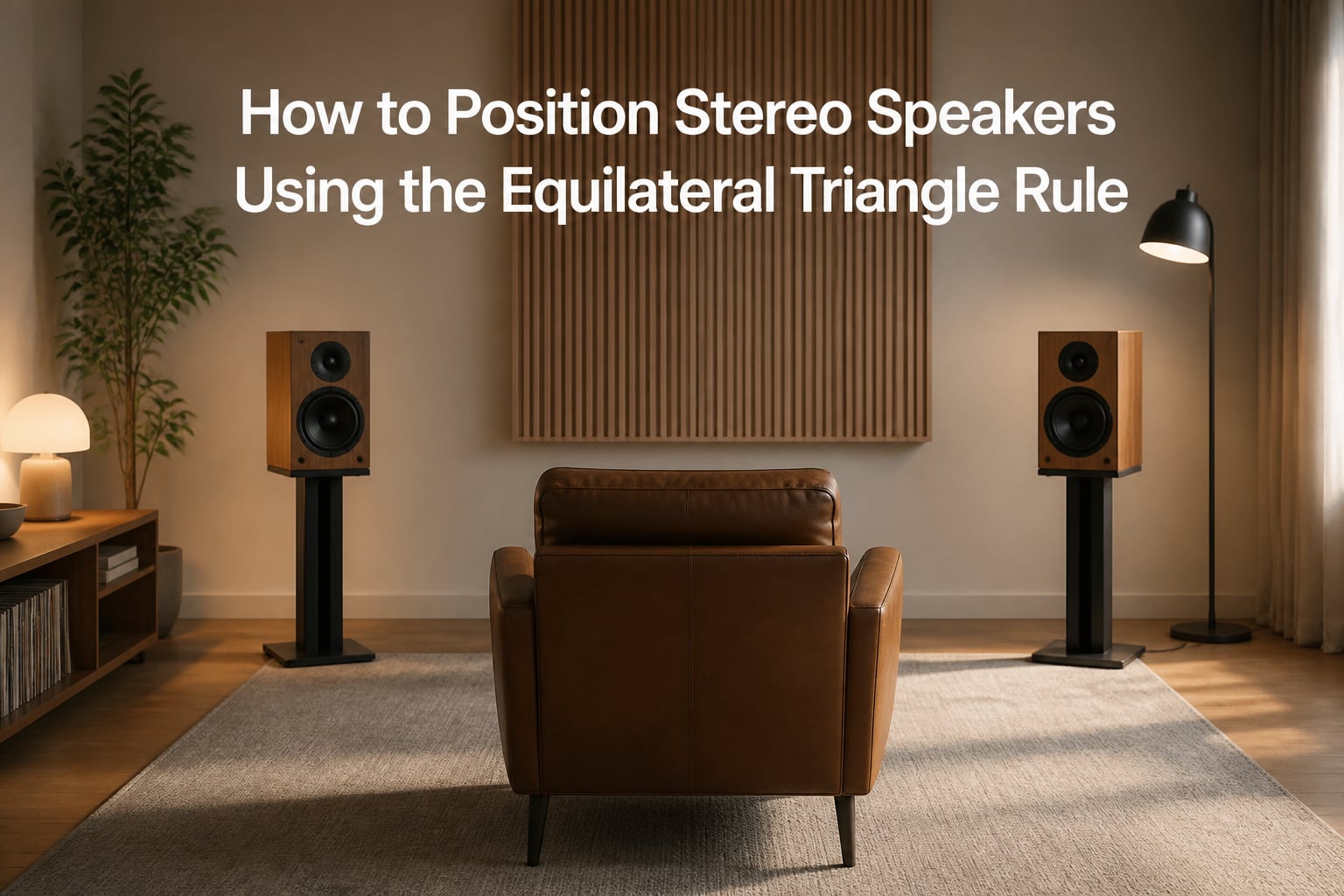
Stereo speakers sound best when you, the left speaker, and the right speaker form an equilateral triangle, with each side measuring the same distance. I learned this the hard way after spending hours fine-tuning EQ settings, only to realize the real issue was my speaker placement. Once I rearranged my setup using the equilateral triangle rule, the difference was night and day.
If you’re chasing a wider soundstage, tighter imaging, or just cleaner vocals, this equilateral triangle speaker placement guide will walk you through what to do, why it works, and how to adapt it to your room. By the end, you’ll know exactly how to set up your speakers for the best possible sound.
Table of Contents
What Is the Equilateral Triangle Rule for Speaker Placement?
The equilateral triangle rule for speaker placement positions your left and right speakers so they form an equal-sided triangle with your listening seat. Each side of the triangle should measure the same distance, meaning the gap between the two speakers equals the distance from each speaker to your ears.
For example, if your speakers sit 6 feet apart, your listening chair should be 6 feet from each speaker. This setup creates the “sweet spot,” the single position where both speakers produce perfectly balanced stereo imaging.
Most audio engineers treat this as the starting point for any stereo setup, whether you’re working with bookshelf speakers, floor-standing towers, or studio monitors. The geometry isn’t arbitrary, it’s rooted in how sound waves reach your ears.
Why the Equilateral Triangle Improves Stereo Imaging
The equilateral triangle works because of something called transit time. Transit time is the tiny delay it takes for sound to travel from one speaker to your ears compared to the other. When both speakers are equidistant from your listening position, that delay disappears and your brain receives both channels at the same moment.
I tested this in my own home studio with two recordings: a solo piano and a hard-panned stereo drum kit. With the equilateral setup, the piano sounded centered and full, and I could pinpoint each drum hit exactly where it belonged in the stereo field. When I moved my chair just 18 inches off-center, the imaging collapsed and everything smeared together.
This is why audiophiles and producers obsess over the triangle. It gives you accurate localization, meaning you hear instruments in their correct positions, plus a stable phantom center, so vocals feel like they’re coming from directly in front of you.
Step-by-Step Guide: Setting Up the Equilateral Triangle
Setting up the equilateral triangle for stereo speaker placement is straightforward once you know the steps. Grab a tape measure and spend about 15 minutes on this process.
- Pick your listening position. Sit in the spot where you’ll do most of your listening. This becomes the apex (point) of the triangle.
- Measure the distance from your head to where each speaker will sit. A common starting point is 6 to 8 feet, but adjust based on your room size.
- Mark speaker positions. Place each speaker the same distance from your seat, then measure the gap between them. It should equal the distance from each speaker to your ears.
- Angle the speakers inward (toe-in). Point each speaker directly at your ears. This sharpens the stereo image.
- Verify the triangle is “true.” Measure all three sides again to confirm they’re equal. Even a 6-inch deviation can affect imaging.
- Test with familiar music. Play a track you know well and adjust as needed.
I run through this checklist every time I set up speakers in a new room. It takes the guesswork out of the process and saves hours of frustration.
Optimal Distance Between Speakers and From Walls
Distance matters as much as triangle geometry. If your speakers sit too close to a wall, you’ll get boosted bass from the boundary effect (sound waves reflecting off the wall and reinforcing low frequencies). Too far from the wall, and you’ll lose warmth and impact.
Here’s what I’ve found works best after dozens of setups:
- Minimum speaker-to-speaker distance: 4 feet (1.2 meters) for bookshelf speakers, 6 feet (1.8 meters) for floor-standers.
- Minimum distance from rear wall: 8 to 12 inches (20 to 30 cm) for ported (bass-reflex) speakers, more for sealed designs.
- Minimum distance from side walls: 2 feet (60 cm) to reduce early reflections that blur imaging.
If your room is small, get the speakers as far from the walls as you can while still keeping the equilateral triangle. Bass-reflex ports (the holes or tubes on the back of many speakers) need breathing room to work properly.
Speaker Height and Tweeter Alignment
Tweeter alignment is one of the most overlooked parts of equilateral triangle speaker placement. Your tweeters (the small drivers that handle high frequencies) should sit at ear level when you’re in your listening seat.
High frequencies are directional, so if your tweeters point at your chest instead of your ears, you’ll lose detail and clarity. Use speaker stands to raise bookshelf speakers to the correct height. For floor-standing speakers, choose models with tweeters positioned to match your seated ear level.
If your speakers are too low or too high, tilt them slightly using isolation pads or angled stands. I keep a small bubble level on hand to confirm my tweeters are dead-on with my ears.
How to Adjust Toe-In for Better Soundstage
Toe-in means angling your speakers inward so they point directly at your listening position. Most speakers image best with at least some toe-in, but the exact angle depends on the room and your speakers.
Here’s my quick method for dialing in toe-in:
- Start with a straight-on aim. Point each speaker directly at your ears.
- If the soundstage feels too narrow, reduce toe-in by rotating each speaker 5 to 10 degrees outward.
- If the imaging feels loose or unfocused, add more toe-in until the center image snaps into place.
Some speakers, especially those with wide dispersion designs, sound better with minimal toe-in. Trust your ears and use a vocal-heavy track to test. The goal is a focused phantom center with vocals appearing directly between the two speakers.
The 38% Rule: Finding the Ideal Listening Position
Once your speakers form an equilateral triangle, the next question is where to put that triangle in your room. The 38% rule, popularized by acoustician Wes Lachot, gives you a reliable answer.
Measure the depth of your room (the wall behind your speakers to the wall behind your listening seat). Place your listening position 38% of that distance from the front wall, in front of or behind the speakers. Then place your speakers at 38% of the room depth from the front wall.
This placement minimizes the impact of standing waves (low-frequency resonances that build up between parallel walls) and reduces bass nulls (spots where bass drops out due to wave cancellation). It’s not the only valid position, but it’s an excellent starting point for most rectangular rooms.
I used this method in a 14 x 12 foot room and immediately noticed tighter, more even bass. The difference compared to my old “sit wherever” approach was dramatic.
Common Mistakes to Avoid When Positioning Speakers
Even experienced listeners make placement errors. Here are the issues I see most often, and how to fix them.
- Skipping the triangle check. Eyeballing placement leads to off-center imaging. Always measure all three sides.
- Pushing speakers into corners. This exaggerates bass and muddies midrange. Pull them out at least 8 to 12 inches.
- Ignoring toe-in. Speakers firing straight ahead often sound diffuse. A slight inward angle sharpens the image.
- Forgetting symmetry. Each speaker should have the same distance to the nearest side wall. Asymmetry skews the stereo image.
- Setting up once and never re-tuning. Speakers, furniture, and room treatment all affect sound. Revisit placement whenever something changes.
Small rooms create real constraints, and that’s okay. A “good enough” equilateral triangle will still beat a perfect triangle in the wrong location. Work with what you have.
Frequently Asked Questions
What is the equilateral triangle rule for speakers?
The equilateral triangle rule is a stereo speaker placement technique where your left speaker, right speaker, and listening position form an equal-sided triangle. The distance between the two speakers equals the distance from each speaker to your ears, creating an ideal sweet spot for balanced stereo imaging.
What is the 38% rule for speaker placement?
The 38% rule, developed by acoustician Wes Lachot, recommends placing your listening position 38% of the room’s depth from the front wall behind the speakers. Your speakers should also sit about 38% of the room depth from the front wall. This reduces standing waves and bass nulls for cleaner low-frequency response.
What is the 83% rule for speakers?
The 83% rule refers to placing your listening seat about 83% of the room depth away from the speakers, putting you farther into the room to avoid a strong rear-wall reflection. It’s an alternative to the 38% rule and works well in rooms where the front-wall placement creates bass buildup.
What is the golden rule for speaker placement?
The golden rule for speaker placement combines the equilateral triangle with proper distance from walls. Form an equal-sided triangle with your listening seat, keep speakers at least 8 to 12 inches from the rear wall, maintain symmetry between speakers, and align tweeters to ear level for the most accurate stereo imaging.
Final Thoughts on Equilateral Triangle Speaker Placement
The equilateral triangle rule for stereo speaker placement remains the gold standard for a reason. It produces accurate timing, balanced imaging, and a stable phantom center that makes music and movies more involving.
Start with the triangle, add proper toe-in, respect your room’s acoustics, and trust your ears over any measurement. Your favorite tracks will reveal whether you’ve nailed the sweet spot. Take 30 minutes this week, follow the steps in this guide, and you’ll hear the difference on the first song you play.