
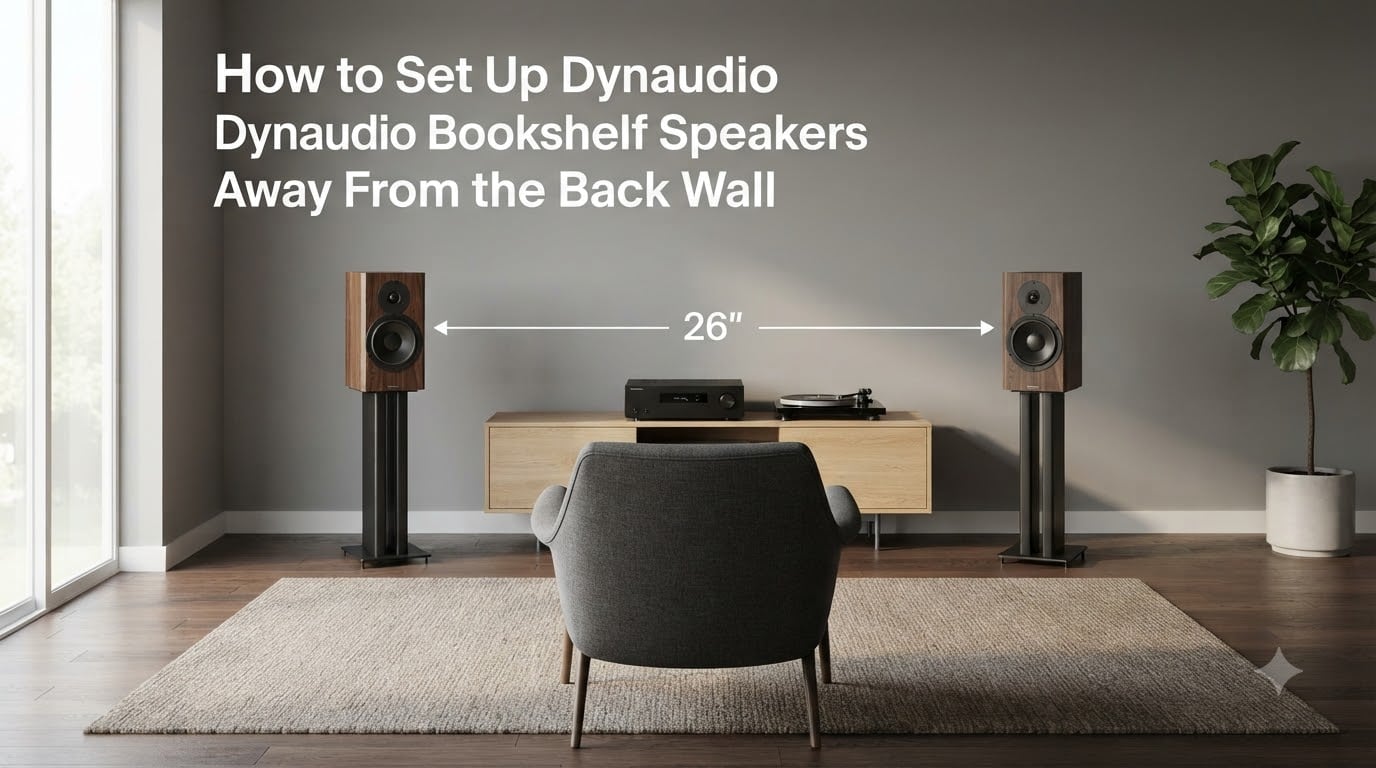
Setting up Dynaudio bookshelf speakers away from the back wall means placing them far enough that reflected bass waves do not reinforce the direct sound and create boomy, uneven low frequencies. For most Dynaudio models with rear-firing bass ports, I recommend starting at least 20 inches (about 50 cm) from the back wall and tuning outward from there by ear. Proper back wall distance matters because Dynaudio speakers have a slightly warm bass tuning, which makes them more sensitive to boundary loading than many other brands.
I have spent the last several months repositioning my own Dynaudio bookshelves across three different rooms, and the single biggest improvement I made was simply pulling them out from the wall. In this guide, I will walk you through the exact setup process I use and the science behind why it works, so you can get the most out of your speakers.
Table of Contents
Why Back Wall Distance Matters for Dynaudio Speakers
Back wall distance matters because the wall behind your speakers acts like an acoustic mirror that reinforces low frequencies. Bass waves are long, so when they hit a nearby wall they bend and merge back into the direct sound at the listening position. The result is a bass buildup that colors the music, making it sound thick and lacking detail.
Dynaudio bookshelf speakers are particularly sensitive to this for a simple reason: their engineers tune the bass response with a small bump that gives music warmth and weight. When a wall reinforces that bump on top of the direct sound, the result is overkill. Pulling your Dynaudio speakers away from the back wall gives the bass room to breathe.
If you have ever described your speakers as “boomy” or “muddy,” boundary loading is almost always the culprit.
Understanding SBIR (Speaker Boundary Interference Response)
SBIR stands for Speaker Boundary Interference Response, and it is the technical term for the bass reinforcement problem I just described. When your speaker is roughly 1 to 4 feet from a wall, sound waves bouncing off that wall arrive at your ears a fraction of a millisecond after the direct sound.
That tiny delay causes phase cancellation and reinforcement at specific bass frequencies, creating dips and peaks in the bass response. SBIR is the reason certain notes seem louder while others disappear, even when listening to a well-mixed track.
Moving the speaker closer to the wall shifts which frequencies are affected. Moving it further away gradually reduces the effect until the wall no longer interferes audibly. That movement is exactly what we are working toward when setting up Dynaudio bookshelf speakers away from the back wall.
Optimal Starting Distances for Dynaudio Bookshelf Speakers
For most rear-ported Dynaudio bookshelf models, start at least 20 inches (50 cm) from the back wall. This is the minimum practical distance to keep the rear bass port from choking and to limit SBIR peaks. If your room allows, 30 to 36 inches gives the bass space to fully develop.
Side walls need their own rule. Keep your speakers at least 18 to 24 inches from any side wall. Reflections from the side walls collapse stereo imaging and blur the soundstage. Pulling the speakers toward the center of the wall reduces this, but never place them exactly at the midpoint or you will create a symmetric acoustic disaster.
Corner placement is the worst spot for any rear-ported Dynaudio. Two walls double the boundary loading, and you lose the deep bass punch that defines good bookshelf sound. If your room forces corners, use acoustic treatment or consider switching to a front-ported model.
The 38% Room Positioning Rule
The 38% rule, popularised by Dynaudio’s own experts, says the ideal listening position is 38% of the room’s length away from the front wall, with the speakers an equal distance from the side walls. So in a 16-foot room, your chair goes about 6 feet from the back wall, with the speakers roughly 6 feet apart.
This positioning puts you in a neutral spot where room modes (resonant bass frequencies) are less excited. It is why many listening rooms across the world feel “right” without explaining why.
I use this rule as a starting reference, then refine by ear.
Step-by-Step: How to Set Up Dynaudio Bookshelf Speakers Away From the Back Wall
Follow these steps in order. Each one builds on the last.
Step 1: Place the speakers 20 inches from the back wall and the same distance from the side walls. This is your reference baseline. Mark the spot on the floor with tape so you can return to it.
Step 2: Sit in your chair and play a familiar track with strong bass and vocals. I use Patricia Barber’s “Ode to Billy Joe” because the upright bass and her voice sit in the same frequency range and expose both problems and improvements instantly.
Step 3: Move the speakers further out in 2-inch increments. After each move, sit back down and listen for 60 seconds. You are listening for tighter bass, a clearer midrange, and a wider soundstage. Stop when more distance stops helping.
Step 4: Adjust toe-in. Point the speakers inward so they cross slightly behind your listening position. Start with the speakers aimed straight ahead, then rotate each inward 5 to 10 degrees. Proper toe-in locks the soundstage into a clear center image.
Step 5: Lock in the speaker positions. Once the bass sounds tight and the vocals feel clear, mark the final spots. Use Blu-Tack under the stand spikes to keep the speakers from drifting.
Step 6: Verify with a second reference track. I keep Steely Dan’s “Aja” queued for this final check. If percussion and bass lock into place across both tracks, your setup is dialed in.
Reference Music for Testing Speaker Placement
The right test tracks reveal problems fast. I cycle through these five every time I move a speaker pair:
- Patricia Barber, “Ode to Billy Joe.” Upright bass and warm vocals. Exposes bass bloat and midrange congestion.
- Steely Dan, “Aja.” Crisp percussion and detailed production. Reveals imaging and toe-in errors.
- Hans Zimmer, “Time” (Inception OST). Slow-building dynamics. Exposes smearing or compression artifacts.
- Norah Jones, “Don’t Know Why.” Intimate vocals and piano. Tests midrange clarity.
- Massive Attack, “Angel.” Deep sub-bass. Reveals boom or nulls at the lowest frequencies.
Whatever you choose, use the same tracks during each adjustment. Reference memory is unreliable; familiar tracks on the same system are not.
Rear-Ported vs Front-Ported Dynaudio Placement
Rear-ported Dynaudio speakers, including many Emit and Contour models, push bass energy out the back. That makes back wall distance critical, because the port needs room to “breathe.” Pulling them 20+ inches from the wall lets the port deliver clean, extended bass.
Front-ported designs like some Confidence and Evoke models fire bass forward. They tolerate much closer wall placement, sometimes as little as 6 to 8 inches. If your room is small and you cannot pull speakers far out, a front-ported Dynaudio is the practical choice.
The trade-off is depth of soundstage. Rear-ported models, given room to breathe, usually image more convincingly than their front-ported siblings.
Small Room Strategies When You Cannot Pull Speakers Out
Sometimes the room dictates the setup. Here is what I do when I cannot pull speakers more than a few inches from the wall.
Use port bungs. Most Dynaudio bookshelves ship with foam plugs for the rear port. Inserting them reduces the port’s output and tames the bass hump, though at the cost of some low-end extension.
Treat the wall behind the speakers. A 2-inch thick acoustic panel directly behind each speaker absorbs the reflections that cause SBIR. This single change can make a 6-inch placement sound like 18 inches.
Switch to near-wall listening. If your chair can sit closer to the speakers, the relative wall distance grows even if the speakers stay put. This is a clever workaround in narrow rooms.
Consider a subwoofer with crossover control. Offloading the deepest bass to a sub lets the bookshelves focus on midrange and treble, where back wall interference is far less of an issue.
Frequently Asked Questions
How far away from the wall should bookshelf speakers be?
Most rear-ported bookshelf speakers, including Dynaudio models, perform best at least 20 inches (50 cm) from the back wall. Front-ported designs can sit much closer, often 6 to 8 inches, without audible bass problems. Always tune by ear from a 20-inch starting point and stop when more distance stops improving the bass.
What is the 83% rule for speakers?
The 83% rule is a placement guideline where the speakers sit 83% of the room’s width apart, with the listening position forming an equilateral triangle. It reduces side wall reflections and widens the soundstage. Use it as a starting reference, then refine by ear.
How far should speakers be from the sidewall?
Keep bookshelf speakers at least 18 to 24 inches away from any side wall. Side wall reflections blur stereo imaging and wash out the soundstage. If that is impossible in your room, add absorption panels at the first reflection points.
How do I hide speakers without ruining the sound?
Hide speakers without ruining the sound by using in-wall or on-wall designs that fire correctly into the room. Bookshelf speakers can be partially concealed on shelves, but doing so trades sound quality for aesthetics. The best compromise is custom cabinetry that leaves the front baffle fully exposed.
Final Thoughts on How to Set Up Dynaudio Bookshelf Speakers Away From the Back Wall
Setting up Dynaudio bookshelf speakers away from the back wall is the highest-value upgrade you can make to your system. Twenty inches of breathing room, the 38% rule, and a 30-minute ear-tuning session will do more for your music than a new cable or amplifier ever could.
Pull them out, play a familiar track, and trust your ears. That is the whole method.