
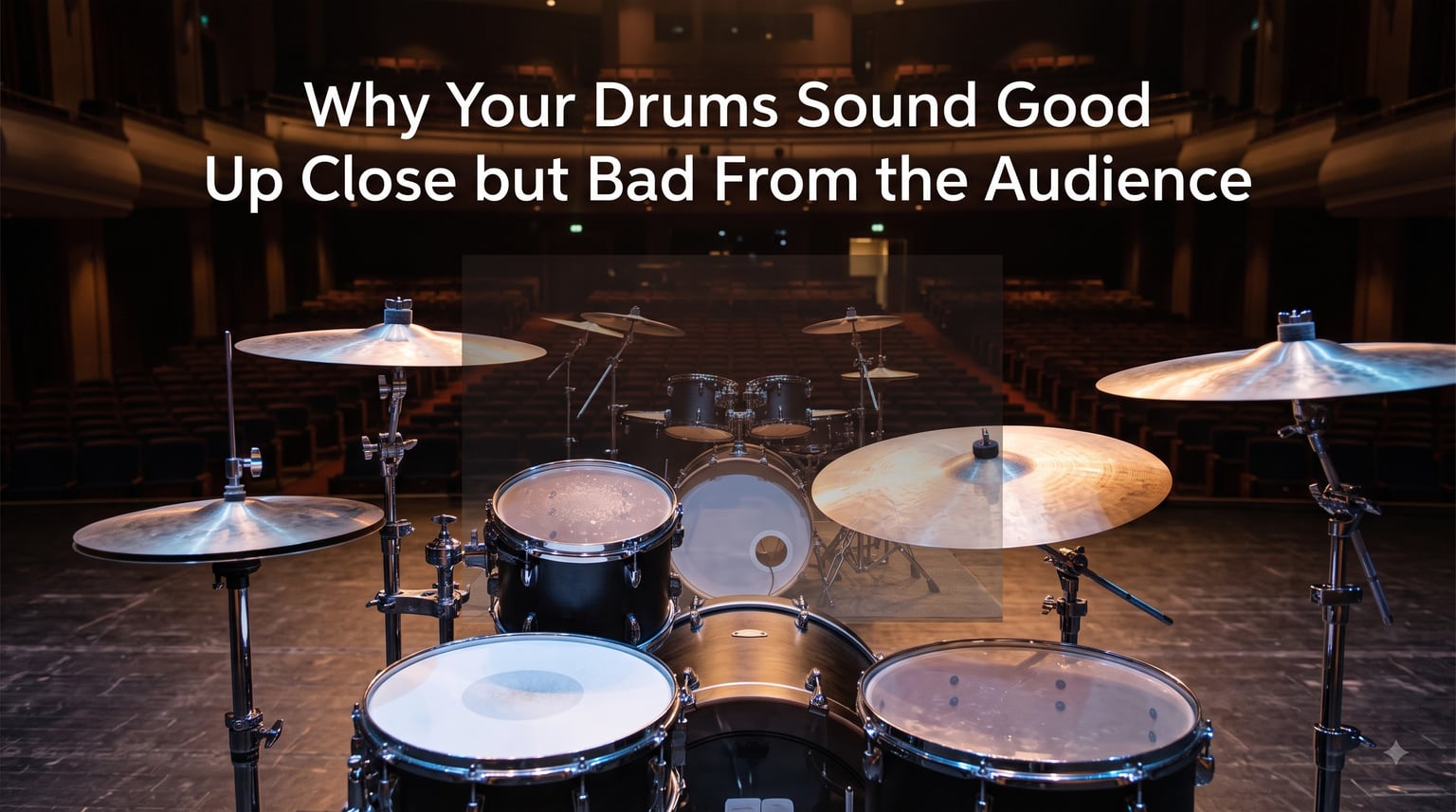
If you’ve ever finished a gig thinking your drums sounded tight, then watched a recording and cringed, you’ve asked the same question countless drummers ask: why your drums sound good up close but bad from the audience. The short answer is acoustic physics. You hear direct sound and nearby reflections within a few feet of the kit, while the audience hears sound that has traveled across the room, bounced off walls, and competed with every other instrument. Understanding this gap is the first step to fixing it.
Our team has spent years playing live, talking to front of house engineers, and testing rooms of every size. In this guide, we’ll explain the acoustic reasons behind the perspective gap, the role of stage volume and monitor mix, and the practical steps you can take to make your drums sound better for the audience without sacrificing your own feel.
Table of Contents
Why Your Drums Sound Good Up Close but Bad From the Audience
The core reason is distance. When you sit behind your kit, sound reaches your ears within milliseconds of striking the drumhead. You hear the full transient, the body of the note, and a tight cluster of early reflections from your floor tom, cymbals, and the stage itself.
From the audience perspective, that same sound has to travel 10, 30, or even 100 feet before it arrives. Along the way, it loses high-frequency content, gains room reflections, and gets masked by stage volume from cymbals, guitar amps, and PA bleed. The result is a muddier, less defined version of what you hear on the throne.
Three acoustic factors drive this gap:
- Direct sound vs reflected sound – the drummer hears mostly direct sound; the audience hears mostly reflections.
- High-frequency air absorption – cymbals and snare crack lose crispness over distance.
- Masking from other sources – stage volume from amps and PA competes with your kit at the back of the room.
The Physics of Drum Sound Projection
Drums are omnidirectional at low frequencies and become increasingly directional at higher ones. Your kick drum pushes low-end energy in every direction, which is why the bass player 20 feet away still feels it in their chest. But your snare crack and cymbal wash project in a tighter beam straight up and forward.
Here’s what that means in practice. When you hit a crash cymbal on the left side of your kit, the drummer hears it almost instantly. A listener in the back row hears it 50 milliseconds later, after the wave has spread, lost energy to air absorption, and blended with reflections from the back wall.
Frequency response also changes with distance. Sounds above 2 kHz lose roughly 6 dB per doubling of distance in open air. That’s why your hi-hat sounds crisp behind the kit but tends to disappear in a large room unless it’s reinforced through the PA.
Drum sound projection depends on the size and tuning of each drum. A high-tuned snare cuts through better than a low one, but it also projects more directionally. A loose, deep kick projects low-end everywhere, but lacks the attack the audience needs to feel the beat.
Room Acoustics and How Venues Change Drum Sound
Every room shapes drum sound differently. A small club with hard walls, low ceiling, and a wooden floor reflects sound back fast, creating a tight, punchy sound. A large hall with high ceilings, drapes, and absorption panels gives the same kit a washy, reverberant character.
Reverb time is the key number. A room with a 0.8-second reverb time makes your snare sound beefy and your toms bloom nicely. The same kit in a room with a 2.5-second reverb time will turn into a smeared mess, especially on faster passages.
Room modes also play a role. These are low-frequency buildups caused by parallel walls. In a small venue, you might find that your kick drum suddenly booms at one specific spot in the audience. Move three feet to the side, and the boom disappears.
From the drummer’s perspective, you’re sitting in the near field, mostly immune to room modes and late reflections. The audience is fully exposed to them. This is why your kit sounds good during soundcheck in an empty room and bad when the venue is full of bodies absorbing the highs.
Sound reinforcement from the PA system changes the equation further. Most live drum sound reaches the audience as a blend of direct acoustic sound from the stage and amplified sound from the microphones. If the mics are too far from the drums, or if the front of house engineer pulls them down to fight stage volume, the audience gets an even thinner version of your kit.
Monitor Mix and What You Hear as the Drummer
Your monitor mix is another reason the gap feels so large. In-ear monitors or a wedge in front of you let you hear your drums at close range, with the levels tweaked to give you confidence. You might have your snare cranked, your kick boosted, and your cymbals pulled down.
What you hear through that wedge has almost no connection to what the audience hears. The wedge points at your head, sits two feet away, and uses near-field frequencies. The audience hears the room, the PA, and whatever spill the engineer has miced up.
Stage volume is the biggest practical problem here. If your drums are loud on stage, the engineer has to turn down the drum mics to avoid feedback and bleed. That means less of your kit in the PA, and a weaker audience experience. Drummers often don’t realize this because their stage wedge is still loud and clear.
How Hearing Protection Changes Your Perception
Earplugs make the gap even wider. Custom molded earplugs with flat attenuation cut volume evenly across frequencies. Foam plugs tend to cut highs more than lows, which makes your drums sound dull and boxy behind the kit.
A drummer on drumforum put it well: “If you wear earplugs your drums are going to sound different to you than somebody not wearing them out in the audience.” You may think your kit sounds muddy because of the room, but part of the muddiness is just the earplugs in your own ears.
This is one reason drummers often think their drums sound bad in the audience but fine on stage. The earplugs are giving you a false reference. If you want a true comparison, pull one plug out briefly during soundcheck and walk to the back of the room to hear what the audience actually gets.
Practical Tips to Improve Drum Sound for the Audience
Now for the part that actually helps you on stage. Here are the steps our team uses to close the gap between the drummer’s perspective and the audience perspective.
- Tune for the room, not just your ears. At soundcheck, walk to the back of the room and listen. If your snare is disappearing, raise the fundamental by tightening the top head. If the kick is boomy, add a pillow or front head to tighten it.
- Work with the front of house engineer. Ask the engineer what they hear from the mix position. They will tell you if your snare needs more beater attack, your kick more click, or your cymbals less wash.
- Control stage volume. Use lighter sticks, lower-volume cymbals, and dampening on your drums when the room is small. The quieter your stage volume, the more your mics can be turned up in the PA.
- Check your mic placement. Snare mic should be 1-2 inches above the head, angled toward the center. Kick mic inside the shell, just touching the beater. Overheads should be spaced evenly above the kit, not biased to one side.
- Use earplugs that match the audience curve. Custom plugs with a flat or musician’s response curve give you a more honest picture of your own sound than foam plugs.
- Record every gig. A simple stereo recorder at the back of the room shows you what the audience actually hears. Listen back and adjust your tuning and dynamics for next time.
These tips won’t make every venue perfect, but they will shrink the gap between what you hear behind the kit and what the audience hears out front.
Common Mistakes Drummers Make About Audience Sound
The biggest mistake is trusting your stage wedge too much. It tells you the truth about timing and feel, but lies about tone and balance. Another mistake is assuming that if your drums sound good at soundcheck, they’ll sound good at showtime. Bodies in the audience absorb high frequencies, so a room that sounded bright at soundcheck often turns dull when full.
Drummers also tend to tune by ear in the practice room and never adjust for the gig. The room changes everything. A kit tuned for a dry rehearsal space will sound boomy in a hall, and tight in a club. Always bring your tuning key and a spare head to every show.
Finally, don’t blame yourself for every bad drum sound in the room. Sometimes it’s the PA, sometimes it’s the engineer, sometimes it’s the room itself. A drummer on a forum wrote: “Your kit will sound different in every room you play. That’s a given that we can’t avoid.” Knowing what you can control, and what you can’t, saves a lot of frustration.
Frequently Asked Questions
Why do my drums sound so bad?
Your drums sound bad because of the gap between direct sound near the drummer and reflected sound at the audience. Stage volume, room acoustics, and monitor mix all make the audience hear a less defined version of your kit.
Why does my drum sound different?
Every room reflects and absorbs sound differently. Walls, ceilings, audience bodies, and PA placement all change the drum sound you hear out front compared to behind the kit.
Why do drums sound different close up vs from the audience?
Close up you hear direct sound and immediate reflections. From the audience, sound has traveled further, lost high frequencies, and blended with room reflections and other stage instruments.
What is the 3 to 1 rule for drum mics?
The 3 to 1 rule means placing each drum mic at least three times farther from the next drum than it is from its own drum. This reduces bleed and phase problems between mics.
Do you pan drums from audience perspective or drummer perspective?
Pan drums from the audience perspective so the listener sees the kit as they look at it. The hi-hat goes left, the floor tom goes right, and the kick and snare stay centered.
How can I make my drums sound better for the audience?
Tune for the room, control stage volume, work with the front of house engineer, check your mic placement, and record from the back of the room to hear what the audience actually hears.
Final Thoughts on Drum Sound Close vs Far
The reason your drums sound good up close but bad from the audience comes down to physics, room acoustics, and stage volume. Once you understand that the audience hears a fundamentally different signal than you do, you can tune, mic, and mix with both perspectives in mind. Walk to the back of the room at every soundcheck, work with your engineer, and bring earplugs that give you an honest curve. That’s how you shrink the gap and make your kit sound great for everyone, not just for you.