
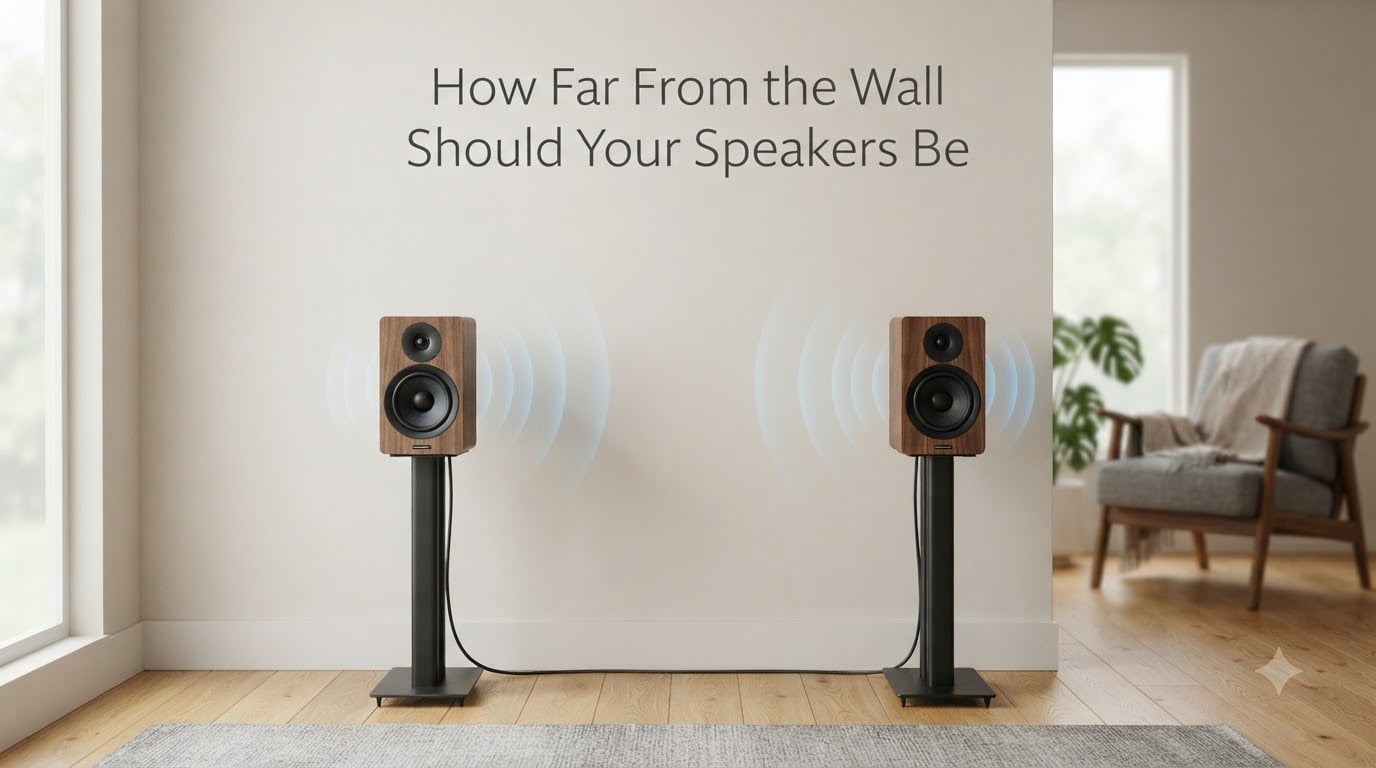
Speakers should sit 12 to 36 inches from the back wall for the cleanest sound. I moved mine from 4 inches to 18 inches and heard bass detail I had missed for years.
This guide from our team at Nabiha Music walks through exactly how far from the wall should your speakers be. We cover the direct answer, the physics behind bass build-up, and a step-by-step tuning method you can run tonight.
By the end you will know which distance matches your speaker type, what the 38% and 83% rules actually do, and how to dial in the sweet spot without any special equipment.
Table of Contents
How Far From the Wall Should Your Speakers Be? The Direct Answer
Place most speakers 12 to 36 inches (30 to 90 cm) from the back wall. Bookshelf speakers with rear ports need at least 6 to 12 inches more clearance than front-ported models.
This range comes from a blend of manufacturer guides and acoustic research from brands like Dynaudio, KEF, and ELAC. ELAC recommends a 2 to 3 foot minimum. KEF suggests 300 mm to 1000 mm. Dynaudio lands on roughly 12 to 36 inches as the sweet spot.
Here is a quick reference you can save:
Bookshelf speakers (rear-ported): 8 to 24 inches from the wall
Bookshelf speakers (front-ported): 4 to 12 inches works
Floorstanding speakers: 12 to 36 inches from the wall
Studio monitors: 6 to 18 inches for near-field use
Treat these as starting points, not rules. Your room, speaker, and music taste all shift the ideal number by a few inches in either direction.
Why Wall Proximity Affects Your Speaker Sound
Bass frequencies radiate in every direction from a speaker, including backwards. When a speaker sits too close to a wall, those rear-going bass waves bounce off the wall and meet the front-going sound at your ears.
That meeting creates phase interference. Some frequencies add together and get louder (which is why the bass sounds boomy). Other frequencies cancel each other out and disappear (which is why the bass sounds muddy).
I noticed this exact problem in a friend’s setup last year. His rear-ported bookshelves were jammed 3 inches from drywall. Every kick drum sounded like a cardboard box. Pulling them out 14 inches fixed it on the spot.
Walls also reflect midrange and treble, just with less energy loss than bass. Mid and treble reflections add echo and blur stereo imaging, which is why even small speakers benefit from a little breathing room.
Understanding Speaker Boundary Interference Response (SBIR)
SBIR stands for Speaker Boundary Interference Response. It is the technical name for the cancellation pattern that happens when a speaker sits near any boundary, including the back wall, side walls, and even the floor.
Here is how it works. A bass wave traveling backwards hits the wall, bounces, and travels back to the speaker. By the time the reflected wave reaches your ear, it is delayed slightly. That delay equals a distance of twice the wall gap.
If twice the wall distance equals half of a bass wavelength, that frequency cancels itself. If twice the wall distance equals a full wavelength, that frequency doubles in volume. The result is a comb-filter pattern of peaks and nulls in the bass.
The classic fix is to move the speaker so the wall distance is not a clean fraction of any common bass wavelength. Irregular spacing breaks up the cancellation pattern.
SBIR is unavoidable in any room. The goal is to pick a distance that minimizes its impact, not to eliminate it entirely.
Rear-Ported vs Front-Ported Speakers: Different Distance Needs
The port on your speaker dictates how close it can sit to the wall. Get this wrong and the port chokes, bass thins out, and the speaker sounds like a clock radio.
Rear-ported speakers fire bass out of the back of the cabinet. They need 8 to 24 inches of clearance. The exact number is in your manual and most audiophiles on Reddit land on 12 to 18 inches in practice.
Front-ported speakers fire bass out of the front baffle. They can sit closer to walls, sometimes as close as 2 to 4 inches, without choking. KEF’s Uni-Q drivers are a famous example.
Bottom-firing or down-firing ports point at the floor. They depend on floor distance and need a stand or shelf with clearance below. A typical minimum is 8 to 12 inches above the floor.
Sealed (acoustic suspension) cabinets have no port at all. They are the most wall-friendly option, but trade deep bass extension for that flexibility.
One audiophile on r/audiophile reported moving his rear-ported speakers from 0 to 4.5 inches and hearing a real bump in clarity. Another at 5 inches still sounded off. The lesson is that even a few inches changes the sound more than most users expect.
The 38% Rule and 83% Rule for Speaker Placement
Two classic formulas help you place speakers and your listening seat in any rectangular room. Almost no one talks about them in mainstream guides, but mastering them gives you a real edge.
The 38% rule for room placement: position your speakers along the long wall so the distance from the wall behind them equals 38% of the room length.
Example: in a 12 foot (144 inch) room, place the speakers 38% of 144 inches equals roughly 55 inches from the back wall. Then mirror that on the front wall side.
Why 38%? It puts the speakers at a node of the room’s standing wave pattern. That position gives smoother bass response in most rooms compared to dead-center placement.
The 83% rule for speaker separation: set the distance between the speakers to 83% of the room width. That keeps them out of the corners and on the right side of the room’s lateral standing waves.
Example: in a 10 foot (120 inch) wide room, the speakers should sit 0.83 times 120 equals roughly 100 inches apart. Center the pair on the middle of the room.
These two rules work together. Apply both, then fine-tune by ear. They will not produce perfect sound in every room, but they get you 80% of the way there.
How to Set Up the Perfect Listening Triangle
An equilateral triangle between you and the two speakers gives the best stereo imaging. Your head is the third corner. The three sides should measure equal distances.
Start with the speakers 6 to 8 feet apart for a small to medium room. Sit at the same distance from the line between the speakers. So if the speakers are 7 feet apart, sit 7 feet back.
Toe-in angles change the soundstage and imaging. A few common starting points:
No toe-in: speakers fire straight ahead. Wide soundstage, soft stereo image.
Mild toe-in (5 to 10 degrees): speakers aim slightly toward the listener. Balanced soundstage and focus.
Heavy toe-in (15+ degrees): speakers aim right at your ears. Sharp imaging, narrower soundstage.
Speaker height matters too. Tweeters should aim at your ears when you sit. Bookshelf speakers on a desk or low shelf usually need angled stands to reach ear level.
Step-by-Step Tuning Method to Find Your Optimal Distance
The right way to set wall distance is by ear, with a simple test track. Here is the method our team uses for every speaker we review.
Start at the manufacturer’s recommendation. If you have a manual, use that exact number as the baseline. If not, start at 12 inches for bookshelf and 18 inches for floorstanding.
Pull the speaker 2 inches forward and listen for 60 seconds to a song you know well. Pay attention to bass tightness and vocal clarity.
Push the speaker 2 inches back from your starting point and repeat. Listen to the same passage each time.
Play the same test track at the same volume for every position. Mark each spot with painter’s tape so you can return.
Stop moving when bass sounds tight and the stereo image snaps into focus. That is your room’s sweet spot.
A good test track has a strong bass line, layered vocals, and clear high-hat detail. I use Steely Dan’s “Aja” and Daft Punk’s “Get Lucky” because I know every note.
Speaker Placement Mistakes to Avoid
Some placements actively ruin sound quality. Skip these setups and your speakers will reward you with far better audio.
Tucked into a corner. Corners amplify bass by an extra 6 dB on top of wall reinforcement. Bass gets boomy and one-noted fast.
Inside a bookcase or cabinet. The enclosed space chokes the speaker, smears imaging, and usually kills bass.
At uneven distances from side walls. One speaker closer to a side wall than the other pulls the stereo image off-center.
Against glass, mirrors, or windows. Hard reflective surfaces create harsh echo and ringing that ruin the high frequencies.
Directly on a shelf without isolation. The shelf turns into a soundboard and adds a hollow, resonant thump to every bass note.
The “where should you not put speakers” question matters as much as where you do. Move 6 inches away from any reflective surface and you hear the difference.
FAQs
What is the 83% rule for speakers?
The 83% rule states that the distance between your left and right speakers should equal 83% of the room’s width. So in a 12 foot wide room, your speakers should sit about 10 feet apart. This placement positions the speakers to the side of the room’s lateral standing waves for smoother bass response.
What is the 38% rule for speakers?
The 38% rule says your speakers should sit 38% of the room’s length away from the front or back wall. In a 14 foot room, that equals roughly 5.3 feet of clearance. This distance aligns with room standing wave nodes and usually produces more even bass than placing speakers flush against the wall.
What happens if speakers are too close to the wall?
Speakers too close to the wall sound boomy or muddy because rear-firing bass waves bounce off the wall and reinforce themselves. Mid and treble reflections also blur the stereo image. The result is one-noted bass, smeared vocals, and a wide but unfocused soundstage.
Where should you not put speakers?
Avoid corners (bass becomes boomy), inside cabinets or bookshelves (sound chokes), on uneven side-wall distances (image shifts off-center), directly against glass or mirrors (harsh reflections), or on shelves without isolation (resonance adds a hollow thump to bass). Give every speaker a few feet of breathing room.
Finding the Right Distance for Your Room
So how far from the wall should your speakers be for the best sound? Most speakers belong 12 to 36 inches out from the back wall, with rear-ported models needing closer to 18 inches and front-ported models able to sit closer. Use the 38% rule as a room-aware starting point, set up an equilateral triangle, then tune by ear in 2-inch increments until bass tightens up and the stereo image locks in.
Every room is different, so the precise number takes a few minutes of patient adjustment. Pull your speakers away from the wall today, run the test track, and listen. The improvement is usually obvious within the first song, and the wall distance you settle on will stay locked in for years of better listening.