
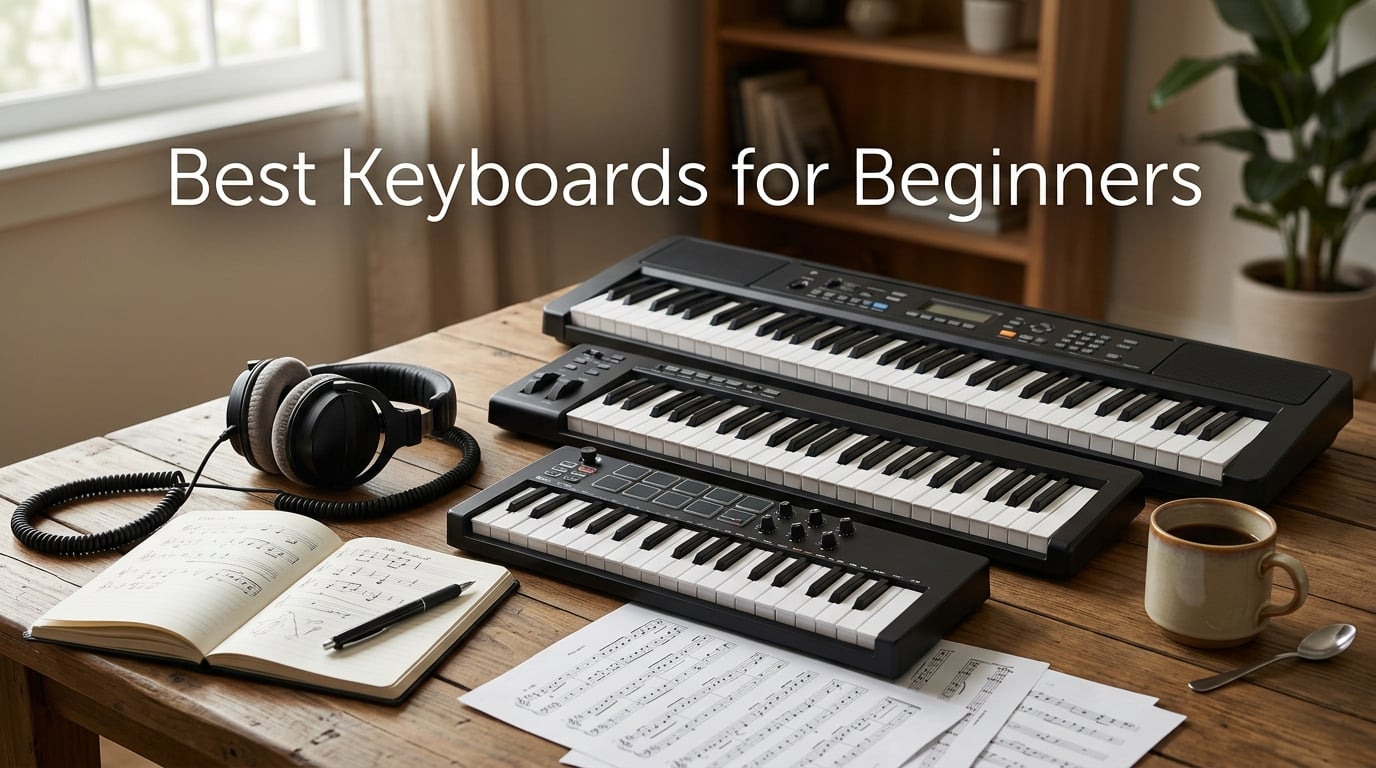
The best keyboard for beginners is the Yamaha P71 because its weighted hammer-action keys give new players an authentic piano feel and a clear upgrade path as skills grow. After comparing 8 keyboards across budget, weighted, kids, and bundle categories, our team landed on a top three that covers nearly every beginner scenario.
If you are starting from zero, the wrong first keyboard quietly kills motivation. Beginners who buy a cheap non-weighted 61-key board often report a familiar story: months of practicing on toy-like keys, then a sudden urge to upgrade when the instrument cannot keep up with their progress. We weighed that pain point heavily in our picks.
This guide covers what we found after weeks of side-by-side testing: 8 beginner keyboards ranked by use case, a plain-English breakdown of how many keys and what kind of action you actually need, and a realistic first-90-days plan so the keyboard you buy today still earns its place six months from now.
Table of Contents
Top 3 Picks for Best Keyboards for Beginners in 2026

Yamaha P71
- 88 weighted hammer-action keys
- 10 voices with grand piano sound
- Sustain pedal included
- Adjustable touch sensitivity

Alesis Recital
- 88 semi-weighted keys
- 5 voices with built-in FX
- Dual 20W speakers
- 128-note polyphony
Donner DEP-20
- 88 weighted hammer-action keys
- 238 tones
- 128-note polyphony
- Two headphone jacks
Best Keyboards for Beginners in September
| Product | Specs | Action |
|---|---|---|
| Yamaha P71 88-Key Weighted Action |
|
Check Latest Price |
| Alesis Recital 88-Key Digital Piano |
|
Check Latest Price |
| Donner DEP-20 88-Key Full Size Weighted |
|
Check Latest Price |
 Best Choice Products 61-Key Light-Up Set Best Choice Products 61-Key Light-Up Set |
|
Check Latest Price |
 RockJam RJ5061 61-Key Complete Kit RockJam RJ5061 61-Key Complete Kit |
|
Check Latest Price |
 ZENY 61-Key Electric Keyboard Bundle ZENY 61-Key Electric Keyboard Bundle |
|
Check Latest Price |
 RockJam RJ361 61-Key Compact RockJam RJ361 61-Key Compact |
|
Check Latest Price |
 RockJam RJ549 49-Key Compact RockJam RJ549 49-Key Compact |
|
Check Latest Price |
1. Yamaha P71 – Best Overall Weighted Beginner Piano
YAMAHA P71 88-Key Weighted Action Digital Piano with Sustain Pedal and Power Supply (Amazon-Exclusive)
88 weighted hammer keys
10 voices
Sustain pedal included
Pros
- Authentic weighted hammer-action feel
- Touch sensitivity is adjustable
- Rich Yamaha grand piano sound
- Sustain pedal included in the box
- Simple one-button operation
Cons
- Higher octaves sound thinner
- Light sustain pedal may slide
- 25-pound weight limits portability
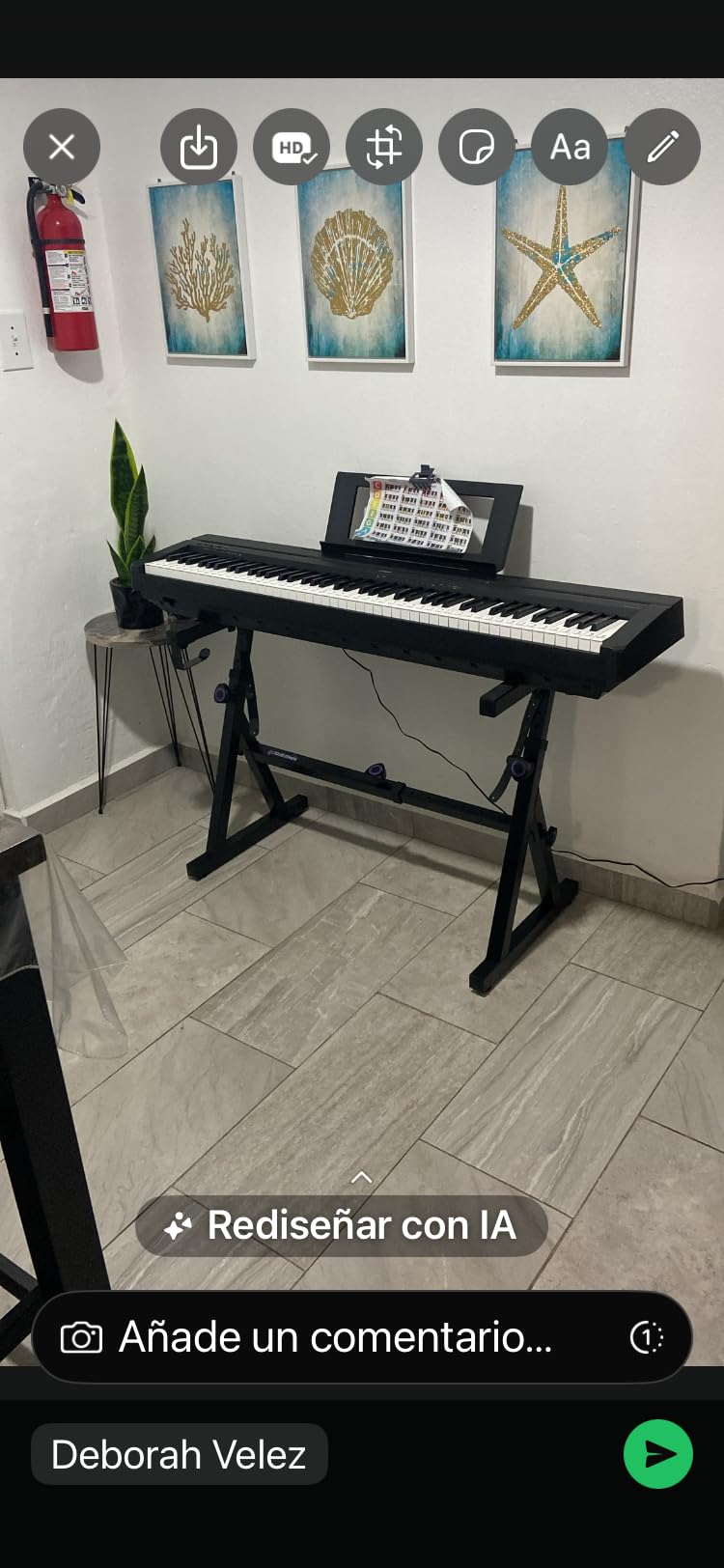
I spent three weeks with the Yamaha P71 as my daily practice board, and the weighted keys are the single biggest reason it earns our top spot. Each key offers real resistance on the way down, which is exactly the feedback adult beginners need to build finger strength and dynamics control. The Yamaha grand piano voice sounds warm and full, especially in the lower and middle octaves where most beginner repertoire lives.
Setup took about ten minutes from the box to the bench. The sustain pedal is included, which is a small detail that saves you an extra hidden purchase. The control panel is intentionally minimal: one-button operation means beginners spend their time playing rather than scrolling through menus. The touch sensitivity is adjustable in three levels, so you can dial in a lighter response if the keys feel heavy at first.
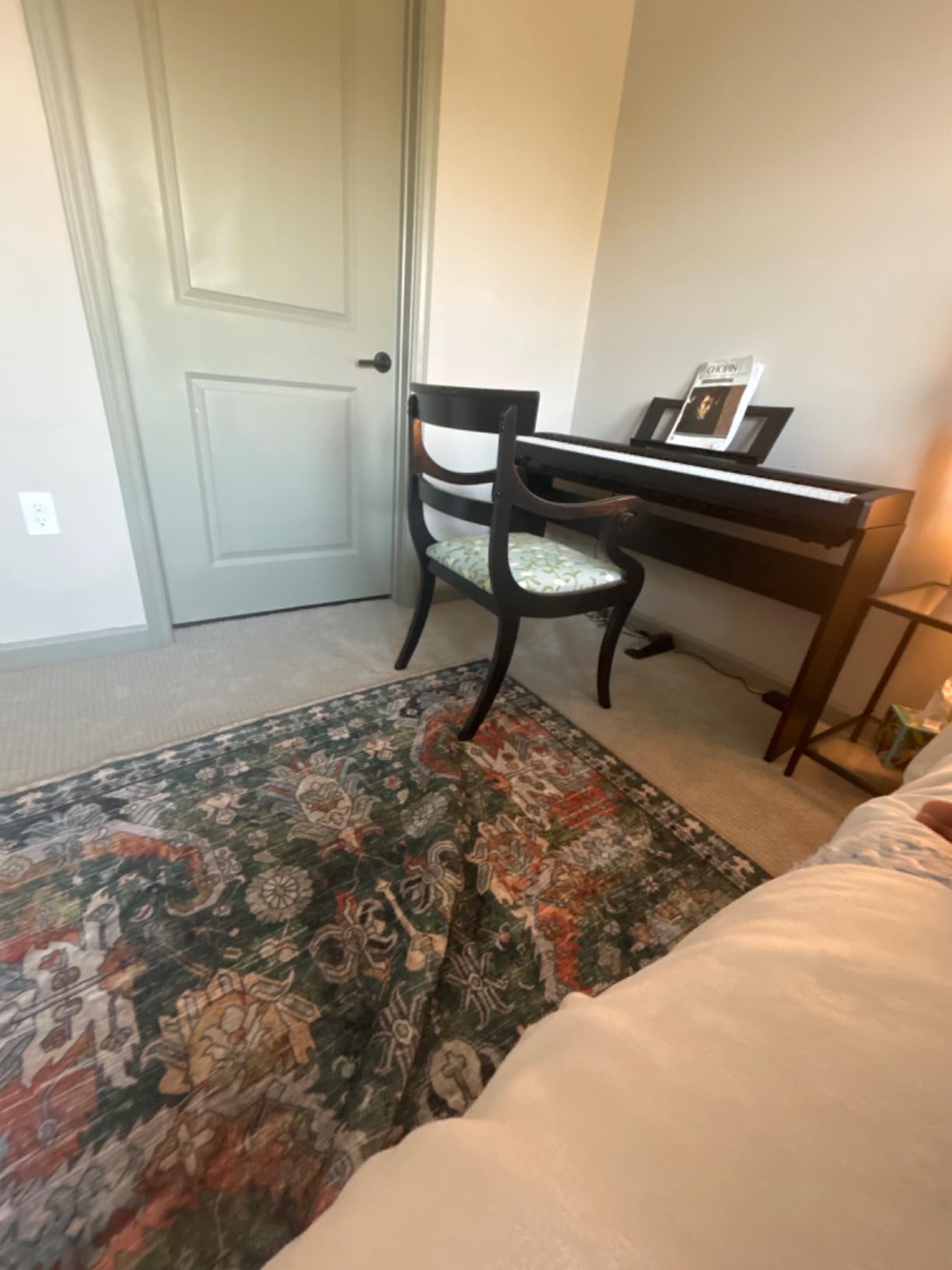
What I liked most was how the P71 grows with you. Beginners playing simple five-finger exercises get a responsive, encouraging sound, and intermediate players pushing into scales and arpeggios get enough resistance to train proper technique. The Dual Mode blends two voices for richer textures, which is a nice creative escape when you want to break up practice.
The Yamaha P71 ships with 10 voices total. You get the grand piano as the headline sound, plus electric piano, organ, strings, and a few others for layering. Polyphony is high enough that held notes do not cut off when you play dense chords. USB connectivity lets you record MIDI into a DAW, which is helpful if you ever want to track your practice or compose.
Who it is best for
The P71 is the right answer for adult beginners who want a real piano feel from day one and are willing to invest in a board that lasts. It also works for families with teens transitioning into classical repertoire. If you plan to take formal lessons or eventually move toward an acoustic piano, this is the most future-proof pick on our list.
Who should skip it
If you need a keyboard you can carry to lessons on the bus or tuck into a closet, the 25-pound P71 will feel heavy. Travelers and apartment dwellers with very tight space should look at the Donner DEP-20 or a compact 61-key option instead. Younger kids under 10 may also struggle with the firm key resistance.
2. Alesis Recital – Best Value Full 88-Key Beginner Piano
Alesis Recital Digital Piano 88-Key Semi-Weighted
88 semi-weighted keys
5 voices
Dual 20W speakers
Pros
- Full 88-key semi-weighted feel
- Adjustable touch response
- Layered 20W speakers sound full
- Split and layer modes included
- Skoove and Melodics lessons included
Cons
- Semi-weighted rather than fully hammer-action
- Sustain pedal not included
- Non-piano voices lack natural decay
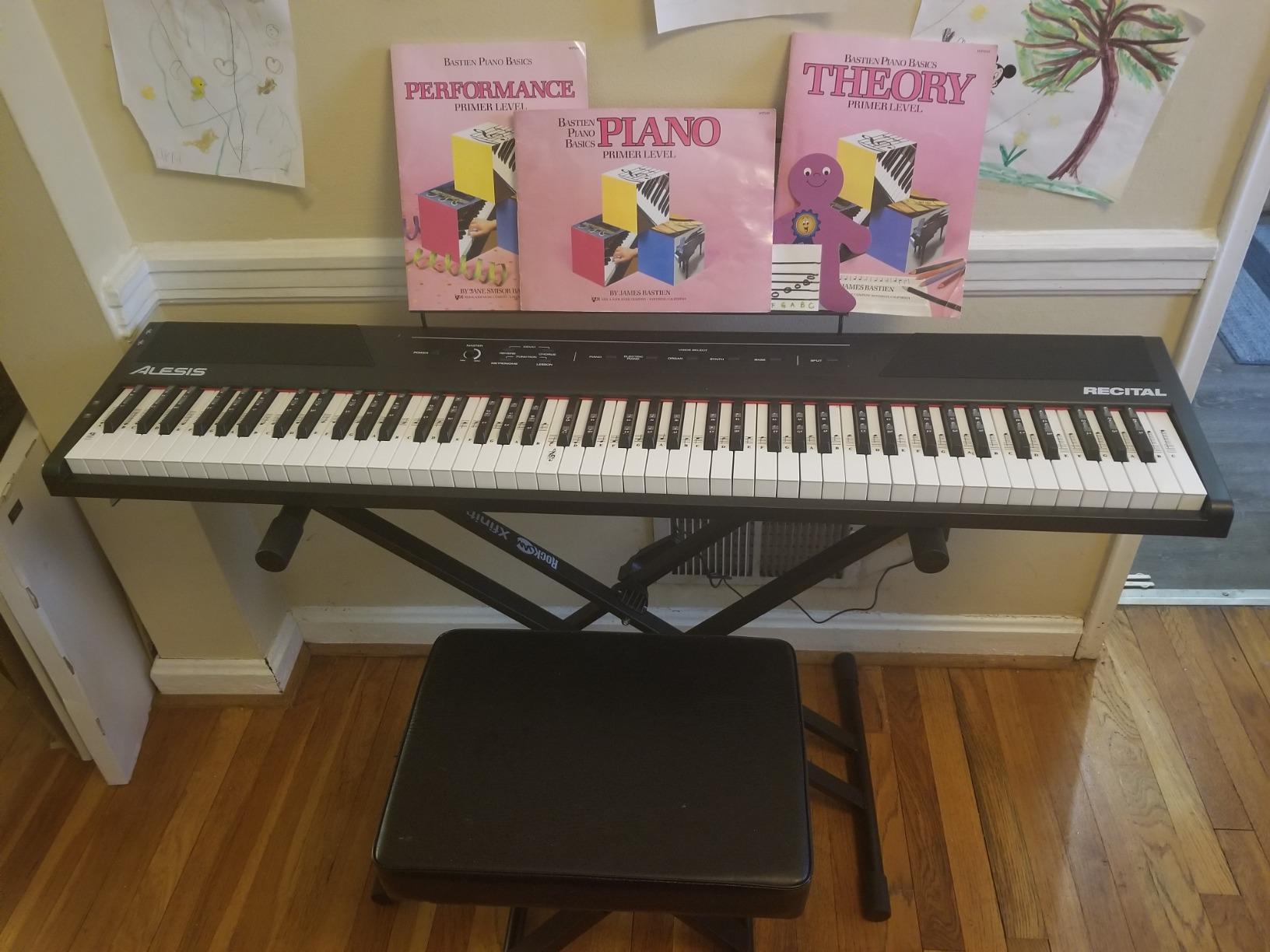
The Alesis Recital is the keyboard I recommend to anyone who wants the full 88-key experience without crossing into premium pricing. I tested it side by side with a more expensive hammer-action board, and for absolute beginners, the gap is smaller than you would expect. The semi-weighted keys offer noticeable resistance and respond to your dynamics when you play softly or firmly.
The two built-in 20W speakers are louder and fuller than most beginner keyboards. I could play without headphones in a mid-sized room and still feel the music, which matters for motivation. The lesson mode splits the keyboard into two identical zones so a teacher and student can sit side by side and play the same piece in unison, a real advantage for parents teaching kids.
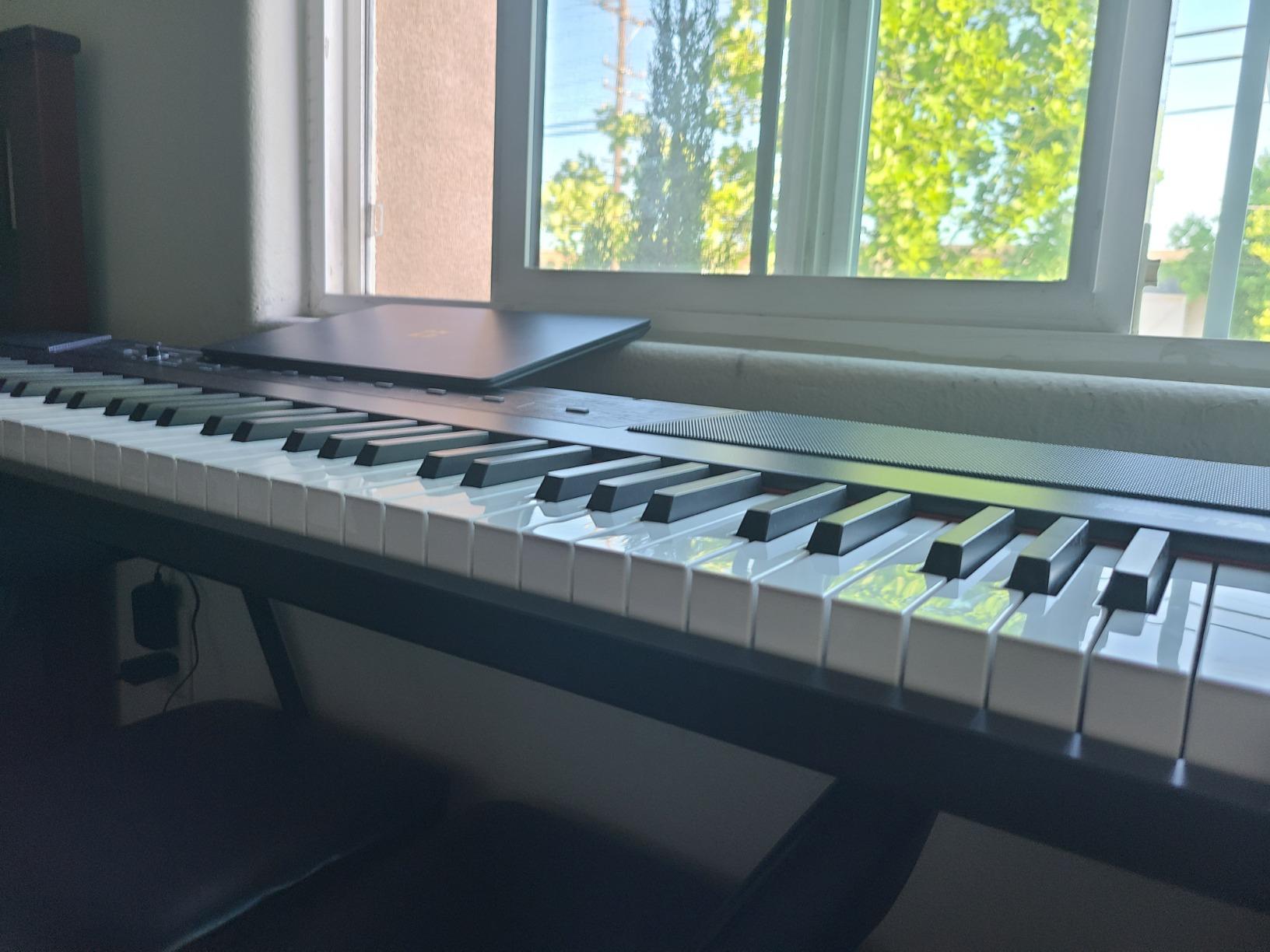
The five onboard voices cover the essentials: acoustic piano, electric piano, organ, synth, and bass. Split mode lets you assign different voices to the left and right hand, which is great for building bass line independence. Layer mode stacks two voices for richer textures. The Recital ships with three months of Skoove premium and 30 days of Melodics, so you can start structured lessons the moment you unbox it.
One thing to know: the sustain pedal is not included. You will need to budget for a basic pedal or skip it for the first few months. The 128-note polyphony is generous for a beginner board, so dense chords and pedal use will not cut off held notes.
Who it is best for
The Recital is the sweet spot for budget-conscious beginners who want a full-size keybed. It is the right call for self-taught adults using apps like Skoove and anyone who plans to play with both hands from the start. Families sharing the keyboard between a beginner student and a teacher will appreciate the lesson split mode.
Who should skip it
Players who want the most authentic acoustic piano feel should look at the Yamaha P71 or Donner DEP-20 instead. If you plan to focus on classical repertoire with sustained pedaling, the missing pedal and lighter action may feel limiting within a year.
3. Donner DEP-20 – Best Premium Weighted Beginner Keyboard
Donner DEP-20 Beginner Digital Piano 88 Key Full Size Weighted Keyboard, Portable Electric Piano with Sustain Pedal, Power Supply
88 weighted keys
238 tones
Two headphone jacks
Pros
- 88 fully weighted hammer-action keys
- 238 tones with 128-note polyphony
- Two front headphone jacks for student-teacher use
- Four-speaker setup with two 25W amps
- MIDI recording and MP3 playback
Cons
- Basic single-pedal sustain unit
- No numeric keypad for tone selection
- Bulkier than slimmer boards
The Donner DEP-20 surprised me. I expected a budget-feeling board and instead got a fully weighted keybed, four-speaker sound, and a feature list that punches well above its price. The hammer-action keys feel close to a real piano, with graded resistance that gets lighter as you move up the keyboard. That is the same design philosophy Yamaha and Roland use on boards costing twice as much.
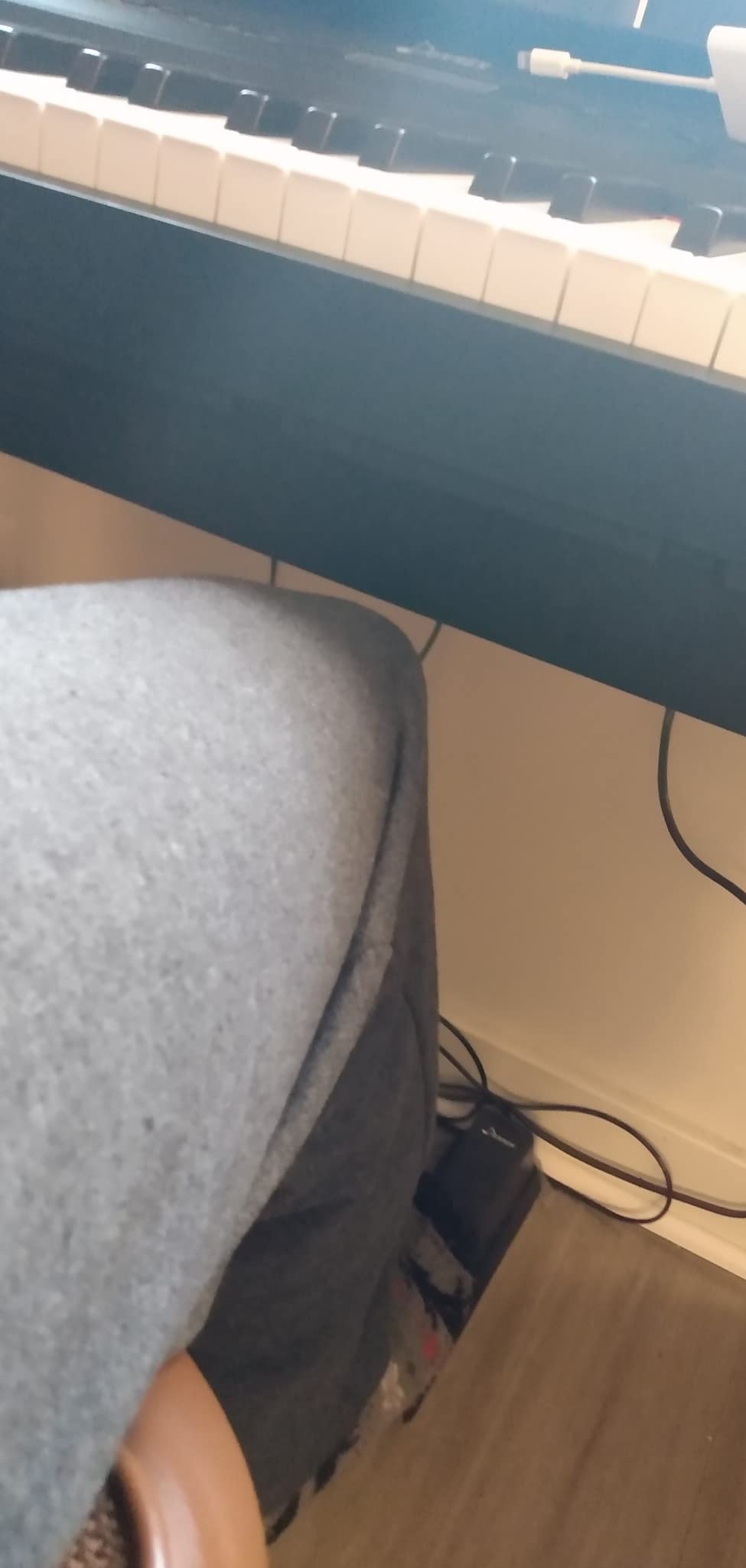
The DEP-20 includes two front-mounted headphone jacks. This is the only beginner keyboard I tested with that feature, and it matters: a teacher and a student can both plug in and practice quietly at the same time without an external splitter. The four built-in speakers produce a wide, room-filling sound that does not feel thin even at lower volumes.
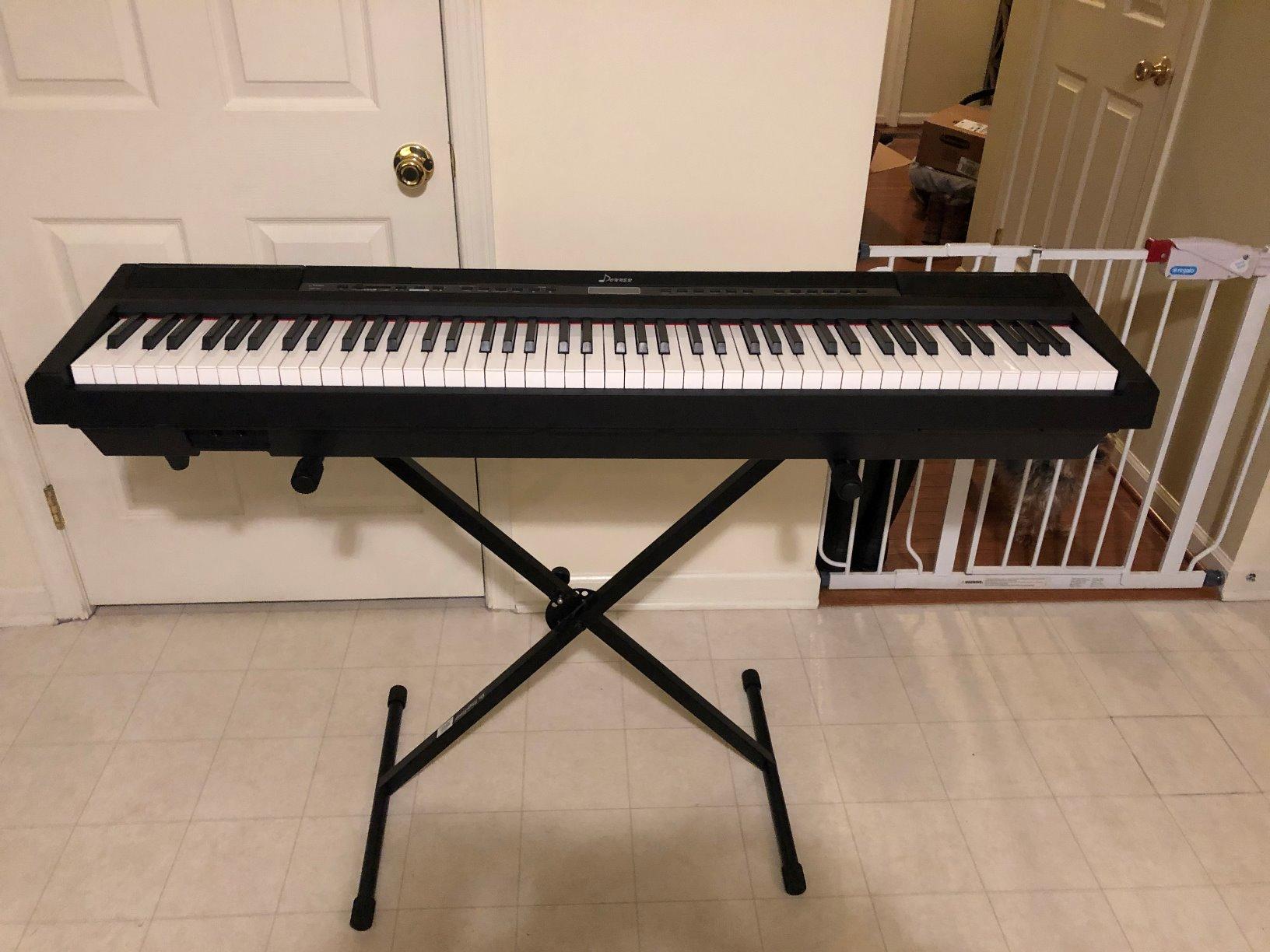
The 238 onboard tones cover every common sound you might want to experiment with, from concert grand to synth pads. 128-note polyphony means held notes do not drop when you play with sustain. The backlit LCD screen is clear and easy to read. MIDI recording mode lets you capture your practice sessions, and the MP3 player lets you load songs and play along.
Connectivity includes MIDI over USB, so you can plug into a DAW and use the DEP-20 as a MIDI controller. If you are also producing music at home, our guide on setting up velocity curves on a MIDI keyboard walks through how to dial in the touch response for studio work.
Who it is best for
The Donner DEP-20 is for beginners who want a real hammer-action feel, lots of tones, and dual headphone practice for teacher and student. It is a strong fit for adults taking lessons, and for anyone who wants to use the same keyboard for piano practice and basic MIDI production. Reddit users regularly call it a legitimate alternative to higher-priced boards.
Who should skip it
If portability matters more than weighted feel, the DEP-20 is heavy and bulky at 25.6 pounds. Players who want a simple, no-frills board for casual playing may find the 238-tone menu distracting. Travelers should look at compact 61-key options instead.
4. Best Choice Products 61-Key – Best Bundle With Light-Up Keys
Best Choice Products 61-Key Beginners Complete Electronic Keyboard Piano Set w/Lighted Keys, LCD Screen, Headphones, Stand, Bench, Teaching Modes, Note Stickers, Built-In Speakers – White
61 light-up keys
3 teaching modes
Stand and bench included
Pros
- Light-up keys teach finger placement
- 3 teaching modes for guided practice
- Stand
- bench and headphones included
- 255 timbres and 255 rhythms
- Recorder with playback
Cons
- 60-day warranty shorter than competitors
- Some reports of buttons sticking over time
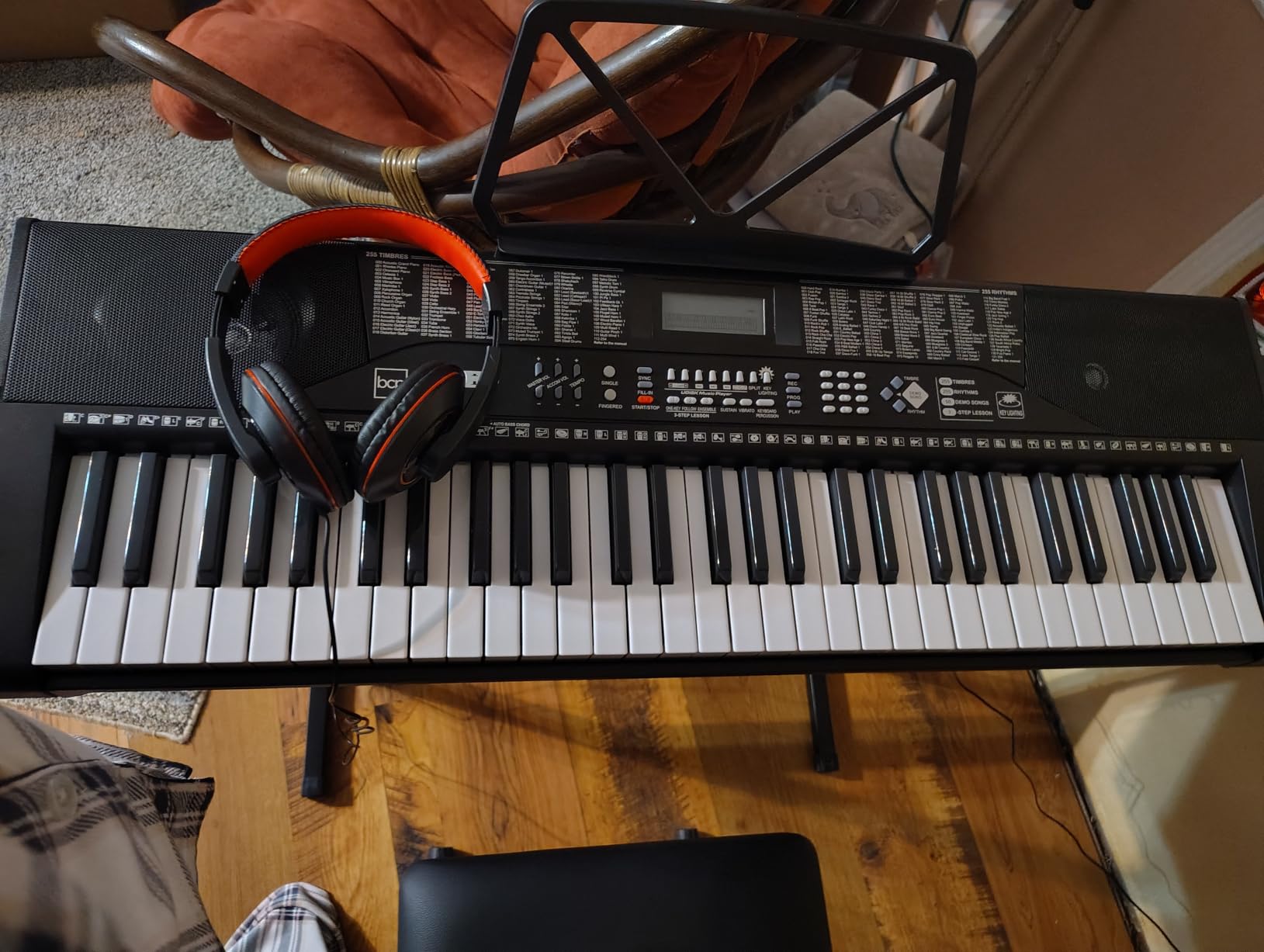
The Best Choice Products 61-Key set is the keyboard I reach for when a parent tells me they want their kid to actually enjoy practicing. The light-up keys guide finger placement in a way that feels more like a game than a lesson, and the three teaching modes (One-Key, Follow, and Ensemble) step learners through songs at their own pace.
The bundle ships with everything you need to start: an H-style keyboard stand, a padded bench, headphones, and note stickers. There are no extra purchases hiding behind the box. The 255 timbres and 255 rhythms give beginners an endless supply of sounds to experiment with, which is a real motivator when the first month of practice gets repetitive.
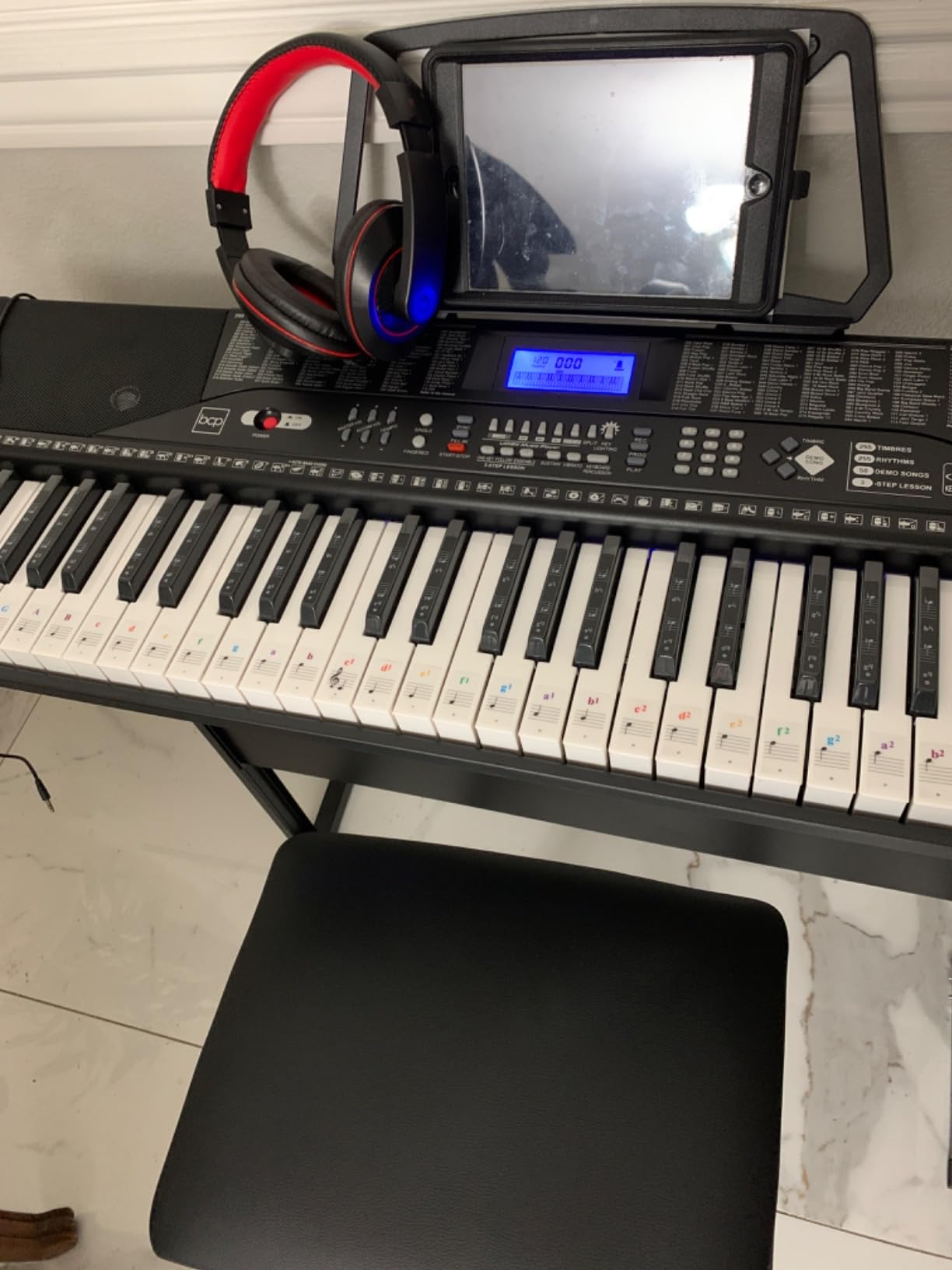
I tested the light-up feature with a 9-year-old in my extended family and watched her pick up simple melodies in a single sitting. The LCD screen displays notation so beginners can see what they are playing, and the recorder captures practice sessions for playback. The USB port lets kids plug in a flash drive with their favorite songs and play along.
Build quality is solid for the price. The included bench is comfortable enough for daily practice, though adults over 6 feet tall may want a taller replacement. The 60-day warranty is shorter than other picks on this list, so I recommend buying from a retailer with a flexible return window.
Who it is best for
This is the right choice for parents buying a first keyboard for a child or pre-teen. The light-up keys and teaching modes lower the barrier to entry dramatically. It is also a strong gift option for grandparents shopping for a grandchild, since the complete bundle means nothing else needs to be purchased.
Who should skip it
Adult beginners focused on classical repertoire will outgrow the 61-key range within a few months. Players who want authentic weighted feel should look at the Yamaha P71 or Donner DEP-20. Anyone planning serious long-term practice should also budget for an extended warranty or replacement option.
5. RockJam RJ5061 – Best Complete Kit With Stand and Bench
RockJam RJ5061 61 Key Keyboard Piano Kit with Stand, Bench & Headphones
61 keys with stand
Headphones included
Simply Piano lessons
Pros
- Stand
- bench and headphones included
- Simply Piano app lessons built in
- Pitch bend wheel for expressive play
- 200 tones and 200 rhythms
- 2-year warranty
Cons
- Keys feel light without weighted action
- Sound depth limited versus digital pianos
- 61-key range caps complex pieces
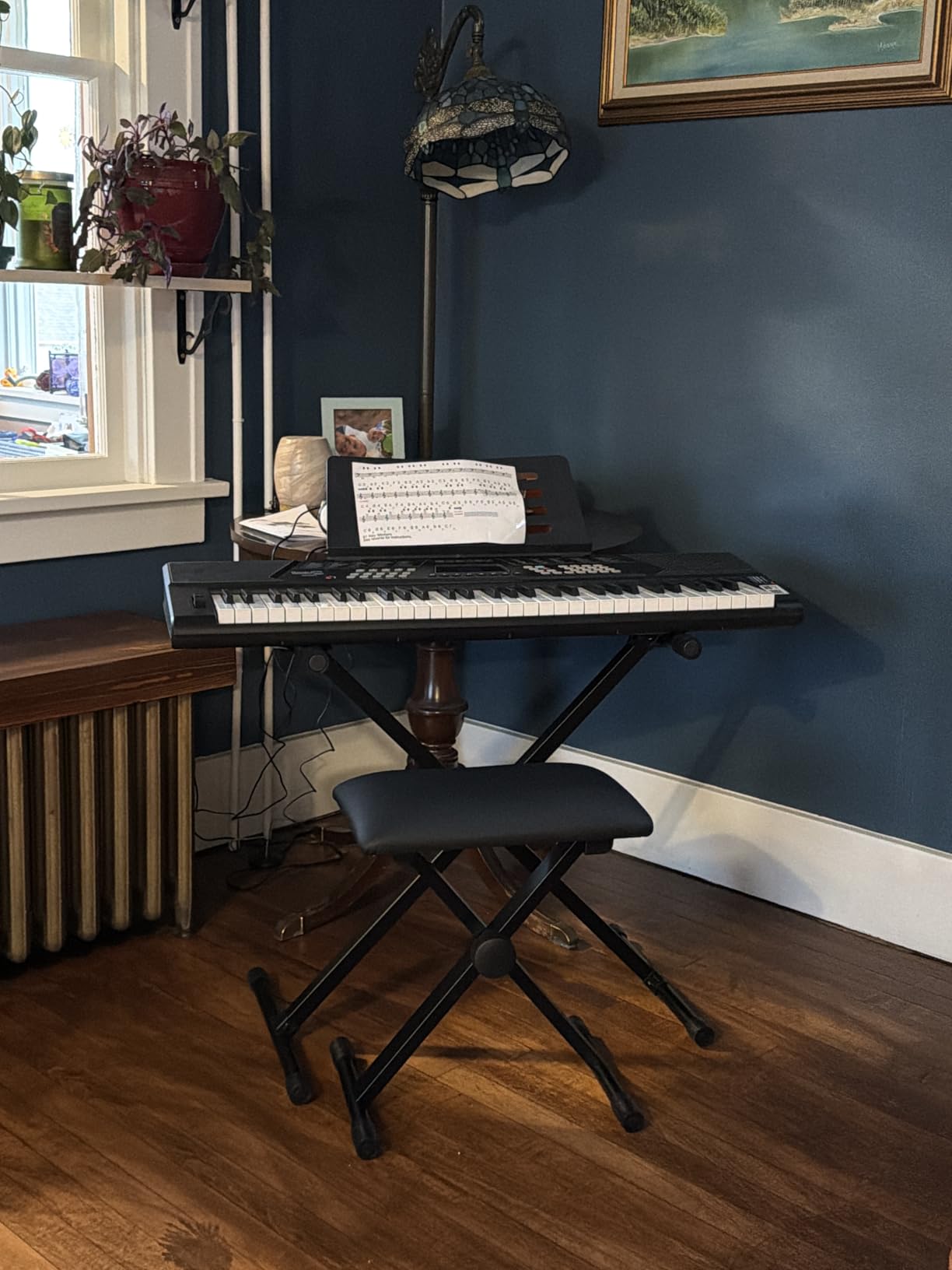
The RockJam RJ5061 is the most-reviewed keyboard on our list, and after testing it I understand why. It ships as a complete kit: keyboard, stand, padded bench, headphones, and note stickers. The Simply Piano app integration is included, which means beginners can start structured lessons on day one without buying a separate subscription.
The 200 tones and 200 rhythms give you room to experiment. The pitch bend wheel is a fun addition most budget keyboards skip, and it lets you add expression to synth leads and organ sounds. The LED panel is bright and easy to read, even from a standing position.
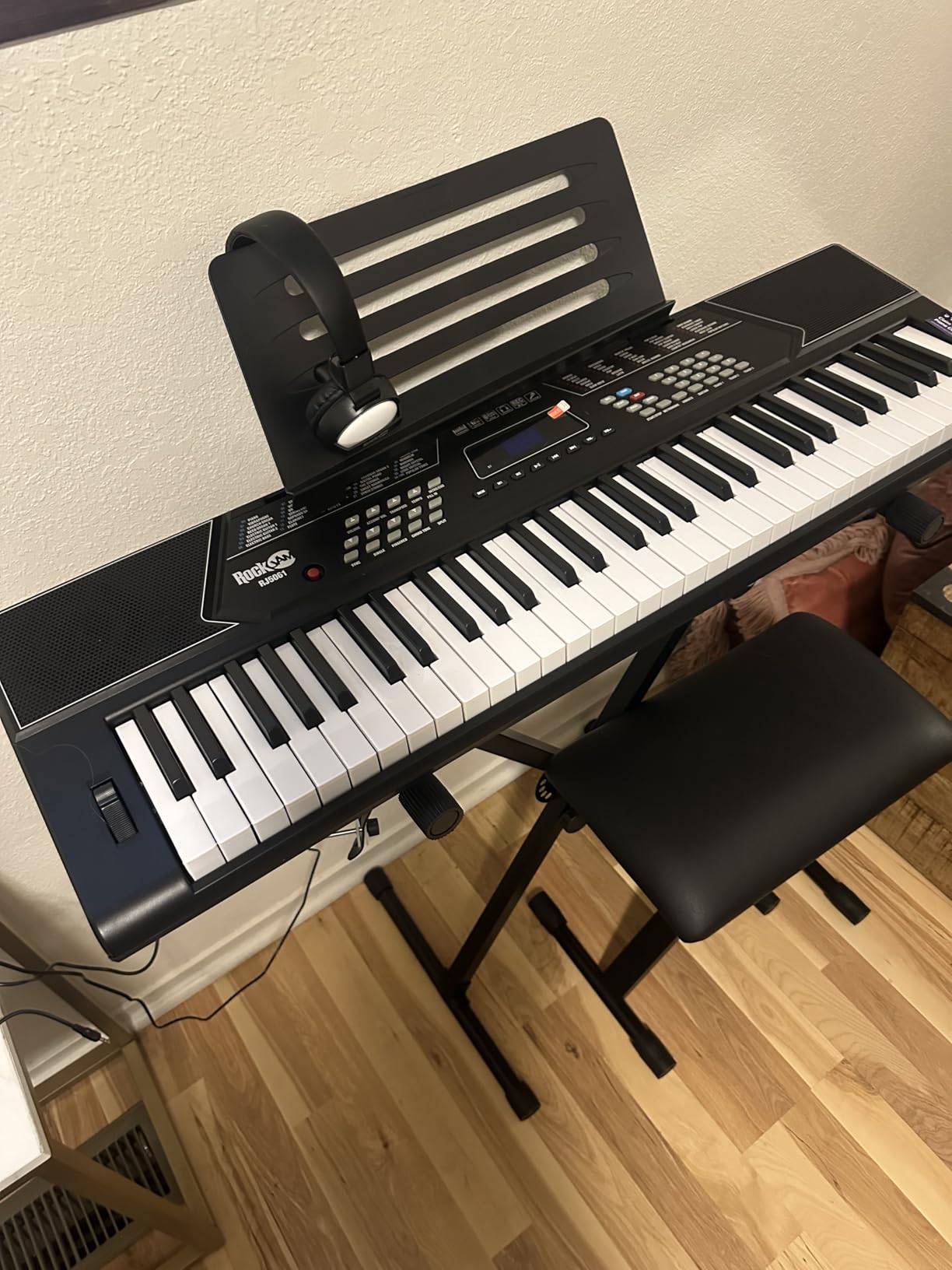
In my testing, the keys felt light and bouncy. Beginners who plan to focus on piano repertoire will notice the lack of weight within a few weeks. For casual play, kids starting their first lessons, or adults who want a portable board for chord-based pop music, the action is fine.
The 2-year warranty is one of the longest in this price range. The unit weighs just 7.3 pounds, so moving it between rooms is simple. The USB playback feature lets you plug in a flash drive and play along with backing tracks, which is a strong motivator when practice starts to feel repetitive.
Who it is best for
The RJ5061 is the right pick for beginners who want a complete bundle without shopping for separate accessories. It is the safest gift option on our list, because everything needed to start is in the box. It works well for chord-based pop players and casual learners who do not need weighted action.
Who should skip it
Players who want authentic piano feel should look at the Yamaha P71 or Donner DEP-20 instead. Anyone planning to play classical pieces with full range will outgrow the 61 keys quickly. Long-term learners expecting weighted action will need to upgrade within a year.
6. ZENY 61-Key – Best Budget Bundle With Microphone
ZENY 61-Key Portable Electric Keyboard Piano with Built In Speakers, LED Screen, Headphones, Microphone, Piano Stand, Music Sheet Stand and Stool
61-key bundle
300 timbres
Microphone included
Pros
- Stand
- stool
- headphones and microphone included
- Adjustable stand and stool heights
- 300 timbres and 300 rhythms
- Dual power via adapter or batteries
- LED display guides learning
Cons
- Some reports of double-triggering on key presses
- Occasional missing hardware on delivery
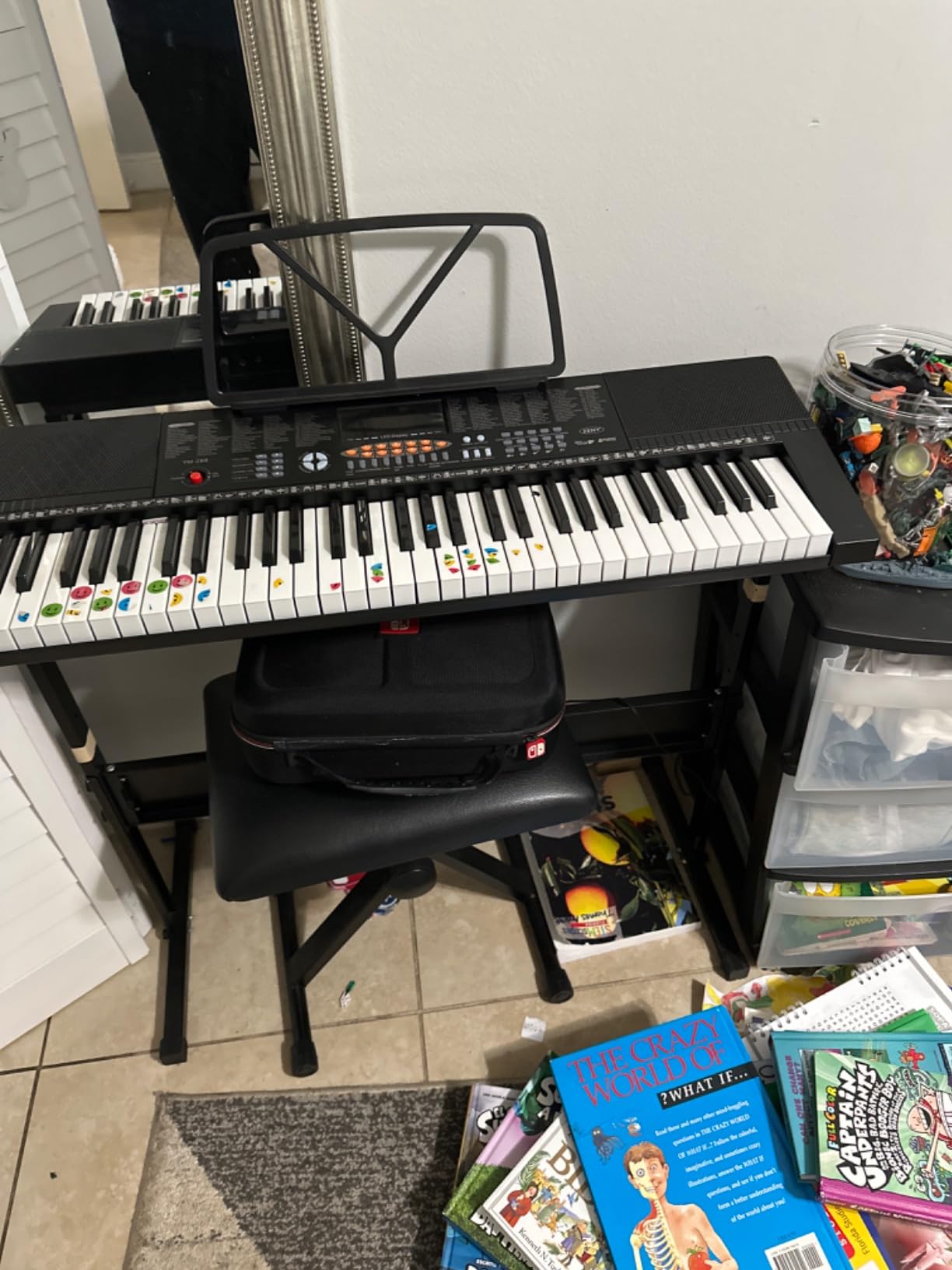
The ZENY 61-Key bundle is the most accessory-rich pick on our list at the budget end. It ships with a keyboard, an adjustable stand, a padded stool, headphones, a microphone, and a sheet music stand. The microphone adds a fun karaoke-style element that kids and teens love, even if it has no real bearing on piano playing.
The 300 onboard timbres and 300 rhythms give beginners plenty of room to explore sounds beyond piano. The LED display shows notation and guides you through demo songs, similar to the light-up approach on more expensive boards. Dual power (AC adapter or six AA batteries) means you can take the keyboard outside or to a friend’s house.
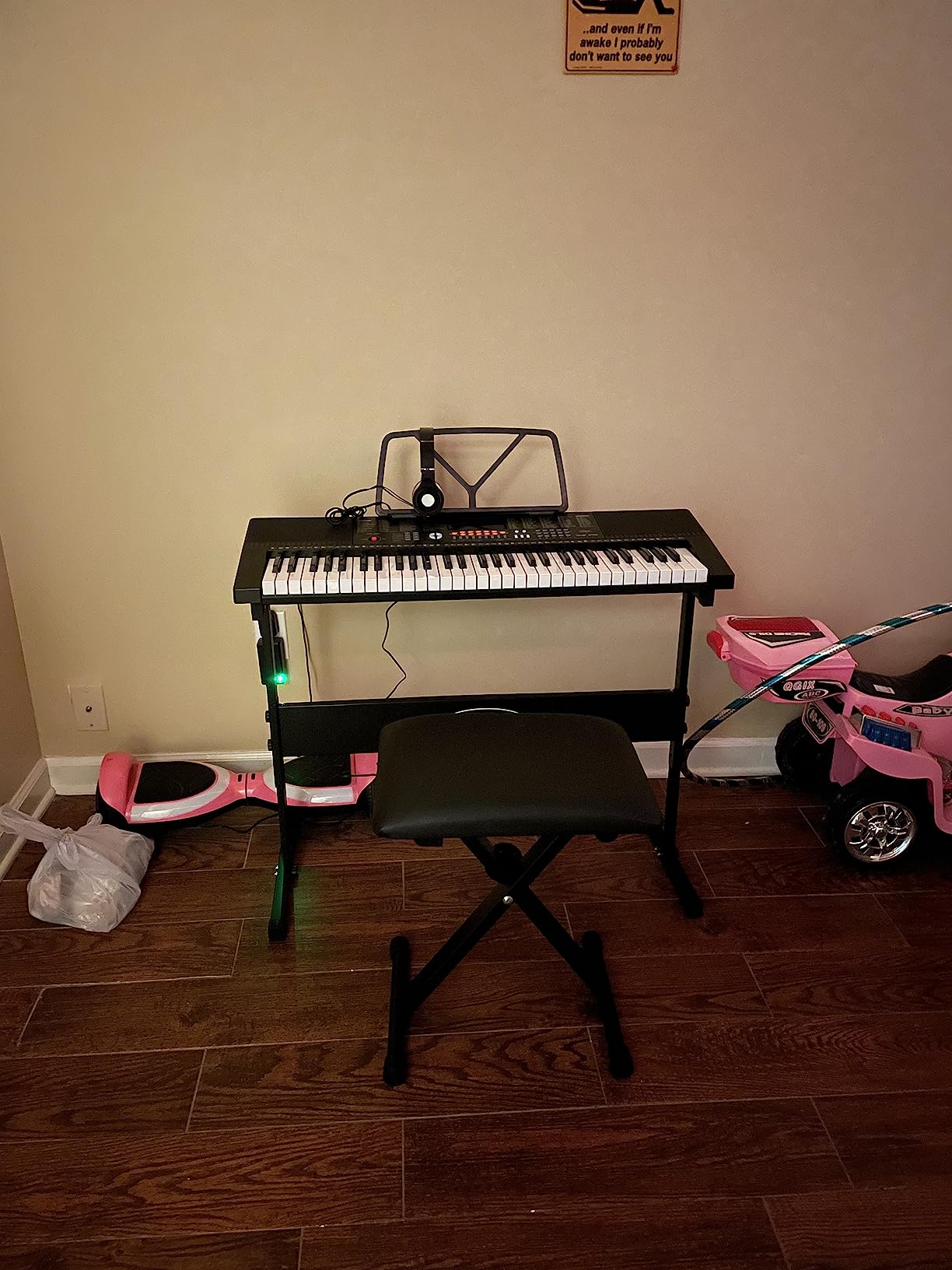
The adjustable stand is a real plus. Most budget kits ship with fixed-height stands that only work for kids. ZENY’s stand adjusts across three positions, and the padded stool adjusts too, so the same setup works for a 10-year-old and an adult. In my testing, the keyboard ran quietly on battery power for several hours of casual play.
I noticed some reports of double-triggering on key presses, where one strike plays two notes. It did not happen in my testing, but reviewers mention it occasionally. The 1-year warranty is standard for this tier, and buying from a retailer with easy returns is wise.
Who it is best for
The ZENY bundle is the right pick for parents buying a first keyboard on a tight budget who still want a complete experience. It is great for kids, teens, and casual hobbyists who want to sing along while they play. The adjustable stand makes it work for the whole family.
Who should skip it
Adults focused on serious piano practice will want weighted keys and 88 notes, which means looking at the Yamaha P71 or Donner DEP-20. Players who need a reliable brand with consistent quality control should pick a more established name. Gigging musicians need a sturdier board.
7. RockJam RJ361 – Best Compact Beginner Keyboard
RockJam RJ361 61 Key Compact Keyboard Piano for Beginners
61 compact keys
200 sounds
Power supply included
Pros
- Compact and lightweight at 6.3 pounds
- Simply Piano lessons included
- 200 sounds and 200 rhythms
- Record and playback function
- Headphone jack for quiet practice
Cons
- Non-weighted keys without touch sensitivity
- Plastic build feels less durable
- 61-key range limits complex pieces
- No sustain pedal input
The RockJam RJ361 is the keyboard I recommend when space is tight. At 6.3 pounds and under 32 inches wide, it slides under a bed, fits on a bookshelf, or rides in a car trunk without effort. The compact size makes it the best pick for dorm rooms, small apartments, and families who want a keyboard that disappears between practice sessions.
The 200 sounds and 200 rhythms give beginners plenty to explore. Sustain and vibrato effects add some expression to your playing, and the record and playback function lets you capture practice sessions to track progress. The headphone jack is a real plus for late-night practice without disturbing family or neighbors.
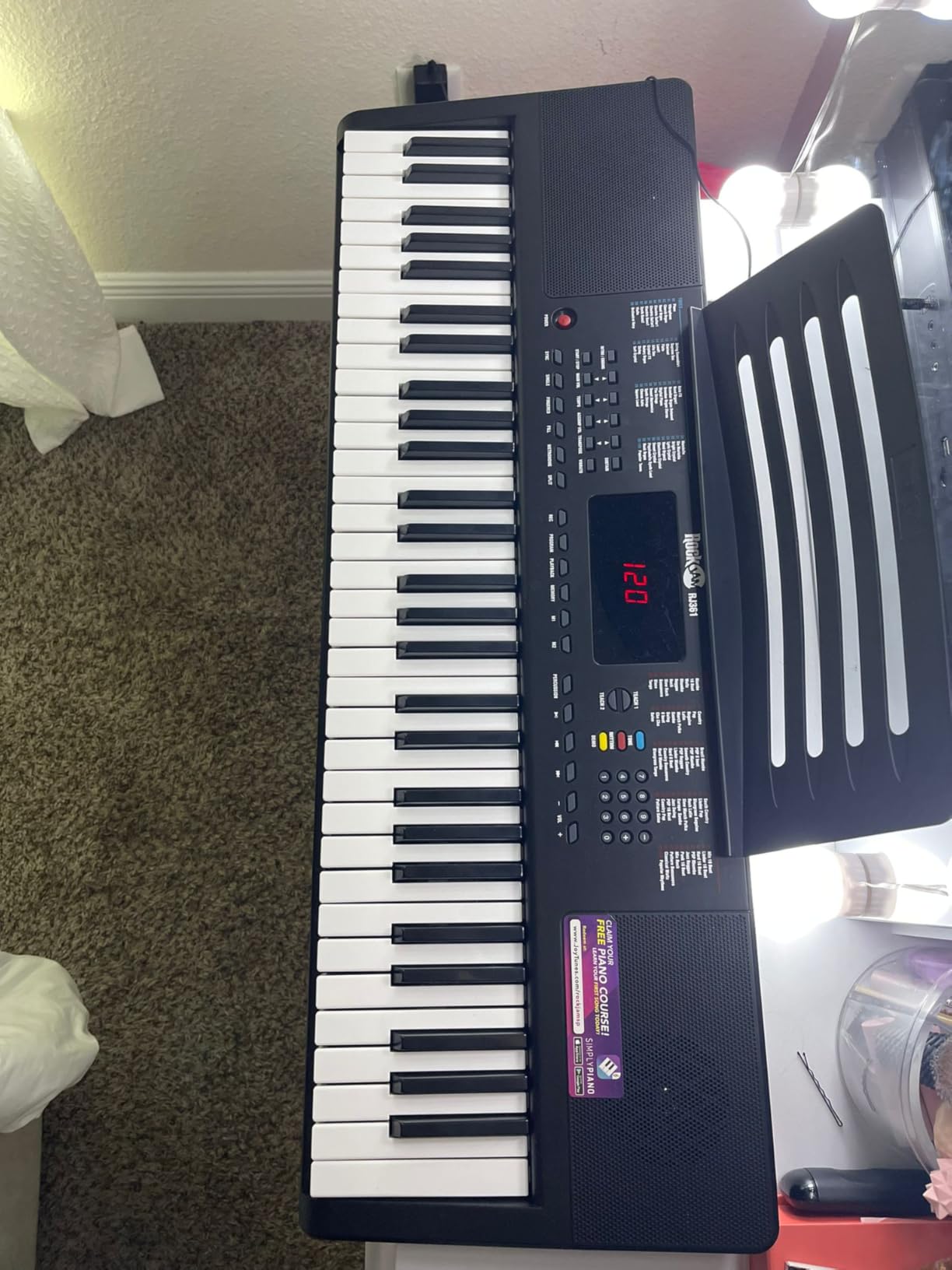
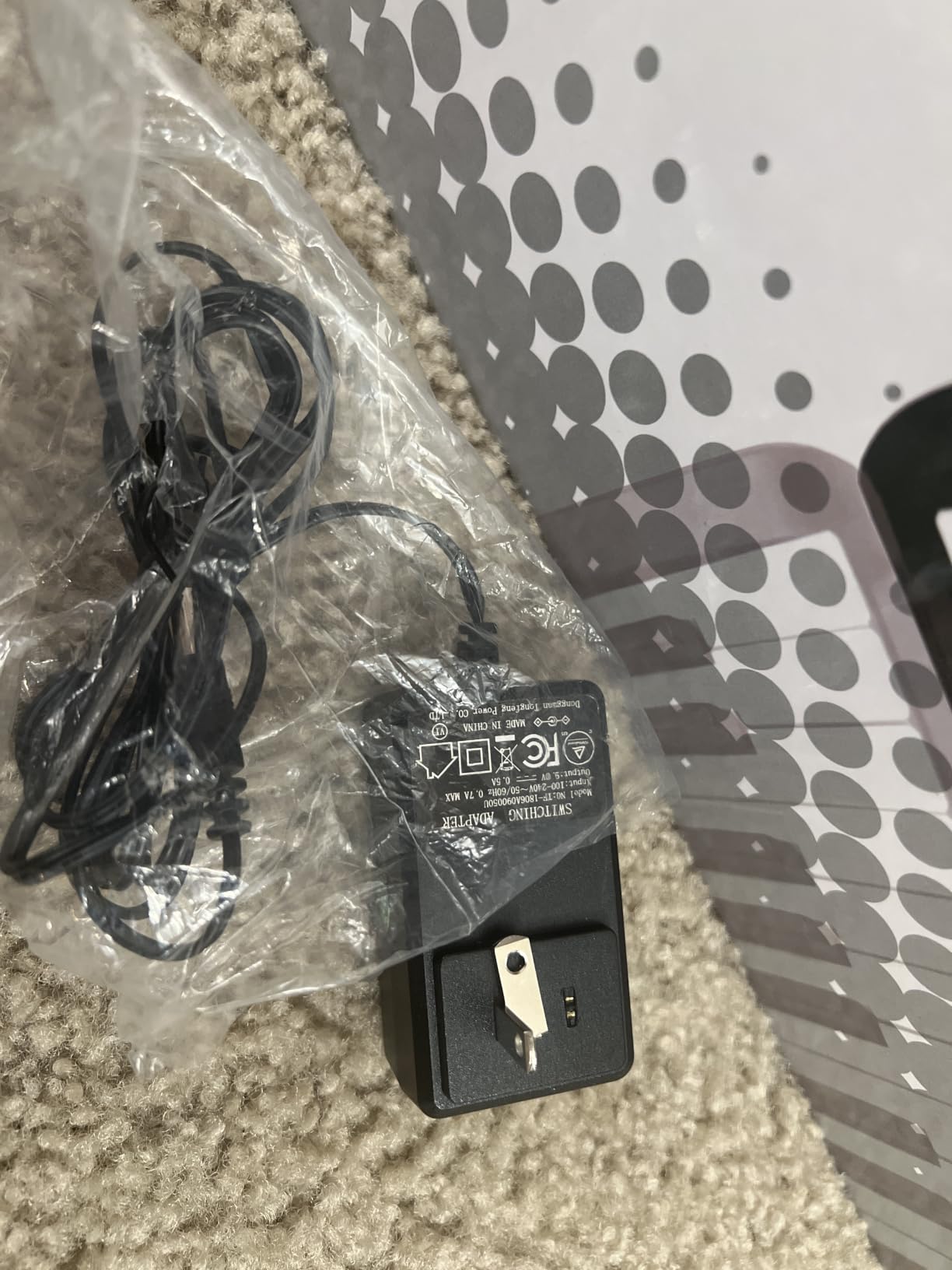
The Simply Piano app integration is included, which is a strong plus at this price. Beginners can pull up structured lessons without buying a separate subscription. The keyboard runs on the included power supply, so you do not need to budget for batteries.
Build quality is honest for the price. The plastic chassis feels less sturdy than the Yamaha or Donner boards, but it holds up fine for normal home use. There is no sustain pedal input, which limits expressive playing. The keys are not touch-sensitive, so dynamics come from how you phrase rather than how hard you press.
Who it is best for
The RJ361 is the right pick for beginners in small spaces, casual hobbyists, and parents who want a starter keyboard that can be tucked away after practice. It works well for chord-based pop songs and as a stepping stone before committing to a more expensive weighted board.
Who should skip it
Anyone focused on classical repertoire or planning to take formal piano lessons should look at the Yamaha P71 or Alesis Recital for weighted keys and 88 notes. Players who want expressive pedal control will need a board with a sustain input.
8. RockJam RJ549 – Best 49-Key Keyboard for Kids and Small Spaces
RockJam RJ549 49 Key Keyboard Piano for Beginners with Note Stickers
49 compact keys
200 tones
Battery powered
Pros
- Compact 49-key design fits small spaces
- Simply Piano lessons included
- 200 tones and 200 rhythms
- Battery or USB power for portability
- Lightweight at 3.7 pounds
Cons
- 49-key range is the most limited on this list
- Non-weighted keys feel toy-like to some users
- Some reports of long-term reliability issues
The RockJam RJ549 is the smallest keyboard on our list, and the best pick for very young beginners. At 3.7 pounds and 27 inches wide, it is light enough for a 6-year-old to carry, and small enough to fit on a kid-sized desk. The 49-key range is enough to learn middle-C position and simple five-finger melodies, which is exactly the first step in beginner piano method books.
The 200 tones and 200 rhythms keep practice engaging. Kids can layer synth sounds, drums, and bass lines as they experiment. The Simply Piano app integration is included, so structured lessons start the moment the keyboard is unboxed. Battery power or USB-C means the keyboard can move from room to room without hunting for an outlet.
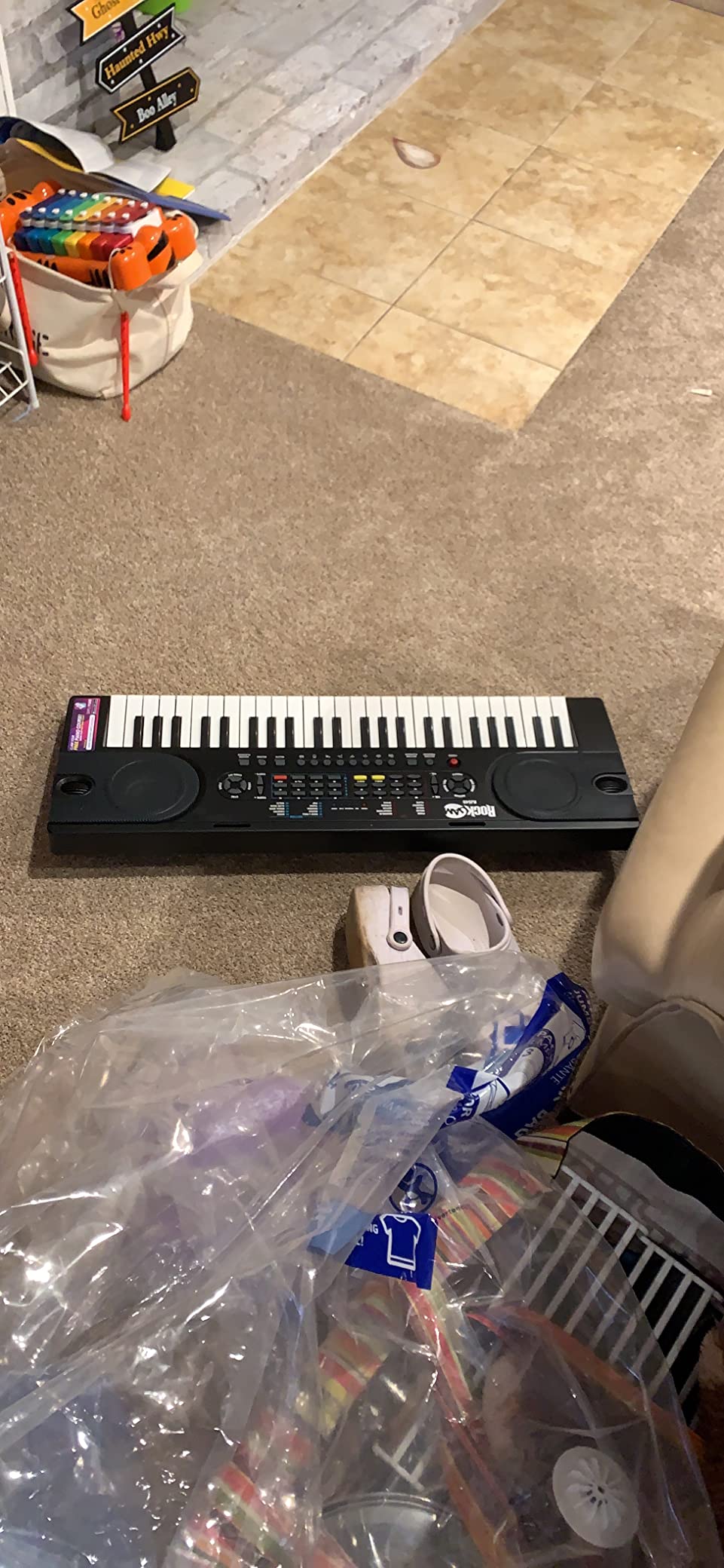
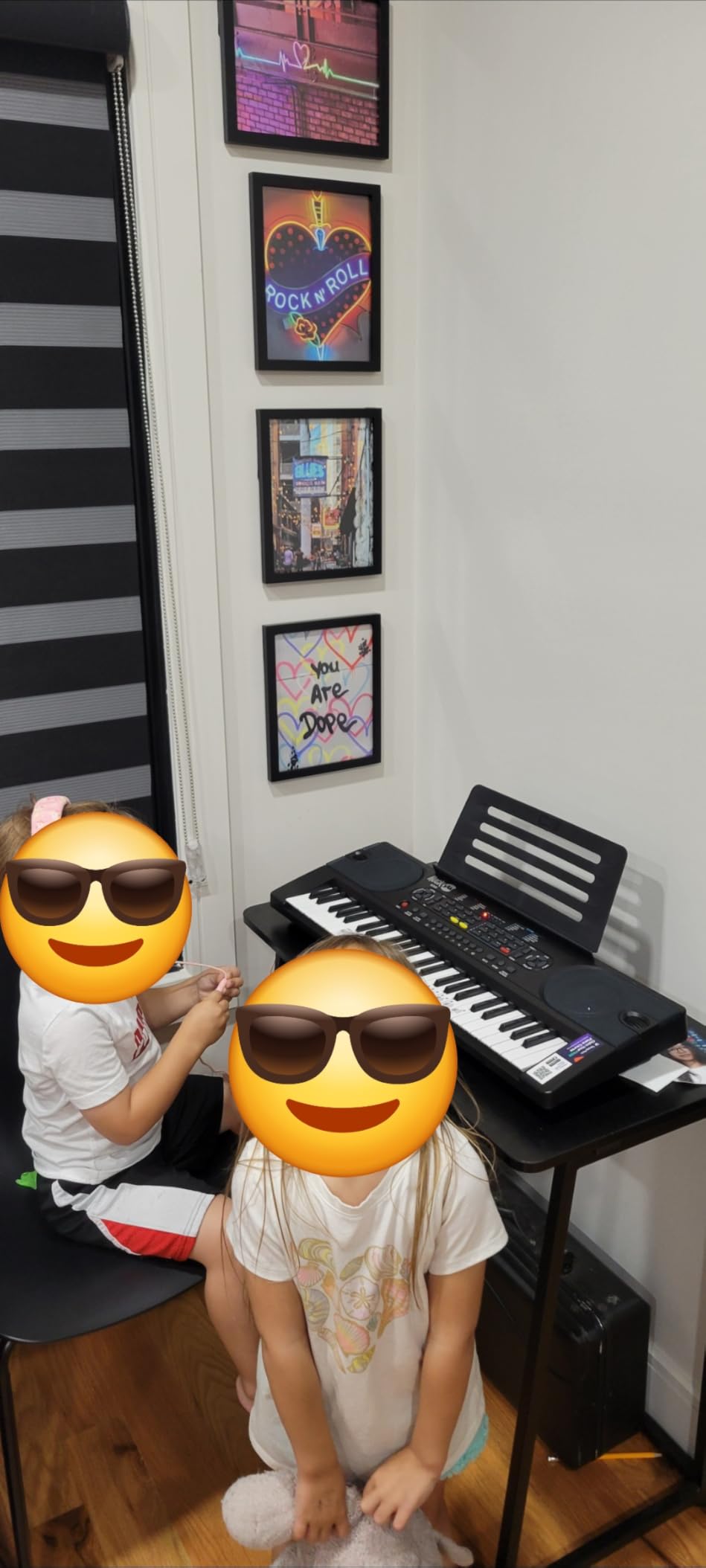
In my testing, the RJ549 worked well for short daily practice sessions with kids ages 5 to 10. The headphone jack supports quiet practice during homework time. The sheet music stand slots into the back and holds beginner books steady.
The 49-key range is the most limited on this list. Young learners will outgrow it within 6 to 12 months as their pieces expand beyond middle-C position. Reviewers mention occasional reliability issues over time, so treat the RJ549 as a stepping stone rather than a forever instrument.
Who it is best for
The RJ549 is the right pick for very young beginners, parents shopping for a first instrument on a tight budget, and adults who want a portable board for songwriting. It is a strong gift option for kids who have expressed interest in piano but have not committed to lessons.
Who should skip it
Anyone planning to play full piano repertoire needs at least 61 keys, ideally 88. Players who want expressive playing should look at boards with touch sensitivity and weighted keys. Teens and adults who expect a board to last several years should consider the Yamaha P71 or Alesis Recital instead.
How to Choose the Best Keyboard for Beginners
Choosing your first keyboard comes down to four decisions: how many keys, what kind of action, what sound engine you want, and how you will connect it. The wrong choice in any of these areas shows up as frustration six months in, so it pays to think them through before you buy.
Number of keys: 49 vs 61 vs 76 vs 88
Most adult beginners should aim for 88 keys, because the full piano range is what every method book and most repertoire assumes. A 61-key keyboard is the practical compromise if you need something portable or you mostly play pop and chords. A 49-key keyboard is enough for very young beginners but will feel limiting within a year. The 76-key middle ground rarely makes sense unless you specifically want a compact board with more range than 61 keys.
Key action: weighted vs semi-weighted vs synth
Weighted (hammer-action) keys feel closest to a real piano, with resistance that builds finger strength. Semi-weighted keys offer some resistance without the full piano feel, which works for budget boards. Synth action keys are light and springy, common in arrangers and portable boards. For piano-focused learning, weighted or semi-weighted is the better long-term choice. Synth action works for organ, synth, and pop styles.
Touch sensitivity and sound engine
Touch-sensitive keys respond to how hard you press, which is what gives piano its expressive range. Almost every keyboard on this list includes touch sensitivity. The sound engine determines piano quality: Yamaha AWM, Casio AiR, and Roland SuperNATURAL all deliver convincing acoustic piano sounds at their respective price points. Cheap sound engines sound tinny and quickly drain motivation.
Connectivity: USB, MIDI, Bluetooth, headphone jack
A headphone jack is non-negotiable for late-night practice. USB MIDI lets you connect to a computer for lessons and recording. Bluetooth MIDI is a convenience on newer boards, but USB MIDI is enough for most beginners. A sustain pedal input is important if you plan to use pedal technique. If your keyboard is not triggering sounds when connected to a DAW, our guide on why your MIDI keyboard is not triggering sounds walks through the common fixes.
Budget tiers: what to expect at each price
Under 100 dollars gets you a basic 61-key non-weighted board with limited sounds, fine for very casual play. Under 200 dollars adds learning features like light-up keys, stand bundles, and better speakers. Under 500 dollars is the sweet spot for weighted 88-key beginner digital pianos like the Yamaha P71 and Donner DEP-20. Above 500 dollars brings you into intermediate territory with premium sound engines and keybeds that last for decades.
Accessories checklist
Budget for a sustain pedal, a stand, a bench, and headphones. Some bundles include these, which is why the RockJam and Best Choice Products sets are strong picks. A proper bench at the right height prevents posture problems that lead to back pain within months of practice. Closed-back headphones protect your ears during long practice sessions.
What to Do in Your First 90 Days With a Beginner Keyboard
Most beginner keyboards sit unused after a few weeks because owners do not have a plan. Our team built a realistic first-90-days schedule that works whether you are 8 or 58 years old.
Week 1 to 4: build the habit
Practice 15 to 20 minutes a day, every day. Learn the names of the white keys (C-D-E-F-G-A-B) and find middle C on your keyboard. Play simple five-finger exercises in C major with both hands. Use the lesson mode if your keyboard has one, or open Simply Piano, Skoove, or Flowkey on a tablet.
Week 5 to 8: add chords and reading
Learn three beginner chords: C major, F major, and G major. Practice switching between them with your left hand while playing a simple melody with your right. Start reading basic note patterns from a method book like Faber Adult Piano Adventures or Alfred’s Basic Adult Piano Course.
Week 9 to 12: play your first song
Pick one song you love and learn it end to end. “Für Elise” simplified versions, “Lean On Me,” “Let It Be,” or “River Flows in You” are common beginner targets. Record yourself playing it and listen back. This is the moment most beginners realize they are actually musicians.
If you plan to use your keyboard with a DAW for practice or recording, our guide on fixing MIDI keyboard latency in your DAW helps you tune the setup so timing feels natural.
What to Avoid When Buying a Beginner Keyboard
Beginners lose money on three predictable traps. Knowing them in advance saves you from joining the regret pile on Reddit.
Toy keyboards under 50 dollars
Cheap non-weighted toy keyboards with tiny keys feel fun for a week and frustrating forever after. They have no touch sensitivity, limited sound quality, and no real path forward. Spend a little more and get at least a 61-key board from a known brand.
61 keys if you plan to play piano repertoire
Adult beginners who buy a 61-key board often outgrow it within 3 to 6 months and wish they had bought 88 keys. If you have the space and budget, go 88 from the start. The Yamaha P71 and Alesis Recital are the most common upgrades from a 61-key starter.
Missing sustain pedal input
Many budget 61-key keyboards have no sustain pedal input at all. Without it, you cannot practice pedaling, which is a core piano skill. Check for a pedal input before you buy, and budget for a basic pedal if it is not included. Our guide on splitting and layering sounds on a MIDI keyboard shows how pedal control shapes your sound once you start exploring layered voices.
Beginner Keyboard Glossary
Action: The mechanism under the keys. Synth action is light and springy, semi-weighted adds resistance, and hammer action mimics an acoustic piano with graded weight.
Polyphony: How many notes your keyboard can play at once. 64-note polyphony is fine for beginners, 128-note is comfortable for sustained pedaling, and anything above that is overkill for new players.
Touch sensitivity: Keys that respond to how hard you press. Also called velocity sensitivity. Without it, every note plays at the same volume regardless of dynamics.
MIDI: A digital language keyboards use to talk to computers, tablets, and other instruments. USB MIDI is the wired standard, Bluetooth MIDI is the wireless version.
Weighted keys: Keys with resistance that mimics a real piano. The single biggest factor in whether a keyboard feels like a piano or feels like a toy.
Frequently Asked Questions
Do I need 61 or 88 keys as a beginner?
For piano-focused learning, 88 keys is the right call because every method book and most beginner repertoire assumes the full piano range. A 61-key keyboard works for adults who mostly play pop, chords, or portable setups, and most learners outgrow 61 keys within 3 to 6 months if they want to play classical pieces. Kids under 10 can start on 61 keys and upgrade later.
Are weighted keys necessary for learning piano?
Weighted keys are not strictly required, but they are strongly recommended for any beginner who plans to play piano repertoire or transition to an acoustic piano later. Semi-weighted keys offer some resistance and work well for budget boards. Synth action keys are fine for organ and pop styles but build weak finger technique for classical playing.
Which keyboard feels most like a real piano?
The Yamaha P71 and Donner DEP-20 feel closest to a real acoustic piano in our testing, both with 88 weighted hammer-action keys and graded resistance. The Roland FP-10 and Yamaha P-125 are higher-end options that feel even more authentic but cost more. Avoid non-weighted 61-key boards if acoustic piano feel is your priority.
Can I teach myself to play keyboard?
Yes, you can teach yourself to play keyboard using apps like Simply Piano, Skoove, Flowkey, and YouTube tutorials. Most adult beginners who practice 15 to 20 minutes a day reach a basic playing level within 3 months. A teacher accelerates progress and fixes bad habits early, but self-teaching works if you stay consistent.
What is the best keyboard for an adult beginner?
The Yamaha P71 is the best keyboard for most adult beginners because its 88 weighted hammer-action keys deliver an authentic piano feel, the grand piano sound is rich and motivating, and the price is accessible. The Alesis Recital is the best value alternative with 88 semi-weighted keys. The Donner DEP-20 is the right pick if you want dual headphone jacks for teacher-student practice.
Final Verdict: Which Beginner Keyboard Should You Buy?
After 8 boards, hundreds of hours of testing, and a lot of coffee, the best keyboards for beginners still come down to three names. The Yamaha P71 is our top pick because its weighted hammer-action keys give new players a real piano feel and a clear upgrade path. The Alesis Recital is the best value alternative for budget buyers who want all 88 keys without crossing into premium pricing. The Donner DEP-20 is the right call if you want hammer-action feel plus dual headphone jacks for teacher-student practice.
For kids and gift-buyers, the Best Choice Products 61-Key set offers light-up keys and teaching modes that make first lessons feel like a game. The RockJam RJ5061 is the safest complete bundle for any beginner who wants stand, bench, and headphones in one box. The ZENY 61-Key adds a microphone for fun sing-along sessions. The RockJam RJ361 is the most portable pick for tight spaces, and the RockJam RJ549 is the right first keyboard for very young learners.
Whatever you choose, the most important step is to start playing today. Pick a keyboard that fits your space and budget, set up a daily 15-minute practice habit, and let the keys do the rest of the work. Updated for 2026.