
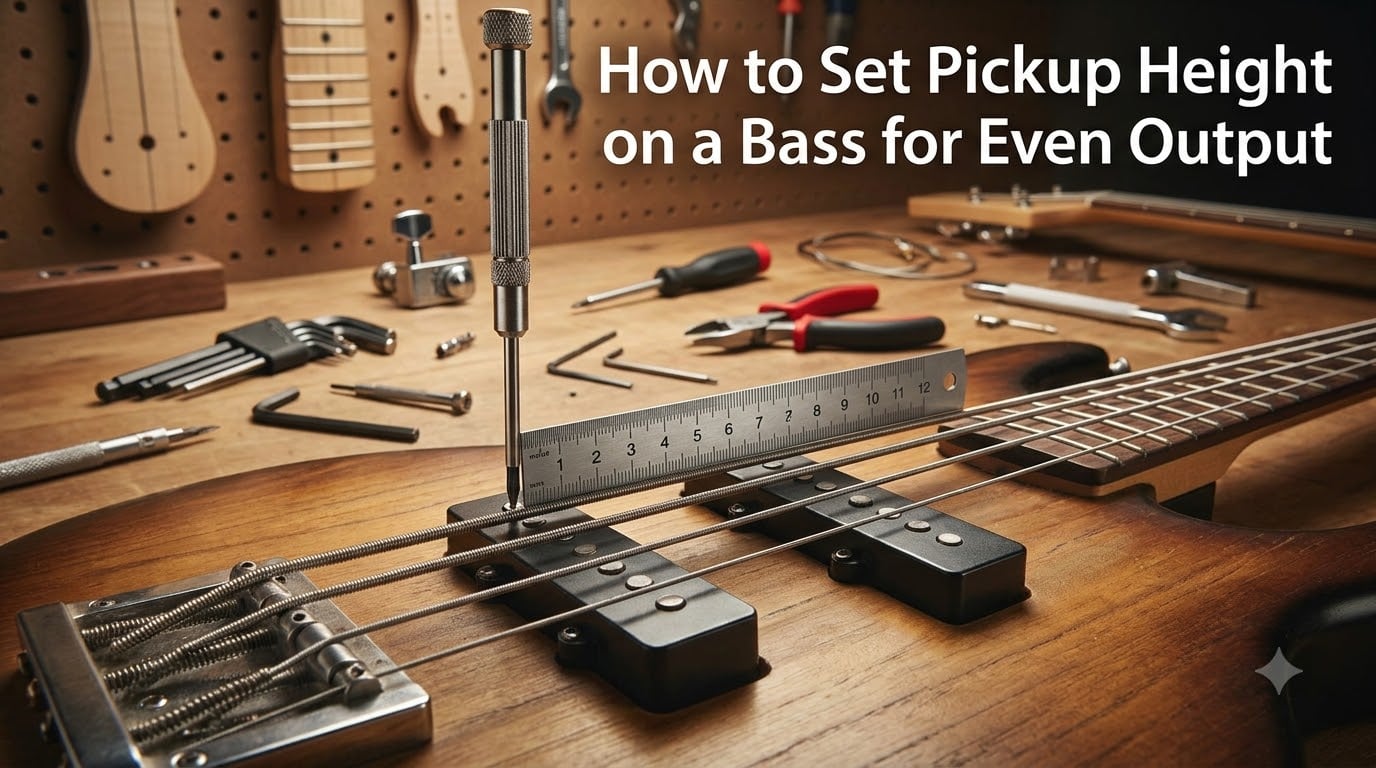
Setting pickup height on a bass for even output is one of the most underrated tweaks a bassist can make. I’ve spent years tweaking basses in studios and on stages, and the difference between a balanced instrument and a string-to-string mess almost always comes down to pickup height.
If your E string overpowers your G string, or your bridge pickup sounds thin while your neck pickup sounds honky, the fix usually lives in the pickup height adjustment screws. In this guide, I’ll walk you through the exact process I use on every bass that comes across my workbench.
Table of Contents
What Is Pickup Height and Why It Matters for Bass Output
Pickup height is the distance between your bass strings and the magnets (pole pieces) inside your pickups. It controls how strongly the magnetic field interacts with your vibrating strings.
When pickups sit closer to the strings, they capture more energy. The output signal gets stronger, the midrange becomes more pronounced, and the tone feels compressed and focused. When pickups sit farther away, the signal weakens, the highs open up, and the tone feels clearer but quieter.
This relationship matters most for bass players because bass strings vibrate with much larger amplitudes than guitar strings. A small height change creates a much bigger sonic shift on a bass than on a six-string guitar.
How Pickup Height Affects Your Bass Tone
Moving your pickups closer to the strings makes your bass sound louder and punchier. The midrange frequencies get boosted, and the bass feels more compressed. Moving them farther away opens up the highs and softens the attack.
But there’s a catch. Push the pickups too close and the magnets physically tug at your strings. This causes sustain issues and triggers what players call “wolf tones” – dead notes that refuse to ring out cleanly.
Most experienced bass techs start with the factory spec measurement, then fine-tune by ear. The factory spec is a starting point, not gospel.
Signs Your Bass Pickups Are Too High
Pickups set too close to the strings cause specific, recognizable problems. Watch for these warning signs.
Wolf tones: certain notes choke out or sound dead, especially on the lower frets
String clacking: you hear the strings physically hitting the pickup when you slap or pick aggressively
Visible magnetic pull: strings wobble or stick when you tune, or you can see the strings vibrating toward the pickup
Muddy midrange: the tone gets boomy and indistinct, losing definition between notes
Inconsistent tuning: the magnetic pull actually pulls strings out of tune as you play
If your bass exhibits any of these symptoms, lower your pickups a quarter-turn at a time and retest.
Signs Your Bass Pickups Are Too Low
Pickups set too far from the strings create a different set of problems. The output drops, and the tone loses character.
Weak output signal: you need to crank your amp volume much higher than other basses
Thin, brittle tone: the bass sounds anemic, with no body or warmth
Excessive hum and noise: with low-output pickups, the signal-to-noise ratio suffers
Poor sustain: notes die quickly because the pickups can’t capture the full string vibration
Raising the pickups slightly usually solves all four of these issues in a single adjustment.
Tools You Need to Set Pickup Height on a Bass
The good news: you don’t need a tech bench full of gear. Here’s the basic toolkit I keep on my workbench.
A 6-inch ruler or feeler gauge: for measuring the gap between pickup and string, measured at the highest fret
A Phillips or flathead screwdriver: matches the screws on your specific pickup (most are Phillips #2)
An amp or audio interface: you need to hear the results in real time
A tuner: critical for accurate A/B comparisons
Total cost is under $20 if you’re starting from scratch. A feeler gauge gives you more precision than a ruler for this job.
How to Set Pickup Height on a Bass for Even Output: Step-by-Step
Follow these steps in order for the best results. I use this exact process on every bass I set up.
Step 1: Tune your bass to standard pitch. Always start with a perfectly tuned instrument. Pickup height doesn’t change tuning, but you’ll want a consistent reference point throughout the adjustment.
Step 2: Lower both pickups completely. Loosen the adjustment screws until the pickups sit flush against the pickguard or mounting ring. This gives you a known starting point.
Step 3: Set the neck pickup first. The neck pickup is more forgiving of being set close to the strings because the string vibration amplitude is smaller at the neck position. Raise it until you can just barely fit a business card between the pickup and the low E string at the highest fret (24th fret for most basses).
Step 4: Set the bridge pickup slightly lower. The bridge pickup sits where the string vibrates with the most amplitude. Lower it so there’s roughly 5/64 inch clearance between the pickup and the low E string at the highest fret. This prevents string-to-pickup contact when you dig in.
Step 5: Plug in and test each string individually. Play each string at the same dynamic level. Listen for the loudest and quietest strings. This is your unevenness map.
Step 6: Adjust individual pole pieces if available. Many bass pickups have adjustable pole pieces. Lower the pole pieces under the loudest strings and raise them under the quietest strings to even out the output.
Step 7: Make small changes and retest. Quarter-turn adjustments only. Re-tune, retest, repeat until the output feels balanced across all strings.
Bass Pickup Height Starting Points (P-Bass vs J-Bass vs 5-String)
Different bass designs benefit from slightly different pickup heights. Here are the measurements I use as starting points before ear adjustment.
Precision Bass (P-Bass, split coil):
Low E string at highest fret: 7/64 inch to 9/64 inch
High E string at highest fret: 5/64 inch to 7/64 inch
Set bass side of split coil slightly lower than treble side to even output
Jazz Bass (J-Bass, dual single coil):
Low E string at highest fret: 6/64 inch to 8/64 inch
High E string at highest fret: 5/64 inch to 6/64 inch
Bridge pickup slightly lower than neck pickup
5-String Bass (low B string consideration):
Low B string at highest fret: 9/64 inch to 11/64 inch (extra clearance needed for the thicker string vibration)
High G string at highest fret: 5/64 inch to 6/64 inch
The low B often needs more height adjustment room than a 4-string E string
These are starting points only. Your specific bass, strings, and playing style will all influence the final sweet spot.
Balancing Individual Strings for Even Output
The most common complaint I hear is “my E and A strings are louder than my D and G strings.” This is usually a pickup height and pole piece issue, not a string problem.
On most bass pickups, the low E and A positions sit directly over the strongest part of the magnetic field. The D and G positions sit on the edge of the field, so they receive less signal.
To fix this, lower the pickup on the bass side slightly, or raise the treble side. If your pickup has individual pole pieces, raise the D and G pole pieces slightly until they match the E and A output.
On a P-Bass split coil, each coil covers two strings. You can adjust the height of the entire bass coil versus the treble coil to balance the two halves.
Active vs Passive Bass Pickup Height Considerations
Active bass pickups (EMG, Bartolini, Aguilar, Darkglass) use a built-in preamp powered by a 9V battery. They behave differently from passive pickups when it comes to height.
Active pickups produce a much hotter output signal. They don’t need to sit as close to the strings to deliver strong volume. Setting them at passive-style heights usually results in a muddy, over-compressed tone.
Start with active pickups roughly 1/8 inch to 3/16 inch away from the strings at the highest fret. The preamp handles the gain staging, so the pickup height mostly affects tone, not volume.
Also remember to unplug your bass when you’re not playing it. An active bass with a plug in the jack will drain the 9V battery in days, even with the volume turned down.
How Pickup Height Interacts With String Gauge and Action
String gauge and pickup height are linked variables. If you change one, the other needs adjustment.
Heavier strings (gauges like .105 to .130) vibrate with larger amplitudes. They need more clearance from the pickup. Lighter strings vibrate with smaller amplitudes and can sit closer.
If you recently switched string gauges and noticed tone or output changes, check your pickup height before assuming the strings themselves are the issue.
Action height also affects this equation. Higher action means strings sit farther from the fretboard, which means they sit closer to the pickups at the highest fret. When you adjust action, always recheck pickup height.
Common Mistakes to Avoid When Adjusting Bass Pickup Height
I’ve watched beginners make these mistakes over and over. Avoid them and you’ll save yourself hours of frustration.
Setting pickups too high from the start. The magnet pull sounds cool in theory but kills your tone and tuning in practice. Start low and raise gradually.
Ignoring the neck vs bridge relationship. The neck pickup should generally sit slightly higher than the bridge pickup. Equal height usually gives you a bridge-heavy bass.
Skipping the individual string balance. Even pickup-to-string distance doesn’t mean even output. You need to check each string individually.
Adjusting without listening. Measurements matter, but your ears are the final judge. Plug in and play actual music during adjustment.
Forgetting to re-tune after each adjustment. Magnetic pull can detune your strings slightly. Always re-tune before judging the result.
FAQs
How far should bass pickups be from the strings?
Most bass pickups should sit between 5/64 inch and 9/64 inch from the low E string at the highest fret. Start with the neck pickup slightly higher than the bridge pickup. These are starting points only – adjust by ear for your specific bass, strings, and playing style.
Does pickup height affect bass output?
Yes, pickup height has a major effect on bass output. Closer pickups produce a stronger signal with more midrange and compressed tone. Farther pickups produce a weaker signal with brighter highs and clearer tone. Bass strings vibrate with larger amplitudes than guitar strings, so small height changes create bigger sonic shifts.
How do I know if my bass pickup height is too high?
Your bass pickups are too high if you hear wolf tones, notice string clacking when you play aggressively, see visible magnetic pull on the strings, or experience muddy midrange and inconsistent tuning. Lower the pickups a quarter-turn at a time and retest until these symptoms disappear.
Should I set bass pickups by measurement or by ear?
Use both. Start with measurement-based factory specs (5/64 to 9/64 inch at the highest fret for the low E string), then fine-tune by ear. Measurement gives you a consistent starting point. Your ears tell you whether the result actually sounds balanced and musical for your playing style.
Final Thoughts on Setting Bass Pickup Height for Even Output
Learning how to set pickup height on a bass for even output is one of those skills that pays off forever. Every bass you own – past, present, and future – benefits from a properly dialed-in pickup height.
Start with the measurement guidelines, listen carefully, and trust your ears. If you find yourself stuck after multiple attempts, a professional setup is worth the investment. A good tech can solve pickup height and related issues in under an hour.
For more bass setup tips and gear advice, keep reading the guides here at Nabiha Music.