
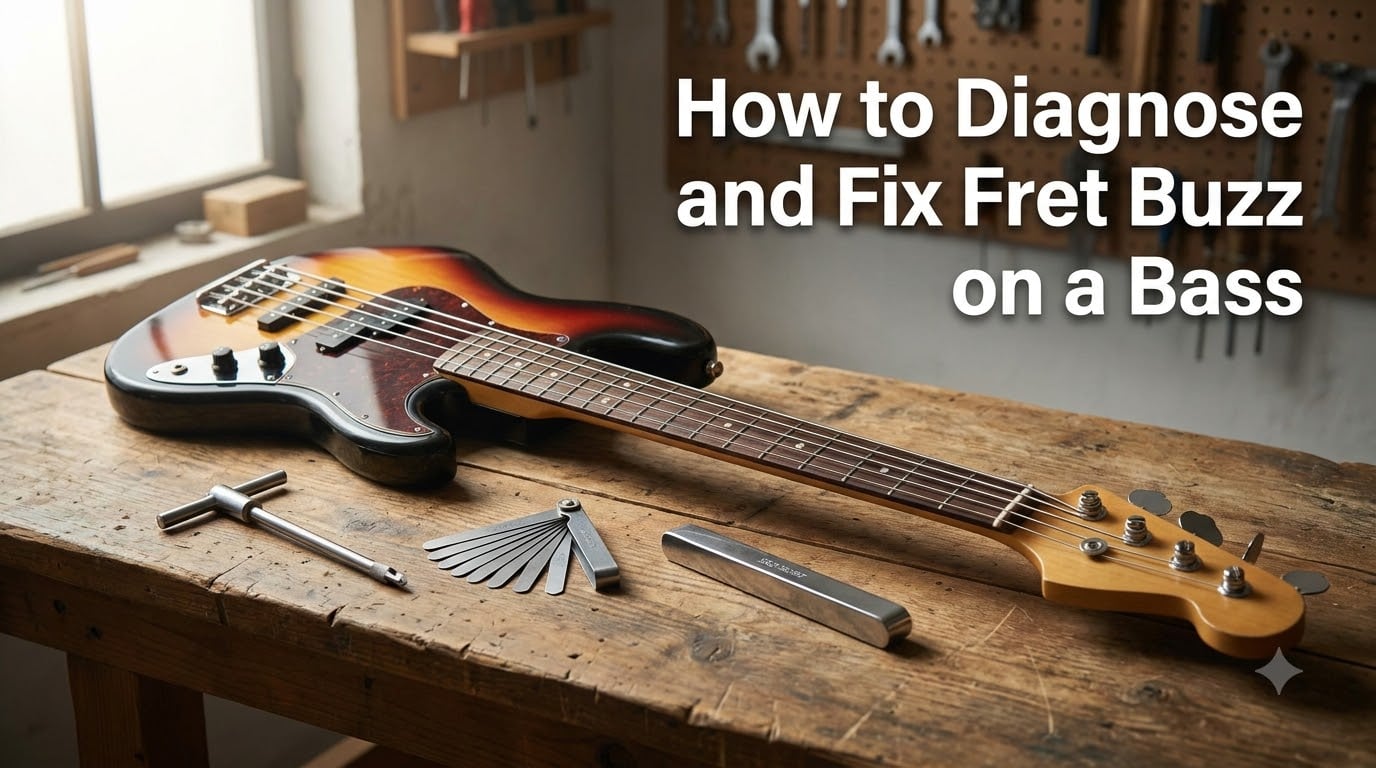
Every bass player has reached for a note, heard that annoying rattle behind it, and wondered what went wrong. Fret buzz on a bass is the gritty, buzzing sound you hear when a vibrating string touches one or more frets instead of ringing clean above them. It wrecks sustain, kills the warmth in your tone, and pulls you out of the groove mid-song.
I have spent hundreds of hours in workshops diagnosing and fixing buzz on everything from brand-new four-strings to vintage basses that travelled the world. In this guide I will show you exactly how to diagnose and fix fret buzz on a bass, using the same workflow I use on my own instruments and on client instruments in my shop.
Table of Contents
What Is Fret Buzz on a Bass?
Fret buzz on a bass is the rattling sound a string makes when it physically contacts a fret while vibrating. Instead of the string swinging freely between the fret you are pressing and the next one over, part of its arc slaps against the metal, creating a buzz.
Think of it like a tennis ball rolling over a pebble. The string is the ball, and any fret sitting too high in its path is the pebble. The longer your strings are and the harder you pluck, the bigger that arc becomes, which is why basses can be especially touchy.
A tiny amount of buzz on the lowest frets can be perfectly normal on a bass. A lot of buzz anywhere on the neck is a problem you can fix.
Common Causes of Fret Buzz on a Bass
Before you grab any tools, it helps to know what you are looking for. Almost every fret buzz problem I see in my shop falls into one of these buckets.
1. String Action Set Too Low
String action is the distance between the bottom of the string and the top of the 12th fret. If that gap is too small, the string does not have enough room to swing without hitting the next fret over. Bass players often chase low action because it feels fast, but too low almost always means buzz.
2. Neck Relief Is Wrong
Relief is the gentle forward curve of a bass neck. A perfectly straight or backbowed neck leaves zero clearance for the string, so it hits frets hard. A neck with too much relief feels floppy and intonation drifts, but it usually does not buzz as much as a too-flat neck.
3. Uneven or Worn Frets
Years of playing wear down the frets. Some get shorter and flatter, others stay tall, and that creates uneven spots where one fret sits higher than the rest. The high one is what buzzes when you play anywhere above it.
4. Nut Slots Cut Too Low
The nut is the white or black bar right behind the headstock. If its slots sit too low, only the first few frets will buzz, especially on open strings. Players often blame the truss rod when the real culprit is the nut.
5. Humidity and Temperature Swings
Wood breathes. A neck that was perfect in a dry January studio can bow forward in a humid August gig. I see this weekly, and seasonal truss rod adjustments are a normal part of bass ownership.
6. Heavy Playing Technique
If you really dig in, you are increasing the size of the string vibration. Some basses are set up light and clean for fingerstyle players, and they will buzz the second someone starts slapping or using a heavy pick.
How to Diagnose Fret Buzz on a Bass: Step-by-Step
This is the workflow I run on every bass that comes into my shop. Follow it in order and the cause will almost always reveal itself.
Step 1: Tune to pitch and stabilise the bass. Let the bass sit in the room where you will play it for at least 20 minutes before doing anything. Tuning up after a temperature change will give you false readings.
Step 2: Play every fret on every string. Pluck each note gently. Mark the frets that buzz with a small piece of tape or a pencil dot on the fretboard edge. Patterns matter. Buzz at one fret only usually means that fret is high. Buzz everywhere usually means relief or action.
Step 3: Apply the 3-fret rule. Press the string down at the 3rd fret, then check the gap between the string and the 2nd fret. There should be roughly the thickness of a business card. If the string sits flat against the 2nd fret, the nut slot for that string is too low.
Step 4: Test for technique buzz. Fret a note cleanly, pluck it, and slowly lift your fretting finger. If buzz appears the moment your finger leaves the string, you are probably pulling the string sideways or off the tip of the fret. This is a left-hand habit, not a setup problem.
Step 5: Check neck relief with a straightedge. Lay a quality straightedge along the strings from nut to about the 17th fret. On a properly relieved bass you should see a tiny gap in the middle, roughly 0.010 inch for a four-string and a hair more for a five-string.
Step 6: Measure action at the 12th fret. Use a ruler or feeler gauge to measure from the top of the 12th fret to the bottom of the string. For a four-string bass, a comfortable starting point is about 5/64 inch on the E string and 4/64 inch on the G string.
Step 7: Rule out amp and pickup noise. Unplug and listen acoustically. If the bass buzzes silently, your pickups or electronics might be the noise source, not the strings.
Tools You Need for DIY Fret Buzz Diagnosis
You can get away with very little, but these tools make the job faster and more accurate.
- Truss rod wrench sized to your specific bass (most Fenders take 4mm or 7/32 inch, most Gibsons take a different key)
- Feeler gauge set for measuring relief and action to the thousandth of an inch
- Fret rocker for finding the high fret causing localized buzz
- Straightedge at least 18 inches long
- Digital tuner with good accuracy
- Small notebook to log measurements and adjustments
I keep all of this in a small tool roll that travels to gigs. The total investment is small and pays for itself the first time you skip a setup fee.
Quick Fixes for Fret Buzz on Bass
Once you have diagnosed the cause, these are the fixes that solve roughly 90 percent of the buzz problems I see. Always adjust the truss rod first, then action, then frets, in that order.
Fix 1: Adjust the Truss Rod for Correct Relief
Loosen the truss rod to add relief (neck bows forward more), tighten it to remove relief (neck straightens). The standard rule I learned from senior techs is no more than a quarter turn at a time.
Make your adjustment, retune, play a few chords, wait five minutes, and recheck. Truss rods are sensitive and changing one always shifts the others. Repeat in small steps until the relief matches the measurement you recorded.
Fix 2: Raise the Bridge Saddles for More Action
Once the neck is right, look at the bridge. Most basses have individual saddle height screws on each string. Turn them clockwise to raise the saddle and counter-clockwise to lower it.
Aim for the action measurement you wrote down in the diagnosis step. Raise both sides of the saddle evenly to keep the intonation you already set.
Fix 3: Address Nut Slot Height
If buzz shows up only at the first three frets and the 3-fret rule fails, the nut slot is too low. A professional should cut it higher with the correct files. I do not recommend doing this yourself unless you have nut files that match your string gauge exactly.
Fix 4: Find and File High Frets
When only one fret buzzes, use a fret rocker to confirm. Place the rocker over the suspect fret and the frets on either side. If it rocks, that fret is high. A light tap-down with a fret hammer and recrowning with a crowning file fixes it. Beginners should leave this to a tech.
Re-tune and play-test after every change. Small adjustments add up faster than you think on a bass.
Bass vs Guitar: Tolerance and Acceptable Buzz
Bass and guitar fret buzz are not the same. The low E string on a bass vibrates in a much larger arc than the low E on a guitar, and the human ear forgives low-end buzz far more than high-end buzz.
That is why many pro bassists accept a tiny rattle in the first few frets and chase clean notes above the 5th fret. On a guitar that same tolerance would sound awful.
Acceptable bass buzz usually falls in the 0.004 to 0.010 inch range at the lower frets and should be near zero above the 7th fret. If your action is comfortable and the notes still sustain and track, a whisper of buzz on the low frets can be part of the bass personality.
When to Take Your Bass to a Professional
DIY fixes stop being safe once the problem goes deeper than a small truss rod or saddle turn. Take it to a tech if any of the following apply.
- The buzz persists after two careful rounds of truss rod and saddle adjustments.
- Multiple frets are uneven, suggesting a full fret level and crown is needed.
- The neck itself looks visibly twisted or has a sharp kink.
- The nut needs filing, replacement, or recutting for a new string gauge.
- Your bass has a dual-action truss rod or a complex bridge that you are not familiar with.
A professional setup runs anywhere from a basic clean-and-adjust to a full fret dress. Either way, it is cheaper than a refret and it protects the resale value of your instrument.
Frequently Asked Questions
How to diagnose fret buzz?
Tune the bass, then play every fret on every string and mark the spots that buzz. Buzz everywhere usually means neck relief or action is off; buzz in one spot usually means a high fret; buzz only at the first few frets usually means the nut slot is too low.
How do I fix fret buzz myself?
Start by adjusting the truss rod for correct neck relief, then raise the bridge saddles to set proper action at the 12th fret. Make small changes, no more than a quarter turn on the truss rod at a time, and retune after every adjustment.
What is the 3 fret rule on bass?
Press the string at the 3rd fret and look at the gap between the string and the 2nd fret. There should be roughly the thickness of a business card. If the string touches the 2nd fret, your nut slot is too low for that string.
Can I repair my buzzing fret by myself?
You can handle minor buzz from truss rod and saddle adjustments at home, but leveling, crowning, or replacing frets requires specialized tools and experience. For any fret work beyond a quick tap-down, take the bass to a qualified tech.
Is a little fret buzz normal on a bass?
Yes. A small amount of buzz on the lowest frets is common and often musically acceptable on bass because the long wavelength of low notes masks the rattle. Buzz above the 7th fret or loud buzz anywhere should be addressed.
Why does my bass buzz only on the lower frets?
Lower fret buzz usually points to incorrect neck relief, action set too low, or a nut slot that sits too low. Start with a truss rod check and use the 3-fret rule to confirm whether the nut is the cause.
Conclusion
Learning how to diagnose and fix fret buzz on a bass comes down to following a clear order: identify where the buzz is, check neck relief, set action, and only then look at frets and the nut. Most buzz problems give up to that workflow within an hour.
Work slowly, log your measurements, and remember that a whisper of buzz on the lowest frets can be part of a healthy bass setup. If you have run the steps and the buzz still fights back, a professional setup is worth every penny.
Pick up your bass, run the diagnosis steps, and reclaim the sustain and clarity your playing deserves.