
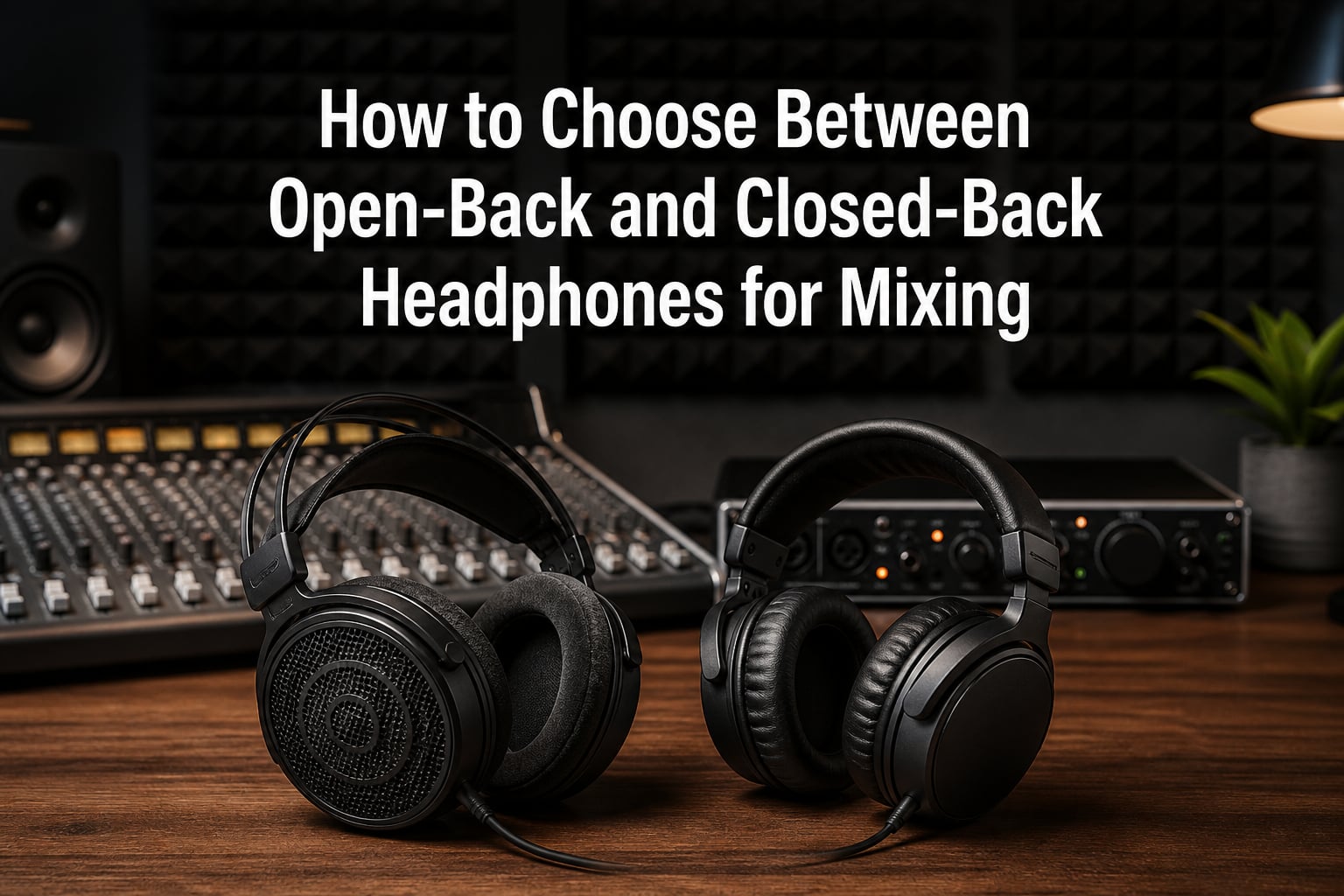
For critical listening, open-back headphones are the way to go. They deliver a more natural frequency response, a wider soundstage, and reduced pressure buildup that lets your ears judge a mix without the coloration that sealed cups introduce. But that simple answer only scratches the surface of the open-back vs closed-back headphones for mixing debate.
The choice between these two designs affects everything from how accurately you hear bass to whether your microphone picks up headphone bleed during a vocal take. I have spent years mixing on both types, and the right answer depends heavily on your room, your workflow, and what you are trying to accomplish at any given stage of production.
In this guide, we will break down exactly how each design works, compare them across the metrics that matter for mixing, and give you a clear framework for choosing the right pair for your studio. Whether you are building a home setup or upgrading a professional rig, you will walk away knowing which type fits your needs.
Table of Contents
Open-Back vs Closed-Back Headphones: What’s the Difference?
The core difference comes down to the ear cup housing. Open-back headphones have perforated or meshed outer shells that let air and sound pass freely through the back of the driver. Closed-back headphones use solid, sealed ear cups that trap sound inside.
That single design choice creates a cascade of differences in soundstage, bass response, isolation, and comfort. It is not a matter of one being universally better than the other. Each design serves a specific purpose in the audio production chain.
Design and Construction
Open-back headphones use grilles, slots, or mesh on the outer housing behind the driver. Air moves in and out of the cup freely, which prevents pressure from building up between the driver and your ear. Think of it like listening to a pair of nearfield monitors in a well-treated room.
Closed-back headphones seal the driver inside a solid enclosure. The trapped air acts as a sealed chamber, which boosts low-frequency output but also creates internal reflections and resonances that can color what you hear. This is why many closed-back models sound “in your head” compared to open-back alternatives.
Why the Design Matters for Audio
That sealed chamber in closed-back headphones does more than isolate noise. It changes the acoustic environment around the driver, creating standing waves and pressure buildup that exaggerate certain frequencies. Open-back designs avoid this problem by venting the rear of the driver, resulting in a cleaner, more transparent sound that translates better to other playback systems.
For mixing, that transparency is gold. When you are making decisions about reverb tails, stereo placement, and frequency balance, you need to hear exactly what is in your mix, not what the headphone housing adds to it.
What Are Open-Back Headphones?
Open-back headphones are studio monitoring headphones designed with vented or perforated ear cups that allow air and sound to pass through freely. They are the go-to choice for mixing, mastering, and any task that requires critical listening accuracy.
How Open-Back Headphones Work
The driver in an open-back headphone sits behind a grille or mesh instead of a solid wall. Sound radiates from both the front and the back of the driver, with the rear wave dissipating into the surrounding air rather than bouncing back toward your ear.
This eliminates the pressure buildup and internal resonances that sealed cups create. The result is a sound that feels more open, natural, and speaker-like. You get a wider perceived soundstage, better instrument separation, and a frequency response that stays closer to what the driver was actually designed to produce.
Open-Back Advantages for Mixing
The biggest advantage is accuracy. Open-back headphones give you a wider, deeper soundstage that makes it easier to judge stereo placement and instrument separation. You can hear where each element sits in the mix, which is essential for panning decisions and spatial effects.
They also reduce ear fatigue during long sessions. Without the trapped heat and pressure of sealed cups, your ears stay comfortable longer. Many engineers on Reddit’s r/mixingmastering community describe open-back headphones as “superior for mixing and mastering” precisely because of this transparency and comfort.
Finally, open-back designs tend to have a flatter, more neutral frequency response. They do not artificially boost bass the way closed-back models often do, which means your low-end decisions will translate more reliably to speakers and other playback systems.
Open-Back Limitations
The main trade-off is isolation. Because sound passes through the cups in both directions, open-back headphones let external noise in and your mix out. If you are mixing in a noisy environment or sharing a room with other people, that leakage becomes a real problem.
You also cannot use open-back headphones for recording, especially when tracking vocals or acoustic instruments with a live microphone. The headphone bleed will leak into the recording and create phase issues or unwanted artifacts in your takes.
What Are Closed-Back Headphones?
Closed-back headphones are studio headphones with solid, sealed ear cups that block external noise and contain sound within the cups. They are the standard choice for recording, tracking, and monitoring in environments where isolation matters.
How Closed-Back Headphones Work
The sealed enclosure traps air between the driver and your ear, creating an acoustic chamber that naturally boosts low frequencies. This is why closed-back headphones often sound punchier and more bass-forward than their open-back counterparts.
That sealed chamber also prevents sound from escaping the cups. Someone sitting next to you will barely hear what you are listening to, and external noise stays largely outside. This makes closed-back designs ideal for recording sessions where microphone bleed would ruin a take.
Closed-Back Advantages for Mixing
Isolation is the headline advantage. If you work in an untreated room with background noise from computers, air conditioning, or neighbors, closed-back headphones give you a quiet, controlled listening environment. That can be more valuable than a marginally wider soundstage.
Closed-back headphones also excel at bass response. The sealed chamber reinforces low frequencies, which helps you identify and control rumble, sub-bass content, and low-end mud. Some engineers prefer closed-back models for the initial low-end balancing pass before switching to open-back for critical detail work.
Closed-Back Limitations
The sealed design creates internal reflections and resonances that color the sound. Many closed-back models introduce a slightly “canned” or cup-like quality that makes it harder to judge reverb decay and spatial depth accurately.
Heat buildup and ear fatigue are also significant concerns. Forum users frequently report that closed-back headphones feel claustrophobic during extended mixing sessions. The trapped warmth and pressure can make your ears uncomfortable after two or three hours, limiting how long you can work productively.
Finally, the narrower soundstage makes it harder to judge stereo width and instrument placement. You lose some of the three-dimensional spatial detail that open-back designs provide, which can lead to less accurate panning and reverb decisions.
Sound Quality Comparison: Soundstage, Imaging, and Detail
Open-back headphones win on soundstage, imaging, and detail retrieval. Closed-back headphones win on bass impact and low-frequency isolation. Here is how they compare across the sound quality metrics that matter most for mixing.
Soundstage Width and Depth
Soundstage refers to the perceived three-dimensional space in which instruments appear when you listen. Open-back headphones create a wide, deep soundstage that extends beyond the boundaries of your head, giving each instrument room to breathe.
Closed-back headphones produce a more intimate, in-your-head soundstage. Instruments feel closer together, and the sense of front-to-back depth is compressed. This narrower presentation can make it harder to judge spatial relationships in a dense mix.
Imaging and Stereo Accuracy
Imaging is your ability to pinpoint exactly where a sound sits in the stereo field. Open-back headphones excel here because the vented design lets the driver perform without the reflections that blur positional cues. You can hear whether a guitar is panned 30 percent left or 40 percent left.
Closed-back headphones still provide decent imaging, but the internal reflections soften the edges of each sound source. For fine panning and spatial effect decisions, open-back models give you the precision that mixing demands.
Bass Response
Closed-back headphones generally deliver more pronounced, impactful bass thanks to the sealed chamber. This can be helpful for identifying sub-bass content and low-frequency problems that might get lost on open-back designs.
However, that boosted bass can be misleading. If your closed-back headphones exaggerate low frequencies, you might under-mix the bass, thinking it is louder than it actually is. Open-back headphones give you a flatter, more honest bass response that translates better across playback systems.
So do open-back headphones have enough bass for mixing? Yes, for most genres. The bass is present and accurate, just not artificially boosted. For EDM, hip-hop, or other bass-heavy genres where sub-bass content is critical, you may want to cross-reference with closed-back headphones or a subwoofer-equipped monitor setup.
Noise Isolation and Sound Leakage
Isolation is where the two designs diverge most dramatically. Closed-back headphones block external noise and contain your audio. Open-back headphones do neither, which makes them unsuitable for certain production tasks.
Isolation Performance
Closed-back headphones typically provide 15 to 25 dB of passive noise reduction. That is enough to tame computer fan noise, air conditioning hum, and moderate room noise. You get a cleaner, quieter reference that lets you focus on the details in your mix.
Open-back headphones provide almost zero isolation. External noise enters freely, and your mix leaks out just as easily. If your mixing environment is not acoustically controlled, this can undermine your ability to make accurate decisions.
Microphone Bleed During Recording
If you are recording vocals or acoustic instruments, headphone bleed is a serious concern. Open-back headphones leak enough sound that a sensitive condenser microphone will pick up your monitoring mix clearly. This bleed creates phase issues and makes it difficult to comp or edit takes cleanly.
Closed-back headphones keep the monitoring mix contained inside the cups. Even with a sensitive microphone positioned inches away, bleed stays minimal. This is why closed-back models remain the industry standard for tracking and recording sessions.
Which Is Better for Mixing?
For mixing, open-back headphones are the better choice for most engineers. Their wider soundstage, flatter frequency response, and reduced internal resonances give you a more honest representation of your mix. That honesty translates to better decisions and mixes that sound good on every playback system.
Why Most Engineers Prefer Open-Back for Mixing
Mixing is about balance. You need to hear every element clearly and place it precisely in the stereo field. Open-back headphones give you the transparency and spatial accuracy that critical listening demands. Communities like r/mixingmastering and r/audioengineering consistently recommend open-back models for this stage of production.
The reduced ear fatigue also matters. A mixing session can last four, six, or even eight hours. If your headphones cause discomfort after two hours, your mixing decisions will suffer. Open-back designs keep air circulating and pressure from building, letting you work longer without compromising your judgment.
When Closed-Back Makes Sense
Closed-back headphones are the right choice when your environment demands isolation. If you mix in a shared space, a noisy apartment, or a room without acoustic treatment, closed-back headphones give you a controlled reference that open-back designs simply cannot match.
They are also valuable as a secondary reference. Many professional engineers own both types and switch between them during a mix. Closed-back headphones help you check how your mix will sound on consumer earbuds and sealed headphones, which is how most listeners actually experience music.
Use Case Recommendations: Recording, Mixing, and Mastering
Different production stages call for different headphones. Here is a breakdown of which type works best for each task in the audio production chain.
Recording and Tracking
Use closed-back headphones for recording. The isolation prevents microphone bleed, and the sealed design keeps the click track and monitoring mix from leaking into your takes. This is non-negotiable for vocal tracking and acoustic instrument recording.
Semi-open designs can work for recording less sensitive sources like electric guitar cabinets, but when a condenser microphone is involved, stick with closed-back.
Mixing Sessions
Use open-back headphones as your primary mixing reference. Their soundstage, imaging, and neutral frequency response give you the accuracy needed to make balance, panning, and effect decisions. Cross-reference periodically with closed-back headphones to check how your mix translates to sealed playback systems.
If your room is noisy and open-back headphones are impractical, high-quality closed-back studio headphones can still produce solid mixes. Just be aware of the bass exaggeration and narrower soundstage, and compensate accordingly.
Mastering and Final Checks
Open-back headphones are strongly preferred for mastering. At this stage, you need maximum transparency to catch subtle issues like harshness, muddiness, and spatial imbalances. The vented design reveals details that sealed cups tend to mask.
That said, headphones should never be your only mastering reference. Always cross-reference with studio monitors in a treated room. Use headphones to confirm details and catch problems, not as your sole source of truth.
Hybrid and Semi-Open Designs
Semi-open and hybrid headphones occupy the middle ground between fully open and fully closed designs. They offer a practical compromise for engineers who need some isolation without sacrificing too much soundstage.
Best of Both Worlds?
Semi-open designs typically feature partially vented ear cups that reduce internal resonances while providing modest noise isolation. They do not seal as tightly as closed-back models, but they leak less than fully open ones. The Beyerdynamic DT 880 is a well-known example that audio communities frequently recommend for its balanced presentation.
The trade-off is that you get less of each design’s strengths. Soundstage is wider than closed-back but narrower than fully open. Isolation is better than open-back but weaker than closed-back. For engineers who can only own one pair of headphones, semi-open models offer a versatile middle path.
Who Should Consider Hybrid Designs
Hybrid designs make sense for home studio owners and project studios where budget or space limits you to a single pair of headphones. They also work well for podcasters and content creators who need reasonable isolation for recording but also want decent sound quality for editing and mixing.
If you produce in a dedicated, treated space, you are better off owning separate open-back and closed-back pairs. Each design excels at its specific task, and no hybrid can fully replace the strengths of either.
How to Choose the Right Headphones for Your Mixing Setup
Choosing between open-back and closed-back headphones comes down to your environment, your workflow, and your budget. Here is a step-by-step process to help you decide.
Step 1: Evaluate Your Room and Environment
Start by assessing where you will be mixing. If you have a quiet, treated room with minimal background noise, open-back headphones will serve you well. If your space has computer fan noise, traffic, or other people nearby, closed-back headphones will give you a cleaner reference.
Be honest about your environment. A pair of accurate open-back headphones in a noisy room will give you worse results than closed-back headphones in the same space, because external noise will mask critical details in your mix.
Step 2: Decide Your Primary Use Case
If you only mix and master, open-back headphones are your best bet. If you also record vocals or instruments, you will need closed-back headphones for tracking. Many engineers end up owning both, using closed-back for recording and open-back for mixing.
If budget forces you to choose one, prioritize based on where you spend the most time. A producer who records daily but mixes occasionally should invest in quality closed-back headphones first.
Step 3: Set a Realistic Budget
Professional-grade open-back headphones like the Sennheiser HD 600 and HD 650 are community favorites for neutral mixing. They deliver the flat frequency response that critical listening demands. Beyerdynamic models like the DT 990 are praised for soundstage, while the DT 880 is valued for low-end accuracy.
Closed-back options like the Audio-Technica ATH-M40x and M50x are popular and affordable, but audio communities consider them somewhat colored rather than truly neutral. For mixing accuracy, look beyond consumer-oriented models and focus on studio monitoring designs.
Step 4: Test Comfort and Seal
Comfort determines how long you can mix effectively. Try headphones on before buying if possible. Look for plush ear pads, adjustable headbands, and a clamping force that feels secure without causing pressure headaches.
For closed-back headphones, test the seal. A proper seal is essential for accurate bass response and effective isolation. If the cups do not form a tight seal around your ears, you will lose low frequencies and isolation performance. Glasses wearers should pay special attention, as temple arms can break the seal.
Step 5: Consider Room Correction Software
Room correction software like Sonarworks SoundID Reference can flatten the frequency response of your headphones, compensating for peaks and dips in the driver’s natural response. This technology works with both open-back and closed-back designs and can significantly improve mixing accuracy.
If your headphones have a known frequency response curve, correction software can make a mid-priced pair perform closer to a high-end reference model. It is not a substitute for good headphone design, but it is a valuable tool for getting the most out of whatever you own.
The 60-60 Rule for Safe Listening During Mixing Sessions
The 60-60 rule is a simple guideline for protecting your hearing during long mixing sessions. Listen at no more than 60 percent of maximum volume for no more than 60 minutes at a time, then take a break.
Hearing fatigue does more than damage your ears. It directly degrades your mixing decisions. After extended loud listening, your perception of frequency balance shifts, bass becomes harder to judge, and harsh frequencies feel less harsh than they actually are. By the time you notice the fatigue, your mixes are already suffering.
This rule matters regardless of which headphone type you use, but it is especially relevant for closed-back models. The sealed chamber concentrates sound pressure directly against your eardrum, which can accelerate fatigue compared to the vented design of open-back headphones. Set a timer, keep your levels reasonable, and step away regularly to reset your ears.
FAQs
Is it better to mix with open-back or closed-back headphones?
Open-back headphones are better for mixing because they provide a wider soundstage, flatter frequency response, and reduced internal resonances. These qualities give you a more honest representation of your mix that translates better across playback systems. Closed-back headphones work for mixing in noisy environments but introduce coloration that can mislead your decisions.
What is the 60-60 rule for headphones?
The 60-60 rule means listening at no more than 60 percent of maximum volume for no more than 60 minutes at a time, followed by a break. This protects your hearing and prevents ear fatigue from degrading your mixing decisions during long studio sessions.
How do I choose headphones for mixing?
Start by evaluating your room noise level, deciding whether you also need to record, and setting a budget. If your room is quiet, choose open-back headphones for their accuracy and soundstage. If you need isolation or also track vocals, consider closed-back or own both types. Always prioritize neutral frequency response over bass boost.
Do open-back headphones have enough bass for mixing?
Yes, open-back headphones have enough bass for mixing in most genres. Their bass response is accurate and flat rather than artificially boosted. For bass-heavy genres like EDM or hip-hop, cross-reference your low-end decisions with closed-back headphones or monitors equipped with a subwoofer to confirm sub-bass content.
Do closed-back headphones leak sound?
Closed-back headphones leak very little sound compared to open-back designs, which is why they are the standard for recording. A well-sealed pair will keep your monitoring mix from bleeding into nearby microphones. However, at very high volumes, some minimal leakage can still occur, so keep monitoring levels reasonable during tracking.
Conclusion
Choosing between open-back and closed-back headphones for mixing comes down to understanding what each design does best. Open-back headphones deliver the transparency, soundstage, and flat frequency response that critical mixing and mastering demand. Closed-back headphones provide the isolation and bass reinforcement that recording and noisy environments require.
For most engineers, the ideal solution is owning both. Use closed-back headphones for tracking and as a secondary mixing reference to check how your mix translates to sealed playback systems. Use open-back headphones as your primary mixing and mastering tool for their unmatched accuracy and comfort.
Whatever you choose, remember that headphones are just one part of your monitoring chain. Pair them with studio monitors when possible, use room correction software to flatten their response, and follow the 60-60 rule to protect your hearing. The best headphones for mixing are the ones you know inside and out, so spend time learning how your pair translates to the real world. Your mixes will be better for it.
1 thought on “How to Choose Headphones for Mixing: Open-Back vs Closed-Back (September 2026)”