
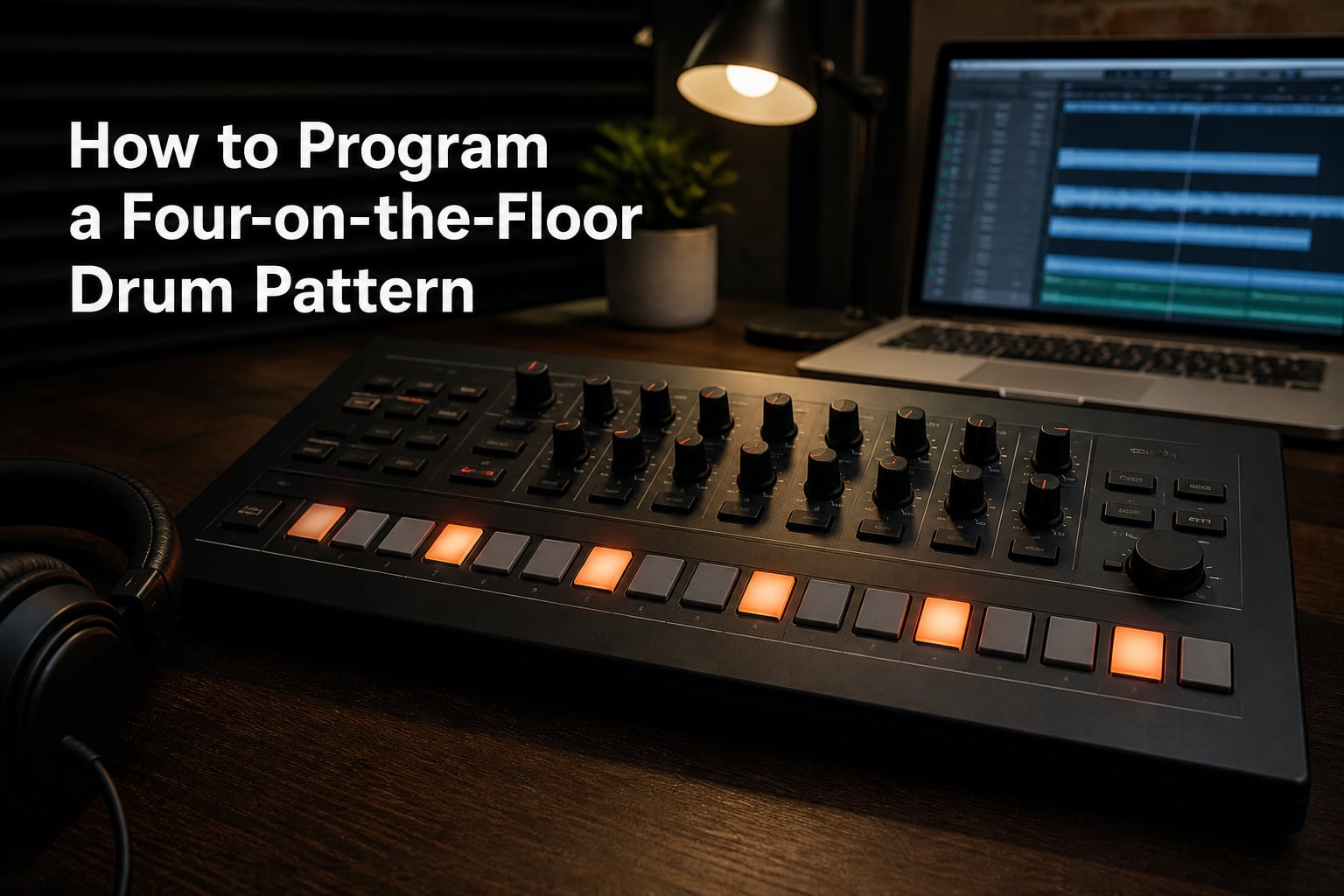
Programming a four-on-the-floor drum pattern is one of the first skills I teach every new student in my production lessons. It looks deceptively simple on paper, but it is the rhythmic foundation behind almost every house, techno, and disco track you have ever danced to. In this guide, I will walk you through exactly how to program a four-on-the-floor drum pattern from scratch, including the kick, snare, hi-hat, and the small production tricks that make it sound professional.
By the end, you will have a complete loop you can build a whole track around, plus the knowledge to adapt the groove for house, techno, EDM, and modern subgenres.
Table of Contents
What Is Four-on-the-Floor? Definition and Origins
A four-on-the-floor drum pattern is a drum pattern where the bass drum (or kick) hits on every quarter-note beat in a 4/4 time signature: beats 1, 2, 3, and 4. The snare usually plays on beats 2 and 4, and the hi-hat adds a steady rhythmic texture on top. This is why it is called “four-on-the-floor” – the kick drum hits four times per measure, like four steady footsteps on the dance floor.
The pattern became the backbone of disco in the 1970s, partly because of the Roland CR-78 drum machine and later the TR-808. Producers like Giorgio Moroder leaned on this steady pulse to keep dancers moving. I have noticed that when I teach it in lessons, students always feel the groove right away – it is physically easy to lock into because the quarter note pulse matches how most people walk.
Today, four-on-the-floor shows up in house, techno, EDM, trance, pop ballads, and even dance rock. If a song makes you want to nod your head in a club, there is a very good chance it is a four-on-the-floor beat underneath.
How to Program a Four-on-the-Floor Drum Pattern Step by Step
Here is the exact process I use when I sit down to program a four-on-the-floor drum pattern in my DAW. Follow these steps in order and you will have a clean loop by the end.
Step 1: Set your tempo and time signature. Start with 120 BPM and 4/4 time. This is the sweet spot for house music and works well for almost any four-on-the-floor genre. You can always speed up or slow down later, but starting at 120 trains your ear to the standard groove.
Step 2: Program the bass drum on every beat. Place a kick drum hit on beat 1, beat 2, beat 3, and beat 4 of a one-bar loop. Use a short, punchy kick sample with a tight low end. I usually set the velocity to around 100-110 of 127 so the kick has presence without clipping.
Step 3: Add the snare on beats 2 and 4. Drop a snare hit on beat 2 and beat 4. This is the backbeat, and it creates the tension and release that makes the pattern feel like a groove rather than a metronome.
Step 4: Layer in the hi-hat. Program closed hi-hat hits on every eighth note – eight notes per bar. This adds motion and energy. Try velocity 70-80 for the off-beats and 90-100 for the on-beats to get a subtle groove.
Step 5: Loop and verify. Loop the bar for at least 30 seconds. Listen for any kick notes that stick out, any hi-hat flams, and any timing issues. Lightly quantize the hi-hat to a straight grid, but leave the kick and snare slightly loose so the groove breathes.
Setting the Kick Drum on Every Beat
The kick drum is the heart of the four-on-the-floor drum pattern. When I edit student projects, the kick is almost always where the magic happens – or where it falls apart.
Pick a kick sample that has a clean attack and a tail that does not ring out into the next beat. In a tight four-on-the-floor, each kick note only has a quarter note of space. If your kick tail lasts longer than that, the hits will blur together and the low end will turn to mud.
Velocity matters more than most beginners realize. I recommend a consistent velocity around 100, but if you want a subtle human feel, drop the velocity of beat 1 slightly (to about 95) and bring beats 3 and 4 up to 105. This little trick keeps every beat audible on smaller speakers without making the pattern feel mechanical.
Quantize the kick to the beat grid for the cleanest result. Four-on-the-floor lives or dies by its tightness, and a slightly off-grid kick will ruin the dance floor feel.
Adding the Snare Backbeat on Beats 2 and 4
The backbeat is what separates a drum pattern from a pulse. Without the snare on beats 2 and 4, your four-on-the-floor would be just a thudding kick. With it, you get groove.
Pick a snare that complements your kick. If your kick is dark and rumbly, go bright and snappy. If your kick is tight and clicky, a fatter snare will balance the low end. I always layer two snares – a main hit and a subtle clap or rim – to fatten the backbeat.
Place the snare precisely on beats 2 and 4. Do not push it late. In rock and funk, drummers often lay the snare just behind the beat, but in four-on-the-floor, the snare usually sits right on the grid or slightly ahead for an aggressive feel.
Try ghost notes if you want extra detail. A quiet snare hit on the “and” of beat 3 (the 16th just before beat 4) fills the gap and adds swing. Keep the velocity around 40-50 so it whispers instead of competing with the main backbeat.
Hi-Hat Pattern Variations
The hi-hat is the element that gives four-on-the-floor its sense of forward motion. The basic pattern is closed hi-hat on every eighth note, but you have plenty of room to vary it.
Closed hi-hat on every 8th. This is the safe, classic choice. It pushes the beat forward without distracting from the kick and snare.
Open hi-hat accents. Replace every fourth eighth note with an open hi-hat. This adds a subtle bounce that works especially well in tech house and disco.
16th note hi-hats. Doubling the hi-hat speed to 16th notes creates a more nervous, hi-energy groove. Use this in EDM build-ups and drops where you want extra tension.
Swing or shuffle. Apply a swing groove of 55-60% on the hi-hat while keeping the kick and snare straight. This is a trick I borrow from garage and broken beat – it adds a loose, human feel without breaking the four-on-the-floor foundation.
DAW-Specific Tips for Programming the Beat
Different DAWs approach drum programming differently. Here is how I approach the four-on-the-floor drum pattern in the three most popular ones.
Ableton Live. Open a Drum Rack, drop a kick on C1, snare on D1, closed hat on F#1, and open hat on A#1. Use the step sequencer view (click the drum rack and tap the small grid icon). Click in beats 1, 2, 3, 4 on the kick row, beats 2 and 4 on the snare row, and every other 16th step on the hi-hat row. Done in 30 seconds.
FL Studio. Open the Step Sequencer (Channel Rack). Add a kick, snare, and hat channel. Click steps 1, 5, 9, 13 for the kick (one click per quarter), steps 5 and 13 for the snare (beats 2 and 4), and every other step for the hat. FL’s channel rack is built for this kind of programming.
Logic Pro. Use the Drum Machine Designer. Drag a kick, snare, and hat onto the pads. Click the pencil tool and draw the notes into the region. Set the grid to 1/4 for kick and snare, and 1/8 for the hi-hat before you draw.
Genre Applications: House, Techno, Disco, and EDM
The four-on-the-floor drum pattern is a template, not a rigid rule. Each genre tweaks it slightly. Here is how I adapt the pattern when I switch styles.
House music (120-130 BPM). Use a deep, melodic kick, a clap layered with the snare, and shuffled hi-hats. Add a shaker on the 16ths for warmth.
Techno (120-140 BPM). Pick a drier, more industrial kick. Skip the snare claps and use a sharp clap or rim. Keep the hi-hat crisp and add a ride in place of the hi-hat for an open, dubby feel.
Disco (110-130 BPM). Layer a tambourine on the off-beats and use a snappy snare with light reverb. The kick should have a slightly softer attack than modern house.
EDM and festival (128-140 BPM). Heavier kicks, distorted processing, layered claps, and big open hats on the off-beats. Add a snare roll in the build-up before the drop.
Using Side-Chain Compression for That Pumping Sound
Side-chain compression is the secret weapon that makes four-on-the-floor tracks feel “alive” on the dance floor. The idea is simple: every time the kick hits, the rest of the mix (especially the bass and pads) ducks down slightly, then comes back up. This creates that signature pumping effect.
To set it up, place a compressor on your bass or pad bus. Route the kick drum as a side-chain input. Use a fast attack (around 1-5 ms), a medium release (around 100-200 ms), and a ratio of 4:1 or higher. Set the threshold so the gain reduction is around 3-6 dB on each kick hit.
Modern DAWs like Ableton and Logic have built-in side-chain routing. In FL Studio, use the Fruity Limiter or a third-party plugin like LFOTool. I keep a side-chain compressor on every bass track I produce for house and techno – it is non-negotiable for that genre.
Common Mistakes and How to Fix Them
Every producer I coach runs into the same handful of beginner mistakes. Here is how to spot and fix them.
Mistake 1: Kick tail bleeding into the next beat. If your kick sample has a long tail, the four-on-the-floor will turn to mud. Fix it by editing the sample’s release or applying a short gate after the compressor.
Mistake 2: Over-quantizing everything. Quantizing the kick is usually fine, but quantizing the hi-hat too tightly kills the groove. Leave about 5-10% swing on the hi-hat and shaker to keep the beat alive.
Mistake 3: Ignoring the low end. Your kick and bass are fighting for the same frequency range. High-pass the bass around 30-40 Hz and side-chain it to the kick.
Mistake 4: Programming on every beat without rests. Four-on-the-floor fills every quarter note with the kick, but if you add a snare or clap on every beat too, the pattern becomes exhausting. Let the kick and snare breathe – that contrast is what makes the groove.
Mistake 5: Forgetting variation. A perfect loop is great for 30 seconds, but a 4-minute track needs movement. Add fills, breaks, and hat rolls every 8 or 16 bars to keep listeners engaged.
Practice Exercises and BPM Guidelines
If you want to get truly comfortable with the four-on-the-floor drum pattern, treat it like an instrument. Practice it.
Exercise 1: Tempo ladder. Program the same pattern at 110, 120, 130, and 140 BPM. Notice how the feel changes. House and disco live around 110-128, techno pushes 130-140, and EDM sits at 128.
Exercise 2: Reduction practice. Start with kick, snare, and hi-hat. Then mute the kick for four bars. Listen to how the hat and snare still hold the groove. Bring it back in. This trains your ear to hear each layer.
Exercise 3: Variation chains. Build a 16-bar loop where bar 1 is the basic pattern, bar 5 adds an open hat, bar 9 adds a snare roll, bar 13 strips back to just kick and snare. Now you have a song structure.
Practice one exercise per day for 30 minutes. After a week, the four-on-the-floor will feel as natural as a metronome, and you will start hearing it everywhere on the radio.
Frequently Asked Questions
What is a four-on-the-floor drum pattern?
A four-on-the-floor drum pattern is a 4/4 beat where the bass drum hits on every quarter note (1, 2, 3, 4), with a snare on beats 2 and 4 and a hi-hat playing eighth notes. It is the foundational groove of house, techno, disco, and most EDM.
How do I make a four-on-the-floor beat?
Set your DAW to 120 BPM and 4/4 time. Place a kick on beats 1, 2, 3, and 4. Add a snare on beats 2 and 4. Layer a closed hi-hat on every eighth note. Loop the bar and adjust velocity and sample choice until the groove feels tight.
What is the 80/20 rule in drumming?
The 80/20 rule in drumming means that 80% of a song’s feel comes from 20% of the parts – usually the kick, snare, and the relationship between them. Mastering those three elements matters more than layering ten extra percussion hits.
What genres use four-on-the-floor?
House, techno, disco, trance, EDM, dance-pop, and modern K-pop all use the four-on-the-floor pattern. It also shows up in pop ballads and dance rock where producers want a driving, danceable pulse.
Final Thoughts on Programming the Four-on-the-Floor Drum Pattern
The four-on-the-floor drum pattern is one of the most useful grooves in modern music. Once you can program it cleanly, you can build almost any dance track on top of it. Start with a tight kick, add a solid backbeat, layer in a moving hi-hat, and finish with side-chain compression for that signature pump.
I have spent years crafting my own four-on-the-floor templates, and I still come back to the same basic formula every time. Open your DAW, set 120 BPM, and try the steps above. Your first fully programmed four-on-the-floor loop is one bar away.
1 thought on “How to Program a Four-on-the-Floor Drum Pattern (September 2026)”