
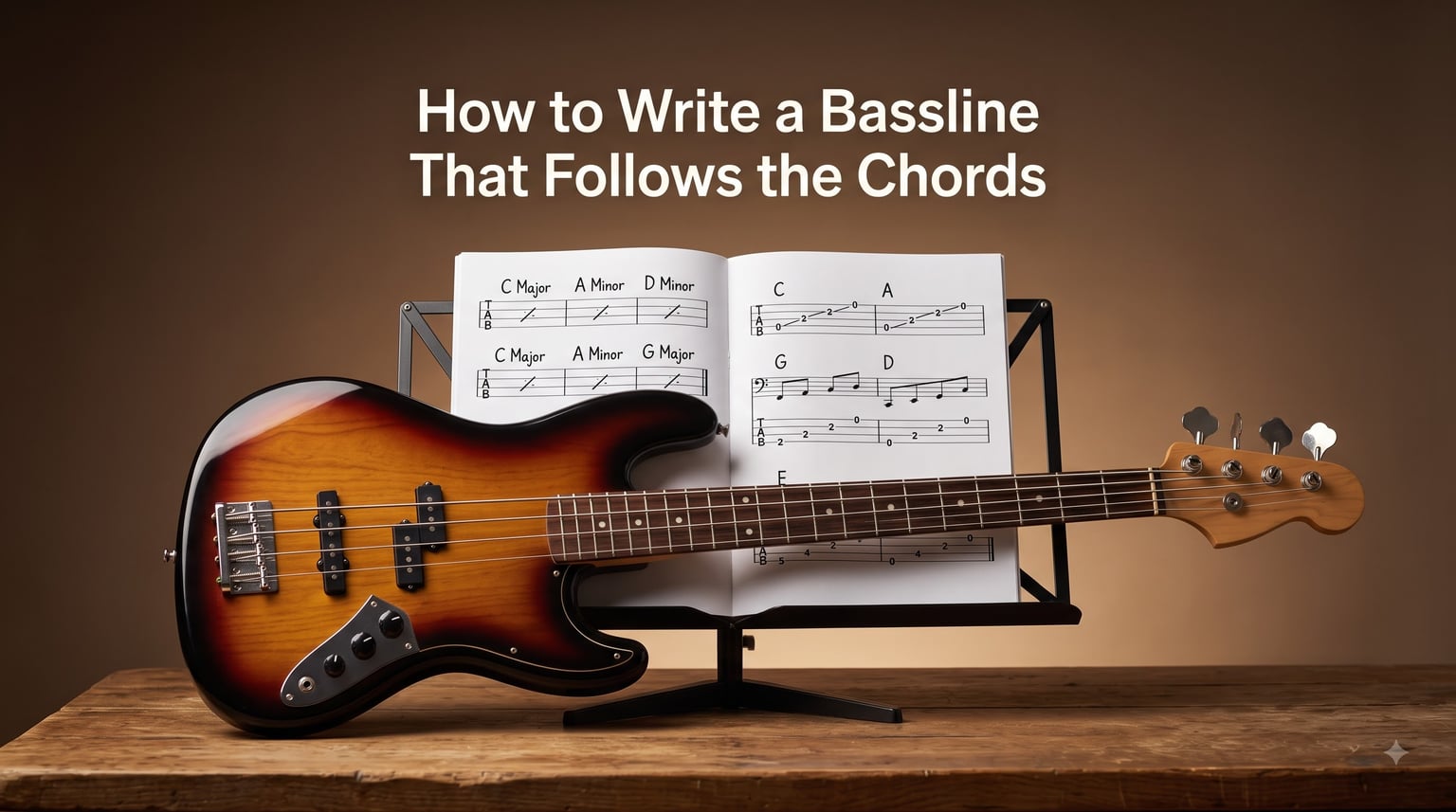
If you have ever sat down with your bass and wondered what notes actually fit with the song you are playing over, you are not alone. I remember my first year of bass more clearly than I would like to admit, mostly because I kept playing notes that clashed with everything. Learning how to write a bassline that follows the chords changed all of that for me, and it can do the same for you.
In this guide, I will walk you through the exact process I use when I write a bass part from scratch. We will cover how to identify the chord progression, choose notes that belong, and add the kind of movement that makes a bassline feel alive instead of mechanical. Whether you play bass guitar, produce electronic music, or just want to understand songwriting better, this walkthrough will give you a clear path forward.
Table of Contents
How to Write a Bassline That Follows the Chords: Step-by-Step Process
Writing a bassline that follows the chords is a five-step process: identify the progression, anchor with root notes, choose a rhythm pattern, add connecting notes, and finally embellish with thirds, fifths, and octaves. I have taught this method to dozens of beginner players, and once it clicks, bass writing becomes intuitive.
Step 1: Identify the chord progression
Before you touch a single note, you need to know what chords the song actually contains. I usually write them out as simple letters first (G, Em, C, D for example) and then check them against a chord chart or by ear. This is the same progression used in countless pop songs, so it is a great place to start.
Knowing your progression in advance saves you from guessing on the fly. Write each chord above a bar line, mark where the chords change, and note any chord that lasts longer than one bar. That timing information directly affects the rhythm you will play in Step 3.
Step 2: Play the root notes
The root note is the single most important note in any chord, and it is what your bassline should center on. For a G chord, the root is G. For a C chord, the root is C. Play each root on beat 1 of the bar where the chord changes, and you already have a workable bassline.
Root notes sound strong and grounded. Many famous bass parts, including the one in Another One Bites the Dust, are essentially root notes with a strong rhythmic feel. Do not underestimate how much mileage you can get out of clean root note placement.
Step 3: Choose a rhythm pattern
Harmonic rhythm is the rate at which chords change, and your bass rhythm should usually match or complement it. If a chord lasts four beats, your bassline has room to move. If the chord changes every two beats, you need shorter, more decisive bass notes.
Start with whole notes or half notes on the roots, then experiment with eighth notes once you are comfortable. The exact pattern depends on the genre, and we will look at genre-specific approaches later in this guide.
Step 4: Add connecting notes between chords
This is where most beginner basslines go from functional to interesting. Connecting notes (sometimes called transition notes or passing tones) bridge the gap between one root and the next. Without them, a bassline can feel like it is teleporting between chords.
The simplest connecting notes come from the scale that fits over your chord progression. In G major, those scale notes include A, B, C, D, E, and F sharp. Pick one of those notes that sits between your two root notes and use it as a stepping stone.
Step 5: Embellish with thirds, fifths, and octaves
Once the skeleton of root notes and connectors works, the next layer is variety. Add the third of the chord (B for G major, E minor for Em) for a richer harmony. Reach up an octave on important chords for emphasis. Drop in a fifth on the strong beats when you want a punchy, open sound.
A common beginner exercise I recommend is to take a four-chord progression and write three different versions: roots only, roots with passing notes, and roots with full embellishment. Comparing them builds your ear faster than any theory lecture.
Understanding Chord Tones for Bass Lines
Chord tones are the building blocks of every bassline you will ever write. Each chord contains a root, a third, a fifth, and often a seventh, and you can use any of these as long as it belongs to the current chord. Knowing these tones by feel is what separates intermediate players from beginners.
Root notes as the foundation
Root notes define the chord and give the listener a clear sense of harmonic motion. I tell every student to spend their first month playing root notes only, because it teaches you where the song wants to go. After that, you can decorate.
Major 3rd and minor 3rd intervals
The third of a chord determines whether it sounds happy or sad. A major 3rd (four half steps above the root) gives bright chords, and a minor 3rd (three half steps above the root) gives darker chords. Using the correct third in your bassline confirms the chord quality to the listener.
On bass, the major 3rd sits one whole step plus a half step above the root, and the minor 3rd sits one whole step above. Practice finding these on your instrument so you can reach for them without thinking.
The fifth interval
The fifth is the safest chord tone after the root because it belongs to nearly every chord without conflict. Many bass players lean on root-fifth patterns as a starting point. Think of songs like Come Together or Money by Pink Floyd for examples of how steady root-fifth motion can carry a whole track.
When to use octaves
Octaves double the root at a higher pitch, and they are useful when you want to add brightness or punch without changing the harmony. Use them sparingly on chord changes to create lift, and avoid them on every single note or your line will sound cluttered.
Connecting Notes: How to Smoothly Transition Between Chords
Connecting notes are the small, often quick notes between two chord tones that smooth the bassline motion. If you have ever wondered why some basslines flow while others feel choppy, the answer is almost always in how the transitions are handled. There are a few reliable techniques here.
Common tones between chords
Some chords share notes with the next chord. G and C major both contain the note B (the third of G and the fifth of C). When you find a common tone, you can hold it across the chord change, then move to the new root. This is one of the smoothest tricks in bass writing.
Passing tones and approach notes
Passing tones sit between two chord tones and connect them stepwise. Approach notes sit one step away from the target note and lead into it. Both are part of what musicians call non-harmonic tones because they are not part of the chord, and they add melodic interest.
Chromatic connecting notes
Chromatic notes move by half step, and they are excellent for adding tension before resolving to a chord tone. Funk basslines in particular love chromatic motion because it adds a slippery, syncopated feel. Try a chromatic approach note on beat 4 leading into the new root on beat 1.
Bass Line Techniques by Genre
Genre shapes the rhythm and note choice of your bassline as much as the chord progression does. A jazz walking bassline sounds nothing like an EDM bass, even when the chords are identical. I will walk through the most common genres I work with so you can adapt the steps above to your style.
Walking bass for jazz
A walking bassline plays one note per beat, usually moving through the chord tones and scale. On a C major chord, you might play C, E, G, A before landing on the next root. The key is constant forward motion with each note a step or skip away from the previous one.
Root-fifth patterns for rock and pop
Rock and pop basslines often stick to root and fifth, with the occasional octave. This is the 80/20 rule: 80 percent of what you need comes from just two notes per chord. Countless hit songs work this way, and they sound full because of the rhythm, not because of the note choices.
Arpeggio patterns for funk and EDM
Funk basslines and EDM basslines often play arpeggios, which means breaking the chord into its individual notes in sequence. C major becomes C, E, G played one after the other. This creates the bouncing, percussive feel that defines both styles.
Common Beginner Mistakes When Writing Basslines
I have made every one of these mistakes at some point, so do not feel bad if you recognize them in your own playing. Spotting them is half the work. Avoiding them is the other half.
Playing only roots without rhythm
Root notes on every beat for eight bars will sound like a metronome. Vary the rhythm, leave space, and even consider sustaining one long note when the harmony does not change. Rhythm is what makes basslines musical.
Ignoring harmonic rhythm
If a chord lasts two bars, do not play four notes per bar as if every chord changes every measure. Match your bass rhythm to how often the chords actually change, and you will sound more grounded in the song.
Not leaving space in the line
Some of the best basslines are mostly silence with a few well-placed notes. Less is more. If you find yourself playing constant eighth notes, try cutting them in half and see what happens to the groove.
Clashing with the kick drum
The bass guitar and kick drum share the low frequencies, so they need to work together. When the kick hits, your bass should usually sit with it or rest. When the kick rests, your bass can move. This is called locking in, and it is one of the most important skills in any rhythm section.
Practice Tips to Strengthen Your Bass Line Writing
Knowledge without practice will not get you very far, so here are the three exercises I run my students through weekly. They are simple but they work, and they will compound quickly.
Practice over common progressions
Pick a four-chord progression in a key you like and write a new bassline every day for a week. G-Em-C-D, C-G-Am-F, and D-A-Bm-G are all great starting points. By day seven, your hands and ears will know the pattern cold.
Record and listen back
Your ears deceive you in real time. Record yourself on your phone and listen with fresh ears the next day. You will notice timing issues, unnecessary notes, and clashing rhythms you never heard while playing. This habit alone will speed up your progress.
Train your ear to chord tones
Play a chord on your instrument or pull up a piano app, then hum the root, third, and fifth in turn. Sing them, find them on bass, and sing them again. This builds the connection between what you hear and what you play, and it is the foundation of writing good basslines on the fly.
Frequently Asked Questions
How to create a bassline from chords?
To create a bassline from chords, list the chords in order, find each chord’s root note, and play those roots on the strong beats. Then add scale notes or chord tones (3rds, 5ths, 7ths) on the weaker beats to fill the line with movement.
Does a bassline always have to follow the chords?
No, a bassline does not always have to follow the chords exactly. Many great basslines use non-chord tones, passing notes, and even intentionally clashing tones for color. The key is to know the rules before you break them so the result sounds intentional.
What is the 80/20 bass rule?
The 80/20 bass rule means that 80 percent of your bassline can be built from just two notes: the root and the fifth of each chord. The remaining 20 percent of embellishment (3rds, 7ths, passing notes) is what gives the line character. Start simple and add flavor only where it serves the song.
What notes am I allowed to use when creating a bass line?
You can use any note that fits the chord progression’s key, plus the chord tones of each current chord. The safe notes are the root, third, fifth, and octave of each chord. The scale notes between chords become your connecting notes. Notes outside the key should be used sparingly as chromatic approaches.
Why does my bassline sound boring?
Your bassline probably sounds boring because you are only playing root notes in a steady rhythm without embellishment. Add passing notes, vary your rhythm, leave space, and use octaves on key chords to add interest. Recording yourself often reveals exactly where the line is sleeping.
Final Thoughts
Learning how to write a bassline that follows the chords is less about memorizing theory and more about building a reliable process you can repeat every time. Identify the chords, anchor with roots, layer rhythm, add connectors, and then embellish. Run that cycle on every new song and your basslines will grow sharper with each pass.
Give yourself at least a few weeks of consistent practice before you judge your progress. I still go back to simple root-fifth lines when I am learning a new song, and there is no shame in starting there. The truth is that once the process feels natural, you will not need this guide anymore, and that is exactly the point.