
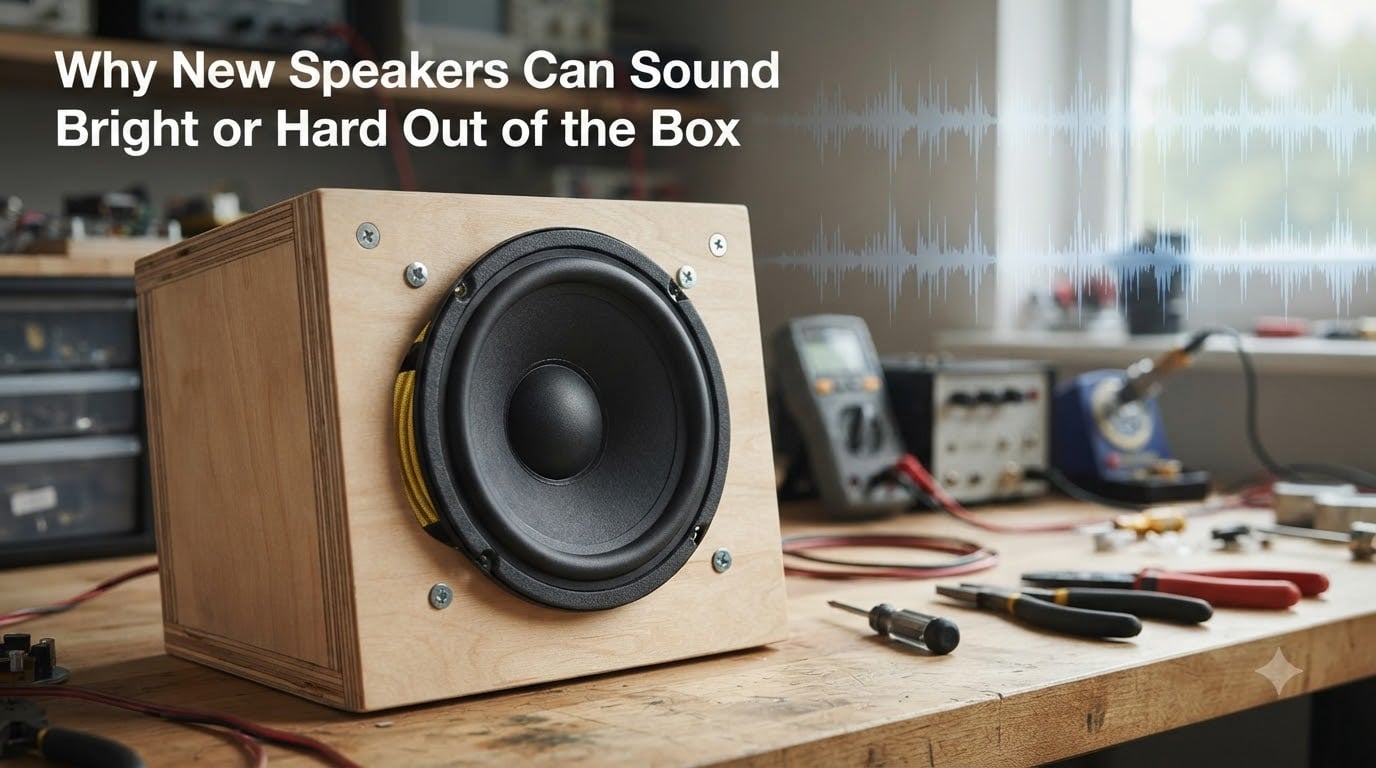
If you just installed a new set of speakers and they sound bright, harsh, or thin, you are not imagining it. New speakers can sound bright or hard out of the box because the mechanical suspension components are still stiff from manufacturing. Once those parts settle through normal use (typically 20-40 hours of playback), the sound usually smooths out and bass response deepens.
I have installed aftermarket speakers in my own vehicles for years, and that brittle, almost metallic quality always shows up in the first week. It is normal, and it is fixable with patience.
In this guide, I will walk you through what causes that initial brightness, how long break-in actually takes, and the safe way to help your speakers reach their full potential without damaging them.
Table of Contents
What Does It Mean When Speakers Sound Bright or Hard?
When we say a speaker sounds “bright,” we mean the high frequencies stick out more than the rest of the audio spectrum. Cymbals, snare drums, consonants in vocals, and string instruments can come across as sharp or even piercing.
“Hard” is a related term that describes sound that lacks warmth and feels aggressive on the ears. Both qualities are usually temporary when you are dealing with fresh speakers.
You might notice these specific symptoms in the first few days:
Vocals sound sibilant (the “s” and “t” sounds are exaggerated)
Cymbals and high hats feel harsh or metallic
Bass feels weak or missing compared to your old speakers
Midrange feels recessed or distant
Overall sound feels “thin” rather than full-bodied
None of these symptoms necessarily mean your speakers are defective. In most cases, they simply mean the mechanical parts have not loosened up yet.
Why New Speakers Sound Bright or Hard Out of the Box
The short answer is mechanical suspension stiffness. Every driver (woofer, midrange, or tweeter) uses a suspension system to keep the cone centered and control its movement. Three components matter most: the surround (the outer ring that connects the cone to the basket), the spider (the corrugated inner piece that attaches to the voice coil), and the voice coil itself.
Right out of the manufacturing process, these parts are brand new and have never flexed under real-world conditions. Rubber surrounds are fresh from the mold. Spider fabric is taut. The adhesives that hold everything together are still curing.
This stiffness changes how the cone moves. A stiff suspension means:
The cone resists quick movements at low frequencies, weakening bass
High-frequency resonances are not damped as effectively, boosting treble
The voice coil does not center perfectly during long excursions, adding distortion
Frequency response is uneven, often with peaks in the upper midrange and treble
That combination produces exactly what you hear: bright highs, weak bass, and an overall harsh character.
Some of the brightness also comes from your ears. When you upgrade speakers, your brain is calibrated to the old sound. New speakers often reveal details you never noticed before, and that can feel like harshness at first. Audiophiles call this “new gear syndrome.”
What Actually Changes During Speaker Break In
Speaker break in is the gradual process where the suspension components loosen through physical use. As the cone moves back and forth thousands of times, the rubber and fabric parts flex and settle into their working positions.
Here is what specifically changes:
The Surround
The rubber or foam surround is the most visible suspension part. When new, it has tighter molecular bonds and more internal friction. Repeated flexing breaks in those bonds and reduces stiffness. A more compliant surround allows the cone to move farther with less effort, which directly improves bass output.
The Spider
The spider is the corrugated fabric disc behind the cone. It controls how far the cone can travel in either direction. New spiders are stiffer than they will ever be again. After break-in, spider compliance increases, which lowers the driver’s resonance frequency (Fs) and improves low-end extension.
This is one reason measurements can confirm break-in. A woofer’s Fs might drop by 2-5 Hz after the first 20 hours of use.
The Voice Coil and Former
The voice coil sits in a magnetic gap and is attached to the cone via a cylindrical former. New voice coils can sit slightly off-center in the gap. Heat from normal use and physical movement help center everything precisely, reducing distortion.
Adhesive Curing
The glues that bond the cone, surround, spider, and voice coil continue to cure in the first weeks of use. Temperature cycling from playback and ambient conditions helps these bonds stabilize.
Break In vs Burn In
You will see both terms used online. They refer to the same mechanical process for speakers. “Burn in” originally described electronic stabilization in amplifiers and DACs, but audiophiles adopted it for speakers too. For speakers specifically, “break in” is the more accurate term since it involves physical flexing of mechanical parts.
How Long the Break In Period Usually Lasts
Most speakers reach roughly 80-90% of their final sound signature within the first 20-40 hours of playback. Some drivers take longer, and some settle much faster.
Here is a general timeline by speaker type:
Tweeters: 5-15 hours. Tweeters have minimal suspension travel, so they settle quickly.
Midrange drivers: 15-30 hours. Moderate suspension travel with more visible change.
Woofers and subwoofers: 30-60 hours. Long excursions mean more dramatic settling.
Full-range or coaxial speakers: 20-40 hours. Combination of midrange and tweeter behavior.
You will likely notice the biggest sonic changes in the first 10 hours. After that, changes become more subtle but continue for weeks. Some audiophiles report their speakers still sounding slightly different after 100+ hours.
Do not judge your speakers in the first hour. Even the best drivers need time.
Safe Break In Methods and Tips
There is a right way and a wrong way to break in new speakers. The goal is to flex the suspension without overdriving the driver.
Follow these guidelines for the best results:
Start at moderate volume. Roughly 50-60% of your head unit or amplifier’s clean output is ideal. Loud enough to exercise the suspension, quiet enough to avoid distortion.
Play varied music. Tracks with full bass, strong vocals, and cymbals cover the full frequency range and exercise every driver section.
Skip tracks with sustained distortion. Clipped signals can damage voice coils even at moderate volume.
Avoid pure test tones at high volume. Single-frequency test tones at high SPL can overheat a driver and damage the voice coil.
Let the system cool down periodically. Voice coils generate heat. Give them breaks if you are running extended break-in sessions.
Use FM radio or a pink noise track for background break-in. If you want to speed things up, low-level pink noise played for 8-12 hours is a popular method.
Recheck your settings after 20 hours. Bass and treble controls that seemed right initially may need adjustment once the speakers settle.
I personally use a playlist of well-recorded songs at conversation-friendly volume for the first day, then start listening normally. By the second week, the speakers usually sound noticeably fuller.
Common Mistakes That Can Damage New Speakers
You can absolutely shorten the life of new speakers by mishandling the break-in period. Here are the most common errors I see:
Cranking the Volume to “Break Them In Faster”
This is the single biggest mistake. Playing speakers loud does not break them in faster. It just sends more power into a stiff suspension that cannot dissipate heat properly. Distortion at high volume is what kills speakers, not the lack of break-in.
Boosting Bass Hard Right Away
A bass boost sends strong low-frequency signal into a stiff suspension. The cone tries to move farther than the new parts allow, leading to distortion and possible damage to the surround or spider.
Playing Heavily Clipped Audio
If your amplifier or head unit is clipping, the speaker receives a square wave instead of a clean sine wave. The extra harmonics heat the voice coil rapidly and can cause failure.
Assuming the Speakers Are Defective Too Soon
Many “defective” speakers are returned to stores during what is actually a normal break-in period. Before assuming a fault, give the speakers at least 30 hours of use and re-evaluate.
Ignoring Installation Issues
Sometimes the brightness is not from the speaker at all. Loose mounting, polarity reversal, or poor sealing can make speakers sound harsh. Confirm proper installation before blaming the break-in process.
The 83% Rule for Speakers
In speaker design and room acoustics circles, the “83% rule” is a guideline that roughly 83% of perceived sound quality comes from the speaker itself, with about 17% coming from room interaction and placement. If your new speakers sound harsh, double-check placement and room treatment before assuming the drivers are at fault.
Many people break in their speakers correctly, then realize the real issue was speaker placement or room reflections all along.
Do Speakers Get Louder After Break In?
This is a common forum question. Yes, many users notice a small perceived loudness increase after break-in, especially in bass frequencies. As suspension compliance improves, the cone moves more efficiently at low frequencies, which means more output for the same input power.
The change is not dramatic. You will not need to recalibrate your amplifier gains. But you might notice your bass knob sitting at a slightly lower position while delivering the same low-end punch.
Some audiophiles report their speakers getting slightly brighter after break-in rather than smoother. This usually points to room acoustics or source material rather than the speakers themselves.
FAQs
How long does it take for new speakers to break in?
Most speakers reach roughly 80-90% of their final sound within 20-40 hours of playback. Tweeters settle faster (5-15 hours), while woofers and subwoofers can take 30-60 hours for noticeable change.
Do speakers really need to break in?
Yes, but the changes are mostly mechanical. Suspension components like the surround and spider loosen with use, improving bass response and smoothing high frequencies. The audible difference varies by driver and listener.
Why do my brand new speakers sound distorted?
Distortion in new speakers usually comes from stiff suspension restricting cone movement or from the source sending clipped or overly loud signals. Check your gain settings and source quality first. If distortion persists beyond 40 hours, the driver may be defective.
What does it mean when speakers sound bright?
A bright sound means high frequencies are emphasized relative to the rest of the audio. Cymbals, snare drums, and vocal consonants stand out sharply. In new speakers this is typically temporary and caused by stiff suspension damping high frequencies poorly.
Why do aftermarket speakers sound harsh?
Aftermarket speakers often reveal details your stock speakers hid. Combined with stiff new suspension, this can feel harsh at first. After 20-40 hours of break-in and proper gain setting, the harshness usually fades and the detail becomes a strength.
Conclusion
New speakers can sound bright or hard out of the box because of stiff mechanical suspension straight from the factory. The surround, spider, and voice coil need flex cycles to reach their working compliance, and that process typically takes 20-40 hours of playback.
If your new speakers sound harsh, give them time, keep the volume moderate, and avoid clipping or bass boosts in the first week. After that, re-evaluate your settings and placement. In most cases, what sounded like a problem becomes a much better-sounding system than the one you replaced.
Patience is the only tool you really need during speaker break in. Let the speakers do their work, and you will be rewarded with cleaner bass, smoother mids, and more accurate highs once everything settles.
1 thought on “Why New Speakers Can Sound Bright or Hard Out of the Box (September 2026) Guide”