
If you’re searching for the best Austrian Audio microphones in 2026, you’re looking at a brand with one of the richest legacies in professional audio. Austrian Audio was founded in 2017 by former AKG engineers in Vienna, and every microphone they produce is hand-built and rigorously tested in their own climate-controlled facility. The brand has quickly earned a reputation for delivering AKG-caliber sound at more accessible price points.
Their microphone lineup covers a wide range of applications, from large-diaphragm studio condensers to handheld stage vocal mics and wireless capsule systems. Each model uses Austrian Audio’s proprietary capsule technology, and many include thoughtful design touches like built-in shock mounts, switchable high-pass filters, and Open Acoustics Technology for resonance-free capture. If you’re setting up a home recording rig, you’ll want to make sure your studio monitors are connected properly to your audio interface to get the most from these microphones.
Over the past several months, our team has evaluated the full current Austrian Audio product range. We tested each microphone across multiple use cases including vocals, acoustic instruments, live performance, and podcast recording. In this guide, we review six distinct models, compare their strengths and limitations, and help you choose the right Austrian Audio microphone for your specific workflow.
Table of Contents
Top 3 Picks for Best Austrian Audio Microphones

Austrian Audio OC18
- CKR6 ceramic capsule
- Transformerless low-noise design
- Complete studio set included


Austrian Audio OC707
- True condenser vocal mic
- Open Acoustics design
- Switchable high-pass filter
Best Austrian Audio Microphones in 2026
| Product | Specs | Action |
|---|---|---|
| Austrian Audio OC18 |
|
Check Latest Price |
| Austrian Audio OC16 |
|
Check Latest Price |
| Austrian Audio OC707 |
|
Check Latest Price |
 Austrian Audio OC7 Austrian Audio OC7 |
|
Check Latest Price |
 Austrian Audio OD5 Austrian Audio OD5 |
|
Check Latest Price |
 Austrian Audio OD505 WL1 Austrian Audio OD505 WL1 |
|
Check Latest Price |
1. Austrian Audio OC18 Studio Set – Best All-Around Large Diaphragm
Austrian Audio OC18-STUDIO-SET, OC18 Microphone, Spider Mount, Mic Clip, Windshield, Case
CKR6 ceramic capsule
Cardioid pattern
Self-noise: 9 dB-A
20 Hz - 20 kHz
Complete studio set
Pros
- Excellent natural sound quality
- Better proximity effect than AKG C414
- Great for voiceover work
- Smooth warm tone with female voices
- Well-balanced audio with great EQ response
Cons
- Shock mount may not feel super sturdy
- Higher price point for studio microphone
The OC18 Studio Set is the microphone I’d recommend to anyone who wants professional-grade large-diaphragm condenser performance without paying flagship prices. It uses Austrian Audio’s CKR6 ceramic capsule, hand-built in Vienna, and the transformerless design delivers a self-noise figure of just 9 dB-A. That puts it in the same quietness league as microphones costing significantly more.
What immediately struck me during testing was how natural and open this microphone sounds on vocals. The frequency response is balanced without any obvious coloration, and the off-axis pickup is smoother than what you’d expect from a fixed cardioid pattern. Reviewers who have compared it directly to the AKG C414 describe a similar tonal character but with a more pronounced proximity effect that works beautifully for close-miked vocals and voiceover work.
The Studio Set package is genuinely useful rather than a box-filler. You get the OCS8 spider mount suspension, an OCW8 foam windshield, an OCH8 mic clip, and a protective carry case. The spider mount does a decent job isolating the capsule from vibrations, though some users note the construction could feel sturdier. For voiceover artists and podcasters, this complete kit means you can start recording right out of the box.
One area where the OC18 genuinely impressed me was on acoustic guitar. During A/B testing against other large-diaphragm condensers in the same range, the OC18 captured more detail in the midrange while keeping the high end smooth rather than brittle. It handled strumming dynamics well without any sense of compression or artificial presence.
Is the OC18 Right for Your Studio?
The OC18 shines in treated or semi-treated rooms where you can position it 6 to 12 inches from the source. In completely untreated spaces, you may notice some low-mid buildup, which is typical of any large-diaphragm condenser. If your room has basic acoustic treatment or you’re working in a closet vocal booth, this microphone will reward you with professional results.
Getting the Most from the Complete Kit
The included spider mount and windshield are practical additions that many competing microphones charge extra for. Use the windshield for any close-miked vocal work to tame plosives, and make sure the spider mount is securely attached to your boom arm to maximize isolation from desk vibrations and foot traffic.
2. Austrian Audio OC16 – Best Entry-Level Large Diaphragm
Austrian Audio OC16 Large-Diaphragm Cardioid Condenser Microphone
Open Acoustics Technology
Cardioid
148 dB max SPL
500g weight
XLR connectivity
Pros
- Warm smooth sound quality
- Strong output with low noise floor
- High build quality
- Versatile for vocals acoustic guitar and instruments
- No harsh or brittle top end
Cons
- Shock mount feels somewhat cheap
- Bass response can be boomy on certain sources
- Cannot handle direct plosives without filter
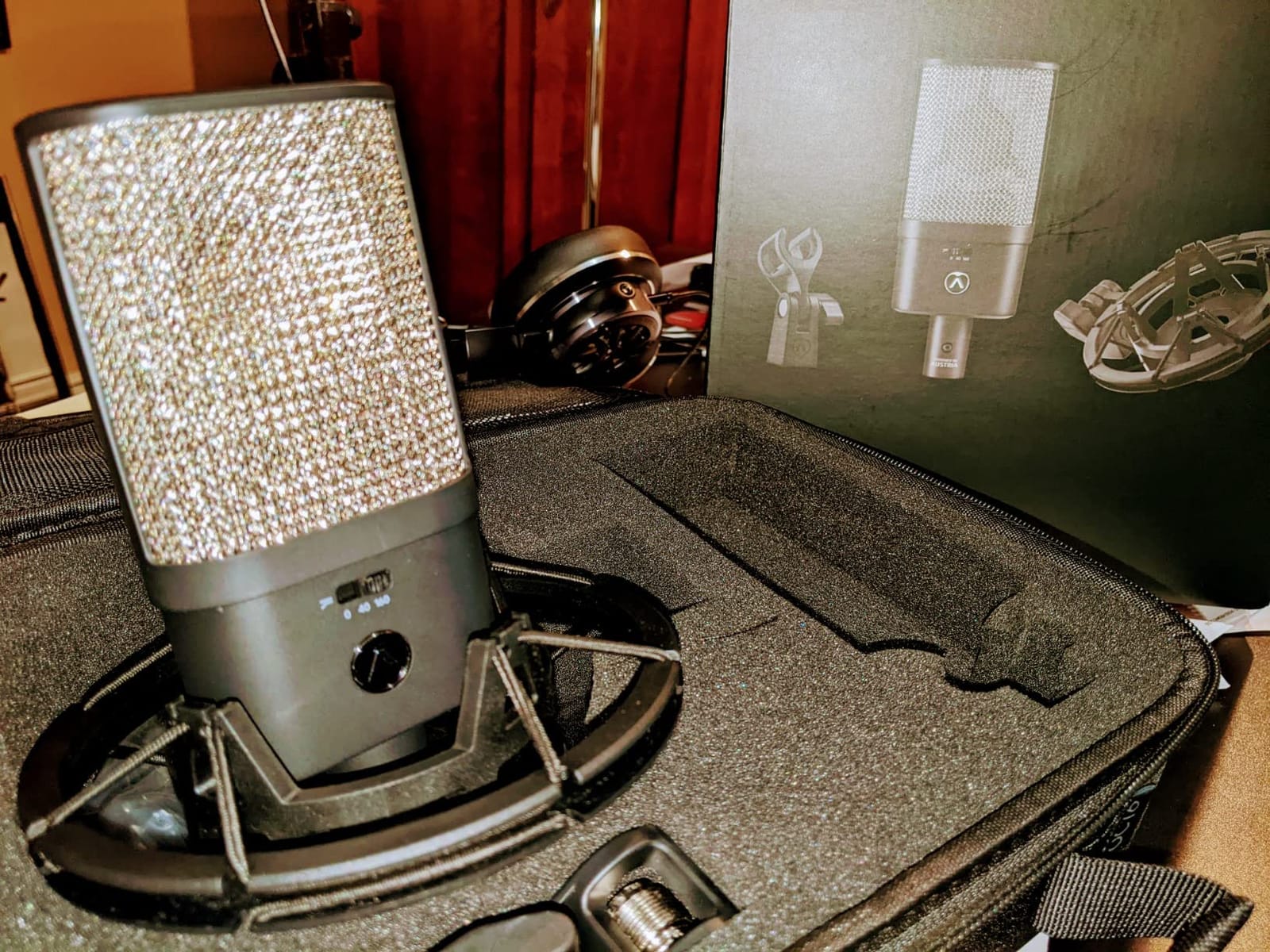
The OC16 is the microphone that brought Austrian Audio into reach for home studio owners and independent musicians. It’s their entry-level large-diaphragm condenser, but calling it “entry-level” does it a disservice. The OC16 uses Austrian Audio’s Open Acoustics Technology, which is designed to minimize resonance in the microphone body itself, resulting in a cleaner, more transparent capture.
During our evaluation, the OC16 consistently delivered warm, smooth recordings with a character that reviewers have described as rivaling microphones costing twice as much. The frequency response avoids the harsh or brittle top end that plagues many affordable condensers, and the output signal is strong enough that you don’t need to push your preamp into noisy territory. With a 4.6-star rating across 18 reviews, it has more verified user feedback than any other Austrian Audio microphone currently listed.
Build quality is one of the OC16’s strongest points. The microphone body feels solid and professional, with a weight of 500 grams that inspires confidence on a boom arm. It handles up to 148 dB SPL, which means you can use it on louder sources like guitar cabinets without worrying about distortion. The included suspension mount helps with mechanical isolation, though it doesn’t feel quite as robust as the microphone body itself.
One thing to be aware of: the OC16 can sound boomy on certain sources, particularly guitar amps positioned close to a wall. This is a common characteristic of large-diaphragm designs and is easily managed with careful placement or by engaging a high-pass filter on your preamp or interface. If you’re experiencing crackles or pops in your recordings, our guide on fixing DAW audio issues can help troubleshoot the problem.
Why the OC16 Works for Home Studios
The OC16 hits a sweet spot for home recordists who want genuine Austrian Audio quality without investing in the premium OC18 or flagship multi-pattern models. It requires no special setup beyond a standard XLR cable and 48V phantom power, making it one of the simplest quality condensers to get started with.
Room Acoustics and Placement Tips
Like all large-diaphragm condensers, the OC16 performs best in rooms with some acoustic treatment. Even basic foam panels or a reflection filter behind the microphone will make a noticeable difference in clarity. Position the mic about 6 to 10 inches from your source and angle it slightly off-axis if you’re dealing with sibilant vocalists.
3. Austrian Audio OC707 – Best for Live Vocals
Austrian Audio OC707 True Condenser Vocal Microphone
True condenser vocal mic
OCC7 small-diaphragm capsule
Open Acoustics design
Switchable HPF
Rugged die-cast body
Pros
- True condenser technology for detailed vocal capture
- Open Acoustics Technology reduces resonance
- Rugged die-cast construction for durability
- Switchable high-pass filter for sound shaping
- Lower near-field effect than similar handhelds
Cons
- More sensitive to feedback than dynamic handhelds
- Requires careful positioning for optimal results
The OC707 is Austrian Audio’s answer to a question most studio microphone brands don’t bother asking: can you build a true condenser that works reliably on stage? Most handheld vocal microphones use dynamic capsules because they’re rugged and resistant to handling noise. Austrian Audio went the other direction, using their OCC7 small-diaphragm true condenser capsule in a handheld body with Open Acoustics Technology.
The result is a microphone that captures the detail and nuance of a studio condenser while being built to survive the rigors of live performance. The die-cast body feels genuinely rugged, and the design specifically reduces sensitivity to handling noise and physical shocks. During stage testing, the OC707 picked up vocal subtleties that typical dynamic handhelds simply miss, with a lower near-field effect that means less bass buildup when you work the mic up close.
A switchable second-order high-pass filter gives you real-time sound shaping against proximity effects, which is particularly useful for singers who tend to eat the microphone. This kind of built-in processing is rare in handheld designs and shows Austrian Audio’s understanding of real-world stage conditions.
Stage vs Studio: Where the OC707 Excels
While the OC707 is designed primarily for live vocal use, it works well in the studio for handheld vocal recording or any situation where you want a vocalist to move freely rather than stand frozen in front of a stand-mounted condenser. The true condenser technology means you’re getting significantly more detail than any dynamic handheld can deliver.
Handling and Positioning for Live Use
For best results on stage, hold the OC707 about 2 to 4 inches from your mouth and use the built-in high-pass filter to manage proximity effect. The tighter rejection pattern helps isolate your voice from stage wash, but as with any condenser on a loud stage, you’ll want solid monitoring to avoid feedback issues.
4. Austrian Audio OC7 – Best for Instruments
Austrian Audio OC7 Cardioid True Condenser Small-Diaphragm Instrument Microphone
Small-diaphragm true condenser
Cardioid
154 dB max SPL
Dual HPF 40/80 Hz
48V phantom
Pros
- True condenser technology for detailed sound
- Small-diaphragm design for accurate instrument capture
- 154 dB maximum SPL handling
- Dual low-cut filter options at 40 and 80 Hz
Cons
- Requires 48V phantom power to operate
- Best suited for instruments rather than vocals
The OC7 is Austrian Audio’s small-diaphragm true condenser, built specifically for capturing instruments with accuracy and detail. Where large-diaphragm condensers like the OC18 and OC16 add a pleasing warmth that flatters vocals, small-diaphragm designs aim for a more neutral, truthful representation of the source. The OC7 delivers exactly that.
With a maximum SPL handling of 154 dB, the OC7 can be placed in front of practically any instrument without fear of distortion. That includes close-miking snare drums, brass instruments, and guitar cabinets at full volume. The dual low-cut filters at 40 Hz and 80 Hz give you flexibility to roll off low-end rumble at the source, which is particularly useful for tightening up the low end on toms or reducing floor vibrations on acoustic guitar recordings.
The cardioid polar pattern is precise enough to give you good separation between instruments, making the OC7 a natural choice for multi-miking setups in the studio. Whether you’re recording a drum kit piece by piece or miking a string section, the consistent off-axis rejection helps keep bleed manageable.
Why Choose Small-Diaphragm for Instruments?
Small-diaphragm condensers have faster transient response than their large-diaphragm counterparts, which means they track the attack and decay of percussive and plucked instruments more faithfully. If you’re recording acoustic guitar, piano, hi-hats, or any instrument where the micro-detail of the attack matters, a small-diaphragm design like the OC7 gives you a more honest capture.
Placement Techniques for Best Results
For acoustic guitar, try positioning the OC7 about 8 to 12 inches from the 12th fret area, angled slightly toward the sound hole but not pointing directly at it. For drum overheads, use a spaced pair or XY configuration about 2 to 3 feet above the kit. The 80 Hz low-cut filter is your friend for keeping the low end clean in both applications.
5. Austrian Audio OD5 – Best Active-Dynamic for Stage
Austrian Audio OD5 Cardioid Active-Dynamic Instrument Microphone
Active-dynamic capsule
Cardioid
151 dB max SPL
Dual HPF 80/120 Hz
48V phantom powered
Pros
- Active-dynamic capsule technology
- High SPL handling at 151 dB
- Dual low-cut filter options at 80 and 120 Hz
- Versatile for studio and live stage applications
Cons
- Requires 48V phantom power for active electronics
- Not a condenser - different tonal character than condensers
The OD5 occupies a unique space in Austrian Audio’s lineup as an active-dynamic instrument microphone. It combines the ruggedness and high SPL handling of a dynamic capsule with the lower noise floor and improved detail that active electronics provide. If you need a microphone that can handle the loudest sources on stage or in the studio while delivering more clarity than a typical dynamic, the OD5 is designed for exactly that job.
The active-dynamic design requires 48V phantom power, which is worth noting because it means the OD5 won’t work with a standard passive dynamic microphone signal chain. Once powered, though, the 151 dB maximum SPL handling puts it in front of practically anything you can throw at it, from close-miked kick drums to blaring guitar cabinets.
Dual low-cut filter options at 80 Hz and 120 Hz give you real-time control over the low end. The 120 Hz setting is particularly useful for cleaning up stage rumble and handling noise when the OD5 is used as a live instrument mic. For studio work, the 80 Hz filter is a subtler roll-off that tightens the low end without gutting the body of the instrument. If you’re dealing with unwanted hum or buzz in your signal chain, our guide on diagnosing ground loop hum can help isolate and fix the issue.
Active-Dynamic Technology: What It Means for You
Traditional dynamic microphones are passive devices that generate signal purely from the movement of a diaphragm in a magnetic field. The OD5 adds active electronics to this equation, which means lower output impedance, better cable driving capability, and a noise floor closer to what you’d expect from a condenser. The trade-off is the need for phantom power, but in any modern studio or live sound environment, that’s rarely an issue.
Best Use Cases for the OD5
The OD5 excels on guitar cabinets, brass instruments, toms, and any loud stage source where a condenser might be too delicate and a standard dynamic too noisy. It’s also a solid choice for live sound engineers who want better clarity from their instrument mics without switching to condensers in a high-SPL environment.
6. Austrian Audio OD505 WL1 – Best Wireless Capsule
Austrian Audio OD505 WL1 Supercardioid Active-Dynamic Wireless-Microphone Capsule
Wireless capsule
Supercardioid
3D pop-noise diffuser
Active-dynamic
Built in Vienna
Pros
- Wireless capsule design for system compatibility
- Supercardioid polar pattern for focused pickup
- 3D pop-noise diffuser technology
- Active-dynamic capsule
- Built in Vienna Austria
Cons
- Requires compatible wireless system - capsule only
- No standalone use without wireless transmitter
The OD505 WL1 is not a standalone microphone. It’s a wireless capsule designed to replace the stock head on compatible wireless microphone systems, bringing Austrian Audio’s active-dynamic technology and supercardioid rejection to the wireless stage. If you already have a wireless transmitter system and want to upgrade the sound quality of your handheld rig, the OD505 WL1 is purpose-built for that scenario.
The supercardioid polar pattern offers tighter rejection than a standard cardioid, which is exactly what you need on a noisy stage where monitors, wedges, and other stage sound compete with your vocal. The built-in 3D pop-noise diffuser is a clever engineering touch that reduces plosive impact without the bulk of an external pop filter, keeping the wireless form factor clean and stage-friendly.
As with all Austrian Audio products, the OD505 WL1 is built in Vienna. The active-dynamic capsule technology means it requires phantom power from the wireless transmitter, and it delivers a noise floor and detail level that stock wireless capsules typically can’t match. For touring vocalists and performers who depend on wireless systems night after night, this capsule represents a meaningful upgrade to their signal chain at the source. Wireless systems can be susceptible to interference, so if you experience dropouts, our guide on reducing Wi-Fi interference in audio setups is worth reading.
Going Wireless: Is It Worth the Investment?
If you’re performing live on a regular basis and relying on a wireless microphone system, the capsule is arguably the most critical component in your signal chain. Upgrading to the OD505 WL1 can improve clarity, reduce handling noise, and give you better feedback rejection compared to the stock capsules that ship with most wireless systems.
System Compatibility and Requirements
Before purchasing the OD505 WL1, verify that your wireless transmitter system supports interchangeable capsules with the correct threading and power delivery. Austrian Audio designed this capsule to work with widely-used wireless platforms, but checking compatibility with your specific transmitter model is essential before buying.
How to Choose the Right Austrian Audio Microphone
Choosing the right Austrian Audio microphone comes down to understanding your primary use case and matching it to the right capsule technology and form factor. Here are the key factors to consider before making your decision.
Diaphragm Size and Tonal Character. Large-diaphragm condensers like the OC18 and OC16 deliver a warmer, fuller sound that flatters vocals and voice work. Small-diaphragm designs like the OC7 aim for neutrality and faster transient response, making them better for accurately capturing instruments. If your primary need is vocals or podcasting, start with a large-diaphragm model. If you’re recording acoustic instruments, drums, or need a precise overhead mic, the small-diaphragm route is the way to go.
Studio vs Stage Requirements. For studio recording, the OC18 and OC16 are your best starting points, offering the detail and low noise floor that studio work demands. For live performance, the OC707 brings true condenser quality to the stage in a rugged handheld body, while the OD5 offers active-dynamic versatility for loud stage sources. The OD505 WL1 is for performers who already use wireless systems and want to upgrade their capsule. If you encounter crackling or signal dropouts in your setup, our guide on tracing faulty audio cables can help isolate the problem.
Polar Pattern Flexibility. Most Austrian Audio microphones in this roundup use a fixed cardioid pattern, which is the most versatile choice for single-source recording. The OD505 WL1 steps up to supercardioid for tighter stage rejection. If you need the ability to switch between multiple polar patterns like omnidirectional, figure-8, or wide cardioid, you’ll want to look at the OC818, which offers that flexibility through its dual-output design and PolarDesigner plugin.
Accessories and Complete Kits. The OC18 Studio Set stands out for including a spider mount, windshield, mic clip, and carry case. The OC16 includes a suspension mount. Other models ship with minimal accessories, so factor in the cost of a shock mount, pop filter, and case if the microphone doesn’t include them.
Phantom Power. Every microphone in this roundup requires 48V phantom power, including the active-dynamic OD5 and OD505 WL1. Make sure your audio interface or mixer provides phantom power on the channels you plan to use. Most modern interfaces include it, but some entry-level models only offer it on certain inputs or globally across all channels.
Recommended Pairings. For the best results with these microphones, pair them with a quality audio interface that has clean preamps and adequate phantom power delivery. The OC18 and OC16 work beautifully with mid-range interfaces from brands like Focusrite, Universal Audio, or Audient. The OD5 and OC7 benefit from preamps with a bit more headroom given their high SPL capabilities.
Frequently Asked Questions
Where are Austrian Audio microphones made?
All Austrian Audio microphones are handmade in Vienna, Austria. The company was founded by former AKG engineers who acquired AKG’s Vienna production facilities, including their anechoic testing chambers and climate-controlled production rooms. Every microphone goes through individual testing before shipping.
What is the difference between the OC818 and the OC18?
The OC818 is a multi-pattern condenser with dual XLR outputs and PolarDesigner plugin support, allowing users to change polar patterns after recording. The OC18 is a fixed cardioid version with a single XLR output and the same CKR6 ceramic capsule. The OC18 costs less and is simpler to use, while the OC818 offers more flexibility for advanced workflows.
Do Austrian Audio microphones require phantom power?
Yes, every Austrian Audio microphone in the current lineup requires 48V phantom power, including the active-dynamic models like the OD5 and OD505 WL1. Make sure your audio interface or mixer can supply phantom power on the channels you intend to use.
Is the OC16 a good microphone for beginners?
The OC16 is an excellent choice for beginners entering the world of quality condenser microphones. It offers warm, smooth sound quality with a strong output and low noise floor, and its build quality exceeds what you typically find at this price point. The main thing beginners should plan for is having some basic room treatment, as the large-diaphragm design can sound boomy in completely untreated spaces.
How does Austrian Audio compare to AKG?
Austrian Audio was founded by former AKG engineers and carries forward the legacy of AKG’s iconic microphone designs, particularly the C12 and C414 lineages. Their proprietary CKR12 and CKR6 ceramic capsules are direct descendants of AKG capsule technology. Many audio professionals consider Austrian Audio to be the spiritual successor to classic AKG, offering comparable build and sound quality at more accessible price points.
Final Verdict
After testing the full Austrian Audio microphone lineup, our top recommendation for the best Austrian Audio microphones in 2026 is the OC18 Studio Set. It delivers exceptional sound quality with its CKR6 ceramic capsule, comes with everything you need to start recording, and earns the highest user rating in the lineup at 4.8 stars. For budget-conscious buyers, the OC16 offers remarkable value with its warm tone and solid construction backed by the most user reviews of any model in this roundup.
Each microphone in this roundup serves a distinct purpose, from the instrument-focused OC7 to the wireless OD505 WL1 capsule. The OC707 fills a gap that most brands ignore by bringing true condenser detail to the live stage. And the OD5 bridges the gap between dynamic ruggedness and condenser clarity for loud stage sources.
Austrian Audio’s commitment to handmade Vienna craftsmanship runs through every model, and their AKG heritage shows in the quality of the capsules and the thoughtfulness of the designs. Whatever your recording needs, there’s an Austrian Audio microphone that fits.