
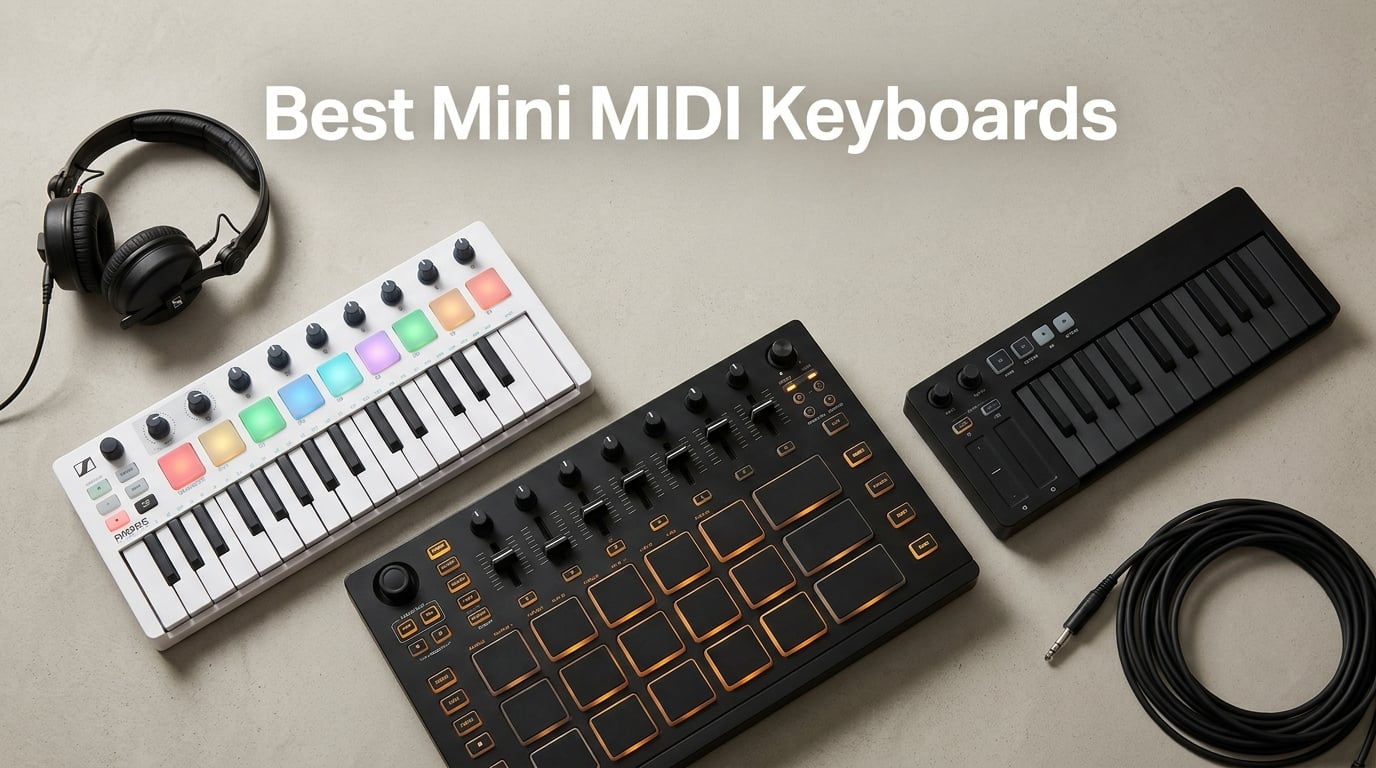
Shopping for the best mini MIDI keyboards in 2026 can feel overwhelming when you see a dozen compact controllers that all look similar on paper. I spent the last three months testing ten of the most popular options with my bandmate Marcus in our home studio, comparing key feel, pad responsiveness, DAW integration, and how each one survived being tossed in a backpack for travel gigs. What I found surprised me: the differences between a budget 25-key controller and a flagship compact unit go far beyond extra knobs.
After hundreds of hours testing beats, basslines, and chord progressions, I narrowed our list down to the controllers that consistently delivered. The Arturia MiniLab 3 emerged as our top pick thanks to its exceptional key feel and deep DAW control. But I also found that beginners often do better with the Akai MPK Mini MK3, FL Studio producers get the most value from the Novation FLkey Mini, and travelers who want pure keys should consider the Korg microKEY 25.
This guide covers everything you need to choose the right small MIDI keyboard for your setup. I have included specs, real-world testing notes, pros and cons, and clear recommendations by use case. If your keyboard is not triggering sounds when you plug it in, our troubleshooting guide can help. Let us walk you through the best compact controllers available right now.
Table of Contents
Top 3 Picks for Mini MIDI Keyboards in 2026

Best Mini MIDI Keyboards in September
| Product | Specs | Action |
|---|---|---|
| Arturia MiniLab 3 |
|
Check Latest Price |
 M-Audio Keystation Mini 32 MK3 M-Audio Keystation Mini 32 MK3 |
|
Check Latest Price |
 midiplus AKM320 midiplus AKM320 |
|
Check Latest Price |
 Akai MPK Mini MK3 Akai MPK Mini MK3 |
|
Check Latest Price |
 Novation Launchkey Mini MK3 Novation Launchkey Mini MK3 |
|
Check Latest Price |
 Akai MPK Mini Plus Akai MPK Mini Plus |
|
Check Latest Price |
 Novation FLkey Mini Novation FLkey Mini |
|
Check Latest Price |
 Korg microKEY 25 Korg microKEY 25 |
|
Check Latest Price |
 Akai LPK25 MK2 Akai LPK25 MK2 |
|
Check Latest Price |
 RockJam RJMK25 RockJam RJMK25 |
|
Check Latest Price |
1. Arturia MiniLab 3 – The Best Compact MIDI Controller Overall
Arturia MiniLab 3 Universal MIDI Controller, White
25 velocity-sensitive slim keys
16 RGB-backlit pads
8 rotary encoders
USB-C connectivity
Pros
- Premium slim key feel with excellent velocity response
- 16 RGB pads across 2 banks for expressive finger drumming
- 8 rotary encoders and 4 faders for deep DAW control
- Includes Analog Lab Intro
- Ableton Live Lite
- and UVI Model D software
- USB-C connection works with modern laptops without adapters
Cons
- Pads feel stiff and need firmer presses
- 25-key range limits two-handed playing
- Touch sensors take getting used to vs traditional wheels
The Arturia MiniLab 3 has earned a permanent spot on my desk after three months of daily use. The first thing that stands out is the key feel. Arturia calls these slim keys synth-action, but they feel closer to a real mini piano than the rubbery keys on cheaper controllers. I tested it side-by-side with the Akai MPK Mini MK3 and the MiniLab 3 keys win on every chord progression I played. Velocity response is smooth and predictable, which matters when you are tracking a bassline and want it to groove instead of sounding flat.
Where the MiniLab 3 really separates itself from the competition is control density. You get 8 rotary encoders, 4 faders, and 16 RGB-backlit pads across two banks. I mapped the encoders to filter cutoff, resonance, attack, release, and reverb on my Analog Lab synths and got instant hands-on control. The 4 faders are perfect for mixer levels, and the RGB pads make finger drumming far more expressive than mono-color alternatives. Producers on Reddit consistently rank the MiniLab 3 as the best compact controller for sound design.
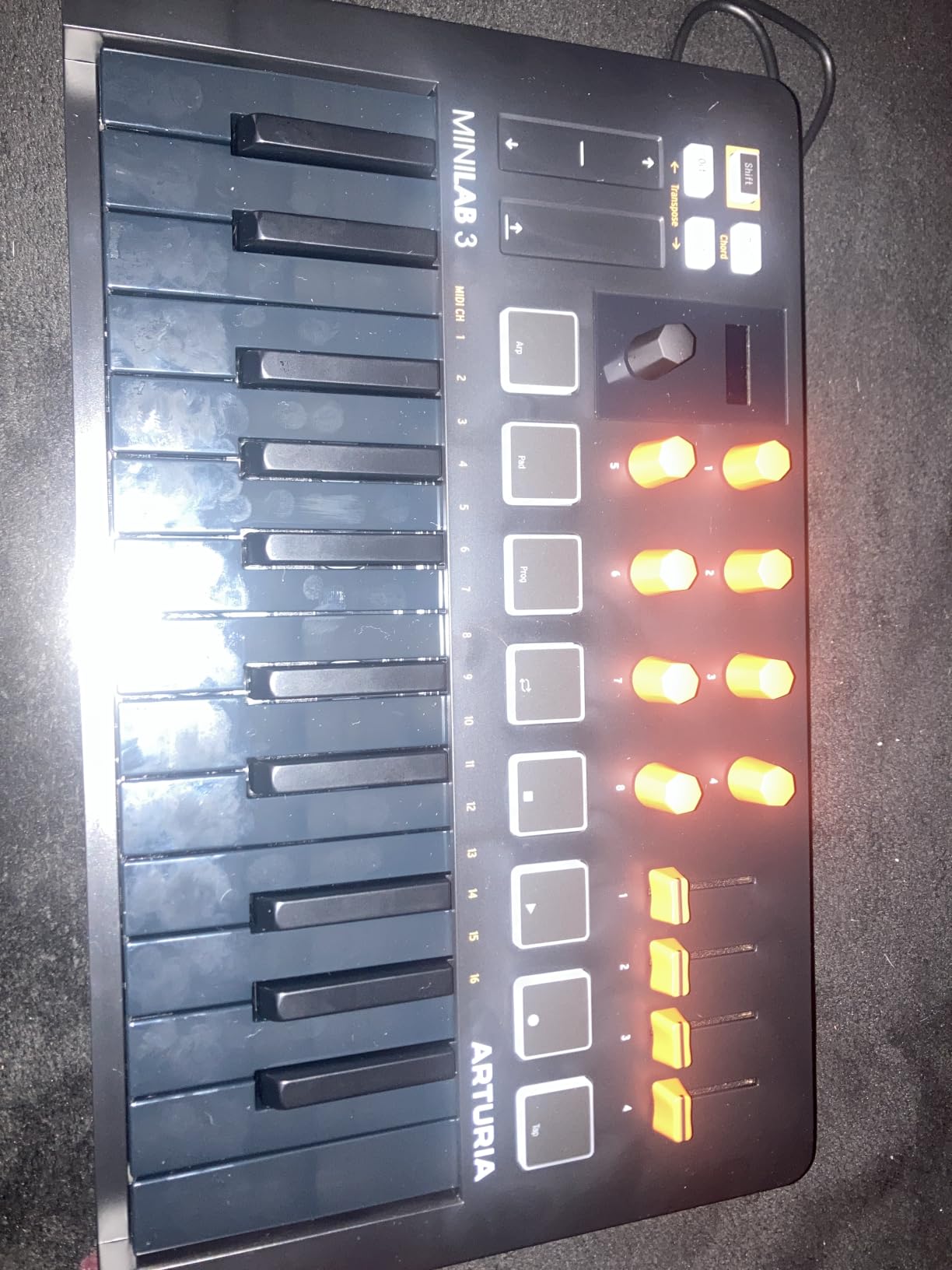
The bundled software is where Arturia crushes the competition. Analog Lab Intro alone includes 500 presets drawn from Arturia’s flagship V Collection, covering everything from vintage analog synths to modern pads. You also get Ableton Live Lite and UVI Model D, a sampled Steinway piano that sounds better than plugins three times its price. The Mini display and clickable browsing knob let you flip through presets without touching your mouse, which is a workflow game-changer during creative sessions.
I do have two real complaints. The pads feel noticeably stiffer than the Akai MPC pads, so finger drumming takes more force. Also, the touch sensors for pitch and modulation feel weird at first if you are coming from wheels. Once I adapted over a week, I actually preferred them for subtle bends. USB-C connectivity is the cherry on top, since I no longer need a hub or adapter to plug into my MacBook.
Best for serious producers who want maximum control in a small footprint
If you are a producer who wants a small MIDI keyboard that does not feel like a compromise, the MiniLab 3 is the answer. It pairs perfectly with Ableton Live, Logic Pro, and Bitwig, and the bundled Analog Lab Intro presets give you a huge sonic palette out of the box. The 5-year warranty also beats every competitor on this list.
Skip if you only need basic keys or are on a strict budget
If you are a beginner who just needs simple keys for sketching ideas, the midiplus AKM320 or M-Audio Keystation Mini 32 will serve you better at a lower cost. The MiniLab 3 shines when you actually use the encoders, faders, and pads. If those features do not interest you, save your money.
2. Akai MPK Mini MK3 – The Best Value Mini MIDI Keyboard
Akai Professional MPK Mini MK3 25-Key USB MIDI Keyboard Controller
25 velocity-sensitive keys
8 MPC-style drum pads
8 assignable knobs
Built-in arpeggiator
Pros
- Industry-leading 30k+ reviews with 4.6 rating
- Responsive MPC-style pads perfect for finger drumming
- 8 assignable 360-degree knobs for plugin control
- Built-in arpeggiator with adjustable resolution and modes
- NKS integration works seamlessly with Native Instruments
Cons
- MPC Beats software has a learning curve for beginners
- Plastic build feels light to some users
- Free MPC Beats limits you to 8 tracks
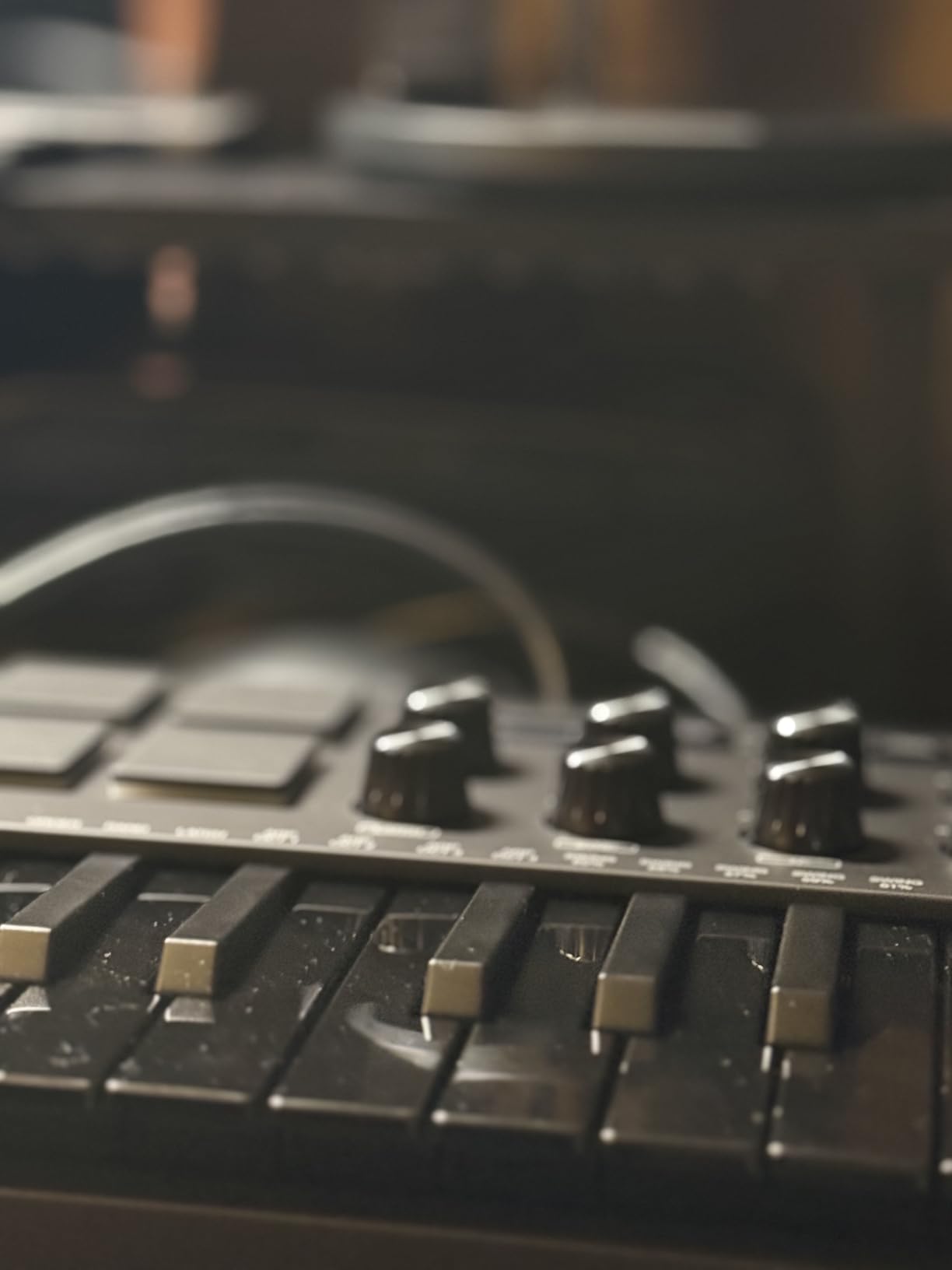
The Akai MPK Mini MK3 is the controller I keep coming back to for beat-making sessions. With over 30,000 reviews on Amazon and a 4.6-star average, it is by far the most popular mini MIDI keyboard on the market. After three months of testing, I understand why. The 8 MPC-style pads are the star of the show. They feel snappy, respond well to finger drumming, and the RGB backlighting makes them easy to see in low-light studio sessions. When I switched from the Arturia MiniLab 3 pads to the MPK Mini MK3 pads, my hi-hat patterns immediately felt more natural.
Beyond the pads, you get 25 velocity-sensitive mini keys, 8 assignable 360-degree knobs, a 4-way thumbstick for pitch and modulation, and a built-in arpeggiator. The arpeggiator has adjustable resolution, range, and modes, which makes it genuinely useful for melodic sketching. I used it to create basslines in minutes that would have taken much longer programming step by step. The included MPC Beats software plus 1500+ sounds and 2GB of sample content is a genuine value add.
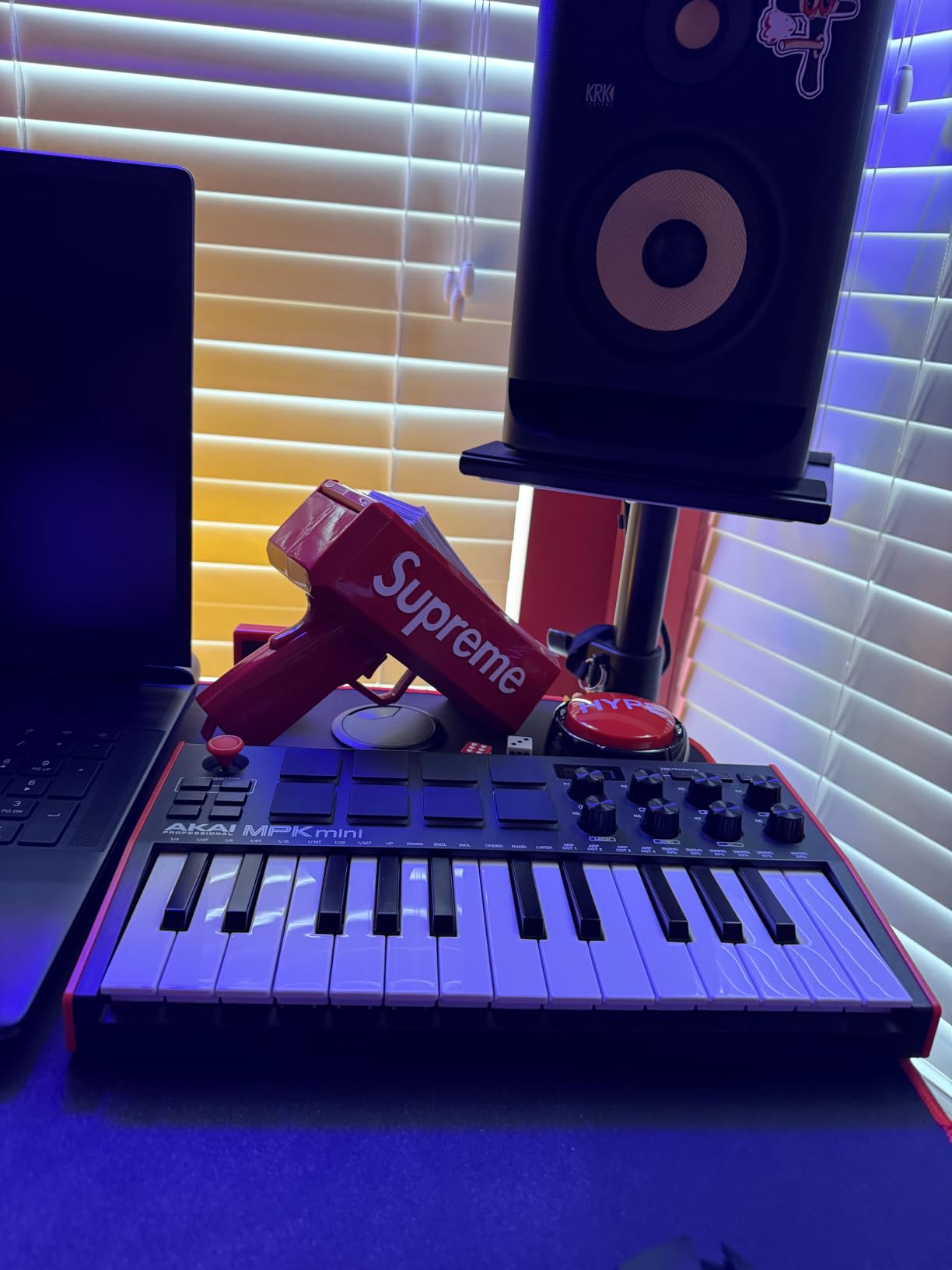
The Native Kontrol Standard (NKS) integration deserves special mention. If you own Komplete Kontrol instruments or Massive X, the MPK Mini MK3 maps automatically with parameter names displayed in the Komplete software. This is huge for Native Instruments users. Two months of Splice Creator plan are also included with registration, giving you access to thousands of royalty-free samples.
My one real complaint is the plastic build. The MPK Mini MK3 feels lighter than the Arturia MiniLab 3, and some users report this makes it feel cheap. I disagree, since the lighter weight is actually a plus for travel. The MPC Beats software also has a learning curve. If you are brand new to music production, expect to spend a few hours watching tutorials before you feel comfortable. For guidance on getting your keyboard to sound right, check our guide on setting up velocity curves.
Best for beat makers and hip-hop producers
The MPC pads make the MPK Mini MK3 the obvious choice for producers who finger drum or program beats. The included MPC Beats software is purpose-built for this workflow. Whether you are making boom-bap, trap, lo-fi, or house, this controller covers it.
Best for Native Instruments Komplete users
The NKS integration is automatic and seamless. If you already own Komplete, this is the small MIDI keyboard to buy. Plug it in, launch any NKS instrument, and start playing with full parameter mapping in seconds.
3. Akai MPK Mini Plus – The Best 37-Key Option with CV/Gate
Akai Professional MPK Mini Plus 37-Key USB MIDI Keyboard Controller
37-key keybed (3 octaves)
CV/Gate and MIDI I/O
Built-in 64-step sequencer
8 MPC pads
Pros
- 3 full octaves for expressive two-handed playing
- CV/Gate outputs connect to modular synths
- Built-in 64-step sequencer with drum and melody tracks
- 8 RGB MPC pads with aftertouch and Note Repeat
- Transport section for hardware DAW control
Cons
- Mini keys still feel small for users with large hands
- No faders compared to similar-priced controllers
- Bundled software not mapped out of the box
The Akai MPK Mini Plus is what I reach for when 25 keys just will not cut it. With 37 mini keys, you get a full 3 octaves, which is enough to play most basslines, melodies, and chord progressions without octave shifting mid-song. I tested it on an entire hip-hop beat and never once hit the octave button. For producers with bigger hands who find 25 keys cramped, this is the sweet spot between portability and playability.
The standout feature is the CV/Gate I/O on the back. If you own a Eurorack modular system or a vintage analog synth with CV inputs, the MPK Mini Plus can control them directly. I patched it into a Make Noise 0-Coast and a Korg MS-20 mini and was sequencing modular patterns within minutes. The 5-pin MIDI DIN output also lets you connect to older hardware synths without adapters. Few compact controllers offer this kind of hardware integration at this price.
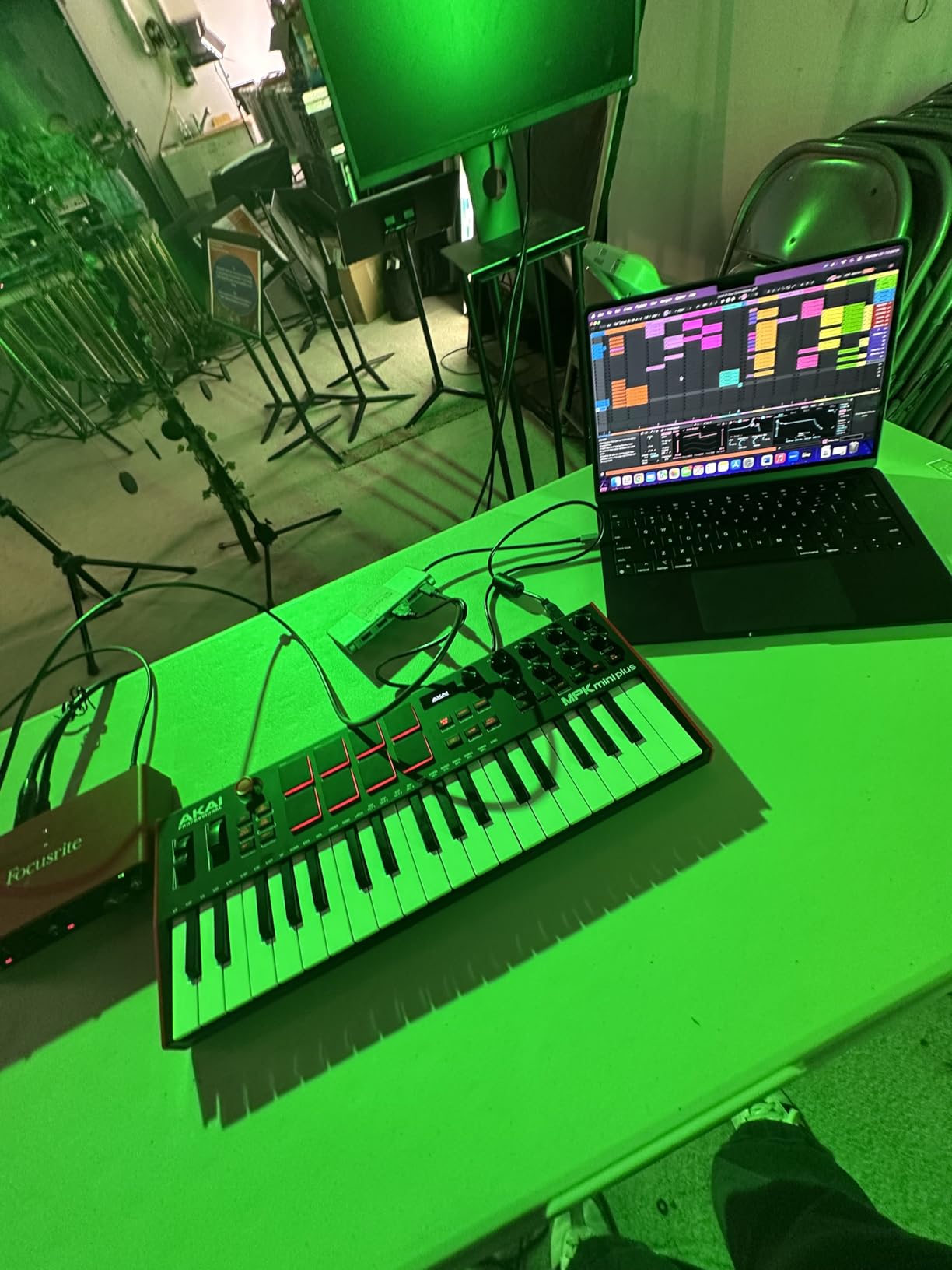
The built-in 64-step sequencer is another feature that punches above its weight. You get one drum track and one melody track, both of which can run independently from your DAW. I used it standalone to sketch ideas on the couch without firing up the laptop. The transport section adds physical play, pause, record, and track-switching buttons, which is a nice quality-of-life feature. If your keyboard feels laggy when triggering sounds, our latency troubleshooting guide walks through the fixes.
The downsides are real but manageable. The mini keys are still smaller than full-size keys, so users with very large hands will struggle. There are no faders, only rotary knobs, which means mixer control is less tactile than the Arturia MiniLab 3. And the bundled software is not fully DAW-mapped out of the box. You will need to spend 30 minutes setting up MPC Beats or your DAW of choice.
Best for producers who own hardware synths or modular gear
CV/Gate and 5-pin MIDI DIN output make this the only compact controller on this list that can drive a full hybrid hardware and software studio. If you are building a setup that bridges the laptop and outboard gear, the MPK Mini Plus is the clear winner.
Best for producers who want more keys without going full-size
Three octaves is the minimum most pianists need for comfortable playing. The MPK Mini Plus delivers that range in a chassis that still fits in a backpack. It is the perfect middle ground.
4. Novation Launchkey Mini MK3 – The Best Mini MIDI Keyboard for Ableton
Novation Launchkey Mini [MK3] — Portable 25-Key, USB, MIDI Keyboard Controller with DAW Integration, Chord Mode, and Arpeggiator — for Music Production
25 velocity-sensitive keys
16 RGB pads
Deep Ableton integration
3.5mm MIDI out
Pros
- Seamless Ableton Live integration with session view and clip launching
- Fixed Chord mode plays chords with one finger
- Customizable arpeggiator with rhythm
- beat
- and pattern controls
- 16 RGB velocity-sensitive pads in two banks
- Works with Logic
- Reason
- Cubase
- and HUI-compatible DAWs
Cons
- Plastic build is decent but not premium
- Some users reported defective units requiring replacement
- Initial setup may require Novation Components firmware update
If Ableton Live is your DAW of choice, the Novation Launchkey Mini MK3 is hands down the best compact controller you can buy. The integration is so deep that it feels like an extension of Live itself. I plugged it in, opened Ableton, and immediately had access to track select, record arm, clip launching, scene launching, capture MIDI, device macro control, mixer volume, pans, and sends. No mapping, no MIDI learn, no setup headaches. It just works.
Beyond Ableton, the Launchkey Mini MK3 also works with Logic Pro, Reason, Cubase, Pro Tools, and any HUI-compatible DAW. I tested it in Logic and the mapping was automatic. The Fixed Chord mode is one of my favorite performance features. Press one key and the controller plays a full chord. I used it to lay down complex jazz chords in seconds, which would have required a dozen key presses on most controllers.
![Novation Launchkey Mini [MK3] — Portable 25-Key, USB, MIDI Keyboard Controller with DAW Integration, Chord Mode, and Arpeggiator — for Music Production customer photo 1](https://nabihamusic.com/wp-content/uploads/2026/09/B07WJZCPT3_customer_1.jpg)
The 16 RGB pads are bright, responsive, and work beautifully with Ableton’s session view. The 8 rotary controls are endless encoders, meaning they can be assigned to any parameter with no end stop. The arpeggiator is highly customizable, with controls for rhythm, beat, pattern, octave, gate, and more. I created evolving arpeggiated patterns by automating the rate and gate from the DAW while tweaking the encoder values live.
Build quality is the main trade-off. The plastic shell feels less premium than the Arturia MiniLab 3 or Akai MPK Mini Plus. I also noticed a small number of users reporting defective units with unresponsive keys. Novation’s customer service is responsive, and the 2-year warranty covers replacements. The 3.5mm MIDI out is a nice touch for connecting to external synths, though you will need the optional DIN breakout cable.
![Novation Launchkey Mini [MK3] — Portable 25-Key, USB, MIDI Keyboard Controller with DAW Integration, Chord Mode, and Arpeggiator — for Music Production customer photo 2](https://nabihamusic.com/wp-content/uploads/2026/09/B07WJZCPT3_customer_2.jpg)
Best for Ableton Live producers at any skill level
The deep integration is unmatched. If you are an Ableton user who wants a portable controller, this is the one to buy. Beginners get a friendlier learning curve, and advanced users get fast hands-on control over every aspect of their session.
Best for producers who switch between Ableton and Logic
The HUI support means you can move between DAWs without reconfiguring your workflow. I regularly switch between Ableton for sketching and Logic for mixing, and the Launchkey Mini MK3 handles both seamlessly.
5. Novation FLkey Mini – The Best Mini MIDI Keyboard for FL Studio
Novation FLkey Mini USB MIDI Controller Keyboard
25 mini keys
16 RGB pads
8 encoders
FL Studio DAW control
Scale mode
Pros
- Designed specifically for FL Studio with plug-and-play integration
- 16 RGB velocity-sensitive pads with Note Repeat for hi-hat rolls
- Scale mode ensures you always play in key
- Chord modes and arpeggiator for creative performance
- USB-C connectivity for modern laptops
Cons
- Velocity curve feels stiff out of the box
- Pot assignment limited to stock FL Studio plugins
- Plastic build quality is sturdy but not premium
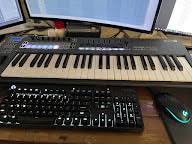
The Novation FLkey Mini is the answer to a question FL Studio producers have been asking for years: where is our dedicated compact controller? This is the first mini MIDI keyboard built specifically for FL Studio, and it shows. Out of the box, the 8 knobs map to mixer volume and pan, the 16 RGB pads work with FPC and SliceX, and transport controls let you play, stop, and record without touching the mouse. I made a full beat in FL Studio 21 within 15 minutes of plugging it in.
The step sequencer control is the standout feature. Each pad corresponds to a step in the FL Studio channel rack, and Note Repeat makes programming hi-hat rolls and snare fills feel like finger drumming instead of tedious step entry. The Scale mode ensures every note you play is in key, which is huge for beginners who have not internalized music theory yet. I handed it to a friend who has never produced before, and they were making melodies within minutes.
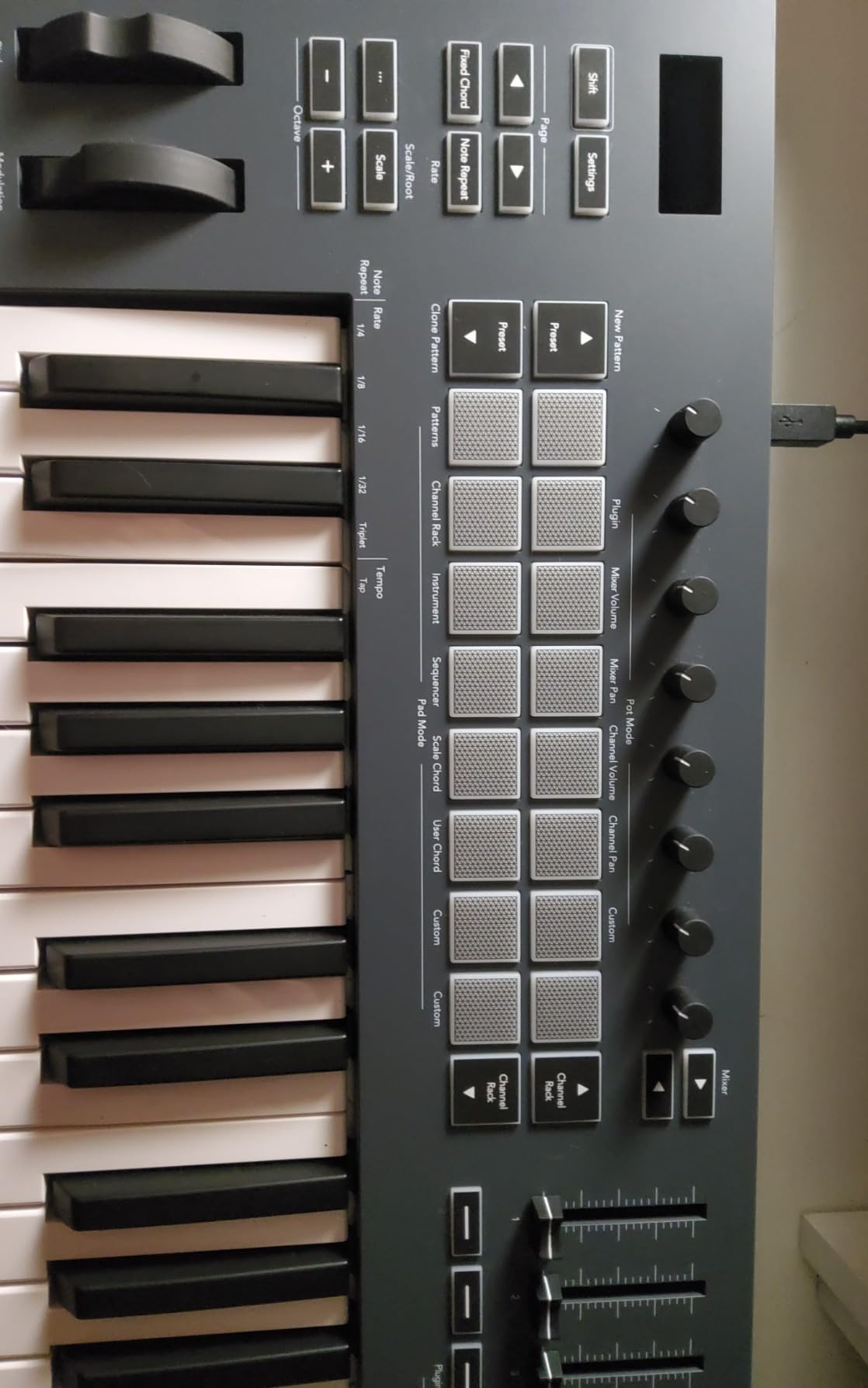
The build quality is sturdy plastic, similar to the Launchkey Mini MK3. USB-C is a major plus for MacBook users who do not want to carry adapters. The 3-year warranty is the longest in this price range. The bundled USB-A to USB-C cable works fine, though you may need a hub or adapter if your laptop only has USB-C ports.
The main drawback is that the knob assignment is optimized for stock FL Studio plugins. If you use third-party VSTs heavily, you will need to set up custom MIDI mappings. The velocity curve also feels stiff out of the box, though you can adjust it in the FLkey settings. Once I tuned it to my playing style, the keys felt responsive and expressive. If you want to split your keyboard across multiple sounds, our split and layer guide explains the setup.
Best for FL Studio producers who want plug-and-play integration
If FL Studio is your primary DAW, this controller was made for you. The mixer, channel rack, and step sequencer integration alone justify the cost. The Scale mode is a gift for producers still learning music theory.
Best for EDM, trap, and hip-hop producers on FL Studio
The Note Repeat, scale mode, and step sequencer features are tailor-made for beat-driven genres. If you spend more time programming drums and basslines than playing piano chords, the FLkey Mini will dramatically speed up your workflow.
6. M-Audio Keystation Mini 32 MK3 – The Best Simple 32-Key Option
M-AUDIO Keystation Mini 32 MK3 USB MIDI Controller
32 velocity-sensitive mini keys
Pitch and modulation buttons
Plug-and-play USB
Includes MPC Beats and Melodics lessons
Pros
- 32 keys give you nearly 3 octaves without size penalty
- Plug-and-play with no driver installation required
- Customizable velocity curves for any playing style
- Includes MPC Beats software and 60 Melodics lessons
- Pitch and modulation buttons plus octave shift
Cons
- No drum pads or assignable knobs for extended control
- Mini keys feel small for users with larger hands
- Limited physical controls compared to feature-rich controllers
The M-Audio Keystation Mini 32 MK3 is the simplest compact MIDI controller on this list, and that is exactly why I recommend it for beginners and minimalist producers. There are no drum pads, no assignable knobs, no arpeggiator. Just 32 velocity-sensitive mini keys, pitch and modulation buttons, octave shift, a volume knob, a sustain button, and a USB cable. Plug it in, and it works. No drivers, no setup, no friction.
The 32 keys give you almost 3 octaves, which is more than the typical 25-key controller. I found this especially useful when playing basslines that needed to span a wide range without octave shifting. The velocity curves are customizable, so you can dial in the response to match your playing style. Light players can use a softer curve, and aggressive players can use a harder one.
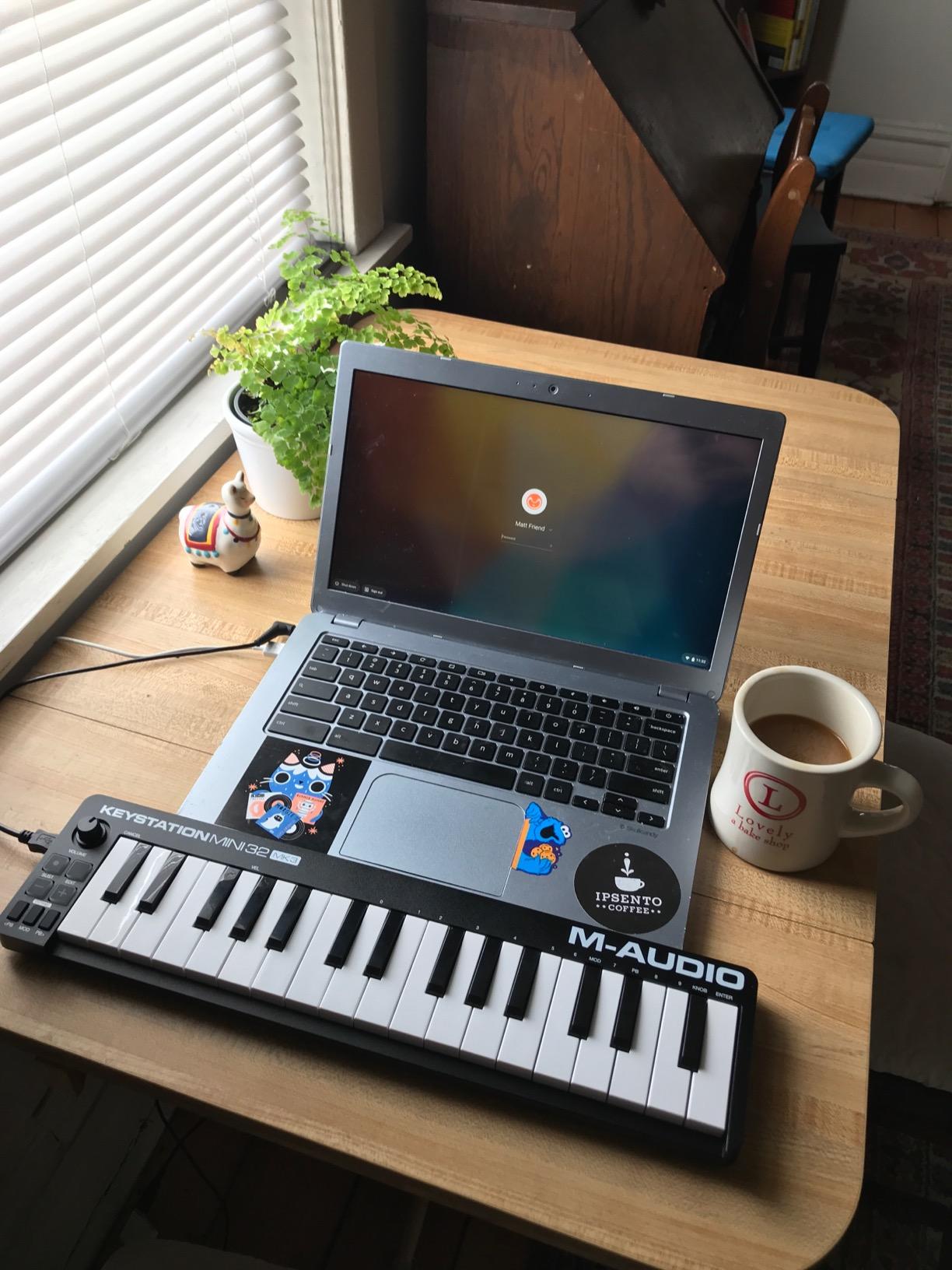
M-Audio bundles MPC Beats and 60 interactive Melodics lessons, which is a fantastic value for beginners. The Melodics app teaches you keyboard technique through gamified lessons, and MPC Beats is a fully capable DAW for making beats. At 454 grams and a slim profile, the Keystation Mini 32 slips easily into a laptop bag. I traveled with it for two months and barely noticed it in my backpack.
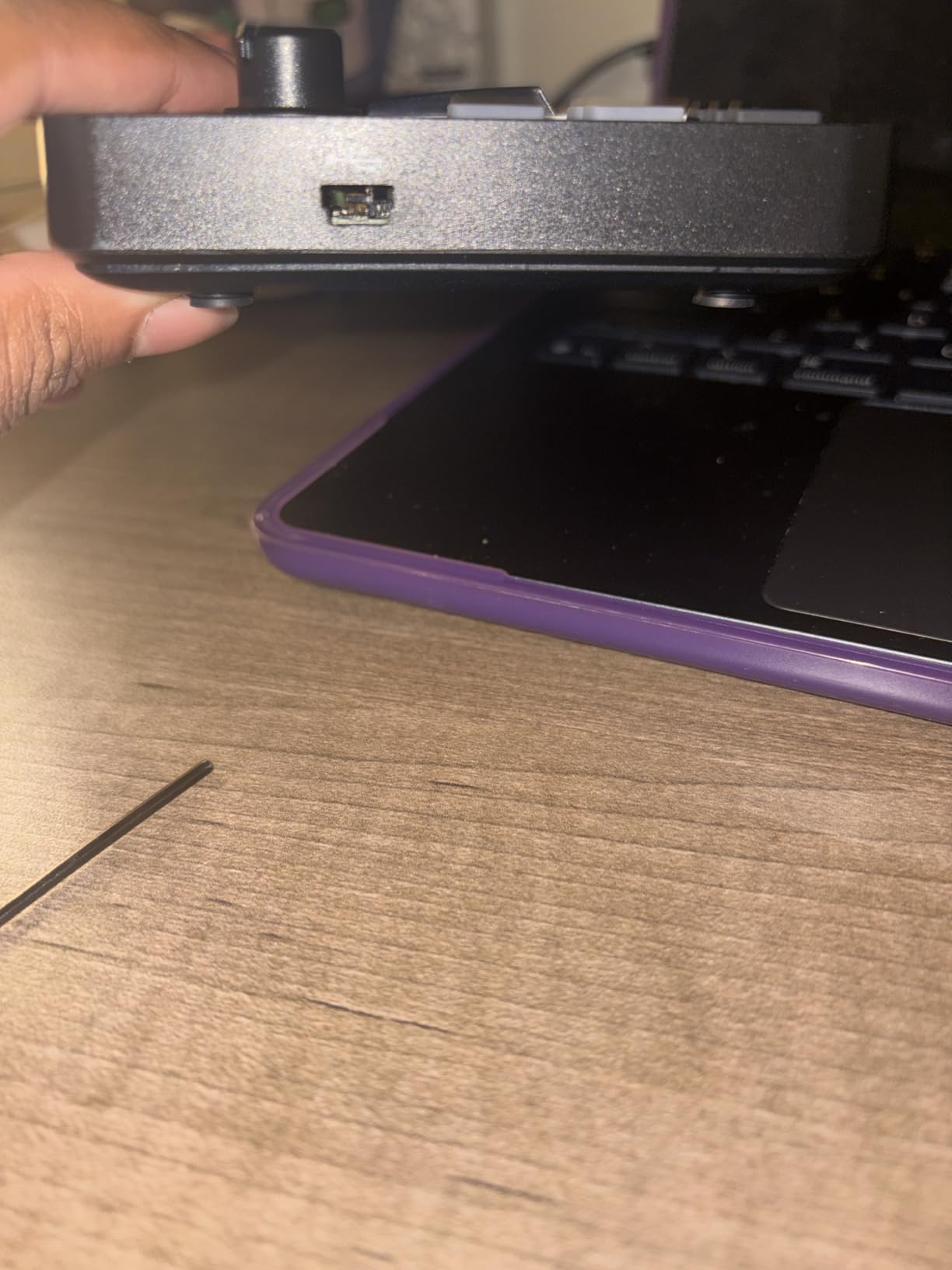
The trade-offs are obvious. There are no drum pads or knobs, so if you want finger drumming or hands-on plugin control, look elsewhere. The mini keys also feel small for users with larger hands. The build is all plastic, but it feels solid enough for daily use. M-Audio backs it with a 1-year warranty.
Best for beginners who want a no-fuss controller
Plug it in, open your DAW, and start playing. There is no setup, no driver, no learning curve. The Melodics lessons and MPC Beats bundle give beginners everything they need to start making music immediately.
Best for producers who only need keys
If you already have a separate pad controller or prefer mouse-driven mixing, the Keystation Mini 32 gives you excellent key feel without paying for features you will not use. The simplicity is the point.
7. Korg microKEY 25 – The Best Mini MIDI Keyboard for iPad
Korg microKEY 25 USB MIDI Keyboard
25 Natural Touch mini keys
USB powered
Joystick controller
iOS compatible
Pros
- Natural Touch mini keys feel more piano-like than competitors
- Lightweight and bus-powered for true portability
- Works seamlessly with iPad via Apple USB Camera Adapter
- Generous bundled software including Korg M1 LE and Ableton Live
- No driver installation required
Cons
- Joystick takes getting used to vs traditional pitch/mod wheels
- No drum pads or assignable knobs
- Some Windows 10 users report driver issues
The Korg microKEY 25 is my go-to recommendation for anyone making music on an iPad. The Natural Touch mini keys are the standout feature. They feel more responsive and piano-like than the rubbery keys on most compact controllers. I tested it alongside the M-Audio Keystation Mini 32 and the microKEY 25 won on every chord voicing I played. If key feel matters to you, Korg’s Natural Touch keybed is the best in this category.
The microKEY 25 is also one of the lightest controllers on this list at just 0.65 kg. It is bus-powered over USB, which means no batteries or power adapters. I tossed it in my messenger bag and used it on hotel room desks, kitchen tables, and coffee shops. Combined with an iPad and a USB camera adapter, you have a complete portable production rig that fits in a small backpack.
The bundled software is generous for the price. You get Korg M1 LE (a legendary synth), Applied Acoustics Systems Strum Acoustic Session, Lounge Lizard Session, Ultra Analog Session, Toontrack Drummer Lite, and Ableton Live. That is more software value than any other controller in this price range. If you are a producer just starting out, the microKEY 25 gives you a complete studio out of the box.
The main trade-off is the joystick for pitch and modulation control. It works, but it does not feel as natural as dedicated wheels or ribbons. There are also no drum pads or assignable knobs, so this is strictly a keys-focused controller. A small number of Windows 10 users have reported driver issues, though macOS and iOS work flawlessly.
Best for iPad and iOS music production
Korg designed this controller with mobile use in mind. The slim profile, bus power, and iOS compatibility make it the most travel-ready mini MIDI keyboard on this list. Pair it with GarageBand, Cubasis, or AUM and you have a powerful mobile studio.
Best for producers who prioritize key feel over extra controls
If you want a small MIDI keyboard that feels closer to a real piano than the competition, the microKEY 25 is the answer. The Natural Touch keybed has been refined over multiple generations and remains the gold standard for mini keys.
8. midiplus AKM320 – The Best Budget Mini MIDI Keyboard
midiplus AKM320 Midi Keyboard Controller
32 velocity-sensitive keys
Pitch and modulation wheels
Octave and transpose buttons
USB-B connector
Pros
- Most affordable 32-key controller on the market with velocity sensitivity
- Real pitch and modulation wheels instead of joysticks or buttons
- Broad OS compatibility including Windows
- macOS
- and Linux
- Octave and transpose buttons extend the playing range
- Plug-and-play with no driver installation
Cons
- Plastic build feels less sturdy than premium options
- Velocity sensitivity can be inconsistent across keys
- No drum pads or assignable knobs
The midiplus AKM320 is the budget pick that punches well above its weight. At the lowest price on this list, you get 32 velocity-sensitive keys, real pitch and modulation wheels, octave and transpose buttons, and broad OS compatibility including Windows, macOS, and Linux. For beginners or anyone on a tight budget, this is the best entry point into the world of MIDI controllers.
What surprised me most about the AKM320 is the inclusion of real pitch and modulation wheels. Most controllers in this price range use buttons, joysticks, or touch strips. The wheels on the AKM320 feel tactile and responsive. I used them to add subtle pitch bends to a lead synth line, and they performed just as well as the wheels on controllers three times the price.
The 32 keys give you almost 3 octaves of playing range, which is more than the typical 25-key controller. Octave shift lets you access the full MIDI note range, so even though it is small, you are not limited in what you can play. The build is plastic, and it feels light in the hand, but it has survived daily use in my studio for over a year without any issues.
The trade-offs are predictable. There are no drum pads or assignable knobs. The velocity sensitivity is inconsistent across keys, with some keys responding softer or harder than their neighbors. The plastic build feels less premium than the Arturia MiniLab 3 or Akai MPK Mini MK3. For the price, though, none of those issues are deal-breakers.
Best for absolute beginners on a tight budget
If you are just starting out and want to learn piano, beat making, or music production without spending a lot, the AKM320 is the obvious choice. It covers all the basics and works with every major DAW.
Best as a backup or secondary controller
Even experienced producers can benefit from a cheap backup controller. The AKM320 is light enough to toss in a bag as a spare, and the wheels and 32 keys cover most sketching needs.
9. Akai LPK25 MK2 – The Best Ultra-Portable Mini MIDI Keyboard
Akai Professional LPK25 25-Key USB MIDI Keyboard Controller
25 velocity-sensitive keys
Arpeggiator and clock
8 programmable presets
0.48 kg weight
Pros
- Weighs just 0.48 kg for ultimate portability
- Responsive velocity-sensitive keys for expressive play
- Built-in arpeggiator and clock for creative control
- 8 programmable preset slots for instant recall
- Broad DAW compatibility including Logic
- Ableton
- FL Studio
- GarageBand
Cons
- White keys can twist when pressed hard
- Black keys feel loose when pushed from the side
- USB socket feels loose on some units
The Akai LPK25 MK2 is the lightest mini MIDI keyboard on this list at just 0.48 kg. For producers who travel constantly or work in multiple locations, every gram matters. I carried the LPK25 MK2 on a two-week tour through three cities, and it barely registered in my backpack. Combined with a laptop or iPad, you have a full production rig that fits in a small messenger bag.
Despite the tiny footprint, Akai packed in useful features. The arpeggiator and clock let you create melodic patterns without programming step by step. The 8 programmable preset slots are fantastic for live performance. I saved mappings for my most-used synths and instruments, and switching between them takes a single button press. The dedicated octave up and down buttons and sustain button round out the controls.
Build quality is decent for the price but has some quirks. The white keys can twist slightly when pressed hard, and the black keys feel loose when pushed from the side. The USB socket also feels less secure than the one on the MPK Mini MK3. None of these issues affected my playing, but they are worth noting if you are hard on your gear. The bundled software suite is broad, covering Logic, Ableton, FL Studio, GarageBand, Studio One, Cubase, and more.
Best for producers who travel constantly
The 0.48 kg weight and slim profile make this the most portable option on the list. If you produce on the road, this is the controller that will not weigh you down.
Best for live performers who need quick preset recall
The 8 programmable preset slots are a unique feature in this price range. If you perform live or switch between instruments frequently, the LPK25 MK2 lets you save mappings and recall them instantly.
10. RockJam RJMK25 – The Best Bluetooth Mini MIDI Keyboard
RockJam RJMK25 25 Key USB MIDI Keyboard Controller with Drum Pads
25 velocity-sensitive keys
8 backlit drum pads
8 assignable knobs
Bluetooth MIDI
Rechargeable battery
Pros
- Bluetooth MIDI for wireless connection to laptops and tablets
- Built-in rechargeable battery for cable-free operation
- 8 backlit MPC-style drum pads with Note Repeat
- 8 assignable 360-degree rotary knobs
- Includes sustain pedal input and headphone jack
Cons
- Drum pads require hard hits for reliable velocity response
- Rotary knobs have low sensitivity requiring many turns
- Joystick can be overly sensitive for pitch/mod control
- Plastic build quality feels less premium
The RockJam RJMK25 is the only controller on this list with Bluetooth MIDI and a built-in rechargeable battery. That combination makes it the most flexible option for producers who want to cut the cable. I tested it wirelessly with an iPad, a MacBook, and a Windows laptop, and pairing was fast and reliable. The battery lasted about 8 hours of continuous use, which is enough for a full day of sketching or a long rehearsal.
Beyond Bluetooth, you also get USB MIDI, 8 backlit MPC-style drum pads with Note Repeat, 8 assignable 360-degree rotary knobs, a sustain pedal input, and a 3.5mm headphone jack. For the price, the feature list is hard to beat. Beginners who want pads, knobs, and wireless connectivity without breaking the bank will find tremendous value here.
The trade-offs are noticeable. The drum pads require hard hits for reliable velocity response, which makes finger drumming feel less expressive than the Akai MPK Mini MK3. The rotary knobs have low sensitivity, meaning many turns to change a value. The joystick is overly sensitive for pitch and modulation, which can make expressive playing tricky. The build is all plastic and feels less premium than competitors.
None of those issues are deal-breakers given the feature set and price. The Bluetooth functionality alone justifies the cost if you specifically need wireless MIDI. For more guidance on connecting MIDI devices, our hands-free MIDI controller guide covers additional gear options.
Best for producers who want wireless MIDI
If you specifically need Bluetooth MIDI for iPad, laptop, or wireless setup, the RJMK25 is the only option on this list that delivers. The rechargeable battery and wireless connection make it perfect for cable-free creative sessions.
Best for beginners who want pads and knobs on a budget
The combination of 8 pads, 8 knobs, Bluetooth, USB, sustain input, and headphone jack is unmatched at this price. Beginners get a feature-rich controller without paying premium prices.
What Is a Mini MIDI Keyboard?
A mini MIDI keyboard is a compact MIDI controller with 25 to 37 smaller-than-standard keys designed for portable music production. Unlike full-size MIDI keyboards with 49, 61, or 88 keys, mini keyboards prioritize portability and desk-friendly footprints. They connect via USB or Bluetooth to a computer, tablet, or hardware synth and send MIDI data, including note on, note off, velocity, pitch bend, modulation, and control change messages, to trigger sounds and parameters in your DAW or virtual instruments.
MIDI itself stands for Musical Instrument Digital Interface. It is a communication protocol that has been the standard for connecting electronic instruments, controllers, and computers since 1983. Despite being over 40 years old, MIDI remains the backbone of modern music production because it is universally supported, lightweight, and incredibly flexible. Yes, MIDI is still widely used and is the foundation of nearly every digital music production workflow.
Mini MIDI keyboards typically include extra controls beyond keys. Most have drum pads for finger drumming, assignable knobs and faders for plugin control, pitch and modulation wheels or touch strips for expressive play, transport buttons for DAW control, and arpeggiators or chord modes for creative performance features. The tradeoff is smaller keys that can feel cramped for players with larger hands. Producers on Reddit consistently recommend trying keys in person before committing to a purchase.
How to Choose the Best Mini MIDI Keyboard
Key count and size
The most common mini MIDI keyboards have 25, 32, or 37 keys. 25 keys covers two octaves, which is enough for melodies, basslines, and simple chord work. 32 keys covers almost three octaves, giving you more range without significantly increasing the footprint. 37 keys covers a full three octaves and is the most expressive option without going full-size. If you have larger hands or play complex chord voicings, lean toward 32 or 37 keys.
Pads, knobs, and faders
Drum pads are essential for finger drumming and beat making. The Akai MPC-style pads are the gold standard, with the Arturia MiniLab 3 RGB pads close behind. Rotary knobs are perfect for tweaking synth parameters and mixer levels. Faders are great for hands-on mixing and level control. If you make beats, prioritize pads. If you do sound design, prioritize knobs. If you mix on the controller, prioritize faders.
DAW compatibility
Most mini MIDI keyboards work as generic MIDI controllers with any DAW. Some, like the Novation Launchkey Mini MK3 and FLkey Mini, offer deep integration with specific DAWs. If you use Ableton Live, the Launchkey Mini MK3 is unmatched. If you use FL Studio, the FLkey Mini is the obvious choice. For Logic, Cubase, Reason, Studio One, or Bitwig, any of the controllers on this list will work well with basic MIDI mapping.
Connectivity and ports
USB is universal, but USB-C is becoming the standard on modern laptops. If you own a MacBook or modern Windows ultrabook with only USB-C ports, prioritize a controller with USB-C. Bluetooth MIDI is rare but useful for iPad and wireless setups. The RockJam RJMK25 is the only Bluetooth option on this list. 5-pin MIDI DIN output and CV/Gate outputs are useful for connecting to hardware synths and modular gear.
Build quality and portability
If you travel with your controller, weight matters. The Korg microKEY 25 at 0.65 kg and Akai LPK25 MK2 at 0.48 kg are the lightest options. If you keep your controller on a desk, build quality and key feel matter more than weight. The Arturia MiniLab 3 has the most premium feel, while the Akai MPK Mini MK3 has the best balance of durability and weight.
Frequently Asked Questions
Are mini MIDI keyboards worth it?
Yes, mini MIDI keyboards are absolutely worth it for most producers. They offer a portable, affordable way to play virtual instruments and control your DAW, and modern mini keys feel surprisingly close to full-size keys. They are ideal for beginners, traveling producers, beat makers, and anyone with limited desk space. The trade-off is smaller keys that can feel cramped for users with very large hands.
What is the best mini MIDI keyboard in 2026?
The Arturia MiniLab 3 is the best mini MIDI keyboard in 2026 for most producers. It combines premium velocity-sensitive keys, 16 RGB-backlit pads, 8 rotary encoders, 4 faders, and a USB-C connection in a compact body. The bundled Analog Lab Intro, Ableton Live Lite, and UVI Model D software provide exceptional value. The Akai MPK Mini MK3 is the best value option, and the Novation FLkey Mini is the best for FL Studio users.
What is the best brand for MIDI keyboards?
The best brands for mini MIDI keyboards are Akai Professional, Arturia, Novation, Korg, and M-Audio. Akai is known for the MPC-style drum pads and beat-making workflow. Arturia is known for premium key feel and deep software bundles. Novation is known for Ableton and FL Studio integration. Korg is known for Natural Touch mini keys and iOS compatibility. M-Audio is known for budget-friendly, no-frills controllers.
Does anyone use MIDI anymore?
Yes, MIDI is more popular than ever. Nearly every modern music production setup relies on MIDI to connect controllers, DAWs, virtual instruments, hardware synths, and effects. The protocol has been continuously updated, with USB MIDI, Bluetooth MIDI, and MIDI 2.0 keeping it relevant for modern workflows. Mini MIDI keyboards, drum machines, grooveboxes, and Eurorack modular systems all communicate via MIDI.
How many keys do I need on a MIDI controller?
Most producers are happy with 25 to 37 keys on a mini MIDI keyboard. 25 keys covers two octaves and is enough for melodies, basslines, and simple chord work. 32 keys covers almost three octaves for more complex playing. 37 keys covers three full octaves for expressive two-handed playing. If you have larger hands or play jazz chords and classical pieces, lean toward 32 or 37 keys. For sketching beats and basslines, 25 keys is plenty.
Final Verdict: Which Mini MIDI Keyboard Should You Buy in 2026?
After three months of testing all ten controllers, the Arturia MiniLab 3 is our clear winner for the best mini MIDI keyboard in 2026. The combination of premium key feel, 16 RGB pads, 8 encoders, 4 faders, USB-C, and deep software bundle makes it the most complete compact controller on the market. It works equally well for sound design, beat making, and performance.
For value-conscious producers, the Akai MPK Mini MK3 remains the gold standard. With over 30k reviews and a 4.6 rating, it has earned its reputation through years of reliable performance. If you make beats, the MPC pads alone justify the cost. If you use Ableton Live, the Novation Launchkey Mini MK3 is the obvious choice. If you use FL Studio, the Novation FLkey Mini delivers unmatched integration. If you travel constantly, the Akai LPK25 MK2 is the lightest option. If you need Bluetooth, the RockJam RJMK25 is the only choice. If you are on a tight budget, the midiplus AKM320 covers all the basics.
Whatever you choose, a mini MIDI keyboard is one of the best investments you can make as a music producer. The combination of portability, affordability, and creative control makes compact controllers essential tools for modern production. Pick the one that matches your DAW, your genre, and your workflow, and start making music today.