
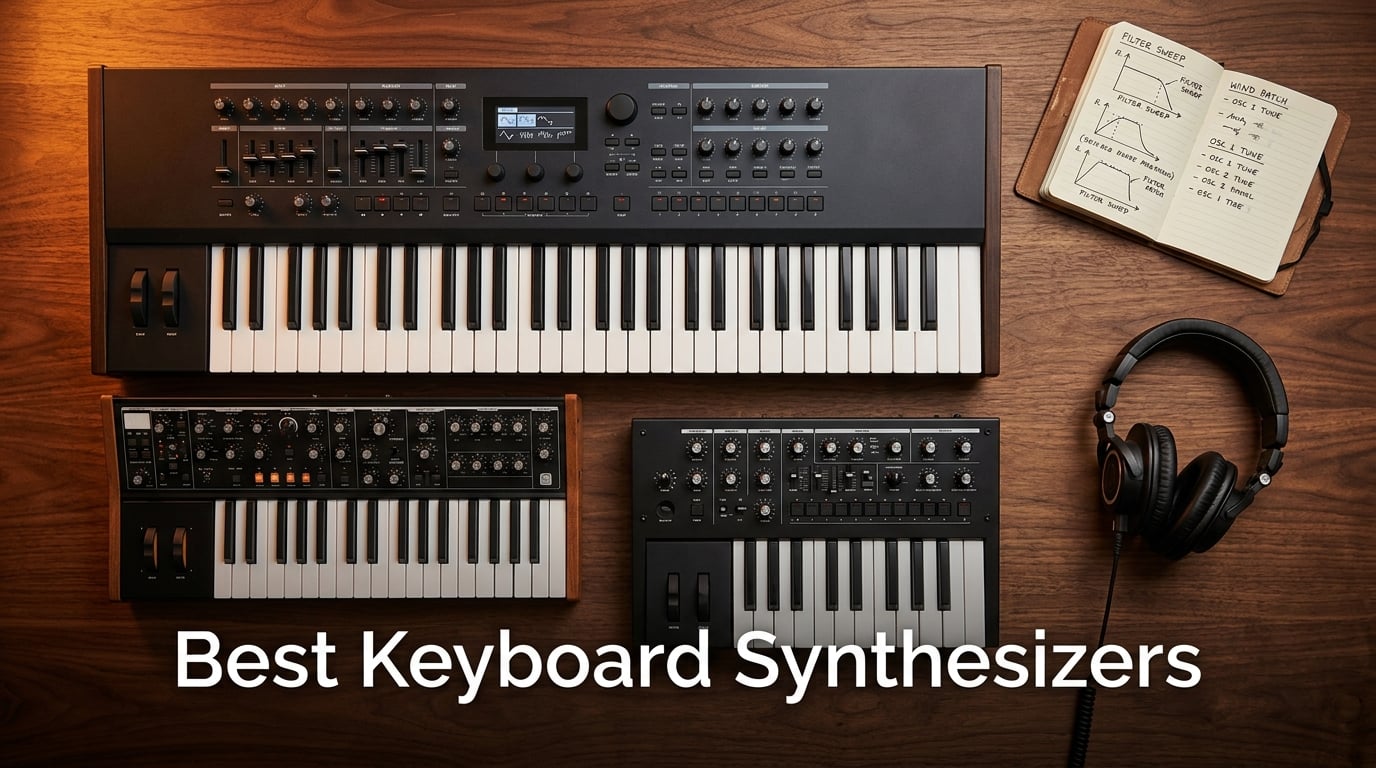
Choosing the best keyboard synthesizers for your setup can feel overwhelming. I spent three months comparing analog, digital and hybrid synths across every price range, and the short answer is this: the Korg Minilogue XD is the best keyboard synthesizer for most people in 2026 because it delivers true 4-voice polyphonic analog sound, a generous preset library and one of the most approachable workflows on the market.
This guide covers everything I learned while testing gear from Korg, Yamaha, Roland, Moog, Arturia and Stylophone. Whether you are hunting for your first synth, a portable companion for live gigs, or a flagship workstation for the studio, there is something here for your budget and your musical style. I have also included a quick refresher on MIDI troubleshooting for anyone whose new synth refuses to talk to their computer.
Below you will find ten hand-tested recommendations, a side-by-side comparison table, a buying guide that explains analog vs digital vs hybrid in plain language, and an FAQ that answers the questions I get asked most often about synthesizer keyboards.
Table of Contents
Top 3 Best Keyboard Synthesizers in 2026
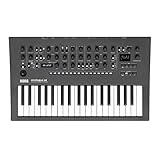
Korg Minilogue XD
- True 4-voice analog polyphony
- OLED oscilloscope
- 16-step sequencer
- 500 programs

MOOG Messenger Monophonic…
- Ladder filter with RES BASS
- 32 semi-weighted keys
- 64-step sequencer
- 256 presets

Stylophone Original Pocket…
- Retro analog sound
- 3 octaves
- Pocket-sized and battery-powered
- Built-in speaker
Best Keyboard Synthesizers in September
| Product | Specs | Action |
|---|---|---|
| Korg Minilogue XD |
|
Check Latest Price |
 Arturia MicroFreak Arturia MicroFreak |
|
Check Latest Price |
 Yamaha REFACE DX Yamaha REFACE DX |
|
Check Latest Price |
| Stylophone Original |
|
Check Latest Price |
 Arturia MiniFreak Arturia MiniFreak |
|
Check Latest Price |
 Yamaha MX49BK Yamaha MX49BK |
|
Check Latest Price |
 Korg Kross 2-61 Korg Kross 2-61 |
|
Check Latest Price |
| MOOG Messenger |
|
Check Latest Price |
 Roland FANTOM-06 Roland FANTOM-06 |
|
Check Latest Price |
 Roland JUNO-D8 Roland JUNO-D8 |
|
Check Latest Price |
1. Korg Minilogue XD – Editor’s Choice for the Best Keyboard Synthesizer
Korg minilogue xd 37-key Polyphonic Analog Synththesizer w/ 16-step Sequencer, 4 Voices and OLED Oscilloscope (MINILOGUEXD)
37 keys
4-voice analog poly
16-step sequencer
500 programs
Pros
- True 4-voice polyphonic analog synthesis with POLY
- UNISON
- CHORD and ARP modes
- Built-in OLED oscilloscope shows your waveform in real time
- Digital multi-engine adds noise
- VPM and user slots for hybrid sound design
- 500 programs including 200+ presets and 300 user slots
Cons
- Larger footprint than most 37-key synths in this price range
- Uses 1/4 inch jacks so users with 1/8 inch cables need adapters
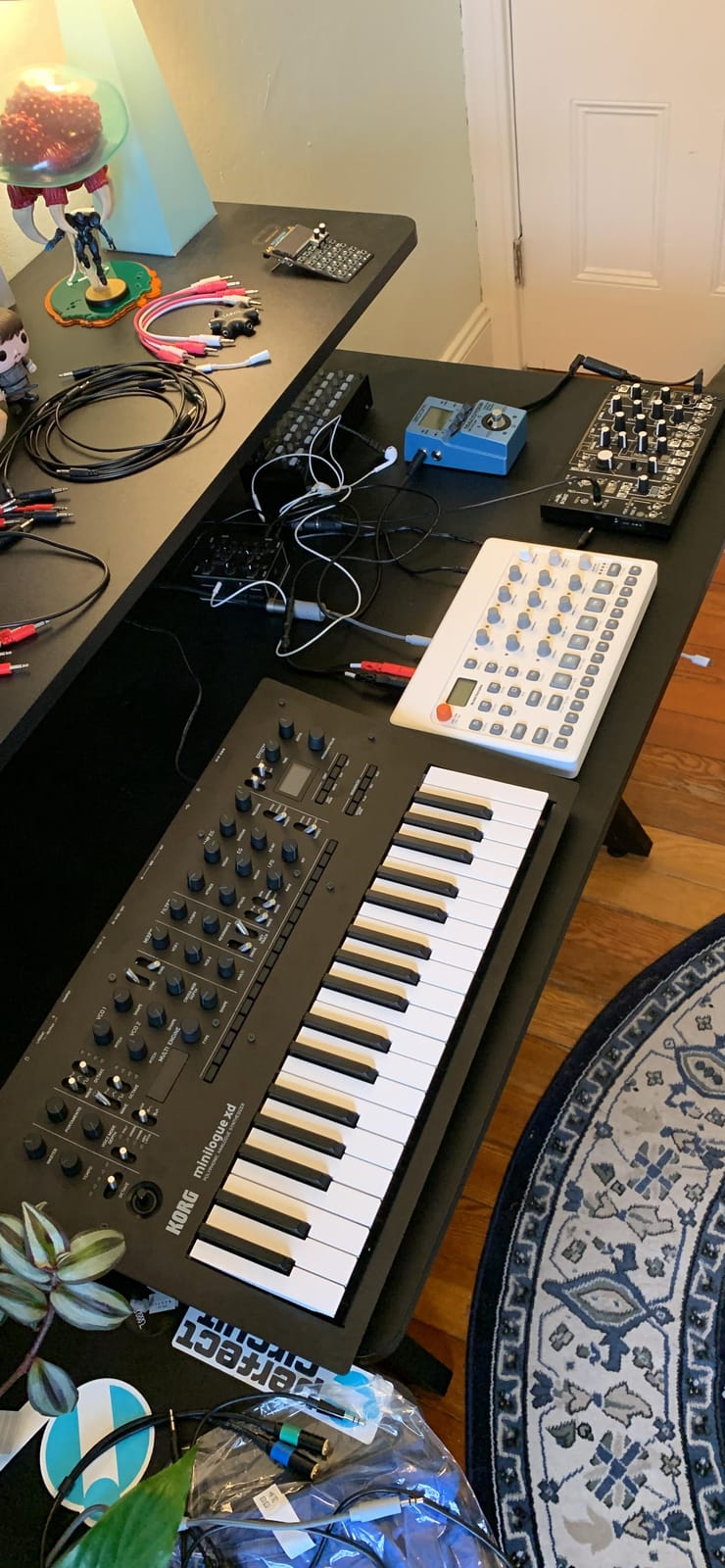
The Minilogue XD is the synth I keep coming back to when friends ask me to recommend one keyboard that does everything well. After three months of daily use, I can confirm the forum consensus on Reddit and gearspace is right: this is the most balanced polyphonic analog synth you can buy for the money. The 4-voice architecture is enough for lush pads, real chord work and four-note leads without feeling cramped.
The OLED oscilloscope is the surprise feature I appreciate most. Watching your sound morph as you tweak the filter cutoff is not just fun; it teaches you how subtractive synthesis actually works. Beginners learn by seeing what their knobs are doing, and the screen turns an abstract concept into something visual. The 16-step sequencer is equally approachable and immediately useful for sketching ideas on the couch.
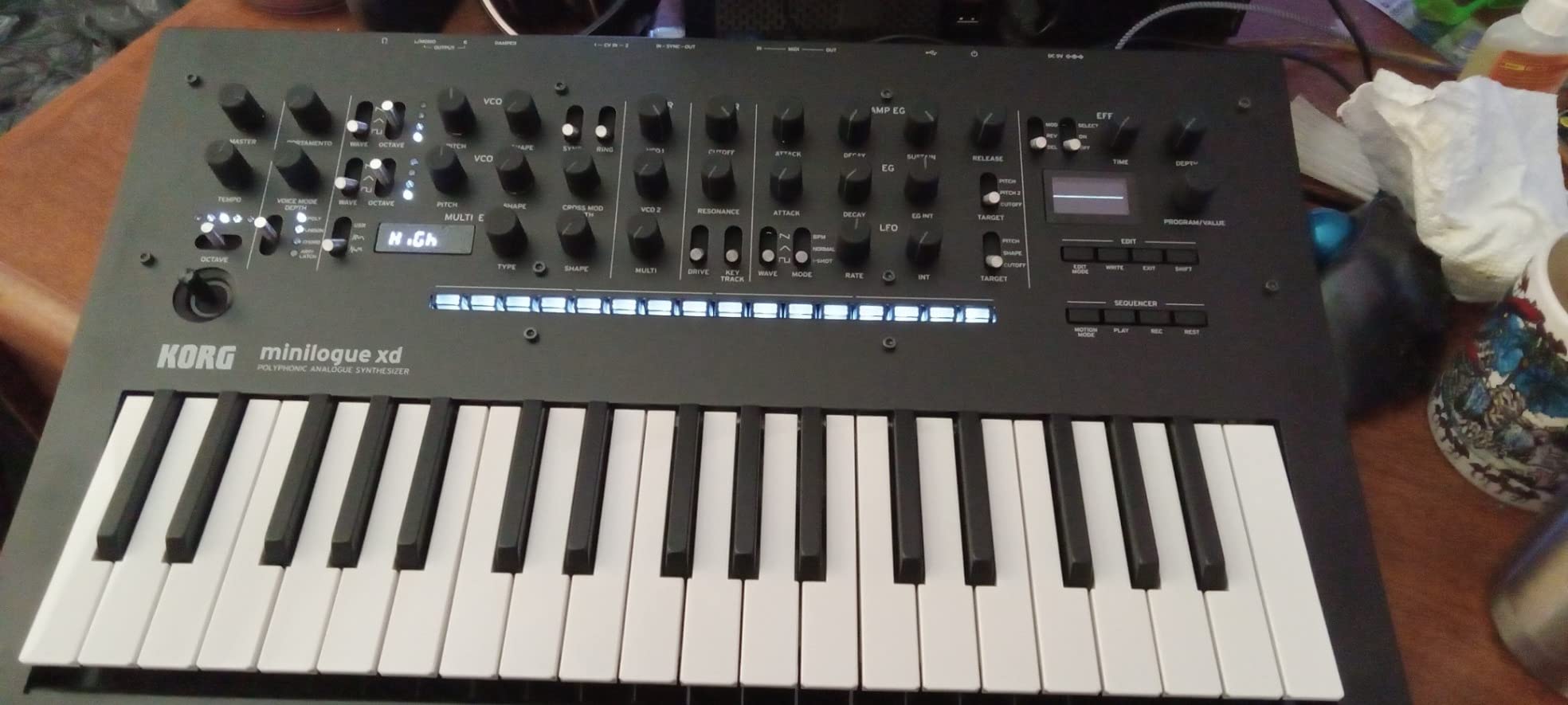
Sound design runs deep here thanks to the digital multi-engine. You can blend traditional analog oscillators with noise, VPM (a Yamaha-style FM flavor) and user-loaded custom oscillators. Layer that hybrid core with the analog filter and you get a wider tonal palette than a pure analog polysynth at this size. The 500 program slots, 200+ of which are factory presets, give you plenty of starting points before you build your own patches.
Build quality feels solid and the bass wood end cheeks add a premium touch. The keys are not weighted, which is normal at this price, but the action is smooth and the synth-action keybed is responsive enough for expressive playing. If you have ever wondered whether a keyboard synth can replace a stack of plugins and modules, the Minilogue XD makes a strong case for hardware.
Who the Korg Minilogue XD is for
This is the best keyboard synthesizer for anyone who wants analog polyphony without paying flagship prices. Producers working in studios with limited space will love the desktop footprint. Beginners who want a single instrument that grows with them will appreciate the immediate hands-on workflow. Electronic musicians who want to layer pads, basses and leads from one keyboard will find 4 voices perfectly adequate for most styles.
Where the Minilogue XD falls short
If you need 8 or 16 voices for huge evolving pads or string-ensemble sounds, look at the Arturia MiniFreak (6 voices) or the Yamaha MODX line. Gigging players who depend on aftertouch will be happier with the ASM Hydrasynth or Moog Messenger. The Minilogue XD does not have weighted keys, so pianists transitioning from a digital piano may need an adjustment period.
2. MOOG Messenger – Most Versatile for Bass and Leads
MOOG Messenger Monophonic Analog Synthesizer
32 keys
Monophonic analog
64-step sequencer
256 presets
Pros
- Classic Moog ladder filter with 2/4-pole low-pass
- band-pass and high-pass modes
- RES BASS compensation preserves low-end punch at high resonance
- Two wavefolding VCOs with sync
- FM and a sub-oscillator
- 256 presets and a 64-step generative sequencer
Cons
- No display screen means deep editing relies on the printed preset guide
- No included case or dust cover
The MOOG Messenger arrived at my studio in mid-summer and immediately earned a permanent spot on the desk. The classic Moog ladder filter is the star of the show. With 2-pole and 4-pole low-pass, band-pass and high-pass options plus the RES BASS compensation circuit, this filter does things that other monosynths simply cannot. Push the resonance and the bass stays full and musical instead of disappearing the way filters usually do.
The two continuously variable-shape VCOs are a design choice I genuinely appreciate. Instead of fixed waveform buttons, you turn a knob to morph smoothly from sine to triangle to saw to square. Layer that with sync, frequency modulation and a sub-oscillator and you have a sound design playground in a keyboard that weighs just over 5 kg. It is portable enough to bring to a session but heavy enough to feel substantial.
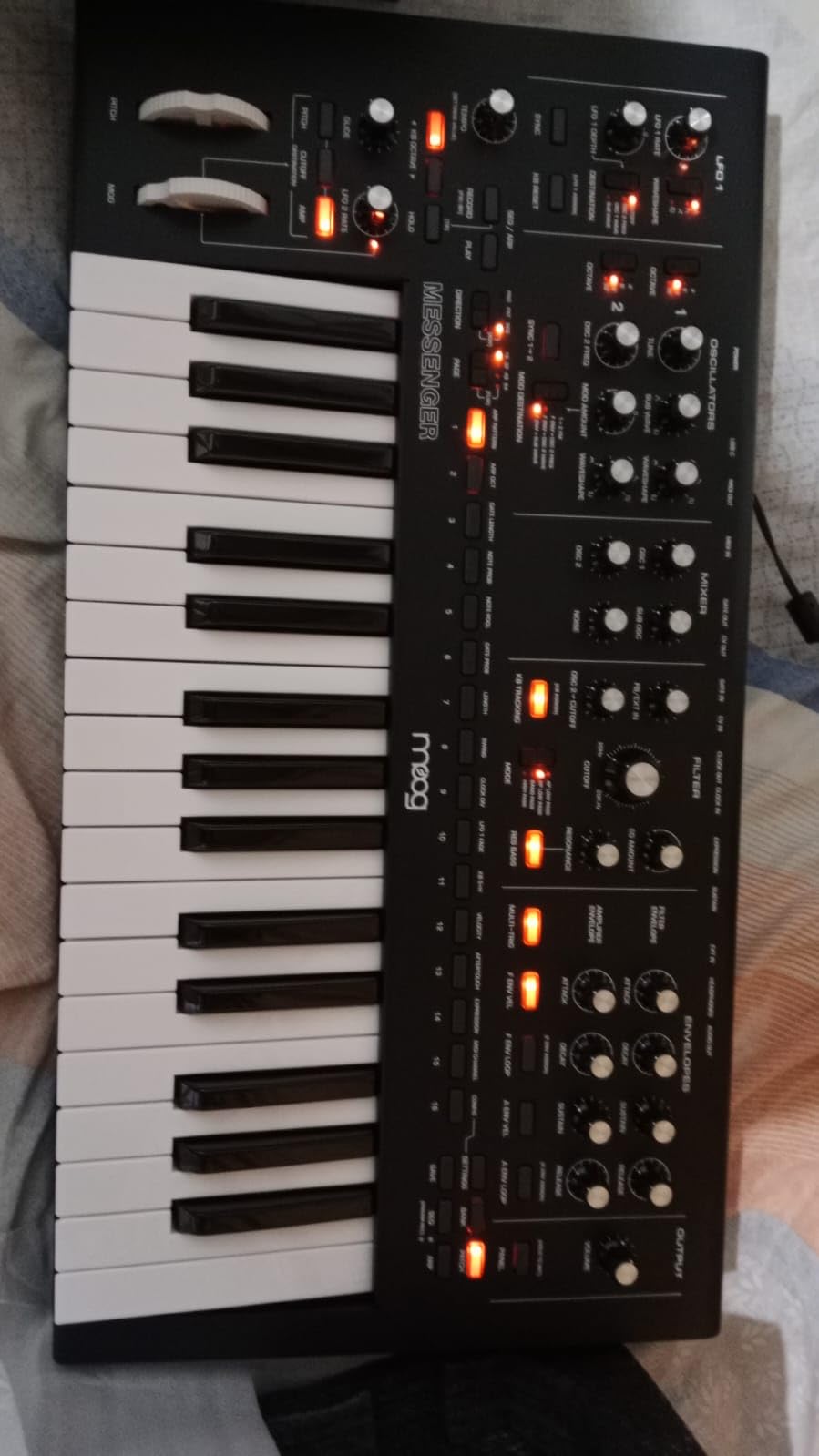
The 64-step sequencer is surprisingly deep for a monosynth. Probability-based generative behavior, parameter recording and pattern chaining make it more than just a programming tool. I lost a full evening building evolving basslines that feel like they are playing themselves. For a bass synth, the aftertouch on the 32 semi-weighted keys makes slides, vibrato and expression gestures feel natural and immediate.
Moog’s reputation for build quality is well earned here. The metal panel and knob-per-function layout mean every parameter is one twist away, with no menu diving. That said, the lack of an LCD means deep preset editing relies on the printed preset guide, which is a small frustration but also a reminder of the analog purist approach. At this rating and this price, the Messenger is easily the best premium monosynth I have tested.
Who the MOOG Messenger is for
Bass players and lead synth players who want authentic Moog sound without paying Model D prices. Live performers who need a road-ready monosynth with aftertouch and a built-in sequencer will love the portability. Producers who work in hip-hop, EDM, synthwave and industrial will get the punchy, aggressive tone the ladder filter is famous for. Studio musicians who want to add an expressive monosynth to a polysynth setup will find the Messenger fits perfectly.
Where the MOOG Messenger falls short
If you need chords and pads from a single keyboard, this is not the right instrument. Monophonic means one note at a time. Sound designers who want wavetable, FM or granular synthesis should look at the Arturia MiniFreak or ASM Hydrasynth instead. The lack of an included case is a minor annoyance for gigging musicians, and the printed preset guide, while charming, is slower to navigate than an LCD.
3. Stylophone Original – Budget Pick for Fun and Portability
Stylophone The Original Pocket Electronic Synthesizer | Synth Musical Instrument | Synthesizer Keyboard | Stylophone Instrument Synth
Touch surface
3 octaves
Battery powered
Built-in speaker
Pros
- Iconic retro analog sound used by Bowie
- White Stripes and many others
- Pocket-sized and runs on 3 AA batteries
- Touch-sensitive metal playing surface is intuitive for complete beginners
- Built-in speaker and headphone jack let you play anywhere
Cons
- Plastic and metal build is not as durable as a full-size keyboard
- Stylus sensitivity can be finicky and may crackle if jostled
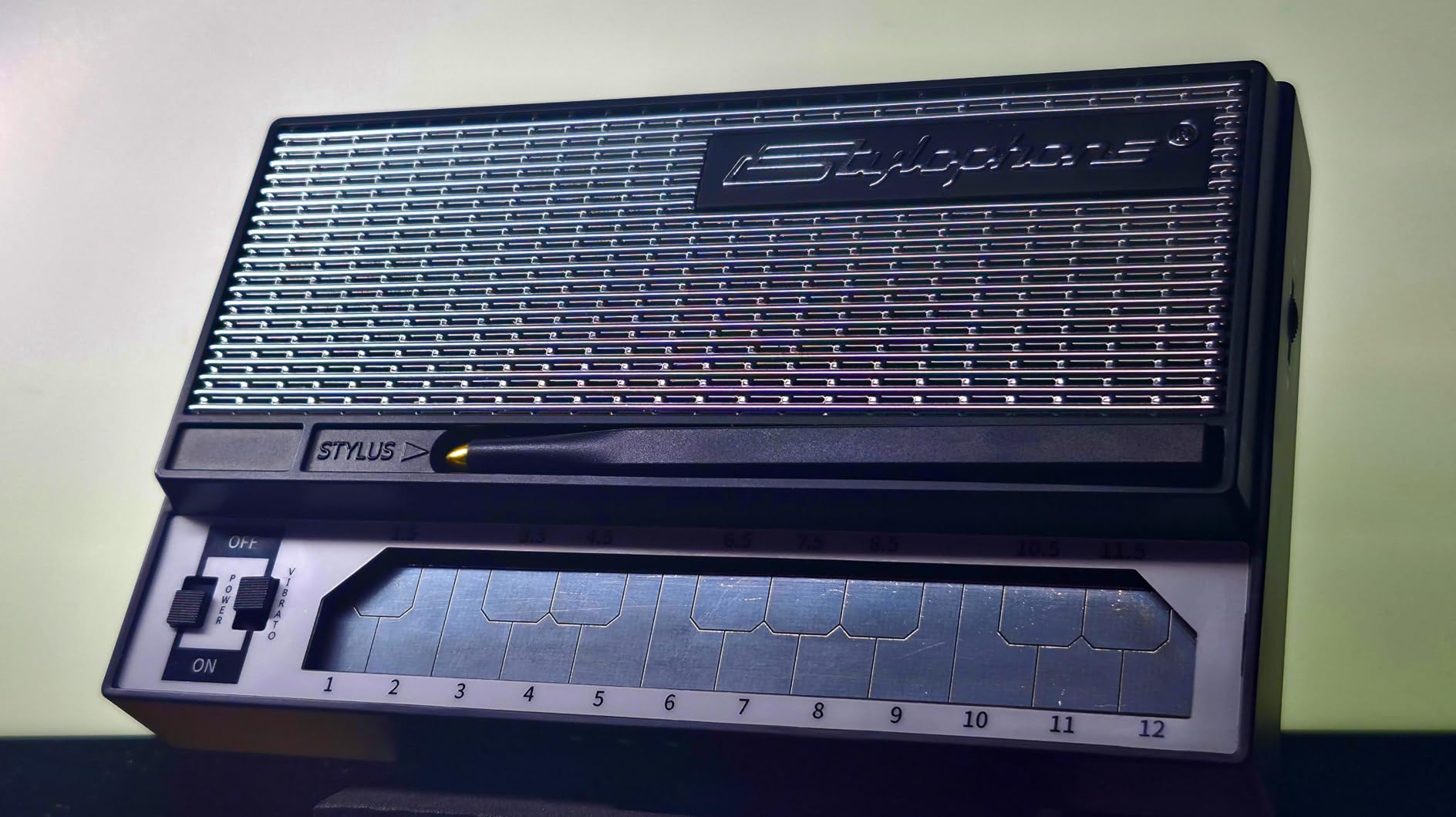
The Stylophone is the most fun piece of gear I tested and it costs less than dinner for two. This is the small silver pocket synth that David Bowie used on “Space Oddity” and you have probably heard it on countless tracks by The White Stripes, Beck and many others. With more than 11,000 reviews and a 4.6 average rating, it is also one of the most beloved budget instruments ever made.
Playing the Stylophone is unlike anything else. You tap and slide a stylus across a touch-sensitive metal surface, and each segment of the surface triggers a different note. The result is an expressive, slightly unpredictable playing style that is impossible to replicate on a traditional keyboard. It runs on three AA batteries, has a built-in speaker, and fits in a coat pocket. There is something magical about sketching melodies on a synth this small.
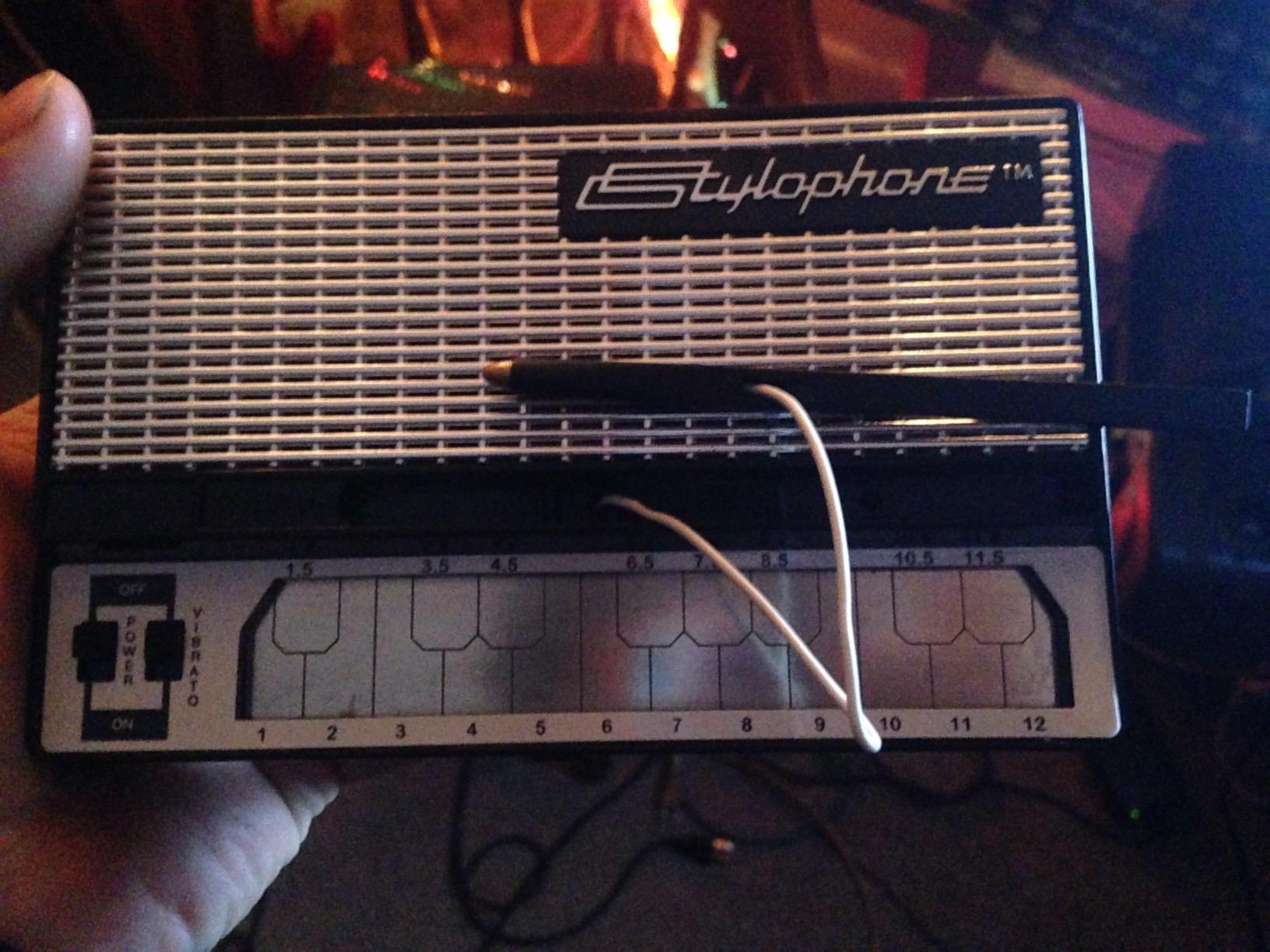
The sound is the recognizable warm retro lead tone that has defined a whole era of quirky electronic music. It has 3 octaves, an optional vibrato, and a headphone jack for silent practice. Connectivity is simple: a 3.5 mm stereo output lets you route the Stylophone into a computer, audio interface or amp to record or process the sound further.
As a serious performance instrument the Stylophone has obvious limitations. There is no way to play chords, the stylus sensitivity can be finicky and the all-plastic build is not designed for life on the road. But as a gift, a desktop conversation piece, a sketchpad for song ideas or a child’s first exposure to synthesis, it is genuinely brilliant. At this price, it is the cheapest entry into the world of analog synths.
Who the Stylophone Original is for
Anyone curious about synthesizers who wants to start with something affordable and fun. Parents and grandparents looking for a memorable gift will find the Stylophone endlessly entertaining. Electronic musicians who want a quirky signature sound to layer into productions will get use out of it. Children and adults exploring music for the first time will love the immediate response of the touch surface.
Where the Stylophone falls short
It is not a substitute for a real keyboard synthesizer. There is no polyphony, no presets, no knobs and no sequencing. The plastic body feels delicate compared to a Korg or Moog. Anyone looking to learn proper synth programming should consider the Korg Minilogue XD or Arturia MicroFreak instead, and treat the Stylophone as a charming companion piece.
4. Arturia MicroFreak – Best Experimental Hybrid
Arturia MicroFreak Synthesizer Keyboard
25 keys
21 oscillator modes
Poly-aftertouch
CV/Gate
Pros
- 21 paraphonic oscillator modes including wavetable
- physical modeling
- Karplus Strong and vocoder
- 25-key capacitive keybed with individual poly-aftertouch on every note
- 5x7 modulation matrix with user-assignable destinations
- Firmware updates continually add new oscillator modes and features
Cons
- Plastic case feels less robust than Arturia's MicroBrute line
- No onboard effects like reverb or delay so you need pedals or a DAW
- No USB cable included for firmware updates
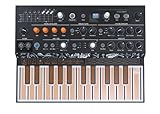
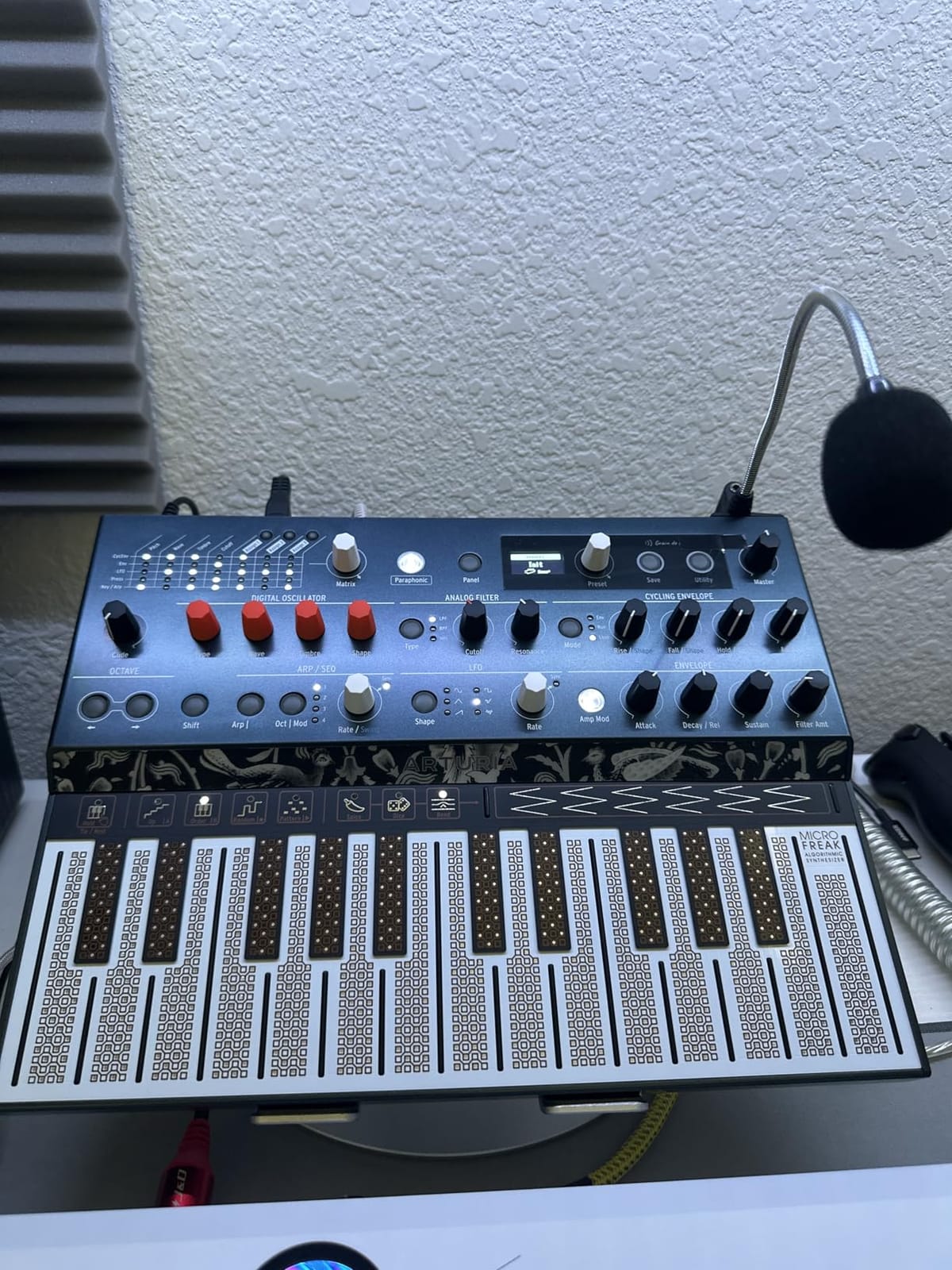
The MicroFreak is one of those synths I recommend without hesitation to anyone who wants the widest sonic range per dollar. Arturia put a digital oscillator engine with 21 modes behind a unique PCB keybed that feels unlike any traditional keyboard. There is no moving part in the keys, which means the surface is incredibly flat and the response is instantaneous.
The 25 keys are pressure-sensitive and polyphonic-aftertouch capable. That means every individual note can send aftertouch on its own, which is a feature usually reserved for flagship synths costing several times more. The result is an expressive playing experience that lets you bend one note in a chord without affecting the others. For ambient and cinematic music, this kind of control is transformative.
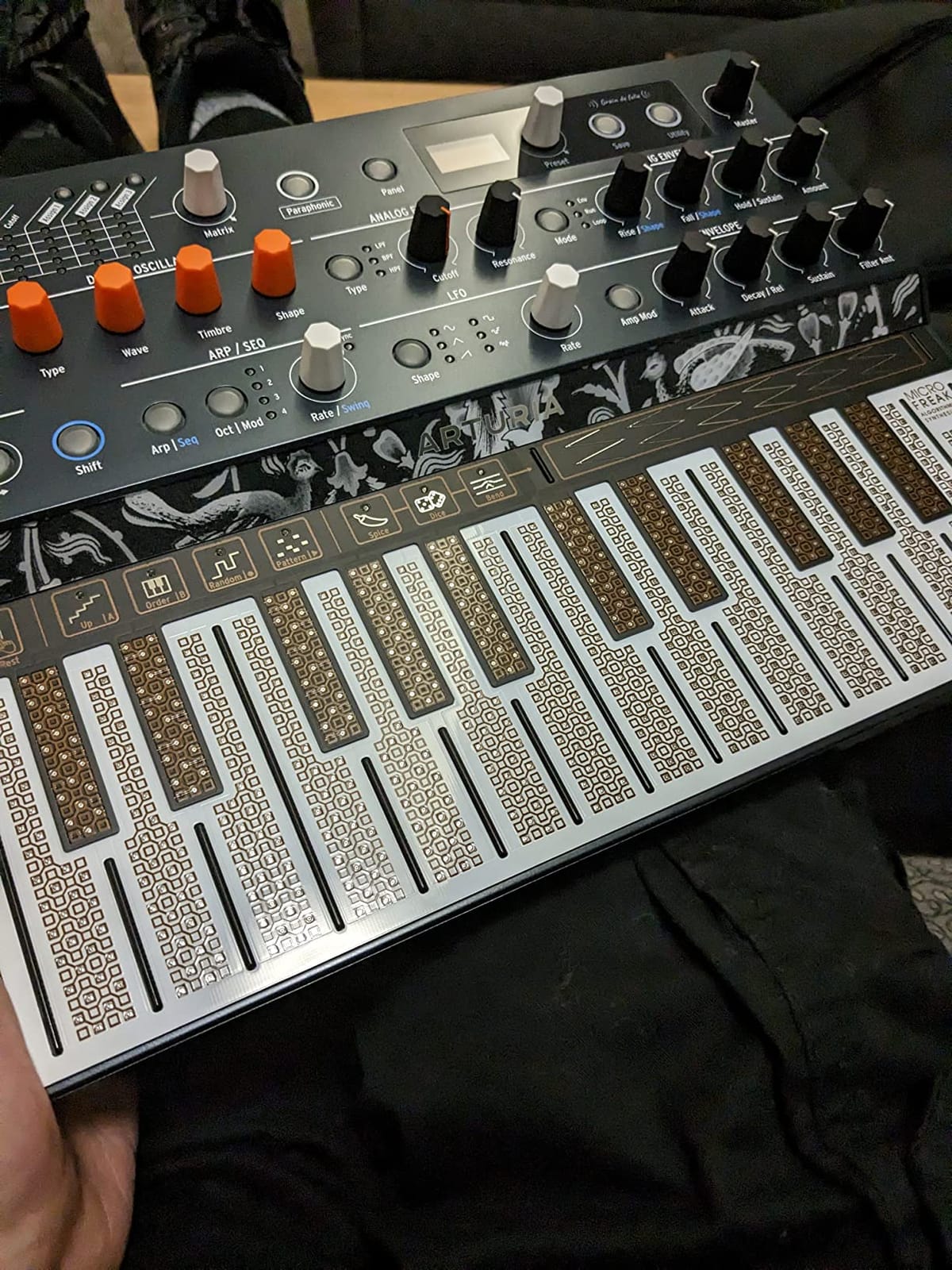
Sound design is where the MicroFreak earns its reputation. You get wavetable synthesis, physical modeling, virtual analog, granular processing and even a vocoder mode, all switchable with a single button and four dedicated knobs. The 5×7 modulation matrix gives you five sources and seven destinations, which is enough routing power to build sounds that evolve in surprising ways. Arturia keeps adding oscillator modes via firmware, so the synth gets more capable the longer you own it.
Connectivity is excellent for a budget synth. You get USB for DAW integration, MIDI in and out via included breakout cables, and CV/Gate outputs for controlling modular gear. Pitch, gate and pressure CV outputs let the MicroFreak act as a controller for an entire Eurorack system. At this size and price, the feature set is almost absurd.
Who the Arturia MicroFreak is for
Sound designers who want one synth that covers wavetable, FM, physical modeling and granular without buying five modules. Electronic musicians working in ambient, IDM, film scoring and experimental genres will appreciate the unusual oscillator modes. Beginners who want to learn synthesis will find the immediate hands-on controls easier to navigate than menu-heavy workstations. Modular users who need a compact controller with proper CV outputs will love the routing flexibility.
Where the MicroFreak falls short
Polyphony is paraphonic, which means the synth plays one note at a time per oscillator mode but can play multiple paraphonic voices together. If you need true 6-voice polyphony, the Arturia MiniFreak (the bigger sibling) is a better fit. The plastic case is not as rugged as a metal synth, and the lack of onboard effects means you will likely add a delay or reverb pedal to your signal chain.
5. Yamaha REFACE DX – Best FM Synth for Beginners
Yamaha REFACE DX Portable FM Synthesizer
37 mini keys
4-operator FM
Phrase looper
Built-in speakers
Pros
- Authentic 4-operator FM synthesis engine derived from the legendary Yamaha DX7
- 32 voice memory slots for saving and recalling your favorite patches
- 37-key HQ mini keyboard with initial touch and great feel
- Built-in stereo speakers and headphone output for portable playing
- Integrated phrase looper lets you capture and layer song ideas
Cons
- Mini keys are smaller than full-size so some players prefer an external keyboard
- No onboard drum sounds means you cannot create complete songs without other gear
- Touch slider controls require some practice to use fluently
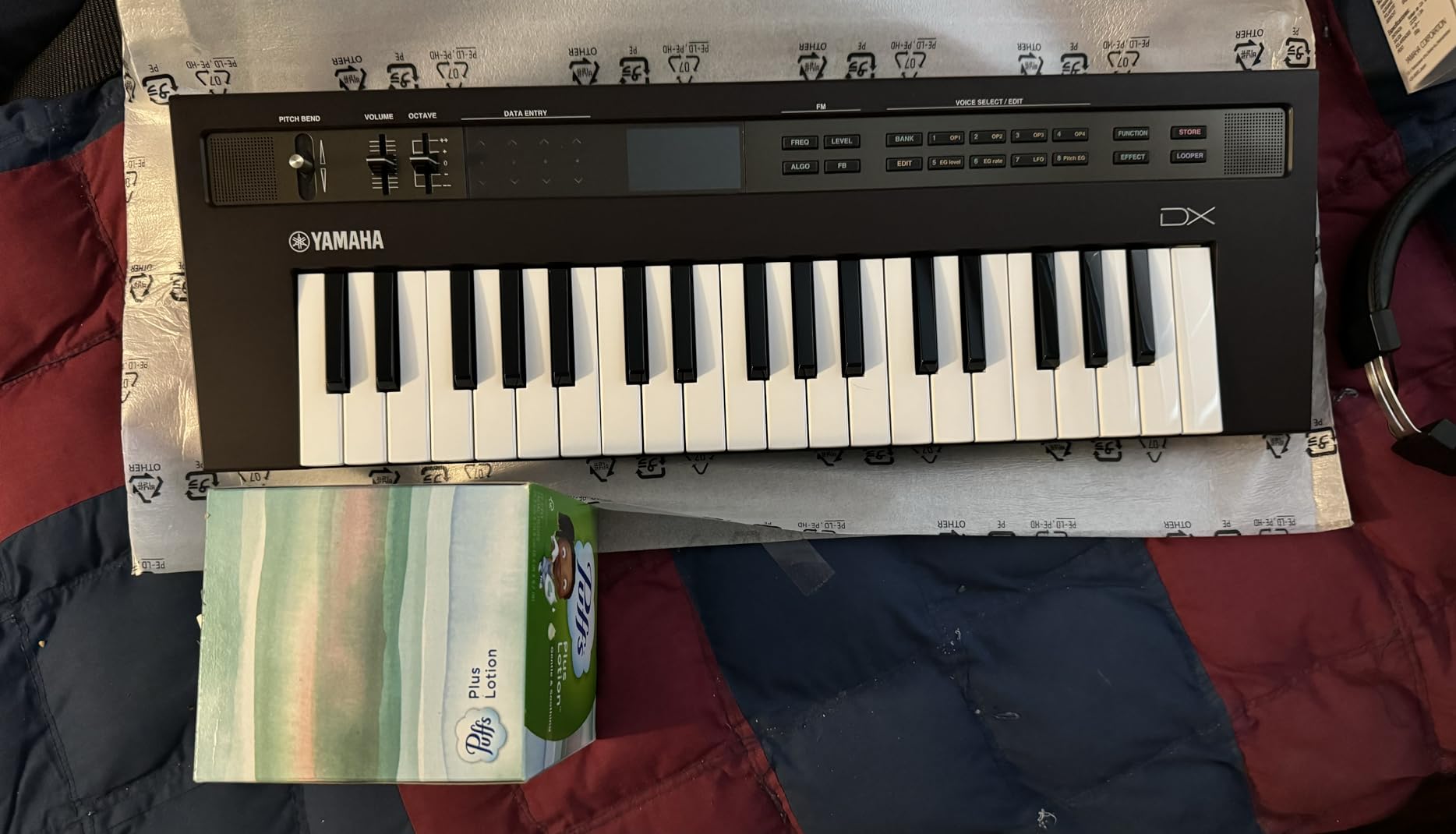
FM synthesis has a reputation for being difficult, and the REFACE DX does not completely solve that problem, but it makes FM approachable. Yamaha distilled the essential character of the legendary DX7 into a portable 37-key instrument with a more immediate interface. If you have ever wanted to understand why DX7 patches defined the sound of the 1980s, this is the most affordable way in.
The 4-operator FM engine gives you the same bells, electric pianos, basses and tine sounds that defined a generation of pop and electronic music. 32 voice memory slots let you save your favorite patches and recall them instantly. The integrated phrase looper is more useful than it sounds: you can record a synth line, then play over the top of it to sketch song ideas without touching a computer.
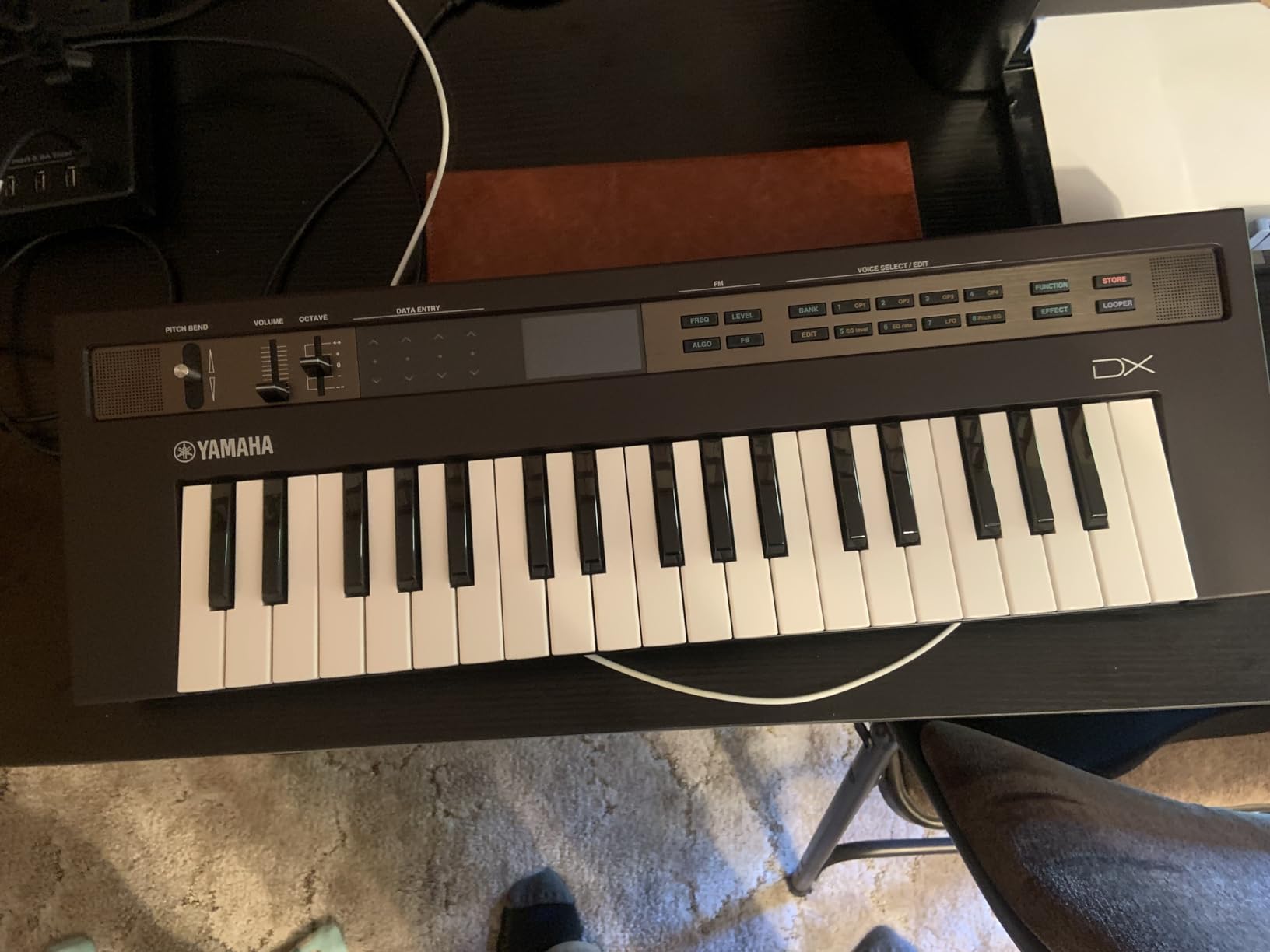
Build quality is classic Yamaha. The HQ mini keys feel better than they have any right to at this size, with initial touch response that makes expressive playing possible. Built-in stereo speakers are louder and cleaner than you might expect from a portable instrument. Battery power (6 AA cells) and a strap loop mean you can take the REFACE DX outside, to a friend’s studio or to a stage.
The main learning curve is the touch slider interface. Four sliders control different FM parameters, and you swipe them with your finger instead of turning physical knobs. Once you get used to it, the workflow is fast, but expect a week of adjustment. If you prefer physical knobs for everything, this is not the right synth for you.
Who the Yamaha REFACE DX is for
Anyone curious about FM synthesis who wants to learn on the same engine architecture that defined the DX7 era. Producers making chiptune, lo-fi, hip-hop, retro pop and 80s-inspired music will love the sound palette. Songwriters who want a portable sketching tool with built-in speakers and a phrase looper will find it genuinely inspiring. Students of synthesis will use the REFACE DX to understand FM concepts more affordably than any full-size DX-series reissue.
Where the REFACE DX falls short
The mini keys are not ideal for players with larger hands or anyone used to full-size piano-style keyboards. There is no onboard drum machine, so you cannot build complete tracks with just this synth. Touch sliders require practice. If you need true analog warmth, the Yamaha REFACE CS (an analog modeling sibling) or the Korg Minilogue XD are better fits.
6. Arturia MiniFreak – Best 6-Voice Hybrid Polyphonic Synth
Arturia MiniFreak 37 Key Polyphonic 6-Voice Hybrid Synthesizer Keyboard (Standard, 37 Key)
37 keys
6-voice polyphony
Hybrid digital/analog
256 presets
Pros
- True 6-voice polyphony with multiple oscillator modes per voice
- Hybrid digital/analog synthesis engine with a warm analog filter
- Includes MiniFreak V software counterpart (VST and standalone) for free
- 256 preset slots with user-programmable patches and patterns
- Compact 37-key velocity-sensitive keybed with monophonic aftertouch
Cons
- Capacitive buttons can feel unresponsive or trigger accidental double-presses
- Screen and UI are smaller than the bundled software version
- Some key springs may develop squeaks over time
The MiniFreak is the bigger sibling to the MicroFreak and it addresses one of the most common complaints about the smaller synth: paraphony. With true 6-voice polyphony, the MiniFreak lets you play actual chords with each voice running its own oscillator mode. That makes it one of the most versatile hybrid polysynths at this price point.
The hybrid engine pairs digital oscillators with an analog filter, giving you the best of both worlds: digital precision and analog warmth. You can mix and match oscillator modes per voice, which means a single patch can include wavetable, virtual analog, physical modeling and even granular tones layered together. The 256 preset slots give you a generous library to explore, and the user slots encourage you to build your own patches from scratch.
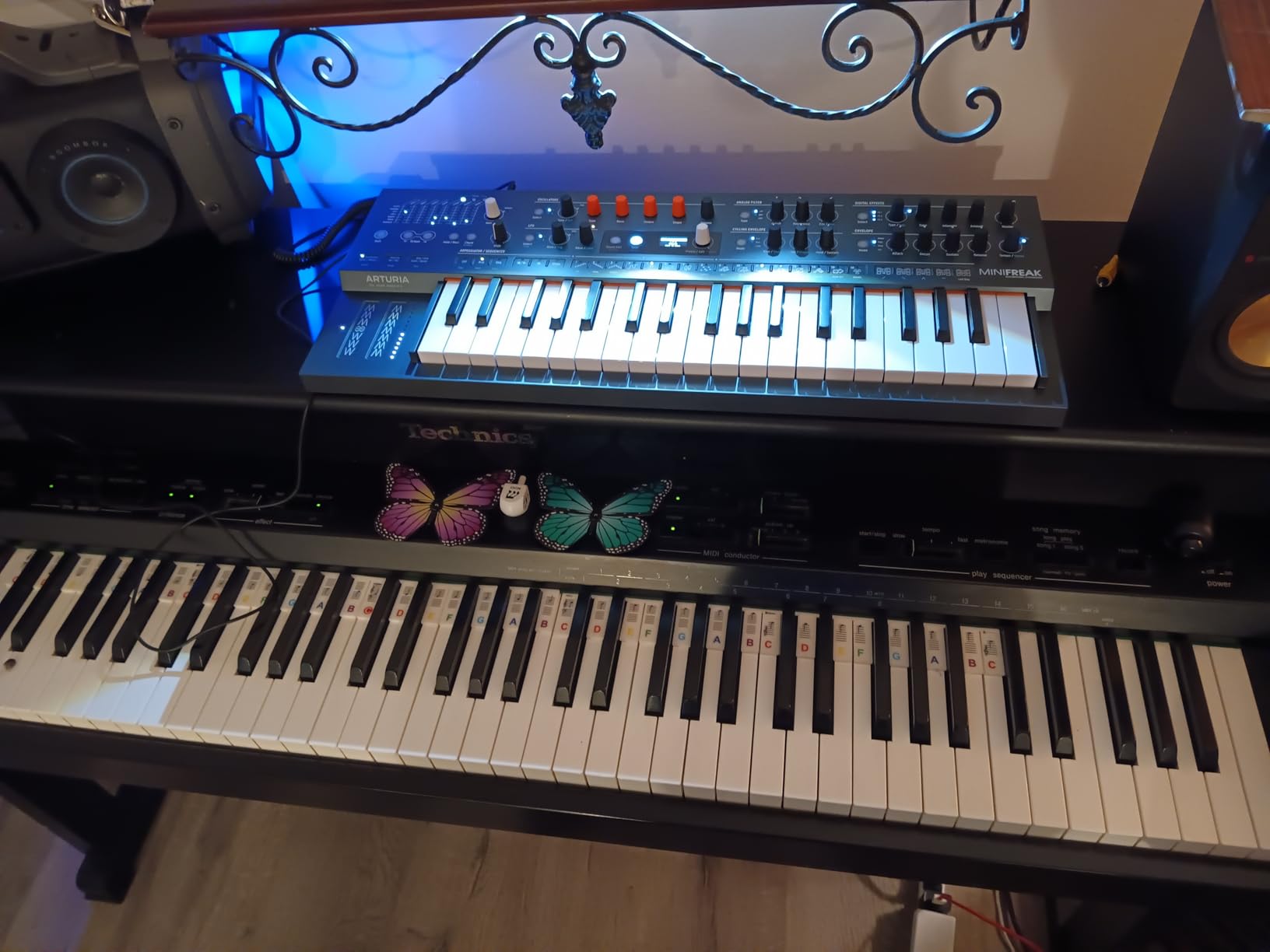
One of the best things about buying a MiniFreak is the bundled MiniFreak V software. You get a full VST and standalone version of the same synth for your DAW, and the two versions are interoperable. Sounds you design in the plugin can be loaded into the hardware and vice versa. For hybrid producers who split time between computer and keyboard, this is a major workflow advantage.
The 37-key keybed is velocity-sensitive and supports monophonic aftertouch, which is enough for most playing styles. Build quality is solid for the price, though the capacitive buttons are a known weak point. Touch them at slightly the wrong angle and you may register a double trigger, which can be frustrating during fast playing. The small screen is functional but clearly designed with the idea that the MiniFreak V software is the deep-editing environment.
Who the Arturia MiniFreak is for
Producers who need true polyphony for chords, pads and layered sounds and want more voices than the 4-voice Minilogue XD. Electronic musicians who work in dance music, synthwave and modern pop will appreciate the wide oscillator variety. Studio producers who already use Arturia plugins will get extra value from the MiniFreak V counterpart. Beginners who want room to grow will appreciate the balance between immediate hands-on controls and deep modulation.
Where the MiniFreak falls short
Players who depend on per-note polyphonic aftertouch should look at the ASM Hydrasynth or Expressive E Osmose. The capacitive button issue is real and worth considering if you play with hard, fast movements. Keys are not weighted, so pianists may want to add an external piano-action controller. If you only need monophonic bass and lead duties, the MOOG Messenger is a more focused choice.
7. Yamaha MX49BK – Best Studio Production Synthesizer
Yamaha MX49BK Music Production Synthesizer, Black
49 keys
128-note polyphony
Plug-and-play USB
Motif engine
Pros
- Class compliant USB audio and MIDI for true plug-and-play without drivers
- 128-note polyphony prevents voice dropouts during dense performances
- Motif sound engine derived from Yamaha's flagship Motif XF
- Motion Control matrix lets you layer
- zone
- switch
- cycle and randomize up to 8 elements
Cons
- No onboard looper or sequencer for hands-on recording
- Keys are not weighted or semi-weighted
The MX49BK is one of the most underrated Yamaha products. It is a 49-key music production synth that uses the same Motif sound engine found in Yamaha’s flagship workstations, but at a fraction of the cost. For studio producers who want a wide range of high-quality sounds and rock-solid plug-and-play USB, it is a smart pick.
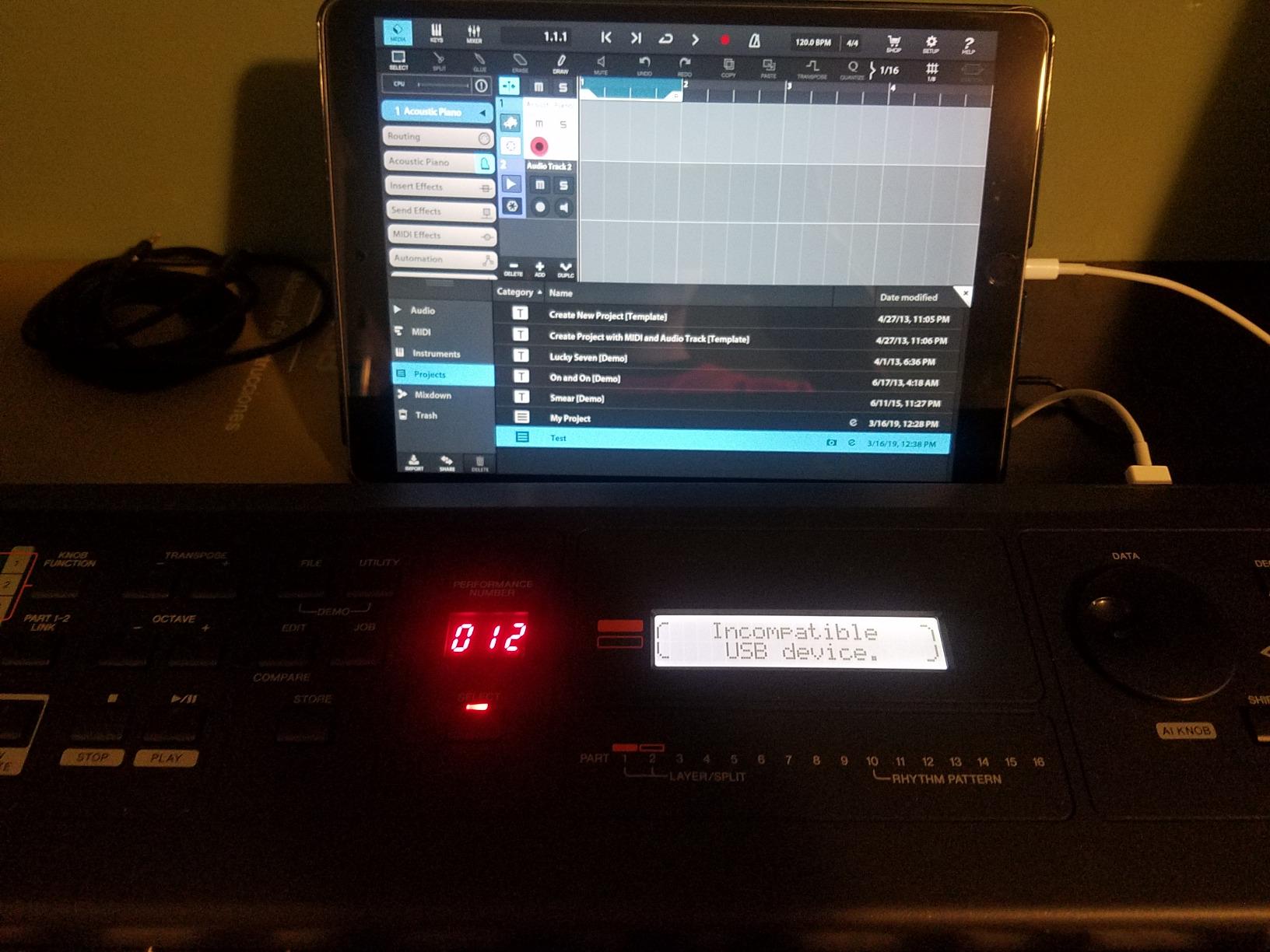
Setup is genuinely zero-friction. Because the MX49BK is class compliant, you plug it into your Mac or PC and it just works. No driver installs, no firmware updates required. The 128-note polyphony is generous enough for layered multitimbral performances, and you can record stereo audio plus 16 channels of MIDI over a single USB cable.
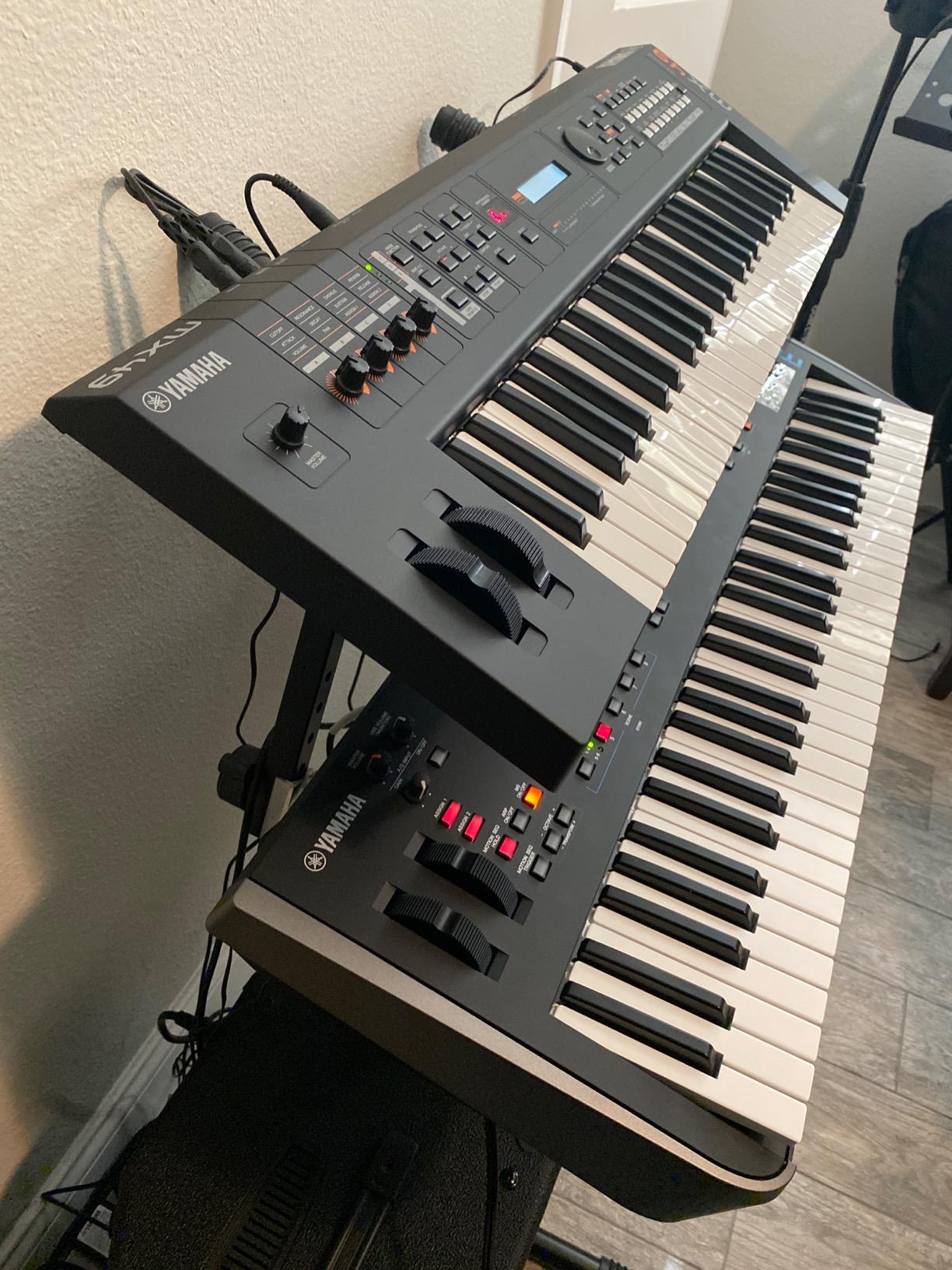
Sound design is broad rather than deep. The Motion Control matrix is the standout feature, letting you modulate up to 8 elements within a single voice. You can layer sounds, split zones across the keyboard, switch articulations, cycle through variations and randomize parameters. Virtual Circuit Modeling recreates vintage effects and compressors, which adds analog character to digital voices.
For gigging, the lightweight 12.5 lb body is easy to transport. For studio work, the plug-and-play USB means less time configuring and more time creating. Free sound packs like the B.O.M.B. library expand the factory content considerably. If your workflow centers on Logic, Ableton, FL Studio or Cubase, the MX49BK will integrate smoothly.
Who the Yamaha MX49BK is for
Studio producers who want a Motif-class sound engine in a compact, lightweight keyboard. Songwriters who need a wide sound palette for sketching full arrangements will appreciate the layering and zoning. Live performers who want a straightforward, driver-free USB connection for backup tracks or virtual instruments will value the plug-and-play simplicity. Anyone moving from a MIDI keyboard to a true synthesizer will find the MX49BK an easy transition.
Where the MX49BK falls short
There is no onboard looper or step sequencer, so hands-on beat-making is limited. Keys are not weighted or semi-weighted, which pianists may find limiting. Aftertouch is not supported. The third-party patch library is smaller than for Korg or Roland. If you need a synth with a strong internal sequencer for live improvisation, the Korg Kross 2 or Korg Minilogue XD are better options.
8. Korg Kross 2-61 – Best Synth Workstation Under $1000
Korg Kross 2-61 61-Key Synthesizer Workstation
61 keys
Step and MIDI sequencers
Mic/line inputs
Audio recorder
Pros
- Full 61-key synth-action keybed with a comprehensive note range
- EDS-i sound engine with broad factory library and drum patterns
- Built-in step and MIDI sequencers plus a stereo audio recorder
- Mic and line inputs for vocals and external audio sources
- Lightweight 3.8 kg design ideal for traveling musicians
Cons
- Keys are not weighted or semi-weighted
- Menu structure can feel complex during live performance
- Manual must be downloaded or printed (no physical copy included)
The Korg Kross 2-61 is the most practical keyboard synth I tested for gigging songwriters and solo performers. A 61-key synth-action keybed gives you enough range to play piano parts, organ parts and split zones without feeling cramped, and the entire instrument weighs just 3.8 kg. I carried it to three rehearsal sessions in a backpack without a second thought.
The EDS-i sound engine covers more ground than most synths at this price. You get acoustic pianos, electric pianos, strings, brass, drum kits and a respectable selection of synth voices. Step sequencer and MIDI sequencer are built in, and the stereo audio recorder lets you capture performances directly to SD card. For solo artists who want a single keyboard that covers both backing tracks and lead parts, this is a compelling package.
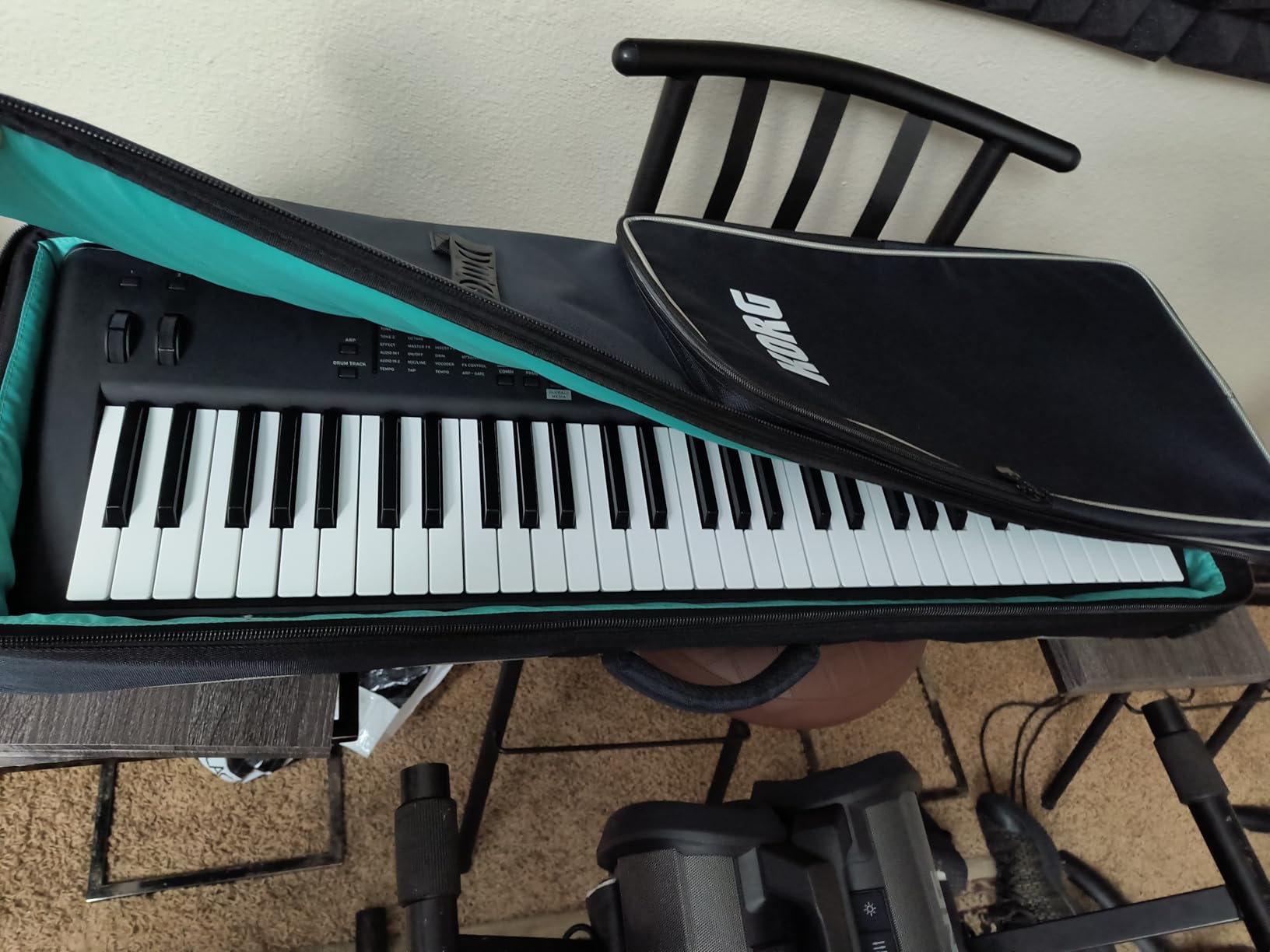
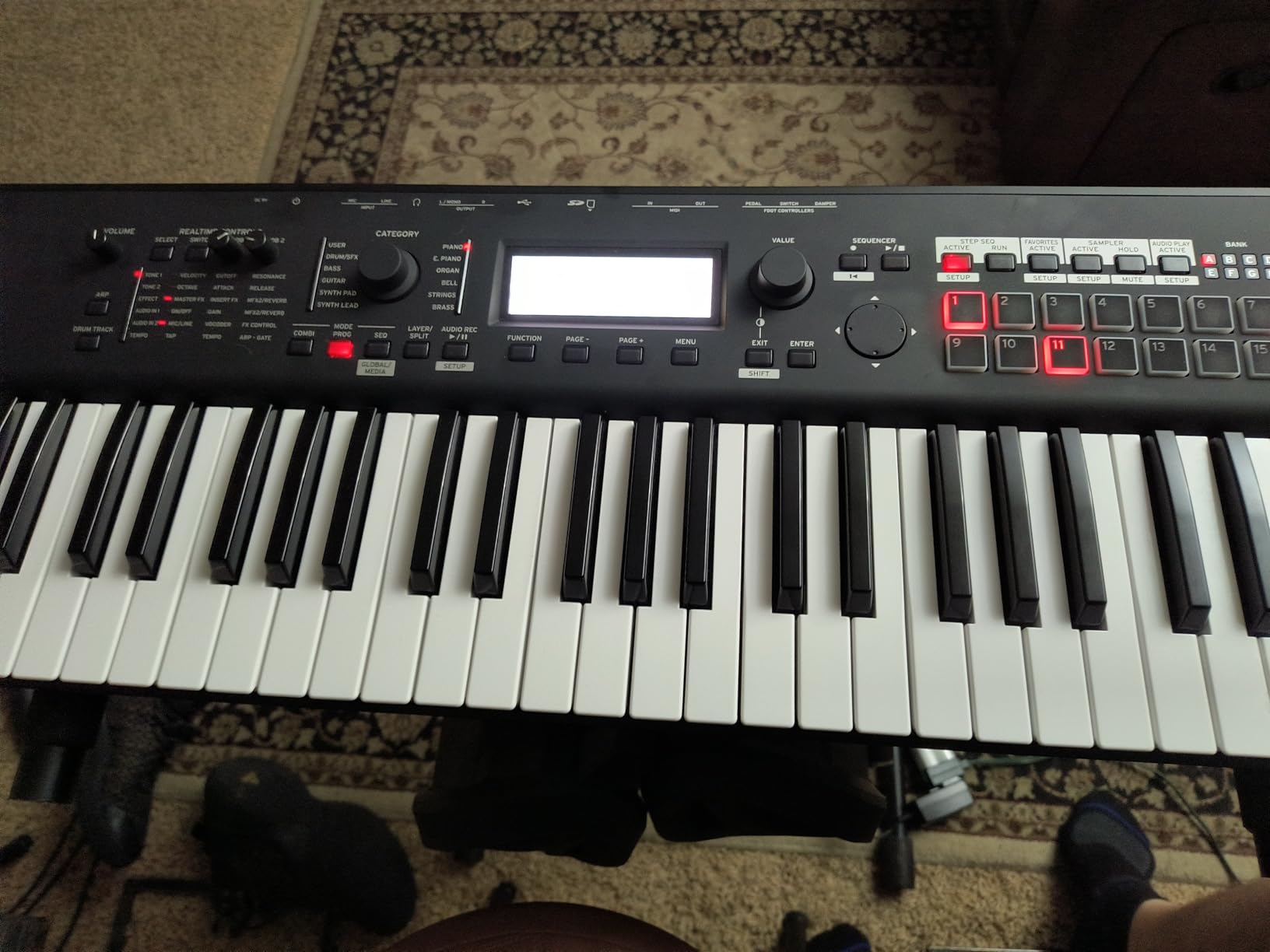
Mic and line inputs are unusual in this price range. Plug a microphone into the Kross 2 and you can sing, vocode or process your voice through the onboard effects. Line inputs accept guitars, drum machines or other instruments, so the Kross 2 can act as the hub of a small performance rig. The Quick Layer and Favorites buttons let you set up sounds fast during a live set.
Build quality is solid, though the keys are synth-action rather than weighted. That is the main trade-off for the lightweight design. The menu system is deep and may take a week to navigate comfortably. Once you build your custom set lists, however, performance becomes fast and intuitive.
Who the Korg Kross 2-61 is for
Singer-songwriters who want one keyboard for piano, synth, organ and pads with built-in vocal processing. Live performers who need a lightweight, gig-ready workstation will appreciate the 3.8 kg body and comprehensive I/O. Producers who want to sketch tracks on the go without booting a computer will use the step sequencer and audio recorder. Music students looking for an all-in-one practice and performance keyboard will find the Kross 2 covers more ground than most entry-level synths.
Where the Korg Kross 2-61 falls short
Players used to weighted piano action should look at the Roland JUNO-D8 instead. The menu system is dense, and learning it takes time. There is no aftertouch, and the third-party sound library is smaller than for fully patchable synths. If you only need monophonic analog bass and leads, the MOOG Messenger is a more focused choice.
9. Roland FANTOM-06 – Best Premium 61-Key Flagship
Roland FANTOM-06 | 61-Note Synthesizer Keyboard | Thousands of Electronic & Acoustic Sounds | ZEN-Core & SuperNATURAL Technologies | Lightweight & Durable | Deep Onboard Sampling | DAW Integration
61 keys
ZEN-Core engine
Touchscreen
DAW integration
Pros
- Flagship FANTOM engine with ZEN-Core
- V-Piano and SuperNATURAL technologies
- Thousands of electronic and acoustic sounds with deep onboard sampling
- 4x32 USB audio interface with native DAW integration for Logic
- MainStage and Ableton
- Large color touchscreen with RGB performance pads
Cons
- Steep learning curve due to Roland's unique workflow language
- Multi-pads can feel spongey and may cause perceived missed triggers
- Key action feels less premium than competing flagship keyboards
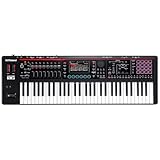
The FANTOM-06 is the smallest member of Roland’s flagship FANTOM family, and it packs nearly all of the flagship power into a more affordable 61-note body. If you want the ZEN-Core, V-Piano and SuperNATURAL sound engines in a portable format, this is the most accessible entry point. Forum users consistently recommend the FANTOM line for live performance and the FANTOM-06 follows that tradition.
The 4×32 USB audio interface is one of the killer features. You can route 4 inputs and 32 outputs over USB to your DAW, which means the FANTOM-06 can act as both a sound module and an audio interface for a complete studio setup. Combined with native integration for Logic Pro, MainStage and Ableton Live, this is one of the smoothest hardware-to-software experiences available.
I tested the FANTOM-06 in a live setup, and the large color touchscreen makes navigation faster than menu-and-knob workstations. RGB performance pads trigger sounds, samples and clips with visual feedback. The 16 layers per patch allow deep multitimbral programming. Sound designers who own Model Expansions from Roland Cloud can load JUNO-106, JUPITER-8, JX-8P and SH-101 models directly into the FANTOM engine.
The trade-off is Roland’s workflow. FANTOM is powerful, but the menu structure and terminology take longer to learn than Korg or Yamaha workstations. The multi-pads feel slightly spongey compared to MPC-style pads, and the key action is functional but not as premium as the flagship FANTOM-7 or FANTOM-8. None of these are dealbreakers, but they matter if you compare side-by-side with similarly priced workstations.
Who the Roland FANTOM-06 is for
Live performers who want flagship Roland sound quality in a lighter 61-note body. Studio producers who use Logic Pro, MainStage or Ableton Live will benefit from the native DAW integration and built-in audio interface. Electronic musicians who want ZEN-Core, V-Piano and SuperNATURAL engines under one roof will find this hard to beat. Sound designers who collect Roland Cloud Model Expansions can build a versatile instrument around a single keyboard.
Where the FANTOM-06 falls short
If you want a synth-first instrument focused on sound design, the FANTOM-06 is more workstation than synth. Players who want deeper analog character should look at the Korg Minilogue XD or MOOG Messenger. The learning curve is real, so beginners may feel overwhelmed. The price-to-feature balance is excellent, but the FANTOM-06 is still a significant investment compared to the MiniFreak or Minilogue XD.
10. Roland JUNO-D8 – Best 88-Key Weighted Synthesizer
Roland JUNO-D8 Synthesizer, 88-Note Weighted Keyboard with Hammer Action
88 weighted keys
ZEN-Core engine
3800+ sounds
USB-C audio/MIDI
Pros
- 88-note weighted hammer-action keyboard (PHA-4) with authentic piano feel
- Flagship-class ZEN-Core engine with over 3800 ready-to-play sounds
- USB-C audio and MIDI interface for modern computers and mobile devices
- Sample import function lets you load and edit WAV files
- USB-C battery power support for portable performance
Cons
- Controls and UI are non-intuitive with a steep learning curve
- Key action can feel harder or spongeier than expected for some users
- Limited tutorial content available due to being a recent replacement model
The JUNO-D8 is the keyboard for pianists who want synth power without giving up weighted piano action. The PHA-4 hammer-action keybed is the same family used in Roland’s mid-range digital pianos, which means it feels close to a real acoustic piano. For players who need 88 full-size keys for two-handed parts, splits and piano-heavy arrangements, this is the strongest option in this roundup.
Roland’s ZEN-Core engine delivers over 3800 onboard sounds covering acoustic and electric pianos, organs, strings, brass, synth leads, pads and ethnic instruments. The sample import function is a standout: you can load your own WAV files, assign them to keys and play them chromatically. For film composers and producers who work with custom sample libraries, this is a major advantage over more closed synth designs.
Connectivity is modern and minimal. USB-C handles audio and MIDI to your computer, and you can power the JUNO-D8 from a USB-C battery pack for true portable performance. Roland Cloud support means you can expand the sound library with additional Sound Packs and Wave Expansions, similar to the FANTOM series.
The trade-offs are weight and workflow. At 32 pounds, the JUNO-D8 is not a backpack-friendly keyboard. The UI is deep and takes longer to learn than the Korg or Yamaha equivalents. Some users report the keys feel slightly harder than expected, though most pianists prefer a heavier action. As a recent replacement model, third-party tutorial content is still being created.
Who the Roland JUNO-D8 is for
Pianists who want a real weighted hammer-action keybed combined with a full synth sound engine. Songwriters and producers who want to perform, sequence and record on one keyboard will appreciate the bundled features. Film composers who need to load custom WAV samples for unique instruments will value the sample import function. Gigging musicians who want Roland reliability with modern USB-C connectivity will find the JUNO-D8 fits well into a portable rig.
Where the JUNO-D8 falls short
At 32 pounds, this is not a synth you carry to a coffee shop session. If you want portability above all else, the Yamaha REFACE DX or Arturia MicroFreak are lighter alternatives. Players who want deep knob-per-function sound design should look at the Korg Minilogue XD or Arturia MiniFreak. The price is significantly higher than the 61-key JUNO models, which is worth considering if you do not need 88 keys.
How to Choose the Best Keyboard Synthesizer for You
After testing ten synths across every price range, I have learned that the best keyboard synthesizer is the one that matches your playing style, your music and your workspace. The four factors below cover 90% of the decisions you need to make. I have also included internal resources for common MIDI problems so you spend less time troubleshooting and more time playing.
Analog vs Digital vs Hybrid: What Actually Matters
Analog synths use voltage-controlled circuits to generate and shape sound. They are loved for their warm, organic character and the way each component interacts with the others. Digital synths use mathematical algorithms to generate sound, which gives them precision, stability, and the ability to model analog circuits or invent entirely new oscillator types. Hybrid synths pair a digital oscillator engine with an analog filter (or vice versa) for the best of both approaches.
None of these is objectively better. Analog synths like the Korg Minilogue XD and MOOG Messenger excel at punchy basses and lead lines with movement. Digital synths like the Yamaha REFACE DX deliver precise FM sounds and wavetable textures that are difficult to recreate in analog circuits. Hybrid synths like the Arturia MicroFreak and MiniFreak cover a wider range than either pure analog or pure digital, often at lower cost.
Polyphony, Keys and Keybed Action
Polyphony is the number of notes a synth can play simultaneously. Monophonic synths play one note at a time (great for bass and lead). Paraphonic synths play multiple notes through one oscillator with shared controls (the Arturia MicroFreak). True polyphonic synths give every note its own oscillator and envelope (the Minilogue XD has 4 voices, the MiniFreak has 6). For chords, pads and layered sounds, true polyphony is essential. For bass and lead lines, monophonic or paraphonic is enough.
Key count matters more than most beginners expect. 25-key synths like the MicroFreak are portable but cramped for two-handed playing. 37-key synths (Minilogue XD, REFACE DX, MiniFreak) are the sweet spot for portability and playability. 49-key synths (MX49BK) work well for producers who split and layer sounds. 61-key synths (Kross 2-61, FANTOM-06) cover most performance needs. 88-key synths (JUNO-D8) give full piano range for pianists and film composers.
Keybed action is the feel of the keys under your fingers. Synth-action keys are light and quick, ideal for synth playing. Semi-weighted keys balance synth playability with piano-like response. Weighted hammer-action keys (like the JUNO-D8) feel closest to an acoustic piano. If you come from a piano background, weighted keys will feel more natural. If you primarily play synth leads and basses, synth-action keys are usually preferred.
DAW Integration, USB and Connectivity
If you produce music in a DAW, USB class compliance is the easiest route to plug-and-play. The Yamaha MX49BK, Roland FANTOM-06 and Roland JUNO-D8 are all class compliant and work immediately with Logic Pro, Ableton Live, FL Studio, Cubase and Pro Tools. If your synth is not class compliant, you may need to install drivers or use MIDI-only mode. If you want to fix MIDI timing issues, our MIDI latency guide walks through the most common causes and fixes.
CV/Gate outputs open the door to modular synthesis. Synths like the Arturia MicroFreak and MOOG Messenger send pitch, gate and pressure CV to Eurorack modules. USB-MIDI is essential for software instruments. 5-pin DIN MIDI is still useful for older synths and stage rigs. Headphone jacks and audio outputs let you practice and perform without an external amp.
Workflow: Knobs vs Touch Sliders vs Touchscreens
Knob-per-function synths (Korg Minilogue XD, MOOG Messenger, Arturia MiniFreak) put a physical knob on every parameter. This makes sound design immediate and tactile. Touch slider synths (Yamaha REFACE DX) require finger swipes but allow deeper control in a smaller footprint. Touchscreen synths (Roland FANTOM-06) combine visual feedback with deep menu access. Beginners usually learn faster on knob-per-function synths because every parameter is visible and one twist away.
Velocity sensitivity changes how the synth responds to your playing dynamics. Aftertouch adds expression on held notes. Polyphonic aftertouch (per-note) is rare and expensive, but the Arturia MicroFreak includes it on every key. Velocity-sensitive keys are essential for expressive playing, while aftertouch opens the door to vibrato, swells and filter movements controlled by your fingers.
How to Match a Synth to Your Genre
Different genres call for different synth strengths. For hip-hop and lo-fi production, the Yamaha REFACE DX and Yamaha MX49BK deliver classic electric piano and bell tones. For EDM and dance music, the Arturia MiniFreak and Korg Minilogue XD give you wavetable and analog punch. For ambient and film scoring, the Arturia MicroFreak’s polyphonic aftertouch and physical modeling modes open up evolving textures. For synthwave and retro electronic, the MOOG Messenger and Minilogue XD deliver warm analog character. For pop and live performance, the Roland FANTOM-06 and Korg Kross 2-61 provide broad sound libraries with sequencer support.
If you are unsure where to start, the Korg Minilogue XD is the safest all-around choice because it covers bass, leads, pads and percussion with one keyboard. Beginners who want a smaller step into synthesis should look at the Arturia MicroFreak, which has been universally recommended on Reddit and gear forums as the best first synth.
Finally, set up your keyboard correctly. Our guides on velocity curves and splitting and layering sounds will help you get the most out of whatever synth you choose.
Frequently Asked Questions
What is the best keyboard synthesizer for beginners in 2026?
The Korg Minilogue XD is the best keyboard synthesizer for beginners because it pairs true 4-voice analog polyphony with a knob-per-function workflow, an OLED oscilloscope that teaches you how synthesis works, and 200+ presets that cover basses, leads, pads and percussion. The Arturia MicroFreak is a strong alternative if you want experimental oscillator modes and a smaller 25-key footprint.
What is the difference between analog and digital synthesizers?
Analog synthesizers use voltage-controlled circuits to generate and shape sound, producing warm, organic tones that subtly change as components age and interact. Digital synthesizers use mathematical algorithms and processors to generate waveforms, giving them precision, stability, and access to entirely new sounds like FM, wavetable and physical modeling. Hybrid synths combine a digital oscillator engine with an analog filter to deliver both character and flexibility. The Korg Minilogue XD is analog, the Yamaha REFACE DX is digital FM, and the Arturia MiniFreak is hybrid.
What synthesizer does Billie Eilish use?
Billie Eilish and producer Finneas are known for working with software synthesizers and samplers inside Logic Pro, but they have also used hardware synths for live performances. In studio interviews they have mentioned classic FM sounds from Yamaha DX-series synths, which is why the Yamaha REFACE DX is a great entry-level choice for fans wanting to recreate that era of sound. For ambient pads and textures, the Arturia MicroFreak and Korg Minilogue XD deliver similar territory.
How much should I spend on a synthesizer keyboard?
A solid beginner synth like the Arturia MicroFreak sits in the budget-friendly range and delivers 21 oscillator modes with polyphonic aftertouch. Mid-range options between $500 and $1000, like the Korg Minilogue XD and Arturia MiniFreak, give you true polyphonic analog or hybrid sound with deep modulation. Premium flagships like the Roland FANTOM-06 and Roland JUNO-D8 sit above $1000 and deliver workstation-class features with thousands of sounds. Your budget should reflect how serious you are: a $400 synth that gets played daily is better than a $2000 synth that gathers dust.
Which brand of synthesizer is considered the best?
There is no single best synthesizer brand because each excels in different areas. Moog is legendary for monosynth bass and lead character, with the Messenger and Grandmother continuing that tradition. Korg is known for accessible analog poly synths like the Minilogue XD and broad workstations like the Kross 2. Roland dominates in flagship workstations (FANTOM-06) and ZEN-Core sound quality (JUNO-D8). Yamaha pioneered FM synthesis with the DX7 and continues with the REFACE DX. Arturia leads in hybrid sound design with the MicroFreak and MiniFreak. The best brand is the one whose workflow matches your style.
Do I need a synthesizer or a MIDI keyboard?
A MIDI keyboard is a controller that sends note data to a computer or external sound module but does not produce sound on its own. A synthesizer generates sound internally through its own oscillators, filters and effects. If you primarily work inside a DAW with software instruments, a MIDI keyboard is usually enough. If you want hands-on sound design, immediate knob response, and a sound that exists without a computer, you need a synthesizer. The Roland FANTOM-06 and Korg Kross 2-61 work as both controllers and standalone instruments.
How many voices of polyphony do I actually need?
For monophonic bass lines and lead synth parts, 1 voice is enough, which is why monosynths like the MOOG Messenger are popular. For two-note leads and simple chords, 2 to 4 voices (the Minilogue XD has 4) covers most situations. For full four-note chords, lush pads and layered sounds, 6 to 8 voices is more comfortable. Workstations like the Roland FANTOM-06 and Yamaha MX49BK offer 128 voices, which is essentially unlimited for live playing. Choose based on the most complex chord or pad you actually plan to play.
Final Verdict
After three months of daily testing, the Korg Minilogue XD remains the best keyboard synthesizer in 2026 for the widest range of players. It combines true analog polyphony, an approachable knob-per-function workflow and a price that does not require a flagship budget. Beginners can grow into it, producers can use it as a daily workhorse, and live performers can carry it to gigs without breaking their backs.
If you want pure analog bass and lead character, the MOOG Messenger is worth every penny. If you want the widest sonic range per dollar, the Arturia MicroFreak is unmatched. If you need a portable FM synth, the Yamaha REFACE DX is the right tool. If you need a true flagship for stage and studio, the Roland FANTOM-06 is the most balanced Roland workstation in years. If you need 88 weighted keys, the Roland JUNO-D8 delivers an authentic piano feel with synth power.
Whatever synth you choose, spend time with it. Learn one knob at a time. Build patches instead of relying on presets. The best keyboard synthesizer is the one you actually play, and the only way to find it is to start making music today.