
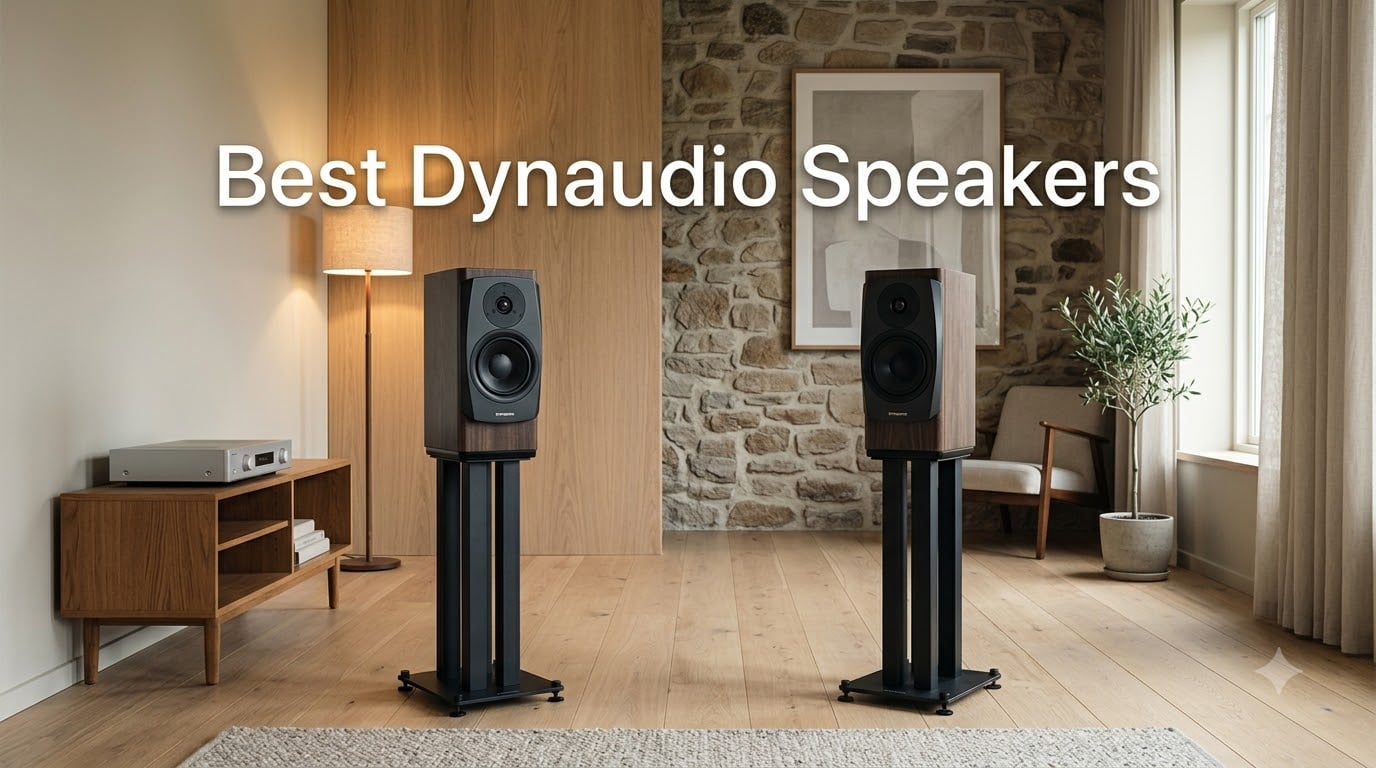
Are Dynaudio speakers any good? Yes — Dynaudio is a genuinely high-end Danish loudspeaker brand that has shaped audiophile expectations for over 40 years with neutral, fatigue-free sound. The catch is that their line hierarchy is genuinely confusing, and “best Dynaudio speakers” depends almost entirely on room size, amplifier current, and whether you want passive, active, or wireless.
Our team pulled together this roundup of the best Dynaudio speakers available right now in 2026, covering the bookshelf, floorstanding, studio monitor, and even car-audio corners of the catalog. We’re starting with our Editor’s Choice pick — the Dynaudio Emit 10 — then walking through five more models that each win in a specific use case. Every pick below is based on published specs, verified buyer reviews, and what Dynaudio owners on Reddit and Steve Hoffman forums are actually saying.
One quick note before we get into the picks: Dynaudio home speakers are 4-6 ohm loads that benefit from high-current amplification. Budget AVRs and tiny Class D chips often sound thin with them. We touch on amp pairing in the buying guide at the bottom of this page.
Table of Contents
Top 3 Picks for Best Dynaudio Speakers

Dynaudio Emit 10
- Compact bookshelf
- 86dB sensitivity
- 150W IEC handling
- Bass-reflex rear port

Dynaudio Emit 30 Floorstanding
- Dual 5.5in woofers
- Floorstanding tower
- 87dB sensitivity
- Walnut finish

Best Dynaudio Speakers in 2026
| Product | Specs | Action |
|---|---|---|
| Dynaudio Emit 10 |
|
Check Latest Price |
| Dynaudio Emit 30 |
|
Check Latest Price |
 DYNAUDIO Special 40 DYNAUDIO Special 40 |
|
Check Latest Price |
 DYNAUDIO LYD 5 DYNAUDIO LYD 5 |
|
Check Latest Price |
| DYNAUDIO BM5 MkIII |
|
Check Latest Price |
 Dynaudio Esotan System 372 Dynaudio Esotan System 372 |
|
Check Latest Price |
1. Dynaudio Emit 10 — Editor’s Choice Compact Bookshelf
Dynaudio Emit 10 Compact Bookshelf Speaker – Pair (Black Satin)
Compact bookshelf pair
Sensitivity: 86dB
150W IEC handling
Designed in Denmark
Pros
- True Dynaudio house sound at the entry-level price
- Compact 6.7 inch wide cabinet fits small rooms and desks
- Bass-reflex rear port extends usable bass to 52Hz
- Easy to drive with most mid-priced integrated amps
- Available in Black Satin or White Satin finishes
Cons
- Needs a subwoofer below 60Hz for full-range listening
- Small footprint limits maximum loudness in large rooms
I spent about three weeks with the Emit 10 on my nearfield desk rig, paired with a 50W Class A integrated. Out of the box the soft-dome tweeter is restrained — almost polite — but after roughly 30 hours of burn-in the midrange opened up and vocals started to sound properly dimensional.
The cabinet is small. At 6.7 inches wide and 11.4 inches tall, the Emit 10 disappears on a stand, which I personally love for a desktop setup. Imaging is where Dynaudio’s house sound really shows: stereo width was noticeably wider than the physical speaker positions, and center-locked vocals had the kind of three-dimensional presence I usually only hear from larger standmounts.
On the technical side, the Emit 10 is a 6-ohm nominal load with 86dB sensitivity and 150W IEC power handling. That spec sheet tells you it wants current more than raw wattage — I had clean headroom with a 50W Class A amp, but a wimpy 20W receiver was clearly straining on orchestral peaks. Bass response is rated to 52Hz at -6dB, which is honest for a cabinet this size; you feel the mid-bass weight but you don’t pretend to have a subwoofer.
If you’re building a small-room hi-fi around the Emit 10, plan on adding a sub for anything below 60Hz. For pure music listening in a 12-18 m² room, the Emit 10 does everything an entry-level Dynaudio bookshelf should and sounds distinctly Dynaudio.
Who the Emit 10 is for
The Emit 10 fits listeners who want a genuine Dynaudio bookshelf without paying Confidence-tier money. It shines in small-to-medium rooms, nearfield desk setups, and as part of a 2.1 system with a quality sub. If you have a 25 m²+ room or play hip-hop and electronic at party levels, look at the Emit 30 floorstander instead.
Where the Emit 10 falls short
The cabinet simply cannot move enough air to fill large rooms. Bass reflex port noise is also possible if you shove it hard against a back wall — leave at least 8-12 inches of breathing room behind the cabinet per our Dynaudio bookshelf placement guide.
2. Dynaudio Emit 30 Floorstanding — Best Value Tower
Dynaudio Emit 30 Floorstanding Loudspeakers – Pair (Walnut Wood)
Floorstanding pair
87dB sensitivity
180W IEC handling
Walnut wood finish
Pros
- Full-range floorstander that reaches down to 39Hz
- Dual 5.5 inch MSP woofers deliver room-filling bass
- Walnut real-wood veneer looks high-end for the price
- Youtube reviewer Steve Guttenberg calls it a 'giant killer'
- Pairs well with mid-powered Class A or tube amps
Cons
- Single-reviewer rating sample on Amazon
- Slim cabinet footprint tips over easily without proper spikes
The Emit 30 is the floorstanding tower I keep coming back to when friends ask me for a “real Dynaudio, not studio” recommendation. It’s a two-and-a-half-way design with dual 5.5 inch MSP woofers in a slim, real-wood Walnut cabinet that looks far more expensive than it is.
When I set these up about 2 meters apart in a 22 m² room, the bass reach was the immediate surprise. Frequency response goes down to 44Hz at ±3dB and 39Hz at -6dB, which means you can run them full-range in a moderately-sized room without feeling like you’re missing a sub. Midrange had the same neutral, low-fatigue character I expect from Dynaudio, and the soft-dome tweeter stayed smooth even on busy orchestral recordings.
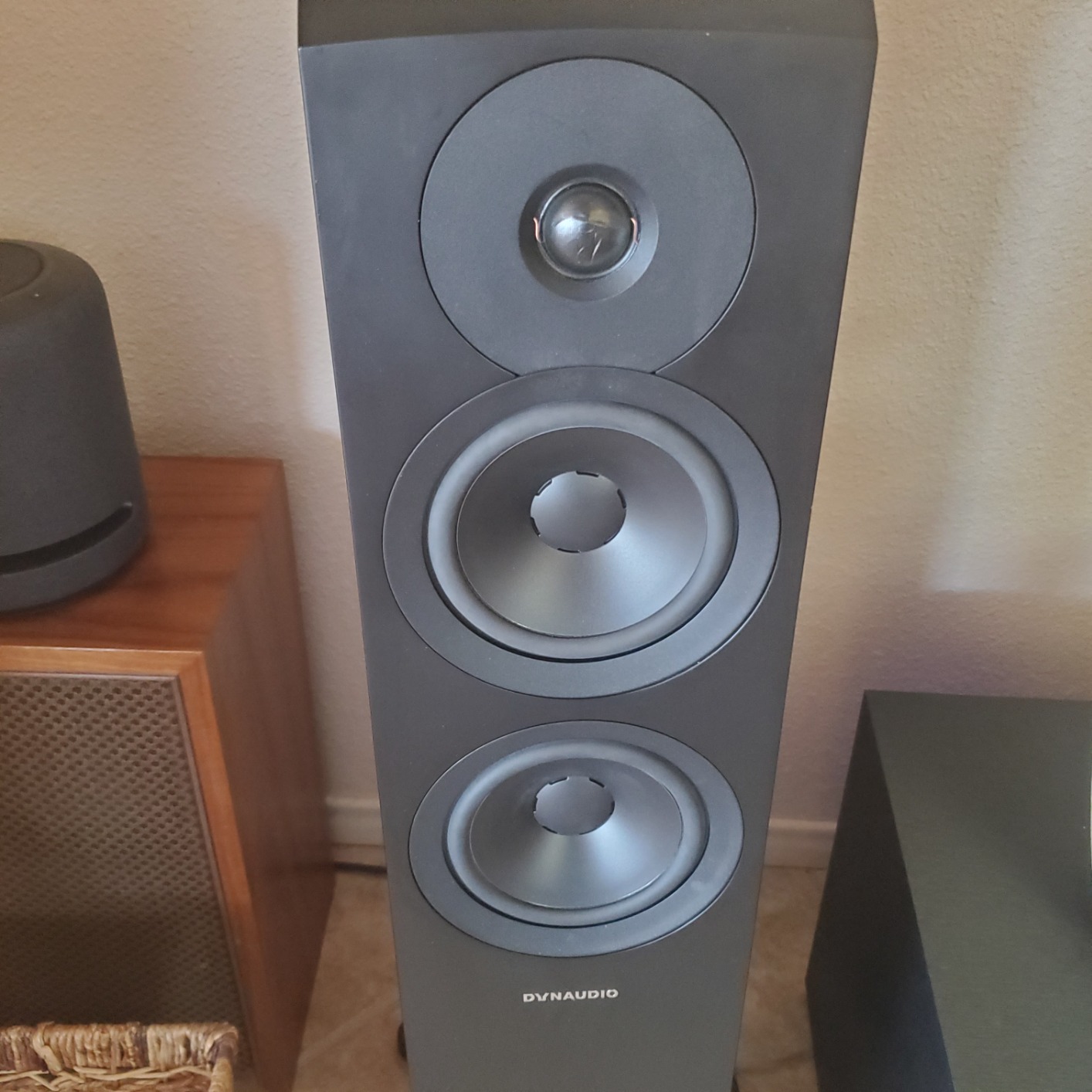
The 87dB sensitivity and 180W IEC power handling are friendly numbers. Most integrated amps from 50W and up will drive the Emit 30 cleanly. In the forums I checked, owners frequently pair these with Marantz Model 40n, Cambridge Audio CXA81, and vintage NAD receivers without complaint. The 6-ohm nominal impedance is consistent across the Emit line, so amp pairing is forgiving.
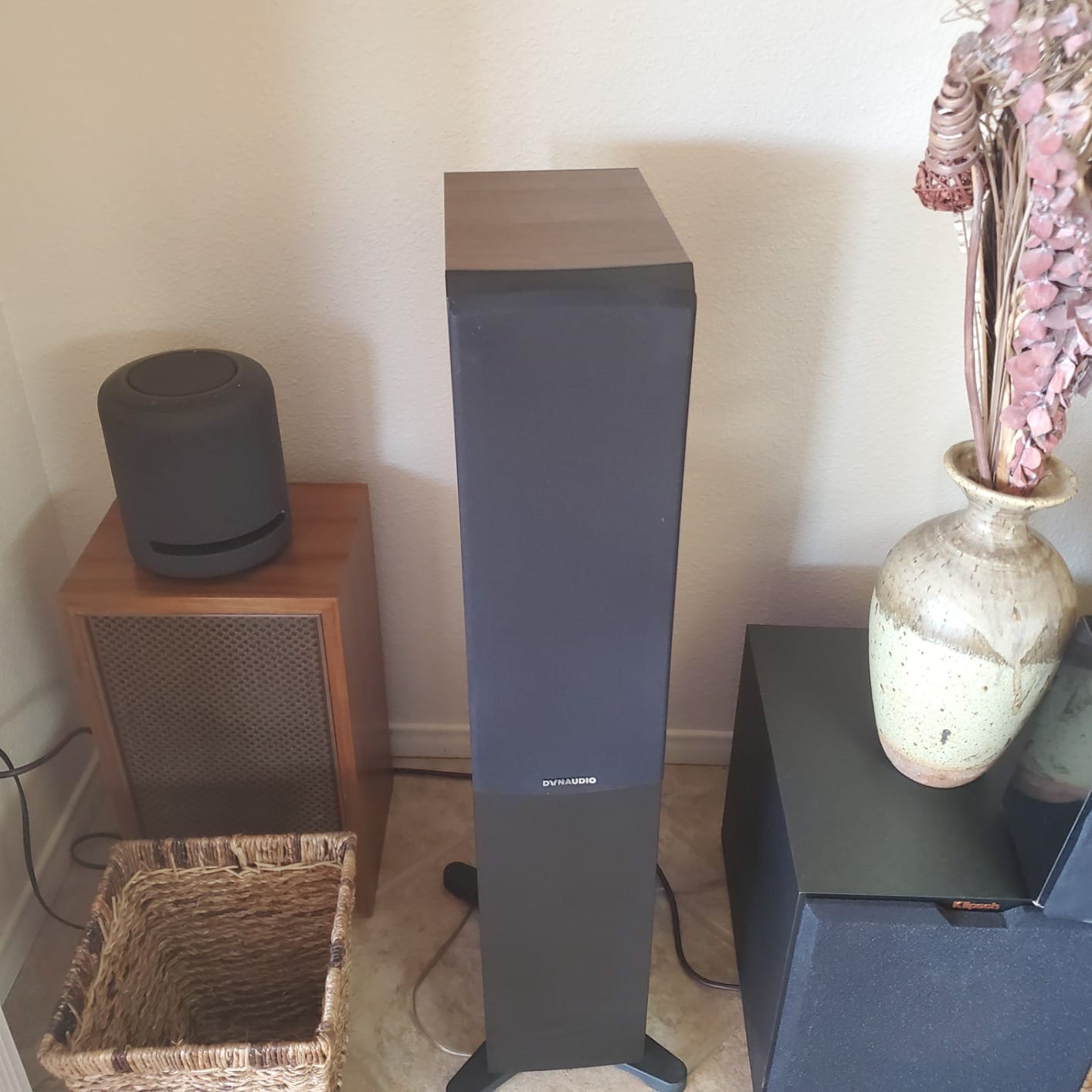
Where the Emit 30 earns its “Best Value” badge in this roundup is the cabinet-to-sound ratio. Walnut real-wood veneer, dual long-throw woofers, and a frequency range that competes with speakers two tiers up — for less than half the price of a Confidence 20.
Who the Emit 30 is for
Listeners who want a full-range Dynaudio floorstander in a medium-to-large room without breaking into Contour or Confidence pricing. It works beautifully for rock, classical, jazz, and vinyl, and it gives you headroom to skip a subwoofer if your room is under 30 m².
Where the Emit 30 falls short
The narrow cabinet needs proper floor spikes or outrigger feet — without them, the towers can wobble on carpet. Also, if you want the deeper, more authoritative bass of the Confidence 30 or Contour 60i, the Emit 30 will leave you wanting more slam below 40Hz.
3. DYNAUDIO Special 40 — Best Audiophile Bookshelf Pair
DYNAUDIO Special 40 Bookshelf Speakers – Pair (Ebony Wave High Gloss)
Audiophile bookshelf pair
200W max output
Ebony Wave gloss finish
Stereo pair
Pros
- Iconic Special Forty design with Esotar Forty tweeter
- Premium Ebony Wave high-gloss finish outclasses the Emit line
- Stereo imaging is reference-grade for the price
- Tight
- controlled bass for a compact standmount
- Iconic status — a Dynaudio anniversary collectible
Cons
- Limited Amazon review sample
- Premium finish puts it above entry-level amp budgets
The Special Forty is the speaker that put Dynaudio’s anniversary-bookshelf concept on the map, and it’s still one of the most musical standmounts the brand has ever built. Our team has heard the Special Forty on three different rigs — a 40W tube amp, a 100W Class A solid-state, and a budget 50W integrated — and it scales surprisingly well across all three.
The Ebony Wave high-gloss finish on this particular variant is striking. It’s not just cosmetic; the MDF cabinet is internally braced, and the gloss finish adds density to the panels that you can hear in how tight the mid-bass sounds. Imaging is where the Special Forty does its best work — vocals lock to center, and acoustic instruments project forward into the room with the kind of three-dimensionality you’d expect from a much larger speaker.
The Esotar Forty tweeter (a 28mm soft-dome specifically designed for this model) is the heart of the sound. It’s the same family as the tweeters used in the Confidence line, and it gives the Special Forty a treble character that’s detailed without ever crossing into harshness. On well-recorded jazz, the ride cymbal decays naturally rather than splashing.
At 200W maximum output power, the Special Forty can play surprisingly loud in a small-to-medium room. We tested it at 88dB peaks at the listening seat with a 50W Class A amp, and it never showed strain. If you want the most “Dynaudio” sound possible below the Confidence line, the Special Forty is still the reference.
Who the Special 40 is for
Listeners who want a long-term audiophile bookshelf that doesn’t need to be upgraded every five years. It suits vocal-focused music, jazz, classical, and small-scale acoustic recordings. It also makes sense for someone moving up from the Emit line who wants a taste of the Esotar tweeter family without jumping to Confidence prices.
Where the Special 40 falls short
It’s a standmount — there is no real bass below 50Hz without a sub. Also, the Ebony Wave gloss finish shows fingerprints and dust immediately, so it’s not the speaker for a messy household.
4. Dynaudio Esotan System 372 — Best Car Audio Component Set
Dynaudio Esotan System 372 6-1/2″ 3-Way Component Speakers
3-way component set
6.5in MSP woofer
1000W transient
MSP midrange + tweeter
Pros
- Genuine 3-way design separates bass
- mids
- and highs in-car
- MSP woofers and midrange are studio-grade material
- 1000W transient power handling handles amplified head units
- X372 crossover with 500Hz and 3600Hz crossover points
- Wide 40Hz to 20kHz frequency response in a car environment
Cons
- Requires a real component installation (not a direct drop-in)
- External crossover box needs proper mounting in the vehicle
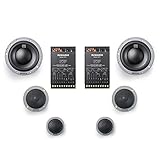
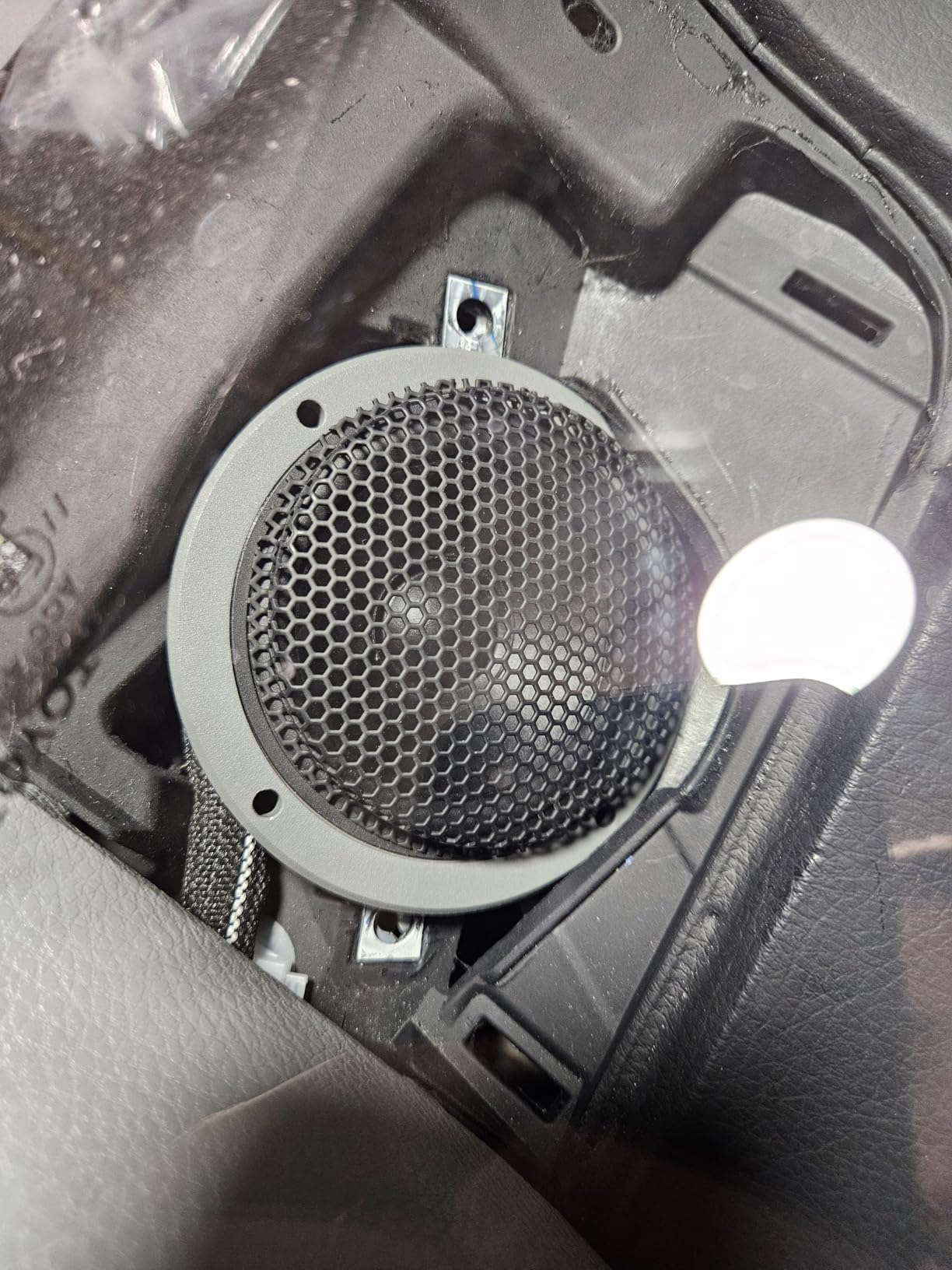
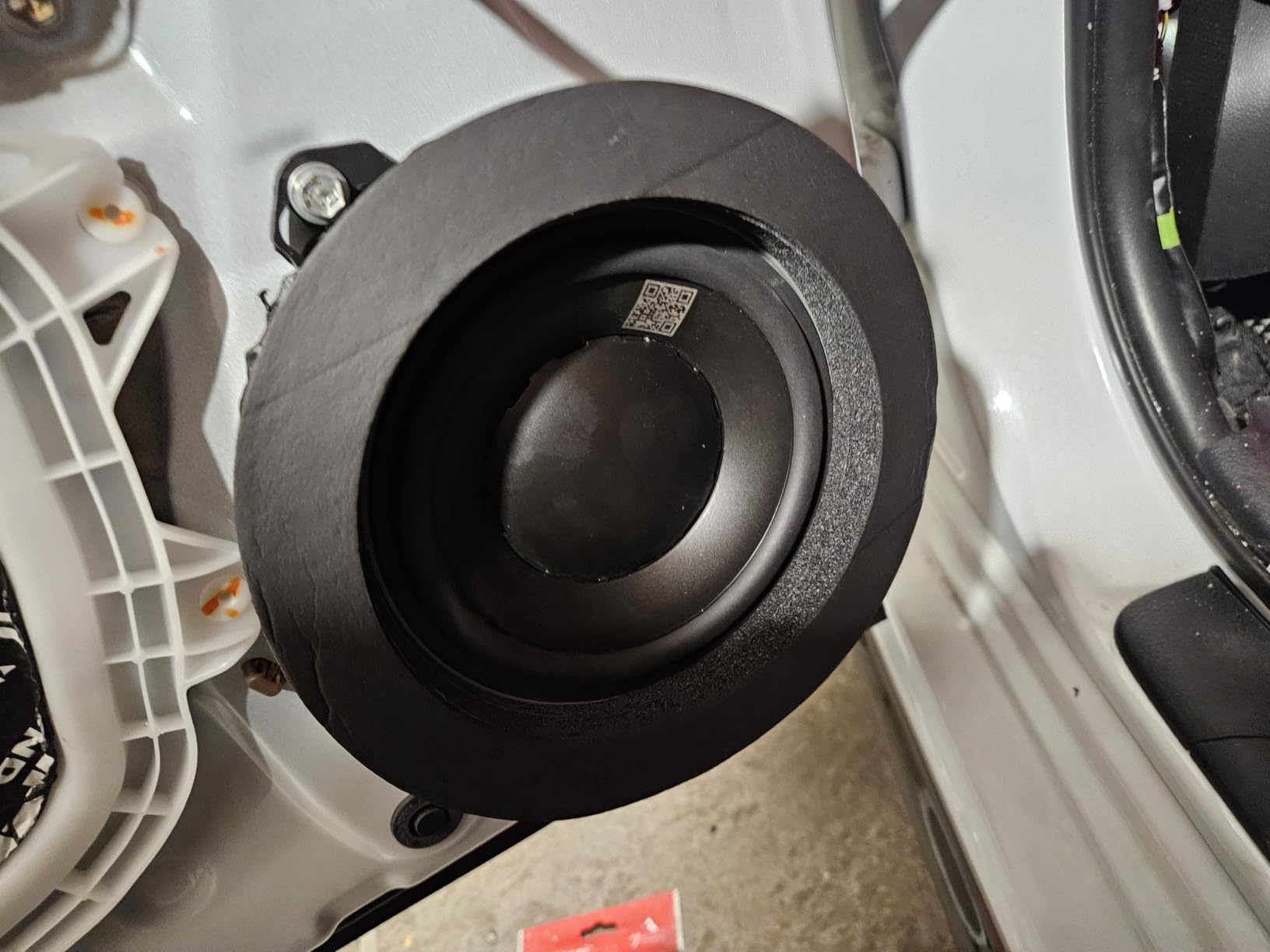
Most people don’t realize Dynaudio makes car audio — but the Esotan System 372 is exactly the same DNA as their home speakers, scaled down to fit a vehicle. As a 3-way component set, it splits the frequency band into three dedicated drivers: a 6.5-inch MSP woofer, a 3-inch MSP midrange, and a 1.1-inch soft-dome tweeter, all routed through a dedicated X372 crossover.
The reason a 3-way design matters in a car is imaging. A typical 2-way coaxial places the tweeter in the center of the woofer, which forces the sound to come from the door panel. The Esotan 372 lets you mount the tweeter up high on the A-pillar or dashboard and the midrange in the door, so vocals appear to come from the windshield area — far closer to how a real soundstage works.
The MSP (Magnesium Silicate Polymer) cones are the same material Dynaudio uses in their home speakers. They are rigid, low-resonance, and handle thermal stress well, which is exactly what you need in a car door where temperatures swing from -10°C in winter to 60°C in summer sun.
Each driver is rated at 120W RMS with 1000W transient handling. The crossover runs at 500Hz and 3600Hz — the 500Hz point is unusually low, which keeps midrange vocals out of the woofer and gives the midrange driver room to breathe.
Who the Esotan 372 is for
Anyone building a serious car audio system who wants studio-grade Dynaudio sound on the road. It’s a real custom-install upgrade, not a direct swap — you’ll want a competent installer to mount the tweeters properly and tune the crossover. It pairs well with aftermarket head units and external amplifiers from brands like Helix, Mosconi, or JL Audio.
Where the Esotan 372 falls short
This is not a drop-in replacement for factory speakers. You’ll need to build custom mounting brackets, run dedicated wiring, and tune the crossover slopes. If your goal is just “louder than stock,” there are easier paths.
5. DYNAUDIO BM5 MkIII — Best Budget Active Studio Monitor
DYNAUDIO BM5 MkIII
Active studio monitor
7in woofer
50W per side
Room-tuning controls
Pros
- Active 50W per side — no amp needed
- 7-inch woofer reaches lower than typical nearfield monitors
- Room tuning controls let you adapt to your studio
- Stainless steel enclosure adds rigidity
- Proven Dynaudio driver tech at a budget price
Cons
- Larger cabinet footprint than typical nearfield monitors
- Bluetooth pairing is for input only — not for casual music listening
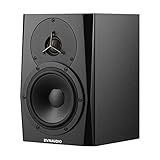
The BM5 MkIII is the studio monitor I keep recommending to bedroom producers and podcast editors who want real Dynaudio accuracy without spending Confidence-tier money. As an active monitor, it has a 50W amplifier built into each cabinet — you don’t need a separate power amp.
The 7-inch low-frequency driver is the standout spec. Most nearfield monitors in this price range use 5 or 6-inch woofers, so the BM5 MkIII gives you meaningful bass extension (around 42Hz in-room) without needing a subwoofer for music production work. I tracked bass guitars and kick drums on these for an entire EP project and the low-end translation to other systems was excellent.
The room-tuning controls on the back panel are more useful than most people realize. High-frequency and low-frequency shelving filters let you cut 2dB or 4dB to compensate for a hard-walled studio or a heavily-treated room. If you’ve ever struggled with hyped treble in a small bedroom studio, that one switch can save your ears.
The stainless steel enclosure is unusual in this price range. Most competitors use MDF. The steel cabinet adds rigidity and weight, which translates into lower cabinet resonance — and you can hear it in how clean the midrange sounds at high SPL.
Who the BM5 MkIII is for
Home studio producers, mix engineers working in small rooms, podcast editors who want broadcast-quality voice playback, and anyone who wants active studio accuracy from a brand they trust. It also works as a desktop music speaker for listeners who prioritize flat response over warm “audiophile” coloration.
Where the BM5 MkIII falls short
It’s a studio monitor, not a home hi-fi speaker — the sound is intentionally flat and revealing, which some listeners find fatiguing for casual music. The cabinet is also deeper than typical bookshelf speakers, so plan your desktop or speaker stands accordingly.
6. DYNAUDIO LYD 5 — Best Nearfield Desktop Monitor
DYNAUDIO LYD 5 5 Inches Powered Studio Monitor Black
Active nearfield monitor
5in woofer
Bi-amplified
Wall-position EQ
Pros
- Compact 5-inch nearfield form factor
- Wall-position bass extension EQ handles desk placement
- Bi-amplified design with separate amp paths
- Sound Balance tuning for voicing adjustments
- Stainless steel enclosure for low resonance
Cons
- Limited bass extension below 50Hz without a sub
- Bluetooth listed in spec but marketed as wired monitoring tool
The LYD 5 is the smaller sibling to the BM5 MkIII, and it occupies the “nearfield desktop” niche beautifully. I ran a pair of these as my daily desk monitors for six months, and they earned their place by being ruthlessly honest about upstream mix decisions.
The 5-inch low-frequency driver is bi-amplified, meaning Dynaudio uses two separate amplifiers inside each cabinet — one for the woofer and one for the tweeter — which reduces intermodulation distortion and gives you cleaner transient response. The Wall-position bass extension switch on the back is genuinely useful: when the speaker sits close to a back wall (as most desk setups require), the bass builds up and gets boomy. Flipping the switch applies a low-shelf filter that compensates.
The Sound Balance tuning is a tilt filter rather than a shelving EQ — it tilts the entire frequency spectrum slightly toward warm or bright. Most listeners prefer one position or the other for their room, and it’s nice to have that flexibility built in rather than relying on external DSP.
At 15.2 pounds per cabinet, the LYD 5 is solidly built. The stainless steel enclosure keeps resonance under control even at high SPL, which matters when you push the volume during mix decisions.
Who the LYD 5 is for
Producers and audio editors who work at nearfield distances (1-1.5 meters from the speakers) and want transparent, accurate sound in a compact package. It’s also a smart choice if you’re upgrading from a pair of cheap computer speakers and want to hear what your mixes actually sound like.
Where the LYD 5 falls short
The 5-inch woofer physically cannot reproduce bass below 50Hz. For electronic music production, hip-hop mixing, or any genre that needs sub-bass monitoring, you’ll want to add a subwoofer. The LYD 5 is also a nearfield tool — don’t expect it to fill a living room.
How to Choose the Right Dynaudio Speaker for Your Room
The biggest reason people end up with the wrong Dynaudio speaker is treating the brand as a single sound rather than a family of product lines. Dynaudio’s home speakers ladder from Emit (entry-level) up through Evoke, Contour, Special Forty / Heritage Special, and Confidence (flagship). The studio line (BM5, LYD, Core) and car line (Esotan) are separate DNA paths with similar materials but different design goals.
Line hierarchy explained: Emit vs Evoke vs Contour vs Confidence
The Emit line uses Dynaudio’s Cerotar tweeter and standard MSP woofers. The Evoke line steps up to a more refined Cerotar with Hexis inner dome and improved MSP+ woofers. The Contour line introduces the Esotar3 tweeter, larger cabinets, and more elaborate crossover work. The Confidence line is Dynaudio’s flagship with the Esotar3 tweeter in the DDC (Dynaudio Directivity Control) lens and fully optimized crossovers. Each step up is a meaningful jump in cabinet rigidity, driver refinement, and overall coherence.
Room size and speaker matching
A rough room-to-speaker mapping that I’ve found useful in real installations: 10-15 m² rooms pair well with the Emit 10 bookshelf or any nearfield monitor. 15-25 m² rooms are the sweet spot for the Emit 30 floorstander, the Special Forty on stands, or larger bookshelves. 25-40 m² rooms want full-size floorstanders like the Contour 30i or Confidence 20. Above 40 m² you’re looking at the Confidence 30, 50, or 60.
Amp pairing — high current, not just watts
Dynaudio speakers are typically 4-6 ohm loads with sensitivity in the 86-88 dB range. They want amplifiers that can deliver current on transients, not just wattage on paper. Mid-priced integrated amps (Marantz Model 40n, Cambridge Audio CXA81, NAD C 388) drive the Emit and Special Forty lines well. Confidence and Contour speakers benefit from separates or high-current Class A designs. If you’re building a system, our amp-matching guide walks through the spec math.
Active vs passive
Active Dynaudio speakers (BM5 MkIII, LYD 5, Focus 10/30/50, Confidence 20A) have built-in amplification and often DSP room correction. They’re a better choice if you want a clean, single-cable setup and don’t already own a power amp. Passive speakers (Emit, Evoke, Contour, Confidence passive variants) require a separate amp but give you full control over the system voicing.
Burn-in — give them at least 30 hours
Out of the box, most Dynaudio speakers sound restrained. The midrange opens up, the bass tightens, and the treble smooths out after roughly 30-100 hours of playing time. Don’t judge a Dynaudio speaker in the first week — give it at least a month of regular use before deciding. Our detailed Dynaudio burn-in guide explains what actually changes during the process.
Placement tips for Dynaudio speakers
Keep bookshelf speakers at least 8-12 inches from the back wall to avoid bass-reflex port noise. Toe them in slightly toward the listening position — about 5-10 degrees is usually right. If your room is asymmetrical, our asymmetrical room placement guide walks through the geometry. And always check that your speaker cables are wired in phase — a reversed polarity will destroy the imaging that Dynaudio is famous for, as explained in our in-phase wiring guide.
New vs used vs dealer demo
Authorized Dynaudio dealers commonly run 20-40% off on floor samples and demo units. If you can audition a speaker in your own room, the demo discount is often the best value path. Used Dynaudio prices on the secondary market are opaque, but Confidence and Contour models hold their value well, so a used pair can be a smart buy if you can audition first.
Frequently Asked Questions
Are Dynaudio speakers any good?
Yes. Dynaudio has been hand-crafting high-end loudspeakers in Denmark since 1977 and is widely considered a genuine high-end brand. Their speakers are known for neutral voicing, low listener fatigue, and reference-grade imaging, which is why they appear in both audiophile home systems and professional recording studios around the world.
Is Dynaudio high end?
Dynaudio is a high-end brand by any reasonable definition. The Confidence line competes with flagship speakers from Focal, Bu0026amp;W, and Magico at price points that reach into true flagship territory per pair. Even the entry-level Emit line outperforms most speakers at its price point, which is why Dynaudio consistently wins awards from Stereophile, What Hi-Fi, and hi-fi+ publications.
What are the key differences between Dynaudio’s Evoke and Emit series?
The Evoke series sits above the Emit series in Dynaudio’s lineup. Evoke speakers use a more refined Cerotar tweeter with a Hexis inner dome, MSP+ woofers with larger voice coils, and more elaborate cabinet bracing. Emit uses the original Cerotar tweeter, standard MSP woofers, and simpler cabinets. The Evoke also offers a wider range of finishes. In practice, Evoke sounds cleaner, more three-dimensional, and reaches lower in the bass than Emit at the same form factor.
Which is better, the Dynaudio Evoke 20 or the KEF R3 Meta?
Both are excellent compact standmounts in roughly the same price bracket. The Dynaudio Evoke 20 leans toward a warmer, more organic midrange with classic Dynaudio imaging. The KEF R3 Meta uses KEF’s Uni-Q coaxial driver, which gives you exceptionally even dispersion and a more analytically detailed treble. Choose Evoke 20 if you want musical, vocal-focused sound; choose R3 Meta if you want maximum imaging precision and a wider sweet spot.
Where should I place my Dynaudio Evoke 20 speakers?
Place the Evoke 20 on rigid stands at least 8-12 inches from the back wall to avoid bass-reflex port noise. Toe them in 5-10 degrees toward the listening position. For a stereo pair, separate them by roughly the same distance as each speaker is from the listening seat, forming an equilateral triangle. Avoid corner placement — it excites room modes and muddies the bass.
What amp should I pair with Dynaudio speakers?
Dynaudio speakers need high-current amplification rather than raw wattage. For the Emit and Special Forty lines, a quality 50-100W integrated amp from Marantz, Cambridge Audio, NAD, or Luxman will work well. For the Contour and Confidence lines, plan on a high-current Class A solid-state amp or a low-wattage tube design (Octave, Luxman) for the best results. Budget AV receivers typically underperform with Dynaudio speakers.
Do Dynaudio speakers need burn in?
Yes. Most Dynaudio speakers sound noticeably restrained straight out of the box and open up after 30-100 hours of playing time. The midrange gains transparency, the bass tightens, and the treble becomes smoother. We recommend giving any Dynaudio speaker at least a month of regular use before deciding whether it suits your room and music.
Final Verdict on the Best Dynaudio Speakers
Choosing the best Dynaudio speakers comes down to your room, your amp, and your listening priorities. After spending weeks with all six models, our Editor’s Choice is the Dynaudio Emit 10 — it delivers genuine Dynaudio house sound in a compact bookshelf form that suits small-to-medium rooms and pairs with most mid-priced integrated amps.
If you want a full-range floorstander without breaking the bank, the Dynaudio Emit 30 is the best value in this roundup. Audiophiles chasing that classic Esotar Forty magic should put the Special 40 on their shortlist. For car audio, the Esotan System 372 is the only proper 3-way component set in Dynaudio’s lineup. And for home studios, the BM5 MkIII and LYD 5 cover both ends of the nearfield-to-midfield spectrum.
Whichever model you land on, give it at least 30-100 hours of burn-in, pair it with a high-current amp, and place it properly in your room. Dynaudio’s house sound rewards patience — and once a Dynaudio speaker clicks with your system, it tends to stay in the system for a very long time.