
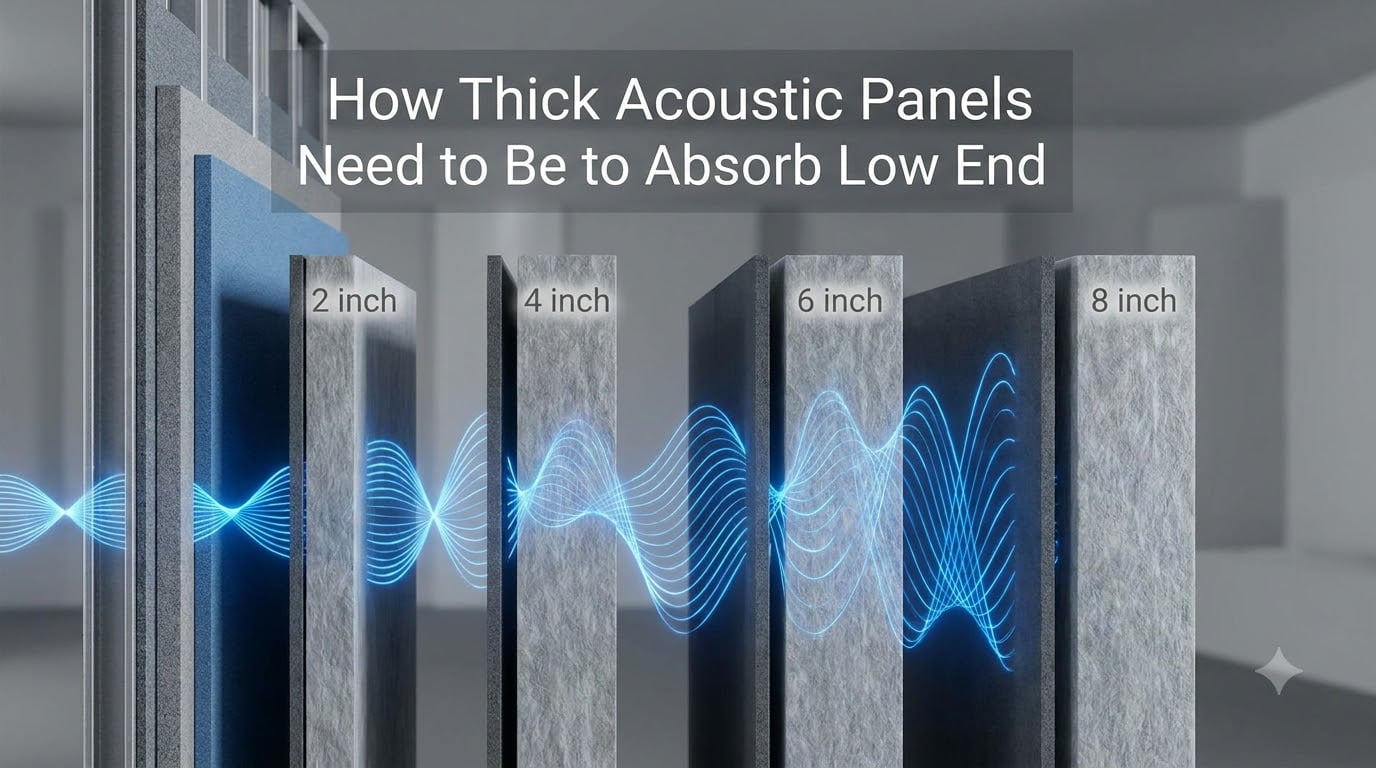
How thick acoustic panels need to be to absorb low end comes down to one rule: the panel must reach the quarter-wavelength point of the target frequency, and for true bass absorption that means panels 4 to 6 inches thick as a starting point. Thin 1 or 2 inch panels are perfectly fine for mid and high frequencies, but they cannot reach far enough into the room to catch the long wavelengths of 50 to 200 Hz bass. I learned this the hard way when I treated my first home studio with 1 inch foam and wondered why my low end still sounded like a swamp. Below is exactly why thickness matters, how to match it to the frequencies you need to tame, and how to calculate the right thickness for your specific room.
Table of Contents
The Quarter Wavelength Rule Explained
To absorb a frequency, a porous panel must extend to at least the quarter-wavelength distance from the wall, because that is where the sound wave’s particle velocity peaks. At the wall surface itself, velocity is zero and pressure is at maximum, so a thin panel pressed against drywall has nothing to grab onto. Move the panel or its density boundary a quarter wavelength out, and the wave is moving fastest, making it vulnerable to friction in the porous material.
Wavelength equals the speed of sound divided by frequency. Sound travels at roughly 343 meters per second (about 1130 feet per second) at room temperature. Plugging that into the formula, a 100 Hz wave has a wavelength of about 3.4 meters, or 11.2 feet. The quarter-wavelength point sits at about 2.8 feet, or 34 inches. A 2 inch panel cannot reach into that zone, but a 4 inch panel with a 30 inch air gap can. Lower frequencies require even thicker assemblies: 50 Hz has a quarter wavelength of about 5.7 feet, which is why true bass trapping demands serious depth.
This is not a marketing claim. The quarter wavelength rule is a direct outcome of standing wave behavior in any rectangular space, and every acoustic engineer I have spoken with uses it as the starting point for any bass treatment design.
Why Low Frequencies Require Thicker Panels
Low frequencies have long wavelengths, and porous absorbers only convert sound to heat where the air is actually moving through the material. Two conditions make that happen: the panel must extend to the velocity-maximum zone, and the material must be porous enough to slow the air without fully blocking it. Thin 1 or 2 inch foam wedges sit right at the wall where velocity is zero at the boundary, so even the densest foam barely slows the wave. The result is reflected bass that builds up in corners and along parallel walls, which is what causes the boomy, muddy low end most listeners complain about.
A 4 inch fiberglass panel with an air gap moves the absorption surface out into the room to where velocity is meaningful. A 6 inch panel with a 2 inch standoff pushes it even further, and an 8 inch panel in a corner reaches deeper still. The trade-off is always space. You give up floor area or wall depth in exchange for actual attenuation at the frequencies that cause the most listening fatigue.
The practical floor for effective bass absorption is about 4 inches of material plus an air gap. Anything thinner will do little more than tame the mid range.
Thickness Recommendations by Frequency Range
Matching thickness to the lowest frequency you want to control is the fastest way to plan a treatment layout. The table below maps panel thickness and air gap to the lowest frequency the assembly effectively absorbs.
| Total Assembly Depth (Panel + Air Gap) | Lowest Frequency Effectively Absorbed | Typical Use Case |
|---|---|---|
| 2 inches (panel only) | About 500 Hz and up | Mid and high range clarity, voice booths |
| 4 inches (panel only or 2 inch panel + 2 inch gap) | About 200 Hz | Small home studios, podcast rooms |
| 6 inches (4 inch panel + 2 inch gap) | About 125 Hz | Home studios, mixing rooms |
| 8 inches (4 inch panel + 4 inch gap, or 6 inch panel + 2 inch gap) | About 80 Hz | Mid-sized music studios, home theaters |
| 12 inches (corner stack with multiple panels) | About 50 Hz | Professional control rooms, dedicated theaters |
Total depth is what matters, not just panel thickness. A 2 inch panel mounted with a 4 inch standoff performs like a much thicker panel at low frequencies. Plan your budget and wall cavity around the total depth you can afford to give up.
If you are treating a typical bedroom-sized home studio of around 10 by 12 feet, focus on 4 inch panels with a 2 inch air gap as your baseline. That combination handles the modal range between 100 and 200 Hz that causes most of the problems in small rooms.
Room Mode Calculations and the 38% Rule
Room modes are the resonant frequencies that build up between parallel walls, and they are why a small room sounds so different from a large one at low frequencies. To plan panel thickness properly, you need to know the modal frequencies of your specific room.
The formula for the lowest axial mode between two parallel walls is straightforward: divide the speed of sound (1130 ft/s) by twice the wall separation. For two walls 10 feet apart, the lowest axial mode sits at 1130 divided by 20, which equals about 56 Hz. That single frequency and its harmonics are exactly where a thin panel fails and a 6 inch corner bass trap succeeds.
The 38 percent rule in room acoustics states that treatment applied to the first 38 percent of wall area, measured from the front wall, provides the largest absorption benefit per square foot for speech and music clarity. Above the Schroeder frequency (the point where modes become dense enough to behave statistically), this rule holds well. Below the Schroeder frequency, the rule breaks down and corner bass traps become far more efficient than mid-wall panels.
Calculate your room’s Schroeder frequency by dividing the speed of sound by twice the cube root of the room volume times some constants. The rough shortcut for a 1500 cubic foot room is around 200 Hz, which means most small studios operate in a hybrid zone where both broadband absorption and corner trapping matter.
Air Gap Mounting Optimization
An air gap between the back of a panel and the wall effectively turns a thinner panel into a deeper absorber at low frequencies. Mount a 4 inch panel with a 2 inch standoff and you get the low-end behavior of a deeper assembly without giving up the visual profile on the wall.
The mechanism is the same as the quarter wavelength rule at work: the panel’s effective absorption surface sits further from the wall, so it reaches into the velocity-maximum zone of longer wavelengths. Two common mounting strategies work well. First, the impaling clip approach with a 2 inch standoff bracket on every other stud gives consistent performance. Second, the framed-out approach where you build a 2 by 4 inset and drop the panel flush into a built-up wall cavity looks clean and lets you cover larger areas.
The practical limit for air gaps is about 12 inches. Beyond that, you begin wasting material because the panel can no longer “see” the wall behind it for absorption purposes, and you start losing efficiency at certain mid frequencies. Plan the gap dimension based on your lowest target frequency using the table above.
Materials Comparison: Foam vs Fiberglass vs Mineral Wool
Material choice matters less than thickness, but it still affects how well a given thickness performs. Three materials dominate residential acoustic treatment: open-cell foam, fiberglass (typically Owens Corning 703 or 705), and mineral wool (such as Rockwool).
Open-cell foam is the lightest and cheapest option, but its flow resistivity is too low for serious bass absorption. A 4 inch foam panel simply does not slow bass-frequency air movement enough to convert meaningful energy to heat. Foam is fine for mid and high frequency treatment where velocity is high and the material has plenty of time to interact with each cycle.
Fiberglass 703 at 3 pounds per cubic foot density is the studio standard. It hits the flow resistivity sweet spot for broadband absorption and is affordable enough to use in quantity. Mineral wool at 4 to 6 pounds per cubic foot density performs similarly to 703 and is preferred in many European studios for fire safety reasons. A 4 inch fiberglass 703 panel will always outperform a 2 inch mineral wool panel at low frequencies. Thickness wins over material density when the difference is large.
If you are building DIY panels, use 703, 705, or Rockwool RW3 at 3 pounds per cubic foot or higher. Skip the 1 pound per cubic floor light-density insulation sold at hardware stores for HVAC use. That material is too low density to absorb bass reliably.
NRC Ratings Explained and Why Thickness Matters
NRC, or Noise Reduction Coefficient, is a single-number rating of how much sound a material absorbs across the speech range from 250 Hz to 2000 Hz. A panel rated NRC 0.85 absorbs 85 percent of incident sound energy across that range on average. The rating does not tell you anything about how the panel performs at 50 Hz or 100 Hz.
For bass frequencies you have to look at the absorption coefficient at specific frequencies. A 2 inch fiberglass panel might have an NRC of 0.85, but its absorption coefficient at 125 Hz might only be 0.20. A 4 inch panel of the same material might hit 0.60 at 125 Hz. NRC is useful for comparing mid-high performance but can mislead you when choosing panels for low-end treatment.
Always look for frequency-specific absorption data when you are shopping for bass control. Reputable manufacturers publish octave-band coefficients at 125, 250, 500, 1000, 2000, and 4000 Hz. If a product only lists NRC and nothing else, assume it is designed for the speech range and will not help your low end.
Corner Bass Trap Placement Strategy
Corners are the most effective place to put bass traps because pressure builds at wall intersections, and pressure converts to velocity at the surfaces touching the corner. A bass trap placed in a tri-corner (where two walls and the ceiling meet, or two walls and the floor meet) intercepts bass energy that has nowhere else to go. The same panel mounted on a flat wall away from a corner will absorb much less of the same frequency.
For ceiling-to-wall corners, stack bass traps vertically from the floor to as high as you can reach. Each 4 inch panel stacked on another creates a column that reaches deep into the corner and absorbs progressively lower frequencies as the column gets taller. A 6 foot stack of 4 inch panels with 2 inch gaps between them can be effective down to about 60 Hz in a typical room.
Wall-to-wall corners benefit from similar treatment. If you cannot fill the entire corner, fill the upper portion first. Bass energy concentrates above ear level in vertical pressure zones, so head-height bass traps are less effective than ceiling-height ones. Floor-to-ceiling bass trap columns in all four corners are the gold standard for a dedicated listening room.
Space vs Performance Trade-Off and Practical Recommendations
Balancing treatment depth against room space is the central design tension of any small studio. If you lose too much floor area to thick panels, the room starts to feel cramped and the proportions shift in ways that can worsen the very modes you are trying to treat. A reasonable starting strategy is to treat the corners first with thick 4 to 6 inch bass traps, then add 2 to 4 inch broadband panels at the first reflection points.
For DIY builders, building your own 4 inch fiberglass panels saves significant cost compared to commercial units. A 2 by 4 foot panel wrapped in fabric and mounted with a 2 inch standoff costs a fraction of a retail 4 inch panel and performs identically when measured. Cover all seams tightly with no air leaks, or you will lose low-frequency performance to bypass.
Hybrid devices like membrane bass traps (a thin membrane over a sealed air cavity) can absorb low frequencies in a thinner profile than full porous treatment, but they tune to a narrow band rather than absorbing broadband. They work well as a complement to broadband absorption but rarely replace it.
For most home studios, the practical answer to how thick acoustic panels need to be to absorb low end is 4 inches of material plus a 2 inch air gap, with deeper 6 to 8 inch corner traps handling the deepest modes. That configuration tames the 100 to 250 Hz range that causes the most small-room problems without taking over the entire room.
FAQs
How thick should sound absorbing panels be?
For broadband absorption that includes bass, panels should be 4 inches thick as a minimum, with a 2 inch air gap if possible. To reach below 100 Hz you will need 6 to 8 inches of total depth, usually achieved by combining a thick panel with a generous air gap or by stacking panels in corners. 2 inch panels are effective from about 500 Hz upward but cannot meaningfully absorb bass.
What is the 38% rule room acoustics?
The 38 percent rule states that acoustic treatment placed on the first 38 percent of wall surface area from the front wall provides the greatest absorption benefit per square foot for clarity and intelligibility, particularly above the Schroeder frequency. It applies well to mid and high frequencies but is less useful for low-frequency bass trapping, where corner placement matters more.
What is the absorption coefficient of acoustic panels?
The absorption coefficient is the fraction of sound energy absorbed at a specific frequency, on a scale from 0 (no absorption, full reflection) to 1 (full absorption). A 4 inch fiberglass panel at 125 Hz might have a coefficient of 0.60, meaning it absorbs 60 percent of incident energy at that frequency. NRC ratings average these coefficients across the 250 to 2000 Hz speech band.
How much noise do acoustic panels absorb?
Acoustic panels do not block noise from passing through a wall. They reduce reverberation and reflections inside a room by absorbing sound energy that would otherwise bounce around. A typical 4 inch panel absorbs 60 to 95 percent of incident sound across the mid range, but only 20 to 50 percent at low bass frequencies, which is why thicker, denser assemblies are needed for low-end control.
Final Thoughts
To sum up how thick acoustic panels need to be to absorb low end: plan for 4 inches minimum with an air gap, scale to 6 to 8 inches for true bass trapping below 100 Hz, and prioritize corners first when room space is limited. The quarter wavelength rule, modal calculations for your specific room, and frequency-specific absorption data together give you a clear path from “this room sounds muddy” to “this room sounds balanced.” Start by measuring your room dimensions, calculate the lowest axial modes, and choose panel depth based on the table above. Your low end will thank you.
2 thoughts on “How Thick Acoustic Panels Need to Be to Absorb Low End (2026)”