
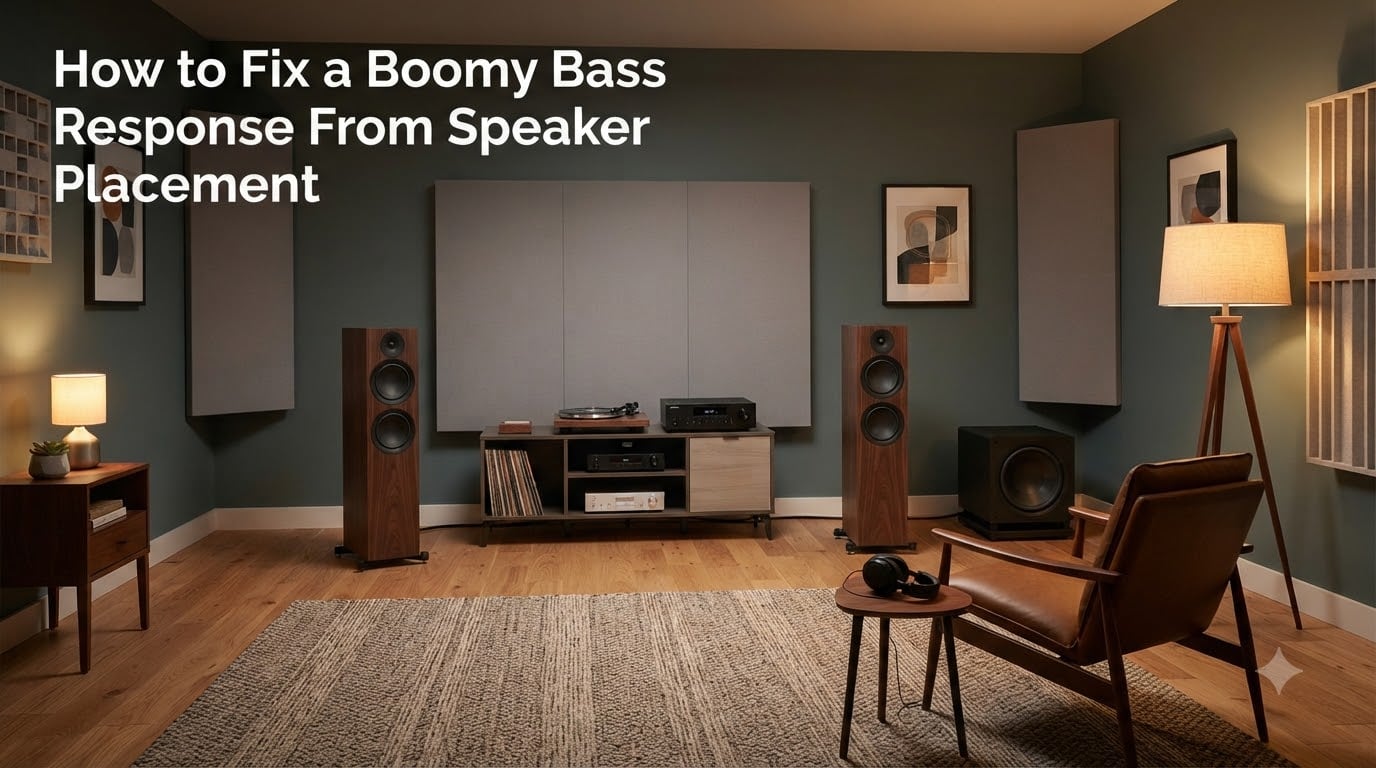
Boomy bass can ruin even the most expensive speaker setup. I remember spending hours dialing in my system, only to hear one-note, resonant bass that overwhelmed everything else. The fix had nothing to do with new gear. It came from understanding how speaker placement interacts with room acoustics. In this guide, I’ll walk you through the exact steps I use to fix a boomy bass response from speaker placement in any room.
You will learn what causes bass buildup, how to apply the 38% and 83% placement rules, and how to measure your results. These techniques work in small bedrooms, dedicated listening rooms, and home theaters. No acoustic panels required to start.
Table of Contents
What Causes Boomy Bass in Your Room
Boomy bass is caused by room modes. These are standing waves that form when low-frequency sound bounces between parallel walls and reinforces itself at certain spots. When your speaker sits at one of these pressure peaks, certain bass notes become exaggerated while others disappear entirely.
The room itself shapes your bass response far more than your speakers do. Below 200Hz, your listening position and speaker placement determine what you hear. Even moving a speaker 15 centimeters can change bass response by 6 dB or more at the listening seat.
Room Modes and Standing Waves Explained
A room mode is a specific resonant frequency where sound waves fit perfectly between two boundaries. For a wall-to-wall length of 5 meters, the primary axial mode is approximately 34 Hz. This frequency will boom in some seats and vanish in others.
Three types of room modes exist: axial (between two parallel surfaces), tangential (four surfaces), and oblique (all six surfaces). Axial modes are the strongest and most responsible for boomy bass. They account for roughly 80% of modal problems in typical rooms.
The formula for the lowest axial mode is simple: divide 343 (speed of sound in m/s) by twice the room dimension. A 4-meter room length produces a fundamental mode at about 43 Hz. A 6-meter room drops it to roughly 29 Hz. These low frequencies are exactly where boomy bass lives.
Boundary Reinforcement: Why Walls Matter
When you place a speaker close to a wall, the wall reflects low frequencies back toward the listener. This creates boundary reinforcement, which can boost bass output by 3 to 6 dB. In a corner, you get reinforcement from two walls and the floor, adding up to 9 dB of bass boost.
More bass sounds good on paper. In practice, this artificial boost creates peaks and uneven response. The same wall reflection that adds bass at one frequency cancels it at another. You end up with one-note boom instead of clean, tight low end.
This is why pulling speakers away from walls almost always improves bass quality. The trade-off is less raw output, but the response becomes far smoother across all bass frequencies.
The Rule of Thirds Explained for Boomy Bass
The rule of thirds is a starting point for placement that minimizes room mode interference. It does not eliminate every problem, but it gets you 80% of the way there without any acoustic treatment. The rule has two parts: speaker position and listener position.
The 38% Rule for Speaker Placement
The 38% rule places each speaker 38% of the room dimension away from the nearest wall. For a 5-meter long room, that means positioning your speaker 1.9 meters from the front wall. This distance puts the speaker at a null between the first and second axial modes.
Why 38%? At this position, the distance from the front wall and the back wall creates opposing wave patterns that partially cancel. The cancellation is strongest at frequencies where room modes would normally peak. You get smoother bass without losing all the low-end reinforcement.
Here is a quick reference table for the 38% rule:
- 3-meter room: 1.14 meters from front wall
- 4-meter room: 1.52 meters from front wall
- 5-meter room: 1.90 meters from front wall
- 6-meter room: 2.28 meters from front wall
- 7-meter room: 2.66 meters from front wall
Apply the same calculation to side walls if your speakers fire along the short axis of the room. Use 38% of the room width measured from each side wall.
The 83% Rule for Listener Position
The 83% rule sets your listening seat at 83% of the room length from the speaker’s front wall. In a 5-meter room, you would sit 4.15 meters from the front wall, which is about 0.85 meters from the back wall.
This position puts your head at the null between the second and third axial modes. Combined with speakers at 38%, the three strongest modal peaks fall away from your listening position. The result is significantly flatter bass response.
Calculate your listening distance:
- 3-meter room: 2.49 meters from front wall
- 4-meter room: 3.32 meters from front wall
- 5-meter room: 4.15 meters from front wall
- 6-meter room: 4.98 meters from front wall
- 7-meter room: 5.81 meters from front wall
These distances work best in rectangular rooms with ceilings between 2.4 and 3 meters. Irregular rooms, sloped ceilings, or alcoves change the math. Treat the percentages as starting points, then fine-tune by ear and measurement.
Speaker and Subwoofer Placement Techniques
Once you know the theory, the next step is hands-on placement. Start with mains, then dial in the subwoofer. Always make one change at a time so you can hear what each adjustment does.
How to Position Your Main Speakers
Begin by measuring 38% from the front wall and marking that distance on the floor. Place your left and right speakers on these marks, at least 1.5 meters apart. Angle each speaker slightly toward the listening position. This is called toe-in.
Toe-in changes the ratio of direct to reflected sound. More toe-in sharpens imaging and reduces side-wall reflections. Less toe-in broadens the soundstage and softens the treble. For bass, moderate toe-in (about 5 to 15 degrees) usually works best.
Pull speakers at least 20 centimeters away from side walls. Closer placement activates strong lateral room modes that color the mid-bass. If your speakers have rear ports, leave at least 30 centimeters behind them to let the port breathe.
A small adjustment like 2 to 3 centimeters can produce a noticeable difference. Forum users often report that tiny movements fix stubborn boomy spots. Move the speakers in small increments and listen between each change.
How to Position Your Subwoofer
Subwoofer placement uses a different strategy because bass is non-directional. Place your subwoofer at the listening position first, then walk around the room. The spot where bass sounds smoothest and most even is where your subwoofer should live permanently.
This is called the subwoofer crawl. It works because swapping the sub and listener positions takes advantage of the same room modes. If the bass sounds tight at a particular wall spot, your listening position will hear tight bass from a sub placed there.
Avoid placing the sub directly in a corner. Corner placement maximizes output but creates the strongest boom. Pull the sub at least 30 to 60 centimeters from any wall as a starting point. Fine-tune from there using the crawl method.
Set the crossover frequency to match your main speakers. Most bookshelf speakers cross over between 80 and 120 Hz. Floor-standing models with strong bass response may cross over at 60 Hz or lower. Mismatched crossover settings cause phase issues that make bass sound muddy.
Measuring and Testing Your Bass Improvements
Trusting your ears is important, but measurements confirm what you hear. A free tool called Room EQ Wizard (REW) paired with a USB measurement microphone costs under 100 dollars total and reveals problems invisible to casual listening.
The Subwoofer Crawl Method
The subwoofer crawl is your first measurement tool and it requires nothing but your ears. Place the subwoofer at your main listening seat. Play a bass-heavy track with steady low frequencies. Crawl around the room near the walls and corners.
Mark the spots where bass sounds even and balanced. Mark spots where one note overwhelms everything or where bass disappears. The good spots are your candidates for subwoofer placement. Pick the one that combines smooth bass with reasonable aesthetic placement.
Run the crawl test with multiple tracks. Different bass notes excite different room modes. A spot that sounds great with one song might still boom with another. Test with at least three tracks covering deep bass (around 35 to 50 Hz) and mid-bass (around 80 to 120 Hz).
Using Room Measurement Software
REW generates a frequency response graph for your listening position. A flat line from 20 Hz to 200 Hz is the goal. Peaks above +5 dB indicate boomy frequencies. Dips below -5 dB indicate nulls where bass vanishes.
Take baseline measurements before moving anything. Then make one change at a time, measuring after each adjustment. This process isolates what each placement change does to your response. Without measurements, you cannot tell whether you improved the boom or moved it to a different frequency.
For more advanced users, software like Dirac Live or Anthem ARC applies digital correction after placement is optimized. These tools cannot fix gross placement mistakes, but they smooth out smaller peaks once your speakers are in good positions.
Common Mistakes to Avoid When Fixing Boomy Bass
Most people attack boomy bass by adding acoustic panels first. Panels help with mid and high frequencies, but bass traps are what tame low-end problems. A room covered in foam panels still sounds boomy because foam does almost nothing below 200 Hz.
Another common mistake is treating the subwoofer as a bass knob. Cranking the subwoofer level to compensate for weak bass makes boom worse, not better. The fix is always placement first, then level.
Sitting in the geometric center of the room creates the worst bass response. The center is exactly where nulls between modes are strongest. Even moving 60 centimeters off-center can recover bass that seemed missing.
Symmetrical placement sounds logical but creates symmetrical modal problems. Both speakers excite the same modes at the same intensity. Asymmetrical placement (different distances from side walls) can break up these patterns and produce smoother bass.
Finally, do not trust online reviews or manufacturer specs as gospel. Every room is different. Your room’s dimensions, furnishings, and construction materials all shape bass response. What works in someone else’s dedicated listening room may not work in your living room.
Advanced Techniques for Smoother Bass
Once you have placement dialed in, two techniques can push bass quality further: multiple subwoofers and bass traps. Both address problems that placement alone cannot fully solve.
Multiple subwoofers smooth bass across a wider listening area. Two subs placed at opposite walls average out modal peaks. Four subs in the corners take this further. This approach is especially valuable for home theaters where multiple seats need good bass.
Phase alignment between subwoofers and main speakers is critical. Run a test tone through both and listen for cancellation or reinforcement at the crossover frequency. Most subs have a phase switch (0 or 180 degrees) or a continuously variable phase knob. Adjust until the crossover region sounds strongest, indicating proper phase alignment.
Bass traps are acoustic absorbers designed for low frequencies. Place them in room corners where bass pressure is highest. A 4-inch thick mineral wool panel in each front corner can reduce modal ringing by 3 to 5 dB. For serious treatment, thicker panels (8 to 12 inches) or porous absorbers behind fabric frames work better.
If budget allows, combine placement optimization with bass traps and a measurement-based room correction system. This three-layer approach delivers reference-quality bass in nearly any room.
Frequently Asked Questions
How to stop boomy bass?
To stop boomy bass, reposition your speakers using the 38% rule (38% of room length from the front wall) and place your listening seat at the 83% position. Pull speakers away from walls, avoid corner placement for your subwoofer, and use the subwoofer crawl method to find the smoothest bass location. Measure with REW software to confirm peaks are reduced below +5 dB.
What is the 83% rule for speaker placement?
The 83% rule places your listening position 83% of the room length away from the front wall. For a 5-meter room, sit 4.15 meters from the front wall. This distance puts your head at a null between the second and third axial room modes, smoothing bass response at the seat.
How to fix a boomy subwoofer?
Fix a boomy subwoofer by moving it away from corners and walls. Use the subwoofer crawl method: place the sub at your listening seat, play bass-heavy music, and crawl around the room to find where bass sounds smoothest. Move the sub to that spot and re-set the crossover frequency to match your main speakers.
What is the 38% rule for speaker placement?
The 38% rule positions each speaker 38% of the room dimension away from the nearest wall. For a 4-meter room, place speakers 1.52 meters from the front wall. This distance puts speakers at a null between the first and second axial room modes, reducing bass peaks caused by boundary reinforcement.
Final Thoughts
Fixing a boomy bass response from speaker placement comes down to understanding room acoustics and applying proven placement rules. Start with the 38% and 83% positions, use the subwoofer crawl, and measure your results. With these techniques, you can transform bloated, one-note bass into tight, even low end in any room.