
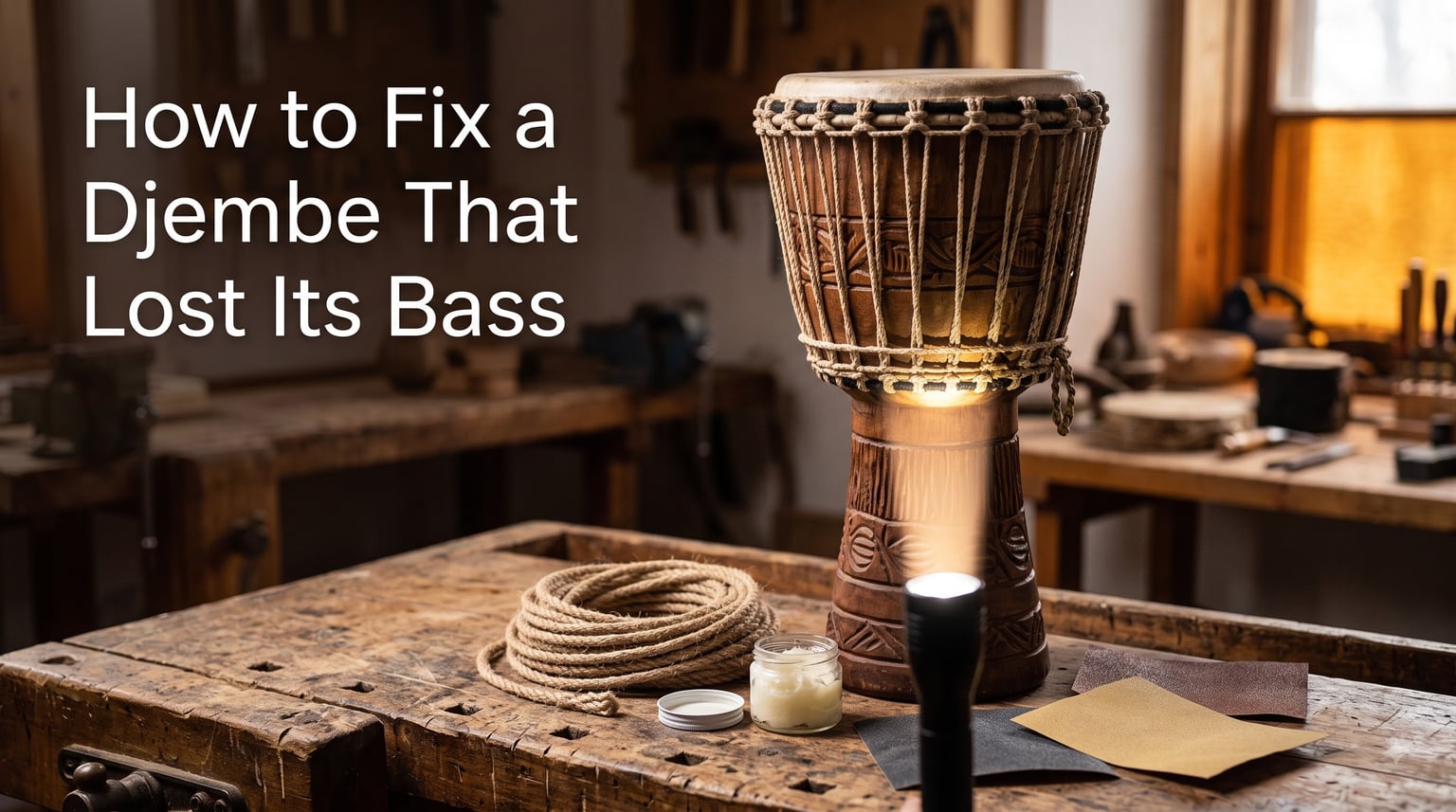
If your djembe sounds like it lost its voice, you are not alone. A djembe that lost its bass is one of the most common problems drummers face, and the good news is that the cause is usually fixable in under an hour. Most of the time, the culprit is a stretched skin, a loose rope, or a small crack that breaks the air pressure your drum needs to resonate.
I have been playing djembe for over a decade and rebuilding drums in my home workshop for most of that time. In this guide, I will walk you through the exact diagnostic process I use on every drum that walks into my repair queue, then show you how to fix the four most common causes of bass loss. Whether your djembe sounds muffled, has no reverb, or just feels flat, this guide will help you bring back that deep, resonant thump.
Table of Contents
How Djembe Bass Actually Works
Djembe bass works through a principle called Helmholtz resonance, the same physics that makes an empty bottle hum when you blow across the top. When you strike the center of the skin, the head pushes down and compresses air inside the bowl-shaped shell. That compressed air rushes out through the bottom sound hole, and the cycle creates a deep, sustained low note.
Three things have to work together for that bass to sing. The skin must be tight enough to push hard against the air column. The shell must be airtight so pressure cannot leak out. The bearing edge (the rim where the skin meets the wood) must be smooth and even so the skin can vibrate freely.
Here is the part most players miss. Tone and slap come from the skin vibrating in different zones rather than from air pressure. That is why your djembe can have a beautiful open tone and a crisp slap while the bass sounds muffled or completely absent. The skin is fine but the air pressure system has broken down somewhere.
Quick Diagnostic Checklist: Why Your Djembe Lost Its Bass
Before you touch a single rope or tool, run through this diagnostic checklist. I have used it on more than 200 djembes, and it correctly identifies the root cause about 95% of the time. Set aside 10 minutes and work through each step in order.
Step 1: The Flashlight Test. Shine a flashlight through the bottom sound hole and look up at the skin from inside. If the skin looks wrinkled, dry, or has visible thin spots, your skin is the problem. If the skin looks uniform and healthy, move on.
Step 2: The Tap Test. With the drum upright, gently tap the skin at the center, edge, and halfway between. A healthy djembe should sound sharp at the edge and deep at the center. If the center sounds dull or dead, your skin has lost its tension.
Step 3: The Rope Check. Press down on a rope ring with your thumb. If it sinks more than a few millimeters, your rope tension is too loose. Squeeze the rope between two rings. If you can easily compress it, you need to re-tension.
Step 4: The Crack Inspection. Run your hand along the outside of the shell, then look inside with the flashlight. Pay special attention to the area near the bearing edge and any knots or visible joints. Hairline cracks often hide in the natural grain of the wood.
Step 5: The Bearing Edge Check. Press the skin lightly with your finger and feel for any ridge or uneven spot where the skin meets the shell. If you can feel a bump, the bearing edge has warped and is choking the skin.
Step 6: The Humidity Test. Think about your environment. Has the drum been stored in a dry room, near a heater, or in a cold car? Sudden humidity and temperature swings are the silent killer of djembe bass.
Once you finish the checklist, you should know which of the four fixes below to try first.
Fix 1: Tighten the Rope Tension
If your diagnostic pointed to loose ropes, start here. This is the most common cause of bass loss and the easiest fix. A djembe that has been played for months or stored in dry conditions will gradually lose skin tension, and the bass is the first thing to disappear.
To retune, work with the existing Mali weave rather than trying to re-rope the drum. Start at the top ring and pull each vertical rope strand upward, one at a time, working your way around the drum. If the rope weave uses a separate tensioning cord, slide the wooden dowel under a vertical strand and pull it sideways to compress the rings.
After each pass, play the drum and check the bass. You should feel the bass deepen and the pitch rise slightly. Stop tightening when the bass sounds round and the edges are crisp. A common beginner mistake is over-tightening until the skin is rock-hard and the drum sounds choked. If your drum sounds like a cardboard box when you tap it, back off the tension by one or two passes.
For a djembe that has lost all bass, you may need to do 3-5 passes around the drum. Recheck the rope tension daily for the first week, since the new tension will stretch the skin slightly. After that, a quick retune every 2-3 months keeps the bass steady.
Fix 2: Check and Repair the Bearing Edge
The bearing edge is where the skin meets the shell, and it has to be perfectly smooth and round. Even a 1-millimeter bump will prevent the skin from vibrating freely, and the bass dies first because the bass frequency is the most sensitive to edge interference.
To inspect the bearing edge, remove the rope and skin completely. Run your finger around the top rim of the shell. Any rough spot, ridge, or flat area is a problem. Look at the inside of the rim too, where the skin makes contact. You should see a clean, even ring of wood polish where the skin has been rubbing.
If you find a rough spot, you can sand it out with 220-grit sandpaper followed by 400-grit. Work slowly and check your progress every few strokes. The goal is a smooth, continuous curve, not a flat surface. Rub the sandpaper in a circular motion following the curve of the rim.
Small bearing edge repairs are well within DIY territory. If the bearing edge is cracked, has chunks missing, or has warped out of round, take the drum to a professional. A botched bearing edge repair is one of the few mistakes that can permanently damage a djembe.
Fix 3: Address Shell Cracks That Steal Your Bass
A shell crack is the most serious cause of bass loss because it breaks the airtight seal that makes Helmholtz resonance possible. Even a hairline crack can leak enough air to kill your bass while leaving the tone and slap mostly intact.
Most shell cracks happen in one of three places. Near the top where the shell is thinnest, around the bottom sound hole where the rope tension pulls hardest, and along the natural grain of the wood. The wood used in djembes is hardwood and handles stress well, but a single drop, a long dry spell, or a sudden temperature change can open a crack.
Small cracks can be repaired with food-safe wood glue. Clean the crack with a thin brush, blow out any dust, and apply a thin bead of glue along the entire length. Clamp the crack closed with a band clamp or wrap the area with cord and a dowel. Wipe away excess glue immediately. Let the repair cure for 24-48 hours before putting the skin back on.
Long cracks, cracks that run through the full thickness of the shell, or multiple cracks in the same drum are signs that the drum has reached the end of its useful life. A professional repair can extend the life of a cracked djembe for a few years, but if the cracks keep coming back, the wood is telling you it is time to retire the drum.
Fix 4: When to Replace the Skin (Reheading)
Sometimes the skin is the problem and not the rope. A goat skin that has dried out, developed thin spots, or stretched past its useful life will never sound right no matter how tight you pull the ropes. The bass sounds muffled because the skin is too soft to push the air column properly.
Signs that your skin needs replacement include visible thin spots, a spongy feel when you press the center, and a bass that gets quieter every time you tune instead of deeper. If your skin has been on the drum for more than 8-10 years and you have been playing regularly, replacement is the most likely fix.
Skin quality matters enormously here. The number one complaint I see in djembe forums is about cheap skins bought from Amazon or generic drum shops. These skins are often scraped too thin, dried improperly, or made from animals that were too young. They look fine out of the package but lose bass within months. Buy from a dedicated djembe maker or a specialty drum shop that sources from West Africa.
Reheading is a multi-hour process that involves soaking the new skin, stretching it over the bearing edge, and tying a new rope system from scratch. Most drummers send their drum to a professional reheading service for this, and the cost is usually modest. If you get a quality skin installed by someone who knows djembes, your bass will come back stronger than it has sounded in years.
How Climate and Humidity Affect Djembe Bass
Climate is the invisible force that affects djembe bass more than any other factor. Goat skin is a natural material that absorbs and releases moisture with the surrounding air. When humidity drops, the skin dries out and shrinks, which loosens the tension and kills the bass. When humidity rises, the skin absorbs moisture and goes slack, which also kills the bass.
You can test this on your own drum right now. Take your djembe to a humid room (a bathroom after a hot shower works) and leave it for 30 minutes. The bass will tighten noticeably. Move it to a dry room with a heater and listen as the bass goes flat. This is why drummers who tour with their instruments often have to retune every day.
There is a clever trick players use to test whether their bass problem is humidity or something else. Play a few rhythms next to a campfire or wood stove. The radiant heat gently dries the skin and tightens it, which often restores the bass temporarily. If your drum sounds great near the fire but flat in your living room, climate is your main problem.
To protect your bass from climate swings, store your djembe in a room with stable humidity between 40-60%. Avoid leaving it in direct sunlight, near heating vents, or in a cold car. A djembe bag made of breathable fabric helps buffer against sudden changes. Avoid plastic bags, which trap moisture and can rot the skin.
Daily Maintenance to Keep Your Bass Alive
A well-maintained djembe will keep its bass for 6-10 years or more before needing a rehead. The maintenance routine is simple and takes only a few minutes per month.
Rub a small amount of shea butter or unrefined coconut oil into the shell every few months. This prevents the wood from drying out and cracking, which is one of the leading causes of bass loss in older drums. Avoid mineral oil or olive oil, which can go rancid and damage the skin.
Your bare hands are actually one of the best tools for skin maintenance. The natural oils on your skin transfer to the goat head every time you play and keep it supple. Players who wear gloves or use plastic-headed djembes often find their skins dry out faster.
Check your rope tension once a month. A quick pull on each vertical strand and a play-through of the bass, tone, and slap takes only two minutes. Catching loose tension early prevents the bass from fading slowly until you forget what it sounded like.
Frequently Asked Questions
Can you tune a djembe?
Yes, you can tune a djembe by adjusting the rope tension in a process called rope tuning. Working in the Mali weave pattern, pull each vertical rope strand upward to compress the rings and tighten the skin. The bass should sound deep and round when the drum is in tune.
How to get a deep bass drum sound?
To get a deep bass drum sound on a djembe, strike the exact center of the skin with the heel of your palm using a relaxed, almost falling motion. Make sure the skin is properly tensioned, the shell has no cracks, and the bearing edge is smooth. A deep bass requires airtight Helmholtz resonance inside the shell.
How long do djembe skins last?
A quality goat skin djembe head lasts 6-10 years with regular play and proper care. Skins that are kept hydrated with natural hand oils, stored in stable humidity, and retuned every few months can last even longer. Cheap synthetic or poorly prepared skins may lose their bass in under a year.
How long does a djembe drum last?
A well-made djembe drum can last decades. The hardwood shell often outlasts multiple skin replacements, and antique djembes are still played today. The drum’s lifespan depends on climate exposure, frequency of play, and how carefully the skin is maintained and replaced when needed.
Why does my djembe have good tone and slap but no bass?
Your djembe has good tone and slap but no bass because tone and slap come from the skin vibrating in different zones, while bass depends on airtight Helmholtz resonance inside the shell. A loose rope, a shell crack, a damaged bearing edge, or a dry skin can all break the air pressure needed for bass without affecting the higher tones.
How to tell if a djembe needs a new skin?
You can tell a djembe needs a new skin if the head feels spongy when pressed, has visible thin spots or wrinkles, sounds dull at the center even when tightened, or has been on the drum for more than 8-10 years. Quality skins from dedicated djembe shops last far longer than cheap alternatives.
Bringing Your Bass Back: Final Thoughts
Fixing a djembe that lost its bass comes down to running the diagnostic checklist and matching the problem to the right fix. Most bass loss comes down to loose rope tension, a small shell crack, a damaged bearing edge, or a worn-out skin. Work through the cheapest fixes first (rope tightening, climate adjustment) before moving to skin replacement or professional repair.
If you take one thing away from this guide, take this. Your djembe wants to make bass. The skin wants to vibrate, the shell wants to resonate, and the air wants to pulse. When the bass disappears, something is blocking that system, and a 10-minute diagnostic will almost always tell you what it is. Pick up your drum, run the checklist, and let your djembe sing again.