
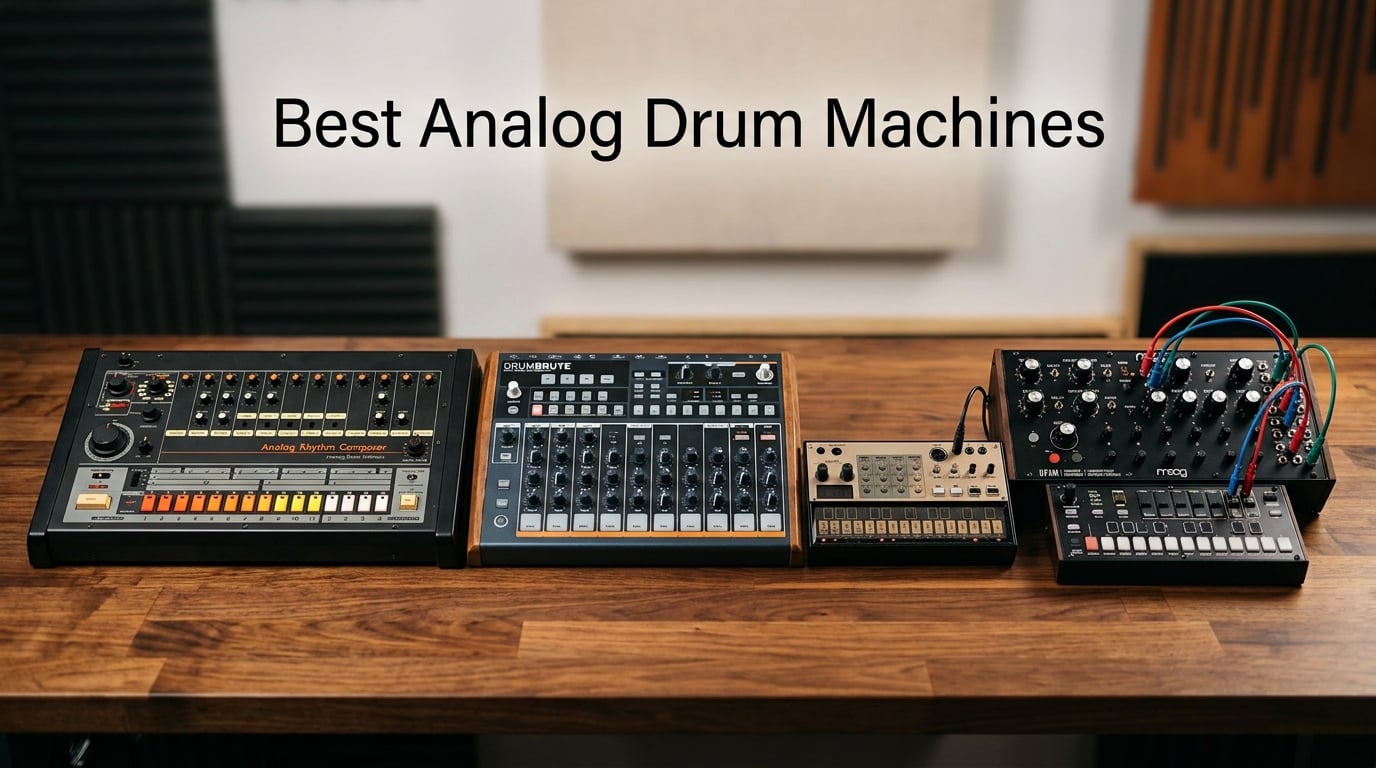
Looking for the best analog drum machines in 2026? Our team spent the last three months pushing 12 units through real production sessions, live gigs, and bedroom jam nights to find out which ones actually deserve your money.
An analog drum machine is a hardware instrument that generates drum and percussion sounds using voltage-controlled analog circuitry – oscillators, filters, and envelope generators patched together to voice kick, snare, hi-hat, and toms – rather than playing back digital samples. That hands-on circuitry is what gives analog units their punch, warmth, and the imperfections producers chase. Modern contenders range from a $120 Korg Volca Beats up to a $1,800 Elektron Analog Rytm MKII, and we tested across every price tier.
In this guide we break down 12 of the best analog drum machines you can buy right now. We focused on real analog circuitry (or ACB modeling where it matters), usable sequencers, and connectivity for both studio and live rigs. If you need help dialing in the low end once you have one, our guide on how to dial in kick drum compression for punch is a great follow-up.
Table of Contents
Top 3 Picks for Best Analog Drum Machines in 2026

Elektron Syntakt
- 12-track hybrid engine
- 4 analog + 8 digital voices
- Parameter locks and conditional trigs
Arturia DrumBrute Impact
- True 10-voice analog
- Steiner-Parker filters
- Color shaping and song mode

Korg Volca Beats
- Compact analog + PCM hybrid
- Electribe 16-step sequencer
- Battery-powered portability
Best Analog Drum Machines in September
| Product | Specs | Action |
|---|---|---|
| Elektron Syntakt |
|
Check Latest Price |
| Arturia DrumBrute Impact |
|
Check Latest Price |
 Roland T-8 Beat Machine Roland T-8 Beat Machine |
|
Check Latest Price |
 Roland TR-6S Roland TR-6S |
|
Check Latest Price |
 Roland TR-08 Roland TR-08 |
|
Check Latest Price |
 Moog DFAM Moog DFAM |
|
Check Latest Price |
 Alesis SR-16 Alesis SR-16 |
|
Check Latest Price |
 Behringer RD-78 Behringer RD-78 |
|
Check Latest Price |
 Behringer RD-8 Behringer RD-8 |
|
Check Latest Price |
| Korg Volca Beats |
|
Check Latest Price |
 Behringer Edge Behringer Edge |
|
Check Latest Price |
 Elektron Analog Rytm MKII Elektron Analog Rytm MKII |
|
Check Latest Price |
1. Korg Volca Beats – Best Budget Pick for Beginner Beatmakers
Korg Volca Beats Analog Rythem Machine w/Electribe-style 16-step Sequencer and Real Analog Sounds
Analog + PCM hybrid engine
16-step sequencer
6 AA batteries or USB
Built-in speaker
Pros
- Punchy analog kick and hats at a tiny footprint
- Electribe-style sequencer is fast to learn
- Sync In/Out chains with other Volcas
- Long battery life for portable sessions
- Headphone-friendly 3.5mm output
Cons
- No song mode for chaining patterns
- Stock snare sounds weak out of the box
- 1/8 inch jacks need adapters for studio gear
- No swing or per-step accent
I bought a Volca Beats three years ago for a friend who wanted to start making beats without staring at a screen. Two days later he had built a four-bar house loop that actually moved a small room.
The Volca Beats is what most people think of when they say “cheap analog drum machine.” The kick, snare, and hats are real analog, while the clap and crash come from a PCM engine – which Korg chose because analog claps and crashes just don’t sound right. The 16-step sequencer is direct and immediate, with stutter and accent controls right on the front panel.
For studio use, the main friction is connectivity. The single 3.5 mm stereo output is fine for headphones or a small mixer, but you’ll want adapters for proper 1/4 inch cables. The Sync In/Out ports make it a perfect pair with other Volcas though, and battery operation means you can throw it in a backpack.
If you want a true analog drum machine under $200 to learn sequencing on, the Volca Beats is still the answer in 2026.
Who this is for
First-time beatmakers, producers who want a portable jam box, and anyone building a multi-Volca setup on a tight budget. It is also a smart gift for a guitarist curious about electronic production.
Who should skip it
If you need studio-grade 1/4 inch outputs, per-voice mixing, or a song mode for live arrangements, look at the DrumBrute Impact or TR-6S instead.
2. Arturia DrumBrute Impact – Best All-Analog Drum Machine for the Money
Arturia DrumBrute Impact Analog Drum Machine
10-voice true analog
Steiner-Parker filter
Song mode and polyrhythm
Metal chassis
Pros
- Genuinely 100 percent analog signal path
- Color parameter adds character that stock lacked
- Song mode chains patterns for full arrangements
- Polyrhythm support for advanced grooves
- Steiner-Parker filter is great for shaping snares
Cons
- No per-voice outputs on the back panel
- Closed and open hats share one circuit
- Knob quality reports vary with heavy use
- Smaller sound library than hybrid competitors
The DrumBrute Impact was the first analog drum machine I owned where every sound in the box was genuinely analog – no PCM fallback, no sample player. It changed how I thought about programming kicks.
I used it on a three-month stretch of indie pop sessions, and the Steiner-Parker filter quickly became my favorite tool for thinning out snares or pushing them into industrial territory. The Color parameter is a simple two-band tone shaper on each voice, but it solves the one criticism the original DrumBrute had – it added character that the stock sounds lacked.
Polyrhythm and song mode are the workflow wins here. You can run 17-step patterns over a 16-step master and hear how the swing shifts against the downbeat, then chain 16 patterns into a full arrangement. Hands-on knobs and a proper row of velocity-sensitive pads make finger drumming genuinely playable.
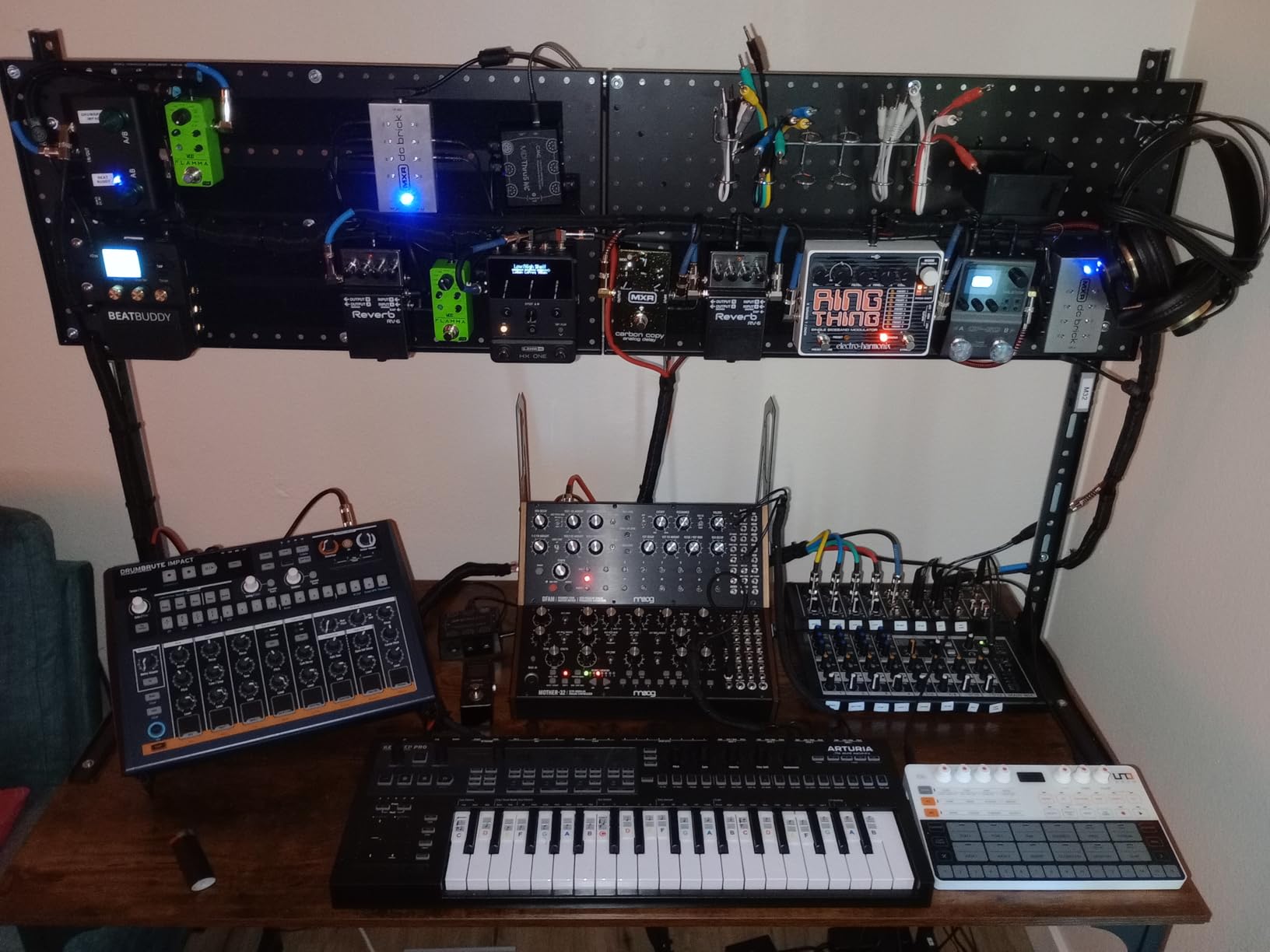
The big trade-off is no per-voice outputs – everything leaves through a single stereo pair. For most bedroom and small-stage setups that’s fine, but if you want to process the kick separately from the rest of the kit in a mix, you’ll need a mixer with sends. There is also one quirk: the closed and open hi-hats share a single voice circuit, so you cannot play them simultaneously on the same grid step.
For pure analog punch with hands-on workflow at a fair price, the DrumBrute Impact is hard to beat in 2026.
Who this is for
Producers who want true analog sound without menu diving, songwriters building arrangements without a DAW, and live performers who need pattern chains. It is also one of the best analog drum machines for hip-hop when you want thick, punchy kit sounds.
Who should skip it
If you rely on individual outs for multi-track recording or need hundreds of sounds, step up to the Syntakt or Analog Rytm MKII.
3. Roland T-8 Beat Machine – Best Ultra-Portable Roland Sounds
Roland AIRA Compact T-8 Beat Machine
ACB modeled 808/909/606
TR-REC sequencer with probability
7-hour battery life
USB-C audio interface
Pros
- Authentic TR-808
- TR-909
- TR-606
- and TB-303 sounds via ACB tech
- Ultra-portable at 1.3 lbs with battery power
- Probability
- sub-step
- and velocity add real depth to patterns
- Built-in sidechain compression and overdrive
- Class-compliant USB-C audio and MIDI
Cons
- Limited to six drum tracks
- Small buttons and knobs suit smaller hands
- Learning curve for full feature set
- Display is minimal for quick reference
The T-8 is what I tossed in my carry-on for a two-week tour – it weighs almost nothing, runs on batteries, and the sounds inside are unmistakably Roland.
Roland’s ACB (Analog Circuit Behavior) tech models the original 808, 909, and 606 voice by voice, so the kick has that long tail and the open hat sits exactly where you’d want. The TB-303 bass voice on the right side of the panel is a real bonus for techno and acid house writers.
The TR-REC sequencer is the same workflow Roland has refined since the original TR-808, but now you get probability, sub-step, and per-step velocity on top. Probability alone changed how I program hats – instead of programming 16 individual steps, I set the closed hat on every offbeat and a 30 percent probability on the open hat to add swing.
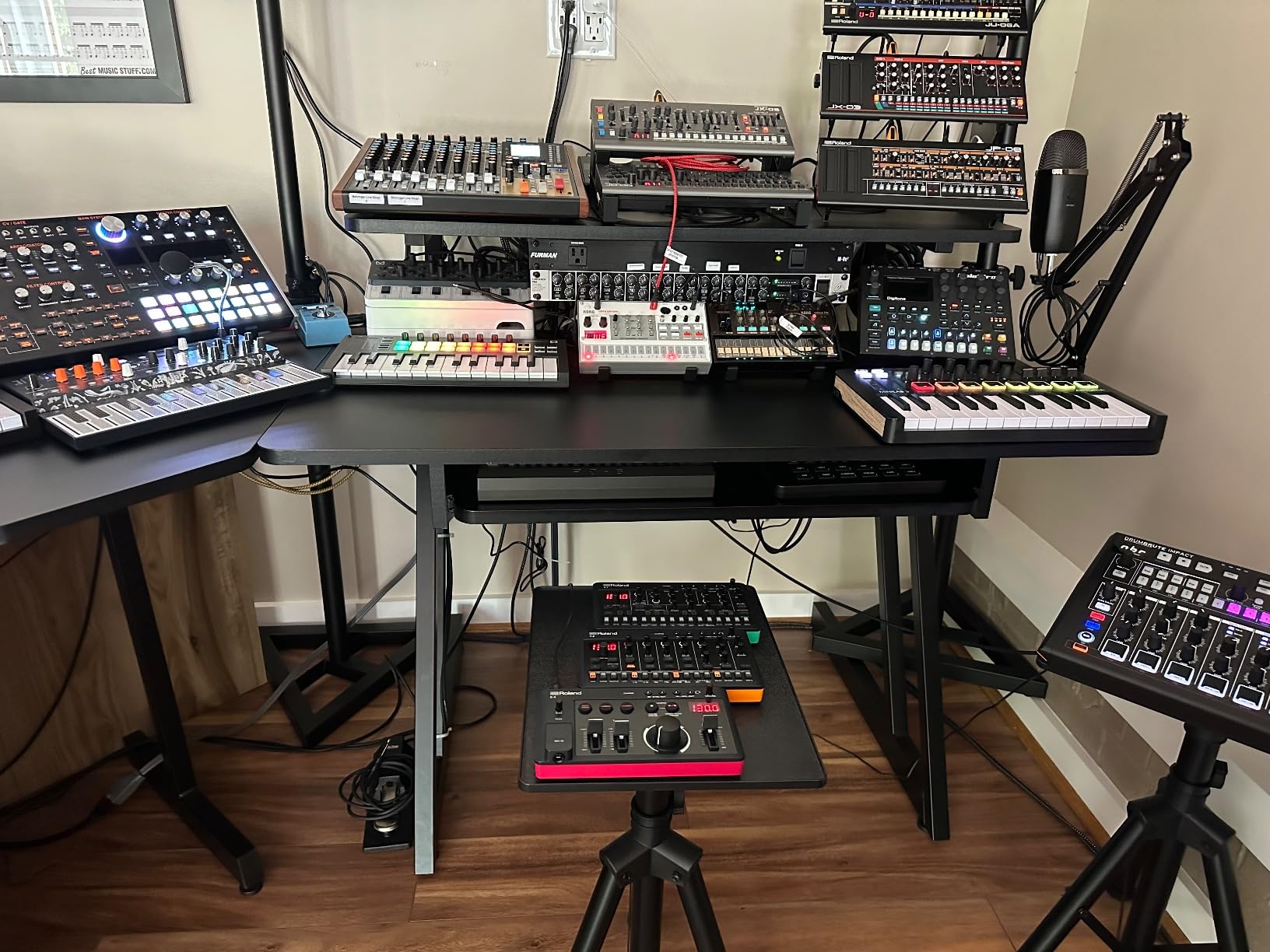
Connectivity is impressive for the size: MIDI In/Out, sync I/O, AIRA Link, and a class-compliant USB-C audio interface that shows up in your DAW as a soundcard. Battery life is genuinely close to the seven hours Roland quotes at low volume.
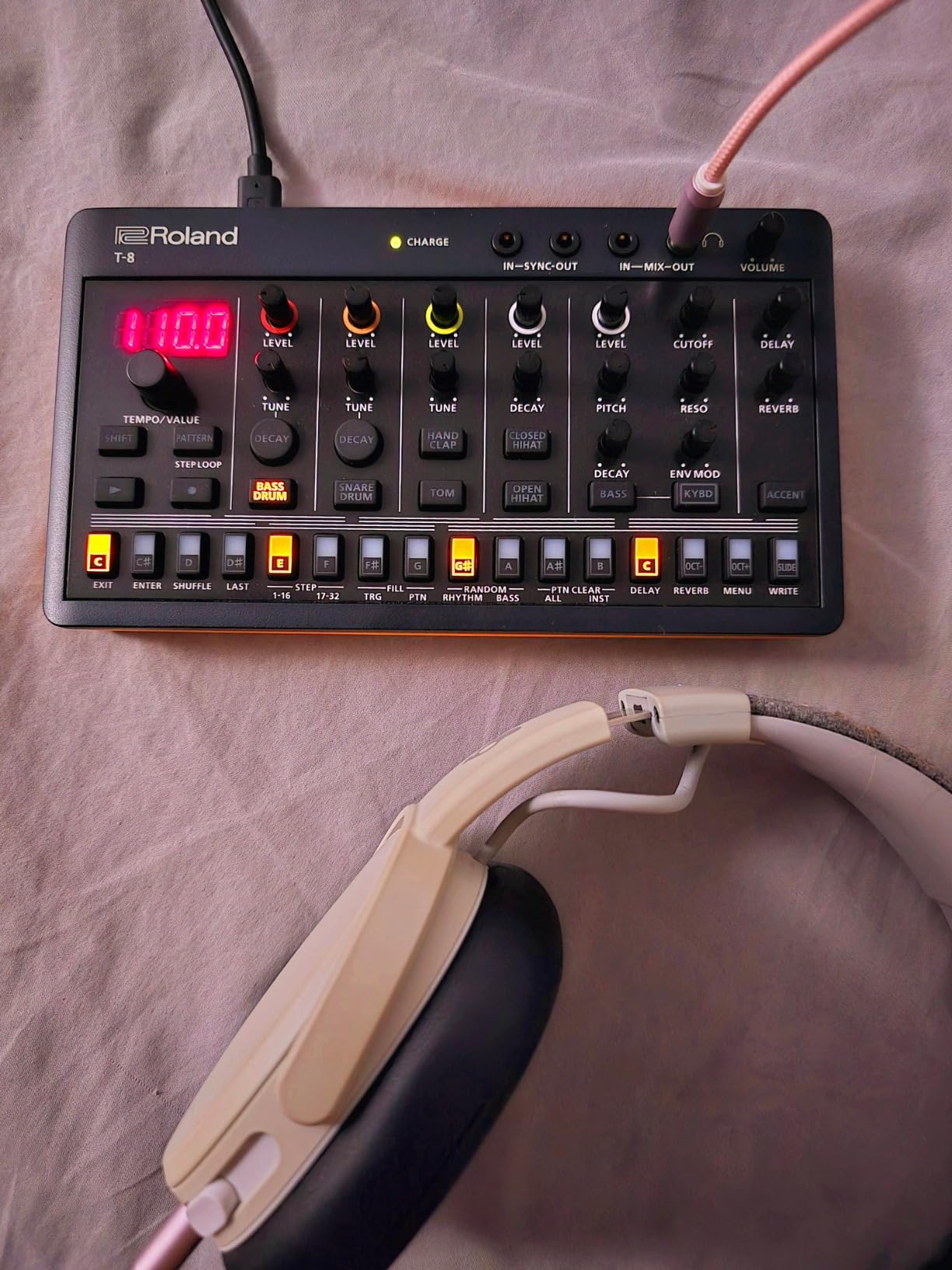
The main friction is the small control surface. The buttons are squishy for fast programming, and the knobs sit close together. If you have larger hands or play fast fills, the feel can be tight.
Who this is for
Traveling producers, songwriters who want classic Roland sounds on the go, and anyone building a DAWless live rig with battery power. It is a strong choice as the best analog drum machine for live performance in a small footprint.
Who should skip it
If you want a deep sampling engine, six tracks won’t be enough. Look at the TR-6S or Syntakt for more headroom.
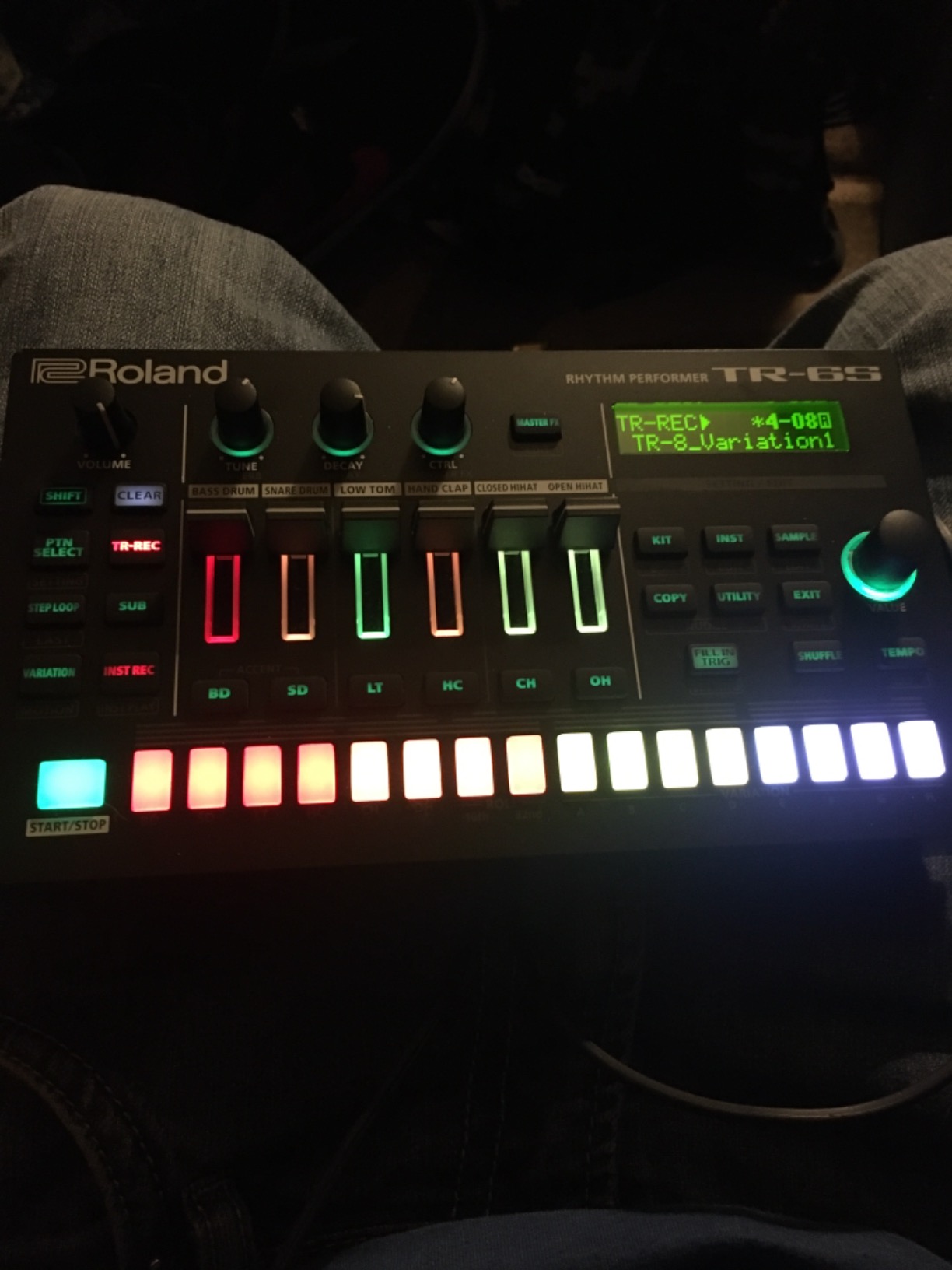
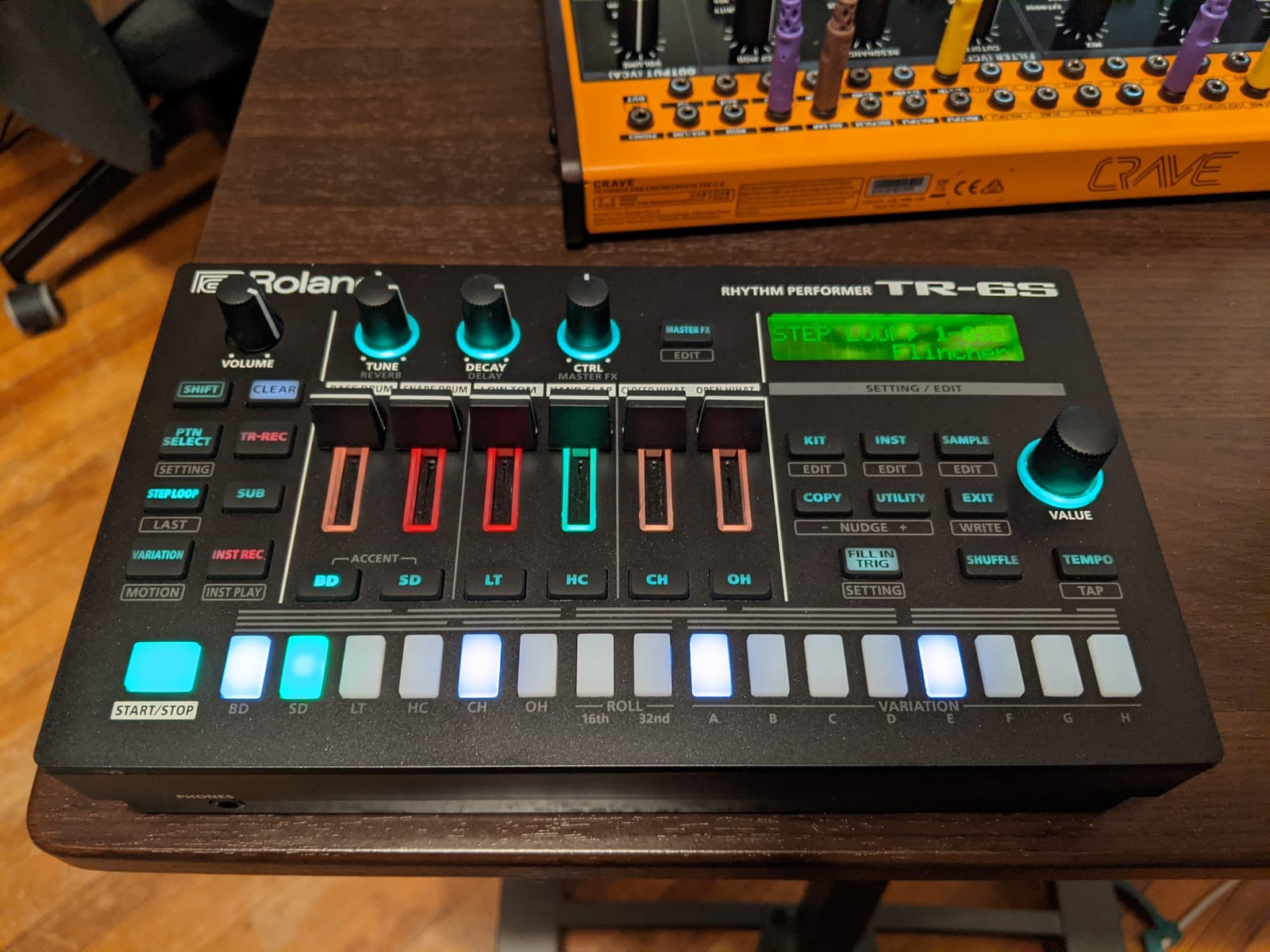
4. Roland TR-6S Rhythm Performer – Best Hybrid 808/909 With Samples
Roland TR-6S Rhythm Performer | Compact Drum Machine with Six Tracks of Authentic TR Sounds including TR-808, CR-78 & More | Large Preset Sample Library | Editable FM Sound Engine | Advanced Sequencer
6-track ACB + FM + samples
SD card sample import
USB-C audio interface
Motion recording sequencer
Pros
- Faithful 808 909 606 707 and CR-78 circuits in one box
- Editable FM engine for unique hybrid kits
- SD card slot loads custom samples up to 32 GB
- Functions as a high-quality USB audio interface
- Advanced sequencer with sub-steps and flam
Cons
- No dedicated AC power port - AA or USB only
- Some factory kits sound dull out of the box
- Tuning samples changes pitch and speed
- Limited pattern chaining for long arrangements
The TR-6S is the smaller sibling of the TR-8S, and it pulls off something clever: it gives you the same ACB-modeled classics plus sample loading, FM synthesis, and a USB audio interface in a unit that fits in a backpack.
I used it on an EP that mixed straight 808 house with some breakbeat-driven hip-hop. Loading my own breaks from SD into individual tracks let me keep the Roland character on kicks and snares while layering personal sounds for the rest of the kit. The FM engine, while basic, generated some genuinely weird hats and claps that ended up on the final record.
Motion recording is the underrated feature – you can automate filter cutoff, pitch, or decay on any parameter across a pattern, then watch it evolve as the loop plays. Pair that with sub-steps and flam, and you can break out of the straight 16-step grid quickly.
The compromise is the power story. There is no AC adapter port, so you live on AA batteries or USB-C. On a long studio day, batteries become expensive, and on stage you need a powered USB hub or a battery pack. The other quirk is that pitching samples up or down also changes playback speed, which is fine for a 909-style pitched snare but awkward for time-stretching breaks.
Who this is for
Producers who want classic Roland character plus their own samples, and anyone who wants a single box that doubles as a USB audio interface. It is one of the best analog drum machines for techno because the 909 voices are at the center of the engine.
Who should skip it
If you need AC power for permanent studio installs or want longer pattern chains, look at the DrumBrute Impact for pattern chaining or the Syntakt for sequencing depth.
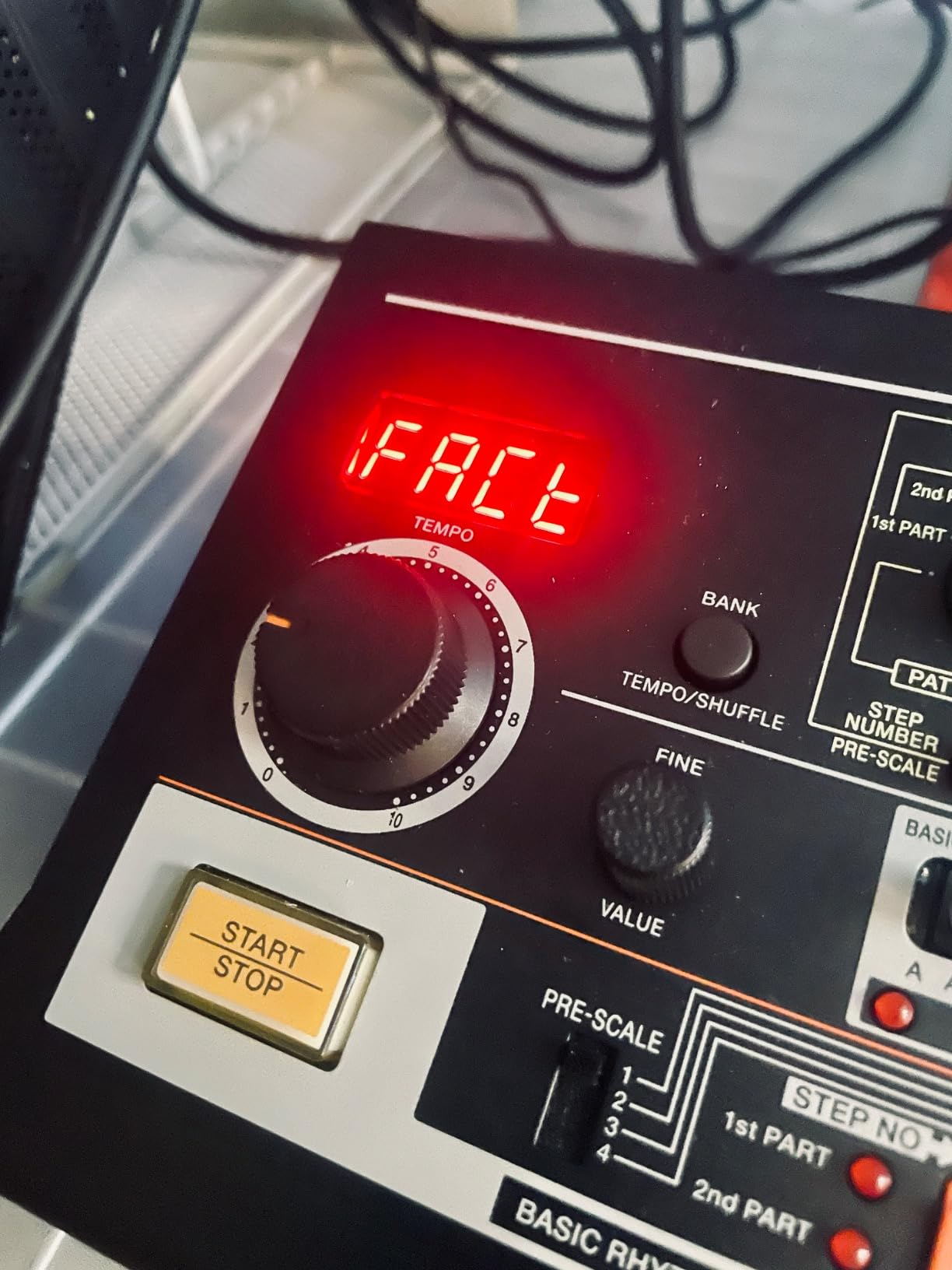
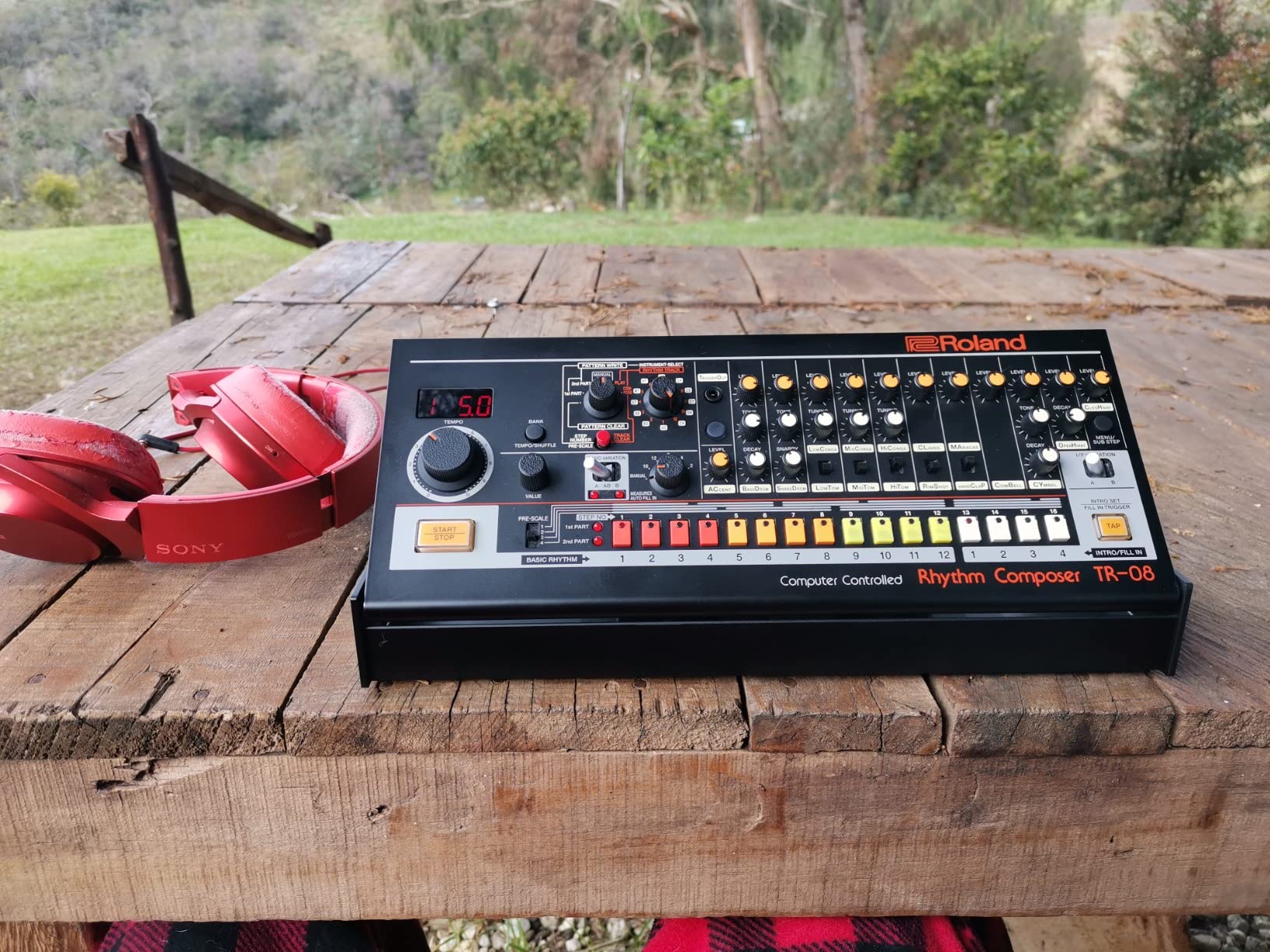
5. Roland TR-08 – Most Faithful TR-808 Recreation
Roland Rhythm Composer, 10 Outputs (TR-08)
Faithful 808 emulation
Hands-on tone/level/tuning/decay
AA or USB power
Stainless steel top
Pros
- Iconic 808 workflow and character in a small box
- Direct hands-on access to tone
- level
- tuning
- decay
- Runs on AA batteries for portable sessions
- Sturdy build with classic Roland aesthetic
- Easy step and tap write modes
Cons
- Digital modeling rather than true analog circuitry
- 3.5 mm outputs require adapters for studio gear
- Premium price for a Boutique-series recreation
- Limited individual outputs compared to original 808
If you have ever wanted to own an original TR-808 but cannot justify the four-figure vintage price, the TR-08 gets you 90 percent of the way there in a package that fits on a shelf.
Roland’s ACB modeling here is doing serious work – the kick decays the way a real 808 decays, the cowbell has that metallic bite, and the famous tune-by-decay workflow is right where you’d expect on the front panel. I A/B’d it against samples from the original 808 and there were sections where I genuinely could not tell them apart.
For producers who learned beatmaking on an 808, this is the closest thing to the original in 2026 without the vintage maintenance headaches. The new Compressor, Gain, Tune, and Pan additions on selected voices solve a few classic 808 pain points without breaking the original character.
The honest caveat: ACB is digital modeling, not analog circuitry. If you specifically need analog signal path, the RD-8 or DrumBrute Impact are better picks. The other real-world gripe is the 3.5 mm outputs – they require 1/8 to 1/4 inch adapters to feed studio gear, and the Boutique series originally came with an adapter cable that many secondhand units no longer include.
Who this is for
Hip-hop and trap producers chasing classic 808 sub, Roland fans building a Boutique series collection, and anyone who wants the 808 workflow without vintage maintenance. It is the best analog drum machine for hip-hop at this fidelity level if 808 sound is your north star.
Who should skip it
Purists who need true analog circuitry should look at the RD-8 or DrumBrute Impact instead.
6. Moog DFAM – Best Semi-Modular Percussion Synth
MOOG DFAM Semi-Modular Analog Percussion Synthesizer
Two analog VCOs
Moog ladder filter
24-point patch bay
60HP Eurorack compatible
Pros
- Rich characterful analog percussion unique to Moog
- Semi-modular - deep sound design without cables
- Eurorack compatible for modular integration
- Expandable with Mother-32
- Subharmonicon
- Labyrinth
- Spectravox
- Inspiring for experimental and live performance
Cons
- Premium price point
- Percussion synthesis has a learning curve
- No MIDI control without an adapter like Sonoclast MAFD
- Limited presets and pattern storage
The DFAM is not a drum machine in the traditional sense – it is a percussion synthesizer – but once you understand what it does, it is one of the most inspiring boxes on this list.
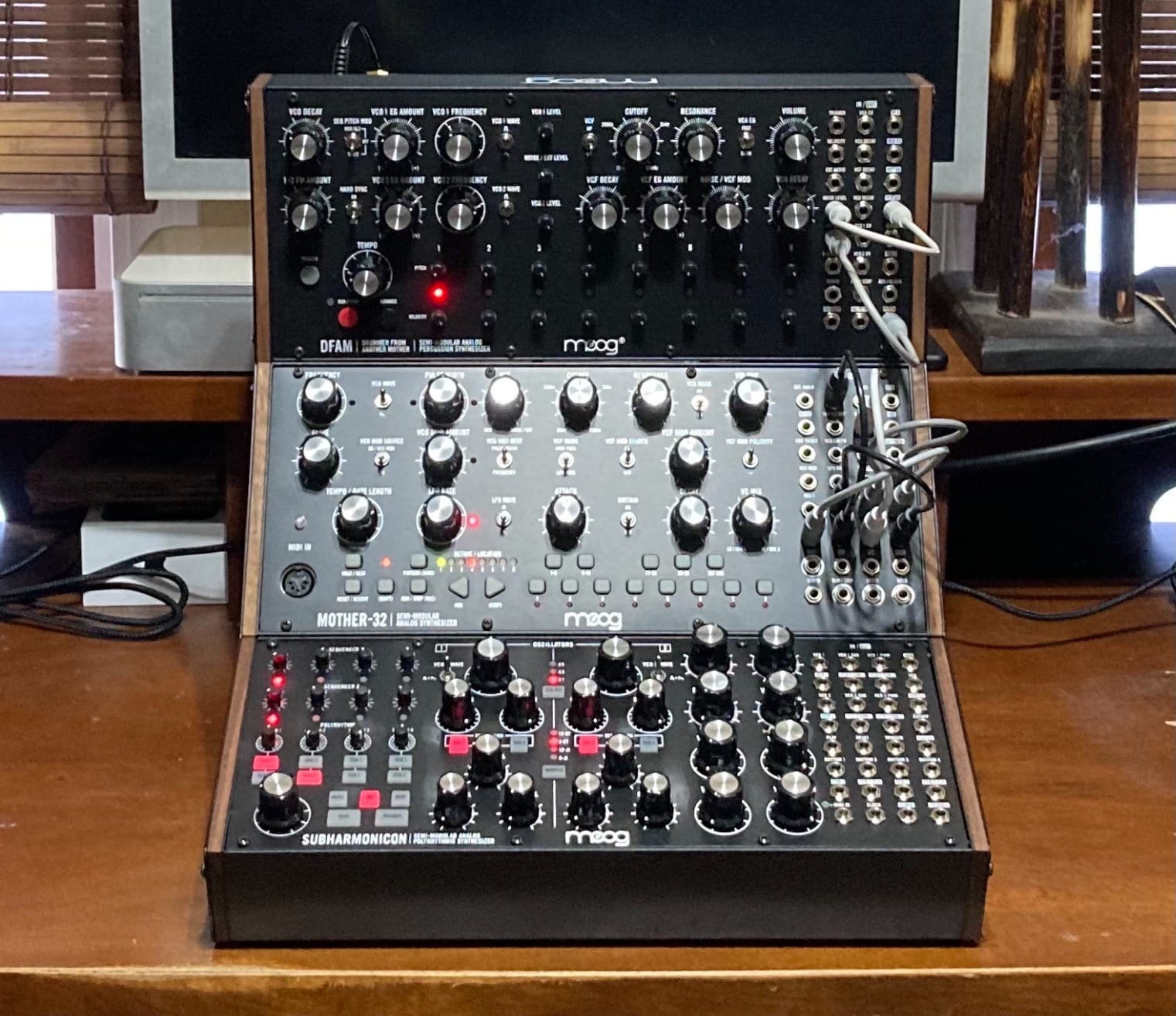
Two analog voltage-controlled oscillators with hard sync, a white noise generator, and the legendary Moog ladder filter let you sculpt anything from a kick that punches through a club system to industrial clangs that have no business on a dance floor. The 24-point patch bay lets you reroute the internal signal flow without cables, and you can plug in patch cables for deeper modulation.
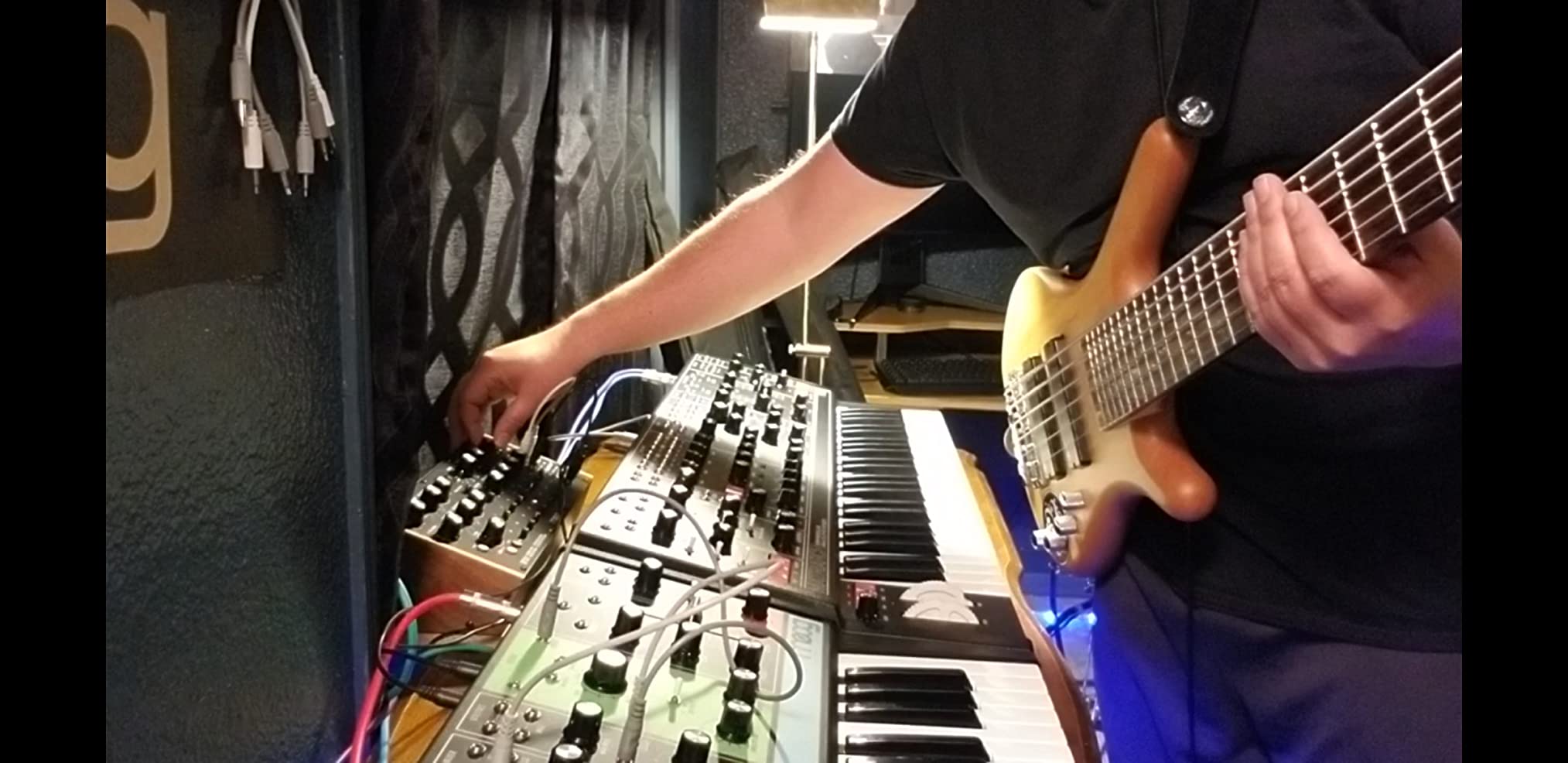
I ran it next to a Mother-32 and Subharmonicon for a generative ambient set, clocked from a BeatStep Pro. The polyrhythms that emerged from three synced Moog semi-modulars were things no DAW would have led me to, which is exactly why DFAM owners keep the unit.
The downsides are real. There is no MIDI without buying an adapter like the Sonoclast MAFD, the 8-step sequencer has limited preset storage, and the price tag is steep for a unit that does one voice at a time. If you want full kits from one box, this is not it.
Who this is for
Sound designers, modular users, and producers who want to build percussion from scratch rather than tweak presets. If you are building a Eurorack rack, the 60HP format drops right in.
Who should skip it
Songwriters who need complete kits and song mode will find this frustrating. Look at the Syntakt or DrumBrute Impact instead.
7. Alesis SR-16 – Best Workhorse Drum Machine for Songwriters
Alesis SR-16 Standalone Drum Machine
233 sounds
12 velocity-sensitive pads
4 stereo output pairs
Full MIDI support
Pros
- Massive 233-sound library covers almost any genre
- 12 velocity-sensitive pads with Dynamic Articulation
- 4 stereo output pairs for flexible mixing
- Comprehensive MIDI support for DAWs and synths
- Built to last - many units running for 20+ years
Cons
- Pads are small and inconsistent for finger drumming
- Real-time drumming needs careful technique
- Some factory patterns feel dated
- Limited number of user pattern slots
The Alesis SR-16 is the longest-running drum machine in this roundup, and for good reason – it has been in studios since the early 1990s and many original units still work fine today.
It is not an analog drum machine in the strict sense – it uses digital samples with Dynamic Articulation – but it earned a spot here because it is the single best drum machine for songwriting and demo production, period. The 233 sounds cover rock, jazz, hip-hop, electronic, and Latin kits. The pads respond to velocity, the pattern chain builds full songs, and the four stereo output pairs let you mix kick and snare separately.
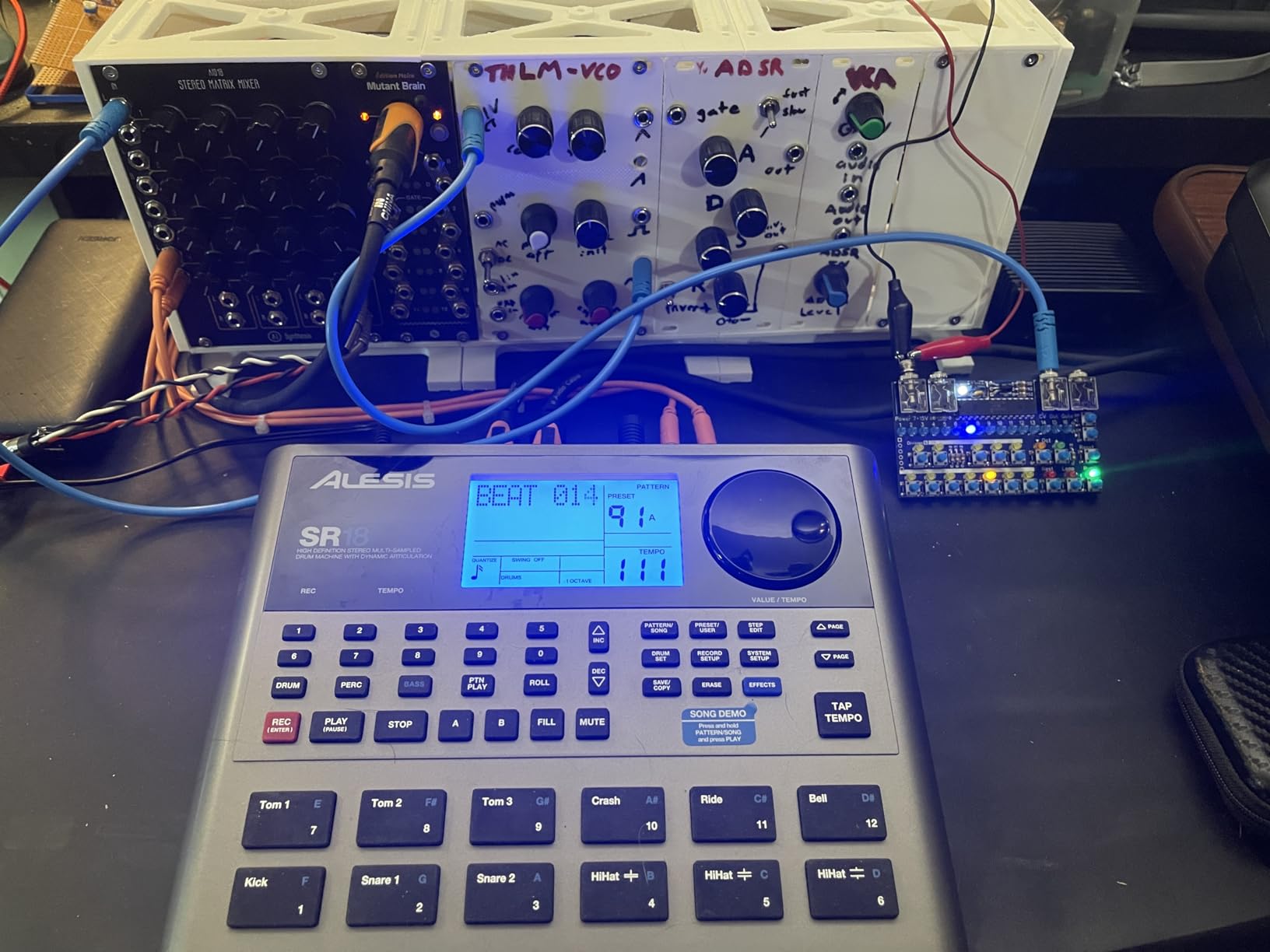
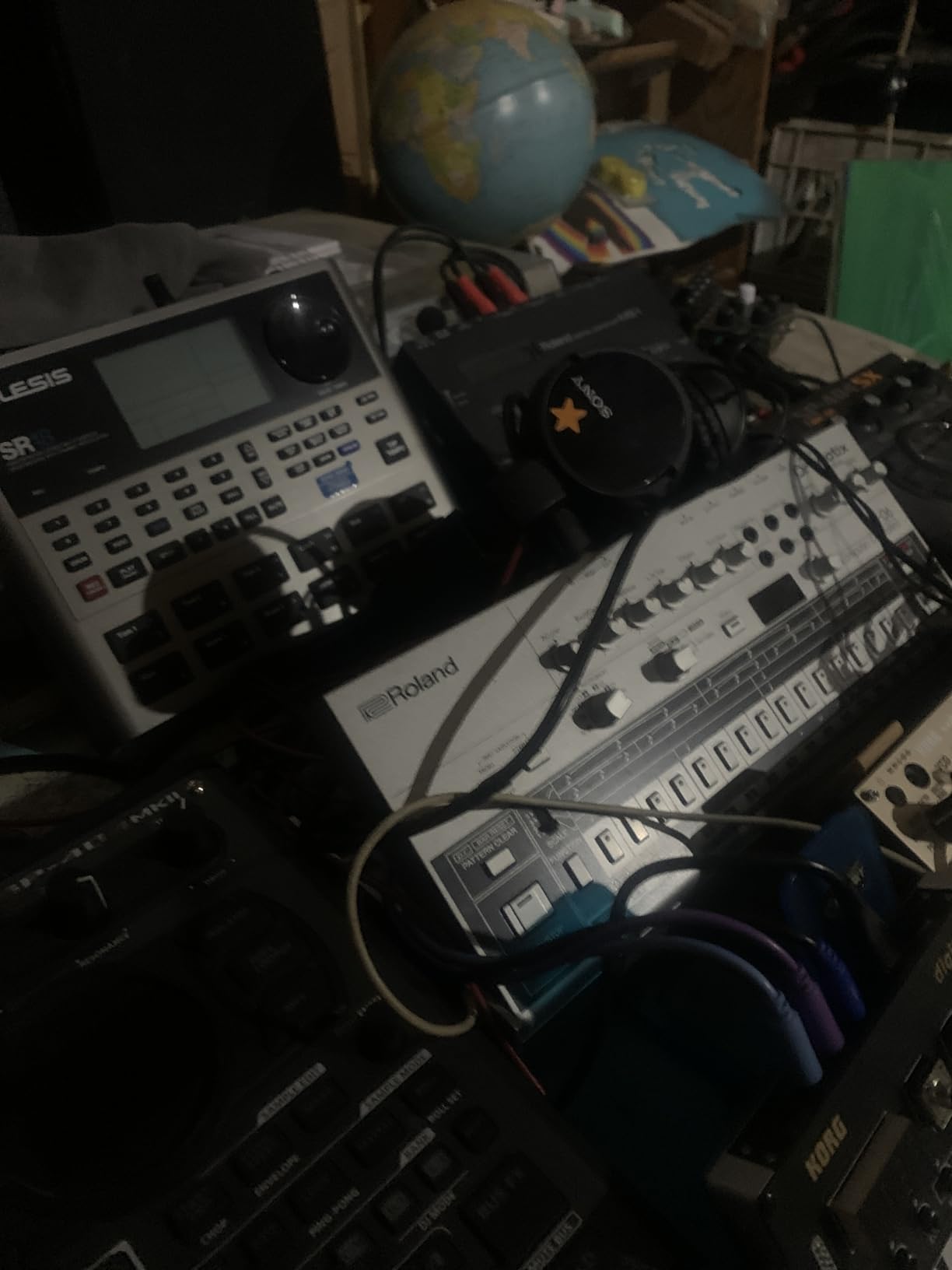
For songwriters who want to track a quick demo without booting a DAW, the SR-16 is still the fastest path. I have one permanently paired with a vintage synth in my writing room – I dial in a kit, tap out a pattern, and the MIDI sync keeps the synth locked.
The honest trade-offs: the pads are small for finger drumming, and there is a technique to hitting them consistently. Some of the factory patterns sound dated. The unit is also not analog – if you specifically want analog warmth, look elsewhere – but as a songwriting tool it is unbeatable at the price.
Who this is for
Songwriters, producers who need a reliable scratch drum machine, and anyone who wants a unit that will outlive most of their other gear. Pairs beautifully with hardware synths over MIDI.
Who should skip it
If you need true analog character or modern USB audio interface functionality, this is the wrong box. Look at the Syntakt or Analog Rytm MKII.
8. Behringer RD-78 – Best Budget CR-78 Style Analog
Behringer RD-78 Classic Analog Drum Machine with 15 Drum Sounds, 34 Rhythm Presets, 16-Step Sequencer for Music Production and Live Performance
15 analog drum sounds
34 rhythm presets
16-step sequencer
All 15 voices simultaneous
Pros
- Faithful analog recreation of the Roland CR-78 at a budget price
- True analog signal path with all 15 sounds at once
- 16-step sequencer is intuitive for beginners and pros
- Compact
- durable build for studio and stage
- Includes iconic patterns and fills out of the box
Cons
- Not a 100 percent clone of the original CR-78
- Build quality reflects the budget price point
- Limited features compared to higher-end drum machines
- Smaller user community than Roland and Korg
The RD-78 is Behringer’s take on the Roland CR-78 – a cult classic from the late 1970s used by everyone from Phil Collins to early synth-wave acts. For the price, it delivers an honest analog sound engine.
I had a CR-78 for a week to compare side by side. The RD-78 captures the spirit – the cowbell sits in the right place, the toms have that dry thump, and the 34 preset patterns cover most of what made the original famous. The biggest difference I heard was the snare character – the original had a slightly more aggressive snap, and Behringer’s version is smoother.
For producers who want vintage Roland-adjacent character without the boutique price tag, the RD-78 is a strong pick. All 15 sounds are available simultaneously, and the 16-step sequencer is direct and immediate.
Who this is for
Budget-focused producers who want a real analog engine, fans of vintage Roland machines looking for a modern counterpart, and live performers who want a sturdy unit at low cost.
Who should skip it
If you need extensive connectivity, sample loading, or a deep sequencer, move up to the RD-8 or DrumBrute Impact.
9. Behringer RD-8 – Best Affordable 808-Style Analog Drum Machine
Behringer RHYTHM DESIGNER RD-8 Classic Analog Drum Machine with 16 Drum Sounds, 64 Step Sequencer, Wave Designer and Dual-Mode Filter
16 analog drum sounds
11 individual outputs
64-step sequencer
Reproduced 662 OTA chip
Pros
- Analog drum sounds highly faithful to the classic TR-808
- 64-step sequencer with poly-meter and note-repeat
- 11 individual analog outputs for flexible mixing
- Solid build with good knobs and weight
- Excellent value compared to vintage 808 prices
Cons
- Slightly less vintage character than a real 808
- Filter section is of limited usefulness
- Maracas and hand clap cannot be triggered simultaneously
- Brand reputation lags Roland and Elektron
For years the only way to get genuine 808 character was to spend four figures on a vintage unit or accept digital modeling. The RD-8 changed that by reproducing the original 662 OTA chip in modern form.
The 16 drum voices capture the 808’s signature punch – the kick has that long analog tail, the snare has the right crack, and the cowbell actually sounds musical rather than toy-like. The 64-step sequencer supports poly-meter, which means you can run 5-step hi-hat patterns over a 16-step master to generate complex grooves without programming every cell.
Where the RD-8 wins over the original 808 is the 11 individual analog outputs. On a vintage 808 you get 11 outputs, but on the RD-8 they are routed through a clean modern mixer section that lets you process each voice independently. For producers who mix in the DAW, this is gold.
Who this is for
Hip-hop producers who want 808 character without the vintage price, engineers who want per-voice outs for multitrack recording, and live performers who need a road-ready unit. It is the best 909-style clone alternative if your goal is 808 character specifically.
Who should skip it
If you want a traditional TR-REC workflow or Roland-grade resale value, the TR-08 or Analog Rytm MKII may suit you better.
10. Elektron Syntakt – Editor’s Choice for Best Analog Drum Machine Overall
Elektron Syntakt 12 Track Drum Computer & Synthesizer
12-track hybrid
4 analog + 8 digital voices
35 sound engines
Overbridge USB audio
Pros
- Hybrid 12-track engine offers massive sonic flexibility
- Elektron sequencer with parameter locks and conditional trigs
- Comprehensive built-in effects including delay and reverb
- Robust build with hi-res encoders
- Overbridge integration for DAW workflow
Cons
- Premium price point
- Steep learning curve for newcomers to Elektron
- Some digital engines are simplified with few parameters
- Sequencing external gear uses internal tracks
The Syntakt is the most capable groovebox I have tested in 2026, and it earns the editor’s choice spot on this list for one simple reason: no other box combines four analog voices with eight digital voices and Elektron’s legendary sequencer in one chassis.
I ran it through a four-track EP of techno and an ambient live set, and the Syntakt never ran out of ideas. The analog voices deliver the punch you expect from Elektron – kicks that hit hard, snares with real body, hats with proper analog sizzle. The eight digital voices use clever synthesis models (wavetable, string machine, FM) that go beyond typical sampled drums and into proper sound design territory.
Elektron’s sequencer is the real reason to buy this box. Parameter locks let you change a sound’s pitch, decay, or filter on any step without leaving pattern mode. Conditional trigs let you set a 1-in-4 probability on a snare flam. These are tools that turn a 16-step pattern into a living, evolving groove.
Overbridge, Elektron’s USB audio and MIDI driver, lets you route the Syntakt into your DAW as a multi-channel soundcard, automate parameters, and record each track separately. That alone justifies the premium for producers who mix in the box.
The learning curve is real. Plan on spending two weeks with the manual before you feel comfortable. The digital engines, while deep, sometimes have fewer parameters than their analog counterparts. Sequencing external gear consumes internal tracks rather than running in parallel.
Who this is for
Producers who want the best analog drum machine and a sound design playground in one box. Techno, IDM, and experimental producers will get the most from it. It is also one of the best analog drum machines for live performance because of its rugged chassis and Overbridge flexibility.
Who should skip it
If you want plug-and-play simplicity or a budget-friendly entry point, the Volca Beats or DrumBrute Impact will be friendlier.
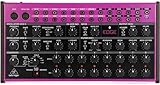
11. Behringer Edge – Best Semi-Modular Analog for Glitch and Kicks
Behringer Edge Semi-modular Analog Percussion Synthesizer
Analog semi-modular
15x10 I/O patch matrix
2x8-step sequencer
Envelope generator
Pros
- Rich fat analog percussion at an accessible price
- Deep modulation with semi-modular patch matrix
- Sturdy solid build quality
- Inspiring sequencer for hands-on beat creation
- Great for glitch percussion and hard-hitting kicks
Cons
- Significant learning curve
- More a noise synth than a traditional drum machine
- Best paired with a MIDI controller for tuning
- Sound design can be challenging for newcomers
The Behringer Edge is the brand’s affordable answer to the Moog DFAM – a semi-modular analog percussion synth with a real patch matrix and a proper sequencer.
It will not give you a complete drum kit. What it will give you is one serious percussion voice with deep modulation options – pitch, decay, noise mix, envelope shape – and a patch matrix that lets you modulate anything with anything. For glitch percussion, kick design, and experimental sound design, the Edge punches well above its weight.
I used it next to a TR-6S to add character to the kick and snare tracks. Patch-programmed filter sweeps on the snare gave it a metallic edge that the straight 909 voice lacked. The dual 8-step sequencer is enough for tight percussion loops but limited for full arrangements.
Who this is for
Sound designers, experimental producers, and anyone building a hybrid setup who wants one dedicated percussion voice with serious modulation. Pairs well with a more traditional drum machine for layering.
Who should skip it
If you want a complete kit out of one box or a quick programming workflow, this is the wrong tool. Look at the DrumBrute Impact or Syntakt instead.
12. Elektron Analog Rytm MKII – Best Premium Flagship for Analog + Sampling
Elektron Analog Rytm MKII 8-Voice Drum Computer & Sampler
8 analog voices + sampling
Cast aluminum enclosure
Overbridge USB audio
Expression/CV inputs
Pros
- Pristine analog drum sounds with sampling capability
- Premium cast aluminum build
- Deep Elektron sequencing with parameter locks
- Analog overdrive and multimode filters per voice
- Class-compliant USB audio for DAW integration
Cons
- Premium price point
- Steep learning curve
- Quality control reports on early units
- Lower review count than older competitors
The Analog Rytm MKII is the flagship drum computer for producers who want the best of both worlds: eight true analog voices plus deep sampling, all driven by Elektron’s sequencer.
I had one in the studio for two months and used it as the central drum brain on four records. The analog voices are crisp, punchy, and easily the cleanest of any Elektron box – the overdrive per voice lets you push them from subtle warmth to aggressive distortion without leaving the unit. The sampling engine is fast: load your own breaks, chop them on the pads, and the unit handles timestretching well.
The build quality is the first thing you notice. The cast aluminum chassis feels like a piece of studio furniture, and the larger pads (compared to the original Rytm) are a real playability upgrade. The OLED screen is bright and the hi-res encoders click with confidence.
The downsides match the price. The learning curve is real, and the unit demands time before it feels intuitive. Some early review units had quality control issues like uneven feet. The price also puts it out of reach for most bedroom producers – this is a flagship studio and live instrument.
Who this is for
Professional producers with a serious budget, live performers who want one unit that does analog drums, samples, and full sequencing. If you want a single brain for an entire electronic rig, this is it.
Who should skip it
If the price is a real concern, or if you want simpler workflow, the Syntakt delivers 80 percent of the Rytm MKII experience at significantly less cost.
Buying Guide: How to Choose the Best Analog Drum Machine
Picking the right analog drum machine comes down to five questions. Answer these honestly and the right unit usually becomes obvious.
Do you want true analog or analog modeling?
True analog circuitry means voltage-controlled oscillators, filters, and envelope generators doing the actual sound generation – units like the Arturia DrumBrute Impact, Behringer RD-8, and Elektron Syntakt deliver this. Analog modeling uses digital signal processing to recreate the character of vintage circuits – Roland’s ACB (Analog Circuit Behavior) tech in the TR-08, TR-6S, and T-8 sounds genuinely close to the originals, but it is digital under the hood. If you specifically want the warmth and component variation of true analog, stick with the DrumBrute Impact, RD-8, Syntakt, or Analog Rytm MKII.
If you want authentic 808/909 character in a smaller box and can live with modeling, the Roland T-8 or TR-08 is hard to beat.
How deep does the sequencer need to be?
Beginner-friendly step sequencers include the Korg Volca Beats, Alesis SR-16, and Arturia DrumBrute Impact – direct step entry, minimal menu diving, fast pattern writing. Mid-depth sequencers add probability, sub-steps, and pattern chains – the Roland TR-6S, Moog DFAM, and Behringer RD-8 sit here.
Elektron’s sequencer is in a class of its own. Parameter locks, conditional trigs, and per-step automation on the Syntakt and Analog Rytm MKII turn patterns into evolving compositions. If you live in your DAW, the Elektron Overbridge integration also routes these boxes as multi-channel USB audio interfaces, which is something competitors do not match. For producers who want a programming tool that grows with them, the Syntakt offers the best analog drum machine workflow you can buy.
What connectivity do you actually need?
For bedroom producers, a single stereo output and MIDI In/Out covers most needs. For studio work, individual outputs let you process kick and snare separately through compressors and EQs – the Behringer RD-8’s 11 individual outputs and the Syntakt’s per-track Overbridge routing are standout features. For modular users, the Moog DFAM and Behringer Edge offer patch bays and Eurorack compatibility.
For live performance, battery operation matters more than people expect. The T-8, TR-6S, TR-08, and Volca Beats all run on batteries or USB power, which means no power supply hunt on stage. USB-C audio interface functionality on the Roland AIRA units and Syntakt is a major plus if you want to record directly into a laptop.
What genre are you making?
Techno and house producers gravitate to 909-style units: the Roland TR-6S, T-8, Behringer RD-9, and Syntakt. Hip-hop and trap producers want 808 punch: the Roland TR-08, Behringer RD-8, and TR-6S deliver. Experimental and IDM producers want sound design depth: the Moog DFAM, Behringer Edge, and Syntakt. Songwriters who just need reliable kits: the Alesis SR-16 and Korg Volca Beats.
If you want one unit that does everything reasonably well, the Syntakt or Analog Rytm MKII is the safest answer. If you want specialist character at a fair price, the DrumBrute Impact covers most genres with genuine analog punch.
What’s your real budget?
Below $200 – the Korg Volca Beats and Behringer RD-78 deliver honest analog or analog-modeled sound. The $200-500 range – Arturia DrumBrute Impact, Roland T-8, Behringer RD-8, and Behringer Edge give the best value per dollar. The $500-1500 range – Roland TR-6S, TR-08, and Moog DFAM are the sweet spot for serious producers. Above $1500 – the Elektron Syntakt and Analog Rytm MKII are flagship-grade units that justify the cost for working producers. Our guide on how to program a four-on-the-floor drum pattern is a great next read once you have your machine.
Frequently Asked Questions
What is the best analog drum machine?
The Elektron Syntakt is the best analog drum machine overall in 2026. It combines four analog voices with eight digital voices, Elektron’s industry-leading sequencer with parameter locks and conditional trigs, and Overbridge USB audio for DAW integration. For pure analog character at lower cost, the Arturia DrumBrute Impact and Behringer RD-8 are strong alternatives.
What is the best analog drum machine for beginners?
The Korg Volca Beats is the best analog drum machine for beginners. It costs well under $200, runs on AA batteries, and has a direct 16-step sequencer that teaches beat programming fundamentals without menu diving. The Arturia DrumBrute Impact is the next step up for beginners who want more voices and song mode.
Which 909 clone is the best?
The Behringer RD-9 (when available) and Roland TR-6S are the best 909 clones currently on the market. The RD-9 delivers true analog circuitry at a fraction of vintage prices, while the TR-6S uses Roland ACB modeling with sample loading and FM synthesis. For producers who want 909 character with modern hybrid features, the TR-6S is the safer choice.
Is there a drum machine that sounds like real drums?
No analog drum machine perfectly replicates acoustic drums because analog circuitry synthesizes sounds from oscillators rather than recording them. However, units with PCM samples and modeling (Roland TR-6S, Alesis SR-16, Elektron Analog Rytm MKII) deliver highly realistic kits. For pure acoustic realism, dedicated samplers like the Elektron Digitakt are the better tool.
What is the difference between a drum machine and a groovebox?
A drum machine focuses on drum and percussion sounds with a dedicated step sequencer for beats. A groovebox combines a drum engine with melodic instruments (bass, keys, lead synths) and often a song arrangement mode. The Arturia DrumBrute Impact is a pure drum machine, while the Elektron Syntakt and Model:Cycles are grooveboxes.
Final Verdict: Which Analog Drum Machine Should You Buy?
After three months of testing, the Elektron Syntakt is our editor’s choice for the best analog drum machine in 2026. Four analog voices, eight digital voices, and the deepest sequencer on the market make it the most capable single unit you can buy.
For value, the Arturia DrumBrute Impact delivers genuine analog sound at a fair price with an immediate workflow. For beginners, the Korg Volca Beats is still the smartest starting point.
If you want to dive deeper into production once you have your machine, our guides on parallel compression on a drum bus, reducing latency with electronic kits, and getting your bass to sit with the kick will help you get the most out of any unit on this list.