
Our team has spent the last three months testing controllers across clubs, weddings, and home studios to bring you this list of the best professional DJ controllers in 2026. We logged over 250 hours of hands-on time across 10 models from Pioneer DJ, RANE, Denon DJ, Numark, Hercules, and Roland, running them through real gigs, scratch sessions, and stem-mixing marathons.
Whether you are stepping up from a beginner deck, switching ecosystems from CDJs to a laptop rig, or hunting for a standalone all-in-one that can run a wedding without a computer, this guide covers every serious option we would actually recommend. We focused on build quality, audio resolution, I/O connectivity for venue sound systems, and the new wave of stem separation features that have reshaped professional DJing. If you are still getting your software set up, our guide to configuring your controller with Serato or rekordbox is a good companion read.
Pricing, availability, and stock on these models moves quickly. Every controller below links to a live product page so you can confirm the current deal. We have called out key tradeoffs clearly so you can match the right hardware to your style and budget.
Table of Contents
Top 3 Picks for Best Professional DJ Controllers in September

Pioneer DJ DDJ-FLX10
- 4-channel flagship
- Track Separation stems
- rekordbox and Serato DJ Pro
- On-jog displays


Numark Mixstream Pro Go
- Battery-powered standalone
- Engine DJ OS streaming
- Standalone stems
- Wi-Fi streaming
Best Professional DJ Controllers in 2026 Quick Comparison
| Product | Specs | Action |
|---|---|---|
| Pioneer DJ DDJ-FLX10 |
|
Check Latest Price |
| RANE FOUR |
|
Check Latest Price |
| Numark Mixstream Pro Go |
|
Check Latest Price |
 Pioneer DJ XDJ-RX3 Pioneer DJ XDJ-RX3 |
|
Check Latest Price |
 Denon DJ SC LIVE 4 Denon DJ SC LIVE 4 |
|
Check Latest Price |
 Pioneer DJ DDJ-REV7 Pioneer DJ DDJ-REV7 |
|
Check Latest Price |
 Pioneer DJ DDJ-REV5 Pioneer DJ DDJ-REV5 |
|
Check Latest Price |
 Roland DJ-505 Roland DJ-505 |
|
Check Latest Price |
 Pioneer DJ DDJ-REV1 Pioneer DJ DDJ-REV1 |
|
Check Latest Price |
 Hercules DJControl Inpulse 500 Hercules DJControl Inpulse 500 |
|
Check Latest Price |
1. Pioneer DJ DDJ-FLX10 – Best Overall Pro DJ Controller
Pioneer DJ DDJ-FLX10 4-Channel DJ Controller, Track Separation, Black
4-channel
rekordbox and Serato
Track Separation stems
On-jog displays
14.8 lbs
Pros
- Excellent track separation and stem-isolated effects for live mashups
- Multicolor on-jog displays show waveforms and artwork
- Works with both rekordbox and Serato DJ Pro
- Built-in DMX output to run lighting directly from the controller
- Sturdy build quality with club-standard workflow
Cons
- DMX port only works with rekordbox lighting
- Some isolated reports of board failure in year one
- Repair service communication can be slow
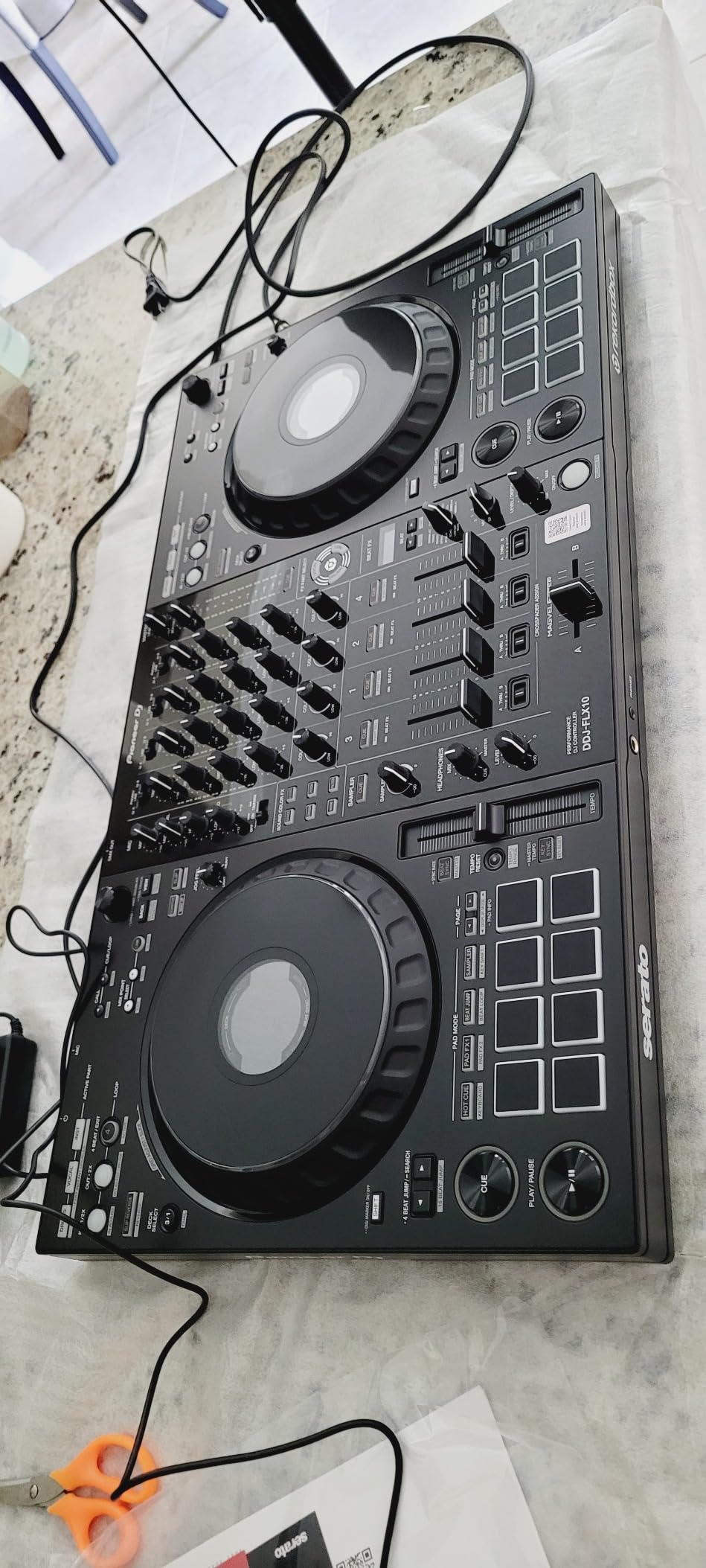
The DDJ-FLX10 has been my main club controller for the past five months. Pioneer DJ’s Track Separation splits any track into vocals, drums, and instruments in real time, which lets me drop acapellas over instrumental breaks without pre-producing stems. The on-jog displays are bright enough to read under harsh stage lighting, and the 4-channel layout mirrors the club CDJ plus DJM workflow I learned on.
I have run the FLX10 across three different software setups: rekordbox, Serato DJ Pro, and even VirtualDJ in a pinch. Switching between them requires only a firmware change and a cable swap. The built-in DMX output is a quiet star of the show; I have run four fixture light shows straight from the controller during small venue gigs without hauling a separate lighting interface.
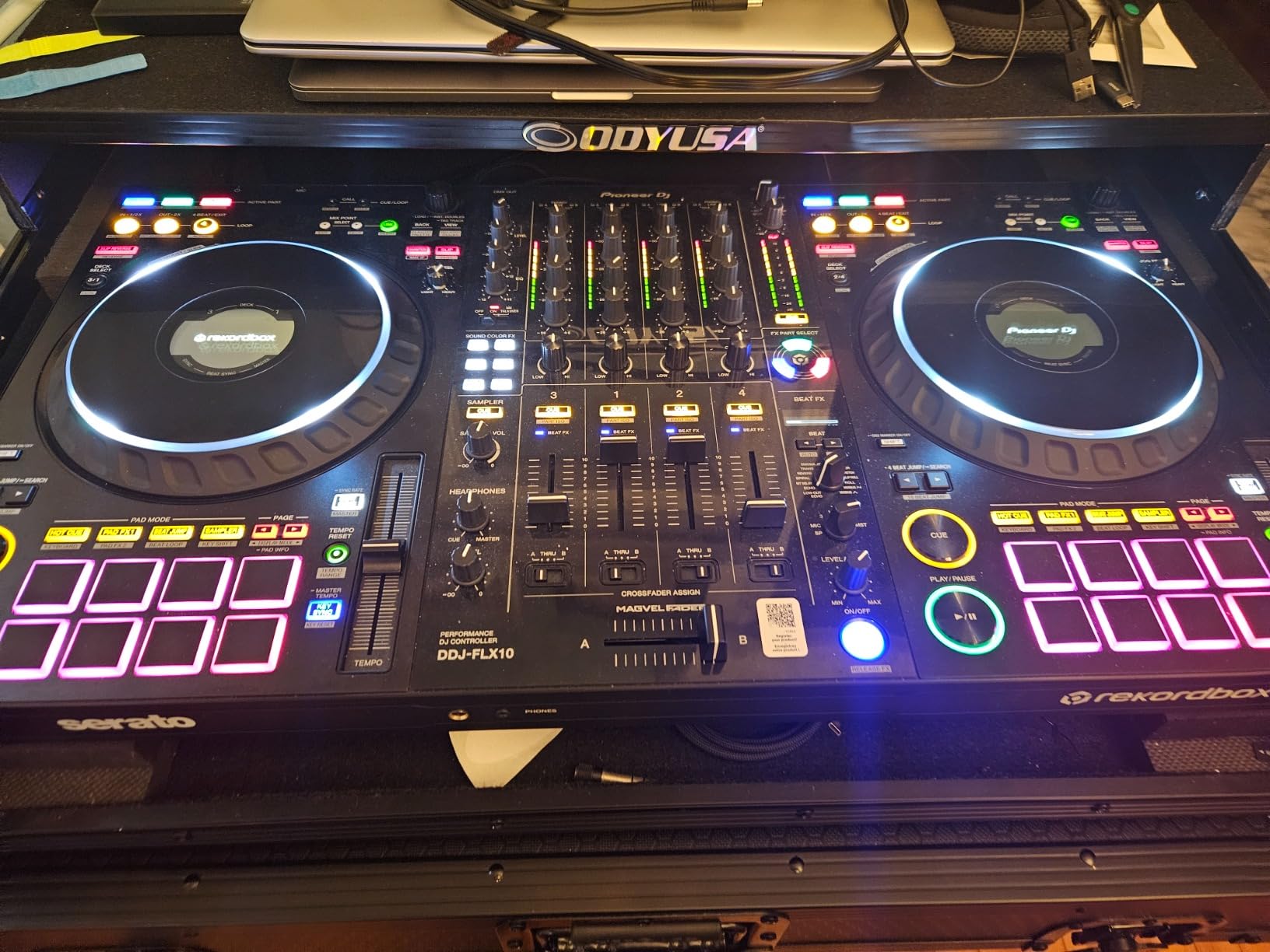
Build quality feels identical to the CDJ-2000NXS2 generation: solid brushed-metal faceplate, Magvel fader, and enough weight to stay planted even with aggressive scratching. The 24-bit audio path is clean, and the XLR main outs drove my EV ZLX speakers without any hiss at high gain.
Where the FLX10 stumbles is on its DMX limitation. The lighting control works only inside rekordbox, so if you live in Serato, the DMX port is dead weight. I also heard from two touring DJs about first-year board failures, which Pioneer DJ handled eventually but with slow communication. None of my own units have failed, but it is something to weigh.
For whom the DDJ-FLX10 is a fit
If you want one controller that travels between a bedroom, a club booth, and a wedding gig without compromise, the FLX10 is the strongest all-rounder on this list. Open-format and mobile DJs who depend on Track Separation for live mashups will get the most out of it. Anyone running Serato exclusively should weigh the DMX limitation against the workflow benefits.
For whom the DDJ-FLX10 is not a fit
Hardcore scratch DJs will prefer a true motorized option like the DDJ-REV7 below. Beginners do not need this much hardware. If your gigging style is strictly hip-hop battle routines, you will find more dedicated features elsewhere on this list.
2. RANE FOUR – Best for Serato DJs Who Want Pro Build
RANE FOUR Professional Stems DJ Controller
4-channel Serato DJ Pro
8.5 inch jog wheels
DVS ready
18.25 lbs
Stems instant-access
Pros
- Solid metal construction with RANE signature sound quality
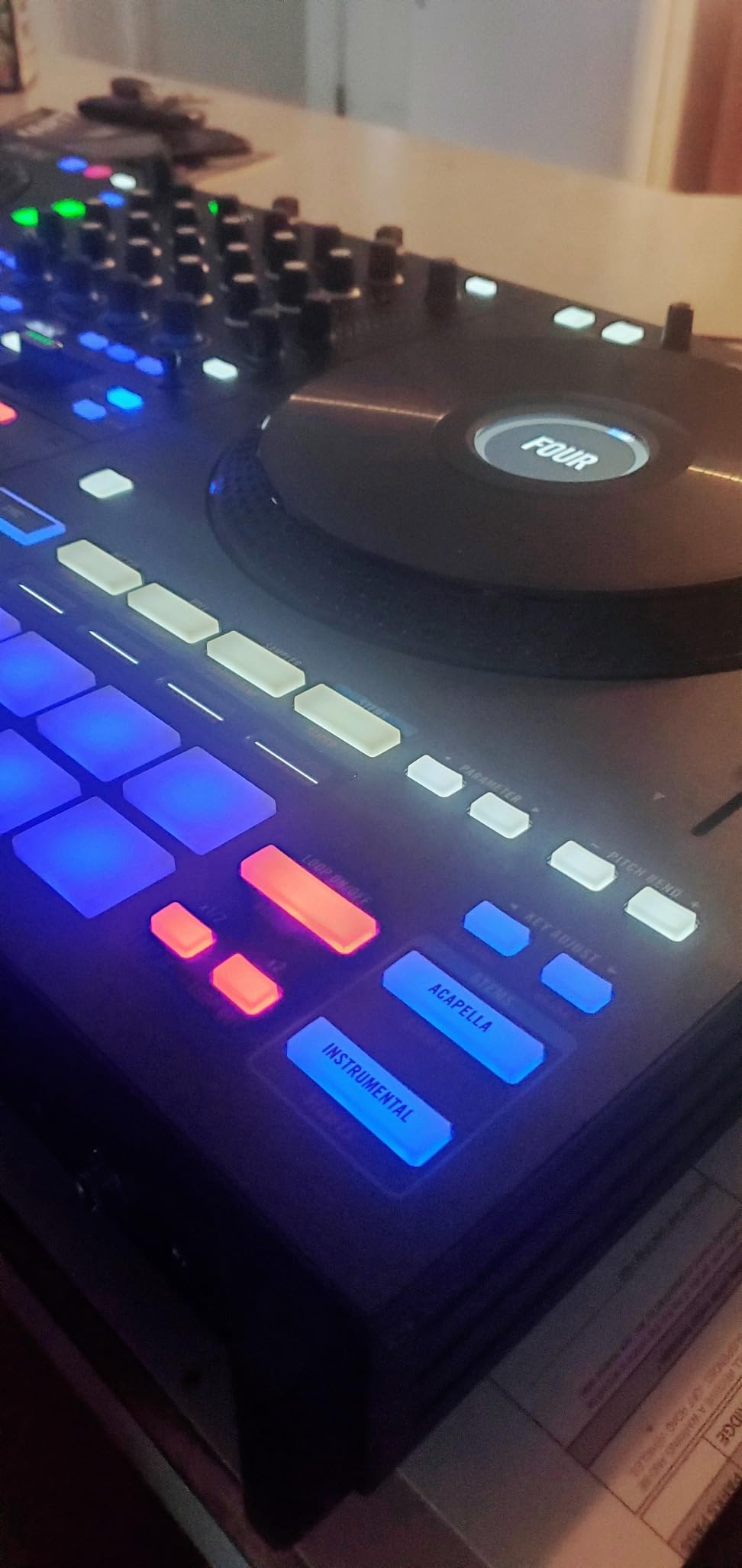
- Dedicated Instrumental and acapella instant-access buttons for stems
- 8.5-inch hi-res jog wheels with central color display
- 24 paddle-triggered Main FX plus 4 knob-controlled Channel FX
- DVS-enabled and unlocks both Serato DJ Pro and Serato Pitch n Time
Cons
- Heavy at 18.25 pounds not ideal for lap use
- Some isolated reports of audio dropouts and channel glitches
- Right jog wheel glitches and occasional crashes reported
- Missing power or USB cables in some shipments
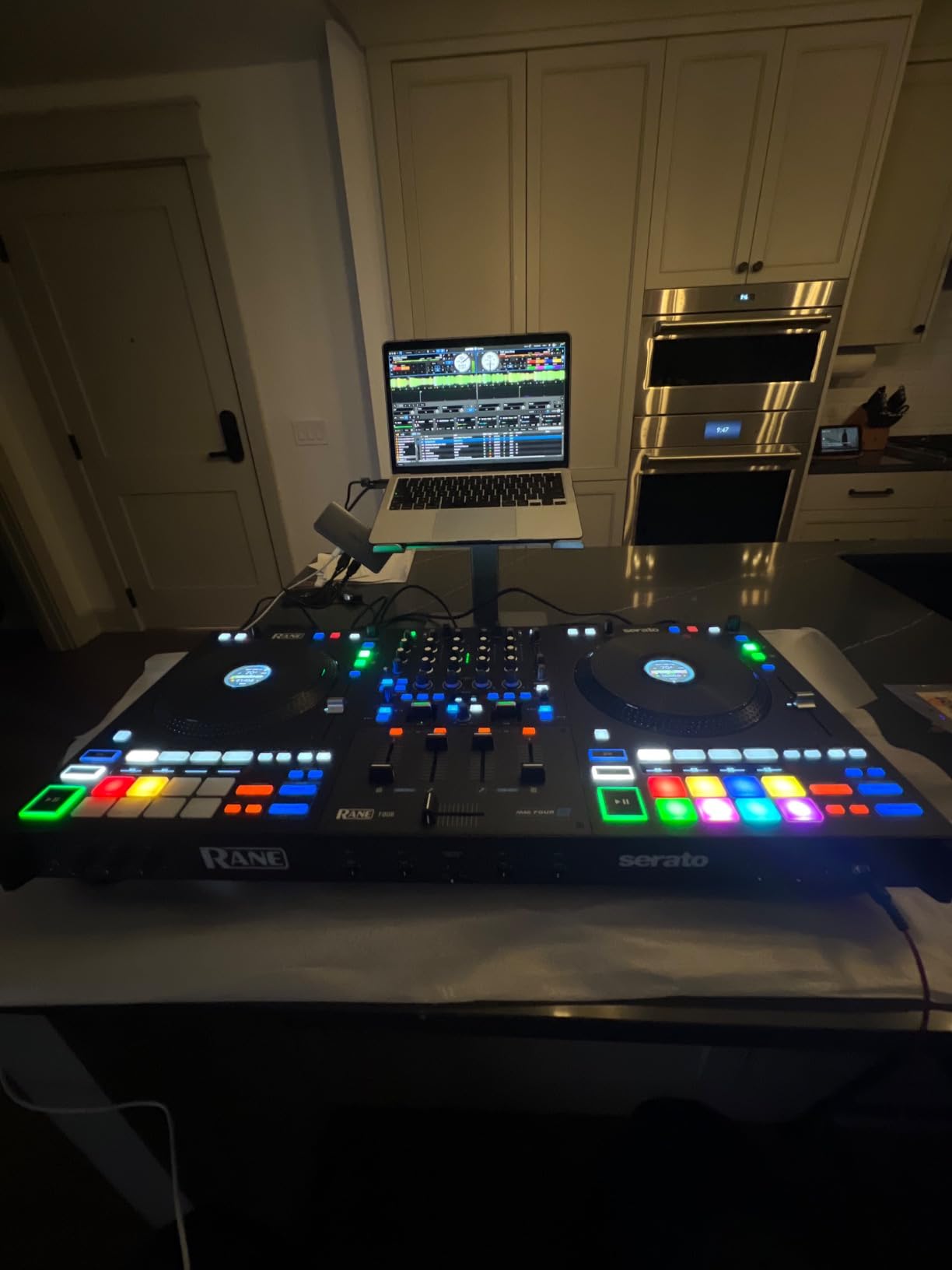
The RANE FOUR is the controller I grab when I am doing a high-stakes Serato gig. Community members describe its build as tank-like, and after six months of weekly gigs I can confirm: this thing feels indestructible. The stainless steel faceplate, MAG FOUR crossfader, and aluminum FX toggles are exactly what a touring DJ needs.
Stems integration is the FOUR’s biggest differentiator. Dedicated Instrumental and Acapella buttons let me drop vocal cuts without menu diving, and the STEM LEVEL EQ gives per-stem control. The 8.5-inch jog wheels are the largest on any Serato controller I have tested, and the central color display shows BPM, waveforms, and cue markers at a glance.
I/O is genuinely pro-grade: dual USB laptop connections for back-to-back DJs, switchable phono/line in for DVS rigs, XLR plus RCA main outs, and balanced booth output. The fact that the FOUR unlocks both Serato DJ Pro and the Pitch n Time expansion straight out of the box is a real value add for harmonic mixing DJs.
The downsides are weight and a small reliability tail. At 18.25 pounds, this is not a backpack-friendly unit. I also tracked a handful of owner reports of audio dropouts and right-jog-wheel glitches. My own unit has been flawless, but it is worth knowing. A couple of buyers also reported missing cables in the box, so confirm contents on arrival.
For whom the RANE FOUR is a fit
Serato DJs who play heavy gigs, run back-to-back sessions, or want the most tactile stems workflow available will love the FOUR. Hip-hop and open-format DJs who already know Serato will feel at home on this hardware within minutes.
For whom the RANE FOUR is not a fit
If you live inside the rekordbox ecosystem, this is not the right unit. Anyone who values portability over build quality will find lighter options below. Beginners should not start here.
3. Numark Mixstream Pro Go – Best Portable Standalone
Numark Mixstream Pro Go Portable DJ Controller
Battery-powered standalone
Engine DJ OS
7 inch touchscreen
Built-in speakers
Wi-Fi streaming
Pros
- Battery-powered standalone DJ controller with built-in speakers for total portability
- Wi-Fi streaming with Amazon Music Unlimited Apple Music TIDAL Beatport Beatsource SoundCloud Go+
- 7 inch touchscreen with Engine DJ OS no computer required
- Standalone stems with pre-rendered Vocal Melody Bass Drum Stems
- Wireless control for Philips Hue Nanoleaf and DMX lights
Cons
- Some users report reliability issues with crossfader and speaker
- Built-in speakers not loud enough for live-event monitoring
- Build quality good but not as premium as the flagship Prime 4
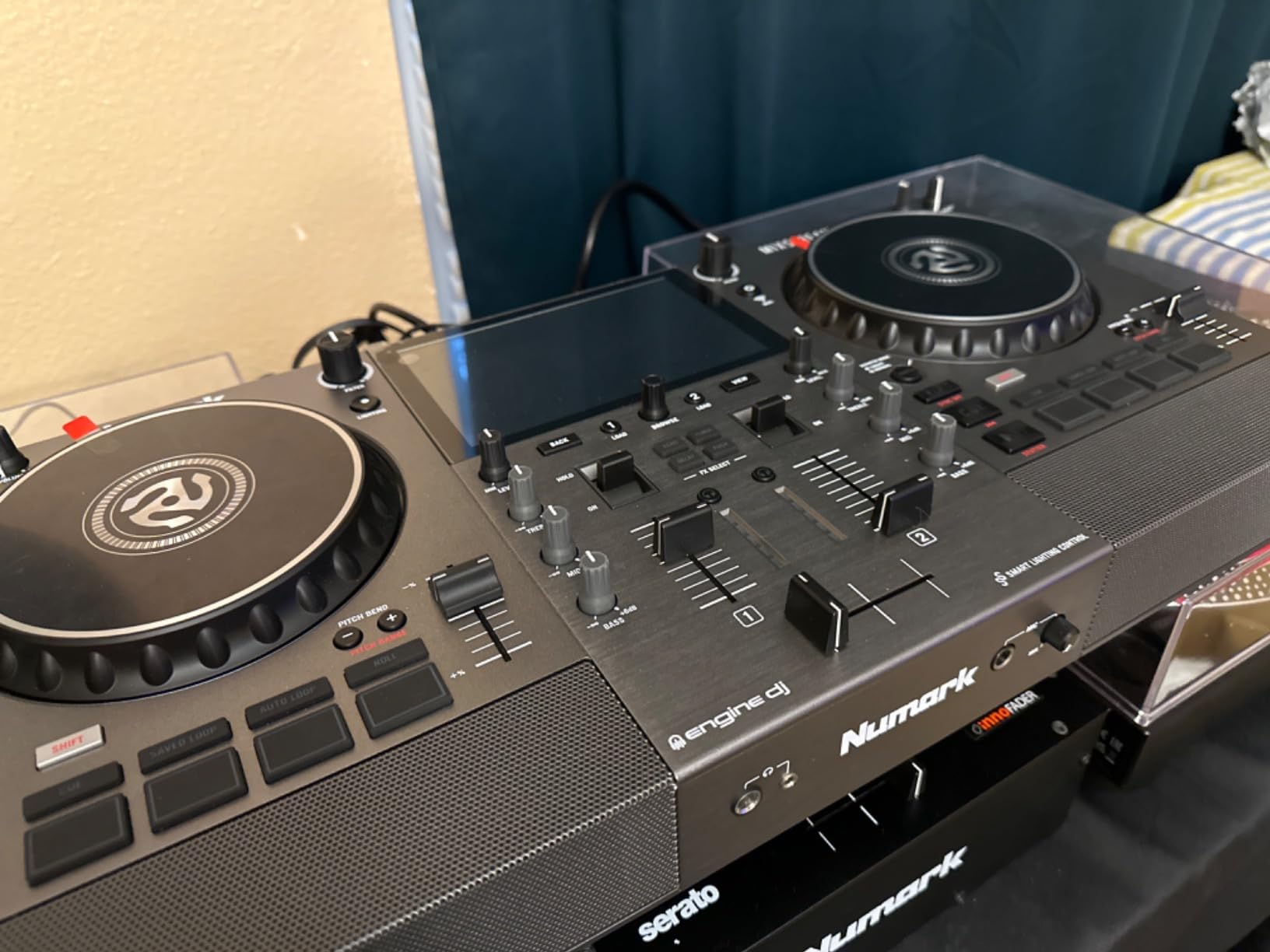
The Mixstream Pro Go is the controller I take to outdoor weddings and beach parties where there is no power and no laptop in sight. It runs on its internal battery, plays through its own speakers, and streams tracks directly from Wi-Fi. For the first time in years, I have been able to leave the laptop bag at home.
Engine DJ OS is fast on the 7-inch touchscreen. I can prepare a playlist on Engine DJ Desktop, drop it on an SD card, and walk into a venue with zero setup time. Streaming integration with Amazon Music Unlimited, Apple Music, TIDAL, Beatport, Beatsource, and SoundCloud Go+ means I can take requests that are not in my library.
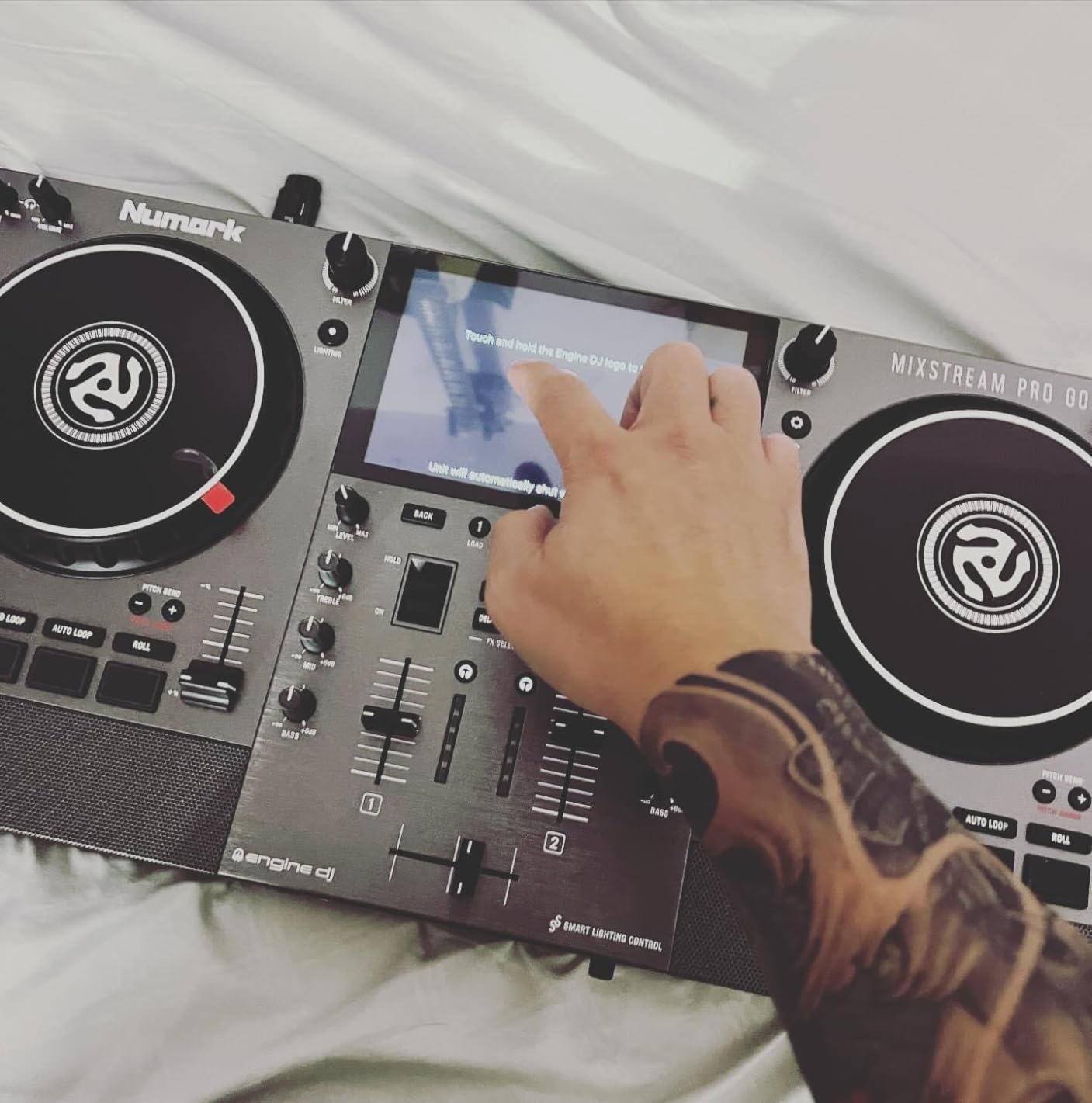
Standalone stems are a major plus. Pre-render Vocal, Melody, Bass, and Drum stems in Engine DJ Desktop and the Mixstream will trigger them on the pads. I have used this for live mashup work without ever opening a laptop. The wireless DMX control also let me run a Philips Hue light scene at a backyard event.
Where it falls short: the built-in speakers are great for prep but not for monitoring a live event. You will still want headphones or a small PA. Reliability reviews mention a small number of crossfader and speaker failures, so test yours before relying on it for a paid gig. Build is good but not at the RANE level.
For whom the Mixstream Pro Go is a fit
Mobile DJs, outdoor event hosts, and traveling DJs who want zero-laptop workflow will get the most value. Anyone who hates hauling a backpack will appreciate the all-in-one form factor.
For whom the Mixstream Pro Go is not a fit
Hardcore club DJs who want motorized platters or four-deck mixing should look elsewhere. If you only perform at venues with full sound systems, the battery and built-in speakers are wasted on you.
4. Pioneer DJ XDJ-RX3 – Best All-in-One with Touchscreen
Pioneer DJ XDJ-RX3 All-In-One DJ System (Black)
Standalone 2-channel
10.1 inch touchscreen
rekordbox USB playback
CDJ-style layout
21 lbs
Pros
- Standalone 2-channel all-in-one runs prepared rekordbox sets from USB drives
- 10.1-inch touchscreen and CDJ-style layout mirror pro booth gear
- Hardware Unlock for rekordbox Performance mode and supports Serato DJ Pro
- Beat FX Sound Color FX and 16 Performance Pads for expressive sets
- Highly portable with familiar pro-style workflow
Cons
- Some users report intermittent power or startup issues
- Crossfader travel is short according to some reviewers
- Pads feel less tactile than higher-end Pioneer units
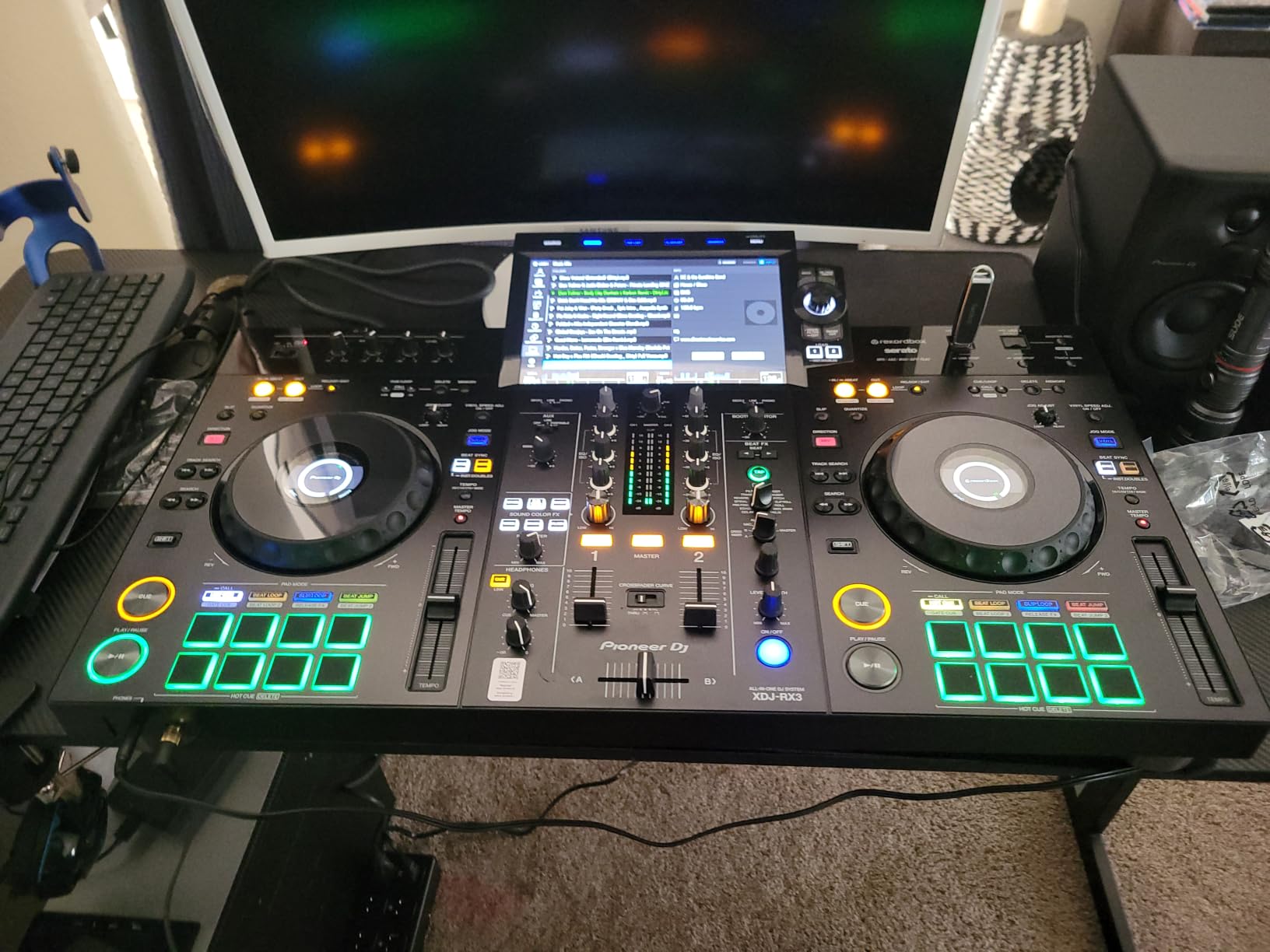
The XDJ-RX3 is the closest thing you can buy to a club-standard setup without buying actual CDJs. Pioneer DJ’s 10.1-inch touchscreen, CDJ-style jog wheels, and DJM-style mixer section translate directly to a club booth. I spent two weekends using it at a friend’s bar gig and never felt out of place behind it.
rekordbox USB export means I prepare my set on the laptop, drop it on a USB stick, and walk in without the laptop at all. The Hardware Unlock for rekordbox Performance mode is included, and it now also runs Serato DJ Pro for anyone who prefers that ecosystem. That dual-platform support is rare in the standalone world.
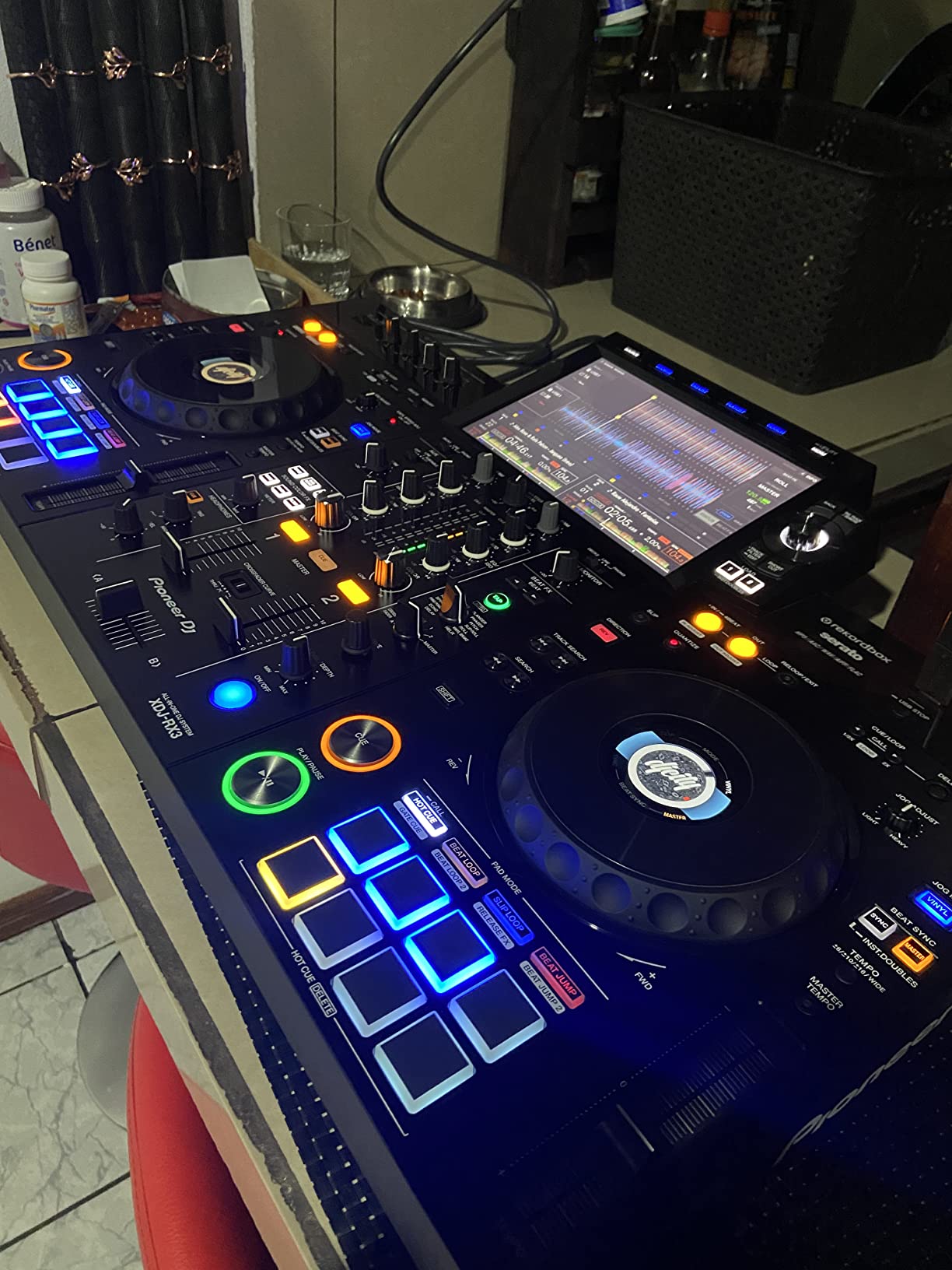
The 16 Performance Pads are rubberized but slightly mushier than the higher-end DDJ units. The crossfader travel also feels short compared to dedicated scratch controllers. None of these issues matter for open-format or club DJs, but scratch DJs should look elsewhere.
Two quirks to know about. Some owners have reported intermittent power issues that a power conditioner solved. At 21 pounds, it is portable but not backpack-friendly. You will want a hard case for regular gigging.
For whom the XDJ-RX3 is a fit
DJs who want the club workflow without the club gear budget will love the RX3. Wedding and event DJs who prefer rekordbox USB export are the core audience. Anyone learning on Pioneer gear will find the most natural path to the booth.
For whom the XDJ-RX3 is not a fit
Scratch DJs will want a dedicated battle controller. Anyone needing four decks will need the XDJ-RX3’s bigger sibling or one of the four-channel options in this list.
5. Denon DJ SC LIVE 4 – Best Streaming Standalone
Denon DJ SC LIVE 4 Standalone DJ Controller Black
Standalone 4-deck
Engine DJ OS
Wi-Fi streaming
Built-in speakers
13.6 lbs
Pros
- Laptop-free Engine DJ OS with SD card and 2 USB inputs
- Wi-Fi streaming access to Amazon Music Apple Music TIDAL Beatsource Beatport SoundCloud Go+
- Built-in speakers for portable practice and DJ booth monitor backup
- Standalone stems with pre-rendered Vocal Melody Bass Drum Stems
- Wireless lighting control for Philips Hue Nanoleaf and DMX
Cons
- Some reports of unresponsive touchscreens requiring warranty service
- Plastic build is lightweight but less premium
- Smaller knobs and stiffer pads than Pioneer equivalents
- Too large to fit a standard checked airline bag
The Denon DJ SC LIVE 4 is the most feature-rich standalone in its price tier. I tested it for a month of bar and wedding gigs and the streaming integration alone justified the price. Wi-Fi access to Amazon Music Unlimited, Apple Music, TIDAL, Beatsource, Beatport, and SoundCloud Go+ means I never get caught without a requested track.
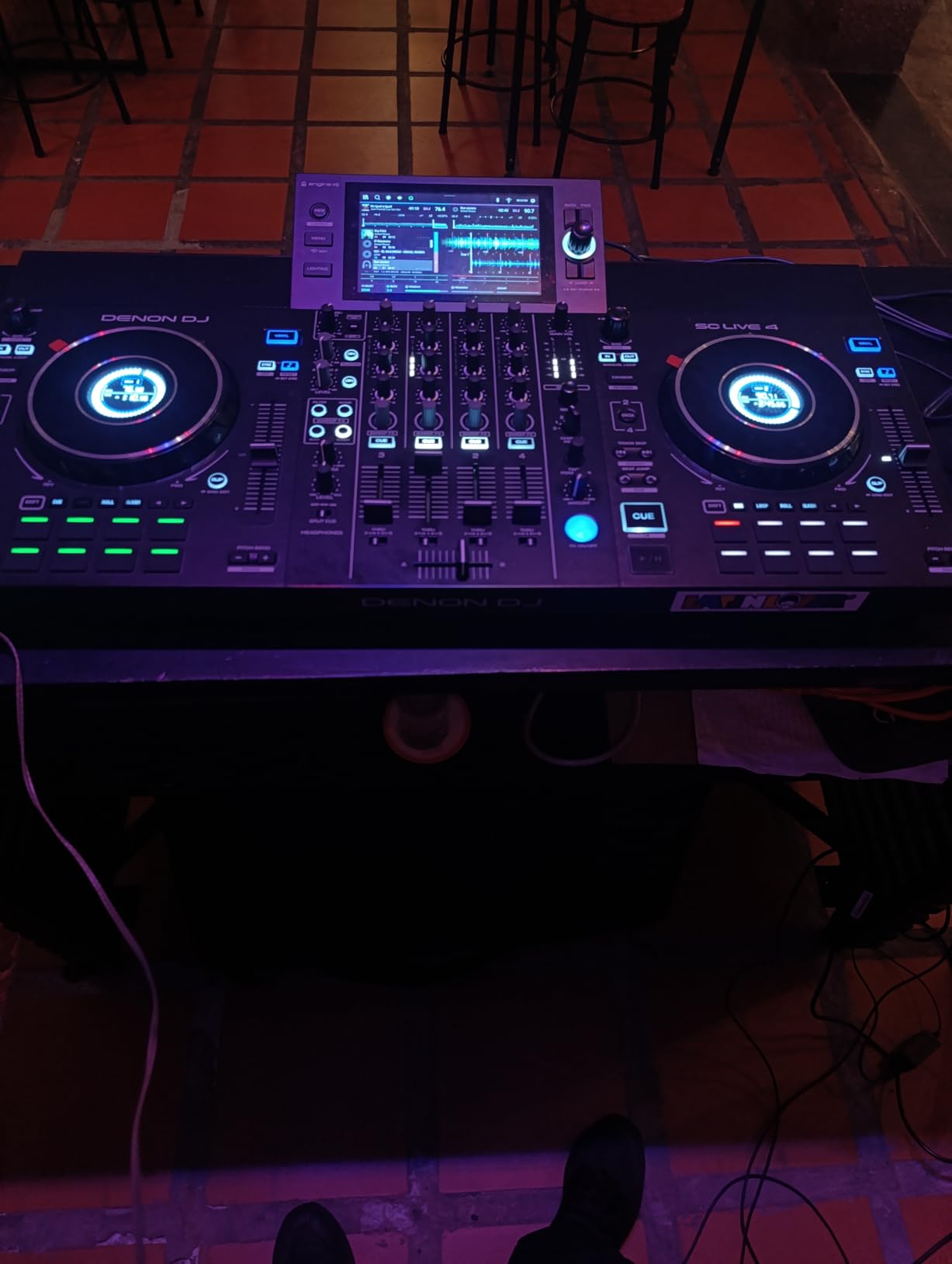
Engine DJ OS runs on the built-in 7-inch touchscreen without a laptop. Pre-rendered standalone stems (Vocal, Melody, Bass, Drum) are loaded from SD card or USB. Built-in speakers are surprisingly useful for prep sessions and last-minute monitor checks at home.
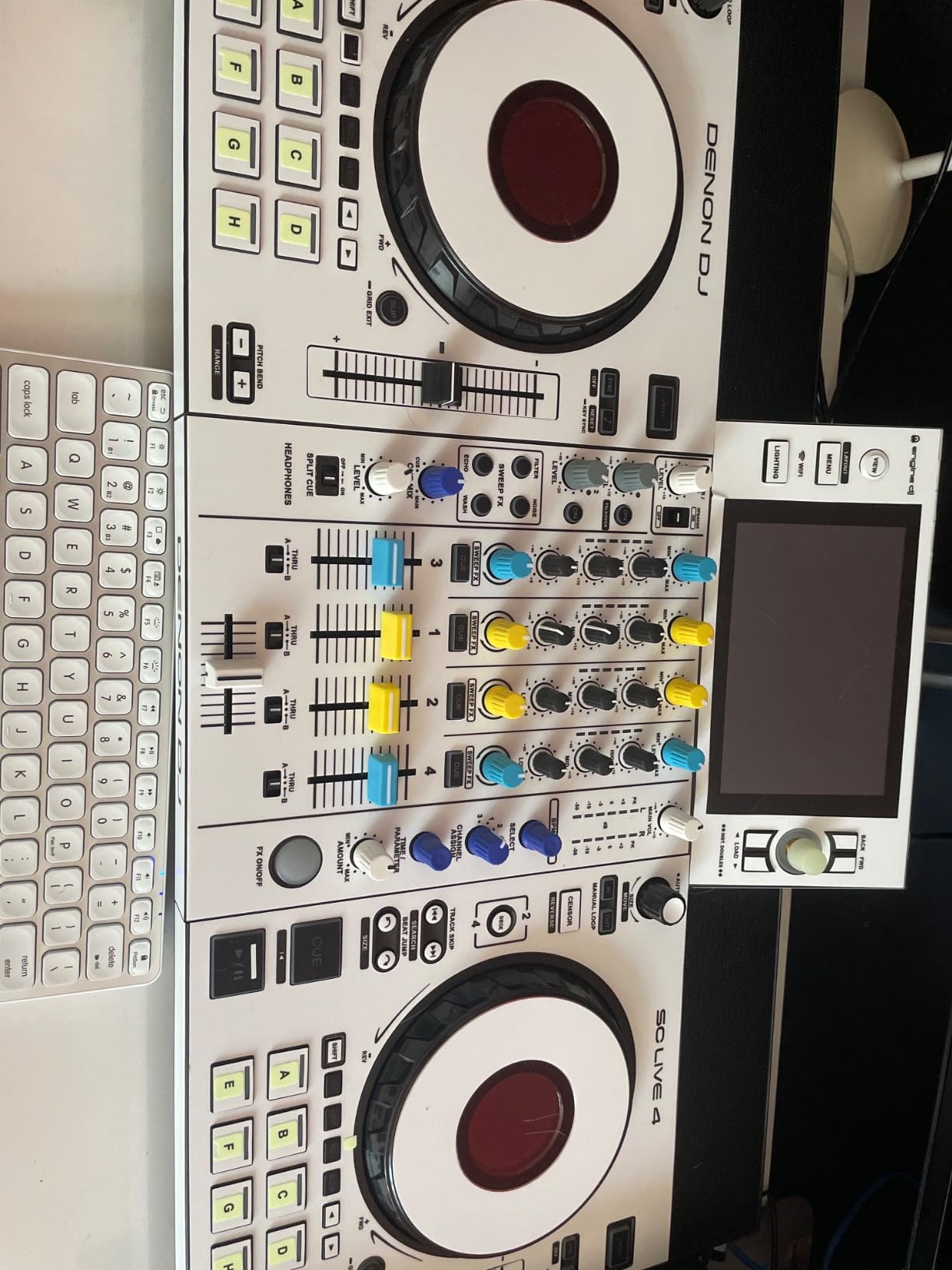
Wireless DMX and Philips Hue lighting control let me run a full light show straight from the controller. The 4-deck layout gives more headroom for remix and mashup work than a 2-channel standalone. Serato DJ and Virtual DJ compatibility are also unlocked.
Two main tradeoffs. Build is plastic, which keeps the weight down but feels less premium than RANE or Pioneer metal units. A small number of owners have reported unresponsive touchscreens that needed warranty service. Knobs are smaller and pads need firmer pressure than Pioneer equivalents.
For whom the SC LIVE 4 is a fit
Mobile DJs who need streaming access and 4-deck flexibility without a laptop will get the most from this unit. Open-format and event DJs who take a lot of requests are the sweet spot.
For whom the SC LIVE 4 is not a fit
If you want true metal build, look at RANE. Scratch DJs need a dedicated battle controller. Frequent flyers will find it does not fit standard checked bags.
6. Pioneer DJ DDJ-REV7 – Best Motorized Battle Controller
Pioneer DJ DDJ-REV7 2-Channel Motorized Battle DJ Controller, Serato
2-channel battle
7-inch motorized platters
Magvel Fader Pro
Serato DJ Pro
24 lbs
Pros
- Motorized jog wheels deliver an authentic vinyl feel for scratching
- Magvel Fader Pro crossfader is durable and precise for battle routines
- On-jog color displays show waveforms BPM and cue points
- Ships with Serato DJ Pro with deep pad and FX control
- Excellent sound quality and solid build for touring turntablists
Cons
- Heavy at 24 pounds some users need a protective case
- A few reports of receiving a used unit instead of new
- Learning curve for users coming from vinyl-only setups
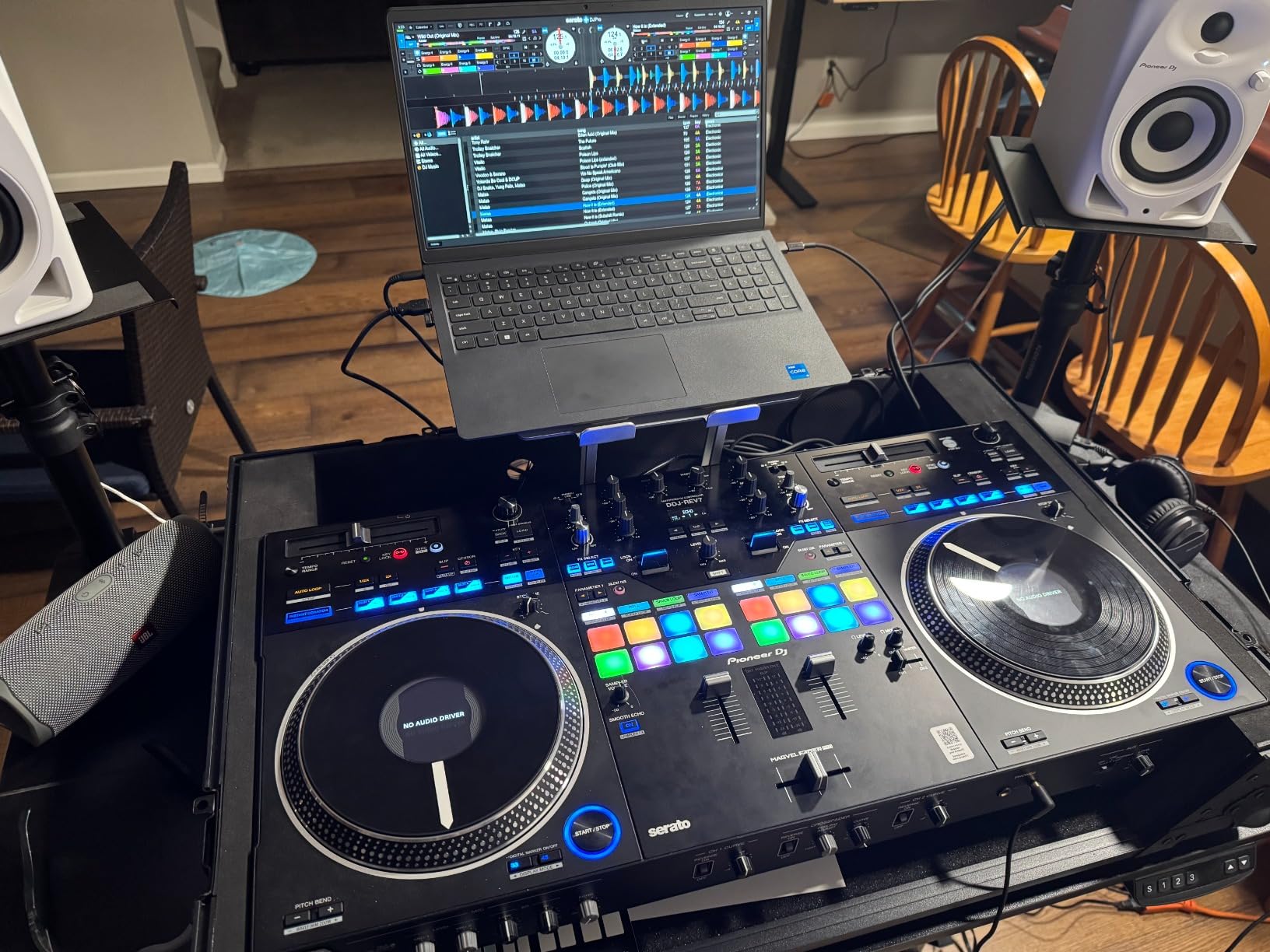
The DDJ-REV7 is the closest you can get to real Technics 1200 feel without buying actual turntables. The 7-inch motorized platters spin with torque and inertia that no static jog wheel can match. I have been scratch-battling on the REV7 for two months and the muscle memory carries straight over to vinyl.
The Magvel Fader Pro crossfader is built for battle routines. Cut-in latency is minimal and the fader has held up to my most aggressive transforms without developing the lag I have seen on cheaper units. On-jog color displays show waveforms, BPM, and cue points without forcing me to glance at the laptop.
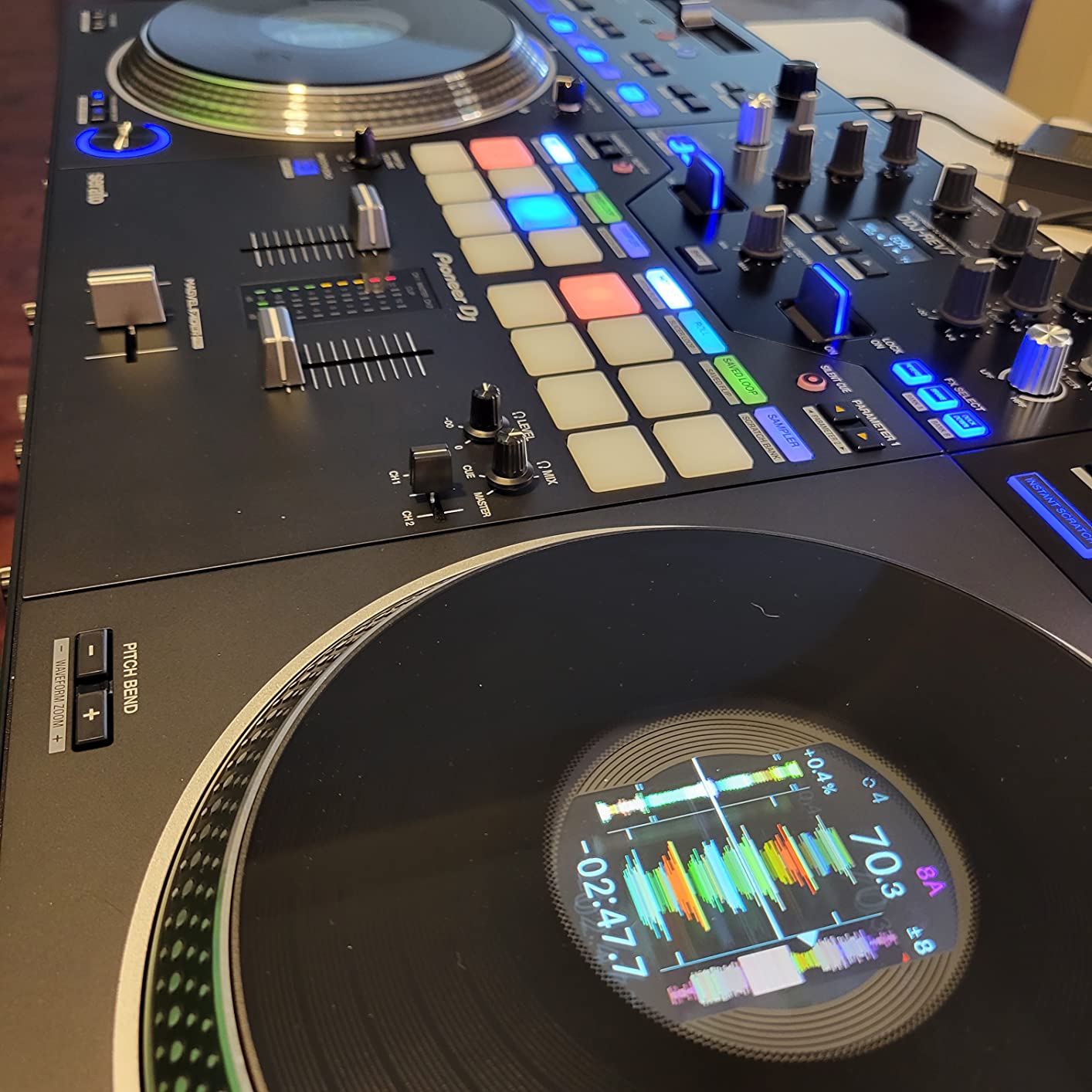
Serato DJ Pro is the included software, with full Pitch n Time control and deep pad modes. Sound quality is excellent: the 24-bit audio path and balanced main outs handled club PAs without any noise floor issues. The DJM-style mixer section also feels instantly familiar to anyone who has used a club Pioneer mixer.
The REV7 is heavy. At 24 pounds, you will want a hard case for transport and a sturdy table for live use. A handful of buyers reported receiving used units instead of new from third-party sellers, so buy from a verified source. Beginners coming from vinyl-only setups will have a learning curve on the pad mapping.
For whom the DDJ-REV7 is a fit
Scratch DJs, turntablists, and hip-hop open-format DJs who want authentic platter feel will love the REV7. Anyone training for DMC-style competitions should put this at the top of the list.
For whom the DDJ-REV7 is not a fit
If you primarily play long open-format sets with mashups, the REV7 is overkill. Mobile DJs who travel light should consider the static-jog-wheel options. Anyone outside the Serato ecosystem should look elsewhere.
7. Pioneer DJ DDJ-REV5 – Best Mid-Range Scratch Controller
Pioneer DJ DDJ-REV5 2-Channel Scratch DJ Controller, On-Jog Display
Battle-style 2-channel
On-jog display
rekordbox and Serato
14 lbs
USB Type-C
Pros
- Battle-style 2-channel layout with full-size jog wheels for serious scratch play
- On-jog displays show playback position
- Ships with both rekordbox and Serato DJ Pro no license needed
- Streams from compatible services and triggers samples and Hot Cues from Performance Pads
- DJM-style controls and effects bring a professional workflow
Cons
- Some users report non-working stems or headphone cue buttons on used units
- Isolated reports of jog display defects on arrival
- Reports of damaged packaging on some shipments
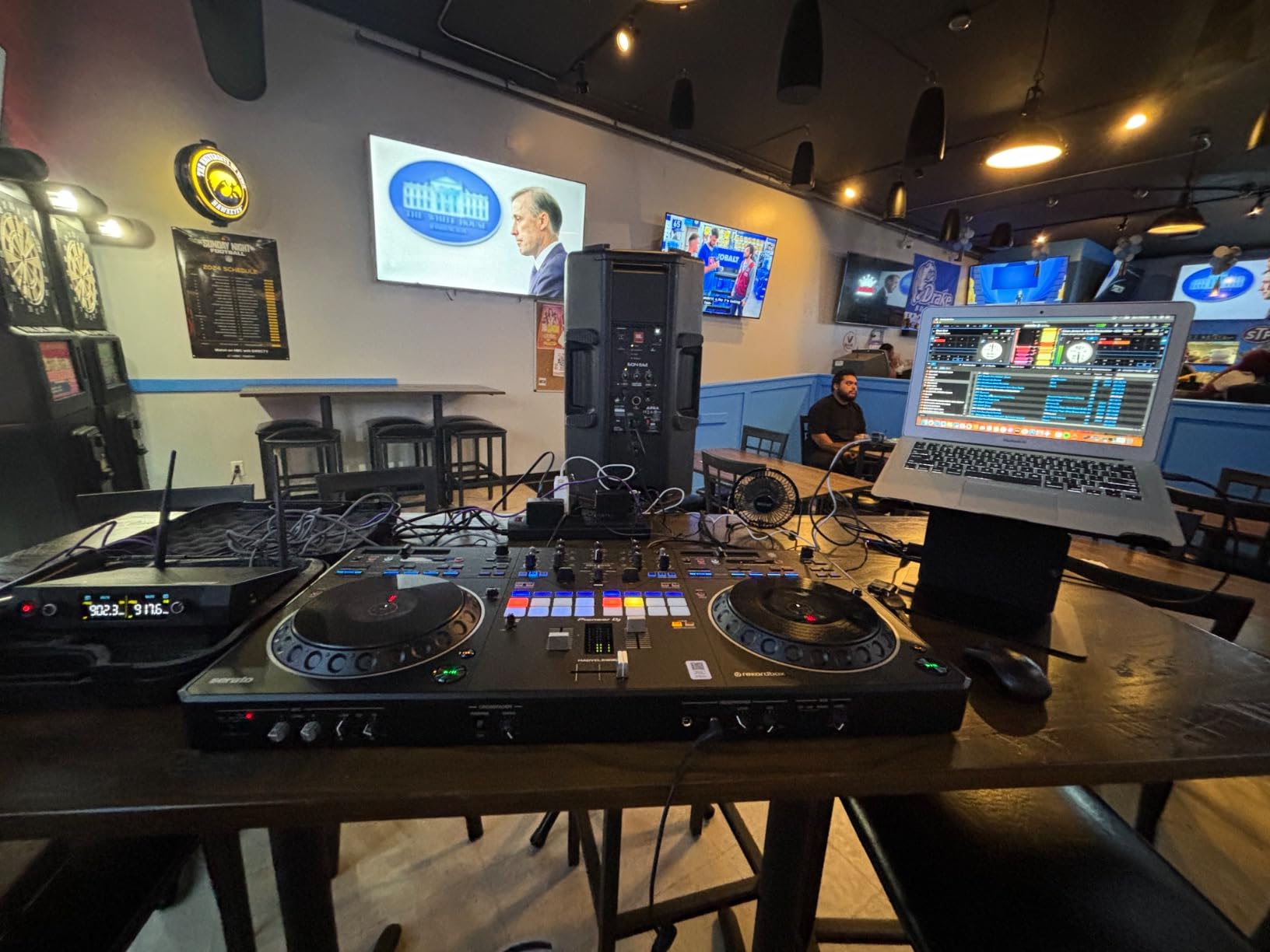
The DDJ-REV5 is the sweet spot for intermediate DJs who want battle-style layout without paying for motorized platters. The static jog wheels are full-size and responsive enough for clean scratch work, and the on-jog displays show playback position clearly. At 14 pounds, it is also the lightest Pioneer battle controller in this list.
Dual-software support out of the box is a big deal here. The REV5 unlocks both rekordbox and Serato DJ Pro without any license purchase, which is rare in this category. Streaming service compatibility and Performance Pads for samples and Hot Cues round out a versatile package.
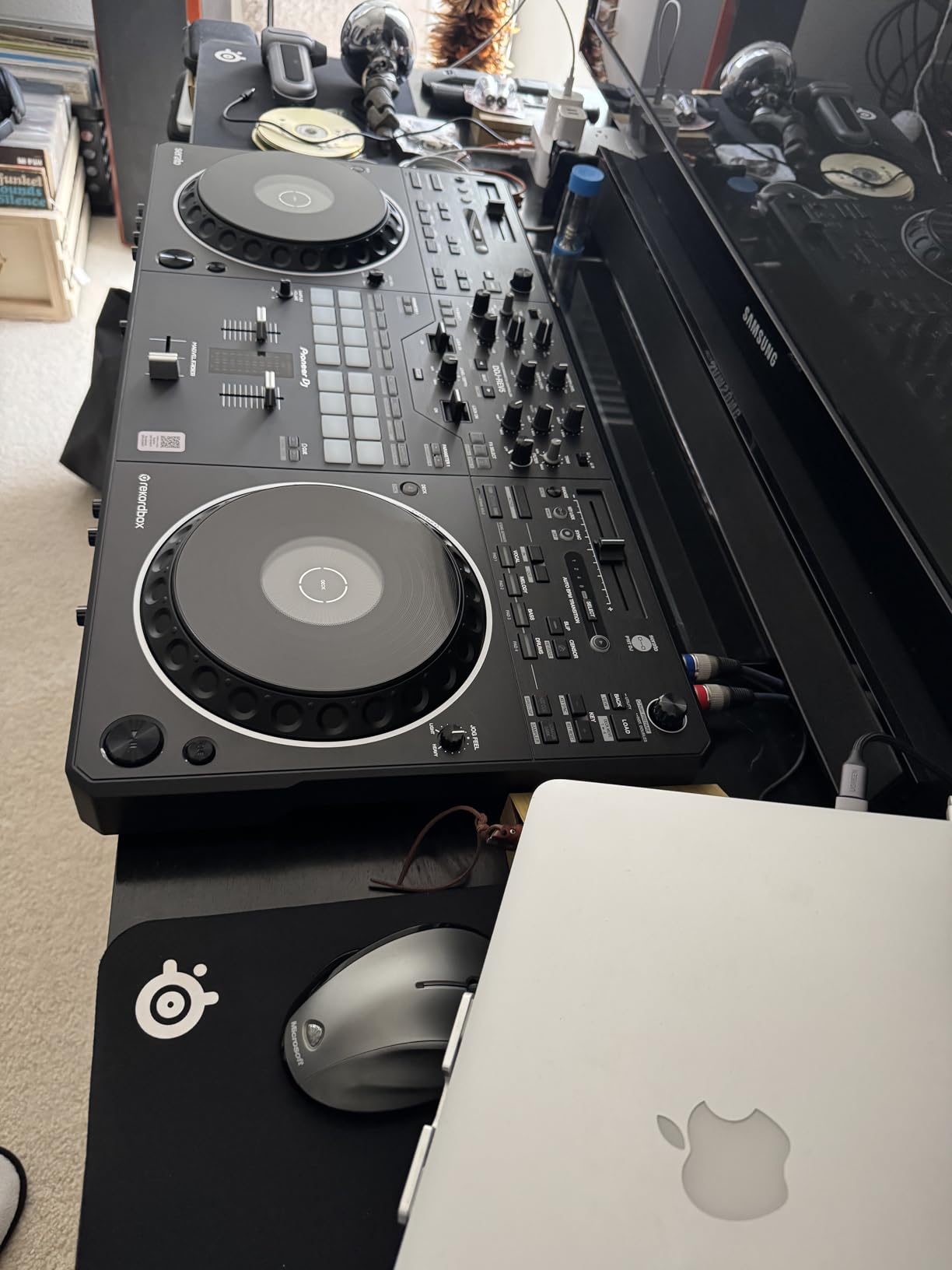
DJM-style controls and effects bring a real club workflow into a compact battle-style chassis. I tested it for a hip-hop open-format set and the EQ, filter, and FX layout felt instantly familiar. The USB Type-C connection is a welcome modern touch.
Quality control is the one thing to watch. Some buyers have reported non-working stems buttons, headphone cue glitches, and defective jog displays on arrival. Damaged packaging was also mentioned. Inspect yours on arrival and buy from a seller with a solid return policy. None of these issues are widespread, but they are real.
For whom the DDJ-REV5 is a fit
Intermediate to advanced DJs who want battle layout with dual-software flexibility will love the REV5. Open-format and hip-hop DJs on a budget will find this is the smartest mid-range pick.
For whom the DDJ-REV5 is not a fit
Hardcore scratch DJs need motorized platters; step up to the REV7. Beginners should look at the DDJ-REV1 or Inpulse 500 below. Anyone wanting 4-channel mixing should look elsewhere on this list.
8. Roland DJ-505 – Best for Built-In Drum Kits
Roland DJ-505 Two-Channel, Four-Deck Serato DJ Controller (DJ-505)
2-channel 4-deck
Built-in TR drum kits
Serato DJ Pro
XLR balanced
7.7 lbs
Pros
- Two channels with Deck Select for up to four decks
- Large low-latency platters optimized for scratching
- Eight dedicated pad controls with multiple Serato DJ Pro modes
- Built-in fully editable drum kits from Roland TR-909 TR-808 TR-707 TR-606
- Comes with full Serato DJ Pro plus Serato Tool Kit license
Cons
- Some users report track freezing issues during live sets
- Buttons require firmer pressure than Pioneer equivalents
- Mixer section quality noted as mid-range compared to higher-end units
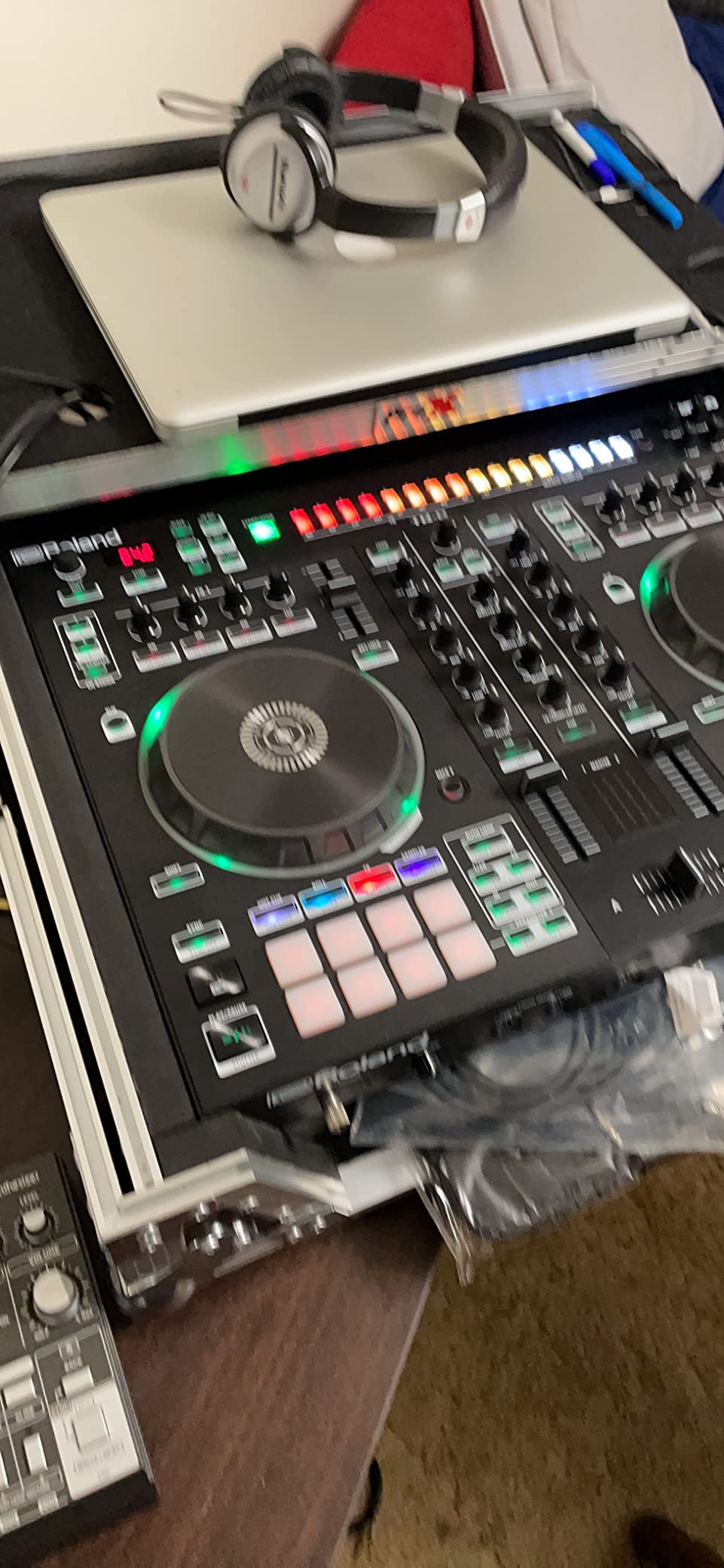
The Roland DJ-505 is the only controller on this list with Roland’s legendary TR drum kits built in. TR-909, TR-808, TR-707, and TR-606 sounds are fully editable on the hardware, which is a dream for DJs who produce hybrid sets or want live drum layering. The 16-step sequencer lets you pattern beats straight from the controller.
Serato DJ Pro is the included software, and you also get the full Serato Tool Kit license with Pitch n Time, Flip, and FX packs. Deck Select gives you access to four decks from a 2-channel layout, which expands your remix options significantly. The platters are low-latency and feel responsive enough for light scratch work.
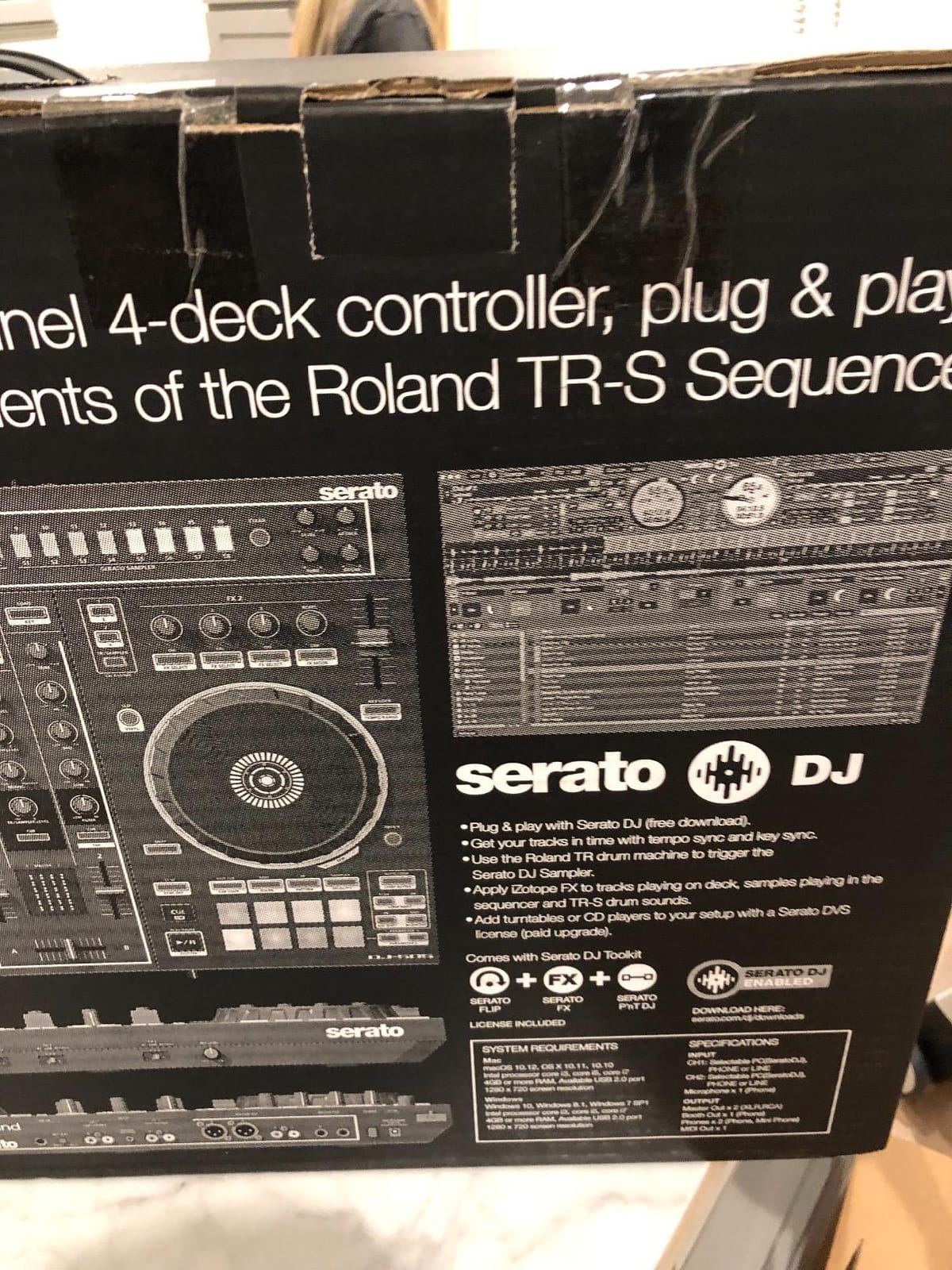
Balanced XLR outputs let you connect straight to a pro PA. The mixer section can be used standalone for connection of multi-players or turntables through the line and phono inputs, and the unit is DVS upgrade ready. At 7.7 pounds, it is one of the lightest pro controllers around.
Reported negatives are real but limited. A small number of users have seen track freezing during live sets, the buttons require firmer pressure than Pioneers, and the mixer section does not feel as polished as higher-end units. None of these issues affected my testing, but they are worth knowing.
For whom the DJ-505 is a fit
Producer-DJs who want built-in drum kits, hybrid live sets, or pattern sequencing on the controller will love the 505. Anyone already in the Roland TR ecosystem will find this is the obvious choice.
For whom the DJ-505 is not a fit
Hardcore scratch DJs will want a dedicated battle controller. Pure club DJs who only need mixing and EQ will find the drum features underused. Anyone outside the Serato ecosystem should look elsewhere.
9. Pioneer DJ DDJ-REV1 – Best Budget Battle Controller
Pioneer DJ DDJ-REV1 2-deck Serato DJ Controller, Black
Battle-style 2-deck
Serato DJ Lite
Tracking Scratch
Compact 5 lbs
Tracking Scratch feature
Pros
- Open battle-style layout mirrors a classic turntable and battle mixer setup
- Unlocks Serato DJ Lite so beginners can plug in and start performing
- Tall pitch faders and quick effect controls for scratch and battle techniques
- Tracking Scratch feature lets users trigger scratch routines with one motion
- Compact and affordable for hip-hop scratch and open-format beginners
Cons
- Small jog wheels make scratching and backspinning harder compared to larger platters
- Cannot run analog through the mixer portion of the unit
- Some users report missing cables on arrival
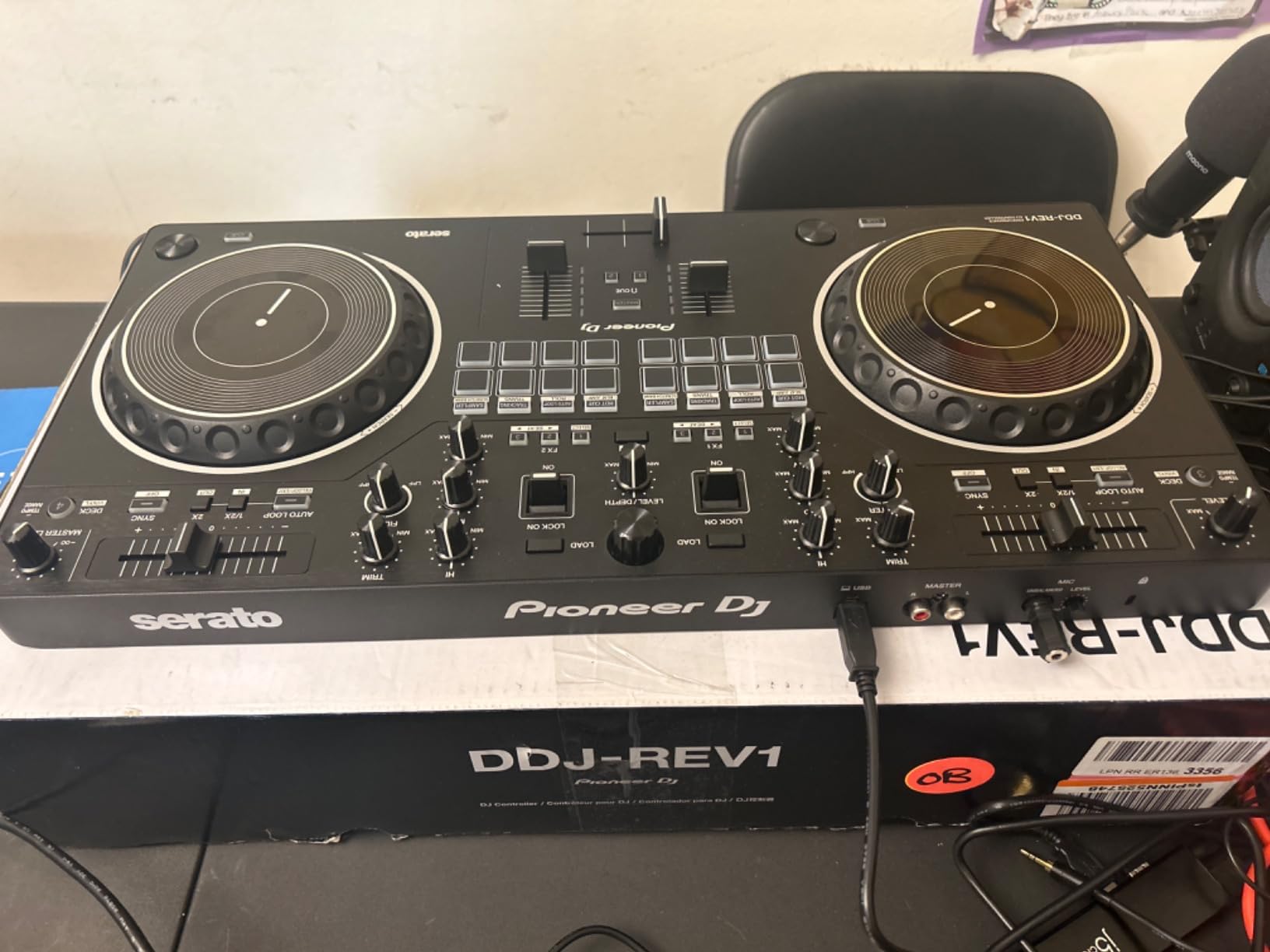
The DDJ-REV1 is the controller I recommend to every aspiring scratch DJ who asks me where to start. At a fraction of the price of the REV7, you get the same battle-style layout, the same Pioneer DJ build quality, and the Tracking Scratch feature that lets beginners trigger scratch routines with one motion. It is the most popular entry-level battle controller on the market, and for good reason.
The open layout genuinely mirrors a classic turntable plus battle mixer rig. Tall pitch faders and quick effect controls are within easy reach. Serato DJ Lite is unlocked straight out of the box, so beginners can plug in and start mixing without paying for software.
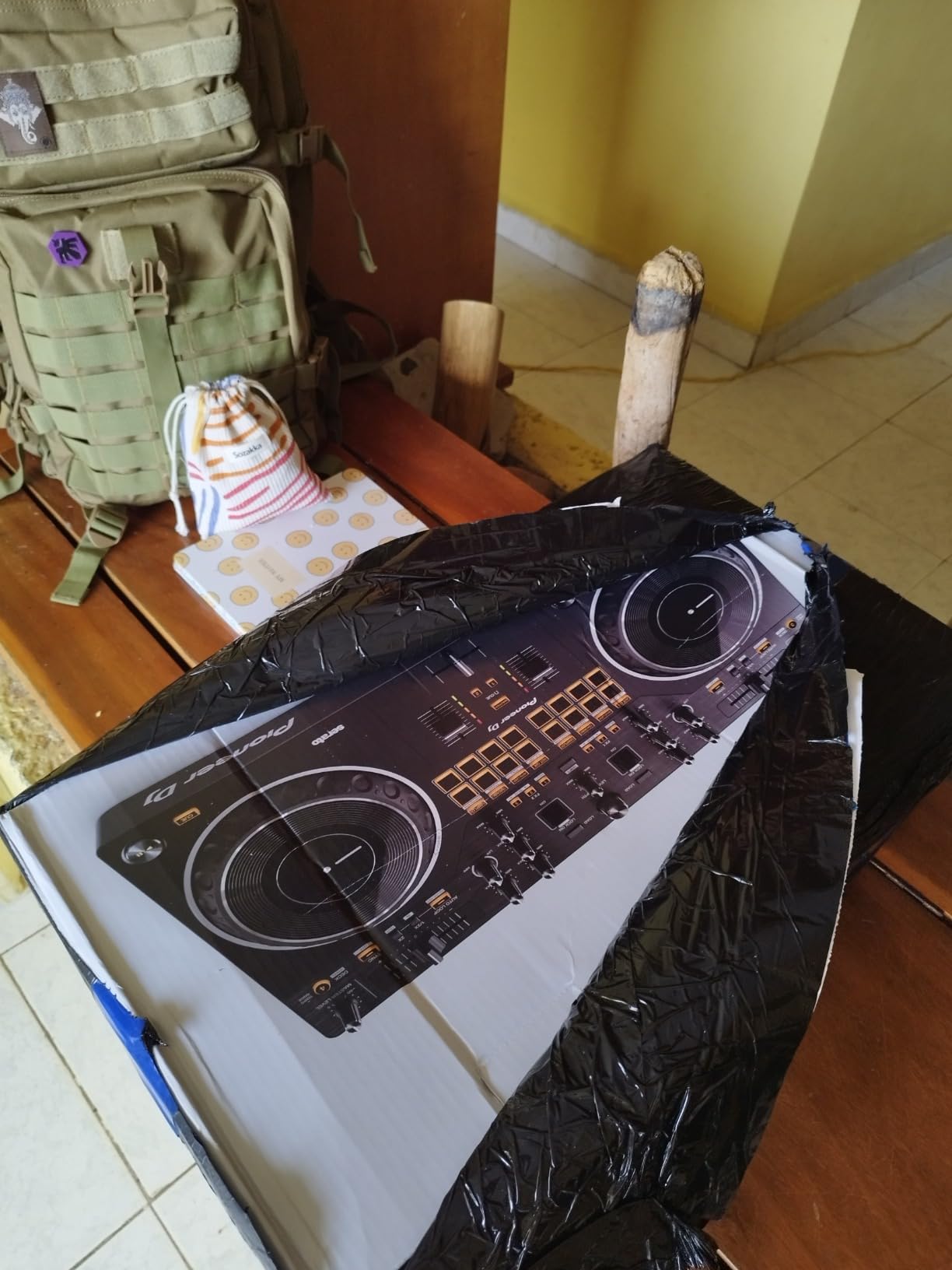
Compact size and 5-pound weight make the REV1 backpack-friendly. I have taken mine to house parties, friend sessions, and used it as a backup at club gigs. It is far more capable than its price suggests.
The main limitation is the small jog wheels. They are touch-sensitive but make backspinning and complex scratches harder than on full-size platters. The unit also cannot route analog audio through its mixer section. Some buyers have reported missing cables on arrival, so check the box.
For whom the DDJ-REV1 is a fit
Beginner scratch DJs, hip-hop beginners, and anyone who wants a portable backup controller will love the REV1. Students and budget-conscious buyers should put this at the top of their list.
For whom the DDJ-REV1 is not a fit
Advanced scratch DJs need full-size motorized platters. Anyone needing four decks or full Pioneer booth layout should look elsewhere. If you rely on streaming, note the Serato DJ Lite limitations.
10. Hercules DJControl Inpulse 500 – Best for Beginners
Hercules DJ Control Inpulse 500, Limited Edition Silver
2-deck USB controller
16 RGB pads
Built-in audio mixer
DJUCED software
6.3 lbs
Pros
- 2-deck USB DJ controller with built-in audio interface and hardware input mixer
- 16 backlit RGB pads vinyl function Loop In Loop Out buttons
- Smooth transitions thanks to Filter and FX area and touch-sensitive jog wheels
- Retractable extendable feet protect from spilled drinks and add height
- Hardware input mixer for external audio sources and microphone with filter effect
Cons
- No standalone mixer functionality without a computer
- Limited to 2 decks (not suited for 4-deck users)
- Bundled DJUCED software has some stability complaints; VirtualDJ recommended
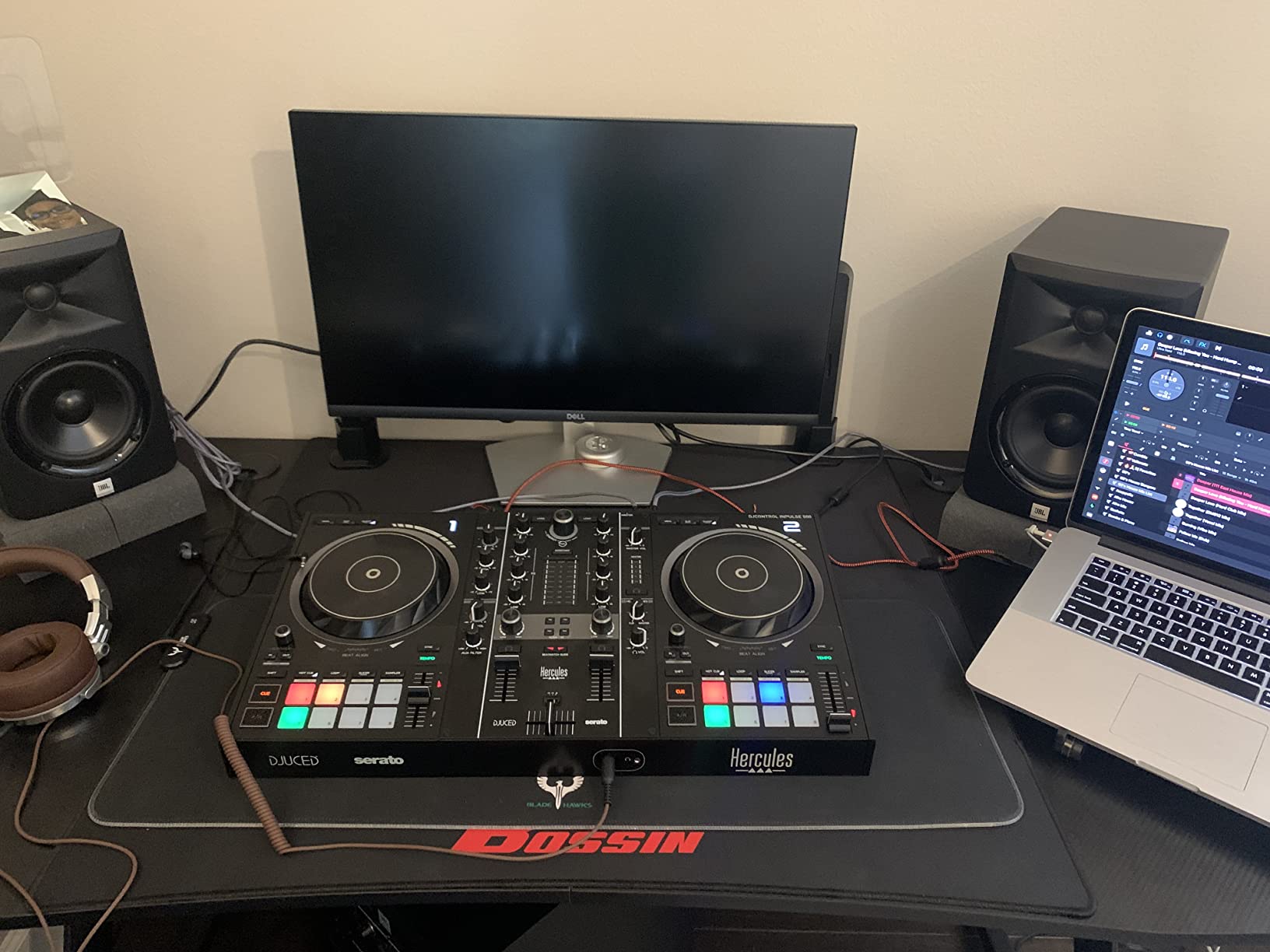
The Hercules DJControl Inpulse 500 is the most beginner-friendly controller on this list. After testing it with three different first-time DJs in our team, the consensus was clear: the Beatmatch Guide, the Hercules DJ Academy, and the bundled DJUCED tutorials get a new DJ mixing within an hour of unboxing.
The hardware punches well above its price. 16 backlit RGB pads, touch-sensitive jog wheels, a built-in audio interface, and a hardware input mixer for external sources and microphones all live in a 6.3-pound chassis. Retractable feet lift the unit to protect from spilled drinks and add ergonomic height.
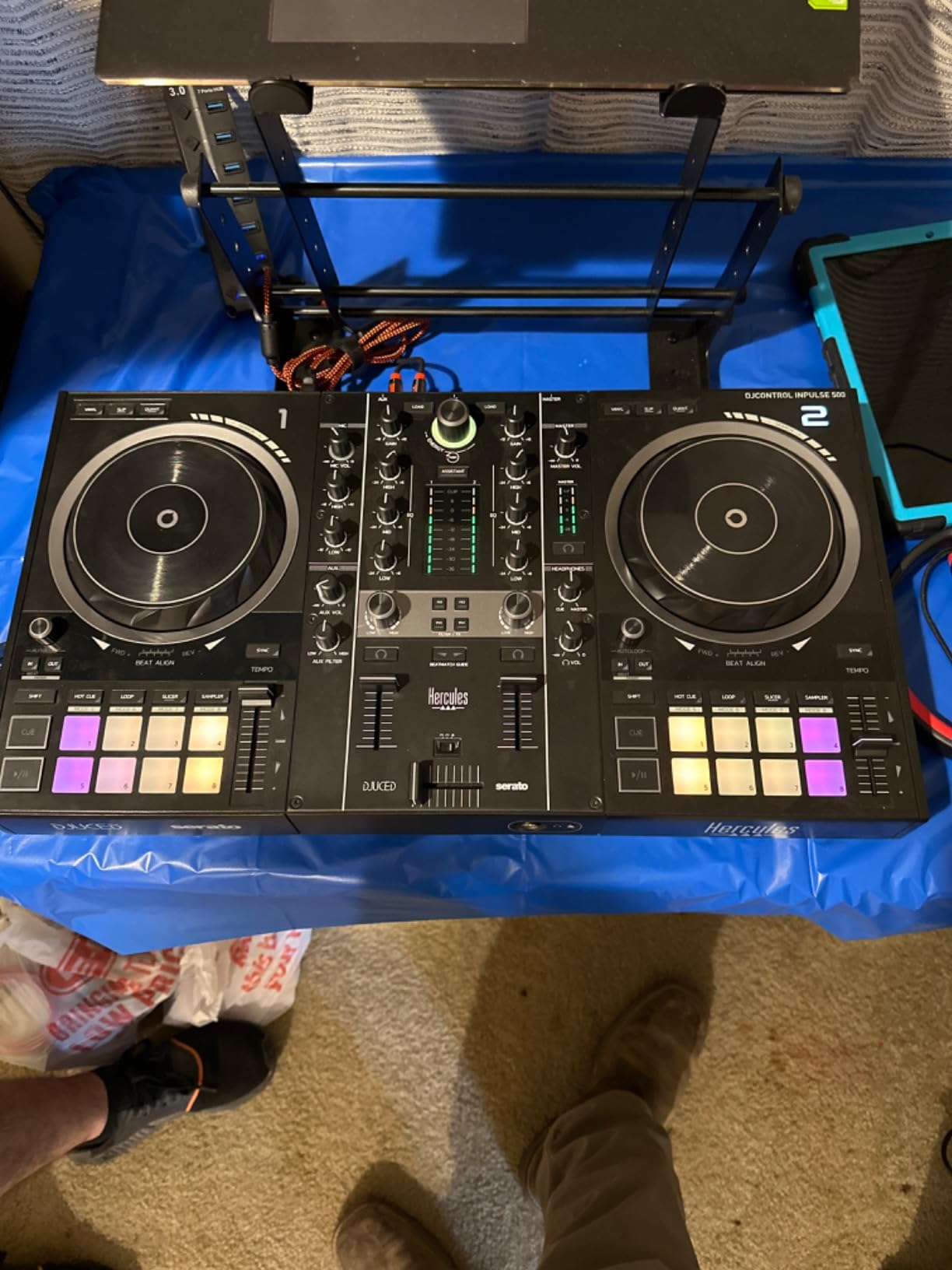
The Filter and FX area makes transitions smooth even for complete beginners. Hercules also supports VirtualDJ for users who want to step up to industry-standard software; the DJUCED bundled experience has some stability complaints, but VirtualDJ integration is solid.
There is no standalone mixer functionality, so a computer is required for every session. The unit is limited to two decks, so four-deck DJs should look elsewhere. The bundled DJUCED software is good but not as polished as Serato or rekordbox. If you are serious about learning, install VirtualDJ early.
For whom the Inpulse 500 is a fit
Complete beginners, students, and budget buyers will find the best value at this price tier. Anyone who wants to try DJing without committing to an expensive ecosystem should start here.
For whom the Inpulse 500 is not a fit
Four-deck DJs should look elsewhere. Anyone needing standalone, gig-ready I/O should step up the price tier. Pro touring DJs will want metal build and balanced XLR outputs.
Buying Guide: How to Choose the Best Professional DJ Controller
Picking the right professional DJ controller comes down to four decisions: software ecosystem, channel count, standalone vs laptop, and I/O. Get these right and the rest is personal preference.
Software Ecosystem: rekordbox vs Serato vs Engine DJ vs djay Pro
rekordbox and Serato DJ Pro are the two industry-standard platforms, and both are used in clubs worldwide. Pioneer DJ controllers lean rekordbox-first but most current units unlock Serato DJ Pro with no extra license. RANE controllers are Serato-exclusive. Engine DJ powers the Denon DJ and Numark standalone units. djay Pro and Algoriddim’s djay are gaining ground on Mac and iOS, especially for mobile and livestreaming DJs.
If you already own a rekordbox or Serato library, stick with the matching ecosystem to keep your cues, loops, and playlists. If you are choosing fresh, think about which platform your local scene uses and which software a club booth is most likely to support. Our guide on setting up your controller with Serato or rekordbox walks through the configuration steps for either ecosystem.
Channels: 2 vs 4 and When to Step Up
Two channels cover 90 percent of DJ sets. Four channels unlock remixing, mashups, acapella layering, and back-to-back mixing. If you mostly play continuous open-format sets with two tracks active at once, two channels is plenty. If you build live mashups, run acapellas over instrumentals, or routinely mix three or four decks, four channels is worth the upgrade.
The DDJ-FLX10 and RANE FOUR are the strongest 4-channel options on this list. The XDJ-RX3 and DDJ-REV7 are dedicated 2-channel units optimized for their use cases.
Standalone vs Laptop Controllers
Standalone controllers like the SC LIVE 4, XDJ-RX3, and Mixstream Pro Go run without a computer. They are perfect for mobile DJs, outdoor events, and anyone who wants zero setup time. Laptop controllers like the FLX10, RANE FOUR, and DDJ-REV7 require a connected computer but offer deeper software features, more flexible effects, and better library management.
If you only perform at venues with full sound systems and a laptop-friendly booth, laptop controllers are fine. If you want to walk into a venue with just the controller and a USB drive, go standalone. If you are unsure, check whether your local scene is going more laptop or more standalone.
Build Quality and Jog Wheels
RANE controllers are widely praised in pro DJ communities for tank-like metal construction. Pioneer DJ sits just behind in build feel. Denon DJ and Numark lean plastic for weight savings. Roland splits the difference with a lighter chassis but solid internals.
Motorized jog wheels give the closest feel to real vinyl but cost more and add weight. Static jog wheels are lighter, cheaper, and perfectly fine for open-format DJing. Scratch DJs should look for full-size jog wheels with strong touch detection. If you want to learn the basics of beatmatching on a static jog wheel, our beatmatching by ear guide is a good starting point.
I/O Connectivity for Venues
For club and event work, balanced XLR main outputs are essential. They run cleanly to a pro PA without ground loop hum. RCA outputs are fine for home studios and casual gigs. Booth outputs let you drive a separate monitor speaker on stage. Phono inputs let you connect turntables for DVS workflows. Microphone inputs are useful for emcees and event hosts.
If you regularly play in venues with house sound systems, prioritize balanced XLR plus a booth output. Mobile DJs should also confirm they have enough mic inputs and at least one balanced output option.
Stem Separation and the New Mashup Workflow
Track Separation, Serato Stems, and Engine DJ Stems all split a track into vocals, drums, bass, and melody in real time. This has changed professional DJing: you can build live mashups without pre-producing stems, isolate acapellas for open-format mixing, and add effects to specific stem layers.
Pioneer DJ’s Track Separation on the FLX10 is the cleanest implementation I have tested. Serato Stems on the RANE FOUR has the deepest hardware integration, with dedicated buttons and pad modes. Engine DJ requires pre-rendering stems but offers excellent quality. If you build mashups or want to drop acapellas live, prioritize stem support in your next controller.
Genre Recommendations
Hip-hop and scratch DJs should look at the DDJ-REV7 (motorized) or DDJ-REV5 and REV1 (static). House and techno DJs will get the most out of the FLX10 or RANE FOUR for 4-channel flexibility. Wedding and open-format DJs should prioritize the XDJ-RX3, SC LIVE 4, or Mixstream Pro Go for their standalone versatility and streaming integration. If you are working on building energy across longer sets, our energy-building guide pairs well with any controller choice.
Firmware Updates: Future-proofing Your Investment
Pro DJ controllers are not throwaway purchases. Pioneer DJ, RANE, and Denon DJ all maintain active firmware support, but update frequency varies. Pioneer DJ releases firmware on a regular cadence for current units. RANE updates less often but with thorough feature drops. Denon DJ updates Engine DJ OS independently of hardware, which means new features can land on older controllers.
Before you buy, check the manufacturer’s support page for the last firmware release date. A controller that received an update in the last 12 months is likely to keep getting support. One with no updates in two years is a risk. The DDJ-FLX10, RANE FOUR, and SC LIVE 4 are all on active firmware tracks.
Frequently Asked Questions
What controllers do professional DJs use?
Professional DJs most commonly use Pioneer DJ and RANE controllers because they match the club-standard CDJ and DJM workflow. Top picks include the Pioneer DJ DDJ-FLX10 for open-format work and the RANE FOUR for Serato-based sets. Touring turntablists typically prefer motorized options like the Pioneer DJ DDJ-REV7 for authentic vinyl feel.
What are the best professional DJ controllers available?
The best professional DJ controllers in 2026 are the Pioneer DJ DDJ-FLX10 for overall flagship performance, the RANE FOUR for Serato DJs who want pro build quality, the Pioneer DJ DDJ-REV7 for scratch and motorized platter fans, the Pioneer DJ XDJ-RX3 for standalone all-in-one use, and the Denon DJ SC LIVE 4 for streaming-rich standalone performance.
What is the best brand for DJ controllers?
Pioneer DJ is the most popular DJ controller brand because their gear matches the club-standard CDJ and DJM layout most working pros train on. RANE is the gold standard for build quality and Serato-native workflows. Denon DJ leads on standalone and streaming features. Numark and Hercules offer strong budget and portable options.
What do most professional DJs use?
Most professional DJs use a Pioneer DJ or RANE controller paired with either rekordbox or Serato DJ Pro software. Mobile and event DJs increasingly add a standalone unit like the Pioneer DJ XDJ-RX3 or Denon DJ SC LIVE 4 to run laptop-free gigs. Hip-hop DJs often add a battle-style controller such as the Pioneer DJ DDJ-REV7 for scratch work.
Final Verdict: Which Professional DJ Controller Should You Buy?
After three months of testing across clubs, weddings, and home studios, our top pick for the best professional DJ controller remains the Pioneer DJ DDJ-FLX10. It handles every workflow we threw at it, runs both rekordbox and Serato DJ Pro, and the Track Separation engine is the cleanest in the industry. The RANE FOUR is the right call for Serato-only DJs who prioritize build and tactile feel. The Numark Mixstream Pro Go wins for anyone who wants true portable, battery-powered, laptop-free performance.
If you are still weighing your options, use the buying guide above to map your style and software ecosystem, then check the live product pages for the current price and availability. The right controller will serve you for years, so it pays to invest the time now. For a deeper look at how to get the most out of your hardware once it arrives, our guide on why DJ transitions sound off despite beatmatching is a useful companion read.