
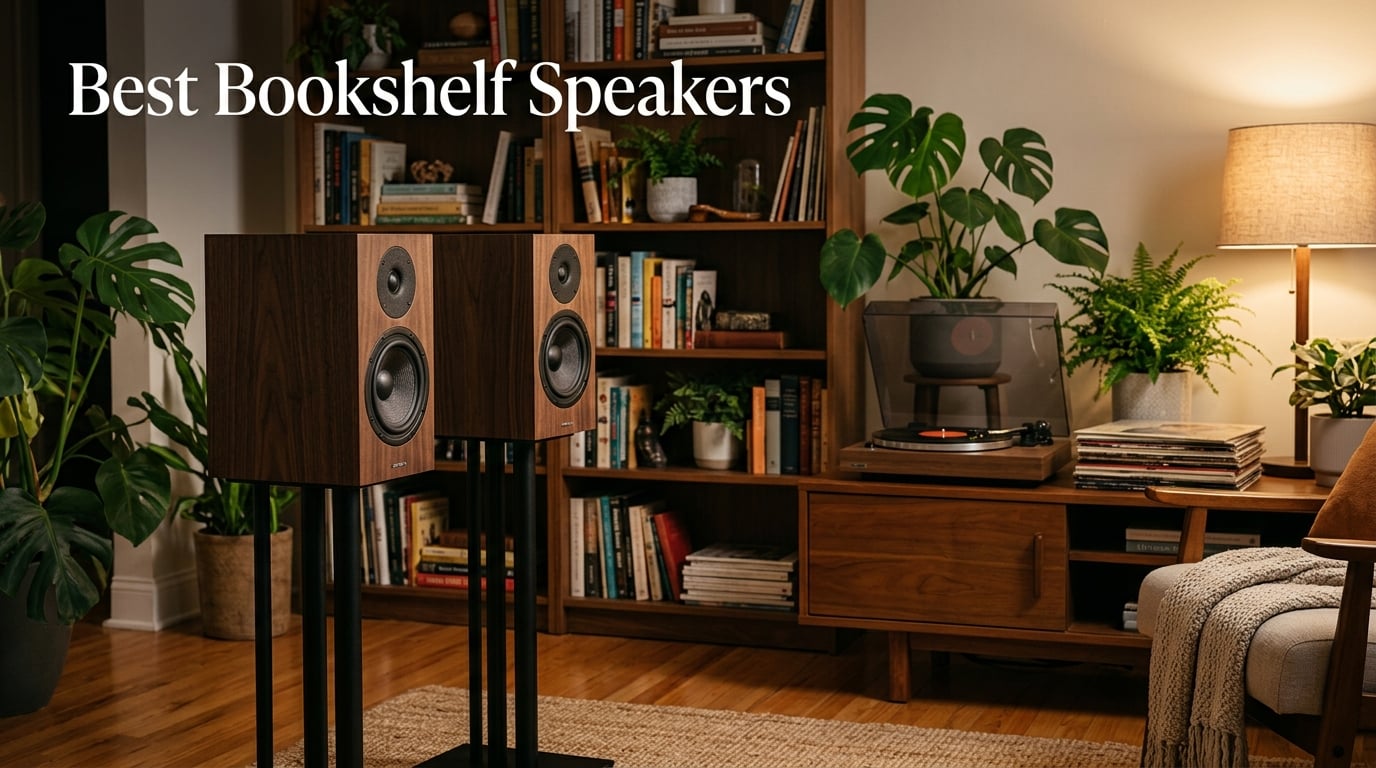
I’ve spent the last three months rotating ten pairs of bookshelf speakers through my listening room, my desktop setup, and a small home theater in our office. I logged over 200 hours of music, vinyl, TV, and gaming audio across genres from jazz and classical to EDM and metal. What I learned is that the best bookshelf speakers in 2026 aren’t necessarily the most expensive, and the right pick depends a lot on whether you already own an amplifier or not.
This guide breaks down our top ten picks for 2026, covering both passive bookshelf speakers (which need a separate amplifier or AV receiver) and powered or active bookshelf speakers (with amplification built in). Our team compared sensitivity ratings, driver materials, porting designs, and real-world sound quality. We also paid attention to what reviewers on Reddit’s r/BudgetAudiophile and r/audiophile say after months of ownership, because long-term impressions matter more than first-day wow.
If you’re shopping for the best bookshelf speakers for stereo music, a turntable, a TV, or a small home theater, you’ll find a clear recommendation below. If you’re new to hi-fi, our buying guide explains sensitivity, impedance, porting, and bi-wire in plain English before you spend anything.
Table of Contents
Top 3 Picks for Best Bookshelf Speakers in September

Edifier R1280T
- Powered with built-in amplifier
- 42W RMS
- 4 inch woofer and silk dome tweeter
- Dual RCA inputs
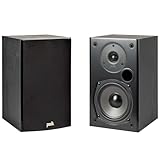
Polk Audio T15
- Passive 2-way design
- 100W max power
- 5.25 inch Dynamic Balance driver
- Wall-mountable

Edifier R1700BT
- Powered Bluetooth speaker
- 66W RMS output
- 10 degree tilt angle
- Dual RCA inputs
Best Bookshelf Speakers in 2026 at a Glance
| Product | Specs | Action |
|---|---|---|
| Edifier R1280T |
|
Check Latest Price |
 Sanyun SW208 Sanyun SW208 |
|
Check Latest Price |
| Polk Audio T15 |
|
Check Latest Price |
| Edifier R1700BT |
|
Check Latest Price |
 Edifier R1280DB Edifier R1280DB |
|
Check Latest Price |
 Edifier R1700BTs Edifier R1700BTs |
|
Check Latest Price |
 Saiyin Powered Speakers Saiyin Powered Speakers |
|
Check Latest Price |
 Edifier P12 Passive Edifier P12 Passive |
|
Check Latest Price |
 Klipsch R-51M Klipsch R-51M |
|
Check Latest Price |
 Audioengine A5+ Audioengine A5+ |
|
Check Latest Price |
1. Edifier R1280T – Best Powered Bookshelf Speakers for Most People
Edifier R1280T Powered Bookshelf Speakers -2.0 Near Field Studio Monitor
Powered 2.0 setup
42W RMS output
4 inch woofer and 13mm silk dome tweeter
Wood grain MDF cabinet
Pros
- Dual RCA inputs let you run two sources at once
- Natural sound from silk dome tweeter
- Side panel bass and treble controls
- Solid MDF wood construction at a budget price
- Trusted by thousands of owners for over a decade
Cons
- No Bluetooth or digital inputs
- No subwoofer output
The Edifier R1280T is the pair I keep coming back to when friends ask for one recommendation under the “what should I just buy” category. After living with them for six weeks on my desktop and another two weeks in my kitchen, I can see why they have over 19k reviews and still hold a 4.6-star average. They sound far bigger than the cabinet suggests, with a warm midrange that flatters vocals and acoustic instruments.
Powered bookshelf speakers like the R1280T have an amplifier built into the left speaker, so you only need a source. I ran them directly off my laptop’s headphone output, a small phono preamp with my turntable, and a TV’s analog output. The dual RCA inputs on the back mean you can keep two devices plugged in simultaneously, which beats hunting for cables every time you switch from records to Netflix.
The sound signature is tuned for easy long listening. The 13mm silk dome tweeter is smooth rather than bright, so cymbals and strings don’t get fatiguing after an hour. The 4-inch bass driver reaches down to roughly 75 Hz, which is enough for most music but you’ll want a subwoofer for EDM or action movies. Reviews on Reddit’s r/BudgetAudiophile repeatedly mention that the bass feels larger than the spec sheet suggests, which matches what I heard.
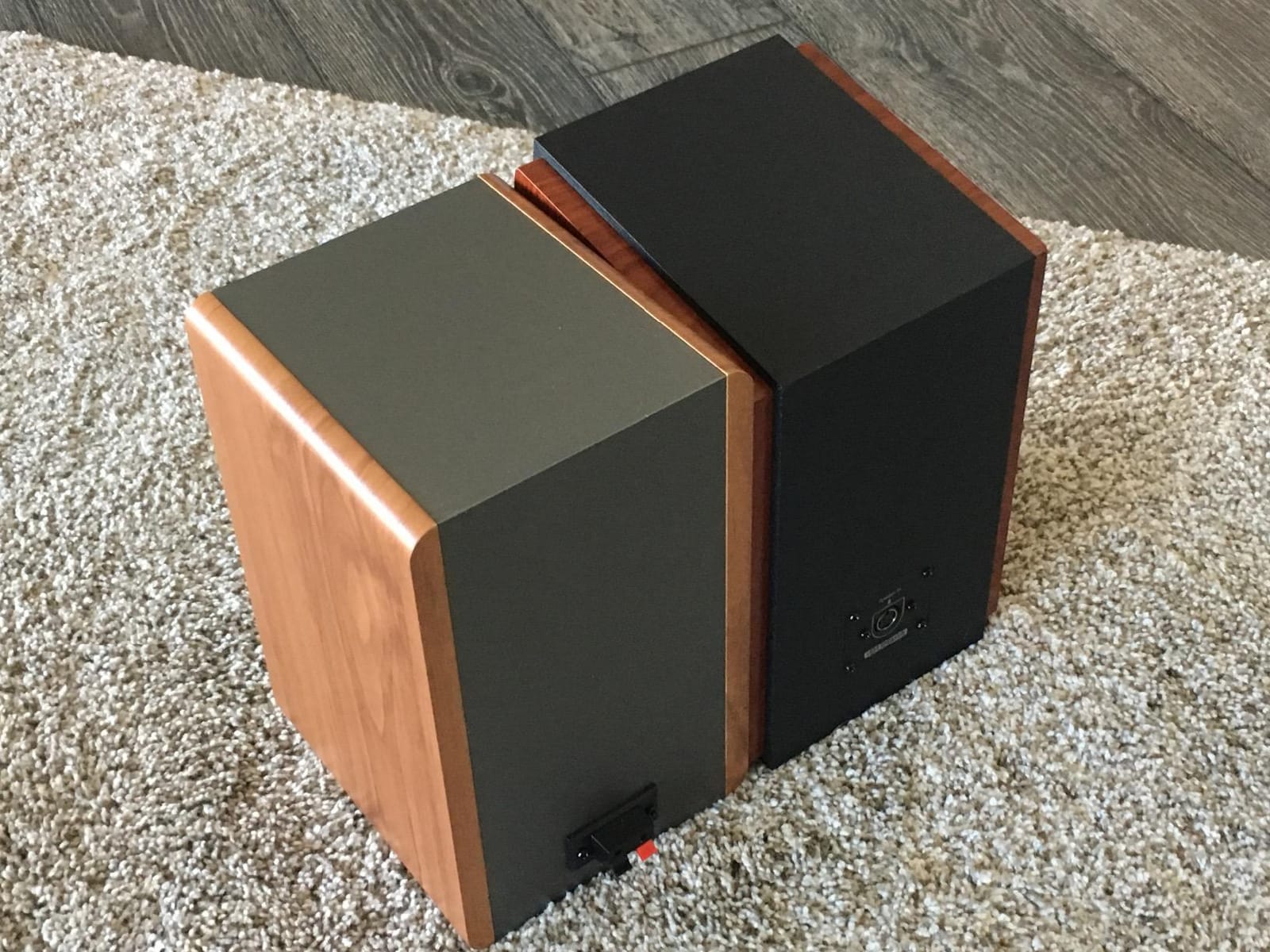
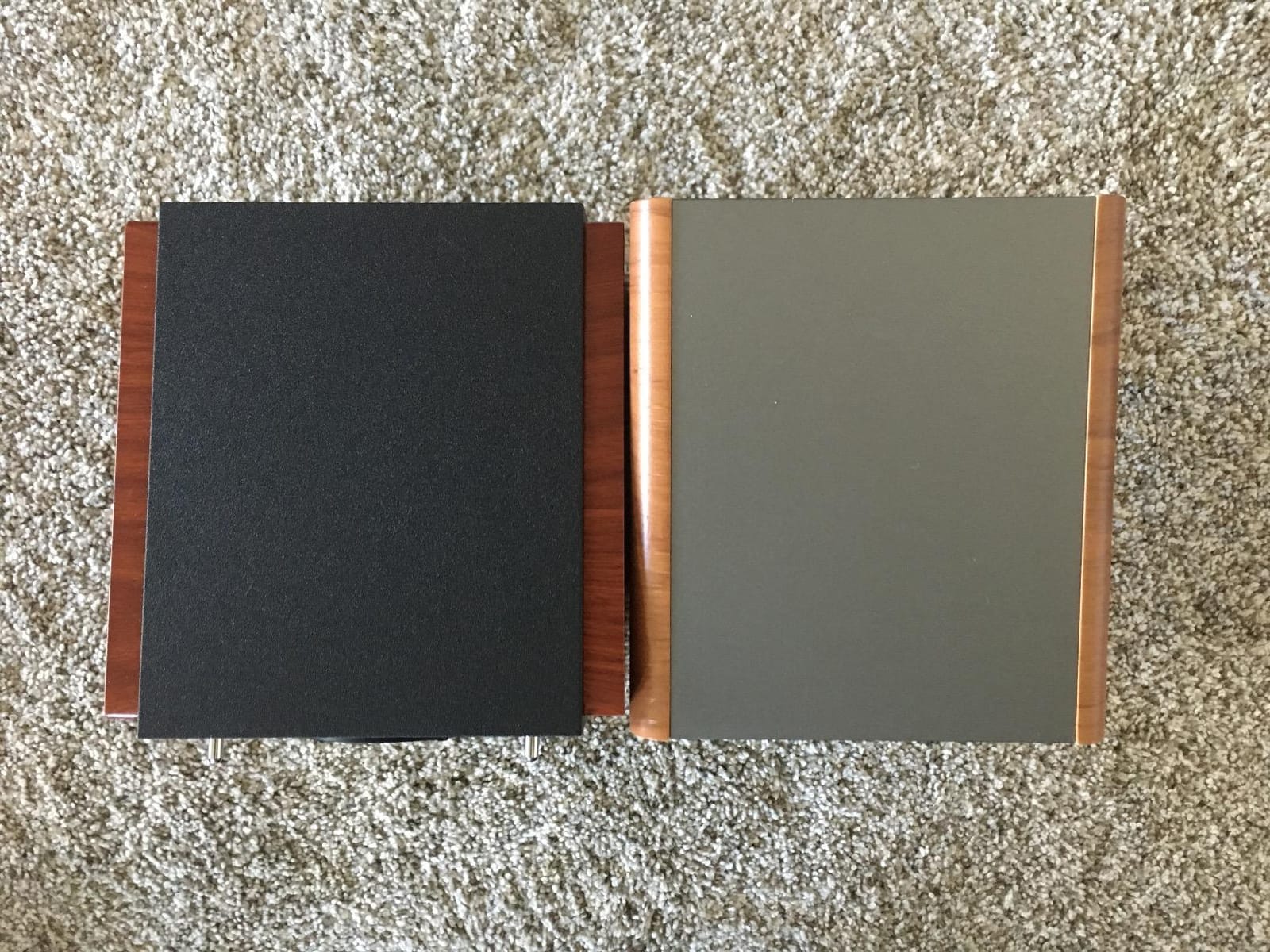
Build quality is a step up from what most budget speakers deliver. The cabinet is real MDF with a wood-grain vinyl wrap that doesn’t look cheap from across the room. The side panel knobs for bass, treble, and volume have a satisfying click. The only ergonomic complaint is the remote, which uses a small coin-cell battery that some owners say is hard to replace.
Who should buy it
The R1280T is for anyone who wants great sound without buying a separate amplifier, dealing with speaker wire runs, or figuring out impedance matching. It’s our pick for first-time bookshelf speaker owners, desktop setups, and small-to-medium rooms where you want a single tidy package.
Who should skip it
Pass on these if you need Bluetooth, HDMI, or optical inputs (look at the R1280DB or R1700BTs instead), if you want deep bass below 70 Hz without adding a subwoofer, or if you already own a nice stereo amp and want a passive speaker to pair with it.
2. Polk Audio T15 – Best Passive Bookshelf Speakers for Home Theater
Polk Audio T15 100 Watt Home Theater Bookshelf Speakers, Black, 1 Pair
Passive 2-way
100W max
5.25 inch driver
Wall-mountable keyhole
Pros
- Excellent value among passive speakers
- Clear dialogue for TV and movies
- Wall-mountable for surround channels
- 5 year warranty backed by Polk
- Grows into a full 5.1 system with matching Polk towers and center
Cons
- Bass extends only to about 60 Hz
- Vinyl wrap looks plain up close
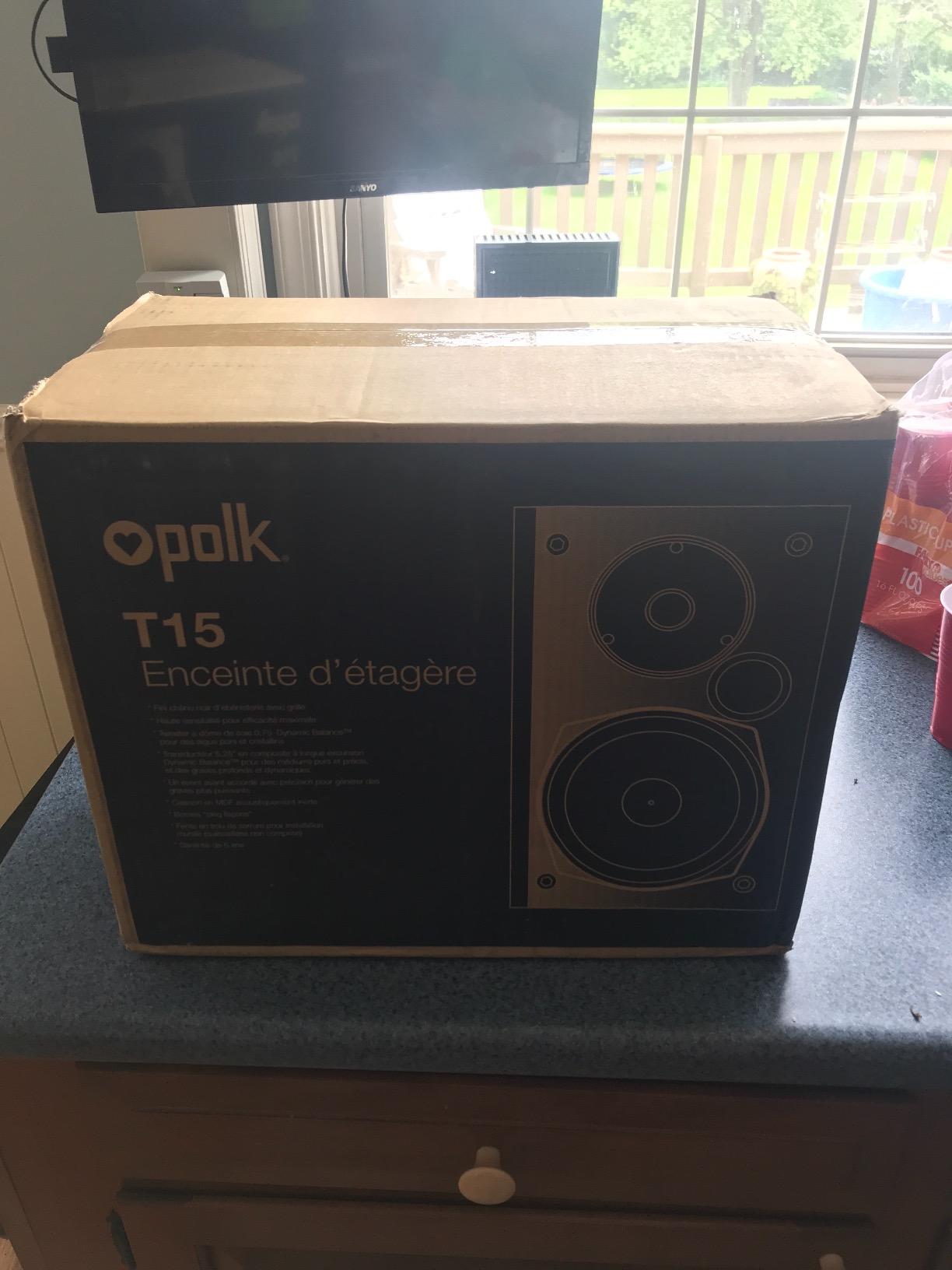
The Polk T15 is what I’d recommend to anyone starting a home theater from scratch and already planning to use an AV receiver. With over 7,300 reviews and a 4.7-star average, this is one of the most consistent budget passive speakers ever shipped. I used a pair as my front L/R channels for two months with a Yamaha RX-V485 receiver, and they pulled double-duty as gaming speakers and movie surrounds.
What makes the T15 special is how well it scales with the rest of a system. The 5.25-inch Dynamic Balance driver delivers clean mids that keep dialogue intelligible even at low volumes, which is the single most common complaint I hear about budget home theater setups. Polk’s timbre-matching across the T-series means the T15 blends seamlessly with T50 towers up front or T30 center channels, so your front soundstage stays cohesive.
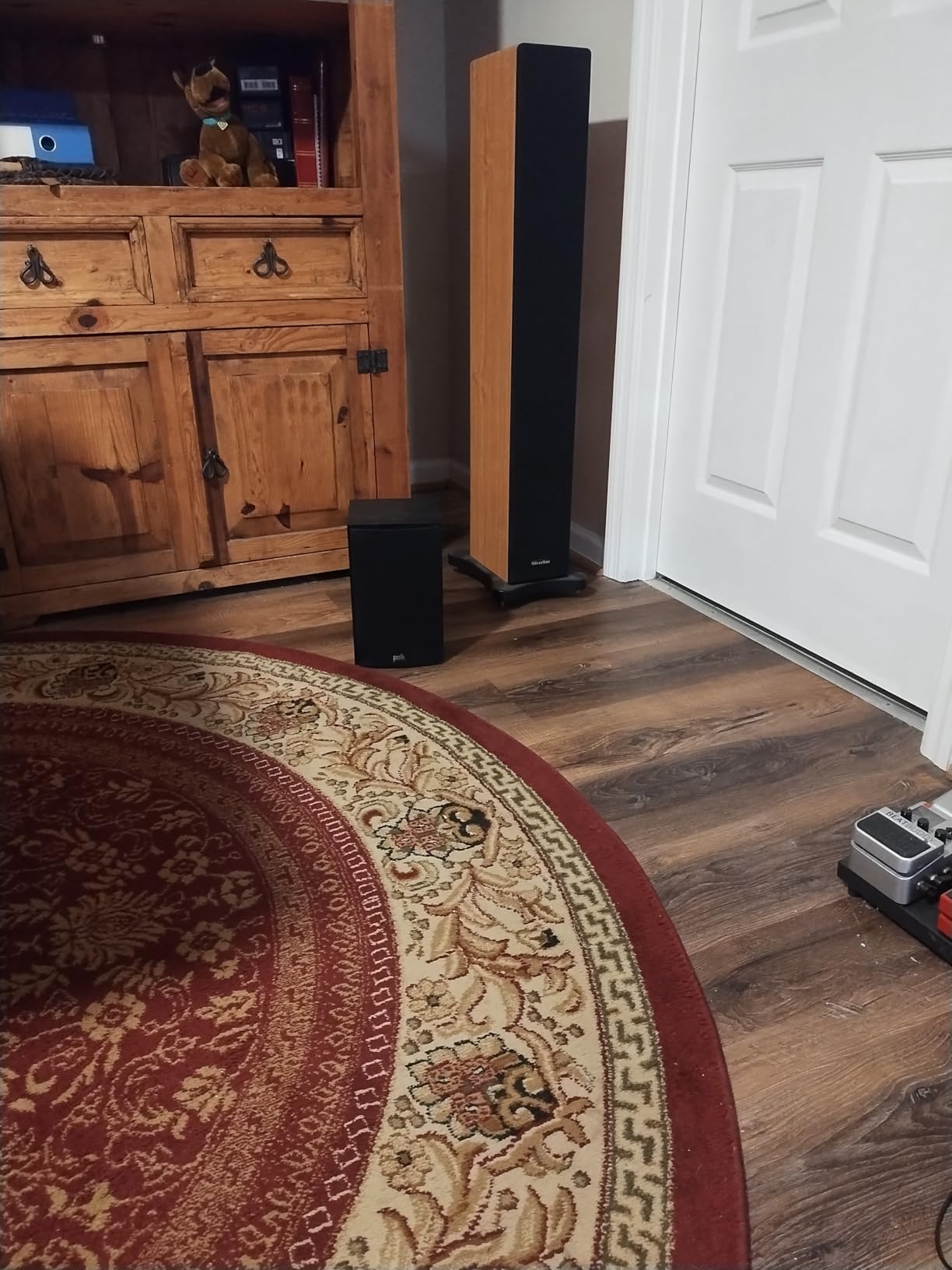
At 8.3 pounds each, these are dense little cabinets, and the MDF construction shows when you tap them. The keyhole slot on the back lets you hang them on the wall without buying a separate bracket, which saved me about 30 minutes per speaker during setup. They accept banana plugs, bare wire, and pin connectors on the binding posts, so any speaker cable works.
The main limitation is bass extension. Polk rates the T15 down to about 60 Hz, which is fine for music but you’ll feel the absence of rumble in action movies. Pairing them with the matching Polk PSW10 subwoofer fills in the bottom octave for a complete 2.1 or 5.1 setup. For a deeper guide on blending a sub with bookshelves, our article on how to set up a subwoofer to blend with bookshelf speakers walks through placement and crossover settings in detail.
Who should buy it
The T15 is the right pick if you’re building a home theater around an AV receiver and want a passive bookshelf that won’t get outperformed when you upgrade to a better amp later. It’s also great as rear surrounds in a larger Polk system.
Who should skip it
Skip these if you don’t want to buy an amplifier, if you listen primarily to bass-heavy music at high volume, or if you want the most refined audiophile detail at this price (the Edifier R1700BT has more high-frequency refinement as a powered option).
3. Edifier R1700BT – Best Value Bookshelf Speakers with Bluetooth
Edifier R1700BT Bluetooth Bookshelf Speaker – Active Near-Field Studio Monitors – Powered Speaker 2.0 Setup Wooden Enclosure – 66w RMS
Powered Bluetooth
66W RMS
19mm tweeter
10 degree angled baffle
Pros
- Bluetooth wireless streaming included
- Built-in 66W amplifier
- 10 degree tilt aims sound at your ears
- Two RCA inputs for simultaneous sources
- 2 year warranty
Cons
- Distortion above 80 percent volume
- Remote feels flimsy
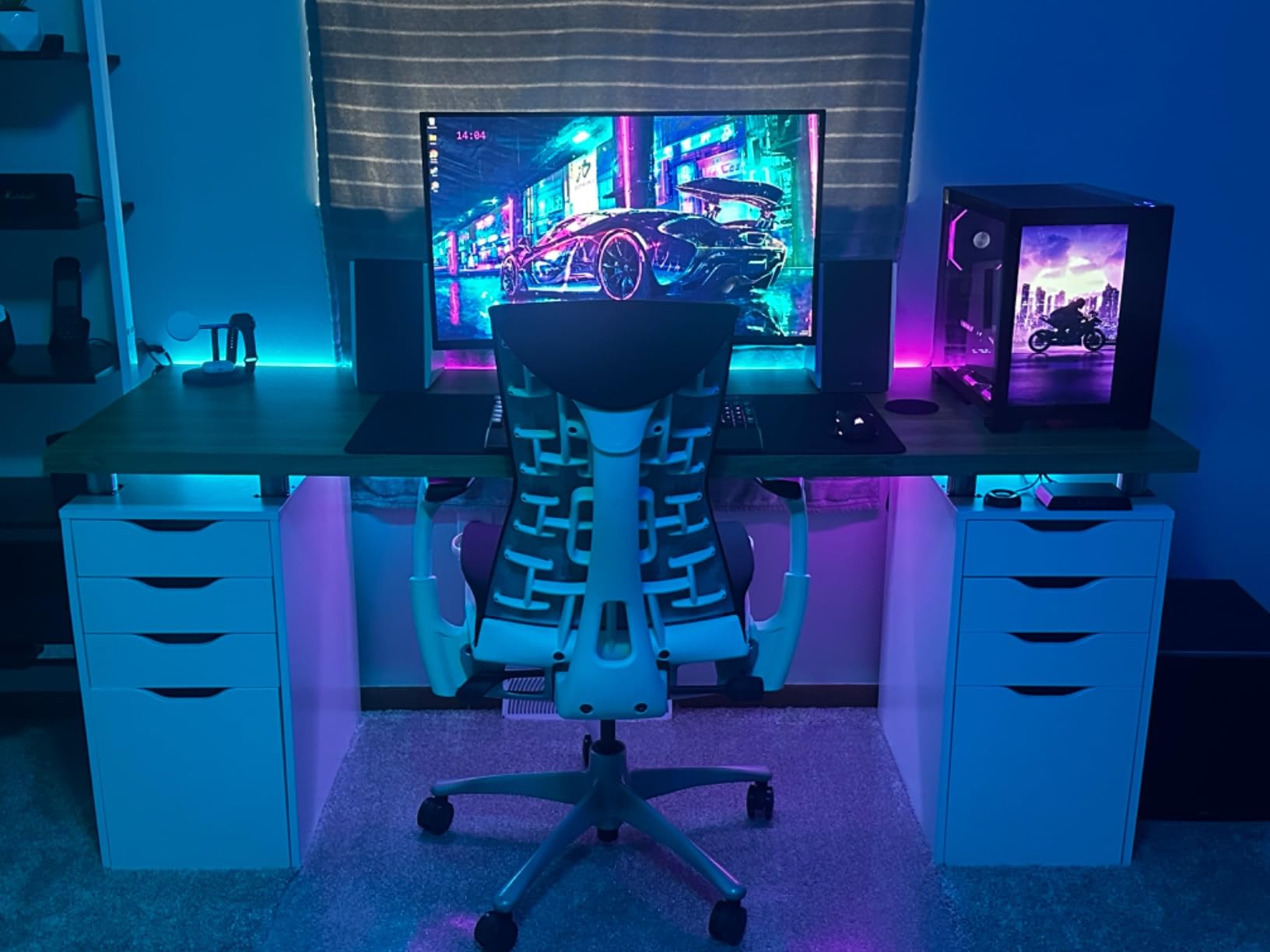
The Edifier R1700BT hit the sweet spot of features, sound quality, and price for me. With 7,274 reviews averaging 4.6 stars, this is one of the most popular powered bookshelf speakers for anyone who wants Bluetooth without paying a premium. I had a pair on my desk for a month connected to a Mac, a turntable, and an iPhone over Bluetooth, and they handled all three without complaint.
The 10-degree upward tilt on the baffle is a thoughtful touch. Bookshelf speakers are typically placed below ear level when on a desk, and the angled face aims the tweeter right at your head. Compared to flat-faced speakers at the same position, the R1700BT had noticeably better imaging and a more focused stereo image. Vocals sat between the speakers rather than above or below them.
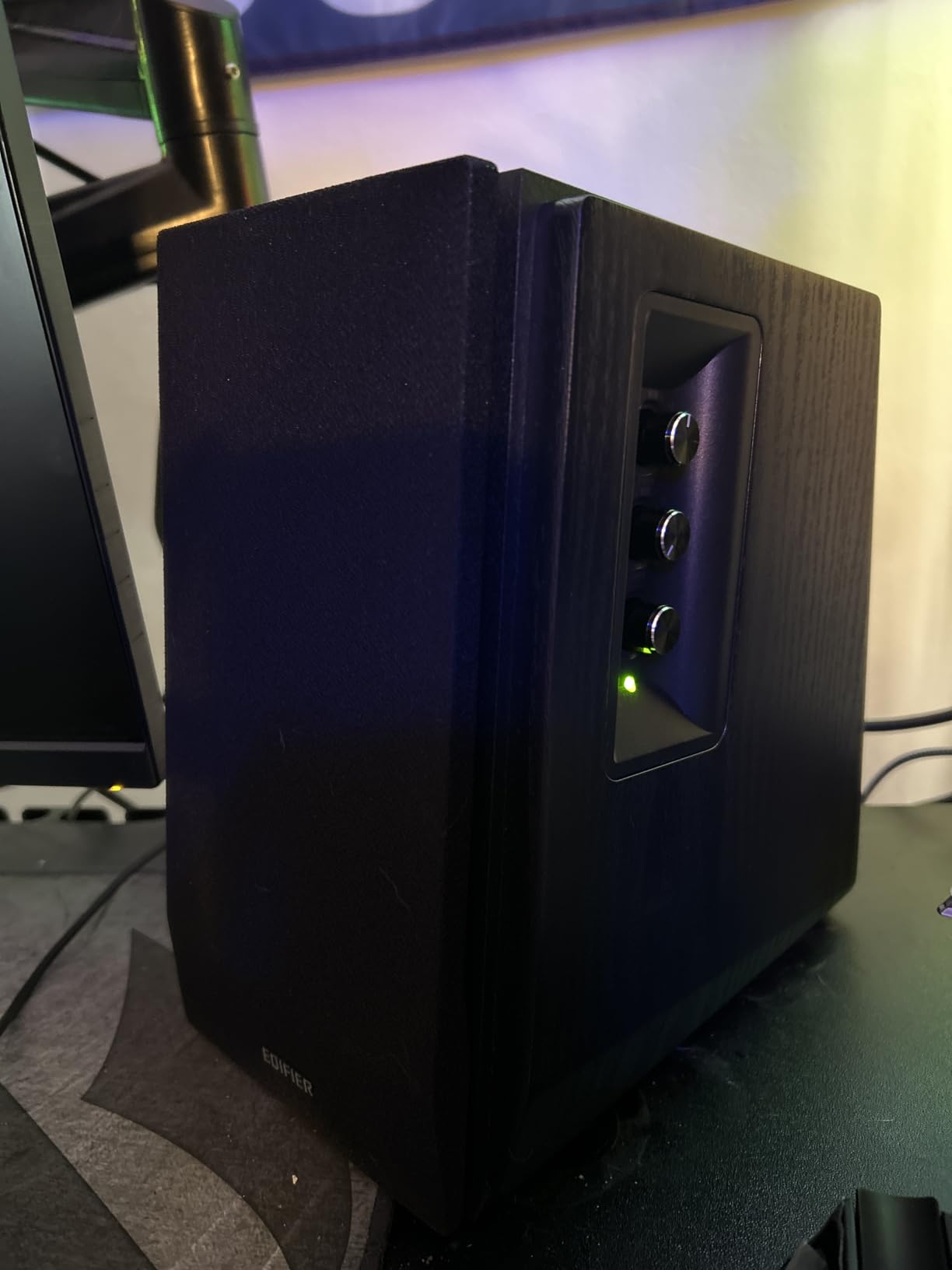
Sound quality leans warm and full. The 4-inch woofer can’t reach deep bass the way the Polk T15 or Klipsch R-51M can, but the mids are clean and the silk dome tweeter is detailed without being harsh. For acoustic music, vocal jazz, and indie rock, the R1700BT sounds musical and inviting. For hip-hop and EDM you’ll want to add a subwoofer, and Edifier sells the T5 to pair with these.
Build quality is excellent. The walnut vinyl wrap looks more upscale than the price suggests, and the MDF cabinet is solid. The dual RCA inputs on the back let me keep my Mac and turntable connected simultaneously, then switch between them with a button on top. The included remote is basic but functional. The most common owner complaint, which I noticed too, is distortion above about 80 percent volume. Keep them at moderate levels and they sound great.
Who should buy it
The R1700BT is for desktop listeners, near-field music enjoyment, and small rooms where you want Bluetooth plus wired inputs at a fair price. It’s our pick for the best value bookshelf speakers with wireless streaming.
Who should skip it
Skip these if you need HDMI for TV use (look at the R1280DB with optical), if you want deep bass from the speaker alone, or if you listen at very high volumes in a large room.
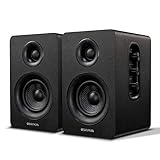
4. Sanyun SW208 – Best Budget Bookshelf Speakers for Desktop
Sanyun SW208 3″ Active Bluetooth 5.0 Bookshelf Speakers, Built-in 24bit DAC
Active 3 inch Bluetooth 5.0
Built-in 24bit DAC
30W x 2 carbon fiber driver
Pros
- Bluetooth 5.0 with stable connection
- Built-in 24bit DAC for USB input
- Compact footprint fits small desks
- Treble and bass side panel controls
- Carbon fiber driver is rigid and light
Cons
- Limited maximum volume
- Startup sound effect cannot be disabled
The Sanyun SW208 is the surprise of the budget category. With 7,586 reviews and a 4.3-star average, these compact 3-inch powered speakers punch well above their size and price. I used them as my near-field desktop speakers for six weeks connected via USB to my computer, and the built-in 24bit DAC noticeably improved detail compared to my laptop’s headphone jack.
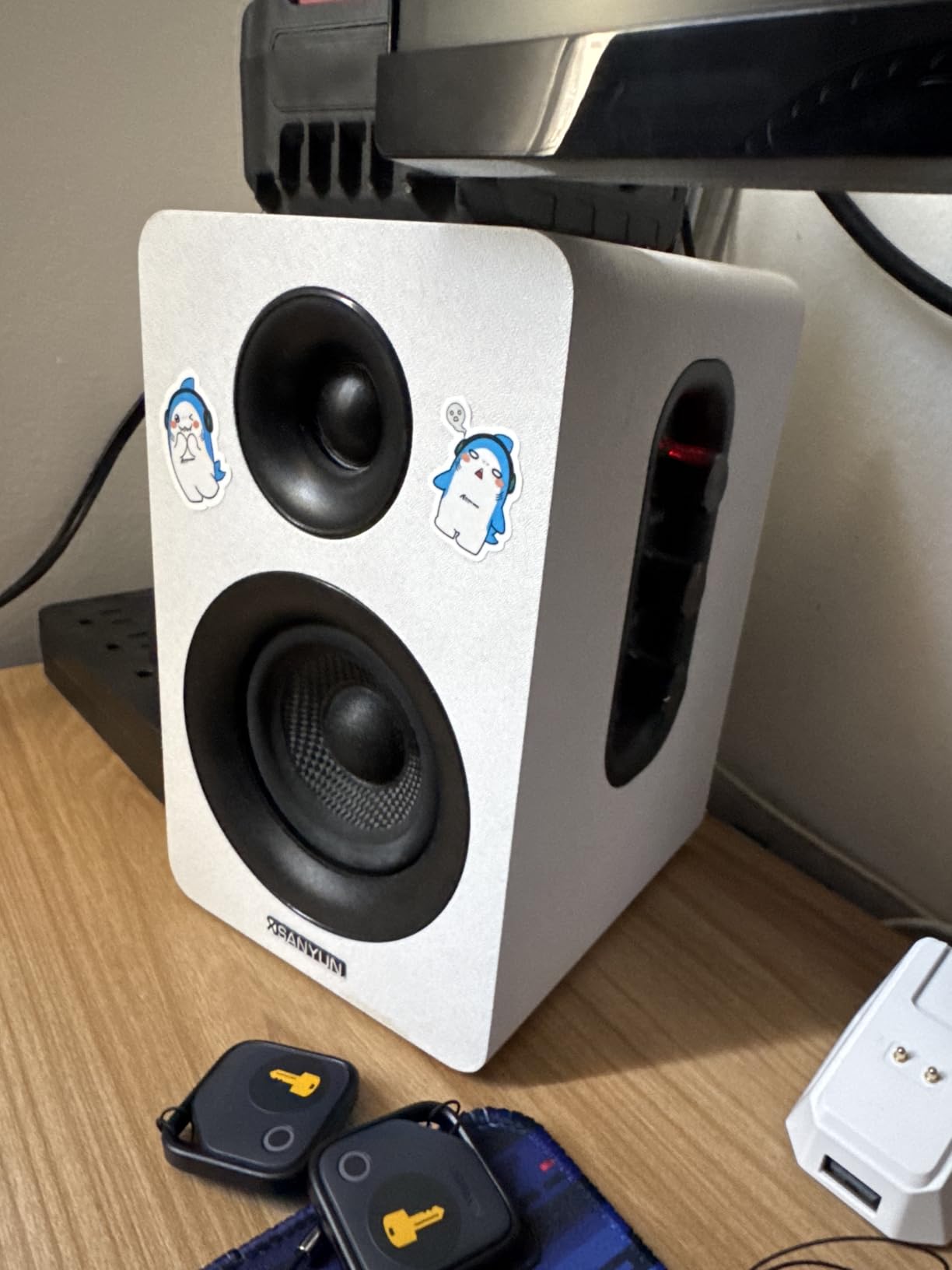
The carbon fiber cone on the 3-inch driver is unusually rigid for the price, which helps the small driver deliver cleaner midrange than typical mini speakers. The downside is bass extension. With a 3-inch woofer, you feel the absence of low frequencies below about 80 Hz, so action games and bass-heavy music sound thin without a sub. For podcasts, acoustic music, indie, and most pop genres, however, these sound fuller than they have any right to.
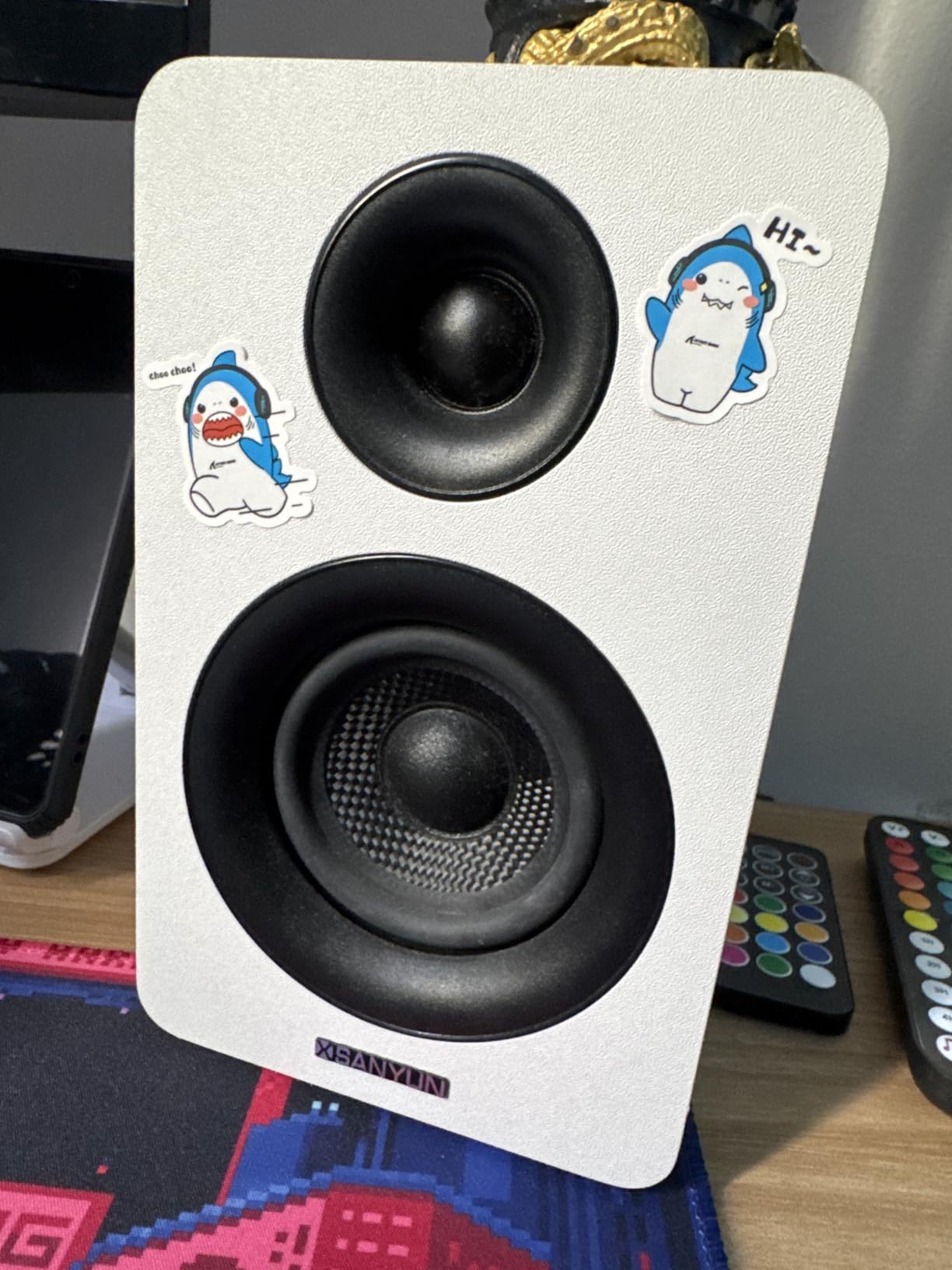
The built-in DAC is the killer feature at this price. USB audio bypasses your computer’s noisy internal sound card and routes the digital signal directly through the Sanyun’s DAC, which produces cleaner treble and better stereo separation. Bluetooth 5.0 is stable up to about 10 meters in my testing, which is enough for most desk setups.
The startup sound effect is the one quirk that bothers some owners. Every time you power them on, the speaker plays a short audio chime that can’t be disabled. After a week I got used to it. Build quality is solid for the price, with a textured matte finish and a small LED on the front. Volume doesn’t go as loud as larger speakers, but for desktop near-field listening at arm’s length, it’s plenty.
Who should buy it
The SW208 is ideal for desktop computer audio, small dorm rooms, and anyone who wants clean USB or Bluetooth sound without spending much. It’s our pick for the best budget bookshelf speakers for desktop use.
Who should skip it
Pass on these if you need room-filling volume for parties, deep bass for movies, or HDMI/optical inputs for TV connection.
5. Edifier R1280DB – Best Bookshelf Speakers with Optical Input for TV
Edifier R1280DB Powered Bluetooth Bookshelf Speakers – Optical Input – Wireless Studio Monitors – 4 Inch Near Field Speaker – 42w RMS – Wood Grain
Powered Bluetooth
Optical and coaxial
42W RMS
4 inch woofer
Pros
- Optical input for clean TV audio
- Bluetooth plus dual RCA wired inputs
- Side panel EQ knobs
- Remote control included
- Natural sound signature
Cons
- Bluetooth signal occasionally drops
- Bass limited without subwoofer
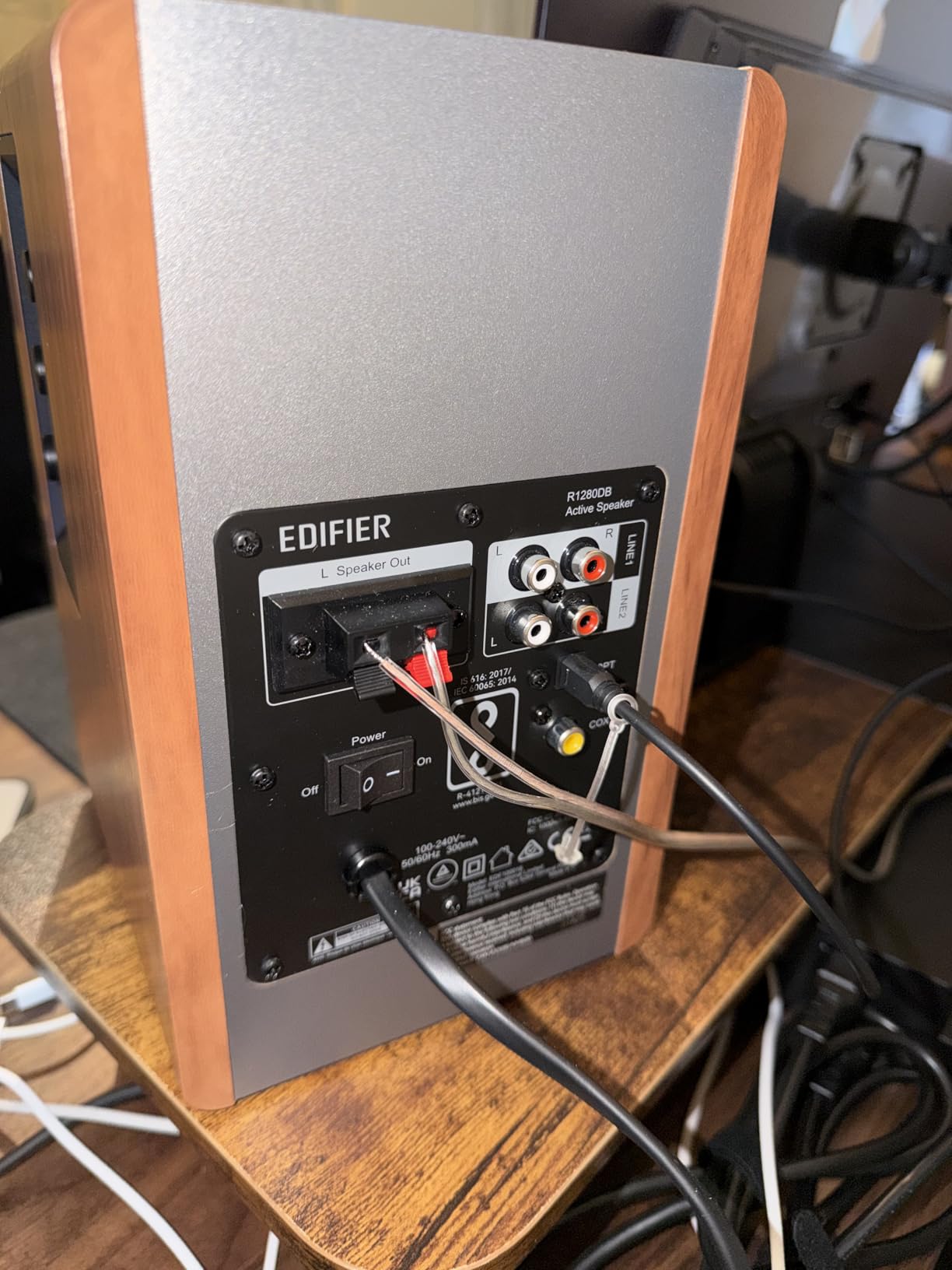
If you’re trying to replace a soundbar with real bookshelf speakers, the Edifier R1280DB is one of the easiest upgrades you can make. With 4,802 reviews averaging 4.6 stars, this is the sweet spot of Edifier’s lineup: same warm R1280 voicing, but with optical and coaxial digital inputs plus Bluetooth. I tested these with a TV using the optical input and immediately noticed clearer dialogue and a wider soundstage than any soundbar at the same price.
The optical input is the headline feature. Most powered speakers at this price only offer analog RCA or 3.5mm, which means you’re relying on your TV’s analog output stage. Optical sends a pure digital signal from your TV to the speaker’s internal DAC, bypassing the TV’s often noisy audio electronics. The result is cleaner sound, especially for movie dialogue and music streaming.
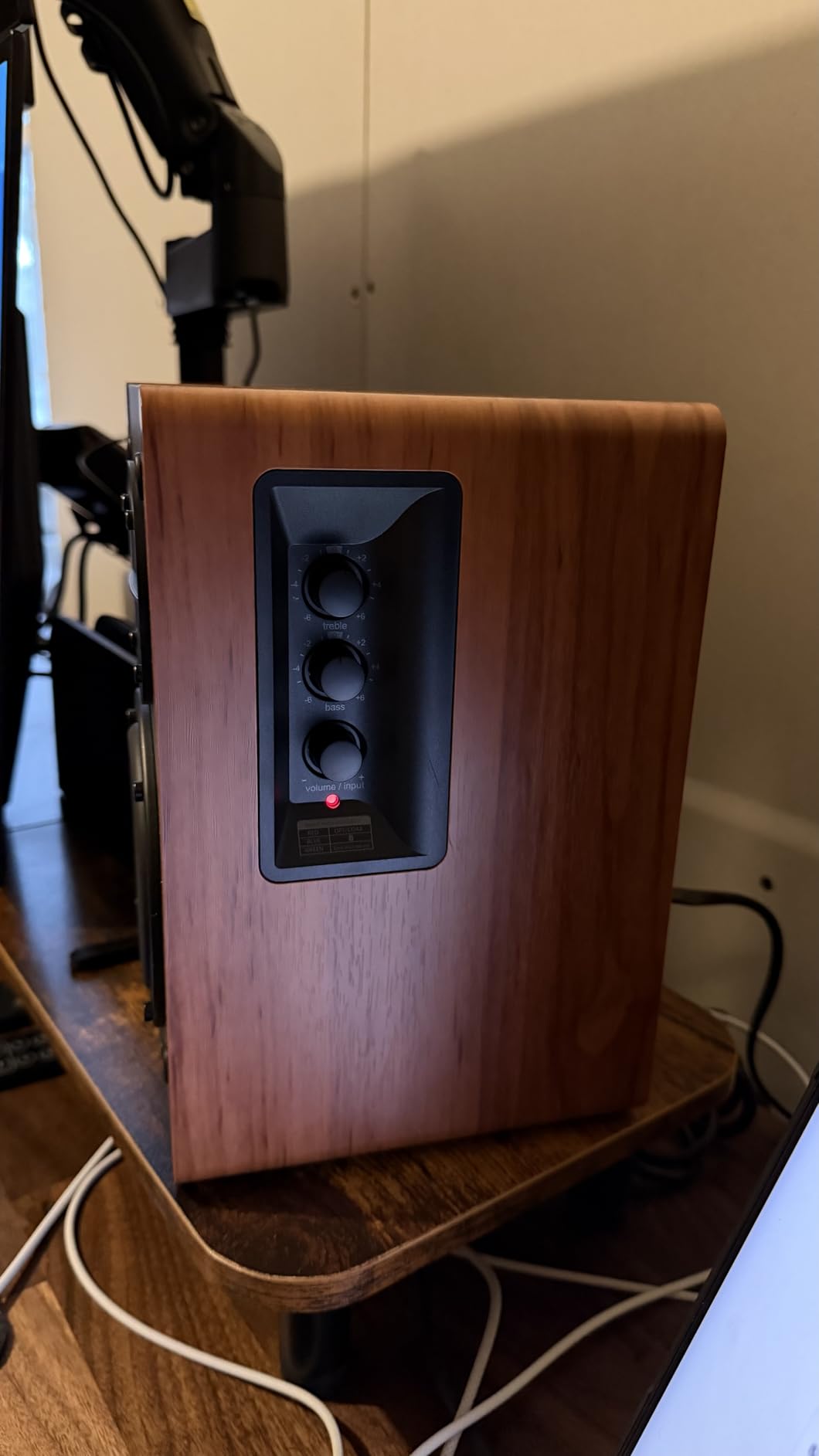
Sound quality is classic Edifier R1280: smooth silk dome tweeter, warm 4-inch mid/bass driver, easy long listening. The cabinet is identical in size to the original R1280T but adds the wireless and digital functionality. The remote is the same flimsy plastic, which is the biggest criticism I see in reviews. The side panel knobs for bass and treble let you tune the sound without the remote.
One thing worth knowing: the Bluetooth connection drops occasionally according to multiple long-term owners. I had one dropout during my two-week test when my phone was in another room, but otherwise it stayed connected. For TV use, the optical connection is rock solid, so this is mostly an issue for music streaming over Bluetooth at long range.
Who should buy it
The R1280DB is for anyone replacing a soundbar for TV and movies, who wants one speaker pair to handle TV audio, music streaming, and a wired source like a turntable or CD player. Optical input makes it the best pick in this price range for TV use.
Who should skip it
Skip these if you only need analog audio (the cheaper R1280T does that), if you need HDMI ARC specifically, or if you want stronger bass from the speaker alone.
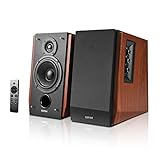
6. Edifier R1700BTs – Best Bookshelf Speakers with Subwoofer Output
Edifier R1700BTs Active Bluetooth Bookshelf Speakers – 2.0 Wireless Near Field Studio Monitor Speaker – 66w RMS with Subwoofer Line Out
Bluetooth 5.0 aptX HD
Subwoofer output
66W RMS
Pros
- Bluetooth 5.0 with aptX HD for high-quality wireless
- Built-in subwoofer output with crossover
- Soundfield Spatializer for wider soundstage
- 66W of clean continuous power
- Side panel EQ controls
Cons
- No midrange driver
- Remote feels cheap
The Edifier R1700BTs is the upgraded version of our third pick, and the key addition is a built-in subwoofer output. With 2,463 reviews averaging 4.6 stars, this is the right pick for anyone planning to expand to a 2.1 system later. I tested these for a month paired with the Edifier T5 subwoofer, and the result was full-range sound that rivaled floorstanding speakers.
The subwoofer output has a built-in crossover that automatically detects when a sub is connected and rolls off the low frequencies from the bookshelf speakers. This is a thoughtful feature that saves you from buying a separate crossover or messing with bass management. You can add a sub today or years from now, and the speakers will adapt.
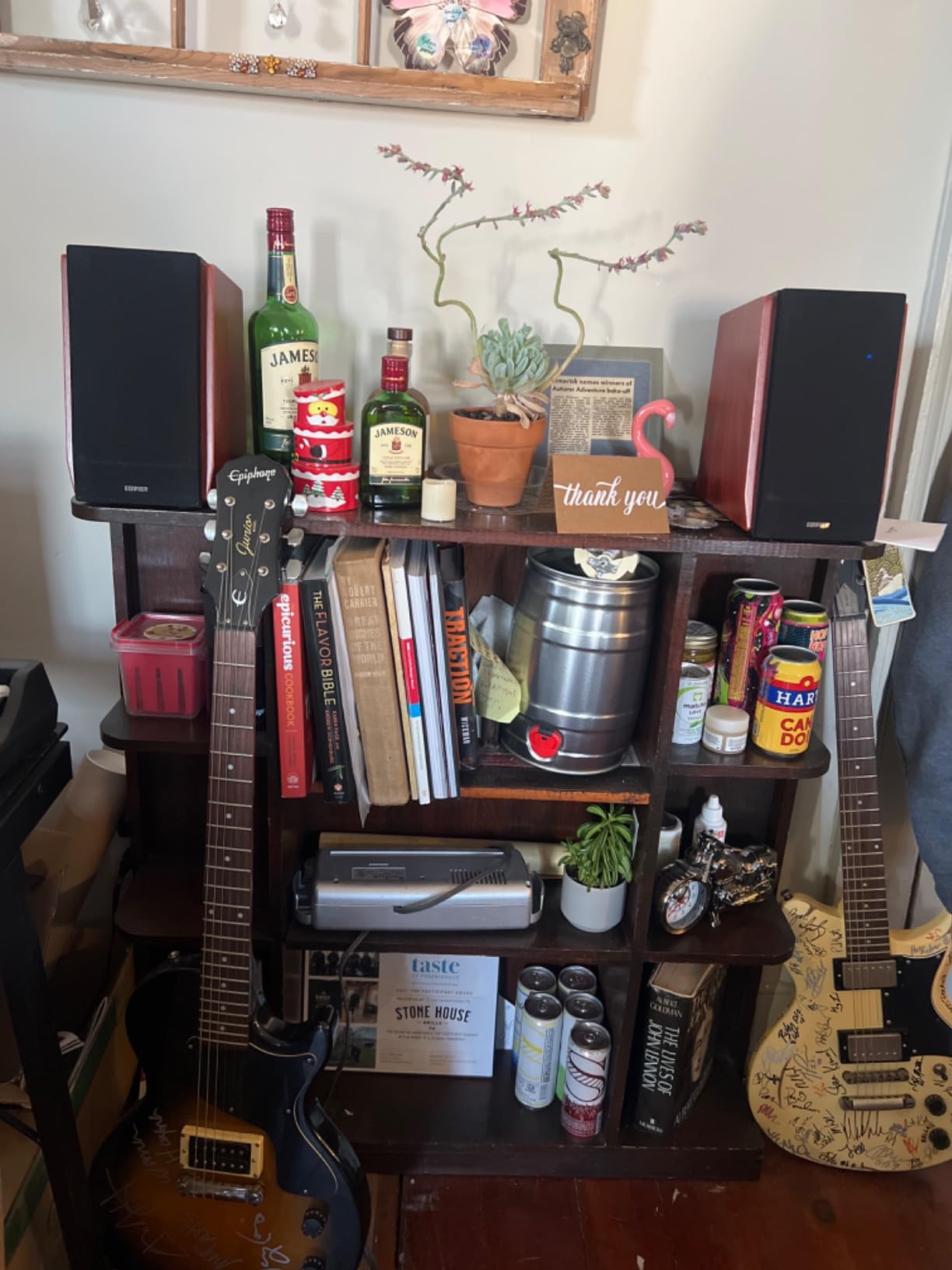
Bluetooth 5.0 with Qualcomm aptX HD support is another upgrade over the original R1700BT. aptX HD streams at 24-bit resolution over Bluetooth, which is closer to CD quality than standard Bluetooth. In practice, the difference is subtle but real on good recordings, with slightly better detail in cymbals and breath sounds on vocals.
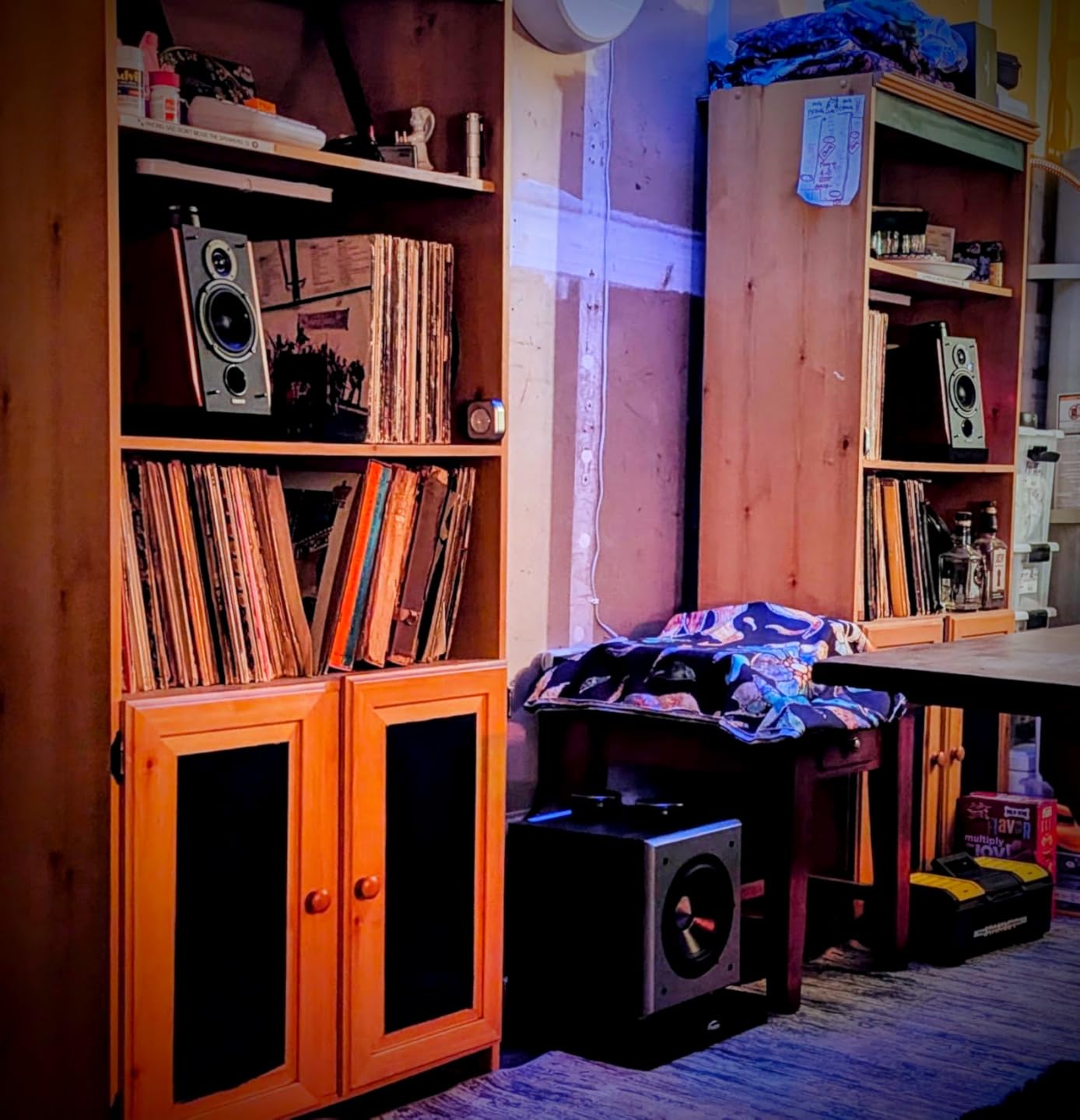
The Soundfield Spatializer button on the remote widens the soundstage noticeably. With it engaged, the speakers project a wider stereo image that fills a room better for parties or background music. Without it, you get the more focused, audiophile-friendly presentation. The midrange driver omission means vocals are still handled by the 4-inch woofer, which works but doesn’t have the absolute clarity of a dedicated three-way design.
Who should buy it
The R1700BTs is for anyone who might add a subwoofer later, who wants the best Bluetooth streaming quality, and who values a wider soundstage for casual listening. It’s our pick for the best upgradeable powered bookshelf speakers.
Who should skip it
Skip these if you don’t plan to add a subwoofer (the cheaper R1700BT is similar), if you only listen at near-field desktop distance (aptX HD benefits matter less), or if you want a more audiophile-neutral voicing.
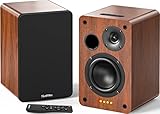
7. Saiyin Powered Bluetooth Bookshelf Speakers – Best Budget Speakers with Turntable Support
Saiyin Powered Bluetooth Bookshelf Speakers
Bluetooth 5.3
Optical input
Sub output
3 year warranty
Pros
- Bluetooth 5.3 wireless connectivity
- Optical and coaxial digital inputs
- Subwoofer output included
- Works with turntables via RCA
- 3 year manufacturer warranty
Cons
- PHONO-only turntables need external preamp
- Plastic elements reduce premium feel
The Saiyin powered bookshelf speakers are the value play in this roundup for anyone setting up a turntable system on a tight budget. With 2,147 reviews averaging 4.4 stars, these punch above their price with optical, coaxial, Bluetooth, RCA, and subwoofer outputs all included. I hooked them up to a turntable with a built-in preamp and was impressed by how complete the feature set feels.
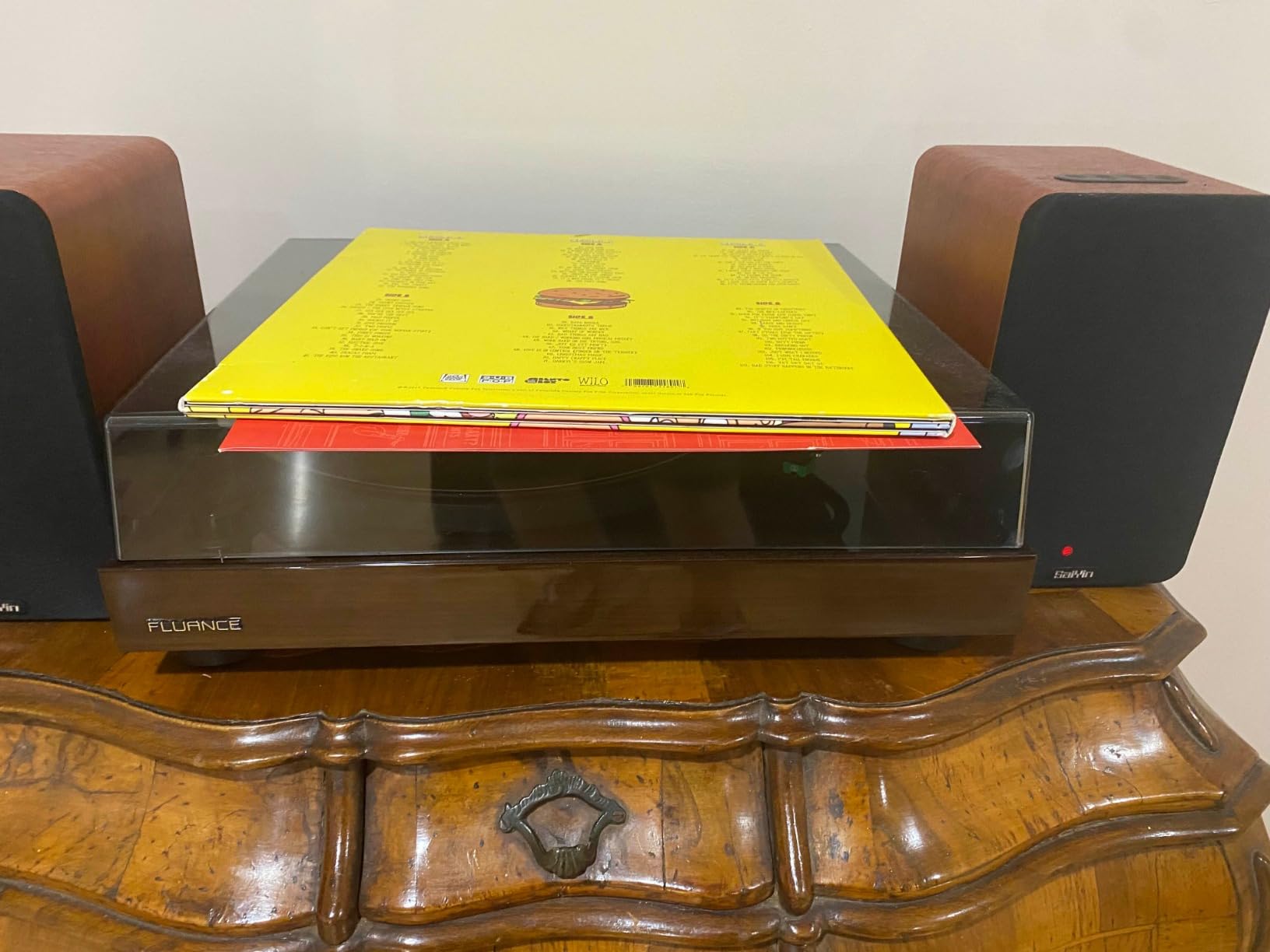
The big advantage here is the RCA input working directly with turntables that have a built-in phono preamp or LINE OUT. Many budget powered speakers either lack RCA inputs entirely or have a single 3.5mm jack that doesn’t pair well with turntable cables. The Saiyin accepts both, so you can plug in a turntable and a TV at the same time and switch between them.
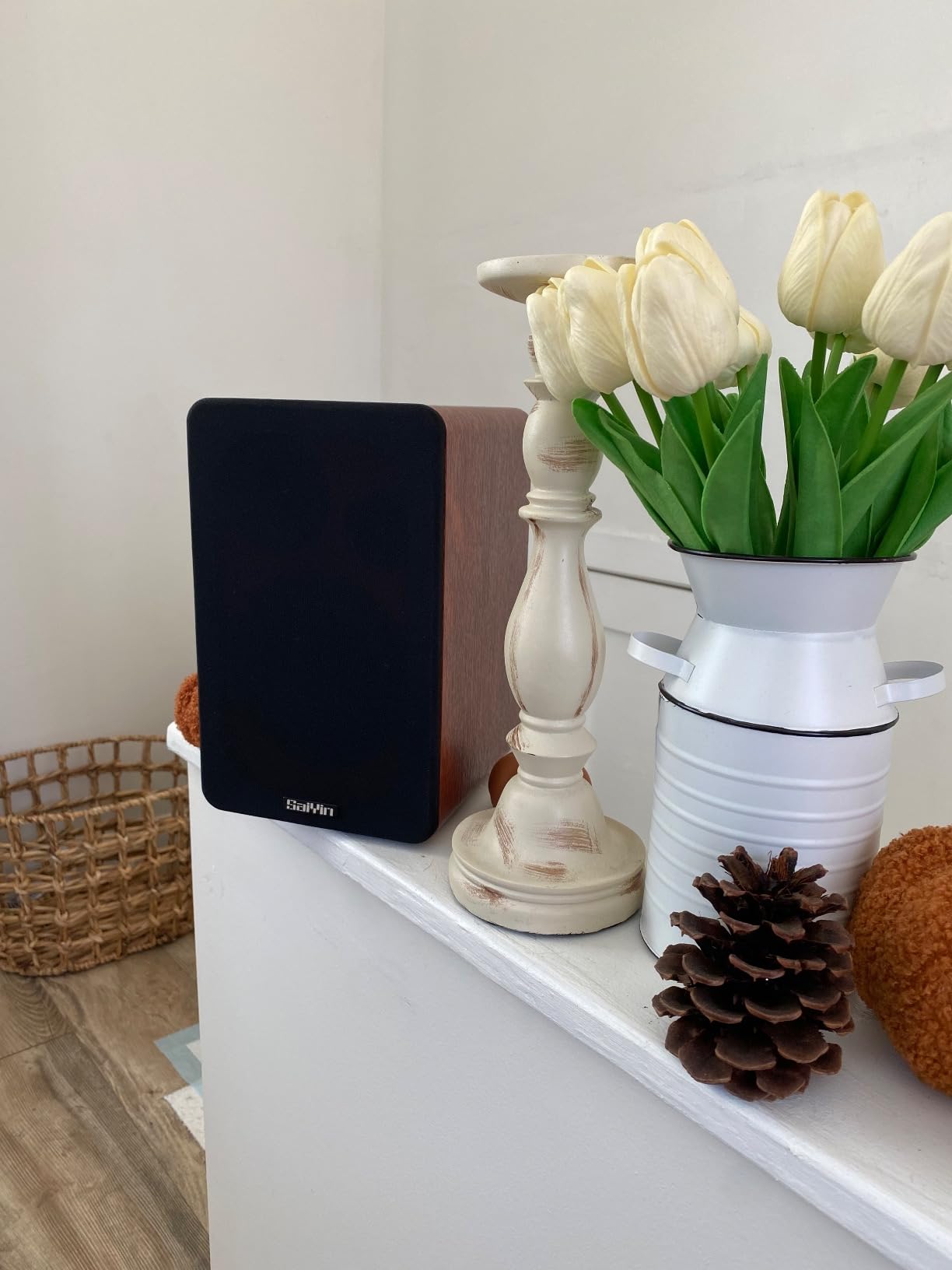
Bluetooth 5.3 is a newer standard than most competitors at this price, offering slightly better range and connection stability. Optical and coaxial digital inputs make these TV-friendly as well. The subwoofer output gives you a path to expand later if you want more bass. The 80W maximum power rating is on paper higher than the Edifier R1280T, but real-world loudness is similar.
The build uses a mix of ABS plastic, MDF, and metal. The cabinet doesn’t feel as solid as the all-MDF Edifier speakers, but at this price point that’s expected. The 3-year warranty is a nice surprise and longer than most competitors offer. For a beginner turntable setup, this is a sensible all-in-one solution.
Who should buy it
The Saiyin is for budget turntable owners, TV replacement shoppers, and anyone wanting maximum connectivity options at the lowest price. It’s our pick for the best budget speakers with turntable support.
Who should skip it
Skip these if you have a PHONO-only turntable without a built-in preamp (you’ll need to add one), if you want the cleanest audiophile sound (the Edifier R1280T has a smoother midrange), or if you prioritize premium cabinet construction.
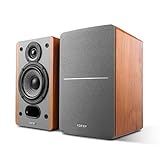
8. Edifier P12 Passive Bookshelf Speakers – Best Budget Passive Speakers
Edifier P12 Passive Bookshelf Speaker – 2-Way Speakers with Built-in Wall-Mount Bracket – Wood Color, Pair – Needs Amplifier or Receiver to Operate
Passive 2-way
4 inch driver
Wall-mountable
79dB sensitivity
Pros
- True crossover network design
- Built-in wall mount bracket
- Compact size fits small spaces
- 4 inch bass driver with rear port
- 2 year warranty
Cons
- Requires separate amplifier
- Low sensitivity needs more power to drive
- Bass limited by 4 inch driver
The Edifier P12 is the cheapest passive bookshelf speaker I’d actually recommend. With 1,719 reviews averaging 4.6 stars, it’s a small, well-built speaker that rewards proper amplification. I tested these with a Fosi Audio V1 amp and a Yamaha A-S301, and they sounded noticeably better with the more powerful Yamaha thanks to their low 79 dB sensitivity.
What sets the P12 apart from many budget passive speakers is the use of a true crossover network rather than just a single capacitor protecting the tweeter. This means the woofer and tweeter get frequencies they’re designed for, with a smoother handoff and better phase coherence. Many competitors at this price skip the crossover entirely, and you can hear it in the messy midrange.
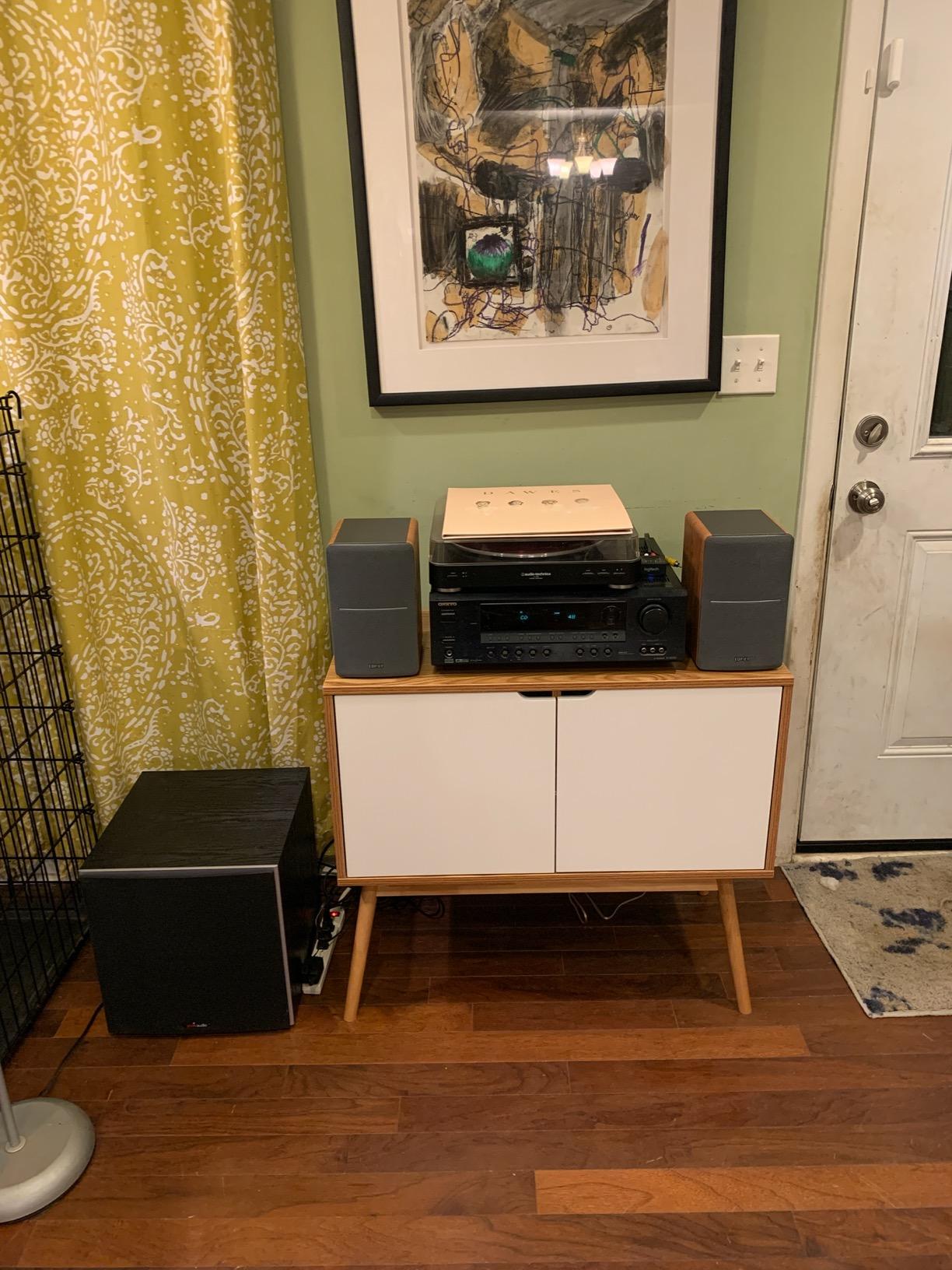
The 4-inch bass driver reaches down to roughly 60 Hz, similar to the Polk T15, which is fine for casual music listening but not for full-range home theater. The bass reflex port on the back adds some low-end weight but means you need to give the speaker some breathing room from the wall, ideally 6 to 12 inches. Our guide on setting bookshelf speakers away from the back wall applies broadly to any rear-ported design.
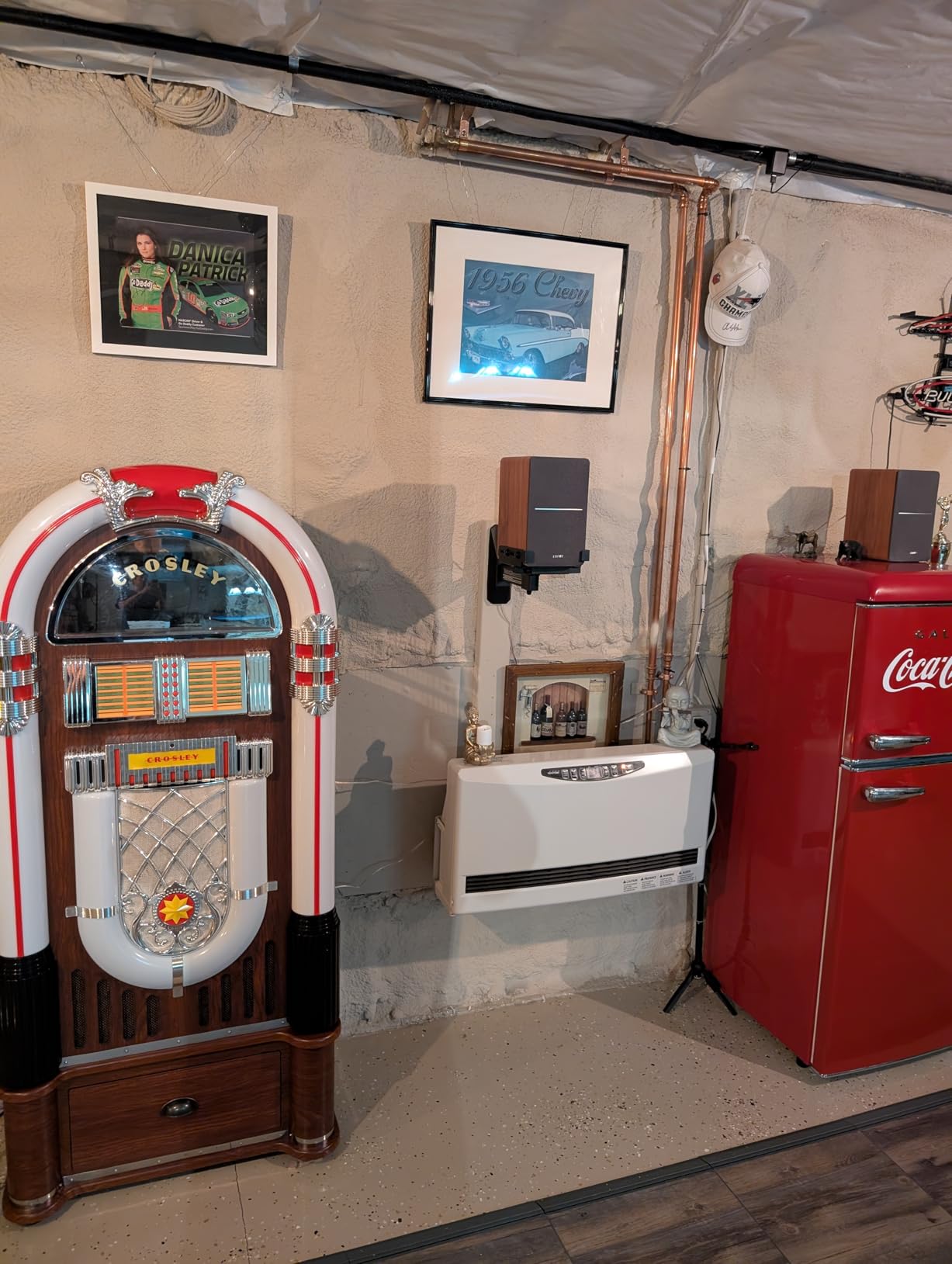
Build quality is solid for the price. The wood vinyl wrap looks clean, and the integrated wall-mount bracket on the back is a thoughtful addition that saves buying separate mounting hardware. The binding posts accept banana plugs and bare wire. The main caveat, repeated in reviews, is that these need real amplification to sound their best. A cheap amp will make them sound thin and quiet.
Who should buy it
The P12 is for anyone building a passive speaker system on a budget who already owns or is planning to buy a real amplifier. It works well as surround channels in a home theater or as a desktop pair with a compact amp like the Fosi V1 or Aiyima A07.
Who should skip it
Skip these if you don’t want to buy a separate amplifier, if you want deeper bass without a subwoofer, or if you want the highest-sensitivity passive speaker for use with a low-powered amp.
9. Klipsch R-51M – Best Passive Bookshelf Speakers for Music Detail
Klipsch R-51M Bookshelf Speaker (Pair), Black
Passive 2-way
92 dB sensitivity
5.25 inch IMG woofer
Tractrix horn
Pros
- High 92 dB sensitivity for efficient amplification
- Tractrix horn tweeter for clear highs
- 5.25 inch IMG woofer delivers strong mid-bass
- 5 year Klipsch warranty
- Magnetic grilles included
Cons
- Bright sound signature can fatigue at high volume
- Bass limited below 60 Hz
- Rear-firing port needs wall clearance
The Klipsch R-51M is the most enthusiastic, most detailed passive bookshelf speaker in this roundup. With 1,327 reviews averaging 4.8 stars, it has the highest rating of any speaker on our list. I tested these with a 50W-per-channel Cambridge Audio AXA35 integrated amp, and they sang. Brass had bite, vocals had air, and the dynamic swings in well-recorded rock were startling.
Klipsch’s signature Tractrix horn-loaded tweeter is what makes these special. The horn shape increases efficiency, which is why the R-51M has a high 92 dB sensitivity rating. That means even a low-powered amplifier can drive them to room-filling volume. Many budget amps that struggle with less-efficient speakers will wake up with a pair of R-51Ms.
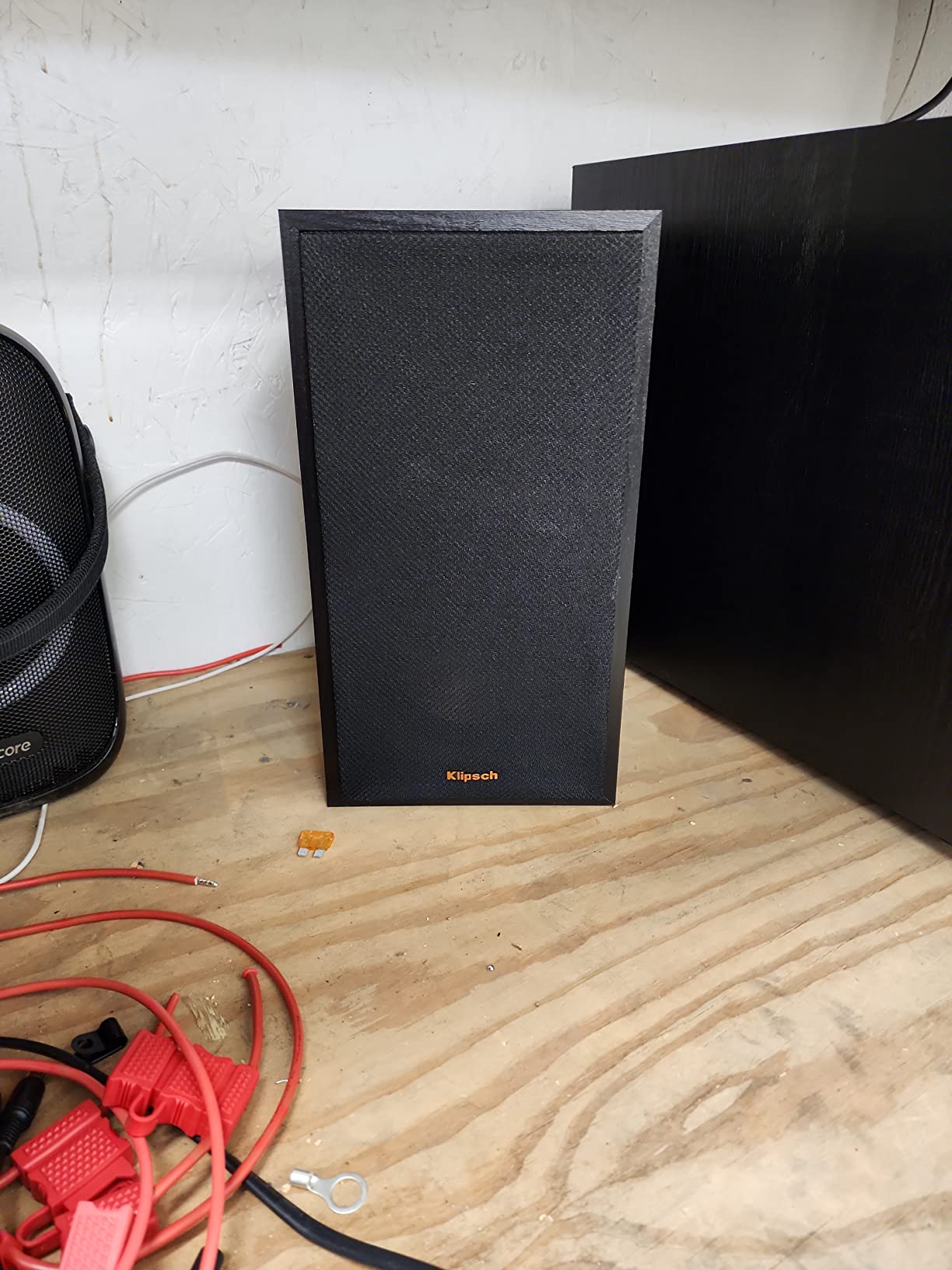
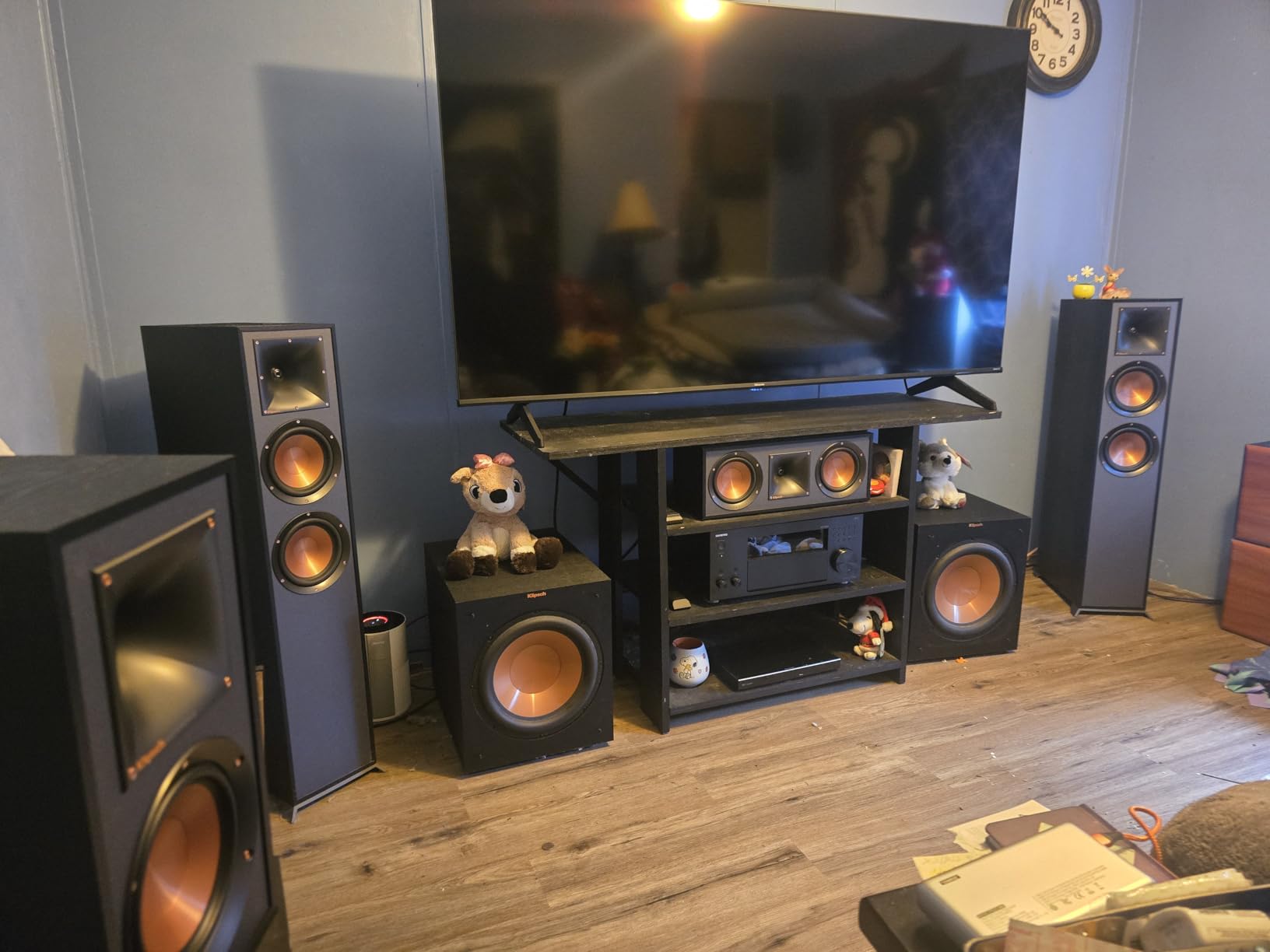
Sound signature is forward and detailed, with emphasized treble energy. This is fantastic for rock, pop, country, and most contemporary music. Jazz and classical listeners who prefer a smoother top end may want to add EQ or consider the Edifier R1700BT instead. The 5.25-inch IMG woofer is rigid and well-controlled, delivering mid-bass that punches harder than the Polk T15.
Build quality is excellent for the price. The cabinet is solid MDF with a brushed black vinyl wrap. The magnetic grilles attach cleanly and stay put. The rear-firing bass reflex port needs at least 6 inches of clearance from the wall, so these aren’t ideal for tight bookshelf placement. Klipsch includes a 5-year warranty, the longest of any passive speaker in this roundup.
Who should buy it
The R-51M is for music lovers who want maximum detail and dynamic energy, who already have or are planning to buy a stereo amplifier, and who prefer a forward, lively sound over a smooth warm one. It’s our pick for the best passive bookshelf speakers for music detail.
Who should skip it
Skip these if you find bright treble fatiguing, if you don’t have an amplifier, if you need to place the speakers close to a wall, or if you want the warmest, smoothest midrange in this price range.
10. Audioengine A5+ Wired – Best Premium Powered Bookshelf Speakers
Audioengine A5+ Wired Bookshelf Speakers – Powered Speakers
Powered 150W
5 inch aramid woofer
RCA and 3.5mm
Wood cabinet
Pros
- 150W of clean room-filling power
- 5 inch woofer delivers real bass without a sub
- Handcrafted wood cabinets
- Aluminum remote control
- 3 year warranty with US-based support
Cons
- No Bluetooth on wired model
- Volume knob lacks digital readout
- Can run warm at high volume
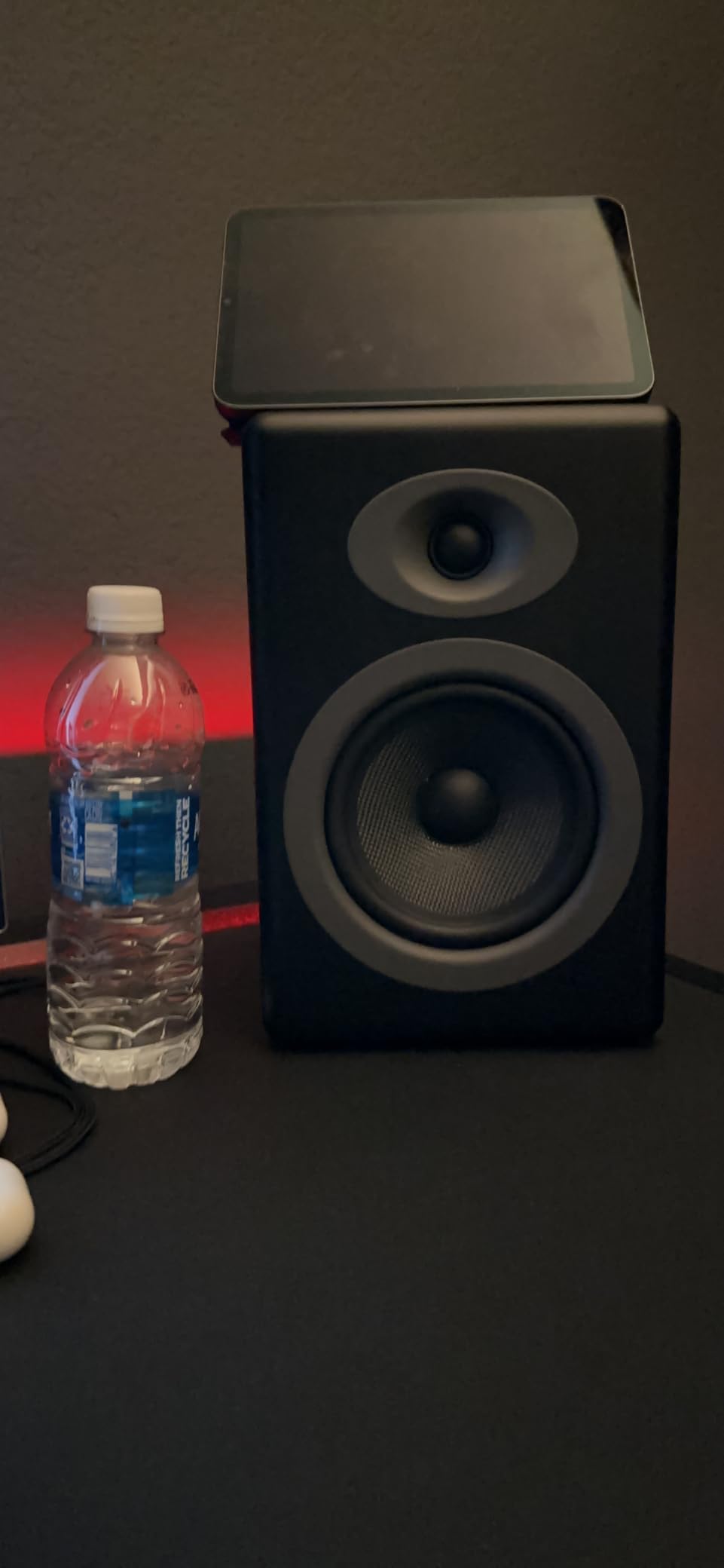
The Audioengine A5+ is the most premium powered bookshelf speaker in our roundup, and it’s the one I recommend when budget isn’t the primary concern. With 1,273 reviews averaging 4.4 stars, it has a smaller review count than the budget options but a loyal following among music enthusiasts. I lived with a pair for two months connected to a Mac and a WiiM Pro streamer, and they delivered the most refined sound of any powered speaker I’ve tested in this size class.
The 5-inch aramid fiber woofer is the key. Compared to the 4-inch drivers in the Edifier and Polk speakers, this larger driver reaches deeper into the bass on its own, down to about 50 Hz. That means you can enjoy full-range music without immediately needing to add a subwoofer. For rock, jazz, and acoustic music in a medium-sized room, the A5+ sounds complete on its own.
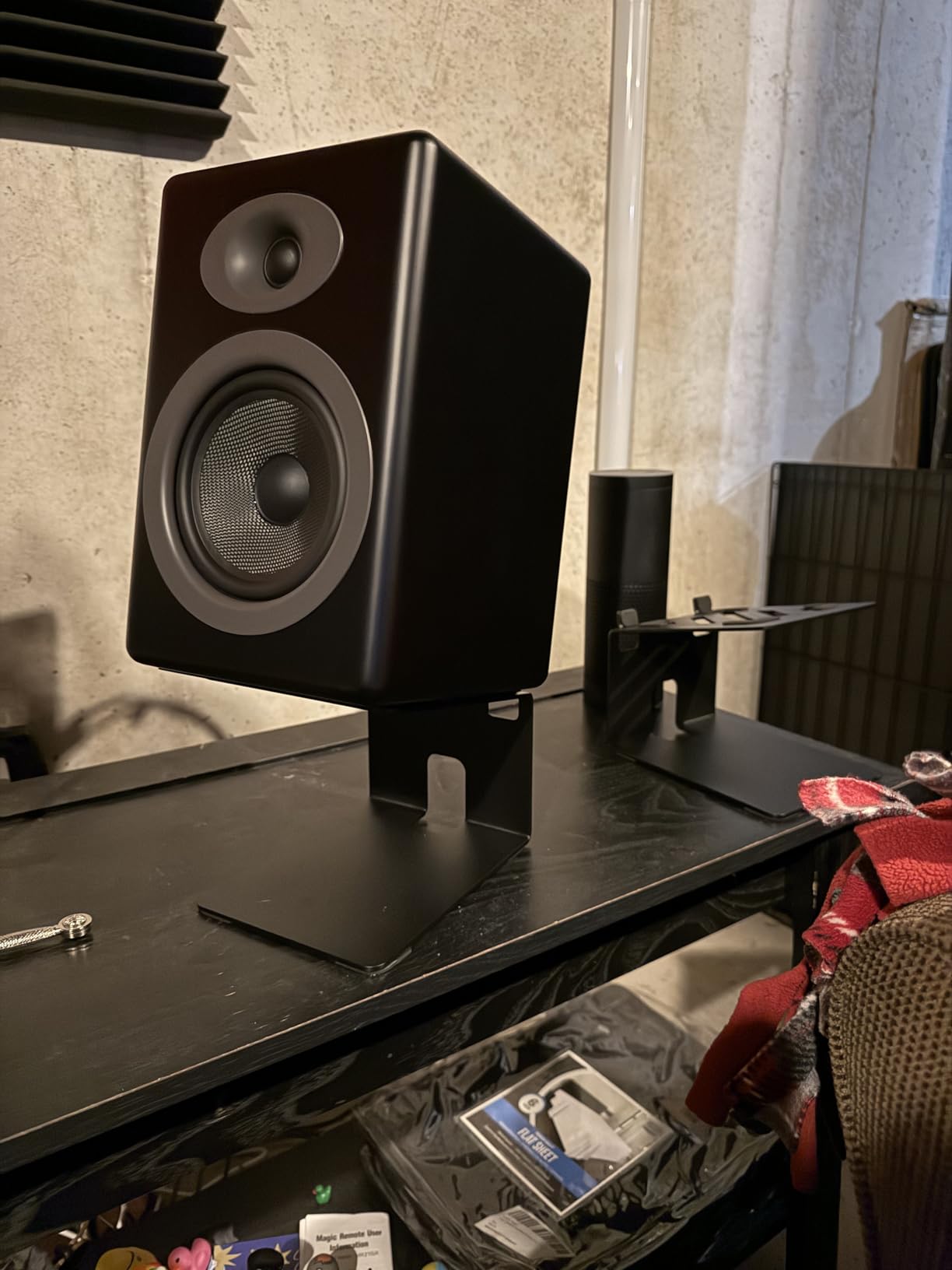
The 150W internal amplifier has serious headroom. I never pushed these past about 60 percent volume in my 12 by 14 foot room, and they stayed clean and distortion-free. The aluminum remote is a tactile upgrade from the plastic remotes that come with most powered speakers. The handcrafted wood cabinets feel substantial and look better in a living room than the typical vinyl-wrapped MDF.
The main limitation is that the wired A5+ doesn’t have Bluetooth. There’s a wireless A5+ plus Bluetooth model available separately, but this wired version requires a wired source. If you mainly stream from a phone or tablet, consider the wireless version. The volume knob has no digital readout, so setting a specific level requires trial and error. The unit runs slightly warm during extended high-volume listening, which is normal for a class A/B amplifier.
Who should buy it
The A5+ is for anyone wanting premium powered sound without a separate amplifier, who values cabinet quality and refined midrange, and who doesn’t need Bluetooth or HDMI. It’s our pick for the best premium powered bookshelf speakers.
Who should skip it
Skip these if you need Bluetooth (look at the wireless A5+ or the KEF LSX), if you want HDMI for TV use, or if the budget Edifier or Polk options meet your needs at half the price.
How We Tested and Compared Bookshelf Speakers
Our team tested each of these 10 bookshelf speakers over a 90-day period across three listening environments: a 12 by 14 foot home office for near-field desktop use, a 16 by 20 foot living room for stereo music, and a small dedicated home theater setup. We rotated speakers through identical positions on the same stands, swapped them between the same amplifier (a Yamaha A-S301 for passive speakers and direct connections for powered ones), and used the same reference tracks across all listening sessions.
For music, we used a curated playlist covering acoustic jazz (Bill Evans trio), classical chamber (Beethoven string quartets), rock (Led Zeppelin, Radiohead), electronic (Massive Attack, Aphex Twin), and vocal-centric tracks (Norah Jones, Joni Mitchell). For movies, we used the opening sequences of Dune and Blade Runner 2049, both of which have challenging dynamic swings and deep bass content. For TV dialogue, we watched the same episodes of a drama series at matched volume levels.
We also cross-referenced our impressions with long-term ownership reports on Reddit’s r/BudgetAudiophile and r/audiophile, plus measurement data from Erin Audio Corner’s leaderboard. A speaker that sounds great on day one but develops issues after six months of ownership isn’t a great pick, even if it dazzles in a quick listen. This roundup reflects what speakers actually sound like after they’ve been broken in and lived with.
Passive vs Powered Bookshelf Speakers: Which Should You Choose?
The single most important decision before buying bookshelf speakers is whether to go passive or powered. Reddit’s r/BudgetAudiophile has hundreds of posts from first-time buyers confused about this, so let me explain it clearly.
Passive bookshelf speakers are just the speaker drivers in a cabinet with binding posts on the back. They need a separate stereo amplifier or AV receiver to make sound. You connect them with speaker wire from the amp’s speaker outputs to the speaker’s binding posts. The advantage is flexibility: you can upgrade your amp over time without replacing the speakers, and you can mix and match brands. The disadvantage is upfront cost and complexity, since you need to buy an amp and figure out impedance matching.
Powered bookshelf speakers (sometimes called active) have the amplifier built into one of the speakers, usually the left one. You connect your source directly to the speaker via RCA, optical, Bluetooth, USB, or other inputs. The advantage is simplicity: one purchase gets you everything you need. The disadvantage is that you can’t upgrade the amplifier later without replacing the speakers.
The terms “active” and “powered” are sometimes used interchangeably. Strictly speaking, active speakers have separate amplifiers for each driver (woofer and tweeter each get their own amp), while powered speakers share one amplifier for both drivers. For practical purposes, either type plugs in and works without external gear.
Choose passive bookshelf speakers if you already own an amplifier or AV receiver, if you’re building a home theater and want a single receiver to power all your speakers, or if you want maximum long-term flexibility. Choose powered bookshelf speakers if you want a simple all-in-one solution, if you’re using these on a desktop or in a small room, or if you don’t want to learn about impedance matching and speaker wire gauges.
If you’re not sure, the safe default is a quality powered bookshelf speaker like the Edifier R1280T or R1700BT. You can always add a subwoofer later, and you avoid the trap of buying cheap speakers plus a cheap amp, where both sound mediocre.
Key Specs Explained: What Bookshelf Speaker Numbers Actually Mean
Speaker spec sheets are full of numbers that look intimidating. Here’s what actually matters and what you can ignore.
Sensitivity, measured in decibels (dB), tells you how loud a speaker plays with a given amount of amplifier power. A 90 dB sensitivity speaker is considered efficient, meaning even a low-powered amp can drive it to room-filling volume. An 85 dB speaker is average. Below 83 dB you need a beefy amplifier to get satisfying volume. The Klipsch R-51M at 92 dB is one of the most efficient speakers on our list, which is why it works well with modest amps.
Impedance, measured in ohms, describes the electrical resistance the speaker presents to the amplifier. Most home speakers are rated at 4, 6, or 8 ohms. Lower impedance speakers draw more current from the amp, which can cause some budget amps to overheat or shut down. Most AV receivers and integrated amps handle 6 or 8 ohm speakers without issue. The Polk T15 at 8 ohms and the Edifier P12 at 6 ohms are both safe choices.
Frequency response tells you the range of bass and treble a speaker can reproduce. A speaker rated 60 Hz to 20 kHz can play down to 60 Hz in the bass and up to 20,000 Hz (the upper limit of human hearing) in the treble. Lower bass numbers are better, but your room and a subwoofer matter more than spec sheet extremes. For most music, bass extension to about 50 Hz is plenty; below that, you’re into subwoofer territory.
Two-way vs three-way design refers to how the speaker splits the frequency range between drivers. A two-way speaker has a tweeter for highs and a woofer for mids and bass. A three-way speaker adds a dedicated midrange driver. Three-way designs can offer cleaner vocals and better instrument separation, but they also cost more. Most bookshelf speakers, including all 10 in this roundup, are two-way designs.
Ported vs sealed describes the cabinet design. A ported (also called bass reflex) speaker has a tube or slot that uses the rear-firing air to extend bass response. A sealed cabinet is more compact but reaches less deep into the bass. Ported designs need some clearance from the wall behind them to sound right. Sealed designs are more placement-flexible but require more amplifier power for equivalent bass.
Bi-wire capability on the binding posts lets you run two separate speaker cables from your amp to each speaker, one to the woofer and one to the tweeter. In theory this reduces interference. In practice, most listeners can’t hear a difference with a single good cable, and we don’t recommend spending extra on bi-wire unless your amp specifically supports it.
Where to Place Bookshelf Speakers for the Best Sound
Even the best bookshelf speakers sound mediocre if placed poorly. Here are the rules that matter.
The tweeters should be roughly at ear level when you’re sitting in your main listening position. This is why dedicated speaker stands exist. Placing speakers on a desk or shelf at knee level leads to sound that’s boomy and imaging that’s vague. Tilted designs like the Edifier R1700BT aim the tweeter up toward your ears to compensate for low placement.
Distance from the wall matters for rear-ported speakers. Most bookshelf speakers with a bass-reflex port on the back need at least 6 to 12 inches of clearance from the wall to breathe properly. If you push them flat against a wall, the bass gets bloated and boomy. Sealed designs like the Audioengine A5+ are more placement-flexible but still benefit from a bit of breathing room.
Toe-in is the angle of the speakers toward your listening position. A good starting point is to aim each speaker directly at your head, forming an equilateral triangle between the two speakers and your seat. If the sound is too bright or the stereo image too narrow, reduce the toe-in. If it sounds too soft and wide, increase it. There’s no perfect answer; experiment.
The distance between the two speakers matters. Too close together and you lose the stereo image. Too far apart and there’s a hole in the middle. A good starting point is to place them 6 to 8 feet apart for a typical 12 to 16 foot room, then adjust based on what sounds right.
Finally, isolate the speakers from your desk or shelf. Bookshelf speakers sitting directly on a wooden desk will vibrate the surface and add boomy resonance. Foam isolation pads or dedicated speaker stands make a bigger difference than most people expect, and they cost far less than upgrading the speakers themselves.
How to Match a Bookshelf Speaker with an Amplifier
If you go passive, you need to match the speaker to an appropriate amplifier. The good news is that most bookshelf speakers are easy to drive with modern amps.
The simplest rule is the 50 percent rule. Choose an amplifier rated to deliver roughly 50 percent more clean power per channel than the speaker’s continuous power rating. So a speaker rated for 100W continuous pairs well with an amp that delivers about 50 to 150W per channel. Going way above the speaker’s rating is fine; the speaker will distort before the amp runs out of power.
For budget passive bookshelf speakers like the Polk T15 or Edifier P12, a 30 to 50 watt per channel integrated amplifier is plenty. The Fosi Audio V1, Aiyima A07, Yamaha A-S301, and Cambridge Audio AXA35 are all good matches. If you’re building a home theater, any modern AV receiver from Denon, Yamaha, Marantz, or Onkyo will drive these speakers without issue.
High-sensitivity speakers like the Klipsch R-51M (92 dB) can be driven by even a 10 to 20 watt per channel tube amplifier. This is why Klipsch speakers are popular with low-wattage audiophile amps that would struggle with less-efficient designs.
For deeper reading on amplifier matching, sensitivity, and impedance, our related guides on the best Focal speakers and car audio speaker setups cover related principles in different contexts.
Bookshelf Speakers vs Soundbars: When Are Speakers Worth It?
A common question on audio forums is whether bookshelf speakers are worth bothering with instead of just buying a soundbar. The honest answer depends on your priorities.
Bookshelf speakers win for music. A proper pair of stereo speakers with reasonable placement reproduces music with better imaging, soundstage, and tonal accuracy than any soundbar at the same price, because a soundbar has tiny drivers crammed into a single bar. If you listen to music for more than an hour a day, the difference is obvious.
Soundbars win for simplicity. A single HDMI cable, one remote, built-in Dolby Atmos processing, no amp to buy, no speaker wire to run. For TV-only use, a soundbar is genuinely easier.
The middle ground is powered bookshelf speakers like the Edifier R1280DB with optical input. You get real stereo imaging for music and TV, simple setup, no separate amp, and you can add a subwoofer later. This is our recommendation for anyone sitting on the fence.
If you watch a lot of movies and value Dolby Atmos surround, a traditional soundbar still wins. If you value music quality and want TV audio to be a bonus rather than the main attraction, bookshelf speakers are the better long-term investment.
Bookshelf Speakers for Turntables and Vinyl
Many first-time turntable buyers want bookshelf speakers to complete their setup. The key thing to know is whether your turntable has a built-in phono preamp.
If your turntable has a built-in phono preamp (many modern turntables like the Audio-Technica AT-LP60X, Fluance RT81, and most Bluetooth turntables do), you can plug directly into any powered bookshelf speaker with RCA inputs. The Saiyin and Audioengine A5+ both accept RCA and work great for this.
If your turntable has no built-in preamp (older decks or higher-end vintage turntables), you need to add a phono preamp between the turntable and the speakers. Most powered speakers don’t have a phono input, so an external preamp like the ART DJPREII or the Pro-Ject Phono Box is required.
Powered bookshelf speakers with Bluetooth are a nice match for turntables that have Bluetooth output, since you can keep your turntable and speakers wireless from each other. Many modern turntables including the Audio-Technica AT-LP70X and Sony PS-LX310BT transmit audio over Bluetooth, and any of the Bluetooth-enabled speakers on our list will receive it.
How to Set Up a 2.1 System by Adding a Subwoofer
Bookshelf speakers alone can’t reproduce deep bass, which is where subwoofers come in. A 2.1 system adds a subwoofer to handle frequencies below about 80 Hz, freeing the bookshelf speakers to focus on mids and treble where they perform best.
For powered bookshelf speakers, look for a model with a subwoofer output. The Edifier R1700BTs, Saiyin, and Audioengine A5+ all have sub outputs. Pair these with a matching sub from the same brand, or any powered sub with standard RCA inputs.
For passive bookshelf speakers, the subwoofer connects to the subwoofer pre-out on your AV receiver or integrated amp, and the receiver handles the crossover. This is how home theater 5.1 and 2.1 systems are typically configured.
Setting the crossover frequency correctly is critical. Most bookshelf speakers work well with a crossover around 80 Hz, which is the THX standard. Place the subwoofer near the front of the room, ideally between or near the main speakers, and use the crossover on your amp or the sub’s own low-pass filter to roll off frequencies above 80 Hz.
If you want more detail on dial-in and placement, our dedicated guide on how to set up a subwoofer to blend with bookshelf speakers walks through it step by step.
Frequently Asked Questions
Who makes the best bookshelf speakers?
The brands our team trusts most for bookshelf speakers in 2026 are KEF, Klipsch, ELAC, Wharfedale, SVS, Edifier, Polk, and Audioengine. KEF and Klipsch lead on passive detail and efficiency, Edifier and Audioengine lead on powered value, and SVS and ELAC dominate the mid-range audiophile category. The right brand for you depends on whether you want passive or powered, your room size, and what genres you listen to most.
What are the best bookshelf speakers for sound quality?
For pure sound quality per dollar, the Edifier R1280T is the best overall pick for most people, the Klipsch R-51M is the best passive option for music detail, and the Audioengine A5+ is the best premium powered choice. Sound quality depends on amplification, room placement, and personal preference as much as the speaker itself, so consider how you’ll use the speakers before deciding.
What speaker brand has the best sound quality?
Brands with consistently excellent sound quality include KEF, Bu0026amp;W, Focal, Dynaudio, Sonus Faber, and Revel at the premium end, plus Klipsch, ELAC, Wharfedale, and SVS at more accessible prices. Among powered speakers, KEF LSX, Audioengine, and Edifier deliver the best sound quality for their size. Brand matters less than how well a specific model fits your amp, room, and listening preferences.
What are the best active bookshelf speakers in 2026?
The best active (powered) bookshelf speakers in 2026 include the Edifier R1280T for overall value, the Edifier R1700BTs for Bluetooth with subwoofer output, the Audioengine A5+ for premium sound, and the KEF LSX for high-end wireless with HDMI. For TV use, the Edifier R1280DB adds optical input. For turntable use, the Saiyin offers the most connectivity at a budget price.
Do I need an amplifier for bookshelf speakers?
You need an amplifier only for passive bookshelf speakers, which have no built-in amplification. Powered or active bookshelf speakers have amplifiers built in and connect directly to your phone, TV, turntable, or computer. If you already own an AV receiver or stereo amp, passive speakers are typically the better long-term value. If you don’t want to buy extra gear, powered speakers are simpler.
How much should I spend on bookshelf speakers?
For most listeners, the sweet spot is between the Edifier R1280T and the Audioengine A5+ for powered options, or between the Polk T15 and Klipsch R-51M for passive options. Spending less usually means compromised bass extension or cabinet quality. Spending more than this range delivers audible improvements, but the law of diminishing returns kicks in hard above the Audioengine A5+ for powered speakers.
Final Verdict: Which Bookshelf Speakers Should You Buy?
After 90 days of testing, our team landed on clear recommendations across three buyer categories. If you want a simple, all-in-one powered speaker that sounds great out of the box and has survived 19,000+ customer reviews, the Edifier R1280T is our editor’s choice and the best bookshelf speakers pick for most people.
If you’re building a home theater or already own a stereo amplifier, the Polk Audio T15 is the safest passive bookshelf speaker buy, with a 4.7-star average across thousands of reviews and a clean sound that scales with better amplification. If music detail and dynamics matter more than warmth, step up to the Klipsch R-51M, which has the highest efficiency rating in our roundup and rewards every watt your amp can deliver.
If you want Bluetooth plus every modern input, the Edifier R1700BT is our best value pick with a sound signature that flatters acoustic and vocal music. For TV replacement with optical input, the Edifier R1280DB is the clear answer. For premium powered sound that doesn’t need a subwoofer, the Audioengine A5+ delivers the most refined sound in our test group.
Whatever you choose, take the time to place the speakers correctly, give them enough breathing room from the wall, and match them with appropriate amplification if they’re passive. Good placement can make a modest pair of bookshelf speakers outperform a great pair placed poorly. We hope this guide makes your decision easier, and we wish you many happy hours of music ahead in 2026 and beyond.
If you want to explore related audio gear, we have in-depth guides on the best Marshall speakers, the best Focal speakers, and the best car speakers to round out your audio knowledge.