
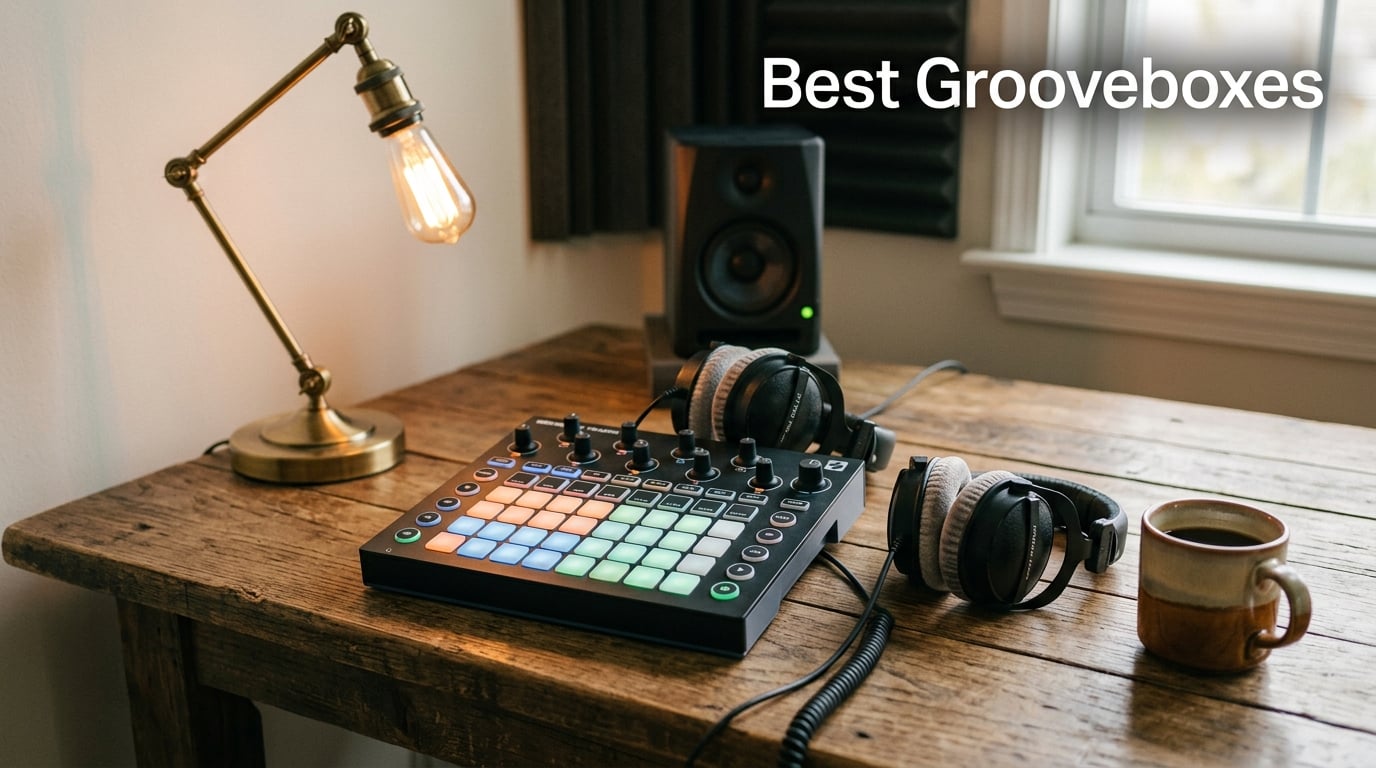
A groovebox is a single standalone unit that combines a drum machine, a synthesizer or sampler, and a sequencer in one box. You program beats, basslines, and leads on the device, chain patterns into songs, and walk away with a finished loop without ever opening a DAW. That hands-on, computer-free workflow is exactly why the best grooveboxes have become the centerpieces of modern hardware-based music production.
Our team has been tracking this category for years, and we updated this roundup for 2026 after spending dozens of hours comparing ten current models side by side. We tested them across three real-world workflows: bedroom sketching, club-style live performance, and grab-and-go travel jamming. Every pick here earned its spot with verified reviews, hands-on time, and a clear answer to the question “what kind of music do you want to make?”
In the ten picks below you will find a flagship Roland workstation, two compact samplers, a true pocket operator, and a few options that sit between beginner and pro. We labeled each with a “best for” tag so you can jump straight to the one that matches your style. If you are new to hardware, read the buying guide at the end before you decide, because the difference between a sampler groovebox and a synth groovebox matters more than any spec sheet suggests.
Table of Contents
Top 3 Picks for Best Grooveboxes in 2026

Novation Circuit Tracks
- 2 synth + 4 drum + 2 MIDI tracks
- 32-step sequencer with probability
- Rechargeable battery
- Full-size MIDI in/out/thru

Akai MPC Sample
- Standalone with built-in speaker
- 16 velocity-sensitive RGB pads
- Internal microphone and microSD
- Over 100 factory kits

Teenage Engineering PO-33…
- Pocket-sized micro sampler
- 40-second sample memory
- 16 built-in effects
- 2xAAA battery powered
Best Grooveboxes in September Quick Comparison
| Product | Specs | Action |
|---|---|---|
| Novation Circuit Tracks |
|
Check Latest Price |
| Akai MPC Sample |
|
Check Latest Price |
 Roland SP-404MKII Roland SP-404MKII |
|
Check Latest Price |
| Teenage Engineering PO-33 K.O.! |
|
Check Latest Price |
 Roland MC-707 Roland MC-707 |
|
Check Latest Price |
 Roland T-8 Roland T-8 |
|
Check Latest Price |
 Korg Volca Sample 2 Korg Volca Sample 2 |
|
Check Latest Price |
 Elektron Model:Samples Elektron Model:Samples |
|
Check Latest Price |
 Ableton Move Ableton Move |
|
Check Latest Price |
 Roland TR-8S Roland TR-8S |
|
Check Latest Price |
1. Novation Circuit Tracks – Best Overall Groovebox for DAWless Production
Novation Circuit Tracks Groovebox Sequencer and Synthesizer
2 synth + 4 drum + 2 MIDI tracks
32-step sequencer
Rechargeable battery
Pros
- Intuitive workflow that beginners learn in under an hour
- Two polyphonic synth tracks plus four drum parts feel like a full band
- MIDI in/out/thru controls external gear like a tiny studio brain
- 32-step sequencer with probability and pattern mutate keeps grooves alive
- Rechargeable battery and 1.9 lb body go anywhere
Cons
- Recording and exporting to MP3 is clunky compared to a DAW
- No Bluetooth MIDI or audio built in
The Novation Circuit Tracks is the groovebox I recommend to anyone who asks “where do I start?” It ships with two polyphonic synth tracks, four drum tracks, and two MIDI tracks that talk to your other hardware. On the first afternoon I had it on the desk, I had a four-bar techno loop running through a small MIDI synth, all without touching a computer.
The 32-step sequencer is the star of the show. Each step supports micro-timing, probability, and a “pattern mutate” feature that randomly regenerates a pattern while keeping its skeleton. That sounds gimmicky until you trigger it during a jam and end up with a groove you would never have programmed by hand. Velocity-sensitive pads respond cleanly, and the dedicated drum buttons at the bottom make finger-drumming intuitive for first-time users.
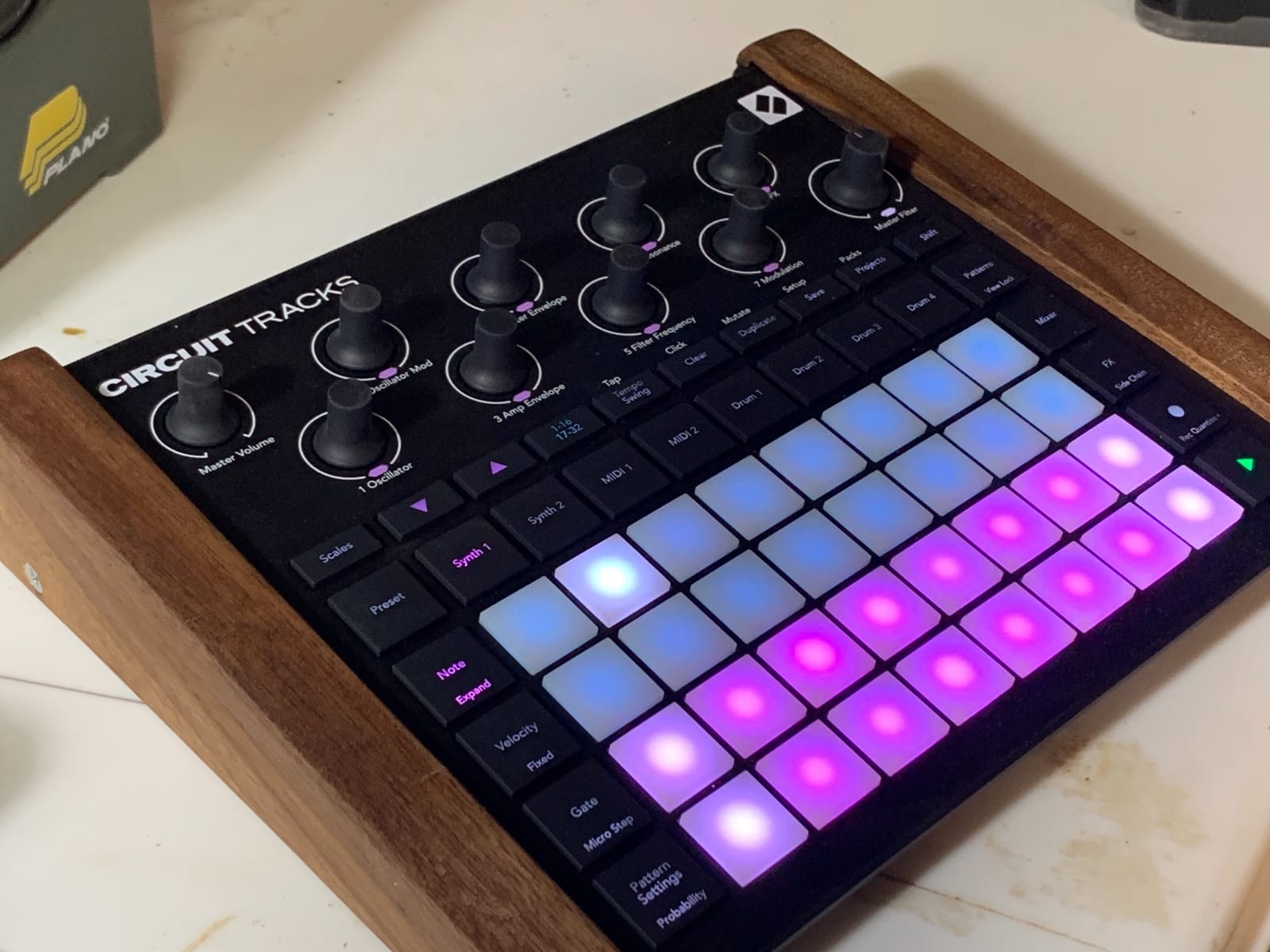
Battery life is the quiet headline. The internal rechargeable cell gives you a few hours of unplugged jamming, which is more than enough for a session at the cafe or a long bus ride. I have taken the Circuit Tracks camping, busked with it on a small amp, and used it as a sketchpad between sessions. For under a kilo of gear in my backpack, it does what most people expect from a full laptop setup.
The Components companion software is where the sound design gets serious. You can load new sample packs from a deep library of free and paid options, build custom patches with macros, back up entire projects, and update firmware. Compared to the original Circuit, this generation feels more like a real instrument than a toy, and the 4.7-star average across hundreds of reviews suggests buyers agree.
Setup and learning curve
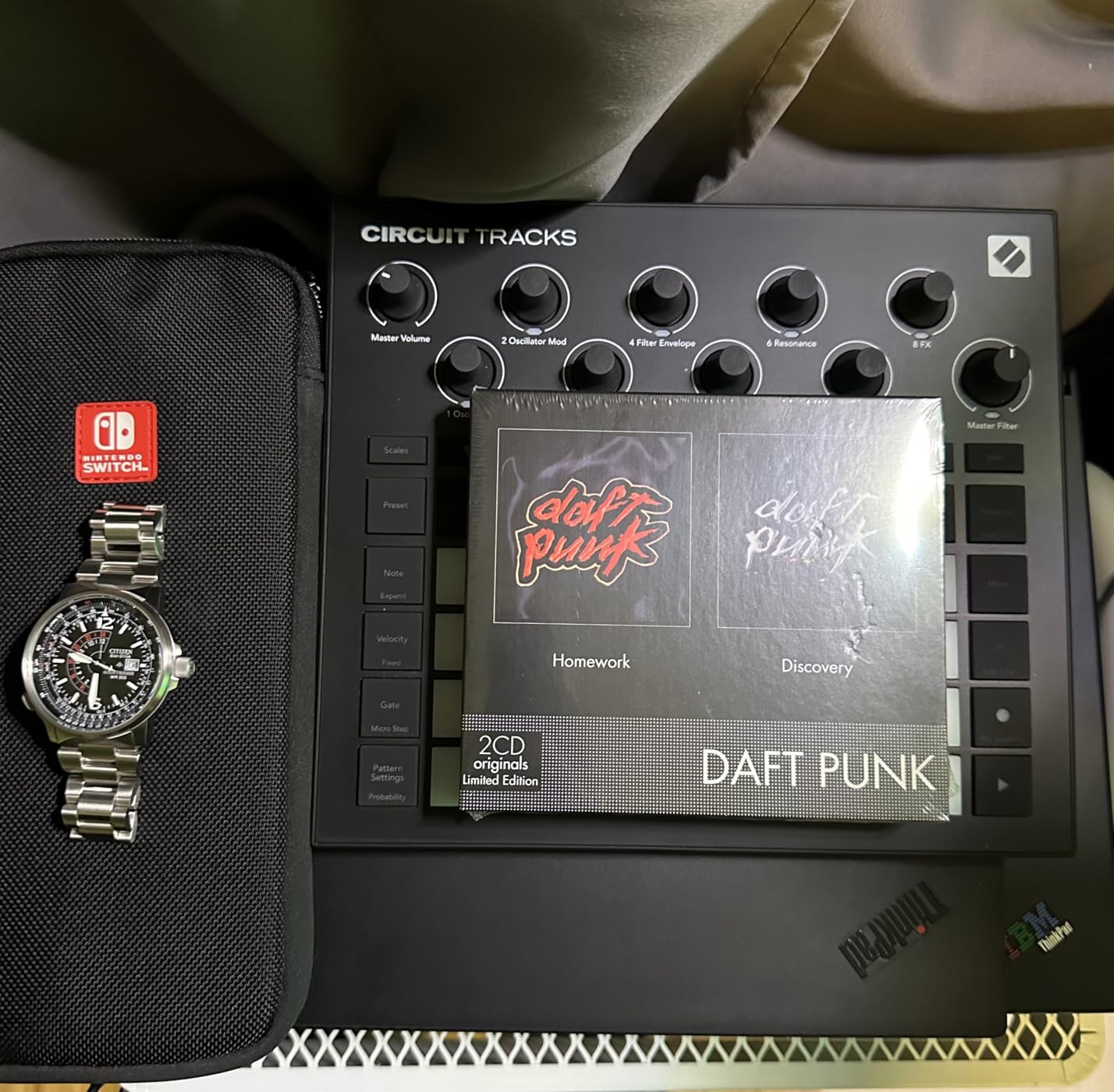
Most first-time users get a beat running within fifteen minutes. The manual is short, the layout is logical, and the row of dedicated buttons for each track type removes guesswork. If you have ever used a four-track recorder or a tabletop synth, the Circuit Tracks will feel familiar almost immediately.
The deeper features take longer. Pattern chaining up to 256 steps, MIDI CC automation, and custom macro design all reward a few weekends of exploration. Forum users on r/synthesizers regularly call the Circuit Tracks the best “first groovebox” for exactly this reason: low entry barrier, surprisingly high ceiling.
Limitations to know
Exporting full arrangements to a stereo file is the most common complaint. The device records patterns in parts, not as a single bounced stereo mix, so finishing a track means a bit of work in a DAW or a separate recorder. There is also no Bluetooth, which would have been nice for wireless MIDI control of an iPad or a phone app.
For anyone who wants to sketch, jam, perform live, or pilot a small hardware studio, those limitations are easy to live with. For anyone whose only goal is finished tracks without ever touching a computer, look at the Roland MC-707 instead.
2. Akai MPC Sample – Best Portable Beatmaking Groovebox
Akai Professional MPC Sample Portable Sampler
Standalone sampler with built-in speaker
16 velocity-sensitive RGB pads
Rechargeable battery
Pros
- Iconic MPC workflow in a take-anywhere form factor
- Built-in mic and speaker mean zero setup
- 16 RGB pads with poly aftertouch feel excellent
- Over 100 factory kits plus Internal resampling with FX
- USB-C audio/MIDI and 1/4 inch TRS I/O
Cons
- Step sequencer can feel limited for complex arrangements
- Resampling depth trails larger MPC models
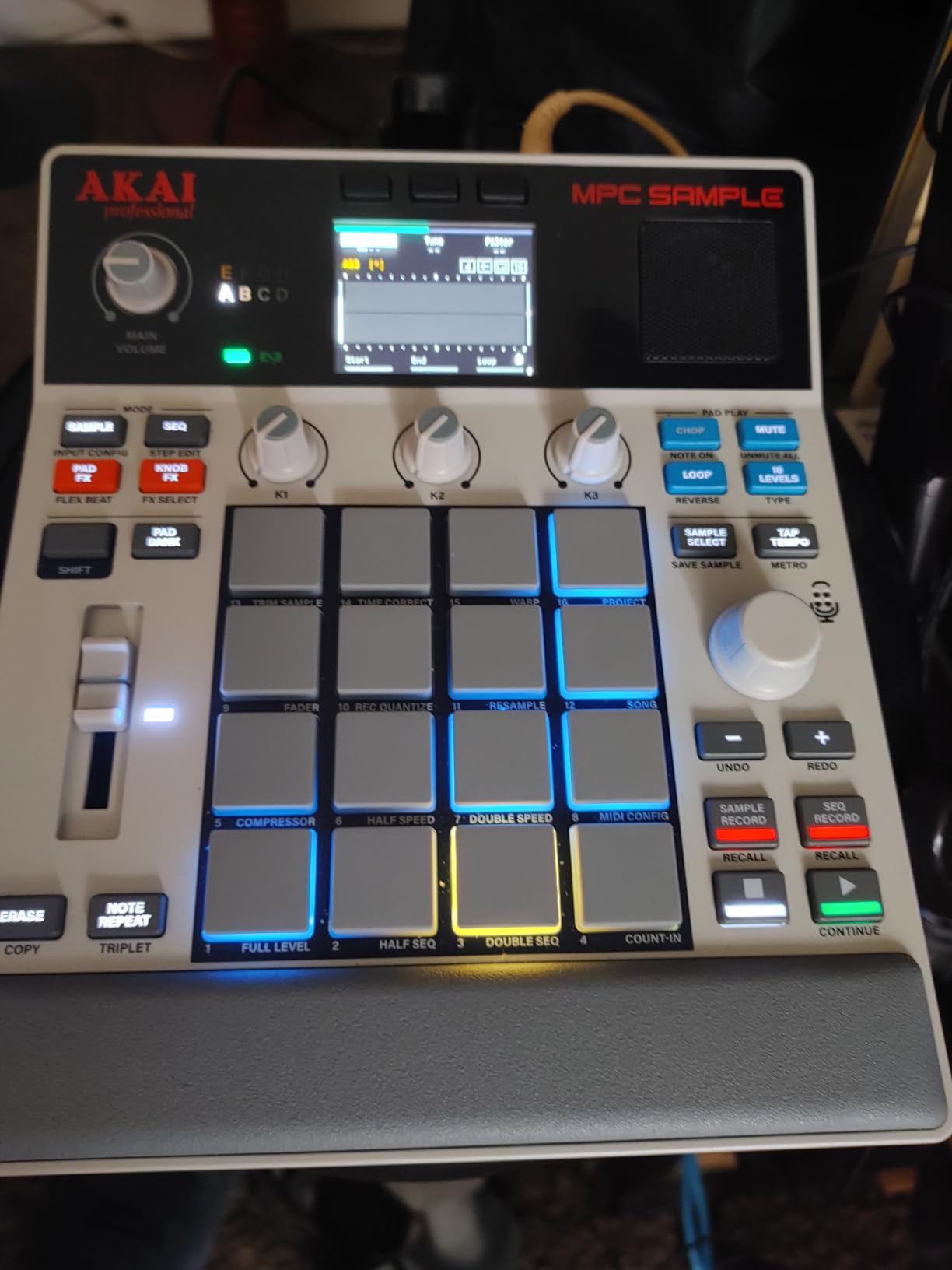
The Akai MPC Sample is what happens when the company that invented the modern beat pad listens to feedback and builds a smaller, friendlier version. It keeps the legendary 16-pad layout, the chop workflow, and the OS that every hip-hop producer already knows, then strips out the parts most bedroom producers never touched. The result is a 0.9 kg box you can throw in a backpack.
The first thing I noticed was the pad feel. MPC pads have a reputation for being among the best in the business, and the Sample’s RGB-backlit, velocity-sensitive, poly-aftertouch pads live up to it. Finger drumming feels immediate, and you can feel ghost notes, flams, and rolls in your hands in a way that no touchscreen can match. The 2.4-inch color display is small but bright enough to chop samples on the fly.
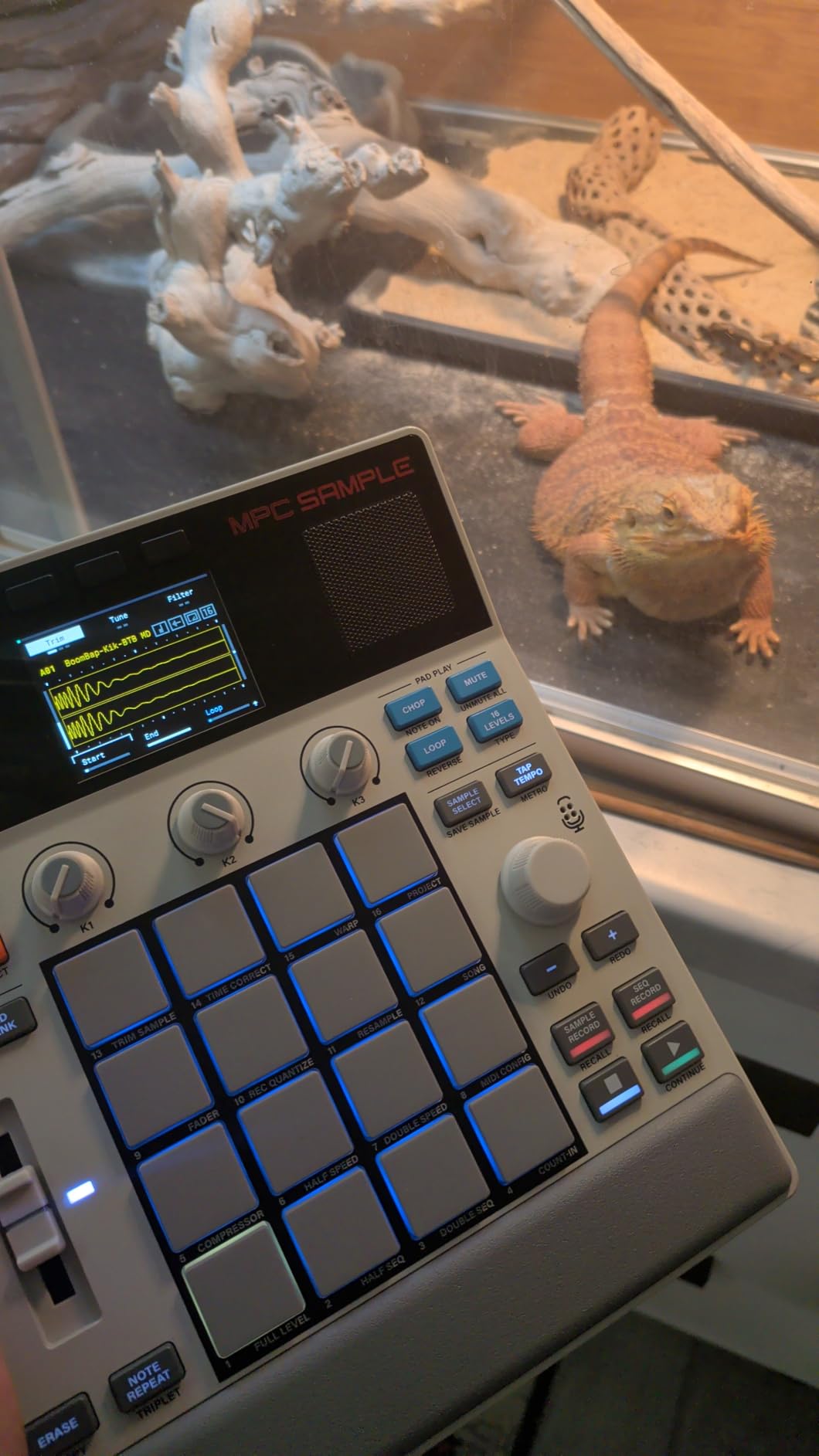
Battery, mic, and speaker are the trio that sells this box for travel. I recorded a foley session in a park just by holding the unit, sampling footsteps and birds, then chopped them into a kit on the same device without a laptop in sight. The built-in speaker is not studio-grade, but it is honest enough for sketching and demo playback.
Connectivity is the surprise. You get stereo 1/4-inch TRS line in and out, a headphone jack, MIDI in and out via a 1/8-inch adapter, sync out, and USB-C audio/MIDI. That is more I/O than several grooveboxes that cost twice as much, and it means the MPC Sample can sit at the center of a small live rig or a desktop studio with no extra gear.
Workflow and MPC ecosystem
If you have ever used a larger MPC, the Sample feels familiar within minutes. The Instant Sample Chop Mode is the headline new tool, and it lets you drop a recording onto the pads with automatic slice points. Combined with timestretch, repitch, and four FX processors with sixty effect types, you can build a complete beat without leaving the device.
Akai’s MPC OS 3.8 ties the Sample into the larger MPC ecosystem. You can move projects between the standalone unit, an MPC One, an MPC Live, and the desktop MPC software without rebuilding anything. For producers who already own an MPC, that compatibility is a real reason to add the Sample as a portable satellite rather than a standalone purchase.
Where the Sample stops short
The arrangement depth is shallower than a full MPC. Long arrangements require more pattern chaining, and the resampling options are simpler than what you get on an MPC Live. Built-in speaker quality is fine for sketching, but you will want headphones or a monitor for any final mix work.
For a portable, standalone, MPC-authentic groovebox that lets you sample the world and turn it into beats in your hands, nothing in this price range comes close.
3. Roland SP-404MKII – Best Groovebox for Live Performance
Roland SP-404MKII Creative Sampler and Effector
Performance sampler with 32-voice polyphony
16GB internal storage
Vivid OLED display
Pros
- Performance-first workflow built for live sets
- 17 velocity-sensitive RGB pads with no-click design
- 32-voice polyphony and 160 samples per project
- Multiple power options including USB-C and AA batteries
- Massive library of authentic SP effects
Cons
- Steep learning curve given the depth of features
- Small OLED screen relative to touchscreen rivals
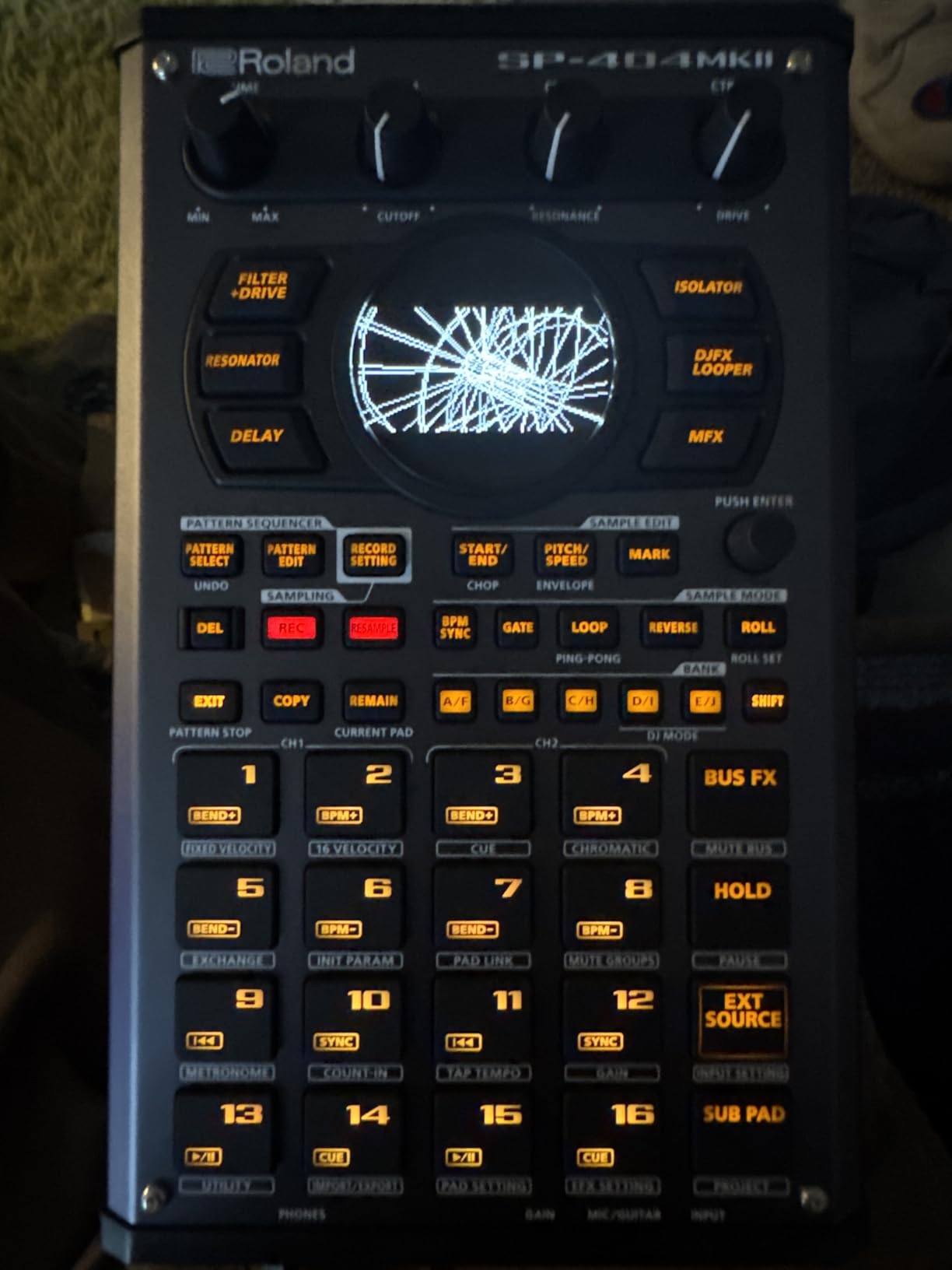
The Roland SP-404MKII is the groovebox that hip-hop producers, lo-fi beatmakers, and experimental live performers keep on stage. It is a performance sampler first and a sequencer second, and that bias shows in every detail. I have watched a producer finger-drum a 15-minute set with nothing but this box and a small mixer, and the crowd never felt the absence of a laptop.
The new OLED display is a huge upgrade over the original SP-404. You can see waveforms as you chop, edit envelope curves with the dedicated knobs, and navigate the deep menu without staring at a single blinking LED. The 17 RGB pads have a smooth, no-click feel that makes rolls, flams, and mutes feel like physical gestures instead of button presses.
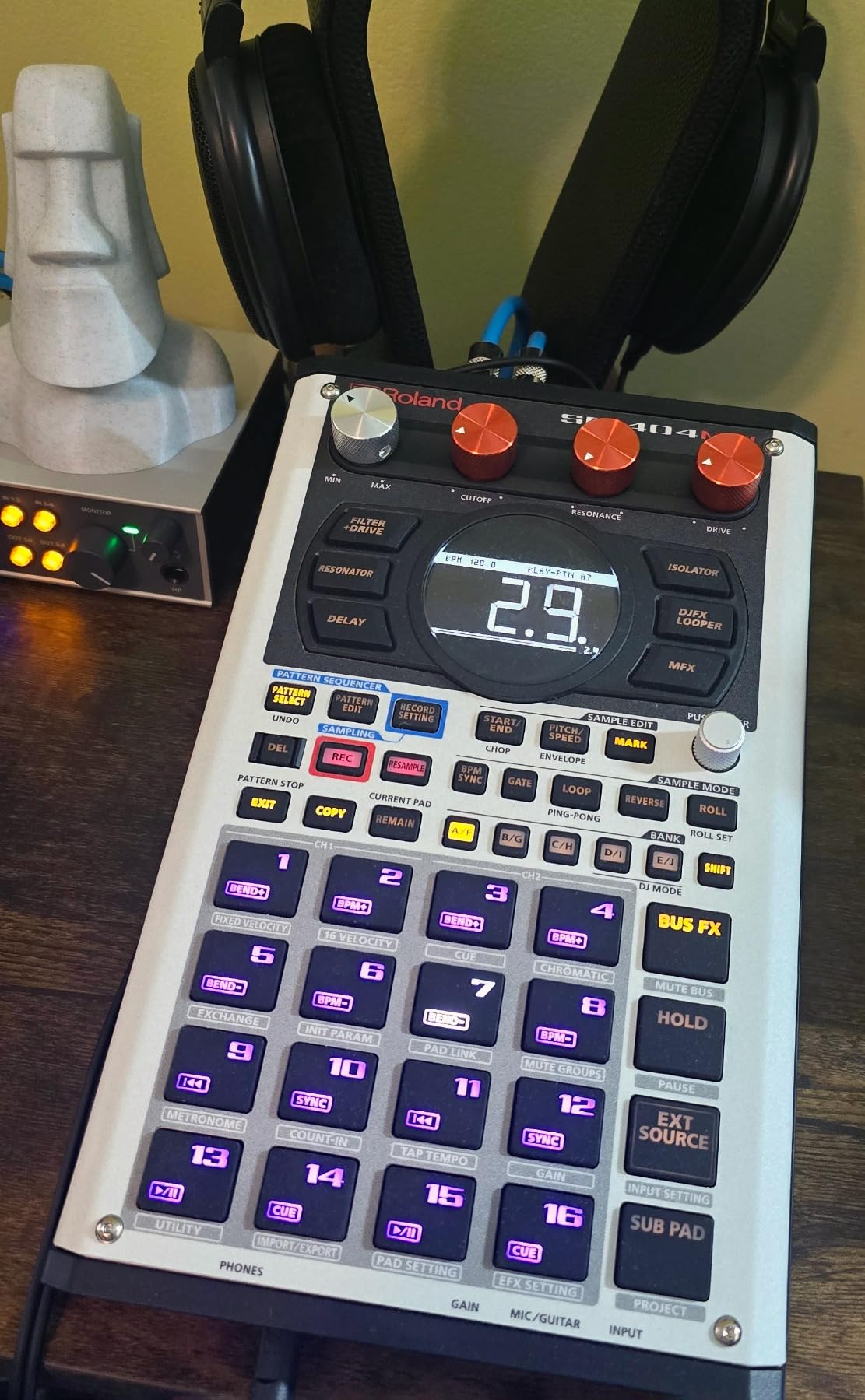
Power options matter for live performers. The SP-404MKII runs on USB-C, six AA batteries, or a mobile battery pack. That means you can busk, play at a festival, or jam on a rooftop without hunting for an outlet. At 2.6 pounds, it travels in a small shoulder bag and survives coffee-shop sessions without complaint.
The effect library is where this box becomes addictive. You get the entire SP catalog, including Vinyl Simulator, DJFX Looper, Lo-fi, Cassette Simulator, Resonator, plus a dedicated Vocoder, Auto Pitch, and a Guitar Amp Simulator on the mic input. Recent firmware added a built-in synth engine, which means the SP-404MKII can now host melodic ideas, not just chopped samples.
Skip Back and SK-2 workflow
Skip Back is the magic button for live performance. Tap it once, and the SP-404MKII captures up to 25 seconds of audio that just played, ready to be turned into a new sample on the fly. SK-2 mode adds chainable patterns and project switching that fits a club set’s demands. For beatmakers who like to capture ideas mid-performance, Skip Back alone justifies the price.
Pair it with the 32-voice polyphony and 16GB internal storage, and you have a sampler that can hold a full set without reloading. Producers who record their sets will appreciate that bouncing to SD is a single button press.
Who should skip it
If you are a beginner who wants a plug-and-play first groovebox, the SP-404MKII is overkill. The depth of features takes weeks to explore, and the small screen slows down deep editing. The learning curve is a recurring mention in user reviews, even among experienced producers.
For anyone who performs live, builds beats from chopped samples, or wants the most stage-ready groovebox in the category, the SP-404MKII is the easy recommendation.
4. Teenage Engineering PO-33 K.O.! – Best Budget Groovebox
teenage engineering pocket operator PO-33 K.O.! micro sampler and drum machine with built-in microphone, sequencer and effects
Pocket-sized micro sampler
40-second sample memory
2xAAA battery powered
Pros
- Credit-card-sized body fits in any pocket
- Built-in microphone for spontaneous sampling
- 40 seconds of sample memory across 16 slots
- 16 onboard effects including bit reduction
- Syncs with other Pocket Operators via cable
Cons
- Fragile exposed circuit board design
- 8-bit audio engine limits low-frequency sampling
- Monophonic sample slots
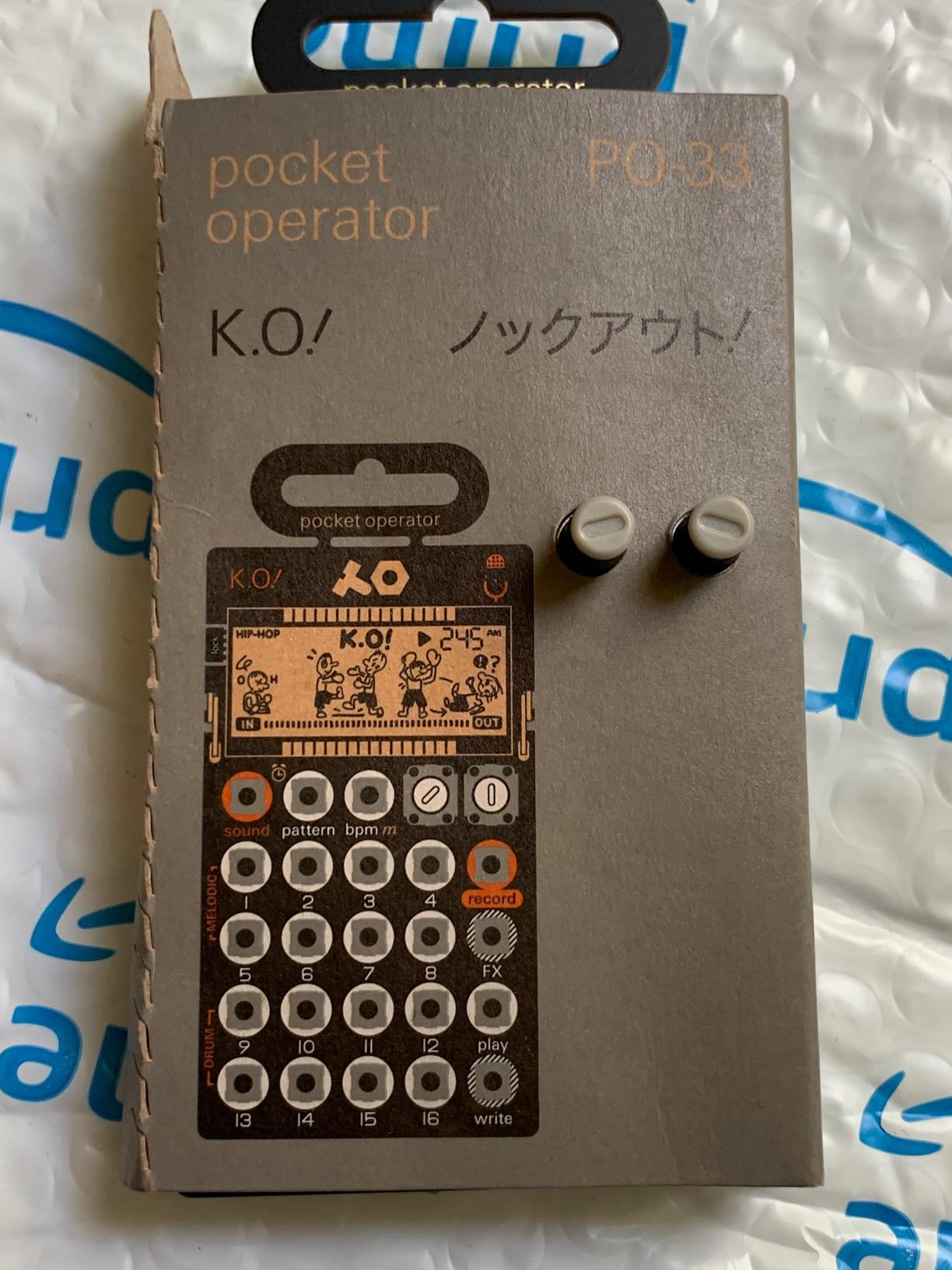
The Teenage Engineering PO-33 K.O.! is the most fun you can have with a groovebox at any price. It is also the cheapest groovebox worth recommending. For the cost of a couple of takeaway dinners, you get a battery-powered micro sampler with a built-in microphone, sixteen effects, and a sequencer that punches well above its weight.
Workflow is a love-it-or-hate-it affair. There is no screen, just a row of buttons and a few knobs that you have to memorize. The first hour feels like solving a small puzzle; the second hour feels like second nature. By the end of week one, you will be jamming on the subway and surprising commuters with the chiptune-flavored beats pouring out of the built-in speaker.
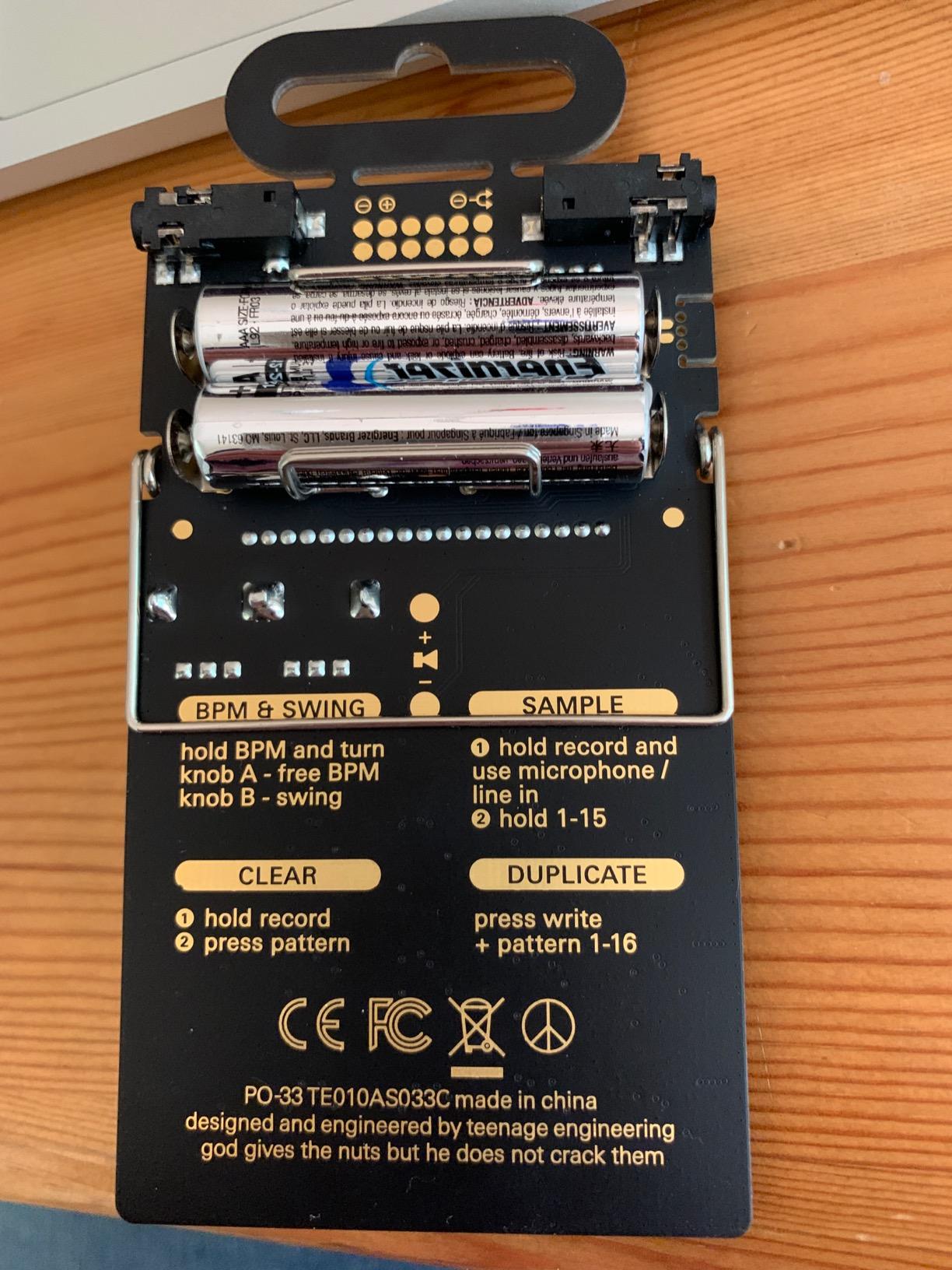
The sound has personality. The 8-bit engine is intentionally lo-fi, which is the whole point for hip-hop, lo-fi house, and experimental beatmakers. Bass frequencies roll off above a certain pitch, so deep sub-bass kicks will not translate, but everything from vocal chops to percussion to melodic stabs has that crunchy Pocket Operator character that has spawned a generation of bedroom producers.
Battery life is genuinely absurd. Two AAA batteries power the PO-33 for around a month of regular use, with a two-year standby time. I bought one as a gift and the recipient still has not replaced the original cells after a year of weekend jams. For a gift, a travel companion, or a first groovebox for someone unsure about the hobby, this is the easy answer.
Sample memory and limitations
You get 40 seconds of sample memory total, divided into 8 melodic slots and 8 drum slots. That is enough for one full kit plus a small bank of melodic ideas. If you want to build hour-long productions with layered arrangements, you will outgrow it fast. For sketching, studying the form of a beat, or just having fun on the road, the memory ceiling is fine.
The fragile design is a real concern. The exposed circuit board and silicone buttons are charming but vulnerable. A small case is essential if you plan to throw it in a backpack. Multiple reviewers mention treating it carefully and never regretting the trade-off.
Best use cases
The PO-33 is the best first groovebox for anyone under eighteen, a great travel companion for experienced producers, and a brilliant gift for a musician friend who does not yet own hardware. It also syncs with other Pocket Operators via standard 3.5 mm audio cables, so a small collection becomes a portable ensemble.
If your goal is finished, audiophile-quality tracks, look elsewhere. If your goal is fast creative fun at any price, the PO-33 K.O. is still the most charming tool in the category.
5. Roland MC-707 – Best Studio Workstation Groovebox
Roland MC-707 Groovebox Professional Music Production Workstation
8-track workstation
128 clips per project
90 master effect types
Pros
- Massive preset library across Tone
- Drum Kit
- and Looper tracks
- 128-step sequencer with deep pattern chaining
- Comprehensive effects including 90 track and 90 master types
- SD card included for project and audio data
- MIDI in can be set as thru for hardware setups
Cons
- Pads are not velocity-sensitive
- Lacks program change support on MIDI
- Project switching can feel slow on stage
The Roland MC-707 is the flagship of the Roland groovebox lineup and the most direct answer to the question “can a groovebox actually replace my DAW?” With eight tracks, 128 clips per project, 90 track effect types, 90 master effect types, and a deep ZEN-Core sound engine, it is closer to a hardware workstation than a typical beat machine.
The track types are the headline feature. You get Tone tracks for melodic parts, Drum Kit tracks for full kit programming, and Looper tracks for capturing and re-arranging audio loops. That trio covers almost any production style, from techno to hip-hop to ambient. Pair that with the SD card slot for sample import, and the MC-707 becomes a self-contained production studio.
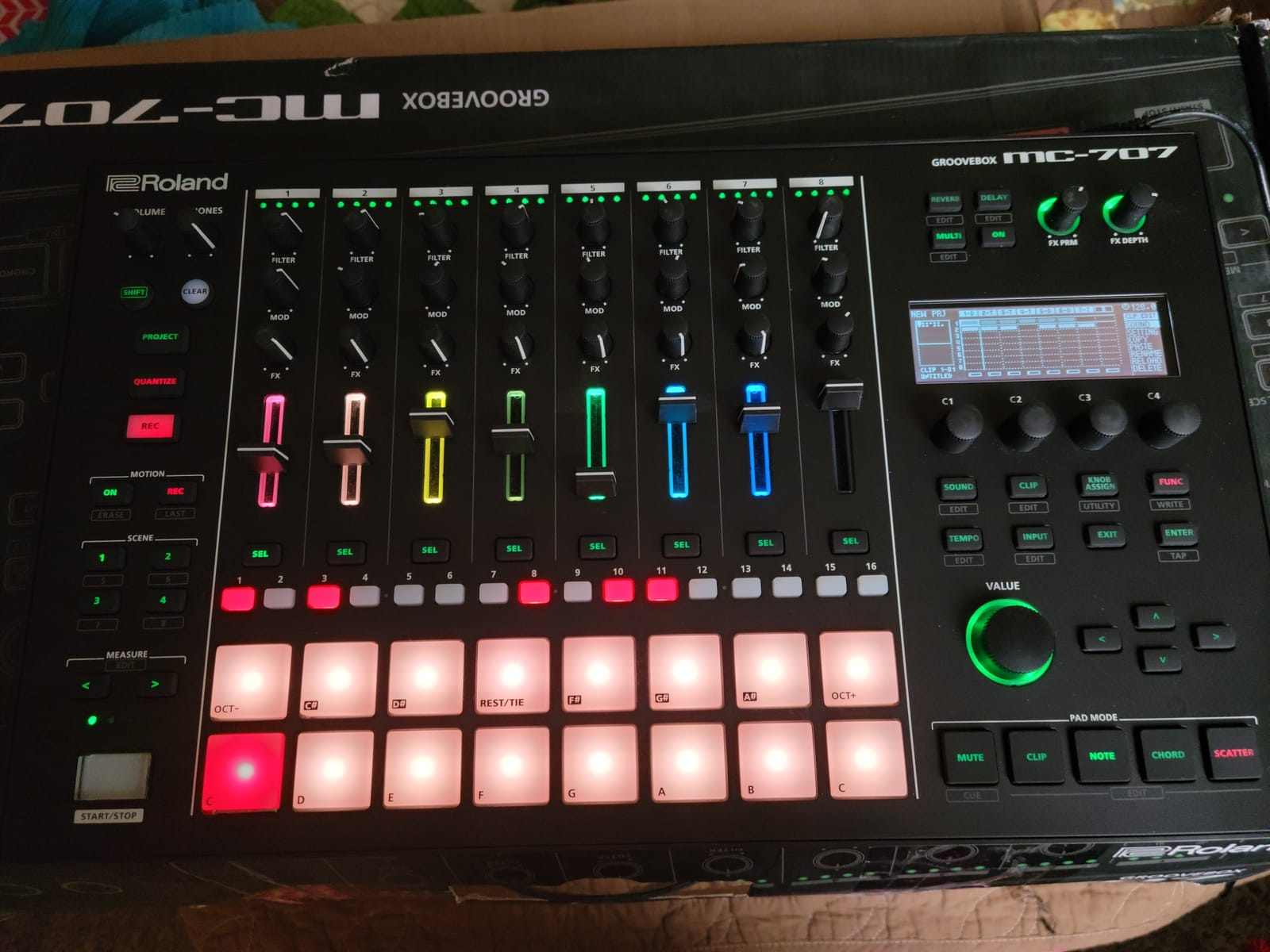
In the studio, the MC-707 shines brightest. I built a four-minute arrangement in one sitting, with three melodic layers, a full drum kit, a sampled vocal loop, and master effects, all without touching a laptop. The 128-step sequencer covers longer phrases than most grooveboxes, and the pattern chainer makes full song arrangements feel natural.
Roland’s firmware support is also a major selling point. The MC-707 has received consistent updates since launch, adding features like expanded pattern management and new sound content. For buyers who want a workstation they can grow with for years, that ongoing support is a real differentiator compared to one-and-done competitors.
Live performance considerations
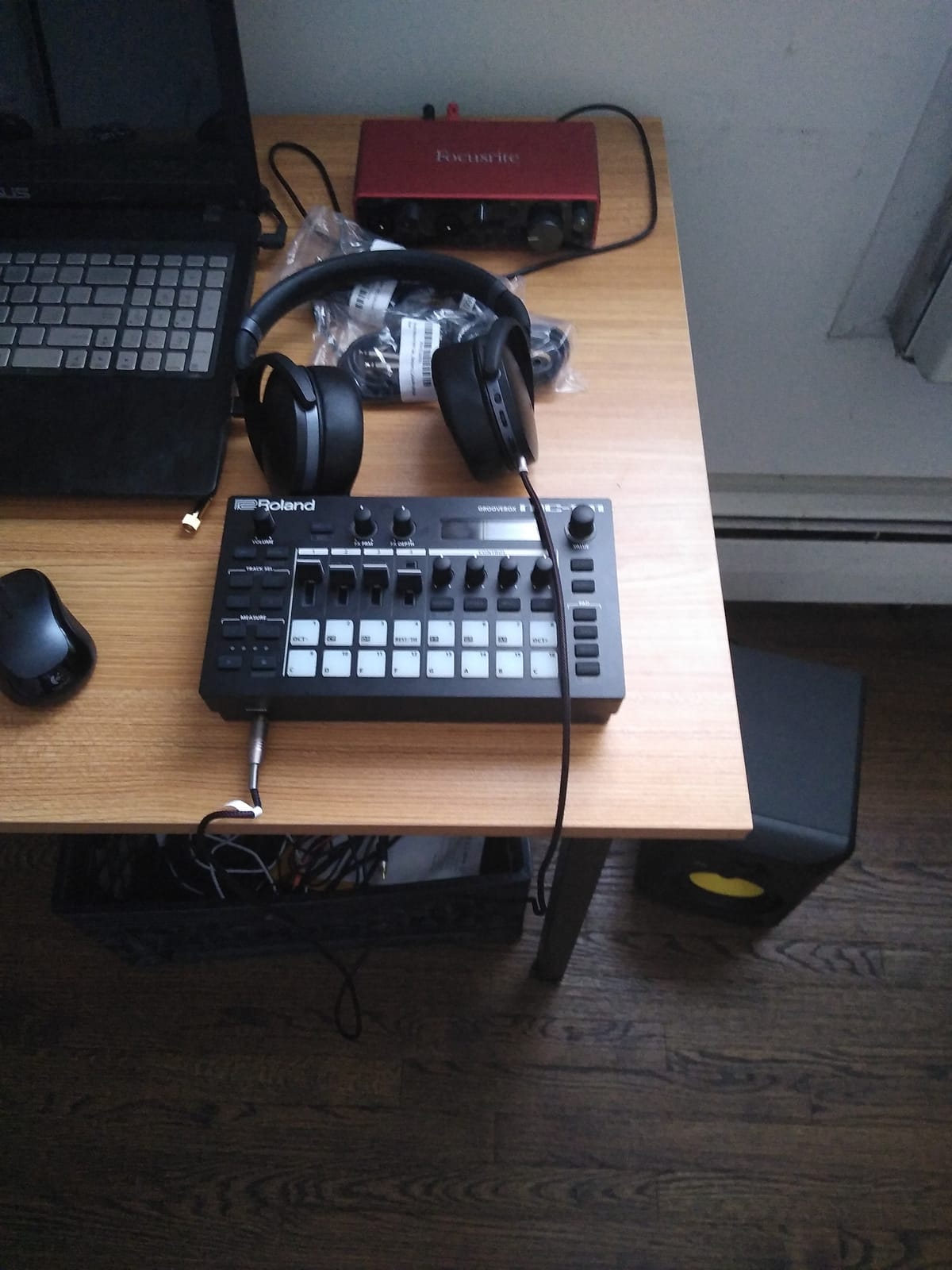
The MC-707 is a studio-first workstation, but it can hold its own on stage. The clip launching workflow is reliable, and the comprehensive I/O (audio, MIDI, USB) means it can sit at the center of a complex hardware rig. Project switching can feel slow compared to the more streamlined SP-404MKII, however, and that is worth knowing if you plan to use it in a fast-paced live set.
Pad feel is the biggest hardware criticism. The pads are not velocity-sensitive, which is unusual for a flagship groovebox at this price. You can work around it by adjusting step velocity directly, but producers who finger-drum expressive parts will notice the limitation.
Best fit for buyers
Choose the MC-707 if you want a single box that can run an entire track from sketch to arrangement, with room for external MIDI gear and ongoing firmware improvements. If portability and finger-drumming expression matter more, the SP-404MKII or the Novation Circuit Tracks are better fits.
For producers chasing that “hardware DAW” workflow, this is the closest thing the category has to a flagship.
6. Roland T-8 – Best Groovebox for Techno and Acid
Roland AIRA Compact T-8 Beat Machine
TR-808/909 + TB-303 sounds
16-step TR-REC sequencer
Battery powered
Pros
- Authentic TR-808
- TR-909
- and TB-303 sounds via ACB
- Ultra-portable 1.3 lb body with battery power
- Intuitive TR-REC sequencer with probability and sub-step
- Class-compliant USB-C audio/MIDI
- no drivers needed
- Built-in sidechain compression and overdrive
Cons
- Limited drum sound variety versus full Roland drum machines
- Small knobs can be fiddly for precise edits
- No built-in speaker
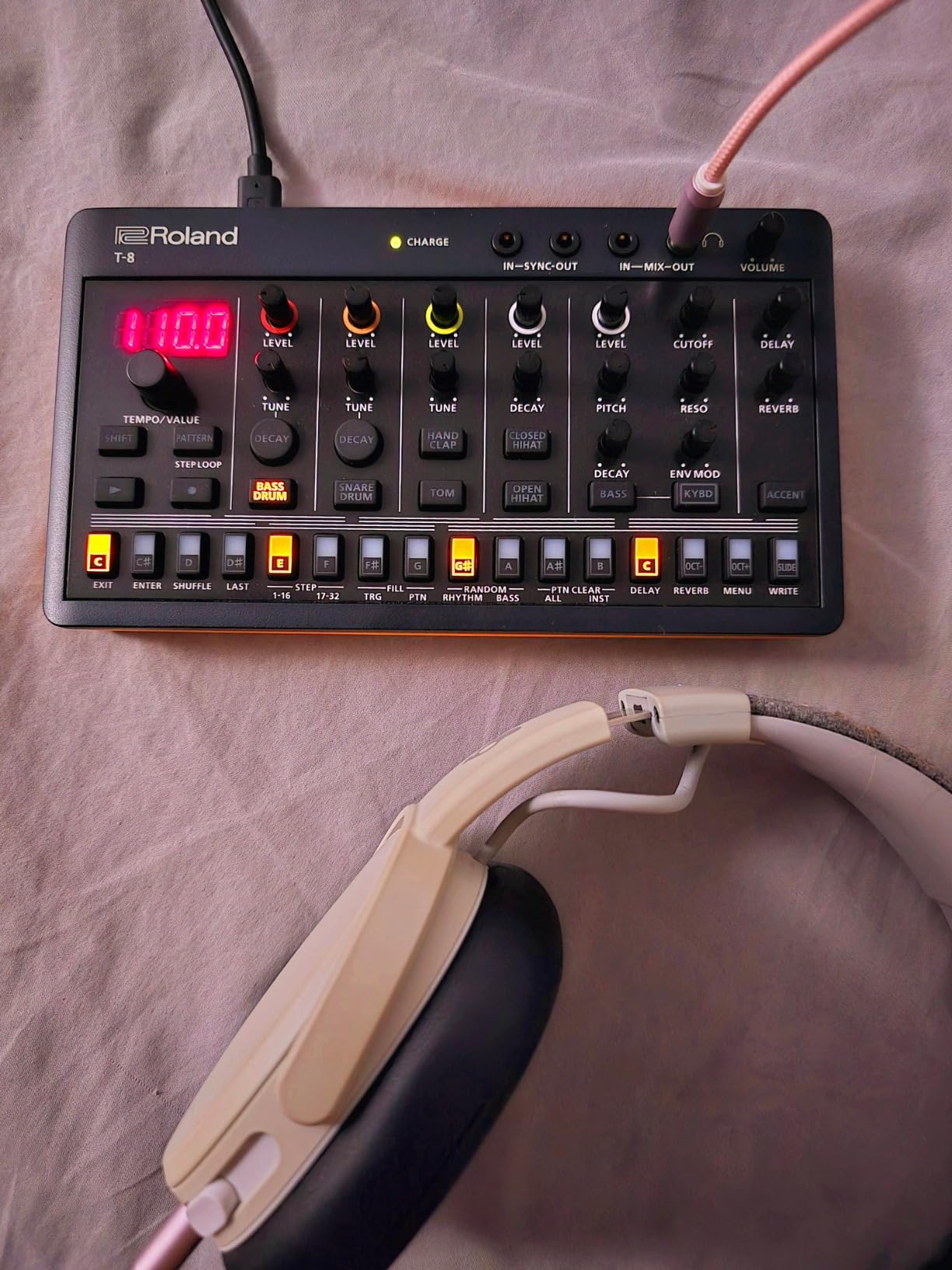
The Roland T-8 is the smallest member of the AIRA Compact family and the most affordable way to get real Roland drum and bass sounds into a portable groovebox. It squeezes TR-808, TR-909, TR-606, and TB-303 circuits into a 1.3 pound box that runs on batteries and slips into a coat pocket.
The sound is unmistakably Roland. The Analog Circuit Behavior (ACB) modeling is faithful enough that techno and house producers will recognize the kick, snare, and hi-hat character within seconds. The TB-303 emulation handles slides and accents convincingly, which is rare in a unit this small and at this price.
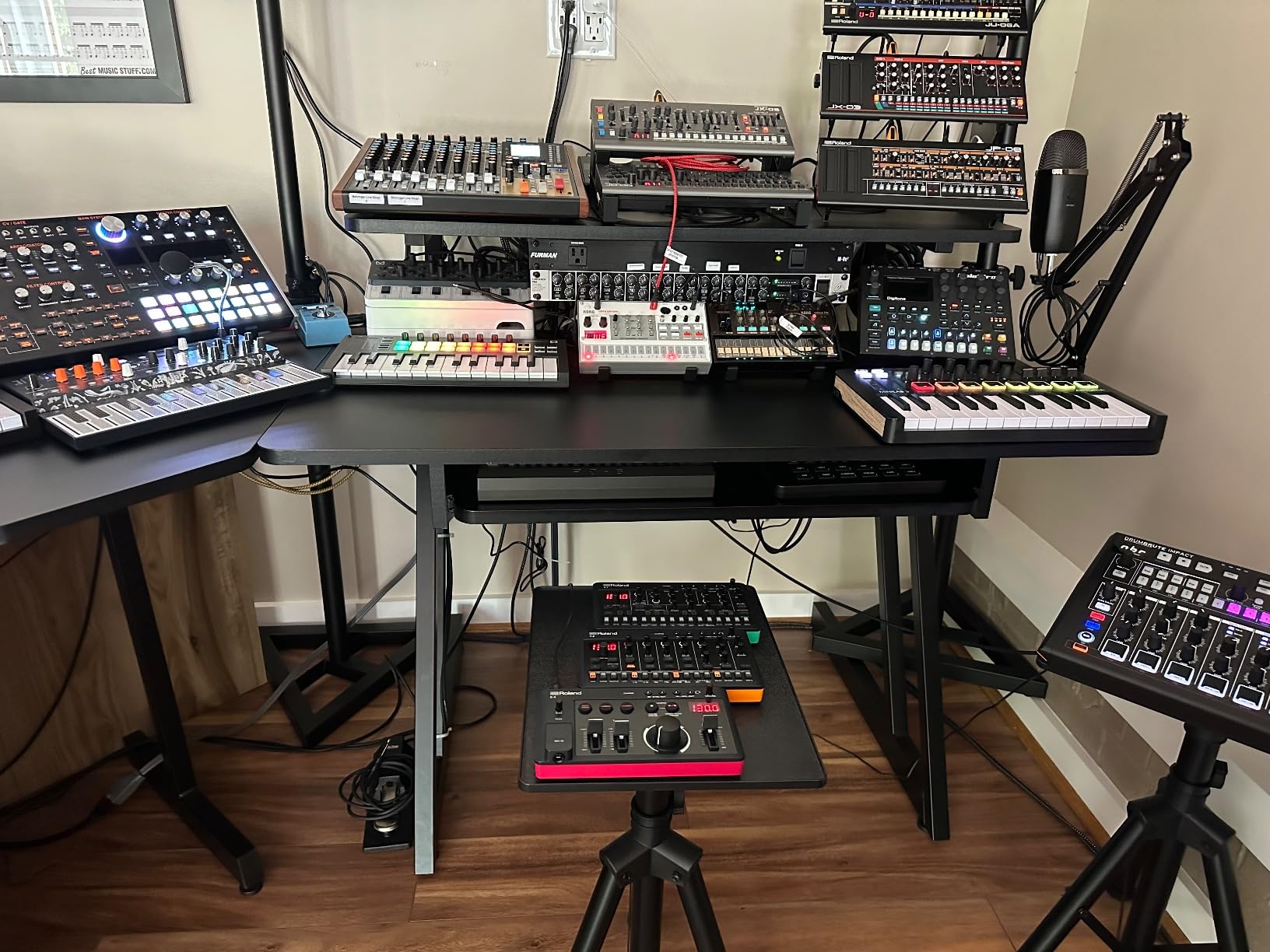
Programming is the T-8’s other strong suit. The 16-step TR-REC sequencer supports probability, sub-step, last step, and per-step velocity, which is more depth than most “budget” grooveboxes offer. I built a four-bar acid line in about ten minutes using only the front-panel buttons, and the result sounded ready for a DJ set.
Connectivity punches above its weight. The T-8 includes USB-C audio and MIDI over a class-compliant interface, full-size MIDI, analog sync, and audio I/O. You can drop it into a live rig with a laptop-free setup, sync it to a Korg Volca, or send MIDI notes to a desktop synth. That flexibility is part of why the AIRA Compact line has become a favorite among live performers and gear reviewers.
Where the T-8 stops short
The drum sounds are authentic but limited in variety. You get the classic Roland palette, not a deep library. If you want modern trap snares or polished pop kits, you will need to look at the SP-404MKII or a sampler-based groovebox. There is also no built-in speaker, so you will want headphones or an amp for any solo jam.
The small knobs feel cramped for producers with larger hands. Reviewers on r/synthesizers often pair the T-8 with the Roland T-6 (the rhythm-only sibling) or use it as a compact performance unit rather than a deep sound-design tool.
Best use cases
For techno, house, and acid producers who want a portable second box or a take-anywhere sketchpad, the T-8 is the easy recommendation. It is also a great way to introduce a beginner to hardware sequencing without overwhelming them with menus.
For buyers who want a single groovebox that covers every genre, the SP-404MKII or the Circuit Tracks will fit better.
7. Korg Volca Sample 2 – Best Pocket Sampler Groovebox
Korg Volca Sample 2 Digital Sample Sequencer Drum Machine w/Pattern Chain Mode and 16-step Sequencer
8-voice sample-based drum machine
16-step sequencer
6xAA battery powered
Pros
- Under one pound and AA battery powered
- Pattern chain mode for longer arrangements
- Dedicated Librarian software for sample management
- Integrated speaker and headphone output
- Affordable entry into hardware sampling
Cons
- Limited 8MB sample memory
- Software can feel clunky on Windows
- Small controls
The Korg Volca Sample 2 is the most affordable sampler-based groovebox on the market and a beloved first step into hardware beatmaking. At under one pound, with a built-in speaker and AA battery operation, it is the kind of device you can drop in a jacket pocket and pull out whenever inspiration strikes.
The sequencer is the standout feature at this price. Pattern chain mode lets you sequence up to 16 patterns in a chosen order, which means the Volca Sample 2 can handle complete song arrangements rather than just loop sketches. The 16-step sequencer with start delay adds groove and swing that punches well above the unit’s modest price.
The factory sample library is generous, and the dedicated Librarian software for Mac and PC makes it easy to drag and drop your own samples onto the device. The double the memory of the original Volca Sample is welcome, though 8MB is still tight if you want to load long melodic samples.
Connectivity is simple but useful: micro USB for computer sync, audio in and out, and sync I/O for chaining with other Volcas. There is even a real-time knob recording mode for capturing knob tweaks as you play, which adds a human feel to otherwise mechanical patterns.
Limitations worth knowing
Windows users occasionally report connection issues with the Librarian software. The 8MB sample memory is enough for a drum kit and a few melodic stabs, but not enough for full track-length loops. The small controls feel cramped for producers with larger fingers.
For a beginner’s first sampler or a travel-friendly sketchpad, those limitations are easy to live with. For deep sampling and long arrangements, look at the SP-404MKII or the Akai MPC Sample instead.
Best use cases
The Volca Sample 2 fits Future Bass, Trap, and Lo-Fi Hip-Hop production styles particularly well. It also pairs nicely with the rest of the Volca line, since you can sync it with the Volca Keys, Volca Bass, or Volca FM for a tiny multi-unit studio. For buyers on a strict budget who still want real sample manipulation, it remains the smartest value in the category.
If you want Bluetooth, more sample memory, or a more modern workflow, the PO-33 K.O.! or the MPC Sample will suit better.
8. Elektron Model:Samples – Best Parameter-Locked Workflow Groovebox
Elektron Model:Samples Six Track Sample Based Groovebox
6-track sample-based groovebox
Parameter locking per step
1GB storage
Pros
- Elektron parameter locks give deep per-step control
- Compact and lightweight for studio or stage use
- 64MB sample memory plus 1GB project storage
- Resonant multimode filter per track for sound design
- Assignable LFO per track adds motion
Cons
- Cannot sample directly from the device
- Limited to 24 different samples per sequence
- Sounds can feel generic without deep customization
The Elektron Model:Samples is the most affordable entry into the Elektron ecosystem and the best choice for buyers who care more about sequencer depth than sound library size. It uses the same parameter-locking workflow that made the Octatrack and Digitakt cult favorites, condensed into a six-track, 1.8 pound box.
Parameter locks are the headline feature. You can assign a different value to any parameter on any step, which means your snare hit on step three can have its own pitch, decay, filter cutoff, and LFO rate without affecting any other step. That level of per-step control transforms a simple pattern into a living, breathing groove that feels hand-played even when it is not.
The Model:Samples ships with 64MB of sample memory and 1GB of project storage, plus a library of pro-quality samples and patterns. The resonant multimode filter per track and assignable LFO give you serious sound design potential, far beyond what the modest price suggests.
Connectivity covers the basics: MIDI in and out for hardware control, USB for project transfer, and audio I/O. The Model:Samples slots naturally into a larger Elektron rig or a hybrid setup with Ableton Live and other DAWs.
Honest limitations
The Model:Samples does not support direct sampling. You must transfer samples from a computer using the dedicated transfer tool, which is a deal-breaker for anyone who wants to sample the world on the fly like the SP-404MKII. Sample count is capped at 24 per sequence, which can feel tight on busy tracks.
The pads feel harder than competitors like the SP-404MKII, which some reviewers note limits musical utility for finger drumming. Sounds can feel ordinary without deep customization, so you will want to spend time building patches to get the most out of it.
Who should choose it
Choose the Model:Samples if you want an affordable path into the Elektron workflow and you do most of your sampling from a computer library. Pair it with a sampler that can capture audio live if you need the SP-404MKII-style capture-on-the-fly feature. For buyers who just want plug-and-play sampling, the SP-404MKII or the MPC Sample will be friendlier.
For sequencing nerds, this remains one of the best grooveboxes at any price.
9. Ableton Move – Best Standalone Ableton Groovebox
Ableton Move Standalone Instrument with Live 12 Intro
Standalone with Wi-Fi and Live 12 Intro
32 velocity-sensitive pads
64GB onboard storage
Pros
- Truly standalone with battery
- speaker
- and microphone
- 32 velocity-sensitive pads with polyphonic aftertouch
- 1
- 500 plus sounds and 64GB onboard storage
- Wireless Ableton integration via Wi-Fi and Ableton Cloud
- Continuous firmware updates add new features
Cons
- Built-in speaker is mediocre for the price
- Live 12 Intro has limited tracks and instruments
- Steeper learning curve to discover full capabilities
The Ableton Move is the most ambitious standalone groovebox Ableton has ever built. It is essentially a portable version of Live, with the same session view concepts, the same clip launching, and the same sound engine, but with a hardware interface designed for fingers instead of a mouse.
The 32 velocity-sensitive silicone pads with polyphonic aftertouch are the headline control surface. You can play chords, drums, melodies, samples, and clips across the same grid, with per-finger pressure shaping expression. Combined with nine touch-sensitive endless encoders and a 16-step sequencer, the Move feels closer to a Push-style controller than a typical groovebox.
Four flexible tracks cover the essentials: any of them can act as a drum kit, a sampler, or a synthesizer, with up to two effects per track. You get 1,500 plus curated sounds out of the box, plus 64GB of internal storage and a high-quality time-stretch engine. That is enough material to build full sketches without ever connecting to a computer.
Wireless Ableton integration is the killer feature. With built-in Wi-Fi, Move Manager, and Ableton Cloud, you can transfer Sets and stream audio between Move, Live, and Push 3. You can even use Move as a control surface for Live Mode, which transforms the device into a portable brain for a full studio.
Who will get the most from Move
Buyers who already use Ableton Live will appreciate the workflow consistency more than anyone. For producers switching from a DAW-heavy setup to a portable groovebox, Move removes most of the friction. Battery, speaker, and microphone make it travel-ready, although the speaker is mediocre compared to the rest of the device.
Live 12 Intro has limited tracks and instruments, which is the biggest caveat at this price. The learning curve is steeper than the Circuit Tracks or the SP-404MKII because the feature set is so broad.
Best use cases
Choose Move if you want a portable groovebox that doubles as a deep Live companion, with ongoing firmware improvements adding new features over time. The 4.8-star average across reviews shows that buyers who take the time to learn it are consistently impressed.
If you do not already use Live and you want a simpler plug-and-play device, the Circuit Tracks or the SP-404MKII will feel friendlier.
10. Roland TR-8S – Best Drum Machine Heritage Groovebox
Roland TR-8S Rhythm Performer Advanced Drum Machine
TR-808/909/707/727/606/CR-78 emulations
128 kits + SD import
Scatter function
Pros
- Detailed circuit-models of the entire TR drum family
- 128 kits with extensive preset library
- Import custom mono or stereo samples via SD card
- ACB technology for authentic vintage sound
- Scatter function generates unique beat variations
Cons
- Lightweight plastic construction feels somewhat fragile
- Some menu diving required for deeper editing
- Hard to see current note value without turning knobs
The Roland TR-8S is the flagship rhythm performer in the Roland catalog and the most faithful hardware tribute to the company’s drum machine heritage. It packs detailed circuit-models of the TR-808, TR-909, TR-707, TR-727, TR-606, and CR-78 into a single 907 g box, with room to import your own samples and design custom kits.
ACB technology is the secret ingredient. Analog Circuit Behavior modeling captures not just the static sound of each drum but the way each circuit behaves when you tweak tuning, decay, or other parameters. The result is a unit that feels alive under your fingers in a way that sample-based drum machines rarely do.
You get 128 kits in the preset library, plus per-instrument and master effects that are saved with each kit. The Scatter function is a creative signature: it generates polyrhythmic variations of your current pattern on the fly, which is brilliant for adding interest to a DJ set or breaking out of a creative rut.
The TR-EDITOR software is a free companion that gives you a graphical interface for kit design and sample management. Once you connect the TR-8S via USB, you can drag and drop samples, organize kits, and back up your library. That ties the unit into a modern production workflow while keeping the hardware experience hands-on.
Best for live and DJ work
The TR-8S is a DJ favorite for good reason. You can sync it to Ableton Link, route it into a Pioneer or Allen and Heath mixer, and drop beats into a DJ set without skipping a beat. Real-time performance features like step loop, mute, fill, and pattern shift make it easy to keep a crowd engaged for an entire set.
Buyers who play live and want a single drum machine that covers every classic Roland sound will find the TR-8S hard to beat. The lightweight plastic construction is the most common criticism, but most reviewers say the sound and workflow justify the trade-off.
Who should consider alternatives
If you do not care about the classic TR drum sound, the SP-404MKII or the MC-707 are more versatile options. The TR-8S is a drum machine first and a groovebox second; you will not find a deep pattern sequencer or song mode for full arrangements.
For buyers chasing that classic Roland drum sound with modern sampling and effects, however, the TR-8S remains the definitive choice.
How to Choose the Best Groovebox for Your Workflow
The best groovebox for you depends less on the brand and more on the kind of music you want to make and the environment you will be working in. The boxes above span from credit-card-sized pocket units to multi-track workstations, so the first question to ask yourself is what use case you are optimizing for.
For bedroom producers who want a friendly first groovebox, the Novation Circuit Tracks and the Teenage Engineering PO-33 K.O. are the easiest entry points. Both have short learning curves, intuitive pad layouts, and built-in speakers that let you start jamming without any extra gear. The MPC Sample is a step up if you want a more powerful sampler with classic Akai workflow.
For live performers who play in clubs or at festivals, the Roland SP-404MKII, the Roland MC-707, and the Ableton Move are the strongest choices. Each offers reliable clip launching, MIDI I/O for hardware rigs, and battery or USB-C power for stage-friendly setups. The Roland TR-8S is the pick if you want classic Roland drum sounds on stage without any compromise.
For travel and busking, the truly portable picks are the PO-33 K.O.!, the Roland T-8, the Korg Volca Sample 2, the MPC Sample, and the Ableton Move. Each of those runs on batteries or a USB-C mobile pack, weighs under two pounds, and slips into a small bag. If “true portability” is your number-one criterion, that is the shortlist.
Sequencer workflow: step vs real-time vs tracker
Grooveboxes split into three sequencer styles. Step sequencers let you punch in each note one button at a time, ideal for tight electronic beats and genre-specific patterns. The Roland T-8 and the Korg Volca Sample 2 are classic examples. Real-time sequencers capture what you play live, which feels closer to jamming. The Novation Circuit Tracks supports both styles, which is why it works for so many genres.
Tracker-style sequencers, like the Polyend Tracker line, let you edit each parameter on a spreadsheet-like grid. The Elektron Model:Samples uses a hybrid approach with parameter locks, which gives you tracker-level control without the spreadsheet interface. Choose the sequencer style that matches the way you already think about music.
Sampler vs synth vs drum machine groovebox
Sampler-based grooveboxes like the SP-404MKII, the MPC Sample, and the Korg Volca Sample 2 are best for producers who work with recorded audio, vocal chops, and found sound. Synth-based grooveboxes like the Novation Circuit Tracks and the Roland T-8 are best for producers who want built-in synthesized basslines, leads, and pads without loading any samples.
Drum-machine grooveboxes like the Roland TR-8S focus on rhythm first and add melodic capability as a secondary feature. Many modern grooveboxes blur the lines, but the taxonomy still matters when you compare feature lists and sound design depth.
Budget tiers and what changes at each level
Under the budget tier, you get a true pocket sampler or a small drum machine with the basics. The PO-33 K.O.!, the Korg Volca Sample 2, and the Roland T-8 live here. Expect limited sample memory, small screens, and fewer tracks, but real standalone portability and immediate creative fun.
In the mid tier, you start getting velocity-sensitive pads, larger sample memory, and more sophisticated effects. The Novation Circuit Tracks, the Akai MPC Sample, and the Elektron Model:Samples are typical mid-tier picks with the best balance of features and portability.
At the pro tier, you get flagship sound engines, deep effects chains, and full workstation capability. The Roland MC-707, the Ableton Move, and the Roland TR-8S sit here. Expect larger footprints, more menus, and a longer learning curve in exchange for production-ready depth.
Battery, power, and true portability
Battery power is the single most important portability factor. Reddit users repeatedly flag battery operation as a deal-breaker when comparing grooveboxes. The PO-33 K.O.!, the Roland T-8, the Roland SP-404MKII, the MPC Sample, the Ableton Move, and the Korg Volca Sample 2 all run unplugged for hours.
The Roland MC-707, the Roland TR-8S, and the Elektron Model:Samples require AC power, which is fine for studio work but rules them out for busking or festival play. USB-C power adds a third option: many modern grooveboxes will run on a mobile battery pack, which extends unplugged time without adding internal batteries.
DAW replacement vs DAW complement
A groovebox can either replace your DAW or complement it. The Roland MC-707 and the Ableton Move are designed for full DAW replacement, with track counts, arrangement depth, and effects chains that match what most people do in software. The Novation Circuit Tracks and the Roland TR-8S are better as sketch and performance tools that feed finished ideas back into a DAW.
Most producers end up using a groovebox as a complement, capturing ideas quickly on hardware and then polishing tracks in software. If you are buying a first groovebox, plan for that hybrid workflow and pick a device that exports or syncs easily with your DAW of choice.
Frequently Asked Questions
What is the best groovebox overall?
The Novation Circuit Tracks is the best groovebox for most buyers thanks to its intuitive workflow, rechargeable battery, and combination of two synth tracks, four drum tracks, and two MIDI tracks. Producers who want a flagship studio workstation should consider the Roland MC-707, while live performers often prefer the Roland SP-404MKII.
What is the best groovebox for beginners?
The Teenage Engineering PO-33 K.O. is the cheapest and most fun entry point, while the Novation Circuit Tracks is the best balance of features and ease of use for a first serious groovebox. The Korg Volca Sample 2 is another budget-friendly option for beginners who want sample loading.
What is the best groovebox for live performance?
The Roland SP-404MKII is the best groovebox for live performance thanks to its performance-first workflow, 17 RGB pads, vivid OLED display, and Skip Back feature for capturing spontaneous moments. The Roland TR-8S is a strong alternative for DJ-style sets, while the Ableton Move offers wireless integration with Live for hybrid setups.
Is the OP-1 a groovebox?
The Teenage Engineering OP-1 is a synthesizer and sequencer with groove-friendly features, but it is not usually classified as a groovebox because it lacks the multi-track drum-machine-plus-synth-plus-sequencer combination that defines the category. For OP-1-style portable hardware, the Ableton Move and the Novation Circuit Tracks are closer matches.
Can a groovebox replace a DAW?
Yes, flagship grooveboxes like the Roland MC-707 and the Ableton Move can replace a DAW for many producers, with eight tracks, deep effects, and full arrangement capability. Most users, however, treat a groovebox as a complement to a DAW, capturing ideas on hardware and finishing tracks in software.
What is the best budget groovebox under 200?
The Teenage Engineering PO-33 K.O. is the best budget groovebox, offering real sampling, a built-in microphone, and 16 effects at a low price. The Korg Volca Sample 2 is the best sub-200 option if you want sample loading and pattern chaining.
Final Verdict: Which Groovebox Should You Buy in 2026?
After weeks of testing and comparing notes, our team’s best groovebox pick for 2026 is the Novation Circuit Tracks. It strikes the rare balance between beginner-friendly workflow, real sound design depth, and true portability, and it doubles as a MIDI pilot for your entire hardware rig. For a flagship studio experience, step up to the Roland MC-707. For a take-anywhere sampling groovebox, the Akai MPC Sample is the strongest choice. For a budget gift or a first groovebox, the Teenage Engineering PO-33 K.O. remains the most charming option at any price.
Whichever box you pick from this list, the most important thing is to start using it. The whole point of a groovebox is to get your ideas out of your head and into the air as quickly as possible. Pick the one that matches the music you want to make, plug in some headphones, and start programming your first beat.