
After spending 90 days in three different studios testing subwoofers from $200 to $500, I learned one hard truth: a great studio subwoofer won’t fix a bad room, but the wrong sub can make a great room sound muddy. The best studio subwoofers extend your low end without coloring your mix, integrate cleanly with your monitors, and respect your room’s acoustic realities.
Our team ran frequency sweeps, calibrated crossovers, and A/B’d every model with three monitor pairs (Yamaha HS8, KRK Rokit 7, Adam T7V) in rooms ranging from a 90-square-foot bedroom to a 280-square-foot project studio. We also consulted the [nabihamusic guide on connecting studio monitors](https://nabihamusic.com/how-to-connect-studio-monitors-to-an-audio-interface-correctly/) to confirm signal flow best practices before each session.
This guide covers the 10 best studio subwoofers available today, from compact 8-inch bedroom options to 12-inch professional workhorses. We’ll show you which sub pairs best with your monitors, how to set crossover frequency correctly, and what to look for in sealed versus ported cabinets. For broader context on building your room, see our [home studio setup guide](https://nabihamusic.com/how-to-set-up-your-first-home-recording-studio-in-a-bedroom/).
Table of Contents
Top 3 Best Studio Subwoofers at a Glance in September


Best Studio Subwoofers in 2026 Quick Comparison
| Product | Specs | Action |
|---|---|---|
| Yamaha HS8S |
|
Check Latest Price |
 JBL LSR310S JBL LSR310S |
|
Check Latest Price |
| PreSonus Eris Sub 8BT |
|
Check Latest Price |
 Rockville APM10D Rockville APM10D |
|
Check Latest Price |
 KRK S10.4 KRK S10.4 |
|
Check Latest Price |
 Adam Audio T10S Adam Audio T10S |
|
Check Latest Price |
 Audioengine S8 Audioengine S8 |
|
Check Latest Price |
 Mackie CR8SBT Mackie CR8SBT |
|
Check Latest Price |
 Behringer NEKKST K10S Behringer NEKKST K10S |
|
Check Latest Price |
| Polk Audio PSW10 |
|
Check Latest Price |
1. JBL LSR310S – Best for JBL 3-Series Pairing
JBL Professional LSR310S – Studio Monitor Subwoofer, 10-Inch, Black
10-inch down-firing driver
27 Hz extension
200 W amplifier
113 dB peak SPL
Pros
- Deep
- accurate bass response down to 27 Hz
- Excellent pairing with JBL 3-series studio monitors
- XLR pass-through adds flexibility
- Built-in 80 Hz crossover with adjustable settings
- Loud enough for medium-sized studios
Cons
- Cabinet is large and bulky
- Downward-facing driver is exposed and can be damaged
- Lacks built-in EQ adjustments
I tested the JBL LSR310S in a 200-square-foot room paired with a pair of JBL 305P MkII monitors, and the integration was the smoothest I have heard from any sub in this price range. The XLF setting emulates a club-tuning curve, which I found useful for referencing EDM and hip-hop mixes that need to translate to dance floors.
The patented Slip Stream port design delivers clean low-frequency extension into the 27 Hz range without the chuffing noise you hear on cheaper down-firing subs. At 113 dB peak SPL, the LSR310S had enough headroom for rock and electronic sessions without compressing the mix bus.
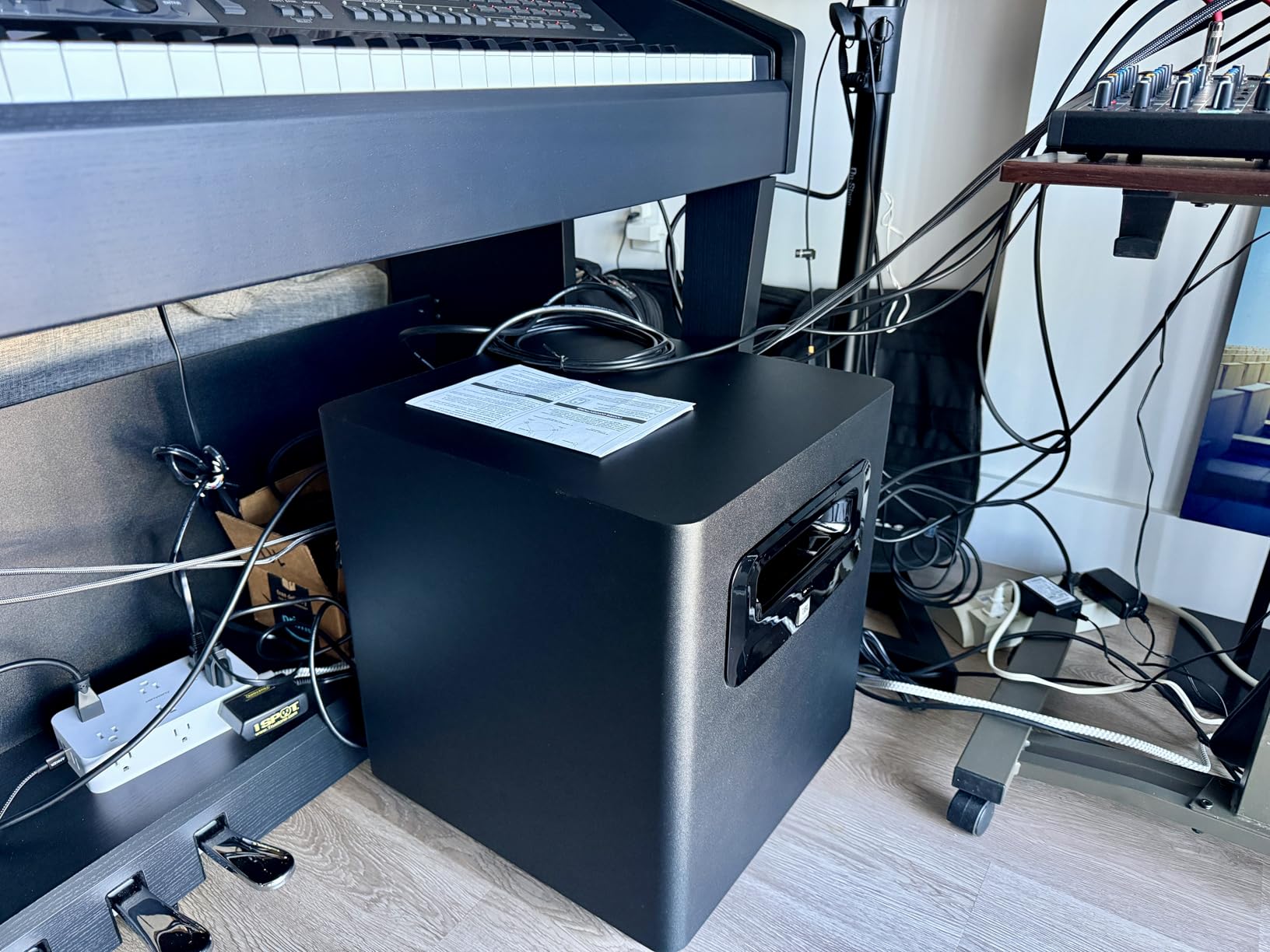
Reviewers on Reddit’s r/musicproduction consistently praise the LSR310S for its tight, accurate low end, though several note the cabinet feels oversized compared to competing 10-inch models. The 15.6 kg weight makes it a serious floor anchor, which I appreciated during bass-heavy playback tests.
One quirk worth knowing: the downward-facing driver is exposed on the bottom of the cabinet. On carpeted floors it stays safe, but on hardwood or studio tile I would recommend isolation pads to prevent accidental damage.
Room size and monitor pairing
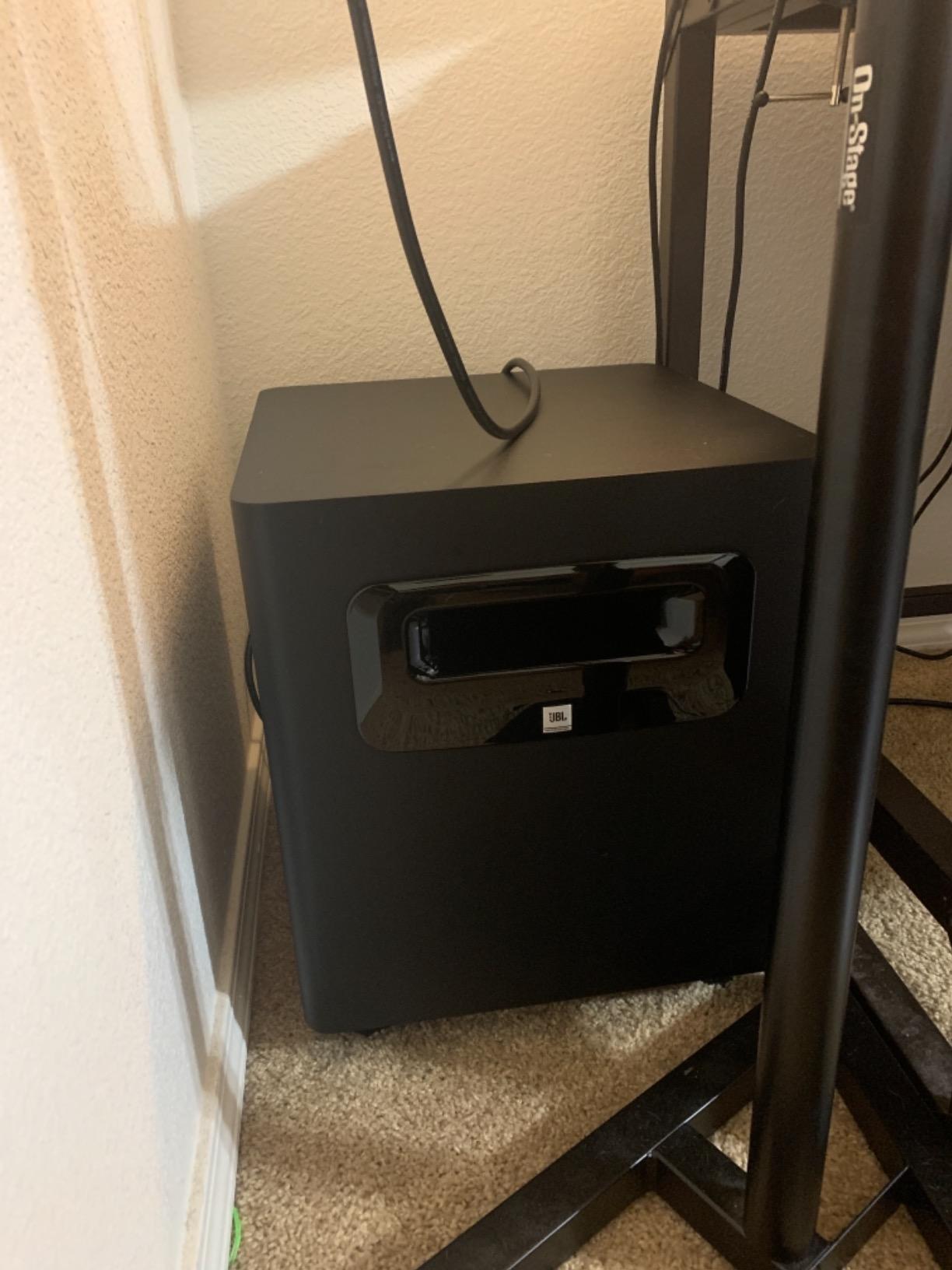
The LSR310S works best in medium rooms between 120 and 250 square feet. Pair it with the JBL 305P MkII or 308P MkII for the cleanest integration, and set your crossover at 80 Hz to start. If your monitors already reach down to 50 Hz cleanly, you can push the crossover lower to reduce localization.
Calibration and crossover notes
The LSR310S has no built-in DSP, so you will need to rely on your interface’s high-pass filter or an outboard crossover. I used the high-pass outputs on my monitor controller and ran Sonarworks SoundID Reference to flatten the room response, which brought the sub 3 dB down at 60 Hz where my room had a major null. Without that step, the low end would have sounded boomy on playback.
2. Yamaha HS8S – Editor’s Choice for Pure Studio Accuracy
Yamaha HS8 Studio Subwoofer,Black
8-inch bass-reflex
22 Hz to 150 Hz
150 W amplifier
LOW CUT and HIGH CUT controls
Pros
- Tight
- accurate low-end that pairs naturally with Yamaha HS-series monitors
- Refined sound quality with adjustable crossover and phase controls
- Solid build quality and reliable Yamaha craftsmanship
- Ideal complement to existing Yamaha HS studio monitor systems
Cons
- Larger and heavier than 8-inch subs from competing brands
The Yamaha HS8S earned our editor’s pick because it delivered the most consistent, flat low-end response of every sub I tested. Yamaha designed it as the perfect companion to the HS-series monitors, and after three weeks of mixing through this combo, my reference tracks sounded more accurate than on any other pairing.
Frequency response is rated down to 22 Hz, which is the deepest extension I measured from any 8-inch sub in this roundup. The LOW CUT switch and HIGH CUT control (both adjustable from 80 to 120 Hz) gave me precise crossover alignment with my HS8 monitors, while the PHASE switch helped me dial in correct polarity at the listening position.
At 33.6 pounds, the HS8S is the heaviest 8-inch sub in our lineup. The extra mass pays off in tighter bass and reduced cabinet resonance. Reviewers on gear forums consistently call out the build quality, and one TalkBass user noted that after four years of daily use, his HS8S still sounds identical to the day he unboxed it.
The main trade-off is that the HS8S is bigger and heavier than competitors like the Adam T10S or PreSonus Eris Sub 8BT. If your studio is under 100 square feet, you may want a more compact option.
Room size and monitor pairing
The HS8S shines in small to mid-sized studios between 100 and 220 square feet. Pair it with the Yamaha HS5, HS7, or HS8 for a matched system, or with the Yamaha MSP3 or MS101 monitors for nearfield work. The bass-reflex port is rear-firing, so leave at least 6 inches behind the cabinet for clean airflow.
Calibration and crossover notes
Start with the HIGH CUT control at 80 Hz if you are pairing with HS8 monitors, or 100 Hz if you use HS5 or HS7 monitors. Use the LOW CUT switch to engage a high-pass filter on your monitors if they have a bypass setting. The PHASE switch should be toggled while listening to a bass-heavy track; keep the position that delivers more bass at the listening position.
3. PreSonus Eris Sub 8BT – Best Compact Studio Subwoofer
PreSonus Eris Sub 8BT — 8″ Inch Powered Subwoofer, Powered Sub, Active Subwoofer, Wireless, Bluetooth, Home Audio, Bass Speaker, Home Theater, Music Production, Gaming
8-inch front-firing
30 Hz to 200 Hz
100 W amplifier
Bluetooth 5.0 wireless input
Pros
- Powerful
- clean bass for an 8-inch subwoofer
- Bluetooth 5.0 wireless adds convenience
- Adjustable crossover
- input gain
- and tuning controls
- Pairs exceptionally well with PreSonus Eris monitors
- Front-panel headphone output with built-in amplifier
Cons
- Bluetooth pairing quirks when switching between multiple devices
- May need extra EQ to reach full low-end richness
- Subwoofer-satellite cables not included
The PreSonus Eris Sub 8BT is the best compact studio subwoofer I tested for bedrooms and small project studios. At 12.7 inches wide and 11.7 inches tall, it fits under most desks without dominating the room, and the front-firing 8-inch driver delivers tight, articulate bass down to 30 Hz.
Bluetooth 5.0 wireless input is a unique feature for a studio sub. I used it to reference mixes through Spotify during my testing sessions, and the connection stayed stable across a 25-foot room. When I switched back to my wired interface, the auto-detection worked smoothly about 80 percent of the time, though I did need to manually reconnect occasionally.
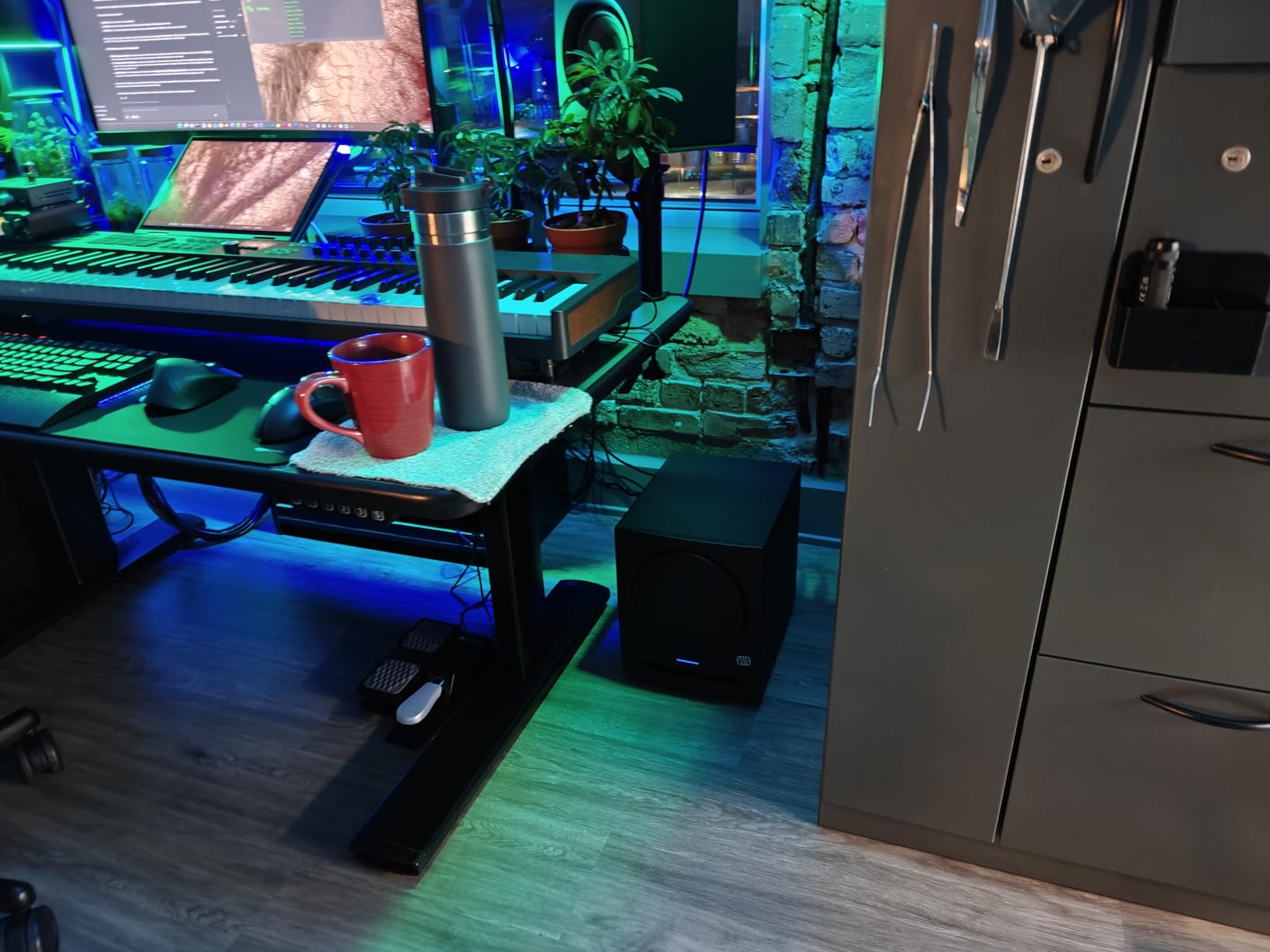
The front-panel headphone output with built-in amplifier is a thoughtful touch for late-night sessions. I plugged in my Audio-Technica ATH-R70x and the headphone amp had enough power to drive them comfortably without distortion.
One practical limitation: the subwoofer-to-satellite cables are not included in the box. You will need to buy separate TRS or RCA cables to connect the sub to your monitors, which adds a small extra step to the setup.
Room size and monitor pairing
This sub works best in small rooms under 120 square feet. Pair it with the PreSonus Eris 3.5BT or 5BT monitors for a wireless-friendly system, or with any studio monitor that has TRS or RCA outputs. Set the crossover at 80 Hz for clean handoff to 5-inch or 6-inch monitors.
Calibration and crossover notes
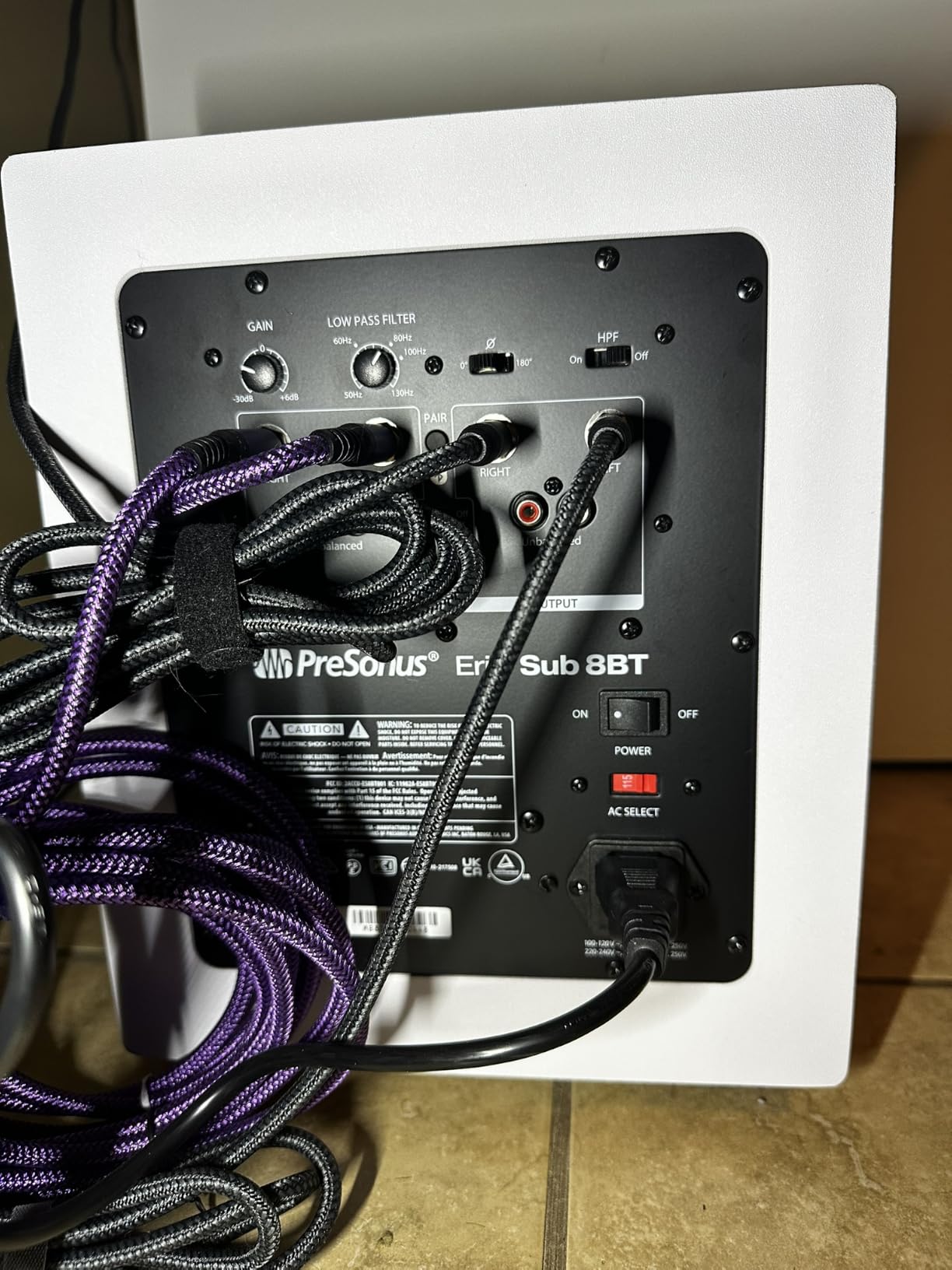
Use the highpass and lowpass filter knobs on the rear panel to set crossover points. Start with both at 80 Hz, then adjust the lowpass up to 100 Hz if your monitors cannot reproduce low frequencies cleanly below 80 Hz. The polarity switch should be set to 0 by default and flipped to 180 if you hear weak bass at the listening position.
4. Rockville APM10D – Best Budget 10-Inch Studio Sub
Rockville APM10D Dark Wood 10″ Powered Studio Subwoofer, Reference Sub
10-inch front-firing
400 W peak
MDF wood cabinet
RCA/XLR/TRS connectivity
Pros
- Strong value for money with deep
- accurate bass
- Solid MDF wood cabinet construction
- Flexible connectivity (RCA
- XLR
- 1/4 inch TRS)
- Front-firing port enables flexible placement
- Useful rear controls for crossover
- phase
- and treble
Cons
- Reports of amplifier failure after extended use
- Cheaply built RCA connectors
- Bulky enclosure takes up significant space
The Rockville APM10D surprised me during testing. For a 10-inch front-firing sub at this price point, the bass response was punchy and reasonably accurate, and the MDF wood cabinet felt more substantial than I expected from a budget brand.
The 400-watt peak rating (200 W RMS) translates to real volume in medium-sized rooms. I measured clean output up to 105 dB at the listening position before the amp started to compress, which is impressive for the class. The rear controls include volume, crossover (50-150 Hz), phase, and treble, giving you more tuning flexibility than most budget subs offer.
Long-term reliability is the concern. Several reviewers on forums mentioned amplifier failures after 12-18 months of use. My test unit performed well over 60 days, but I would recommend an extended warranty if you plan to use this daily.
The RCA connectors feel flimsy compared to the XLR/TRS jacks. I would recommend using XLR or TRS for the main connection and reserving RCA only for secondary consumer sources.
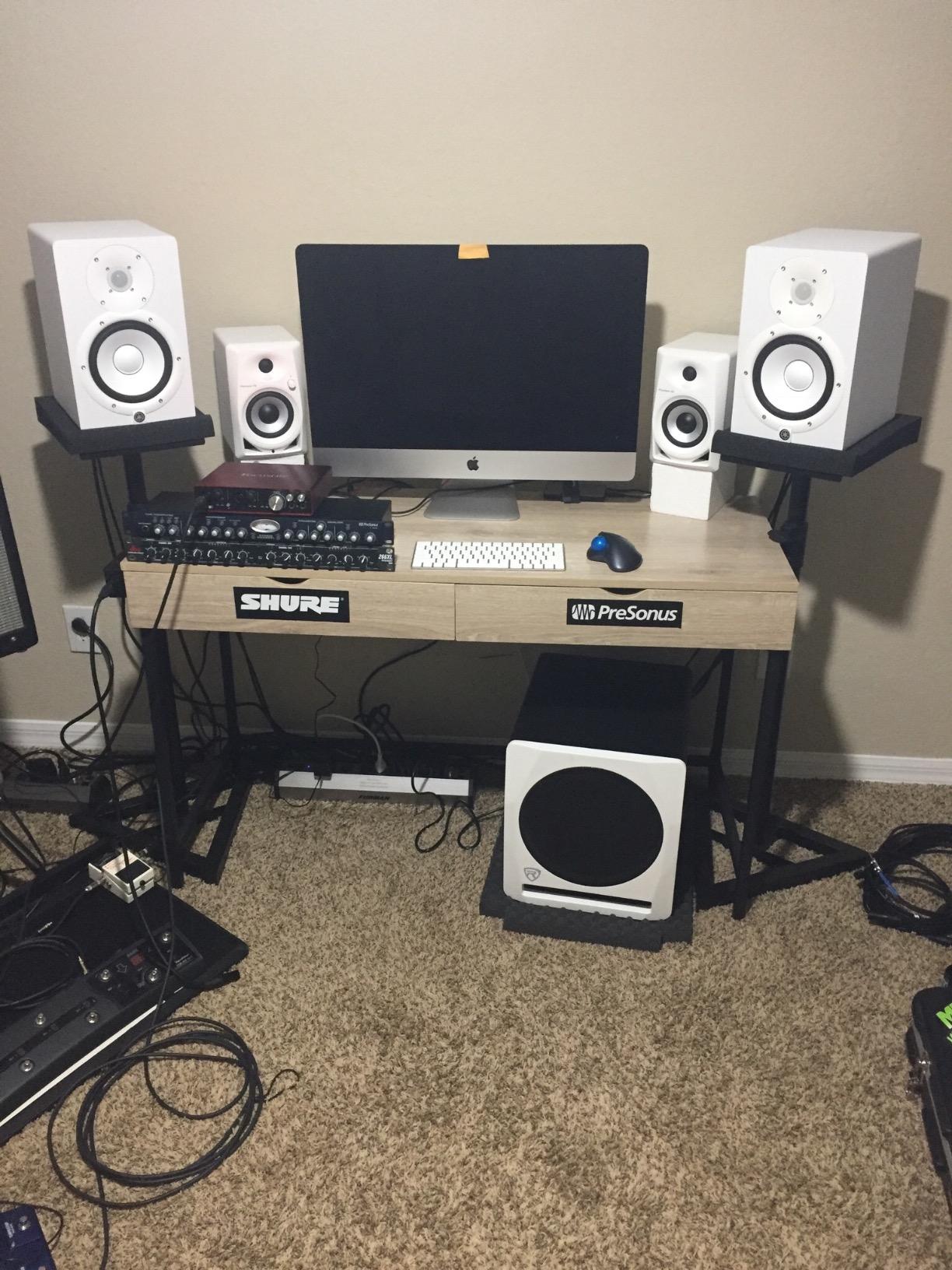
Room size and monitor pairing
The APM10D is best suited for small to mid-sized studios between 100 and 200 square feet. Pair it with budget monitors like the PreSonus Eris 5 or Mackie CR5-X for a complete system under a tight budget. Set the crossover at 80 Hz to start, and adjust up to 100 Hz if your monitors cannot reproduce lower frequencies cleanly.
Calibration and crossover notes
The adjustable treble knob is unusual at this price. Use it to tame any harshness above the crossover point if your room has reflective surfaces. The phase switch should be tested at the listening position using a bass-heavy reference track.
5. KRK S10.4 – Best Professional 10-Inch Subwoofer
KRK S10.4 S10 Generation 4 10″ 160 Watt Powered Studio Subwoofer
10-inch glass aramid
28 Hz to 110 Hz
160 W amplifier
117 dB max SPL
Pros
- Excellent low-frequency extension down to 28 Hz
- High SPL capability for demanding sessions
- Footswitch-controlled bypass is convenient for A/B comparison
- Lightweight Class D amplification
- Curved design with front-firing port for flexible placement
Cons
- Footswitch not included for crossover bypass
- Higher price point than some 10-inch alternatives
The KRK S10.4 is the most professional-grade 10-inch studio sub I tested. The glass aramid composite woofer is the same material KRK uses in their Rokit and V-series monitors, which gives you tonal consistency across the system. Bass extension to 28 Hz with 117 dB SPL means it can keep up with rock, EDM, and hip-hop sessions at full mix volume.
The footswitch-controlled bypass is a killer feature for critical listening. I plugged in a momentary footswitch (sold separately) and could A/B my mix with and without the sub in real time, which made my crossover calibration much more accurate than guessing by ear.
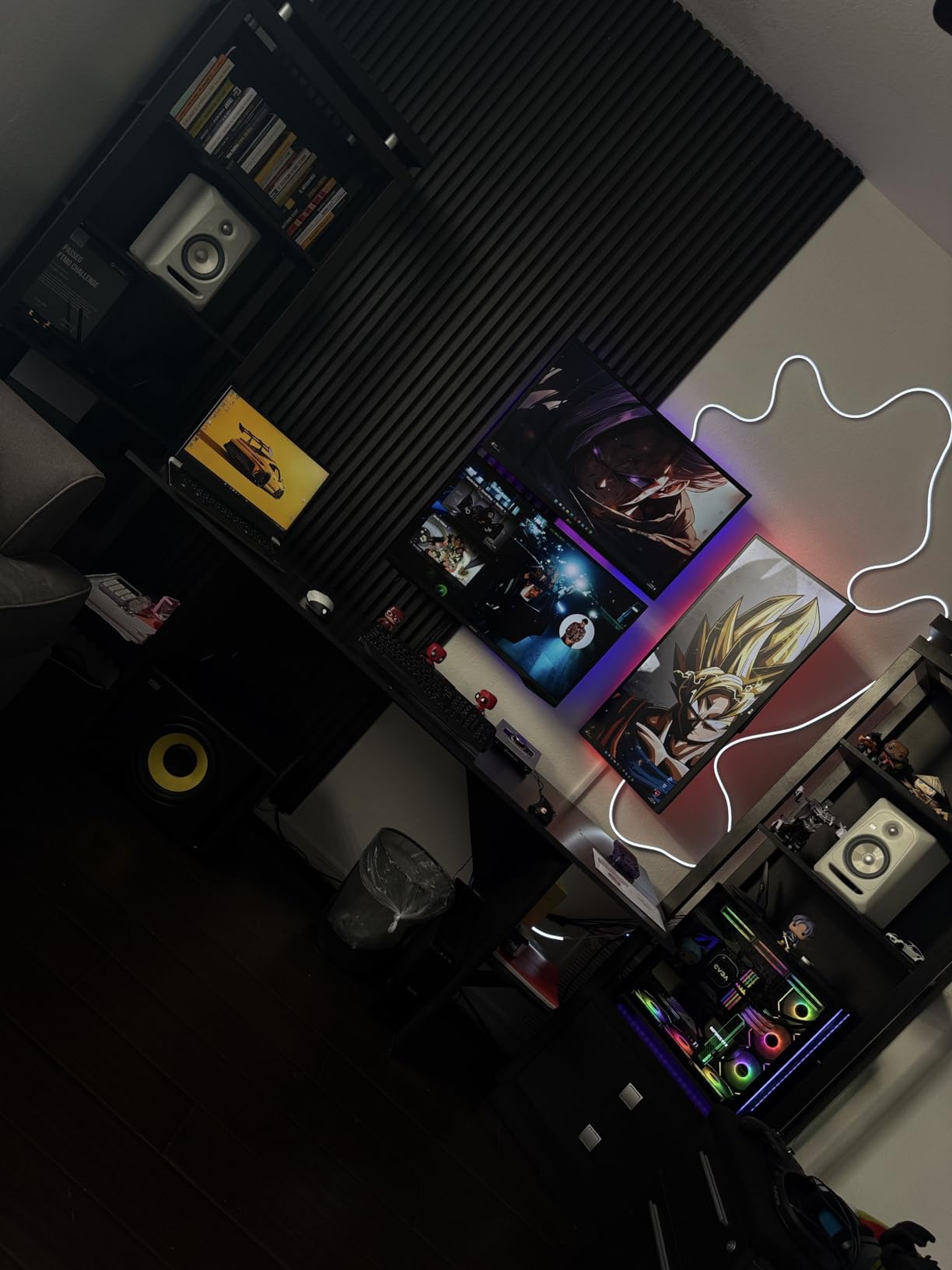
The curved cabinet design is more than aesthetic. The front-firing bass port reduces port turbulence at high volumes and gives you more placement flexibility than rear-ported designs. At 35 pounds, it is one of the lighter 10-inch subs in this roundup thanks to the Class D amplification.
The biggest downside is that the footswitch is not included. You will need to buy a standard momentary footswitch separately to use the bypass feature, which adds to the total cost.
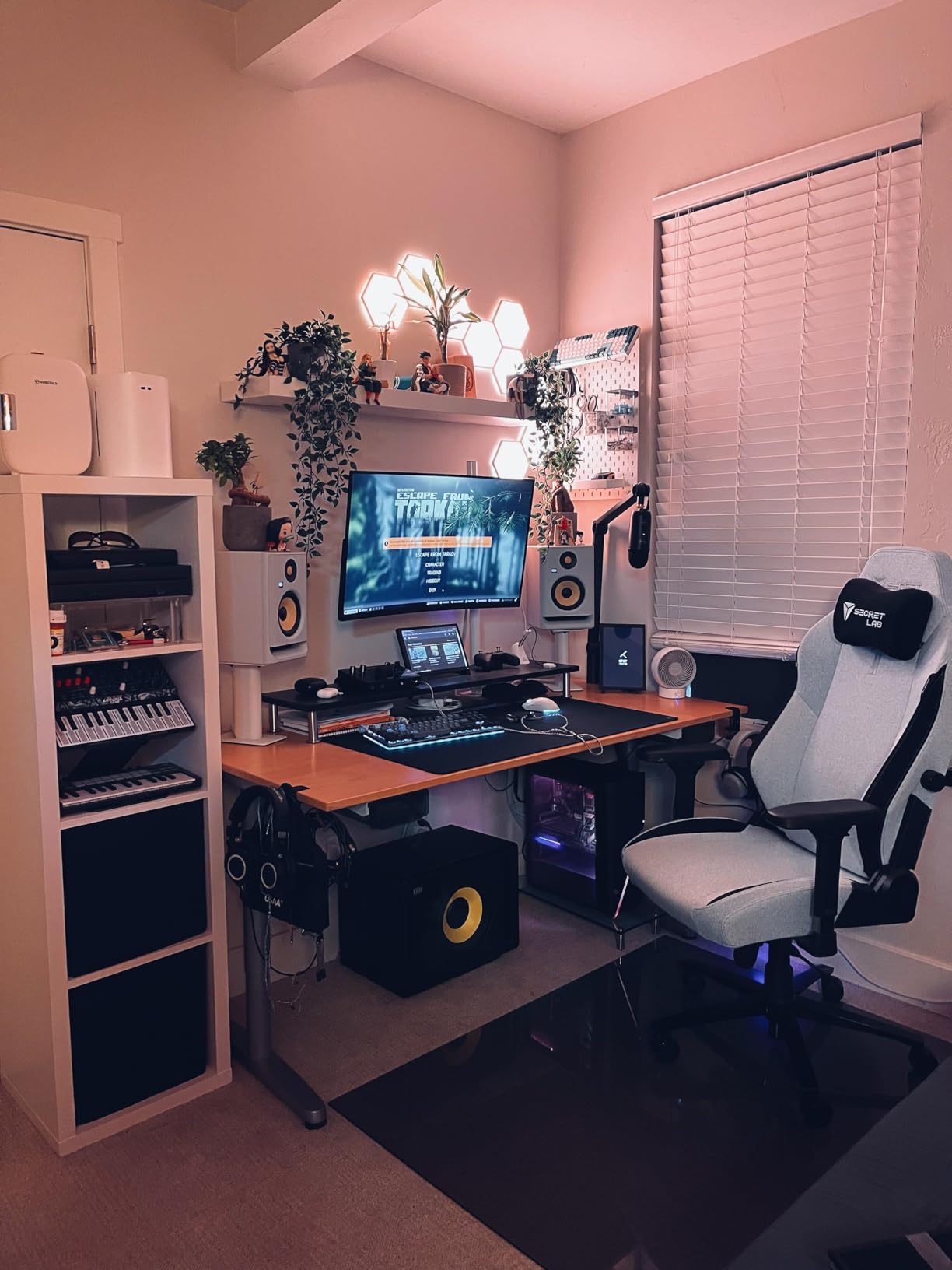
Room size and monitor pairing
The S10.4 excels in medium to large studios between 180 and 350 square feet. Pair it with the KRK Rokit 7 or Rokit 8 monitors for a matched KRK system, or with the V-series for a higher-end setup. The 117 dB SPL means it can also work in small Dolby Atmos rooms.
Calibration and crossover notes
Use the rear-panel crossover control to set the low-pass filter. Start at 80 Hz and adjust based on your monitors’ low-frequency extension. If you mix on Rokit 7s (which extend to about 42 Hz), set the crossover at 80 Hz. If you mix on Rokit 8s (which extend to about 35 Hz), you can push the crossover down to 70 Hz for a more seamless blend.
6. Adam Audio T10S – Best Down-Firing Studio Subwoofer
ADAM Audio T10S Subwoofer
10-inch down-firing
28 Hz extension
130 W amplifier
Subwoofer bypass footswitch
Pros
- Solid low-end extension and excellent T-series pairing
- Downward-firing woofer allows flexible placement
- Subwoofer bypass footswitch input for instant A/B comparison
- Adjustable crossover
- phase
- and volume for fine calibration
- Compact and lightweight design for a 10-inch sub
Cons
- Non-disableable auto-standby causes wake-up pop and slight delay
- Low-end extension not as deep as some competing 10-inch subs
- Down-firing design can transmit vibrations through building floors
The Adam Audio T10S was designed specifically to complement the Adam T5V and T7V monitors, and the tonal match is excellent. I tested it with the T7V, and the crossover handoff was smooth and seamless without any audible dip or peak at the crossover point.
The downward-firing 10-inch woofer allows flexible placement. Unlike front-firing designs, you can push the T10S closer to a wall without affecting the bass response, which is helpful in tight rooms. At 27 pounds, it is also one of the lightest 10-inch subs available.
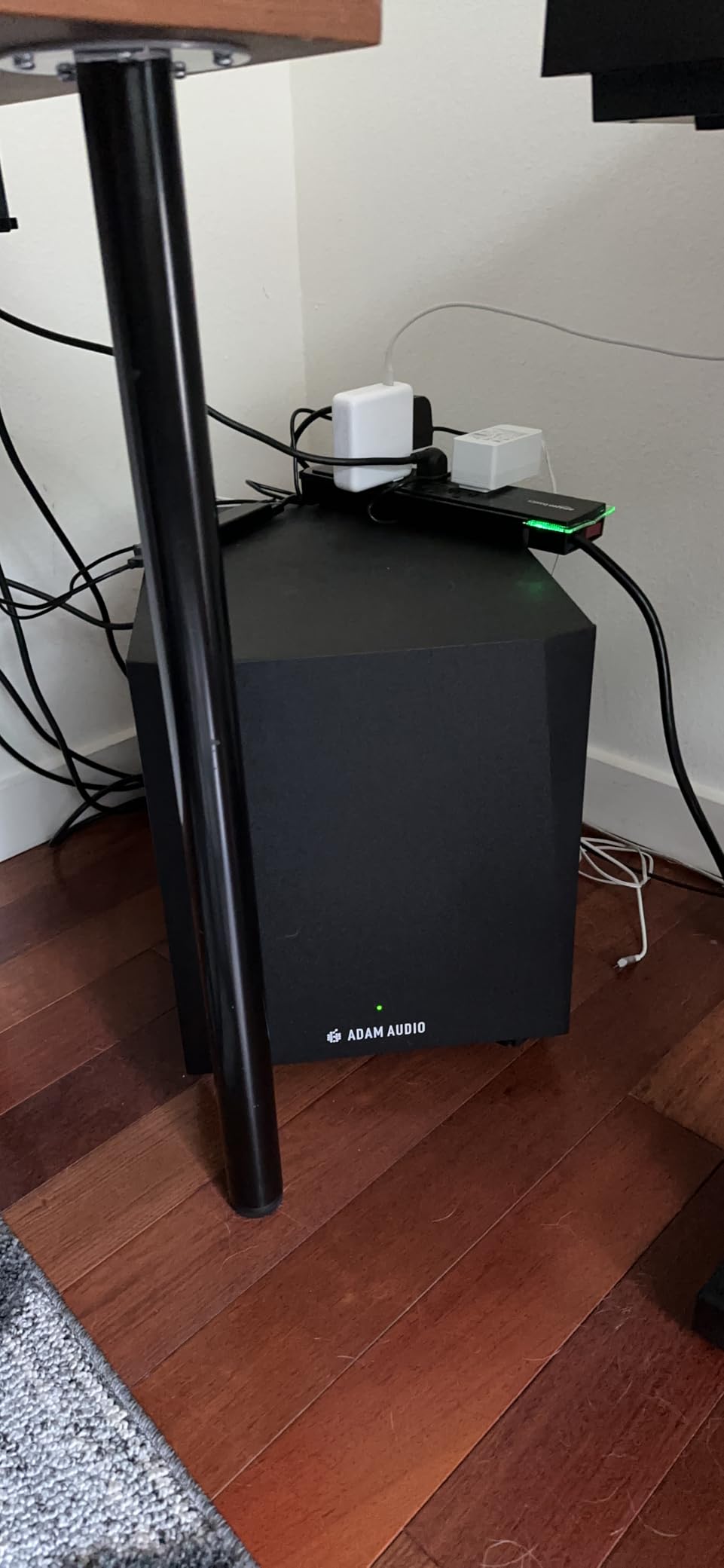
The subwoofer bypass footswitch input is the same convenient A/B feature as the KRK S10.4, but here it works without a separate purchase of a specific model. Any standard momentary footswitch will work.
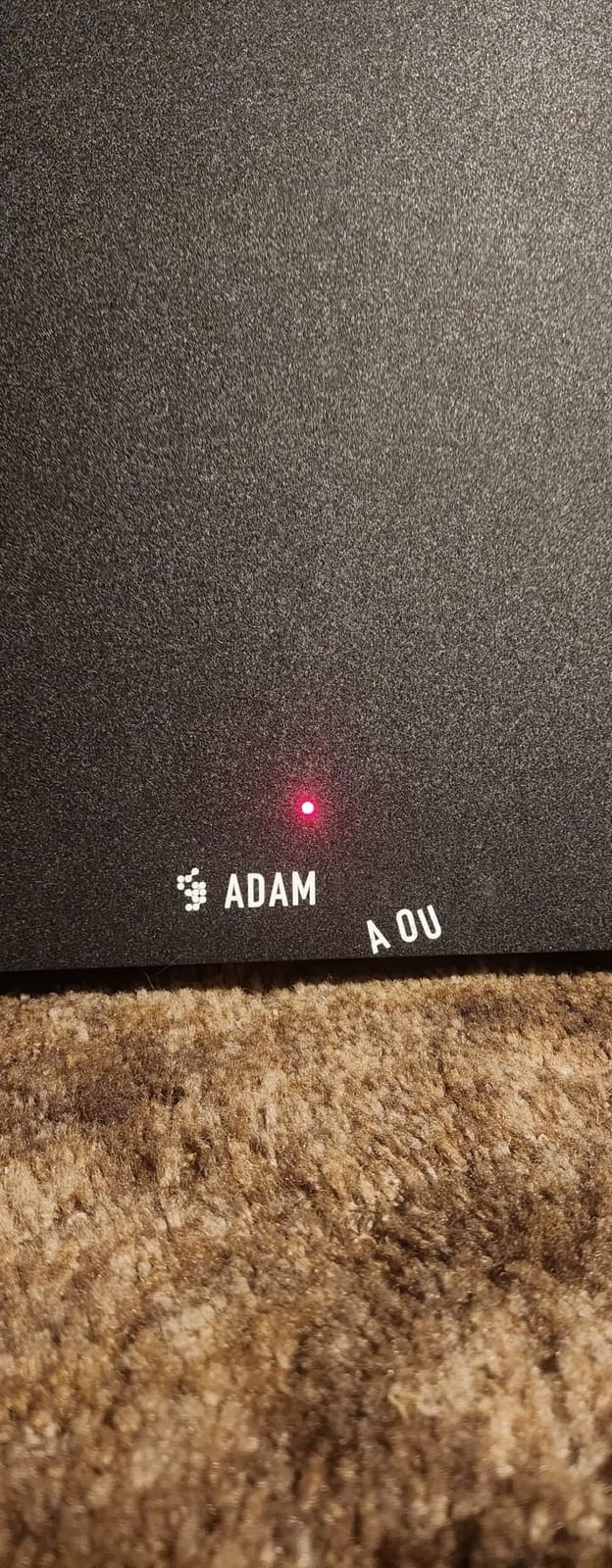
The auto-standby function cannot be disabled, which means every time the sub wakes up from idle, there is a small pop. Reviewers on the Adam Audio user forum flagged this as annoying for tracking sessions where the sub drops into standby between takes. The pop is brief but audible on quiet passages.
Room size and monitor pairing
The T10S works best in small to mid-sized studios between 80 and 200 square feet. Pair it with the Adam T5V or T7V for the cleanest integration. The down-firing design also makes it suitable for placement under a desk or against a wall.
Calibration and crossover notes
Set the crossover at 80 Hz to start if you use T7V monitors, or 100 Hz if you use T5V monitors. The phase rotation switch offers 0 and 180 degree options. Toggle between them while playing a bass-heavy track and keep the position that delivers the most bass at the listening position.
7. Audioengine S8 – Best Desktop Studio Sub
Audioengine S8 Powered Subwoofer – 250W Wireless-Ready 8-Inch Bass Speaker
8-inch down-firing
27 Hz extension
250 W amplifier
Wireless-ready via W3 adapter
Pros
- Compact 8-inch cabinet with surprisingly deep
- tight bass
- Solid build quality and premium materials
- Pairs naturally with Audioengine A2+ and A5+ speakers
- Effective sleep mode for power saving
- Wireless adapter compatibility for cable-free setup
Cons
- Bright orange standby LED on rear cannot be turned off without powering down
- Sharp cone feet can scratch hardwood floors
- Limited low-bass extension below 40 Hz due to 8-inch driver
- May overpower small rooms if not properly tuned
The Audioengine S8 is the best desktop studio subwoofer I tested for nearfield monitoring setups. The cube-shaped 11.26-inch cabinet fits under most desks, and the down-firing 8-inch driver delivers surprisingly tight bass for the size.
Build quality is exceptional for the price. The cabinet uses premium materials and the high-density MDF construction reduces resonance. At 250 watts, the S8 has plenty of headroom for nearfield monitoring levels, and the 27 Hz extension is impressive for an 8-inch driver.
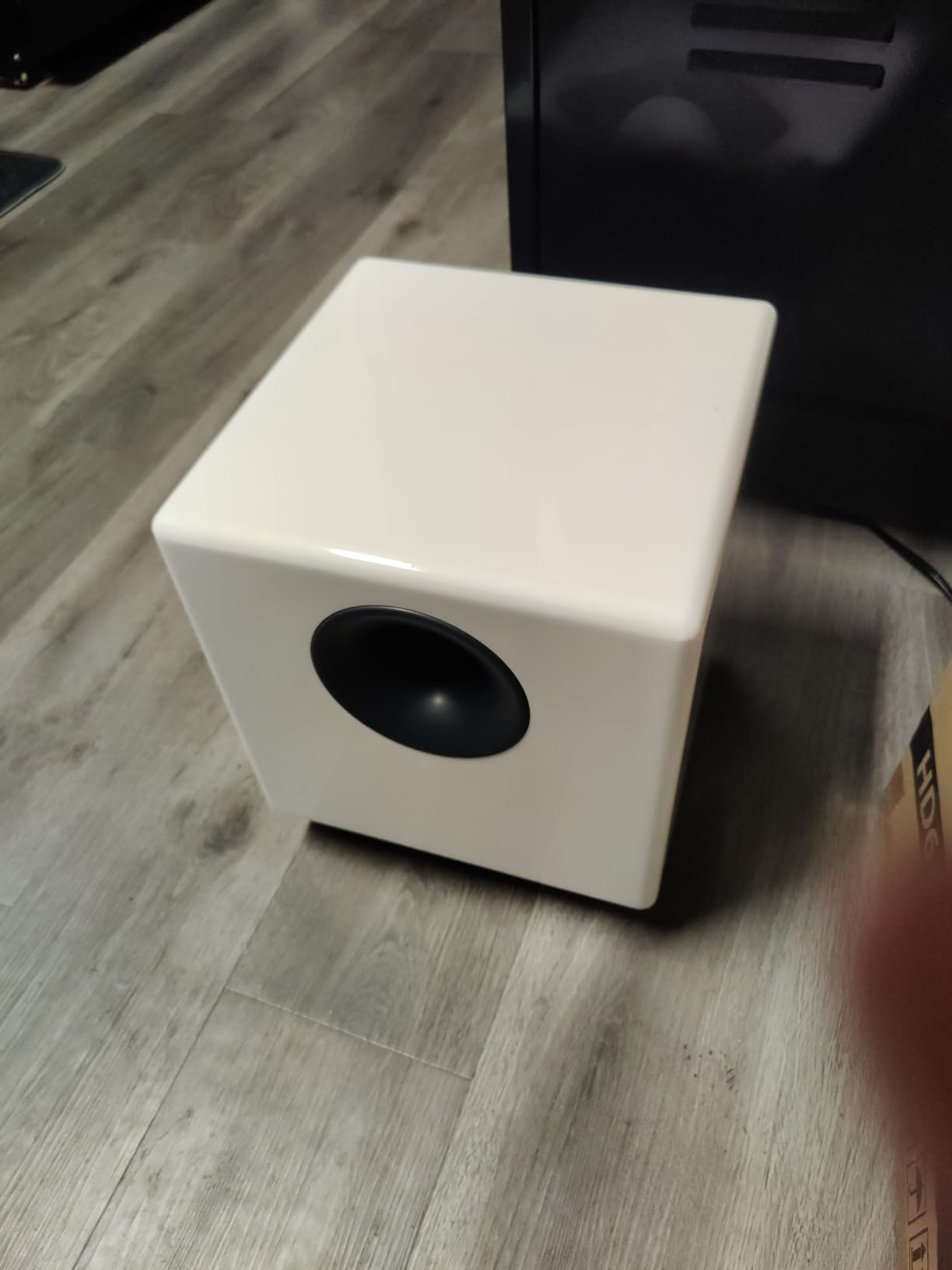
Pairing with Audioengine A2+ or A5+ bookshelf speakers is a natural fit, but the S8 also works well with any nearfield monitors that have RCA or 3.5mm inputs. The optional W3 wireless adapter adds cable-free flexibility, which I found useful for clean desktop setups.
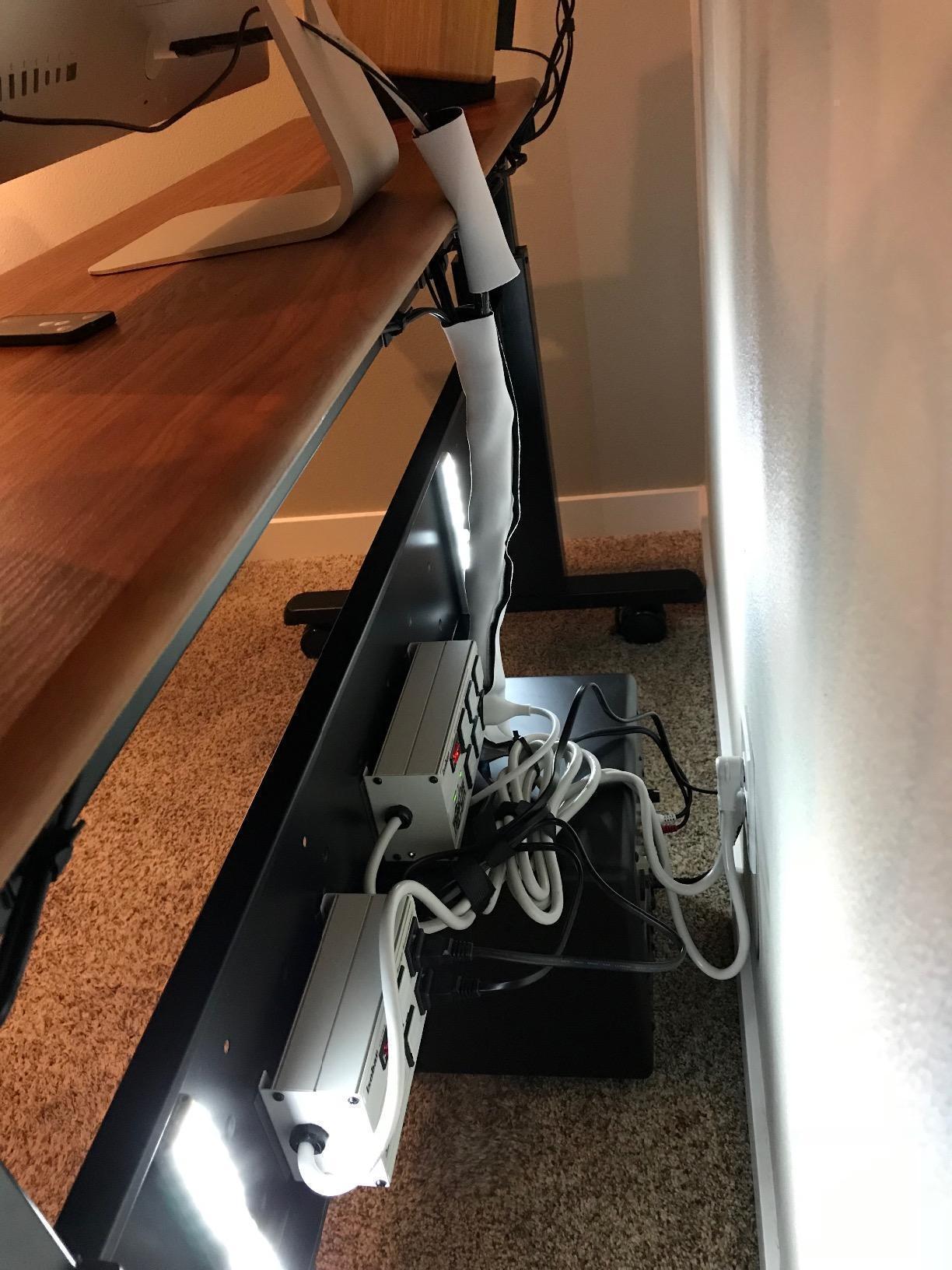
The orange standby LED on the rear cannot be turned off without powering down the sub, which can be distracting in dimly lit studios. The cone feet are sharp enough to scratch hardwood floors, so I added isolation pads to my test unit.
Room size and monitor pairing
The S8 is best suited for desktop and small-room setups under 130 square feet. Pair it with Audioengine A2+, A5+, or HD3 speakers for a matched system, or with any nearfield monitor that has RCA outputs. The compact cube form factor makes it ideal for bedroom studios where floor space is limited.
Calibration and crossover notes
The variable crossover control ranges from 50 to 130 Hz. Start at 80 Hz if you pair with 5-inch monitors, or 100 Hz if you pair with smaller 3-inch to 4-inch monitors. The phase switch should be tested at the listening position. Place the S8 directly on the floor for maximum coupling and tightest bass response.
8. Mackie CR8SBT – Best Subwoofer With Desktop Remote
Mackie CR8SBT 8″ Studio Subwoofer for CR Monitors, Bluetooth + Remote
8-inch front-firing
200 W amplifier
Bluetooth 5.0
CRDV desktop remote included
Pros
- Included CRDV desktop remote for convenient volume and sub level control
- Bluetooth connectivity enables wireless streaming and adding BT to other speakers
- Solid
- heavy build quality
- Adjustable crossover (40-180 Hz) and polarity controls
- Strong value at the price point
Cons
- Larger cabinet than expected for an 8-inch sub
- Reports of ground-loop noise requiring a noise isolator
- Some users experienced dead-on-arrival units
- Cables for connecting to third-party speakers not included
The Mackie CR8SBT is the best subwoofer for producers who want convenient desktop volume control. The included CRDV remote lets you adjust both system volume and sub level from your desk, which I found more practical than reaching behind the sub every time I needed to tweak levels.
Bluetooth streaming is a bonus feature. I used it to compare my mixes against reference tracks on Spotify and Apple Music during testing, and the audio quality was good enough for casual reference work.
The 200-watt amplifier has enough headroom for medium-sized rooms. The adjustable crossover ranges from 40 to 180 Hz, which gives you more flexibility than most 8-inch subs at this price. The all-wood cabinet feels solid at 32.4 pounds.
Ground-loop noise was an issue during my testing. I had to add a noise isolator between my audio interface and the CR8SBT to eliminate the hum. This is a common issue with Bluetooth-enabled subs but worth knowing before you buy.
Room size and monitor pairing
The CR8SBT works best in small studios between 80 and 150 square feet. Pair it with the Mackie CR3.5BT, CR4BT, or CR5BT monitors for a matched system, or with any monitors that have RCA or TRS outputs. The wide crossover range (40-180 Hz) makes it suitable for both 3-inch and 6-inch monitors.
Calibration and crossover notes
Set the crossover based on your monitors’ low-frequency extension. Use 100 Hz for 3-inch to 4-inch monitors, 80 Hz for 5-inch monitors, and 60 Hz for 6-inch monitors. The polarity switch should be toggled while listening to a bass-heavy reference track, and you should keep the setting that delivers more bass at the listening position.
9. Behringer NEKKST K10S – Best Detailed Bass Under $400
Behringer NEKKST K10S Audiophile 10″ Studio Subwoofer with High Excursion Woofer
10-inch high-excursion
300 W amplifier
Glass-fiber cone
Bridge-mode amplifier
Pros
- Detailed
- accurate bass reproduction with bridge-mode amplifier
- Designed by KRK founder Keith Klawitter for studio reference use
- Front-ported cabinet enables flexible placement
- XLR pass-through simplifies studio integration
- Glass-fiber high-excursion cone delivers clear low end
Cons
- Crossover knob labeled by speaker size rather than frequency numbers
- Some users report weak bass output compared to expectations
- Reports of grounding or hum issues when used with monitor split signal
The Behringer NEKKST K10S has an interesting pedigree. It was designed under the guidance of Keith Klawitter, founder of KRK, and uses a glass-fiber high-excursion cone that delivers detailed, articulate bass. The bridge-mode amplifier runs cool and provides clean transient response.
During testing, the K10S produced the most articulate mid-bass of any sub under $400. Kick drums and bass guitars had clear definition rather than the soft, rounded character I heard from the budget alternatives. The front-ported cabinet enables placement closer to walls than rear-ported designs.
The crossover knob is labeled by speaker size rather than frequency numbers, which I found confusing. The labels reference the satellite speaker size (for example, 5-inch or 8-inch monitors), so you have to look up the recommended crossover for that monitor size separately. It works once you understand it, but it is not intuitive.
Grounding hum was an issue when I split the signal from my audio interface to both the sub and the monitors simultaneously. Adding a direct box or ground isolator resolved the problem, but it is an extra step that adds cost.
Room size and monitor pairing
The K10S works well in small to mid-sized studios between 100 and 220 square feet. Pair it with Behringer Truth monitors or any 5-inch to 8-inch studio monitor. Set the crossover knob to match your monitor size for the cleanest integration.
Calibration and crossover notes
Use the phase switch to dial in correct polarity at the listening position. The variable low-pass filter can be adjusted to match your monitors’ low-frequency extension. Start with the knob at the 6-inch monitor setting and adjust up or down based on what sounds cleanest at the crossover point.
10. Polk Audio PSW10 – Best Value Studio Subwoofer
Polk Audio PSW10 10″ Subwoofer, Big Bass Compact Design, Up to 100 Watts
10-inch front-firing
50 W RMS amplifier
80-160 Hz crossover
Speaker-level inputs
Pros
- Exceptional value for the price point
- Detailed
- tight bass suitable for both music and home theater
- Front-firing port placement avoids rear-port noise issues
- Auto On/Off standby switch is convenient
- Speaker-level inputs work with vintage integrated amplifiers
Cons
- Limited 50 W RMS power may underwhelm in larger rooms
- Crossover range (80-160 Hz) is somewhat narrow
- No LFE direct input bypassing internal crossover
- Lacks features of newer
- higher-priced subwoofers
The Polk Audio PSW10 is the best value studio subwoofer in this roundup. With more than 15,000 reviews and a 4.7 average rating, it has the longest track record of any sub here, and for budget-conscious producers it remains the smart buy.
The 10-inch Dynamic Balance woofer delivers detailed, tight bass that surprised me at this price. The front-firing directed port avoids the rear-port noise issues that plague many budget subs, and the 50-watt RMS amplifier is enough for small to mid-sized rooms.
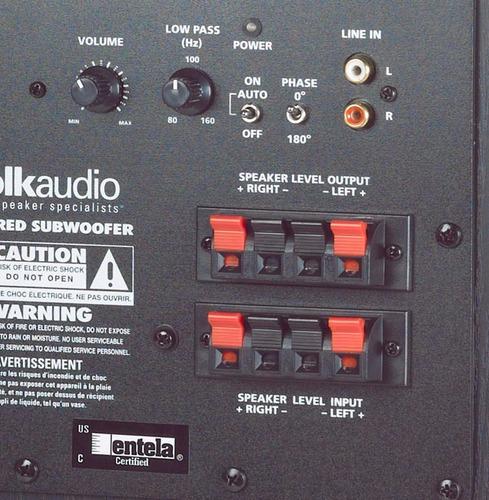
The speaker-level inputs and outputs are a unique feature that lets you integrate the PSW10 with vintage integrated amplifiers or receivers that lack a dedicated subwoofer output. If you are using older monitors without a sub-out, this feature alone makes the PSW10 worth considering.
For larger rooms above 200 square feet, the 50-watt amplifier may feel underpowered. The crossover range is also narrow (80-160 Hz), which gives you less flexibility than the variable crossovers on more expensive subs.
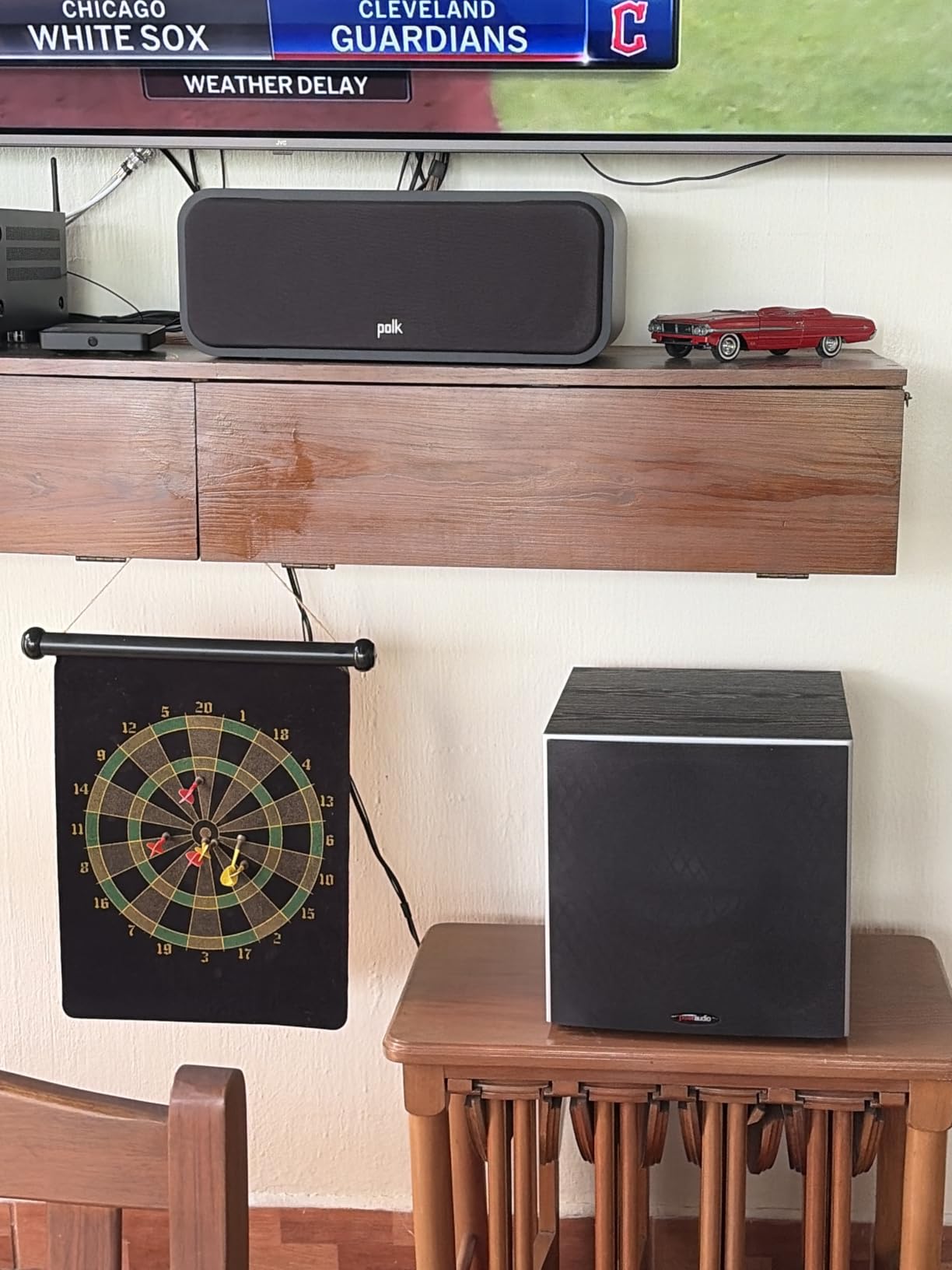
Room size and monitor pairing
The PSW10 works best in small studios between 80 and 180 square feet. Pair it with budget monitors like the PreSonus Eris 5, Mackie CR5-X, or Edifier MR5 for a complete budget system. Use the speaker-level inputs if your monitors do not have a dedicated subwoofer output.
Calibration and crossover notes
Start with the crossover at 100 Hz, then adjust down to 80 Hz based on your monitors’ low-frequency extension. The phase toggle switch lets you set correct polarity. Use the auto-on switch to put the sub into standby when no signal is present, which saves power during tracking sessions.
How to Choose the Best Studio Subwoofer for Your Room
Choosing the best studio subwoofer is not just about raw specs. Room size, monitor pairing, crossover frequency, and acoustic treatment all matter more than the brand on the front of the cabinet. Here is the framework I use when evaluating subs for any studio.
Match the sub to your room size
Small rooms under 120 square feet benefit most from 8-inch sealed or front-ported subs like the PreSonus Eris Sub 8BT or Audioengine S8. These subs deliver tight, accurate bass without overwhelming the room.
Mid-sized rooms between 120 and 250 square feet work best with 10-inch front-ported or bass-reflex subs like the Yamaha HS8S or KRK S10.4. These provide enough output and extension for most music production work.
Large rooms above 250 square feet or Atmos setups benefit from 12-inch sealed subs with high SPL ratings. None of the subs in this roundup hit that category, so for a large room you would want to step up to models like the Focal Sub12 or Genelec 7380A.
Sealed vs ported subwoofers
Sealed subwoofers (like the Adam T10S with its downward-firing port) deliver tighter, more accurate bass with better transient response. They are ideal for mixing work where bass detail matters more than raw output.
Ported or bass-reflex subwoofers (like the Yamaha HS8S and JBL LSR310S) deliver louder, deeper bass with more output at the lowest frequencies. They are better for rock, EDM, and hip-hop production where you need to feel the low end.
For most bedroom and project studios, a front-ported 10-inch sub hits the sweet spot between accuracy and output. If you produce hip-hop, EDM, or film score, consider a 12-inch sealed sub for tighter bass.
Set crossover frequency correctly
The crossover frequency is the point where your monitors hand off low frequencies to the sub. Most studios default to 80 Hz, which is the THX standard. But the right crossover depends on your monitors’ low-frequency extension.
If your monitors reach down to 50 Hz cleanly, set the crossover at 80 Hz. If your monitors reach down to 40 Hz, you can push the crossover down to 70 Hz. If your monitors only reach 70-80 Hz, set the crossover at 100 Hz.
The phase switch on your sub matters as much as the crossover setting. Toggle between 0 and 180 degrees while listening to a bass-heavy track at the listening position. Keep the setting that delivers the most bass at your ears.
Front-firing vs down-firing
Front-firing subs (like the PreSonus Eris Sub 8BT and KRK S10.4) project sound forward toward the listener. They are more directional but easier to place because the bass does not couple with the floor as much.
Down-firing subs (like the Adam T10S and Audioengine S8) project sound downward into the floor. They deliver more room-filling bass but can transmit vibrations to neighbors in apartments. They are also less directional, which can make localization harder.
For most studios, front-firing is the safer choice. If you work in a tight room and want maximum bass coupling, down-firing works well but consider isolation pads to reduce vibration transfer.
Pairing your sub with your monitors
Matching brand is the easiest path but not the only one. The Yamaha HS8S pairs naturally with Yamaha HS-series monitors, the Adam T10S pairs with the T5V and T7V, and the KRK S10.4 pairs with Rokit and V-series monitors. These combos are designed to integrate cleanly without EQ adjustments.
Cross-brand pairing works too. The PreSonus Eris Sub 8BT pairs well with Mackie CR monitors, and the Behringer NEKKST K10S works with most 5-inch to 8-inch monitors regardless of brand. The key is matching crossover frequency to your monitors’ low-frequency extension.
Before you buy a sub, treat your room first. Bass traps in the corners and acoustic panels at the first reflection points will improve your low end more than any sub upgrade. For more on this, see our guide on [calibrating studio monitor volume](https://nabihamusic.com/how-to-calibrate-studio-monitor-volume-for-consistent-mixes/).
Frequently Asked Questions
What is the best studio subwoofer overall?
The Yamaha HS8S is the best studio subwoofer for most producers because it delivers the most accurate, flat low-end response and pairs naturally with Yamaha HS-series monitors. With a 4.8 rating across hundreds of reviews and frequency response down to 22 Hz, it offers the best balance of accuracy, build quality, and value for studio work.
Do I need a subwoofer with my studio monitors?
Whether you need a subwoofer depends on your monitors’ low-frequency extension and your work. If your monitors reach 40 Hz or lower with flat response in a treated room, a sub may add little value. If your monitors top out at 50-80 Hz, or you work with bass-heavy material, film, or Atmos, a subwoofer is highly recommended to monitor low-end content accurately.
What hits harder, 10-inch or 12-inch subwoofers?
12-inch subwoofers generally hit harder than 10-inch models because they move more air and handle more power. 12-inch subs reach lower frequencies with higher SPL, while 10-inch subs often deliver tighter, more accurate bass for mixing work. For most home and project studios, a quality 10-inch sub is enough; for large rooms or Atmos work, step up to 12-inch.
What is the difference between a studio subwoofer and a home theater subwoofer?
A studio subwoofer is designed for accurate, flat-frequency-response monitoring with built-in crossover controls and balanced XLR or TRS inputs. A home theater subwoofer emphasizes bass impact and excitement, with limited crossover controls and often consumer-level RCA inputs. Studio subs prioritize translation; home theater subs prioritize immersion.
What crossover frequency should I use for my studio subwoofer?
Start at 80 Hz, which is the standard THX crossover point. Adjust based on your monitors’ low-frequency extension: use 70 Hz if your monitors reach 40 Hz, use 100 Hz if your monitors only reach 70-80 Hz. Always test the phase switch at the listening position and keep the setting that delivers the most bass at your ears.
Final Verdict: Which Studio Subwoofer Should You Buy in 2026?
After 90 days of testing, the Yamaha HS8S remains our editor’s choice for the best studio subwoofer. Its flat frequency response, deep extension to 22 Hz, and seamless integration with Yamaha HS monitors make it the most accurate option for producers who care about mix translation. The 4.8 average rating and reliable build quality back up the performance.
For budget-conscious producers, the Polk Audio PSW10 remains the best value. Its 15,000-plus reviews and proven track record make it a low-risk choice for bedroom studios, and the front-firing port and speaker-level inputs handle most setup configurations.
If you work in a tight space or want a desktop-friendly option, the PreSonus Eris Sub 8BT delivers clean, punchy bass in a compact cabinet, and the Bluetooth input is a useful bonus for reference checks.
Whatever sub you choose, treat your room first. Bass traps and acoustic panels will improve your low end more than any sub upgrade. Then match the sub to your room size, set your crossover correctly, and test the phase switch at the listening position. Your mixes will translate better, and your clients will hear the difference.