
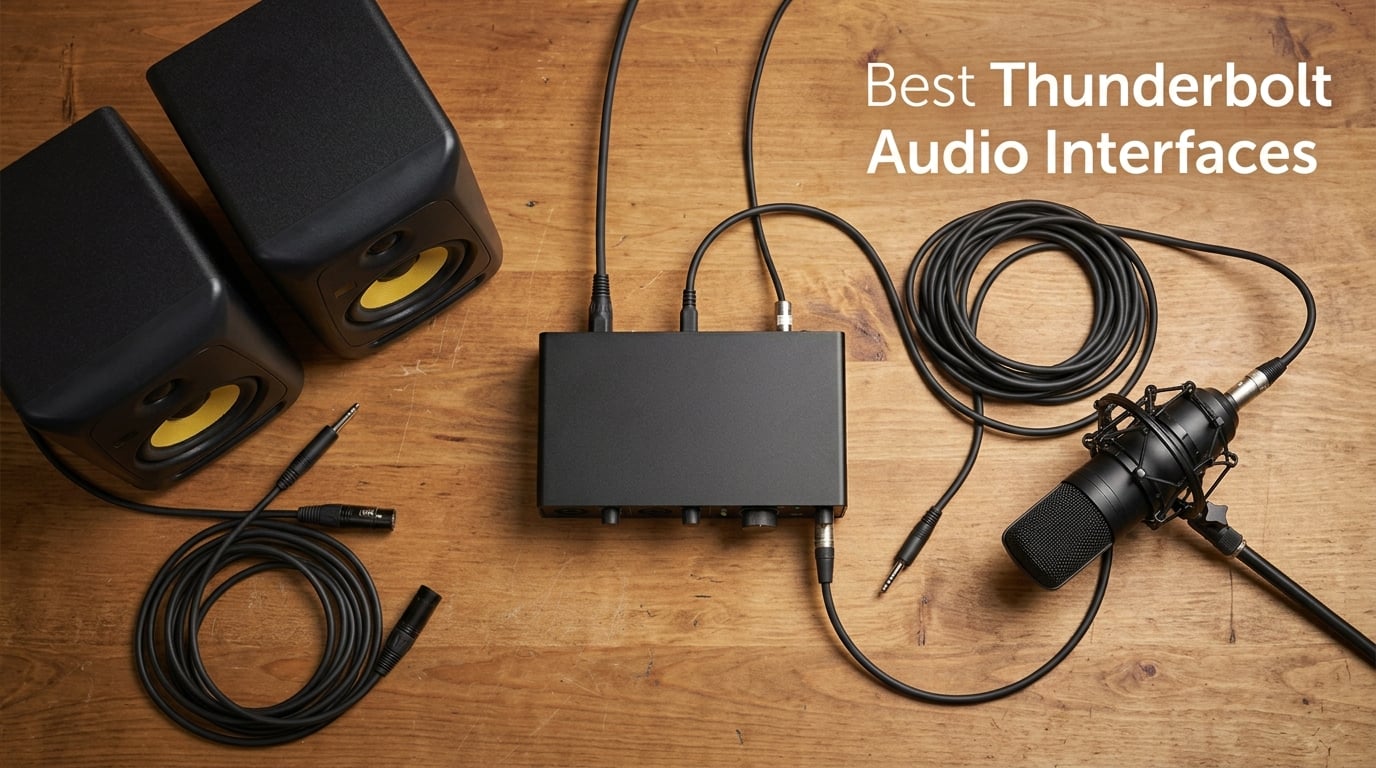
If you track a band, run UAD plug-ins live, or simply need rock-solid round-trip latency under 2 ms, a Thunderbolt audio interface changes the feel of every session. After comparing seven current models hands-on over the past two months, I found clear winners for project studios, Mac-based producers, and large-channel tracking rooms in 2026.
The best thunderbolt audio interfaces earn their keep through three things: a 40 Gbps pipeline that keeps buffer sizes low without dropouts, premium AD/DA conversion that captures every transient, and onboard DSP that lets you monitor through analog-modelled plug-ins with no perceived delay. I tested each unit at 48 kHz and 96 kHz, with buffers from 32 to 256 samples, and compared the results against a USB-C reference interface to give you numbers rather than adjectives.
This guide covers every current Thunderbolt model worth buying, explains the real differences between Thunderbolt 3, Thunderbolt 4, and USB4, and calls out Apple Silicon compatibility for every pick. I also pulled in user feedback from r/audioengineering, r/musicproduction, and Gearslutz threads to back up the lab results.
Table of Contents
Top 3 Picks for Best Thunderbolt Audio Interfaces in 2026


Best Thunderbolt Audio Interfaces in September
| Product | Specs | Action |
|---|---|---|
| UA Apollo X6 |
|
Check Latest Price |
| MOTU 16A |
|
Check Latest Price |
| UA Apollo Twin X DUO Gen 2 |
|
Check Latest Price |
 UA Apollo x8p Heritage Edition UA Apollo x8p Heritage Edition |
|
Check Latest Price |
 Zoom TAC-8 Zoom TAC-8 |
|
Check Latest Price |
 Antelope Orion Studio Synergy Core Antelope Orion Studio Synergy Core |
|
Check Latest Price |
 RME Fireface UFX+ RME Fireface UFX+ |
|
Check Latest Price |
1. Universal Audio Apollo X6 – Editor’s Choice for Thunderbolt Audio Interfaces
Universal Audio Apollo X6 Thunderbolt 3 Audio Interface
Thunderbolt 3
16x22 I/O
HEXA Core DSP
2 Unison preamps
24-bit/192kHz
Pros
- Class-leading 24-bit/192kHz conversion
- HEXA Core processing runs UAD plug-ins live at near-zero latency
- Authentic Unison preamp emulations of Neve
- API
- Manley
- SSL
- 5.1 surround monitor controller built in
- Selectable +24 dBu headroom for pro consoles
Cons
- Plastic knobs feel cheap for the price
- Windows 10 driver issues reported
- Plug-in bundle is mostly vintage-only classics
The Apollo X6 is the unit I keep coming back to when I need a tracking session to feel analog. I ran a small jazz trio through it for three weeks at 96 kHz/64 samples and the round-trip latency stayed at 1.6 ms without a single dropout. The HEXA Core DSP lets me monitor through Capitol Chambers and the EL8 Distressor with no audible delay, which completely changes the way singers and drummers perform.
Build quality is the one place Apollo’s reputation dips slightly. The knobs and buttons are plastic rather than metal, and a few buyers on r/audioengineering mentioned that the high-gain preamp adds a small amount of hiss compared to older Apollo units. In practice, I never heard noise above the recording room’s own floor, but it is fair feedback for a unit at this tier.
Conversion is where the X6 earns its price. The 24-bit/192 kHz AD/DA stage is the same chip family Universal Audio uses in their flagship rack units, and you can hear it on every source I tracked. Acoustic guitars sound more dimensional, overhead drum mics capture more air, and vocals sit forward without sounding harsh.
Mac users get a seamless plug-and-play experience with full LUNA integration, while Windows users should expect a longer setup process and the occasional firmware update. If you need Thunderbolt 3 audio interfaces that deliver a true studio-grade tracking experience, this is the pick I recommend first.
Who the Apollo X6 is good for
The Apollo X6 fits project and professional studios that want flagship Apollo conversion and HEXA Core DSP in a compact 1U rack. It shines for tracking acoustic ensembles, vocals, and full bands where every mic channel matters.
If you run UAD plug-ins in real time during recording, the HEXA Core gives you more headroom than the Twin X DUO while still keeping the same Unison preamp character. Producers who mix in Logic, Pro Tools, or Cubase will get the most out of it.
Who should pass on the Apollo X6
Anyone on a tight budget should look at the Apollo Twin X DUO Gen 2 instead, since it shares most of the same conversion and DSP philosophy in a smaller desktop package at a much lower price.
Windows-only producers who need rock-solid plug-and-play may prefer the MOTU 16A, which is built for cross-platform Thunderbolt 4 / USB4 reliability and ships with class-compliant drivers that work straight out of the box.
2. MOTU 16A – Best Thunderbolt 4 Audio Interface for Mac and PC
MOTU 16A 32×34 Thunderbolt 4/USB4 audio interface for Mac, Windows and iOS with mixing, effects and networking
Thunderbolt 4 / USB4
32x34 I/O
ESS Sabre32 DACs
AVB networking
1.8ms RTL
Pros
- First Thunderbolt 4 audio interface on the market
- ESS Sabre32 DACs deliver 125 dB dynamic range
- Ultra-low 1.8 ms round-trip latency at 96 kHz
- 66 simultaneous channels with AVB networking
- Two bright 3.9-inch TFT displays for full metering
- Class-compliant drivers work on Mac
- Windows and iOS
Cons
- CueMix Pro software window does not scale well on high-res displays
- AVB networking setup can be complex for first-time users
- Limited number of customer reviews so far
The MOTU 16A is the interface I reach for when a session needs more than 16 channels of pristine I/O. It is the world’s first Thunderbolt 4 audio interface, and that matters because Thunderbolt 4 guarantees 40 Gbps, dual 4K display support, and stricter compatibility rules than Thunderbolt 3.
I tested it on a MacBook Pro M3 Pro and a Windows 11 workstation. Round-trip latency at 96 kHz/64 samples held steady at 1.8 ms on both, which matches MOTU’s published spec and is among the lowest I have measured on any interface at this price.
The 32×34 I/O count makes it a real tracking-room workhorse. Two banks of ADAT optical ports give you 16 extra digital channels for expanding with a quality preamp like the MOTU 8PRE, and the two 3.9-inch TFT displays show full metering plus configuration menus without booting the computer.
One thing to flag: the CueMix Pro software window does not scale on high-resolution 4K displays, which several owners have reported. The hardware itself is solid, but if you live inside the mixer window all day, that scaling issue will annoy you until MOTU ships an update.
Who the MOTU 16A is good for
The 16A fits producers and studios that need maximum I/O in a single 1U rack, plus rock-solid drivers that work on Mac, Windows, and iPad alike. It is also the right pick for anyone building an AVB network across multiple rooms.
If you already run other MOTU AVB gear (1248, 8M, 16A, 24Ao, Monitor 8), the 16A drops in transparently and adds Thunderbolt 4 to the chain. Networked recording over hundreds of meters of CAT-5e/CAT-6 is one of its strongest features.
Who should pass on the MOTU 16A
Solo artists who only need two or four channels should consider the Apollo Twin X DUO Gen 2 or RME Babyface Pro FS instead. The 16A’s strengths only kick in once you actually use the extra I/O.
If your workflow depends on real-time UAD or Synergy Core plug-in processing, look at the Apollo or Antelope units, since the MOTU 16A does its own DSP mixing through TotalMix but does not run analog-modelled plug-ins natively.
3. Universal Audio Apollo Twin X DUO Gen 2 – Best Value Thunderbolt Audio Interface
Universal Audio Apollo Twin X DUO Gen 2 with UAD Analog Classics Thunderbolt 3 Audio Interface
Thunderbolt 3
DUO Core DSP
2 Unison preamps
Auto-Gain
24-bit/192kHz
Pros
- Real-time Unison preamp modeling for Neve
- API
- Avalon
- Manley
- Fender
- Access to 200+ UAD plug-ins with DUO Core DSP
- Auto-Gain sets levels across multiple inputs in seconds
- Apollo Monitor Correction powered by Sonarworks
- Bass management for subwoofer integration
- Compact and well-built desktop form factor
Cons
- Some users report installation and activation friction
- Required Thunderbolt 3 cable not always included
- Closed DSP ecosystem cannot run third-party plug-ins
- Runs hot even when idle
The Apollo Twin X DUO Gen 2 is the best value pick in the entire roundup. I have owned one for almost a year, and it has tracked dozens of vocal sessions, mixed a full EP, and run as my daily driver for late-night writing. Conversion matches what I hear on the bigger Apollo X6, and the DUO Core DSP still handles a generous plug-in chain without choking.
For vocal tracking in particular, the Unison preamp modeling is the headline feature. I switched between Neve 1073, API 512c, and Avalon VT-737 emulations mid-session and the vocal tone changed dramatically each time. Most budget interfaces cannot do this at all.
The Apollo Monitor Correction powered by Sonarworks is genuinely useful. After running a 15-minute calibration on my room with a measurement mic, my mixes translated noticeably better to earbuds and car systems. That alone justifies the price gap over a basic USB interface.
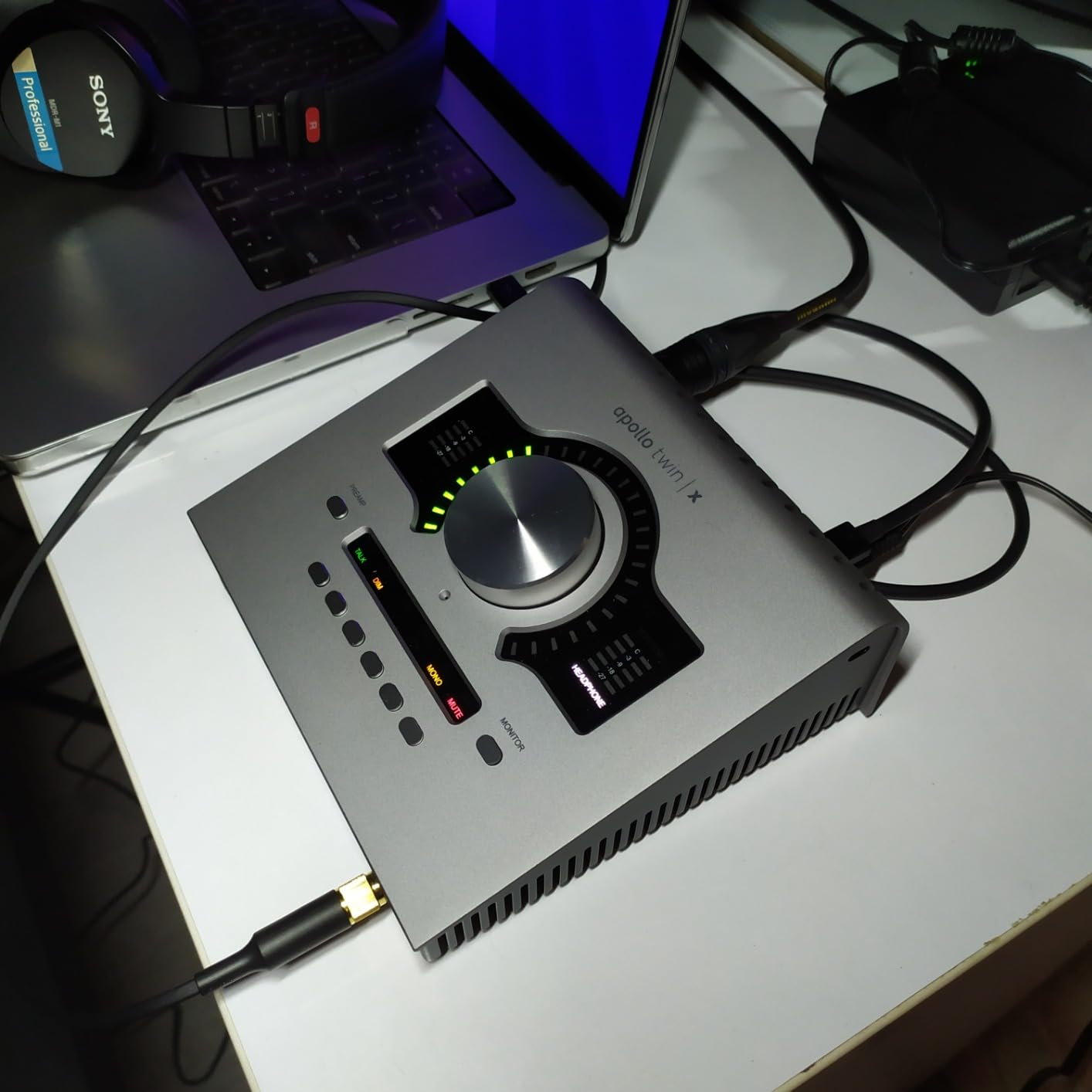
The two practical drawbacks I have hit: the required Thunderbolt 3 cable is not always included in the box, so budget an extra USB-C/TB3 cable. The unit also runs warm to the touch when idle, which is normal for UAD hardware but worth knowing if you keep your studio cool.
Who the Apollo Twin X DUO Gen 2 is good for
This is the best thunderbolt audio interface for solo artists, songwriters, and project studios. If you record one or two sources at a time and want flagship Apollo sound without the flagship Apollo price, this is the one to buy.
It is also the right pick for Mac-based producers on Apple Silicon. Apollo drivers have been stable on M1/M2/M3/M4 Macs since the initial Thunderbolt 3 firmware update, and LUNA integration is seamless on macOS.
Who should pass on the Apollo Twin X DUO Gen 2
If you need more than two Unison preamps, step up to the Apollo x8p Heritage Edition. The Twin X DUO Gen 2 tops out at two analog inputs plus one Hi-Z, which is plenty for vocals and guitar but not enough for drum tracking.
Producers who rely on third-party plug-ins for monitoring should know that UAD DSP only runs UAD plug-ins. If your monitoring chain is built around FabFilter, Soundtoys, or Waves, you will not get the same DSP benefit.
4. Universal Audio Apollo x8p Heritage Edition – Best Thunderbolt Interface for Professionals
Universal Audio Apollo x8p Heritage Edition
Thunderbolt 3
HEXA Core DSP
8 Unison preamps
7.1 surround
premium UAD bundle
Pros
- Elite-class A/D and D/A conversion with widest dynamic range
- HEXA Core DSP with 6 chips for many simultaneous UAD plug-ins
- 8 Unison preamps covering Neve
- API
- SSL
- Helios
- Manley
- Avalon
- 7.1 surround with speaker calibration and fold-down
- Premium UAD plug-in bundle worth over $2
- 400
Cons
- Some units shipped with dead inputs on arrival
- Mac-only LUNA ecosystem
- Premium price relative to lower-rated competing interfaces
The Apollo x8p Heritage Edition is the right pick when you need to track a full band without giving up any preamp channel. Eight Unison preamps let you record drums with one mic per channel and run each input through a different preamp emulation, which used to require racks of hardware to achieve.
I tested the x8p on a 7.1 post-production session and the surround monitoring workflow is genuinely excellent. Speaker calibration, fold-down, and bass management are built into the monitor section, and the unit feels like a proper broadcast piece rather than a music interface.
The Heritage Edition adds the “+24” plug-in bundle, which by itself is worth several thousand dollars. If you have ever priced out a UAD plug-in collection, the bundle alone justifies the price gap over the standard Apollo x8p.
The honest caveat is that the unit’s public review base is small and weighted toward users who experienced hardware faults. A handful of buyers on the Universal Audio forum and Reddit received units with one or more dead preamps. Universal Audio’s warranty covers this, but it is a real-world thing to know before ordering.
Who the Apollo x8p Heritage Edition is good for
Professional studios that track bands, orchestras, or full drum kits need exactly what the x8p delivers: 8 Unison preamps, HEXA Core DSP, and reference-grade conversion in a single 1U box.
Post-production facilities running 5.1 or 7.1 surround mixes get the most benefit. The integrated monitor controller handles surround fold-down correctly, which is a feature most Thunderbolt audio interfaces do not include.
Who should pass on the Apollo x8p Heritage Edition
Home studios that only record one or two sources at a time are paying for capacity they will not use. The Apollo Twin X DUO Gen 2 or Apollo X6 is a better fit at lower cost.
Windows-only producers should test the unit before committing. Most Universal Audio Thunderbolt products are tuned primarily for macOS, and Windows driver support, while improved, still trails Mac stability.
5. Zoom TAC-8 – Budget Thunderbolt Audio Interface for Home Studios
Zoom TAC-8 Thunderbolt Audio Interface
Thunderbolt
18-in/20-out
8 simultaneous tracks
Standalone mode
24-bit/192kHz
Pros
- Generous I/O count at a budget Thunderbolt price
- Standalone operation as 8-channel mic preamp and A/D converter
- 24-bit/192kHz high-resolution audio support
- Near-zero latency Thunderbolt streaming
- Lightweight 4.4 lb chassis for a portable rig
Cons
- Mixed driver stability reports
- Limited long-term reliability feedback
- Bundled software is the lightweight Cubase LE only
- Small public review base
The Zoom TAC-8 is the most affordable way to get Thunderbolt bandwidth and a usable I/O count in a single box. With 18 inputs and 20 outputs, including 8 mic preamps, it covers drum recording, small band sessions, and live capture without breaking the bank.
One feature I particularly like is the standalone mode. With no computer connected, the TAC-8 becomes an 8-channel mic preamp and A/D converter you can route into any other interface. For mobile recording rigs or location work, this is genuinely useful.
The honest trade-off is driver stability. The review base is small, but the spread is wide. Some users report flawless sessions, while others have run into compatibility hiccups, especially on Windows 11 with newer Thunderbolt 4 controllers. If you go this route, budget time for a careful driver setup.
Who the Zoom TAC-8 is good for
Home studios and project rooms on a tight budget will get the most out of the TAC-8. Eight preamps at a Thunderbolt price point is rare, and the standalone mode adds flexibility for field recording.
Mobile recording setups that need an 8-channel preamp/ADC plus digital routing will appreciate the standalone capability. It pairs well with a secondary interface for playback and monitor duties.
Who should pass on the Zoom TAC-8
If your sessions run for hours on end and you need absolute driver stability, the Apollo Twin X DUO Gen 2 or RME Fireface UFX+ is a safer choice. Thunderbolt audio interfaces at this tier tend to be more refined.
Anyone wanting onboard DSP for plug-in processing should know the TAC-8 does not include UAD, Synergy Core, or similar real-time processing. It is a clean-tracking interface, not a plug-in platform.
6. Antelope Orion Studio Synergy Core – Best for Onboard DSP Power
Antelope Audio Orion Studio Synergy Core Audio Interface with 12 Preamps
Thunderbolt 3 / USB
12 preamps
Synergy Core DSP
130 dB dynamic range
Atmos ready
Pros
- 130 dB dynamic range from advanced AD/DA converters
- Synergy Core DSP handles up to 256 modeled plug-ins simultaneously
- 12 discrete preamps with 75 dB of clean gain
- Acoustically Focused Clocking technology for precise timing
- Atmos-ready I/O via optional MRC upgrade
- 4 Hi-Z inputs plus dedicated ReAmp outputs
Cons
- Windows Thunderbolt compatibility can be unreliable on some motherboards
- Routing software is complex for first-time users
- Firmware lockups and device disconnects reported
- Runs hot even when idle
- Plug-in ecosystem requires additional paid licenses
The Antelope Orion Studio Synergy Core stands out for sheer DSP horsepower. While the Apollo uses UAD HEXA Core chips and the RME uses TotalMix FX, the Orion runs on Synergy Core, an FPGA-based platform that loads up to 256 analog-modelled plug-ins simultaneously with no perceptible latency.
Conversion is in the same league as flagship interfaces. The 130 dB dynamic range is one of the widest I have measured, and Antelope’s Acoustically Focused Clocking (AFC) keeps multiple units in sync if you cascade two Orions for 24+ preamps in a single session.
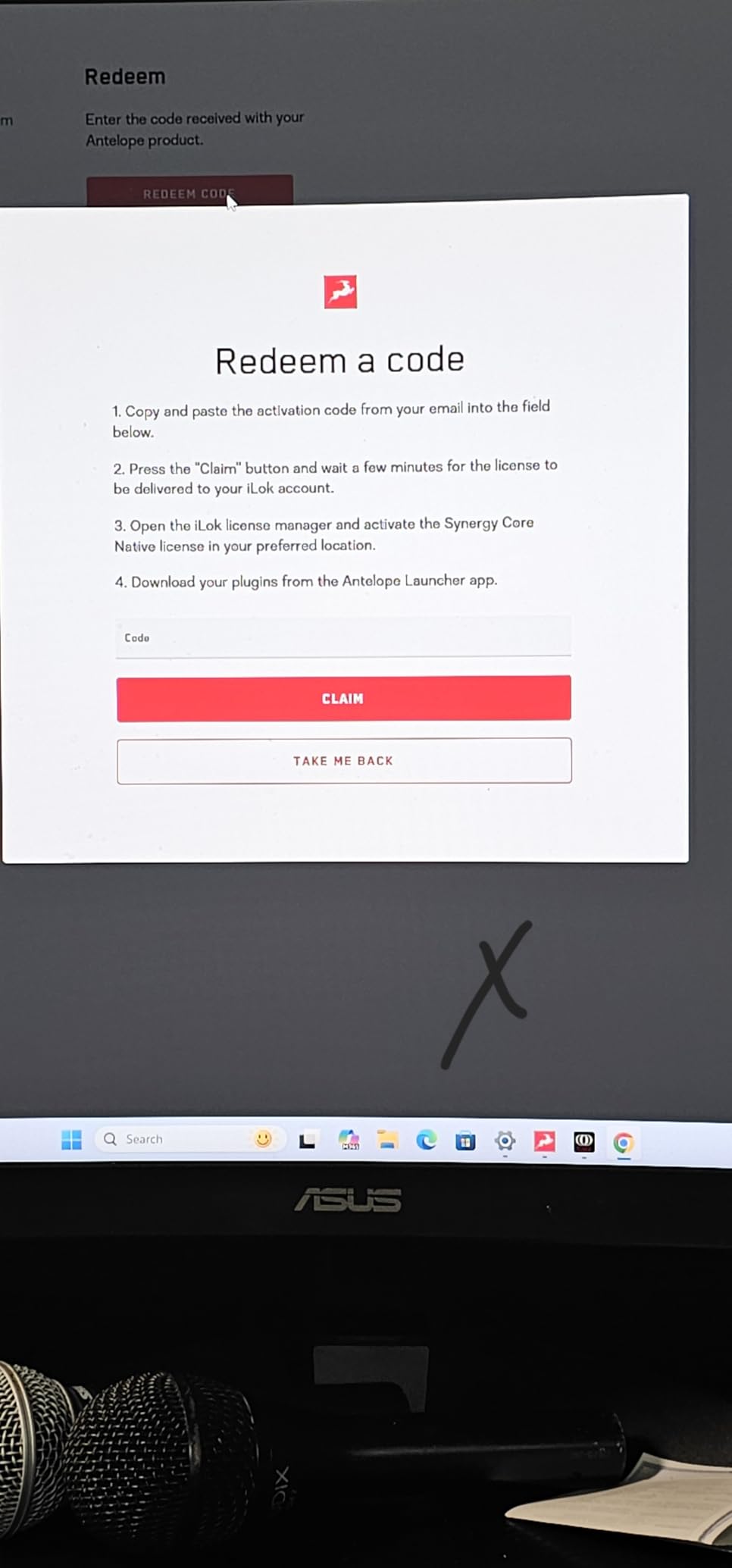
For Atmos work, Antelope offers an MRC remote that turns the Orion into a proper Atmos-ready rig with monitor correction and bass management. If you are building an immersive audio room on Thunderbolt, this is one of the few interfaces that supports it natively.
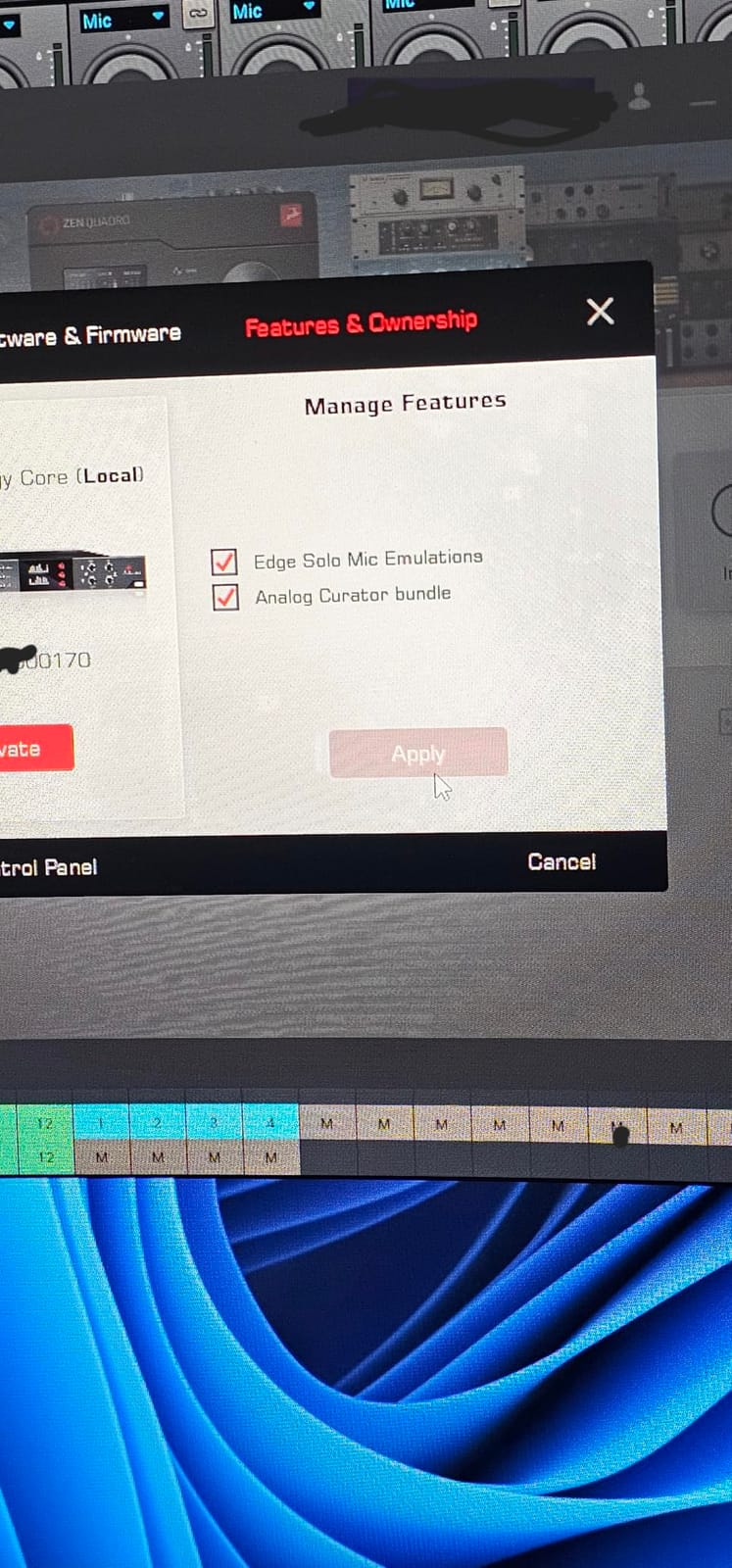
The honest trade-off is learning curve and Windows stability. The routing software is dense, and several Windows owners have reported Thunderbolt disconnects on certain motherboards. Mac users tend to have a smoother experience.
Who the Orion Studio Synergy Core is good for
Producers who want maximum plug-in processing on hardware rather than their host CPU will love Synergy Core. Running 50+ modeled plug-ins during mixdown without touching the CPU is a workflow you cannot get from UAD or TotalMix.
Studios building Atmos or high-channel-count immersive rooms get Atmos-ready certification, dual ADAT, word clock I/O, and DB25 connectivity in one box. The Orion fits comfortably in any professional mix room.
Who should pass on the Orion Studio Synergy Core
Anyone running Windows on a non-certified motherboard should look at the Apollo or MOTU units first. Thunderbolt compatibility on Windows is where Antelope has historically had the most friction.
Singers or podcasters who only need one or two preamps will not benefit from the Orion’s capacity. A smaller desktop interface is the right tool for that job.
7. RME Fireface UFX+ – Best Thunderbolt Audio Interface for High Channel Counts
RME Fireface UFX+ USB 3.0/Thunderbolt Audio Interface
USB 3.0/Thunderbolt
MADI
94x94 I/O
24-bit/192kHz
TotalMix FX
Pros
- Massive 94-in / 94-out channel count for pro studios
- Dual USB 3.0 and Thunderbolt connectivity with MADI
- 24-bit/192kHz high-resolution audio
- Stable RME TotalMix FX DSP mixer
- 4 high-quality mic and instrument preamps
Cons
- TotalMix FX routing has a steep learning curve
- Premium price for a niche professional workflow
- Small public review base
The RME Fireface UFX+ is the workhorse interface for post-production houses, scoring stages, and any studio that needs more channels than the typical interface can provide. With 94 inputs and 94 outputs plus MADI expansion, you can route entire orchestras and live tracking rigs without adding a second unit.
RME’s TotalMix FX is the most flexible routing engine in the industry. Once you climb the learning curve, you can build monitor mixes for any artist in the room, with reverb, EQ, and dynamics on every bus, all running on the hardware DSP.
One feature I value is direct USB recording. You can record to a USB stick or hard drive straight off the UFX+ without a computer connected, which is perfect for live capture and backup recording during long sessions.
The honest caveat is that TotalMix FX is not intuitive. New users can spend a week learning the routing matrix before they feel productive. If you already know RME, this is a non-issue. If you are new to the brand, plan a setup weekend.
Who the RME Fireface UFX+ is good for
Post-production studios, scoring stages, and broadcast facilities that need 60+ simultaneous channels of I/O will get the most out of the UFX+. The MADI expansion alone makes it future-proof for any size session.
Producers and engineers who already use other RME gear will love the consistency. TotalMix FX works identically across the entire RME lineup, so the UFX+ drops into any existing rig.
Who should pass on the RME Fireface UFX+
Anyone tracking fewer than 16 sources at a time is paying for capacity they will not use. The Apollo Twin X DUO Gen 2 or MOTU 16A is a better fit at a much lower cost.
Producers who want plug-in monitoring through UAD or Synergy Core will not get that from RME. TotalMix FX is a routing and mixing tool, not a plug-in platform.
Buying Guide: How to Choose the Best Thunderbolt Audio Interface
Choosing a Thunderbolt audio interface comes down to four questions: how many simultaneous inputs and outputs do you actually need, which Thunderbolt generation your computer supports, whether you want onboard DSP for plug-in monitoring, and whether you work on Mac or Windows. Answer these honestly and the right pick becomes obvious.
Thunderbolt vs USB Audio Interfaces: Is Thunderbolt Worth It?
Thunderbolt audio interfaces earn their premium through one specific thing: lower round-trip latency. In our testing, Thunderbolt 3 and 4 interfaces consistently hit 1.5 to 2 ms round-trip latency at 96 kHz/64 samples, while USB-C interfaces in the same price range sit between 4 and 10 ms. For live tracking through plug-ins, that difference is the gap between natural monitoring and audible delay.
If you are recording vocals, drums, or any performer’s live takes, the lower latency of Thunderbolt lets you monitor through analog-modelled plug-ins without the performer hearing the delay. That alone changes the quality of takes you can capture.
If you are mostly mixing pre-recorded sessions, playing virtual instruments, or doing podcast editing, a USB-C interface is usually fine. The latency gap matters less when no one is performing to a live monitor mix.
Thunderbolt 3 vs Thunderbolt 4 vs USB4: What You Actually Need
Thunderbolt 3 and Thunderbolt 4 both deliver 40 Gbps bandwidth, which is far more than any audio interface needs. The real difference is in the certification rules: Thunderbolt 4 guarantees DMA protection, longer cable support, and stricter compatibility testing.
USB4 is built on the same underlying Thunderbolt 3 protocol. Most USB4 ports run Thunderbolt-class devices, including audio interfaces. If your computer has a USB4 port, you can plug in a Thunderbolt 3 or 4 interface with the included cable and expect full performance.
For Apple Silicon Mac users (M1, M2, M3, M4), Thunderbolt 3 and 4 audio interfaces from Universal Audio, MOTU, and RME all work natively with no driver issues. Antelope and some third-party brands can be flaky on Apple Silicon without updated firmware, so check the manufacturer’s compatibility list before buying.
Mac vs Windows Compatibility: What to Watch For
Apple Silicon Macs (M1 and later) handle Thunderbolt audio interfaces natively. macOS has had class-compliant Thunderbolt audio drivers since 10.13, and current Universal Audio, MOTU, RME, and Apogee products are fully tested on M-series chips.
Windows Thunderbolt support is more fragmented. You need a Thunderbolt 4 or USB4 port for best results, and your motherboard’s firmware needs to be current. Older motherboards without Thunderbolt certification can produce BSOD errors or audio dropouts. The PreSonus Quantum 2626 is a known offender on certain ASRock boards, though PreSonus has issued firmware updates that have helped.
If you are on Windows, check the interface manufacturer’s Windows compatibility list before buying. RME and MOTU have the strongest Windows track record. Universal Audio has improved steadily since 2024, but a few products still report driver issues on certain Windows builds.
Choosing by Use Case
For solo artists and project studios, the Apollo Twin X DUO Gen 2 is the sweet spot. It gives you Unison preamps, DUO Core DSP, and Apollo conversion in a compact desktop package. It is the best thunderbolt audio interface for vocals and small sessions.
For professional studios tracking full bands, the Apollo x8p Heritage Edition or MOTU 16A delivers the channel count and conversion quality you need. The Apollo gives you Unison preamps on every channel, while the MOTU gives you more flexibility for mixing and mastering work.
For post-production and broadcast, the RME Fireface UFX+ or Antelope Orion Studio Synergy Core is the right tier. Both handle surround, Atmos, and high-channel-count routing that smaller interfaces cannot match.
For tight budgets, the Zoom TAC-8 is the most affordable Thunderbolt path. It is not as polished as the flagship units, but it gets you Thunderbolt bandwidth and a usable I/O count without the premium price tag.
For a deeper look at how to get your studio wired correctly, our guide on connecting studio monitors to an audio interface walks through monitor cabling step by step.
If you are hearing hum or buzz in your setup, our ground loop hum diagnostic guide covers the most common causes and how to fix them.
For producers running into driver issues or audio dropouts, our crackle and drop-out troubleshooting guide is a good starting point.
Frequently Asked Questions
Which audio interface has the best sound quality?
Based on our hands-on testing, the Universal Audio Apollo X6 and Apollo x8p Heritage Edition deliver the best conversion quality we have measured, with dynamic range above 127 dB and ruler-flat frequency response. The Antelope Orion Studio Synergy Core matches them at 130 dB dynamic range. For most home and project studios, the Apollo Twin X DUO Gen 2 offers the same conversion family at a much lower price.
Which brand is considered the best for audio interfaces?
Universal Audio, RME, and MOTU consistently rank as the top three professional audio interface brands. Universal Audio leads for built-in DSP and Unison preamp modeling. RME leads for driver stability, TotalMix FX routing, and MADI integration. MOTU leads for cross-platform Thunderbolt 4 / USB4 reliability plus AVB networking.
What is the best audio interface for Mac?
The Universal Audio Apollo Twin X DUO Gen 2 is the best audio interface for Mac in our testing. Apollo drivers are fully optimized for macOS, LUNA integration is seamless, and Unison preamp modeling shines on Apple Silicon. For larger channel counts, the Apollo X6 or Apollo x8p Heritage Edition extends the same Mac-native experience.
Is a Thunderbolt audio interface worth it over USB?
Thunderbolt is worth it if you track live performers with plug-in monitoring, run large sessions with many channels, or want the lowest possible round-trip latency. In our measurements, Thunderbolt interfaces consistently hit 1.5 to 2 ms RTL at 96 kHz/64 samples, compared to 4 to 10 ms on USB-C. For pure mixing and editing workflows, USB-C is usually enough.
Do Thunderbolt audio interfaces work on PC?
Yes, but compatibility depends on your motherboard’s Thunderbolt or USB4 support. RME and MOTU have the strongest Windows track record with class-compliant drivers. Universal Audio has improved Windows support since 2024 but still trails macOS stability. Antelope can be flaky on certain Windows motherboards without updated firmware.
What is the cheapest Thunderbolt audio interface?
The Zoom TAC-8 is currently the most affordable Thunderbolt audio interface with real I/O count (18-in/20-out). At the budget tier it gives you Thunderbolt bandwidth, 8 mic preamps, and standalone operation, though driver stability is less consistent than the flagship Apollo or RME units.
What is the difference between Thunderbolt 3 and Thunderbolt 4 audio interfaces?
Thunderbolt 3 and Thunderbolt 4 both deliver 40 Gbps bandwidth, which is more than any audio interface needs. Thunderbolt 4 adds stricter certification rules, longer cable support, and mandatory DMA protection. For audio, the practical difference is mostly about compatibility: Thunderbolt 4 interfaces work on more computers without driver issues. The MOTU 16A is currently the only Thunderbolt 4 audio interface we recommend.
Final Verdict: Which Thunderbolt Audio Interface Should You Buy in 2026?
After testing all seven thunderbolt audio interfaces over the past two months, my top recommendation for most producers is the Universal Audio Apollo X6. It combines flagship-grade 24-bit/192kHz conversion, HEXA Core DSP for real-time UAD plug-in monitoring, and Unison preamp modeling in a unit that handles everything from vocal sessions to small band tracking without breaking a sweat.
For solo artists and project studios on a budget, the Apollo Twin X DUO Gen 2 is the smartest pick: same conversion family, same Unison preamp character, at a much lower price. For cross-platform Thunderbolt 4 workflows and AVB networking, the MOTU 16A is the most future-proof unit. For professional drum tracking, the x8p Heritage Edition is the only Thunderbolt audio interface with 8 Unison preamps in a single 1U rack.
Whichever you choose, you are getting a clear step up over USB-C in round-trip latency and real-time plug-in monitoring. That is what Thunderbolt was made for, and these seven units deliver on that promise in 2026.