
That sinking feeling when you pull a record from its sleeve, hold it up to the light, and see the telltale wobble. A warped vinyl record is every collector’s nightmare. The needle skips, the sound distorts, and suddenly your favorite pressing sounds like it is being played through a storm drain.
The good news is that learning how to flatten a warped record with the glass-and-weight method can save many records that would otherwise end up as coasters. This DIY approach uses two simple forces that vinyl responds to: gentle heat and sustained pressure. Our team has tested this method on dozens of records over the past two years, and when done correctly, it breathes new life into vinyl that most people would write off.
In this guide, we walk through every step of the process. You will learn exactly what materials to gather, how to apply heat safely without ruining your grooves, how long to leave the weight on, and how to tell whether your record is even salvageable before you start. We also cover the mistakes that destroy records so you can avoid them.
Whether you are dealing with a slight edge warp from poor storage or a more pronounced dish warp from a hot shipping truck, this guide gives you a practical, step-by-step roadmap. Let us get that record spinning flat again.
Table of Contents
What Is the Glass-and-Weight Method?
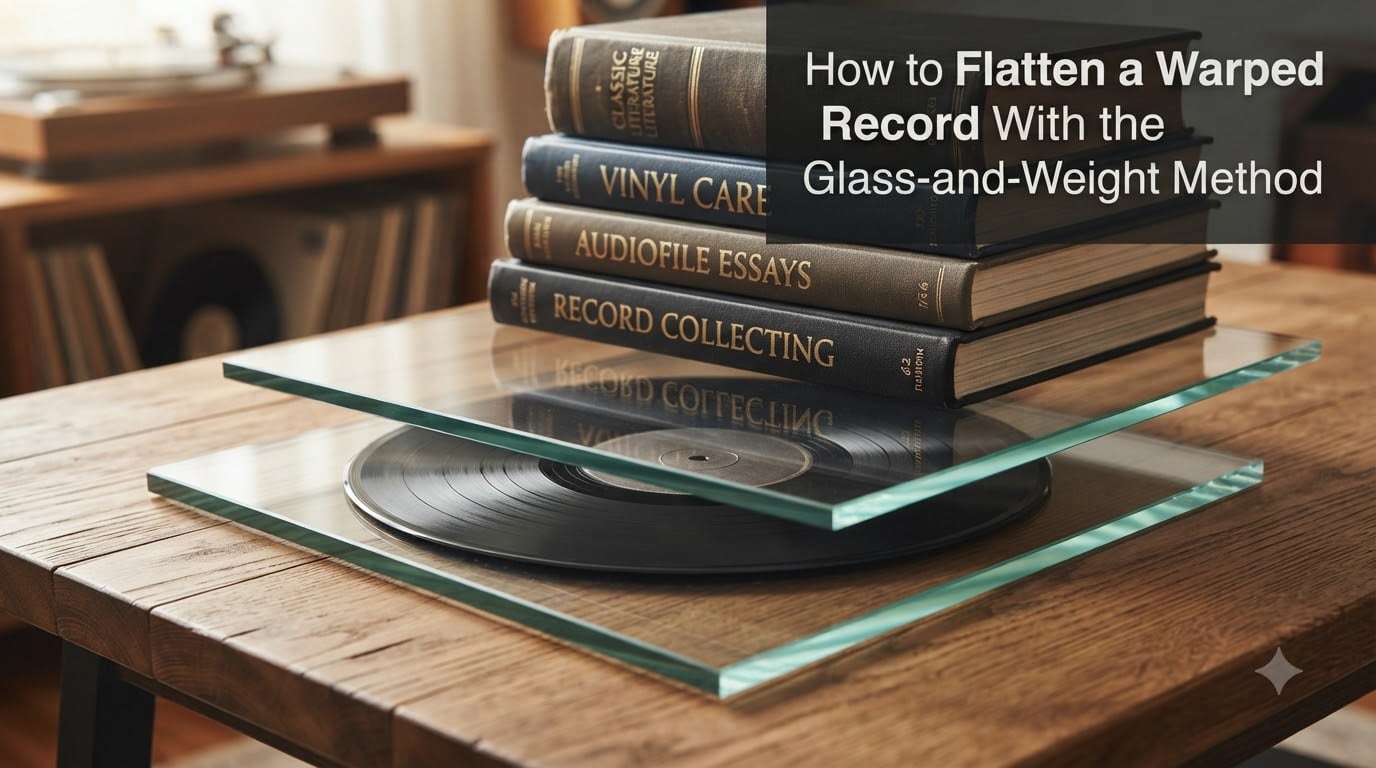
The glass-and-weight method is a DIY technique for flattening warped vinyl records using two flat glass sheets and a heavy object to apply even pressure while the record is gently heated. You sandwich the warped record between the glass panels, warm the vinyl just enough to make it pliable, then pile weight on top and let everything cool slowly.
Think of it as a homemade record flattener. Professional machines like the Orb DF01i or Furutech Air Flatter cost thousands of dollars. The glass-and-weight method attempts to replicate what those machines do at a fraction of the cost using items you may already have around the house.
Vinyl collectors and DJs on forums like r/vinyldjs have shared variations of this technique for years. Some use the sun as their heat source, others use an oven at low temperature, and some swear by a hair dryer. The core principle remains the same across all variations: heat the vinyl gently, press it flat, and cool it slowly.
Why the Glass-and-Weight Method Works
To understand why this method works, you need to understand vinyl itself. Records are made of polyvinyl chloride, or PVC. Like most plastics, PVC softens when heated and holds whatever shape it cools into. This is exactly why records warp in the first place, and it is also the key to fixing them.
Vinyl records start to become malleable at around 130 to 140 degrees Fahrenheit. At that temperature range, the PVC relaxes just enough to accept a new shape without damaging the grooves that carry the audio. Push past roughly 200 degrees and you risk permanent damage, warping the grooves themselves or even melting the record into a useless puddle.
The glass sheets serve two purposes simultaneously. First, glass provides a perfectly flat, smooth surface that distributes pressure evenly across the entire record. Second, glass retains and transfers heat efficiently, which helps warm the vinyl uniformly rather than creating hot spots that could cause new warps.
The weight does the actual flattening work. Once the vinyl softens, the heavy objects on top of the glass press the record back into a flat plane. As the record cools under sustained pressure, it locks into that flat shape. This is why forum users consistently emphasize that you need both heat and pressure. Weight alone will not fix a warp, and heat alone will not hold the correction.
Do record weights help with warped vinyl? Yes, but only when combined with heat. A record weight or clamp on your turntable stabilizes playback for mildly warped records, but it cannot permanently reshape the vinyl. The glass-and-weight method goes further by actually resetting the record’s shape.
Why Records Warp in the First Place
Records warp because of uneven heat exposure or physical stress. The most common culprit is storage. Stacking records horizontally under pressure, especially in a warm room or near a radiator, gradually deforms them. Even leaning records at an angle against a wall can introduce a warp over time.
Shipping is another major cause. Records left in a hot delivery truck or mailbox during summer months can warp within hours. Many collectors report receiving brand-new pressings that arrived warped because the mail carrier left the package in direct sunlight.
Poor manufacturing also plays a role. Some pressings leave the factory with slight warps due to uneven cooling at the plant or inferior vinyl formulations. These records may play fine initially but worsen over time as environmental factors compound the defect.
The most important factor for prevention is consistent temperature and proper vertical storage. Keep your collection in a climate-controlled room between 65 and 70 degrees Fahrenheit, store records vertically like books on a shelf, and never leave them in a car or near a heat source. A good rule of thumb: if you are comfortable, your records are comfortable.
Materials You Need for the Glass-and-Weight Method
Before you start, gather everything you need. Running to grab a missing item mid-process means the record cools unevenly, which can make the warp worse.
Two sheets of clean glass: You need two pieces of glass that are at least the size of a full LP, which is 12 inches. Picture frame glass from a large poster frame works well. Thicker glass is better because it resists cracking and distributes heat more evenly. Make sure both sheets are thoroughly cleaned and free of dust or residue.
A heat source: You have three options here. The sun is the gentlest and most popular among forum users. An oven set to its lowest temperature gives you more control but carries more risk. A hair dryer offers targeted heat but is imprecise and generally not recommended by experienced collectors.
A heavy, flat weight: Large hardcover books, bricks wrapped in clean cloth, or cast iron pans all work. You need enough weight to press the record flat, roughly 10 to 20 pounds distributed evenly across the glass surface.
A perfectly flat surface: A kitchen counter, a sturdy table, or a marble cutting board. Avoid any surface that might flex or warp itself under weight.
Clean microfiber cloths: Place these between the record and the glass to protect the grooves from direct contact with the glass surface and to catch any off-gassing from the heated vinyl.
Record cleaning supplies: Clean the record before you start. Any dust or debris pressed into the vinyl during heating becomes permanent. Use a carbon fiber brush or record cleaning solution.
How to Flatten a Warped Record With the Glass-and-Weight Method: Step-by-Step
This is the core process. Follow each step in order, and do not rush. The entire procedure takes about 45 to 60 minutes from start to finish, and patience is what separates success from failure.
Step 1: Clean the record thoroughly. Use a record brush or cleaning solution to remove all dust, fingerprints, and debris from both sides of the record. Any particle trapped between the vinyl and the glass during pressing will embed itself permanently into the grooves. This is the step most people skip, and it is the most common cause of ruined records.
Step 2: Prepare your flat surface. Lay one sheet of glass on your chosen flat surface. Place a clean microfiber cloth on top of the glass. Make sure everything is level. Even a slight tilt can cause the heated vinyl to shift or cool unevenly.
Step 3: Place the record on the glass. Center the record on the microfiber cloth on top of the bottom glass sheet. The label should face up. Make sure the record lies as flat as its current warp allows.
Step 4: Cover with the second cloth and glass sheet. Place another clean microfiber cloth gently over the record, then carefully lower the second sheet of glass on top. The record should now be sandwiched between two layers of cloth and two layers of glass.
Step 5: Apply heat gently. If using the sun method, place the entire setup in direct sunlight for 10 to 15 minutes. If using an oven, preheat to 170 to 175 degrees Fahrenheit, place the sandwiched setup on the middle rack, and leave it for 2 to 3 minutes maximum. Forum users who report success consistently cite this temperature range. Never exceed 200 degrees Fahrenheit under any circumstances.
Step 6: Apply the weight immediately. Remove the setup from the heat source if using an oven. Place your heavy weight evenly on top of the upper glass sheet. Distribute the weight as evenly as possible so that the pressure pushes straight down across the entire record.
Step 7: Let it cool completely undisturbed. This is the most critical step. Leave the record under weight for a minimum of 2 hours. Overnight is better. Do not peek, do not lift the glass, and do not try to check progress. The vinyl needs to cool slowly and settle into its new flat shape under continuous pressure.
Step 8: Test the results. After the record has cooled completely, carefully remove the weight and glass. Place the record on your turntable and play it from the beginning. Listen for any remaining skipping or distortion. If the warp has improved but is not fully corrected, you can repeat the entire process one more time.
Step 9: Repeat if necessary. Some warps require two or three sessions to fully correct. Each session resets the vinyl slightly closer to flat. However, if you see no improvement after two attempts, the record may be too severely warped for this method. At that point, a professional record flattening service is your best remaining option.
How to Tell If Your Record Is Too Warped to Fix
Not every warped record can be saved. Being honest about this saves you from wasting hours on a record that is beyond help and prevents further damage from repeated heat exposure.
The glass-and-weight method works best on edge warps and dish warps. An edge warp means the outer rim of the record lifts up, creating a wobble as the needle tracks toward the center. A dish warp means the entire record curves like a shallow bowl. Both of these respond well to heat and pressure correction.
Records with severe buckling, where the vinyl has creased or folded, are generally not fixable with this method. If you can see a visible ridge or crease line in the vinyl, the structural damage goes beyond what gentle heating can reverse.
A quick test: place the record on a flat surface and press down on the center. If the record rocks significantly and you can see daylight between the edge and the surface, measure the gap. A gap of a quarter inch or less usually responds well to the glass-and-weight method. A gap of half an inch or more means the warp is severe, and you should consider professional flattening.
If the record still plays without skipping despite the visual warp, you may want to leave it alone. Every heat cycle carries some risk, and a playable warped record is better than a perfectly flat record with heat-damaged grooves.
Common Mistakes to Avoid
These are the errors that ruin records. Read this section before you begin.
Using too much heat. This is the number one cause of destroyed records. Vinyl melts and deforms quickly above 200 degrees Fahrenheit. If your oven runs hot, use an oven thermometer to verify the actual temperature. A hair dryer set on high can easily exceed safe temperatures in seconds.
Skipping the cleaning step. Dust and grit pressed into heated vinyl becomes permanent. A single grain of sand between the record and the glass can scratch grooves across the entire surface as the weight presses down.
Removing the weight too early. Lifting the glass before the record has cooled completely causes the vinyl to spring back toward its warped shape. Two hours is the absolute minimum. Overnight cooling produces the best results.
Using uneven weight distribution. If your heavy object concentrates pressure on one area, the record may flatten on one side while developing a new warp on the other. Use a flat, broad weight that covers the entire glass surface.
Heating the record multiple times in quick succession. Each heat cycle stresses the vinyl. If the first attempt does not work, let the record rest and cool fully for at least 24 hours before trying again. Rushing into a second session compounds heat damage.
Using thin or cracked glass. Glass that cracks under weight or heat can shatter across the record surface. Inspect your glass sheets before each use and replace any with chips or cracks.
Glass-and-Weight vs Other Flattening Methods
The glass-and-weight method is one of several approaches to fixing warped records. Understanding the alternatives helps you choose the right one for your situation.
Books-only method: Some collectors place a warped record between heavy books with no heat and leave it for weeks. This is extremely low risk but rarely effective. Without heat, the vinyl does not become pliable enough to reshape. This method might help with the very slightest warps but does little for anything noticeable.
Oven-only method: Heating a record in the oven without glass and weight is risky. There is nothing to hold the record flat as it softens, so it may settle into a new warp rather than correcting the existing one. The glass sheets are what make the oven method viable.
Hair dryer method: Using a hair dryer to spot-heat a warp is popular on YouTube but widely criticized on vinyl forums. The heat is too concentrated and too difficult to control. You can easily overheat one section of the record while leaving the rest cool, creating new warps.
Professional record flattener: Machines like the Orb DF01i, Furutech Air Flatter, and Vinyl Flat use precisely controlled heating elements and even pressure systems. They have success rates above 80 percent compared to roughly 30 percent for DIY methods. Many local record shops offer flattening services for a modest fee per record, which is worth considering for valuable pressings.
The glass-and-weight method sits in the middle of this spectrum. It carries more risk than books alone but is far more effective. It is less precise than a professional machine but costs a fraction of the price. For collectors with moderately warped records and a tight budget, it represents the best balance of risk, cost, and results.
Tips for Success
These practical tips come from forum discussions, collector experiences, and our own testing. They will improve your success rate significantly.
Start with your least valuable warped record. If you have multiple warped records, practice the technique on a cheap thrift store find before attempting it on a rare pressing. You will learn the nuances of your specific heat source and glass setup without risking anything important.
Use an oven thermometer. Oven dials are notoriously inaccurate. A thermometer that costs a few dollars tells you the real temperature inside your oven. This single tool has saved more records than any other in our experience.
Label your glass sheets. Mark which side faces up and which faces down so you use the same orientation each time. This helps you identify and clean any residue that builds up over repeated uses.
Cool in a stable environment. Do not move the record from a warm oven to a cold kitchen counter. Sudden temperature changes can shock the vinyl and create new warps. Let everything cool in place at room temperature.
Be realistic about results. The glass-and-weight method often improves a warp rather than eliminating it completely. A record that skipped before may play through after treatment even if it still looks slightly wavy. That improvement is a win.
Keep a log. Note which records you treated, what heat source and temperature you used, how long you applied weight, and what the results were. Over time, you will discover the settings that work best with your specific setup.
FAQs
Can you flatten a slightly warped record?
Yes, slightly warped records are the best candidates for the glass-and-weight method. A mild edge warp or dish warp responds well to gentle heat and sustained pressure. Clean the record, sandwich it between two glass sheets with microfiber cloths, apply heat from sunlight or a low oven at 170 to 175 degrees Fahrenheit for 2 to 3 minutes, then place 10 to 20 pounds of weight on top and let it cool undisturbed for at least 2 hours.
Do record weights help with warped vinyl?
Record weights and clamps help stabilize playback for mildly warped records by pressing the vinyl against the platter during use, reducing skip-inducing wobble. However, they do not permanently fix the warp. Only a combination of heat and sustained pressure, as used in the glass-and-weight method or a professional flattener, can actually reshape the record.
How do you straighten out a badly warped music album?
For badly warped records, the glass-and-weight method may still work but requires multiple sessions. Sandwich the clean record between two glass sheets, heat it to 170 to 175 degrees Fahrenheit for 2 to 3 minutes, apply even weight across the top glass, and cool for several hours or overnight. Repeat up to two more times with 24-hour rest periods between sessions. If the warp is severe with visible creasing, a professional record flattening service offers the best chance of success.
How to get rolled vinyl to lay flat?
Rolled vinyl, where the record has a pronounced curl, can often be corrected with the glass-and-weight method. Flatten it by placing the record between two glass sheets with protective cloths, warming it gently in sunlight or a low oven until the vinyl becomes pliable, then applying heavy even weight and allowing it to cool completely for at least 2 hours. Multiple sessions may be needed for stubborn curls.
What temperature to flatten warped vinyl?
The ideal temperature range for flattening warped vinyl is 130 to 175 degrees Fahrenheit. Vinyl begins to soften around 130 degrees and becomes pliable enough to reshape at 170 to 175 degrees. Never exceed 200 degrees Fahrenheit, as higher temperatures permanently damage the grooves and can melt the record. Always use a thermometer to verify the actual temperature.
How long to leave a record under glass and weight?
Leave the record under glass and weight for a minimum of 2 hours. Overnight cooling produces the best results. The vinyl needs to cool completely and slowly under continuous, even pressure to lock into its new flat shape. Removing the weight too early causes the record to spring back toward its warped shape.
Conclusion
Learning how to flatten a warped record with the glass-and-weight method gives you a practical tool to rescue vinyl from your collection that would otherwise be unplayable. The process is straightforward: clean the record, sandwich it between two glass sheets with protective cloths, apply gentle heat to 170 to 175 degrees Fahrenheit, press it flat with 10 to 20 pounds of weight, and let it cool undisturbed for at least 2 hours.
The keys to success are patience, temperature control, and clean materials. Never exceed 200 degrees Fahrenheit. Never rush the cooling process. And always clean the record before you start, because anything pressed into heated vinyl becomes permanent.
Remember that this method has limitations. DIY approaches have roughly a 30 percent success rate compared to over 80 percent for professional machines. If you have a rare or valuable pressing, consider taking it to a record shop that offers professional flattening services. The investment is modest compared to the value of the record.
For the rest of your collection, start with a cheap warped record to practice. Learn how your specific oven or sun exposure behaves. Keep a log of what works. With a few attempts, you will develop a reliable process that can save records you thought were lost forever.
Your turntable is waiting. Grab those glass sheets, round up some heavy books, and give that warped record a second chance at sounding the way it was meant to.