
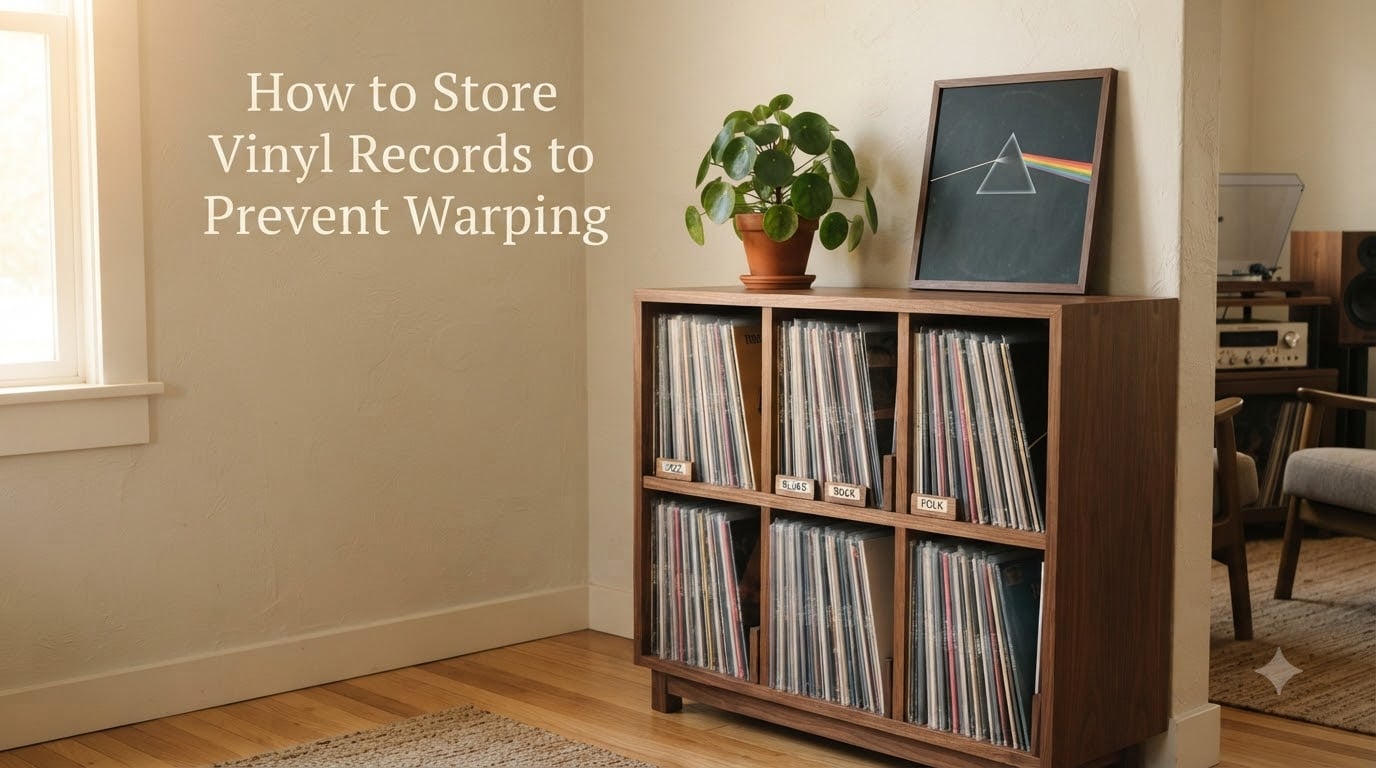
If you’ve invested in a vinyl collection, you already know the sound is unmatched. Nothing plays music quite like a well-kept record spinning on a good turntable. But here’s the thing: that beautiful sound depends entirely on how you store your records. I learned this the hard way when I pulled out a favorite album one summer afternoon and found it gently curved like a taco. After that, I went deep on how to store vinyl records to prevent warping, and now I’m sharing what actually works.
The short answer is this: store records upright (never flat), keep the room between 65 and 70°F (18-21°C), and control humidity around 45 to 50 percent. Skip the garage, attic, and basement. Use inner and outer sleeves. Keep records snug but not packed tight. That core formula covers about 90% of warping problems. The rest of this guide breaks down exactly why each step matters and how to set up your collection for the long haul.
Table of Contents
Why Vinyl Records Warp: The Science Behind the Damage
Vinyl records are made from polyvinyl chloride (PVC), a thermoplastic that softens under heat. The material starts to lose its rigidity around 140°F and reaches its melting point somewhere between 160 and 212°F. Your home probably never gets that hot, but your car on a summer day absolutely can. Heat-soaked dashboards regularly hit 150°F, which is why so many collectors report warping after leaving records in the vehicle.
Pressure is the second cause. When you stack records flat for months, the weight of everything on top creates uneven stress. Even a few leaning records can create a slow curve over time. The third factor is humidity. PVC absorbs moisture from the air, and that moisture changes how the disc holds its shape. High humidity also invites mold and mildew on the jacket and inner sleeve, which can permanently stain the vinyl.
Records warp because their physical structure is being changed by external forces. Heat softens the disc. Pressure bends it. Humidity warps the supporting materials around it. Fix any one of these and you eliminate most warping risk. Fix all three and your collection stays flat for decades.
Store Records Vertically (Never Flat or Leaning)
Always store vinyl records upright, like books on a shelf. The standard 12-inch LP was designed to sit vertically, and that’s how it maintains its shape. Flat stacking puts constant pressure on the bottom records and creates that gentle bowing you see in neglected collections.
The density matters as much as the orientation. Records should be snug enough that they don’t lean or fall over, but loose enough that you can pull one out without tugging the whole row. Think of it as “snug but not tight.” If you have to wrestle a record free, the shelf is too packed. If records shift around when you pull one, the shelf is too empty.
A partially filled shelf is one of the most common problems I see. Records lean, the lean creates pressure on one side, and over months you get a banana-shaped curve. Solve this with bookends on each row of records, or use a record-sized divider that holds the last record upright. The IKEA Kallax is the gold standard here because its 13-inch-deep cubbies fit LPs perfectly without wasted space.
Keep Temperature Between 65-70°F (18-21°C)
The ideal temperature range for storing vinyl records is between 65 and 70°F, which is 18 to 21°C. This is close to normal room temperature, which is exactly the point. Anything above 80°F starts to introduce risk, and anything above 100°F accelerates damage noticeably.
Direct sunlight is the enemy. UV rays heat the surface of a record unevenly, and that uneven heating is what causes the classic taco or cupped shape. Keep records away from windows, sliding glass doors, and rooms with skylights. If your listening room has a sunny wall, store records on the opposite side or inside a closed cabinet.
Heat sources matter too. Keep records away from radiators, heating vents, fireplaces, and electronics that run warm. A turntable sitting on top of an amplifier generates heat. Records stored right next to that stack feel it. Leave at least a few inches of clearance between records and any heat-producing equipment.
Control Humidity at 45-50% Relative Humidity
Vinyl records do best at 45 to 50 percent relative humidity. This is the same range recommended for wooden instruments and fine books, and for the same reason: it stabilizes organic and semi-organic materials without drying them out or saturating them.
Below 30 percent humidity, the cardboard jacket and inner sleeve lose moisture and can become brittle. Paper dust and jacket fragments then settle into the grooves. Above 60 percent humidity, you invite mold, mildew, and paper warping. The record itself can take slightly higher humidity than the jacket, but you should plan for the materials around it.
If you live in a humid climate, run a dehumidifier in the room where you store records. A small unit that holds 30 to 50 pints per day costs around $150 and protects more than just your collection. In dry climates, a humidifier in winter helps. For sealed storage boxes, silica gel packets absorb excess moisture and last for months before needing to be recharged. Climate-controlled storage beats any single device, though, because it handles both temperature and humidity at once.
Places to Never Store Vinyl Records
Some storage spots are so risky they deserve their own list. Avoid these entirely for any record you care about.
- Garage: Uninsulated garages swing from freezing to over 100°F depending on the season. Cars in the garage also leak fumes that deposit on vinyl.
- Attic: Heat rises, and attics can reach 130°F or more in summer. Attics are the single most common place to find destroyed collections.
- Basement: Dampness, flooding risk, and poor air circulation make basements mold factories. Records absorb basement moisture and develop mildew within months.
- Car: Interior temperatures in parked cars regularly exceed 140°F. Even a few hours in summer can permanently warp a record.
- Windowsills: Direct sun and heat through glass creates extreme surface temperatures that cup records fast.
If your only option is one of these spots, climate-controlled storage is the workaround. Companies like PODS offer portable containers with climate control, and self-storage facilities with climate control run about $50 to $150 per month for a small unit. Either option beats a free garage.
Use the Right Protective Sleeves
Every record should live in two sleeves: an inner sleeve touching the vinyl and an outer sleeve protecting the jacket. Most new records ship with a paper or poly inner sleeve and a paperboard outer jacket. Both can be improved.
The best inner sleeves are made from polyethylene (PE) or polypropylene (PP). Both are anti-static, chemically stable, and won’t scratch the vinyl. Look for sleeves marketed as “rice paper” or “archival quality.” Avoid PVC inner sleeves. PVC can react with the record’s PVC surface and cause a chemical bonding that ruins the disc over time.
Outer sleeves come in three main types. Polyethylene (PE) outer sleeves are affordable, clear, and protect against dust and minor scratches. Polypropylene (PP) is stiffer and clearer, with better archival properties. PVC outer sleeves are the cheapest option but introduce the same chemical risk as PVC inner sleeves. Skip PVC entirely.
Replace paper inner sleeves as soon as you can. The cheap paper sleeves that come with most new records shed fibers into the grooves and scratch the surface over time. A pack of 50 high-quality rice paper inner sleeves costs around $20 and protects your collection for years. Outer sleeves are even cheaper per unit and last indefinitely.
Best Storage Furniture and Solutions
The right furniture makes everything else easier. A good record shelf keeps records vertical, supports them snugly, and fits standard LP dimensions without wasted space.
The IKEA Kallax is the collector favorite for good reason. Its 13-inch-wide, 13-inch-deep cubbies hold LPs upright with no lean. The 4-cube and 8-cube configurations work for small to medium collections. For larger collections, the IKEA Expedit (now discontinued but still available used) is similar. Each bin holds roughly 60 to 70 records, so you can plan your storage based on collection size.
For budget storage, milk crates work surprisingly well. They hold about 40 to 50 LPs each, cost under $10 each, and stack vertically if you have floor space. The downside is looks. They aren’t exactly living room furniture. Vintage vinyl shops often use them, and professional collectors use them too, because the ventilation is actually better than closed cabinets.
For collection sizes, here’s a rough guide. Under 100 records: a single Kallax cube or two milk crates. 100 to 300 records: a 4-cube Kallax. 300 to 600 records: an 8-cube Kallax or two 4-cubes. 600+ records: dedicated shelving or a custom build. Whatever you choose, make sure the shelf is sturdy enough to handle the weight. Vinyl is heavy, about 0.5 pounds per record, so a 600-record shelf is holding 300 pounds of vinyl.
How to Spot Early Signs of Warping
Records rarely warp overnight. The damage accumulates slowly, which means you can catch it early if you know what to look for. Inspect your collection every few months, especially the records you play most often and any stored near windows or heat sources.
Hold the record at eye level with one hand on the center label and the other on the outer edge. Look at the silhouette against a flat background. A flat record shows a clean line. A warped record shows a curve, cup, or twist. Place the record on a flat surface like a glass table. Press lightly on the edge. If it rocks, it’s warped.
Play-test the record. Light warping causes subtle pitch shifts and brightness changes. Heavier warping causes the needle to skip or bounce. Severe warping prevents playback entirely. If you notice any of these, isolate the record from your collection. One warped record can slowly pressure its neighbors if they are stored tightly together.
The severity matters for what to do next. Slight warping (under 1mm of deviation) is often fixable at home. Moderate warping (1 to 3mm) is sometimes fixable but risky. Severe warping (over 3mm) usually means professional restoration or a replacement.
Quick Fixes for Slightly Warped Records
If you catch a warped record early, you have a few options. The glass sandwich method is the gentlest. Place the record between two clean sheets of glass, add roughly 10 to 15 pounds of weight on top, and leave it in a warm room (around 80°F) for 24 to 48 hours. The gentle, even pressure slowly flattens the disc.
The low-heat oven method works for stubborn warps but carries risk. Preheat the oven to its lowest setting (usually 150 to 170°F). Place the record on a flat baking sheet. Heat for 30 seconds to 2 minutes. The heat softens the PVC just enough to release the memory of the warp. Pull it out, place it between two pieces of glass, and let it cool slowly for several hours. Note that this method can damage the record if you overheat it. The melting point of PVC is 160°F, so you are working right at the edge of safety.
Commercial flattening devices are the third option. These clamp the record between two heated glass plates and apply pressure for a controlled cycle. The VPI Record Flattener and similar devices cost about $300 to $500 and recover many records that other methods cannot. For collectors with hundreds of records, this is a worthwhile investment.
When a record is severely warped, has visible damage, or has sentimental value you cannot replace, take it to a professional restoration service. They have industrial-grade equipment and can sometimes achieve results that home methods cannot match. Cost is typically $20 to $50 per record, depending on severity.
Common Vinyl Record Storage Mistakes to Avoid
After talking to dozens of collectors and reading forum threads, the same mistakes come up again and again. Here are the biggest ones to dodge.
Stacking records flat. Even a few records stacked on a table will deform over time. Always store upright.
Storing records in the garage or attic. These are the two worst places in most homes. The temperature swings are extreme and warping is almost guaranteed.
Leaving records in the car. Car interiors reach 150°F on a hot day. Even a short trip can damage a record.
Using PVC inner sleeves. Cheap PVC sleeves can chemically bond with the record over time. Use PE or PP rice paper instead.
Skipping outer sleeves. Outer sleeves protect the jacket from ring wear, dust, and moisture. They cost pennies and add years of life.
Cramming records too tightly. Packed-tight records stress the sleeves and can deform the vinyl. Snug but not tight is the rule.
Letting records lean in empty shelves. The lean creates uneven pressure and slowly warps the disc. Use bookends or dividers.
Storing records near windows. UV light and heat through glass curl records fast. Keep records on interior walls.
Forgetting to clean before storage. Dust and oils on the record surface attract moisture and contaminants. Wipe records with a microfiber cloth or carbon fiber brush before putting them away.
Assuming “out of sight” equals “safe.” Closets, under-bed storage, and other hidden spots can have poor air circulation and temperature issues. If you cannot see them, you cannot monitor them.
Frequently Asked Questions
Is it better to store vinyl records flat or upright?
Always store vinyl records upright, like books on a shelf. Flat stacking puts pressure on the bottom records and causes warping over time. Records are designed to sit vertically, and this position maintains their shape. Keep them snug enough to stand on their own but loose enough to pull one out without tugging the rest of the row.
Is it okay to store vinyl records in a garage?
No, an uninsulated garage is one of the worst places to store vinyl records. Garages swing from freezing to over 100°F depending on the season, and most lack humidity control. Records stored in garages warp within months. If you must use a garage, get a climate-controlled storage unit or a portable container with climate control.
What is the best container to store vinyl records in?
The best container for vinyl records is a sturdy shelf with cubbies that fit LPs vertically, like the IKEA Kallax. Each 13-inch cube holds roughly 60 to 70 records upright. For sealed storage, use double-walled cardboard boxes with lids. Make sure any container keeps records vertical, allows some air circulation, and is stored in a climate-controlled room.
What temperature should vinyl records be stored at?
Vinyl records should be stored at 65 to 70°F (18 to 21°C). Anything above 80°F introduces risk, and above 100°F accelerates warping noticeably. Direct sunlight and heat sources like radiators or amplifiers can push local temperatures much higher than the room average. Keep records on interior walls away from windows and heat-producing equipment.
What are common vinyl record storage mistakes?
The most common mistakes include stacking records flat, storing them in garages or attics, leaving records in hot cars, using PVC inner sleeves, skipping outer sleeves, packing records too tightly, letting records lean in partially-filled shelves, and storing near windows. Any of these can cause warping or damage over time, but they are all easy to fix once you know what to watch for.
Final Thoughts on Long-Term Vinyl Storage
Storing vinyl records so they don’t warp comes down to three habits: keep them vertical, keep them cool, and keep them dry. Add inner and outer sleeves, and your collection is set for decades. The whole setup costs less than a single replacement record, and it protects whatever you already own.
I’ve personally torn apart and rebuilt my own storage three times over the years. Each time I apply these same principles, and each time my records hold their shape. Whether you have 50 records or 5,000, the rules are the same. The investment in proper storage is one of the best things you can do for your collection. Your records will outlive the trends that made them popular, and the sound will be there when you come back to them. Treat them well, and they’ll return the favor every time you drop the needle.