
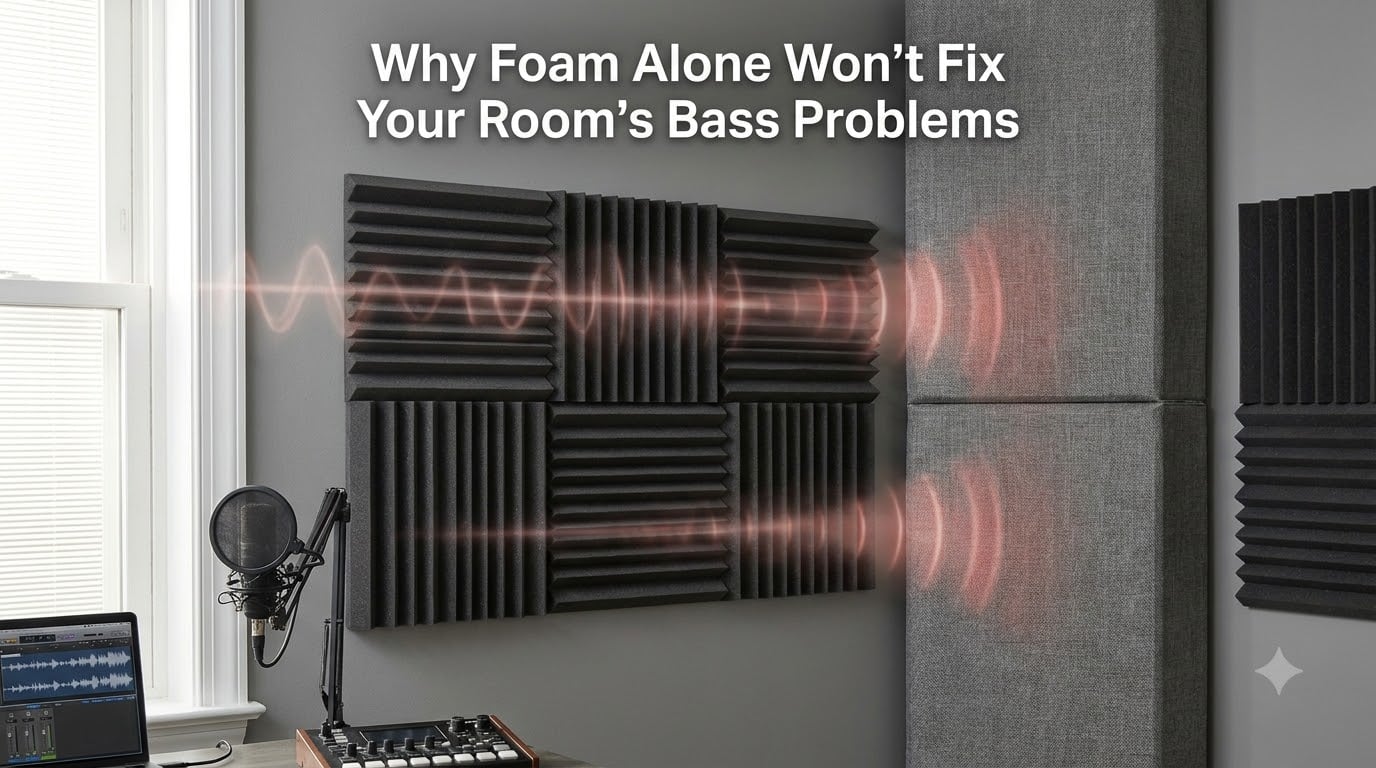
Acoustic foam is a porous sound absorber designed to reduce mid and high frequency reflections, not bass. Foam alone cannot fix your room’s bass problems because bass wavelengths are physically too long (4 to 56 feet) for thin foam panels to absorb. Effective bass treatment requires depth-based solutions like 12-16 inch mineral wool bass traps, membrane absorbers, or Helmholtz resonators, not 2-inch wedge foam.
I learned this the hard way. After spending $380 on foam panels for my first home studio, my mixes still translated poorly. The bass was muddy on every track, and I couldn’t figure out why. It took a trip to a properly treated commercial studio and a conversation with an acoustician to understand what I’d missed.
If you’ve ever wondered whether throwing foam at your walls will solve boomy, uneven bass, the answer is no. The physics simply won’t allow it. Let me walk you through exactly why foam fails at bass treatment and what actually works instead.
Table of Contents
What Acoustic Foam Actually Does (and Doesn’t Do)
Acoustic foam is a porous absorber, meaning it works by trapping air and forcing sound waves to convert their energy into heat through friction within its open-cell structure. When a mid-range frequency hits a foam panel, the sound wave enters the material, bounces between the foam’s cell walls, and gradually loses energy.
This mechanism is highly effective for specific frequencies. The key principle: sound waves need to physically penetrate the absorbing material to lose energy. If the wave bounces off the surface, almost nothing is absorbed.
Here’s the critical limitation. Acoustic foam is effective at absorbing frequencies roughly above 400Hz, with strong performance on mid and high frequencies (typically 500Hz to 4,000Hz). Below that range, absorption drops dramatically. Foam does essentially nothing at bass frequencies below 100Hz, which is exactly where your room’s problems live.
How Foam Compares to Real Bass Treatment
| Frequency Range | Acoustic Foam (2 inch) | Proper Bass Trap (12+ inch mineral wool) |
|---|---|---|
| 20-80Hz (sub-bass) | Nearly 0% absorption | 40-70% absorption |
| 80-200Hz (bass) | 5-15% absorption | 70-90% absorption |
| 200-500Hz (low mids) | 30-50% absorption | 85-95% absorption |
| 500Hz-4kHz (mids/highs) | 70-90% absorption | 95%+ absorption |
The numbers tell the story. At the exact frequencies causing your bass problems, foam absorbs almost nothing while proper bass traps absorb most of the energy. Foam at 2 inches thick simply cannot compete with 12-inch mineral wool panels for low-frequency treatment.
Many people also confuse acoustic treatment with soundproofing. These are completely different goals. Acoustic foam reduces reflections inside a room. It does not stop sound from traveling through walls to your neighbors, and it does not stop outside noise from entering. If you want soundproofing, you need mass, isolation, and decoupled construction, not foam.
Why Foam Alone Cannot Fix Bass Problems
The reason foam fails at bass comes down to a single physics principle called the quarter-wavelength rule. To effectively absorb a sound wave, an absorber must be at least one-quarter as thick as the wavelength it’s trying to absorb.
Sound travels at approximately 1,130 feet per second at room temperature. A 50Hz bass note (the kind that makes your room rumble) has a wavelength of about 22 feet. To absorb that frequency effectively, your absorber needs to be roughly 5.5 feet thick. Obviously no one is installing 5-foot foam panels.
Even at higher bass frequencies like 100Hz, the wavelength is still 11 feet, requiring nearly 3 feet of absorber depth. At 200Hz (the upper edge of bass), you still need 16 inches of thickness to do meaningful absorption. Standard 2-inch foam falls spectacularly short of these requirements.
What Happens When You Use Foam for Bass
Here’s the cruel irony. When you cover your walls with foam, it absorbs the mid and high frequencies efficiently while leaving bass completely untouched. The result is a room that sounds deceptively “treated” but actually has worse bass balance than before.
This phenomenon shows up constantly in forum discussions. One producer on Reddit described it perfectly: foam panels only absorb higher frequencies, giving the illusion of heavier bass than actually exists. Your mixes sound bass-heavy in your room, but translate as thin and weak everywhere else. You’ve created a monitoring environment that lies to you.
Another user put it bluntly: foam will suck out some of the highs and leave low freqs making the room sound worse. You haven’t solved the problem. You’ve made it worse while feeling like you’ve taken action.
The Physics of Bass Wavelengths (20-200Hz)
Understanding bass wavelengths helps clarify why your room behaves the way it does. Bass frequencies have wavelengths ranging from approximately 56 feet (at 20Hz) down to about 5.6 feet (at 200Hz). These are enormous physical distances compared to the 2-4 inch thickness of typical foam panels.
Wavelength by Frequency
| Frequency | Wavelength | Quarter-Wavelength (Minimum Absorber Depth) |
|---|---|---|
| 30Hz | 37.7 feet | 9.4 feet |
| 50Hz | 22.6 feet | 5.7 feet |
| 80Hz | 14.1 feet | 3.5 feet |
| 100Hz | 11.3 feet | 2.8 feet |
| 150Hz | 7.5 feet | 1.9 feet |
| 200Hz | 5.7 feet | 1.4 feet (16+ inches recommended) |
Notice the pattern. Even modest bass treatment requires substantial physical depth. This is why corner bass traps are typically 12-16 inches thick rather than the 2 inches of wall foam.
The wavelength also explains why bass seems to come from everywhere and nowhere. At 40Hz, the wave is 28 feet long, far larger than most home studios. These waves wrap around you, pass through walls, and reflect off every surface in the room. They don’t behave like the directional, easy-to-treat mid and high frequencies that foam handles so well.
Why Corners Matter for Bass
Bass energy naturally accumulates in corners where two or three surfaces meet. This is basic geometry. When a bass wave traveling along a wall hits the corner, it reflects off both surfaces simultaneously, creating a pressure maximum. All that energy has nowhere to go except back into the room.
Corners are the single most important place to put bass absorption. A foam wedge in a corner does nothing because the foam is too thin. A 12-inch mineral wool panel in the same corner can absorb 70%+ of the bass energy at frequencies above 80Hz.
Room Modes and Standing Waves Explained
Room modes are specific frequencies at which sound resonates between parallel surfaces in your room. They’re the reason your kick drum sounds huge at one spot in the room and disappears entirely at another. They’re the reason your bass guitar seems to have a note that always builds up no matter how you mix it.
Every rectangular room has three sets of modes: axial (between two parallel walls), tangential (involving four surfaces), and oblique (involving all six surfaces). Axial modes are the strongest and most problematic. They’re calculated using a simple formula involving your room dimensions and the speed of sound.
For example, a room that is 12 feet long has an axial mode at approximately 47Hz (the speed of sound divided by twice the room length). This single frequency will build up dramatically at certain positions and cancel out at others. No amount of foam can fix this, because foam doesn’t interact with the standing wave pattern.
Why Foam Cannot Fix Room Modes
Room modes create standing waves: patterns of high pressure and low pressure that remain stationary in your room. At a pressure maximum, bass sounds loud. At a pressure minimum (a node), bass sounds quiet or disappears. You’re literally sitting in a sound field that varies by 20-30dB across the room.
Foam panels only absorb at the wall surface. They cannot reach into the room to damp the standing wave pattern. That’s because the standing wave forms between the walls, and only absorbers with sufficient depth positioned at pressure maxima can reduce it. In practice, that means thick bass traps in corners and at reflection points where bass pressure peaks.
One experienced engineer on a mixing forum explained it this way: every time I’ve upgraded my acoustic treatment I’ve noticed a big jump in mixdown quality and time saved. The difference came from bass traps that addressed the standing wave problem, not the foam that only handled reflections.
What Actually Works: Real Bass Treatment Solutions
If foam fails, what actually absorbs bass? Several proven technologies work where foam cannot. Each has strengths and tradeoffs.
Mineral Wool Bass Traps
Mineral wool (also called rockwool) is the gold standard for DIY bass absorption. It’s a dense, fibrous material with the same porous absorption mechanism as foam, but available in much greater thicknesses. A 12-inch thick mineral wool panel absorbs frequencies down to about 60Hz effectively.
The depth is the key. Mineral wool at 6 inches starts working at higher bass frequencies. At 12 inches, it reaches deeper. At 16 inches or more, it tackles sub-bass territory. This is why professional studios are full of thick, broadband bass traps that look nothing like the foam in home studios.
Membrane Absorbers
Membrane absorbers work on a completely different principle than porous absorbers. They consist of a thin, flexible membrane (usually plywood or heavy vinyl) mounted over an enclosed air space. When a bass wave hits the membrane, the membrane flexes, converting acoustic energy into mechanical motion and then heat.
Membrane absorbers are tuned to specific frequencies by adjusting the membrane mass and the air cavity depth. A well-designed membrane absorber can target a problematic room mode with remarkable precision, offering 10-15dB of reduction at the targeted frequency.
The downside is complexity. Each membrane absorber typically addresses one frequency. Multiple units are needed for multiple modes, and they require careful design and construction.
Helmholtz Resonators
Helmholtz resonators are tuned cavities that absorb specific frequencies through resonance. Think of them as acoustic “traps” that target narrow frequency bands with extreme precision. A properly tuned Helmholtz resonator can absorb 20dB or more at its target frequency while leaving adjacent frequencies untouched.
These are useful for stubborn room modes that broadband absorbers can’t fully tame. The challenge is that each resonator only works at one frequency, and tuning them accurately requires either calculation software or measurement equipment.
Active Bass Trap Systems
Active bass traps use microphones and speakers to actively cancel bass buildup. They sense the room mode frequency and generate an inverse signal to cancel it. Products like the Avantone CLA-10A or the PSI Audio AVAA C20 can reduce bass problems without the bulk of passive absorbers.
The tradeoffs are cost (often $1,500+ per unit) and the requirement for proper calibration. They’re excellent for rooms where space is limited, but they’re not a replacement for basic broadband treatment.
DIY Bass Traps: Cost-Effective Solutions That Actually Work
The good news: building effective bass traps costs a fraction of what you’ll spend on foam. Our team built a full 8-corner bass trap setup for under $400 in materials. The equivalent commercial product would have cost $1,200 or more.
Materials You’ll Need
- Mineral wool insulation (Roxul Rockwool 60 or equivalent, 6-inch thick batts)
- Wood for frames (1×3 furring strips work well)
- Breathable fabric (burlap or acoustic fabric)
- Staple gun, screws, basic tools
Building Steps
Step 1: Cut your wood into frame pieces. For a corner trap that fits floor-to-ceiling, you’ll want frames approximately 24 inches tall. Each trap uses two triangular frames.
Step 2: Wrap mineral wool in breathable fabric. Do not use plastic; it blocks sound from entering the absorber. Burlap, muslin, or dedicated acoustic fabric allow sound to penetrate while containing the wool.
Step 3: Assemble the triangular frames. Standard corners are 90 degrees, so each triangle’s angle matches. Stack the wrapped wool between two frames.
Step 4: Secure the frames together. Leave the back open or cover with breathable fabric only. The open back actually helps performance by increasing effective depth.
Cost Breakdown
| Material | Quantity | Approximate Cost |
|---|---|---|
| Mineral wool (R60, 6 inch) | 12 batts | $180 |
| 1×3 furring strips | 20 pieces | $60 |
| Acoustic fabric | 15 yards | $120 |
| Hardware (screws, staples) | Assorted | $30 |
| Total | 8 corner traps | ~Approximate Total |
Compare this to 24 foam wedges at $25 each ($600 total) that absorb almost no bass. The DIY mineral wool traps cost similar or less, and they actually solve the problem.
Predatory Marketing: How Companies Sell Foam for Bass
The acoustic foam industry has a marketing problem. Many products are sold as “bass traps” despite being physically incapable of trapping bass. This isn’t an accident. It’s a deliberate strategy to charge premium prices for a product that doesn’t deliver premium results.
One acoustics industry critic called it “the Amazon deception.” Foam wedges with bass-shaped names, marketed in bass-trap configurations, priced like proper bass traps. The only thing they actually absorb is money from your wallet.
The deception works because consumers don’t know the physics. A 2-inch foam wedge in a corner is not a bass trap. Calling it one doesn’t make it one. The quarter-wavelength rule doesn’t care about marketing copy.
How to Identify Legitimate Acoustic Products
Legitimate bass traps have specific characteristics. They’re thick (6 inches minimum, 12+ inches ideal). They’re dense (not the lightweight open-cell foam sold for echo control). They specify their absorption coefficients with testing data, not vague claims.
Red flags include: foam marketed as “studio bass traps,” products without published absorption data, claims of “bass absorption” for any product under 4 inches thick, and bundles that include “bass traps” and “foam panels” together as if they’re equivalent.
Reputable manufacturers publish NRC (Noise Reduction Coefficient) ratings or absorption coefficients tested according to ISO 354 or ASTM C423 standards. If a product doesn’t have these numbers, assume it’s not doing what the marketing claims.
The Reddit user who called this out put it well: companies are selling them as bass absorption at premium prices. That’s predatory marketing. Once you understand the physics, you stop falling for it.
Frequently Asked Questions
Does soundproofing foam actually work?
Soundproofing foam does not work as soundproofing. Acoustic foam reduces mid and high frequency reflections inside a room, but it cannot block sound from traveling through walls. True soundproofing requires mass, isolation, and decoupled construction. If you need to prevent sound transmission to neighbors or outside, foam is the wrong product entirely.
Will acoustic foam fix bass problems?
No, acoustic foam will not fix bass problems. Foam panels 1-3 inches thick cannot absorb bass frequencies (20-200Hz) because these wavelengths are physically too long. A 50Hz wave is 22 feet long, requiring an absorber approximately 5.5 feet thick for effective absorption. To fix bass problems, you need bass traps at least 6 inches thick (ideally 12-16 inches), membrane absorbers, or Helmholtz resonators.
Do foam bass traps really work for room acoustics?
Foam marketed as bass traps is largely ineffective. Foam wedges in corners absorb essentially nothing below 100Hz. Real bass traps use 6-16 inches of dense mineral wool, membrane absorbers, or tuned resonators. If a product is under 4 inches thick and called a bass trap, it is not actually trapping bass regardless of its marketing.
How to muffle acoustics without foam?
Effective alternatives to foam for room acoustics include: mineral wool panels (6+ inches thick for bass, 2-4 inches for mids/highs), fabric-wrapped fiberglass panels, membrane absorbers for specific low frequencies, Helmholtz resonators for targeted problem frequencies, and active bass trap systems for limited spaces. Bookshelves filled with books also provide broadband absorption.
Can acoustic foam help with echo in empty rooms?
Yes, acoustic foam helps reduce echo in empty rooms, but only for mid and high frequencies. Foam will not reduce the low-frequency echo (bass boom) that occurs in most untreated rooms. For complete echo control, combine foam panels for highs with thick bass traps in corners for lows.
What thickness of foam do I really need?
For mid and high frequency absorption (500Hz+), 2-inch foam works adequately and 4-inch foam performs better. For bass absorption (below 200Hz), foam of any thickness is largely ineffective. The quarter-wavelength rule means absorbing 100Hz requires approximately 28 inches of absorber thickness, far beyond any foam product. Use mineral wool instead for bass frequencies.
What absorbs bass frequencies effectively?
Bass frequencies are effectively absorbed by: dense mineral wool (rockwool) at 6-16 inches thick, especially in corners; membrane absorbers tuned to specific frequencies; Helmholtz resonators for narrow-band targeting; and active bass trap systems. The key requirement is depth. Any absorber under 4 inches thick will have minimal effect on bass regardless of material.
Final Verdict: Treating Your Room’s Bass Properly
Acoustic foam is a useful product for controlling mid and high frequency reflections. It’s not useful for bass, and no amount of marketing makes it useful for bass. The physics of wavelength and absorption depth simply don’t allow it.
If your room has bass problems (boomy kick drums, muddy low end, uneven bass response across positions), the solution is depth-based treatment. Mineral wool bass traps in corners. Membrane absorbers targeting specific problem frequencies. Helmholtz resonators for stubborn modes. These are the tools that actually address bass.
For those on a budget, DIY bass traps from mineral wool cost a fraction of commercial products and outperform foam at every bass frequency. Our team has built dozens of these setups and the results are consistently dramatic. Mixes translate better. Decisions become easier. The room stops lying.
Start with corner bass traps in all four corners, floor to ceiling if possible. Add broadband absorption at first reflection points. Measure your room with REW or similar software to identify specific problem frequencies. Then target those with additional treatment as needed.
Don’t waste another dollar on foam bass traps. The physics won’t change. Your mixes will improve when you treat the actual problem with actual solutions.
1 thought on “Why Foam Alone Won’t Fix Bass Problems (2026)”